

Genomic insights into multidrug-resistance, mating and virulence in Candida auris and related emerging species
Open accessPublished version of a preprint
The DOI matches its Crossref record; 64 of the 64 references it cites were found in a registry or an index.
Abstract
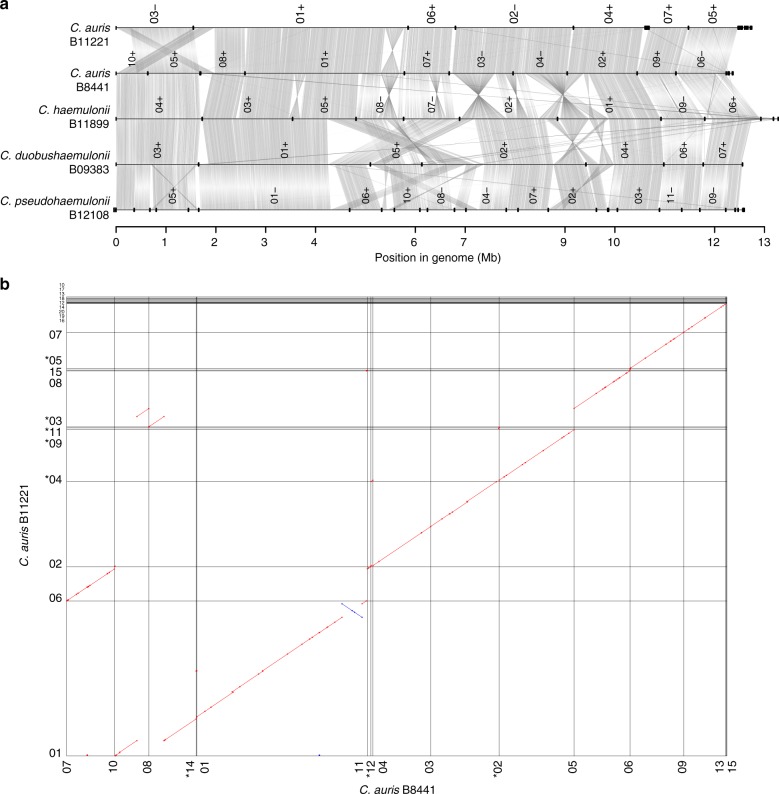
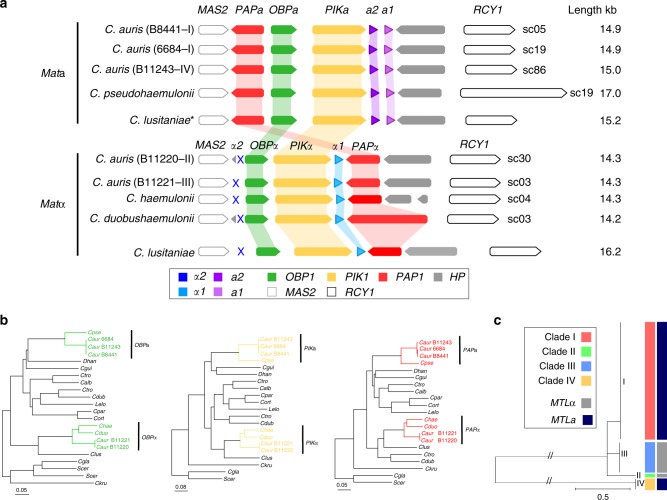
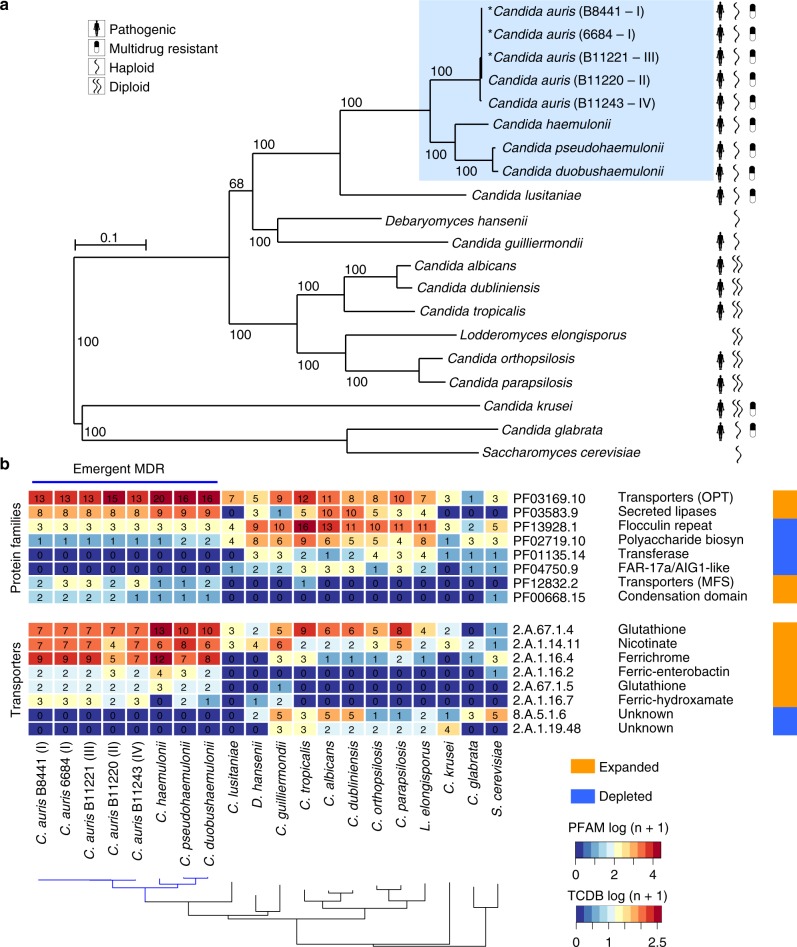
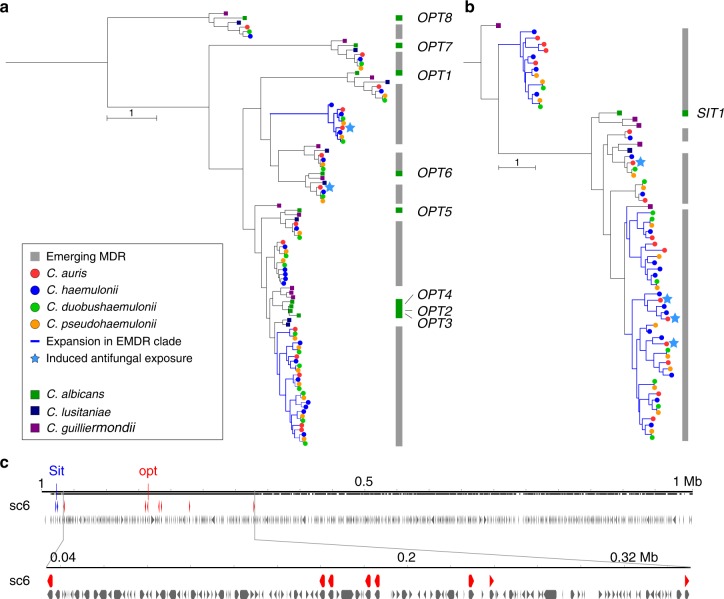
Candida auris is an emergent multidrug-resistant fungal pathogen causing increasing reports of outbreaks. While distantly related to C. albicans and C. glabrata , C. auris is closely related to rarely observed and often multidrug-resistant species from the C. haemulonii clade. Here, we analyze near complete genome assemblies for the four C. auris clades and three related species, and map intra- and inter-species rearrangements across the seven chromosomes. Using RNA-Seq-guided gene predictions, we find that most mating and meiosis genes are conserved and that clades contain either the MTL a or MTL α mating loci. Comparing the genomes of these emerging species to those of other Candida species identifies genes linked to drug resistance and virulence, including expanded families of transporters and lipases, as well as mutations and copy number variants in ERG11 . Gene expression analysis identifies transporters and metabolic regulators specific to C. auris and those conserved with related species which may contribute to differences in drug response in this emerging fungal clade.
Overview
The claims and statistics of this paper haven’t been checked yet.
Free: it reads the open-access text and checks the first 5 claims that cite a source we can check. Create a free account to check every claim.
Integrity signals
Registry
Cites
Statistics
Figures
Verification
Claims the paper makes
The claims and statistics of this paper haven’t been checked yet.
Free: it reads the open-access text and checks the first 5 claims that cite a source we can check. Create a free account to check every claim.
Claims other papers make about this one
Each is checked against this paper’s own text: does it say what the citing paper says it does?
The source backs part of the claim, not all of it — or backs it for a different population, condition or comparison.
In the citing paper
“Mutations in ERG11 have also been observed in Candida spp. and over 100 different ERG11 alleles have been described35.”
From Drug resistance and tolerance in fungi. (2020) · cites this paper as [35]
Experimental — accuracy not yet measuredThe source backs part of the claim, not all of it — or backs it for a different population, condition or comparison.
In the citing paper
“Furthermore, C. auris clades display substantial genetic diversity and show distinct phenotypic traits, especially diminished susceptibilities to antifungal therapies (11–14).”
From Transcriptomics and Phenotyping Define Genetic Signatures Associated with Echinocandin Resistance in Candida auris (2022) · cites this paper as [14]
Experimental — accuracy not yet measuredThe source backs part of the claim, not all of it — or backs it for a different population, condition or comparison.
In the citing paper
“It is worth noting that molecular mechanisms underlying the high rate of AMBR in C. auris remain largely enigmatic10,11.”
From Candida auris skin tropism and antifungal resistance are mediated by carbonic anhydrase Nce103 (2025) · cites this paper as [11]
Experimental — accuracy not yet measuredThe source backs part of the claim, not all of it — or backs it for a different population, condition or comparison.
In the citing paper
“Because U.S. isolates are closely related to those of South America and South Asia, we used the genome sequenced South Asian clade CA 0387 (B8441) to compare with C. albicans (4, 30 – 32).”
From Differential skin immune responses in mice intradermally infected with Candida auris and Candida albicans (2023) · cites this paper as [31]
Experimental — accuracy not yet measuredThe source backs part of the claim, not all of it — or backs it for a different population, condition or comparison.
In the citing paper
“multiple secreted lipases ( LIP ) for nutrient acquisition of lipids and adaptation (37, 38)”
From Candida auris metabolism and growth preferences in physiologically relevant skin-like conditions (2026) · cites this paper as [38]
Experimental — accuracy not yet measured
6 more claims about this paper
Create a free account to see every claim other papers make about this one.
Self-check
Percentages, sums and reported differences re-computed from the paper’s own numbers.
The self-check needs the paper’s full text.
Citations
Cites
Fast gapped-read alignment with Bowtie 2
Langmead, B., & Salzberg, S. L. (2012) · Nature Methods · doi:10.1038/nmeth.1923 · Cited by 56,400
Robinson, M. D., McCarthy, D. J., & Smyth, G. K. (2010) · Bioinformatics · doi:10.1093/bioinformatics/btp616 · Cited by 41,364
SPAdes: A New Genome Assembly Algorithm and Its Applications to Single-Cell Sequencing
Bankevich, A., Nurk, S., Antipov, D., Gurevich, A. A., Dvorkin, M., Kulikov, A. S., Lesin, V. M., Nikolenko, S. I., Pham, S., Prjibelski, A. D., et al. (2012) · Journal of Computational Biology · doi:10.1089/cmb.2012.0021 · Cited by 25,987
The variant call format and VCFtools
Danecek, P., Auton, A., Abecasis, G., Albers, C. A., Banks, E., DePristo, M. A., Handsaker, R. E., Lunter, G., Marth, G. T., Sherry, S. T., et al. (2011) · Bioinformatics · doi:10.1093/bioinformatics/btr330 · Cited by 16,200
RAxML-VI-HPC: maximum likelihood-based phylogenetic analyses with thousands of taxa and mixed models
Stamatakis, A. (2006) · Bioinformatics · doi:10.1093/bioinformatics/btl446 · Cited by 15,582
BUSCO: assessing genome assembly and annotation completeness with single-copy orthologs
Simão, F. A., Waterhouse, R. M., Ioannidis, P., Kriventseva, E. V., & Zdobnov, E. M. (2015) · Bioinformatics · doi:10.1093/bioinformatics/btv351 · Cited by 13,344
Conesa, A., Götz, S., García-Gómez, J. M., Terol, J., Talón, M., & Robles, M. (2005) · Bioinformatics · doi:10.1093/bioinformatics/bti610 · Cited by 11,495
tRNAscan-SE: A Program for Improved Detection of Transfer RNA Genes in Genomic Sequence
Lowe, T. M., & Eddy, S. R. (1997) · Nucleic Acids Research · doi:10.1093/nar/25.5.955 · Cited by 10,905
Statistical significance for genomewide studies
Storey, J. D., & Tibshirani, R. (2003) · Proceedings of the National Academy of Sciences · doi:10.1073/pnas.1530509100 · Cited by 9,692
Walker, B. J., Abeel, T., Shea, T., Priest, M., Abouelliel, A., Sakthikumar, S., Cuomo, C. A., Zeng, Q., Wortman, J., Young, S. K., et al. (2014) · PLoS ONE · doi:10.1371/journal.pone.0112963 · Cited by 9,197
Self-citation
Research works printed but not linked: 1
- Lockhart, S. R. et al. Simultaneous emergence of multidrug-resistant Candida auris on 3 continents confirmed by whole-genome sequencing and epidemiological analyses. Clin. Infect. Dis.64, 134–140 (2017); erratum 67, 987 (2018). PMC5215215 27988485
Cited by
Items 201–300 of 467
Chow, E. W. L., Song, Y., Chen, J., Xu, X., Wang, J., Chen, K., Gao, J., & Wang, Y. (2023) · mBio · doi:10.1128/mbio.02688-23 · Cited by 22
“2A and D; Data S2), previously shown to play important roles in drug resistance in various fungal pathogens (23, 46).”
BackgroundInfluentialSphingolipid diversity in Candida auris: unraveling interclade and drug resistance fingerprints
Ali, B., Kumar, M., Kumar, P., Chauhan, A., Usmani, S. A., Rudramurthy, S. M., Meis, J. F. G. M., Chakrabarti, A., Singh, A., Gaur, N. A., et al. (2024) · FEMS Yeast Research · doi:10.1093/femsyr/foae008 · Cited by 21
“The sim ultaneous a ppear ance of C. auris in m ultiple geogr a phical areas as different clades and the observed phenotypic and genetic differences between them with respect to pathogenicity and resistance to different antifungal drugs demands a closer look (Muñoz et al. 2018 , Welsh et al. 2019 ).”
BackgroundBalancing Positive and Negative Selection: In Vivo Evolution of Candida lusitaniae MRR1
Demers, E. G., Stajich, J., Ashare, A., Occhipinti, P., & Hogan, D. A. (2021) · mBio · doi:10.1128/mbio.03328-20 · Cited by 21
The Emerging Fungal Pathogen Candida auris Induces IFNγ to Colonize the Skin
Das, D., Ganesh, S. M., Mishra, A., Netea, M. G., & Thangamani, S. (2025) · PLOS Pathogens · doi:10.1371/journal.ppat.1013114 · Cited by 23
Amer, H. A., AlFaraj, S., Alboqami, K., Alshakarh, F., Alsalam, M., Kumar, D., Altayieb, J., Alsunid, A., Khanum, N., Dar, N. G., et al. (2023) · Journal of Epidemiology and Global Health · doi:10.1007/s44197-023-00154-9 · Cited by 18
“Although the development of matrix-assisted laser desorption/ionization time-of-flight mass spectrometry (MALDI-TOF MS) and sequencing strategies have helped in the rapid and accurate diagnosis of C. auris , most parts the world does not have the infrastructure to carry out these techniques [6, 7].”
Candida auris biofilm: a review on model to mechanism conservation
Khari, A., Biswas, B., Gangwar, G., Thakur, A., & Puria, R. (2023) · Expert Review of Anti-infective Therapy · doi:10.1080/14787210.2023.2179036 · Cited by 18
“auris, probably it has certain less ALS-dependent adhesion mechanism [46].”
BackgroundCandida auris : host interactions, antifungal drug resistance, and diagnostics
Chowdhary, A., Lionakis, M. S., & Chauhan, N. (2025) · Microbiology and Molecular Biology Reviews · doi:10.1128/mmbr.00187-22 · Cited by 22
“The F126L substitution is more commonly reported from African clade isolates (119, 162, 163).”
Molecular characterization of some multidrug resistant Candida Auris in egypt
Ahmed, S. H., El-Kholy, I. M. A., El-Mehalawy, A. A., Mahmoud, E. M., & Elkady, N. A. (2025) · Scientific Reports · doi:10.1038/s41598-025-88656-3 · Cited by 18
Ross, Z. K., & Lorenz, A. (2020) · PLoS Pathogens · doi:10.1371/journal.ppat.1009094 · Cited by 19
“So far, all sequenced clade I and clade IV isolates are MTLa and all clade II and III isolates are MTLα [26].”
BackgroundInfluentialSathi, F. A., Aung, M. S., Paul, S. K., Nasreen, S. A., Haque, N., Roy, S., Ahmed, S., Alam, M. M., Khan, S., Rabbany, M. A., et al. (2023) · Journal of Fungi · doi:10.3390/jof9060658 · Cited by 19
Kurakado, S., Matsumoto, Y., & Sugita, T. (2023) · Medical Mycology · doi:10.1093/mmy/myad108 · Cited by 18
Gao, F., Qi, Q., Wu, X., Yu, J., Yao, J. P., Cao, Z., Mi, Y., & Cui, Q. (2021) · Colloids and Surfaces A Physicochemical and Engineering Aspects · doi:10.1016/j.colsurfa.2021.126235 · Cited by 17
COVID-19 and Candida duobushaemulonii superinfection: A case report
Awada, B., Alam, W., Chalfoun, M., Araj, G. F., & Bizri, A. R. (2021) · Journal de Mycologie Médicale · doi:10.1016/j.mycmed.2021.101168 · Cited by 18
“In 2018, a genomic study found that Candida auris and Candida duobushaemulonii were closely related phylogenetically [16].”
Dekkerová, J., Lopez-Ribot, J. L., & Bujdáková, H. (2018) · European Journal of Clinical Microbiology & Infectious Diseases · doi:10.1007/s10096-018-3400-x · Cited by 17
Rodrigues, L. S., Gazara, R. K., Passarelli‐Araujo, H., Valengo, A. E., Pontes, P. V. M., da Fonseca, R. N., de Souza, R. F., Venâncio, T. M., & Dalla-Costa, L. M. (2020) · Frontiers in Microbiology · doi:10.3389/fmicb.2020.01535 · Cited by 19
Candida auris skin tropism and antifungal resistance are mediated by carbonic anhydrase Nce103
Phan-Canh, T., Coman, C., Lackner, M., Troppmair, N., Müller, C., Cerbu, D., Seiser, S., Penninger, P., Tsymala, I., Khunweeraphong, N., et al. (2025) · Nature Microbiology · doi:10.1038/s41564-025-02189-z · Cited by 16
“The rca1∆nce103∆ double mutant It is worth noting that molecular mechanisms underlying the high rate of AMB R in C. auris remain largely enigmatic 10,11 .”
A Comparative Transcriptome Between Anti-drug Sensitive and Resistant Candida auris in China
Zhou, W., Li, X., Lin, Y., Yan, W., Jiang, S., Huang, X., Yang, X., Qiao, D., & Li, N. (2021) · Frontiers in Microbiology · doi:10.3389/fmicb.2021.708009 · Cited by 16
Chauhan, A., Carolus, H., Sofras, D., Kumar, M., Kumar, P., Nair, R., Narayanan, A., Yadav, K., Ali, B., Biriukov, V., et al. (2025) · Molecular Microbiology · doi:10.1111/mmi.15379 · Cited by 16
“Strain B11220 (CBS10913 T ) is the type strain of Clade II (Satoh et al. 2009; Muñoz et al. 2018) and was re-confirmed as a Clade II isolate in our analysis (Figure S1a).”
Clonal Dissemination of Antifungal-Resistant Candida haemulonii , China
Chen, X., Jia, X., Bing, J., Zhang, H., Hong, N., Liu, Y., Xi, H., Wang, W., Liu, Z., Zhang, Q., et al. (2023) · Emerging infectious diseases · doi:10.3201/eid2903.221082 · Cited by 16
“Genome-based phylogenetic studies of C. auris have revealed that 5 distinct clades (I, II, III, IV, and V) are distributed in East Asia, South Asia, South Af - rica, and South America ( 17 , 26 ), whereas the popula - tion structure of C. haemulonii has not been previously defined.”
Machine learning reveals genes impacting oxidative stress resistance across yeasts
Aranguiz, K., Horianopoulos, L. C., Elkin, L., Abá, K. S., Jordahl, D., Overmyer, K. A., Wrobel, R. L., Coon, J. J., Shiu, S., Rokas, A., et al. (2025) · Nature Communications · doi:10.1038/s41467-025-60189-3 · Cited by 15
Candida auris Identification and Profiling by MALDI–ToF Mass Spectrometry
Abdolrasouli, A., & Fraser, M. (2022) · Methods in molecular biology · doi:10.1007/978-1-0716-2417-3_2 · Cited by 17
Silva, L. N., Ramos, L. S., Oliveira, S. S. C., Magalhães, L. B., Cypriano, J. B. S., Abreu, F. D. Á., Macêdo, A. J., Branquinha, M. H., & dos Santos, A. L. S. (2023) · Journal of Fungi · doi:10.3390/jof9080859 · Cited by 16
Zhang, H., Niu, Y., Tan, J., Liu, W., Sun, M.-A., Yang, E., Wang, Q., Li, R., Wang, Y., & Liu, W. Y. (2019) · mSystems · doi:10.1128/msystems.00459-19 · Cited by 15
“haemulonii remain to be investigated, although previous studies suggested possible roles of transporters and metabolic regulators in drug responses (26).”
Backgroundde Jong, A. W., Francisco, E. C., de Almeida, J. N., Brandão, I. B., Pereira, F. M., Dias, P. H. P., Costa, M. M. D. M., Jordão, R. T. D. S., Vu, D., Colombo, A. L., et al. (2021) · Mycopathologia · doi:10.1007/s11046-021-00593-7 · Cited by 15
Comparing genomic variant identification protocols for Candida auris
Xiao, L., Muñoz, J. F., Gade, L., Argimón, S., Bougnoux, M., Bowers, J. R., Chow, N. A., Cuesta, I., Farrer, R. A., Maufrais, C., et al. (2023) · Microbial Genomics · doi:10.1099/mgen.0.000979 · Cited by 15
“2/) [5, 18] and to provide detailed methods, a standard VCF file, a pairwise matrix of SNPs counts and a maximum parsimony phylogenetic tree inferred using the predicted variants.”
InfluentialSelf-citationTools and techniques to identify, study, and control Candida auris
Carty, J., Chowdhary, A., Bernstein, D. A., & Thangamani, S. (2023) · PLoS Pathogens · doi:10.1371/journal.ppat.1011698 · Cited by 16
Psychogenetic, genetic and epigenetic mechanisms in Candida auris: Role in drug resistance
Rabaan, A. A., Eljaaly, K., Alfouzan, W. A., Mutair, A. A., Alhumaid, S., Alfaraj, A. H., Aldawood, Y., Alsaleh, A. A., Albayat, H., Azmi, R. A., et al. (2023) · Journal of Infection and Public Health · doi:10.1016/j.jiph.2022.12.012 · Cited by 14
Bing, J., Li, S., Ji, L., Du, H., Shamoon, N. M., Nobile, C. J., & Huang, G. (2026) · Clinical Microbiology Reviews · doi:10.1128/cmr.00394-25 · Cited by 15
“Analysis of mating-type loci indicates that C. auris harbors a single mating-type locus ( MTL ) (40).”
Broad susceptibility of Candida auris strains to 8-hydroxyquinolines and mechanisms of resistance
Lohse, M. B., Laurie, M. T., Levan, S., Ziv, N., Ennis, C. L., Nobile, C. J., DeRisi, J. L., & Johnson, A. D. (2023) · mBio · doi:10.1128/mbio.01376-23 · Cited by 16
Ploidy evolution in a wild yeast is linked to an interaction between cell type and metabolism
Crandall, J. G., Fisher, K. J., Sato, T. K., & Hittinger, C. T. (2023) · PLoS Biology · doi:10.1371/journal.pbio.3001909 · Cited by 14
Acosta-Mosquera, Y., Tapia, J. C., Armas-González, R., Cáceres-Valdiviezo, M. J., Fernández‐Cadena, J. C., & Andrade-Molina, D. (2024) · Journal of Fungi · doi:10.3390/jof10050304 · Cited by 15
“These schemes would enable us to track rare NCA species occurrence and to study other important factors such as multidrug resistance (MDR) and virulence gene profiles associated with possible outbreaks [58–61].”
BackgroundAlvarado, M., Navajas, J. A. G., Muñoz, M. T. B., Gómez-Molero, E., Fernández-Sánchez, S., Eraso, E., Munro, C. A., Valentín, E., Mateo, E., & de Groot, P. W. J. (2024) · FEMS Yeast Research · doi:10.1093/femsyr/foae039 · Cited by 14
“Analysis of C. haemuli -complex species was focused on genome assemblies of r efer ence str ains C. haemuli str ain B11899, C. pseudohaemuli str ain B12108, and C. duobushaemuli strain B09383 (Muñoz et al. 2018 ).”
Polyphyllin I Effects Candida albicans via Inhibition of Virulence Factors
Sun, A.-M., Wang, Y.-X., Hu, G.-X., Li, L., & Wang, R.-R. (2023) · Evidence-based Complementary and Alternative Medicine · doi:10.1155/2023/5645500 · Cited by 14
Misas, E., Escandón, P., McEwen, J. G., & Clay, O. (2019) · Protein Science · doi:10.1002/pro.3727 · Cited by 14
Tracking a Global Threat: a New Genotyping Method for Candida auris
Cuomo, C. A., & Alanio, A. (2020) · mBio · doi:10.1128/mbio.00259-20 · Cited by 14
“STR markers were initially identified from a search across reference genome assemblies generated for each of the initially described four major clades (11).”
BackgroundSelf-citationSchutz, K., Melie, T., Smith, S. D., & Quandt, C. A. (2024) · Microbial Genomics · doi:10.1099/mgen.0.001233 · Cited by 13
“This species complex typically includes C. haemulonii , C. haemulonii var. vulnera (isolates K1 and K2) [68], C. duobushaemulonii, and C. vulturna which are all sister to C. pseudohaemulonii and C. auris [18, 69].”
InfluentialCandida auris Resistance Mechanisms to Amphotericin B Alternative Treatments Development
Fenton, A., & John, G. K. (2024) · Current Clinical Microbiology Reports · doi:10.1007/s40588-024-00233-w · Cited by 14
“Due to the speed of drug development, increased resistance profile and the applicability of selective ligands for the discovery of therapeutic agents to target, there is a reduced repertoire for treatments against infections [12, 14].”
InfluentialDo morphogenetic switching and intraspecies variation enhance virulence of Candida auris?
Phan-Canh, T., & Kuchler, K. (2024) · PLoS Pathogens · doi:10.1371/journal.ppat.1012559 · Cited by 13
Liu, X., Tao, Y., Zhang, L., Liu, Y., Shi, D., Wang, J., Xue, P., Xu, B., Fang, W., & Ran, Y. (2025) · Redox Biology · doi:10.1016/j.redox.2025.103708 · Cited by 13
“However, the overuse of these agents has led to drug resistance, especially in C. auris , which underscores the urgent need for novel antifungal therapeutics [7,8].”
Brandt, P., Gerwien, F., Wagner, L., Krüger, T., Ramírez-Zavala, B., Mirhakkak, M. H., Schäuble, S., Kniemeyer, O., Panagiotou, G., Brakhage, A. A., et al. (2022) · Frontiers in Cellular and Infection Microbiology · doi:10.3389/fcimb.2022.850531 · Cited by 14
Clavispora lusitaniae: From a saprophytic yeast to an emergent pathogen
Rojas, O. C., Montoya, A. M., & Treviño‐Rangel, R. D. J. (2024) · Fungal Biology · doi:10.1016/j.funbio.2024.05.013 · Cited by 14
Evolutionary origin and population diversity of a cryptic hybrid pathogen
Steenwyk, J. L., Knowles, S., Bastos, R. W., Balamurugan, C., Rinker, D. C., Mead, M. E., Roberts, C. D., Raja, H. A., Li, Y., Colabardini, A. C., et al. (2024) · Nature Communications · doi:10.1038/s41467-024-52639-1 · Cited by 14
Mitochondrial Genome Sequences of the Emerging Fungal Pathogen Candida auris
Misas, E., Chow, N. A., Gómez, O. M., Muñoz, J. F., McEwen, J. G., Litvintseva, A. P., & Clay, O. (2020) · Frontiers in Microbiology · doi:10.3389/fmicb.2020.560332 · Cited by 14
“…contigs for an amphotericin B-resistant strain of C. duobushaemulonii (isolate B09383, sequence PKFP01000007) and for a multidrug resistant strain of C. haemulonii (isolate B11899, sequence PKFO01000012) had been previously obtained as part of a whole genome sequencing project (Munoz et al., 2018).”
BackgroundSelf-citationThe sphingolipid inhibitor myriocin increases Candida auris susceptibility to amphotericin B
Stieber, H., Junghanns, L., Wilhelm, H., Batliner, M., Aldejohann, A. M., Kurzai, O., & Martin, R. (2024) · Mycoses · doi:10.1111/myc.13723 · Cited by 13
Antifungal Plant Defensins as an Alternative Tool to Combat Candidiasis
Finkina, E. I., Shevchenko, O. V., Fateeva, S. I., Tagaev, A. A., & Ovchinnikova, T. V. (2024) · Plants · doi:10.3390/plants13111499 · Cited by 13
Genetic Diversity of Human Fungal Pathogens
Freese, J. M., & Beyhan, S. (2023) · Current Clinical Microbiology Reports · doi:10.1007/s40588-023-00188-4 · Cited by 13
Emerging Role of Sphingolipids in Amphotericin B Drug Resistance
Madaan, K., & Bari, V. K. (2023) · Microbial Drug Resistance · doi:10.1089/mdr.2022.0353 · Cited by 13
Massic, L., Gorzalski, A. J., Siao, D. D., Dykema, P., Hua, C. N., Schneider, E., Hooser, S. V., Pandori, M., & Hess, D. C. (2023) · The Lancet Infectious Diseases · doi:10.1016/s1473-3099(23)00434-6 · Cited by 12
Enablers of Candida auris persistence on medical devices and their mode of eradication.
Nwachukwu, K. C., Nwarunma, E., Uchenna, C. D., & Ugbogu, O. C. (2023) · PubMed Central · doi:10.18502/cmm.2023.150673 · Cited by 15
“In a genomic study performed by Lockhart and colleagues[15], over 7 chromosomes were identified; with an estimated 5,500 genes between 12.1 to 12.7 Mb [16].”
BackgroundInfluentialFrota, H. F., Barbosa, P. F., Lorentino, C. M. A., Affonso, L. R. F., Ramos, L. S., Oliveira, S. S. C., Souza, L. O. P., Abosede, O. O., Ogunlaja, A. S., Branquinha, M. H., et al. (2024) · BioMetals · doi:10.1007/s10534-024-00605-1 · Cited by 12
“Furthermore, NACs are linked to treatment failure because of their resistance to standard antifungal agents that are commonly employed in clinical settings (Xiao et al. 2016; Muñoz et al. 2018; Černáková et al. 2021; Lass-Flörl and Steixner 2023).”
Reséndiz-Sánchez, J., Ortiz-Álvarez, J., Casimiro-Ramos, A., Hernández, G., & Villa‐Tanaca, L. (2020) · International Journal of Infectious Diseases · doi:10.1016/j.ijid.2019.12.037 · Cited by 13
Casimiro-Ramos, A., Bautista-Crescencio, C., Vidal-Montiel, A., González, G. M., Hernández-García, J. A., Hernández-Rodríguez, C., & Villa‐Tanaca, L. (2024) · Journal of Fungi · doi:10.3390/jof10060392 · Cited by 12
“Such information should facilitate monitoring of the global dissemination of drug-resistant strains [32].”
BackgroundZhang, Y., Han, J., Ma, Y., Zhang, F., Li, C., Zhao, J., Lu, B., & Cao, B. (2024) · Infection · doi:10.1007/s15010-024-02378-8 · Cited by 11
Octenidine effectively reduces Candida auris colonisation on human skin
Cerbu, D., Seiser, S., Phan-Canh, T., Moser, D., Freystätter, C., Matiasek, J., Kuchler, K., & Elbe‐Bürger, A. (2025) · Scientific Reports · doi:10.1038/s41598-025-11914-x · Cited by 11
Kraševec, N. (2022) · Journal of Fungi · doi:10.3390/jof8050461 · Cited by 12
“auris mating and resulting diversity in the clinical context [27].”
BackgroundIn silico environmental sampling of emerging fungal pathogens via big data analysis
Irinyi, L., Roper, M., Malík, R., & Meyer, W. (2022) · Fungal ecology · doi:10.1016/j.funeco.2022.101212 · Cited by 11
Clorgyline Analogs Synergize with Azoles against Drug Efflux in Candida auris
Toepfer, S., Lackner, M., Keniya, M. V., Zenz, L.-M., Friemert, M., Bracher, F., & Monk, B. C. (2023) · Journal of Fungi · doi:10.3390/jof9060663 · Cited by 11
Highly Reactive Group I Introns Ubiquitous in Pathogenic Fungi
Liu, T., & Pyle, A. M. (2024) · Journal of Molecular Biology · doi:10.1016/j.jmb.2024.168513 · Cited by 11
Verma, N., Riyaz, M., Kaur, G., Negi, P., Ghawri, H., & Raj, K. (2024) · Indian Journal of Microbiology · doi:10.1007/s12088-024-01277-8 · Cited by 13
“Genetic analysis of C. auris has revealed an upsurge of genes related to multidrug efflux and drug resistance [12].”
Short-term evolution and dispersal patterns of fluconazole-resistance in Candida auris clade III
Cancino‐Muñoz, I., Bayona, J. V. M., García, C. S., Tormo, N., Guna, R., Cardona, C. G., & Gónzález‐Candelas, F. (2024) · mBio · doi:10.1128/mbio.03164-24 · Cited by 10
“This fungus is characterized by causing large, difficult-to-control nosocomial outbreaks (4–6), as well as by its rapid acquisition of resistance to antifungals (1, 7).”
Gene dosage of PDR16 modulates azole susceptibility in Candida auris
Phan-Canh, T., Bitencourt, T., & Kuchler, K. (2025) · Microbiology Spectrum · doi:10.1128/spectrum.02659-24 · Cited by 7
Balkrishna, A., Kharayat, B., Rastogi, S., Kabdwal, M., Haldar, S., & Varshney, A. (2023) · Journal of Applied Microbiology · doi:10.1093/jambio/lxad087 · Cited by 10
Emerging Pathogens of the Candida Species
Yang, B., & Rao, R. P. (2019) · IntechOpen eBooks · doi:10.5772/intechopen.80378 · Cited by 11
Ramos, L. S., Oliveira, S. S. C., Braga-Silva, L. A., Branquinha, M. H., & dos Santos, A. L. S. (2020) · Fungal Biology · doi:10.1016/j.funbio.2020.04.001 · Cited by 10
Smithgall, M. C., Kılıç, A., Weidmann, M. D., Ofori, K., Gu, Y., Koganti, L., Mi, S., Xia, H., Shi, J., Pang, J., et al. (2025) · Clinical Chemistry · doi:10.1093/clinchem/hvae185 · Cited by 9
A benchmark dataset for validating FKS1 mutations in Candida auris
Misas, E., Parnell, L. A., Rajeev, M., López, L. F., dos Santos, A. R., Mudge, Z. B., Gade, L., Forsberg, K., Lyman, M., Sexton, D. J., et al. (2025) · Microbiology Spectrum · doi:10.1128/spectrum.03147-24 · Cited by 12
Self-citationGifford, H., Bedekovic, T., Helmstetter, N., Gregory, J., Ma, Q., Brand, A., Wilson, D., Rhodes, J. L., Ramsdale, M., Kudoh, T., et al. (2025) · Communications Biology · doi:10.1038/s42003-025-09321-z · Cited by 11
Self-citationMrs4 loss of function in fungi during adaptation to the cystic fibrosis lung
Murante, D., Demers, E. G., Kurbessoian, T., Ruzic, M., Ashare, A., Stajich, J., & Hogan, D. A. (2023) · mBio · doi:10.1128/mbio.01171-23 · Cited by 9
“Analysis of Candida auris MRS4 274 alleles within and between clades, available from published sequences (30), found that the encoded Mrs4 275”
Bohner, F., Papp, C., Takács, T., Varga, M., Szekeres, A., Nosanchuk, J. D., Vágvölgyi, C., Tóth, R., & Gácser, A. (2023) · Journal of Fungi · doi:10.3390/jof9121148 · Cited by 10
“…enzymes (e.g., Erg11) [6,28,29]; (ii) increased drug target production due to the corresponding genomic site’s duplication event (e.g., ERG11) [30,31]; (iii) point mutations in target associated genes (e.g., ERG3 ); or (iv) overexpression of ABC-and MFS transporter genes (e.g., CDR1 , SNQ2 ,…”
BackgroundGenetic microevolution of clinical Candida auris with reduced Amphotericin B sensitivity in China
Tian, S., Chen, R., Li, H., Wu, Y., Wu, N., Yunzhuo, C., Jiang, N., Zhang, J., & Shang, H. (2024) · Emerging Microbes & Infections · doi:10.1080/22221751.2024.2398596 · Cited by 9
“AmB has been shown to bind or trap membrane ergosterol to trigger changes in membrane permeability by chelating ergosterol or by regulating channel function [25–27].”
Khatoon, R., Sharma, S., Prasad, R., Lynn, A. M., Prakash, A., & Banerjee, A. (2022) · Applied Microbiology and Biotechnology · doi:10.1007/s00253-022-11998-9 · Cited by 10
Gupta, S. K., Osmanoğlu, Ö., Minocha, R., Bandi, S. R., Bencúrová, E., Srivastava, M., & Dandekar, T. (2022) · Frontiers in Medicine · doi:10.3389/fmed.2022.1008527 · Cited by 9
“auris have been identified up to date with tens to hundreds of thousands of single nucleotide polymorphisms, which can be potentially linked to various infection strategies and outbreaks (80, 81).”
BackgroundKordalewska, M., Guerrero, K. D., Mikulski, T. D., Elias, T. N., Garcia‐Rubio, R., Berrío, I., Gardam, D. J., Heath, C. H., Chowdhary, A., Govender, N. P., et al. (2021) · bioRxiv (Cold Spring Harbor Laboratory) · doi:10.1101/2021.10.22.465535 · Cited by 9
Candida auris metabolism and growth preferences in physiologically relevant skin-like conditions
Nicklas, J. P., Deming, C., Lee-Lin, S., Conlan, S., Shen, Z., Blaustein, R. A., & Segre, J. A. (2026) · mBio · doi:10.1128/mbio.03117-25 · Cited by 13
“…( YAT1 , YAT2 , CAT2 ) to assist in the transport of acetyl-CoA (29), multiple secreted lipases ( LIP ) for nutrient acquisition of lipids and adaptation (37, 38), phospholipases and proteases for nutrient acquisition, and amino acid permeases and transporters for additional nutrient uptake (39).”
A clinical and molecular analysis of Candidozyma auris strains from Romania, 2022–2023
Surleac, M. D., Stanciu, A. M., Florea, D., Paraschiv, S., Tălăpan, D., Flonta, M., Vasile, C. C., Popescu, G. A., & Oţelea, D. (2025) · Microbiology Spectrum · doi:10.1128/spectrum.02809-24 · Cited by 8
Sofras, D., Carolus, H., Subotić, A., Romero, C. L., Ennis, C. L., Cuypers, L., Lagrou, K., Hernday, A. D., Nobile, C. J., Rybak, J. M., et al. (2025) · Scientific Reports · doi:10.1038/s41598-025-19115-2 · Cited by 8
A study of genomic complexity underlying multidrug resistance in Candida auris strains in Thailand
Opassathian, K., Boonmee, N., Swangkaew, S., Jenjaroenpun, P., Wongsurawat, T., Kruasuwan, W., Ngamskulrungroj, P., & Mitrpant, C. (2025) · Scientific Reports · doi:10.1038/s41598-025-25386-6 · Cited by 9
“Not only the gene level mutations, but a study from Munoz et al. (2018) also shows the expansion of mutated genes shared the protein families associated with antifungal resistance in the genomes of C. auris and its closely related species.”
Genetic and Epigenetic Mechanisms Underlying Reversible Adaptive Responses in Fungi
Dan, L., Liu, S., Qiang, Z., Ye, X., & Zhang, J. (2026) · Journal of Fungi · doi:10.3390/jof12050309 · Cited by 10
“Similar regulatory principles have been proposed in other fungal species, including Candida auris, where mating-type-like regulatory mechanisms have been associated with phenotypic variation and antifungal responses [80].”
Updated Genomic Epidemiologic Description of Candida (Candidozyma) auris , United States
Parnell, L. A., dos Santos, A. R., Forsberg, K., Lyman, M., Misas, E., Gade, L., Sexton, D. J., Litvintseva, A. P., & Chow, N. A. (2026) · Emerging infectious diseases · doi:10.3201/eid3205.250760 · Cited by 10
Self-citationKim, J.-S., & Bahn, Y. (2023) · Antioxidants · doi:10.3390/antiox12091702 · Cited by 8
“3390/antiox12091702/s1, References [15,20,21] are cited in the supplementary materials.”
BackgroundYang, B., Vaisvil, B., Schmitt, D. P., Collins, J., Young, E. M., Kapatral, V., & Rao, R. P. (2024) · Infection and Immunity · doi:10.1128/iai.00103-24 · Cited by 9
Vertebrate and invertebrate animal infection models of Candida auris pathogenicity
Martinez, M., Garsin, D. A., & Lorenz, M. C. (2024) · Current Opinion in Microbiology · doi:10.1016/j.mib.2024.102506 · Cited by 8
Ogundeji, A. O., Bello‐Akinosho, M., Swart, V. R., Featherston, J., Cason, E. D., Bolsenbroek, A., Beneke, C., Musoke, J., Baker, T., Ismail, A., et al. (2025) · Medical Mycology · doi:10.1093/mmy/myaf069 · Cited by 8
“33 The tree file is available at https://figshare.com/articles/dataset/ Phylogenetic_Tree_File/29222603?file=55075763.”
Long, S. W., Olsen, R. J., Nguyen, H. A. T., Saavedra, M. O., & Musser, J. M. (2019) · Microbiology Resource Announcements · doi:10.1128/mra.00532-19 · Cited by 8
“The LOM genome has the erg11 gene with an F126L amino acid replacement that is common to clade III strains (6).”
BackgroundCharacteristics of monolayer formation in vitro by the chytrid Batrachochytrium dendrobatidis
Silva, S., Matz, L. M., Elmassry, M. M., & Francisco, M. J. S. (2019) · Biofilm · doi:10.1016/j.bioflm.2019.100009 · Cited by 10
“Expression of genes encoding oligopeptide transporter activity (OPT) and those involved in fatty acid biosynthesis as we observed in sporangia have been observed in amphotericin resistance in Candida auris and could explain their observed resistance to the drug in our experiments [60].”
BackgroundRodrigues, D. K. D. B., Lockhart, S. R., Berkow, E. L., Gade, L., Bonfietti, L. X., Gimenes, V. M. F., Ruiz, L. D. S., Macioni, M. B., & Melhem, M. D. S. C. (2023) · Medical Mycology · doi:10.1093/mmy/myad030 · Cited by 8
Self-citationTranscriptional Response of Candida auris to the Mrr1 Inducers Methylglyoxal and Benomyl
Biermann, A. R., & Hogan, D. A. (2022) · mSphere · doi:10.1128/msphere.00124-22 · Cited by 9
Ross, Z. K., Alsayegh, S., Zhao, Y., McPherson, S., Munro, C. A., & Lorenz, A. (2025) · Microbiological Research · doi:10.1016/j.micres.2025.128322 · Cited by 8
Candida auris vacuolar calcium pump mediates fluconazole efflux and resistance evolution
Song, Y., Chen, J., Wan, J., Zhang, J., Liu, Q., Sun, F., Zhang, H., Guo, Y., Chow, E. W. L., Chen, Y., et al. (2026) · Nature Microbiology · doi:10.1038/s41564-026-02270-1 · Cited by 8
Global characteristics and trends in research on Candida auris
Wang, Q., Cheng, S., Wang, Y., Li, F., Chen, J., Du, W., Kang, H., & Wang, Z. (2023) · Frontiers in Microbiology · doi:10.3389/fmicb.2023.1287003 · Cited by 7
Oganesyan, E. G., Klimenteva, V., Vybornova, I. V., Venchakova, V. V., Parshikova, E., Kovyrshin, S., Oe, O., Kruglov, A., Александровна, Г. С., Vasilyeva, N. V., et al. (2025) · Journal of Fungi · doi:10.3390/jof11010035 · Cited by 9
Chen, H., Li, Z., Yu, Q., Li, W., & Gu, L. (2025) · Advanced Composites and Hybrid Materials · doi:10.1007/s42114-025-01271-8 · Cited by 7
“These medications often result in various adverse effects, such as altered taste, diarrhea, headaches, allergic reactions, adrenal insufficiency, and hepatotoxicity [11, 14], and their misuse can lead to high recurrence rates of DS and the emergence of drug-resistant strains [15–17].”
Wu, N., Wu, Y., Chu, Y., Ren, Z., Li, H., Chen, R., Yang, M., Jiang, N., Jiang, Y., Chen, J., et al. (2023) · Frontiers in Microbiology · doi:10.3389/fmicb.2023.1165721 · Cited by 7
Umamaheshwari, S., Neelambike, S. M., Shankarnarayan, S. A., Kumarswamy, K. S., Gopal, S., Prakash, H., & Rudramurthy, S. M. (2021) · Journal de Mycologie Médicale · doi:10.1016/j.mycmed.2021.101176 · Cited by 7
Hassan, Y., & Sule, H. (2023) · Academia Biology · doi:10.20935/acadbiol6074 · Cited by 8
Ramos, L. S., Silva, L. N., Branquinha, M. H., & dos Santos, A. L. S. (2020) · Journal of Fungi · doi:10.3390/jof6040201 · Cited by 8
Kord, M., Elmimoghaddam, A., Hashemi, S. J., Reziae, S., Ghazvini, R. D., Salehi, M., Abdollahi, A., Ahmadi, A., Getso, M. I., Boekhout, T., et al. (2021) · Mycopathologia · doi:10.1007/s11046-020-00522-0 · Cited by 7
Pathogenicity and virulence of Candida auris
Phan-Canh, T., Seiser, S., Chauhan, M., Kuchler, K., Chauhan, N., & Elbe‐Bürger, A. (2026) · Virulence · doi:10.1080/21505594.2026.2707827 · Cited by 7
“The MTL a or MTL α mating loci are clade-specific, whereby clades I, IV, and V isolates are MTL a , while clades II, III, and VI are MTL α [13,16].”
InfluentialGenetic modification of Candida maltosa, a non-pathogenic CTG species, reveals EFG1 function
Chávez-Tinoco, M., García-Ortega, L. F., & Mancera, E. (2024) · Microbiology · doi:10.1099/mic.0.001447 · Cited by 6
“This is especially the case for C. auris which is an emerging pathogen of growing concern given its resistance to multiple typical antifungal drugs [12].”
InfluentialImproved genome assembly of Candida auris strain B8441 and annotation of B11205
Cauldron, N. C., Shea, T., & Cuomo, C. A. (2024) · Microbiology Resource Announcements · doi:10.1128/mra.00512-24 · Cited by 6
Self-citation
Metadata
- Authors
- Muñoz, J. F., Gade, L., Chow, N. A., Loparev, V. N., Juieng, P., Berkow, E. L., Farrer, R. A., Litvintseva, A. P., & Cuomo, C. A.
- Affiliations
- Broad Institute (US)
- Centers for Disease Control and Prevention (US)
- Corresponding author
- Litvintseva, Anastasia P.
- Cuomo, Christina A.
- ORCID
- Venue
- Nature Communications
- Published
- 2018-12-17
- Volume
- 9
- Issue
- 1
- Pages
- 5346-5346
- ISSN
- 2041-1723 (ISSN-L)
- PMC
- PMC6297351
- OpenAlex
- W2951867871
- Semantic Scholar
- 66e56b3513c248d181f77faab6a93d9ab844712d
- Cited by
- 458
- References
- 64
- Citations by year
- 2026: 50 · 2025: 67 · 2024: 59 · 2023: 71 · 2022: 48 · 2021: 59 · 2020: 64 · 2019: 31 · 2018: 7
- FWCI
- 30.45
- Type
- journal article
- Language
- en
- Open access
- gold
- doi.org
- Licence
- cc-by
- creativecommons.org/licenses/by/4.0 (tdm)
- creativecommons.org/licenses/by/4.0 (vor)
- Locations
- Nature Communications (publishedVersion, cc-by)
- bioRxiv (Cold Spring Harbor Laboratory) (acceptedVersion, cc-by)
- Europe PMC (PubMed Central) (publishedVersion, cc-by)
- PubMed Central (publishedVersion, cc-by)
- PubMed (publishedVersion)
- RePEc: Research Papers in Economics (submittedVersion)
- DOAJ (DOAJ: Directory of Open Access Journals) (submittedVersion, cc-by-sa)
- DOAJ (DOAJ: Directory of Open Access Journals) (submittedVersion)
- Funders
- U.S. Department of Health and Human Services (U19-AI110818)
- National Institutes of Health
- National Institute of Allergy and Infectious Diseases (U19AI110818)
- Topics
- Health Sciences › Medicine › Infectious Diseases › Antifungal resistance and susceptibility
- Life Sciences › Biochemistry, Genetics and Molecular Biology › Molecular Biology › Fungal and yeast genetics research
- Life Sciences › Immunology and Microbiology › Microbiology › Yeasts and Rust Fungi Studies
- Keywords
- Candida auris, multidrug resistance, meiosis genes, virulence genes, genome rearrangement, ERG11, copy number variation, drug transporters, lipase, gene expression, emerging fungal pathogens
- MeSH terms
- Whole Genome Sequencing, Antifungal Agents, Candida, Candidiasis, Cytochrome P-450 Enzyme System, Microbial Sensitivity Tests, Virulence, Genome, Fungal, Communicable Diseases, Emerging, Drug Resistance, Multiple, Fungal
About these checks
Registry, retraction, Cites and statistics results are computed, not judged, with one exception: a printed reference that no index lists is read once by a model before it counts as a citation error. Claims are extracted by a model and kept only when their quote appears verbatim in the text; each cited source is then checked, with a model’s help, for whether it says what the claim relies on. Those verdicts can be wrong — read the claim’s quote and the cited source before relying on one.
Statistics and arithmetic are recomputed, not judged.
Confidence bands are shown only for fields calibrated on our annotated test set. None is calibrated yet, so no band is shown.
What counts as a claim ›How we measure confidence ›How we check this ›
Are you an author, or do you see a problem with this page? Request a review
Data sources
Bibliographic data: Semantic Scholar, OpenAlex, Crossref.
Contains information from the Semantic Scholar Academic Graph Datasets, made available under the ODC Attribution License (ODC-BY 1.0).
Semantic Scholar’s data is described in: Kinney, R., et al. (2023). The Semantic Scholar Open Data Platform. arXiv:2301.10140.
