

Genomic insights into multidrug-resistance, mating and virulence in Candida auris and related emerging species
Open accessPublished version of a preprint
The DOI matches its Crossref record; 64 of the 64 references it cites were found in a registry or an index.
Abstract
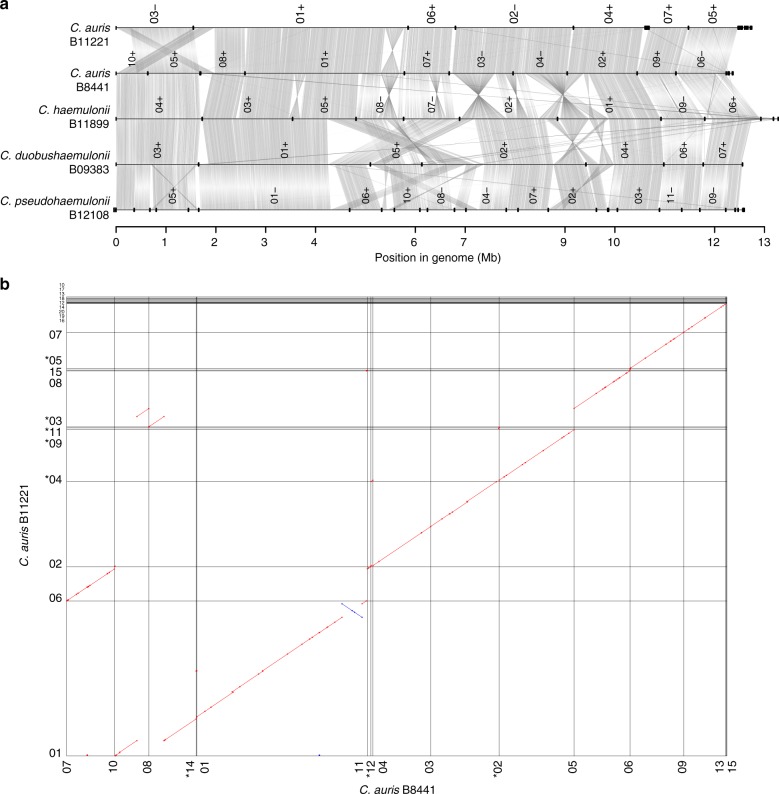
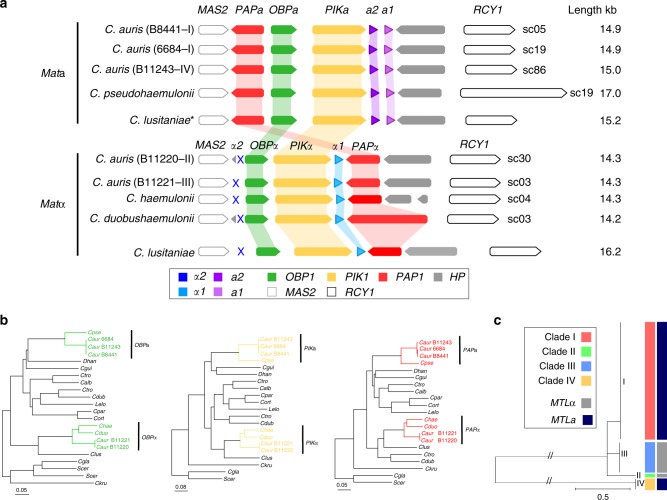
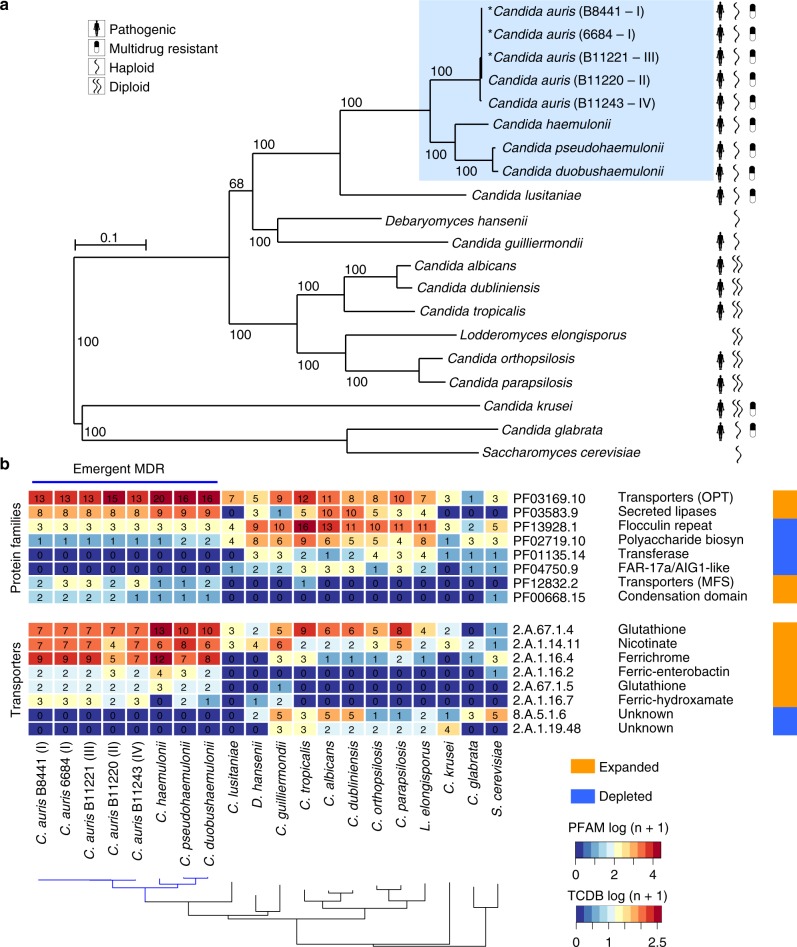
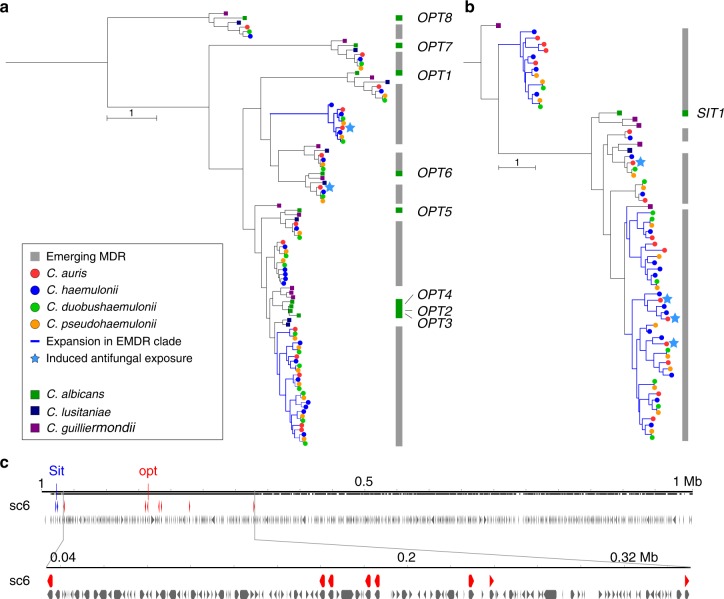
Candida auris is an emergent multidrug-resistant fungal pathogen causing increasing reports of outbreaks. While distantly related to C. albicans and C. glabrata , C. auris is closely related to rarely observed and often multidrug-resistant species from the C. haemulonii clade. Here, we analyze near complete genome assemblies for the four C. auris clades and three related species, and map intra- and inter-species rearrangements across the seven chromosomes. Using RNA-Seq-guided gene predictions, we find that most mating and meiosis genes are conserved and that clades contain either the MTL a or MTL α mating loci. Comparing the genomes of these emerging species to those of other Candida species identifies genes linked to drug resistance and virulence, including expanded families of transporters and lipases, as well as mutations and copy number variants in ERG11 . Gene expression analysis identifies transporters and metabolic regulators specific to C. auris and those conserved with related species which may contribute to differences in drug response in this emerging fungal clade.
Overview
The claims and statistics of this paper haven’t been checked yet.
Free: it reads the open-access text and checks the first 5 claims that cite a source we can check. Create a free account to check every claim.
Integrity signals
Registry
Cites
Statistics
Figures
Verification
Claims the paper makes
The claims and statistics of this paper haven’t been checked yet.
Free: it reads the open-access text and checks the first 5 claims that cite a source we can check. Create a free account to check every claim.
Claims other papers make about this one
Each is checked against this paper’s own text: does it say what the citing paper says it does?
The source backs part of the claim, not all of it — or backs it for a different population, condition or comparison.
In the citing paper
“Mutations in ERG11 have also been observed in Candida spp. and over 100 different ERG11 alleles have been described35.”
From Drug resistance and tolerance in fungi. (2020) · cites this paper as [35]
Experimental — accuracy not yet measuredThe source backs part of the claim, not all of it — or backs it for a different population, condition or comparison.
In the citing paper
“Furthermore, C. auris clades display substantial genetic diversity and show distinct phenotypic traits, especially diminished susceptibilities to antifungal therapies (11–14).”
From Transcriptomics and Phenotyping Define Genetic Signatures Associated with Echinocandin Resistance in Candida auris (2022) · cites this paper as [14]
Experimental — accuracy not yet measuredThe source backs part of the claim, not all of it — or backs it for a different population, condition or comparison.
In the citing paper
“It is worth noting that molecular mechanisms underlying the high rate of AMBR in C. auris remain largely enigmatic10,11.”
From Candida auris skin tropism and antifungal resistance are mediated by carbonic anhydrase Nce103 (2025) · cites this paper as [11]
Experimental — accuracy not yet measuredThe source backs part of the claim, not all of it — or backs it for a different population, condition or comparison.
In the citing paper
“Because U.S. isolates are closely related to those of South America and South Asia, we used the genome sequenced South Asian clade CA 0387 (B8441) to compare with C. albicans (4, 30 – 32).”
From Differential skin immune responses in mice intradermally infected with Candida auris and Candida albicans (2023) · cites this paper as [31]
Experimental — accuracy not yet measuredThe source backs part of the claim, not all of it — or backs it for a different population, condition or comparison.
In the citing paper
“multiple secreted lipases ( LIP ) for nutrient acquisition of lipids and adaptation (37, 38)”
From Candida auris metabolism and growth preferences in physiologically relevant skin-like conditions (2026) · cites this paper as [38]
Experimental — accuracy not yet measured
6 more claims about this paper
Create a free account to see every claim other papers make about this one.
Self-check
Percentages, sums and reported differences re-computed from the paper’s own numbers.
The self-check needs the paper’s full text.
Citations
Cites
Fast gapped-read alignment with Bowtie 2
Langmead, B., & Salzberg, S. L. (2012) · Nature Methods · doi:10.1038/nmeth.1923 · Cited by 56,400
Robinson, M. D., McCarthy, D. J., & Smyth, G. K. (2010) · Bioinformatics · doi:10.1093/bioinformatics/btp616 · Cited by 41,364
SPAdes: A New Genome Assembly Algorithm and Its Applications to Single-Cell Sequencing
Bankevich, A., Nurk, S., Antipov, D., Gurevich, A. A., Dvorkin, M., Kulikov, A. S., Lesin, V. M., Nikolenko, S. I., Pham, S., Prjibelski, A. D., et al. (2012) · Journal of Computational Biology · doi:10.1089/cmb.2012.0021 · Cited by 25,987
The variant call format and VCFtools
Danecek, P., Auton, A., Abecasis, G., Albers, C. A., Banks, E., DePristo, M. A., Handsaker, R. E., Lunter, G., Marth, G. T., Sherry, S. T., et al. (2011) · Bioinformatics · doi:10.1093/bioinformatics/btr330 · Cited by 16,200
RAxML-VI-HPC: maximum likelihood-based phylogenetic analyses with thousands of taxa and mixed models
Stamatakis, A. (2006) · Bioinformatics · doi:10.1093/bioinformatics/btl446 · Cited by 15,582
BUSCO: assessing genome assembly and annotation completeness with single-copy orthologs
Simão, F. A., Waterhouse, R. M., Ioannidis, P., Kriventseva, E. V., & Zdobnov, E. M. (2015) · Bioinformatics · doi:10.1093/bioinformatics/btv351 · Cited by 13,344
Conesa, A., Götz, S., García-Gómez, J. M., Terol, J., Talón, M., & Robles, M. (2005) · Bioinformatics · doi:10.1093/bioinformatics/bti610 · Cited by 11,495
tRNAscan-SE: A Program for Improved Detection of Transfer RNA Genes in Genomic Sequence
Lowe, T. M., & Eddy, S. R. (1997) · Nucleic Acids Research · doi:10.1093/nar/25.5.955 · Cited by 10,905
Statistical significance for genomewide studies
Storey, J. D., & Tibshirani, R. (2003) · Proceedings of the National Academy of Sciences · doi:10.1073/pnas.1530509100 · Cited by 9,692
Walker, B. J., Abeel, T., Shea, T., Priest, M., Abouelliel, A., Sakthikumar, S., Cuomo, C. A., Zeng, Q., Wortman, J., Young, S. K., et al. (2014) · PLoS ONE · doi:10.1371/journal.pone.0112963 · Cited by 9,197
Self-citation
Research works printed but not linked: 1
- Lockhart, S. R. et al. Simultaneous emergence of multidrug-resistant Candida auris on 3 continents confirmed by whole-genome sequencing and epidemiological analyses. Clin. Infect. Dis.64, 134–140 (2017); erratum 67, 987 (2018). PMC5215215 27988485
Cited by
Items 401–467 of 467
Identification and classification of microorganisms based on their fatty acid profiles
Huỳnh, T. (2023) · SZTE Repository of Dissertations (University of Szeged) · doi:10.14232/phd.11336
Barroso, V. D. M. (2023) · Digital Library of Theses and Dissertations (Universidade de São Paulo) · doi:10.11606/t.42.2023.tde-15092023-110730
The C. auris Epidemic: Understanding its Impact on ICU Patients
Ugemuge, P., Ugemuge, S., Mishra, V. H., & Tidake, A. A. (2023) · Journal of Pure and Applied Microbiology · doi:10.22207/jpam.17.4.57
Bhattacharyya, S. (2024) · Public Health Open Access · doi:10.23880/phoa-16000263
Kandati, K., Nannepaga, J. S., & Viswanath, B. (2024) · Elsevier eBooks · doi:10.1016/b978-0-443-18574-8.00018-2
Emerging Saccharomycotina yeast pathogens: Detection and susceptibility profiles
Stavrou, A. A. (2021) · UvA-DARE (University of Amsterdam) · doi:10.5281/zenodo.5558633
Žvynakytė, V., Pažusienė, J., Dainys, J., & Stankevičiūtė, M. (2024) · doi:10.3846/da.2024.001
Chheda, P., Gupta, N., Shivaprakash, S., & Dama, T. (2024) · Journal of The Academy of Clinical Microbiologists · doi:10.5005/jacm-11020-0005
Erganiş, S., Şahin, E. A., Öztürk, A., Yıldız, P. A., Şahin, C., Top, Ö. Ö., & Tunçcan, Ö. G. (2024) · Akademisyen Kitabevi eBooks · doi:10.37609/akya.3202
Dissemination of Candida auris Biofilms: A Medical Abrosia
Gangwar, G., Singh, B., & Puria, R. (2024) · Springer eBooks · doi:10.1007/978-981-97-4909-6_10
Construction of a drug sensitised Candida auris strainPreprint
Hassan, M., Furner-Pardoe, J., Chen, Y., Mason, A. J., Rahman, K. M., Sutton, J. M., Hind, C. K., & Panaretou, B. (2024) · bioRxiv (Cold Spring Harbor Laboratory) · doi:10.1101/2024.12.28.630619
Bohner, F. (2024) · SZTE Repository of Dissertations (University of Szeged) · doi:10.14232/phd.12031
Molecular mechanism of host-yeast interactions and prevention by nanoformulation approaches
Oshika, & Bari, V. K. (2025) · Microbial Pathogenesis · doi:10.1016/j.micpath.2025.107663
Kumar, P., Ali, B., Kumar, M., Carolus, H., Romero, C. L., Vergauwen, R., Chauhan, A., Narayanan, A., Banerjee, A., Gaur, N. A., et al. (2025) · FEMS Yeast Research · doi:10.1093/femsyr/foaf030 · Cited by 1
Draft genome sequence of Kodamaea ohmeri, an emerging human pathogen
Liu, L., Wang, Q., Wang, H., Quan, S., Wang, M., Xie, D., & Hao, Y.-E. (2025) · Genomics · doi:10.1016/j.ygeno.2025.111062 · Cited by 1
Comparative genomic analysis of clinically relevant human skin-associated fungi
Agerbæk, S., Nielsen, K. N., Sølberg, J., Zhang, Y., Al-badran, Z., Stegger, M., Kabatnik, S., Mann, M., Clark, R. A., Saunte, D. M. L., et al. (2026) · Nature Communications · doi:10.1038/s41467-026-74431-z
“The observed lower numbers of lipolytic enzymes in P. kudriav-zevii and N. glabratus have been previously reported 35 , suggesting a more recent expansion of these genes in the Candida spp. Compared with Trichophyton spp. and Microsporum spp., the Candida spp. were also enriched in phospholipases (…”
Multidrug resistance mechanisms and therapeutic strategies in Candida auris
Alkaabi, S. (2025) · International Journal of Research in Medical Sciences · doi:10.18203/2320-6012.ijrms20252187
Resistome and Resistance Mechanisms of Candidozyma Auris Clade IV: A Systematic Review
Bonilla-Caballero, M. A., Álvarez, G., & González, Á. F. (2025) · Current Tropical Medicine Reports · doi:10.1007/s40475-025-00353-3
“The Y132F substitution is the most reported mutation in the ERG11 gene, followed by K143R and Phe132T (also known as F132Y) in isolates from Colombia, United States, Venezuela, and Mexico [7, 10, 15–20].”
InfluentialLi, T., Wu, Y., Zhang, L., Alyami, H. R., Alomeir, N., Wu, T., & Xiao, J. (2025) · Frontiers in Cellular and Infection Microbiology · doi:10.3389/fcimb.2025.1652490
Snyder, L. F. (2024) · Iowa Research Online (The University of Iowa) · doi:10.25820/etd.007450
Chen, J., Tian, S., Han, X., Chu, Y., Wang, Q., Zhou, B., & Shang, H. (2020) · Figshare · doi:10.6084/m9.figshare.13226135
Chen, J., Tian, S., Han, X., Chu, Y., Wang, Q., Zhou, B., & Shang, H. (2020) · Figshare · doi:10.6084/m9.figshare.13226126
Chen, J., Tian, S., Han, X., Chu, Y., Wang, Q., Zhou, B., & Shang, H. (2020) · Figshare · doi:10.6084/m9.figshare.13226132
Chen, J., Tian, S., Han, X., Chu, Y., Wang, Q., Zhou, B., & Shang, H. (2020) · Figshare · doi:10.6084/m9.figshare.13226129
Chen, J., Tian, S., Han, X., Chu, Y., Wang, Q., Zhou, B., & Shang, H. (2020) · Figshare · doi:10.6084/m9.figshare.13226123
Wang, Y. (2023) · MacSphere (McMaster University) · doi:10.71548/17335 · Cited by 1
Gaitán, A. C. R. (2020) · Repository of Digital Objects for Teaching Research and Culture (University of Valencia)
Studies on the yeast-hypha mediated virulence in Candida species
Paudyal, A. (2022) · K-State Research Exchange (Kansas State University) · Cited by 1
Lim, S. J. (2024) · Universiti Putra Malaysia Institutional Repository (Universiti Putra Malaysia)
shao, D., Li, Z., Cao, Z., Yang, Z., Huang, W., Pu, K., Wu, J., & Zhao, N. (2026) · Frontiers in Medicine · doi:10.3389/fmed.2025.1701719
Perera, M., Fong, W., Haywood, R., Sullivan, G. J., Wang, Q., Halliday, C. L., Dowsett-Moeahu, S., Biswas, C., Firacative, C., Liu, M.-C., et al. (2026) · Frontiers in Microbiology · doi:10.3389/fmicb.2025.1742871
Huỳnh, T., Bohner, F., Turbat, A., Sipos, G., Gácser, A., Vágvölgyi, C., Papp, T., Varga, M., & Szekeres, A. (2026) · Journal of Fungi · doi:10.3390/jof12020130
Cai, R., & Gu, J. (2026) · Journal of Fungi · doi:10.3390/jof12030174
“The overlap of lineage-specific gene expansion and responsive transcriptional regulation suggests that SIT transporters are a dynamically regulated element of the C. auris stress response [21,38,152].”
Tironi, A. P. D. O., Barros, K. O., Santana, L. F. A., Souza, D. L., Santos, A. R. O., de Ávila, G. R., Batista, T. M., Franco, G. R., Pimenta, R. S., Morais, P. B., et al. (2026) · Yeast · doi:10.1002/yea.70012
“In that species, Muñoz et al. (2018) observed a 37:14 distribution of α and a mating types, which show a strong association with four phylogenetic sub-groups and geography, indicating that proliferation of clinical specimens is overwhelmingly asexual.”
Morifuji, Y., Fukutani, T., Wakamatsu, K., MARUKO, M., Nakase, Y., Hamada, A., Okamoto, K., & Yanamoto, S. (2026) · Research Square · doi:10.21203/rs.3.rs-8441654/v1
Kemmerich, K. K., Alves, L. R., de Almeida, J. N., Colombo, A. L., & Alves, L. R. (2026) · Journal of Medical Microbiology · doi:10.1099/jmm.0.002135
“The ERG11 gene, which encodes lanosterol 14α-demethylase involved in ergosterol biosynthesis, is frequently mutated in azole-resistant strains of C. auris , particularly in Clades I and III [54].”
Potential Antifungal Activity of Retinoids Against Non-albicans Candida Species
Cosio, T., Pistoia, E. S., Pica, F., Orlandi, A., Campione, E., & Gaziano, R. (2026) · Microorganisms · doi:10.3390/microorganisms14040759
L'interaction Hsp90/co-chaperonnes : nouvelle cible pour le traitement des candidoses invasives
Rouges, C. (2023) · theses.fr (ABES) · doi:10.70675/40b24a3fz159ez4d8ez8a34zdd8ffa1c22fa
The Epidemiology and Infection Control of Candida Auris in Shanghai
Wei, M., Guo, J., Li, L., ZHU, J., Xue, Y., Chen, G., Yang, F., Wu, W., & Zhu, M. (2026) · Mycoses · doi:10.1111/myc.70176
Liu, L. L., Niu, T., Zhang, T., Tan, D., Duan, X., & Li, X. (2026) · Microbiological Research · doi:10.1016/j.micres.2026.128542
Cao, J., Wang, X., Qin, C., Gu, D., Zhang, R., Zhou, H., & Li, R. (2026) · Virulence · doi:10.1080/21505594.2026.2667550
“Our SNP analysis revealed strong clade-specific differentiation, with ERG11 Y132F enriched in Clade I and ERG11 VF125AL/F126L characteristic of Clade III iso-lates, consistent with their reported association with reduced azole susceptibility [30,31].”
Zhou, X., Zheng, Y., Jiang, Z., Karki, S., Pan, K., Zheng, D., Li, X. B., Huang, L., Liu, G., Ling, J., et al. (2026) · Mycopathologia · doi:10.1007/s11046-026-01105-1
Lefranc, M., Accoceberry, I., Fitton‐Ouhabi, V., Biteau, N., & Noël, T. (2026) · JAC-Antimicrobial Resistance · doi:10.1093/jacamr/dlag091
Insights on molecular drivers of phenotypic plasticity in Candidozyma auris
Solanki, S., Singh, B., Mathur, K., Asif, S., Francis, A., Gangwar, G., Thakur, A. S., & Puria, R. (2026) · World Journal of Microbiology and Biotechnology · doi:10.1007/s11274-026-05085-8
“Even with this reduction, C. auris retains a single conserved ALS3 ortholog (Muñoz et al. 2018).”
Zainal, M., Ibrahim, M. J., Sarmin, N. ‘. M., Ismail, S., Cirillo, N., Dashper, S. G., & Arzmi, M. H. (2026) · Biofouling · doi:10.1080/08927014.2026.2688203
“However, the key fila-mentation genes that respond to nutrient limitation were fewer in C. auris (Mu ~ noz et al. 2018).”
WGS-Based Hypersurveillance of Dual-Clade Overlapping Candidozyma auris Outbreaks From 2021-2024Preprint
Hess, D., Massic, L., Siao, D. D., Siao, L., Martins, C., Dykema, P., Hua, C. N., Schneider, E., Southern, T., Hooser, S. V., et al. (2026) · Research Square · doi:10.21203/rs.3.rs-9898928/v1
Validation of molecular detection of Candida auris from wastewater
Stewart, R. M. R., Litvintseva, A. P., Chavez, J., Sexton, D. J., & Lockhart, S. R. (2026) · Microbiology Spectrum · doi:10.1128/spectrum.02508-25
“Studies suggest that C. auris emerged simultaneously in four distinct global regions, with Clade I first isolated in South Asia, Clade II in East Asia, Clade III in Africa, and Clade IV in South America (1, 5).”
Self-citationda Rocha, I. F. M., Ennis, C. L., Romagnoli, B. A. A., Almeida, K. S., Rossi, S. A., da Costa, A. T., de Oliveira, H. C., Nobile, C. J., & Alves, L. R. (2026) · Current Research in Microbial Sciences · doi:10.1016/j.crmicr.2026.100645
“Finally, the extensive redundancy of MFS and ABC transporters in C. auris may buffer loss of Qdr3 in ways that reconfigure cellular physiology rather than simply reducing fitness (Dos Santos et al., 2014; Mu ˜ noz et al., 2018).”
Sakrikar, S., Agrawal, A., Suresh, I., & Gresham, D. (2026) · bioRxiv (Cold Spring Harbor Laboratory) · doi:10.64898/2026.07.12.738117
“…previous studies of azole-resistant CNVs in other yeast species which have produced largely whole-chromosome or segmental aneuploidies [10,12,20,22,30], and others which have produced local amplifications [27,34,58], and that further work could establish the reason for these apparent preferences.”
Ding, Y., Huang, C., Ning, S., Liu, J., Ge, Y., & Chi, Y. (2026) · Pathogens · doi:10.3390/pathogens15070754
“Traditional genetic experiments have established the functional roles of core stress hubs—Hog1, calcineurin, and PKA—in C. auris [82–87], but whether these pathways are functionally reprogrammed at the phosphorylation level in response to drug stress or host conditions is entirely untested.”
Osama, D., Alsedawy, M., Hussein, M. S., Hassan, M. A., Elrefaey, S. M., & Tawfick, M. M. (2026) · Antonie van Leeuwenhoek · doi:10.1007/s10482-026-02393-9
“ERG11 encodes the cytochrome P450 enzyme lanosterol 14 α-demethylase in Candida species (Chakrabarti and Sood 2021; Lee et al. 2021).”
InfluentialParallel evolution under constraint shapes echinocandin resistance in Candida aurisPreprint
Cauldron, N. C., Dort, E. N., Weeks, G., Rogers, P. D., & Cuomo, C. A. (2026) · bioRxiv (Cold Spring Harbor Laboratory) · doi:10.64898/2026.08.30.748140
Self-citationTaş, E., Çetin, B., Yılmazer, A. N., & Işık, T. (2026) · Molecular Biology Reports · doi:10.1007/s11033-026-12737-3
“Furthermore, titan cells generate aneuploid prog - eny that increase genomic diversity and enhance adaptation to antifungal stress, thereby facilitating the persistence of heteroresistant populations during infection [ 51 , 57 – 60 ].”
de Sousa, D. S. M., Cabral, A. K. L. F., Arantes, B. B. A., Sato, J. H. A., Monari, G. P. D. M., Ruiz, L. D. S., Elgammal, Y., Martinez, L. R., Fusco‐Almeida, A. M., & Mendes‐Giannini, M. J. S. (2026) · Critical Reviews in Microbiology · doi:10.1080/1040841x.2026.2727050
“…of C. auris , which encode genes like members of the conserved AlS and iFF/HYR adhesin families, have been identified across the genus (table 2; Muñoz et al. 2018; Smoak et al., 2023)). the Hyr/iff-like (Hil) protein family represents a fundamentally important class of adhes-ins, present in…”
From confrontation to co-adaptation: the dynamic dialogue of Candida albicans and macrophages
Miramón, P., Wilson, H. B., & Lorenz, M. C. (2026) · Microbiology and Molecular Biology Reviews · doi:10.1128/mmbr.00191-22
“…ses) (133, 146, 354–356), nutrient transport systems (sugar and organic acid transport ers, amino acid permeases, and OPT transporters) (320, 357–359), cell wall-modifying enzymes (360–363), and detoxification machinery (superoxide dismutases, glutathione-dependent enzymes, and…”
InfluentialPhan-Canh, T., Elbe‐Bürger, A., & Kuchler, K. (2026) · Trends in Microbiology · doi:10.1016/j.tim.2026.08.011
Iron acquisition mechanisms of human skin-associated fungi
Jeon, J., Shin, J., & Jung, W. H. (2026) · FEMS Yeast Research · doi:10.1093/femsyr/foag045
“C. auris may employ mechanisms similar to those found in C. albicans , including heme acquisition pathways, reductive iron uptake systems, and siderophore-mediated uptake (Munoz et al. 2018 , Simm et al. 2022 , Gifford et al. 2025 ).”
Non-albicans Candida Species: Epidemiology and Antifungal Resistance
Bosan, M. A., Durrani, A. D., Faiz, A., Farooqi, J. Q., & Jabeen, K. (2026) · Current Fungal Infection Reports · doi:10.1007/s12281-026-00542-1
“Increased expression of sterol biosynthesis genes, including ERG1 , ERG2 , ERG6 , and ERG16 , has been linked to reduced amphotericin B susceptibility [ 89].”
Soni, A., Vrzoňová, R., Paulovičová, L., Bzducha‐Wróbel, A., & Farkaš, P. (2026) · International Journal of Biological Macromolecules · doi:10.1016/j.ijbiomac.2026.154672
Kamasah, J. S., Akin, B. E., Baker, L. J., Taba, A., Mahjouri‐Samani, M., & Hasim, S. (2026) · Microbiology Spectrum · doi:10.1128/spectrum.00184-26
“In addition to phenotypic variation, C. auris exhibits substantial genetic diversity, with four major clades distributed globally (31, 32).”
Candidozyma auris ( Candida auris ) as a harbinger of novel fungal pathogens
Schuh, C., & Gokhale, C. S. (2026) · mSphere · doi:10.1128/msphere.00109-26
“…features cannot be captured by a stress-response account alone: copy-number variation and expanded families of drug transporters and lipases (72), clade-specific chromosomal rearrangements and a variable subtelomeric repertoire of cell-surface adhesins (73), clade-specific amplification of…”
Khalid, M., Li, X., Lei, L., Xiao, Y., Huang, H., & He, B. (2026) · Infection and Drug Resistance · doi:10.2147/idr.s625639
“7,8 From a therapeutic perspective, current guidance recommends an echinocandin as initial treatment for adult C. auris infection, with caspofungin generally administered as a 70-mg intravenous loading dose followed by 50 mg daily.”
Ye, S., Cui, Z., Zhou, M., Hu, C., Yu, P., Zhang, L., Li, S., & Sun, X. (2026) · mBio · doi:10.1128/mbio.02021-26
“However, emerging evidence suggests the existence of additional, mechanistically distinct resistance pathways that operate independently of these classical mechanisms (40, 69).”
Purine metabolism dysregulation as a multi-omics signature of fatal Candida auris infection
Bataineh, M. T. A., Barreiros, A. S., Sreedharan, S. P., Dash, N. R., Mudalagiriyappa, S., Alkhayyal, N., Al‐Omari, B., & Alnaqbi, H. (2026) · Mycology: An International Journal on Fungal Biology · doi:10.1080/21501203.2026.2735107
Li, Y., Deng, B., Teng, W., Lei, J., & Huang, H. (2026) · Journal of Fungi · doi:10.3390/jof12110841
Metadata
- Authors
- Muñoz, J. F., Gade, L., Chow, N. A., Loparev, V. N., Juieng, P., Berkow, E. L., Farrer, R. A., Litvintseva, A. P., & Cuomo, C. A.
- Affiliations
- Broad Institute (US)
- Centers for Disease Control and Prevention (US)
- Corresponding author
- Litvintseva, Anastasia P.
- Cuomo, Christina A.
- ORCID
- Venue
- Nature Communications
- Published
- 2018-12-17
- Volume
- 9
- Issue
- 1
- Pages
- 5346-5346
- ISSN
- 2041-1723 (ISSN-L)
- PMC
- PMC6297351
- OpenAlex
- W2951867871
- Semantic Scholar
- 66e56b3513c248d181f77faab6a93d9ab844712d
- Cited by
- 458
- References
- 64
- Citations by year
- 2026: 50 · 2025: 67 · 2024: 59 · 2023: 71 · 2022: 48 · 2021: 59 · 2020: 64 · 2019: 31 · 2018: 7
- FWCI
- 30.45
- Type
- journal article
- Language
- en
- Open access
- gold
- doi.org
- Licence
- cc-by
- creativecommons.org/licenses/by/4.0 (tdm)
- creativecommons.org/licenses/by/4.0 (vor)
- Locations
- Nature Communications (publishedVersion, cc-by)
- bioRxiv (Cold Spring Harbor Laboratory) (acceptedVersion, cc-by)
- Europe PMC (PubMed Central) (publishedVersion, cc-by)
- PubMed Central (publishedVersion, cc-by)
- PubMed (publishedVersion)
- RePEc: Research Papers in Economics (submittedVersion)
- DOAJ (DOAJ: Directory of Open Access Journals) (submittedVersion, cc-by-sa)
- DOAJ (DOAJ: Directory of Open Access Journals) (submittedVersion)
- Funders
- U.S. Department of Health and Human Services (U19-AI110818)
- National Institutes of Health
- National Institute of Allergy and Infectious Diseases (U19AI110818)
- Topics
- Health Sciences › Medicine › Infectious Diseases › Antifungal resistance and susceptibility
- Life Sciences › Biochemistry, Genetics and Molecular Biology › Molecular Biology › Fungal and yeast genetics research
- Life Sciences › Immunology and Microbiology › Microbiology › Yeasts and Rust Fungi Studies
- Keywords
- Candida auris, multidrug resistance, meiosis genes, virulence genes, genome rearrangement, ERG11, copy number variation, drug transporters, lipase, gene expression, emerging fungal pathogens
- MeSH terms
- Whole Genome Sequencing, Antifungal Agents, Candida, Candidiasis, Cytochrome P-450 Enzyme System, Microbial Sensitivity Tests, Virulence, Genome, Fungal, Communicable Diseases, Emerging, Drug Resistance, Multiple, Fungal
About these checks
Registry, retraction, Cites and statistics results are computed, not judged, with one exception: a printed reference that no index lists is read once by a model before it counts as a citation error. Claims are extracted by a model and kept only when their quote appears verbatim in the text; each cited source is then checked, with a model’s help, for whether it says what the claim relies on. Those verdicts can be wrong — read the claim’s quote and the cited source before relying on one.
Statistics and arithmetic are recomputed, not judged.
Confidence bands are shown only for fields calibrated on our annotated test set. None is calibrated yet, so no band is shown.
What counts as a claim ›How we measure confidence ›How we check this ›
Are you an author, or do you see a problem with this page? Request a review
Data sources
Bibliographic data: Semantic Scholar, OpenAlex, Crossref.
Contains information from the Semantic Scholar Academic Graph Datasets, made available under the ODC Attribution License (ODC-BY 1.0).
Semantic Scholar’s data is described in: Kinney, R., et al. (2023). The Semantic Scholar Open Data Platform. arXiv:2301.10140.
