

Unmasking Clever Hans predictors and assessing what machines really learn
Open accessThe DOI matches its Crossref record; 65 of the 65 references it cites were found in a registry or an index.
Abstract
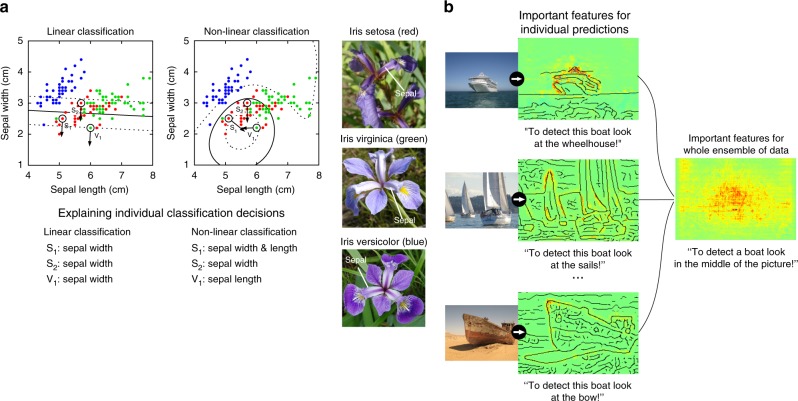
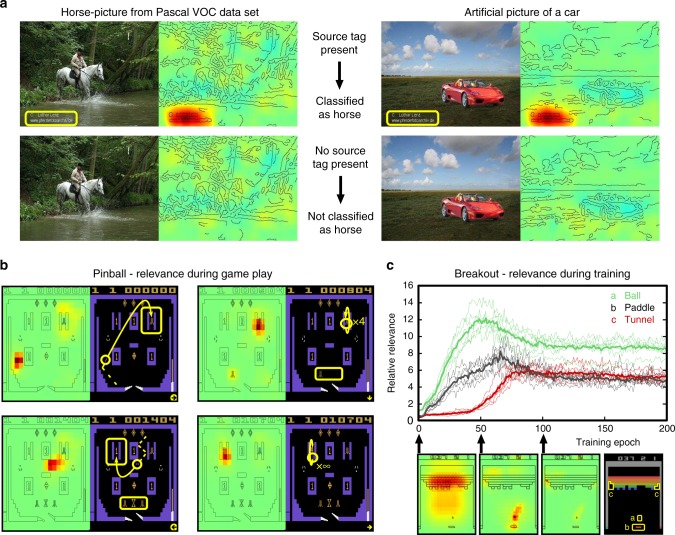
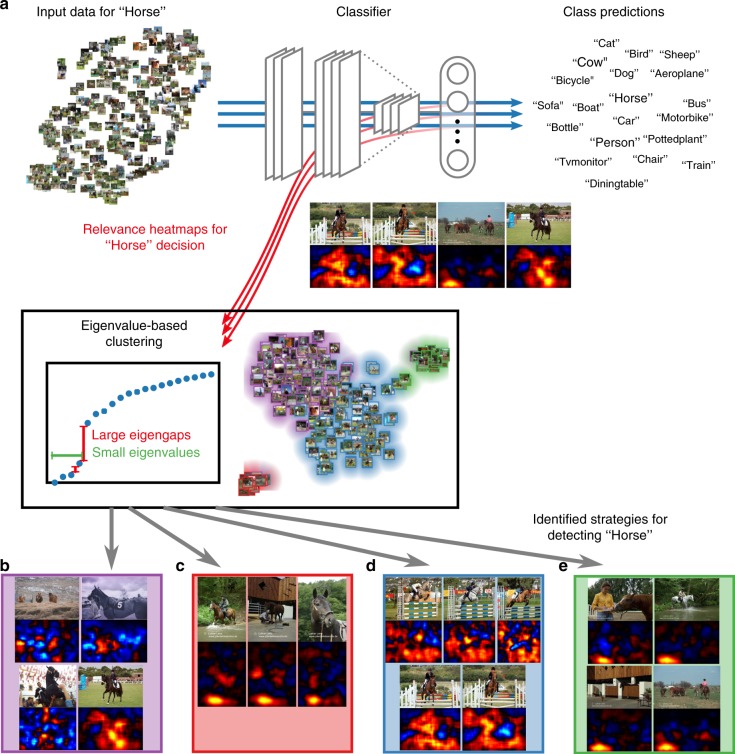
Current learning machines have successfully solved hard application problems, reaching high accuracy and displaying seemingly intelligent behavior. Here we apply recent techniques for explaining decisions of state-of-the-art learning machines and analyze various tasks from computer vision and arcade games. This showcases a spectrum of problem-solving behaviors ranging from naive and short-sighted, to well-informed and strategic. We observe that standard performance evaluation metrics can be oblivious to distinguishing these diverse problem solving behaviors. Furthermore, we propose our semi-automated Spectral Relevance Analysis that provides a practically effective way of characterizing and validating the behavior of nonlinear learning machines. This helps to assess whether a learned model indeed delivers reliably for the problem that it was conceived for. Furthermore, our work intends to add a voice of caution to the ongoing excitement about machine intelligence and pledges to evaluate and judge some of these recent successes in a more nuanced manner.
Overview
The claims and statistics of this paper haven’t been checked yet.
Free: it reads the open-access text and checks the first 5 claims that cite a source we can check. Create a free account to check every claim.
Integrity signals
Registry
Cites
Statistics
Figures
Verification
Claims the paper makes
The claims and statistics of this paper haven’t been checked yet.
Free: it reads the open-access text and checks the first 5 claims that cite a source we can check. Create a free account to check every claim.
Claims other papers make about this one
Each is checked against this paper’s own text: does it say what the citing paper says it does?
The cited source says what the claim attributes to it.
In the citing paper
“Thus, interpretability becomes fundamental to test against ' clever Hans ' models and to ensure that the model has learned relevant processes rather than spurious associations.”
From Artificial intelligence for climate prediction of extremes: State of the art, challenges, and future perspectives (2024) · cites this paper as Lapuschkin et al., 2019
The cited source says what the claim attributes to it.
In the citing paper
“There are examples of AI models predicting correctly for the wrong reasons (known as”
From Artificial intelligence for climate prediction of extremes: State of the art, challenges, and future perspectives (2024) · cites this paper as Lapuschkin et al., 2019
Self-check
Percentages, sums and reported differences re-computed from the paper’s own numbers.
The self-check needs the paper’s full text.
Citations
Cites
Deep Residual Learning for Image Recognition
He, K., Zhang, X., Ren, S., & Sun, J. (2016) · 2016 IEEE Conference on Computer Vision and Pattern Recognition (CVPR) · doi:10.1109/cvpr.2016.90 · Cited by 235,474
Hochreiter, S., & Schmidhuber, J. (1997) · Neural Computation · doi:10.1162/neco.1997.9.8.1735 · Cited by 102,318
LeCun, Y., Bengio, Y., & Hinton, G. (2015) · Nature · doi:10.1038/nature14539 · Cited by 84,126
Cortes, C., & Vapnik, V. (1995) · Machine Learning · doi:10.1007/bf00994018 · Cited by 59,421
Gradient-based learning applied to document recognition
Lecun, Y., Bottou, L., Bengio, Y., & Haffner, P. (1998) · Proceedings of the IEEE · doi:10.1109/5.726791 · Cited by 58,805
Going deeper with convolutions
Szegedy, C., Liu, W., Jia, Y., Sermanet, P., Reed, S., Anguelov, D., Erhan, D., Vanhoucke, V., & Rabinovich, A. (2015) · 2015 IEEE Conference on Computer Vision and Pattern Recognition (CVPR) · doi:10.1109/cvpr.2015.7298594 · Cited by 48,562
Human-level control through deep reinforcement learning
Mnih, V., Kavukcuoglu, K., Silver, D., Rusu, A. A., Veness, J., Bellemare, M. G., Graves, A., Riedmiller, M., Fidjeland, A. K., Ostrovski, G., et al. (2015) · Nature · doi:10.1038/nature14236 · Cited by 30,357
Multilayer feedforward networks are universal approximators
Hornik, K., Stinchcombe, M., & White, H. (1989) · Neural Networks · doi:10.1016/0893-6080(89)90020-8 · Cited by 21,728
The pascal visual object classes (VOC) challenge
Everingham, M., Van Gool, L., Williams, C. K. I., Winn, J., & Zisserman, A. (2010) · International Journal of Computer Vision · doi:10.1007/s11263-009-0275-4 · Cited by 19,599
"Why Should I Trust You?": Explaining the Predictions of Any Classifier
Ribeiro, M. T., Singh, S., & Guestrin, C. (2016) · Proceedings of the 22nd ACM SIGKDD International Conference on Knowledge Discovery and Data Mining · doi:10.1145/2939672.2939778 · Cited by 17,555
Research works printed but not linked: 9
- Pfungst O Clever Hans (the Horse of Mr. Von Osten): contribution to experimental animal and human psychology J. Philos. Psychol. Sci. Method 1911 8 663 666
- Guyon I Elisseeff A An introduction to variable and feature selection J. Mach. Learn. Res. 2003 3 1157 1182
- Nguyen, A., Dosovitskiy, A., Yosinski, J., Brox, T. & Clune, J. Synthesizing the preferred inputs for neurons in neural networks via deep generator networks. (D. D. Lee, M. Sugiyama, U. von Luxburg, I. Guyon, R. Garnett eds.) In Proc. Advances in Neural Information Processing Systems, 3387–3395 (Curran Associates, Inc., Red Hook, NY) (2016).
- Greydanus, S., Koul, A., Dodge, J. & Fern, A. Visualizing and understanding Atari agents. (J. Dy, A. Krause eds.) In Proc. International Conference on Machine Learning, 1787–1796 (JMLR.org, Brookline, MA) (2018).
- Zahavy, T., Ben-Zrihem, N. & Mannor, S. Graying the black box: Understanding DQNs. (M.-F. Balcan, K. Q. Weinberger eds.) In Proc. International Conference on Machine Learning, 1899–1908 (JMLR.org, Brookline, MA) (2016).
- Tsividis, P. A., Pouncy, T., Xu, J. L., Tenenbaum, J. B. & Gershman, S. J. Human learning in Atari. (G. Sukthankar, C. Geib eds.) In Proc. AAAI Spring Symposium Series, 643–646 (AAAI Press, Palo Alto, CA) (2017).
- Winston PH Horn B The Psychology of Computer Vision 1975 New York McGraw-Hill
- The European Parliament and the Council of the European Union.. Regulation (EU) 2016/679 of the European Parliament and of the Council of 27 April 2016 on the protection of natural persons with regard to the processing of personal data and on the free movement of such data, and repealing Directive 95/46/EC (General Data Protection Regulation) Off. J. Eur. Union 2016 L119 1 88
- Thomas, A. W., Heekeren, H. R., Müller, K.-R. & Samek, W. Interpretable LSTMs for whole-brain neuroimaging analyses. Preprint at https://arxiv.org/abs/1810.09945 (2018). · arXiv
Cited by
Items 801–900 of 1,003
Biometrics and Artificial Intelligence: Attacks and Challenges
Hernández–Álvarez, L., González‐Manzano, L., Fuentes, J. M. D., & Encinas, L. H. (2022) · Springer eBooks · doi:10.1007/978-3-031-10706-1_10 · Cited by 7
Finding Spurious Correlations with Function-Semantic Contrast Analysis
Bykov, K., Kopf, L., & Höhne, M. (2023) · Communications in computer and information science · doi:10.1007/978-3-031-44067-0_28 · Cited by 7
Decoding family‐level features for modern and fossil leaves from computer‐vision heat maps
Spagnuolo, E. J., Wilf, P., & Serre, T. (2022) · American Journal of Botany · doi:10.1002/ajb2.1842 · Cited by 7
Breier, B., & Onken, A. (2019) · arXiv (Cornell University) · doi:10.48550/arxiv.1912.09857 · Cited by 7
Human-centric explanation facilities
Chromik, M. (2021) · Electronic Theses of LMU Munich (Ludwig-Maximilians-Universität München) · doi:10.5282/edoc.28238 · Cited by 7
Challenges for cognitive decoding using deep learning methodsPreprint
Thomas, A. W., Ré, C., & Poldrack, R. A. (2021) · arXiv (Cornell University) · doi:10.48550/arxiv.2108.06896 · Cited by 7
Interpretability Guarantees with Merlin-Arthur ClassifiersPreprint
Wäldchen, S., Sharma, K., Turan, B., Zimmer, M., & Pokutta, S. (2022) · arXiv (Cornell University) · doi:10.48550/arxiv.2206.00759 · Cited by 7
Self-citationRobustness, Evaluation and Adaptation of Machine Learning Models in the WildPreprint
Piratla, V. (2023) · arXiv (Cornell University) · doi:10.48550/arxiv.2303.02781 · Cited by 7
Towards Interpretable Classification of Leukocytes based on Deep LearningPreprint
Röhrl, S., Groll, J., Lengl, M., Schumann, S., Klenk, C., Heim, D., Knopp, M., Hayden, O., & Diepold, K. J. (2023) · arXiv (Cornell University) · doi:10.48550/arxiv.2311.14485 · Cited by 7
Toward a Unified Framework for Debugging Gray-box Models.Preprint
Bontempelli, A., Giunchiglia, F., Passerini, A., & Teso, S. (2021) · Institutional Research Information System (Università degli Studi di Trento) · doi:10.48550/arxiv.2109.11160 · Cited by 6
Basics of Auditable AI Systems
Gräupner, O. S., Pawlaszczyk, D., & Hummert, C. (2023) · Congress in Computer Science, Computer Engineering, and Applied Computing (CSCE) · doi:10.1109/csce60160.2023.00382 · Cited by 6
Measuring model alignment for code clone detection using causal interpretation
Abid, S., Cai, X., & Jiang, L. (2024) · Empirical Software Engineering · doi:10.1007/s10664-024-10583-0 · Cited by 7
Multi-Scale Grouped Prototypes for Interpretable Semantic Segmentation
Porta, H., Dalsasso, E., Marcos, D., & Tuia, D. (2025) · IEEE Winter Conference on Applications of Computer Vision · doi:10.1109/wacv61041.2025.00284 · Cited by 6
Wang, X., Yang, J., Zhang, R., Xin, J., Yu, W., Ren, J., & Xiao, X. (2025) · Chinese Geographical Science · doi:10.1007/s11769-025-1527-0 · Cited by 6
Malware Detection with AI: A Comprehensive Review of Trends and Challenges with Future Directions
Singh, K., Gaur, M., Shukla, P. K., & Yadav, D. S. (2025) · Peer-to-Peer Networking and Applications · doi:10.1007/s12083-025-02112-7 · Cited by 6
Dong, R.-Z., Fan, Y., Na, B.-W., & Yang, J. (2025) · Composites Communications · doi:10.1016/j.coco.2025.102687 · Cited by 6
Chen, Z. S., Lu, B., & Wu, W. (2025) · IEEE Signal Processing Magazine · doi:10.1109/msp.2025.3595320 · Cited by 6
Bias in the Shadows: Explore Shortcuts in Encrypted Network Traffic Classification
Wang, C., Xie, X., Wang, T., & Cui, Y. (2026) · International Workshop on Quality of Service · doi:10.1109/iwqos70441.2026.11661209 · Cited by 6
Explainable Artificial Intelligence in biomedical engineering
Fonck, S., & Stollenwerk, A. (2026) · De Gruyter eBooks · doi:10.1515/9783111586458-013 · Cited by 6
INTUIT: Investigating intuitive reasoning in humans and language models
Cognitive Science Society 2025, Cheke, L. G., O'Flynn, A., & Prunty, J. E. (2025) · eScholarship (California Digital Library) · doi:10.48448/3x0z-en52 · Cited by 6
Fraile, M., Fawcett, C. A., Lindblad, J., Sladoje, N., & Castellano, G. (2022) · INTERNATIONAL CONFERENCE ON MULTIMODAL INTERACTION · doi:10.1145/3536221.3556629 · Cited by 6
Neglected Free Lunch – Learning Image Classifiers Using Annotation Byproducts
Han, D., Choe, J., Chun, S., Chung, J. J. Y., Chang, M., Yun, S., Song, J. Y., & Oh, S. J. (2023) · IEEE/CVF International Conference on Computer Vision (ICCV) · doi:10.1109/iccv51070.2023.01848 · Cited by 6
Dresden, T. U., Kretzschmar, M., Dammann, M. P., Schwoch, S., Berger, E., Saske, B., & Paetzold-Byhain, K. (2024) · Entwerfen Entwickeln Erleben in Produktentwicklung und Design (EEE) · doi:10.25368/2024.eee.031 · Cited by 6
IDEAL: A malicious traffic detection framework with explanation-guided learning
Jia, H., Lang, B., Li, X., & Yan, Y. (2025) · Knowledge-Based Systems · doi:10.1016/j.knosys.2025.113419 · Cited by 6
Perception Visualization: Seeing Through The Eyes Of a DNN
Giulivi, L., Carman, M., & Boracchi, G. (2021) · British Machine Vision Conference (BMVC) · doi:10.5244/c.35.426 · Cited by 7
Exploring complex pattern formation with convolutional neural networks
Scholz, C., & Scholz, S. (2022) · American Journal of Physics · doi:10.1119/5.0065458 · Cited by 6
Artificial Intelligence for Medical Decisions
Buchard, A., & Richens, J. G. (2022) · Springer eBooks · doi:10.1007/978-3-030-64573-1_28 · Cited by 6
A Methodological Framework for Facilitating Explainable AI Design
Zhang, J., & Yu, H. (2022) · Lecture notes in computer science · doi:10.1007/978-3-031-05061-9_31 · Cited by 6
Shaikh, T. A., Mir, W. A., & Sofi, S. A. (2022) · Studies in computational intelligence · doi:10.1007/978-3-030-97929-4_3 · Cited by 6
Explainable AI and Its Applications in Healthcare
Sarkar, A. (2022) · Intelligent systems reference library · doi:10.1007/978-3-031-12807-3_6 · Cited by 6
Establishing Transparency in Artificial Intelligence Systems
Quakulinski, L., Koumpis, A., & Beyan, O. (2022) · International Conference on Transdisciplinary AI (TransAI) · doi:10.1109/transai54797.2022.00027 · Cited by 6
Unsupervised DeepView: Global Explainability of Uncertainties for High Dimensional Data
Newen, C., & Müller, E. (2022) · IEEE International Conference on Knowledge Graph (ICKG) · doi:10.1109/ickg55886.2022.00032 · Cited by 6
Improving explainability results of convolutional neural networks in microscopy images
Kallipolitis, A., Yfantis, P., & Maglogiannis, I. G. (2023) · Neural Computing and Applications · doi:10.1007/s00521-023-08452-w · Cited by 6
A comprehensive assessment benchmark for rigorously evaluating deep learning image classifiers
Spratling, M. (2025) · Neural Networks · doi:10.1016/j.neunet.2025.107801 · Cited by 6
Müller, N. M., Jacobs, J., Williams, J. R., & Böttinger, K. (2023) · IEEE/CVF Conference on Computer Vision and Pattern Recognition Workshops (CVPRW) · doi:10.1109/cvprw59228.2023.00382 · Cited by 6
This Reads Like That: Deep Learning for Interpretable Natural Language Processing
Fanconi, C., Vandenhirtz, M., Husmann, S., & Vogt, J. E. (2023) · Conference on Empirical Methods in Natural Language Processing (EMNLP) · doi:10.18653/v1/2023.emnlp-main.869 · Cited by 6
Temporal segmentation in multi agent path finding with applications to explainability
Almagor, S., Kottinger, J., & Lahijanian, M. (2024) · Artificial Intelligence · doi:10.1016/j.artint.2024.104087 · Cited by 6
Machine learning and essentialism
Šekrst, K., & Skansi, S. (2022) · Philosophical Problems in Science (Zagadnienia Filozoficzne w Nauce) · doi:10.59203/zfn.73.595 · Cited by 6
Kamimura, R. (2021) · Neurocomputing · doi:10.1016/j.neucom.2021.04.019 · Cited by 6
Using compositionality to understand parts in whole objects
Arun, S. P. (2022) · European Journal of Neuroscience · doi:10.1111/ejn.15746 · Cited by 6
Relevance analysis of MRI sequences for automatic liver tumor segmentationPreprint
Chlebus, G., Abolmaali, N., Schenk, A., & Meine, H. (2019) · arXiv (Cornell University) · doi:10.48550/arxiv.1907.11773 · Cited by 6
HiResCAM: Explainable Multi-Organ Multi-Abnormality Prediction in 3D Medical Images.Preprint
Draelos, R. L., & Carin, L. (2020) · arXiv (Cornell University) · Cited by 6
Explainable Artificial Intelligence in Endocrinological Medical Research
Webb‐Robertson, B. (2021) · The Journal of Clinical Endocrinology & Metabolism · doi:10.1210/clinem/dgab237 · Cited by 6
Building Trustworthy Machine Learning Models for AstronomyPreprint
Ntampaka, M., Ho, M., & Nord, B. (2021) · arXiv (Cornell University) · doi:10.48550/arxiv.2111.14566 · Cited by 6
Laugwitz, L. L. (2021) · SocArXiv (OSF Preprints) · doi:10.31235/osf.io/gt28f · Cited by 6
Data augmentation and explainability for bias discovery and mitigation in deep learningPreprint
Mikołajczyk, A. (2023) · arXiv (Cornell University) · doi:10.48550/arxiv.2308.09464 · Cited by 7
Bajorath, J. (2024) · Future Science OA · doi:10.2144/fsoa-2023-0318 · Cited by 6
Training with Explanations Alone: A New Paradigm to Prevent Shortcut LearningPreprint
Bassi, P. R. A. S., Ali, H. A. H., Cavalli, A., & Decherchi, S. (2024) · arXiv (Cornell University) · doi:10.48550/arxiv.2407.09788 · Cited by 6
Obschonka, M., & Lévesque, M. (2024) · RePEc: Research Papers in Economics · doi:10.48550/arxiv.2409.08890 · Cited by 6
Mundt, M., Ovalle, A., Friedrich, F., Pranav, A., Paul, S., Brack, M., Kersting, K., & Agnew, W. S. (2025) · arXiv (Cornell University) · doi:10.48550/arxiv.2502.03038 · Cited by 6
Liang, J., Huang, J., Jiao, X., Liang, S., Liu, S., & Cao, X. (2025) · arXiv (Cornell University) · doi:10.48550/arxiv.2509.22415 · Cited by 6
Liu, S., Kailkhura, B., Zhang, J., Hiszpanski, A. M., Robertson, E. L., Loveland, D., & Han, T. Y.-J. (2020) · arXiv (Cornell University) · doi:10.48550/arxiv.2007.08631 · Cited by 6
RobustMap: Visual Exploration of DNN Adversarial Robustness in Generative Latent Space
Li, J., & Kuang, J. (2024) · IEEE Transactions on Visualization and Computer Graphics · doi:10.1109/tvcg.2024.3471551 · Cited by 5
End-To-End Deep Learning Explains Antimicrobial Resistance in Peak-Picking-Free MALDI-MS Data
Lassen, J. K., & Villesen, P. (2025) · Analytical Chemistry · doi:10.1021/acs.analchem.4c05113 · Cited by 5
Braune, A., Hosch, R., Kersting, D., Müller, J., Hofheinz, F., Herrmann, K., Nensa, F., Kotzerke, J., & Seifert, R. (2025) · EJNMMI Physics · doi:10.1186/s40658-025-00745-4 · Cited by 5
Wu, Y., Dong, Y., Mou, Y., & Kim, K. J. (2025) · CHI Conference on Human Factors in Computing Systems · doi:10.1145/3706598.3713199 · Cited by 5
Explainable AI Model Reveals Informative Mutational Signatures for Cancer-Type Classification
Wagner, J., Oldenburg, J., Nath, N., & Simm, S. (2025) · Cancers · doi:10.3390/cancers17111731 · Cited by 5
Graciosa, J. C., Corbi, F., & Capitanio, F. A. (2025) · Geophysical Research Letters · doi:10.1029/2024gl114428 · Cited by 5
Unraveling the physicochemical differences among Osborne protein classes via bioinformatics and AI
Kwon, H., Xu, Y., Xu, X., & Li, Y. (2025) · Food Research International · doi:10.1016/j.foodres.2025.117322 · Cited by 5
Explainable Reinforcement Learning via Dynamic Mixture Policies
Schier, M., Schubert, F., & Rosenhahn, B. (2025) · Proceedings - IEEE International Conference on Robotics and Automation/Proceedings · doi:10.1109/icra55743.2025.11127782 · Cited by 5
Explainable Seismic Event Discrimination: Improved Explainability With Vision Transformers
Kasburg, V., Zehner, M., van Laaten, M., Müller, J., & Kukowski, N. (2025) · Journal of Geophysical Research Machine Learning and Computation · doi:10.1029/2025jh000802 · Cited by 5
Empowering scientific discovery with explainable small domain-specific and large language models
Yu, H., Wang, Y., Cheng, T., Yan, Y., Dawson, K. A., Li, S. F. Y., Zheng, Y., & Jin, Y. (2025) · Artificial Intelligence Review · doi:10.1007/s10462-025-11365-w · Cited by 5
POMELO: Black-Box Feature Attribution with Full-Input, In-Distribution Perturbations
Ademi, L., Noppel, M., & Wressnegger, C. (2025) · Communications in computer and information science · doi:10.1007/978-3-032-08324-1_10 · Cited by 5
Model Science: Getting Serious About Verification, Explanation and Control of AI Systems
Biecek, P., & Samek, W. (2025) · Frontiers in artificial intelligence and applications · doi:10.3233/faia250784 · Cited by 5
Self-citationDiffusion Counterfactuals for Image Regressors
Ha, T. D., & Bender, S. (2025) · Communications in computer and information science · doi:10.1007/978-3-032-08330-2_6 · Cited by 5
Li, G., Nie, W., & Li, Y. (2026) · Agricultural Water Management · doi:10.1016/j.agwat.2026.110177 · Cited by 5
Mahindran, M., Liu, Q., Kadambalithaya, V. M., & Kalinina, O. V. (2026) · Journal of Chemical Information and Modeling · doi:10.1021/acs.jcim.6c00037 · Cited by 5
Clever materials: when models identify good materials for the wrong reasons
Jablonka, K. M. (2026) · Faraday Discussions · doi:10.1039/d6fd00024j · Cited by 5
Erfassung der Bedeutung von geschriebenem Text
Paaß, G., & Hecker, D. (2020) · Künstliche Intelligenz · doi:10.1007/978-3-658-30211-5_6 · Cited by 5
Feature Importance in Explainable AI for Expounding Black Box Models
Bhuyan, B. P., & Srivastava, S. (2023) · Lecture notes in networks and systems · doi:10.1007/978-981-19-6634-7_58 · Cited by 5
Hartong, S., & Renz, A. (2024) · Bildungsforschung · doi:10.1515/9783839468937 · Cited by 5
Knof, H., Boerger, M., & Tcholtchev, N. (2024) · Communications in computer and information science · doi:10.1007/978-3-031-63803-9_9 · Cited by 5
SE3D: A Framework for Saliency Method Evaluation in 3D Imaging
Wiśniewski, M., Giulivi, L., & Boracchi, G. (2024) · Proceedings - International Conference on Image Processing · doi:10.1109/icip51287.2024.10647305 · Cited by 5
Li, Z., Zhang, Y., Chen, Z., Chen, J., Hou, H., Wang, C., Lu, Z., Wang, X., Geng, X., & Liu, F. (2024) · Frontiers in Digital Health · doi:10.3389/fdgth.2024.1510674 · Cited by 5
Radke, T., Fuchs, S., Wilms, C., Polkova, I., & Rautenhaus, M. (2025) · Geoscientific model development · doi:10.5194/gmd-18-1017-2025 · Cited by 5
A Convolutional Neural Network as a Potential Tool for Camouflage Assessment
der Burg, E. V., Toet, A., Perone, P., & Hogervorst, M. A. J. (2025) · Applied Sciences · doi:10.3390/app15095066 · Cited by 5
Deep Supramolecular Language Processing for Co‐Crystal Prediction
Birolo, R., Özçelik, R., Aramini, A., Gobetto, R., Chierotti, M. R., & Grisoni, F. (2025) · Angewandte Chemie · doi:10.1002/ange.202507835 · Cited by 5
AI Literacy for the Common Good
Ullrich, S., & Messerschmidt, R. (2024) · Weizenbaum Journal of the Digital Society · doi:10.34669/wi.wjds/4.1.5 · Cited by 5
Varini, F., Gayford, J. H., Jenrette, J., Witt, M. J., Garzon, F., Ferretti, F., Wilday, S., Bond, M. E., Heithaus, M. R., Robinson, D., et al. (2026) · Ecological Informatics · doi:10.1016/j.ecoinf.2026.103713 · Cited by 5
Patch Shortcuts: Interpretable Proxy Models Efficiently Find Black-Box Vulnerabilities
Rosenzweig, J., Sicking, J., Houben, S., Möck, M., & Akila, M. (2021) · IEEE/CVF Conference on Computer Vision and Pattern Recognition Workshops (CVPRW) · doi:10.1109/cvprw53098.2021.00015 · Cited by 5
Zong, W., Chow, Y.-W., Susilo, W., Kim, J., & Le, N. T. (2022) · Journal of Imaging · doi:10.3390/jimaging8120324 · Cited by 5
Keppel, J., Liebers, J., Auda, J., Gruenefeld, U., & Schneegaß, S. (2022) · International Conference on Mobile and Ubiquitous Multimedia (MUM) · doi:10.1145/3568444.3568469 · Cited by 5
Manipulating Feature Visualizations with Gradient Slingshots
Bareeva, D., Höhne, M., Warnecke, A., Pirch, L., Müller, K., Rieck, K., Lapuschkin, S., & Bykov, K. (2025) · neural information processing systems · doi:10.52202/085713-5560 · Cited by 5
Self-citationZhang, X., Ono, J. P., He, W., Gou, L., Sachan, M., Ma, K., & Ren, L. (2024) · ACM International Conference on Intelligent User Interfaces (IUI) · doi:10.1145/3640543.3645163 · Cited by 5
FaceX: Understanding Face Attribute Classifiers through Summary Model Explanations
Sarridis, I., Koutlis, C., Papadopoulos, S., & Diou, C. (2024) · International Conference on Multimedia Retrieval · doi:10.1145/3652583.3658007 · Cited by 5
Stable multivariate lesion symptom mapping
Teghipco, A., Newman‐Norlund, R., Gibson, M., Bonilha, L., Absher, J. R., Fridriksson, J., & Rorden, C. (2024) · Aperture Neuro · doi:10.52294/001c.117311 · Cited by 5
Philosophische Digitalisierungsforschung: Verantwortung, Verständigung, Vernunft, Macht
Adolphi, R., Alpsancar, S., Hahn, S., & Kettner, M. (2024) · Digitale Gesellschaft · doi:10.14361/9783839474976 · Cited by 5
Network artificial intelligence, fast and slow
Rossi, D., & Zhang, L. (2022) · doi:10.1145/3565009.3569521 · Cited by 5
Interpreting the decisions of CNNs via influence functions
Aamir, A., Tamošiūnaitė, M., & Wörgötter, F. (2023) · Frontiers in Computational Neuroscience · doi:10.3389/fncom.2023.1172883 · Cited by 5
Weber, K., Tinnes, L., Huber, T., Heimerl, A., Reinecker, M.-L., Pohlen, E., & André, E. (2020) · Lecture notes in computer science · doi:10.1007/978-3-030-51924-7_7 · Cited by 5
Michaud, A., Adams, O., Cox, C., Guillaume, S., Wisniewski, G., & Galliot, B. (2020) · Bulletin de la Société de Linguistique de Paris · doi:10.2143/bsl.115.1.3289158 · Cited by 5
Interpreting and Explaining Deep Neural Networks: A Perspective on Time Series Data
Choi, J. (2020) · ACM SIGKDD Conference on Knowledge Discovery and Data Mining (KDD) · doi:10.1145/3394486.3406478 · Cited by 6
An Evolutionary Algorithm for Learning Interpretable Ensembles of Classifiers
Cagnini, H. E. L., Freitas, A. A., & Barros, R. C. (2020) · Lecture notes in computer science · doi:10.1007/978-3-030-61377-8_2 · Cited by 5
Weakly Supervised Attention Map Training for Histological Localization of Colonoscopy Images
Kwon, J., & Choi, K. (2021) · Annual International Conference of the IEEE Engineering in Medicine and Biology Society (EMBC) · doi:10.1109/embc46164.2021.9629608 · Cited by 5
Visualizing the Diversity of Representations Learned by Bayesian Neural Networks
Grinwald, D., Bykov, K., Nakajima, S., & Höhne, M. (2023) · Transactions on machine learning research · doi:10.48550/arxiv.2201.10859 · Cited by 5
Discussion of “Prediction, Estimation, and Attribution” by Bradley Efron
Friedman, J. H., Hastie, T. J., & Tibshirani, R. J. (2020) · Journal of the American Statistical Association · doi:10.1080/01621459.2020.1762617 · Cited by 5
Exposing Image Classifier Shortcuts with Counterfactual Frequency (CoF) TablesPreprint
Hinns, J., & Martens, D. (2024) · arXiv (Cornell University) · doi:10.48550/arxiv.2405.15661 · Cited by 5
SIDE: Sparse Information Disentanglement for Explainable Artificial IntelligencePreprint
Dubovik, V., Struski, Ł., Tabor, J., & Rymarczyk, D. (2025) · arXiv (Cornell University) · doi:10.48550/arxiv.2507.19321 · Cited by 5
Shen, Y., Chen, Z., He, Y., Xu, Y., Zhang, S., Sun, L., Wang, Z., Zhu, Y., Yang, Y., Qian, J., et al. (2025) · arXiv (Cornell University) · doi:10.48550/arxiv.2511.15242 · Cited by 5
Kasmi, G. (2024) · theses.fr (ABES) · doi:10.70675/370cb136zf495z4962z96e0z5f83c7836b58 · Cited by 5
Metadata
- Authors
- Lapuschkin, S., Wäldchen, S., Binder, A., Montavon, G., Samek, W., & Müller, K.-R.
- Affiliations
- Fraunhofer Institute for Telecommunications, Heinrich Hertz Institute (DE)
- Technische Universität Berlin (DE)
- Singapore University of Technology and Design (SG)
- Korea University (KR)
- Corresponding author
- Samek, Wojciech
- Müller, Klaus-Robert
- Venue
- Nature Communications
- Published
- 2019-03-11
- Volume
- 10
- Issue
- 1
- Pages
- 1096-1096
- ISSN
- 2041-1723 (ISSN-L)
- PMC
- PMC6411769
- OpenAlex
- W2921802966
- Semantic Scholar
- 4f51a64793d3b2a60e9e5846c31dae023cf5c69a
- Cited by
- 1,047
- References
- 41
- Citations by year
- 2026: 129 · 2025: 178 · 2024: 142 · 2023: 178 · 2022: 159 · 2021: 140 · 2020: 86 · 2019: 34
- FWCI
- 47.80
- Type
- journal article
- Language
- en
- Open access
- gold
- doi.org
- Licence
- cc-by
- creativecommons.org/licenses/by/4.0 (tdm)
- creativecommons.org/licenses/by/4.0 (vor)
- Locations
- Nature Communications (publishedVersion, cc-by)
- Europe PMC (PubMed Central) (publishedVersion, cc-by)
- PubMed Central (publishedVersion, cc-by)
- PubMed (publishedVersion)
- arXiv (Cornell University) (submittedVersion)
- DOAJ (DOAJ: Directory of Open Access Journals) (submittedVersion)
- DOAJ (DOAJ: Directory of Open Access Journals) (submittedVersion, cc-by-sa)
- Publikationsdatenbank der Fraunhofer-Gesellschaft (Fraunhofer-Gesellschaft) (submittedVersion, other-oa)
- Fraunhofer-Publica (Fraunhofer-Gesellschaft) (submittedVersion)
- arXiv (Cornell University)
- Funders
- Deutsche Forschungsgemeinschaft (EXC-2046, EXC‐2046/1, 01IS18037I, 390685689)
- Institute for Information and Communications Technology Promotion (2017-0-00451)
- Topics
- Physical Sciences › Computer Science › Artificial Intelligence › Explainable Artificial Intelligence (XAI)
- Physical Sciences › Computer Science › Software › Software Testing and Debugging Techniques
- Physical Sciences › Computer Science › Artificial Intelligence › Adversarial Robustness in Machine Learning
- Keywords
- Clever Hans effect, explainable AI, decision explanation, problem-solving behavior, model evaluation metrics, computer vision, arcade games, model validation, machine intelligence
About these checks
Registry, retraction, Cites and statistics results are computed, not judged, with one exception: a printed reference that no index lists is read once by a model before it counts as a citation error. Claims are extracted by a model and kept only when their quote appears verbatim in the text; each cited source is then checked, with a model’s help, for whether it says what the claim relies on. Those verdicts can be wrong — read the claim’s quote and the cited source before relying on one.
Statistics and arithmetic are recomputed, not judged.
Confidence bands are shown only for fields calibrated on our annotated test set. None is calibrated yet, so no band is shown.
What counts as a claim ›How we measure confidence ›How we check this ›
Are you an author, or do you see a problem with this page? Request a review
Data sources
Bibliographic data: Semantic Scholar, OpenAlex, Crossref.
Contains information from the Semantic Scholar Academic Graph Datasets, made available under the ODC Attribution License (ODC-BY 1.0).
Semantic Scholar’s data is described in: Kinney, R., et al. (2023). The Semantic Scholar Open Data Platform. arXiv:2301.10140.
