

Unmasking Clever Hans predictors and assessing what machines really learn
Open accessThe DOI matches its Crossref record; 65 of the 65 references it cites were found in a registry or an index.
Abstract
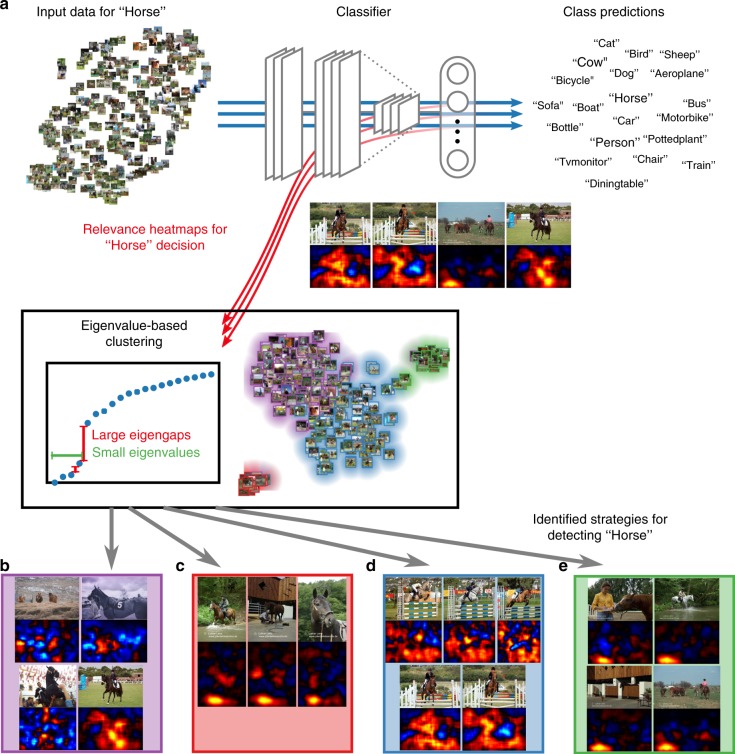
Current learning machines have successfully solved hard application problems, reaching high accuracy and displaying seemingly intelligent behavior. Here we apply recent techniques for explaining decisions of state-of-the-art learning machines and analyze various tasks from computer vision and arcade games. This showcases a spectrum of problem-solving behaviors ranging from naive and short-sighted, to well-informed and strategic. We observe that standard performance evaluation metrics can be oblivious to distinguishing these diverse problem solving behaviors. Furthermore, we propose our semi-automated Spectral Relevance Analysis that provides a practically effective way of characterizing and validating the behavior of nonlinear learning machines. This helps to assess whether a learned model indeed delivers reliably for the problem that it was conceived for. Furthermore, our work intends to add a voice of caution to the ongoing excitement about machine intelligence and pledges to evaluate and judge some of these recent successes in a more nuanced manner.
Overview
The claims and statistics of this paper haven’t been checked yet.
Free: it reads the open-access text and checks the first 5 claims that cite a source we can check. Create a free account to check every claim.
Integrity signals
Registry
Cites
Statistics
Figures
Verification
Claims the paper makes
The claims and statistics of this paper haven’t been checked yet.
Free: it reads the open-access text and checks the first 5 claims that cite a source we can check. Create a free account to check every claim.
Claims other papers make about this one
Each is checked against this paper’s own text: does it say what the citing paper says it does?
The cited source says what the claim attributes to it.
In the citing paper
“Thus, interpretability becomes fundamental to test against ' clever Hans ' models and to ensure that the model has learned relevant processes rather than spurious associations.”
From Artificial intelligence for climate prediction of extremes: State of the art, challenges, and future perspectives (2024) · cites this paper as Lapuschkin et al., 2019
The cited source says what the claim attributes to it.
In the citing paper
“There are examples of AI models predicting correctly for the wrong reasons (known as”
From Artificial intelligence for climate prediction of extremes: State of the art, challenges, and future perspectives (2024) · cites this paper as Lapuschkin et al., 2019
Self-check
Percentages, sums and reported differences re-computed from the paper’s own numbers.
The self-check needs the paper’s full text.
Citations
Cites
Deep Residual Learning for Image Recognition
He, K., Zhang, X., Ren, S., & Sun, J. (2016) · 2016 IEEE Conference on Computer Vision and Pattern Recognition (CVPR) · doi:10.1109/cvpr.2016.90 · Cited by 235,474
Hochreiter, S., & Schmidhuber, J. (1997) · Neural Computation · doi:10.1162/neco.1997.9.8.1735 · Cited by 102,318
LeCun, Y., Bengio, Y., & Hinton, G. (2015) · Nature · doi:10.1038/nature14539 · Cited by 84,126
Cortes, C., & Vapnik, V. (1995) · Machine Learning · doi:10.1007/bf00994018 · Cited by 59,421
Gradient-based learning applied to document recognition
Lecun, Y., Bottou, L., Bengio, Y., & Haffner, P. (1998) · Proceedings of the IEEE · doi:10.1109/5.726791 · Cited by 58,805
Going deeper with convolutions
Szegedy, C., Liu, W., Jia, Y., Sermanet, P., Reed, S., Anguelov, D., Erhan, D., Vanhoucke, V., & Rabinovich, A. (2015) · 2015 IEEE Conference on Computer Vision and Pattern Recognition (CVPR) · doi:10.1109/cvpr.2015.7298594 · Cited by 48,562
Human-level control through deep reinforcement learning
Mnih, V., Kavukcuoglu, K., Silver, D., Rusu, A. A., Veness, J., Bellemare, M. G., Graves, A., Riedmiller, M., Fidjeland, A. K., Ostrovski, G., et al. (2015) · Nature · doi:10.1038/nature14236 · Cited by 30,357
Multilayer feedforward networks are universal approximators
Hornik, K., Stinchcombe, M., & White, H. (1989) · Neural Networks · doi:10.1016/0893-6080(89)90020-8 · Cited by 21,728
The pascal visual object classes (VOC) challenge
Everingham, M., Van Gool, L., Williams, C. K. I., Winn, J., & Zisserman, A. (2010) · International Journal of Computer Vision · doi:10.1007/s11263-009-0275-4 · Cited by 19,599
"Why Should I Trust You?": Explaining the Predictions of Any Classifier
Ribeiro, M. T., Singh, S., & Guestrin, C. (2016) · Proceedings of the 22nd ACM SIGKDD International Conference on Knowledge Discovery and Data Mining · doi:10.1145/2939672.2939778 · Cited by 17,555
Research works printed but not linked: 9
- Pfungst O Clever Hans (the Horse of Mr. Von Osten): contribution to experimental animal and human psychology J. Philos. Psychol. Sci. Method 1911 8 663 666
- Guyon I Elisseeff A An introduction to variable and feature selection J. Mach. Learn. Res. 2003 3 1157 1182
- Nguyen, A., Dosovitskiy, A., Yosinski, J., Brox, T. & Clune, J. Synthesizing the preferred inputs for neurons in neural networks via deep generator networks. (D. D. Lee, M. Sugiyama, U. von Luxburg, I. Guyon, R. Garnett eds.) In Proc. Advances in Neural Information Processing Systems, 3387–3395 (Curran Associates, Inc., Red Hook, NY) (2016).
- Greydanus, S., Koul, A., Dodge, J. & Fern, A. Visualizing and understanding Atari agents. (J. Dy, A. Krause eds.) In Proc. International Conference on Machine Learning, 1787–1796 (JMLR.org, Brookline, MA) (2018).
- Zahavy, T., Ben-Zrihem, N. & Mannor, S. Graying the black box: Understanding DQNs. (M.-F. Balcan, K. Q. Weinberger eds.) In Proc. International Conference on Machine Learning, 1899–1908 (JMLR.org, Brookline, MA) (2016).
- Tsividis, P. A., Pouncy, T., Xu, J. L., Tenenbaum, J. B. & Gershman, S. J. Human learning in Atari. (G. Sukthankar, C. Geib eds.) In Proc. AAAI Spring Symposium Series, 643–646 (AAAI Press, Palo Alto, CA) (2017).
- Winston PH Horn B The Psychology of Computer Vision 1975 New York McGraw-Hill
- The European Parliament and the Council of the European Union.. Regulation (EU) 2016/679 of the European Parliament and of the Council of 27 April 2016 on the protection of natural persons with regard to the processing of personal data and on the free movement of such data, and repealing Directive 95/46/EC (General Data Protection Regulation) Off. J. Eur. Union 2016 L119 1 88
- Thomas, A. W., Heekeren, H. R., Müller, K.-R. & Samek, W. Interpretable LSTMs for whole-brain neuroimaging analyses. Preprint at https://arxiv.org/abs/1810.09945 (2018). · arXiv
Cited by
Items 201–300 of 1,003
Scientific Exploration and Explainable Artificial Intelligence
Zednik, C., & Boelsen, H. (2022) · Minds and Machines · doi:10.1007/s11023-021-09583-6 · Cited by 80
An Experimental Study of Quantitative Evaluations on Saliency Methods
Li, X., Shi, Y., Li, H., Bai, W., Cao, C. C., & Chen, L. (2021) · ACM SIGKDD Conference on Knowledge Discovery and Data Mining (KDD) · doi:10.1145/3447548.3467148 · Cited by 79
Single-cell gene regulatory network prediction by explainable AI
Keyl, P., Bischoff, P., Dernbach, G., Bockmayr, M. L., Fritz, R., Horst, D. A., Blüthgen, N., Montavon, G., Müller, K., & Klauschen, F. (2023) · Nucleic Acids Research · doi:10.1093/nar/gkac1212 · Cited by 80
Self-citationReimann, R., Zeng, B., Jakopec, M., Burdukiewicz, M., Petrick, I., Schierack, P., & Rödiger, S. (2020) · Algal Research · doi:10.1016/j.algal.2020.101908 · Cited by 79
Promises and pitfalls of deep neural networks in neuroimaging-based psychiatric research
Eitel, F., Schulz, M.-A., Seiler, M., Walter, H., & Ritter, K. (2021) · Experimental Neurology · doi:10.1016/j.expneurol.2021.113608 · Cited by 80
Anders, C. J., Neumann, D., Samek, W., Müller, K., & Lapuschkin, S. (2026) · PLoS ONE · doi:10.1371/journal.pone.0336683 · Cited by 79
Self-citationOccluded Person Re-Identification with Single-scale Global Representations
Cheng, Y., Pang, G., Jiao, J., Bai, X. P., Feng, X., & Shen, C. (2021) · IEEE/CVF International Conference on Computer Vision (ICCV) · doi:10.1109/iccv48922.2021.01166 · Cited by 79
Robustness of convolutional neural networks in recognition of pigmented skin lesions
Maron, R. C., Haggenmüller, S., Kalle, C. V., Utikal, J. S., Meier, F. E., Gellrich, F. F., Hauschild, A., French, L. E., Schlaak, M. S., Ghoreschi, K., et al. (2021) · European Journal of Cancer · doi:10.1016/j.ejca.2020.11.020 · Cited by 79
Li, H., Wu, J., Xu, H., Li, G., & Guizani, M. (2021) · IEEE Transactions on Dependable and Secure Computing · doi:10.1109/tdsc.2021.3130944 · Cited by 79
Hofmann, S., Beyer, F., Lapuschkin, S., Goltermann, O., Loeffler, M., Müller, K., Villringer, A., Samek, W., & Witte, A. V. (2022) · NeuroImage · doi:10.1016/j.neuroimage.2022.119504 · Cited by 78
Self-citationExplaining AI through mechanistic interpretability
Kästner, L., & Crook, B. (2024) · European Journal for Philosophy of Science · doi:10.1007/s13194-024-00614-4 · Cited by 79
Survey of XAI in Digital Pathology
Pocevičiūtė, M., Eilertsen, G., & Lundström, C. (2020) · Lecture notes in computer science · doi:10.1007/978-3-030-50402-1_4 · Cited by 76
Fricke, C., Alizadeh, J., Zakhary, N., Woost, T. B., Bogdan, M., & Claßen, J. (2021) · Frontiers in Neurology · doi:10.3389/fneur.2021.666458 · Cited by 78
Gunashekar, D. D., Bielak, L., Hägele, L., Oerther, B., Benndorf, M., Grosu, A., Brox, T., Zamboglou, C., & Bock, M. (2022) · Radiation Oncology · doi:10.1186/s13014-022-02035-0 · Cited by 77
Varieties of AI Explanations Under the Law. From the GDPR to the AIA, and Beyond
Hacker, P., & Passoth, J.-H. (2022) · Lecture Notes in Computer Science · doi:10.1007/978-3-031-04083-2_17 · Cited by 76
SliceTeller : A Data Slice-Driven Approach for Machine Learning Model Validation
Zhang, X., Ono, J. P., Song, H., Gou, L., Ma, K., & Ren, L. (2022) · IEEE Transactions on Visualization and Computer Graphics · doi:10.1109/tvcg.2022.3209465 · Cited by 76
Han, S. S., Kim, Y. J., Moon, I. J., Jung, J. M., Lee, M. Y., Lee, W. J., Won, C. H., Lee, M. W., Kim, S. H., Navarrete-Dechent, C., et al. (2022) · Journal of Investigative Dermatology · doi:10.1016/j.jid.2022.02.003 · Cited by 75
Mieth, B., Rozier, A., Rodríguez, J. A., Höhne, M., Görnitz, N., & Müller, K. (2021) · NAR Genomics and Bioinformatics · doi:10.1093/nargab/lqab065 · Cited by 75
Self-citationWon, D.-O., Jang, Y.-N., & Lee, S. (2022) · IEEE Transactions on Emerging Topics in Computing · doi:10.1109/tetc.2022.3170544 · Cited by 74
Interpretable machine learning for psychological research: Opportunities and pitfalls.
Henninger, M., Debelak, R., Rothacher, Y., & Strobl, C. (2025) · Psychological Methods · doi:10.1037/met0000560 · Cited by 74
Revisiting the Performance-Explainability Trade-Off in Explainable Artificial Intelligence (XAI)
Crook, B., Schlüter, M., & Speith, T. (2023) · 2023 IEEE 31st International Requirements Engineering Conference Workshops (REW) · doi:10.1109/rew57809.2023.00060 · Cited by 36
AudioMNIST: Exploring Explainable Artificial Intelligence for audio analysis on a simple benchmark
Becker, S., Vielhaben, J., Ackermann, M., Müller, K.-R., Lapuschkin, S., & Samek, W. (2024) · Journal of the Franklin Institute · doi:10.1016/j.jfranklin.2023.11.038 · Cited by 73
Self-citationInspect, Understand, Overcome: A Survey of Practical Methods for AI Safety
Houben, S., Abrecht, S., Akila, M., Bär, A., Brockherde, F., Feifel, P., Fingscheidt, T., Gannamaneni, S. S., Ghobadi, S. E., Hammam, A., et al. (2022) · Springer eBooks · doi:10.1007/978-3-031-01233-4_1 · Cited by 74
What do neural networks learn in image classification? A frequency shortcut perspective
Wang, S., Veldhuis, R. N. J., Brüne, C., & Strisciuglio, N. (2023) · IEEE/CVF International Conference on Computer Vision (ICCV) · doi:10.1109/iccv51070.2023.00138 · Cited by 74
A scoping review and expert consensus on digital determinants of health
van Kessel, R., Seghers, L.-E., Anderson, M., Schutte, N. M., Monti, G., Haig, M., Schmidt, J., Wharton, G., Román-Urrestarazu, A., Larrain, B., et al. (2025) · Bulletin of the World Health Organization · doi:10.2471/blt.24.292057 · Cited by 73
Abbasi, N., Nizamullah, F. N. U., & Zeb, S. (2023) · BULLET : Jurnal Multidisiplin Ilmu · Cited by 73
Survey of Explainable Machine Learning with Visual and Granular Methods Beyond Quasi-Explanations
Kovalerchuk, B., Ahmad, M. A., & Teredesai, A. M. (2021) · Studies in computational intelligence · doi:10.1007/978-3-030-64949-4_8 · Cited by 74
March, C. (2021) · Journal of Economic Psychology · doi:10.1016/j.joep.2021.102426 · Cited by 72
Compact and Computationally Efficient Representation of Deep Neural Networks
Wiedemann, S., Muller, K.-R., & Samek, W. (2020) · IEEE Transactions on Neural Networks and Learning Systems · doi:10.1109/tnnls.2019.2910073 · Cited by 72
Self-citationde Souza, L. A., Mendel, R., Strasser, S., Ebigbo, A., Probst, A., Messmann, H., Papa, J. P., & Palm, C. (2021) · Computers in Biology and Medicine · doi:10.1016/j.compbiomed.2021.104578 · Cited by 72
Lasers that learn: The interface of laser machining and machine learning
Mills, B., & Grant‐Jacob, J. A. (2021) · IET Optoelectronics · doi:10.1049/ote2.12039 · Cited by 71
This looks More Like that: Enhancing Self-Explaining Models by Prototypical Relevance Propagation
Gautam, S., Höhne, M., Hansen, S., Jenssen, R., & Kampffmeyer, M. (2022) · Pattern Recognition · doi:10.1016/j.patcog.2022.109172 · Cited by 71
Deciphering urban traffic impacts on air quality by deep learning and emission inventory
Du, W., Chen, L., Wang, H., Shan, Z., Zhou, Z., Li, W., & Wang, Y. (2022) · Journal of Environmental Sciences · doi:10.1016/j.jes.2021.12.035 · Cited by 71
Continual Learning: Applications and the Road ForwardPreprint
Verwimp, E., Aljundi, R., Ben-David, S., Bethge, M., Cossu, A., Gepperth, A., Hayes, T. L., Hüllermeier, E., Kanan, C., Kudithipudi, D., et al. (2024) · Transactions on machine learning research · doi:10.48550/arxiv.2311.11908 · Cited by 71
Ravindran, A. S., & Contreras-Vidal, J. L. (2023) · Scientific Reports · doi:10.1038/s41598-023-43871-8 · Cited by 71
Interpretability of deep neural networks: A review of methods, classification and hardware
Antamis, T., Drosou, A., Vafeiadis, T., Nizamis, A., Ioannidis, D., & Tzovaras, D. K. (2024) · Neurocomputing · doi:10.1016/j.neucom.2024.128204 · Cited by 70
Speech is Silver, Silence is Golden: What do ASVspoof-trained Models Really Learn?
Müller, N., Dieckmann, F., Czempin, P., Canals, R., Böttinger, K., & Williams, J. (2021) · 2021 Edition of the Automatic Speaker Verification and Spoofing Countermeasures Challenge · doi:10.21437/asvspoof.2021-9 · Cited by 69
Bender, T., Metsch, J. M., Krefting, D., Müller, C., Dathe, H., Seidler, T., Spicher, N., & Hauschild, A.-C. (2023) · IEEE Journal of Biomedical and Health Informatics · doi:10.1109/jbhi.2023.3271858 · Cited by 69
Explainable AI In Education : Current Trends, Challenges, And Opportunities
Rachha, A., & Seyam, M. (2023) · SoutheastCon 2023 · doi:10.1109/southeastcon51012.2023.10115140 · Cited by 68
Building and Interpreting Deep Similarity Models
Eberle, O., Buttner, J., Krautli, F., Muller, K.-R., Valleriani, M., & Montavon, G. (2022) · IEEE Transactions on Pattern Analysis and Machine Intelligence · doi:10.1109/tpami.2020.3020738 · Cited by 68
Self-citationExplainable Machine Learning with Prior Knowledge: An Overview
Beckh, K., Müller, S., Jakobs, M., Toborek, V., Tan, H., Fischer, R., Welke, P., Houben, S., & von Rueden, L. (2021) · Lancaster EPrints (Lancaster University) · doi:10.48550/arxiv.2105.10172 · Cited by 68
Toward human-level concept learning: Pattern benchmarking for AI algorithms
Holzinger, A., Saranti, A., Angerschmid, A., Finzel, B., Schmid, U., & Mueller, H. (2023) · Patterns · doi:10.1016/j.patter.2023.100788 · Cited by 68
Haj‐Hosseini, N., Lindblad, J., Hasséus, B., Kumar, V. V., Subramaniam, N., & Hirsch, J. (2022) · Journal of Maxillofacial and Oral Surgery · doi:10.1007/s12663-022-01710-9 · Cited by 68
Comprehensible Artificial Intelligence on Knowledge Graphs: A survey
Schramm, S., Wehner, C., & Schmid, U. (2023) · Journal of Web Semantics · doi:10.1016/j.websem.2023.100806 · Cited by 66
Improving neural network representations using human similarity judgments
Muttenthaler, L., Linhardt, L., Dippel, J., Vandermeulen, R. A., Hermann, K. L., Lampinen, A. K., & Kornblith, S. (2023) · neural information processing systems · doi:10.52202/075280-2218 · Cited by 67
Unsere gemeinsame digitale Zukunft
Fromhold-Eisebith, M., Grote, U., Matthies, E., Messner, D., Pittel, K., Schellnhuber, H. J., Schieferdecker, I., Schlacke, S., & Schneidewind, U. (2019) · doi:10.24406/publica-fhg-299739 · Cited by 66
Artificial intelligence bias in medical system designs: a systematic review
Kumar, A., Aelgani, V., Vohra, R., Gupta, S. K., Bhagawati, M., Paul, S., Saba, L., Suri, N., Khanna, N. N., Laird, J. R., et al. (2023) · Multimedia Tools and Applications · doi:10.1007/s11042-023-16029-x · Cited by 65
Applications of Neural Networks in Biomedical Data Analysis
Weiss, R., Karimijafarbigloo, S., Roggenbuck, D., & Rödiger, S. (2022) · Biomedicines · doi:10.3390/biomedicines10071469 · Cited by 66
Towards Trustable Skin Cancer Diagnosis via Rewriting Model's Decision
Yan, S., Yu, Z., Zhang, X., Mahapatra, D., Chandra, S. S., Janda, M., Soyer, P., & Ge, Z.-Y. (2023) · Computer Vision and Pattern Recognition · doi:10.1109/cvpr52729.2023.01113 · Cited by 43
Explainability can foster trust in artificial intelligence in geoscience
Dramsch, J. S., Kuglitsch, M. M., Fernández‐Torres, M., Toreti, A., Albayrak, A. R., Nava, L., Ghaffarian, S., Cheng, X., Ma, J., Samek, W., et al. (2025) · Nature Geoscience · doi:10.1038/s41561-025-01639-x · Cited by 65
Self-citationA neural network walks into a lab: towards using deep nets as models for human behavior
Ma, W. J., & Peters, B. (2020) · arXiv (Cornell University) · doi:10.48550/arxiv.2005.02181 · Cited by 39
Uncovering and Correcting Shortcut Learning in Machine Learning Models for Skin Cancer Diagnosis
Nauta, M., Walsh, R., Dubowski, A., & Seifert, C. (2021) · Diagnostics · doi:10.3390/diagnostics12010040 · Cited by 64
Classification of Dental Radiographs Using Deep Learning
de Oro, J. E. C. G., Chaurasia, A., Feldberg, B., Krois, J., & Schwendicke, F. (2021) · Journal of Clinical Medicine · doi:10.3390/jcm10071496 · Cited by 65
Yang, S., Lee, H., Jang, B., Kim, K., Kim, J., Kim, H., & Park, W. (2022) · Journal of Endodontics · doi:10.1016/j.joen.2022.04.007 · Cited by 64
A Machine Learning Tutorial for Operational Meteorology. Part II: Neural Networks and Deep Learning
Chase, R. J., Harrison, D., Lackmann, G. M., & McGovern, A. (2023) · Weather and Forecasting · doi:10.1175/waf-d-22-0187.1 · Cited by 63
Chang-Brahim, I., Koppensteiner, L. J., Beltrame, L., Bodner, G., Saranti, A., Salzinger, J., Fanta‐Jende, P., Sulzbachner, C., Bruckmüller, F., Trognitz, F., et al. (2024) · Frontiers in Plant Science · doi:10.3389/fpls.2024.1319938 · Cited by 63
Prelogović, D., Mesinger, A., Murray, S., Fiameni, G., & Gillet, N. (2021) · Monthly Notices of the Royal Astronomical Society · doi:10.1093/mnras/stab3215 · Cited by 62
Clever Hans effect found in a widely used brain tumour MRI dataset
Wallis, D., & Buvat, I. (2022) · Medical Image Analysis · doi:10.1016/j.media.2022.102368 · Cited by 62
Towards Trustworthy AI in Dentistry
Ma, J., Schneider, L., Lapuschkin, S., Achtibat, R., Duchrau, M., Krois, J., Schwendicke, F., & Samek, W. (2022) · Journal of Dental Research · doi:10.1177/00220345221106086 · Cited by 61
Self-citationNOVA - A tool for eXplainable Cooperative Machine Learning
Heimerl, A., Baur, T., Lingenfelser, F., Wagner, J., & André, E. (2019) · International Conference on Affective Computing and Intelligent Interaction and workshops · doi:10.1109/acii.2019.8925519 · Cited by 61
Unraveling the Black Box: A Review of Explainable Deep Learning Healthcare Techniques
Murad, N. Y., Hasan, M. H., Azam, M. H., Yousuf, N., & Yalli, J. S. (2024) · IEEE Access · doi:10.1109/access.2024.3398203 · Cited by 64
Harren, T., Gutermuth, T., Grebner, C., Heßler, G., & Rarey, M. (2024) · Wiley Interdisciplinary Reviews Computational Molecular Science · doi:10.1002/wcms.1716 · Cited by 62
Fourth paradigm GIScience? Prospects for automated discovery and explanation from data
GAHEGAN, M. N. (2019) · International Journal of Geographical Information Systems · doi:10.1080/13658816.2019.1652304 · Cited by 61
Manifold-based Shapley explanations for high dimensional correlated features
Hu, X., Zhu, M., Feng, Z., & Stanković, L. (2024) · Neural Networks · doi:10.1016/j.neunet.2024.106634 · Cited by 60
Llorca, D. F., Hamon, R., Junklewitz, H., Grosse, K., Kunze, L., Seiniger, P., Swaim, R., Reed, N., Alahi, A., Gómez, E., et al. (2025) · European Transport Research Review · doi:10.1186/s12544-025-00732-x · Cited by 63
Optimizing Relevance Maps of Vision Transformers Improves Robustness
Chefer, H., Schwartz, I., & Wolf, L. (2022) · neural information processing systems · doi:10.52202/068431-2436 · Cited by 60
Explainable Student Agency Analytics
Saarela, M., Heilala, V., Jääskelä, P., Rantakaulio, A., & Kärkkäinen, T. (2021) · IEEE Access · doi:10.1109/access.2021.3116664 · Cited by 59
An explainable AI framework for robust and transparent data-driven wind turbine power curve models
Letzgus, S., & Müller, K. (2023) · Energy and AI · doi:10.1016/j.egyai.2023.100328 · Cited by 61
Self-citationAI: Unexplainable, Unpredictable, Uncontrollable
Yampolskiy, R. V. (2024) · Chapman & Hall/CRC eBooks · doi:10.1201/9781003440260 · Cited by 60
Disentangled Explanations of Neural Network Predictions by Finding Relevant Subspaces
Chormai, P., Herrmann, J., Müller, K., & Montavon, G. (2024) · IEEE Transactions on Pattern Analysis and Machine Intelligence · doi:10.1109/tpami.2024.3388275 · Cited by 58
Self-citationAligning generalization between humans and machines
Ilievski, F., Hammer, B., van Harmelen, F., Paaßen, B., Saralajew, S., Schmid, U., Biehl, M. L., Bolognesi, M., Dong, X., Gashteovski, K., et al. (2025) · Nature Machine Intelligence · doi:10.1038/s42256-025-01109-4 · Cited by 60
Towards robust foundation models for digital pathology
Kömen, J., de Jong, E. D., Hense, J., Marienwald, H., Dippel, J., Naumann, P., Marcus, E., Ruff, L., Alber, M., Teuwen, J., et al. (2026) · Nature Communications · doi:10.1038/s41467-026-73923-2 · Cited by 19
Self-citationMambaLRP: Explaining Selective State Space Sequence Models
Jafari, F. R., Montavon, G., Müller, K., & Eberle, O. (2024) · neural information processing systems · doi:10.52202/079017-3764 · Cited by 60
Self-citationMachine learning for observational cosmology
Moriwaki, K., Nishimichi, T., & Yoshida, N. (2023) · Reports on Progress in Physics · doi:10.1088/1361-6633/acd2ea · Cited by 58
Anomaly diagnosis of connected autonomous vehicles: A survey
Fang, Y., Min, H., Wu, X., Wang, W., Zhao, X., Martínez‐Pastor, B., & Teixeira, R. (2024) · Information Fusion · doi:10.1016/j.inffus.2024.102223 · Cited by 58
Explain and improve: LRP-inference fine-tuning for image captioning models
Sun, J., Lapuschkin, S., Samek, W., & Binder, A. (2021) · Information Fusion · doi:10.1016/j.inffus.2021.07.008 · Cited by 57
Self-citationReal-World and Regulatory Perspectives of Artificial Intelligence in Cardiovascular Imaging
Wellnhofer, E. (2022) · Frontiers in Cardiovascular Medicine · doi:10.3389/fcvm.2022.890809 · Cited by 56
Towards transparent deep learning for surface water detection from SAR imagery
Chen, L., Cai, X., Jin, X., Li, Z., Zhu, W., Yuan, Z., & Fang, Z. (2023) · International Journal of Applied Earth Observation and Geoinformation · doi:10.1016/j.jag.2023.103287 · Cited by 55
Towards a pragmatist dealing with algorithmic bias in medical machine learning
Starke, G., De Clercq, E., & Elger, B. S. (2021) · Medicine, Health Care and Philosophy · doi:10.1007/s11019-021-10008-5 · Cited by 54
Mamalakis, A., Ebert-Uphoff, I., & Barnes, E. A. (2022) · Lecture Notes in Computer Science · doi:10.1007/978-3-031-04083-2_16 · Cited by 54
Multi-dimensional concept discovery (MCD): A unifying framework with completeness guarantees
Vielhaben, J., Blücher, S., & Strodthoff, N. (2023) · Transactions on machine learning research · doi:10.48550/arxiv.2301.11911 · Cited by 54
Local and global explanations of agent behavior: Integrating strategy summaries with saliency maps
Huber, T., Weitz, K., André, E., & Amir, O. (2021) · Artificial Intelligence · doi:10.1016/j.artint.2021.103571 · Cited by 53
“Bach et al. [12] argue that any monotonous increasing function σ with σ ( 0 ) = 0, like the ReLU function, conserves the relevance of the dot product W ki · fc i − 1 ( x .”
BackgroundDeep Learning-Based Attack Detection and Classification in Android Devices
Gómez, A., & Muñoz, A. (2023) · Electronics · doi:10.3390/electronics12153253 · Cited by 54
Understanding plant phenotypes in crop breeding through explainable AI
Danilevicz, M. F., Upadhyaya, S. R., Batley, J., Bennamoun, M., Bayer, P. E., & Edwards, D. (2025) · Plant Biotechnology Journal · doi:10.1111/pbi.70208 · Cited by 56
Extraction of an Explanatory Graph to Interpret a CNN
Zhang, Q., Wang, X., Cao, R., Wu, Y. N., Shi, F., & Zhu, S. C. (2020) · IEEE Transactions on Pattern Analysis and Machine Intelligence · doi:10.1109/tpami.2020.2992207 · Cited by 52
Robustifying models against adversarial attacks by Langevin dynamics
Srinivasan, V., Rohrer, C., Marbán, A., Müller, K., Samek, W., & Nakajima, S. (2021) · Neural Networks · doi:10.1016/j.neunet.2020.12.024 · Cited by 51
Self-citationLee, M., Jeon, J., & Lee, H.-C. (2021) · Journal of Intelligent Manufacturing · doi:10.1007/s10845-021-01758-3 · Cited by 53
Koeppe, A., Bamer, F., Selzer, M. A., Nestler, B., & Markert, B. A. (2022) · Frontiers in Materials · doi:10.3389/fmats.2021.824958 · Cited by 53
One-Pixel Shortcut: on the Learning Preference of Deep Neural NetworksPreprint
Wu, S., Chen, S., Xie, C., & Huang, X. (2022) · arXiv (Cornell University) · doi:10.48550/arxiv.2205.12141 · Cited by 53
A Survey on the Robustness of Computer Vision Models Against Common CorruptionsPreprint
Wang, S., Veldhuis, R. N. J., Brüne, C., & Strisciuglio, N. (2024) · SSRN Electronic Journal · doi:10.2139/ssrn.4960634 · Cited by 54
Steinmann, D. B., Divo, F., Kraus, M., Wüst, A., Struppek, L., Friedrich, F., & Kersting, K. (2024) · arXiv (Cornell University) · doi:10.48550/arxiv.2412.05152 · Cited by 54
Walsh, S. L. F., Backer, J. D., Prosch, H., Langs, G., Calandriello, L., Cottin, V., Brown, K. K., Inoue, Y., Tzilas, V., & Estes, E. A. (2024) · European Respiratory Review · doi:10.1183/16000617.0055-2023 · Cited by 53
Mammography Image Quality Assurance Using Deep Learning
Kretz, T., Mueller, K.-R., Schaeffter, T., & Elster, C. (2020) · IEEE Transactions on Biomedical Engineering · doi:10.1109/tbme.2020.2983539 · Cited by 51
Liu, Q., Wang, P., Zhu, C., Gaines, B. B., Zhu, T., Bi, J., & Song, M. (2021) · Journal of Molecular Graphics and Modelling · doi:10.1016/j.jmgm.2021.107865 · Cited by 51
Topp, S., Barclay, J. R., Diaz, J., Sun, A. Y., Jia, X., Lu, D., Sadler, J. M., & Appling, A. (2023) · Water Resources Research · doi:10.1029/2022wr033880 · Cited by 50
Semnani, P., Bogojeski, M., Bley, F., Zhang, Z., Wu, Q., Kneib, T., Herrmann, J., Weisser, C., Patcas, F., & Müller, K. (2024) · The Journal of Physical Chemistry C · doi:10.1021/acs.jpcc.4c05332 · Cited by 51
Self-citationMechanistic understanding and validation of large AI models with SemanticLens
Dreyer, M., Berend, J., Labarta, T., Vielhaben, J., Wiegand, T., Lapuschkin, S., & Samek, W. (2025) · Nature Machine Intelligence · doi:10.1038/s42256-025-01084-w · Cited by 50
Self-citationToken Activation Map to Visually Explain Multimodal LLMs
Li, Y., Wang, H., Ding, X., Wang, H., & Li, X. (2025) · IEEE/CVF International Conference on Computer Vision (ICCV) · doi:10.1109/iccv51701.2025.00012 · Cited by 54
Revisiting the Modifiable Areal Unit Problem in Deep Traffic Prediction with Visual Analytics
Zeng, W., Lin, C., Lin, J., Jiang, J., Xia, J., Turkay, Ç., & Chen, W. (2020) · IEEE Transactions on Visualization and Computer Graphics · doi:10.1109/tvcg.2020.3030410 · Cited by 50
Metadata
- Authors
- Lapuschkin, S., Wäldchen, S., Binder, A., Montavon, G., Samek, W., & Müller, K.-R.
- Affiliations
- Fraunhofer Institute for Telecommunications, Heinrich Hertz Institute (DE)
- Technische Universität Berlin (DE)
- Singapore University of Technology and Design (SG)
- Korea University (KR)
- Corresponding author
- Samek, Wojciech
- Müller, Klaus-Robert
- Venue
- Nature Communications
- Published
- 2019-03-11
- Volume
- 10
- Issue
- 1
- Pages
- 1096-1096
- ISSN
- 2041-1723 (ISSN-L)
- PMC
- PMC6411769
- OpenAlex
- W2921802966
- Semantic Scholar
- 4f51a64793d3b2a60e9e5846c31dae023cf5c69a
- Cited by
- 1,047
- References
- 41
- Citations by year
- 2026: 129 · 2025: 178 · 2024: 142 · 2023: 178 · 2022: 159 · 2021: 140 · 2020: 86 · 2019: 34
- FWCI
- 47.80
- Type
- journal article
- Language
- en
- Open access
- gold
- doi.org
- Licence
- cc-by
- creativecommons.org/licenses/by/4.0 (tdm)
- creativecommons.org/licenses/by/4.0 (vor)
- Locations
- Nature Communications (publishedVersion, cc-by)
- Europe PMC (PubMed Central) (publishedVersion, cc-by)
- PubMed Central (publishedVersion, cc-by)
- PubMed (publishedVersion)
- arXiv (Cornell University) (submittedVersion)
- DOAJ (DOAJ: Directory of Open Access Journals) (submittedVersion)
- DOAJ (DOAJ: Directory of Open Access Journals) (submittedVersion, cc-by-sa)
- Publikationsdatenbank der Fraunhofer-Gesellschaft (Fraunhofer-Gesellschaft) (submittedVersion, other-oa)
- Fraunhofer-Publica (Fraunhofer-Gesellschaft) (submittedVersion)
- arXiv (Cornell University)
- Funders
- Deutsche Forschungsgemeinschaft (EXC-2046, EXC‐2046/1, 01IS18037I, 390685689)
- Institute for Information and Communications Technology Promotion (2017-0-00451)
- Topics
- Physical Sciences › Computer Science › Artificial Intelligence › Explainable Artificial Intelligence (XAI)
- Physical Sciences › Computer Science › Software › Software Testing and Debugging Techniques
- Physical Sciences › Computer Science › Artificial Intelligence › Adversarial Robustness in Machine Learning
- Keywords
- Clever Hans effect, explainable AI, decision explanation, problem-solving behavior, model evaluation metrics, computer vision, arcade games, model validation, machine intelligence
About these checks
Registry, retraction, Cites and statistics results are computed, not judged, with one exception: a printed reference that no index lists is read once by a model before it counts as a citation error. Claims are extracted by a model and kept only when their quote appears verbatim in the text; each cited source is then checked, with a model’s help, for whether it says what the claim relies on. Those verdicts can be wrong — read the claim’s quote and the cited source before relying on one.
Statistics and arithmetic are recomputed, not judged.
Confidence bands are shown only for fields calibrated on our annotated test set. None is calibrated yet, so no band is shown.
What counts as a claim ›How we measure confidence ›How we check this ›
Are you an author, or do you see a problem with this page? Request a review
Data sources
Bibliographic data: Semantic Scholar, OpenAlex, Crossref.
Contains information from the Semantic Scholar Academic Graph Datasets, made available under the ODC Attribution License (ODC-BY 1.0).
Semantic Scholar’s data is described in: Kinney, R., et al. (2023). The Semantic Scholar Open Data Platform. arXiv:2301.10140.
