

Unmasking Clever Hans predictors and assessing what machines really learn
Open accessThe DOI matches its Crossref record; 65 of the 65 references it cites were found in a registry or an index.
Abstract
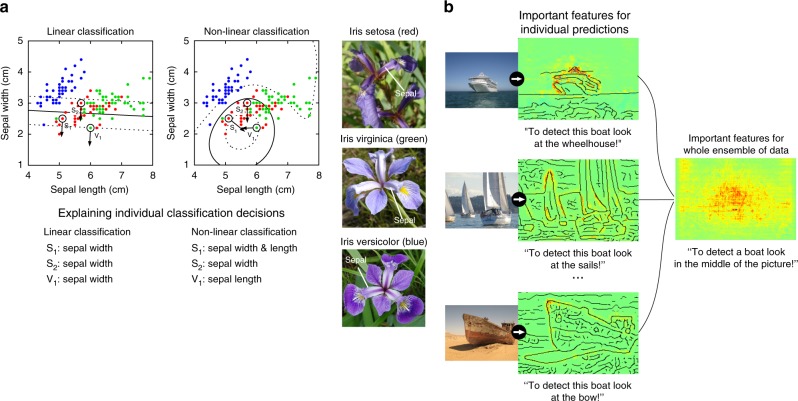
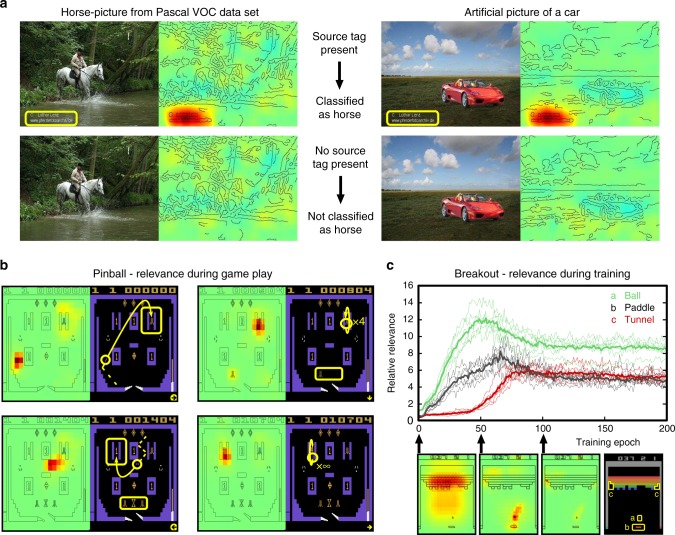
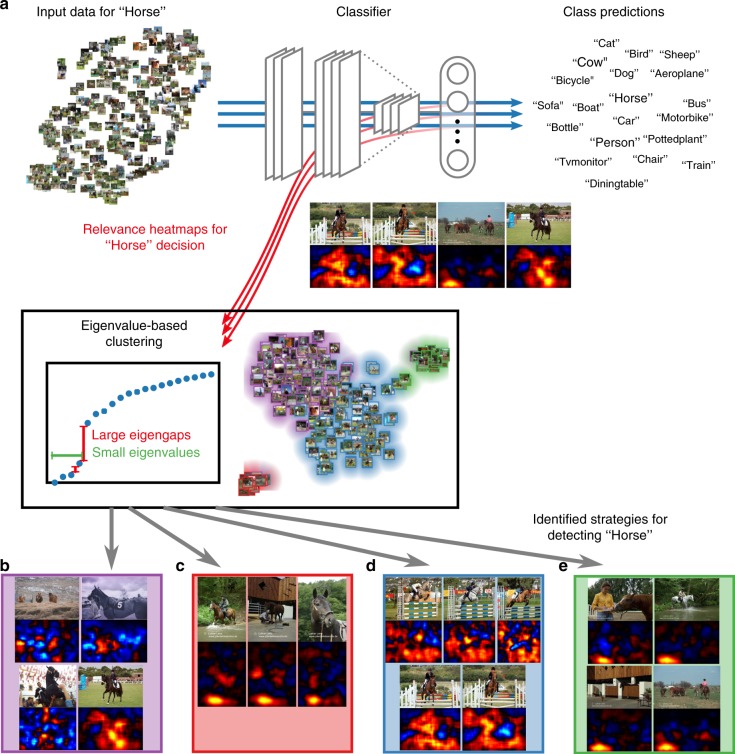
Current learning machines have successfully solved hard application problems, reaching high accuracy and displaying seemingly intelligent behavior. Here we apply recent techniques for explaining decisions of state-of-the-art learning machines and analyze various tasks from computer vision and arcade games. This showcases a spectrum of problem-solving behaviors ranging from naive and short-sighted, to well-informed and strategic. We observe that standard performance evaluation metrics can be oblivious to distinguishing these diverse problem solving behaviors. Furthermore, we propose our semi-automated Spectral Relevance Analysis that provides a practically effective way of characterizing and validating the behavior of nonlinear learning machines. This helps to assess whether a learned model indeed delivers reliably for the problem that it was conceived for. Furthermore, our work intends to add a voice of caution to the ongoing excitement about machine intelligence and pledges to evaluate and judge some of these recent successes in a more nuanced manner.
Overview
The claims and statistics of this paper haven’t been checked yet.
Free: it reads the open-access text and checks the first 5 claims that cite a source we can check. Create a free account to check every claim.
Integrity signals
Registry
Cites
Statistics
Figures
Verification
Claims the paper makes
The claims and statistics of this paper haven’t been checked yet.
Free: it reads the open-access text and checks the first 5 claims that cite a source we can check. Create a free account to check every claim.
Claims other papers make about this one
Each is checked against this paper’s own text: does it say what the citing paper says it does?
The cited source says what the claim attributes to it.
In the citing paper
“Thus, interpretability becomes fundamental to test against ' clever Hans ' models and to ensure that the model has learned relevant processes rather than spurious associations.”
From Artificial intelligence for climate prediction of extremes: State of the art, challenges, and future perspectives (2024) · cites this paper as Lapuschkin et al., 2019
The cited source says what the claim attributes to it.
In the citing paper
“There are examples of AI models predicting correctly for the wrong reasons (known as”
From Artificial intelligence for climate prediction of extremes: State of the art, challenges, and future perspectives (2024) · cites this paper as Lapuschkin et al., 2019
Self-check
Percentages, sums and reported differences re-computed from the paper’s own numbers.
The self-check needs the paper’s full text.
Citations
Cites
Deep Residual Learning for Image Recognition
He, K., Zhang, X., Ren, S., & Sun, J. (2016) · 2016 IEEE Conference on Computer Vision and Pattern Recognition (CVPR) · doi:10.1109/cvpr.2016.90 · Cited by 235,474
Hochreiter, S., & Schmidhuber, J. (1997) · Neural Computation · doi:10.1162/neco.1997.9.8.1735 · Cited by 102,318
LeCun, Y., Bengio, Y., & Hinton, G. (2015) · Nature · doi:10.1038/nature14539 · Cited by 84,126
Cortes, C., & Vapnik, V. (1995) · Machine Learning · doi:10.1007/bf00994018 · Cited by 59,421
Gradient-based learning applied to document recognition
Lecun, Y., Bottou, L., Bengio, Y., & Haffner, P. (1998) · Proceedings of the IEEE · doi:10.1109/5.726791 · Cited by 58,805
Going deeper with convolutions
Szegedy, C., Liu, W., Jia, Y., Sermanet, P., Reed, S., Anguelov, D., Erhan, D., Vanhoucke, V., & Rabinovich, A. (2015) · 2015 IEEE Conference on Computer Vision and Pattern Recognition (CVPR) · doi:10.1109/cvpr.2015.7298594 · Cited by 48,562
Human-level control through deep reinforcement learning
Mnih, V., Kavukcuoglu, K., Silver, D., Rusu, A. A., Veness, J., Bellemare, M. G., Graves, A., Riedmiller, M., Fidjeland, A. K., Ostrovski, G., et al. (2015) · Nature · doi:10.1038/nature14236 · Cited by 30,357
Multilayer feedforward networks are universal approximators
Hornik, K., Stinchcombe, M., & White, H. (1989) · Neural Networks · doi:10.1016/0893-6080(89)90020-8 · Cited by 21,728
The pascal visual object classes (VOC) challenge
Everingham, M., Van Gool, L., Williams, C. K. I., Winn, J., & Zisserman, A. (2010) · International Journal of Computer Vision · doi:10.1007/s11263-009-0275-4 · Cited by 19,599
"Why Should I Trust You?": Explaining the Predictions of Any Classifier
Ribeiro, M. T., Singh, S., & Guestrin, C. (2016) · Proceedings of the 22nd ACM SIGKDD International Conference on Knowledge Discovery and Data Mining · doi:10.1145/2939672.2939778 · Cited by 17,555
Research works printed but not linked: 9
- Pfungst O Clever Hans (the Horse of Mr. Von Osten): contribution to experimental animal and human psychology J. Philos. Psychol. Sci. Method 1911 8 663 666
- Guyon I Elisseeff A An introduction to variable and feature selection J. Mach. Learn. Res. 2003 3 1157 1182
- Nguyen, A., Dosovitskiy, A., Yosinski, J., Brox, T. & Clune, J. Synthesizing the preferred inputs for neurons in neural networks via deep generator networks. (D. D. Lee, M. Sugiyama, U. von Luxburg, I. Guyon, R. Garnett eds.) In Proc. Advances in Neural Information Processing Systems, 3387–3395 (Curran Associates, Inc., Red Hook, NY) (2016).
- Greydanus, S., Koul, A., Dodge, J. & Fern, A. Visualizing and understanding Atari agents. (J. Dy, A. Krause eds.) In Proc. International Conference on Machine Learning, 1787–1796 (JMLR.org, Brookline, MA) (2018).
- Zahavy, T., Ben-Zrihem, N. & Mannor, S. Graying the black box: Understanding DQNs. (M.-F. Balcan, K. Q. Weinberger eds.) In Proc. International Conference on Machine Learning, 1899–1908 (JMLR.org, Brookline, MA) (2016).
- Tsividis, P. A., Pouncy, T., Xu, J. L., Tenenbaum, J. B. & Gershman, S. J. Human learning in Atari. (G. Sukthankar, C. Geib eds.) In Proc. AAAI Spring Symposium Series, 643–646 (AAAI Press, Palo Alto, CA) (2017).
- Winston PH Horn B The Psychology of Computer Vision 1975 New York McGraw-Hill
- The European Parliament and the Council of the European Union.. Regulation (EU) 2016/679 of the European Parliament and of the Council of 27 April 2016 on the protection of natural persons with regard to the processing of personal data and on the free movement of such data, and repealing Directive 95/46/EC (General Data Protection Regulation) Off. J. Eur. Union 2016 L119 1 88
- Thomas, A. W., Heekeren, H. R., Müller, K.-R. & Samek, W. Interpretable LSTMs for whole-brain neuroimaging analyses. Preprint at https://arxiv.org/abs/1810.09945 (2018). · arXiv
Cited by
Items 401–500 of 1,003
SLISEMAP: supervised dimensionality reduction through local explanations
Björklund, A., Mäkelä, J., & Puolamäki, K. (2022) · Machine Learning · doi:10.1007/s10994-022-06261-1 · Cited by 32
Relevance-based channel selection in motor imagery brain–computer interface
Nagarajan, A., Robinson, N., & Guan, C. (2023) · Journal of Neural Engineering · doi:10.1088/1741-2552/acae07 · Cited by 32
From Hope to Safety: Unlearning Biases of Deep Models via Gradient Penalization in Latent Space
Dreyer, M., Pahde, F., Anders, C. J., Samek, W., & Lapuschkin, S. (2024) · Proceedings of the AAAI Conference on Artificial Intelligence · doi:10.1609/aaai.v38i19.30096 · Cited by 32
Self-citationIntroduction to Neural Networks
Montavon, G. (2020) · Lecture notes in physics · doi:10.1007/978-3-030-40245-7_4 · Cited by 32
Self-citationAI-Based Anomaly Detection for Clinical-Grade Histopathological Diagnostics
Dippel, J., Prenißl, N., Hense, J., Liznerski, P., Winterhoff, T., Schallenberg, S., Kloft, M., Buchstab, O., Horst, D. A., Alber, M., et al. (2024) · NEJM AI · doi:10.1056/aioa2400468 · Cited by 32
Self-citationExplainable AI needs formalization
Haufe, S., Wilming, R., Clark, B., Zhumagambetov, R., Boubekki, A., Martin, J., & Panknin, D. (2026) · npj Artificial Intelligence · doi:10.1038/s44387-026-00095-1 · Cited by 32
Krishnamurthy, V., Nezafati, K., Stayton, E., & Singh, V. (2020) · Data-Enabled Discovery and Applications · doi:10.1007/s41688-020-00042-2 · Cited by 31
Explainable multiple abnormality classification of chest CT volumes
Draelos, R. L., & Carin, L. (2022) · Artificial Intelligence in Medicine · doi:10.1016/j.artmed.2022.102372 · Cited by 32
Explaining molecular properties with natural languagePreprint
Gandhi, H. A., & White, A. D. (2022) · ChemRxiv · doi:10.26434/chemrxiv-2022-v5p6m-v3 · Cited by 31
Wang, X., Delgado, H., Tak, H., Jung, J.-W., Shim, H.-J., Todisco, M., Kukanov, I., Liu, X., Sahidullah, M., Kinnunen, T., et al. (2026) · Computer Speech & Language · doi:10.1016/j.csl.2025.101825 · Cited by 30
“When assessed in the laboratory using evaluation datasets contaminated by such artefacts, detection performance can be strong [104].”
Artificial intelligence-aided data mining of medical records for cancer detection and screening
Haue, A. D., Hjaltelin, J. X., Holm, P. C., Placido, D., & Brunak, S. (2024) · The Lancet Oncology · doi:10.1016/s1470-2045(24)00277-8 · Cited by 30
Socio-cognitive biases in folk AI ethics and risk discourse
Laakasuo, M., Herzon, V., Perander, S., Drosinou, M., Sundvall, J. R. I., Palomäki, J., & Visala, A. (2021) · AI and Ethics · doi:10.1007/s43681-021-00060-5 · Cited by 30
Kaadoud, I. C., Bennetot, A., Mawhin, B., Charisi, V., & Díaz-Rodríguez, N. (2022) · Neural Networks · doi:10.1016/j.neunet.2022.08.002 · Cited by 30
Uncertainty, Evidence, and the Integration of Machine Learning into Medical Practice
Grote, T., & Berens, P. (2023) · The Journal of Medicine and Philosophy A Forum for Bioethics and Philosophy of Medicine · doi:10.1093/jmp/jhac034 · Cited by 30
Machine learning based small bowel video capsule endoscopy analysis: Challenges and opportunities
Wahab, H., Mehmood, I., Ugail, H., Sangaiah, A. K., & Muhammad, K. (2023) · Future Generation Computer Systems · doi:10.1016/j.future.2023.01.011 · Cited by 31
Interpretable neural networks: principles and applications
Liu, Z., & Xu, F. (2023) · Frontiers in Artificial Intelligence · doi:10.3389/frai.2023.974295 · Cited by 30
Saranti, A., Pfeifer, B., Gollob, C., Stampfer, K., & Holzinger, A. (2024) · Wiley Interdisciplinary Reviews Data Mining and Knowledge Discovery · doi:10.1002/widm.1554 · Cited by 30
Decoupling Pixel Flipping and Occlusion Strategy for Consistent XAI Benchmarks
Blücher, S., Vielhaben, J., & Strodthoff, N. (2024) · Transactions on machine learning research · doi:10.48550/arxiv.2401.06654 · Cited by 30
Labeling Neural Representations with Inverse Recognition
Bykov, K., Kopf, L., 中島, 伸., Kloft, M., & Höhne, M. (2023) · neural information processing systems · doi:10.52202/075280-1077 · Cited by 30
Explainable artificial intelligence in ophthalmology
Tan, T. F., Dai, P., Zhang, X., Jin, L., Poh, S. S. J., Hong, D. C., Lim, J., Lim, G., Teo, Z. L., Liu, N., et al. (2023) · Current Opinion in Ophthalmology · doi:10.1097/icu.0000000000000983 · Cited by 30
Hallström, E., Kandavalli, V. K., Ranefall, P., Elf, J., & Wählby, C. (2023) · PLoS Computational Biology · doi:10.1371/journal.pcbi.1011181 · Cited by 29
Houidi, S., Fourer, D., & Auger, F. A. (2020) · Entropy · doi:10.3390/e22090911 · Cited by 29
Determining the Relevance of Features for Deep Neural Networks
Reimers, C., Runge, J., & Denzler, J. (2020) · Lecture notes in computer science · doi:10.1007/978-3-030-58574-7_20 · Cited by 29
LIME-Based Data Selection Method for SAR Images Generation Using GAN
Zhu, M., Zang, B., Ding, L., Lei, T., Feng, Z., & Fan, J. (2022) · Remote Sensing · doi:10.3390/rs14010204 · Cited by 29
Accurate and Explainable Recommendation via Review Rationalization
Pan, S., Li, D., Gu, H., Lu, T., Luo, X., & Gu, N. (2022) · International World Wide Web Conference (WWW) · doi:10.1145/3485447.3512029 · Cited by 29
Effective Explanations for Entity Resolution Models
Teofili, T., Firmani, D., Koudas, N., Martello, V., Merialdo, P., & Srivastava, D. (2022) · IEEE International Conference on Data Engineering (ICDE) · doi:10.1109/icde53745.2022.00248 · Cited by 29
Interpretable brain disease classification and relevance-guided deep learning
Tinauer, C., Heber, S., Pirpamer, L., Damulina, A., Schmidt, R., Stollberger, R., Ropele, S., & Langkammer, C. (2022) · Scientific Reports · doi:10.1038/s41598-022-24541-7 · Cited by 30
Integrated machine learning reveals aquatic biological integrity patterns in semi-arid watersheds
Li, L., Xia, R., Dou, M., Zhang, K., Chen, Y., Jia, R., Li, X., Dou, J., Xiang, L., Hu, Q., et al. (2024) · Journal of Environmental Management · doi:10.1016/j.jenvman.2024.121054 · Cited by 29
Learning with explainable trees
Samek, W. (2020) · Nature Machine Intelligence · doi:10.1038/s42256-019-0142-0 · Cited by 29
Self-citationThe CAST package for training and assessment of spatial prediction models in RPreprint
Meyer, H., Ludwig, M., Milà, C., Linnenbrink, J., & Schumacher, F. (2024) · arXiv (Cornell University) · doi:10.48550/arxiv.2404.06978 · Cited by 31
Deep Learning for Describing Breast Ultrasound Images with BI-RADS Terms
Carrilero-Mardones, M., Jurado, M. P., Nogales, A., Pérez‐Martín, J., & Díez, F. J. (2024) · Journal of Imaging Informatics in Medicine · doi:10.1007/s10278-024-01155-1 · Cited by 28
A data-centric perspective on the information needed for hydrological uncertainty predictions
Auer, A., Gauch, M., Kratzert, F., Nearing, G., Hochreiter, S., & Klotz, D. (2024) · Hydrology and earth system sciences · doi:10.5194/hess-28-4099-2024 · Cited by 28
Brattoli, B., Mostafavi, M., Lee, T., Jung, W., Ryu, J., Park, S., Park, J., Pereira, S., Shin, S.-H., Choi, S., et al. (2024) · npj Precision Oncology · doi:10.1038/s41698-024-00770-z · Cited by 29
Explainable Artificial Intelligence for State of Charge Estimation of Lithium-Ion Batteries
Chan, H. T. J., Rubeša-Zrim, J., Pichler, F., Salihi, A., Mourad, A., Šimić, I., Časni, K., & Veas, E. E. (2025) · Applied Sciences · doi:10.3390/app15095078 · Cited by 29
Chasing Luck: Data-driven Prediction, Faith, Hunch, and Cultural Norms in Rural Betting Practices
Sultana, S., Mozumder, M. M. H., & Ahmed, S. I. (2021) · CHI Conference on Human Factors in Computing Systems · doi:10.1145/3411764.3445047 · Cited by 28
Ojih, J., Rodriguez, A. D., Hu, J., & Hu, M. (2023) · Energy and AI · doi:10.1016/j.egyai.2023.100286 · Cited by 28
Explainability and transparency in the realm of digital humanities: toward a historian XAI
El-Hajj, H., Eberle, O., Merklein, A., Siebold, A., Shlomi, N., Büttner, J., Martinetz, J., Müller, K., Montavon, G., & Valleriani, M. (2023) · International Journal of Digital Humanities · doi:10.1007/s42803-023-00070-1 · Cited by 28
Self-citationSchiller, D., Huber, T., Lingenfelser, F., Dietz, M., Seiderer, A., & André, E. (2019) · Interspeech (USB) · doi:10.21437/interspeech.2019-2707 · Cited by 28
A Context-Aware Locality Measure for Inlier Pool Enrichment in Stepwise Image Registration
Zhang, S., Zhao, W., Hao, X., Yang, Y., & Guan, C. (2019) · IEEE Transactions on Image Processing · doi:10.1109/tip.2019.2961480 · Cited by 28
Interpretable Deep Learning for Probabilistic MJO Prediction
Delaunay, A., & Christensen, H. M. (2022) · Geophysical Research Letters · doi:10.1029/2022gl098566 · Cited by 27
RudolfV: A Foundation Model by Pathologists for Pathologists
Dippel, J., Feulner, B., Winterhoff, T., Milbich, T., Tietz, S., Schallenberg, S., Dernbach, G., Kunft, A., Heinke, S., Eich, M.-L., et al. (2024) · arXiv · doi:10.48550/arxiv.2401.04079 · Cited by 27
Self-citationŠimić, I., Veas, E. E., & Sabol, V. (2025) · Scientific Reports · doi:10.1038/s41598-025-09538-2 · Cited by 27
Robustness Evaluation of Entity Disambiguation Using Prior Probes: the Case of Entity Overshadowing
Provatorova, V., Bhargav, S., Vakulenko, S., & Kanoulas, E. (2021) · Conference on Empirical Methods in Natural Language Processing (EMNLP) · doi:10.18653/v1/2021.emnlp-main.820 · Cited by 27
Bottani, S., Burgos, N., Maire, A., Saracino, D., Ströer, S., Dormont, D., & Colliot, O. (2023) · Medical Image Analysis · doi:10.1016/j.media.2023.102903 · Cited by 27
This Looks Like That There: Interpretable Neural Networks for Image Tasks When Location Matters
Barnes, E. A., Barnes, R. J., Martin, Z., & Rader, J. K. (2022) · Artificial Intelligence for the Earth Systems · doi:10.1175/aies-d-22-0001.1 · Cited by 30
Rethinking data-driven networking with foundation models: challenges and opportunities
Le, F., Srivatsa, M., Ganti, R., & Sekar, V. (2022) · ACM Workshop on Hot Topics in Networks (HotNets) · doi:10.1145/3563766.3564109 · Cited by 27
Chereda, H., Leha, A., & Beißbarth, T. (2024) · Artificial Intelligence in Medicine · doi:10.1016/j.artmed.2024.102840 · Cited by 27
Zehlike, M., Loosley, A., Jonsson, H., Wiedemann, E., & Hacker, P. (2025) · Artificial Intelligence · doi:10.1016/j.artint.2024.104280 · Cited by 29
Contextual Semantic Interpretability
Marcos, D., Fong, R., Lobry, S., Flamary, R., Courty, N., & Tuia, D. (2021) · Lecture notes in computer science · doi:10.1007/978-3-030-69538-5_22 · Cited by 27
Levering, A., Marcos, D., & Tuia, D. (2021) · ISPRS Journal of Photogrammetry and Remote Sensing · doi:10.1016/j.isprsjprs.2021.04.020 · Cited by 27
Validating Automatic Concept-Based Explanations for AI-Based Digital Histopathology
Sauter, D., Lodde, G., Nensa, F., Schadendorf, D., Livingstone, E., & Kukuk, M. (2022) · Sensors · doi:10.3390/s22145346 · Cited by 26
“Our work may help to encourage transparency and reproducibility in computational histopathology in the future.”
BackgroundExplainable Multi Agent Path Finding
Almagor, S., & Lahijanian, M. (2020) · Adaptive Agents and Multi-Agents Systems · doi:10.65109/fdyu8893 · Cited by 26
PredDiff: Explanations and interactions from conditional expectations
Blücher, S., Vielhaben, J., & Strodthoff, N. (2022) · Artificial Intelligence · doi:10.1016/j.artint.2022.103774 · Cited by 26
Explaining Deep Neural Network using Layer-wise Relevance Propagation and Integrated Gradients
Čík, I., Rasamoelina, A. D., Mach, M., & Sinčák, P. (2021) · IEEE World Symposium on Applied Machine Intelligence and Informatics (SAMI) · doi:10.1109/sami50585.2021.9378686 · Cited by 26
Schuhmacher, D., Schörner, S., Küpper, C., Großerueschkamp, F., Sternemann, C., Lugnier, C., Kraeft, A., Jütte, H., Tannapfel, A., Reinacher‐Schick, A., et al. (2022) · Medical Image Analysis · doi:10.1016/j.media.2022.102594 · Cited by 26
Explainable deep learning: concepts, methods, and new developments
Samek, W. (2023) · Elsevier eBooks · doi:10.1016/b978-0-32-396098-4.00008-9 · Cited by 27
Self-citationInterpreting and Correcting Medical Image Classification with PIP-Net
Nauta, M., Hegeman, J. H., Geerdink, J., Schlötterer, J., van Keulen, M., & Seifert, C. (2024) · Communications in computer and information science · doi:10.1007/978-3-031-50396-2_11 · Cited by 26
Insights into the inner workings of transformer models for protein function prediction
Wenzel, M. A., Grüner, E., & Strodthoff, N. (2024) · Bioinformatics · doi:10.1093/bioinformatics/btae031 · Cited by 27
Raimondi, D., Passemiers, A., Fariselli, P., & Moreau, Y. (2021) · BMC Biology · doi:10.1186/s12915-020-00930-0 · Cited by 27
Shortcut Learning in In-Context Learning: A SurveyPreprint
Song, R., Li, Y., Shi, L., Giunchiglia, F., & Xu, H. (2024) · arXiv (Cornell University) · doi:10.48550/arxiv.2411.02018 · Cited by 26
Mirzaei, S., Mao, H., Al-Nima, R. R. O., & Woo, W. L. (2023) · Information · doi:10.3390/info15010004 · Cited by 25
“Based on the work of Lapuschkin et al. [40], a model relying on the spurious correlation’s decision strategy would mostly fail in identifying the correct classification and, therefore, lead to overfitting when applied to real-world applications.”
MethodThe specification game: rethinking the evaluation of drug response prediction for precision oncology
Codicè, F., Pancotti, C., Rollo, C., Moreau, Y., Fariselli, P., & Raimondi, D. (2025) · Journal of Cheminformatics · doi:10.1186/s13321-025-00972-y · Cited by 25
Challenges and Perspectives of Hate Speech Research
Strippel, C., Paasch‐Colberg, S., Emmer, M., & Trebbe, J. (2023) · Weizenbaum Library (Weizenbaum Institute) · doi:10.48541/dcr.v12.0 · Cited by 26
Explainable artificial intelligence for molecular design in pharmaceutical research
Lamens, A., & Bajorath, J. (2026) · Chemical Science · doi:10.1039/d5sc08461j · Cited by 26
Mulliqi, N., Blilie, A., Ji, X., Szolnoky, K., Olsson, H., Boman, S. E., Titus, M., Gonzalez, G. M., Mielcarz, J. A., Valkonen, M., et al. (2026) · Nature Communications · doi:10.1038/s41467-026-78996-7 · Cited by 25
Expressive Explanations of DNNs by Combining Concept Analysis with ILP
Rabold, J., Schwalbe, G., & Schmid, U. (2020) · Lecture notes in computer science · doi:10.1007/978-3-030-58285-2_11 · Cited by 25
Cooney, R., Wan, A. H. L., O’Donncha, F., & Clifford, E. (2021) · Current Opinion in Environmental Science & Health · doi:10.1016/j.coesh.2021.100276 · Cited by 25
A Probabilistic Transformation of Distance-Based Outliers
Muhr, D., Affenzeller, M., & Küng, J. (2023) · Machine Learning and Knowledge Extraction · doi:10.3390/make5030042 · Cited by 27
Lee, C., Jui, C.-Y., Yeh, A., Chang, Y., & Lee, W. (2023) · Journal of Alloys and Compounds · doi:10.1016/j.jallcom.2023.173144 · Cited by 25
Towards Benchmarking the Utility of Explanations for Model Debugging
Idahl, M., Lyu, L., Gadiraju, U., & Anand, A. (2021) · Workshop on Trustworthy Natural Language Processing (TrustNLP) · doi:10.18653/v1/2021.trustnlp-1.8 · Cited by 25
A Visual Designer of Layer‐wise Relevance Propagation Models
Huang, X., Jamonnak, S., Zhao, Y., Wu, T. H., & Xu, W. (2021) · Computer Graphics Forum · doi:10.1111/cgf.14302 · Cited by 26
Algorithms as complementary abstractions
Matzner, T. (2022) · New Media & Society · doi:10.1177/14614448221078604 · Cited by 25
AI-powered spatial cell phenomics enhances risk stratification in non-small cell lung cancer
Schallenberg, S., Dernbach, G., Ruane, S., Jurmeister, P. S., Böhm, C., Standvoss, K., Ghosh, S., Frentsch, M., Dragomir, M. P., Keyl, P., et al. (2025) · Nature Communications · doi:10.1038/s41467-025-65783-z · Cited by 25
Self-citationAfroogh, S., Mostafavi, A., Akbari, A., Pouresmaeil, Y., Goudarzi, S., Hajhosseini, F., & Rasoulkhani, K. (2023) · AI and Ethics · doi:10.1007/s43681-023-00309-1 · Cited by 24
Oveis, A. H., Giusti, E., Ghio, S., Meucci, G., & Martorella, M. (2023) · IEEE Journal of Selected Topics in Applied Earth Observations and Remote Sensing · doi:10.1109/jstars.2023.3318675 · Cited by 24
An Explainable Deep Learning Model for Daily Sea Ice Concentration Forecast
Li, Y., Qiu, Y., Jia, G., Yu, S., Zhang, Y., Huang, L., & Leppäranta, M. (2024) · IEEE Transactions on Geoscience and Remote Sensing · doi:10.1109/tgrs.2024.3386930 · Cited by 24
Interpreting Neural Network Models for Toxicity Prediction by Extracting Learned Chemical Features
Walter, M., Webb, S. J., & Gillet, V. J. (2024) · Journal of Chemical Information and Modeling · doi:10.1021/acs.jcim.4c00127 · Cited by 24
Machine learning in stream and river water temperature modeling: a review and metrics for evaluation
Corona, C. R., & Hogue, T. S. (2025) · Hydrology and earth system sciences · doi:10.5194/hess-29-2521-2025 · Cited by 24
Towards Measuring Bias in Image Classification
Schaaf, N., de Mitri, O., Kim, H. B., Windberger, A., & Huber, M. F. (2021) · Lecture notes in computer science · doi:10.1007/978-3-030-86365-4_35 · Cited by 24
Li, X., Chen, D., Xu, W., Chen, H., Li, J., & Mo, F. (2023) · Humanities and Social Sciences Communications · doi:10.1057/s41599-023-01505-4 · Cited by 24
Dhar, S., & Shamir, L. (2022) · Astronomy and Computing · doi:10.1016/j.ascom.2022.100545 · Cited by 23
“The deep convolutional neural network used in this experiment is an expansion of the common LeNet-5 architecture (LeCun et al., 1998), implemented using the Keras library (Chollet et al., 2015, 2018), and adjusted to the input size of images with dimensionality of 120×120 pixels.”
MethodApplications of Artificial Intelligence in Neurological Voice Disorders
Yao, D., Koivu, A., & Simonyan, K. (2025) · World Journal of Otorhinolaryngology - Head and Neck Surgery · doi:10.1002/wjo2.70017 · Cited by 24
Gangwal, A., & Lavecchia, A. (2026) · Computer Science Review · doi:10.1016/j.cosrev.2026.100943 · Cited by 23
Ntampaka, M., & Vikhlinin, A. A. (2022) · The Astrophysical Journal · doi:10.3847/1538-4357/ac423e · Cited by 23
Structured Verification of Machine Learning Models in Industrial Settings
Kaminwar, S. R., Goschenhofer, J., Thomas, J., Thon, I., & Bischl, B. (2022) · Big Data · doi:10.1089/big.2021.0112 · Cited by 23
Morales‐Forero, A., Bassetto, S., & Coatanéa, É. (2022) · AI & Society · doi:10.1007/s00146-022-01591-z · Cited by 23
Explainable Analysis of Deep Learning Methods for Sar Image Classification
Su, S., Cui, Z., Guo, W., Zhang, Z., & Yu, W. (2022) · IEEE International Geoscience and Remote Sensing Symposium (IGARSS) · doi:10.1109/igarss46834.2022.9883815 · Cited by 23
Boge, F. J. (2023) · Synthese · doi:10.1007/s11229-023-04440-8 · Cited by 23
Primiero, C., Betz‐Stablein, B., Ascott, N., D’Alessandro, B., Gaborit, S., Fricker, P., Goldsteen, A., González-Villà, S., Lee, K., Nazari, S., et al. (2024) · Frontiers in Medicine · doi:10.3389/fmed.2024.1380984 · Cited by 23
Banyong, C., Hantanong, N., Wisutwattanasak, P., Champahom, T., Theerathitichaipa, K., Seefong, M., Ratanavaraha, V., & Jomnonkwao, S. (2024) · Results in Engineering · doi:10.1016/j.rineng.2024.103110 · Cited by 23
Eberle, O., Büttner, J., El-Hajj, H., Montavon, G., Müller, K., & Valleriani, M. (2024) · Science Advances · doi:10.1126/sciadv.adj1719 · Cited by 23
Self-citationExplanation needs and ethical demands: unpacking the instrumental value of XAI
Alpsancar, S., Buhl, H. M., Matzner, T., & Scharlau, I. (2024) · AI and Ethics · doi:10.1007/s43681-024-00622-3 · Cited by 24
Dindorf, C., Horst, F., Slijepčević, D., Dumphart, B., Dully, J., Zeppelzauer, M., Horsak, B., & Fröhlich, M. (2024) · Springer optimization and its applications · doi:10.1007/978-3-031-76047-1_4 · Cited by 23
Sauceda, H. E., Chmiela, S., Poltavsky, I., Müller, K.-R., & Tkatchenko, A. (2020) · Lecture notes in physics · doi:10.1007/978-3-030-40245-7_14 · Cited by 24
Self-citationLess may be more: an informed reflection on molecular descriptors for drug design and discovery
Barnard, T., Hagan, H., Tseng, S., & Sosso, G. C. (2020) · Molecular Systems Design & Engineering · doi:10.1039/c9me00109c · Cited by 24
Approximating complex musculoskeletal biomechanics using multidimensional autogenerating polynomials
Sobinov, A. R., Boots, M. T., Gritsenko, V., Fisher, L. E., Gaunt, R. A., & Yakovenko, S. (2020) · PLoS Computational Biology · doi:10.1371/journal.pcbi.1008350 · Cited by 24
Dialogue Games for Benchmarking Language Understanding: Motivation, Taxonomy, StrategyPreprint
Schlangen, D. (2023) · arXiv (Cornell University) · doi:10.48550/arxiv.2304.07007 · Cited by 23
Opportunities and limitations of explaining quantum machine learningPreprint
Gil-Fuster, E., Naujoks, J. R., Montavon, G., Wiegand, T., Samek, W., & Eisert, J. (2024) · arXiv (Cornell University) · doi:10.48550/arxiv.2412.14753 · Cited by 23
Self-citationXie, W., Kimura, M., Takaki, K., Asada, Y., Iida, T., & Jia, X. (2022) · Water Resources Research · doi:10.1029/2021wr030493 · Cited by 22
Deciphering the Feature Representation of Deep Neural Networks for High-Performance AI
Islam, M. T., & Xing, L. (2024) · IEEE Transactions on Pattern Analysis and Machine Intelligence · doi:10.1109/tpami.2024.3363642 · Cited by 22
Metadata
- Authors
- Lapuschkin, S., Wäldchen, S., Binder, A., Montavon, G., Samek, W., & Müller, K.-R.
- Affiliations
- Fraunhofer Institute for Telecommunications, Heinrich Hertz Institute (DE)
- Technische Universität Berlin (DE)
- Singapore University of Technology and Design (SG)
- Korea University (KR)
- Corresponding author
- Samek, Wojciech
- Müller, Klaus-Robert
- Venue
- Nature Communications
- Published
- 2019-03-11
- Volume
- 10
- Issue
- 1
- Pages
- 1096-1096
- ISSN
- 2041-1723 (ISSN-L)
- PMC
- PMC6411769
- OpenAlex
- W2921802966
- Semantic Scholar
- 4f51a64793d3b2a60e9e5846c31dae023cf5c69a
- Cited by
- 1,047
- References
- 41
- Citations by year
- 2026: 129 · 2025: 178 · 2024: 142 · 2023: 178 · 2022: 159 · 2021: 140 · 2020: 86 · 2019: 34
- FWCI
- 47.80
- Type
- journal article
- Language
- en
- Open access
- gold
- doi.org
- Licence
- cc-by
- creativecommons.org/licenses/by/4.0 (tdm)
- creativecommons.org/licenses/by/4.0 (vor)
- Locations
- Nature Communications (publishedVersion, cc-by)
- Europe PMC (PubMed Central) (publishedVersion, cc-by)
- PubMed Central (publishedVersion, cc-by)
- PubMed (publishedVersion)
- arXiv (Cornell University) (submittedVersion)
- DOAJ (DOAJ: Directory of Open Access Journals) (submittedVersion)
- DOAJ (DOAJ: Directory of Open Access Journals) (submittedVersion, cc-by-sa)
- Publikationsdatenbank der Fraunhofer-Gesellschaft (Fraunhofer-Gesellschaft) (submittedVersion, other-oa)
- Fraunhofer-Publica (Fraunhofer-Gesellschaft) (submittedVersion)
- arXiv (Cornell University)
- Funders
- Deutsche Forschungsgemeinschaft (EXC-2046, EXC‐2046/1, 01IS18037I, 390685689)
- Institute for Information and Communications Technology Promotion (2017-0-00451)
- Topics
- Physical Sciences › Computer Science › Artificial Intelligence › Explainable Artificial Intelligence (XAI)
- Physical Sciences › Computer Science › Software › Software Testing and Debugging Techniques
- Physical Sciences › Computer Science › Artificial Intelligence › Adversarial Robustness in Machine Learning
- Keywords
- Clever Hans effect, explainable AI, decision explanation, problem-solving behavior, model evaluation metrics, computer vision, arcade games, model validation, machine intelligence
About these checks
Registry, retraction, Cites and statistics results are computed, not judged, with one exception: a printed reference that no index lists is read once by a model before it counts as a citation error. Claims are extracted by a model and kept only when their quote appears verbatim in the text; each cited source is then checked, with a model’s help, for whether it says what the claim relies on. Those verdicts can be wrong — read the claim’s quote and the cited source before relying on one.
Statistics and arithmetic are recomputed, not judged.
Confidence bands are shown only for fields calibrated on our annotated test set. None is calibrated yet, so no band is shown.
What counts as a claim ›How we measure confidence ›How we check this ›
Are you an author, or do you see a problem with this page? Request a review
Data sources
Bibliographic data: Semantic Scholar, OpenAlex, Crossref.
Contains information from the Semantic Scholar Academic Graph Datasets, made available under the ODC Attribution License (ODC-BY 1.0).
Semantic Scholar’s data is described in: Kinney, R., et al. (2023). The Semantic Scholar Open Data Platform. arXiv:2301.10140.
