

Estimating the success of re-identifications in incomplete datasets using generative models
Open accessThe DOI matches its Crossref record; 59 of the 59 references it cites were found in a registry or an index.
Abstract
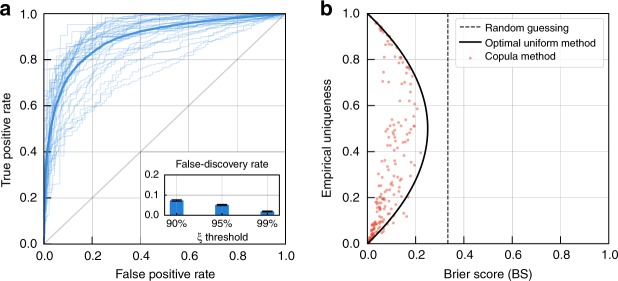
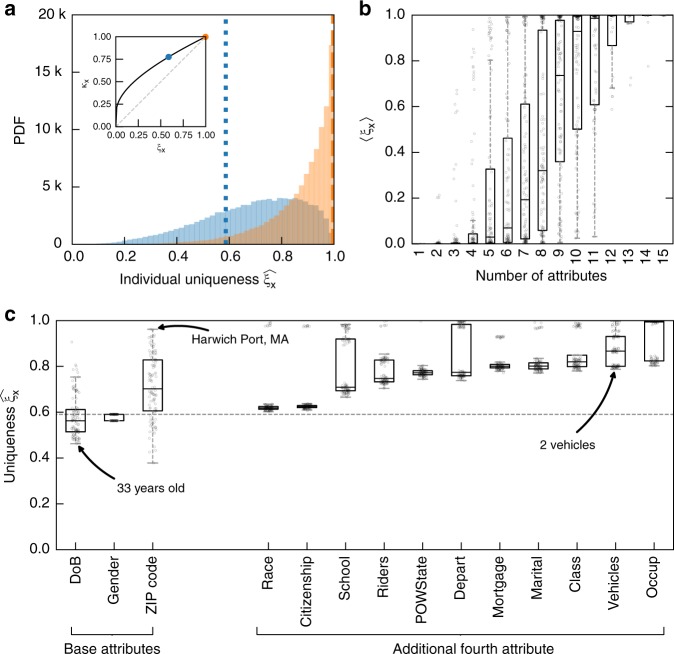
While rich medical, behavioral, and socio-demographic data are key to modern data-driven research, their collection and use raise legitimate privacy concerns. Anonymizing datasets through de-identification and sampling before sharing them has been the main tool used to address those concerns. We here propose a generative copula-based method that can accurately estimate the likelihood of a specific person to be correctly re-identified, even in a heavily incomplete dataset. On 210 populations, our method obtains AUC scores for predicting individual uniqueness ranging from 0.84 to 0.97, with low false-discovery rate. Using our model, we find that 99.98% of Americans would be correctly re-identified in any dataset using 15 demographic attributes. Our results suggest that even heavily sampled anonymized datasets are unlikely to satisfy the modern standards for anonymization set forth by GDPR and seriously challenge the technical and legal adequacy of the de-identification release-and-forget model.
Overview
The claims and statistics of this paper haven’t been checked yet.
Free: it reads the open-access text and checks the first 5 claims that cite a source we can check. Create a free account to check every claim.
Integrity signals
Registry
Cites
Statistics
Figures
Verification
Claims the paper makes
The claims and statistics of this paper haven’t been checked yet.
Free: it reads the open-access text and checks the first 5 claims that cite a source we can check. Create a free account to check every claim.
Claims other papers make about this one
Each is checked against this paper’s own text: does it say what the citing paper says it does?
The source backs part of the claim, not all of it — or backs it for a different population, condition or comparison.
In the citing paper
“Existing medical data is not fully exploited by ML primarily because it sits in data silos and privacy concerns restrict access to this data.”
From The future of digital health with federated learning (2020) · cites this paper as [7]
Experimental — accuracy not yet measuredThe source backs part of the claim, not all of it — or backs it for a different population, condition or comparison.
In the citing paper
“Centralising or releasing data, however, poses not only regulatory, ethical and legal challenges, related to privacy and data protection, but also technical ones.”
From The future of digital health with federated learning (2020) · cites this paper as [7]
Experimental — accuracy not yet measuredThe source backs part of the claim, not all of it — or backs it for a different population, condition or comparison.
In the citing paper
“Beyond these considerations, a required step for multimodal AI is the appropriate linking of all data types available in the datasets, which represents another challenge owing to the increasing risk of identification of individuals and regulatory constraints 146”
From Multimodal biomedical AI (2022) · cites this paper as [146]
Experimental — accuracy not yet measuredThe cited source says what the claim attributes to it.
In the citing paper
“Data anonymization alone does not provide sufficient protection (Rocher et al., 2019) since parts of the training data can be reconstructed by inversion of model parameters (Carlini et al., 2019; Zhang et al., 2020), gradients (Zhu et al., 2019; Geiping et al., 2020), or through adversarial attacks (Wang et al., 2019; Hitaj et al., 2017).”
From Federated learning for computational pathology on gigapixel whole slide images (2022) · cites this paper as Rocher et al., 2019
The cited source says what the claim attributes to it.
In the citing paper
“Even if data anonymisation could bypass these limitations, it is now well understood that removing metadata such as patient name or date of birth is often not enough to preserve privacy7.”
From The future of digital health with federated learning (2020) · cites this paper as [7]
1 more claim about this paper
Create a free account to see every claim other papers make about this one.
Self-check
Percentages, sums and reported differences re-computed from the paper’s own numbers.
The self-check needs the paper’s full text.
Citations
Cites
k-ANONYMITY: A MODEL FOR PROTECTING PRIVACY
SWEENEY, L. (2002) · International Journal of Uncertainty, Fuzziness and Knowledge-Based Systems · doi:10.1142/s0218488502001648 · Cited by 8,571 · cited 1×
“While more advanced guarantees like k -anonymity 57 would give every individual in the dataset some protection, they have been shown to be NP-Hard 58 , hard to achieve in modern high-dimensional datasets 59 , and not always suf fi cient 60 .”
BackgroundBig Data : The Management Revolution
マカフィー, ア., ブリニョルフソン, エ., & 有賀, 裕. (2013) · Harvard business review · Cited by 3,550
t-Closeness: Privacy Beyond k-Anonymity and l-Diversity
Li, N., Li, T., & Venkatasubramanian, S. (2007) · 2007 IEEE 23rd International Conference on Data Engineering · doi:10.1109/icde.2007.367856 · Cited by 3,451
Lazer, D., Pentland, A., Adamic, L., Aral, S., Barabási, A.-L., Brewer, D., Christakis, N., Contractor, N., Fowler, J., Gutmann, M., et al. (2009) · Science · doi:10.1126/science.1167742 · Cited by 3,365
The real-time city? Big data and smart urbanism
Kitchin, R. (2014) · GeoJournal · doi:10.1007/s10708-013-9516-8 · Cited by 2,794 · cited 5×
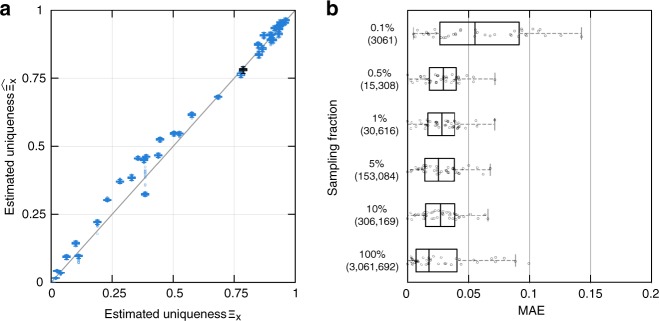
“Table 1 and Supplementary Note 7 show that, at very small sampling fraction (below 0.1%), where the error is the largest, the error is mostly determined by the marginals, and converges after few hundred records when the exact marginals are known.”
BackgroundInfluentialThe Real-Time City? Big Data and Smart Urbanism
Kitchin, R. (2013) · SSRN Electronic Journal · doi:10.2139/ssrn.2289141 · Cited by 2,794
(2012) · PubMed · Cited by 2,326
Cherubini, U., Luciano, E., & Vecchiato, W. (2004) · Wiley eBooks · doi:10.1002/9781118673331 · Cited by 2,009
Vinh, N. X., Epps, J., & Bailey, J. (2010) · Minerva Access (University of Melbourne) · doi:10.5555/1756006.1953024 · Cited by 1,781
The Unreasonable Effectiveness of Data
Halevy, A., Norvig, P., & Pereira, F. (2009) · IEEE Intelligent Systems · doi:10.1109/mis.2009.36 · Cited by 1,767
Research works printed but not linked: 4
- Cadwalladr, C. & Graham-Harrison, E. Revealed: 50 million facebook profiles harvested for Cambridge Analytica in major data breach. The Guardian (17 Mar 2018).
- Polonetsky J Tene O Finch K Shades of gray: seeing the full spectrum of practical data De-Identification St. Clara Law Rev. 2016 56 593 629
- Fienberg SE Sanil AP A Bayesian approach to data disclosure: optimal intruder behavior for continuous data J. Stat. 1997 13 75
- Chen G Keller-McNulty S Estimation of identification disclosure risk in microdata J. Stat. 1998 14 79
Cited by
Items 301–400 of 817
Gesundheits-Apps auf Rezept und Forschung mit Gesundheitsdaten
Schrahe, D., & Städter, T. (2020) · Datenschutz und Datensicherheit - DuD · doi:10.1007/s11623-020-1355-4 · Cited by 10
Mori, M., Khera, R., Lin, Z., Ross, J. S., Schulz, W. L., & Krumholz, H. M. (2020) · Methodist DeBakey Cardiovascular Journal · doi:10.14797/mdcj-16-3-212 · Cited by 14
Practical AI Transparency: Revealing Datafication and Algorithmic Identities
Stefanija, A. P., & Pierson, J. (2020) · Journal of Digital Social Research · doi:10.33621/jdsr.v2i3.32 · Cited by 13
Evaluation of Re-identification Risk using Anonymization and Differential Privacy in Healthcare
Ratra, R., Gulia, P., & Gill, N. S. (2022) · International Journal of Advanced Computer Science and Applications · doi:10.14569/ijacsa.2022.0130266 · Cited by 10
An Equity-Based Scoring System for Evaluating Surveillance-Related Harm in Public Health Crises
Amani, B., McAndrew, B., Sharif, M. Z., Garcia, J. N., Nwankwo, E. M., Cabral, A., Abotsi-Kowu, C., Khan, H., Le, C., Ponder, M. L., et al. (2023) · Ethnicity & Disease · doi:10.18865/2022-2022 · Cited by 12
Jwa, A. S., Koyejo, S., & Poldrack, R. A. (2024) · Imaging Neuroscience · doi:10.1162/imag_a_00111 · Cited by 22
Bokhari, S. M., Sohaib, S., & Shafi, M. (2025) · PLoS ONE · doi:10.1371/journal.pone.0327108 · Cited by 17
“While data anonymization offers a potential solution, it is well-documented that removing identifiers such as a patient’s name or birth date often fails to ensure complete privacy [16].”
Calibrating predictive model estimates in a distributed network of patient data
Huang, Y., Jiang, X., Gabriel, R. A., & Ohno-Machado, L. (2021) · Journal of Biomedical Informatics · doi:10.1016/j.jbi.2021.103758 · Cited by 10
Database reconstruction does compromise confidentiality
Keller‐McNulty, S., & Abowd, J. M. (2023) · Proceedings of the National Academy of Sciences · doi:10.1073/pnas.2300976120 · Cited by 9
“(9), because the more questions tabulated, the greater the chances of uniqueness.”
BackgroundStrongly universally consistent nonparametric regression and classification with privatised data
Berrett, T. B., Györfi, L., & Walk, H. (2021) · Electronic Journal of Statistics · doi:10.1214/21-ejs1845 · Cited by 32
“While there has long been an awareness that sensitive data must be anonymised, it has become apparent only relatively recently that simply removing names and addresses is insufficient in many cases (e.g. Sweeney, 2002, Rocher et al., 2019).”
BackgroundTool-chain for supporting Privacy Risk Assessments
Schwee, J. H., Sangogboye, F. C., Salim, F. D., & Kjærgaard, M. B. (2020) · ACM International Conference on Systems for Energy-Efficient Buildings, Cities, and Transportation (BuildSys) · doi:10.1145/3408308.3427605 · Cited by 9
“Rocher et al. [27] found that a significant amount of the investigated datasets were not sufficiently protected.”
BackgroundThe National ReferAll Database: An Open Dataset of Exercise Referral Schemes Across the UK
Steele, J., Wade, M., Copeland, R. J., Stokes, S., Stokes, R., & Mann, S. (2021) · International Journal of Environmental Research and Public Health · doi:10.3390/ijerph18094831 · Cited by 13
Rodríguez-García, M., Sicilia, M., & Dodero, J. M. (2021) · PeerJ Computer Science · doi:10.7717/peerj-cs.568 · Cited by 10
“…approaches to sharing healthcare datasets rely upon processes of anonymization using techniques that control the risk of identity disclosure of individuals ( Rocher, Hendrickx & Montjoye, 2019 ), and are not carried out automatically but as the result of occasional or human-initiated processes.”
MethodBrown, J. T., Yan, C., Xia, W., Yin, Z., Wan, Z., Gkoulalas-Divanis, A., Kantarcıoğlu, M., & Malin, B. (2022) · Journal of the American Medical Informatics Association · doi:10.1093/jamia/ocac011 · Cited by 9
McLennan, S., Rachut, S., Lange, J., Fiske, A., Heckmann, D., & Buyx, A. (2022) · Journal of Medical Internet Research · doi:10.2196/38754 · Cited by 13
“Although fully anonymized data typically fall outside data protection laws around the world and can thus be freely used and shared, full anonymization is increasingly difficult to achieve given the use of models that can correctly reidentify people in anonymized data sets [20].”
BackgroundAttack Risk Analysis in Data Anonymization in Internet of Things
Yang, T., Li, S., Iqbal, M., & Almakhles, D. J. (2023) · IEEE Transactions on Computational Social Systems · doi:10.1109/tcss.2023.3243089 · Cited by 11
“However, improperly anonymized data can be reiden-tified, which can cause highly privacy risk [11].”
BackgroundMethodKim, J., Kassels, A. C., Costin, N. I., & Schmidt, H. (2020) · Journal of Medical Ethics · doi:10.1136/medethics-2019-105667 · Cited by 9
Alarm bells ring for patient data and privacy in the covid-19 goldrush
Cox, D. (2020) · BMJ · doi:10.1136/bmj.m1925 · Cited by 9
Steffny, L., Dahlem, N., Reichl, L., Gisa, K., Greff, T., & Werth, D. (2023) · Frontiers in Artificial Intelligence and Applications · doi:10.3233/faia230090 · Cited by 8
Artificial intelligence in the oncology workflow: Applications, limitations, and future perspectives
Cobanaj, M., Corti, C., Dee, E. C., McCullum, L. B., Celi, L. A., Curigliano, G., & Criscitiello, C. (2024) · Elsevier eBooks · doi:10.1016/b978-0-443-13671-9.00013-2 · Cited by 10
Husnain, G., Ali, A. B. M., Khan, A., Junaid, A., Usman, M., Awwad, E. M., & Telba, A. A. (2025) · IEEE Transactions on Consumer Electronics · doi:10.1109/tce.2025.3643884 · Cited by 11
“Legal and deployment challenges require models to offer plain-language explanations, audit trails and data privacy during use [18].”
A Practical Defense against Attribute Inference Attacks in Session-based Recommendations
Zhang, Y., Gao, N., & Chen, J. (2020) · IEEE International Conference on Web Services (ICWS) · doi:10.1109/icws49710.2020.00053 · Cited by 9
Locally private online change point detection
Berrett, T. B., & Yu, Y. (2021) · neural information processing systems · doi:10.48550/arxiv.2105.10675 · Cited by 20
“Traditional anonymisation of data has been shown to be an outdated method of privacy protection, particularly in multivariate settings [28, 26].”
Digital Privacy: GDPR and Its Lessons for Australia
Chaudhury, R. D., & Choe, C. (2023) · Australian Economic Review · doi:10.1111/1467-8462.12506 · Cited by 14
AI-Assisted Diplomatic Decision-Making During Crises: Challenges and Opportunities
Pokhriyal, N., & Koebe, T. (2023) · Springer eBooks · doi:10.1007/978-3-032-12201-8_36 · Cited by 17
Raddatz, N. I., Kettinger, W. J., & Coyne, J. G. (2023) · Communications of the Association for Information Systems · doi:10.17705/1cais.05247 · Cited by 14
The Social Contract for Health and Wellness Data Sharing Needs a Trusted Standardized Consent
Brückner, S., Kirsten, T., Schwarz, P. E. H., Cotte, F., Tsesis, M., & Gilbert, S. (2023) · Mayo Clinic Proceedings Digital Health · doi:10.1016/j.mcpdig.2023.07.008 · Cited by 16
“13 Consent and transparency are crucial to people ’ s choice to share this sensitive data, and a loss of trust in institutions is to be expected if these approaches are not followed, with likely long-term effects on public opinion.”
Reidentification of Participants in Shared Clinical Data Sets: Experimental Study
Wiepert, D. A., Malin, B., Duffy, J. R., Utianski, R. L., Stricker, J. L., Jones, D. T., & Botha, H. (2024) · JMIR AI · doi:10.2196/52054 · Cited by 11
“Naïve approaches such as the “deidentification release-and-forget model” are unlikely to provide sufficient protection [55].”
MethodWho is (not) vaccinated? A proposal for a comprehensive immunization information system
Vigezzi, G. P., Maggioni, E., Bert, F., Vito, C. D., Siliquini, R., & Odone, A. (2024) · Human Vaccines & Immunotherapeutics · doi:10.1080/21645515.2024.2386739 · Cited by 10
“38”
Navigating the Privacy Paradox : Balancing AI Advancement and Data Protection in the Digital Age
Adapa, V. R. K. (2024) · International Journal of Scientific Research in Computer Science Engineering and Information Technology · doi:10.32628/cseit24106158 · Cited by 12
Los imperativos éticos de la pandemia de COVID-19: Un análisis desde la ética de los datos
Arriagada-Bruneau, G., Gilthorpe, M. S., & Müller, V. C. (2020) · Veritas · doi:10.4067/s0718-92732020000200013 · Cited by 14
“…likelihood for individual re-identification can be estimated with high levels of accuracy, “even when the anonymized dataset is heavily incomplete” (Rocher et al., 2019: 2) confirming that: re-identification is a real practical risk; sampling partial datasets does not provide plausible…”
BackgroundInfluentialPreserving User Privacy in Personalized Networks
Alkurd, R., Abualhaol, I. Y., & Yanıkömeroğlu, H. (2021) · IEEE Networking Letters · doi:10.1109/lnet.2021.3094518 · Cited by 9
Resisting Crisis Surveillance Capitalism in Academic Libraries
Bignoli, C., Buechler, S., Caldwell, D., & McElroy, K. (2021) · Canadian Journal of Academic Librarianship · doi:10.33137/cjalrcbu.v7.36450 · Cited by 12
Kraler, A., & Reichel, D. (2022) · IMISCOE research series · doi:10.1007/978-3-030-92377-8_27 · Cited by 11
Diseases Prediction from Officially Anonymized Medical and Healthcare Big Data
Kikuchi, H., Ito, S., Ikegami, K., & Shindo, S. (2022) · IEEE International Conference on Big Data (BigData) · doi:10.1109/bigdata55660.2022.10075547 · Cited by 7
“The conventional studies [26], [27], [28] use public open data and synthesized to quantify the loss of utilities.”
MethodWilson, J. R., Prevedello, L. M. S., Witiw, C. D., Flanders, A. E., & Colak, E. (2023) · Radiology Artificial Intelligence · doi:10.1148/ryai.230006 · Cited by 9
Collecting network data from documents to reach non-participatory populations
Tischer, D. (2020) · Social Networks · doi:10.1016/j.socnet.2020.09.004 · Cited by 11
Multimodal Review Generation with Privacy and Fairness Awareness
Vu, X.-S., Nguyen, T.-S., Le, D.-T., & Jiang, L. (2020) · International Conference on Computational Linguistics · doi:10.18653/v1/2020.coling-main.37 · Cited by 13
Encrypted Dataset Collaboration
Potoczny-Jones, I., Kenneally, E. E., & Ruffing, J. (2019) · doi:10.1145/3357492.3358630 · Cited by 7
“Unfortunately, it has been shown repeatedly that for large datasets, especially datasets with many fields, re-identification is possible, and not necessarily even difficult [2].”
BackgroundAI Meets the GDPR: Navigating the Impact of Data Protection on AI Systems
Dewitte, P. (2025) · Cambridge University Press eBooks · doi:10.1017/9781009367783.010 · Cited by 12
Goodings, A. J., Fadahunsi, K. P., Tarn, D. M., Lutomski, J. E., Chhor, A. D., Shiely, F., Henn, P., & O’Donoghue, J. (2025) · Journal of Medical Internet Research · doi:10.2196/67414 · Cited by 6
“Such concerns are justified given that a recent statistical model found that 99.98% of Americans could be reidentified using 15 demographic attributes from a deidentified dataset [39].”
InfluentialZeng, X., Ahmed, A., & Tunio, M. H. (2025) · Electronics · doi:10.3390/electronics14183600 · Cited by 10
“Merely anonymizing data does not provide sufficient protection [34] as parts of the training data can be reconstructed through gradients [35,36] or model parameters [37,38].”
A model for data ethics instruction for non-experts
Phan, L., Ali, I., Labou, S. G., & Foster, E. D. (2022) · IASSIST Quarterly · doi:10.29173/iq1028 · Cited by 6
“…we highlighted the study published by Rocher and colleagues in 2019 which showed that it is possible to re-identify the vast majority of the American population using only 15 demographic attributes (Rocher et al., 2019), and showcased other examples where supposedly anonymous data was reidentified.”
BackgroundA standardised differential privacy framework for epidemiological modeling with mobile phone data
Savi, M. K., Yadav, A., Zhang, W., Vembar, N., Schroeder, A., Balsari, S., Buckee, C. O., Vadhan, S., & Kishore, N. (2023) · PLOS Digital Health · doi:10.1371/journal.pdig.0000233 · Cited by 13
“As big data, the semantic web, the 71 interconnectedness of digital technology, and the "Internet of Things" (IoT) increase the volume 72 and velocity of data, it becomes easier to reanonymise such aggregated data [8].”
BackgroundWatson, J. L., McNevin, D. B., & Ward, J. (2024) · Forensic Genomics · doi:10.1089/forensic.2023.0018 · Cited by 10
“200 Therefore, the sensitive personal information that is generated and/or accessed during extended kinship testing, for both the genetic analysis and genealogical research, warrants all agencies undertaking FIGG to conduct adequate privacy, risk, and cybersecurity assessments to ensure compliance…”
Diagnostic and Prognostic Electrocardiogram-Based Models for Rapid Clinical Applications
Islam, M. S., Kalmady, S. V., Hindle, A., Sandhu, R. K., Sun, W., Sepehrvand, N., Greiner, R., & Kaul, P. (2024) · Canadian Journal of Cardiology · doi:10.1016/j.cjca.2024.07.003 · Cited by 21
The opportunities and limits of open science for LGBTIQ+ research
Leskinen, E. A., Horne, S. G., Ryan, W. S., & van der Toorn, J. (2024) · Journal of Social Issues · doi:10.1111/josi.12636 · Cited by 9
Jackson, B. R., Kaplan, B., Schreiber, R., DeMuro, P. R., Nichols-Johnson, V., Ozeran, L., Solomonides, A. E., & Koppel, R. (2024) · Applied Clinical Informatics · doi:10.1055/a-2432-0329 · Cited by 11
Development of a novel methodology for ascertaining scientific opinion and extent of agreement
Vickers, P., Adamo, L., Alfano, M., Clark, C., Cresto, E., Cui, H., Dang, H., Dellsén, F., Dupin, N., Gradowski, L., et al. (2024) · PLoS ONE · doi:10.1371/journal.pone.0313541 · Cited by 10
Dove, E. S., & Chen, J. (2020) · The Journal of Law Medicine & Ethics · doi:10.1177/1073110520917046 · Cited by 7
A Hybrid Recommender System Combing Singular Value Decomposition and Linear Mixed Model
Zuo, T., Zhu, S., & Lü, J. (2020) · Advances in intelligent systems and computing · doi:10.1007/978-3-030-52249-0_25 · Cited by 7
Synthesizing Individual Consumers′ Credit Historical Data Using Generative Adversarial Networks
Park, N., Gu, Y. H., & Yoo, S. J. (2021) · Applied Sciences · doi:10.3390/app11031126 · Cited by 7
“Nevertheless, even if anonymized, it is not all impossible to re-identify a specific individual from a dataset, even in a 1% subset of the data released [2].”
BackgroundPRIVEE: A Visual Analytic Workflow for Proactive Privacy Risk Inspection of Open Data
Bhattacharjee, K., Islam, A., Vaidya, J. S., & Dasgupta, A. (2022) · IEEE Symposium on Visualization for Cyber Security (VIZSEC) · doi:10.1109/vizsec56996.2022.9941431 · Cited by 8
“Recent research has shown how the lack of checks and balances in the conventional release-and-forget model [45] makes it surprisingly easy to breach privacy.”
BackgroundDesign choices for productive, secure, data-intensive research at scale in the cloudPreprint
Arenas, D., Atkins, J., Austin, C., Beavan, D., Cabrejas-Egea, A., Carlysle-Davies, S., Carter, I. M., Clarke, R., Cunningham, J. A., Doel, T., et al. (2019) · arXiv (Cornell University) · doi:10.48550/arxiv.1908.08737 · Cited by 7
“Anonymised data is data which under no circumstances can be used to identify an individual, and this is less common than many realise [44].”
BackgroundEmerging Privacy Issues in Times of Open SciencePreprint
Erb, B., Bösch, C., Herbert, C., Kargl, F., & Montag, C. (2021) · PsyArXiv (OSF Preprints) · doi:10.31234/osf.io/u236e · Cited by 13
The Potential for Using ChatGPT to Improve Imaging Appropriateness
Varney, E. T., & Lee, C. I. (2023) · Journal of the American College of Radiology · doi:10.1016/j.jacr.2023.06.005 · Cited by 7
Gutiérrez, M., & Bryant, J. (2022) · Development · doi:10.1057/s41301-022-00327-2 · Cited by 7
“Several studies demonstrate that you can re-identify most individuals in anonymized datasets with few demographic traits (Rocher et al. 2019).”
BackgroundRodríguez, A., Williams, L. J., Lewis, S. C., Sinclair, P., Eldridge, S. M., Jackson, T., & Weir, C. J. (2025) · Clinical Trials · doi:10.1177/17407745251356423 · Cited by 8
“The re-identification risk scores alone do not determine a dataset’s real-world vulnerability to re-identification attacks, 54–57 factors such as an attacker’s motivations, resources and potential gains also play a role, which were outside the scope of this research.”
Synthetic patient and interview transcript creator: an essential tool for LLMs in mental health
Warner, A., LeDue, J. M., Cao, Y., Tham, J. C. W., & Murphy, T. H. (2025) · Frontiers in Digital Health · doi:10.3389/fdgth.2025.1625444 · Cited by 7
“Unlike de-identi fi ed clinical data, which can still pose re-identi fi cation risks, synthetic datasets generated from probabilistic models and language-based simulations eliminate direct links to real individuals (45 – 47).”
Sokhansanj, B. A., & ROSEN, G. L. (2025) · Human Genetics · doi:10.1007/s00439-025-02768-4 · Cited by 8
“For example, even where data have been fully deidentified, one frequently cited 2019 study found that the identity 99.98% of Americans could be recovered using 15 demographic attributes (Rocher et al. 2019).”
InfluentialFarag, N., Noë, A., Patrinos, D., & Zawati, M. H. (2024) · Asian Bioethics Review · doi:10.1007/s41649-024-00296-3 · Cited by 14
“Furthermore, while legislation, such as the GDPR, has made advancements in highlighting the importance of user consent to information use, anonymized data is not regulated by the GDPR and this data can often be re-identified (El Emam 2019; Rocher et al. 2019).”
BackgroundThe IT Artifact in People Analytics: Reviewing Tools to Understand a Nascent Field
Hüllmann, J. A., Krebber, S., & Troglauer, P. (2021) · Lecture notes in information systems and organisation · doi:10.1007/978-3-030-86800-0_18 · Cited by 12
“In contrast to social network analytics, despite the collected data typically being deidentified, the problem of reidentification does exist [46] and privacy is, therefore, a severe concern for people analytics.”
BackgroundVolodina, E., Mohammed, Y. A., Derbring, S., Matsson, A., & Megyesi, B. B. (2020) · International Conference on Computational Linguistics · doi:10.18653/v1/2020.coling-main.32 · Cited by 6
“However, no data is truly anonymous and is said to be an unattainable target (Rocher et al., 2019).”
BackgroundIntercensal Updating Using Structure-Preserving Methods and Satellite Imagery
Koebe, T., Arias-Salazar, A., Rojas-Perilla, N., & Schmid, T. (2022) · Journal of the Royal Statistical Society Series A (Statistics in Society) · doi:10.1111/rssa.12802 · Cited by 7
“Here, copulas as used in Rocher et al. (2019) may provide a powerful vehicle to generalize SPREE further.”
MethodComplementing Privacy and Utility Trade-Off with Self-Organising Maps
Mohammed, K., Ayesh, A., & Boiten, E. (2021) · Cryptography · doi:10.3390/cryptography5030020 · Cited by 6
“Despite this development the challenge of balancing data utility and data privacy continue to ensue as [47] suggests.”
BackgroundA Method for Solving Quasi-Identifiers of Single Structured Relational Data
Hua, Y., Li, Z., Wang, B., & Li, J. (2021) · IEEE Access · doi:10.1109/access.2021.3135946 · Cited by 6
“To prove the seriousness of the privacy disclosure issue, Rocher et al . proposed a copula-based generation method, which can accurately estimate the possibility of personal re-identification in anonymous data [2].”
MethodThe effect of differential privacy on Medicaid participation among racial and ethnic minority groups
Kurz, C., König, A., Emmert-Fees, K. M. F., & Allen, L. (2022) · Health Services Research · doi:10.1111/1475-6773.14000 · Cited by 8
“Although controversial among researchers,(2) DP is a promising concept that can protect respondents' privacy against a wide range of attacks, such as reidentification and record linkage.(8,9) The DP approach is based on adding a controlled amount of statistical noise to the data in a way that protects the information…”
BackgroundBaskaran, K., & Mathew, S. K. (2022) · International Journal of Human-Computer Interaction · doi:10.1080/10447318.2022.2124358 · Cited by 7
“…tools, over time, can produce predictive models on health habits and individuals could become victims of identity theft, targeted marketing, or sometimes end up paying higher health insurance premiums (Christovich, 2016; Raghupathi & Raghupathi, 2014; Raij et al., 2011; Rocher et al., 2019).”
BackgroundExperiments and Analyses of Anonymization Mechanisms for Trajectory Data Publishing
Sun, S., Ma, S., Song, J.-H., Yue, W.-H., Lin, X., & Ma, T. (2022) · Journal of Computer Science and Technology · doi:10.1007/s11390-022-2409-x · Cited by 6
The DMA and the GDPR: Making Sense of Data Accumulation, Cross-Use and Data Sharing Provisions
Demircan, M. (2023) · IFIP advances in information and communication technology · doi:10.1007/978-3-031-31971-6_12 · Cited by 6
VRIL: A Tuple Frequency-Based Identity Privacy Protection Framework for Metaverse
Yang, Z., Cao, X., Wang, H., Wu, D., Wang, R., & Yang, B. (2023) · IEEE Journal on Selected Areas in Communications · doi:10.1109/jsac.2023.3345425 · Cited by 6
“In the state-of-the-art research related to VRIL risk predictions, only [29] proposed a universal prediction model of the individual uniqueness using 1% sampled data, and tested it on five real-world datasets including USA, Adult, MERNIS, HDV, and MIDUS.”
BackgroundMethodInfluentialJosephson, C. B., Aronica, E., Beniczky, S., Boyce, D. M., Cavalleri, G. L., Denaxas, S., French, J. A., Jehi, L. E., Koh, H. Y., Kwan, P., et al. (2024) · Epileptic Disorders · doi:10.1002/epd2.20288 · Cited by 5
“58 Thus, novel approaches to increase awareness of these issues are urgently needed.”
Psychometrics Anonymous: Does a Transparent Data Sharing Policy Affect Data Collection?
Eberlen, J. C., Nicaise, E., Leveaux, S., Mora, Y. L., & Klein, O. (2019) · Psychologica Belgica · doi:10.5334/pb.503 · Cited by 10
Big Data Technologies in Political Processes: Risks and Opportunities
Mukhametov, D. R. (2020) · Humanities and Social Sciences Bulletin of the Financial University · doi:10.26794/2226-7867-2019-9-6-143-149 · Cited by 6
A firm foundation for statistical disclosure control
Hoshino, N. (2020) · Japanese Journal of Statistics and Data Science · doi:10.1007/s42081-020-00086-9 · Cited by 10
“For example, Rocher et al. (2019) claim that the likelihood of population uniqueness for each record can be better estimated using correlation among attributes.”
BackgroundInfluentialIdentifying the Main Causes of Medical Data Incompleteness in the Smart Healthcare Era
Wilcox, C., Djahel, S., & Giagos, V. (2021) · International Symposium on Networks, Computers and Communications (ISNCC) · doi:10.1109/isncc52172.2021.9615774 · Cited by 7
“Imputation techniques can take two main forms depending on whether the data is anonymized [2] or not [7].”
BackgroundArchives and Records: Privacy, Personality Rights, and Access
Čtvrtník, M. (2023) · Springer eBooks · doi:10.1007/978-3-031-18667-7 · Cited by 12
Mujeres y digitalización. De las brechas a los algoritmos
(2020) · doi:10.30923/mujdigbrealg · Cited by 76
Soltan, A. A. S., Thakur, A., Yang, J., Chauhan, A., D'Cruz, L. G., Dickson, P., Soltan, M., THICKETT, D. R., Eyre, D. W., Zhu, T., et al. (2023) · medRxiv · doi:10.1101/2023.05.05.23289554 · Cited by 6
Ethics and Regulations in Generative AI
ZadZiabari, A., & Tabatabaei, A. (2025) · Springer eBooks · doi:10.1007/978-3-031-82963-5_8 · Cited by 7
Advancing the diagnosis of major depressive disorder: Integrating neuroimaging and machine learning
Yin, S., & Li, Y.-H. (2025) · World Journal of Psychiatry · doi:10.5498/wjp.v15.i3.103321 · Cited by 9
The European Health Data Space: The Next Step in Data Regulation
Markschies, L. (2025) · Nomos Verlagsgesellschaft mbH & Co. KG eBooks · doi:10.5771/9783748943990-425 · Cited by 5
Diaz-Asper, C. M., Bongo, L. A., & Elvevåg, B. (2025) · npj Digital Medicine · doi:10.1038/s41746-025-01987-3 · Cited by 5
Okesanya, O. J., Adebayo, U. O., Ngwoke, I., Agboola, A. O., Atewologun, F. A., Ajayi, S. B., Olaleke, N. O., Oso, T. A., & Lucero‐Prisno, D. E. (2025) · Exploration of Digital Health Technologies · doi:10.37349/edht.2025.101174 · Cited by 7
Fadel, M., Petot, J., Gourraud, P., & Descatha, A. (2024) · PLoS ONE · doi:10.1371/journal.pone.0308063 · Cited by 5
Differentially Private Synthetic Data Generation Using Context-Aware GANs
Kotal, A., & Joshi, A. (2024) · IEEE International Conference on Big Data (BigData) · doi:10.1109/bigdata62323.2024.10826047 · Cited by 6
“Data anonymization, though widely used, can be vulnerable to re-identification attacks when new information is combined with the anonymized dataset [9]–[12].”
Chang, K., Singh, P., Vepakomma, P., Poirot, M. G., Raskar, R., Rubin, D. L., & Kalpathy–Cramer, J. (2020) · Elsevier eBooks · doi:10.1016/b978-0-12-821259-2.00006-5 · Cited by 6
Artificial Intelligence in Medicine and Privacy Preservation
Ziller, A., Passerat‐Palmbach, J., Trask, A., Braren, R., Rueckert, D., & Kaissis, G. A. (2021) · Springer eBooks · doi:10.1007/978-3-030-58080-3_261-1 · Cited by 7
Appenzeller, A., Bartholomäus, S., Breitschwerdt, R., Claussen, C., Geisler, S., Hartz, T., Kachel, P., Krempel, E., Robert, S., & Zeißig, S. R. (2021) · IEEE/ACS International Conference on Computer Systems and Applications (AICCSA) · doi:10.1109/aiccsa53542.2021.9686918 · Cited by 9
Privacy and Paternalism: The Ethics of Student Data Collection
Creel, K., & Dixit, T. (2022) · doi:10.21428/2c646de5.b725319a · Cited by 9
Yu, S., & Carroll, F. (2023) · Springer eBooks · doi:10.1007/978-3-031-34006-2_5 · Cited by 5
Conceptualizing fairness in the secondary use of health data for research: A scoping review
de la Cruz, P. C., & Shabani, M. (2023) · Accountability in Research · doi:10.1080/08989621.2023.2271394 · Cited by 7
“…groups (Ross, Iguchi, and Panicker 2018), the potential for data misuse by third parties (O’Doherty et al. 2016) and privacy-associated risks such as re-identification (Rocher, Hendrickx, and de Montjoye 2019; Sweeney 2015) which have required adopting a robust ethics and regulatory framework.”
Biomedical data analytics for better patient outcomes
Ghofrani, A., & Taherdoost, H. (2024) · Drug Discovery Today · doi:10.1016/j.drudis.2024.104280 · Cited by 7
Danger vs Fear: An Empirical Study on Wearable Users' Privacy Coping
Baskaran, K., & Mathew, S. K. (2020) · ACM SIGCPR Conference on Computer Personnel Research (SIGCPR) · doi:10.1145/3378539.3393856 · Cited by 11
“This data along with analytical tools can produce predictive models and individuals could become victims to identity theft , targeted marketing or even end up paying higher insurance premiums [36,38].”
MethodKweon, S., Lee, J. H., Lee, Y., & Park, Y. R. (2020) · Journal of Medical Internet Research · doi:10.2196/18387 · Cited by 6
Data Anonymization: K-anonymity Sensitivity Analysis
Santos, W., Sousa, G., Prata, P., & Ferrão, M. E. (2020) · Iberian Conference on Information Systems and Technologies (CISTI) · doi:10.23919/cisti49556.2020.9141044 · Cited by 5
“In [12], it is proposed a statistical model to quantify the likelihood for a re-identification attempt to be successful.”
BackgroundAnalytics on Anonymity for Privacy Retention in Smart Health Data
Arca, S., & Hewett, R. (2021) · Future Internet · doi:10.3390/fi13110274 · Cited by 7
Sidi, D., & Bambauer, J. R. Y. (2020) · Lecture notes in computer science · doi:10.1007/978-3-030-57521-2_7 · Cited by 6
Trustworthy Distributed Intelligence for Smart Cities
Liu, X., Tamminen, S., Tarkoma, S., & Su, X. J. (2022) · IEEE International Conference on Data Engineering Workshops (ICDEW) · doi:10.1109/icdew55742.2022.00013 · Cited by 8
Kargl, F., van der Heijden, R. W., Erb, B., & Bösch, C. (2022) · Studies in neuroscience, psychology and behavioral economics · doi:10.1007/978-3-030-98546-2_2 · Cited by 6
Metadata
- Authors
- Rocher, L., Hendrickx, J. M., & de Montjoye, Y.-A.
- Affiliations
- Imperial College London (GB)
- UCLouvain (BE)
- Venue
- Nature Communications
- Published
- 2019-07-23
- Volume
- 10
- Issue
- 1
- Pages
- 3069-3069
- ISSN
- 2041-1723 (ISSN-L)
- PMC
- PMC6650473
- OpenAlex
- W2963693643
- Semantic Scholar
- f34b6423878090c7422c078a3dd6a3db80fb7532
- Cited by
- 816
- References
- 57
- Citations by year
- 2026: 86 · 2025: 99 · 2024: 111 · 2023: 105 · 2022: 154 · 2021: 120 · 2020: 124 · 2019: 16
- FWCI
- 47.23
- Type
- journal article
- Language
- en
- Open access
- gold
- doi.org
- Licence
- cc-by
- creativecommons.org/licenses/by/4.0 (tdm)
- creativecommons.org/licenses/by/4.0 (vor)
- Locations
- Nature Communications (publishedVersion, cc-by)
- PubMed Central (publishedVersion, cc-by)
- PubMed (publishedVersion)
- RePEc: Research Papers in Economics (submittedVersion)
- Digital Access to Libraries (Université catholique de Louvain (UCL), l'Université de Namur (UNamur) and the Université Saint-Louis (USL-B)) (submittedVersion, other-oa)
- DOAJ (DOAJ: Directory of Open Access Journals) (submittedVersion)
- DOAJ (DOAJ: Directory of Open Access Journals) (submittedVersion, cc-by-sa)
- Spiral (Imperial College London) (submittedVersion, cc-by)
- Funders
- Fonds De La Recherche Scientifique - FNRS
- Wallonie-Bruxelles International
- Imperial College London
- Topics
- Physical Sciences › Computer Science › Artificial Intelligence › Privacy-Preserving Technologies in Data
- Physical Sciences › Computer Science › Information Systems › Data Quality and Management
- Physical Sciences › Computer Science › Artificial Intelligence › Internet Traffic Analysis and Secure E-voting
- Keywords
- re-identification risk, data anonymization, de-identification, missing data, privacy, demographic factors, data sharing
- MeSH terms
- Data Anonymization, Personally Identifiable Information, Data Analysis, Normal Distribution, Likelihood Functions, Datasets as Topic
About these checks
Registry, retraction, Cites and statistics results are computed, not judged, with one exception: a printed reference that no index lists is read once by a model before it counts as a citation error. Claims are extracted by a model and kept only when their quote appears verbatim in the text; each cited source is then checked, with a model’s help, for whether it says what the claim relies on. Those verdicts can be wrong — read the claim’s quote and the cited source before relying on one.
Statistics and arithmetic are recomputed, not judged.
Confidence bands are shown only for fields calibrated on our annotated test set. None is calibrated yet, so no band is shown.
What counts as a claim ›How we measure confidence ›How we check this ›
Are you an author, or do you see a problem with this page? Request a review
Data sources
Bibliographic data: Semantic Scholar, OpenAlex, Crossref.
Contains information from the Semantic Scholar Academic Graph Datasets, made available under the ODC Attribution License (ODC-BY 1.0).
Semantic Scholar’s data is described in: Kinney, R., et al. (2023). The Semantic Scholar Open Data Platform. arXiv:2301.10140.
