

Estimating the success of re-identifications in incomplete datasets using generative models
Open accessThe DOI matches its Crossref record; 59 of the 59 references it cites were found in a registry or an index.
Abstract
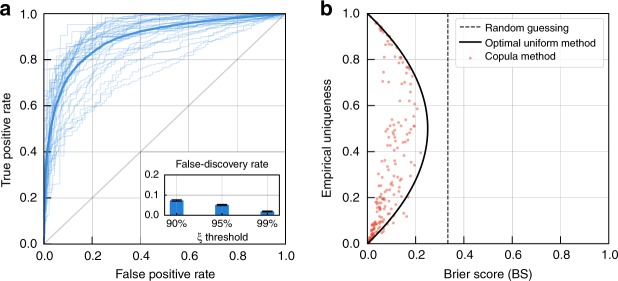
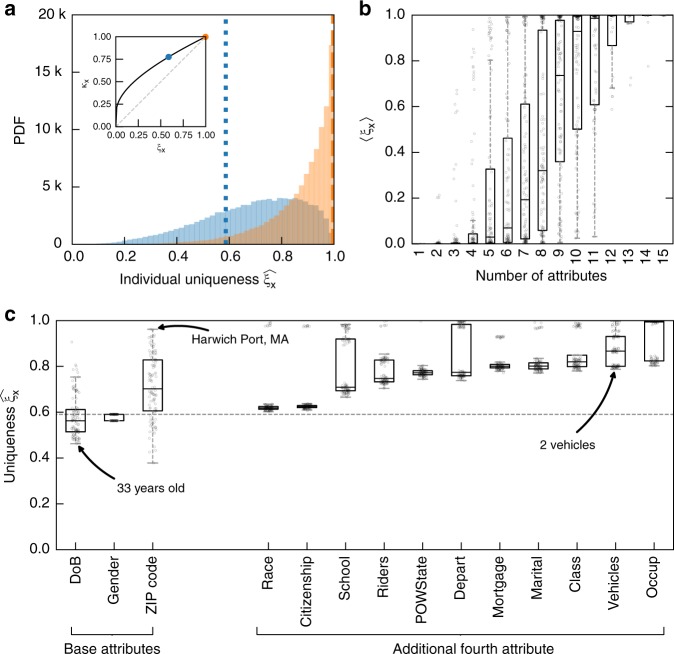
While rich medical, behavioral, and socio-demographic data are key to modern data-driven research, their collection and use raise legitimate privacy concerns. Anonymizing datasets through de-identification and sampling before sharing them has been the main tool used to address those concerns. We here propose a generative copula-based method that can accurately estimate the likelihood of a specific person to be correctly re-identified, even in a heavily incomplete dataset. On 210 populations, our method obtains AUC scores for predicting individual uniqueness ranging from 0.84 to 0.97, with low false-discovery rate. Using our model, we find that 99.98% of Americans would be correctly re-identified in any dataset using 15 demographic attributes. Our results suggest that even heavily sampled anonymized datasets are unlikely to satisfy the modern standards for anonymization set forth by GDPR and seriously challenge the technical and legal adequacy of the de-identification release-and-forget model.
Overview
The claims and statistics of this paper haven’t been checked yet.
Free: it reads the open-access text and checks the first 5 claims that cite a source we can check. Create a free account to check every claim.
Integrity signals
Registry
Cites
Statistics
Figures
Verification
Claims the paper makes
The claims and statistics of this paper haven’t been checked yet.
Free: it reads the open-access text and checks the first 5 claims that cite a source we can check. Create a free account to check every claim.
Claims other papers make about this one
Each is checked against this paper’s own text: does it say what the citing paper says it does?
The source backs part of the claim, not all of it — or backs it for a different population, condition or comparison.
In the citing paper
“Existing medical data is not fully exploited by ML primarily because it sits in data silos and privacy concerns restrict access to this data.”
From The future of digital health with federated learning (2020) · cites this paper as [7]
Experimental — accuracy not yet measuredThe source backs part of the claim, not all of it — or backs it for a different population, condition or comparison.
In the citing paper
“Centralising or releasing data, however, poses not only regulatory, ethical and legal challenges, related to privacy and data protection, but also technical ones.”
From The future of digital health with federated learning (2020) · cites this paper as [7]
Experimental — accuracy not yet measuredThe source backs part of the claim, not all of it — or backs it for a different population, condition or comparison.
In the citing paper
“Beyond these considerations, a required step for multimodal AI is the appropriate linking of all data types available in the datasets, which represents another challenge owing to the increasing risk of identification of individuals and regulatory constraints 146”
From Multimodal biomedical AI (2022) · cites this paper as [146]
Experimental — accuracy not yet measuredThe cited source says what the claim attributes to it.
In the citing paper
“Data anonymization alone does not provide sufficient protection (Rocher et al., 2019) since parts of the training data can be reconstructed by inversion of model parameters (Carlini et al., 2019; Zhang et al., 2020), gradients (Zhu et al., 2019; Geiping et al., 2020), or through adversarial attacks (Wang et al., 2019; Hitaj et al., 2017).”
From Federated learning for computational pathology on gigapixel whole slide images (2022) · cites this paper as Rocher et al., 2019
The cited source says what the claim attributes to it.
In the citing paper
“Even if data anonymisation could bypass these limitations, it is now well understood that removing metadata such as patient name or date of birth is often not enough to preserve privacy7.”
From The future of digital health with federated learning (2020) · cites this paper as [7]
1 more claim about this paper
Create a free account to see every claim other papers make about this one.
Self-check
Percentages, sums and reported differences re-computed from the paper’s own numbers.
The self-check needs the paper’s full text.
Citations
Cites
k-ANONYMITY: A MODEL FOR PROTECTING PRIVACY
SWEENEY, L. (2002) · International Journal of Uncertainty, Fuzziness and Knowledge-Based Systems · doi:10.1142/s0218488502001648 · Cited by 8,571 · cited 1×
“While more advanced guarantees like k -anonymity 57 would give every individual in the dataset some protection, they have been shown to be NP-Hard 58 , hard to achieve in modern high-dimensional datasets 59 , and not always suf fi cient 60 .”
BackgroundBig Data : The Management Revolution
マカフィー, ア., ブリニョルフソン, エ., & 有賀, 裕. (2013) · Harvard business review · Cited by 3,550
t-Closeness: Privacy Beyond k-Anonymity and l-Diversity
Li, N., Li, T., & Venkatasubramanian, S. (2007) · 2007 IEEE 23rd International Conference on Data Engineering · doi:10.1109/icde.2007.367856 · Cited by 3,451
Lazer, D., Pentland, A., Adamic, L., Aral, S., Barabási, A.-L., Brewer, D., Christakis, N., Contractor, N., Fowler, J., Gutmann, M., et al. (2009) · Science · doi:10.1126/science.1167742 · Cited by 3,365
The real-time city? Big data and smart urbanism
Kitchin, R. (2014) · GeoJournal · doi:10.1007/s10708-013-9516-8 · Cited by 2,794 · cited 5×
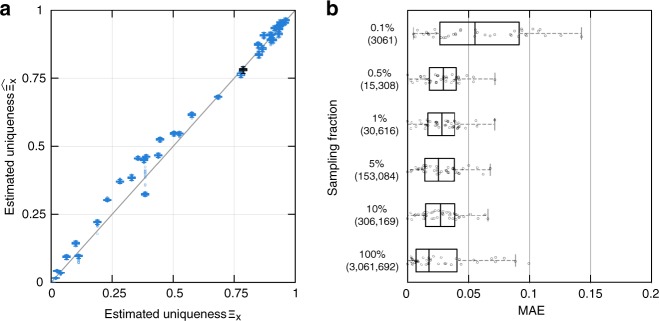
“Table 1 and Supplementary Note 7 show that, at very small sampling fraction (below 0.1%), where the error is the largest, the error is mostly determined by the marginals, and converges after few hundred records when the exact marginals are known.”
BackgroundInfluentialThe Real-Time City? Big Data and Smart Urbanism
Kitchin, R. (2013) · SSRN Electronic Journal · doi:10.2139/ssrn.2289141 · Cited by 2,794
(2012) · PubMed · Cited by 2,326
Cherubini, U., Luciano, E., & Vecchiato, W. (2004) · Wiley eBooks · doi:10.1002/9781118673331 · Cited by 2,009
Vinh, N. X., Epps, J., & Bailey, J. (2010) · Minerva Access (University of Melbourne) · doi:10.5555/1756006.1953024 · Cited by 1,781
The Unreasonable Effectiveness of Data
Halevy, A., Norvig, P., & Pereira, F. (2009) · IEEE Intelligent Systems · doi:10.1109/mis.2009.36 · Cited by 1,767
Research works printed but not linked: 4
- Cadwalladr, C. & Graham-Harrison, E. Revealed: 50 million facebook profiles harvested for Cambridge Analytica in major data breach. The Guardian (17 Mar 2018).
- Polonetsky J Tene O Finch K Shades of gray: seeing the full spectrum of practical data De-Identification St. Clara Law Rev. 2016 56 593 629
- Fienberg SE Sanil AP A Bayesian approach to data disclosure: optimal intruder behavior for continuous data J. Stat. 1997 13 75
- Chen G Keller-McNulty S Estimation of identification disclosure risk in microdata J. Stat. 1998 14 79
Cited by
Items 701–800 of 817
Jonas, J. (2024) · SSRN Electronic Journal · doi:10.2139/ssrn.5002032
Behavioral Unicity: On the Limits of Anonymized Social Behavior Metadata
Tang, H. J., & Wang, C. (2024) · Communications in computer and information science · doi:10.1007/978-981-97-9412-6_1
Cabrera‐Mendoza, B., Burmeister, M., Rietschel, M., Crepaz‐Keay, D., Balhara, Y. P. S., Seedat, S., Marshe, V. S., Hemmings, S. M. J., Peterson, R. E., Kaushik, R., et al. (2024) · doi:10.31219/osf.io/83qry
Fach- und Geschäftsverständnis
Selle, S. (2024) · Springer eBooks · doi:10.1007/978-3-662-67960-9_1
Ethical considerations in the use of patient medical records for research
Raea, S. M., Almotairi, K. M., Alharbi, A. M., Almutairi, G. T., Alhassun, A. M., Binselm, K. R. A., Alruqaie, R. I. M., Albalawi, B. M., Alyamani, A. M. A., Alamri, B. J., et al. (2023) · International Journal of Health Sciences · doi:10.53730/ijhs.v7ns1.15415
“[1,2] Questions concerning privacy, informed consent, ownership and accountability re-emerge more especially when research is being conducted in collaboration with other institutions or across national borders.”
Towards a Trustworthy Federated Learning Framework for Constrained Devices
Fithcheallaigh, S. Ó., Cleland, I., Nugent, C., & Liu, J. (2024) · Lecture notes in networks and systems · doi:10.1007/978-3-031-77571-0_65
Giyilebilir Cihazlardan Gelen Sağlık Verilerinin Kimliksizleştirilmesi Yeterince Güvenli mi?
Durmuş, V. (2024) · İstanbul Gelişim Üniversitesi Sağlık Bilimleri Dergisi · doi:10.38079/igusabder.1326830
di Vimercati, S. D. C., & Foresti, S. (2025) · Springer eBooks · doi:10.1007/978-3-030-71522-9_763
Gregory, J. S. (2024) · Biomedical visualization · doi:10.1007/978-3-031-73270-6_5
A Flexible Parametric Approach to Synthetic Patients Generation in Clinical Trials
Cipriani, M., Rocco, L. D., & Alfò, M. (2025) · Springer eBooks · doi:10.1007/978-3-031-64431-3_69
Strava Metro Data as an Urban Planning Input: Seizing Opportunities and Managing Limitations
Robinson, P. J., Johnson, P. A., Vernooy, M., & Klein, L. (2025) · International Journal of E-Planning Research · doi:10.4018/ijepr.368846 · Cited by 1
Policing Children's DataPreprint
Bala, N. (2025) · SSRN Electronic Journal · doi:10.2139/ssrn.5118251
Building Realities in the XR Age: How We Learned to Engineer Worlds in Our Own Image and Likeness
León-Geyer, A. (2025) · Advances in wireless technologies and telecommunication book series · doi:10.4018/979-8-3693-7147-3.ch006
Cohen, A., Jacob, Y., Châtellier, G., Jean, C., Playe, B., Mouchet, A., Audureau, É., Boutet, A., & Bey, R. (2025) · SSRN Electronic Journal · doi:10.2139/ssrn.5207758
An investigation on synthetic data generation from original incomplete data
Seo, Y.-B., & Kim, Y. M. (2025) · Communications in Statistics - Simulation and Computation · doi:10.1080/03610918.2025.2496777
“However, these methods frequently distort the original data structure (Purdam and Elliot 2007; Winkler 2007) and may remain vulnerable to re-identification when linked with external datasets (Ohm 2010; Rocher, Hendrickx, and De Montjoye 2019).”
Frecè, J. T., Черниш, І. В., & Harder, D. L. (2025) · Springer eBooks · doi:10.1007/978-3-031-76902-3_19
Jiang, B., Raftery, A. E., Steele, R. J., & Wang, N. (2025) · The Annals of Applied Statistics · doi:10.1214/24-aoas2009 · Cited by 2
Mikulska, E. (2024) · Horizons - International Scientific Journal · doi:10.20544/horizons.1.1.24.p09
Identifying Machine-Generated Tweets with Deep Learning and FastText Embeddings on Social Media
Sasikanth, M. M., Ajaykumar, M., Mohan, M., Reddy, M. G. L., & Reddy, M. K. G. (2025) · Industrial Engineering Journal · doi:10.36893/iej.2025.v54i05.005
“This is especially useful for analysing sequences, such as tweets [15]..”
Леро, Н., Donlic, J., & Marjanović, M. (2025) · Societies · doi:10.3390/soc15060158
“Instead, the first author ensures confidentiality by employing robust de-identification strategies: names, locations, and time references are altered, while maintaining the sociopolitical and cultural integrity of the narrative [94].”
Romanchuk, R. (2025) · Springer eBooks · doi:10.1007/978-3-031-85546-7_14
Evaluation of Client Participation on Federated Learning Scenario for Chest X-Ray Imaging
Cerro, C. F. D., Desco, M., & Abella, M. (2025) · Proceedings - IEEE Symposium on Computer-Based Medical Systems · doi:10.1109/cbms65348.2025.00139
Disclosure Risk for Firms in Combined Firm-DatasetsPreprint
Breithaupt, P., & Gottschalk, S. (2025) · SSRN Electronic Journal · doi:10.2139/ssrn.5350791
Mobile Phone Data as an Opportunity to Fight the PandemicPreprint
Dong, C. (2025) · SSRN Electronic Journal · doi:10.2139/ssrn.5350281
Komenda, M., Klimeš, D., Tichopád, A., Jarkovský, J., Májek, O., Mužı́k, J., Táborský, M., Těšitelová, V., Habětínek, J., & Dušek, L. (2025) · doi:10.2196/preprints.80683
Traces as DataPreprint
Parry, D. A., & Klingelhoefer, J. (2025) · PsyArXiv (OSF Preprints) · doi:10.31234/osf.io/6nctf_v1
Surveillance Capitalism and the Right to Medical Privacy
Nuckols, L. (2025) · The International Library of Bioethics · doi:10.1007/978-3-031-94690-5_15
Distributed Biomarker Discovery for Immuno-OncologyPreprint
Aghababazadeh, F. A., Ni, K., Nakano, M., Wang, X., Nair, S. K., Sahebi, N. B., Sella, N., Spasojevic, S. S., Denck, J., Riesterer, N., et al. (2025) · bioRxiv (Cold Spring Harbor Laboratory) · doi:10.1101/2025.07.25.666789
“Even anonymization methods are often insufficient to guarantee privacy [32].”
Adjei-Mensah, I., Wang, Q., Agyemang, I. O., Baffour, A. A., Yussif, S. B., Sey, C., Fiasam, L. D., Chikwendu, I. A., & Wang, W. X. (2025) · Engineering Applications of Artificial Intelligence · doi:10.1016/j.engappai.2025.111891 · Cited by 1
Алексеевна, С. Н. (2025) · Patria · doi:10.17323/patria.2025.27621
Ottawa’s use of our location data raises big surveillance and privacy concerns
Rockwell, G., Matthews, J. N., Chee, F. M., Gambs, S., & Berendt, B. (2022) · doi:10.64628/aam.ca5j6a93p
Multidimensional social signature de-anonymizes low-sensitivity data
Jia, W., Zhou, B., Lu, X., & Xu, X. (2025) · Scientific Reports · doi:10.1038/s41598-025-16663-5
“Although individually innocuous, these behavioral traces can accumulate over time and expose sensitive patterns related to financial status, interpersonal ties, or lifestyle preferences 16–20 , creating risks of blackmail, surveillance, and identity theft 6 .”
InfluentialA flexible parametric approach to synthetic patients generation using health data
Cipriani, M., Rocco, L. D., Puopolo, M., & Alfò, M. (2025) · Statistical Methods & Applications · doi:10.1007/s10260-025-00800-5
“Moreover, this approach overcomes the limitations of traditional anonymisation techniques, which have become increasingly vulnerable due to technological advancements (Rocher et al. 2019).”
K P N -anonymity: Extension of K-anonymity for user anonymity evaluation on web applications
Merino, Á., Cuevas, √., & Cuevas, R. (2025) · Array · doi:10.1016/j.array.2025.100499
Federated Learning in the Healthcare Industry
Mondal, R. (2025) · Studies in systems, decision and control · doi:10.1007/978-3-031-99270-4_2
Reidentification risks in distributed differentially private data leveraging large language models
Sei, Y., Okumura, H., Ohsuga, A., & Imoize, A. L. (2025) · Elsevier eBooks · doi:10.1016/b978-0-443-34109-0.00007-3
Hukuki Boyutuyla Tıbbı Cihaz Vasfı Taşımayan Giyilebilir Dijital Sağlık Ürünleri
Seçer, T. (2025) · İstanbul Medeniyet Üniversitesi Hukuk Fakültesi Dergisi · doi:10.58733/imhfd.1618585
The European Health Data Space and its impact on 21st-century surgery
Garcia-Alamino, J. M., & Cano, M. L. (2025) · Cirugía Española (English Edition) · doi:10.1016/j.cireng.2025.800234
Quantitative Metrics for Balancing Privacy and Utility in Pseudonymized Big Data
Kim, S. S. (2025) · Electronics · doi:10.3390/electronics14214350
Borders, J. C., Thompson, A. R., & Kearney, E. (2025) · Journal of Speech Language and Hearing Research · doi:10.1044/2025_jslhr-24-00736 · Cited by 2
Data Anonymization with the Density Matrix Classifier
Garvin, D., Fiorentini, M., Kondratyev, O., & Paini, M. (2025) · The Journal of FinTech · doi:10.1142/s2705109925500105
“Indeed, the advances of machine learning applications have also improved our ability to reverse engineer de-identified datasets in order to trace information back to specific individuals [8].”
Lysaght, T., Ballantyne, A., Xafis, V., Ong, S., Schaefer, G. O., Ling, J., Newson, A. J., Khor, I. W., & Tai, E. S. (2020) · Figshare · doi:10.6084/m9.figshare.13266252
El Espacio Europeo de Datos Sanitarios y su impacto en la cirugía del siglo XXI
Garcia-Alamino, J. M., & Cano, M. L. (2025) · Cirugía Española · doi:10.1016/j.ciresp.2025.800234
Shourov, M. A. H., Kaium, A. S. M., Rahman, R., Zhanda, M. M. K., & Rafiq, J. I. (2025) · Studies in computational intelligence · doi:10.1007/978-981-96-8353-6_10
Li, K., Lohachab, A., & Urovi, V. (2025) · Conference on Blockchain Research & Applications for Innovative Networks and Services (BRAINS) · doi:10.1109/brains67003.2025.11302943
Sağlık Hizmetlerinde Yapay Zekâ Kullanımı: Dönüşüm, Yenilik ve Gelecek Öngörüleri
Karasu, E., & Karasu, L. (2025) · Özgür Yayınları eBooks · doi:10.58830/ozgur.pub1078.c4266
Geng, Y., Bi, X., & De, L. (2026) · SSRN Electronic Journal · doi:10.2139/ssrn.5907882
Pérez, A. D., & Pérez, W. A. (2026) · Research Square · doi:10.21203/rs.3.rs-8585342/v1
Smart Data Portfolios: A Quantitative Framework for Input Governance in AIPreprint
Yalta, A. T., & Yalta, A. T. (2026) · SSRN Electronic Journal · doi:10.2139/ssrn.5942058
Jose, A., Kaithathara, S. T., Mohan, R., Bhat, N., & Tapase, P. (2026) · IGI Global eBooks · doi:10.4018/979-8-3373-1454-9.ch005 · Cited by 1
Protecting Vulnerable Voices: Synthetic Dataset Generation for Self-disclosure Detection
Jangra, S., De, S., Sastry, N. R., & Fadaei, S. (2026) · Lecture notes in computer science · doi:10.1007/978-3-032-13821-7_1 · Cited by 5
Assessing metadata privacy in neuroimaging
Kibsgaard, E., Jwa, A. S., Markiewicz, C. J., Gonzalez, D. R., Díaz, J. S.-P., Poldrack, R. A., & Pernet, C. R. (2026) · Imaging Neuroscience · doi:10.1162/imag.a.1144 · Cited by 1
“Those data are an easy target because they require little expertise to analyze and no specific or proprietary software ( Rocher et al., 2019).”
InfluentialEthical, Legal, and Practical Considerations
AlEdani, E. M. (2025) · Updates in clinical dermatology · doi:10.1007/978-3-031-78139-1_7
Cohen, A. A., Jacob, Y., Châtellier, G., Jean, C., Playe, B., Mouchet, A., Audureau, É., Boutet, A., & Bey, R. (2026) · BMC Medical Informatics and Decision Making · doi:10.1186/s12911-026-03360-0 · Cited by 1
“Indeed, as shown by Rocher et al. [23], an attacker can often infer with a high degree of confidence whether a record is unique in a total dataset even when accessing only a minimised subset.”
Plimakis, S., & Mantas, C. (2026) · IGI Global eBooks · doi:10.4018/979-8-3373-4606-9.ch009 · Cited by 1
AI Regulations and Policies for Data Privacy Protection in Indonesia
Aji, B. M. P., Septaninda, S. P., Idris, F. M., Zulfanabil, M. B., Loilatu, M. J., Saiman, S., Roziqin, A., & Sulistyaningsih, T. (2026) · Advances in computational intelligence and robotics book series · doi:10.4018/979-8-3373-7804-6.ch004 · Cited by 1
AI and Machine Learning in Bioscience Research and Environmental Monitoring
Malakar, C. (2026) · Journal of Environmental Science and Pollution Research · doi:10.30799/jespr.265.26120104
Semantically-Aware LLM Agent to Enhance Privacy in Conversational AI Services
Serenari, J., & Lee, S. (2025) · IEEE International Conference on Big Data (BigData) · doi:10.1109/bigdata66926.2025.11401540 · Cited by 3
“Recent research has also highlighted similar privacy risks arising from LLMs [13].”
Tillayeva, N., Tamura, N., Urano, K., Yonezawa, T., Kawaguchi, N., & Okumura, T. (2026) · Infectious Disease Modelling · doi:10.1016/j.idm.2026.03.006
“High-resolution pseudo-data may even risk re-identification if it replicates real user behavior too closely (Rocher et al., 2019).”
Hamada, S. (2019) · theses.fr (ABES) · doi:10.70675/8922fb90zf449z4c1ez8b37z805a597e177c · Cited by 1
Eisenhauer, C. (2021) · theses.fr (ABES) · doi:10.70675/760b3df4z633cz420dza2bdz95dc31ce2fba
On contradictions between model interpretability and inversion attacks
Naseem, M. L., Ye, Z., Qi, Z., & Luo, W. (2026) · Complex & Intelligent Systems · doi:10.1007/s40747-026-02294-4
Adversarial mitigation to reduce unwanted biases in machine learning
Grari, V. (2022) · theses.fr (ABES) · doi:10.70675/df2cbae5zd700z4b62z845dz004fa5581c09 · Cited by 3
Guennec, N. L. (2023) · theses.fr (ABES) · doi:10.70675/a2d6a35az09c7z4993zae19z8c5e49cc6cdb
Lee, Y., Park, S., & Son, Y. (2026) · Applied Sciences · doi:10.3390/app16083680
Modern Advancements in AI for Healthcare Diagnostics: Transforming Medical Care
Khan, N. A. (2026) · Advances in computational intelligence and robotics book series · doi:10.4018/407372 · Cited by 1
Toward Autonomous 6G Networks: A Trust-Centric and Privacy-Preserving Framework
Manhas, J., & Pavate, A. A. (2026) · Qubahan Techno Journal · doi:10.48161/qtj.v5n2a83 · Cited by 1
Information Security and Privacy Protection in the Age of Explainable and Generative AI
Das, A. (2026) · Advances in computational intelligence and robotics book series · doi:10.4018/979-8-3373-7852-7.ch002 · Cited by 1
Privacy-Preserving Federated Mining of Top- K Frequent Itemsets Under Local Differential Privacy
Chen, Y., Gan, W., Ren, J., Zhou, Q., & Yu, P. S. (2026) · IEEE Internet of Things Journal · doi:10.1109/jiot.2026.3688898
“For example, Rocher et al. [6] demonstrated that generative models can accurately estimate the probability of reidentifying individuals in partially anonymized datasets, while de Montjoye et al. [7] showed that as few as four spatiotemporal points in credit card metadata are su ffi cient to uniquely…”
Centering the marginalized: AI-driven strategies for advancing health equity in rare disease care
Lei, C., Zuo, Y., Lopes, C. A., Stuart, J., Xu, B., Liu, T. Y. A., Ploug, T., Wang, Z., Dang, K., Jin, K., et al. (2026) · Patterns · doi:10.1016/j.patter.2026.101535 · Cited by 1
“39,40 Advances in computational techniques, such as inference algorithms, have also lowered the barrier for malicious attacks and can uncover personal attributes.”
Safeguarding the world’s biobanks: A call to cardiovascular science
Liu, Y. (2026) · Cardiac Research · doi:10.1097/re9.0000000000000017
Nebeker, C., Arias, S. A., Dunlap, D. R., Palmer, B. W., & Boudreaux, E. D. (2026) · doi:10.2196/preprints.101562
Faults and Pitfalls in Implementing the Right to be Forgotten
Sun, C., Guggenberger, N., & Shastri, S. (2026) · Communications of the ACM · doi:10.1145/3807515
“Even when it is well done, prior research has shown that not all anonymizations hold the test of time [55, 63] and may need to be constantly evaluated to ensure anonymity [23].”
Smart diagnostics: redefining healthcare precision and efficiency with artificial intelligence
Kaur, D., & Kaur, P. (2026) · Elsevier eBooks · doi:10.1016/b978-0-443-41545-6.00002-6
Dario, P. (2026) · Journal of Diabetes Science and Technology · doi:10.1177/19322968261455365 · Cited by 1
“46,47 A 2023 systematic review specifically examining deidentification of wearable device data concluded that current anonymization methods may give a false sense of security, as the temporal granularity of sensor-generated data creates unique individual signatures resistant to standard…”
Ethics of Health Data Infrastructures: Toward Continuous Governance and Public Trust
Inoue, Y., & Johansson, J. V. (2026) · Journal of Medical Internet Research · doi:10.2196/104402
“Ongoing debates concerning reidentification through data linkage and AI-based analysis further underscore the need for broader communication about downstream data-use risks [20,21].”
Back, S.-H., & Yoo, S. B. (2026) · Information Sciences · doi:10.1016/j.ins.2026.123803
Risk-calibrated sharing of human brain data
Hendriks, S., Beckel-Mitchener, A. C., Eberwine, J. H., Farahany, N. A., Hsu, N. S., Ngai, J., & Grady, C. (2026) · Brain · doi:10.1093/brain/awag205 · Cited by 1
Ethical and regulatory considerations in the adoption of AI in medicine
DOBHAL, A., Painuly, P., Ashutosh, K., Jha, R. S., Gupta, M., & Tyagi, N. (2026) · AIP conference proceedings · doi:10.1063/5.0330310
Sardar, T. H., Thahniyath, G., Pal, D., & Santhosh, S. (2026) · Elsevier eBooks · doi:10.1016/b978-0-443-45875-0.00015-6
Kassai, M. L., & Funer, F. (2026) · Research Ethics · doi:10.1177/17470161261465028
The true costs of data management in the era of data sharing mandates
Espin, A. T., Nielson, J. L., Hawkins, B. E., Mondello, S., Martone, M. E., Nelson, D. W., Ercole, A., Steyerberg, E. W., Cifu, D. X., Pugh, M. J., et al. (2026) · Brain Injury · doi:10.1080/02699052.2026.2695303
“Data scientists recognize that there is no such thing as perfect anonymization, and the free availability of large, rich datasets increases the risk of re-identification (12).”
Kajol, M. A., Chennagouni, N., Lu, W., & Yu, Q. (2026) · IEEE International Symposium on Hardware Oriented Security and Trust (HOST) · doi:10.1109/host68814.2026.11604903
“A recent survey of privacy risks in AI-driven healthcare [2] found that anonymized data could be re-identified under certain conditions when combined with other data sources.”
Tracing the unseen: a deep dive into mobility behavior exposure
Félix, L. G. S., Kouam, A. J., Viana, A. C., Achir, N., & Almeida, J. M. (2026) · EPJ Data Science · doi:10.1140/epjds/s13688-026-00680-z
When Data Protection Fails to Protect: Law, Power, and Postcolonial Governance in Bangladesh
Saha, P., Chan, A., & Sultana, S. (2026) · ACM SIGCAS/SIGCHI Conference on Computing and Sustainable Societies (COMPASS) · doi:10.1145/3811242.3819089 · Cited by 2
Yu, Z., Xu, Z., & Qi, J. (2026) · AI and Ethics · doi:10.1007/s43681-026-01292-z
“In small or specialized user populations, combinations of seemingly non-identifying attributes may significantly increase the possibility of individual re-identification [ 74].”
Bruni, R., Bianchi, G., & Lorusso, P. (2026) · Information Processing & Management · doi:10.1016/j.ipm.2026.105073
A harm-reduction framework for responsible AI in public health research
Hughes, M. C. (2026) · npj Digital Public Health · doi:10.1038/s44482-026-00031-9
Challenges and Solutions to Deploying Differential Privacy
Desfontaines, D., & Task, C. (2025) · Emerald Group Publishing Limited eBooks · doi:10.1561/978-1-63828-477-220251019
The Triple Bind: Performance, Stability, And Oversight In Ai-Driven Financial Risk Management
Oet, M. V., & Kvedaravičiūtė, E. (2026) · Springer proceedings in complexity · doi:10.1007/978-3-032-21596-3_9
Ekusai‐Sebatta, D., Ocan, M., Singh, S., Kyaddondo, D., Akena, D. H., Kinengyere, A. A., Namisango, E., Obuku, E. A., & Mwaka, E. (2026) · PLoS ONE · doi:10.1371/journal.pone.0354471 · Cited by 1
“The risk of re-identifiability remains a major ethical concern in genomic data sharing, even with the implementation of technical safeguards such as controlled-access repositories, encryption, pseudonymisation, and secure data transfer protocols [22–24].”
Reidentification risk estimation using Gaussian-copula-based generative models
Bandara, K., Bandara, H. M. N. D., & Fernando, S. (2026) · PeerJ Computer Science · doi:10.7717/peerj-cs.4032
Embedding-Space Anonymization for Privacy-Preserving AI Systems
Panagoulias, D. P., Tsichrintzi, E.-A., & Sakkopoulos, E. (2026) · International Conference on Computer, Information and Telecommunication Systems · doi:10.1109/cits70307.2026.11637145
“Research by Rocher, Hendrickx, and de Montjoye demonstrated that even sparse, seemingly innocuous attribute combinations can re-identify 99.98% of individuals in large datasets, underscoring that naive de-identification, such as simply removing a name column, is entirely insufficient [6].”
InfluentialKama, M. O., Ajah, I. A., Ikegwu, A. C., Obayi, A. A., Uloko, F. O., & Ogbuagu, I. C. (2026) · BMC Medical Informatics and Decision Making · doi:10.1186/s12911-026-03796-4
Semantic computing in healthcare: Bridging the gap between innovation and privacy security measures
Agarwal, N., Aliswag, E. G., & Kumar, P. (2026) · Elsevier eBooks · doi:10.1016/b978-0-443-33512-9.00012-3
Komenda, M., Klimeš, D., Tichopád, A., Jarkovský, J., Májek, O., Mužík, J., Táborský, M., Těšitelová, V., Habetinek, J., & Dušek, L. (2026) · JMIR Medical Informatics · doi:10.2196/80683
Othman, Z. K., Ahmed, M. M., Nazari, R., & Ibrahim, A. M. (2026) · Biotechnology Notes · doi:10.1016/j.biotno.2026.08.003
“61 The ownership and governance of laboratory, imaging, genomic, and multi-omics data, the security of sensitive clinical information and the handling of data breaches, and the conditions under which data are shared across institutions and national borders all require explicit frameworks.”
Regulatory Frameworks: Legislation, Policies and Governance of Genomic Data
Antwi-Boasiako, A., Animah, E. N., Mensah, J., Daniel, M., & Mohammed, M. (2026) · Genetics. · doi:10.5772/intechopen.1015402
Saha, S., Choudhary, P. K., Dubey, S., & Khati, A. (2026) · Advances in computational intelligence and robotics book series · doi:10.4018/979-8-3373-9109-0.ch004
Metadata
- Authors
- Rocher, L., Hendrickx, J. M., & de Montjoye, Y.-A.
- Affiliations
- Imperial College London (GB)
- UCLouvain (BE)
- Venue
- Nature Communications
- Published
- 2019-07-23
- Volume
- 10
- Issue
- 1
- Pages
- 3069-3069
- ISSN
- 2041-1723 (ISSN-L)
- PMC
- PMC6650473
- OpenAlex
- W2963693643
- Semantic Scholar
- f34b6423878090c7422c078a3dd6a3db80fb7532
- Cited by
- 816
- References
- 57
- Citations by year
- 2026: 86 · 2025: 99 · 2024: 111 · 2023: 105 · 2022: 154 · 2021: 120 · 2020: 124 · 2019: 16
- FWCI
- 47.23
- Type
- journal article
- Language
- en
- Open access
- gold
- doi.org
- Licence
- cc-by
- creativecommons.org/licenses/by/4.0 (tdm)
- creativecommons.org/licenses/by/4.0 (vor)
- Locations
- Nature Communications (publishedVersion, cc-by)
- PubMed Central (publishedVersion, cc-by)
- PubMed (publishedVersion)
- RePEc: Research Papers in Economics (submittedVersion)
- Digital Access to Libraries (Université catholique de Louvain (UCL), l'Université de Namur (UNamur) and the Université Saint-Louis (USL-B)) (submittedVersion, other-oa)
- DOAJ (DOAJ: Directory of Open Access Journals) (submittedVersion)
- DOAJ (DOAJ: Directory of Open Access Journals) (submittedVersion, cc-by-sa)
- Spiral (Imperial College London) (submittedVersion, cc-by)
- Funders
- Fonds De La Recherche Scientifique - FNRS
- Wallonie-Bruxelles International
- Imperial College London
- Topics
- Physical Sciences › Computer Science › Artificial Intelligence › Privacy-Preserving Technologies in Data
- Physical Sciences › Computer Science › Information Systems › Data Quality and Management
- Physical Sciences › Computer Science › Artificial Intelligence › Internet Traffic Analysis and Secure E-voting
- Keywords
- re-identification risk, data anonymization, de-identification, missing data, privacy, demographic factors, data sharing
- MeSH terms
- Data Anonymization, Personally Identifiable Information, Data Analysis, Normal Distribution, Likelihood Functions, Datasets as Topic
About these checks
Registry, retraction, Cites and statistics results are computed, not judged, with one exception: a printed reference that no index lists is read once by a model before it counts as a citation error. Claims are extracted by a model and kept only when their quote appears verbatim in the text; each cited source is then checked, with a model’s help, for whether it says what the claim relies on. Those verdicts can be wrong — read the claim’s quote and the cited source before relying on one.
Statistics and arithmetic are recomputed, not judged.
Confidence bands are shown only for fields calibrated on our annotated test set. None is calibrated yet, so no band is shown.
What counts as a claim ›How we measure confidence ›How we check this ›
Are you an author, or do you see a problem with this page? Request a review
Data sources
Bibliographic data: Semantic Scholar, OpenAlex, Crossref.
Contains information from the Semantic Scholar Academic Graph Datasets, made available under the ODC Attribution License (ODC-BY 1.0).
Semantic Scholar’s data is described in: Kinney, R., et al. (2023). The Semantic Scholar Open Data Platform. arXiv:2301.10140.
