

Estimating the success of re-identifications in incomplete datasets using generative models
Open accessThe DOI matches its Crossref record; 59 of the 59 references it cites were found in a registry or an index.
Abstract
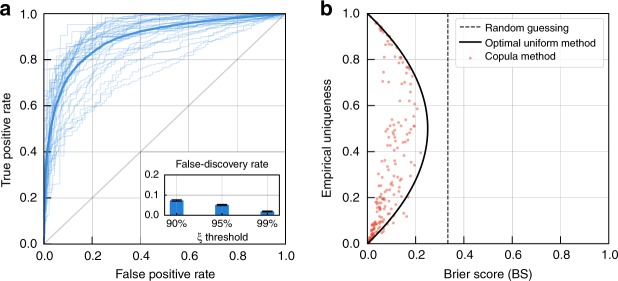
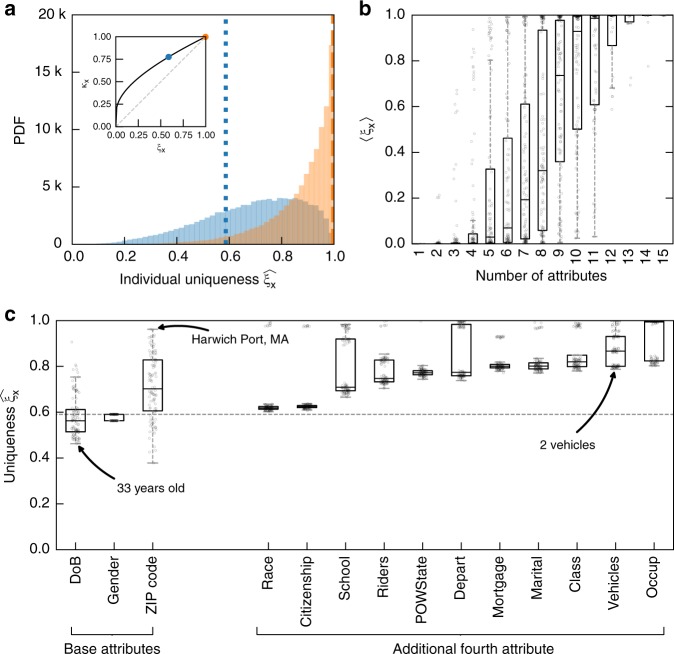
While rich medical, behavioral, and socio-demographic data are key to modern data-driven research, their collection and use raise legitimate privacy concerns. Anonymizing datasets through de-identification and sampling before sharing them has been the main tool used to address those concerns. We here propose a generative copula-based method that can accurately estimate the likelihood of a specific person to be correctly re-identified, even in a heavily incomplete dataset. On 210 populations, our method obtains AUC scores for predicting individual uniqueness ranging from 0.84 to 0.97, with low false-discovery rate. Using our model, we find that 99.98% of Americans would be correctly re-identified in any dataset using 15 demographic attributes. Our results suggest that even heavily sampled anonymized datasets are unlikely to satisfy the modern standards for anonymization set forth by GDPR and seriously challenge the technical and legal adequacy of the de-identification release-and-forget model.
Overview
The claims and statistics of this paper haven’t been checked yet.
Free: it reads the open-access text and checks the first 5 claims that cite a source we can check. Create a free account to check every claim.
Integrity signals
Registry
Cites
Statistics
Figures
Verification
Claims the paper makes
The claims and statistics of this paper haven’t been checked yet.
Free: it reads the open-access text and checks the first 5 claims that cite a source we can check. Create a free account to check every claim.
Claims other papers make about this one
Each is checked against this paper’s own text: does it say what the citing paper says it does?
The source backs part of the claim, not all of it — or backs it for a different population, condition or comparison.
In the citing paper
“Existing medical data is not fully exploited by ML primarily because it sits in data silos and privacy concerns restrict access to this data.”
From The future of digital health with federated learning (2020) · cites this paper as [7]
Experimental — accuracy not yet measuredThe source backs part of the claim, not all of it — or backs it for a different population, condition or comparison.
In the citing paper
“Centralising or releasing data, however, poses not only regulatory, ethical and legal challenges, related to privacy and data protection, but also technical ones.”
From The future of digital health with federated learning (2020) · cites this paper as [7]
Experimental — accuracy not yet measuredThe source backs part of the claim, not all of it — or backs it for a different population, condition or comparison.
In the citing paper
“Beyond these considerations, a required step for multimodal AI is the appropriate linking of all data types available in the datasets, which represents another challenge owing to the increasing risk of identification of individuals and regulatory constraints 146”
From Multimodal biomedical AI (2022) · cites this paper as [146]
Experimental — accuracy not yet measuredThe cited source says what the claim attributes to it.
In the citing paper
“Data anonymization alone does not provide sufficient protection (Rocher et al., 2019) since parts of the training data can be reconstructed by inversion of model parameters (Carlini et al., 2019; Zhang et al., 2020), gradients (Zhu et al., 2019; Geiping et al., 2020), or through adversarial attacks (Wang et al., 2019; Hitaj et al., 2017).”
From Federated learning for computational pathology on gigapixel whole slide images (2022) · cites this paper as Rocher et al., 2019
The cited source says what the claim attributes to it.
In the citing paper
“Even if data anonymisation could bypass these limitations, it is now well understood that removing metadata such as patient name or date of birth is often not enough to preserve privacy7.”
From The future of digital health with federated learning (2020) · cites this paper as [7]
1 more claim about this paper
Create a free account to see every claim other papers make about this one.
Self-check
Percentages, sums and reported differences re-computed from the paper’s own numbers.
The self-check needs the paper’s full text.
Citations
Cites
k-ANONYMITY: A MODEL FOR PROTECTING PRIVACY
SWEENEY, L. (2002) · International Journal of Uncertainty, Fuzziness and Knowledge-Based Systems · doi:10.1142/s0218488502001648 · Cited by 8,571 · cited 1×
“While more advanced guarantees like k -anonymity 57 would give every individual in the dataset some protection, they have been shown to be NP-Hard 58 , hard to achieve in modern high-dimensional datasets 59 , and not always suf fi cient 60 .”
BackgroundBig Data : The Management Revolution
マカフィー, ア., ブリニョルフソン, エ., & 有賀, 裕. (2013) · Harvard business review · Cited by 3,550
t-Closeness: Privacy Beyond k-Anonymity and l-Diversity
Li, N., Li, T., & Venkatasubramanian, S. (2007) · 2007 IEEE 23rd International Conference on Data Engineering · doi:10.1109/icde.2007.367856 · Cited by 3,451
Lazer, D., Pentland, A., Adamic, L., Aral, S., Barabási, A.-L., Brewer, D., Christakis, N., Contractor, N., Fowler, J., Gutmann, M., et al. (2009) · Science · doi:10.1126/science.1167742 · Cited by 3,365
The real-time city? Big data and smart urbanism
Kitchin, R. (2014) · GeoJournal · doi:10.1007/s10708-013-9516-8 · Cited by 2,794 · cited 5×
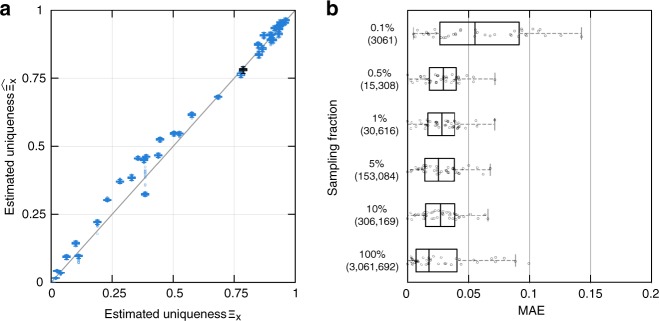
“Table 1 and Supplementary Note 7 show that, at very small sampling fraction (below 0.1%), where the error is the largest, the error is mostly determined by the marginals, and converges after few hundred records when the exact marginals are known.”
BackgroundInfluentialThe Real-Time City? Big Data and Smart Urbanism
Kitchin, R. (2013) · SSRN Electronic Journal · doi:10.2139/ssrn.2289141 · Cited by 2,794
(2012) · PubMed · Cited by 2,326
Cherubini, U., Luciano, E., & Vecchiato, W. (2004) · Wiley eBooks · doi:10.1002/9781118673331 · Cited by 2,009
Vinh, N. X., Epps, J., & Bailey, J. (2010) · Minerva Access (University of Melbourne) · doi:10.5555/1756006.1953024 · Cited by 1,781
The Unreasonable Effectiveness of Data
Halevy, A., Norvig, P., & Pereira, F. (2009) · IEEE Intelligent Systems · doi:10.1109/mis.2009.36 · Cited by 1,767
Research works printed but not linked: 4
- Cadwalladr, C. & Graham-Harrison, E. Revealed: 50 million facebook profiles harvested for Cambridge Analytica in major data breach. The Guardian (17 Mar 2018).
- Polonetsky J Tene O Finch K Shades of gray: seeing the full spectrum of practical data De-Identification St. Clara Law Rev. 2016 56 593 629
- Fienberg SE Sanil AP A Bayesian approach to data disclosure: optimal intruder behavior for continuous data J. Stat. 1997 13 75
- Chen G Keller-McNulty S Estimation of identification disclosure risk in microdata J. Stat. 1998 14 79
Cited by
Items 401–500 of 817
Javaid, U., Li, Z., Aman, M. N., Shao, D., Yee, K., & Sikdar, B. (2022) · IEEE International Conference on Big Data (BigData) · doi:10.1109/bigdata55660.2022.10021011 · Cited by 6
“98% of Americans would be correctly re-identified in any dataset using only 15 demographic attributes [3].”
BackgroundArtificial Intelligence and the Weaponization of Genetic Data
Sawaya, S. M., Kenneally, E. E., Nelson, D., & Schumacher, G. J. (2012) · Springer eBooks · doi:10.1007/978-3-031-26034-6_14 · Cited by 8
Maximising the Educational and Research Value of the Undergraduate Dissertation in Psychology
Creaven, A., Button, K. S., Woods, H. C., & Nordmann, E. (2023) · Collabra Psychology · doi:10.1525/collabra.90216 · Cited by 13
Maximising the educational and research value of the undergraduate dissertation in psychologyPreprint
Creaven, A., Button, K. S., Woods, H. C., & Nordmann, E. (2021) · doi:10.31234/osf.io/deh93 · Cited by 5
“Although there is debate about the value of open data initiatives (e.g., Kitchin, 2013), and it is highly challenging to truly anonymise data (e.g., Rocher et al., 2019), making a conscious decision to make data open (or not, particularly for qualitative research) is an important element of student…”
BackgroundAbowd, J. M., Adams, T., Ashmead, R., Darais, D., Dey, S., Garfinkel, S., Goldschlag, N., Kifer, D., Leclerc, P., Lew, E., et al. (2023) · National Bureau of Economic Research · doi:10.3386/w31995 · Cited by 5
Data Protection in Zimbabwe with Reference to the Covid-19 Pandemic and International Law
Saki, O. (2024) · Potchefstroom Electronic Law Journal/Potchefstroomse Elektroniese Regsblad · doi:10.17159/1727-3781/2024/v27i0a17744 · Cited by 4
Should We Trust the Credit Decisions Provided by Machine Learning Models?
Alonso-Robisco, A., & Carbó, J. M. (2025) · Computational Economics · doi:10.1007/s10614-025-10855-x · Cited by 8
“Since the risk of re-identification is important (Rocher et al., 2019), researchers often turn to generative models such as Generative Adversarial Networks (GANs), to generate new instances of data that have similar statistical properties to the original dataset (Goodfellow et al., 2020).”
A quantitative analysis of the use of anonymization in biomedical research
Meurers, T., Otte, K., Attieh, H. A., Briki, F., Despraz, J., Halilovic, M., Kaabachi, B., Milićević, V., Müller, A., Papapostolou, G., et al. (2025) · npj Digital Medicine · doi:10.1038/s41746-025-01644-9 · Cited by 6
Differentially Private Profiling of Anonymized Customer Purchase Records
Kikuchi, H. (2020) · Lecture notes in computer science · doi:10.1007/978-3-030-66172-4_2 · Cited by 4
Ethical Considerations of Artificial Intelligence Applications in Healthcare
Gichoya, J. W., MELTZER, C. C., Newsome, J. M., Correa, R., Trivedi, H., Banerjee, I., Davis, M. A., & Celi, L. A. (2022) · Contemporary medical imaging · doi:10.1007/978-3-030-92087-6_52 · Cited by 7
BORISOV, A. V., Bosov, A. V., & IVANOV, A. V. (2023) · Программирование · doi:10.31857/s0132347423040040 · Cited by 5
Thinking in Categories: A Survey on Assessing the Quality for Time Series Synthesis
Stenger, M., Bauer, A., Prantl, T., Leppich, R., Hudson, N., Chard, K., Foster, I. T., & Kounev, S. (2024) · Journal of Data and Information Quality · doi:10.1145/3666006 · Cited by 11
De-Anonymizing Users across Rating Datasets via Record Linkage and Quasi-Identifier Attacks
Torres, N., & Olivares, P. (2024) · Data · doi:10.3390/data9060075 · Cited by 10
“Rocher et al. [14] proposed an approach to estimate the risk of re-identification in anonymized datasets using machine learning models trained on auxiliary data.”
Wang, R., Liu, J., Jiang, B., Gao, B., Luo, H., Yang, F., Ye, Y., Chen, Z., Liu, H. S., Cui, C., et al. (2024) · Frontiers in Immunology · doi:10.3389/fimmu.2024.1454833 · Cited by 6
Overfit detection method for deep neural networks trained to beamform ultrasound images
Zhang, J., & Bell, M. A. L. (2024) · Ultrasonics · doi:10.1016/j.ultras.2024.107562 · Cited by 4
ANN Activation Function Estimators for Homomorphic Encrypted Inference
Harb, M. R. A., & Çeliktaş, B. (2025) · IEEE Access · doi:10.1109/access.2025.3579667 · Cited by 5
“This mirrors prior findings that (i) up to 28% of individuals in HIPAA-compliant discharge data were re-identified via newspaper linkage [36], and (ii) 99.98% of U.S. residents are unique when just 15 demographic fields are known [37].”
InfluentialSayeed, R., Jones, J. B., Gottlieb, D., Mandel, J. C., & Mandl, K. D. (2020) · Journal of the American Medical Informatics Association · doi:10.1093/jamia/ocaa227 · Cited by 6
Privacy Preserving Inference with Convolutional Neural Network Ensemble
Xiong, A., Nguyen, M., So, A., & Chen, T. (2020) · IEEE International Performance, Computing, and Communications Conference · doi:10.1109/ipccc50635.2020.9391544 · Cited by 4
“However, studies have shown how machine learning techniques can be used to re-identify a specific person with high accuracy even after de-identification [3].”
BackgroundDesigning a User Interface for Improving the Usability of a Statistical Disclosure Control Tool
Rawat, A., Janssen, M., Bargh, M. S., & Choenni, S. (2021) · IEEE International Symposium on Parallel and Distributed Processing with Applications (ISPA) · doi:10.1109/ispa-bdcloud-socialcom-sustaincom52081.2021.00212 · Cited by 4
Quantifying the Re-identification Risk in Published Process Models
Maatouk, K., & Mannhardt, F. (2022) · Lecture notes in business information processing · doi:10.1007/978-3-030-98581-3_28 · Cited by 4
A journey toward an open data culture through transformation of shared data into a data resource
Kahn, S. D., & Koralova, A. (2022) · Data & Policy · doi:10.1017/dap.2022.22 · Cited by 4
Health Research with Data in a Time of Privacy: Which Information do Patients Want?
Beusink, M., Koetsveld, F., van Scheijen, S., Janssen, T. M., Buiter, M., Schmidt, M. K., & Rebers, S. (2023) · Journal of Empirical Research on Human Research Ethics · doi:10.1177/15562646231181439 · Cited by 4
“However, data processing will always entail small risks for patients, most notably privacy risks (Piasecki et al., 2021; Rocher et al., 2019).”
BackgroundGrandma Karl is 27 years old – research agenda for pseudonymization of research data
Volodina, E., Dobnik, S., Tiedemann, T. L., & Vu, X.-S. (2023) · IEEE International Conference on Big Data Computing Service and Applications (BigDataService) · doi:10.1109/bigdataservice58306.2023.00047 · Cited by 4
From Isolation to Identification
D’Acquisto, G., Cohen, A., Naldi, M., & Kobbi Nissim, B. (2024) · Lecture notes in computer science · doi:10.1007/978-3-031-69651-0_1 · Cited by 4
Demuth, S., Rousseau, O., Faddeenkov, I., Paris, J., Seze, J. D., Baciotti, B., Payet, M., Guillaudeux, M., Barreteau, A.-F., Laplaud, D. A., et al. (2025) · Journal of Medical Internet Research · doi:10.2196/71297 · Cited by 3
“However, this does not prevent indirect reidentification by unique combinations of variables [9,10].”
Dodero, J. M., Rodríguez-García, M., Ruiz‐Rube, I., & Palomo‐Duarte, M. (2019) · Journal of Web Engineering · doi:10.13052/jwe1540-9589.1875 · Cited by 4
“Despite the policies that legally regulate the use of web data sources [6], and in spite of the fact that data items must be anonymized before publishing an application’s data, one cannot impede someone from knowing sensitive information [40].”
BackgroundPodda, E., & Vigna, F. (2021) · Lecture notes in computer science · doi:10.1007/978-3-030-86611-2_8 · Cited by 5
Embedding Personal Data Minimization Technologies in Organizations: Needs, Vision and Artifacts
Bargh, M. S., Meijer, R. F., van den Braak, S. W., Latenko, A., Vink, M., & Choenni, S. (2021) · International Conference on Theory and Practice of Electronic Governance · doi:10.1145/3494193.3494203 · Cited by 4
Mariniello, M. (2022) · Oxford University Press eBooks · doi:10.1093/oso/9780198831471.003.0015 · Cited by 4
Using preregistration as a tool for transparent fNIRS study designPreprint
Schroeder, P. A., Artemenko, C., Kosie, J. E., Cockx, H., Stute, K., Pereira, J., Klein, F., & Mehler, D. M. A. (2022) · MetArXiv (OSF Preprints) · doi:10.31222/osf.io/zfawx · Cited by 5
Manipulation through Design: A Law and Economics Analysis of EU Dark Patterns RegulationPreprint
Egberts, A. (2021) · SSRN Electronic Journal · doi:10.2139/ssrn.4262859 · Cited by 5
Abuhammad, S. (2025) · SAGE Open Nursing · doi:10.1177/23779608251398113 · Cited by 10
“Re-identi fi cation risks especially in small or unique populations, since AI models may be able to reconstruct personal identities from anonymized data (Rocher et al., 2019).”
Protecting health data at UK Biobank
Rocher, L., & Morley, J. (2026) · BMJ · doi:10.1136/bmj.s660 · Cited by 4
Self-citationBiesen, W. V., Buturović‐Ponikvar, J., Fontana, M., Heering, P., Sever, M. Ş., Sawhney, S., & Luyckx, V. A. (2024) · Nephrology Dialysis Transplantation · doi:10.1093/ndt/gfae267 · Cited by 7
To “In-House” or To Outsource? Artificial Intelligence in Canadian Local Governments
Wan, S., & Sieber, R. E. (2025) · Journal of Urban Technology · doi:10.1080/10630732.2025.2477993 · Cited by 6
“Municipal data scientists may lack understanding of the ease with which AI can pierce anonymity, even with a minimal set of variables and with nonconfidential datasets (Rocher et al. 2019).”
Liu, X., Zhang, X., Chen, H., Wang, T., Zhang, J., Zhang, J., & Bao, L. (2025) · Geomatica · doi:10.1016/j.geomat.2025.100067 · Cited by 5
Towards a governance roadmap for educational technology in Australian schools
Southgate, E., Naghizade, E., Corman, A. B., & Atherton, M. (2025) · The Australian Educational Researcher · doi:10.1007/s13384-025-00916-3 · Cited by 7
“For example, one study reported that their generative statistical model could correctly re-iden-4714 tify 99.98% of Americans in any anonymised dataset using only 15 demographic attributes (Rocher et al., 2019).”
InfluentialTowards equitable governance of human genomic data sharing: guided by genomic contextualism
Wang, G. (2025) · Data & Policy · doi:10.1017/dap.2025.10046 · Cited by 4
“…genetic uniqueness creates robust correlations between genomic data and personal identity, rendering such information particularly susceptible to re-identification through identification attacks and phenotype inference attacks (Altman et al., 2013; Rocher et al., 2019; Bonomi et al., 2020).”
InfluentialKenderova, G., Birrell, E., & Munson, S. A. (2026) · ACM Transactions on Computing for Healthcare · doi:10.1145/3788682 · Cited by 3
“…mode that allows users to track without having to input personal information (e.g., name, contact info); while this decision seems to be a step toward increased privacy, some prior work has argued that this type of “anonymization” approach is not as effective and reliable as it might seem [15, 91].”
The Continuity Trap in Data Science Health Research
Adebamowo, C., Adebamowo, S. N., Akintola, A., Ikhane, P. A., Akintola, S., Ogundiran, T. O., Jegede, A. S., Adeyemo, O., Callier, S., Imam-Tamim, M. K., et al. (2026) · Journal of Medical Internet Research · doi:10.2196/98699 · Cited by 3
“A model card is relevant evidence for documentation and accountability, but it is not relational standing; a consent form is relevant to authorization, but it is not authorization continuity itself [13,28,29].”
Fundamental Rights and the Use of Artificial Intelligence in Court
Gyseghem, J.-M. V. (2021) · Cambridge University Press eBooks · doi:10.1017/9781108936040.019 · Cited by 3
Genossenschaften im neuen Datenzeitalter
Hafen, E., Steiger, D., & Brauchbar, M. (2022) · Zeitschrift für das gesamte Genossenschaftswesen · doi:10.1515/zfgg-2022-0003 · Cited by 3
Kanwal, T., Attaullah, H., Anjum, A., Khan, A., & Jeon, G. (2022) · Digital Communications and Networks · doi:10.1016/j.dcan.2022.09.025 · Cited by 3
Maor, O. (2025) · Digital Society · doi:10.1007/s44206-024-00155-6 · Cited by 4
“This finding was consequently refined by further research that Rocher et al. (2019 ) conducted.”
Regulating Emerging Technologies: Opportunities and Challenges for Latin America
Stankovic, M., & Neftenov, N. (2020) · Artificial Intelligence for Science, Industry and Society (AISIS) · doi:10.22323/1.372.0015 · Cited by 3
A Method to Anonymize Business Metrics to Publishing Implicit Feedback Datasets
Seki, Y., & Maehara, T. (2020) · ACM Conference on Recommender Systems (RecSys) · doi:10.1145/3383313.3412256 · Cited by 3
“Thesestudiesfocusonhowdefensethede-anonymization attack that combines published datasets with other resources, such as other public datasets, crawled web pages, and social hackings 8 [7, 23].”
BackgroundTEA-RNN: Topic-Enhanced Attentive RNN for Attribute Inference Attacks via User Behaviors
Zhang, Y., Wang, J., Chen, J., Gao, N., Li, M., & Bai, J. (2021) · International Conference on Computer Supported Cooperative Work in Design (CSCWD) · doi:10.1109/cscwd49262.2021.9437808 · Cited by 3
“According to a recent study [3] on reidentification, 99.”
BackgroundThe Body as the Border: A New Era
Shachar, A., & -, A. P. D. M. M. (2021) · Historical social research · doi:10.12759/hsr.46.2021.3.124-150 · Cited by 5
Ali, M., Prakash, K., Macana, C. A., Rabiul, M., Hussain, A., & Pota, H. R. (2022) · Sustainable Energy Technologies and Assessments · doi:10.1016/j.seta.2022.102152 · Cited by 3
Know Thyself as a Virtual Reality
Oliver, M., Rossi, A., & Cohn, J. (2022) · The International Review of Information Ethics · doi:10.29173/irie481 · Cited by 3
Large-Scale Demographic Inference of Social Media Users in a Low-Resource Scenario
Lasri, K., Tonneau, M., Naushan, H., Malhotra, N., Farouq, I. S., Orozco-Olvera, V., & Fraiberger, S. P. (2023) · Proceedings of the International AAAI Conference on Web and Social Media · doi:10.1609/icwsm.v17i1.22165 · Cited by 3
“Due to the accessibility of available tools and the high risk of re-identification (Rocher, Hendrickx, and De Montjoye 2019), the data used for development and evaluation may be sensitive and require confidentiality.”
MethodBorisov, A. V., Bosov, A. V., & Ivanov, A. V. (2023) · Programming and Computer Software · doi:10.1134/s0361768823040047 · Cited by 3
Ghalib, M., Bouida, Z., & Ibnkahla, M. A. (2023) · IEEE International Symposium on Personal, Indoor and Mobile Radio Communications (PIMRC) · doi:10.1109/pimrc56721.2023.10293997 · Cited by 6
“[2] shows how 99.98% of Americans would be correctly re-identified in any dataset using 15 demographic attributes.”
BackgroundInfluentialFischer‐Hübner, S., & Karegar, F. (2024) · Synthesis lectures on information security, privacy, and trust · doi:10.1007/978-3-031-54158-2_4 · Cited by 5
Park, D. Y., & Ko, I. (2024) · IEEE International Conference on Big Data and Smart Computing (BigComp) · doi:10.1109/bigcomp60711.2024.00020 · Cited by 3
“The GU metrics measures ratio of matched records between original and synthetic data in terms of several attributes(i.e, quasi-identifier) [23]–[25].”
BackgroundEl-Sayed, S., & Paspalj, F. (2024) · Research Ethics · doi:10.1177/17470161241247686 · Cited by 5
“Similarly, this applies to the issue of reidentification (Rocher et al., 2019).”
Chouit, E. M., Rachdi, M., Bellafkih, M., & Raouyane, B. (2024) · Advances in environmental engineering and green technologies book series · doi:10.4018/979-8-3693-3807-0.ch005 · Cited by 5
Farhadyar, K., Bonofiglio, F., Hackenberg, M., Behrens, M., Zöller, D., & Binder, H. (2024) · BMC Medical Research Methodology · doi:10.1186/s12874-024-02327-x · Cited by 5
“Such approaches may, e.g., be useful for providing data protection when even heavily sampled anonymized datasets do not meet privacy standards [2].”
BackgroundGiving Away the Science of School Psychology
Ash, T. L. (2024) · School Psychology Review · doi:10.1080/2372966x.2024.2417234 · Cited by 4
“Therefore, data sharing may not be advisable, because it may make possible that individuals with knowledge of the local context can re-identify participants within the data (Meyer, 2018; Rocher et al., 2019).”
Gesmann-Nuissl, D., Tacke, I. M., & Olschewski, B. (2024) · Digital Society · doi:10.1007/s44206-024-00153-8 · Cited by 3
“With the development of technical possibilities regarding data processing and the increase of the size of data sets, the risk of personalization increases even for raw data that appears to be non-personal (Finck & Pallas, 2019; Greveler et al., 2012; Rocher et al., 2019).”
Ontology-Based Modeling of Privacy Vulnerabilities for Data Sharing
Schwee, J. H., Sangogboye, F. C., Johansen, A., & Kjærgaard, M. B. (2020) · IFIP advances in information and communication technology · doi:10.1007/978-3-030-42504-3_8 · Cited by 3
“State-of-the-practice (SoP) meth-ods for anonymization have, in recent research [26, 28] been found insufficient to protect the released data.”
Ethical Benefits and Drawbacks of Digitally Informed Consent
Charles, W., & Magtanong, R. V. (2021) · Advances in human and social aspects of technology book series · doi:10.4018/978-1-7998-8467-5.ch008 · Cited by 3
Bednarz, Z. (2022) · International Review of Law Computers & Technology · doi:10.1080/13600869.2022.2060469 · Cited by 5
“…items, such as demographic attributes, spatio-temporal points or credit card metadata, can lead to re-identification of personal information (Rocher, Hendrickx, and de Montjoye 2019; Culnane, Rubinstein, and Teague 2017; Montjoye de et al. 2013), especially when de-identified data are…”
BackgroundAnyMApp Framework: Anonymous Digital Twin Human-App Interactions
Ferreira, A., Chilro, R., & Cruz-Correia, R. J. (2022) · Lecture notes in computer science · doi:10.1007/978-3-031-17615-9_15 · Cited by 4
Privacy and data balkanization: circumventing the barriers
Huberman, B. A., & Hogg, T. (2021) · AI and Ethics · doi:10.1007/s43681-021-00042-7 · Cited by 4
Herausforderungen und Gefahren der Digitalen Bildung in Deutschland
Lankau, R. (2020) · Springer eBooks · doi:10.1007/978-3-658-30525-3_14 · Cited by 3
Burmeister, F., Drews, P., & Schirmer, I. (2021) · Hawaii International Conference on System Sciences (HICSS) · doi:10.24251/hicss.2021.799 · Cited by 3
“98% of participants in an anonymized dataset [7].”
BackgroundConsensus too soon: judges’ and lawyers’ views on genetic information use
Selita, F., Chapman, R., Kovas, Y. V., Smereczynska, V., Likhanov, M. V., & Toivainen, T. (2023) · New Genetics and Society · doi:10.1080/14636778.2023.2197583 · Cited by 4
The Identity Fragmentation BiasPreprint
Lin, T., & Misra, S. (2019) · SSRN Electronic Journal · doi:10.2139/ssrn.3507185 · Cited by 3
Open Science at Liberal Arts CollegesPreprint
Lane, K. A., Le, B., Woodzicka, J. A., Detweiler-Bedell, J. B., & Detweiler-Bedell, B. T. (2020) · PsyArXiv (OSF Preprints) · doi:10.31234/osf.io/437c8 · Cited by 3
Kishore, N., Kiang, M. V., Engø‐Monsen, K., Vembar, N., Balsari, S., & Buckee, C. O. (2020) · doi:10.31219/osf.io/5arjy · Cited by 4
A standardised differential privacy framework for epidemiological modelling with mobile phone dataPreprint
Savi, M. K., Yadav, A., Zhang, W., Vembar, N., Schroeder, A., Balsari, S., Buckee, C. O., Vadhan, S., & Kishore, N. (2023) · medRxiv · doi:10.1101/2023.03.16.23287382 · Cited by 3
The Growth of Medical Knowledge and Data Sharing
Boffa, D. J., Nelson, H., & Shulman, L. N. (2023) · JAMA · doi:10.1001/jama.2023.2345 · Cited by 3
Abowd, J. M., Adams, T., Ashmead, R., Darais, D., Dey, S., Garfinkel, S., Goldschlag, N., Kifer, D., Leclerc, P., Lew, E., et al. (2023) · SSRN Electronic Journal · doi:10.2139/ssrn.4675183 · Cited by 3
Inference Is Not Consent: Privacy Risks from Training LLMs on Social Media and Web-Scraped DataPreprint
Oguine, O. C., & Badillo-Urquiola, K. A. (2025) · SSRN Electronic Journal · doi:10.2139/ssrn.5347177 · Cited by 4
A Welfare Test for Sharing Health Data
Sen, A., Chen, H., Grossman, M. R., & Tsao, S. (2024) · Review of Income and Wealth · doi:10.1111/roiw.12717 · Cited by 2
Malhotra, A. K., Malhotra, A. R., & Bernstein, M. (2024) · Springer eBooks · doi:10.1007/978-3-031-71477-1_5 · Cited by 2
A scaling law to model the effectiveness of identification techniques
Rocher, L., Hendrickx, J. M., & de Montjoye, Y.-A. (2025) · Nature Communications · doi:10.1038/s41467-024-55296-6 · Cited by 6
Self-citationCabrera‐Mendoza, B., Burmeister, M., Rietschel, M., Crepaz‐Keay, D., Balhara, Y. P. S., Seedat, S., Marshe, V. S., Hemmings, S. M. J., Peterson, R. E., Kaushik, R., et al. (2025) · American Journal of Medical Genetics Part B Neuropsychiatric Genetics · doi:10.1002/ajmg.b.33042 · Cited by 3
“Furthermore, demographic data often shared with genomic data can be cross-referenced with other datasets to infer identification details (Rocher et al. 2019; BOX 3 | Precollaborative considerations for research aligned with capacity building.”
Multimodal flexible sensor system toward telediagnosis
Lee, D. H., & Takei, K. (2026) · Proceedings of the Japan Academy Series B · doi:10.2183/pjab.102.004 · Cited by 2
Building The Health Chatbot Users’ Guide
Khair, D. O., Kale, A. U., Agbakoba, R., Goh, E., Mateen, B. A., Ong, A. Y., McAteer, S.-J., Shelmerdine, S. C., Mackintosh, M. E., Liu, X., et al. (2026) · Nature Health · doi:10.1038/s44360-026-00074-5 · Cited by 3
Electronic Health Record Systems Based on Blockchain: A Comprehensive Survey
Chentouf, F. Z., Hassoun, M. E. A., & Bouchkaren, S. (2026) · Applied Sciences · doi:10.3390/app16083768 · Cited by 4
Research integrity and data ethics in AI-driven integrated healthcare: a critical appraisal
Zeng, W., Wei, H., Chen, Y., Tang, J., Ge, J., & Chen, H. (2026) · Frontiers in Public Health · doi:10.3389/fpubh.2026.1838551 · Cited by 2
“Research demonstrating re-identification from ostensibly anonymized datasets challenges assumptions about adequate de-identification, particularly as linkage attacks become more sophisticated (55).”
Transcending genome-wide association studies to create useful multi-omic views of glaucoma
Li, K., Kang, J. H., Khawaja, A. P., Jardines, S., Vergroesen, J. E., Ramdas, W. D., Stuart, K. V., Luben, R., Hysi, P. G., Hanyuda, A., et al. (2026) · Progress in Retinal and Eye Research · doi:10.1016/j.preteyeres.2026.101490 · Cited by 2
Positive psychology 4.0: a science of consequence for a world that can no longer wait
van Zyl, L. E. (2026) · Frontiers in Psychology · doi:10.3389/fpsyg.2026.1726065 · Cited by 3
“…when individuals cannot reasonably anticipate what sensitive information might be inferred from seemingly innocuous data and (3) centralized data storage creates catastrophic failure points where single breaches can expose thousands of individuals’ intimate information (Rocher et al., 2019).”
Advancing data protections for implantable brain-computer interfaces
Sandbrink, J. D., & Young, M. J. (2026) · Communications Medicine · doi:10.1038/s43856-026-01797-y · Cited by 2
A Measure of Personal Information in Mobile Data
Oppermann, I., Nabaglo, J., & Henecka, W. (2020) · Joint European Conference on Networks and Communications & 6G Summit (EuCNC/6G Summit) · doi:10.1109/6gsummit49458.2020.9083749 · Cited by 2
“A recent paper published in Nature Communications [3] provides a means to “ estimate the likelihood of a specific person to be correctly re-identified, even in a heavily incomplete dataset” .”
BackgroundA Method for Finding Quasi-identifier of Single Structured Relational Data
Hua, Y., Li, Z., Sheng, H., & Wang, B. (2021) · IEEE International Conference on Big Data Security on Cloud, IEEE International Conference on High Performance and Smart Computing, and IEEE International Conference on Intelligent Data and Security (BigDataSecurity/HPSC/IDS) · doi:10.1109/bigdatasecurityhpscids52275.2021.00027 · Cited by 2
Desai, B. C. (2021) · International Database Engineering and Applications Symposium (IDEAS) · doi:10.1145/3472163.3472179 · Cited by 2
New Solutions to Biomedical Data Sharing: Secure Computation and Synthetic Data
Morley‐Fletcher, E. (2022) · Human perspectives in health sciences and technology · doi:10.1007/978-3-030-74804-3_9 · Cited by 2
Access and Control in Digital Humanities
Ketzan, E., & Kamocki, P. (2021) · Routledge eBooks · doi:10.4324/9780429259616 · Cited by 4
Mariniello, M. (2022) · Oxford University Press eBooks · doi:10.1093/oso/9780198831471.003.0013 · Cited by 6
Health and Digital Technology Partnerships: Too Close for Comfort?
Sullivan, L. S. (2022) · Oxford University Press eBooks · doi:10.1093/oxfordhb/9780198857815.013.26 · Cited by 2
Soziotechnische Einflussfaktoren auf die »digitale Souveränität« des Individuums
Benenson, Z., Freiling, F., & Meyer-Wegener, K. (2022) · Politik in der digitalen Gesellschaft · doi:10.14361/9783839458273-003 · Cited by 6
People with disability and privacy in precision medicine research: what’s at stake?
Kapur, S. L., & Sabatello, M. (2023) · Trends in Genetics · doi:10.1016/j.tig.2023.01.001 · Cited by 2
Epidemic Spreading and Localization in Multilayer Scale-free Networks
Okudaira, A. (2023) · Journal of Information Processing · doi:10.2197/ipsjjip.31.97 · Cited by 2
Power to the Data Defenders: Human-Centered Disclosure Risk Calibration of Open Data
Bhattacharjee, K., & Dasgupta, A. (2023) · Workshop on Usable Security (USEC) · doi:10.14722/usec.2023.237256 · Cited by 2
Releasing survey microdata with exact cluster locations and additional privacy safeguards
Koebe, T., Arias-Salazar, A., & Schmid, T. (2023) · Humanities and Social Sciences Communications · doi:10.1057/s41599-023-01694-y · Cited by 4
Anonymisation: The Trap for Biobanking (Part II)
Kogut-Czarkowska, M. (2023) · Springer eBooks · doi:10.1007/978-3-031-42944-6_4 · Cited by 2
Privacy on the Road to Personalized Medicine
Boffa, D. J., Nelson, H., Mullett, T. W., Opelka, F. G., Turner, P. L., & Shulman, L. N. (2024) · Journal of the National Comprehensive Cancer Network · doi:10.6004/jnccn.2023.7101 · Cited by 2
Metadata
- Authors
- Rocher, L., Hendrickx, J. M., & de Montjoye, Y.-A.
- Affiliations
- Imperial College London (GB)
- UCLouvain (BE)
- Venue
- Nature Communications
- Published
- 2019-07-23
- Volume
- 10
- Issue
- 1
- Pages
- 3069-3069
- ISSN
- 2041-1723 (ISSN-L)
- PMC
- PMC6650473
- OpenAlex
- W2963693643
- Semantic Scholar
- f34b6423878090c7422c078a3dd6a3db80fb7532
- Cited by
- 816
- References
- 57
- Citations by year
- 2026: 86 · 2025: 99 · 2024: 111 · 2023: 105 · 2022: 154 · 2021: 120 · 2020: 124 · 2019: 16
- FWCI
- 47.23
- Type
- journal article
- Language
- en
- Open access
- gold
- doi.org
- Licence
- cc-by
- creativecommons.org/licenses/by/4.0 (tdm)
- creativecommons.org/licenses/by/4.0 (vor)
- Locations
- Nature Communications (publishedVersion, cc-by)
- PubMed Central (publishedVersion, cc-by)
- PubMed (publishedVersion)
- RePEc: Research Papers in Economics (submittedVersion)
- Digital Access to Libraries (Université catholique de Louvain (UCL), l'Université de Namur (UNamur) and the Université Saint-Louis (USL-B)) (submittedVersion, other-oa)
- DOAJ (DOAJ: Directory of Open Access Journals) (submittedVersion)
- DOAJ (DOAJ: Directory of Open Access Journals) (submittedVersion, cc-by-sa)
- Spiral (Imperial College London) (submittedVersion, cc-by)
- Funders
- Fonds De La Recherche Scientifique - FNRS
- Wallonie-Bruxelles International
- Imperial College London
- Topics
- Physical Sciences › Computer Science › Artificial Intelligence › Privacy-Preserving Technologies in Data
- Physical Sciences › Computer Science › Information Systems › Data Quality and Management
- Physical Sciences › Computer Science › Artificial Intelligence › Internet Traffic Analysis and Secure E-voting
- Keywords
- re-identification risk, data anonymization, de-identification, missing data, privacy, demographic factors, data sharing
- MeSH terms
- Data Anonymization, Personally Identifiable Information, Data Analysis, Normal Distribution, Likelihood Functions, Datasets as Topic
About these checks
Registry, retraction, Cites and statistics results are computed, not judged, with one exception: a printed reference that no index lists is read once by a model before it counts as a citation error. Claims are extracted by a model and kept only when their quote appears verbatim in the text; each cited source is then checked, with a model’s help, for whether it says what the claim relies on. Those verdicts can be wrong — read the claim’s quote and the cited source before relying on one.
Statistics and arithmetic are recomputed, not judged.
Confidence bands are shown only for fields calibrated on our annotated test set. None is calibrated yet, so no band is shown.
What counts as a claim ›How we measure confidence ›How we check this ›
Are you an author, or do you see a problem with this page? Request a review
Data sources
Bibliographic data: Semantic Scholar, OpenAlex, Crossref.
Contains information from the Semantic Scholar Academic Graph Datasets, made available under the ODC Attribution License (ODC-BY 1.0).
Semantic Scholar’s data is described in: Kinney, R., et al. (2023). The Semantic Scholar Open Data Platform. arXiv:2301.10140.
