

Estimating the success of re-identifications in incomplete datasets using generative models
Open accessThe DOI matches its Crossref record; 59 of the 59 references it cites were found in a registry or an index.
Abstract
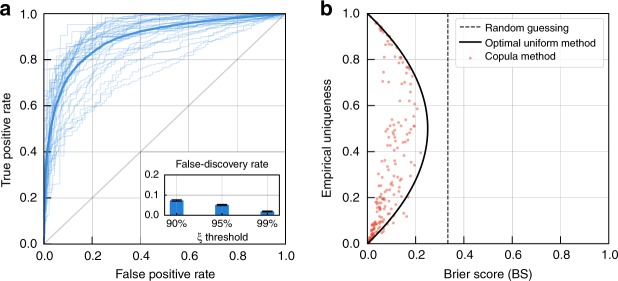
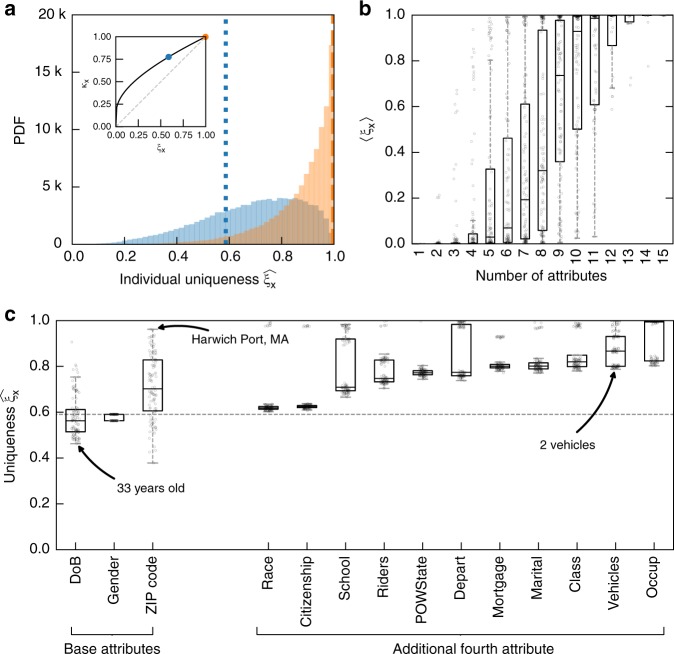
While rich medical, behavioral, and socio-demographic data are key to modern data-driven research, their collection and use raise legitimate privacy concerns. Anonymizing datasets through de-identification and sampling before sharing them has been the main tool used to address those concerns. We here propose a generative copula-based method that can accurately estimate the likelihood of a specific person to be correctly re-identified, even in a heavily incomplete dataset. On 210 populations, our method obtains AUC scores for predicting individual uniqueness ranging from 0.84 to 0.97, with low false-discovery rate. Using our model, we find that 99.98% of Americans would be correctly re-identified in any dataset using 15 demographic attributes. Our results suggest that even heavily sampled anonymized datasets are unlikely to satisfy the modern standards for anonymization set forth by GDPR and seriously challenge the technical and legal adequacy of the de-identification release-and-forget model.
Overview
The claims and statistics of this paper haven’t been checked yet.
Free: it reads the open-access text and checks the first 5 claims that cite a source we can check. Create a free account to check every claim.
Integrity signals
Registry
Cites
Statistics
Figures
Verification
Claims the paper makes
The claims and statistics of this paper haven’t been checked yet.
Free: it reads the open-access text and checks the first 5 claims that cite a source we can check. Create a free account to check every claim.
Claims other papers make about this one
Each is checked against this paper’s own text: does it say what the citing paper says it does?
The source backs part of the claim, not all of it — or backs it for a different population, condition or comparison.
In the citing paper
“Existing medical data is not fully exploited by ML primarily because it sits in data silos and privacy concerns restrict access to this data.”
From The future of digital health with federated learning (2020) · cites this paper as [7]
Experimental — accuracy not yet measuredThe source backs part of the claim, not all of it — or backs it for a different population, condition or comparison.
In the citing paper
“Centralising or releasing data, however, poses not only regulatory, ethical and legal challenges, related to privacy and data protection, but also technical ones.”
From The future of digital health with federated learning (2020) · cites this paper as [7]
Experimental — accuracy not yet measuredThe source backs part of the claim, not all of it — or backs it for a different population, condition or comparison.
In the citing paper
“Beyond these considerations, a required step for multimodal AI is the appropriate linking of all data types available in the datasets, which represents another challenge owing to the increasing risk of identification of individuals and regulatory constraints 146”
From Multimodal biomedical AI (2022) · cites this paper as [146]
Experimental — accuracy not yet measuredThe cited source says what the claim attributes to it.
In the citing paper
“Data anonymization alone does not provide sufficient protection (Rocher et al., 2019) since parts of the training data can be reconstructed by inversion of model parameters (Carlini et al., 2019; Zhang et al., 2020), gradients (Zhu et al., 2019; Geiping et al., 2020), or through adversarial attacks (Wang et al., 2019; Hitaj et al., 2017).”
From Federated learning for computational pathology on gigapixel whole slide images (2022) · cites this paper as Rocher et al., 2019
The cited source says what the claim attributes to it.
In the citing paper
“Even if data anonymisation could bypass these limitations, it is now well understood that removing metadata such as patient name or date of birth is often not enough to preserve privacy7.”
From The future of digital health with federated learning (2020) · cites this paper as [7]
1 more claim about this paper
Create a free account to see every claim other papers make about this one.
Self-check
Percentages, sums and reported differences re-computed from the paper’s own numbers.
The self-check needs the paper’s full text.
Citations
Cites
k-ANONYMITY: A MODEL FOR PROTECTING PRIVACY
SWEENEY, L. (2002) · International Journal of Uncertainty, Fuzziness and Knowledge-Based Systems · doi:10.1142/s0218488502001648 · Cited by 8,571 · cited 1×
“While more advanced guarantees like k -anonymity 57 would give every individual in the dataset some protection, they have been shown to be NP-Hard 58 , hard to achieve in modern high-dimensional datasets 59 , and not always suf fi cient 60 .”
BackgroundBig Data : The Management Revolution
マカフィー, ア., ブリニョルフソン, エ., & 有賀, 裕. (2013) · Harvard business review · Cited by 3,550
t-Closeness: Privacy Beyond k-Anonymity and l-Diversity
Li, N., Li, T., & Venkatasubramanian, S. (2007) · 2007 IEEE 23rd International Conference on Data Engineering · doi:10.1109/icde.2007.367856 · Cited by 3,451
Lazer, D., Pentland, A., Adamic, L., Aral, S., Barabási, A.-L., Brewer, D., Christakis, N., Contractor, N., Fowler, J., Gutmann, M., et al. (2009) · Science · doi:10.1126/science.1167742 · Cited by 3,365
The real-time city? Big data and smart urbanism
Kitchin, R. (2014) · GeoJournal · doi:10.1007/s10708-013-9516-8 · Cited by 2,794 · cited 5×
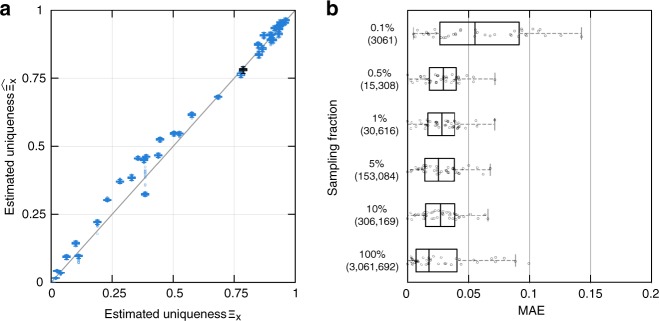
“Table 1 and Supplementary Note 7 show that, at very small sampling fraction (below 0.1%), where the error is the largest, the error is mostly determined by the marginals, and converges after few hundred records when the exact marginals are known.”
BackgroundInfluentialThe Real-Time City? Big Data and Smart Urbanism
Kitchin, R. (2013) · SSRN Electronic Journal · doi:10.2139/ssrn.2289141 · Cited by 2,794
(2012) · PubMed · Cited by 2,326
Cherubini, U., Luciano, E., & Vecchiato, W. (2004) · Wiley eBooks · doi:10.1002/9781118673331 · Cited by 2,009
Vinh, N. X., Epps, J., & Bailey, J. (2010) · Minerva Access (University of Melbourne) · doi:10.5555/1756006.1953024 · Cited by 1,781
The Unreasonable Effectiveness of Data
Halevy, A., Norvig, P., & Pereira, F. (2009) · IEEE Intelligent Systems · doi:10.1109/mis.2009.36 · Cited by 1,767
Research works printed but not linked: 4
- Cadwalladr, C. & Graham-Harrison, E. Revealed: 50 million facebook profiles harvested for Cambridge Analytica in major data breach. The Guardian (17 Mar 2018).
- Polonetsky J Tene O Finch K Shades of gray: seeing the full spectrum of practical data De-Identification St. Clara Law Rev. 2016 56 593 629
- Fienberg SE Sanil AP A Bayesian approach to data disclosure: optimal intruder behavior for continuous data J. Stat. 1997 13 75
- Chen G Keller-McNulty S Estimation of identification disclosure risk in microdata J. Stat. 1998 14 79
Cited by
Items 601–700 of 817
SARS-CoV-2, a Threat to Privacy?Preprint
Daubenschuetz, T., Kulyk, O., Neumann, S., Hinterleitner, I., Delgado, P. R., Hoffmann, C., & Scheible, F. (2020) · arXiv (Cornell University) · doi:10.48550/arxiv.2004.10305 · Cited by 1
“Several research studies had shown the deanonymization for data sets to extract personal information, including a case from 2016, when a journalist and a data scientist acquired an anonymized dataset with the browsing habits of more than three million German citizens [32], [33].”
OECD (2020) · Medidas políticas clave de la OCDE ante el coronavirus (Covid-19) · doi:10.1787/76e1c9d1-es · Cited by 2
Preservação da privacidade no enfrentamento da COVID-19: dados pessoais e a pandemia globalPreprint
Almeida, B. D. A., Doneda, D. C. M., Ichihara, M. Y., Barral‐Netto, M., Matta, G. C., Rabello, E. T., Gouveia, F. C., & Barreto, M. L. (2020) · doi:10.1590/scielopreprints.421 · Cited by 1
Response to Open Peer Commentaries on “Privacy and Health Practices in the Digital Age”
Pyrrho, M., Cambraia, L., & de Vasconcelos, V. F. (2022) · The American Journal of Bioethics · doi:10.1080/15265161.2022.2127972 · Cited by 1
“This sort of statistical effect is described by Rocher, Hendrickx, and de Montjoye (2019), and they conclude that the CONTACT Monique Pyrrho pyrrho.monique@gmail.com University of Brasilia, Brasilia, Brazil.”
BackgroundPersonal data in biomedical research
Parimi, V. P., Kedia, A. K., & Ravindran, V. K. (2023) · The Journal of the Royal College of Physicians of Edinburgh · doi:10.1177/14782715231175001 · Cited by 1
Petit-Jean, T., Gérardin, C., Berthelot, E., Châtellier, G., Frank, M., Tannier, X., Kempf, E., & Bey, R. (2023) · medRxiv · doi:10.1101/2023.09.11.23295069 · Cited by 1
Regulação da inteligência artificial na saúde
Dourado, D. D. A. (2024) · Digital Library of Theses and Dissertations (Universidade de São Paulo) · doi:10.11606/t.5.2024.tde-23042024-111255 · Cited by 11
Johansen, A. R., Hur, K., Hung, J., Castellon, R., Peng, T., Ren, S., White, R., Park, C., Lau, A., Shah, S., et al. (2025) · medRxiv · doi:10.1101/2025.05.12.25327465 · Cited by 1
“Recent efforts in clinical studies have shown promising results using wear-ables to predict features such as COVID-19 before symptom onset 6,7 , menstrual cycle and pregnancy 8–10 , and abnormal heart func-55 tion 11 .”
An Emerging Strategy for Privacy Preserving Databases: Differential Privacy
Rashid, F., & Miri, A. (2020) · Lecture notes in computer science · doi:10.1007/978-3-030-50309-3_32
COVID-19 PANDEMİYASI DÖVRÜNDƏ KİBERTƏHLÜKƏSİZLİK PROBLEMLƏRİNİN ANALİZİ
İmamverdiyev, Y. (2020) · Problems of Information Society · doi:10.25045/jpis.v11.i2.02
“Tədqiqatçılar qrupu de-identifikasiya edilmiş verilənlərdən istifadə edərək müəyyən əlamətləri dəqiq tapa bilmişdir [26].”
Vigilância digital e coronavida: o “novo normal” do século XXI
Velloso, R. (2020) · Em Construção · doi:10.12957/emconstrucao.2020.53730
Anonymization of 3D face models for GDPR compliant outsourcing to 3rd party companies
Rustici, P. (2020) · Research Repository (Delft University of Technology)
The Identity Fragmentation BiasPreprint
Lin, T., & Misra, S. (2020) · arXiv (Cornell University) · doi:10.48550/arxiv.2008.12849 · Cited by 2
Hoe artificiële intelligentie, digitalisering en big data ons kunnen helpen bij verantwoordbare zorg
BIESEN, W. V., Veys, N., Decruyenaere, J. M. A., Peleman, R. A., & Sterckx, S. (2021) · Tijdschrift voor Geneeskunde · doi:10.47671/tvg.77.20.110
Big Data-Driven AI-based Wireless Network Personalization
Alkurd, R. (2020) · Carleton University's Institutional Repository (MacOdrum Library, Carleton University) · doi:10.22215/etd/2020-14129
Gezondheidsgegevens als nieuw zakenmodel
Peleman, R. A., BIESEN, W. V., Decruyenaere, J. M. A., & Sterckx, S. (2021) · Tijdschrift voor Geneeskunde · doi:10.47671/tvg.77.20.125
O Capitalismo de vigilância e a lei geral de proteção de dados
Morellato, A. C. B., & dos Santos, A. F. P. R. (2021) · Revista Brasileira de Sociologia do Direito · doi:10.21910/rbsd.v8i2.455
Yang, Z., Wang, R., Wu, D., Yang, B., & Luo, D. (2021) · Research Square · doi:10.21203/rs.3.rs-533949/v1
Eerste stappen in Europese regulering van artificiële intelligentie: algoritmes en patiëntenrechten
van Kolfschooten, H. (2021) · Tijdschrift voor Gezondheidsrecht · doi:10.5553/tvgr/016508742021045004008
Building Legal DatasetsPreprint
Soh, J. (2021) · arXiv (Cornell University) · doi:10.48550/arxiv.2111.02034 · Cited by 4
“Anonymization is not much better, since preventing re-identification may require destroying most of a dataset’s informative signals [23, 32].”
BackgroundVáradi, S. (2021) · Multidiszciplináris Tudományok · doi:10.35925/j.multi.2021.5.37
Wearable Devices and Privacy Concerns: Data Collection, Analysis, and Interpretation
Dincelli, E., Zhou, X., Yayla, A., & Jafarian, H. (2021) · IGI Global eBooks · doi:10.4018/978-1-7998-8954-0.ch009
Science: Undermining Facts to Understate Regulatory Benefits
Gamper‐Rabindran, S. (2022) · Cambridge University Press eBooks · doi:10.1017/9781009039567.008
OECD (2020) · Singata korona wairusu (Covid-19) he no OECD seisaku tai'ō · doi:10.1787/358f8238-ja
Testando para a COVID-19: Uma maneira de flexibilizar as restrições do confinamento
OECD (2020) · As políticas públicas da OCDE para responder ao coronavírus (Covid-19) · doi:10.1787/d8bbac2f-pt
Strengthening ICT Infrastructure and Promoting Digital Transformation to Control Infectious Disease
Takakura, H. (2021) · TRENDS IN THE SCIENCES · doi:10.5363/tits.26.9_42
Distributed learning for optimal radiomics knowledge
Zerka, F. (2022) · Research Publications (Maastricht University) · doi:10.26481/dis.20220209fz
AIM and the Patient’s Perspective
Taylor, D. G. (2022) · Springer eBooks · doi:10.1007/978-3-030-64573-1_37
Privacy as Vulnerability Protection: Optimizing Trade-Offs with Opportunities to Gain Knowledge
Fasterling, B. (2022) · Emerald Group Publishing Limited eBooks · doi:10.1108/s0193-589520220000030004
Spithoff, S. M., Stockdale, J., Rowe, R., McPhail, B. M., & Persaud, N. (2022) · Canadian Medical Association Journal · doi:10.1503/cmaj.210455-f
Gregorio, G. D. (2022) · Cambridge University Press eBooks · doi:10.1017/9781009071215.009
Restoring Faith in HIPAA Privacy Protections while Enabling More Efficient Data Sharing (Preprint)Preprint
Jose, J., & Hendricks‐Sturrup, R. (2020) · doi:10.2196/preprints.20349
How can new technology support better measurement of extreme poverty?
Doruska, M., & Hoddinott, J. (2020) · doi:10.55158/deepwp2
“Studies have shown that in many cases individuals can be re-identified with an extremely high degree of reliability through a core set of basic demographic characteristics even from datasets that have been through a process of anonymisation (Rocher et al. 2019).”
Backgrounddi Vimercati, S. D. C., & Foresti, S. (2021) · Springer eBooks · doi:10.1007/978-3-642-27739-9_763-2
Sáez-Rodríguez, J., Rinschen, M. M., Floege, J., & Kramann, R. (2019) · Kidney International · doi:10.1016/j.kint.2019.09.011
Brinberg, M., Vanderbilt, R. R., & Solomon, D. H. (2022) · Emerald Group Publishing Limited eBooks · doi:10.1108/978-1-80071-597-420221004 · Cited by 2
Anonymized Questionnaire Analysis with Differential Privacy for Large-Scale Crowdsourcing
Sei, Y., & Ohsuga, A. (2022) · Lecture notes in electrical engineering · doi:10.1007/978-981-19-2177-3_2
Assessing Identity Disclosure Risk in the Absence of Identified Datasets in the Public Domain
Muturi, P. N., Kahonge, A. M., & Chepken, C. K. (2022) · East African Journal of Information Technology · doi:10.37284/eajit.5.1.773
Online Content and Platform Liability
Mariniello, M. (2022) · Oxford University Press eBooks · doi:10.1093/oso/9780198831471.003.0009 · Cited by 2
(2022) · Oxford University Press eBooks · doi:10.1093/oso/9780198831471.002.0009
(2022) · Oxford University Press eBooks · doi:10.1093/oso/9780198831471.002.0005
(2022) · Oxford University Press eBooks · doi:10.1093/oso/9780198831471.002.0008
Disinformation in the Digital Age
Mariniello, M. (2022) · Oxford University Press eBooks · doi:10.1093/oso/9780198831471.003.0014
Mariniello, M. (2022) · Oxford University Press eBooks · doi:10.1093/oso/9780198831471.005.0001
Mariniello, M. (2022) · Oxford University Press eBooks · doi:10.1093/oso/9780198831471.003.0006 · Cited by 1
Technology and the Covid-19 Pandemic
Mariniello, M. (2022) · Oxford University Press eBooks · doi:10.1093/oso/9780198831471.003.0003
Introduction: Why You Should Read This Book
(2022) · Oxford University Press eBooks · doi:10.1093/oso/9780198831471.002.0011
Facts about the European Digital Economy
Mariniello, M. (2022) · Oxford University Press eBooks · doi:10.1093/oso/9780198831471.003.0002
(2022) · Oxford University Press eBooks · doi:10.1093/oso/9780198831471.002.0010
Mariniello, M. (2022) · Oxford University Press eBooks · doi:10.1093/oso/9780198831471.003.0001 · Cited by 1
Mariniello, M. (2022) · Oxford University Press eBooks · doi:10.1093/oso/9780198831471.003.0004
(2022) · Oxford University Press eBooks · doi:10.1093/oso/9780198831471.002.0007
Mariniello, M. (2022) · Oxford University Press eBooks · doi:10.1093/oso/9780198831471.003.0007
Mariniello, M. (2022) · Oxford University Press eBooks · doi:10.1093/oso/9780198831471.003.0010
(2022) · Oxford University Press eBooks · doi:10.1093/oso/9780198831471.002.0004
(2022) · Oxford University Press eBooks · doi:10.1093/oso/9780198831471.002.0012
Mariniello, M. (2022) · Oxford University Press eBooks · doi:10.1093/oso/9780198831471.003.0011
(2022) · Oxford University Press eBooks · doi:10.1093/oso/9780198831471.002.0003
Using routine clinical and administrative data to produce information on mental health in Brazil
Alves, F. J. O., Machado, D. B., de Araújo, J. A. P., & Castro-de-Araujo, L. F. S. (2022) · Revista de Saúde Pública · doi:10.11606/s1518-8787.2022056004818
Mobile Health, Behavior Change
de Bruijn, G., Liu, S., & Rhodes, R. E. (2022) · The International Encyclopedia of Health Communication · doi:10.1002/9781119678816.iehc0788
Generating evidence on privacy outcomes to inform privacy risk management: A way forward?
Strech, D., Haven, T. L., Madai, V. I., Meurers, T., & Praßer, F. (2022) · Journal of Biomedical Informatics · doi:10.1016/j.jbi.2022.104257
Kulkarni, M., Mondal, A., & Singh, K. K. (2022) · Cognitive science and technology · doi:10.1007/978-981-19-2350-0_12
An Evaluation of Machine Learning Approaches to Integrate Historical Farm Data
Guerrón, P. B., & Hallo, M. (2022) · Baltic Journal of Modern Computing · doi:10.22364/bjmc.2022.10.4.03 · Cited by 2
Technikanwendung im Spannungsfeld von Freiheit, Sicherheit und neuen Abhängigkeiten
Huber, J. M. (2022) · Springer Reference Pflege, Therapie, Gesundheit · doi:10.1007/978-3-662-58680-8_83
Duguet, A. (2022) · Presses de l'Université Toulouse Capitole eBooks · doi:10.4000/books.putc.15470 · Cited by 1
Changing Contexts of Neuroinnovation: Societal Considerations
Cho, M. K. (2023) · Springer eBooks · doi:10.1007/978-3-031-14339-7_4 · Cited by 1
Data continuity and linkage in the healthcare ecosystem
Charles, W. (2023) · Elsevier eBooks · doi:10.1016/b978-0-12-824010-6.00020-4 · Cited by 1
AI methods and their application to health and prevention using open data.
Ferres, J. L. (2023) · doi:10.5463/thesis.172 · Cited by 1
Rainey, S. (2023) · Springer eBooks · doi:10.1007/978-3-031-27170-0_4
Besonderheiten der Forschung im Gesundheitswesen
Stamm, T., Karner, G., Kutrovátz, J., Ritschl, V., Perkhofer, S., Tucek, G., & Weigl, R. (2023) · Studium Pflege, Therapie, Gesundheit · doi:10.1007/978-3-662-66501-5_3
The Application of Non-invasive Inverse ECG Techniques in Cardiomyopathy
Boonstra, M. (2023) · Utrecht University Repository (Utrecht University) · doi:10.33540/1807
LASI Synthetic Data ReportPreprint
Phillips, D. F., Lee, J., Meijer, E., Wilkens, J., & Snoke, J. (2023) · SSRN Electronic Journal · doi:10.2139/ssrn.4569904
“But given enough information, particularly geographically identifying information in low population regions, studies have shown that disclosure is quite possible (e.g., Rocher et al. (2019)).”
BackgroundPrivacy and Data Balkanization: Circumventing the Barriers
Huberman, B. A., & Hogg, T. (2023) · Revista Abierta de Informática Aplicada · doi:10.59471/raia202116
Poster: Analysis of User Uniqueness on LinkedIn Based on Publicly Available Non-PII
Merino, Á., González-Cabañas, J., Cuevas, √., & Cuevas, R. (2023) · ACM Internet Measurement Conference (IMC) · doi:10.1145/3618257.3625000
Hype or Help? The Real Benefits of BlockchainPreprint
Bieser, J. C. T., & Fasnacht, D. (2023) · SSRN Electronic Journal · doi:10.2139/ssrn.4610155 · Cited by 1
Bieser, J. C. T., & Fasnacht, D. (2023) · SSRN Electronic Journal · doi:10.2139/ssrn.4612335
Federated and Multi-Task Learning for Privacy-Preserving Short-Term Electric Load Forecasting
Ghalib, M. (2023) · Carleton University's Institutional Repository (MacOdrum Library, Carleton University) · doi:10.22215/etd/2023-15754
Pope, K. S., Vásquez, M. J. T., Chavez‐Dueñas, N. Y., & Adames, H. Y. (2021) · Wiley eBooks · doi:10.1002/9781394259038.refs
A Game-Theoretic Analysis of the Adoption of Patient-Generated Health Data
Akçura, M. T., Ozdemir, Z. D., & Tarakci, H. (2024) · Journal of theoretical and applied electronic commerce research · doi:10.3390/jtaer19010017
Principles of Clinical Genetics and the Ethical, Legal, and Social Implications
(2024) · The Singapore Family Physician · doi:10.33591/sfp.50.1.u1
FCA-based reasoning for privacy
Aranda-Corral, G. A., Borrego‐Díaz, J., & Galán‐Paez, J. (2024) · Logic Journal of IGPL · doi:10.1093/jigpal/jzae011
Adam, Z. (2024) · University College London · doi:10.14324/000.rp.10190449
Analysis and Implementation of Nanotargeting on LinkedIn Based on Publicly Available Non-PII
Merino, Á., González-Cabañas, J., Cuevas, √., & Cuevas, R. (2024) · CHI Conference on Human Factors in Computing Systems · doi:10.1145/3613904.3642107 · Cited by 2
“Also, 15 demographic attributes can re-identify 99.98% of Americans in any dataset [40].”
InfluentialLuo, Z. (2024) · Management Science Informatization and Economic Innovation Development Conference (MSIEID) · doi:10.4108/eai.8-12-2023.2344354
Kupers, E. R., Knapen, T. H. J., Merriam, E. P., & Kay, K. (2024) · OSF Preprints (OSF Preprints) · doi:10.31219/osf.io/5pds4
Yuen, J., Guzman, A. C. D. D., Courtney, E., & Ngeow, J. Y. Y. (2024) · Elsevier eBooks · doi:10.1016/b978-0-323-99967-0.00307-0 · Cited by 1
The Impact of Saving on Financial Resilience: Keep It Simple
Grace, C., Metzler, A., Yang, M., Feng, L., & Fazelli, A. (2024) · Financial Services Review · doi:10.61190/fsr.v32i2.3358 · Cited by 2
From Energy Consumption Data to User Profiling: Quantifying Privacy Exposure in Smart HomesPreprint
Shanmugarasa, Y., Paik, H.-Y., Kanhere, S. S., Windl, M., Feger, S. S., & Zhu, L. (2024) · SSRN Electronic Journal · doi:10.2139/ssrn.4903758
Ethische und gesetzliche Richtlinien für Smart HR
Gärtner, C. (2024) · Springer eBooks · doi:10.1007/978-3-658-44904-9_6
Moghaddam, S. N. M., & Cao, H. (2024) · City development · doi:10.1007/978-981-97-5116-7_8
Čtvrtník, M. (2024) · Soudobé dějiny · doi:10.51134/sod.2024.045
Time in Latent Growth Curve Models
Miller, M. L., & Ghisletta, P. (2024) · Springer eBooks · doi:10.1007/978-3-031-56318-8_2
Metadata
- Authors
- Rocher, L., Hendrickx, J. M., & de Montjoye, Y.-A.
- Affiliations
- Imperial College London (GB)
- UCLouvain (BE)
- Venue
- Nature Communications
- Published
- 2019-07-23
- Volume
- 10
- Issue
- 1
- Pages
- 3069-3069
- ISSN
- 2041-1723 (ISSN-L)
- PMC
- PMC6650473
- OpenAlex
- W2963693643
- Semantic Scholar
- f34b6423878090c7422c078a3dd6a3db80fb7532
- Cited by
- 816
- References
- 57
- Citations by year
- 2026: 86 · 2025: 99 · 2024: 111 · 2023: 105 · 2022: 154 · 2021: 120 · 2020: 124 · 2019: 16
- FWCI
- 47.23
- Type
- journal article
- Language
- en
- Open access
- gold
- doi.org
- Licence
- cc-by
- creativecommons.org/licenses/by/4.0 (tdm)
- creativecommons.org/licenses/by/4.0 (vor)
- Locations
- Nature Communications (publishedVersion, cc-by)
- PubMed Central (publishedVersion, cc-by)
- PubMed (publishedVersion)
- RePEc: Research Papers in Economics (submittedVersion)
- Digital Access to Libraries (Université catholique de Louvain (UCL), l'Université de Namur (UNamur) and the Université Saint-Louis (USL-B)) (submittedVersion, other-oa)
- DOAJ (DOAJ: Directory of Open Access Journals) (submittedVersion)
- DOAJ (DOAJ: Directory of Open Access Journals) (submittedVersion, cc-by-sa)
- Spiral (Imperial College London) (submittedVersion, cc-by)
- Funders
- Fonds De La Recherche Scientifique - FNRS
- Wallonie-Bruxelles International
- Imperial College London
- Topics
- Physical Sciences › Computer Science › Artificial Intelligence › Privacy-Preserving Technologies in Data
- Physical Sciences › Computer Science › Information Systems › Data Quality and Management
- Physical Sciences › Computer Science › Artificial Intelligence › Internet Traffic Analysis and Secure E-voting
- Keywords
- re-identification risk, data anonymization, de-identification, missing data, privacy, demographic factors, data sharing
- MeSH terms
- Data Anonymization, Personally Identifiable Information, Data Analysis, Normal Distribution, Likelihood Functions, Datasets as Topic
About these checks
Registry, retraction, Cites and statistics results are computed, not judged, with one exception: a printed reference that no index lists is read once by a model before it counts as a citation error. Claims are extracted by a model and kept only when their quote appears verbatim in the text; each cited source is then checked, with a model’s help, for whether it says what the claim relies on. Those verdicts can be wrong — read the claim’s quote and the cited source before relying on one.
Statistics and arithmetic are recomputed, not judged.
Confidence bands are shown only for fields calibrated on our annotated test set. None is calibrated yet, so no band is shown.
What counts as a claim ›How we measure confidence ›How we check this ›
Are you an author, or do you see a problem with this page? Request a review
Data sources
Bibliographic data: Semantic Scholar, OpenAlex, Crossref.
Contains information from the Semantic Scholar Academic Graph Datasets, made available under the ODC Attribution License (ODC-BY 1.0).
Semantic Scholar’s data is described in: Kinney, R., et al. (2023). The Semantic Scholar Open Data Platform. arXiv:2301.10140.
