

Estimating the success of re-identifications in incomplete datasets using generative models
Open accessThe DOI matches its Crossref record; 59 of the 59 references it cites were found in a registry or an index.
Abstract
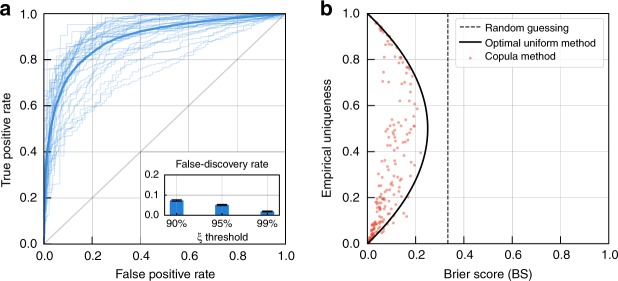
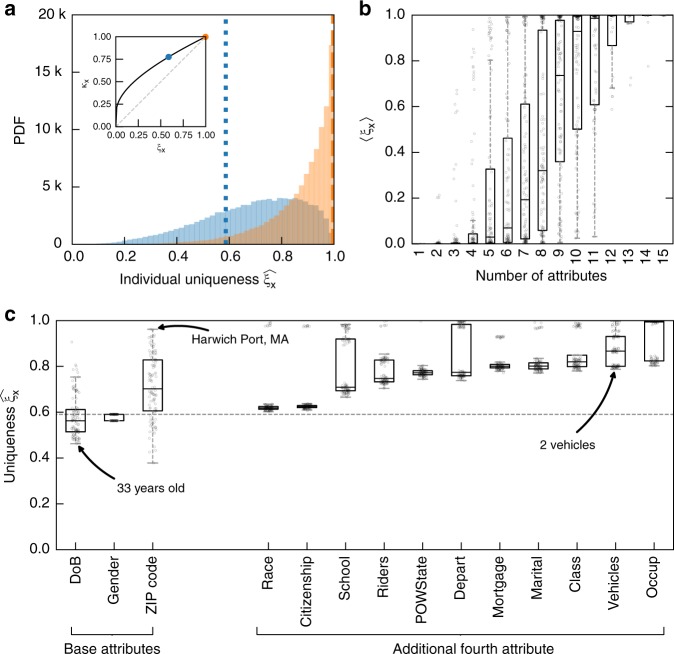
While rich medical, behavioral, and socio-demographic data are key to modern data-driven research, their collection and use raise legitimate privacy concerns. Anonymizing datasets through de-identification and sampling before sharing them has been the main tool used to address those concerns. We here propose a generative copula-based method that can accurately estimate the likelihood of a specific person to be correctly re-identified, even in a heavily incomplete dataset. On 210 populations, our method obtains AUC scores for predicting individual uniqueness ranging from 0.84 to 0.97, with low false-discovery rate. Using our model, we find that 99.98% of Americans would be correctly re-identified in any dataset using 15 demographic attributes. Our results suggest that even heavily sampled anonymized datasets are unlikely to satisfy the modern standards for anonymization set forth by GDPR and seriously challenge the technical and legal adequacy of the de-identification release-and-forget model.
Overview
The claims and statistics of this paper haven’t been checked yet.
Free: it reads the open-access text and checks the first 5 claims that cite a source we can check. Create a free account to check every claim.
Integrity signals
Registry
Cites
Statistics
Figures
Verification
Claims the paper makes
The claims and statistics of this paper haven’t been checked yet.
Free: it reads the open-access text and checks the first 5 claims that cite a source we can check. Create a free account to check every claim.
Claims other papers make about this one
Each is checked against this paper’s own text: does it say what the citing paper says it does?
The source backs part of the claim, not all of it — or backs it for a different population, condition or comparison.
In the citing paper
“Existing medical data is not fully exploited by ML primarily because it sits in data silos and privacy concerns restrict access to this data.”
From The future of digital health with federated learning (2020) · cites this paper as [7]
Experimental — accuracy not yet measuredThe source backs part of the claim, not all of it — or backs it for a different population, condition or comparison.
In the citing paper
“Centralising or releasing data, however, poses not only regulatory, ethical and legal challenges, related to privacy and data protection, but also technical ones.”
From The future of digital health with federated learning (2020) · cites this paper as [7]
Experimental — accuracy not yet measuredThe source backs part of the claim, not all of it — or backs it for a different population, condition or comparison.
In the citing paper
“Beyond these considerations, a required step for multimodal AI is the appropriate linking of all data types available in the datasets, which represents another challenge owing to the increasing risk of identification of individuals and regulatory constraints 146”
From Multimodal biomedical AI (2022) · cites this paper as [146]
Experimental — accuracy not yet measuredThe cited source says what the claim attributes to it.
In the citing paper
“Data anonymization alone does not provide sufficient protection (Rocher et al., 2019) since parts of the training data can be reconstructed by inversion of model parameters (Carlini et al., 2019; Zhang et al., 2020), gradients (Zhu et al., 2019; Geiping et al., 2020), or through adversarial attacks (Wang et al., 2019; Hitaj et al., 2017).”
From Federated learning for computational pathology on gigapixel whole slide images (2022) · cites this paper as Rocher et al., 2019
The cited source says what the claim attributes to it.
In the citing paper
“Even if data anonymisation could bypass these limitations, it is now well understood that removing metadata such as patient name or date of birth is often not enough to preserve privacy7.”
From The future of digital health with federated learning (2020) · cites this paper as [7]
1 more claim about this paper
Create a free account to see every claim other papers make about this one.
Self-check
Percentages, sums and reported differences re-computed from the paper’s own numbers.
The self-check needs the paper’s full text.
Citations
Cites
k-ANONYMITY: A MODEL FOR PROTECTING PRIVACY
SWEENEY, L. (2002) · International Journal of Uncertainty, Fuzziness and Knowledge-Based Systems · doi:10.1142/s0218488502001648 · Cited by 8,571 · cited 1×
“While more advanced guarantees like k -anonymity 57 would give every individual in the dataset some protection, they have been shown to be NP-Hard 58 , hard to achieve in modern high-dimensional datasets 59 , and not always suf fi cient 60 .”
BackgroundBig Data : The Management Revolution
マカフィー, ア., ブリニョルフソン, エ., & 有賀, 裕. (2013) · Harvard business review · Cited by 3,550
t-Closeness: Privacy Beyond k-Anonymity and l-Diversity
Li, N., Li, T., & Venkatasubramanian, S. (2007) · 2007 IEEE 23rd International Conference on Data Engineering · doi:10.1109/icde.2007.367856 · Cited by 3,451
Lazer, D., Pentland, A., Adamic, L., Aral, S., Barabási, A.-L., Brewer, D., Christakis, N., Contractor, N., Fowler, J., Gutmann, M., et al. (2009) · Science · doi:10.1126/science.1167742 · Cited by 3,365
The real-time city? Big data and smart urbanism
Kitchin, R. (2014) · GeoJournal · doi:10.1007/s10708-013-9516-8 · Cited by 2,794 · cited 5×
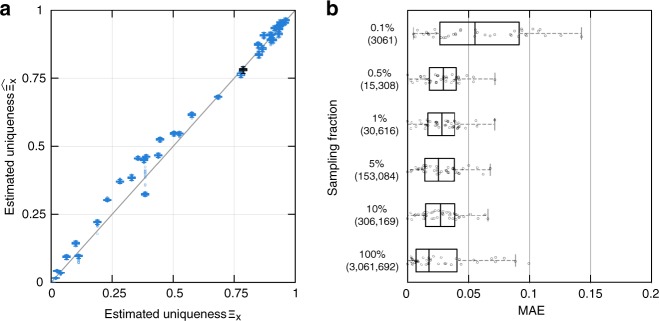
“Table 1 and Supplementary Note 7 show that, at very small sampling fraction (below 0.1%), where the error is the largest, the error is mostly determined by the marginals, and converges after few hundred records when the exact marginals are known.”
BackgroundInfluentialThe Real-Time City? Big Data and Smart Urbanism
Kitchin, R. (2013) · SSRN Electronic Journal · doi:10.2139/ssrn.2289141 · Cited by 2,794
(2012) · PubMed · Cited by 2,326
Cherubini, U., Luciano, E., & Vecchiato, W. (2004) · Wiley eBooks · doi:10.1002/9781118673331 · Cited by 2,009
Vinh, N. X., Epps, J., & Bailey, J. (2010) · Minerva Access (University of Melbourne) · doi:10.5555/1756006.1953024 · Cited by 1,781
The Unreasonable Effectiveness of Data
Halevy, A., Norvig, P., & Pereira, F. (2009) · IEEE Intelligent Systems · doi:10.1109/mis.2009.36 · Cited by 1,767
Research works printed but not linked: 4
- Cadwalladr, C. & Graham-Harrison, E. Revealed: 50 million facebook profiles harvested for Cambridge Analytica in major data breach. The Guardian (17 Mar 2018).
- Polonetsky J Tene O Finch K Shades of gray: seeing the full spectrum of practical data De-Identification St. Clara Law Rev. 2016 56 593 629
- Fienberg SE Sanil AP A Bayesian approach to data disclosure: optimal intruder behavior for continuous data J. Stat. 1997 13 75
- Chen G Keller-McNulty S Estimation of identification disclosure risk in microdata J. Stat. 1998 14 79
Cited by
Items 501–600 of 817
Song, J., Song, Z., Zhang, J., & Gong, Y. (2024) · Journal of Computational Biology · doi:10.1089/cmb.2023.0115 · Cited by 2
“…to deidentify patient privacy data before sharing these on public databases, recent studies have highlighted the potential vulnerabilities of these methods, as patient information can be reidentified when combined with other data (Gymrek et al., 2013; Rocher et al., 2019; Zerka et al., 2021).”
Al-Accelerated Human Genetic Discrimination: Implications of UNGPs
Wang, L., & Liang, X. (2024) · Current Genetic Medicine Reports · doi:10.1007/s40142-023-00208-1 · Cited by 2
“Researchers have demonstrated that an individual can be correctly re-identified with high likelihood even if the disclosed dataset is heavily incomplete [11].”
Human-Centered Services Computing for Smart Cities: IEICE Monograph
Murakami, Y., & Kimura, K. (2024) · Springer eBooks · doi:10.1007/978-981-97-0779-9 · Cited by 4
Eiermann, M. (2024) · Child Maltreatment · doi:10.1177/10775595241270042 · Cited by 1
“…that those strategies provide imperfect safeguards against very concerted and sophisticated re-identi fi cation attempts, given the increasing capabilities of computational prediction models and the widespread availability of linkable datasets (Pearce & Stalla-Bourdillon, 2019; Rocher et al., 2019).”
InfluentialStelter, L., Corbetta, V., Beets‐Tan, R. G. H., & Silva, W. (2024) · Annual International Conference of the IEEE Engineering in Medicine and Biology Society (EMBC) · doi:10.1109/embc53108.2024.10782682 · Cited by 5
“Furthermore, the process of data anonymisation, which was once thought to bypass these constraints, is now understood to be insufficient for maintaining patient privacy [3].”
Snoke, J., Meijer, E., Phillips, D. F., Wilkens, J., & Lee, J. (2025) · Journal of Survey Statistics and Methodology · doi:10.1093/jssam/smae047 · Cited by 2
“But given enough information, particularly geographically identifying information in low population regions, studies have shown that disclosure is quite possible (e.g., Rocher et al. 2019).”
Ramadhan, M., & Rakhmawati, N. A. (2024) · International Conference on Innovation and Intelligence for Informatics, Computing, and Technologies (3ICT) · doi:10.1109/3ict64318.2024.10824330 · Cited by 2
Advancing Ethical Considerations for Data Science in Injury and Violence Prevention
Idaikkadar, N., Bodin, E., Cholli, P. A., Navon, L., Ortmann, L., Banja, J. D., Waller, L. A., Alic, A., Yuan, K., & Law, R. (2025) · Public Health Reports · doi:10.1177/00333549241312055 · Cited by 7
“24,25”
Largent, E. A., Kim, Y., Karlawish, J. H., & Wexler, A. (2025) · The Journals of Gerontology Series A · doi:10.1093/gerona/glaf035 · Cited by 4
Digital Decade: How the EU Shapes Digitalisation Research
Sekwenz, M.-T., & MSc Rita Gsenger, M. A. (2025) · Nomos Verlagsgesellschaft mbH & Co. KG eBooks · doi:10.5771/9783748943990 · Cited by 2
Roettger, T. B., Askelund, A. D., Birkenæs, V., Bjørndal, L. D., Bochyńska, A., Glaser, B. D., Kalandadze, T., Korbmacher, M., Malovic, I., Mayor, J., et al. (2025) · BMC Medical Research Methodology · doi:10.1186/s12874-025-02601-6 · Cited by 2
Rocher, L., Annamalai, M. S. M. S., & de Montjoye, Y.-A. (2021) · International World Wide Web Conference (WWW) · doi:10.1145/3442442.3458606 · Cited by 2
“Building upon our recent method to estimate the likelihood of any re-identification to be successful [18], we propose an interactive website demonstrating how few pieces of demographic information can easily breach our anonymity.”
BackgroundMethodSelf-citationAn Assessment of the Application of Private Aggregation of Ensemble Models to Sensible Data
Yovine, S., Mayr, F., Sosa, S., & Visca, R. (2021) · Machine Learning and Knowledge Extraction · doi:10.3390/make3040039 · Cited by 7
“To avoid this loss of privacy, appropriate measures must be taken when allowing access to an organization’s database, notwithstanding any anonymization technique that removes personally identifiable information [10].”
BackgroundA Policy Framework to Support Shared Decision-Making through the Use of Person-Generated Health Data
Petersen, C. C., Edmunds, M., McGraw, D., Priest, E. L., Smith, J. R. L., Kemp, E., & Campos, H. (2021) · ACI Open · doi:10.1055/s-0041-1736632 · Cited by 2
Parental Control Technologies und die Überwachung kindlicher Mobilität
Berg, S., & Wehrheim, J. (2021) · sub\urban zeitschrift für kritische stadtforschung · doi:10.36900/suburban.v9i3/4.654 · Cited by 2
Evangelista, L. E. G., Coutinho, K. D., Valentim, R. A. D. M., Pereira, A. G. D., Hékis, H. R., da Cunha-Oliveira, A. C. G. D. P., de Oliveira, C. A. P., Barbosa, C., & Lins, H. W. D. C. (2022) · CADERNOS IBERO-AMERICANOS DE DIREITO SANITÁRIO · doi:10.17566/ciads.v11i1.820 · Cited by 2
Islam, H., Alaboud, K., Paul, T., Rana, M. K. Z., & Mosa, A. S. M. (2022) · PubMed · Cited by 4
Li, X., & Yuan, K. (2022) · Lecture notes in computer science · doi:10.1007/978-3-031-12053-4_49 · Cited by 2
Mariniello, M. (2022) · Oxford University Press eBooks · doi:10.1093/oso/9780198831471.003.0005 · Cited by 2
La regulación ética de aplicaciones digitales en salud frente a la pandemia por COVID-19
Lascano, M. D. L. P., & Daly, T. P. (2023) · Revista de Bioética y Derecho · doi:10.1344/rbd2023.57.39432 · Cited by 2
Secure Future Healthcare Applications Through Federated Learning Approaches
Tabassum, M., Kuzlu, M., Çatak, F. Ö., Sarp, S., & Şahinbaş, K. (2023) · Communications in computer and information science · doi:10.1007/978-3-031-50920-9_17 · Cited by 2
Blueprints for Deploying Privacy Enhancing Technologies in E-Government
Kamm, L., Bogdanov, D., Brito, E., & Ostrak, A. (2024) · IFIP advances in information and communication technology · doi:10.1007/978-3-031-57978-3_1 · Cited by 2
Directions for Enhancing the Use of Personal Data Minimization Technology in Public Organizations
Bargh, M. S., Vlietinck, H., Amighi, A., Omar, A., Yang, S., Daniels, N., & Choenni, S. (2024) · Annual International Conference on Digital Government Research · doi:10.1145/3657054.3657084 · Cited by 2
“Thus, indirectly identifying data items can be used as proxy to re-identify individuals in de-identified data sets [9, 18, 35, 39].”
MethodBernier, A., & Knoppers, B. M. (2021) · SCRIPTed A Journal of Law Technology & Society · doi:10.2966/scrip.180121.4 · Cited by 2
Beyond privacy regulations: an ethical approach to data usage in transportationPreprint
van Hulst, J. M., Zeni, M., Kröller, A., Moons, C., & Casale, P. (2020) · arXiv (Cornell University) · doi:10.48550/arxiv.2004.00491 · Cited by 5
“[4], that found that using a particular model and 15 demographic attributes, originating from heavily sampled anonymized datasets, was sufficient to correctly identify 99.”
MethodDrawing open the curtain on home-based interventions
van Heerden, A. C., Comulada, W. S., Kolozali, Ş., & Kohrt, B. A. (2021) · mHealth · doi:10.21037/mhealth.2020.01.02 · Cited by 1
“98% of people in any dataset using only 15 demographic variables (7).”
BackgroundThe Identity Fragmentation BiasPreprint
Lin, T., & Misra, S. (n.d.) · RePEc: Research Papers in Economics · Cited by 3
Data in an evolving technological landscape
OECD (2022) · OECD digital economy papers · doi:10.1787/ec7d2f6b-en · Cited by 4
Network Privacy and Security Issues in 5G and 6GPreprint
Fatima, Z., & Arshad, S. (2023) · Authorea · doi:10.22541/au.167930311.15785905/v1 · Cited by 2
Müller, V. C. (2025) · Wiley eBooks · doi:10.1002/9781394238651.ch6 · Cited by 4
AIM and the Patient’s Perspective
Taylor, D. G. (2021) · Springer eBooks · doi:10.1007/978-3-030-58080-3_37-1 · Cited by 1
Medikal Sentetik Veri Üretimiyle Veri Dengelemesi
Deveci, A. F., & Esen, M. F. (2022) · İstatistik ve Uygulamalı Bilimler Dergisi · doi:10.52693/jsas.1105599 · Cited by 1
Biomedical Advances: Neuroinnovation and Technology
Martinez‐Martin, N. (2023) · Springer eBooks · doi:10.1007/978-3-031-14339-7_5 · Cited by 1
Vulcano, D. M. (2023) · Journal of the Society for Clinical Data Management · doi:10.47912/jscdm.233 · Cited by 2
“18,19 The contractual obligations may even go so far as to specify the prevention of manipulations with the intent to prepare for secondary use, such as stripping the identifiers, making derivatives of the data set, or other strategies to render the data set unregulated.”
Digital Ethics Beyond Informational Flow
Pyrrho, M. (2024) · Digital Society · doi:10.1007/s44206-024-00092-4 · Cited by 1
“(Re)identifying someone is only a matter of (little) time when there is a lot of information, even if the data is not sensible (Rocher et al., 2019), and not to mention hacker attacks (Narayanan & Shmatikov, 2008).”
Panavas, L., Sarker, A., Bartolomeo, S. D., Sarvghad, A., Dunne, C., & Mahyar, N. (2024) · IEEE Transactions on Visualization and Computer Graphics · doi:10.1109/tvcg.2024.3427733 · Cited by 6
“W ITH sensitive data being collected at scale and driving scientific advancements in medicine, social science, and artificial intelligence, implementing effective data anonymization techniques has become essential [64].”
Eiermann, M., & Sernaker, S. (2025) · Child Maltreatment · doi:10.1177/10775595251337073 · Cited by 1
“However, this is not the only plausible scenario, and recent research has demonstrated that k-anonymity approaches are unlikely to offer strong privacy pro-tections against increasingly sophisticated computational matching and prediction models (Ramachandran et al., 2012; Rocher et al., 2019).”
Defense Methods for Adversarial Attacks and Privacy Issues in Secure AI
Sharma, D. P., Lashkari, A. H., Firoozjaei, M. D., Mahdavifar, S., & Xiong, P. (2025) · Progress in IS · doi:10.1007/978-3-031-91524-6_9 · Cited by 4
Demystifying the Definition of Data Privacy: Insights from Data and Privacy Legal Framework in China
Tang, Y. (2025) · Journal of the Australian Library and Information Association · doi:10.1080/24750158.2025.2535176 · Cited by 3
“…on the context and processing involved: (1) Aggregation or Anonymisation involves understanding that non-sensitive data may take on a sensitive nature when combined or aggregated with other data, potentially disclosing personal or sensitive information about an individual (Rocher et al., 2019).”
Singh, R., Kassis, G., Sbaih, O. I., Li, H., Shahrestani, S., Lawton, M. T., Gottfried, O. N., Bydon, M., & Stone, J. J. (2025) · Operative Neurosurgery · doi:10.1227/ons.0000000000001751 · Cited by 1
Ethical concerns of open government data
Ishengoma, F., & Shao, D. D. (2025) · Journal of Ethics in Entrepreneurship and Technology · doi:10.1108/jeet-06-2025-0035 · Cited by 3
Subedi, R., Chakraborty, S., He, Z., Pang, Y., Zhang, S., Lustria, M. L. A., Charness, N. H., & Boot, W. R. (2026) · JMIR Aging · doi:10.2196/79123 · Cited by 1
“Similarly, ML techniques can successfully reidentify individuals from incomplete datasets with high likelihood [28].”
Veeranki, S. P. K., Hayn, D., Kramer, D., Gampawar, P. G., Baumgartner, M., Lorenzer, L. D., Schrempf, M., & Schreier, G. (2026) · BMC Medical Informatics and Decision Making · doi:10.1186/s12911-025-03322-y · Cited by 4
Privacy-preserving federated prediction of health outcomes using multi-center survey data
Das, S., Rafiei, M., Kammer, P., Skou, S. T., Grønne, D. T., Roos, E. M., Hajek, A., König, H. H., Ullah, M. S., Probul, N., et al. (2026) · BMC Medical Research Methodology · doi:10.1186/s12874-026-02785-5 · Cited by 2
“Despite patient ID anonymization attempts [17], recent studies demonstrate how various reidentification techniques may compromise patient privacy [18, 19].”
Tool-wielding language model-based agent offers conversational exploration of clinical tabular data
Yang, A. J., Woo, J. J., Zhang, R., Mach, A., Ramkumar, P., & Ma, Y. (2026) · npj Artificial Intelligence · doi:10.1038/s44387-025-00070-2 · Cited by 4
Privacy and Security Throughout the Health Data Life Cycle: From Primary Care to Research Networks
Malin, B., Yan, C., & Bonomi, L. (2026) · Annual Review of Biomedical Data Science · doi:10.1146/annurev-biodatasci-092724-031932 · Cited by 2
“…the basic demographics of a patient, such as date of birth, gender, and ZIP code of residence, are expected to be unique for over half of the US population (49, 50), and as the number of factors in the set of indirect identifiers grows, so does the chance that an individual is unique (51, 52).”
Paging the algorithm: applying the Best Available Human principle to graduate medical education
Stamos, D. B., & Dharod, A. (2026) · Academic Medicine · doi:10.1093/acamed/wvag119 · Cited by 4
AI-enabled privacy-preserving cardiac diagnostics via electrocardiograms
Shishir, F. S., Harvey, C. J., Gupta, A., Noheria, A., & Shomaji, S. (2026) · Scientific Reports · doi:10.1038/s41598-026-47665-6 · Cited by 2
“Conventional anonymization techniques such as data masking or removal of explicit identifiers often prove insufficient, as demographic attributes may remain inferrable from the signal data itself 12 .”
AI Applications Integrating Legal and Regulatory Perspectives in Mental Health: Systematic Review
Kandeel, M. E., Hamza, E. A., Abouahmed, A., Abdelaziz, G. M., Hashish, A., El-Wafa, T. A., Khalil, A., & Eldakak, A. (2026) · JMIR AI · doi:10.2196/84305 · Cited by 1
“Rocher et al [40] stated that many AI systems did not put proper consent mechanisms in place; thus, it is important to analyze them.”
InfluentialDigital twins in IBD—bridging data, biology and trial innovation
Colwill, M., Honap, S., Young, A.-M., Magro, F., Jairath, V., Danese, S., & Peyrin‐Biroulet, L. (2026) · Gut · doi:10.1136/gutjnl-2026-338447 · Cited by 4
Wang, D., Li, H., & Xie, S. (2026) · Discrete Dynamics in Nature and Society · doi:10.1155/ddns/6615770 · Cited by 1
Huang, X., Chen, W., Guan, W., & Lin, W. (2026) · BMC Medical Research Methodology · doi:10.1186/s12874-026-02909-x · Cited by 1
“By releasing all code and simulation tools, we aim to establish a reproducible, privacy-preserving benchmark [54, 55] that can accelerate the development and external validation of deep learning-based prehospital decision support systems [56].”
Yin, J., Wang, W., Wu, L., Li, Z., Wang, W., He, T., Wang, Y., Li, G., Tang, L., Zhao, X., et al. (2026) · Stroke · doi:10.1161/strokeaha.126.055189 · Cited by 2
Palermi, S., Saglietto, A., D’Ascenzo, F., Ferrari, G. M. D., Bruno, F., Tse, G., Kizilkilic, S. E., Tjong, F. V. Y., Ruipérez-Campillo, S., Keser, N., et al. (2026) · Progress in Cardiovascular Diseases · doi:10.1016/j.pcad.2026.07.005 · Cited by 2
Masseno, M. D. (2019) · Journal of Law and Sustainable Development · doi:10.37497/sdgs.v7i2.50 · Cited by 1
Evaluating the Risk of Disclosure and Utility in a Synthetic Dataset
Chen, K.-C., Yu, C.-M., & Dargahi, T. (2021) · Computers, materials & continua/Computers, materials & continua (Print) · doi:10.32604/cmc.2021.014984 · Cited by 4
“98% of Americans in any dataset by using 15 demographic attributes [7].”
BackgroundEstimating Re-identification Risk by Means of Formal Conceptualization
Aranda-Corral, G. A., Borrego‐Díaz, J., & Galán‐Paez, J. (2021) · Advances in intelligent systems and computing · doi:10.1007/978-3-030-87872-6_2 · Cited by 1
The right to respect private life in the context of the development of artificial intelligence
Angjeli, G., & Premalaj, B. (2021) · Publisher House WSGE Alcide De Gasperi University of Euroregional Economy ul. Sienkiewicza 4 05-410 Józefów eBooks · doi:10.13166/wsge//vptv1229 · Cited by 1
Regression with Set-Valued Categorical Predictors
Wang, G., Ding, J., & Yang, Y. (2022) · Statistica Sinica · doi:10.5705/ss.202021.0332 · Cited by 1
Kommersiell sporing – nasjonal risiko
Wilhelmsen, V. C. R. (2022) · Internasjonal politikk · doi:10.23865/intpol.v80.3096 · Cited by 14
“Rocher et al. (2019) har gjennom enkel maskinlære korrekt identifisert hele 99,98 % av enkeltindivider i en milliardpopulasjon, til tross for at datasettene bestod av standard informasjon, var ukomplett, og anonymisert.”
BackgroundHow Attacker Knowledge Affects Privacy Risks: An Analysis Using Probabilistic Programming
Halvorsen, L., Steffensen, S. L., Rafnsson, W., Kulyk, O., & Pardo, R. (2022) · ACM International Workshop on Security and Privacy Analytics (IWSPA) · doi:10.1145/3510548.3519380 · Cited by 5
“(2) Reducing granularity of quasi-identifiers (e.g. age, birthday, zip[9, 23, 26]) reduces attribute disclosure risk by at least 20% in the covid19 prior and 10% for uniform.”
BackgroundInfluentialArtificial Intelligence in Medicine and Privacy Preservation
Ziller, A., Passerat‐Palmbach, J., Trask, A., Braren, R., Rueckert, D., & Kaissis, G. A. (2022) · Springer eBooks · doi:10.1007/978-3-030-64573-1_261 · Cited by 1
TransRisk: Mobility Privacy Risk Prediction based on Transferred Knowledge
Xie, X., Hong, Z., Zhou, Q., Fang, Z., Tian, Y., & Zhang, D. (2022) · Proceedings of the ACM on Interactive Mobile Wearable and Ubiquitous Technologies · doi:10.1145/3534581 · Cited by 1
An Introduction to Online Platforms
Mariniello, M. (2022) · Oxford University Press eBooks · doi:10.1093/oso/9780198831471.003.0008 · Cited by 2
Mariniello, M. (2022) · Oxford University Press eBooks · doi:10.1093/oso/9780198831471.003.0012 · Cited by 1
The Changing Meaning of Teenagers in Today’s Digital Education and Economy
Stockman, C. (2022) · Journal of Education and Culture Studies · doi:10.22158/jecs.v6n3p60 · Cited by 1
Ética em Pesquisa: A Utilização de Levantamento On-line em Psicologia
Vieira, G. P., Kamazaki, D. F., & Dias, A. C. G. (2022) · Psicologia Ciência e Profissão · doi:10.1590/1982-3703003238789 · Cited by 4
A contribution towards the regulation of anonymised datasets within the framework of GDPR
Britton, F. C., Dowling, S., & Frain, M. (2022) · Cyber Research Conference - Ireland (Cyber-RCI) · doi:10.1109/cyber-rci55324.2022.10032680 · Cited by 1
Aspectos éticos y recomendaciones para investigación en seres humanos en la era genómica
Cifuentes, L. O., Manuel Oyarzún, G., Karima Yarmuch, G., & Bascuñán, M. L. (2022) · Revista chilena de infectología · doi:10.4067/s0716-10182022000500640 · Cited by 5
Jang, Y., Guridi, J. A., Molitor, D., Kwon, R., & Nagarajan, S. (2023) · ACM Conference on Computer Supported Cooperative Work (CSCW) · doi:10.1145/3584931.3607004 · Cited by 1
“[19] further support this claim, showing that 99.”
Ethical AI: Designing Responsible And Trustworthy Systems
Mana, S. C., Kalaiarasi, G., Selvi, M., Velvizhi, R., & Nair, M. C. (2023) · Jupiter Publications Consortium eBooks · doi:10.47715/jpc.978-93-91303-66-2 · Cited by 2
Rolland-Harris, E., Bryan, S., & VanTil, L. D. (2024) · Journal of Military Veteran and Family Health · doi:10.3138/jmvfh-2022-0071 · Cited by 1
Song, Y., Zhang, J., Tian, Z., Sheng, T., Yang, Y., Huang, M., Liu, X., & Li, D. (2026) · Neural Networks · doi:10.1016/j.neunet.2026.108668 · Cited by 26
“Nevertheless, straightforward data anonymization measures may difficult to effectively deal with privacy leakage challenges (Rocher et al., 2019).”
Privacy-Preserving Data Collection and Analysis for Smart Cities
Sei, Y. (2024) · Springer eBooks · doi:10.1007/978-981-97-0779-9_5 · Cited by 3
Dawnay, G. (2024) · British Journal of General Practice · doi:10.3399/bjgp24x738981 · Cited by 1
The Lawfulness of Re-identification Under Data Protection Law
Curelariu, T., & Lodie, A. (2024) · Lecture notes in computer science · doi:10.1007/978-3-031-68024-3_6 · Cited by 1
Content-based Obfuscation for Structured Documents using Secret Sharing at the Edge
Morabito, G., Ruggeri, A., Celesti, A., Villari, M., & Fazio, M. C. (2024) · IEEE Symposium on Computers and Communications (ISCC) · doi:10.1109/iscc61673.2024.10733558 · Cited by 1
“Re-identification is the process by which previously anonymized data is correlated back to a specific individual and researchers investigated the re-identification risks when applying several data anonymization techniques [11], [12].”
BackgroundInformation and Data Correlation and Differentiation
НАЗАРОВ, Н. А. (2024) · Actual Problems of Russian Law · doi:10.17803/1994-1471.2024.168.11.021-030 · Cited by 1
Purpose of Mobility Data Usage and Risk Assessment: POSMO Ethical Data Market Case
Yatsenko, O. (2024) · IEEE Conference on Information Technology and Data Science (CITDS) · doi:10.1109/citds62610.2024.10791347 · Cited by 2
Smuha, N. A. (2025) · Cambridge University Press eBooks · doi:10.1017/9781009367783.009 · Cited by 1
Pujari, T. D., Goel, A., & Sharma, A. (2024) · International Journal Science and Technology · doi:10.56127/ijst.v3i3.1968 · Cited by 2
Chaudhary, S. R., & Jeevika (2025) · Academic Radiology · doi:10.1016/j.acra.2024.12.004 · Cited by 1
Shaping Tomorrow: The Future of GeoAI in Human Geography
Huang, X., Wang, S., Wilson, J., & Kedron, P. (2025) · Springer geography · doi:10.1007/978-3-031-87421-5_28 · Cited by 1
Anusha, R., & Prasad, S. (2025) · MethodsX · doi:10.1016/j.mex.2025.103564 · Cited by 1
“To address these limitations, our study presents a novel methodology that integrates blockchain technology with an advanced deep learning framework for cervical cancer risk prediction [8].”
A Decentralized Approach to Privacy-Preserving Data Analysis using Federated Learning
Mohammed, S. S. (2025) · doi:10.38124/ijisrt/25sep1145 · Cited by 1
Ethische und gesetzliche Richtlinien für Smart HR
Gärtner, C. (2020) · Springer eBooks · doi:10.1007/978-3-658-29431-1_6 · Cited by 2
Wearable Devices and Privacy Concerns: Data Collection, Analysis, and Interpretation
Dincelli, E., Zhou, X., Yayla, A., & Jafarian, H. (2020) · Advances in information security, privacy, and ethics book series · doi:10.4018/978-1-7998-3487-8.ch004 · Cited by 1
Big data, differential privacy and national statistical organisations
Bailie, J. (2020) · Statistical Journal of the IAOS · doi:10.3233/sji-200685 · Cited by 3
Estimation and Prediction of Record Values Using Pivotal Quantities and Copulas
Lee, J.-W., Song, J. J., Kim, Y., & Seo, J. I. (2020) · Mathematics · doi:10.3390/math8101678 · Cited by 1
“[12] proposed a generative copula-based method that can elaborately estimate the likelihood that a particular person will be correctly re-identified, even in a very incomplete dataset.”
Data Processing in a Healthcare National System
Panebianco, M. D., & Capoluongo, A. (2020) · Studies in classification, data analysis, and knowledge organization · doi:10.1007/978-3-030-51222-4_10 · Cited by 1
Hussein, M. R., Rahman, M. A., Mojumder, M. J. H., Ahmed, S., & Apu, E. H. (2021) · Journal of Engineering Advancements · doi:10.38032/jea.2021.01.005 · Cited by 1
“The Australian Department of Health publicly released de-identified medical records for 10% of the population exclusively for researchers few months ago, but those got re-identified one and half months later [13],[14].”
BackgroundData Protection and Data Commerce: Friends or Foes?
Đurović, M., & Montanaro, M. (2021) · European Review of Contract Law · doi:10.1515/ercl-2021-0001 · Cited by 1
Technikanwendung im Spannungsfeld von Freiheit, Sicherheit und neuen Abhängigkeiten
Huber, J. M. (2020) · Springer Reference Pflege, Therapie, Gesundheit · doi:10.1007/978-3-662-58685-3_83-1 · Cited by 1
Informationelle Privatheit, Standardautorität und soziale Pathologien
Loh, W. (2021) · Academia – ein Verlag in der Nomos Verlagsgesellschaft eBooks · doi:10.5771/9783896659378-147
Security of the Use of Cognitive Information Technologies of Decision-Making
Mironova, N. G. (2021) · Publishing house Sreda eBooks · doi:10.31483/r-98432 · Cited by 1
Are Sequential Patterns Shareable? Ensuring Individuals’ Privacy
Núñez-del-Prado, M., Salas, J., Alatrista-Salas, H., Maehara-Aliaga, Y., & Megías, D. (2021) · Lecture notes in computer science · doi:10.1007/978-3-030-85529-1_3 · Cited by 1
Chapter 4: Legal framework for the use of big data and blockchain in public governance
Tombal, T., Willem, P., & de Terwangne, C. (2022) · Wageningen Academic Publishers eBooks · doi:10.3920/978-90-8686-930-5_4 · Cited by 1
Analysis of Sharia Marketing Strategy on Bt Batik Trusmi Business
Huda, S., & Yuliati, A. (2022) · Eduvest - Journal Of Universal Studies · doi:10.36418/edv.v2i5.442 · Cited by 1
Resnik, D. B. (2024) · The International Library of Bioethics · doi:10.1007/978-3-031-82757-0_6 · Cited by 1
On new data sources for the production of official statisticsPreprint
Salgado, D., & Oancea, B. (2020) · arXiv (Cornell University) · doi:10.48550/arxiv.2003.06797 · Cited by 8
“Now, the data deluge has made this risk increase since it is more feasible to identify individual population units (Rocher et al., 2019), even despite data are not personally identified anymore (in contrast to survey and administrative data).”
Background
Metadata
- Authors
- Rocher, L., Hendrickx, J. M., & de Montjoye, Y.-A.
- Affiliations
- Imperial College London (GB)
- UCLouvain (BE)
- Venue
- Nature Communications
- Published
- 2019-07-23
- Volume
- 10
- Issue
- 1
- Pages
- 3069-3069
- ISSN
- 2041-1723 (ISSN-L)
- PMC
- PMC6650473
- OpenAlex
- W2963693643
- Semantic Scholar
- f34b6423878090c7422c078a3dd6a3db80fb7532
- Cited by
- 816
- References
- 57
- Citations by year
- 2026: 86 · 2025: 99 · 2024: 111 · 2023: 105 · 2022: 154 · 2021: 120 · 2020: 124 · 2019: 16
- FWCI
- 47.23
- Type
- journal article
- Language
- en
- Open access
- gold
- doi.org
- Licence
- cc-by
- creativecommons.org/licenses/by/4.0 (tdm)
- creativecommons.org/licenses/by/4.0 (vor)
- Locations
- Nature Communications (publishedVersion, cc-by)
- PubMed Central (publishedVersion, cc-by)
- PubMed (publishedVersion)
- RePEc: Research Papers in Economics (submittedVersion)
- Digital Access to Libraries (Université catholique de Louvain (UCL), l'Université de Namur (UNamur) and the Université Saint-Louis (USL-B)) (submittedVersion, other-oa)
- DOAJ (DOAJ: Directory of Open Access Journals) (submittedVersion)
- DOAJ (DOAJ: Directory of Open Access Journals) (submittedVersion, cc-by-sa)
- Spiral (Imperial College London) (submittedVersion, cc-by)
- Funders
- Fonds De La Recherche Scientifique - FNRS
- Wallonie-Bruxelles International
- Imperial College London
- Topics
- Physical Sciences › Computer Science › Artificial Intelligence › Privacy-Preserving Technologies in Data
- Physical Sciences › Computer Science › Information Systems › Data Quality and Management
- Physical Sciences › Computer Science › Artificial Intelligence › Internet Traffic Analysis and Secure E-voting
- Keywords
- re-identification risk, data anonymization, de-identification, missing data, privacy, demographic factors, data sharing
- MeSH terms
- Data Anonymization, Personally Identifiable Information, Data Analysis, Normal Distribution, Likelihood Functions, Datasets as Topic
About these checks
Registry, retraction, Cites and statistics results are computed, not judged, with one exception: a printed reference that no index lists is read once by a model before it counts as a citation error. Claims are extracted by a model and kept only when their quote appears verbatim in the text; each cited source is then checked, with a model’s help, for whether it says what the claim relies on. Those verdicts can be wrong — read the claim’s quote and the cited source before relying on one.
Statistics and arithmetic are recomputed, not judged.
Confidence bands are shown only for fields calibrated on our annotated test set. None is calibrated yet, so no band is shown.
What counts as a claim ›How we measure confidence ›How we check this ›
Are you an author, or do you see a problem with this page? Request a review
Data sources
Bibliographic data: Semantic Scholar, OpenAlex, Crossref.
Contains information from the Semantic Scholar Academic Graph Datasets, made available under the ODC Attribution License (ODC-BY 1.0).
Semantic Scholar’s data is described in: Kinney, R., et al. (2023). The Semantic Scholar Open Data Platform. arXiv:2301.10140.
