

U1 snRNP regulates cancer cell migration and invasion in vitro
Open accessPublished version of a preprint
The DOI matches its Crossref record; 58 of the 58 references it cites were found in a registry or an index.
Abstract
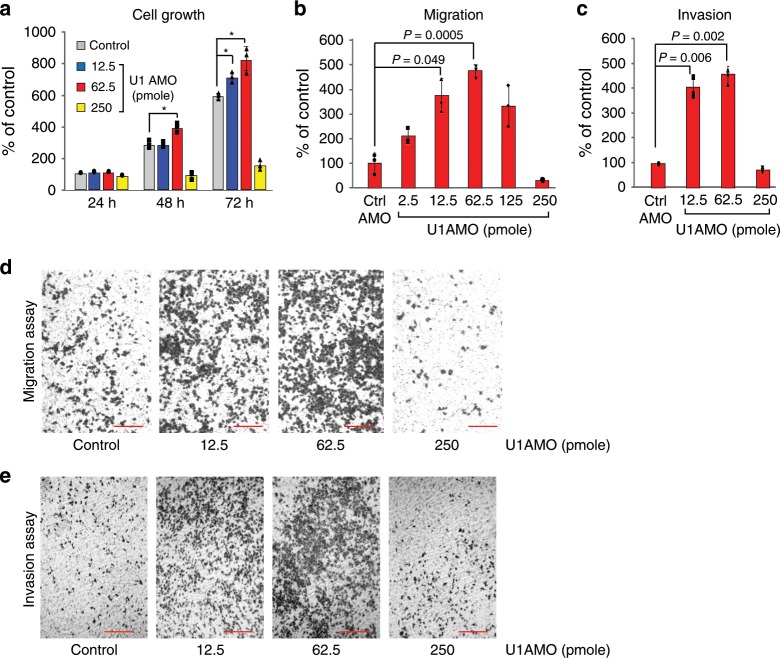
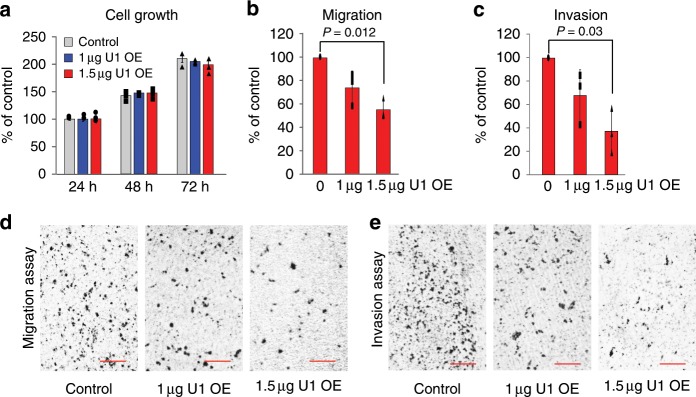
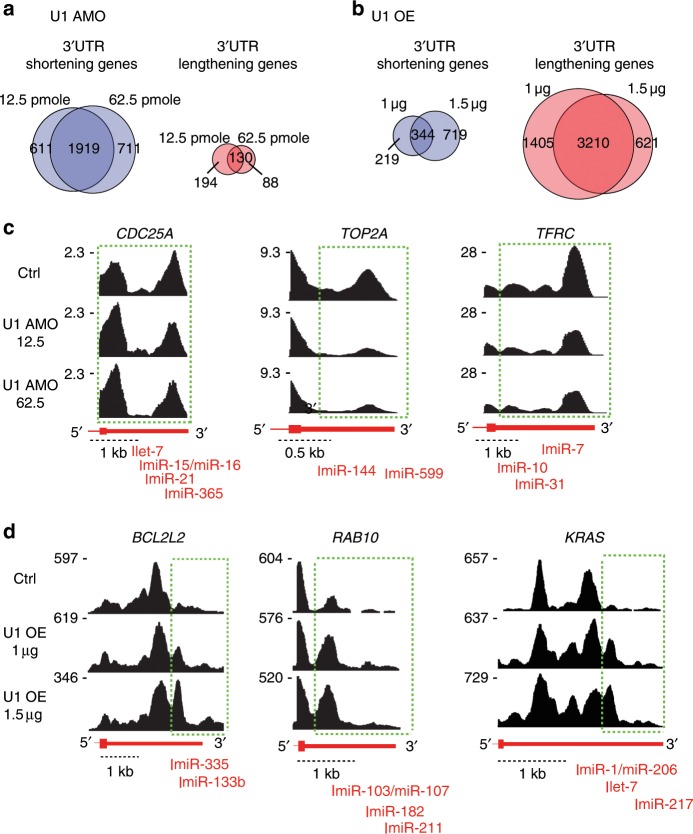
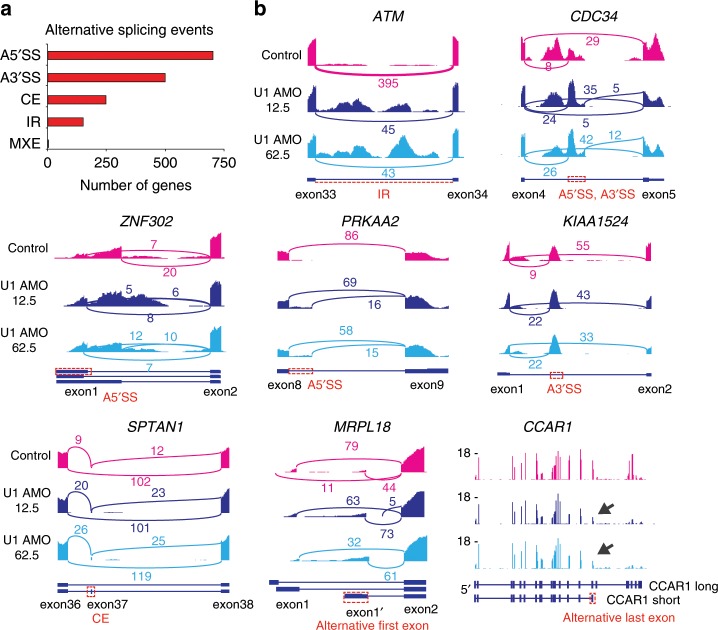
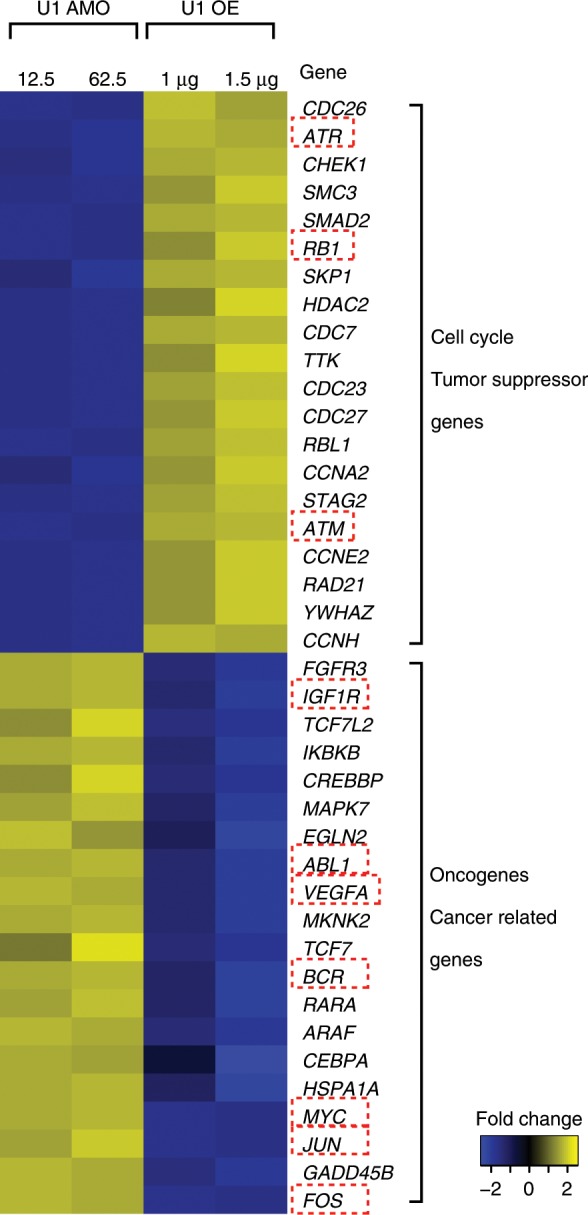
Stimulated cells and cancer cells have widespread shortening of mRNA 3’-untranslated regions (3’UTRs) and switches to shorter mRNA isoforms due to usage of more proximal polyadenylation signals (PASs) in introns and last exons. U1 snRNP (U1), vertebrates’ most abundant non-coding (spliceosomal) small nuclear RNA, silences proximal PASs and its inhibition with antisense morpholino oligonucleotides (U1 AMO) triggers widespread premature transcription termination and mRNA shortening. Here we show that low U1 AMO doses increase cancer cells’ migration and invasion in vitro by up to 500%, whereas U1 over-expression has the opposite effect. In addition to 3’UTR length, numerous transcriptome changes that could contribute to this phenotype are observed, including alternative splicing, and mRNA expression levels of proto-oncogenes and tumor suppressors. These findings reveal an unexpected role for U1 homeostasis (available U1 relative to transcription) in oncogenic and activated cell states, and suggest U1 as a potential target for their modulation.
Overview
The claims and statistics of this paper haven’t been checked yet.
Free: it reads the open-access text and checks the first 5 claims that cite a source we can check. Create a free account to check every claim.
Integrity signals
Registry
Cites
Statistics
Figures
Verification
Claims the paper makes
The claims and statistics of this paper haven’t been checked yet.
Free: it reads the open-access text and checks the first 5 claims that cite a source we can check. Create a free account to check every claim.
Claims other papers make about this one
Each is checked against this paper’s own text: does it say what the citing paper says it does?
The check wasn’t confident either way, so it gives no verdict — never disputed.
In the citing paper
“Zhang et al. [24] reported a more efficient entry of pseudovirus SG614 with less S1 domain shedding in ACE-2 expressing cells.”
From Waves and variants of SARS-CoV-2: understanding the causes and effect of the COVID-19 catastrophe (2022) · cites this paper as [24]
Experimental — accuracy not yet measuredThe check wasn’t confident either way, so it gives no verdict — never disputed.
In the citing paper
“A recent study estimated that fewer than 100 causal common variants may explain the entire AD risk52; if that estimate is correct, then our study might have already characterized a large proportion of this genetic component due to common variants.”
From New insights into the genetic etiology of Alzheimer’s disease and related dementias (2022) · cites this paper as [52]
Experimental — accuracy not yet measuredThe check wasn’t confident either way, so it gives no verdict — never disputed.
In the citing paper
“other research on DBS in OCD (and other psychiatric disorders) has highlighted that the efficacy of DBS in reducing symptoms may depend less on the gray or white matter stimulation target and more on the white matter networks affected by the stimulation [70–71]”
From Toward a neurocircuit-based taxonomy to guide treatment of obsessive-compulsive disorder (2021) · cites this paper as [70]
Experimental — accuracy not yet measuredThe check wasn’t confident either way, so it gives no verdict — never disputed.
In the citing paper
“recent findings showing the importance of targeting white matter networks rather than discrete cortical targets [70–71].”
From Toward a neurocircuit-based taxonomy to guide treatment of obsessive-compulsive disorder (2021) · cites this paper as [70]
Experimental — accuracy not yet measuredThe check wasn’t confident either way, so it gives no verdict — never disputed.
In the citing paper
“Qualitatively, our HAIM framework appears to improve on previous work in this field30 by including scalable patient-centric data pre-processing and enabling standardized feature extraction stages that allow for rapid prototyping, testing, and deployment of predictive models based on user-defined prediction targets.”
From Integrated multimodal artificial intelligence framework for healthcare applications (2022) · cites this paper as [30]
Experimental — accuracy not yet measured
7 more claims about this paper
Create a free account to see every claim other papers make about this one.
Self-check
Percentages, sums and reported differences re-computed from the paper’s own numbers.
The self-check needs the paper’s full text.
Citations
Cites
Hallmarks of Cancer: The Next Generation
Hanahan, D., & Weinberg, R. A. (2011) · Cell · doi:10.1016/j.cell.2011.02.013 · Cited by 66,590
STAR: ultrafast universal RNA-seq aligner
Dobin, A., Davis, C. A., Schlesinger, F., Drenkow, J., Zaleski, C., Jha, S., Batut, P., Chaisson, M., & Gingeras, T. R. (2013) · Bioinformatics · doi:10.1093/bioinformatics/bts635 · Cited by 51,709
Mapping and quantifying mammalian transcriptomes by RNA-Seq
Mortazavi, A., Williams, B. A., McCue, K., Schaeffer, L., & Wold, B. (2008) · Nature Methods · doi:10.1038/nmeth.1226 · Cited by 13,696
A census of human cancer genes
Futreal, P. A., Coin, L., Marshall, M., Down, T., Hubbard, T., Wooster, R., Rahman, N., & Stratton, M. R. (2004) · Nature Reviews Cancer · doi:10.1038/nrc1299 · Cited by 3,184
Cyclooxygenase regulates angiogenesis induced by colon cancer cells
Tsujii, M., Kawano, S., Tsuji, S., Sawaoka, H., Hori, M., & DuBois, R. N. (1998) · Cell · doi:10.1016/s0092-8674(00)81433-6 · Cited by 2,272
Frequent pathway mutations of splicing machinery in myelodysplasia
Yoshida, K., Sanada, M., Shiraishi, Y., Nowak, D., Nagata, Y., Yamamoto, R., Sato, Y., Sato-Otsubo, A., Kon, A., Nagasaki, M., et al. (2011) · Nature · doi:10.1038/nature10496 · Cited by 2,029
MicroRNAs in Stress Signaling and Human Disease
Mendell, J. T., & Olson, E. N. (2012) · Cell · doi:10.1016/j.cell.2012.02.005 · Cited by 1,673
Mayr, C., & Bartel, D. P. (2009) · Cell · doi:10.1016/j.cell.2009.06.016 · Cited by 1,613
Roles for MicroRNAs in Conferring Robustness to Biological Processes
Ebert, M. S., & Sharp, P. A. (2012) · Cell · doi:10.1016/j.cell.2012.04.005 · Cited by 1,564
Sandberg, R., Neilson, J. R., Sarma, A., Sharp, P. A., & Burge, C. B. (2008) · Science · doi:10.1126/science.1155390 · Cited by 1,349
The let-7 MicroRNA Represses Cell Proliferation Pathways in Human Cells
Johnson, C. D., Esquela-Kerscher, A., Stefani, G., Byrom, M., Kelnar, K., Ovcharenko, D., Wilson, M., Wang, X., Shelton, J., Shingara, J., et al. (2007) · Cancer Research · doi:10.1158/0008-5472.can-07-1083 · Cited by 1,224
In vitro cell migration and invasion assays
Kramer, N., Walzl, A., Unger, C., Rosner, M., Krupitza, G., Hengstschläger, M., & Dolznig, H. (2013) · Mutation Research/Reviews in Mutation Research · doi:10.1016/j.mrrev.2012.08.001 · Cited by 1,170
A day in the life of the spliceosome
Matera, A. G., & Wang, Z. (2014) · Nature Reviews Molecular Cell Biology · doi:10.1038/nrm3742 · Cited by 1,074
Principles of Tumor Suppression
Sherr, C. J. (2004) · Cell · doi:10.1016/s0092-8674(03)01075-4 · Cited by 1,034
MicroRNAs — the micro steering wheel of tumour metastases
Nicoloso, M. S., Spizzo, R., Shimizu, M., Rossi, S., & Calin, G. A. (2009) · Nature Reviews Cancer · doi:10.1038/nrc2619 · Cited by 749
Mechanisms and Consequences of Alternative Polyadenylation
Di Giammartino, D. C., Nishida, K., & Manley, J. L. (2011) · Molecular Cell · doi:10.1016/j.molcel.2011.08.017 · Cited by 737
U1 snRNP protects pre-mRNAs from premature cleavage and polyadenylation
Kaida, D., Berg, M. G., Younis, I., Kasim, M., Singh, L. N., Wan, L., & Dreyfuss, G. (2010) · Nature · doi:10.1038/nature09479 · Cited by 638
Self-citationThe Fos family of transcription factors and their role in tumourigenesis
Milde-Langosch, K. (2005) · European Journal of Cancer · doi:10.1016/j.ejca.2005.08.008 · Cited by 583
SRSF2 Mutations Contribute to Myelodysplasia by Mutant-Specific Effects on Exon Recognition
Kim, E., Ilagan, J. O., Liang, Y., Daubner, G. M., Lee, S. C.-W., Ramakrishnan, A., Li, Y., Chung, Y. R., Micol, J.-B., Murphy, M. E., et al. (2015) · Cancer Cell · doi:10.1016/j.ccell.2015.04.006 · Cited by 575
U1 snRNP Determines mRNA Length and Regulates Isoform Expression
Berg, M. G., Singh, L. N., Younis, I., Liu, Q., Pinto, A. M., Kaida, D., Zhang, Z., Cho, S., Sherrill-Mix, S., Wan, L., et al. (2012) · Cell · doi:10.1016/j.cell.2012.05.029 · Cited by 473
Self-citationCFIm25 links alternative polyadenylation to glioblastoma tumour suppression
Masamha, C. P., Xia, Z., Yang, J., Albrecht, T. R., Li, M., Shyu, A.-B., Li, W., & Wagner, E. J. (2014) · Nature · doi:10.1038/nature13261 · Cited by 446
Seiler, M., Peng, S., Agrawal, A. A., Palacino, J., Teng, T., Zhu, P., Smith, P. G., Caesar-Johnson, S. J., Demchok, J. A., Felau, I., et al. (2018) · Cell Reports · doi:10.1016/j.celrep.2018.01.088 · Cited by 444
Flavell, S. W., Kim, T.-K., Gray, J. M., Harmin, D. A., Hemberg, M., Hong, E. J., Markenscoff-Papadimitriou, E., Bear, D. M., & Greenberg, M. E. (2008) · Neuron · doi:10.1016/j.neuron.2008.11.029 · Cited by 440
GFOLD: a generalized fold change for ranking differentially expressed genes from RNA-seq data
Feng, J., Meyer, C. A., Wang, Q., Liu, J. S., Shirley Liu, X., & Zhang, Y. (2012) · Bioinformatics · doi:10.1093/bioinformatics/bts515 · Cited by 437
Takagaki, Y., Seipelt, R. L., Peterson, M. L., & Manley, J. L. (1996) · Cell · doi:10.1016/s0092-8674(00)82000-0 · Cited by 425
Promoter directionality is controlled by U1 snRNP and polyadenylation signals
Almada, A. E., Wu, X., Kriz, A. J., Burge, C. B., & Sharp, P. A. (2013) · Nature · doi:10.1038/nature12349 · Cited by 406
Alsafadi, S., Houy, A., Battistella, A., Popova, T., Wassef, M., Henry, E., Tirode, F., Constantinou, A., Piperno-Neumann, S., Roman-Roman, S., et al. (2016) · Nature Communications · doi:10.1038/ncomms10615 · Cited by 386
Martin, G., Gruber, A. R., Keller, W., & Zavolan, M. (2012) · Cell Reports · doi:10.1016/j.celrep.2012.05.003 · Cited by 359
The Poly(A)-Binding Protein Nuclear 1 Suppresses Alternative Cleavage and Polyadenylation Sites
Jenal, M., Elkon, R., Loayza-Puch, F., van Haaften, G., Kühn, U., Menzies, F. M., Vrielink, J. A. F. O., Bos, A. J., Drost, J., Rooijers, K., et al. (2012) · Cell · doi:10.1016/j.cell.2012.03.022 · Cited by 339
microRNA-21 negatively regulates Cdc25A and cell cycle progression in colon cancer cells
Wang, P., Zou, F., Zhang, X., Li, H., Dulak, A., Tomko, R. J., Lazo, J. S., Wang, Z., Zhang, L., & Yu, J. (2009) · Cancer Research · doi:10.1158/0008-5472.can-09-1996 · Cited by 308
U2AF1 mutations alter splice site recognition in hematological malignancies
Ilagan, J. O., Ramakrishnan, A., Hayes, B., Murphy, M. E., Zebari, A. S., Bradley, P., & Bradley, R. K. (2015) · Genome Research · doi:10.1101/gr.181016.114 · Cited by 287
Polyadenylation site–induced decay of upstream transcripts enforces promoter directionality
Ntini, E., Järvelin, A. I., Bornholdt, J., Chen, Y., Boyd, M., Jørgensen, M., Andersson, R., Hoof, I., Schein, A., Andersen, P. R., et al. (2013) · Nature Structural & Molecular Biology · doi:10.1038/nsmb.2640 · Cited by 286
Ji, Z., & Tian, B. (2009) · PLoS ONE · doi:10.1371/journal.pone.0008419 · Cited by 264
Li, W., You, B., Hoque, M., Zheng, D., Luo, W., Ji, Z., Park, J. Y., Gunderson, S. I., Kalsotra, A., Manley, J. L., et al. (2015) · PLOS Genetics · doi:10.1371/journal.pgen.1005166 · Cited by 263
Genotype-Phenotype Relationships in Ataxia-Telangiectasia and Variants
Gilad, S., Chessa, L., Khosravi, R., Russell, P., Galanty, Y., Piane, M., Gatti, R. A., Jorgensen, T. J., Shiloh, Y., & Bar-Shira, A. (1998) · The American Journal of Human Genetics · doi:10.1086/301755 · Cited by 254
Widespread intronic polyadenylation inactivates tumour suppressor genes in leukaemia
Lee, S.-H., Singh, I., Tisdale, S., Abdel-Wahab, O., Leslie, C. S., & Mayr, C. (2018) · Nature · doi:10.1038/s41586-018-0465-8 · Cited by 251
Yao, C., Biesinger, J., Wan, J., Weng, L., Xing, Y., Xie, X., & Shi, Y. (2012) · Proceedings of the National Academy of Sciences · doi:10.1073/pnas.1211101109 · Cited by 208
3′ UTR shortening represses tumor-suppressor genes in trans by disrupting ceRNA crosstalk
Park, H. J., Ji, P., Kim, S., Xia, Z., Rodriguez, B., Li, L., Su, J., Chen, K., Masamha, C. P., Baillat, D., et al. (2018) · Nature Genetics · doi:10.1038/s41588-018-0118-8 · Cited by 180
Lee, S.-O., Masyuk, T., Splinter, P., Banales, J. M., Masyuk, A., Stroope, A., & LaRusso, N. (2008) · Journal of Clinical Investigation · doi:10.1172/jci34922 · Cited by 179
Poly(A) binding protein nuclear 1 levels affect alternative polyadenylation
de Klerk, E., Venema, A., Anvar, S. Y., Goeman, J. J., Hu, O., Trollet, C., Dickson, G., den Dunnen, J. T., van der Maarel, S. M., Raz, V., et al. (2012) · Nucleic Acids Research · doi:10.1093/nar/gks655 · Cited by 172
Yu, K., Ganesan, K., Tan, L. K., Laban, M., Wu, J., Zhao, X. D., Li, H., Leung, C. H. W., Zhu, Y., Wei, C. L., et al. (2008) · PLoS Genetics · doi:10.1371/journal.pgen.1000129 · Cited by 159
Widespread intronic polyadenylation diversifies immune cell transcriptomes
Singh, I., Lee, S.-H., Sperling, A. S., Samur, M. K., Tai, Y.-T., Fulciniti, M., Munshi, N. C., Mayr, C., & Leslie, C. S. (2018) · Nature Communications · doi:10.1038/s41467-018-04112-z · Cited by 156
Induction of Antagonistic Soluble Decoy Receptor Tyrosine Kinases by Intronic PolyA Activation
Vorlová, S., Rocco, G., LeFave, C. V., Jodelka, F. M., Hess, K., Hastings, M. L., Henke, E., & Cartegni, L. (2011) · Molecular Cell · doi:10.1016/j.molcel.2011.08.009 · Cited by 145
Ogami, K., Richard, P., Chen, Y., Hoque, M., Li, W., Moresco, J. J., Yates, J. R., Tian, B., & Manley, J. L. (2017) · Genes & Development · doi:10.1101/gad.302604.117 · Cited by 141
Paranjape, T., Heneghan, H., Lindner, R. M., Keane, F. K., Hoffman, A. E., Hollestelle, A., Dorairaj, J. J., Geyda, K., Pelletier, C., Nallur, S. V., et al. (2011) · The Lancet Oncology · doi:10.1016/s1470-2045(11)70044-4 · Cited by 134
Chiu, A. C., Suzuki, H. I., Wu, X., Mahat, D. B., Kriz, A. J., & Sharp, P. A. (2018) · Molecular Cell · doi:10.1016/j.molcel.2018.01.006 · Cited by 124
Non‐coding RNAs in cancer initiation and progression and as novel biomarkers
Nana-Sinkam, S. P., & Croce, C. M. (2011) · Molecular Oncology · doi:10.1016/j.molonc.2011.10.003 · Cited by 119
U1 snRNP telescripting regulates a size–function-stratified human genome
Oh, J.-M., Di, C., Venters, C. C., Guo, J., Arai, C., So, B. R., Pinto, A. M., Zhang, Z., Wan, L., Younis, I., et al. (2017) · Nature Structural & Molecular Biology · doi:10.1038/nsmb.3473 · Cited by 117
Self-citationSo, B. R., Di, C., Cai, Z., Venters, C. C., Guo, J., Oh, J.-M., Arai, C., & Dreyfuss, G. (2019) · Molecular Cell · doi:10.1016/j.molcel.2019.08.007 · Cited by 115
Self-citation1p36 Tumor Suppression—A Matter of Dosage?
Henrich, K.-O., Schwab, M., & Westermann, F. (2012) · Cancer Research · doi:10.1158/0008-5472.can-12-2230 · Cited by 101
Means to an end: mechanisms of alternative polyadenylation of messenger RNA precursors
Gruber, A. R., Martin, G., Keller, W., & Zavolan, M. (2013) · Wiley Interdisciplinary Reviews - RNA · doi:10.1002/wrna.1206 · Cited by 97
Wang, Q., & Rio, D. C. (2018) · Proceedings of the National Academy of Sciences · doi:10.1073/pnas.1806018115 · Cited by 74
Cdc48/VCP Promotes Chromosome Morphogenesis by Releasing Condensin from Self-Entrapment in Chromatin
Thattikota, Y., Tollis, S., Palou, R., Vinet, J., Tyers, M., & D’Amours, D. (2018) · Molecular Cell · doi:10.1016/j.molcel.2018.01.030 · Cited by 63
A complex immunodeficiency is based on U1 snRNP‐mediated poly(A) site suppression
Langemeier, J., Schrom, E.-M., Rabner, A., Radtke, M., Zychlinski, D., Saborowski, A. L., Bohn, G., Mandel‐Gutfreund, Y., Bodem, J., Klein, C., et al. (2012) · The EMBO Journal · doi:10.1038/emboj.2012.252 · Cited by 28
Silvestre, D. C., Gil, G. A., Tomasini, N., Bussolino, D. F., & Caputto, B. L. (2010) · PLoS ONE · doi:10.1371/journal.pone.0009544 · Cited by 27
Gene expression profiling reveals U1 snRNA regulates cancer gene expression
Cheng, Z., Sun, Y., Niu, X., Shang, Y., Wu, Z., Shi, J., Gao, S., & Zhang, T. (2017) · Oncotarget · doi:10.18632/oncotarget.22842 · Cited by 26
Targeted 'knockdown' of spliceosome function in mammalian cells
Matter, N. (2005) · Nucleic Acids Research · doi:10.1093/nar/gni041 · Cited by 25
Niibori, Y., Hayashi, F., Hirai, K., Matsui, M., & Inokuchi, K. (2006) · Neuroscience Research · doi:10.1016/j.neures.2006.11.014 · Cited by 21
Cited by
Review of deep learning: concepts, CNN architectures, challenges, applications, future directions
Alzubaidi, L., Zhang, J., Humaidi, A. J., Al-Dujaili, A., Duan, Y., Al-Shamma, O., Santamaría, J., Fadhel, M. A., Al-Amidie, M., & Farhan, L. (2021) · Journal of Big Data · doi:10.1186/s40537-021-00444-8 · Cited by 7,906
Gut microbiota in human metabolic health and disease
Fan, Y., & Pedersen, O. (2021) · Nature Reviews Microbiology · doi:10.1038/s41579-020-0433-9 · Cited by 4,724
New insights into the genetic etiology of Alzheimer’s disease and related dementias
Bellenguez, C., Küçükali, F., Jansen, I. E., Kleineidam, L., Moreno-Grau, S., Amin, N., Naj, A. C., Campos-Martin, R., Grenier-Boley, B., Andrade, V., et al. (2022) · Nature Genetics · doi:10.1038/s41588-022-01024-z · Cited by 2,498
Towards 6G wireless communication networks: vision, enabling technologies, and new paradigm shifts
You, X., Wang, C.-X., Huang, J., Gao, X., Zhang, Z., Wang, M., Huang, Y., Zhang, C., Jiang, Y., Wang, J., et al. (2021) · Science China Information Sciences · doi:10.1007/s11432-020-2955-6 · Cited by 2,027
Chatenet, M., Pollet, B. G., Dekel, D. R., Dionigi, F., Deseure, J., Millet, P., Braatz, R. D., Bazant, M. Z., Eikerling, M., Staffell, I., et al. (2022) · Chemical Society Reviews · doi:10.1039/d0cs01079k · Cited by 2,025
Metadata
- Authors
- Oh, J.-M., Venters, C. C., Di, C., Pinto, A. M., Wan, L., Younis, I., Cai, Z., Arai, C., So, B. R., Duan, J., & Dreyfuss, G.
- Affiliations
- Howard Hughes Medical Institute (US)
- Corresponding author
- Dreyfuss, Gideon
- ORCID
- Venue
- Nature Communications
- Published
- 2020-01-07
- Volume
- 11
- Issue
- 1
- Pages
- 1-1
- ISSN
- 2041-1723 (ISSN-L)
- PMC
- PMC6946686
- OpenAlex
- W2998840182
- Semantic Scholar
- 39e1d05c7954dabaeb99cc553a4f7599573055bf
- Cited by
- 7,157
- References
- 58
- Citations by year
- 2026: 81 · 2025: 706 · 2024: 808 · 2023: 1381 · 2022: 1956 · 2021: 1753 · 2020: 471
- FWCI
- 451.98
- Type
- journal article
- Language
- en
- Open access
- gold
- doi.org
- Licence
- cc-by
- creativecommons.org/licenses/by/4.0 (tdm)
- creativecommons.org/licenses/by/4.0 (vor)
- Locations
- Nature Communications (publishedVersion, cc-by)
- bioRxiv (Cold Spring Harbor Laboratory) (acceptedVersion)
- PubMed Central (publishedVersion, cc-by)
- PubMed (publishedVersion)
- RePEc: Research Papers in Economics (submittedVersion)
- DOAJ (DOAJ: Directory of Open Access Journals) (submittedVersion, cc-by-sa)
- DOAJ (DOAJ: Directory of Open Access Journals) (submittedVersion)
- Use Siena air (University of Siena) (submittedVersion, cc-by)
- Funders
- U.S. Department of Health & Human Services | NIH | National Institute of General Medical Sciences (R01GM112923)
- Topics
- Life Sciences › Biochemistry, Genetics and Molecular Biology › Molecular Biology › RNA Research and Splicing
- Life Sciences › Biochemistry, Genetics and Molecular Biology › Cancer Research › Cancer-related molecular mechanisms research
- Life Sciences › Biochemistry, Genetics and Molecular Biology › Molecular Biology › RNA regulation and disease
- Keywords
- U1 snRNP, tumor cell migration, tumor invasion, polyadenylation signal, premature transcription termination, morpholino antisense oligonucleotides, alternative splicing, proto-oncogenes, tumor suppressor, transcriptome changes
- MeSH terms
- Cell Movement, Humans, Neoplasm Invasiveness, Neoplasms, RNA Splicing, RNA, Messenger, Oligonucleotides, Antisense, Ribonucleoprotein, U1 Small Nuclear, Cell Line, Tumor
About these checks
Registry, retraction, Cites and statistics results are computed, not judged, with one exception: a printed reference that no index lists is read once by a model before it counts as a citation error. Claims are extracted by a model and kept only when their quote appears verbatim in the text; each cited source is then checked, with a model’s help, for whether it says what the claim relies on. Those verdicts can be wrong — read the claim’s quote and the cited source before relying on one.
Statistics and arithmetic are recomputed, not judged.
Confidence bands are shown only for fields calibrated on our annotated test set. None is calibrated yet, so no band is shown.
What counts as a claim ›How we measure confidence ›How we check this ›
Are you an author, or do you see a problem with this page? Request a review
Data sources
Bibliographic data: Semantic Scholar, OpenAlex, Crossref.
Contains information from the Semantic Scholar Academic Graph Datasets, made available under the ODC Attribution License (ODC-BY 1.0).
Semantic Scholar’s data is described in: Kinney, R., et al. (2023). The Semantic Scholar Open Data Platform. arXiv:2301.10140.
