

Word contexts enhance the neural representation of individual letters in early visual cortex
Open accessThe DOI matches its Crossref record; 68 of the 68 references it cites were found in a registry or an index.
Abstract
Visual context facilitates perception, but how this is neurally implemented remains unclear. One example of contextual facilitation is found in reading, where letters are more easily identified when embedded in a word. Bottom-up models explain this word advantage as a post-perceptual decision bias, while top-down models propose that word contexts enhance perception itself. Here, we arbitrate between these accounts by presenting words and nonwords and probing the representational fidelity of individual letters using functional magnetic resonance imaging. In line with top-down models, we find that word contexts enhance letter representations in early visual cortex. Moreover, we observe increased coupling between letter information in visual cortex and brain activity in key areas of the reading network, suggesting these areas may be the source of the enhancement. Our results provide evidence for top-down representational enhancement in word recognition, demonstrating that word contexts can modulate perceptual processing already at the earliest visual regions.
Overview
The claims and statistics of this paper haven’t been checked yet.
Free: it reads the open-access text and checks the first 5 claims that cite a source we can check. Create a free account to check every claim.
Integrity signals
Registry
Cites
Statistics
Figures
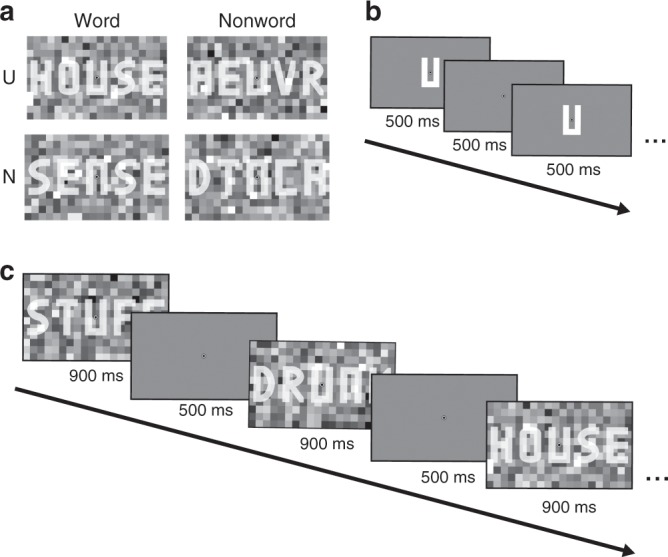
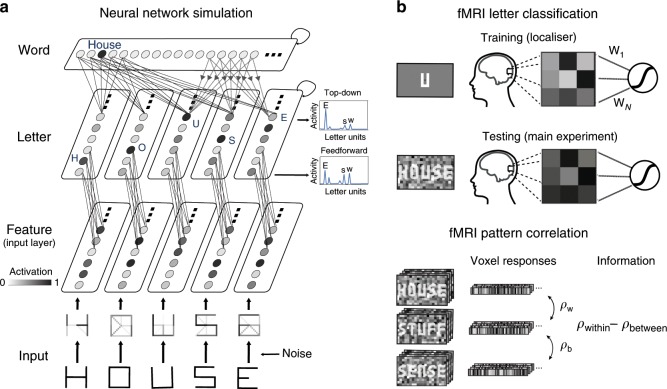
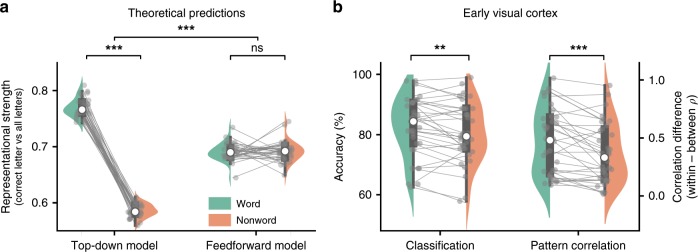
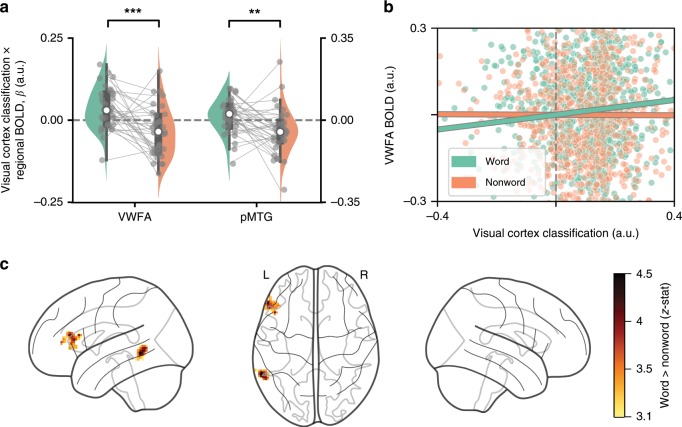
Verification
Claims the paper makes
The claims and statistics of this paper haven’t been checked yet.
Free: it reads the open-access text and checks the first 5 claims that cite a source we can check. Create a free account to check every claim.
Claims other papers make about this one
Each is checked against this paper’s own text: does it say what the citing paper says it does?
In the citing paper
“Within each subsystem, and between each connected pair of subsystems, the neurons are reciprocally interconnected via learning-dependent pathways, allowing mutual constraint satisfaction among all of the elements of each of the representation types, as indicated by the looping blue arrows from each oval to itself and by the bidirectional blue arrows between these ovals.”
From Placing language in an integrated understanding system: Next steps toward human-level performance in neural language models (2020) · cites this paper as [51]
Self-check
Percentages, sums and reported differences re-computed from the paper’s own numbers.
The self-check needs the paper’s full text.
Citations
Cites
LeCun, Y., Bengio, Y., & Hinton, G. (2015) · Nature · doi:10.1038/nature14539 · Cited by 84,126
Scikit-learn: Machine Learning in Python
Pedregosa, F., Varoquaux, G., Gramfort, A., Michel, V., Thirion, B., Grisel, O., Blondel, M., Müller, A., Nothman, J., Louppe, G., et al. (2012) · arXiv · doi:10.48550/arxiv.1201.0490 · Cited by 71,016
Advances in functional and structural MR image analysis and implementation as FSL
Smith, S. M., Jenkinson, M., Woolrich, M. W., Beckmann, C. F., Behrens, T. E. J., Johansen-Berg, H., Bannister, P. R., De Luca, M., Drobnjak, I., Flitney, D. E., et al. (2004) · NeuroImage · doi:10.1016/j.neuroimage.2004.07.051 · Cited by 13,630
Desikan, R. S., Ségonne, F., Fischl, B., Quinn, B. T., Dickerson, B. C., Blacker, D., Buckner, R. L., Dale, A. M., Maguire, R. P., Hyman, B. T., et al. (2006) · NeuroImage · doi:10.1016/j.neuroimage.2006.01.021 · Cited by 13,324
Cortical Surface-Based Analysis
Dale, A. M., Fischl, B., & Sereno, M. I. (1999) · NeuroImage · doi:10.1006/nimg.1998.0395 · Cited by 10,910
Kleiner, M., Brainard, D. H., & Pelli, D. G. (2007) · MPG.PuRe (Max Planck Society) · Cited by 6,195
Rao, R. P. N., & Ballard, D. H. (1999) · Nature Neuroscience · doi:10.1038/4580 · Cited by 5,483
McClelland, J. L., & Rumelhart, D. E. (1981) · Psychological Review · doi:10.1037/0033-295x.88.5.375 · Cited by 4,889
A theory of cortical responses.
Friston, K. (2005) · Philosophical Transactions of the Royal Society B: Biological Sciences · doi:10.1098/rstb.2005.1622 · Cited by 4,578
DRC: A dual route cascaded model of visual word recognition and reading aloud.
Coltheart, M., Rastle, K., Perry, C., Langdon, R., & Ziegler, J. (2001) · Psychological Review · doi:10.1037/0033-295x.108.1.204 · Cited by 4,500
A distributed, developmental model of word recognition and naming.
Seidenberg, M. S., & McClelland, J. L. (1989) · Psychological Review · doi:10.1037/0033-295x.96.4.523 · Cited by 3,909
Movement‐Related effects in fMRI time‐series
Friston, K. J., Williams, S., Howard, R., Frackowiak, R. S. J., & Turner, R. (1996) · Magnetic Resonance in Medicine · doi:10.1002/mrm.1910350312 · Cited by 3,774
Large-scale automated synthesis of human functional neuroimaging data.
Yarkoni, T., Poldrack, R. A., Nichols, T. E., Van Essen, D. C., & Wager, T. D. (2011) · Nature Methods · doi:10.1038/nmeth.1635 · Cited by 3,686
Psychophysiological and Modulatory Interactions in Neuroimaging
Friston, K. J., Buechel, C., Fink, G. R., Morris, J., Rolls, E., & Dolan, R. J. (1997) · NeuroImage · doi:10.1006/nimg.1997.0291 · Cited by 3,097
Machine learning for neuroimaging with scikit-learn
Abraham, A., Pedregosa, F., Eickenberg, M., Gervais, P., Mueller, A., Kossaifi, J., Gramfort, A., Thirion, B., & Varoquaux, G. (2014) · Frontiers in Neuroinformatics · doi:10.3389/fninf.2014.00014 · Cited by 2,384
Nipype: A Flexible, Lightweight and Extensible Neuroimaging Data Processing Framework in Python
Gorgolewski, K., Burns, C. D., Madison, C., Clark, D., Halchenko, Y. O., Waskom, M. L., & Ghosh, S. S. (2011) · Frontiers in Neuroinformatics · doi:10.3389/fninf.2011.00013 · Cited by 2,186
Cohen, L., Dehaene, S., Naccache, L., Lehéricy, S., Dehaene-Lambertz, G., Hénaff, M.-A., & Michel, F. (2000) · Brain · doi:10.1093/brain/123.2.291 · Cited by 1,954
Bar, M. (2004) · Nature Reviews Neuroscience · doi:10.1038/nrn1476 · Cited by 1,613
Rumelhart, D. E., & McClelland, J. L. (1982) · Psychological Review · doi:10.1037//0033-295x.89.1.60 · Cited by 1,525
Hierarchical Bayesian inference in the visual cortex
Lee, T. S., & Mumford, D. (2003) · Journal of the Optical Society of America A · doi:10.1364/josaa.20.001434 · Cited by 1,473
The unique role of the visual word form area in reading
Dehaene, S., & Cohen, L. (2011) · Trends in Cognitive Sciences · doi:10.1016/j.tics.2011.04.003 · Cited by 1,390
Perceptual recognition as a function of meaningfulness of stimulus material
Reicher, G. M. (1969) · Journal of Experimental Psychology · doi:10.1037/h0027768 · Cited by 1,252
The neural code for written words: a proposal
DEHAENE, S., COHEN, L., SIGMAN, M., & VINCKIER, F. (2005) · Trends in Cognitive Sciences · doi:10.1016/j.tics.2005.05.004 · Cited by 1,147
What do we mean by prediction in language comprehension?
Kuperberg, G. R., & Jaeger, T. F. (2016) · Language, Cognition and Neuroscience · doi:10.1080/23273798.2015.1102299 · Cited by 1,087
Turken, A. U., & Dronkers, N. F. (2011) · Frontiers in System Neuroscience · doi:10.3389/fnsys.2011.00001 · Cited by 1,012
How Do Expectations Shape Perception?
de Lange, F. P., Heilbron, M., & Kok, P. (2018) · Trends in Cognitive Sciences · doi:10.1016/j.tics.2018.06.002 · Cited by 975
Self-citationContextual modulation in primary visual cortex
Zipser, K., Lamme, V. A. F., & Schiller, P. H. (1996) · The Journal of Neuroscience · doi:10.1523/jneurosci.16-22-07376.1996 · Cited by 873
Wheeler, D. D. (1970) · Cognitive Psychology · doi:10.1016/0010-0285(70)90005-8 · Cited by 746
Coding of Border Ownership in Monkey Visual Cortex
Zhou, H., Friedman, H. S., & von der Heydt, R. (2000) · The Journal of Neuroscience · doi:10.1523/jneurosci.20-17-06594.2000 · Cited by 726
Vinckier, F., Dehaene, S., Jobert, A., Dubus, J. P., Sigman, M., & Cohen, L. (2007) · Neuron · doi:10.1016/j.neuron.2007.05.031 · Cited by 717
Analysing connectivity with Granger causality and dynamic causal modelling
Friston, K., Moran, R., & Seth, A. K. (2013) · Current Opinion in Neurobiology · doi:10.1016/j.conb.2012.11.010 · Cited by 684
An activation–verification model for letter and word recognition: The word-superiority effect.
Paap, K. R., Newsome, S. L., McDonald, J. E., & Schvaneveldt, R. W. (1982) · Psychological Review · doi:10.1037/0033-295x.89.5.573 · Cited by 551
Surface-Based and Probabilistic Atlases of Primate Cerebral Cortex
Van Essen, D. C., & Dierker, D. L. (2007) · Neuron · doi:10.1016/j.neuron.2007.10.015 · Cited by 550
SUBTLEX-NL: A new measure for Dutch word frequency based on film subtitles
Keuleers, E., Brysbaert, M., & New, B. (2010) · Behavior Research Methods · doi:10.3758/brm.42.3.643 · Cited by 535
Hearing speech sounds: Top-down influences on the interface between audition and speech perception
Davis, M. H., & Johnsrude, I. S. (2007) · Hearing Research · doi:10.1016/j.heares.2007.01.014 · Cited by 458
A review of predictive coding algorithms
Spratling, M. W. (2017) · Brain and Cognition · doi:10.1016/j.bandc.2015.11.003 · Cited by 437
Davey, J., Thompson, H. E., Hallam, G., Karapanagiotidis, T., Murphy, C., De Caso, I., Krieger-Redwood, K., Bernhardt, B. C., Smallwood, J., & Jefferies, E. (2016) · NeuroImage · doi:10.1016/j.neuroimage.2016.05.051 · Cited by 433
Great Expectations: Is there Evidence for Predictive Coding in Auditory Cortex?
Heilbron, M., & Chait, M. (2018) · Neuroscience · doi:10.1016/j.neuroscience.2017.07.061 · Cited by 428
Self-citationAn analysis of the word-superiority effect
Baron, J., & Thurston, I. (1973) · Cognitive Psychology · doi:10.1016/0010-0285(73)90012-1 · Cited by 348
Evidence for Highly Selective Neuronal Tuning to Whole Words in the “Visual Word Form Area”
Glezer, L. S., Jiang, X., & Riesenhuber, M. (2009) · Neuron · doi:10.1016/j.neuron.2009.03.017 · Cited by 294
The remarkable inefficiency of word recognition
Pelli, D. G., Farell, B., & Moore, D. C. (2003) · Nature · doi:10.1038/nature01516 · Cited by 280
Estéban, O., Markiewicz, C. J., Burns, C., Goncalves, M., Jarecka, D., Ziegler, E., Berleant, S., Ellis, D. G., Pinsard, B., Madison, C., et al. (2016) · Zenodo (CERN European Organization for Nuclear Research) · doi:10.5281/zenodo.596855 · Cited by 280
Are faces processed like words? A diagnostic test for recognition by parts
Martelli, M., Majaj, N. J., & Pelli, D. G. (2005) · Journal of Vision · doi:10.1167/5.1.6 · Cited by 266
THE TIME TAKEN UP BY CEREBRAL OPERATIONS
CATTELL, J. M. (1886) · Mind · doi:10.1093/mind/os-xi.42.220 · Cited by 263
Process of recognizing tachistoscopically presented words.
Rumelhart, D. E., & Siple, P. (1974) · Psychological Review · doi:10.1037/h0036117 · Cited by 248
Adams, M. J. (1979) · Cognitive Psychology · doi:10.1016/0010-0285(79)90008-2 · Cited by 247
Laminar fMRI: applications for cognitive neuroscience
Lawrence, S. J. D., Formisano, E., Muckli, L., & de Lange, F. P. (2019) · NeuroImage · doi:10.1016/j.neuroimage.2017.07.004 · Cited by 186
Facial organization blocks access to low-level features: An object inferiority effect.
Suzuki, S., & Cavanagh, P. (1995) · Journal of Experimental Psychology: Human Perception and Performance · doi:10.1037//0096-1523.21.4.901 · Cited by 183
Interaction between Scene and Object Processing Revealed by Human fMRI and MEG Decoding
Brandman, T., & Peelen, M. V. (2017) · The Journal of Neuroscience · doi:10.1523/jneurosci.0582-17.2017 · Cited by 168
Sequential then interactive processing of letters and words in the left fusiform gyrus
Thesen, T., McDonald, C. R., Carlson, C., Doyle, W., Cash, S., Sherfey, J., Felsovalyi, O., Girard, H., Barr, W., Devinsky, O., et al. (2012) · Nature Communications · doi:10.1038/ncomms2220 · Cited by 158
Bottom-up and top-down computations in word- and face-selective cortex
Kay, K., & Yeatman, J. D. (2017) · eLife · doi:10.7554/elife.22341 · Cited by 158
Machine Learning for Neuroimaging with Scikit-Learn
Abraham, A., Pedregosa, F., Eickenberg, M., Gervais, P., Muller, A., Kossaifi, J., Gramfort, A., Thirion, B., & Varoquaux, G. P. (2014) · arXiv (Cornell University) · doi:10.48550/arxiv.1412.3919 · Cited by 158
Suppressed Sensory Response to Predictable Object Stimuli throughout the Ventral Visual Stream
Richter, D., Ekman, M., & de Lange, F. P. (2018) · The Journal of Neuroscience · doi:10.1523/jneurosci.3421-17.2018 · Cited by 150
Self-citationVisual information and redundancy in reading.
Thompson, M. C., & Massaro, D. W. (1973) · Journal of Experimental Psychology · doi:10.1037/h0034308 · Cited by 122
Balota, D. A., Yap, M. J.-M., & Cortese, M. J. (2006) · Elsevier eBooks · doi:10.1016/b978-012369374-7/50010-9 · Cited by 119
Individual Variability in Location Impacts Orthographic Selectivity in the "Visual Word Form Area"
Glezer, L. S., & Riesenhuber, M. (2013) · Journal of Neuroscience · doi:10.1523/jneurosci.5002-12.2013 · Cited by 110
Predictive coding as a model of cognition
Spratling, M. (2016) · Cognitive Processing · doi:10.1007/s10339-016-0765-6 · Cited by 104
Contextual signals in visual cortex
Khan, A. G., & Hofer, S. B. (2018) · Current Opinion in Neurobiology · doi:10.1016/j.conb.2018.05.003 · Cited by 82
Weiner, K. S., Barnett, M. A., Witthoft, N., Golarai, G., Stigliani, A., Kay, K. N., Gomez, J., Natu, V. S., Amunts, K., Zilles, K., et al. (2018) · NeuroImage · doi:10.1016/j.neuroimage.2017.04.040 · Cited by 79
Wenger, M. J., & Townsend, J. T. (2006) · Journal of Experimental Psychology Human Perception & Performance · doi:10.1037/0096-1523.32.3.755 · Cited by 54
Gorgolewski, K. J., Estéban, O., Burns, C., Ziegler, E., Pinsard, B., Madison, C., Waskom, M., Ellis, D. G., Clark, D., Wong, J., et al. (2017) · DSpace@MIT (Massachusetts Institute of Technology) · doi:10.5281/zenodo.575897 · Cited by 54
The confounding effect of response amplitude on MVPA performance measures
Smith, A. T., Kosillo, P., & Williams, A. L. (2010) · NeuroImage · doi:10.1016/j.neuroimage.2010.05.079 · Cited by 41
THE TIME TAKEN UP BY CEREBRAL OPERATIONS1
CATTELL, J. M. (1886) · Mind · doi:10.1093/mind/os-xi.43.377 · Cited by 35
Gorgolewski, K. J., Estéban, O., Ellis, D. G., et al. (2017) · Zenodo (CERN European Organization for Nuclear Research) · doi:10.5281/zenodo.581704 · Cited by 30
Objective effects of knowledge on visual perception.
Lupyan, G. (2017) · Journal of Experimental Psychology Human Perception & Performance · doi:10.1037/xhp0000343 · Cited by 25
Ter sprake : spraak als betekenisvol geluid in 36 thematische hoofdstukken
van den Broecke, M. P. R. (1988) · Medical Entomology and Zoology · Cited by 22
Tracking naturalistic linguistic predictions with deep neural language models
Heilbron, M., Ehinger, B., Peter Hagoort, A., & de Lange, F. P. (2019) · MPG.PuRe (Max Planck Society) · Cited by 19
Self-citationTracking Naturalistic Linguistic Predictions with Deep Neural Language Models
Heilbron, M., Ehinger, B., Hagoort, P., & de Lange, F. (2019) · 2019 Conference on Cognitive Computational Neuroscience · doi:10.32470/ccn.2019.1096-0 · Cited by 16
Self-citation
Research works printed but not linked: 1
- Dehaene, S. Reading in the Brain: The New Science of How We Read (Penguin, 2009).
Cited by
A hierarchy of linguistic predictions during natural language comprehension
Heilbron, M., Armeni, K., Schoffelen, J.-M., Hagoort, P., & de Lange, F. P. (2022) · Proceedings of the National Academy of Sciences · doi:10.1073/pnas.2201968119 · Cited by 343
Self-citationPredictive processing as a systematic basis for identifying the neural correlates of consciousness
Hohwy, J., & Seth, A. (2020) · Philosophy and the Mind Sciences · doi:10.33735/phimisci.2020.ii.64 · Cited by 170
Spatiotemporal dynamics of orthographic and lexical processing in the ventral visual pathway
Woolnough, O., Donos, C., Rollo, P. S., Forseth, K. J., Lakretz, Y., Crone, N. E., Fischer-Baum, S., Dehaene, S., & Tandon, N. (2020) · Nature Human Behaviour · doi:10.1038/s41562-020-00982-w · Cited by 130
Twos in human visual perception
Papeo, L. (2020) · Cortex · doi:10.1016/j.cortex.2020.06.005 · Cited by 107
McClelland, J. L., Hill, F., Rudolph, M., Baldridge, J., & Schütze, H. (2020) · Proceedings of the National Academy of Sciences · doi:10.1073/pnas.1910416117 · Cited by 91
“Brain regions for representing visual and auditory inputs are well established, and the evidence for their involvement in a mutual constraint satisfaction process with more integrative brain areas has been reviewed elsewhere (50, 51).”
Background
Metadata
- Authors
- Heilbron, M., Richter, D., Ekman, M., Hagoort, P., & de Lange, F. P.
- Affiliations
- Radboud University Nijmegen (NL)
- Corresponding author
- Heilbron, Micha
- Venue
- Nature Communications
- Published
- 2020-01-16
- Volume
- 11
- Issue
- 1
- Pages
- 321-321
- ISSN
- 2041-1723 (ISSN-L)
- PMC
- PMC6965097
- OpenAlex
- W2991650583
- Cited by
- 48
- References
- 68
- Citations by year
- 2026: 2 · 2025: 7 · 2024: 5 · 2023: 9 · 2022: 11 · 2021: 6 · 2020: 8
- FWCI
- 12.81
- Type
- journal article
- Language
- en
- Open access
- gold
- doi.org
- Licence
- cc-by
- creativecommons.org/licenses/by/4.0 (tdm)
- creativecommons.org/licenses/by/4.0 (vor)
- Locations
- Nature Communications (publishedVersion, cc-by)
- PubMed Central (publishedVersion, cc-by)
- PubMed (publishedVersion)
- Radboud Repository (Radboud University) (submittedVersion)
- RePEc: Research Papers in Economics (submittedVersion)
- DOAJ (DOAJ: Directory of Open Access Journals) (submittedVersion)
- DOAJ (DOAJ: Directory of Open Access Journals) (submittedVersion, cc-by-sa)
- MPG.PuRe (Max Planck Society) (submittedVersion, other-oa)
- Radboud Repository (Radboud University) (submittedVersion, other-oa)
- Data Archiving and Networked Services (DANS) (submittedVersion)
- Funders
- Nederlandse Organisatie voor Wetenschappelijk Onderzoek (Uitslag beoordeling MaGW Onderzoekstalent 2017 406-17-516)
- EC | Horizon 2020 Framework Programme (ERC Starting Grant 678286)
- Topics
- Social Sciences › Psychology › Developmental and Educational Psychology › Reading and Literacy Development
- Life Sciences › Neuroscience › Cognitive Neuroscience › Visual perception and processing mechanisms
- Life Sciences › Neuroscience › Cognitive Neuroscience › Neurobiology of Language and Bilingualism
- Keywords
- word context, top-down modulation, early visual cortex, word recognition, reading, pseudowords, bottom-up model, top-down model, reading network, perceptual enhancement
- MeSH terms
- Cognitive Neuroscience, Adult, Brain Mapping, Female, Form Perception, Humans, Language, Magnetic Resonance Imaging, Male, Pattern Recognition, Visual, Reading, Visual Cortex, Visual Perception, Neural Networks, Computer, Young Adult
About these checks
Registry, retraction, Cites and statistics results are computed, not judged, with one exception: a printed reference that no index lists is read once by a model before it counts as a citation error. Claims are extracted by a model and kept only when their quote appears verbatim in the text; each cited source is then checked, with a model’s help, for whether it says what the claim relies on. Those verdicts can be wrong — read the claim’s quote and the cited source before relying on one.
Statistics and arithmetic are recomputed, not judged.
Confidence bands are shown only for fields calibrated on our annotated test set. None is calibrated yet, so no band is shown.
What counts as a claim ›How we measure confidence ›How we check this ›
Are you an author, or do you see a problem with this page? Request a review
Data sources
Bibliographic data: Semantic Scholar, OpenAlex, Crossref.
Contains information from the Semantic Scholar Academic Graph Datasets, made available under the ODC Attribution License (ODC-BY 1.0).
Semantic Scholar’s data is described in: Kinney, R., et al. (2023). The Semantic Scholar Open Data Platform. arXiv:2301.10140.
