

The DOI matches its Crossref record; 41 of the 41 references it cites were found in a registry or an index.
Self-clocking fast and variation tolerant true random number generator based on a stochastic mott memristor
Open accessPublished version of a preprint
Abstract
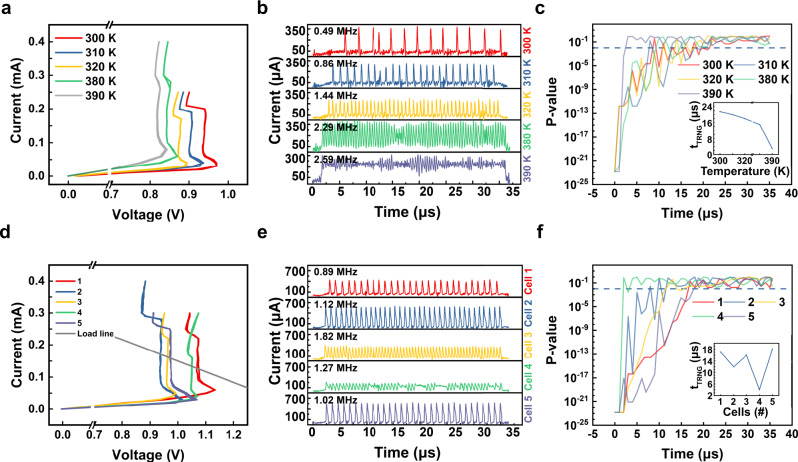
Abstract The intrinsic stochasticity of the memristor can be used to generate true random numbers, essential for non-decryptable hardware-based security devices. Here we propose a novel and advanced method to generate true random numbers utilizing the stochastic oscillation behavior of a NbOx mott memristor, exhibiting self-clocking, fast and variation tolerant characteristics. The random number generation rate of the device can be at least 40 kbs-1, which is the fastest record compared with previous volatile memristor-based TRNG devices. Also, its dimensionless operating principle provides high tolerance against both ambient temperature variation and device-to-device variation, enabling robust security hardware applicable in harsh environments.
Overview
The claims and statistics of this paper haven’t been checked yet.
Run the check — free, no account needed. It reads the open-access text and checks the sources it cites.
Integrity signals
Registry
Cites
Statistics
Figures
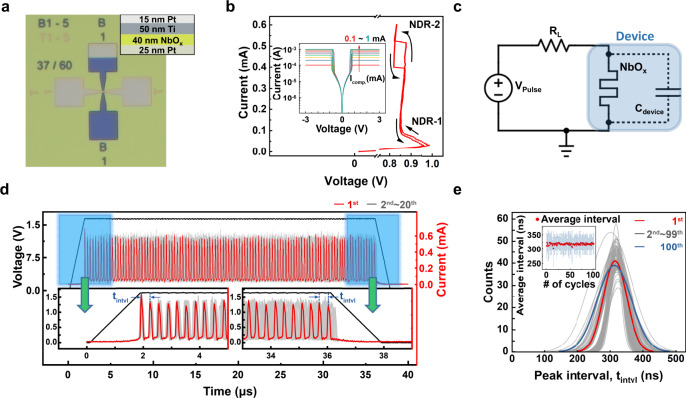
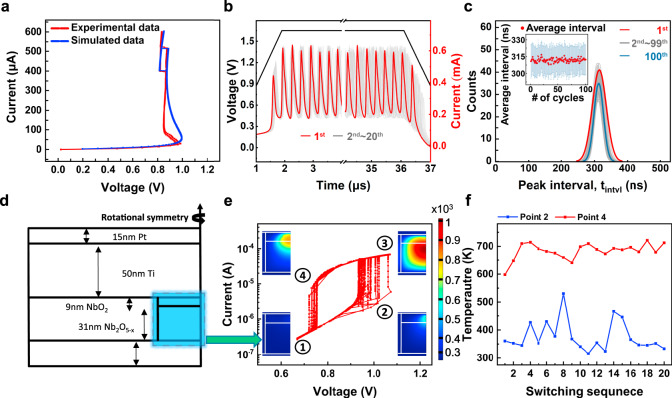
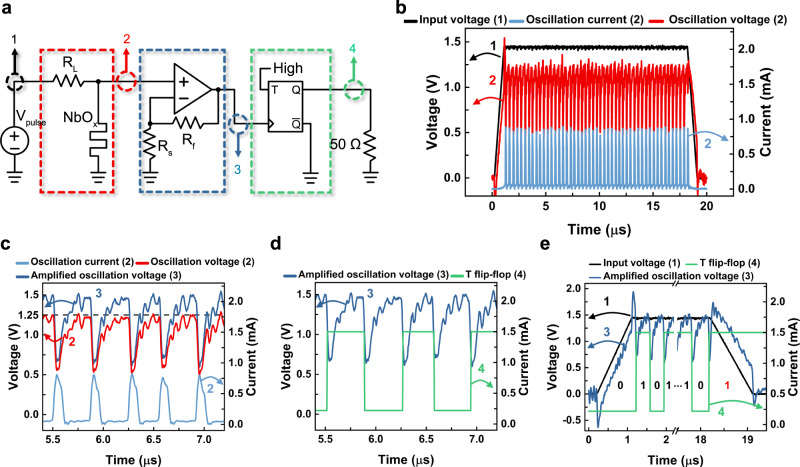
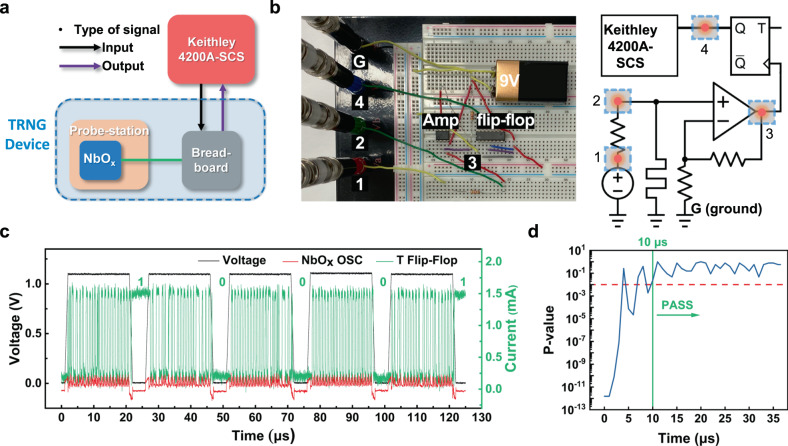
Verification
Claims the paper makes
The claims and statistics of this paper haven’t been checked yet.
Run the check — free, no account needed. It reads the open-access text and checks the sources it cites.
Claims other papers make about this one
Each is checked against this paper’s own text: does it say what the citing paper says it does?
The source backs part of the claim, not all of it — or backs it for a different population, condition or comparison.
In the citing paper
“For example, tRNGs such as RRAM or MRAM, which are not Si-based complementary metal-oxide semiconductor (CMOS) devices, are widely studied given their inherent switching stochasticity as an entropy source, which relies on material-induced variations (11–18).”
From Cryptographic transistor for true random number generator with low power consumption (2024) · cites this paper as [18]
Experimental — accuracy not yet measuredThe check wasn’t confident either way, so it gives no verdict — never disputed.
In the citing paper
“Moreover, their lack of compatibility with CMOS fabrication standards makes it difficult to apply them directly to the current CMOS logic platform used for mass production.”
From Cryptographic transistor for true random number generator with low power consumption (2024) · cites this paper as [18]
Experimental — accuracy not yet measuredThe check wasn’t confident either way, so it gives no verdict — never disputed.
In the citing paper
“However, these tRNGs require a few entropy extraction circuits, each of which consumes power at the milliwatt level.”
From Cryptographic transistor for true random number generator with low power consumption (2024) · cites this paper as [18]
Experimental — accuracy not yet measured
Self-check
Percentages, sums and reported differences re-computed from the paper’s own numbers.
The self-check needs the paper’s full text.
Citations
Cites
A scalable neuristor built with Mott memristors
Pickett, M. D., Medeiros‐Ribeiro, G., & Williams, R. S. (2012) · Nature Materials · doi:10.1038/nmat3510 · Cited by 1,046
Chaotic dynamics in nanoscale NbO2 Mott memristors for analogue computing
Kumar, S., Strachan, J. P., & Williams, R. S. (2017) · Nature · doi:10.1038/nature23307 · Cited by 620
A novel true random number generator based on a stochastic diffusive memristor
Jiang, H., Belkin, D., Savel’ev, S. E., Lin, S., Wang, Z., Li, Y., Joshi, S., Midya, R., Li, C., Rao, M., et al. (2017) · Nature Communications · doi:10.1038/s41467-017-00869-x · Cited by 459
2018 IEEE International Electron Devices Meeting (IEDM)
(2018) · doi:10.1109/iedm13552.2018 · Cited by 459
An artificial spiking afferent nerve based on Mott memristors for neurorobotics
Zhang, X., Zhuo, Y., Luo, Q., Wu, Z., Midya, R., Wang, Z., Song, W., Wang, R., Upadhyay, N. K., Fang, Y., et al. (2020) · Nature Communications · doi:10.1038/s41467-019-13827-6 · Cited by 401
Pickett, M. D., & Stanley Williams, R. (2012) · Nanotechnology · doi:10.1088/0957-4484/23/21/215202 · Cited by 385
Third-order nanocircuit elements for neuromorphic engineering
Kumar, S., Williams, R. S., & Wang, Z. (2020) · Nature · doi:10.1038/s41586-020-2735-5 · Cited by 370
Stochastic memristive devices for computing and neuromorphic applications
Gaba, S., Sheridan, P., Zhou, J., Choi, S., & Lu, W. (2013) · Nanoscale · doi:10.1039/c3nr01176c · Cited by 307
2005 IEEE International Electron Devices Meeting
(2005) · Journal of Lightwave Technology · doi:10.1109/jlt.2005.853686 · Cited by 258
Spin dice: A scalable truly random number generator based on spintronics
Fukushima, A., Seki, T., Yakushiji, K., Kubota, H., Imamura, H., Yuasa, S., & Ando, K. (2014) · Applied Physics Express · doi:10.7567/apex.7.083001 · Cited by 238
Physical origins of current and temperature controlled negative differential resistances in NbO2
Kumar, S., Wang, Z., Dávila, N., Kumari, N., Norris, K. J., Huang, X., Strachan, J. P., Vine, D. J., Kilcoyne, A. L. D., Nishi, Y., et al. (2017) · Nature Communications · doi:10.1038/s41467-017-00773-4 · Cited by 226
An accurate locally active memristor model for S-type negative differential resistance in NbOx
Gibson, G. A., Musunuru, S., Zhang, J., Vandenberghe, K., Lee, J., Hsieh, C., Jackson, W. B., Jeon, Y., Henze, D., Li, Z., et al. (2016) · Applied Physics Letters · doi:10.1063/1.4939913 · Cited by 209
The Security Impact of a New Cryptographic Library
Bernstein, D. J., Lange, T., & Schwabe, P. (2012) · Lecture notes in computer science · doi:10.1007/978-3-642-33481-8_9 · Cited by 208
2021 IEEE International Electron Devices Meeting (IEDM)
(2021) · doi:10.1109/iedm19574.2021 · Cited by 197
Chudnovskiǐ, F. A., Odynets, L. L., Pergament, A. L., & Болеславович, С. Г. (1996) · Journal of Solid State Chemistry · doi:10.1006/jssc.1996.0087 · Cited by 174
Physical model of threshold switching in NbO 2 based memristors
Slesazeck, S., Mähne, H., Wylezich, H., Wachowiak, A., Radhakrishnan, J., Ascoli, A., Tetzlaff, R., & Mikolajick, T. (2015) · RSC Advances · doi:10.1039/c5ra19300a · Cited by 168
A Contact-Resistive Random-Access-Memory-Based True Random Number Generator
Huang, C.-Y., Shen, W. C., Tseng, Y.-H., King, Y.-C., & Lin, C.-J. (2012) · IEEE Electron Device Letters · doi:10.1109/led.2012.2199734 · Cited by 167
Stochastic Memory Devices for Security and Computing
Carboni, R., & Ielmini, D. (2019) · Advanced Electronic Materials · doi:10.1002/aelm.201900198 · Cited by 150
True Random Number Generation by Variability of Resistive Switching in Oxide-Based Devices
Balatti, S., Ambrogio, S., Wang, Z., & Ielmini, D. (2015) · IEEE Journal on Emerging and Selected Topics in Circuits and Systems · doi:10.1109/jetcas.2015.2426492 · Cited by 147
2022 IEEE International Electron Devices Meeting
(2022) · IEEE Electron Device Letters · doi:10.1109/led.2022.3184459 · Cited by 139
Funck, C., Menzel, S., Aslam, N., Zhang, H., Hardtdegen, A., Waser, R. M., & Hoffmann‐Eifert, S. (2016) · Advanced Electronic Materials · doi:10.1002/aelm.201600169 · Cited by 129
Physical Unbiased Generation of Random Numbers With Coupled Resistive Switching Devices
Balatti, S., Ambrogio, S., Carboni, R., Milo, V., Wang, Z., Calderoni, A., Ramaswamy, N., & Ielmini, D. (2016) · IEEE Transactions on Electron Devices · doi:10.1109/ted.2016.2537792 · Cited by 127
Threshold switching and electrical self-oscillation in niobium oxide films
Liu, X., Li, S., Nandi, S. K., Venkatachalam, D. K., & Elliman, R. G. (2016) · Journal of Applied Physics · doi:10.1063/1.4963288 · Cited by 98
A caloritronics-based Mott neuristor
del Valle, J., Salev, P., Kalcheim, Y., & Schuller, I. K. (2020) · Scientific Reports · doi:10.1038/s41598-020-61176-y · Cited by 92
Nandi, S. K., Liu, X., Venkatachalam, D. K., & Elliman, R. G. (2015) · Journal of Physics D Applied Physics · doi:10.1088/0022-3727/48/19/195105 · Cited by 89
Designing Negative Differential Resistance Devices Based on Self‐Heating
Gibson, G. A. (2018) · Advanced Functional Materials · doi:10.1002/adfm.201704175 · Cited by 82
Spontaneous current constriction in threshold switching devices
Goodwill, J. M., Ramer, G., Li, D., Hoskins, B. D., Pavlidis, G., McClelland, J. J., Centrone, A., Bain, J. A., & Skowroński, M. (2019) · Nature Communications · doi:10.1038/s41467-019-09679-9 · Cited by 82
Kumar, S., & Williams, R. S. (2018) · Nature Communications · doi:10.1038/s41467-018-04452-w · Cited by 65
IEEE Journal on Emerging and Selected Topics in Circuits and Systems
(2023) · IEEE Journal on Emerging and Selected Topics in Circuits and Systems · doi:10.1109/jetcas.2026.3696791 · Cited by 65
Woo, K. S., Wang, Y., Kim, J., Kim, Y., Kwon, Y. J., Yoon, J. H., Kim, W., & Hwang, C. S. (2019) · Advanced Electronic Materials · doi:10.1002/aelm.201800543 · Cited by 64
Self-citationHigh-speed true random number generation based on paired memristors for security electronics
Zhang, T., Yin, M., Xu, C., Lu, X., Sun, X., Yang, Y., & Huang, R. (2017) · Nanotechnology · doi:10.1088/1361-6528/aa8b3a · Cited by 63
Woo, K. S., Wang, Y., Kim, Y., Kim, J., Kim, W., & Hwang, C. S. (2020) · Advanced Electronic Materials · doi:10.1002/aelm.201901117 · Cited by 52
Self-citationHigh-speed high-current field switching of NbO2
Shin, S. H., Halpern, T., & Raccah, P. M. (1977) · Journal of Applied Physics · doi:10.1063/1.324047 · Cited by 45
Anatomy of filamentary threshold switching in amorphous niobium oxide
Li, S., Liu, X., Nandi, S. K., & Elliman, R. G. (2018) · Nanotechnology · doi:10.1088/1361-6528/aacee4 · Cited by 45
Wang, Z., Kumar, S., Nishi, Y., & Wong, H. ‐. P. (2018) · Applied Physics Letters · doi:10.1063/1.5027152 · Cited by 41
Memory Switching and Threshold Switching in a 3D Nanoscaled NbOX System
Luo, Q., Zhang, X., Yu, J., Wang, W., Gong, T., Xu, X., Yin, J., Yuan, P., Tai, L., Dong, D., et al. (2019) · IEEE Electron Device Letters · doi:10.1109/led.2019.2904279 · Cited by 37
Temperature dependent frequency tuning of NbOx relaxation oscillators
Nandi, S. K., Li, S., Liu, X., & Elliman, R. G. (2017) · Applied Physics Letters · doi:10.1063/1.4999373 · Cited by 34
Coupling dynamics of Nb/Nb 2 O 5 relaxation oscillators
Li, S., Liu, X., Nandi, S. K., Venkatachalam, D. K., & Elliman, R. G. (2017) · Nanotechnology · doi:10.1088/1361-6528/aa5de0 · Cited by 34
Memristor based Random Number Generator: Architectures and Evaluation
Rai, V. K., Tripathy, S., & Mathew, J. (2018) · Procedia Computer Science · doi:10.1016/j.procs.2017.12.074 · Cited by 33
Thermally induced crystallization in NbO2 thin films
Zhang, J., Norris, K. J., Gibson, G. A., Zhao, D., Samuels, K., Zhang, M. M., Yang, J. J., Park, J., Sinclair, R., Jeon, Y., et al. (2016) · Scientific Reports · doi:10.1038/srep34294 · Cited by 23
Self-citationMemristor-based arbiter Physically Unclonable Function (APUF) with multiple response bits
Loong, J. T. H., Hashim, N. A. N., & Hamid, F. A. (2016) · IEEE Student Conference on Research and Development (SCOReD) · doi:10.1109/scored.2016.7810033 · Cited by 5
Research works printed but not linked: 2
- Hashim, N. A. B. N., Teo, J., Hamid, M. S. A. & Hamid, F. A. B. IEEE student conference on research and development (SCOReD). 1–5 (2016)
- Wang, Y., Wen, W., Li, H. & Hu, M. Proceedings of the 25th edition on Great Lakes Symposium on VLSI, 271–276 (2015).
Cited by
Sorted by citations
A review of memristor: material and structure design, device performance, applications and prospects
Xiao, Y., Jiang, B., Zhang, Z., Ke, S., Jin, Y., Wen, X., & Ye, C. (2023) · Science and Technology of Advanced Materials · doi:10.1080/14686996.2022.2162323 · Cited by 318
Artificial Neuronal Devices Based on Emerging Materials: Neuronal Dynamics and Applications
Liu, H., Qin, Y., Chen, H., Wu, J., Ma, J., Du, Z., Wang, N., Zou, J., Lin, S., Zhang, X., et al. (2023) · Advanced Materials · doi:10.1002/adma.202205047 · Cited by 100
Application of Resistive Random Access Memory in Hardware Security: A Review
Rajendran, G., Banerjee, W., Chattopadhyay, A., & Aly, M. M. S. (2021) · Advanced Electronic Materials · doi:10.1002/aelm.202100536 · Cited by 78
Tunable stochastic memristors for energy-efficient encryption and computing
Woo, K. S., Han, J., Yi, S., Thomas, L., Park, H., Kumar, S., & Hwang, C. S. (2024) · Nature Communications · doi:10.1038/s41467-024-47488-x · Cited by 77
A Unified PUF and TRNG Design Based on 40-nm RRAM With High Entropy and Robustness for IoT Security
Gao, B., Lin, B., Li, X., Tang, J., Qian, H., & Wu, H. (2022) · IEEE Transactions on Electron Devices · doi:10.1109/ted.2021.3138365 · Cited by 69
Metadata
- Authors
- Kim, G., In, J. H., Kim, Y. S., Rhee, H., Park, W., Song, H., Park, J., & Kim, K. M.
- Affiliations
- Korea Advanced Institute of Science and Technology (KR)
- Corresponding author
- Kim, Kyung Min
- ORCID
- Venue
- Nature Communications
- Published
- 2021-05-18
- Volume
- 12
- Issue
- 1
- Pages
- 2906-2906
- ISSN
- 2041-1723 (ISSN-L)
- PMC
- PMC8131590
- OpenAlex
- W3112007195
- Cited by
- 126
- References
- 41
- Citations by year
- 2026: 23 · 2025: 27 · 2024: 32 · 2023: 29 · 2022: 11 · 2021: 3
- FWCI
- 5.51
- Type
- journal article
- Language
- en
- Open access
- gold
- doi.org
- Locations
- Nature Communications (publishedVersion, cc-by)
- Research Square (acceptedVersion, cc-by)
- PubMed Central (publishedVersion, cc-by)
- PubMed (publishedVersion)
- RePEc: Research Papers in Economics (submittedVersion)
- DOAJ (DOAJ: Directory of Open Access Journals) (submittedVersion, cc-by-sa)
- Funders
- Ministry of Trade, Industry and Energy (20003655, 20003789)
- Korea Advanced Institute of Science and Technology
- Korea Semiconductor Research Consortium
- Topics
- Physical Sciences › Engineering › Electrical and Electronic Engineering › Advanced Memory and Neural Computing
- Physical Sciences › Computer Science › Hardware and Architecture › Physical Unclonable Functions (PUFs) and Hardware Security
- Physical Sciences › Computer Science › Computer Vision and Pattern Recognition › Chaos-based Image/Signal Encryption
- Keywords
- true random number generation, memristors, Mott transition, variation tolerance, temperature variation, device-to-device variation, hardware security, hardware-based cryptography
About these checks
Registry, retraction, Cites and statistics results are computed, not judged, with one exception: a printed reference that no index lists is read once by a model before it counts as a citation error. Claims are extracted by a model and kept only when their quote appears verbatim in the text; each cited source is then checked, with a model’s help, for whether it says what the claim relies on. Those verdicts can be wrong — read the claim’s quote and the cited source before relying on one.
Statistics and arithmetic are recomputed, not judged.
Confidence bands are shown only for fields calibrated on our annotated test set. None is calibrated yet, so no band is shown.
What counts as a claim ›How we measure confidence ›How we check this ›
Are you an author, or do you see a problem with this page? Request a review
