

VEGA is an interpretable generative model for inferring biological network activity in single-cell transcriptomics
Open accessThe DOI matches its Crossref record; 49 of the 51 references it cites were found in a registry or an index.
Abstract
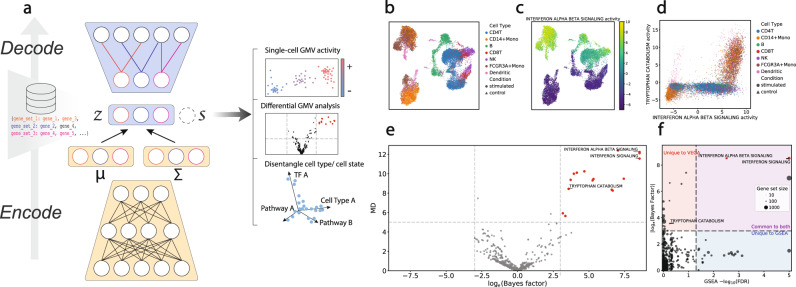
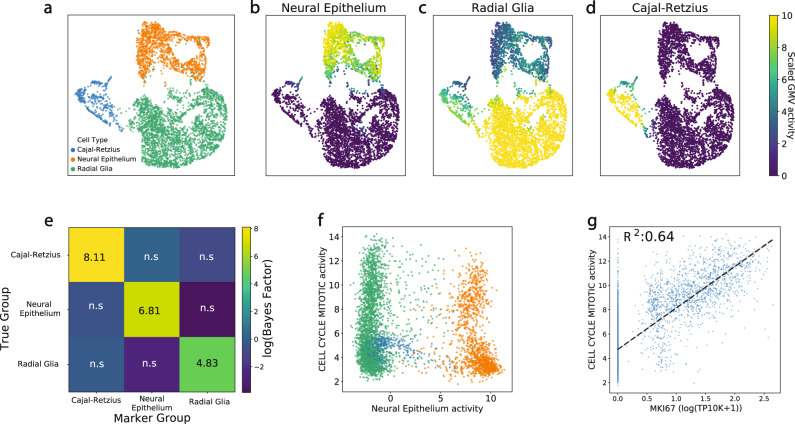
Deep learning architectures such as variational autoencoders have revolutionized the analysis of transcriptomics data. However, the latent space of these variational autoencoders offers little to no interpretability. To provide further biological insights, we introduce a novel sparse Variational Autoencoder architecture, VEGA (VAE Enhanced by Gene Annotations), whose decoder wiring mirrors user-provided gene modules, providing direct interpretability to the latent variables. We demonstrate the performance of VEGA in diverse biological contexts using pathways, gene regulatory networks and cell type identities as the gene modules that define its latent space. VEGA successfully recapitulates the mechanism of cellular-specific response to treatments, the status of master regulators as well as jointly revealing the cell type and cellular state identity in developing cells. We envision the approach could serve as an explanatory biological model for development and drug treatment experiments.
Overview
The claims and statistics of this paper haven’t been checked yet.
Free: it reads the open-access text and checks the first 5 claims that cite a source we can check. Create a free account to check every claim.
Integrity signals
Registry
Cites
Statistics
Figures
Verification
Claims the paper makes
The claims and statistics of this paper haven’t been checked yet.
Free: it reads the open-access text and checks the first 5 claims that cite a source we can check. Create a free account to check every claim.
Claims other papers make about this one
Each is checked against this paper’s own text: does it say what the citing paper says it does?
The cited source says what the claim attributes to it.
In the citing paper
“VEGA can aid the disentanglement of cell types and states while robustly performing out-of-distribution predictions.”
From A mini-review on perturbation modelling across single-cell omic modalities (2024) · cites this paper as [56]
The cited source says what the claim attributes to it.
In the citing paper
“The common approach for biological model design is to construct a neural network architecture that is restrained by biological pathways, specifically connecting target gene nodes with pathway nodes, including models of P-NET [116], pmVAE [163], VEGA [164], and LDVAE [165].”
From Challenges in AI-driven Biomedical Multimodal Data Fusion and Analysis (2025) · cites this paper as [164]
In the citing paper
“Concerning the latter, compared to scGEN, VEGA sacrifices predictive performance for biological interpretability of the latent space.”
From A mini-review on perturbation modelling across single-cell omic modalities (2024) · cites this paper as [56]
Self-check
Percentages, sums and reported differences re-computed from the paper’s own numbers.
The self-check needs the paper’s full text.
Citations
Cites
Scikit-learn: Machine Learning in Python
Pedregosa, F., Varoquaux, G., Gramfort, A., Michel, V., Thirion, B., Grisel, O., Blondel, M., Müller, A., Nothman, J., Louppe, G., et al. (2012) · arXiv · doi:10.48550/arxiv.1201.0490 · Cited by 71,016
Subramanian, A., Tamayo, P., Mootha, V. K., Mukherjee, S., Ebert, B. L., Gillette, M. A., Paulovich, A., Pomeroy, S. L., Golub, T. R., Lander, E. S., et al. (2005) · Proceedings of the National Academy of Sciences · doi:10.1073/pnas.0506580102 · Cited by 53,625
(2008) · Journal of Machine Learning Research · Cited by 33,051
Harris, C. R., Millman, K. J., van der Walt, S. J., Gommers, R., Virtanen, P., Cournapeau, D., Wieser, E., Taylor, J., Berg, S., Smith, N. J., et al. (2020) · Nature · doi:10.1038/s41586-020-2649-2 · Cited by 23,826
Reducing the dimensionality of data with neural networks
Hinton, G. E., & Salakhutdinov, R. R. (2006) · Science · doi:10.1126/science.1127647 · Cited by 20,928
Auto-Encoding Variational Bayes
Kingma, D. P., & Welling, M. (2013) · arXiv · doi:10.48550/arxiv.1312.6114 · Cited by 20,067 · cited 4×
“More recently, deep generative models such as variational autoencoders 7 (VAEs) have proven to be extremely useful for the probabilistic modeling of single-cell transcriptomes, such as scVI and scGen 8 – 10 .”
BackgroundMethodInfluentialHarris, C., Millman, K., van der Walt, S., Gommers, R., Virtanen, P., Cournapeau, D., Wieser, E., Taylor, J., Berg, S., Smith, N., et al. (2020) · RePEc: Research Papers in Economics · Cited by 17,844
The Molecular Signatures Database Hallmark Gene Set Collection
Liberzon, A., Birger, C., Thorvaldsdóttir, H., Ghandi, M., Mesirov, J. P., & Tamayo, P. (2015) · Cell Systems · doi:10.1016/j.cels.2015.12.004 · Cited by 13,807
Kass, R. E., & Raftery, A. E. (1995) · Journal of the American Statistical Association · doi:10.1080/01621459.1995.10476572 · Cited by 12,558
SCANPY: large-scale single-cell gene expression data analysis
Wolf, F. A., Angerer, P., & Theis, F. J. (2018) · Genome Biology · doi:10.1186/s13059-017-1382-0 · Cited by 8,881
In situ click chemistry generation of cyclooxygenase-2 inhibitors
Bhardwaj, A., Kaur, J., Wuest, M., & Wuest, F. (2017) · Nature Communications · doi:10.1038/s41467-016-0009-6 · Cited by 7,448
Massively parallel digital transcriptional profiling of single cells
Zheng, G. X. Y., Terry, J. M., Belgrader, P., Ryvkin, P., Bent, Z. W., Wilson, R., Ziraldo, S. B., Wheeler, T. D., McDermott, G. P., Zhu, J., et al. (2017) · Nature Communications · doi:10.1038/ncomms14049 · Cited by 7,353
UMAP: Uniform Manifold Approximation and Projection for Dimension Reduction
McInnes, L., Healy, J., & Melville, J. (2018) · arXiv · doi:10.48550/arxiv.1802.03426 · Cited by 7,101
The Reactome pathway Knowledgebase
Fabregat, A., Sidiropoulos, K., Garapati, P., Gillespie, M., Hausmann, K., Haw, R., Jassal, B., Jupe, S., Korninger, F., McKay, S., et al. (2016) · Nucleic Acids Research · doi:10.1093/nar/gkv1351 · Cited by 5,605
Deep generative modeling for single-cell transcriptomics
Lopez, R., Regier, J., Cole, M. B., Jordan, M. I., & Yosef, N. (2018) · Nature Methods · doi:10.1038/s41592-018-0229-2 · Cited by 2,530
Margolin, A. A., Nemenman, I., Basso, K., Wiggins, C., Stolovitzky, G., Favera, R. D., & Califano, A. (2006) · BMC Bioinformatics · doi:10.1186/1471-2105-7-s1-s7 · Cited by 2,420
Margolin, A. A., Nemenman, I. M., Basso, K., Wiggins, C. H., Stolovitzky, G. A., Favera, R. D., & Califano, A. (2006) · BMC Bioinformatics · doi:10.7916/d8g15zbp · Cited by 2,246
Transcription factors: from enhancer binding to developmental control
Spitz, F., & Furlong, E. E. M. (2012) · Nature Reviews Genetics · doi:10.1038/nrg3207 · Cited by 2,227
The reactome pathway knowledgebase
Jassal, B., Matthews, L., Viteri, G., Gong, C., Lorente, P., Fabregat, A., Sidiropoulos, K., Cook, J., Gillespie, M., Haw, R., et al. (2019) · Nucleic Acids Research · doi:10.1093/nar/gkz1031 · Cited by 2,159
Transcriptional Regulation and Its Misregulation in Disease
Lee, T. I., & Young, R. A. (2013) · Cell · doi:10.1016/j.cell.2013.02.014 · Cited by 1,620
Howe, K. L., Achuthan, P., Allen, J., Allen, J., Alvarez-Jarreta, J., Amode, M. R., Armean, I. M., Azov, A. G., Bennett, R., Bhai, J., et al. (2021) · Nucleic Acids Research · doi:10.1093/nar/gkaa942 · Cited by 1,568
The Technology and Biology of Single-Cell RNA Sequencing
Kolodziejczyk, A. A., Kim, J. K., Svensson, V., Marioni, J. C., & Teichmann, S. A. (2015) · Molecular Cell · doi:10.1016/j.molcel.2015.04.005 · Cited by 1,487 · cited 6×
“The two main advantages of this design are (1) the latent variables are directly interpretable as the activity of biological modules and (2) the flexibility in the gene module specification allows it to generalize to different biological abstractions (such as pathways, gene regulatory networks (GRNs), or even cell typ…”
BackgroundMethodInfluentialThe transcriptional network for mesenchymal transformation of brain tumours
Carro, M. S., Lim, W. K., Alvarez, M. J., Bollo, R. J., Zhao, X., Snyder, E. Y., Sulman, E. P., Anne, S. L., Doetsch, F., Colman, H., et al. (2010) · Nature · doi:10.1038/nature08712 · Cited by 1,259
Comprehensive Classification of Retinal Bipolar Neurons by Single-Cell Transcriptomics
Shekhar, K., Lapan, S. W., Whitney, I. E., Tran, N. M., Macosko, E. Z., Kowalczyk, M., Adiconis, X., Levin, J. Z., Nemesh, J., Goldman, M., et al. (2016) · Cell · doi:10.1016/j.cell.2016.07.054 · Cited by 1,176
Multiplexed droplet single-cell RNA-sequencing using natural genetic variation
Kang, H. M., Subramaniam, M., Targ, S., Nguyen, M., Maliskova, L., McCarthy, E., Wan, E., Wong, S., Byrnes, L., Lanata, C. M., et al. (2018) · Nature Biotechnology · doi:10.1038/nbt.4042 · Cited by 1,101
Single-cell RNA-seq denoising using a deep count autoencoder
Eraslan, G., Simon, L. M., Mircea, M., Mueller, N. S., & Theis, F. J. (2019) · Nature Communications · doi:10.1038/s41467-018-07931-2 · Cited by 1,084
Lu, Q. R., Sun, T., Zhu, Z., Ma, N., Garcia, M., Stiles, C. D., & Rowitch, D. H. (2002) · Cell · doi:10.1016/s0092-8674(02)00678-5 · Cited by 1,073
Darmanis, S., Sloan, S. A., Croote, D., Mignardi, M., Chernikova, S., Samghababi, P., Zhang, Y., Neff, N., Kowarsky, M., Caneda, C., et al. (2017) · Cell Reports · doi:10.1016/j.celrep.2017.10.030 · Cited by 997
scGen predicts single-cell perturbation responses
Lotfollahi, M., Wolf, F. A., & Theis, F. J. (2019) · Nature Methods · doi:10.1038/s41592-019-0494-8 · Cited by 661
Using deep learning to model the hierarchical structure and function of a cell
Ma, J., Yu, M. K., Fong, S., Ono, K., Sage, E., Demchak, B., Sharan, R., & Ideker, T. (2018) · Nature Methods · doi:10.1038/nmeth.4627 · Cited by 435
Lachmann, A., Giorgi, F. M., Lopez, G., & Califano, A. (2016) · Bioinformatics · doi:10.1093/bioinformatics/btw216 · Cited by 407
Choudhuri, D., Srinivasan, S. G., Gibson, M. A., Zheng, Y., Jaeger, D. L., Fraser, H. L., & Banerjee, R. (2017) · Nature Communications · doi:10.1038/s41467-017-02112-z · Cited by 384
Tryptophan Metabolism in Inflammaging: From Biomarker to Therapeutic Target
Sorgdrager, F. J. H., Naudé, P. J. W., Kema, I. P., Nollen, E. A., & Deyn, P. P. D. (2019) · Frontiers in Immunology · doi:10.3389/fimmu.2019.02565 · Cited by 372
Way, G. P., & Greene, C. S. (2018) · Biocomputing 2018 · doi:10.1142/9789813235533_0008 · Cited by 247
Indoleamine 2,3-Dioxygenase and Tolerance: Where Are We Now?
Mellor, A. L., Lemos, H., & Huang, L. (2017) · Frontiers in Immunology · doi:10.3389/fimmu.2017.01360 · Cited by 219 · cited 1×
“1d), as previously investigated 18,19 .”
Wang, D., & Gu, J. (2018) · Genomics, Proteomics & Bioinformatics · doi:10.1016/j.gpb.2018.08.003 · Cited by 215
Interpretable factor models of single-cell RNA-seq via variational autoencoders
Svensson, V., Gayoso, A., Yosef, N., & Pachter, L. (2020) · Bioinformatics · doi:10.1093/bioinformatics/btaa169 · Cited by 190
McFarland, J. M., Paolella, B. R., Warren, A., Geiger-Schuller, K., Shibue, T., Rothberg, M., Kuksenko, O., Colgan, W. N., Jones, A., Chambers, E., et al. (2020) · Nature Communications · doi:10.1038/s41467-020-17440-w · Cited by 173
f-scLVM: scalable and versatile factor analysis for single-cell RNA-seq
Buettner, F., Pratanwanich, N., McCarthy, D. J., Marioni, J. C., & Stegle, O. (2017) · Genome Biology · doi:10.1186/s13059-017-1334-8 · Cited by 135
Ding, H., Douglass, E. F., Sonabend, A. M., Mela, A., Bose, S., Gonzalez, C., Canoll, P. D., Sims, P. A., Alvarez, M. J., & Califano, A. (2018) · Nature Communications · doi:10.1038/s41467-018-03843-3 · Cited by 117
Self-citationWay, G. P., & Greene, C. S. (2017) · bioRxiv (Cold Spring Harbor Laboratory) · doi:10.1101/174474 · Cited by 103 · cited 1×
“More recently, deep generative models such as variational autoencoders 7 (VAEs) have proven to be extremely useful for the probabilistic modeling of single-cell transcriptomes, such as scVI and scGen 8 – 10 .”
BackgroundTackling Over-pruning in Variational AutoencodersPreprint
Yeung, S. Y., Kannan, A., Dauphin, Y., & Fei-Fei, L. (2017) · arXiv (Cornell University) · doi:10.48550/arxiv.1706.03643 · Cited by 75 · cited 1×
“This has been shown to force the VAE to preserve redundancy between latent variables 34 , which is applicable when the gene annotation database used to initialize VEGA ’ s latent space contains overlapping gene sets (SFig.”
MethodField, A. R., Jacobs, F. M. J., Fiddes, I. T., Phillips, A. P. R., Reyes-Ortiz, A. M., LaMontagne, E., Whitehead, L., Meng, V., Rosenkrantz, J. L., Olsen, M., et al. (2019) · Stem Cell Reports · doi:10.1016/j.stemcr.2018.12.006 · Cited by 74
Trametinib with or without Vemurafenib in BRAF Mutated Non-Small Cell Lung Cancer
Joshi, M., Rice, S. J., Liu, X., Miller, B., & Belani, C. P. (2015) · PLoS ONE · doi:10.1371/journal.pone.0118210 · Cited by 64 · cited 1×
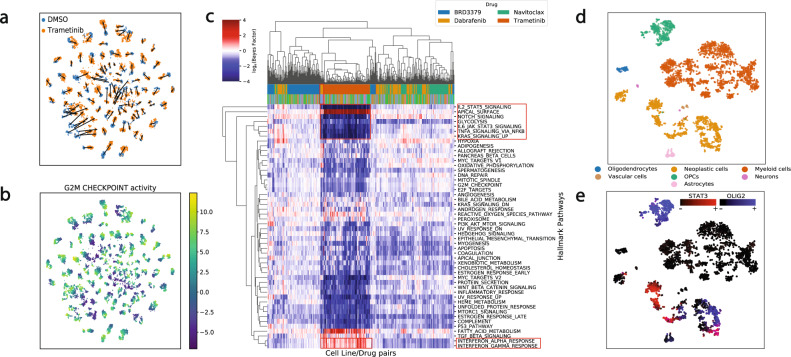
“For Trametinib notably, the important change in G2M checkpoint GMV activity (decrease in the treated condition) agrees with the expected MoA of a MEK inhibitor 23,24 (Fig.”
ResultAutoencoder-based cluster ensembles for single-cell RNA-seq data analysis
Geddes, T. A., Kim, T., Nan, L., Burchfield, J. G., Yang, J. Y. H., Tao, D., & Yang, P. (2019) · BMC Bioinformatics · doi:10.1186/s12859-019-3179-5 · Cited by 63
Growth arrest by activated BRAF and MEK inhibition in human anaplastic thyroid cancer cells
Kurata, K., Onoda, N., Noda, S., Kashiwagi, S., Asano, Y., Hirakawa, K., & Ohira, M. (2016) · International Journal of Oncology · doi:10.3892/ijo.2016.3723 · Cited by 36
Lulli, D., Carbone, M., & Pastore, S. (2017) · International Journal of Molecular Sciences · doi:10.3390/ijms18102227 · Cited by 34 · cited 1×
“Notably, the Trametinib-speci fi c interferon-α and inter- feron-γ response was correctly recapitulated in VEGA ’ s latent space, consistent with previous experimental work 25 and the fi ndings reported by the original MIX-Seq authors 21 .”
ResultFood intake and rate of weight gain in two healthy breast-fed infants
Wheeler, E. F. (1973) · American Journal of Clinical Nutrition · doi:10.1093/ajcn/26.6.631 · Cited by 32
Learning interpretable latent autoencoder representations with annotations of feature sets
Rybakov, S., Lotfollahi, M., Theis, F. J., & Wolf, F. A. (2020) · bioRxiv (Cold Spring Harbor Laboratory) · doi:10.1101/2020.12.02.401182 · Cited by 21 · cited 1×
“In parallel to our work on VEGA, Rybakov et al. 33 introduced a regularization procedure to incorporate prior knowledge from gene annotation databases via a penalty term on the weights of the linear decoder.”
MethodLucasESBS/vega: VEGA pre-release
LucaSC (2021) · Zenodo (CERN European Organization for Nuclear Research) · doi:10.5281/zenodo.5338891 · Cited by 1
LucasESBS/vega: VEGA pre-release
(2021) · Zenodo · doi:10.5281/zenodo.5338892
Research works printed but not linked: 1
- Baldi, P. Autoencoders, unsupervised learning, and deep architectures. Proc. Mach. Learn. Res.27, 37_49 (2012).
Cited by
Hu, T., Allam, M., Cai, S., Henderson, W. E., Yueh, B., Alici-Garipcan, A., Ievlev, A. V., Afkarian, M., Beyaz, S., & Coskun, A. F. (2023) · Nature Communications · doi:10.1038/s41467-023-43917-5 · Cited by 204
“On the other hand, single-cell analysis methods such as VEGA 25 , scDHA 26 , scMM 27 , SPADE 28 , DPT 29 , Squidpy 30 , Athena 31 , and SPEX 32 were developed for latent embedding generation, cell lineage reconstruction, and spatial analysis.”
Biologically informed deep learning to query gene programs in single-cell atlases
Lotfollahi, M., Rybakov, S., Hrovatin, K., Hediyeh-zadeh, S., Talavera-López, C., Misharin, A. V., & Theis, F. J. (2023) · Nature Cell Biology · doi:10.1038/s41556-022-01072-x · Cited by 100
Explainable artificial intelligence for omics data: a systematic mapping study
Toussaint, P. A., Leiser, F., Thiebes, S., Schlesner, M., Brors, B., & Sunyaev, A. (2023) · Briefings in Bioinformatics · doi:10.1093/bib/bbad453 · Cited by 130
“One especially promising approach is VEGA, a variational autoencoder architecture with enhanced transparency provided by including gene annotations [82].”
BackgroundBiologically informed deep learning to infer gene program activity in single cells
Lotfollahi, M., Rybakov, S., Hrovatin, K., Hediyeh-zadeh, S., Talavera-López, C., Misharin, A. V., & Theis, F. J. (2022) · doi:10.1101/2022.02.05.479217 · Cited by 100
Quantitative characterization of cell niches in spatially resolved omics data
Birk, S., Bonafonte-Pardàs, I., Feriz, A. M., Boxall, A. R., Agirre, E., Memi, F., Maguza, A., Yadav, A., Armingol, E., Fan, R., et al. (2025) · Nature Genetics · doi:10.1038/s41588-025-02120-6 · Cited by 143
Metadata
- Authors
- Seninge, L., Anastopoulos, I., Ding, H., & Stuart, J.
- Affiliations
- University of California, Santa Cruz (US)
- Corresponding author
- Ding, Hongxu
- Stuart, Joshua
- Venue
- Nature Communications
- Published
- 2021-09-28
- Volume
- 12
- Issue
- 1
- Pages
- 5684-5684
- ISSN
- 2041-1723 (ISSN-L)
- PMC
- PMC8478947
- OpenAlex
- W3204708585
- Cited by
- 107
- References
- 51
- Citations by year
- 2026: 16 · 2025: 29 · 2024: 27 · 2023: 28 · 2022: 5 · 2021: 2
- FWCI
- 5.02
- Type
- journal article
- Language
- en
- Open access
- gold
- doi.org
- Licence
- cc-by
- creativecommons.org/licenses/by/4.0 (tdm)
- creativecommons.org/licenses/by/4.0 (vor)
- Locations
- Nature Communications (publishedVersion, cc-by)
- PubMed Central (publishedVersion, cc-by)
- PubMed (publishedVersion)
- RePEc: Research Papers in Economics (submittedVersion)
- DOAJ (DOAJ: Directory of Open Access Journals) (submittedVersion, cc-by-sa)
- eScholarship (California Digital Library) (submittedVersion)
- eScholarship (California Digital Library) (submittedVersion, cc-by)
- Funders
- California Institute for Regenerative Medicine (GC1R-06673-C, GC1R-06673)
- Seagate Technology
- National Institutes of Health
- National Institute of Mental Health (R01MH120295)
- National Cancer Institute (U24CA210990)
- National Institute of General Medical Sciences (R01GM109031)
- Topics
- Life Sciences › Biochemistry, Genetics and Molecular Biology › Molecular Biology › Single-cell and spatial transcriptomics
- Life Sciences › Biochemistry, Genetics and Molecular Biology › Molecular Biology › Gene Regulatory Network Analysis
- Life Sciences › Biochemistry, Genetics and Molecular Biology › Molecular Biology › Bioinformatics and Genomic Networks
- Keywords
- Vega, interpretable generative models, single-cell transcriptomics, gene modules, latent space interpretability, gene regulatory networks, cell identity, cell states, drug response, master regulators
- MeSH terms
- Deep Learning, RNA-Seq, Animals, Humans, Models, Genetic, Mice, Gene Regulatory Networks, Single-Cell Analysis, Datasets as Topic
About these checks
Registry, retraction, Cites and statistics results are computed, not judged, with one exception: a printed reference that no index lists is read once by a model before it counts as a citation error. Claims are extracted by a model and kept only when their quote appears verbatim in the text; each cited source is then checked, with a model’s help, for whether it says what the claim relies on. Those verdicts can be wrong — read the claim’s quote and the cited source before relying on one.
Statistics and arithmetic are recomputed, not judged.
Confidence bands are shown only for fields calibrated on our annotated test set. None is calibrated yet, so no band is shown.
What counts as a claim ›How we measure confidence ›How we check this ›
Are you an author, or do you see a problem with this page? Request a review
Data sources
Bibliographic data: Semantic Scholar, OpenAlex, Crossref.
Contains information from the Semantic Scholar Academic Graph Datasets, made available under the ODC Attribution License (ODC-BY 1.0).
Semantic Scholar’s data is described in: Kinney, R., et al. (2023). The Semantic Scholar Open Data Platform. arXiv:2301.10140.
