

The DOI matches its Crossref record; 71 of the 71 references it cites were found in a registry or an index.
Natural statistics support a rational account of confidence biases
Open accessPublished version of a preprint
Abstract
Previous work has sought to understand decision confidence as a prediction of the probability that a decision will be correct, leading to debate over whether these predictions are optimal, and whether they rely on the same decision variable as decisions themselves. This work has generally relied on idealized, low-dimensional models, necessitating strong assumptions about the representations over which confidence is computed. To address this, we used deep neural networks to develop a model of decision confidence that operates directly over high-dimensional, naturalistic stimuli. The model accounts for a number of puzzling dissociations between decisions and confidence, reveals a rational explanation of these dissociations in terms of optimization for the statistics of sensory inputs, and makes the surprising prediction that, despite these dissociations, decisions and confidence depend on a common decision variable.
Overview
The claims and statistics of this paper haven’t been checked yet.
Run the check — free, no account needed. It reads the open-access text and checks the sources it cites.
Integrity signals
Registry
Cites
Statistics
Figures
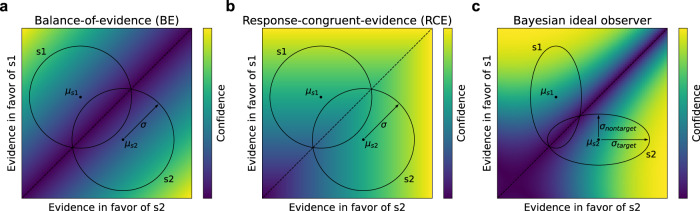
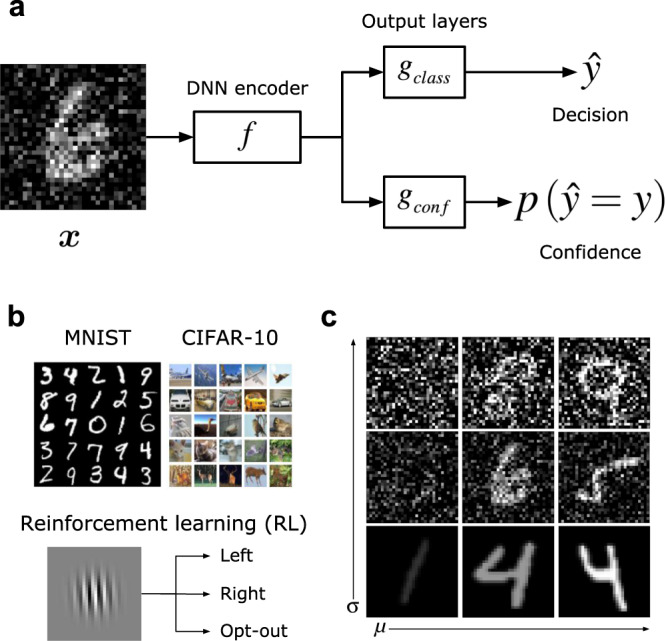
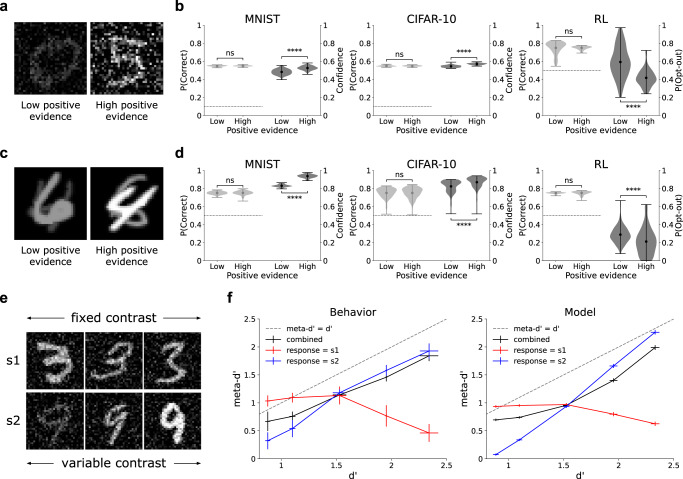
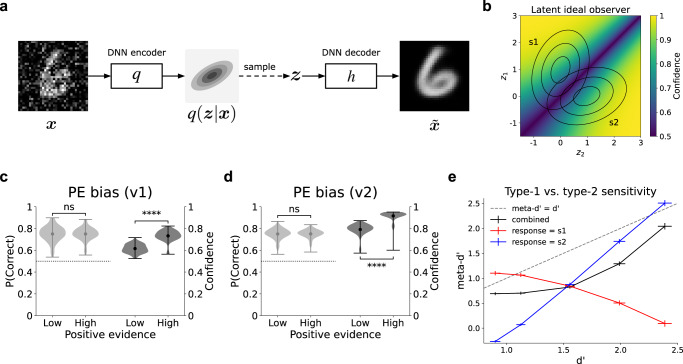
Verification
Claims the paper makes
The claims and statistics of this paper haven’t been checked yet.
Run the check — free, no account needed. It reads the open-access text and checks the sources it cites.
Claims other papers make about this one
Each is checked against this paper’s own text: does it say what the citing paper says it does?
The cited source says what the claim attributes to it.
In the citing paper
“First, a PEB emerges within a convolutional neural network that is trained to both discriminate digits and estimate confidence in these classifications-indicating that a PEB may be not a foible of human metacognition but rather a core feature of how high-dimensional evidence spaces are mapped to propositional confidence (Webb et al. 2023).”
From Metacognition and Confidence: A Review and Synthesis (2024) · cites this paper as Webb et al. 2023
The cited source says what the claim attributes to it.
In the citing paper
“indicating that a PEB may be not a foible of human metacognition but rather a core feature of how high-dimensional evidence spaces are mapped to propositional confidence (Webb et al. 2023).”
From Metacognition and Confidence: A Review and Synthesis (2024) · cites this paper as Webb et al. 2023
Self-check
Percentages, sums and reported differences re-computed from the paper’s own numbers.
The self-check needs the paper’s full text.
Citations
Cites
Deep Residual Learning for Image Recognition
He, K., Zhang, X., Ren, S., & Sun, J. (2016) · 2016 IEEE Conference on Computer Vision and Pattern Recognition (CVPR) · doi:10.1109/cvpr.2016.90 · Cited by 235,474
Hochreiter, S., & Schmidhuber, J. (1997) · Neural Computation · doi:10.1162/neco.1997.9.8.1735 · Cited by 102,318
Adam: A Method for Stochastic Optimization
Kingma, D. P., & Ba, J. (2014) · arXiv · doi:10.48550/arxiv.1412.6980 · Cited by 98,946
Scikit-learn: Machine Learning in Python
Pedregosa, F., Varoquaux, G., Gramfort, A., Michel, V., Thirion, B., Grisel, O., Blondel, M., Müller, A., Nothman, J., Louppe, G., et al. (2012) · arXiv · doi:10.48550/arxiv.1201.0490 · Cited by 71,016
Gradient-based learning applied to document recognition
Lecun, Y., Bottou, L., Bengio, Y., & Haffner, P. (1998) · Proceedings of the IEEE · doi:10.1109/5.726791 · Cited by 58,805
Matplotlib: a 2D graphics environment
Hunter, J. D. (2007) · Computing in Science & Engineering · doi:10.1109/mcse.2007.55 · Cited by 39,249
SciPy 1.0: fundamental algorithms for scientific computing in Python
Virtanen, P., Gommers, R., Oliphant, T. E., Haberland, M., Reddy, T., Cournapeau, D., Burovski, E., Peterson, P., Weckesser, W., Bright, J., et al. (2020) · Nature Methods · doi:10.1038/s41592-019-0686-2 · Cited by 38,430
PyTorch: An Imperative Style, High-Performance Deep Learning Library
Paszke, A., Gross, S., Massa, F., Lerer, A., Bradbury, J., Chanan, G., Killeen, T., Lin, Z., Gimelshein, N., Antiga, L., et al. (2019) · arXiv · doi:10.48550/arxiv.1912.01703 · Cited by 31,473
Learning Multiple Layers of Features from Tiny Images
Krizhevsky, A. (2024) · doi:10.57702/zp44cu3g · Cited by 23,889
Harris, C. R., Millman, K. J., van der Walt, S. J., Gommers, R., Virtanen, P., Cournapeau, D., Wieser, E., Taylor, J., Berg, S., Smith, N. J., et al. (2020) · Nature · doi:10.1038/s41586-020-2649-2 · Cited by 23,826
Auto-Encoding Variational Bayes
Kingma, D. P., & Welling, M. (2013) · arXiv · doi:10.48550/arxiv.1312.6114 · Cited by 20,067
Delving Deep into Rectifiers: Surpassing Human-Level Performance on ImageNet Classification
He, K., Zhang, X., Ren, S., & Sun, J. (2015) · 2015 IEEE International Conference on Computer Vision (ICCV) · doi:10.1109/iccv.2015.123 · Cited by 19,741
Harris, C., Millman, K., van der Walt, S., Gommers, R., Virtanen, P., Cournapeau, D., Wieser, E., Taylor, J., Berg, S., Smith, N., et al. (2020) · RePEc: Research Papers in Economics · Cited by 17,844
(2010) · Cited by 14,134
SciPy 1.0: fundamental algorithms for scientific computing in Python
Virtanen, P., Gommers, R., Oliphant, T. E., Haberland, M., Reddy, T., Cournapeau, D., Burovski, E., Peterson, P., Weckesser, W., Bright, J., et al. (2019) · Apollo - University of Cambridge Repository · doi:10.17863/cam.64134 · Cited by 10,460
International Conference on Learning Representations (ICLR 2013)
松尾, 豊. (2013) · 人工知能学会誌 = Journal of Japanese Society for Artificial Intelligence · Cited by 6,286
The Neural Basis of Decision Making
Gold, J. I., & Shadlen, M. N. (2007) · Annual Review of Neuroscience · doi:10.1146/annurev.neuro.29.051605.113038 · Cited by 3,764
Neuronlike adaptive elements that can solve difficult learning control problems
Barto, A. G., Sutton, R. S., & Anderson, C. W. (1983) · IEEE Transactions on Systems Man and Cybernetics · doi:10.1109/tsmc.1983.6313077 · Cited by 3,325
The time course of perceptual choice: The leaky, competing accumulator model.
Usher, M., & McClelland, J. L. (2001) · Psychological Review · doi:10.1037/0033-295x.108.3.550 · Cited by 2,152
Uniting the Tribes of Fluency to Form a Metacognitive Nation
Alter, A. L., & Oppenheimer, D. M. (2009) · Personality and Social Psychology Review · doi:10.1177/1088868309341564 · Cited by 1,821
Neural Basis of a Perceptual Decision in the Parietal Cortex (Area LIP) of the Rhesus Monkey
Shadlen, M. N., & Newsome, W. T. (2001) · Journal of Neurophysiology · doi:10.1152/jn.2001.86.4.1916 · Cited by 1,755
Representation of Confidence Associated with a Decision by Neurons in the Parietal Cortex
Kiani, R., & Shadlen, M. N. (2009) · Science · doi:10.1126/science.1169405 · Cited by 1,027
Simulation physiologischer Regelkreise mit der objektorientierten Modellbibliothek “HumanLib”
Brunberg, A., Spillner, J. W., Autschbach, R., & Abel, D. (2011) · at - Automatisierungstechnik · doi:10.1524/auto.2011.0951 · Cited by 1,015
Maniscalco, B., & Lau, H. (2012) · Consciousness and Cognition · doi:10.1016/j.concog.2011.09.021 · Cited by 883
Self-citationBlindsight: A Case Study and Implications
Weiskrantz, L. (1986) · Medical Entomology and Zoology · Cited by 819
Kelley, C. M., & Lindsay, D. S. (1993) · Journal of Memory and Language · doi:10.1006/jmla.1993.1001 · Cited by 557
Kell, A. J. E., Yamins, D. L. K., Shook, E. N., Norman-Haignere, S. V., & McDermott, J. H. (2018) · Neuron · doi:10.1016/j.neuron.2018.03.044 · Cited by 544
Confidence and certainty: Distinct probabilistic quantities for different goals
Pouget, A., Drugowitsch, J., & Kepecs, A. (2016) · Nature Neuroscience · doi:10.1038/nn.4240 · Cited by 528
Post-decision wagering objectively measures awareness
Persaud, N., McLeod, P., & Cowey, A. (2007) · Nature Neuroscience · doi:10.1038/nn1840 · Cited by 454
Rounis, E., Maniscalco, B., Rothwell, J. C., Passingham, R. E., & Lau, H. (2010) · Cognitive Neuroscience · doi:10.1080/17588921003632529 · Cited by 407
Self-citationVerghese, P. (2001) · Neuron · doi:10.1016/s0896-6273(01)00392-0 · Cited by 369
Domain-specific impairment in metacognitive accuracy following anterior prefrontal lesions
Fleming, S. M., Ryu, J., Golfinos, J. G., & Blackmon, K. (2014) · Brain · doi:10.1093/brain/awu221 · Cited by 331
Cuomo, A. S. E., Seaton, D. D., McCarthy, D. J., Martinez, I., Bonder, M. J., Garcia-Bernardo, J., Amatya, S., Madrigal, P., Isaacson, A., Buettner, F., et al. (2020) · Nature Communications · doi:10.1038/s41467-020-14457-z · Cited by 331
A computational framework for the study of confidence in humans and animals
Kepecs, A., & Mainen, Z. F. (2012) · Philosophical Transactions of the Royal Society B: Biological Sciences · doi:10.1098/rstb.2012.0037 · Cited by 305
The construction of confidence in a perceptual decision
Zylberberg, A., Barttfeld, P., & Sigman, M. (2012) · Frontiers in Integrative Neuroscience · doi:10.3389/fnint.2012.00079 · Cited by 297
Song, H. F., Yang, G. R., & Wang, X.-J. (2016) · PLOS Computational Biology · doi:10.1371/journal.pcbi.1004792 · Cited by 281
Perceptual confidence neglects decision-incongruent evidence in the brain
Peters, M. A. K., Thesen, T., Ko, Y., Maniscalco, B., Carlson, C., Davidson, M., Doyle, W., Kuzniecky, R., Devinsky, O., Halgren, E., et al. (2017) · Nature Human Behaviour · doi:10.1038/s41562-017-0139 · Cited by 265
Self-citationSignatures of a Statistical Computation in the Human Sense of Confidence
Sanders, J. I., Hangya, B., & Kepecs, A. (2016) · Neuron · doi:10.1016/j.neuron.2016.03.025 · Cited by 253
Responses of pulvinar neurons reflect a subject's confidence in visual categorization
Komura, Y., Nikkuni, A., Hirashima, N., Uetake, T., & Miyamoto, A. (2013) · Nature Neuroscience · doi:10.1038/nn.3393 · Cited by 226
Orbitofrontal Cortex Is Required for Optimal Waiting Based on Decision Confidence
Lak, A., Costa, G. M., Romberg, E., Koulakov, A. A., Mainen, Z. F., & Kepecs, A. (2014) · Neuron · doi:10.1016/j.neuron.2014.08.039 · Cited by 209
A principle for the formation of the spatial structure of cortical feature maps.
Obermayer, K., Ritter, H. J., & Schulten, K. (1990) · Proceedings of the National Academy of Sciences · doi:10.1073/pnas.87.21.8345 · Cited by 208
Effects of cortical microstimulation on confidence in a perceptual decision
Fetsch, C. R., Kiani, R., Newsome, W. T., & Shadlen, M. N. (2014) · Neuron · doi:10.1016/j.neuron.2014.07.011 · Cited by 185
Reward-based training of recurrent neural networks for cognitive and value-based tasks
Song, H., Yang, G. R., & Wang, X. (2017) · eLife · doi:10.7554/elife.21492 · Cited by 175
The Sense of Confidence during Probabilistic Learning: A Normative Account
Meyniel, F., Schlunegger, D., & Dehaene, S. (2015) · PLOS Computational Biology · doi:10.1371/journal.pcbi.1004305 · Cited by 163
Direct injection of noise to the visual cortex decreases accuracy but increases decision confidence
Rahnev, D. A., Maniscalco, B., Luber, B., Lau, H., & Lisanby, S. H. (2012) · Journal of Neurophysiology · doi:10.1152/jn.00985.2011 · Cited by 156
Self-citationZylberberg, A., Fetsch, C. R., & Shadlen, M. N. (2016) · eLife · doi:10.7554/elife.17688 · Cited by 152
Gherman, S., & Philiastides, M. G. (2014) · NeuroImage · doi:10.1016/j.neuroimage.2014.11.036 · Cited by 149
Persaud, N., Davidson, M., Maniscalco, B., Mobbs, D., Passingham, R. E., Cowey, A., & Lau, H. (2011) · NeuroImage · doi:10.1016/j.neuroimage.2011.06.081 · Cited by 139
Self-citationConfidence controls perceptual evidence accumulation
Balsdon, T., Wyart, V., & Mamassian, P. (2020) · Nature Communications · doi:10.1038/s41467-020-15561-w · Cited by 137
Doubly Bayesian Analysis of Confidence in Perceptual Decision-Making
Aitchison, L., Bang, D., Bahrami, B., & Latham, P. E. (2015) · PLOS Computational Biology · doi:10.1371/journal.pcbi.1004519 · Cited by 131
Maniscalco, B., Peters, M. A. K., & Lau, H. (2016) · Attention, Perception, & Psychophysics · doi:10.3758/s13414-016-1059-x · Cited by 129
Self-citationComparing Bayesian and non-Bayesian accounts of human confidence reports
Adler, W. T., & Ma, W. J. (2018) · PLoS Computational Biology · doi:10.1371/journal.pcbi.1006572 · Cited by 118
Gross, C. G. (1991) · Neuropsychologia · doi:10.1016/0028-3932(91)90007-u · Cited by 110
Behavior- and Modality-General Representation of Confidence in Orbitofrontal Cortex
Masset, P., Ott, T., Lak, A., Hirokawa, J., & Kepecs, A. (2020) · Cell · doi:10.1016/j.cell.2020.05.022 · Cited by 109
Retrieval Fluency as a Metacognitive Index
Benjamin, A. S., & Bjork, R. A. (2014) · Psychology Press eBooks · doi:10.4324/9781315806136-19 · Cited by 106
Causal neural network of metamemory for retrospection in primates
Miyamoto, K., Osada, T., Setsuie, R., Takeda, M., Tamura, K., Adachi, Y., & Miyashita, Y. (2017) · Science · doi:10.1126/science.aal0162 · Cited by 106
Ko, Y., & Lau, H. C. (2012) · Philosophical Transactions of the Royal Society B Biological Sciences · doi:10.1098/rstb.2011.0380 · Cited by 105
Self-citationKnow thyself: Metacognitive networks and measures of consciousness
Pasquali, A., Timmermans, B., & Cleeremans, A. (2010) · Cognition · doi:10.1016/j.cognition.2010.08.010 · Cited by 102
Does perceptual confidence facilitate cognitive control?
Koizumi, A., Maniscalco, B., & Lau, H. C. (2015) · Attention Perception & Psychophysics · doi:10.3758/s13414-015-0843-3 · Cited by 97
Self-citationPost-decisional accounts of biases in confidence
Navajas, J., Bahrami, B., & Latham, P. E. (2016) · Current Opinion in Behavioral Sciences · doi:10.1016/j.cobeha.2016.05.005 · Cited by 97
King, J.-R., & Dehaene, S. (2014) · Philosophical Transactions of the Royal Society B: Biological Sciences · doi:10.1098/rstb.2013.0204 · Cited by 82
Bhandari, A., Gagne, C., & Badre, D. (2018) · Journal of Cognitive Neuroscience · doi:10.1162/jocn_a_01291 · Cited by 79
Superior colliculus neuronal ensemble activity signals optimal rather than subjective confidence
Odegaard, B., Grimaldi, P., Cho, S. H., Peters, M. A. K., Lau, H. C., & Basso, M. A. (2018) · Proceedings of the National Academy of Sciences · doi:10.1073/pnas.1711628115 · Cited by 78
Self-citationKhalvati, K., Kiani, R., & Rao, R. P. N. (2021) · Nature Communications · doi:10.1038/s41467-021-25419-4 · Cited by 64
Maniscalco, B., Odegaard, B., Grimaldi, P., Cho, S. H., Basso, M. A., Lau, H., & Peters, M. A. K. (2021) · PLOS Computational Biology · doi:10.1371/journal.pcbi.1008779 · Cited by 44
Self-citationImputation of spatially-resolved transcriptomes by graph-regularized tensor completion
Li, Z., Song, T., Yong, J., & Kuang, R. (2021) · PLoS Computational Biology · doi:10.1371/journal.pcbi.1008218 · Cited by 37
Miyoshi, K., & Lau, H. (2020) · Psychological Review · doi:10.1037/rev0000184 · Cited by 33
Self-citationThe positive evidence bias in perceptual confidence is unlikely post-decisional
Samaha, J., & Denison, R. N. (2022) · Neuroscience of Consciousness · doi:10.1093/nc/niac010 · Cited by 32
Self-Organized Formation of Colour Maps in a Model Cortex
Saarinen, J. K. S., & Kohonen, T. (1985) · Perception · doi:10.1068/p140711 · Cited by 32
Rats use memory confidence to guide decisions
Joo, H. R., Liang, H., Chung, J. E., Geaghan-Breiner, C., Fan, J. L., Nachman, B. P., Kepecs, Á., & Frank, L. M. (2021) · Current Biology · doi:10.1016/j.cub.2021.08.013 · Cited by 27
The positive evidence bias in perceptual confidence is not post-decisionalPreprint
Samaha, J., & Denison, R. N. (2020) · bioRxiv (Cold Spring Harbor Laboratory) · doi:10.1101/2020.03.15.991513 · Cited by 9
Research works printed but not linked: 1
- Benjamin, A. S. & Bjork, R. A. In Implicit memory and metacognition, 321–350 (Psychology Press, 2014).
Cited by
Sorted by citations
Metacognition and Confidence: A Review and Synthesis
Fleming, S. M. (2024) · Annual Review of Psychology · doi:10.1146/annurev-psych-022423-032425 · Cited by 256
“…neural network that is trained to both discriminate digits and estimate confidence in these classifications – indicating that a PEB may not be a foible of human metacognition, but a core feature of how high-dimensional evidence spaces are mapped to propositional confidence (Webb et al., 2023).”
Metacognition and confidence: A review and synthesisPreprint
Fleming, S. M. (2023) · doi:10.31234/osf.io/ge7tz · Cited by 27
On the assumptions behind metacognitive measurements: Implications for theory and practice
Miyoshi, K., Sakamoto, Y., & Nishida, S. (2022) · Journal of Vision · doi:10.1167/jov.22.10.18 · Cited by 10
Self-citationReflexivity gradient—Consciousness knowing itself
Josipovic, Z. (2024) · Frontiers in Psychology · doi:10.3389/fpsyg.2024.1450553 · Cited by 12
Metacognition of perceptual resolution across and around the visual field
Kim, C., & Chong, S. C. (2024) · Cognition · doi:10.1016/j.cognition.2024.105938 · Cited by 9
Metadata
- Authors
- Webb, T. W., Miyoshi, K., So, T. Y., Rajananda, S., & Lau, H.
- Affiliations
- University of California, Los Angeles (US)
- Kyoto University (JP)
- University of Hong Kong (HK)
- Harvard University (US)
- RIKEN Center for Brain Science (JP)
- Corresponding author
- Webb, Taylor W.
- Lau, Hakwan
- Venue
- Nature Communications
- Published
- 2023-07-06
- Volume
- 14
- Issue
- 1
- Pages
- 3992-3992
- ISSN
- 2041-1723 (ISSN-L)
- PMC
- PMC10326055
- OpenAlex
- W4383371132
- Cited by
- 31
- References
- 70
- Citations by year
- 2026: 6 · 2025: 8 · 2024: 7 · 2023: 7
- FWCI
- 4.19
- Type
- journal article
- Language
- en
- Open access
- gold
- doi.org
- Locations
- Nature Communications (publishedVersion, cc-by)
- bioRxiv (Cold Spring Harbor Laboratory) (acceptedVersion, cc-by)
- PubMed Central (publishedVersion, cc-by)
- PubMed (publishedVersion)
- RePEc: Research Papers in Economics (submittedVersion)
- DOAJ (DOAJ: Directory of Open Access Journals) (submittedVersion, cc-by-sa)
- Funders
- U.S. Department of Health & Human Services | NIH | National Institute of Mental Health (F32MH117972)
- Topics
- Life Sciences › Neuroscience › Cognitive Neuroscience › Visual perception and processing mechanisms
- Social Sciences › Decision Sciences › General Decision Sciences › Decision-Making and Behavioral Economics
- Life Sciences › Neuroscience › Cognitive Neuroscience › Neural and Behavioral Psychology Studies
- Keywords
- decision confidence, rational decision-making, naturalistic stimuli, deep neural network, decision variables
- MeSH terms
- Cognition, Decision Making, Probability, Bias
About these checks
Registry, retraction, Cites and statistics results are computed, not judged, with one exception: a printed reference that no index lists is read once by a model before it counts as a citation error. Claims are extracted by a model and kept only when their quote appears verbatim in the text; each cited source is then checked, with a model’s help, for whether it says what the claim relies on. Those verdicts can be wrong — read the claim’s quote and the cited source before relying on one.
Statistics and arithmetic are recomputed, not judged.
Confidence bands are shown only for fields calibrated on our annotated test set. None is calibrated yet, so no band is shown.
What counts as a claim ›How we measure confidence ›How we check this ›
Are you an author, or do you see a problem with this page? Request a review
