

The DOI matches its Crossref record; 16 of the 16 references it cites were found in a registry or an index.
Patrilocality and hunter-gatherer-related ancestry of populations in East-Central Europe during the Middle Bronze Age
Abstract
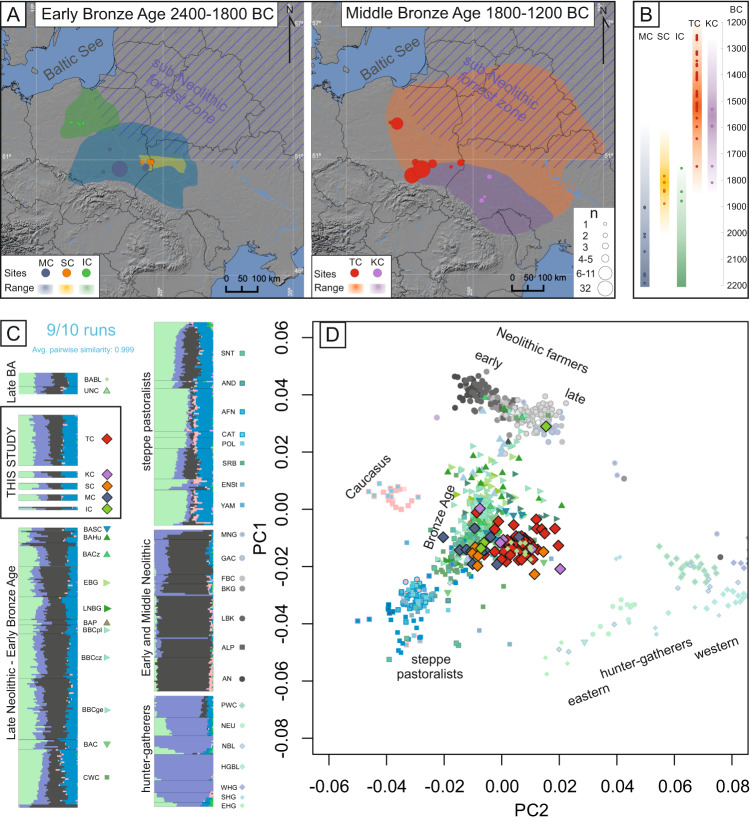
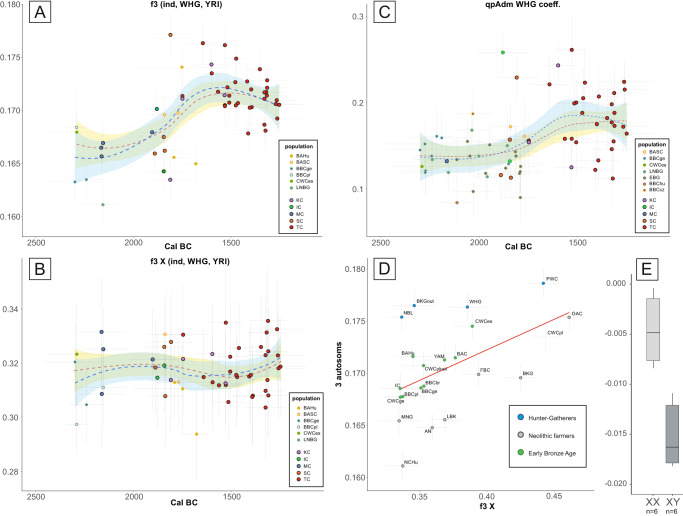
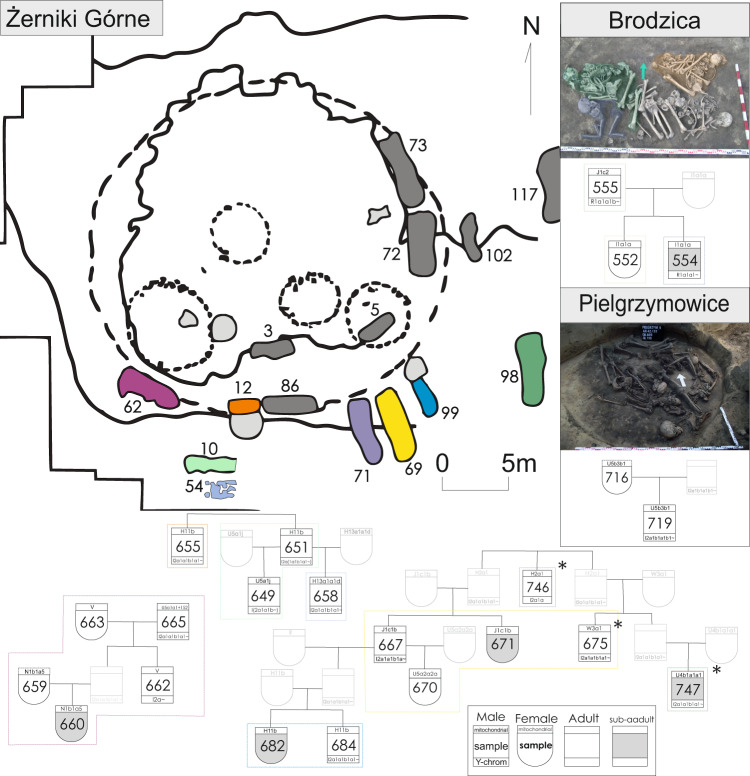
The demographic history of East-Central Europe after the Neolithic period remains poorly explored, despite this region being on the confluence of various ecological zones and cultural entities. Here, the descendants of societies associated with steppe pastoralists form Early Bronze Age were followed by Middle Bronze Age populations displaying unique characteristics. Particularly, the predominance of collective burials, the scale of which, was previously seen only in the Neolithic. The extent to which this re-emergence of older traditions is a result of genetic shift or social changes in the MBA is a subject of debate. Here by analysing 91 newly generated genomes from Bronze Age individuals from present Poland and Ukraine, we discovered that Middle Bronze Age populations were formed by an additional admixture event involving a population with relatively high proportions of genetic component associated with European hunter-gatherers and that their social structure was based on, primarily patrilocal, multigenerational kin-groups.
Overview
The claims and statistics of this paper haven’t been checked yet.
Run the check — free, no account needed. It reads the open-access text and checks the sources it cites.
Integrity signals
Registry
Cites
Statistics
Figures
Verification
Claims the paper makes
The claims and statistics of this paper haven’t been checked yet.
Run the check — free, no account needed. It reads the open-access text and checks the sources it cites.
Claims other papers make about this one
Each is checked against this paper’s own text: does it say what the citing paper says it does?
In the citing paper
“In addition, kinship analyses based on ancient DNA data from the Neolithic and Bronze Age (mostly Europe) showed low frequency of half-brothers and half-sisters67–71,73–77, with the exception of Hazleton North long cairn72.”
From Patrilineal segmentary systems provide a peaceful explanation for the post-Neolithic Y-chromosome bottleneck (2024) · cites this paper as [77]
Self-check
Percentages, sums and reported differences re-computed from the paper’s own numbers.
The self-check needs the paper’s full text.
Citations
Cites
ANGSD: Analysis of Next Generation Sequencing Data
Korneliussen, T. S., Albrechtsen, A., & Nielsen, R. (2014) · BMC Bioinformatics · doi:10.1186/s12859-014-0356-4 · Cited by 2,982
Ancient Admixture in Human History
Patterson, N., Moorjani, P., Luo, Y., Mallick, S., Rohland, N., Zhan, Y., Genschoreck, T., Webster, T., & Reich, D. (2012) · Genetics · doi:10.1534/genetics.112.145037 · Cited by 2,848
Massive migration from the steppe was a source for Indo-European languages in Europe
Haak, W., Lazaridis, I., Patterson, N., Rohland, N., Mallick, S., Llamas, B., Brandt, G., Nordenfelt, S., Harney, E., Stewardson, K., et al. (2015) · Nature · doi:10.1038/nature14317 · Cited by 1,940
Updated comprehensive phylogenetic tree of global human mitochondrial DNA variation
van Oven, M., & Kayser, M. (2009) · Human Mutation · doi:10.1002/humu.20921 · Cited by 1,810
mapDamage2.0: fast approximate Bayesian estimates of ancient DNA damage parameters
Jónsson, H., Ginolhac, A., Schubert, M., Johnson, P. L. F., & Orlando, L. (2013) · Bioinformatics · doi:10.1093/bioinformatics/btt193 · Cited by 1,669
The Simons Genome Diversity Project: 300 genomes from 142 diverse populations
Mallick, S., Li, H., Lipson, M., Mathieson, I., Gymrek, M., Racimo, F., Zhao, M., Chennagiri, N., Nordenfelt, S., Tandon, A., et al. (2016) · Nature · doi:10.1038/nature18964 · Cited by 1,584
Population genomics of Bronze Age Eurasia
Allentoft, M. E., Sikora, M., Sjögren, K.-G., Rasmussen, S., Rasmussen, M., Stenderup, J., Damgaard, P. B., Schroeder, H., Ahlström, T., Vinner, L., et al. (2015) · Nature · doi:10.1038/nature14507 · Cited by 1,550
Self-citationGenome-wide patterns of selection in 230 ancient Eurasians
Mathieson, I., Lazaridis, I., Rohland, N., Mallick, S., Patterson, N., Roodenberg, S. A., Harney, E., Stewardson, K., Fernandes, D., Novak, M., et al. (2015) · Nature · doi:10.1038/nature16152 · Cited by 1,515
Ancient human genomes suggest three ancestral populations for present-day Europeans
Lazaridis, I., Patterson, N., Mittnik, A., Renaud, G., Mallick, S., Kirsanow, K., Sudmant, P. H., Schraiber, J. G., Castellano, S., Lipson, M., et al. (2014) · Nature · doi:10.1038/nature13673 · Cited by 1,357
The genetic history of Ice Age Europe
Fu, Q., Posth, C., Hajdinjak, M., Petr, M., Mallick, S., Fernandes, D., Furtwängler, A., Haak, W., Meyer, M., Mittnik, A., et al. (2016) · Nature · doi:10.1038/nature17993 · Cited by 959
Research works printed but not linked: 52
- Skoglund, P. et al. Origins and Genetic Legacy of Neolithic Farmers and Hunter-Gatherers in Europe. Science 336, 466–469 (2012). · DOI · Paper page
- Malmström, H. et al. The genomic ancestry of the Scandinavian Battle Axe Culture people and their relation to the broader Corded Ware horizon. Proc. R. Soc. B Biol. Sci. 286, 20191528 (2019). · DOI
- Furholt, M. Mobility and Social Change: Understanding the European Neolithic Period after the Archaeogenetic Revolution. J. Archaeol. Res. 29, 481–535 (2021). · DOI · Paper page
- Olalde, I. et al. The Beaker phenomenon and the genomic transformation of northwest Europe. Nature 555, 190–196 (2018). · DOI · Paper page
- Mathieson, I. et al. The genomic history of southeastern Europe. Nature 555, 197–203 (2018). · DOI
- Kukawka, S. The State of Current Knowledge of the Eastern European Sub-Neolithic in Poland. Archaeol. Pol. 57, 63–77 (2019). · DOI
- Mittnik, A. et al. The genetic prehistory of the Baltic Sea region. Nat. Commun. 9, 442 (2018). · DOI
- Saag, L. et al. Extensive Farming in Estonia Started through a Sex-Biased Migration from the Steppe. Curr. Biol. 27, 2185–2193.e6 (2017). · DOI
- Coutinho, A. et al. The Neolithic Pitted Ware culture foragers were culturally but not genetically influenced by the Battle Axe culture herders. Am. J. Phys. Anthropol. 172, 638–649 (2020). · DOI
- Malmström, H. et al. Ancient DNA Reveals Lack of Continuity between Neolithic Hunter-Gatherers and Contemporary Scandinavians. Curr. Biol. 19, 1758–1762 (2009). · DOI · Paper page
- Czebreszuk, J. & Szmyt, M. Background to Beakers. Inquiries into regional cultural backgrounds of the Bell Beaker complex. in Bell Beakers and the cultural milieu of north European plain (eds. Fokkens, H. & Nicolis, F.) 157–175 (Sidestone Press, 2012).
- Makarowicz, P. The construction of social structure: Bell Beakers and Trzciniec complex in north-eastern part of Central Europe. Przegląd. Archeol. 51, 123–158 (2003).
- Czebreszuk, J. & Szmyt, M. Identities, Differentiation and Interactions on the Central European Plain in the 3rd millennium BC. in Sozialarchäologische Perspektiven: Gesselschaftlicher Wandel 5000-1500 v. Chr. zwischen Atlantik und Kaukasus. Internationale Tagung 15.−18 (eds. Hansen, S. & Müller, J.) vol. 24 247–269 (Philipp von Zabern, 2011).
- Juras, A. et al. Mitochondrial genomes from Bronze Age Poland reveal genetic continuity from the Late Neolithic and additional genetic affinities with the steppe populations. Am. J. Phys. Anthropol. 172, 176–188 (2020). · DOI
- Damm, C. Continuity and change An analysis of social and material patterns in the Danish Neolithic. (Cambridge University Press, 1991).
- Cassidy, L. M. et al. A dynastic elite in monumental Neolithic society. Nature 582, 384–388 (2020). · DOI · Paper page
- Fowler, C. et al. A high-resolution picture of kinship practices in an Early Neolithic tomb. Nature 601, 584–587 (2022). · DOI · Paper page
- Sánchez-Quinto, F. et al. Megalithic tombs in western and northern Neolithic Europe were linked to a kindred society. Proc. Natl Acad. Sci. 116, 9469 (2019). · DOI · Paper page
- Schroeder, H. et al. Unraveling ancestry, kinship, and violence in a Late Neolithic mass grave. Proc. Natl Acad. Sci. 116, 10705 (2019). · DOI · Paper page
- Furtwängler, A. et al. Ancient genomes reveal social and genetic structure of Late Neolithic Switzerland. Nat. Commun. 11, 1915 (2020). · DOI · Paper page
- Romaniszyn, J., Niculică, B. P. & Ignat, I. Funeral rites on the southern boundary of the Komarov culture. Spraw. Archeol. 69, 83–112 (2017). · DOI
- Harney, É., Patterson, N., Reich, D. & Wakeley, J. Assessing the performance of qpAdm: a statistical tool for studying population admixture. Genetics 217, iyaa045 (2021). · DOI
- Manasterski, D. Exchanges between Syncretic Groups from the Mazury Lake District in Northeast Poland and Early Bronze Age Communities in Central Europe. Archaeol. Balt. 13, 126–139 (2010).
- Vai, S. et al. How a paleogenomic approach can provide details on bioarchaeological reconstruction: a case study from the globular amphorae culture. Genes 12, 910 (2021). · DOI
- Makarowicz, P. et al. The absolute chronology of collective burials from the 2nd millennium BC in East Central Europe. Radiocarbon 63, 669–692 (2021). · DOI
- Haak, W. et al. Ancient DNA, Strontium isotopes, and osteological analyses shed light on social and kinship organization of the Later Stone Age. Proc. Natl Acad. Sci. 105, 18226–18231 (2008). · DOI
- Goldberg, A., Günther, T., Rosenberg, N. A. & Jakobsson, M. Ancient X chromosomes reveal contrasting sex bias in Neolithic and Bronze Age Eurasian migrations. Proc. Natl Acad. Sci. 114, 2657–2662 (2017). · DOI
- Mittnik, A. et al. Kinship-based social inequality in Bronze Age Europe. Science 366, 731 (2019). · DOI · Paper page
- Marlowe, F. W. Marital Residence among Foragers. Curr. Anthropol. 45, 277–284 (2004). · DOI · Paper page
- Alt, K. W. et al. A community in life and death: the Late Neolithic megalithic tomb at Alto de Reinoso (Burgos, Spain). PloS ONE 11, e0146176 (2016). · DOI
- Yang, D. Y., Eng, B., Waye, J. S., Dudar, J. C. & Saunders, S. R. Improved DNA extraction from ancient bones using silica-based spin columns. Am. J. Phys. Anthropol. 105, 539–543 (1998). · DOI
- Svensson, E. M. et al. Tracing genetic change over time using nuclear SNPs in ancient and modern cattle. Anim. Genet. 38, 378–383 (2007). · DOI
- Günther, T. et al. Population genomics of Mesolithic Scandinavia: Investigating early postglacial migration routes and high-latitude adaptation. PLOS Biol. 16, e2003703 (2018). · DOI
- Meyer, M. & Kircher, M. Illumina Sequencing Library Preparation for Highly Multiplexed Target Capture and Sequencing. Cold Spring Harb. Protoc. 2010, pdb.prot5448 (2010). · DOI
- Briggs, A. W. & Heyn, P. Preparation of Next-Generation Sequencing Libraries from Damaged DNA. in Ancient DNA: Methods and Protocols (eds. Shapiro, B. & Hofreiter, M.) 143–154 (Humana Press, 2012). https://doi.org/10.1007/978-1-61779-516-9_18. · DOI
- Juras, A. et al. Investigating kinship of Neolithic post-LBK human remains from Krusza Zamkowa, Poland using ancient DNA. Forensic Sci. Int. Genet. 26, 30–39 (2017). · DOI
- Schubert, M., Lindgreen, S. & Orlando, L. AdapterRemoval v2: rapid adapter trimming, identification, and read merging. BMC Res. Notes 9, 88 (2016). · DOI
- Kircher, M. Analysis of High-Throughput Ancient DNA Sequencing Data. in Ancient DNA: Methods and Protocols (eds. Shapiro, B. & Hofreiter, M.) 197–228 (Humana Press, 2012). https://doi.org/10.1007/978-1-61779-516-9_23. · DOI · Paper page
- Li, H. & Durbin, R. Fast and accurate short read alignment with Burrows–Wheeler transform. Bioinformatics 25, 1754–1760 (2009). · DOI · Paper page
- Skoglund, P. et al. Genomic diversity and admixture differs for Stone-Age Scandinavian foragers and farmers. Science 344, 747–750 (2014). · DOI
- Skoglund, P., Storå, J., Götherström, A. & Jakobsson, M. Accurate sex identification of ancient human remains using DNA shotgun sequencing. J. Archaeol. Sci. 40, 4477–4482 (2013). · DOI · Paper page
- Li, H. et al. The Sequence Alignment/Map format and SAMtools. Bioinforma. Oxf. Engl. 25, 2078–2079 (2009). · DOI · Paper page
- Briggs, A. W. et al. Patterns of damage in genomic DNA sequences from a Neandertal. Proc. Natl Acad. Sci. 104, 14616–14621 (2007). · DOI · Paper page
- Andrews, R. M. et al. Reanalysis and revision of the Cambridge reference sequence for human mitochondrial DNA. Nat. Genet. 23, 147–147 (1999). · DOI · Paper page
- Weissensteiner, H. et al. HaploGrep 2: mitochondrial haplogroup classification in the era of high-throughput sequencing. Nucleic Acids Res. 44, W58–W63 (2016). · DOI
- Amorim, C. E. G. et al. Understanding 6th-century barbarian social organization and migration through paleogenomics. Nat. Commun. 9, 3547 (2018). · DOI
- Danecek, P. et al. The variant call format and VCFtools. Bioinformatics 27, 2156–2158 (2011). · DOI
- Patterson, N., Price, A. L. & Reich, D. Population Structure and Eigenanalysis. PLOS Genet. 2, 1–20 (2006). · DOI · Paper page
- Alexander, D. H., Novembre, J. & Lange, K. Fast model-based estimation of ancestry in unrelated individuals. Genome Res. 19, 1655–1664 (2009). · DOI · Paper page
- Purcell, S. et al. PLINK: a tool set for whole-genome association and population-based linkage analyses. Am. J. Hum. Genet. 81, 559–575 (2007). · DOI · Paper page
- Behr, A. A., Liu, K. Z., Liu-Fang, G., Nakka, P. & Ramachandran, S. pong: fast analysis and visualization of latent clusters in population genetic data. Bioinformatics 32, 2817–2823 (2016). · DOI
- Yaka, R. et al. Variable kinship patterns in Neolithic Anatolia revealed by ancient genomes. Curr. Biol. 31, 2455–2468.e18 (2021). · DOI
Cited by
Guyon, L., Guez, J., Toupance, B., Heyer, E., & Chaix, R. (2024) · Nature Communications · doi:10.1038/s41467-024-47618-5 · Cited by 28
Metadata
- Authors
- Chyleński, M., Makarowicz, P., Juras, A., Krzewińska, M., Pospieszny, Ł., Ehler, E., Breszka, A., Górski, J., Taras, H., Szczepanek, A., Polańska, M., Włodarczak, P., Lasota-Kuś, A., Wójcik, I., Romaniszyn, J., Szmyt, M., Kośko, A., Ignaczak, M., Sadowski, S., Matoga, A., Grossman, A., Ilchyshyn, V., Yahodinska, M. O., Romańska, A., Tunia, K., Przybyła, M., Grygiel, R., Szostek, K., Dabert, M., Götherström, A., Jakobsson, M., & Malmström, H.
- Venue
- Nature Communications
- Published
- 2023-08-01
- Volume
- 14
- Issue
- 1
- ISSN
- 2041-1723
- PMC
- PMC10393988
- Cited by
- 34
- References
- 16
- Language
- en
About these checks
Registry, retraction, Cites and statistics results are computed, not judged, with one exception: a printed reference that no index lists is read once by a model before it counts as a citation error. Claims are extracted by a model and kept only when their quote appears verbatim in the text; each cited source is then checked, with a model’s help, for whether it says what the claim relies on. Those verdicts can be wrong — read the claim’s quote and the cited source before relying on one.
Statistics and arithmetic are recomputed, not judged.
Confidence bands are shown only for fields calibrated on our annotated test set. None is calibrated yet, so no band is shown.
What counts as a claim ›How we measure confidence ›How we check this ›
Are you an author, or do you see a problem with this page? Request a review
