

Revealing the role of interfacial water and key intermediates at ruthenium surfaces in the alkaline hydrogen evolution reaction
Open accessThe DOI matches its Crossref record; 63 of the 63 references it cites were found in a registry or an index.
Abstract
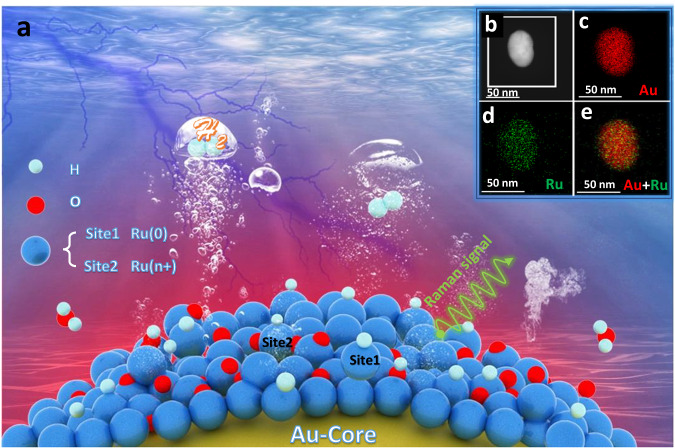
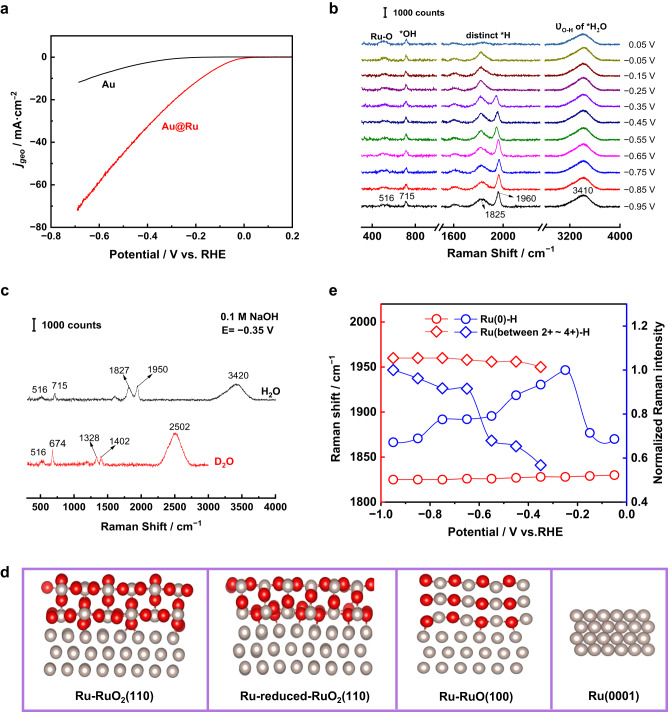
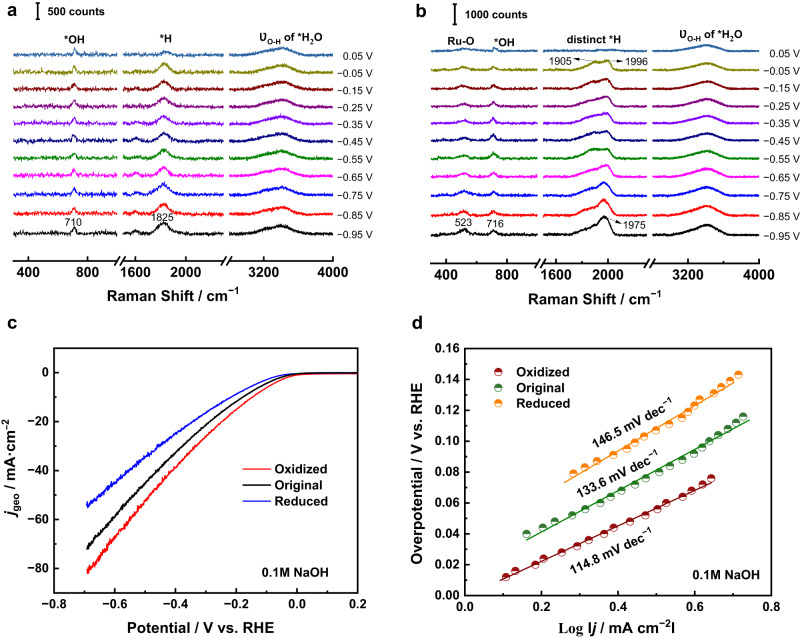
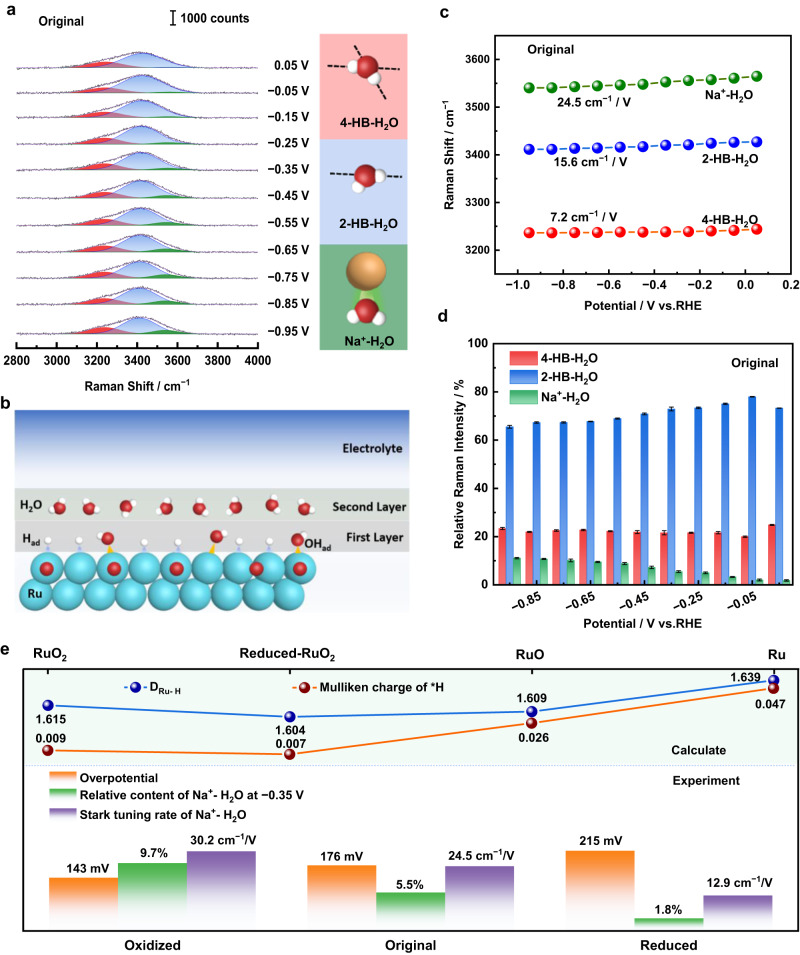
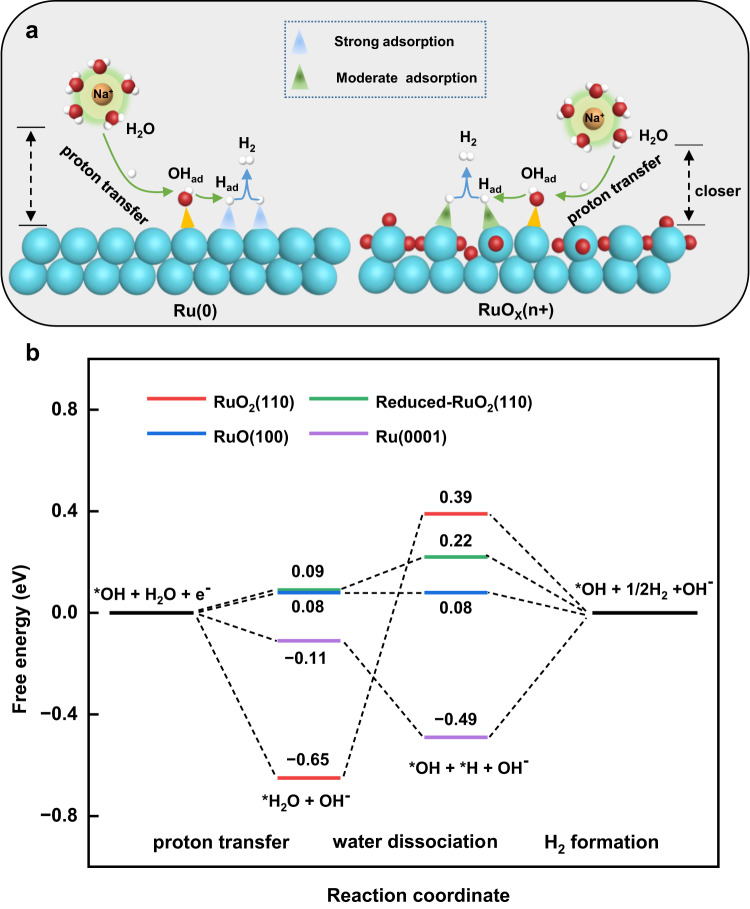
Ruthenium exhibits comparable or even better alkaline hydrogen evolution reaction activity than platinum, however, the mechanistic aspects are yet to be settled, which are elucidated by combining in situ Raman spectroscopy and theoretical calculations herein. We simultaneously capture dynamic spectral evidence of Ru surfaces, interfacial water, *H and *OH intermediates. Ru surfaces exist in different valence states in the reaction potential range, dissociating interfacial water differently and generating two distinct *H, resulting in different activities. The local cation tuning effect of hydrated Na + ion water and the large work function of high-valence Ru(n+) surfaces promote interfacial water dissociation. Moreover, compared to low-valence Ru(0) surfaces, high-valence Ru(n+) surfaces have more moderate adsorption energies for interfacial water, *H, and *OH. They, therefore, facilitate the activity. Our findings demonstrate the regulation of valence state on interfacial water, intermediates, and finally the catalytic activity, which provide guidelines for the rational design of high-efficiency catalysts.
Overview
The claims and statistics of this paper haven’t been checked yet.
Free: it reads the open-access text and checks the first 5 claims that cite a source we can check. Create a free account to check every claim.
Integrity signals
Registry
Cites
Statistics
Figures
Verification
Claims the paper makes
The claims and statistics of this paper haven’t been checked yet.
Free: it reads the open-access text and checks the first 5 claims that cite a source we can check. Create a free account to check every claim.
Claims other papers make about this one
Each is checked against this paper’s own text: does it say what the citing paper says it does?
The cited source says what the claim attributes to it.
In the citing paper
“Currently, the acid HER pathway typically involves the Volmer step, which generates adsorbed hydrogen intermediates (H*) by electrochemical reduction, generally followed by either the charge-transfer Heyrovsky process () or a Tafel recombination process () to produce H216,17.”
From Pd hydride metallene aerogels with lattice hydrogen participation for efficient hydrogen evolution reaction (2024) · cites this paper as [17]
In the citing paper
“Particularly, when the OCP was reduced to -10 mV versus reversible hydrogen electrode (RHE), a prominent bending vibration peak of CeO-H was observed at 1540 cm -1 , indicating the hydrogen insertion into CeO 2 .[50]”
From Revealing the Role of Ru‐O‐Ce Interface Coupling in CeO 2 ‐Ru Aerogel for Boosting Hydrogen Evolution Kinetics (2025) · cites this paper as [50]
Self-check
Percentages, sums and reported differences re-computed from the paper’s own numbers.
The self-check needs the paper’s full text.
Citations
Cites
Grimme, S., Antony, J., Ehrlich, S., & Krieg, H. (2010) · The Journal of Chemical Physics · doi:10.1063/1.3382344 · Cited by 59,686
Origin of the Overpotential for Oxygen Reduction at a Fuel-Cell Cathode
Nørskov, J. K., Rossmeisl, J., Logadottir, A., Lindqvist, L., Kitchin, J. R., Bligaard, T., & Jónsson, H. (2004) · The Journal of Physical Chemistry B · doi:10.1021/jp047349j · Cited by 13,153
Unified Approach for Molecular Dynamics and Density-Functional Theory
Car, R., & Parrinello, M. (1985) · Physical Review Letters · doi:10.1103/physrevlett.55.2471 · Cited by 10,754
Controlled Nucleation for the Regulation of the Particle Size in Monodisperse Gold Suspensions
FRENS, G. (1973) · Nature Physical Science · doi:10.1038/physci241020a0 · Cited by 8,336
Anomalous collapses of Nares Strait ice arches leads to enhanced export of Arctic sea ice
Moore, G. W. K., Howell, S. E. L., Brady, M., Xu, X., & McNeil, K. (2021) · Nature Communications · doi:10.1038/s41467-020-20314-w · Cited by 5,155
Recent Advances in Electrocatalytic Hydrogen Evolution Using Nanoparticles
Zhu, J., Hu, L., Zhao, P., Lee, L. Y. S., & Wong, K.-Y. (2020) · Chemical Reviews · doi:10.1021/acs.chemrev.9b00248 · Cited by 3,133
Subbaraman, R., Tripkovic, D., Chang, K.-C., Strmcnik, D., Paulikas, A. P., Hirunsit, P., Chan, M., Greeley, J., Stamenkovic, V., & Markovic, N. M. (2012) · Nature Materials · doi:10.1038/nmat3313 · Cited by 3,053
Self‐Supported Transition‐Metal‐Based Electrocatalysts for Hydrogen and Oxygen Evolution
Sun, H., Yan, Z., Liu, F., Xu, W., Cheng, F., & Chen, J. (2020) · Advanced Materials · doi:10.1002/adma.201806326 · Cited by 1,734
In situ Raman spectroscopy reveals the structure and dissociation of interfacial water
Wang, Y.-H., Zheng, S., Yang, W.-M., Zhou, R.-Y., He, Q.-F., Radjenovic, P., Dong, J.-C., Li, S., Zheng, J., Yang, Z.-L., et al. (2021) · Nature · doi:10.1038/s41586-021-04068-z · Cited by 1,703
Self-citationAn efficient and pH-universal ruthenium-based catalyst for the hydrogen evolution reaction
Mahmood, J., Li, F., Jung, S.-M., Okyay, M. S., Ahmad, I., Kim, S.-J., Park, N., Jeong, H. Y., & Baek, J.-B. (2017) · Nature Nanotechnology · doi:10.1038/nnano.2016.304 · Cited by 1,685
Zheng, Y., Jiao, Y., Vasileff, A., & Qiao, S. (2018) · Angewandte Chemie International Edition · doi:10.1002/anie.201710556 · Cited by 1,489
Improving the hydrogen oxidation reaction rate by promotion of hydroxyl adsorption
Strmcnik, D., Uchimura, M., Wang, C., Subbaraman, R., Danilovic, N., van der Vliet, D., Paulikas, A. P., Stamenkovic, V. R., & Markovic, N. M. (2013) · Nature Chemistry · doi:10.1038/nchem.1574 · Cited by 1,426
Ledezma-Yanez, I., Wallace, W. D. Z., Sebastián-Pascual, P., Climent, V., Feliu, J. M., & Koper, M. T. M. (2017) · Nature Energy · doi:10.1038/nenergy.2017.31 · Cited by 1,285
Sheng, W., Myint, M., Chen, J. G., & Yan, Y. (2013) · Energy & Environmental Science · doi:10.1039/c3ee00045a · Cited by 1,202
Sheng, W., Zhuang, Z., Gao, M., Zheng, J., Chen, J. G., & Yan, Y. (2015) · Nature Communications · doi:10.1038/ncomms6848 · Cited by 1,136 · cited 1×
“This water dissociation step may introduce an additional energybarrier,resultinginsluggishkinetics 12 – 16 .”
BackgroundHigh Electrocatalytic Hydrogen Evolution Activity of an Anomalous Ruthenium Catalyst
Zheng, Y., Jiao, Y., Zhu, Y., Li, L. H., Han, Y., Chen, Y., Jaroniec, M., & Qiao, S.-Z. (2016) · Journal of the American Chemical Society · doi:10.1021/jacs.6b11291 · Cited by 1,110
The hydrogen evolution reaction: from material to interfacial descriptors
Dubouis, N., & Grimaud, A. (2019) · Chemical Science · doi:10.1039/c9sc03831k · Cited by 962
Design principles for hydrogen evolution reaction catalyst materials
Strmcnik, D., Lopes, P. P., Genorio, B., Stamenkovic, V. R., & Markovic, N. M. (2016) · Nano Energy · doi:10.1016/j.nanoen.2016.04.017 · Cited by 917
Shi, Y., Ma, Z.-R., Xiao, Y.-Y., Yin, Y.-C., Huang, W.-M., Huang, Z.-C., Zheng, Y.-Z., Mu, F.-Y., Huang, R., Shi, G.-Y., et al. (2021) · Nature Communications · doi:10.1038/s41467-021-23306-6 · Cited by 894 · cited 1×
“Fortunately, some recent work report various strategies for stabilizing metals in high-valence states 55 – 57 .”
BackgroundZheng, J., Sheng, W., Zhuang, Z., Xu, B., & Yan, Y. (2016) · Science Advances · doi:10.1126/sciadv.1501602 · Cited by 863
Li, P., Jiang, Y., Hu, Y., Men, Y., Liu, Y., Cai, W., & Chen, S. (2022) · Nature Catalysis · doi:10.1038/s41929-022-00846-8 · Cited by 852
Is There Anything Better than Pt for HER?
Hansen, J. N., Prats, H., Toudahl, K. K., Mørch Secher, N., Chan, K., Kibsgaard, J., & Chorkendorff, I. (2021) · ACS Energy Letters · doi:10.1021/acsenergylett.1c00246 · Cited by 820 · cited 1×
“…HER pathway in both acidic and alkaline electrolytes involves Volmer-Heyrovsky or Volmer-Tafel steps, except that in the former the adsor-bed hydrogen (*H) is from hydronium ions (H 3 O + ) 6 – 12 while in the latter the *H are formed by an initial water dissociation step (H 2 O + e – → *H+OH – ).”
BackgroundThe role of adsorbed hydroxide in hydrogen evolution reaction kinetics on modified platinum
McCrum, I. T., & Koper, M. T. M. (2020) · Nature Energy · doi:10.1038/s41560-020-00710-8 · Cited by 818 · cited 1×
“Note that the existence of *OH species at Ru surfaces during alkaline HER has rarely been directly observed, although many works speculated that water dissociation is the critical step 29,41 – 44 .”
BackgroundSultan, S., Tiwari, J. N., Singh, A. N., Zhumagali, S., Ha, M., Myung, C. W., Thangavel, P., & Kim, K. S. (2019) · Advanced Energy Materials · doi:10.1002/aenm.201900624 · Cited by 815
Recent Advances and Prospective in Ruthenium-Based Materials for Electrochemical Water Splitting
Yu, J., He, Q., Yang, G., Zhou, W., Shao, Z., & Ni, M. (2019) · ACS Catalysis · doi:10.1021/acscatal.9b02457 · Cited by 789 · cited 1×
“The overpotentials of alkaline HER in 1.0M KOH and NaOH are similar (67mV), which is comparable to the reported results 33 kinetics in 1.0 M electrolytes.”
ResultInfluentialThe role of non-covalent interactions in electrocatalytic fuel-cell reactions on platinum
Strmcnik, D., Kodama, K., van der Vliet, D., Greeley, J., Stamenkovic, V. R., & Marković, N. M. (2009) · Nature Chemistry · doi:10.1038/nchem.330 · Cited by 771
Dendritic Nanostructured Waste Copper Wires for High-Energy Alkaline Battery
Chodankar, N. R., Ji, S.-H., Han, Y.-K., & Kim, D.-H. (2020) · Nano-Micro Letters · doi:10.1007/s40820-019-0337-2 · Cited by 769
Li, W., Liu, Y., Wu, M., Feng, X., Redfern, S. A. T., Shang, Y., Yong, X., Feng, T., Wu, K., Liu, Z., et al. (2018) · Advanced Materials · doi:10.1002/adma.201800676 · Cited by 642 · cited 2×
“…HER pathway in both acidic and alkaline electrolytes involves Volmer-Heyrovsky or Volmer-Tafel steps, except that in the former the adsor-bed hydrogen (*H) is from hydronium ions (H 3 O + ) 6 – 12 while in the latter the *H are formed by an initial water dissociation step (H 2 O + e – → *H+OH – ).”
BackgroundWater Splitting: From Electrode to Green Energy System
Li, X., Zhao, L., Yu, J., Liu, X., Zhang, X., Liu, H., & Zhou, W. (2020) · Nano-Micro Letters · doi:10.1007/s40820-020-00469-3 · Cited by 619
Kweon, D. H., Okyay, M. S., Kim, S.-J., Jeon, J.-P., Noh, H.-J., Park, N., Mahmood, J., & Baek, J.-B. (2020) · Nature Communications · doi:10.1038/s41467-020-15069-3 · Cited by 546 · cited 1×
“Traditional electrochemical techniques afford deep insights into the kinetics of catalytic reactions while molecular information about the species is lacking 24 – 26 .”
BackgroundElectrocatalysis in Alkaline Media and Alkaline Membrane-Based Energy Technologies
Yang, Y., Peltier, C. R., Zeng, R., Schimmenti, R., Li, Q., Huang, X., Yan, Z., Potsi, G., Selhorst, R., Lu, X., et al. (2022) · Chemical Reviews · doi:10.1021/acs.chemrev.1c00331 · Cited by 544
Hydrogen storage in Pd nanocrystals covered with a metal–organic framework
Li, G., Kobayashi, H., Taylor, J. M., Ikeda, R., Kubota, Y., Kato, K., Takata, M., Yamamoto, T., Toh, S., Matsumura, S., et al. (2014) · Nature Materials · doi:10.1038/nmat4030 · Cited by 482
Zhu, S., Qin, X., Xiao, F., Yang, S., Xu, Y., Tan, Z., Li, J., Yan, J., Chen, Q., Chen, M., et al. (2021) · Nature Catalysis · doi:10.1038/s41929-021-00663-5 · Cited by 436 · cited 3×
“( as calculated, see mass formula section of Supplementary Information) and previous reports in the literature 27,34,35 .”
BackgroundResultSelf-citationLiu, E., Li, J., Jiao, L., Doan, H. T. T., Liu, Z., Zhao, Z., Huang, Y., Abraham, K. M., Mukerjee, S., & Jia, Q. (2019) · Journal of the American Chemical Society · doi:10.1021/jacs.8b13228 · Cited by 382
Self-citationGoyal, A., & Koper, M. T. M. (2021) · Angewandte Chemie International Edition · doi:10.1002/anie.202102803 · Cited by 373
Shah, A. H., Zhang, Z., Huang, Z., Wang, S., Zhong, G., Wan, C., Alexandrova, A. N., Huang, Y., & Duan, X. (2022) · Nature Catalysis · doi:10.1038/s41929-022-00851-x · Cited by 373
Zhu, S., Qin, X., Yao, Y., & Shao, M. (2020) · Journal of the American Chemical Society · doi:10.1021/jacs.0c01104 · Cited by 368
Cation- and pH-Dependent Hydrogen Evolution and Oxidation Reaction Kinetics
Huang, B., Rao, R. R., You, S., Hpone Myint, K., Song, Y., Wang, Y., Ding, W., Giordano, L., Zhang, Y., Wang, T., et al. (2021) · JACS Au · doi:10.1021/jacsau.1c00281 · Cited by 366
Self-citationRecent advances in ruthenium-based electrocatalysts for the hydrogen evolution reaction
Bae, S.-Y., Mahmood, J., Jeon, I.-Y., & Baek, J.-B. (2020) · Nanoscale Horizons · doi:10.1039/c9nh00485h · Cited by 334
Engineering Ruthenium-Based Electrocatalysts for Effective Hydrogen Evolution Reaction
Yang, Y., Yu, Y., Li, J., Chen, Q., Du, Y., Rao, P., Li, R., Jia, C., Kang, Z., Deng, P., et al. (2021) · Nano-Micro Letters · doi:10.1007/s40820-021-00679-3 · Cited by 313
Self-citationMulti-heteroatom-doped carbon from waste-yeast biomass for sustained water splitting
Tiwari, J. N., Dang, N. K., Sultan, S., Thangavel, P., Jeong, H. Y., & Kim, K. S. (2020) · Nature Sustainability · doi:10.1038/s41893-020-0509-6 · Cited by 276
Huang, Y.-F., Kooyman, P. J., & Koper, M. T. M. (2016) · Nature Communications · doi:10.1038/ncomms12440 · Cited by 262
Mao, B., Sun, P., Jiang, Y., Meng, T., Guo, D., Qin, J., & Cao, M. (2020) · Angewandte Chemie International Edition · doi:10.1002/anie.202006722 · Cited by 214
Core–Shell Nanostructure-Enhanced Raman Spectroscopy for Surface Catalysis
Zhang, H., Duan, S., Radjenovic, P. M., Tian, Z.-Q., & Li, J.-F. (2020) · Accounts of Chemical Research · doi:10.1021/acs.accounts.9b00545 · Cited by 206
Self-citationWinsche, W. E., Hoffman, K. C., & Salzano, F. J. (1973) · Science · doi:10.1126/science.180.4093.1325 · Cited by 169
Liu, E., Jiao, L., Li, J., Stracensky, T., Sun, Q., Mukerjee, S., & Jia, Q. (2020) · Energy & Environmental Science · doi:10.1039/d0ee01754j · Cited by 158
Self-citationDang, Y., Wu, T., Tan, H., Wang, J., Cui, C., Kerns, P., Zhao, W., Posada, L., Wen, L., & Suib, S. L. (2021) · Energy & Environmental Science · doi:10.1039/d1ee02380b · Cited by 158
A framework for a hydrogen economy
Majumdar, A., Deutch, J. M., Prasher, R. S., & Griffin, T. P. (2021) · Joule · doi:10.1016/j.joule.2021.07.007 · Cited by 156
Modeling Electrified Pt(111)-H ad /Water Interfaces from Ab Initio Molecular Dynamics
Le, J., Chen, A., Li, L., Xiong, J.-F., Lan, J., Liu, Y., Iannuzzi, M., & Cheng, J. (2021) · JACS Au · doi:10.1021/jacsau.1c00108 · Cited by 151
Self-citationInvestigating the presence of adsorbed species on Pt steps at low potentials
Rizo, R., Fernández-Vidal, J., Hardwick, L. J., Attard, G. A., Vidal-Iglesias, F. J., Climent, V., Herrero, E., & Feliu, J. M. (2022) · Nature Communications · doi:10.1038/s41467-022-30241-7 · Cited by 140
Zhao, K., Chang, X., Su, H., Nie, Y., Lu, Q., & Xu, B. (2022) · Angewandte Chemie International Edition · doi:10.1002/anie.202207197 · Cited by 138
On the pH dependence of electrochemical proton transfer barriers
Rossmeisl, J., Chan, K., Skúlason, E., Björketun, M. E., & Tripković, V. (2015) · Catalysis Today · doi:10.1016/j.cattod.2015.08.016 · Cited by 135
SERS and DFT study of water on metal cathodes of silver, gold and platinum nanoparticles
Li, J.-F., Huang, Y.-F., Duan, S., Pang, R., Wu, D.-Y., Ren, B., Xu, X., & Tian, Z.-Q. (2010) · Physical Chemistry Chemical Physics · doi:10.1039/b919266b · Cited by 106
Self-citationLigand-Capped Ru Nanoparticles as Efficient Electrocatalyst for the Hydrogen Evolution Reaction
Creus, J., Drouet, S., Suriñach, S., Lecante, P., Collière, V., Poteau, R., Philippot, K., García-Antón, J., & Sala, X. (2018) · ACS Catalysis · doi:10.1021/acscatal.8b03053 · Cited by 105
Lin, X.-M., Wang, X.-T., Deng, Y.-L., Chen, X., Chen, H.-N., Radjenovic, P. M., Zhang, X.-G., Wang, Y.-H., Dong, J.-C., Tian, Z.-Q., et al. (2022) · Nano Letters · doi:10.1021/acs.nanolett.2c01744 · Cited by 91
Self-citationLe, J., Fan, Q., Pérez-Martínez, L., Cuesta, Á., & Cheng, J. (2018) · Physical Chemistry Chemical Physics · doi:10.1039/c8cp00615f · Cited by 89
Self-citationAnantharaj, S. (2021) · Journal of Materials Chemistry A · doi:10.1039/d0ta12424a · Cited by 78
Prospects for hydrogen as an energy resource
Dawson, J. K. (1974) · Nature · doi:10.1038/249724a0 · Cited by 69
Jiang, Y., Li, J., Wu, D., Yang, Z., Ren, B. W., Hu, J., Chow, Y. L., & Tian, Z. (2007) · Chemical Communications · doi:10.1039/b711218a · Cited by 66
Self-citationCho, Y.-B., Yu, A., Lee, C., Kim, M. H., & Lee, Y. (2018) · ACS Applied Materials & Interfaces · doi:10.1021/acsami.7b14399 · Cited by 60
Is Pt/C More Electrocatalytic than Ru/C for Hydrogen Evolution in Alkaline Electrolytes?
Shao, R., Chen, L.-W., Yan, Q., Zeng, W.-J., Yin, P., & Liang, H. (2021) · ACS Applied Energy Materials · doi:10.1021/acsaem.1c00308 · Cited by 39
Bond energies, force constants and electronegativities
Pearson, R. G. (1993) · Journal of Molecular Structure · doi:10.1016/0022-2860(93)87044-a · Cited by 30
Can hydrogen anion be a possible intermediate of the hydrogen electrode reaction?
Huang, J., & Attard, G. A. (2021) · Journal of Electroanalytical Chemistry · doi:10.1016/j.jelechem.2021.115150 · Cited by 3
Cited by
Deng, L., Chen, H., Hung, S.-F., Zhang, Y., Yu, H., Chen, H.-Y., Li, L., & Peng, S. (2024) · Journal of the American Chemical Society · doi:10.1021/jacs.4c14529 · Cited by 281
Self-citationZe, H., Yang, Z.-L., Li, M.-L., Zhang, X.-G., A, Y.-L., Zheng, Q.-N., Wang, Y.-H., Tian, J.-H., Zhang, Y.-J., & Li, J.-F. (2024) · Journal of the American Chemical Society · doi:10.1021/jacs.4c00948 · Cited by 248
Self-citationAtomic Co─P Catalytic Pair Drives Efficient Electrochemical Nitrate Reduction to Ammonia
Ni, J., Yan, J., Li, F., Qi, H., Xu, Q., Su, C., Sun, L., Sun, H., Ding, J., & Liu, B. (2024) · Advanced Energy Materials · doi:10.1002/aenm.202400065 · Cited by 234
How to Assess and Predict Electrical Double Layer Properties. Implications for Electrocatalysis
Schott, C. M., Schneider, P. M., Song, K.-T., Yu, H., Götz, R., Haimerl, F., Gubanova, E., Zhou, J., Schmidt, T. O., Zhang, Q., et al. (2024) · Chemical Reviews · doi:10.1021/acs.chemrev.3c00806 · Cited by 226
Li, S., Shi, L., Guo, Y., Wang, J., Liu, D., & Zhao, S. (2024) · Chemical Science · doi:10.1039/d4sc02853h · Cited by 225
“145 Additionally, in situ infrared technology and in situ Raman technology provide rich chemical information.”
BackgroundSelf-citation
Metadata
- Authors
- Chen, X., Wang, X.-T., Le, J.-B., Li, S.-M., Wang, X., Zhang, Y.-J., Radjenovic, P., Zhao, Y., Wang, Y.-H., Lin, X.-M., Dong, J.-C., & Li, J.-F.
- Affiliations
- Xiamen University (CN)
- Corresponding author
- Lin, Xiu-Mei
- Dong, Jin-Chao
- Li, Jian-Feng
- Venue
- Nature Communications
- Published
- 2023-08-30
- Volume
- 14
- Issue
- 1
- Pages
- 5289-5289
- ISSN
- 2041-1723 (ISSN-L)
- PMC
- PMC10468501
- OpenAlex
- W4386304401
- Cited by
- 600
- References
- 63
- Citations by year
- 2026: 177 · 2025: 274 · 2024: 144 · 2023: 5
- FWCI
- 28.55
- Type
- journal article
- Language
- en
- Open access
- gold
- doi.org
- Licence
- cc-by
- creativecommons.org/licenses/by/4.0 (tdm)
- creativecommons.org/licenses/by/4.0 (vor)
- Locations
- Nature Communications (publishedVersion, cc-by)
- PubMed Central (publishedVersion, cc-by)
- PubMed (publishedVersion)
- RePEc: Research Papers in Economics (submittedVersion)
- DOAJ (DOAJ: Directory of Open Access Journals) (submittedVersion, cc-by-sa)
- Funders
- National Key Research and Development Program of China (2020YFB1505800, 22021001)
- Fundamental Research Funds for the Central Universities (20720210043)
- Topics
- Physical Sciences › Energy › Renewable Energy, Sustainability and the Environment › Electrocatalysts for Energy Conversion
- Physical Sciences › Materials Science › Materials Chemistry › Catalytic Processes in Materials Science
- Physical Sciences › Materials Science › Materials Chemistry › Hydrogen Storage and Materials
- Keywords
- ruthenium electrocatalysts, alkaline hydrogen evolution reaction, interfacial water, water dissociation, hydroxyl intermediate, sodium ion hydration, work function, adsorption energy, reaction mechanism, catalyst design
About these checks
Registry, retraction, Cites and statistics results are computed, not judged, with one exception: a printed reference that no index lists is read once by a model before it counts as a citation error. Claims are extracted by a model and kept only when their quote appears verbatim in the text; each cited source is then checked, with a model’s help, for whether it says what the claim relies on. Those verdicts can be wrong — read the claim’s quote and the cited source before relying on one.
Statistics and arithmetic are recomputed, not judged.
Confidence bands are shown only for fields calibrated on our annotated test set. None is calibrated yet, so no band is shown.
What counts as a claim ›How we measure confidence ›How we check this ›
Are you an author, or do you see a problem with this page? Request a review
Data sources
Bibliographic data: Semantic Scholar, OpenAlex, Crossref.
Contains information from the Semantic Scholar Academic Graph Datasets, made available under the ODC Attribution License (ODC-BY 1.0).
Semantic Scholar’s data is described in: Kinney, R., et al. (2023). The Semantic Scholar Open Data Platform. arXiv:2301.10140.
