

Learning few-shot imitation as cultural transmission
Open accessThe DOI matches its Crossref record; 75 of the 83 references it cites were found in a registry or an index; 21 of the 30 sources its claims cite were checked for support.
Abstract
Cultural transmission is the domain-general social skill that allows agents to acquire and use information from each other in real-time with high fidelity and recall. It can be thought of as the process that perpetuates fit variants in cultural evolution. In humans, cultural evolution has led to the accumulation and refinement of skills, tools and knowledge across generations. We provide a method for generating cultural transmission in artificially intelligent agents, in the form of few-shot imitation. Our agents succeed at real-time imitation of a human in novel contexts without using any pre-collected human data. We identify a surprisingly simple set of ingredients sufficient for generating cultural transmission and develop an evaluation methodology for rigorously assessing it. This paves the way for cultural evolution to play an algorithmic role in the development of artificial general intelligence.
Overview
CoChat Summary
TL;DR
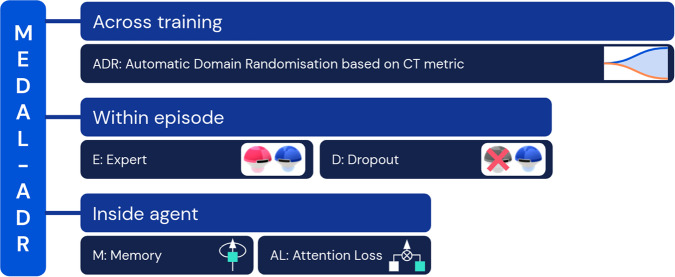
The paper introduces GoalCycle3D and MEDAL-ADR, a deep RL recipe that lets agents learn few-shot imitation as cultural transmission from expert co-players in novel 3D tasks without pre-collected human data. Ablations show memory, expert presence, expert dropout, attention loss, and automatic domain randomisation are jointly necessary for robust cultural transmission, recall, and generalisation.
Key findings
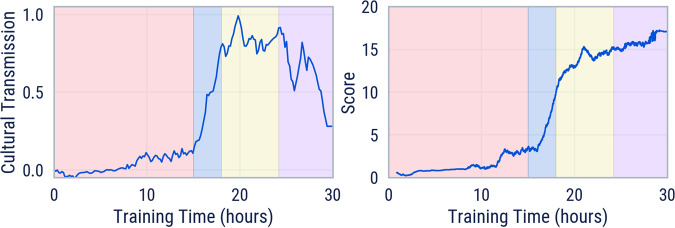
- MEDAL-ADR agents show cultural transmission: training CT rises to ~0.75 (pure following), approaches 1 (remembering and reproducing after the expert leaves), then falls toward 0 as the agent becomes independent and exceeds the expert’s score; a vanilla RL baseline (M) fails to score on the task.
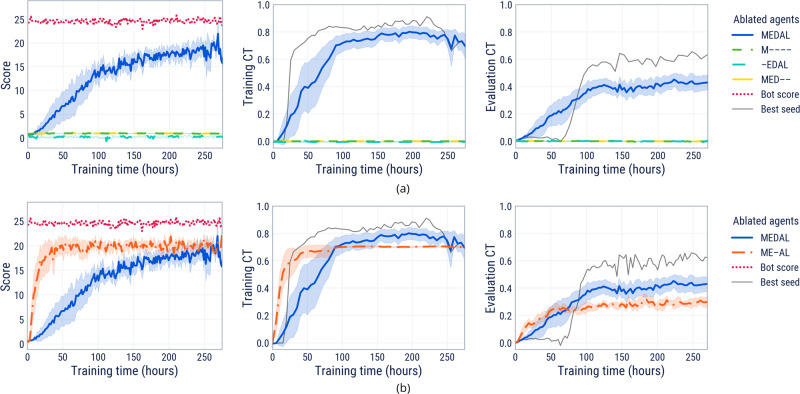
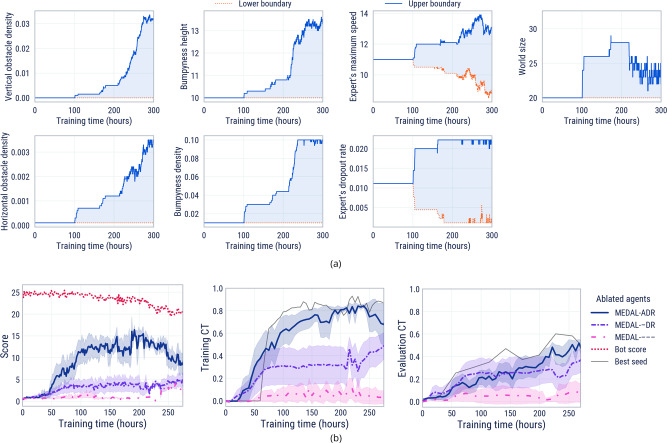
- Ablations show removing memory, expert demonstrations, attention loss, or expert dropout eliminates or degrades cultural transmission; ADR is crucial in complex worlds, with MEDAL-ADR achieving significantly higher scores and CT than MEDAL-DR and MEDAL.
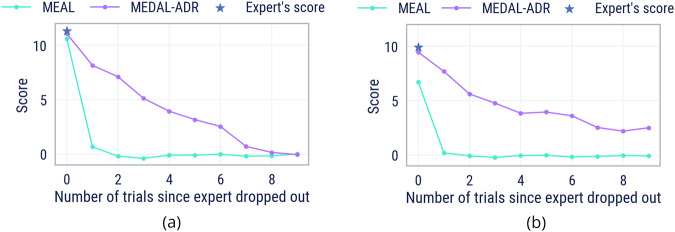
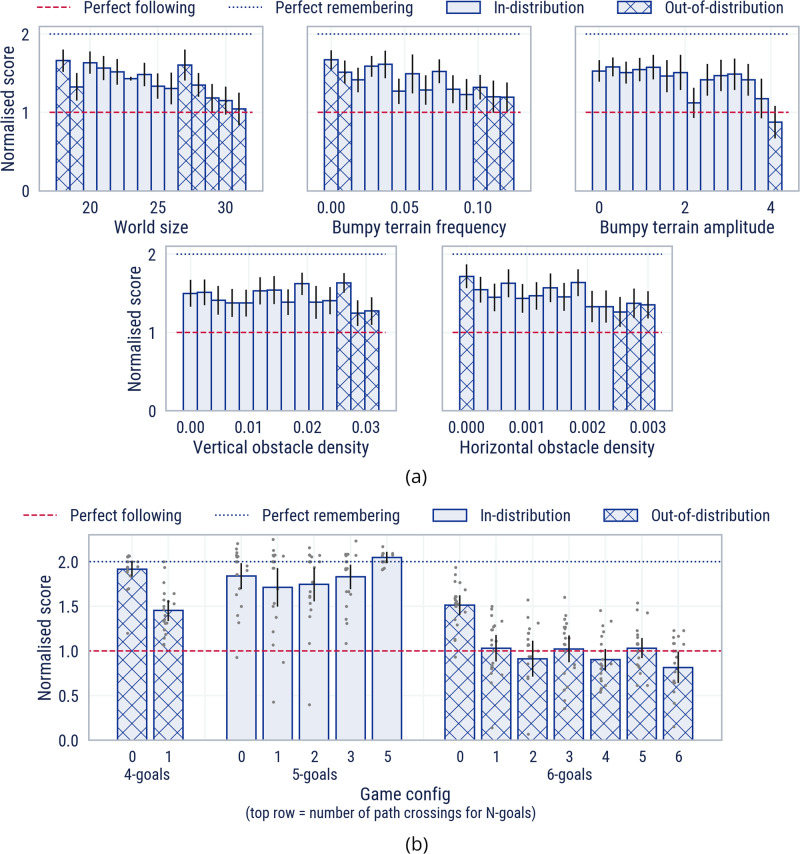
- Recall and generalisation: after expert dropout, MEDAL-ADR continues solving the task for the first trial while ME-AL cannot, and maintains performance for several trials despite only 1800-step training episodes; in a two-action task over 1000 trials, the agent’s preference matched the demonstrated option 100% of the time; it generalises across world and game spaces, including out-of-distribution tasks.
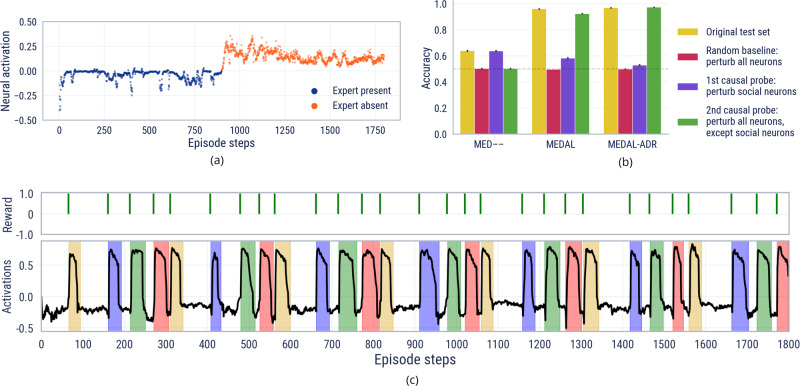
- Interpretability: a “social neuron” encodes the presence or absence of the expert, and a “goal neuron” fires when the agent enters and remains within a goal sphere; the attention loss is at least partly responsible for socially-aware representations.
Methods
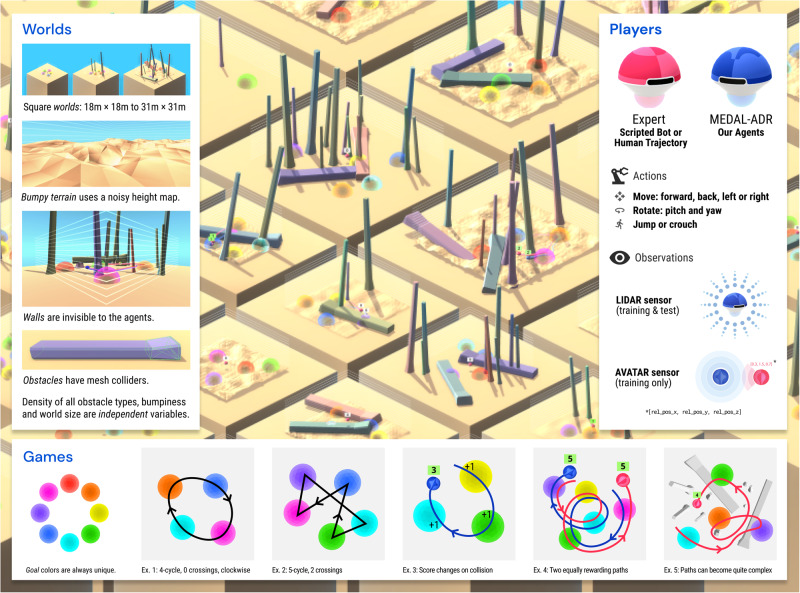
- Deep RL with maximum a posteriori policy optimisation (MPO) in a distributed framework; the agent uses a single-layer LSTM of size 512 unrolled for 800 steps, LIDAR observations, and an auxiliary attention loss that predicts the egocentric relative position of other players via a privileged AVATAR sensor used only at training time.
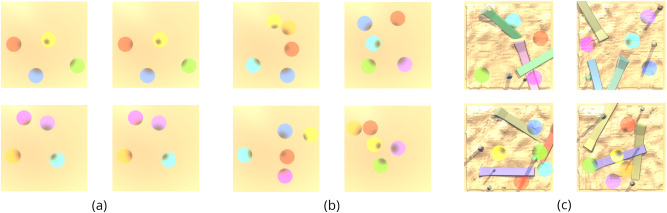
- GoalCycle3D is a Unity-based 3D physical task space with procedurally generated worlds and games; agents must visit goal spheres in a correct cyclic order, with +1 reward for correct goals, −1 for incorrect goals, and 0 for re-entering the last goal; evaluation uses held-out probe tasks, including a human proxy expert.
- Expert dropout schemes include no dropout, full dropout, half dropout, and probabilistic dropout; ADR expands task parameter ranges when training CT exceeds 0.75 and contracts them below a lower threshold; the cultural transmission metric averages improvement with the expert present and after the expert departs, normalised by expert score; two-action task used 1000 trials, and linear probing identified the social neuron.
Limitations
- Stated: cultural transmission was tested with only a single human player from the study team, so the authors cannot make statistically significant claims about robustness across a human population; task diversity is constrained by the navigation task; and the evaluation cannot distinguish whether agents memorise a geographical path or an abstraction over the correct sphere ordering.
- Stated: the method assumes expert visibility, dropout, and procedural generation, with silent assumptions including easy initial reward, no fine-motor control, short episode timescale, no irreversibilities, visible goals, and a constant rewarding order within an episode; the agent also shows objective misgeneralisation by following an incorrect demonstration and reproducing it after the expert drops out.
- Evident from the text: code was not released because it was developed in a proprietary context, and the human evaluation relies on a single human proxy rather than a range of human participants.
Model-written summary. Check it against the paper before relying on it.
Integrity signals
Registry
Cites
Statistics
Figures
Verification
Claims the paper makes
13 Valid · 8 Not valid · 5 Not checked · 98 Own results and interpretations
The sources with a verdict support this claim; the rest weren’t checked yet, have no full text we could read, or their verdicts aren’t rated yet.
In the paper
“The central novelty in this work is the application of agentenvironment co-adaptation 26,27 to generate an agent capable of robust real-time cultural transmission.”
§ Learning few-shot imitation as cultural transmission > Abstract
What the sources say
- Not checked — no full text of the sourcecites [26] 26. Wang, R., Lehman, J., Clune, J. & Stanley, K. O. Poet: open-ended coevolution of environments and their optimized solutions. In: Proceedings of the Genetic and Evolutionary Computation Con- ference, 142-151 (2019). source
- Supportedcites [27] 27. Stooke, A. et al. Open-ended learning leads to generally capable agents. arXiv https://arxiv.org/abs/2107.12808 (2021). source
The paper describes its own “world-agent co-evolution” procedure, which generates a dynamic distribution of worlds for agent training (section labelled “3. The control policy is not performing well”; page not given). This supports the citation’s use as an example of agent–environment co-adaptation. The claim that applying it produces robust real-time cultural transmission is the citing authors’ description of their own work, not a result attributed to this source. (LLM, conf=0.89)
plainstates a cause- Asserted: passes — The authors put it forward as true.
- Checkable: passes — It can be checked against evidence.
- Load-bearing: passes — The paper’s conclusions depend on it.
- Based: passes — The paper gives a reason why it holds.
The cited sources support only part of this claim — read each source’s verdict below.
In the paper
“Training agents to imitate via meta-reinforcement learning embeds the logic for a state-machine capable of approximately Bayes-optimal cultural transmission into the neural network's weights 45 .”
§ Learning few-shot imitation as cultural transmission > Introspecting the agent's brain
What the sources say
- Partly supportedcites [45] 45. Mikulik, V. et al. Meta-trained agents implement bayes-optimal agents. In: Proceedings of the 34th International Conference on Neural Information Processing Systems, 18691-18703 (2020). sourceExperimental — accuracy not yet measured
The Introduction (p. 2) says meta-learned agents approximately simulate Bayes-optimal agents using computational structures corresponding to state machines. The Preliminaries (p. 2) describe RNN weights defining a state machine. But the paper studies prediction and bandit tasks; our copy does not support the claim that agents were trained to imitate or that the result applies to cultural transmission. (LLM, conf=0.89)
plainstates a cause- Asserted: passes — The authors put it forward as true.
- Checkable: passes — It can be checked against evidence.
- Load-bearing: passes — The paper’s conclusions depend on it.
- Based: passes — The paper gives a reason why it holds.
- Partly supported
The cited sources that could be checked couldn’t confirm or dispute this claim.
In the paper
“We know that the MEAL variant 33 does not learn a within-episode recall ability, even in a gridworld”
§ Learning few-shot imitation as cultural transmission > Discussion
What the sources say
- Could not verifycites [33] 33. Ndousse, K. K., Eck, D., Levine, S. & Jaques, N. Emergent social learning via multi-agent reinforcement learning. In: International Conference on Machine Learning, 7991-8004 (PMLR, 2021). sourceExperimental — accuracy not yet measured
Section 4.2 (pp. 7–8) discusses within-episode adaptation through social learning in grid environments, but does not assess within-episode recall. Searches for “MEAL” and “within-episode recall” found no passage identifying or evaluating that variant, so our copy does not establish the claimed failure. (LLM, conf=0.76)
boosted- Asserted: passes — The authors put it forward as true.
- Checkable: passes — It can be checked against evidence.
- Load-bearing: passes — The paper’s conclusions depend on it.
- Based: passes — The paper gives a reason why it holds.
- Could not verify
The cited sources support only part of this claim — read each source’s verdict below.
In the paper
“These neurons have specialised roles required for solving a new task online via cultural transmission, a subset of the sufficient statistics which drive the statemachine 46 .”
§ Learning few-shot imitation as cultural transmission > Introspecting the agent's brain
What the sources say
- Partly supportedcites [46] 46. Ortega, P. A. et al. Meta-learning of sequential strategies. arXiv https://arxiv.org/abs/1905.03030 (2019). sourceExperimental — accuracy not yet measured
In “D. Anatomy of meta-learned agents” (p. 6), the paper says a state machine’s state captures sufficient statistics of past inputs; the Conclusions (p. 12) likewise describe memory states as sufficient statistics for predicting future interactions. Our copy does not establish that particular neurons have specialised roles required for solving new tasks through cultural transmission, or that those neurons constitute a subset of the sufficient statistics. (LLM, conf=0.87)
plainstates a cause- Asserted: passes — The authors put it forward as true.
- Checkable: passes — It can be checked against evidence.
- Load-bearing: passes — The paper’s conclusions depend on it.
- Based: passes — The paper gives a reason why it holds.
- Partly supported
Every source the paper cites for this claim was checked and supports it.
In the paper
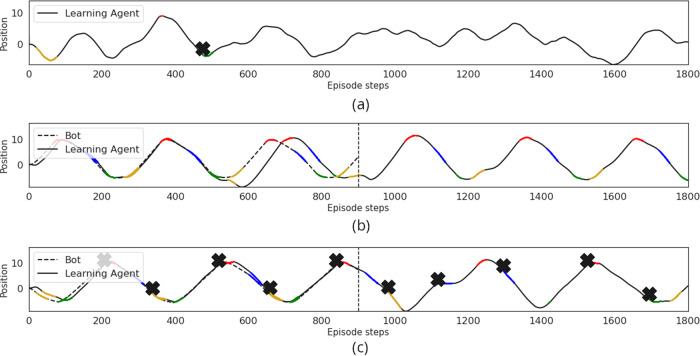
“From a safety perspective, our trained agent as an artefact has a case of objective misgeneralisation 61 , which we see in Fig. 6c.”
§ Learning few-shot imitation as cultural transmission > Discussion
What the sources say
- Supportedcites [61] 61. Shah, R. et al. Goal misgeneralization: why correct specifications aren't enough for correct goals. arXiv https://arxiv.org/abs/2210. 01790 (2022). source
The Introduction (p. 2) defines goal misgeneralization as a trained model pursuing an unintended goal while retaining its capabilities, and Section 2.2 (p. 4) gives the corresponding test-setting criteria. The citation supports the concept the citing authors apply to their agent; their assessment of that particular agent is their own, not a finding attributed to this source. (LLM, conf=0.85)
plainSingle case- Asserted: passes — The authors put it forward as true.
- Checkable: passes — It can be checked against evidence.
- Load-bearing: unclear — It is unclear whether the paper’s conclusions depend on it.
- Based: passes — The paper gives a reason why it holds.
- Supported
47 more claims · 1 with their cited sources checked
Create a free account to see all 124 claims and to verify the 1 reference still open.
- Probably not a substantial claim. 44
- It may state two separate claims as one. 36
- The quote only partly states this claim. 1
Claims other papers make about this one
Each is checked against this paper’s own text: does it say what the citing paper says it does?
The cited source says what the claim attributes to it.
In the citing paper
“However, these works have only considered one iteration of information transmission from an expert to a student.”
From Artificial Generational Intelligence: Cultural Accumulation in Reinforcement Learning (2024) · cites this paper as Bhoopchand et al., 2023
The cited source says what the claim attributes to it.
In the citing paper
“Prior work has successfully demonstrated emergent social learning in RL [Borsa et al., 2017, Ndousse et al., 2021, Bhoopchand et al., 2023], showing that it helps agents solve hard exploration problems and adapt online to new tasks.”
From Artificial Generational Intelligence: Cultural Accumulation in Reinforcement Learning (2024) · cites this paper as Bhoopchand et al., 2023
Self-check
Percentages, sums and reported differences re-computed from the paper’s own numbers.
Each contradiction between two passages listed here was confirmed by an independent check.
Rated minor: it would not touch a result — a value no result rests on, a p-value that stays on the same side of the significance level, or a conflict that is clerical, resolved elsewhere in the paper, or outside its own findings.
In the paper
§ Learning few-shot imitation as cultural transmission > Automatic domain randomisation
“Each set of task parameters λ are drawn from a distribution P ϕ (Λ) over the (d-1)-dimensional standard simplex, parameterised by a vector ϕ.”
§ Learning few-shot imitation as cultural transmission > Automatic domain randomisation
“We use a product of uniform distributions with 2d parameters and joint cumulative density function P ϕ ðλÞ = Y d i = 1 1 ϕ H i À ϕ L i ,ð4Þ defined over the standard simplex given by λ : λ i 2 ϕ L i , ϕ H i  à for i 2 f1, . . . , dg, λ 2 R d n o :ð5Þ”
Citations
Cites
Hochreiter, S., & Schmidhuber, J. (1997) · Neural Computation · doi:10.1162/neco.1997.9.8.1735 · Cited by 102,318
Kytle, J., & Bandura, A. (1978) · Contemporary Sociology · doi:10.2307/2065952 · Cited by 25,422
Distilling the Knowledge in a Neural Network
Hinton, G., Vinyals, O., & Dean, J. (2015) · arXiv · doi:10.48550/arxiv.1503.02531 · Cited by 14,204
Mind in Society: Development of Higher Psychological Processes
VYGOTSKY, L. S. (1980) · doi:10.2307/j.ctvjf9vz4 · Cited by 6,255
Grandmaster level in StarCraft II using multi-agent reinforcement learning
Vinyals, O., Babuschkin, I., Czarnecki, W. M., Mathieu, M., Dudzik, A., Chung, J., Choi, D. H., Powell, R., Ewalds, T., Georgiev, P., et al. (2019) · Nature · doi:10.1038/s41586-019-1724-z · Cited by 3,455 · cited 1×
“Firstly, it would be interesting to bootstrap agent cultural capabilities from scratch using generational training 66 , as opposed to relying on hand-coded expert bots as co-players.”
A survey of robot learning from demonstration
Argall, B. D., Chernova, S., Veloso, M., & Browning, B. (2009) · Robotics and Autonomous Systems · doi:10.1016/j.robot.2008.10.024 · Cited by 3,227 · cited 1×
“Our approach contrasts with prior methods in which the training itself is a process of cultural transmission, namely imitation learning 20 – 22 and policy distillation 23,24 .”
Theory of fluid and crystallized intelligence: A critical experiment.
Cattell, R. B. (1963) · Journal of Educational Psychology · doi:10.1037/h0046743 · Cited by 2,536
The nature of the child’s tie to his mother 1
Bowlby, J. (2018) · Influential Papers from the 1950s · doi:10.4324/9780429475931-15 · Cited by 2,376 · cited 1×
“The progressive increase in duration of expert dropout (ED)mirrorsthedevelopmentofsecureattachmentinhumans 53 ,andis important for the learning of imitation in animals 54 .”
Neuroscience-Inspired Artificial Intelligence
Hassabis, D., Kumaran, D., Summerfield, C., & Botvinick, M. (2017) · Neuron · doi:10.1016/j.neuron.2017.06.011 · Cited by 1,557
(1999) · Choice Reviews Online · doi:10.5860/choice.37-0272 · Cited by 1,441
Imitation Learning: A Survey of Learning Methods
Hussein, A., Gaber, M. M., Elyan, E., & Jayne, C. (2018) · ACM Computing Surveys · doi:10.1145/3054912 · Cited by 1,060
Xu, Y., & Goodacre, R. (2018) · Journal of Analysis and Testing · doi:10.1007/s41664-018-0068-2 · Cited by 1,030 · cited 1×
“To address this, we measure cultural transmission in held-out test tasks and with human expert demonstrators 40,41 , similar to the familiar train-test dataset split in supervised learning 42 .”
Henrich, J. (2016) · doi:10.1515/9781400873296 · Cited by 1,002
Why Copy Others? Insights from the Social Learning Strategies Tournament
Rendell, L., Boyd, R., Cownden, D., Enquist, M., Eriksson, K., Feldman, M. W., Fogarty, L., Ghirlanda, S., Lillicrap, T., & Laland, K. N. (2010) · Science · doi:10.1126/science.1184719 · Cited by 811 · cited 1×
“With such experience, an agent should meta-learn a selective sociallearning strategy 62,63 , deciding what knowledge to infer from which experts, and when to rely on independent exploration.”
Experimentally induced innovations lead to persistent culture via conformity in wild birds
Aplin, L. M., Farine, D. R., Morand-Ferron, J., Cockburn, A., Thornton, A., & Sheldon, B. C. (2015) · Nature · doi:10.1038/nature13998 · Cited by 697 · cited 2×
“In the “ two-action task ” 28 – 30 subjects are required to solve a task with two alternative solutions.”
Becoming Human: A Theory of Ontogeny
Tomasello, M. (2019) · Harvard University Press eBooks · doi:10.4159/9780674988651 · Cited by 668
Unity: A General Platform for Intelligent Agents
Juliani, A., Berges, V.-P., Teng, E., Cohen, A., Harper, J., Elion, C., Goy, C., Gao, Y., Henry, H., Mattar, M., et al. (2018) · arXiv · doi:10.48550/arxiv.1809.02627 · Cited by 626
Solving Rubik's Cube with a Robot Hand
OpenAI, Akkaya, I., Andrychowicz, M., Chociej, M., Litwin, M., McGrew, B., Petron, A., Paino, A., Plappert, M., Powell, G., et al. (2019) · arXiv · doi:10.48550/arxiv.1910.07113 · Cited by 602
Self-citationUnderstanding intermediate layers using linear classifier probes
Alain, G., & Bengio, Y. (2016) · arXiv · doi:10.48550/arxiv.1610.01644 · Cited by 581 · cited 1×
“To identify the social neuron, we use linear probing 47,48 , a well-known and powerful method for understanding intermediate layers of adeepneuralnetwork.”
Learning to reinforcement learn
Wang, J. X., Kurth-Nelson, Z., Tirumala, D., Soyer, H., Leibo, J. Z., Munos, R., Blundell, C., Kumaran, D., & Botvinick, M. (2016) · arXiv · doi:10.48550/arxiv.1611.05763 · Cited by 579
Cognitive Gadgets: The Cultural Evolution of Thinking
Heyes, C. (2018) · doi:10.4159/9780674985155 · Cited by 518
RL$^2$: Fast Reinforcement Learning via Slow Reinforcement Learning
Duan, Y., Schulman, J., Chen, X., Bartlett, P. L., Sutskever, I., & Abbeel, P. (2016) · arXiv · doi:10.48550/arxiv.1611.02779 · Cited by 503
Diversity is All You Need: Learning Skills without a Reward Function
Eysenbach, B., Gupta, A., Ibarz, J., & Levine, S. (2018) · arXiv · doi:10.48550/arxiv.1802.06070 · Cited by 480 · cited 1×
“Fortunately, there are a variety of off-the-shelf techniques for generating diverse policies 70,71 .”
Silver, D., Singh, S., Precup, D., & Sutton, R. S. (2021) · Artificial Intelligence · doi:10.1016/j.artint.2021.103535 · Cited by 445 · cited 1×
“That is to say, it may be learned purely from individual reward 49 , requiring onlythat the environment contains knowledgeable co-players, and that the agent has a minimal suf fi cient number of representational and experiential biases.”
Self-citationThe Next Decade in AI: Four Steps Towards Robust Artificial Intelligence
Marcus, G. (2020) · arXiv · doi:10.48550/arxiv.2002.06177 · Cited by 297
Nehaniv, C. L., & Dautenhahn, K. (2002) · Imitation in Animals and Artifacts · doi:10.7551/mitpress/3676.003.0003 · Cited by 270 · cited 1×
“It is a particularly impressive form of cultural transmission because it requires solving the challenging “ correspondence problem ” 12,13 , instantaneously translating a sensory observation of another agent ’ s motor behaviour into a motor reproduction of that behaviour oneself.”
Rusu, A. A., Colmenarejo, S. G., Gulcehre, C., Desjardins, G., Kirkpatrick, J., Pascanu, R., Mnih, V., Kavukcuoglu, K., & Hadsell, R. (2015) · arXiv · doi:10.48550/arxiv.1511.06295 · Cited by 270
Imitation of the sequential structure of actions by chimpanzees (Pan troglodytes).
Whiten, A. (1998) · Journal of Comparative Psychology · doi:10.1037//0735-7036.112.3.270 · Cited by 267
Maximum a Posteriori Policy Optimisation
Abdolmaleki, A., Springenberg, J. T., Tassa, Y., Munos, R., Heess, N., & Riedmiller, M. (2018) · arXiv · doi:10.48550/arxiv.1806.06920 · Cited by 259 · cited 6×
“The MPO agent ’ s exploration strategy is not suf fi ciently structured to deduce the underlying conceptual structure of the task space, so the agent simply learns a “ risk-averse ” behaviour of avoiding goal spheres altogether (see Supplementary Movie 5).”
InfluentialCritique of Cattell's "Theory of fluid and crystallized intelligence: A critical experiment."
Humphreys, L. G. (1967) · Journal of Educational Psychology · doi:10.1037/h0024654 · Cited by 250
Biological motion preference in humans at birth: role of dynamic and configural properties
Bardi, L., Regolin, L., & Simion, F. (2011) · Developmental Science · doi:10.1111/j.1467-7687.2010.00985.x · Cited by 246
Observational learning in budgerigars
Dawson, B. V., & Foss, B. M. (1965) · Animal Behaviour · doi:10.1016/0003-3472(65)90108-9 · Cited by 230 · cited 2×
“In the “ two-action task ” 28 – 30 subjects are required to solve a task with two alternative solutions.”
On the Measure of Intelligence
Chollet, F. (2019) · arXiv · doi:10.48550/arxiv.1911.01547 · Cited by 218
Duan, Y., Andrychowicz, M., Stadie, B. C., Ho, J., Schneider, J., Sutskever, I., Abbeel, P., & Zaremba, W. (2017) · arXiv (Cornell University) · doi:10.48550/arxiv.1703.07326 · Cited by 208
Unsupervised State Representation Learning in Atari
Anand, A., Racah, E., Ozair, S., Bengio, Y., Côté, M.-A., & Hjelm, R. D. (2019) · neural information processing systems · doi:10.48550/arxiv.1906.08226 · Cited by 199
Beyond rational imitation: Learning arbitrary means actions from communicative demonstrations
Király, I., Csibra, G., & Gergely, G. (2013) · Journal of Experimental Child Psychology · doi:10.1016/j.jecp.2012.12.003 · Cited by 196
Cumulative cultural learning: Development and diversity
Legare, C. H. (2017) · Proceedings of the National Academy of Sciences · doi:10.1073/pnas.1620743114 · Cited by 173 · cited 1×
“72,73) and theoretical (e.g., refs.”
Never Give Up: Learning Directed Exploration Strategies
Badia, A. P., Sprechmann, P., Vitvitskyi, A., Guo, D., Piot, B., Kapturowski, S., Tieleman, O., Arjovsky, M., Pritzel, A., Bolt, A., et al. (2020) · arXiv · doi:10.48550/arxiv.2002.06038 · Cited by 170
The ontogeny of cultural learning
Tomasello, M. (2015) · Current Opinion in Psychology · doi:10.1016/j.copsyc.2015.09.008 · Cited by 151 · cited 1×
“We want to know how the skill of cultural transmission can develop when an arti fi cial agent is learning from scratch, analogous in the cognitive science literature to the combination of phylogeny and ontogeny 17,18 .”
Imitation, objects, tools, and the rudiments of language in human ontogeny
Meltzoff, A. N. (1988) · Human Evolution · doi:10.1007/bf02436590 · Cited by 138 · cited 1×
“In humans, imitation provides the kind of high-fi delity cultural transmission needed for the cultural evolution of tools and technology 14,15 .”
Les lois de l'imitation; Etude sociologique
Tarde, G. (1890) · The American Journal of Psychology · doi:10.2307/1411168 · Cited by 119
The Developmental Origins of Selective Social Learning
Poulin-Dubois, D., & Brosseau-Liard, P. (2016) · Current Directions in Psychological Science · doi:10.1177/0963721415613962 · Cited by 113 · cited 1×
“With such experience, an agent should meta-learn a selective sociallearning strategy 62,63 , deciding what knowledge to infer from which experts, and when to rely on independent exploration.”
Illuminating Generalization in Deep Reinforcement Learning through Procedural Level Generation
Justesen, N., Torrado, R. R., Bontrager, P., Khalifa, A., Togelius, J., & Risi, S. (2018) · OAR@UM (University of Malta) · doi:10.48550/arxiv.1806.10729 · Cited by 109
Task rules, working memory, and fluid intelligence
Duncan, J., Schramm, M., Thompson, R., & Dumontheil, I. (2012) · Psychonomic Bulletin & Review · doi:10.3758/s13423-012-0225-y · Cited by 96
Précis of Cognitive Gadgets: The Cultural Evolution of Thinking
Heyes, C. M. (2018) · Behavioral and Brain Sciences · doi:10.1017/s0140525x18002145 · Cited by 95
Copy-when-uncertain: bumblebees rely on social information when rewards are highly variable
Smolla, M., Alem, S., Chıttka, L., & Shultz, S. (2016) · Biology Letters · doi:10.1098/rsbl.2016.0188 · Cited by 86 · cited 1×
“Among animals, social learning is known to be preferred over asocial learning in uncertain or varying ecological contexts 57,58 , environment properties we create via ADR.”
The first time ever I saw your feet: Inversion effect in newborns’ sensitivity to biological motion.
Bardi, L., Regolin, L., & Simion, F. (2013) · Developmental Psychology · doi:10.1037/a0034678 · Cited by 83
Clune, J. (2019) · arXiv · doi:10.48550/arxiv.1905.10985 · Cited by 82 · cited 1×
“By exhibiting cultural transmission among embodied arti fi cial agents in a complex space of 3D interactive tasks, we extend previous literature on computational models of cultural transmission 6 and cultural evolution 7 in the direction of using cultural evolution as an AI-generating algorithm 8,9 .”
Imitating Latent Policies from Observation
Edwards, A. D., Sahni, H., Schroecker, Y., & Isbell, C. L. (2018) · arXiv · doi:10.48550/arxiv.1805.07914 · Cited by 79 · cited 2×
“Our approach contrasts with prior methods in which the training itself is a process of cultural transmission, namely imitation learning 20 – 22 and policy distillation 23,24 .”
Self-citationImitation and culture: What gives?
Heyes, C. M. (2021) · Mind & Language · doi:10.1111/mila.12388 · Cited by 78
Diversity-Driven Exploration Strategy for Deep Reinforcement Learning
Hong, Z.-W., Shann, T.-Y., Su, S.-Y., Chang, Y.-H., & Lee, C.-Y. (2018) · arXiv · doi:10.48550/arxiv.1802.04564 · Cited by 77
Homo imitans? Seven reasons why imitation couldn't possibly be associative
Heyes, C. M. (2016) · Philosophical Transactions of the Royal Society B Biological Sciences · doi:10.1098/rstb.2015.0069 · Cited by 71 · cited 1×
“We focus on a particular form of cultural transmission, known in the psychology and neuroscience literatureas observational learning 10 or (few-shot) imitation 11 .”
Imitation Learning:A Survey of Learning Methods
Hussein, A., Gaber, M. M., Elyan, E., & Jayne, C. (2017) · ACM Computing Surveys · doi:10.1145/3071073 · Cited by 62
POET: open-ended coevolution of environments and their optimized solutions
Wang, R., Lehman, J., Clune, J., & Stanley, K. O. (2019) · Proceedings of the Genetic and Evolutionary Computation Conference · doi:10.1145/3321707.3321799 · Cited by 61
Emergent Complexity and Zero-shot Transfer via Unsupervised Environment Design
Dennis, M., Jaques, N., Vinitsky, E., Bayen, A., Russell, S., Critch, A., & Levine, S. (2020) · arXiv · doi:10.48550/arxiv.2012.02096 · Cited by 60 · cited 1×
“As machine learning algorithms become increasingly powerful, we expect that such unsupervised environment design algorithms 65 will become a ubiquitous tool for avoiding over fi tting and maintaining within-episode adaptation.”
Leibo, J. Z., Hughes, E., Lanctot, M., & Graepel, T. (2019) · arXiv · doi:10.48550/arxiv.1903.00742 · Cited by 60 · cited 2×
“For intuition about the meaning of the parameter values, see Supplementary Movies 6 – 9.”
Self-citationEffective Diversity in Population-Based Reinforcement Learning
Parker-Holder, J., Pacchiano, A., Choromanski, K., & Roberts, S. (2020) · arXiv · doi:10.48550/arxiv.2002.00632 · Cited by 60
Understanding the multiple factors governing social learning and the diffusion of innovations
Aplin, L. M. (2016) · Current Opinion in Behavioral Sciences · doi:10.1016/j.cobeha.2016.09.003 · Cited by 59 · cited 1×
“Among animals, social learning is known to be preferred over asocial learning in uncertain or varying ecological contexts 57,58 , environment properties we create via ADR.”
Open-Ended Learning Leads to Generally Capable Agents
Open Ended Learning Team, Stooke, A., Mahajan, A., Barros, C., Deck, C., Bauer, J., Sygnowski, J., Trebacz, M., Jaderberg, M., Mathieu, M., et al. (2021) · arXiv · doi:10.48550/arxiv.2107.12808 · Cited by 56 · cited 3×
“27, we decompose an agent ’ s task as the direct product of a world, a game and a set of co-players.”
InfluentialThe Development of Attentional Biases for Faces in Infancy: A Developmental Systems Perspective
Reynolds, G. D., & Roth, K. C. (2018) · Frontiers in Psychology · doi:10.3389/fpsyg.2018.00222 · Cited by 53 · cited 2×
“However,drawingananalogywithhumans suggests that an attention bias might be an important and general built-in shortcut to social learning: infants display such a bias from a very young age 64 .”
Loucks, J., Mutschler, C., & Meltzoff, A. N. (2016) · Cognitive Science · doi:10.1111/cogs.12446 · Cited by 48
Meta-learning of Sequential Strategies
Ortega, P. A., Wang, J. X., Rowland, M., Genewein, T., Kurth-Nelson, Z., Pascanu, R., Heess, N., Veness, J., Pritzel, A., Sprechmann, P., et al. (2019) · arXiv · doi:10.48550/arxiv.1905.03030 · Cited by 47 · cited 1×
“These neurons have specialised roles required for solving a new task online via cultural transmission, a subset of the suf fi cient statistics which drive the state-machine 46 .”
Observational Learning by Reinforcement Learning
Borsa, D., Heess, N., Piot, B., Liu, S., Hasenclever, L., Munos, R., & Pietquin, O. (2019) · International Joint Conference on Autonomous Agents and Multiagent Systems · doi:10.65109/nqzd5621 · Cited by 47
Observational Learning by Reinforcement Learning
Borsa, D., Piot, B., Munos, R., & Pietquin, O. (2017) · arXiv · doi:10.48550/arxiv.1706.06617 · Cited by 47
Wang, Z., Williamson, R. A., & Meltzoff, A. N. (2015) · Frontiers in Psychology · doi:10.3389/fpsyg.2015.00562 · Cited by 44
Social Diversity and Social Preferences in Mixed-Motive Reinforcement Learning
McKee, K. R., Gemp, I., McWilliams, B., Duèñez-Guzmán, E. A., Hughes, E., & Leibo, J. Z. (2020) · International Joint Conference on Autonomous Agents and Multiagent Systems · doi:10.65109/dnuf7773 · Cited by 33 · cited 1×
“NeuroscienceanddeepRL have already mutually bene fi ted from collaborations with a modelling fl avour 75 , and the precedent has been set for MARL as a modelling tool in social cognition 76,77 .”
Self-citationPolicy manifold search: exploring the manifold hypothesis for diversity-based neuroevolution
Rakicevic, N., Cully, A., & Kormushev, P. (2021) · Proceedings of the Genetic and Evolutionary Computation Conference · doi:10.1145/3449639.3459320 · Cited by 32
Task-Embedded Control Networks for Few-Shot Imitation Learning
James, S., Bloesch, M., & Davison, A. J. (2018) · arXiv (Cornell University) · doi:10.48550/arxiv.1810.03237 · Cited by 30
The Role of Intelligence in Social Learning
Vostroknutov, A., Polonio, L., & Coricelli, G. (2018) · Scientific Reports · doi:10.1038/s41598-018-25289-9 · Cited by 29 · cited 1×
“Betterworkingmemory(M) is known to correlate with improved fl uid intelligence in humans 50 and the ability to solve novel reasoning problems 51 , including by imitation 52 .”
Examining memory for ritualized gesture in complex causal sequences
Kapitány, R., Kavanagh, C. M., Whitehouse, H., & Nielsen, M. (2018) · Cognition · doi:10.1016/j.cognition.2018.08.005 · Cited by 29 · cited 1×
“We analyse the capabilities and limitations of our agent ’ s cultural transmission abilities on three axes inspired by the cognitive science of imitation, namely recall, generalisation, and fi delity 34 – 37 .”
Meta-trained agents implement Bayes-optimal agents
Mikulik, V., Delétang, G., McGrath, T., Genewein, T., Martic, M., Legg, S., & Ortega, P. A. (2020) · arXiv · doi:10.48550/arxiv.2010.11223 · Cited by 24 · cited 1×
“Training agents to imitate via meta-reinforcement learning embeds the logic for a state-machine capable of approximately Bayes-optimal cultural transmission into the neuralnetwork ’ sweights 45 .”
An evolutionary process without variation and selection
Gabora, L., & Steel, M. (2021) · Journal of The Royal Society Interface · doi:10.1098/rsif.2021.0334 · Cited by 23
Emergent Social Learning via Multi-agent Reinforcement Learning
Ndousse, K., Eck, D., Levine, S., & Jaques, N. (2020) · arXiv · doi:10.48550/arxiv.2010.00581 · Cited by 23
Learning to Interactively Learn and Assist
Woodward, M. P., Finn, C., & Hausman, K. (2020) · AAAI Publications (The Association for the Advancement of Artificial Intelligence (AAAI)) · doi:10.1609/aaai.v34i03.5636 · Cited by 21 · cited 1×
“Starting from the belief, we concatenate the agent ’ s current action, pass this through two MLP layers of size 32 and 64 with relu activations,and fi nally predictthe egocentric relative position of other players in the world at the current timestep.”
Generalization Guarantees for Imitation Learning
Ren, A. Z., Veer, S., & Majumdar, A. (2020) · arXiv · doi:10.48550/arxiv.2008.01913 · Cited by 17
Goal Misgeneralization: Why Correct Specifications Aren't Enough For Correct Goals
Shah, R., Varma, V., Kumar, R., Phuong, M., Krakovna, V., Uesato, J., & Kenton, Z. (2022) · arXiv · doi:10.48550/arxiv.2210.01790 · Cited by 16 · cited 1×
“From a safety perspective, our trained agent as an artefact has a caseofobjectivemisgeneralisation 61 ,whichweseeinFig.6c. Theagent happily follows an incorrect demonstration and even reproduces that incorrect path once the expert has dropped out.”
Cognitive instincts versus cognitive gadgets: A fallacy
Roige, A., & Carruthers, P. (2019) · Mind & Language · doi:10.1111/mila.12251 · Cited by 9 · cited 1×
“We want to know how the skill of cultural transmission can develop when an arti fi cial agent is learning from scratch, analogous in the cognitive science literature to the combination of phylogeny and ontogeny 17,18 .”
Using Unity to Help Solve Intelligence
Ward, T., Bolt, A., Hemmings, N., Carter, S., Sanchez, M., Barreira, R., Noury, S., Anderson, K., Lemmon, J., Coe, J., et al. (2020) · arXiv · doi:10.48550/arxiv.2011.09294 · Cited by 6
Procedural Generalization by Planning with Self-Supervised World Models
Anand, A., Walker, J., Li, Y., Vértes, E., Schrittwieser, J., Ozair, S., Weber, T., & Hamrick, J. B. (2021) · arXiv · doi:10.48550/arxiv.2111.01587 · Cited by 5 · cited 1×
“To address this, we measure cultural transmission in held-out test tasks and with human expert demonstrators 40,41 , similar to the familiar train-test dataset split in supervised learning 42 .”
A multi-agent reinforcement learning model of reputation and cooperation in human groups
McKee, K. R., Hughes, E., Zhu, T. O., Chadwick, M. J., Koster, R., Castaneda, A. G., Beattie, C., Graepel, T., Botvinick, M., & Leibo, J. Z. (2021) · arXiv · doi:10.48550/arxiv.2103.04982 · Cited by 5 · cited 1×
“NeuroscienceanddeepRL have already mutually bene fi ted from collaborations with a modelling fl avour 75 , and the precedent has been set for MARL as a modelling tool in social cognition 76,77 .”
Self-citationAn Evolutionary Process Without Variation and SelectionPreprint
Gabora, L. M., & Steel, M. (2020) · bioRxiv (Cold Spring Harbor Laboratory) · doi:10.1101/2020.08.30.274407 · Cited by 3
Examining memory for ritualized gesture in complex causal sequences.
Kapitány, R., Kavanagh, C. M., Whitehouse, H., et al. (2018) · doi:10.31234/osf.io/ax9fy
Rabinowitz, N. C., Perbet, F., Song, H. F., Zhang, C., Eslami, S. M. A., & Botvinick, M. (2018) · arXiv · doi:10.48550/arxiv.1802.07740
Research works printed but not linked: 6
- 7. Gabora, L. Meme and variations: a computer model of cultural evolution. In: Nadel, L. and Stein, D.(Eds.), 1993 Lectures in Complex Systems, Addison-Wesley. (1995).
- 19. Sutton, R. S. & Barto, A. G. Reinforcement learning: An introduction (MIT press, 2018).
- 54. Galef Jr., B. G. Imitation in animals: History, definition, and inter- pretation of data from the psychological laboratory. In Zentall, T. R. & Galef Jr., B. G. (eds.) In: Social learning: psychological and bio- logical perspectives, 3-28 (Lawrence Erlbaum Associates, Inc., 1988).
- 67. Bratman, M. E. Intention, plans, and practical reason. Mind 97, 632 (1988).
- 77. McKee, K. R. et al. Deep reinforcement learning models the emer- gent dynamics of human cooperation. arXiv https://arxiv.org/abs/ 2103.04982 (2021).
- 80. Vezhnevets, A., Wu, Y., Eckstein, M., Leblond, R. & Leibo, J. Z. Options as responses: grounding behavioural hierarchies in multi- agent reinforcement learning. In: International Conference on Machine Learning, 9733-9742 (PMLR, 2020).
Cited by
Vision-Based Learning for Drones: A Survey
Xiao, J., Zhang, R., Zhang, Y., & Feroskhan, M. (2025) · IEEE Transactions on Neural Networks and Learning Systems · doi:10.1109/tnnls.2025.3564184 · Cited by 85
“Through interactions in the open world [21], [211] or provide few-shot imitation [212], vision-based learning can emerge with full autonomy for drone applications.”
Water droplets play a role in Internet of Things applications
Wen, F., & Lee, C. (2024) · Droplet · doi:10.1002/dro2.133 · Cited by 29
“Research 143 and multimodality, 144,146–148 in the era of big data where everything is connected, device intelligence with the help of algorithms 149–151 is very important for IoT construction, a process that involves the consideration of energy consumption (self-sustainability) 145 and data fusion.”
Yager, K. G. (2024) · Digital Discovery · doi:10.1039/d4dd00178h · Cited by 12
Multi-Agent Risks from Advanced AI
Hammond, L., Chan, A., Clifton, J., Hoelscher-Obermaier, J., Khan, A., McLean, E., Smith, C., Barfuss, W., Foerster, J., Gavenčiak, T., et al. (2025) · arXiv · doi:10.48550/arxiv.2502.14143 · Cited by 305
Self-citationHuman-Centered Artificial Social Intelligence (HC-ASI)
Hanxi, P. A. N., Xu, W., Shen, M., & Gao, Z. (2026) · Springer eBooks · doi:10.1007/978-981-97-8440-0_110-1 · Cited by 2
Metadata
- Authors
- Bhoopchand, A., Brownfield, B., Collister, A., Dal Lago, A., Edwards, A., Everett, R., Fréchette, A., Oliveira, Y. G., Hughes, E., Mathewson, K. W., Mendolicchio, P., Pawar, J., Pȋslar, M., Platonov, A., Senter, E., Singh, S., Zacherl, A., & Zhang, L. M.
- Affiliations
- Google DeepMind (United Kingdom) (GB)
- Corresponding author
- Hughes, Edward
- ORCID
- Venue
- Nature Communications
- Published
- 2023-11-28
- Volume
- 14
- Issue
- 1
- Pages
- 7536-7536
- ISSN
- 2041-1723 (ISSN-L)
- PMC
- PMC10684502
- OpenAlex
- W4389080522
- Cited by
- 14
- References
- 53
- Citations by year
- 2026: 4 · 2025: 4 · 2024: 5 · 2023: 1
- FWCI
- 21.83
- Type
- journal article
- Language
- en
- Open access
- gold
- doi.org
- Licence
- cc-by
- creativecommons.org/licenses/by/4.0 (tdm)
- creativecommons.org/licenses/by/4.0 (vor)
- Locations
- Nature Communications (publishedVersion, cc-by)
- PubMed Central (publishedVersion, cc-by)
- PubMed (publishedVersion)
- RePEc: Research Papers in Economics (submittedVersion)
- DOAJ (DOAJ: Directory of Open Access Journals) (submittedVersion, cc-by-sa)
- Funders
- DeepMind
- Topics
- Social Sciences › Cultural Studies › Language and cultural evolution
- Physical Sciences › Computer Science › Artificial Intelligence › Reinforcement Learning in Robotics
- Physical Sciences › Computer Science › Artificial Intelligence › Evolutionary Algorithms and Applications
- Keywords
- cultural transmission, cultural evolution, artificial general intelligence, social learning, human-robot interaction, evaluation methodology
About these checks
Registry, retraction, Cites and statistics results are computed, not judged, with one exception: a printed reference that no index lists is read once by a model before it counts as a citation error. Claims are extracted by a model and kept only when their quote appears verbatim in the text; each cited source is then checked, with a model’s help, for whether it says what the claim relies on. Those verdicts can be wrong — read the claim’s quote and the cited source before relying on one.
The claim verdicts this report counts are experimental: their accuracy is not yet measured.
A language model drew the claims from the paper on 2026-10-01, under version 3 of the claim definition (model deepseek-v4.1-flash, prompt extract-v3).
A second model labelled each claim on 2026-10-01 (model jev-1.13-20260917, definition revision gold-guideline-v0.2).
Cited sources are checked with a language model’s help (gpt-6-sol).
Statistics and arithmetic are recomputed, not judged.
Confidence bands are shown only for fields calibrated on our annotated test set. None is calibrated yet, so no band is shown.
What counts as a claim ›How we measure confidence ›How we check this ›
Are you an author, or do you see a problem with this page? Request a review
Data sources
Bibliographic data: Semantic Scholar, OpenAlex, Crossref.
Contains information from the Semantic Scholar Academic Graph Datasets, made available under the ODC Attribution License (ODC-BY 1.0).
Semantic Scholar’s data is described in: Kinney, R., et al. (2023). The Semantic Scholar Open Data Platform. arXiv:2301.10140.
