

Using social and behavioural science to support COVID-19 pandemic response
Open accessThe DOI matches its Crossref record; 257 of the 259 references it cites were found in a registry or an index; 24 of the 89 sources its claims cite were checked for support.
Abstract
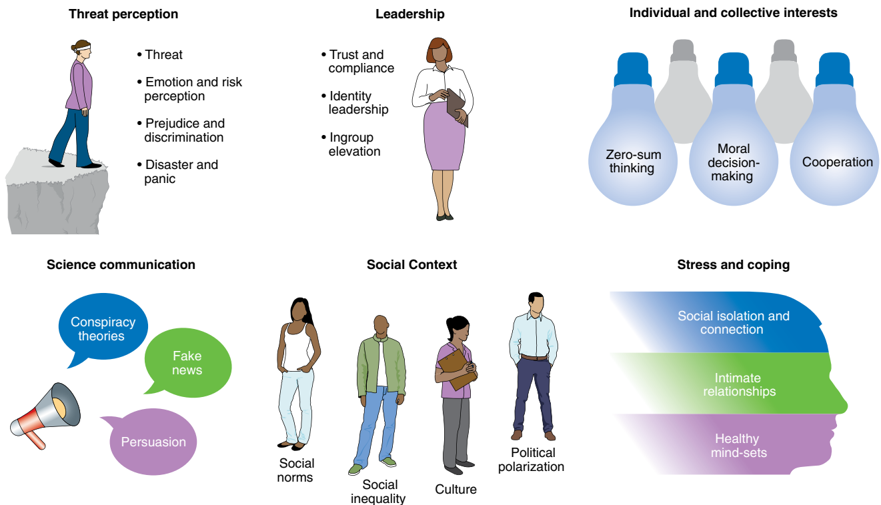
The COVID-19 pandemic represents a massive global health crisis. Because the crisis requires large-scale behaviour change and places significant psychological burdens on individuals, insights from the social and behavioural sciences can be used to help align human behaviour with the recommendations of epidemiologists and public health experts. Here we discuss evidence from a selection of research topics relevant to pandemics, including work on navigating threats, social and cultural influences on behaviour, science communication, moral decision-making, leadership, and stress and coping. In each section, we note the nature and quality of prior research, including uncertainty and unsettled issues. We identify several insights for effective response to the COVID-19 pandemic and highlight important gaps researchers should move quickly to fill in the coming weeks and months.
Overview
CoChat Summary
TL;DR
This perspective argues that social and behavioural science can help align public behaviour with COVID-19 public health recommendations across threat perception, social context, science communication, cooperation, leadership, and stress/coping. It synthesizes prior evidence and policy insights while cautioning that evidence is limited, often drawn from non-pandemic contexts, and in many areas unsettled.
Key findings
- The paper notes the scale of infectious disease threats: the bubonic plague killed approximately 25% of the European population, and by March 2020 COVID-19 had spread to more than 118,000 cases and caused 4,291 deaths in 114 countries. It also notes that 21 countries donated medical supplies to China in February, with China reciprocating widely.
- Fear appeals can change behaviour when people feel capable of dealing with the threat, but produce defensive reactions when people feel helpless; optimism bias can lead people to underestimate personal risk and ignore public health warnings.
- Social norms, inequality, culture, and political polarization shape pandemic behaviour: correcting misperceived norms can help when most people are already doing the desirable behaviour, but descriptive norms can backfire if the behaviour is undesirable unless paired with prescriptive norms.
- Effective communication and leadership may involve credible sources, messages that protect others or align with moral values, prebunking/inoculation against misinformation, accuracy nudges, shared social identity, and leaders modelling prosocial sacrifice; excessive national self-image concerns (“collective narcissism”) can backfire.
Methods
- Design: Perspective/narrative review; no primary data collection or sample. Topics were identified by the corresponding authors as potentially relevant to pandemic response and are explicitly not exhaustive.
- Evidence base: synthesizes prior social and behavioural research on threat perception, social context, science communication, moral decision-making, cooperation, leadership, and stress/coping, drawing on laboratory experiments, correlational studies, field experiments, meta-analyses, and preprints/forthcoming work.
- Analysis: narrative synthesis with policy implications and identified research gaps; no systematic search strategy or quantitative synthesis is reported.
Limitations
- Stated: due to space constraints, the paper provides only a brief summary of each topic; research on these topics is ongoing and in many cases far from settled; there is very little published social science research on the current pandemic, so discussion often draws from different circumstances and evidence quality varies substantially.
- Stated: insights and policy implications should be interpreted with caution.
- Evident: as a perspective rather than a systematic review or empirical study, it does not provide a comprehensive evidence appraisal, and its reliance on preprints and forthcoming sources limits certainty.
Model-written summary. Check it against the paper before relying on it.
Integrity signals
Registry
Cites
Statistics
Figures
Verification
Claims the paper makes
19 Valid · 5 Not valid · 37 Not checked · 13 Own results and interpretations
At least one cited source doesn’t support this claim or points to a different paper, and none confirmed it — see the verdicts below.
In the paper
“For instance, in hypothetical scenarios about deciding whether to go to work while sick, American and British participants reported they would be less willing to stay home when it was uncertain they would infect a co-worker.”
What the sources say
- Disputedcites [176] Kappes, A. et al. Uncertainty about the impact of social decisions increases prosocial behaviour. Nat. Hum. Behav. 2, 573–580 (2018). sourceExperimental — accuracy not yet measured
In the paper’s account of the infectious-disease scenario (Abstract; page not provided), participants facing uncertainty about how severely a co-worker might be affected were more likely to stay home than controls, not less. The paper distinguishes that impact uncertainty from uncertainty about whether a co-worker would be infected. Its Study 6 Methods (page not provided) describe recruitment through AMT, but do not establish the claimed American and British participant groups. (LLM, conf=0.88)
Checked by a reasoning model — may be wrong.
hedgedstates an association- Asserted: passes — The authors put it forward as true.
- Checkable: passes — It can be checked against evidence.
- Load-bearing: passes — The paper’s conclusions depend on it.
- Based: passes — The paper gives a reason why it holds.
- Disputed
The cited sources that could be checked couldn’t confirm or dispute this claim.
In the paper
“Moreover, there is mixed research regarding whether corrections may actually increase belief in the original misinformation 121,124-126 or in other misleading claims that fail to get corrected 127 .”
What the sources say
- Not checked — no full text of the sourcecites [121] Guess, A. & Coppock, A. Does counter-attitudinal information cause backlash? Results from three large survey experiments. Br. J. Polit. Sci. https://doi.org/10.1017/S0007123418000327 (2018). source
- Not matchedcites [124] Wittenberg, C. & Berinsky, A.J. Misinformation and its correction. in Social Media and Democracy: The State of the Field (eds Persily, N. & Tucker, J. A.) (Cambridge University Press, forthcoming).
Its entry has no title and year that we can search by.
- Not checked — no full text of the sourcecites [125] Swire, B. & Ecker, U.K.H. Misinformation and its correction: Cognitive mechanisms and recommendations for mass communication. in Misinformation and Mass Audiences (eds. Southwell, B. G., Thorson, E. A. & Sheble, L.) 195–2011 (University of Texas Press, 2018). source
- Not checked — no full text of the sourcecites [126] Wood, T. & Porter, E. The elusive backfire effect: mass attitudes’ steadfast factual adherence. Polit. Behav. 41, 135–163 (2018). source
- Could not verifycites [127] Pennycook, G., McPhetres, J., Zhang, Y. & Rand, D. Fighting COVID-19 misinformation on social media: Experimental evidence for a scalable accuracy nudge intervention. Preprint at PsyArXiv https://doi.org/10.31234/osf.io/uhbk9 (2020). sourceExperimental — accuracy not yet measured
Citation 127 is attached to the suggestion that corrections may increase belief in other misleading claims that go uncorrected. The Statement of Relevance and Discussion describe an accuracy nudge that improved sharing decisions, not corrections or their effects on belief in uncorrected claims. Searches for correction backfire and uncorrected misinformation found no passage addressing that point; page numbers were unavailable in our copy. (LLM, conf=0.76)
hedgedstates a possible cause- Asserted: passes — The authors put it forward as true.
- Checkable: passes — It can be checked against evidence.
- Load-bearing: passes — The paper’s conclusions depend on it.
- Based: passes — The paper gives a reason why it holds.
The sources with a verdict support this claim; the rest weren’t checked yet, have no full text we could read, or their verdicts aren’t rated yet.
In the paper
“Indeed, laboratory research has found that people prioritize local over global (or international) interests 185,186 .”
What the sources say
- Supportedcites [185] Milinski, M., Hilbe, C., Semmann, D., Sommerfeld, R. & Marotzke, J. Humans choose representatives who enforce cooperation in social dilemmas through extortion. Nat. Commun. 7, 10915 (2016). source
The Results section (‘Voters choose selfish representatives’; page unavailable) reports that participants preferentially re-elected representatives who contributed less to the shared climate account and elected candidates who pledged to contribute less than a fair share. In this simulated international dilemma, that supports the claim that participants favored their own group’s interests over the collective goal; it does not establish that everyone did so. (LLM, conf=0.85)
- Not checked — no full text of the sourcecites [186] Reinders Folmer, C. P. et al. One for all: what representing a group may do to us. J. Exp. Soc. Psychol. 48, 1047–1056 (2012). source
plain- Asserted: passes — The authors put it forward as true.
- Checkable: passes — It can be checked against evidence.
- Load-bearing: passes — The paper’s conclusions depend on it.
- Based: passes — The paper gives a reason why it holds.
- Supported
Every source the paper cites for this claim was checked and supports it.
In the paper
“However, when going to work risked infecting an elderly co-worker who would suffer a serious illness, participants reported they would be more willing to stay home 176 .”
What the sources say
- Supportedcites [176] Kappes, A. et al. Uncertainty about the impact of social decisions increases prosocial behaviour. Nat. Hum. Behav. 2, 573–580 (2018). source
The Study 6 Methods (page not provided) describe a scenario in which going to work could infect an older, vulnerable co-worker who would suffer severely, followed by a rating of willingness to go to work. The reported Study 6 findings (indexed under Abstract; page not provided) say participants given that risk information were significantly more likely to stay home than controls. (LLM, conf=0.92)
hedgedstates a cause- Asserted: passes — The authors put it forward as true.
- Checkable: passes — It can be checked against evidence.
- Load-bearing: passes — The paper’s conclusions depend on it.
- Based: passes — The paper gives a reason why it holds.
- Supported
The sources with a verdict support this claim; the rest weren’t checked yet, have no full text we could read, or their verdicts aren’t rated yet.
In the paper
“Several techniques, such as sanctioning defectors 187 or rewarding cooperators 188 , tend to increase cooperative behaviour in laboratory experiments using economic games.”
What the sources say
- Not checked — no full text of the sourcecites [187] Yamagishi, T. The provision of a sanctioning system as a public good. J. Pers. Soc. Psychol. 51, 110–116 (1986). source
- Supportedcites [188] Rand, D. G., Dreber, A., Ellingsen, T., Fudenberg, D. & Nowak, M. A. Positive interactions promote public cooperation. Science 325, 1272–1275 (2009). source
Citation 188 is attached to rewarding cooperators. The paper’s Abstract reports a laboratory comparison using repeated public goods games and finds that reward maintained public cooperation and, when both reward and punishment were available, increased contributions. (LLM, conf=0.93)
plainstates a cause- Asserted: passes — The authors put it forward as true.
- Checkable: passes — It can be checked against evidence.
- Load-bearing: unclear — It is unclear whether the paper’s conclusions depend on it.
- Based: passes — The paper gives a reason why it holds.
50 more claims · 13 with their cited sources checked
Create a free account to see all 74 claims and to verify the 2 references still open.
- It may state two separate claims as one. 13
- Probably not a substantial claim. 6
Claims other papers make about this one
Each is checked against this paper’s own text: does it say what the citing paper says it does?
The source backs part of the claim, not all of it — or backs it for a different population, condition or comparison.
In the citing paper
“COVID-19 is an international public health crisis, putting substantial burden on medical centers and increasing the psychological toll on health care workers (HCW).”
From Supporting the well-being of health care providers during the COVID-19 pandemic: The CopeColumbia response (2020) · cites this paper as [6]
Experimental — accuracy not yet measuredThe source backs part of the claim, not all of it — or backs it for a different population, condition or comparison.
In the citing paper
“these population-wide measures affected psychological well-being and mental health as well as increased social isolation [68] and loneliness.”
From Psychological correlates of perceived loneliness in college students before and during the COVID-19 stay-at-home period: a longitudinal study (2023) · cites this paper as [68]
Experimental — accuracy not yet measuredThe source backs part of the claim, not all of it — or backs it for a different population, condition or comparison.
In the citing paper
“they may eventually increase the social isolation of students and affect their psychological well-being and mental health [3].”
From Students under lockdown: Comparisons of students’ social networks and mental health before and during the COVID-19 crisis in Switzerland (2020) · cites this paper as [3]
Experimental — accuracy not yet measuredThe source backs part of the claim, not all of it — or backs it for a different population, condition or comparison.
In the citing paper
“effective interventions are hard to scale to a population level (12);”
From Psychological inoculation improves resilience against misinformation on social media (2022) · cites this paper as [12]
Experimental — accuracy not yet measuredThe source backs part of the claim, not all of it — or backs it for a different population, condition or comparison.
In the citing paper
“There is a shortage of studies that test anti-misinformation interventions in an ecologically valid manner, i.e., testing an intervention as consumers would interact with it in online environments (8, 12).”
From Psychological inoculation improves resilience against misinformation on social media (2022) · cites this paper as [12]
Experimental — accuracy not yet measured
6 more claims about this paper
Create a free account to see every claim other papers make about this one.
Citations
Cites
Granovetter, M. S. (1973) · American Journal of Sociology · doi:10.1086/225469 · Cited by 40,491
Zhou, F., Yu, T., Du, R., Fan, G., Liu, Y., Liu, Z., Xiang, J., Wang, Y., Song, B., Gu, X., et al. (2020) · The Lancet · doi:10.1016/s0140-6736(20)30566-3 · Cited by 27,263
The need to belong: Desire for interpersonal attachments as a fundamental human motivation.
Baumeister, R. F., & Leary, M. R. (1995) · Psychological Bulletin · doi:10.1037//0033-2909.117.3.497 · Cited by 23,245
Culture and the self: Implications for cognition, emotion, and motivation.
Markus, H. R., & Kitayama, S. (1991) · Psychological Review · doi:10.1037/0033-295x.98.2.224 · Cited by 21,995
Self-citationThe Psychological Impact of Quarantine and How to Reduce It: Rapid Review of the Evidence
Brooks, S. K., Webster, R. K., Smith, L. E., Woodland, L., Wessely, S., Greenberg, N., & Rubin, G. J. (2020) · doi:10.2139/ssrn.3532534 · Cited by 16,394
The psychological impact of quarantine and how to reduce it: Rapid review of the evidence
Brooks, S. K., Webster, R. K., Smith, L. E., Woodland, L., Wessely, S., Greenberg, N., & Rubin, G. J. (2020) · The Lancet · doi:10.1016/s0140-6736(20)30460-8 · Cited by 16,378
Nudge: improving decisions about health, wealth, and happiness
(2008) · Choice Reviews Online · doi:10.5860/choice.46-0977 · Cited by 11,572
Slovic, P. (1987) · Science · doi:10.1126/science.3563507 · Cited by 9,271
The Elaboration Likelihood Model of Persuasion
Petty, R. E., & Cacioppo, J. T. (1986) · Advances in Experimental Social Psychology · doi:10.1016/s0065-2601(08)60214-2 · Cited by 8,822
Self-citationThe emotional dog and its rational tail: A social intuitionist approach to moral judgment.
Haidt, J. (2001) · Psychological Review · doi:10.1037/0033-295x.108.4.814 · Cited by 8,048
Research works printed but not linked: 3
- Berkowitz, A.D. An overview of the social norms approach. in Changing the Culture of College Drinking: A Socially Situated Health Communication Campaign (eds. Stewart, L. & Lederman, L. C.) 193–214 (Hampton Press, 2005).
- Wittenberg, C. & Berinsky, A.J. Misinformation and its correction. in Social Media and Democracy: The State of the Field (eds Persily, N. & Tucker, J. A.) (Cambridge University Press, forthcoming).
- Ransohoff, K.J. Patients on the Trolley Track: The Moral Cognition of Medical Practitioners and Public Health Professionals. (Harvard Univ. Press, 2011).
Cited by
Items 301–400 of 5,015
Repon, M. A. U., Pakhe, S. A., Quaiyum, S., Das, R. K., Daria, S., & Islam, M. R. (2021) · Science Progress · doi:10.1177/00368504211026409 · Cited by 118
Moving beyond social categories by incorporating context in social psychological theory
Cikara, M., Martinez, J. E., & Lewis, N. A. (2022) · Nature Reviews Psychology · doi:10.1038/s44159-022-00079-3 · Cited by 146
“For example, some social psychologists suggested using principles of normative social influence to persuade people to engage in a variety of pandemic-relevant health behaviours 31 .”
Self-citation“The COVID-19 Generation”: A Cautionary Note
Rudolph, C. W., & Zacher, H. (2020) · Work Aging and Retirement · doi:10.1093/workar/waaa009 · Cited by 118
Understanding Psychosocial Wellbeing in the Context of Complex and Multidimensional Problems
Eiroá‐Orosa, F. J. (2020) · International Journal of Environmental Research and Public Health · doi:10.3390/ijerph17165937 · Cited by 100
“Since the beginning of the health emergency, there have been several calls from the social scientific community to try to understand how people cope with stress and make health decisions related to the recommendations of health authorities in the new context [15].”
BackgroundHarnessing Shared Identities to Mobilize Resilient Responses to the COVID‐19 Pandemic
Vignoles, V. L., Jaser, Z., Taylor, F., & Ntontis, E. (2021) · Political Psychology · doi:10.1111/pops.12726 · Cited by 112
“Although affluent and culturally similar island nations, the United Kingdom and New Zealand showed diverging early trajectories for the pandemic.”
BackgroundInfluentialCutler, J., Nitschke, J. P., Lamm, C., & Lockwood, P. L. (2021) · Nature Aging · doi:10.1038/s43587-021-00118-3 · Cited by 108
Understanding patterns of COVID infodemic: A systematic and pragmatic approach to curb fake news
Gupta, A. V., Li, H., Farnoush, A., & Jiang, W. (2021) · Journal of Business Research · doi:10.1016/j.jbusres.2021.11.032 · Cited by 124
“Even though more and more fact-checkers have participated in response to COVID-19 fake news (Brennen et al., 2020), it is challenging for fact-checkers to keep up with the massive amount of fake news produced during the pandemic Van Bavel et al. (2020).”
Anticipation of COVID-19 vaccines reduces willingness to socially distance
Andersson, O., Campos-Mercade, P., Meier, A. N., & Wengström, E. (2021) · Journal of Health Economics · doi:10.1016/j.jhealeco.2021.102530 · Cited by 97
Addressing inequities in COVID-19 morbidity and mortality: research and policy recommendations
Wang, M. L., Behrman, P., Dulin, A., Baskin, M. L., Buscemi, J., Alcaraz, K. I., Goldstein, C. M., Carson, T. L., Shen, M. J., & Fitzgibbon, M. (2020) · Translational Behavioral Medicine · doi:10.1093/tbm/ibaa055 · Cited by 106
“The potential for misinformation among underserved communities underscores the need for accurate science communication and the need to build trust and enhance engagement in public health measures [11].”
BackgroundInfluentialUyheng, J., & Carley, K. M. (2020) · Journal of Computational Social Science · doi:10.1007/s42001-020-00087-4 · Cited by 96
“Localized hashtags were used to delineate tweets of interest, specifically ‘#COVID19PH’ for the Philippines and ‘#COVID19US’ for the US.”
BackgroundMethodResultInfluentialNetwork interventions for managing the COVID-19 pandemic and sustaining economy
Nishi, A., Dewey, G., Endo, A., Neman, S., Iwamoto, S. K., Ni, M. Y., Tsugawa, Y., Iosifidis, G., Smith, J. D., & Young, S. D. (2020) · Proceedings of the National Academy of Sciences · doi:10.1073/pnas.2014297117 · Cited by 120
“Although nonpharmaceutical interventions (NPIs), including lockdowns, have been shown to reduce the speed of the spread of severe acute respiratory syndrome coronavirus 2 (SARS-CoV-2) (4–8), these interventions are not sustainable for a prolonged period of time due to their detrimental impact on population health and…”
BackgroundOsterrieder, A., Cuman, G., Ngum, W. P., Cheah, P. K., Cheah, P.-K., Peerawaranun, P., Silan, M., Oražem, M., Perković, K., Grošelj, U., et al. (2021) · BMJ Open · doi:10.1136/bmjopen-2020-046863 · Cited by 112
Chong, Y. Y., Chien, W. T., Cheng, H. Y., Chow, K. M., Kassianos, A. P., Karekla, M., & Gloster, A. T. (2020) · International Journal of Environmental Research and Public Health · doi:10.3390/ijerph17186540 · Cited by 107
“Further research should be conducted to test the model by including other contextual factors that affect individual’s adherence, such as social norms of perceiving illness threat, social inequality in accessing resources for adhering to precautionary measures, and the practicalities of exercising precautionary measure…”
BackgroundProsocial behavior of wearing a mask during an epidemic: an evolutionary explanation
Kabir, K. M. A., Risa, T., & Tanimoto, J. (2021) · Scientific Reports · doi:10.1038/s41598-021-92094-2 · Cited by 96
Yuen, K. F., Tan, L. S., Wong, Y. D., & Wang, X. (2022) · Journal of Retailing and Consumer Services · doi:10.1016/j.jretconser.2022.102948 · Cited by 116
Kastendieck, T., Zillmer, S., & Heß, U. (2021) · Cognition & Emotion · doi:10.1080/02699931.2021.1950639 · Cited by 114
“Since these masks cover parts of the face, they can be expected to impact on social cognition and interaction (see van Bavel et al., 2020).”
BackgroundThe importance of non-pharmaceutical interventions during the COVID-19 vaccine rollout
Gozzi, N., Bajardi, P., & Perra, N. (2021) · PLoS Computational Biology · doi:10.1371/journal.pcbi.1009346 · Cited by 99
“Behavioural science can provide valuable insights for managing policies, incentives, communication strategies and can help coordinate efforts to control threats and evaluate such interventions [76].”
The health belief model’s ability to predict COVID-19 preventive behavior: A systematic review
Zewdie, A., Mose, A., Sahle, T., Bedewi, J., Gashu, M., Kebede, N., & Yimer, A. (2022) · SAGE Open Medicine · doi:10.1177/20503121221113668 · Cited by 145
Advances in wearable respiration sensors
Shen, S., Zhou, Q., Chen, G., Fang, Y., Kurilova, O., Liu, Z., Li, S., & Chen, J. (2024) · Materials Today · doi:10.1016/j.mattod.2023.12.003 · Cited by 102
Dahlke, J., Bogner, K., Becker, M., Schlaile, M. P., Pyka, A., & Ebersberger, B. (2021) · Technological Forecasting and Social Change · doi:10.1016/j.techfore.2021.120799 · Cited by 114
Human Cooperation and the Crises of Climate Change, COVID-19, and Misinformation
Lange, P. A. M. V., & Rand, D. G. (2021) · Annual Review of Psychology · doi:10.1146/annurev-psych-020821-110044 · Cited by 129
Self-citationBuilding community resilience beyond COVID-19: The Singapore way
Yip, W., Ge, L., Ho, A. H. Y., Heng, B. H., & Tan, W. S. (2021) · The Lancet Regional Health - Western Pacific · doi:10.1016/j.lanwpc.2020.100091 · Cited by 120
Fatalism, beliefs, and behaviors during the COVID-19 pandemic
Akesson, J., Ashworth-Hayes, S., Hahn, R. W., Metcalfe, R., & Rasooly, I. (2022) · Journal of Risk and Uncertainty · doi:10.1007/s11166-022-09375-y · Cited by 100
Xiao, J., Dai, J., Hu, J., Liu, T., Gong, D., Li, X., Kang, M., Zhou, Y., Li, Y., Quan, Y., et al. (2021) · The Lancet Regional Health - Western Pacific · doi:10.1016/j.lanwpc.2021.100282 · Cited by 106
“The COVID-19 pandemic as had significantly disruptive impacts on the economy [2] , soiety [3] , environment [4] , and human health [5] throughout the orld.”
Samper-Pardo, M., Oliván‐Blázquez, B., Magallón-Botaya, R. M., Méndez-López, F., Bartolomé-Moreno, C., & León-Herrera, S. (2023) · BMC Psychiatry · doi:10.1186/s12888-022-04497-8 · Cited by 115
“The qualitative methodology is an adequate method to obtain novel information of high value, as is the case of the experiences and subsequent sequelae of people infected with COVID-19, as well as the interactions of these patients with their community, health care system, and society [75, 76].”
MethodPost COVID-19 condition, work ability and occupational changes in a population-based cohort
Kerksieck, P., Ballouz, T., Haile, S. R., Schumacher, C., Lacy, J., Domenghino, A., Fehr, J. S., Bauer, G. F., Dressel, H., Puhan, M. A., et al. (2023) · The Lancet Regional Health - Europe · doi:10.1016/j.lanepe.2023.100671 · Cited by 119
Maher, P. J., MacCarron, P., & Quayle, M. (2020) · British Journal of Social Psychology · doi:10.1111/bjso.12396 · Cited by 103
Framing the Origins of COVID-19
Bolsen, T., Palm, R. I., & Kingsland, J. T. (2020) · Science Communication · doi:10.1177/1075547020953603 · Cited by 136
“…best available information” (Levy et al., in press, p. 3), can undermine the influence of science on the public and policy makers (Druckman, 2015; Flynn et al., 2017; Van Bavel et al., 2020) and lead to collective decisions that are not in best interests of society (Dietz, 2013; Levy et al., 2020).”
BackgroundInfluentialUsher, K. J., Jackson, D. W., Durkin, J., Gyamfi, N., & Bhullar, N. (2020) · International Journal of Mental Health Nursing · doi:10.1111/inm.12790 · Cited by 113
The acceptability and uptake of smartphone tracking for COVID-19 in Australia
Garrett, P. M., White, J. P., Lewandowsky, S., Kashima, Y., Perfors, A., Little, D. R., Geard, N. L., Mitchell, L., Tomko, M., & Dennis, S. J. (2021) · PLoS ONE · doi:10.1371/journal.pone.0244827 · Cited by 100
“Understanding the complex interplay between perceptions of the virus’ threat, and the personal risks and public health benefits that accompany COVID-19 tracking technologies, is crucial for policy decision makers who wish to introduce effective technological solutions for curtailing the spread of the SARS-CoV-2 virus…”
BackgroundAre regions equal in adversity? A spatial analysis of spread and dynamics of COVID-19 in Europe
Amdaoud, M., Arcuri, G., & Levratto, N. (2021) · The European Journal of Health Economics · doi:10.1007/s10198-021-01280-6 · Cited by 109
The Language of Pandemic Leaderships: Mapping Political Rhetoric During the COVID‐19 Outbreak
Montiel, C. J., Uyheng, J., & Paz, E. D. (2021) · Political Psychology · doi:10.1111/pops.12753 · Cited by 114
Li, S., & Xu, Q. (2020) · Journal of Health Psychology · doi:10.1177/1359105320971697 · Cited by 125
“For example, several recent studies have emphasized family support as a key principle in maintaining “social distancing” to tackle COVID-19 (Bavel et al., 2020; Gupta and Dhamija, 2020; Razai et al., 2020).”
BackgroundLee, S. (2020) · Research on Aging · doi:10.1177/0164027520975145 · Cited by 117
“A handful of studies suggested that political regimes and cultural variables, such as collectivism, affect different attitudes toward and compliance with preventive measures (e.g., Frey et al., 2020; Van Bavel et al., 2020; Wong & Jensen, 2020).”
BackgroundBardosh, K., de Vries, D. H., Abramowitz, S. A., Thorlie, A., Cremers, L., Kinsman, J., & Stellmach, D. (2020) · Globalization and Health · doi:10.1186/s12992-020-00652-6 · Cited by 107
Schnabel, L., & Schieman, S. (2021) · Journal for the Scientific Study of Religion · doi:10.1111/jssr.12720 · Cited by 105
“Fear of the virus itself joined with financial uncertainty, disrupted routines, and general societal upheaval to create a unique array of stressors (Van Bavel et al. 2020).”
BackgroundA research agenda for the study of social norm change
Andrighetto, G., & Vriens, E. (2022) · Philosophical Transactions of the Royal Society A Mathematical Physical and Engineering Sciences · doi:10.1098/rsta.2020.0411 · Cited by 145
Vrdelja, M., Vrbovšek, S., Klopčič, V., Dadaczynski, K., & Okan, O. (2021) · International Journal of Environmental Research and Public Health · doi:10.3390/ijerph18168507 · Cited by 90
“The consequences of the COVID-19 pandemic will be large and extensive throughout all areas [3].”
BackgroundMellins, C. A., Mayer, L. E. S., Glasofer, D. R., Devlin, M. J., Albano, A. M., Nash, S. S., Engle, E., Cullen, C., Ng, W. Y. K., Allmann, A. E., et al. (2020) · General Hospital Psychiatry · doi:10.1016/j.genhosppsych.2020.08.013 · Cited by 90
Correlates of Health-Protective Behavior During the Initial Days of the COVID-19 Outbreak in Norway
Zickfeld, J., Schubert, T. W., Herting, A. K., Grahe, J. E., & Faasse, K. (2020) · Frontiers in Psychology · doi:10.3389/fpsyg.2020.564083 · Cited by 109
Randler, C., Tryjanowski, P., Jokimäki, J., Kaisanlahti‐Jokimäki, M., & Staller, N. (2020) · International Journal of Environmental Research and Public Health · doi:10.3390/ijerph17197310 · Cited by 99
“, daily traffic [2], or psychological and social aspects [3,4].”
BackgroundHuang, J. W., Kwan, M., Kan, Z., Wong, M. S., Kwok, C. Y. T., & Yu, X. (2020) · ISPRS International Journal of Geo-Information · doi:10.3390/ijgi9110624 · Cited by 92
“Hence, the geographic patterns of human behaviors and interactions can be modified using built-environment-related nonpharmaceutical intervention measures to control the spread of COVID-19 [42].”
BackgroundFu, X., & Zhai, W. (2021) · Sustainable Cities and Society · doi:10.1016/j.scs.2021.102757 · Cited by 92
Political Polarization During the COVID-19 Pandemic
Jungkunz, S. (2021) · Frontiers in Political Science · doi:10.3389/fpos.2021.622512 · Cited by 127
Multiple fields manipulation on nitride material structures in ultraviolet light-emitting diodes
Li, J., Gao, N., Cai, D., Lin, W., Huang, K., Li, S., & Kang, J. (2021) · Light Science & Applications · doi:10.1038/s41377-021-00563-0 · Cited by 91
Factors Related to COVID-19 Preventive Behaviors: A Structural Equation Model
Šuriņa, S., Mārtinsone, K., Perepjolkina, V., Koļesņikova, J., Vainik, U., Ruža, A., Vrubļevska, J., Smirnova, D. A., Fountoulakis, K. Ν., & Rancāns, E. (2021) · Frontiers in Psychology · doi:10.3389/fpsyg.2021.676521 · Cited by 126
Kim, B., Xiong, A., Lee, D., & Han, K. (2021) · PLoS ONE · doi:10.1371/journal.pone.0260080 · Cited by 131
“Recently, the spread of the absurd rumor that COVID-19 propagates through 5G base stations in the UK caused many people to become upset and resulted in a base station being set on fire [3].”
BackgroundChuah, S. H., Sujanto, R. Y., Sulistiawan, J., & Aw, E. C. (2022) · Journal of Hospitality and Tourism Management · doi:10.1016/j.jhtm.2021.12.007 · Cited by 118
Coping With COVID-19: Mindfulness-Based Approaches for Mitigating Mental Health Crisis
Antonova, E., Schlosser, K., Pandey, R., & Kumari, V. (2021) · Frontiers in Psychiatry · doi:10.3389/fpsyt.2021.563417 · Cited by 89
“Systematic research is urgently needed to examine if adopting these mindfulness-based approaches can not only offset many of the negative mental health consequences, but also help individuals channel the COVID-19-related stress toward positive growth and resilience (86).”
BackgroundBourassa, K. J., Sbarra, D. A., Caspi, A., & Moffitt, T. E. (2020) · Annals of Behavioral Medicine · doi:10.1093/abm/kaaa049 · Cited by 95
Analytic-thinking predicts hoax beliefs and helping behaviors in response to the COVID-19 pandemic
Stanley, M. L., Barr, N., Peters, K., & Seli, P. (2021) · Thinking & Reasoning · doi:10.1080/13546783.2020.1813806 · Cited by 88
Desigualdade, situação geográfica e sentidos da ação na pandemia da COVID-19 no Brasil
de Albuquerque, M. V., & Ribeiro, L. H. L. (2020) · Cadernos de Saúde Pública · doi:10.1590/0102-311x00208720 · Cited by 94
Impact of the COVID-19 pandemic on the kidney community: lessons learned and future directions
Geetha, D., Kronbichler, A., Rutter, M., Bajpai, D., Menez, S. P., Weißenbacher, A., Anand, S., Lin, E., Carlson, N., Sozio, S. M., et al. (2022) · Nature Reviews Nephrology · doi:10.1038/s41581-022-00618-4 · Cited by 101
Face coverings for covid-19: from medical intervention to social practice
van der Westhuizen, H., Kotze, K., Tonkin-Crine, S. K., Gobat, N., & Greenhalgh, T. (2020) · BMJ · doi:10.1136/bmj.m3021 · Cited by 87
“The social norms around how this deviance is tolerated, is likely to vary between a society’s tightness (for example Singapore) and looseness (for example Brazil).(11)”
BackgroundBonotti, M., & Zech, S. T. (2021) · OAPEN (The OAPEN Foundation) · Cited by 89
Identifying emergence process of group panic buying behavior under the COVID-19 pandemic
Chen, T., Jin, Y., Yang, J., & Cong, G. (2022) · Journal of Retailing and Consumer Services · doi:10.1016/j.jretconser.2022.102970 · Cited by 108
Technique-based inoculation against real-world misinformation
Roozenbeek, J., Traberg, C. S., & van der Linden, S. (2022) · Royal Society Open Science · doi:10.1098/rsos.211719 · Cited by 126
Self-citationIodice, F., Cassano, V., & Rossini, P. M. (2021) · Neurological Sciences · doi:10.1007/s10072-020-04902-8 · Cited by 117
Hameleers, M. (2021) · Mass Communication & Society · doi:10.1080/15205436.2020.1870144 · Cited by 109
“Specifically, applied to the outbreak of the coronavirus, Van Bavel et al. (2020) argue that negative emotions may promote the approach of more negative information, and promote behaviors that are both desirable in the context of the spread of the virus (i.e., social distancing, washing hands) and…”
BackgroundMethodInfluentialKnowledge, Attitudes, and Behavior Related to COVID-19 Testing: A Rapid Scoping Review
Bevan, I., Baxter, M. S., Stagg, H. R., & Street, A. (2021) · Diagnostics · doi:10.3390/diagnostics11091685 · Cited by 86
“Given the burden this places on individuals undergoing testing, understanding people’s views of the testing landscape; their motivations to seek testing; their trust in tests, providers of tests, and the authorities who set public health guidelines; and their willingness to shoulder some personal costs in the interest…”
BackgroundCOVID-19 social distancing measures and economic growth: Distinguishing short- and long-term effects
Ashraf, B. N., & Goodell, J. W. (2021) · Finance research letters · doi:10.1016/j.frl.2021.102639 · Cited by 95
Wei, J., Song, Z., Cui, J., et al. (2023) · Journal of Hazardous Materials · doi:10.1016/j.jhazmat.2023.131268 · Cited by 87
Relational Mobility Predicts Faster Spread of COVID-19: A 39-Country Study
Salvador, C. E., Berg, M. K., Yu, Q., Martín, Á. S., & Kitayama, S. (2020) · Psychological Science · doi:10.1177/0956797620958118 · Cited by 97
Self-citationSchiff, M., Zasiekina, L., Pat‐Horenczyk, R., & Benbenishty, R. (2020) · Journal of Community Health · doi:10.1007/s10900-020-00930-9 · Cited by 97
“We join the initiative of mental health experts in pointing out that insights from the social and behavioral sciences need to guide the recommendations of epidemiologists, public health experts, policy makers, and community leaders [28].”
BackgroundStress during COVID-19 pandemic: mental health condition in Indonesia
Kaligis, F., Indraswari, M. T., & Ismail, R. I. (2020) · Medical Journal of Indonesia · doi:10.13181/mji.bc.204640 · Cited by 111
Correia, I. F., & Almeida, A. E. (2020) · Frontiers in Psychology · doi:10.3389/fpsyg.2020.566139 · Cited by 120
“, 2017), they had to deal with the increased stress caused by the Pandemic (Bavel et al., 2020), and specifically as health care workers they faced additional stressors, such as increased workload, high risks of contagion and, many of them, isolation from their own families (Guimarães, 2020).”
BackgroundInfluentialConspiracy beliefs and the individual, relational, and collective selves
Biddlestone, M., Green, R., Cichocka, A. K., Sutton, R. M., & Douglas, K. M. (2021) · Social and Personality Psychology Compass · doi:10.1111/spc3.12639 · Cited by 108
Self-citationMicroneedle-mediated drug delivery for cutaneous diseases
Chen, J., Ren, H., Zhou, P., Zheng, S., Du, B., Liu, X., & Xiao, F. (2022) · Frontiers in Bioengineering and Biotechnology · doi:10.3389/fbioe.2022.1032041 · Cited by 102
Triggering Altruism Increases the Willingness to Get Vaccinated Against COVID-19
Rieger, M. O. (2020) · Asian Journal of Social Health and Behavior · doi:10.4103/shb.shb_39_20 · Cited by 85
“[6,7] The problem is essentially similar to other measures that have already been implemented to curtail the disease, in particular enforcing social distancing and wearing face masks: these measures were also met with opposition, and compliance was and still remains an issue.”
BackgroundThriving during COVID-19: Predictors of psychological well-being and ways of coping
Tuason, M. T., Güss, C. D., & Boyd, L. (2021) · PLoS ONE · doi:10.1371/journal.pone.0248591 · Cited by 112
“We created a new coping scale that is tailored to the COVID-19 pandemic, but is also informed by the perspective of social connection, interpersonal relationships, and healthy attitudes as proposed by scientists discussing the social and behavioral research for the response to COVID-19 [13].”
BackgroundMethodInfluentialExploring panic buying behavior during the COVID-19 pandemic: a developing country perspective
Singh, G., Aiyub, A. S., Greig, T., Naidu, S., Sewak, A., & Sharma, S. (2021) · International Journal of Emerging Markets · doi:10.1108/ijoem-03-2021-0308 · Cited by 109
Becher, M., Stegmueller, D., Brouard, S., & Kerrouche, É. (2021) · Social Science Quarterly · doi:10.1111/ssqu.13035 · Cited by 89
“Access to alternative measures of non-compliance, as well as credible estimates of sub-groups that are least likely to comply, is thus paramount to the design of effective non-pharmaceutical interventions during the pandemic (Bavel et al. 2020; West et al. 2020).”
COVID‐19 Increases Online Searches for Emotional and Health‐Related Terms
Du, H., Yang, J., King, R. B., Yang, L., & Chi, P. (2020) · Applied Psychology Health and Well-Being · doi:10.1111/aphw.12237 · Cited by 90
“Third, perceptions of a pandemic threat can lead to negative emotional reactions, such as fear-related emotions (Van Bavel et al., 2020).”
BackgroundMoglia, M., Frantzeskaki, N., Newton, P., Pineda-Pinto, M., Witheridge, J., Cook, S., & Glackin, S. (2021) · Developments in the Built Environment · doi:10.1016/j.dibe.2021.100052 · Cited by 95
Influence of rapid COVID-19 vaccine development on vaccine hesitancy
Rosenthal, S., & Cummings, C. L. (2021) · Vaccine · doi:10.1016/j.vaccine.2021.11.014 · Cited by 94
“7626 Modelling these covariates can address some of the more sociocultural aspects of vaccination willingness and hesitancy [2].”
Charron, N., Lapuente, V., & Rodríguez‐Pose, A. (2023) · European Journal of Political Research · doi:10.1111/1475-6765.12529 · Cited by 119
Sensing the future of bio-informational engineering
Dixon, T. A., Williams, T. C., & Pretorius, I. S. (2021) · Nature Communications · doi:10.1038/s41467-020-20764-2 · Cited by 94
Díaz, R., & Cova, F. (2021) · Cognition & Emotion · doi:10.1080/02699931.2021.1941783 · Cited by 95
A machine learning based exploration of COVID-19 mortality risk
Mahdavi, M., Choubdar, H., Zabeh, E., Rieder, M. J., Safavi‐Naeini, S., Jobbágy, Z., Ghorbani, A., Abedini, A., Kiani, A., Khanlarzadeh, V., et al. (2021) · PLoS ONE · doi:10.1371/journal.pone.0252384 · Cited by 92
“Furthermore, strict preventive measures, social isolation, and pandemic distress could lead to the activation of psychological defensive behaviors in patients where they underestimate their symptoms and do not seek immediate medical assistance [18].”
BackgroundRivera, M. A., Shapoval, V., & Medeiros, M. (2021) · Journal of Hospitality Leisure Sport & Tourism Education · doi:10.1016/j.jhlste.2021.100344 · Cited by 117
Duckworth, A. L., & Gross, J. J. (2020) · Organizational Behavior and Human Decision Processes · doi:10.1016/j.obhdp.2020.09.002 · Cited by 124
“Regardless of whether hard paternalism is justified, the full suite of self-initiated and otherinitiated process model strategies can, in our view, make bans more palatable and more effective (Bavel et al., 2020; Duckworth, Ungar, & Emanuel, 2020).”
BackgroundChen, X., Zou, Y., & Gao, H. (2021) · Health & Place · doi:10.1016/j.healthplace.2021.102532 · Cited by 98
Kong, J. D., Tekwa, E. W., & Gignoux‐Wolfsohn, S. (2021) · PLoS ONE · doi:10.1371/journal.pone.0252373 · Cited by 84
Dai, J., Sang, X., Menhas, R., Xu, X., Khurshid, S., Mahmood, S., Weng, Y., Huang, J., Cai, Y., Shahzad, B., et al. (2021) · Frontiers in Psychology · doi:10.3389/fpsyg.2021.667461 · Cited by 101
“Since there is no definite time limit for the conclusion of infectious disease outbreaks, people feel at risk all the time (Bavel et al., 2020).”
BackgroundObrenovic, B., Du, J., Godinić, D., Baslom, M. M. M., & Tsoy, D. (2021) · Frontiers in Psychology · doi:10.3389/fpsyg.2021.648572 · Cited by 101
The Role of Cultural Heritage in Promoting Urban Sustainability: A Brief Review
Naheed, S., & Shooshtarian, S. (2022) · Land · doi:10.3390/land11091508 · Cited by 82
A scientometric overview of CORD-19
Colavizza, G., Costas, R., Traag, V., van Eck, N. J., van Leeuwen, T. N., & Waltman, L. (2021) · PLoS ONE · doi:10.1371/journal.pone.0244839 · Cited by 138
An Emotion Care Model using Multimodal Textual Analysis on COVID-19
Gupta, V., Jain, N., Katariya, P., Kumar, A., Mohan, S., Ahmadian, A., & Феррара, М. (2021) · Chaos Solitons & Fractals · doi:10.1016/j.chaos.2021.110708 · Cited by 94
Franzén, A., & Wöhner, F. (2021) · PLoS ONE · doi:10.1371/journal.pone.0247447 · Cited by 88
“For individuals not directly experiencing a health risk the decision to comply with the safety regulations is like the decision to cooperate in a public good game [6, 7].”
BackgroundHuman responses to Covid-19: The role of optimism bias, perceived severity, and anxiety
Fragkaki, I., Maciejewski, D. F., Weijman, E. L., Feltes, J., & Cima, M. (2021) · Personality and Individual Differences · doi:10.1016/j.paid.2021.110781 · Cited by 83
Kuhn, S. A. K., Lieb, R., Freeman, D. H., Andreou, C., & Zander-Schellenberg, T. (2021) · Psychological Medicine · doi:10.1017/s0033291721001124 · Cited by 102
Lee, Y., Malcein, L. A., & Kim, S. C. (2021) · International Journal of Environmental Research and Public Health · doi:10.3390/ijerph18073571 · Cited by 105
“These feelings are not easy to tease apart, as they are deeply intertwined with the economic, societal, and psychological consequences of the pandemic [48].”
BackgroundThe Impact of COVID‐19 on Adolescents’ Daily Lives: The Role of Parent–Child Relationship Quality
Janssens, J. J., Achterhof, R., Lafit, G., Bamps, E., Hagemann, N., Hiekkaranta, A. P., Hermans, K. S. F. M., Lecei, A., Myin‐Germeys, I., & Kirtley, O. J. (2021) · Journal of Research on Adolescence · doi:10.1111/jora.12657 · Cited by 80
“…is in line with emerging literature and suggests that adolescents are vulnerable to the detrimental effects of the COVID-19 pandemic and its associated physical distancing measures (Van Bavel et al., 2020; Brooks et al., 2020; Gunnell et al., 2020; Nelson, Pettitt, Flannery, & Allen, 2020).”
ResultGe, Y., Zhang, W., Liu, H., Ruktanonchai, C. W., Hu, M., Wu, X., Song, Y., Ruktanonchai, N., Yan, W., Cleary, E., et al. (2021) · International Journal of Applied Earth Observation and Geoinformation · doi:10.1016/j.jag.2021.102649 · Cited by 97
“…of NPIs may vary across countries, nations and subnational regions with different geographical characteristics, such as health capacity, residential population density, aging ratio, humidity and air temperature (Hsiang et al., 2020; Van Bavel et al., 2020; Zhang et al., 2021; Ge et al., 2021).”
Political trust in the first year of the COVID-19 pandemic: a meta-analysis of 67 studies
Devine, D., Valgarðsson, V. O., Smith, J. C., Jennings, W., di Vettimo, M. S., Bunting, H., & McKay, L. (2023) · Journal of European Public Policy · doi:10.1080/13501763.2023.2169741 · Cited by 116
“In a highly cited paper published early in the pandemic, Bavel et al .”
BackgroundA Brain Capital Grand Strategy: toward economic reimagination
Smith, E., Ali, D., Wilkerson, B., Dawson, W. D., Sobowale, K., Reynolds, C., Berk, M., Lavretsky, H., Jeste, D., Ng, C. H., et al. (2021) · Molecular Psychiatry · doi:10.1038/s41380-020-00918-w · Cited by 81
Framing Messages to Deal With the COVID-19 Crisis: The Role of Loss/Gain Frames and Content
Gantiva, C., Jiménez‐Leal, W., & Urriago-Rayo, J. (2021) · Frontiers in Psychology · doi:10.3389/fpsyg.2021.568212 · Cited by 90
The effect of COVID-19 on the economy: Evidence from an early adopter of localized lockdowns
Asahi, K., Undurraga, E. A., Valdés, R., & Wagner, R. A. (2021) · Journal of Global Health · doi:10.7189/jogh.10.05002 · Cited by 101
Walker, K. K., Head, K. J., Owens, H. N., & Zimet, G. D. (2021) · Human Vaccines & Immunotherapeutics · doi:10.1080/21645515.2021.1942713 · Cited by 94
“, health beliefs) of the costs and benefits of choices for oneself and for society, yet emotions like threat often drive these perceptions, sometimes more so than factual information.(61) Future research should further investigate the directional relationships among health beliefs, threat, and preventive COVID-19 beha…”
BackgroundA look into the future of the COVID-19 pandemic in Europe: an expert consultation
Iftekhar, E. N., Priesemann, V., Balling, R., Bauer, S., Beutels, P., Valdez, A. C., Cuschieri, S., Czypionka, T., Dumpis, U., Glaab, E., et al. (2021) · The Lancet Regional Health - Europe · doi:10.1016/j.lanepe.2021.100185 · Cited by 137
“As the assumed effectiveness of measures is a key predictor of their protective effects [84], it will remain critically important to improve scienti fi c communication about them [77].”
Metadata
- Authors
- Bavel, J. J. V., Baicker, K., Boggio, P. S., Capraro, V., Cichocka, A., Cikara, M., Crockett, M. J., Crum, A. J., Douglas, K. M., Druckman, J. N., Drury, J., Dube, O., Ellemers, N., Finkel, E. J., Fowler, J. H., Gelfand, M., Han, S., Haslam, S. A., Jetten, J., Kitayama, S., Mobbs, D., Napper, L. E., Packer, D. J., Pennycook, G., Peters, E., Petty, R. E., Rand, D. G., Reicher, S. D., Schnall, S., Shariff, A., Skitka, L. J., Smith, S. S., Sunstein, C. R., Tabri, N., Tucker, J. A., Linden, S. V. D., Lange, P. V., Weeden, K. A., Wohl, M. J. A., Zaki, J., Zion, S. R., & Willer, R.
- Affiliations
- New York University (US)
- Universidade Presbiteriana Mackenzie (BR)
- Middlesex University London (GB)
- University of Kent (GB)
- Harvard University (US)
- Yale University (US)
- Stanford University (US)
- Northwestern University (US)
- University of Sussex (GB)
- University of Chicago (US)
- Utrecht University (NL)
- University of California San Diego (US)
- University of Maryland, College Park (US)
- Peking University (CN)
- The University of Queensland (AU)
- University of Michigan (US)
- California Institute of Technology (US)
- Lehigh University (US)
- University of Regina (CA)
- University of Oregon (US)
- The Ohio State University (US)
- Massachusetts Institute of Technology (US)
- University of St Andrews (GB)
- University of Cambridge (GB)
- University of British Columbia (CA)
- University of Illinois Chicago (US)
- University of California, Berkeley (US)
- Carleton University (CA)
- Cornell University (US)
- Corresponding author
- Bavel, Jay J. Van
- Willer, Robb
- ORCID
- Bavel, Jay J. Van
- Baicker, Katherine
- Boggio, Paulo S.
- Capraro, Valerio
- Cichocka, Aleksandra
- Cikara, Mina
- Crockett, Molly J.
- Crum, Alia J.
- Douglas, Karen M.
- Druckman, James N.
- Drury, John
- Ellemers, Naomi
- Finkel, Eli J.
- Fowler, James H.
- Gelfand, Michele
- Han, Shihui
- Haslam, S. Alexander
- Jetten, Jolanda
- Kitayama, Shinobu
- Mobbs, Dean
- Napper, Lucy E.
- Packer, Dominic J.
- Pennycook, Gordon
- Peters, Ellen
- Petty, Richard E.
- Rand, David G.
- Reicher, Stephen D.
- Schnall, Simone
- Shariff, Azim
- Skitka, Linda J.
- Sunstein, Cass R.
- Tabri, Nassim
- Tucker, Joshua A.
- Linden, Sander van der
- Weeden, Kim A.
- Wohl, Michael J. A.
- Zaki, Jamil
- Zion, Sean R.
- Willer, Robb
- Venue
- Nature Human Behaviour
- Published
- 2020-04-30
- Volume
- 4
- Issue
- 5
- Pages
- 460-471
- ISSN
- 2397-3374 (ISSN-L)
- OpenAlex
- W3016902371
- Semantic Scholar
- d81abcd7f053b136423f1e7f57928524e8b0e1a0
- Cited by
- 4,964
- References
- 259
- Citations by year
- 2026: 177 · 2025: 288 · 2024: 483 · 2023: 741 · 2022: 1094 · 2021: 1474 · 2020: 702
- FWCI
- 175.81
- Type
- journal article
- Language
- en
- Open access
- bronze
- doi.org
- Licence
- www.springernature.com/gp/researchers/text-and-data-mining (tdm)
- www.springernature.com/gp/researchers/text-and-data-mining (vor)
- Locations
- Nature Human Behaviour (publishedVersion)
- PubMed (publishedVersion)
- Middlesex University Research Repository (Middlesex University Of London) (acceptedVersion)
- Kent Academic Repository (University of Kent) (acceptedVersion)
- DSpace@MIT (Massachusetts Institute of Technology) (submittedVersion, cc-by-nc-sa)
- Sussex Research Online (University of Sussex) (submittedVersion)
- CaltechAUTHORS (California Institute of Technology) (submittedVersion)
- RePEc: Research Papers in Economics (submittedVersion)
- BOA (University of Milano-Bicocca) (submittedVersion)
- Carleton University's Institutional Repository (MacOdrum Library, Carleton University) (submittedVersion, other-oa)
- Utrecht University Repository (Utrecht University) (submittedVersion)
- Figshare (submittedVersion)
- VU Research Portal (submittedVersion, other-oa)
- Utrecht University Repository (Utrecht University) (submittedVersion, other-oa)
- Data Archiving and Networked Services (DANS) (submittedVersion, other-oa)
- Funders
- U.S. Department of Health and Human Services (2P50 MH094258)
- National Institute of Mental Health (P50MH094258)
- Topics
- Social Sciences › Sociology and Political Science › COVID-19 Prevention and Impact
- Social Sciences › Communication › Communication and COVID-19 Impact
- Physical Sciences › Mathematics › Modeling and Simulation › COVID-19 epidemiological studies
- Keywords
- COVID-19 pandemic, pandemic response, behavior change, science communication, ethical decision-making, leadership, stress coping, psychological burden, public health recommendations
- MeSH terms
- Betacoronavirus, COVID-19, SARS-CoV-2, Adaptation, Psychological, Communicable Disease Control, Decision Making, Humans, Human Activities, Health Knowledge, Attitudes, Practice, Leadership, Pneumonia, Viral, Public Health, Quarantine, Stress, Psychological, Global Health, Coronavirus, Coronavirus Infections, Pandemics, Social Media, Epidemiological Monitoring
About these checks
Registry, retraction, Cites and statistics results are computed, not judged, with one exception: a printed reference that no index lists is read once by a model before it counts as a citation error. Claims are extracted by a model and kept only when their quote appears verbatim in the text; each cited source is then checked, with a model’s help, for whether it says what the claim relies on. Those verdicts can be wrong — read the claim’s quote and the cited source before relying on one.
The claim verdicts this report counts are experimental: their accuracy is not yet measured.
A language model drew the claims from the paper on 2026-10-10, under version 3 of the claim definition (model deepseek-v4.1-flash, prompt extract-v3).
A second model labelled each claim on 2026-10-10 (model jev-1.13-20260917, definition revision gold-guideline-v0.2).
Cited sources are checked with a language model’s help (gpt-6-sol).
Statistics and arithmetic are recomputed, not judged.
Confidence bands are shown only for fields calibrated on our annotated test set. None is calibrated yet, so no band is shown.
What counts as a claim ›How we measure confidence ›How we check this ›
Are you an author, or do you see a problem with this page? Request a review
Data sources
Bibliographic data: Semantic Scholar, OpenAlex, Crossref.
Contains information from the Semantic Scholar Academic Graph Datasets, made available under the ODC Attribution License (ODC-BY 1.0).
Semantic Scholar’s data is described in: Kinney, R., et al. (2023). The Semantic Scholar Open Data Platform. arXiv:2301.10140.
