

Using social and behavioural science to support COVID-19 pandemic response
Open accessThe DOI matches its Crossref record; 257 of the 259 references it cites were found in a registry or an index; 24 of the 89 sources its claims cite were checked for support.
Abstract
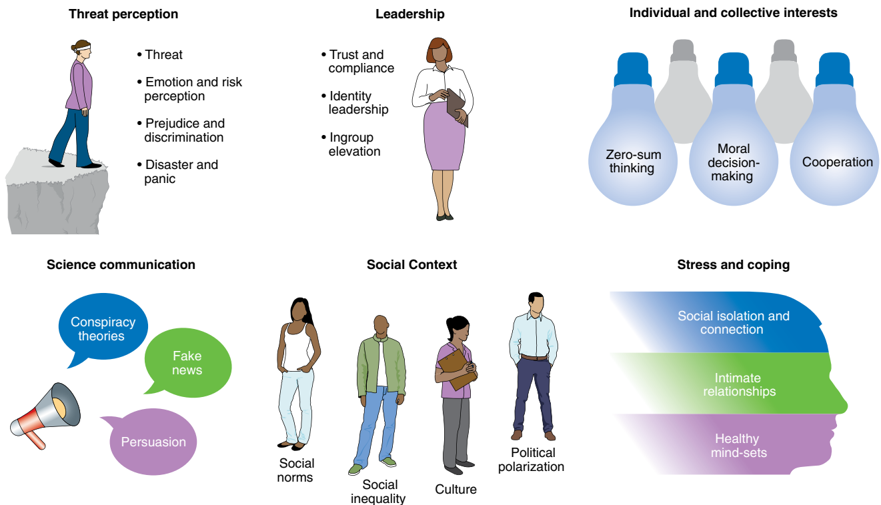
The COVID-19 pandemic represents a massive global health crisis. Because the crisis requires large-scale behaviour change and places significant psychological burdens on individuals, insights from the social and behavioural sciences can be used to help align human behaviour with the recommendations of epidemiologists and public health experts. Here we discuss evidence from a selection of research topics relevant to pandemics, including work on navigating threats, social and cultural influences on behaviour, science communication, moral decision-making, leadership, and stress and coping. In each section, we note the nature and quality of prior research, including uncertainty and unsettled issues. We identify several insights for effective response to the COVID-19 pandemic and highlight important gaps researchers should move quickly to fill in the coming weeks and months.
Overview
CoChat Summary
TL;DR
This perspective argues that social and behavioural science can help align public behaviour with COVID-19 public health recommendations across threat perception, social context, science communication, cooperation, leadership, and stress/coping. It synthesizes prior evidence and policy insights while cautioning that evidence is limited, often drawn from non-pandemic contexts, and in many areas unsettled.
Key findings
- The paper notes the scale of infectious disease threats: the bubonic plague killed approximately 25% of the European population, and by March 2020 COVID-19 had spread to more than 118,000 cases and caused 4,291 deaths in 114 countries. It also notes that 21 countries donated medical supplies to China in February, with China reciprocating widely.
- Fear appeals can change behaviour when people feel capable of dealing with the threat, but produce defensive reactions when people feel helpless; optimism bias can lead people to underestimate personal risk and ignore public health warnings.
- Social norms, inequality, culture, and political polarization shape pandemic behaviour: correcting misperceived norms can help when most people are already doing the desirable behaviour, but descriptive norms can backfire if the behaviour is undesirable unless paired with prescriptive norms.
- Effective communication and leadership may involve credible sources, messages that protect others or align with moral values, prebunking/inoculation against misinformation, accuracy nudges, shared social identity, and leaders modelling prosocial sacrifice; excessive national self-image concerns (“collective narcissism”) can backfire.
Methods
- Design: Perspective/narrative review; no primary data collection or sample. Topics were identified by the corresponding authors as potentially relevant to pandemic response and are explicitly not exhaustive.
- Evidence base: synthesizes prior social and behavioural research on threat perception, social context, science communication, moral decision-making, cooperation, leadership, and stress/coping, drawing on laboratory experiments, correlational studies, field experiments, meta-analyses, and preprints/forthcoming work.
- Analysis: narrative synthesis with policy implications and identified research gaps; no systematic search strategy or quantitative synthesis is reported.
Limitations
- Stated: due to space constraints, the paper provides only a brief summary of each topic; research on these topics is ongoing and in many cases far from settled; there is very little published social science research on the current pandemic, so discussion often draws from different circumstances and evidence quality varies substantially.
- Stated: insights and policy implications should be interpreted with caution.
- Evident: as a perspective rather than a systematic review or empirical study, it does not provide a comprehensive evidence appraisal, and its reliance on preprints and forthcoming sources limits certainty.
Model-written summary. Check it against the paper before relying on it.
Integrity signals
Registry
Cites
Statistics
Figures
Verification
Claims the paper makes
19 Valid · 5 Not valid · 37 Not checked · 13 Own results and interpretations
At least one cited source doesn’t support this claim or points to a different paper, and none confirmed it — see the verdicts below.
In the paper
“For instance, in hypothetical scenarios about deciding whether to go to work while sick, American and British participants reported they would be less willing to stay home when it was uncertain they would infect a co-worker.”
What the sources say
- Disputedcites [176] Kappes, A. et al. Uncertainty about the impact of social decisions increases prosocial behaviour. Nat. Hum. Behav. 2, 573–580 (2018). sourceExperimental — accuracy not yet measured
In the paper’s account of the infectious-disease scenario (Abstract; page not provided), participants facing uncertainty about how severely a co-worker might be affected were more likely to stay home than controls, not less. The paper distinguishes that impact uncertainty from uncertainty about whether a co-worker would be infected. Its Study 6 Methods (page not provided) describe recruitment through AMT, but do not establish the claimed American and British participant groups. (LLM, conf=0.88)
Checked by a reasoning model — may be wrong.
hedgedstates an association- Asserted: passes — The authors put it forward as true.
- Checkable: passes — It can be checked against evidence.
- Load-bearing: passes — The paper’s conclusions depend on it.
- Based: passes — The paper gives a reason why it holds.
- Disputed
The cited sources that could be checked couldn’t confirm or dispute this claim.
In the paper
“Moreover, there is mixed research regarding whether corrections may actually increase belief in the original misinformation 121,124-126 or in other misleading claims that fail to get corrected 127 .”
What the sources say
- Not checked — no full text of the sourcecites [121] Guess, A. & Coppock, A. Does counter-attitudinal information cause backlash? Results from three large survey experiments. Br. J. Polit. Sci. https://doi.org/10.1017/S0007123418000327 (2018). source
- Not matchedcites [124] Wittenberg, C. & Berinsky, A.J. Misinformation and its correction. in Social Media and Democracy: The State of the Field (eds Persily, N. & Tucker, J. A.) (Cambridge University Press, forthcoming).
Its entry has no title and year that we can search by.
- Not checked — no full text of the sourcecites [125] Swire, B. & Ecker, U.K.H. Misinformation and its correction: Cognitive mechanisms and recommendations for mass communication. in Misinformation and Mass Audiences (eds. Southwell, B. G., Thorson, E. A. & Sheble, L.) 195–2011 (University of Texas Press, 2018). source
- Not checked — no full text of the sourcecites [126] Wood, T. & Porter, E. The elusive backfire effect: mass attitudes’ steadfast factual adherence. Polit. Behav. 41, 135–163 (2018). source
- Could not verifycites [127] Pennycook, G., McPhetres, J., Zhang, Y. & Rand, D. Fighting COVID-19 misinformation on social media: Experimental evidence for a scalable accuracy nudge intervention. Preprint at PsyArXiv https://doi.org/10.31234/osf.io/uhbk9 (2020). sourceExperimental — accuracy not yet measured
Citation 127 is attached to the suggestion that corrections may increase belief in other misleading claims that go uncorrected. The Statement of Relevance and Discussion describe an accuracy nudge that improved sharing decisions, not corrections or their effects on belief in uncorrected claims. Searches for correction backfire and uncorrected misinformation found no passage addressing that point; page numbers were unavailable in our copy. (LLM, conf=0.76)
hedgedstates a possible cause- Asserted: passes — The authors put it forward as true.
- Checkable: passes — It can be checked against evidence.
- Load-bearing: passes — The paper’s conclusions depend on it.
- Based: passes — The paper gives a reason why it holds.
The sources with a verdict support this claim; the rest weren’t checked yet, have no full text we could read, or their verdicts aren’t rated yet.
In the paper
“Indeed, laboratory research has found that people prioritize local over global (or international) interests 185,186 .”
What the sources say
- Supportedcites [185] Milinski, M., Hilbe, C., Semmann, D., Sommerfeld, R. & Marotzke, J. Humans choose representatives who enforce cooperation in social dilemmas through extortion. Nat. Commun. 7, 10915 (2016). source
The Results section (‘Voters choose selfish representatives’; page unavailable) reports that participants preferentially re-elected representatives who contributed less to the shared climate account and elected candidates who pledged to contribute less than a fair share. In this simulated international dilemma, that supports the claim that participants favored their own group’s interests over the collective goal; it does not establish that everyone did so. (LLM, conf=0.85)
- Not checked — no full text of the sourcecites [186] Reinders Folmer, C. P. et al. One for all: what representing a group may do to us. J. Exp. Soc. Psychol. 48, 1047–1056 (2012). source
plain- Asserted: passes — The authors put it forward as true.
- Checkable: passes — It can be checked against evidence.
- Load-bearing: passes — The paper’s conclusions depend on it.
- Based: passes — The paper gives a reason why it holds.
- Supported
Every source the paper cites for this claim was checked and supports it.
In the paper
“However, when going to work risked infecting an elderly co-worker who would suffer a serious illness, participants reported they would be more willing to stay home 176 .”
What the sources say
- Supportedcites [176] Kappes, A. et al. Uncertainty about the impact of social decisions increases prosocial behaviour. Nat. Hum. Behav. 2, 573–580 (2018). source
The Study 6 Methods (page not provided) describe a scenario in which going to work could infect an older, vulnerable co-worker who would suffer severely, followed by a rating of willingness to go to work. The reported Study 6 findings (indexed under Abstract; page not provided) say participants given that risk information were significantly more likely to stay home than controls. (LLM, conf=0.92)
hedgedstates a cause- Asserted: passes — The authors put it forward as true.
- Checkable: passes — It can be checked against evidence.
- Load-bearing: passes — The paper’s conclusions depend on it.
- Based: passes — The paper gives a reason why it holds.
- Supported
The sources with a verdict support this claim; the rest weren’t checked yet, have no full text we could read, or their verdicts aren’t rated yet.
In the paper
“Several techniques, such as sanctioning defectors 187 or rewarding cooperators 188 , tend to increase cooperative behaviour in laboratory experiments using economic games.”
What the sources say
- Not checked — no full text of the sourcecites [187] Yamagishi, T. The provision of a sanctioning system as a public good. J. Pers. Soc. Psychol. 51, 110–116 (1986). source
- Supportedcites [188] Rand, D. G., Dreber, A., Ellingsen, T., Fudenberg, D. & Nowak, M. A. Positive interactions promote public cooperation. Science 325, 1272–1275 (2009). source
Citation 188 is attached to rewarding cooperators. The paper’s Abstract reports a laboratory comparison using repeated public goods games and finds that reward maintained public cooperation and, when both reward and punishment were available, increased contributions. (LLM, conf=0.93)
plainstates a cause- Asserted: passes — The authors put it forward as true.
- Checkable: passes — It can be checked against evidence.
- Load-bearing: unclear — It is unclear whether the paper’s conclusions depend on it.
- Based: passes — The paper gives a reason why it holds.
50 more claims · 13 with their cited sources checked
Create a free account to see all 74 claims and to verify the 2 references still open.
- It may state two separate claims as one. 13
- Probably not a substantial claim. 6
Claims other papers make about this one
Each is checked against this paper’s own text: does it say what the citing paper says it does?
The source backs part of the claim, not all of it — or backs it for a different population, condition or comparison.
In the citing paper
“COVID-19 is an international public health crisis, putting substantial burden on medical centers and increasing the psychological toll on health care workers (HCW).”
From Supporting the well-being of health care providers during the COVID-19 pandemic: The CopeColumbia response (2020) · cites this paper as [6]
Experimental — accuracy not yet measuredThe source backs part of the claim, not all of it — or backs it for a different population, condition or comparison.
In the citing paper
“these population-wide measures affected psychological well-being and mental health as well as increased social isolation [68] and loneliness.”
From Psychological correlates of perceived loneliness in college students before and during the COVID-19 stay-at-home period: a longitudinal study (2023) · cites this paper as [68]
Experimental — accuracy not yet measuredThe source backs part of the claim, not all of it — or backs it for a different population, condition or comparison.
In the citing paper
“they may eventually increase the social isolation of students and affect their psychological well-being and mental health [3].”
From Students under lockdown: Comparisons of students’ social networks and mental health before and during the COVID-19 crisis in Switzerland (2020) · cites this paper as [3]
Experimental — accuracy not yet measuredThe source backs part of the claim, not all of it — or backs it for a different population, condition or comparison.
In the citing paper
“effective interventions are hard to scale to a population level (12);”
From Psychological inoculation improves resilience against misinformation on social media (2022) · cites this paper as [12]
Experimental — accuracy not yet measuredThe source backs part of the claim, not all of it — or backs it for a different population, condition or comparison.
In the citing paper
“There is a shortage of studies that test anti-misinformation interventions in an ecologically valid manner, i.e., testing an intervention as consumers would interact with it in online environments (8, 12).”
From Psychological inoculation improves resilience against misinformation on social media (2022) · cites this paper as [12]
Experimental — accuracy not yet measured
6 more claims about this paper
Create a free account to see every claim other papers make about this one.
Citations
Cites
Granovetter, M. S. (1973) · American Journal of Sociology · doi:10.1086/225469 · Cited by 40,491
Zhou, F., Yu, T., Du, R., Fan, G., Liu, Y., Liu, Z., Xiang, J., Wang, Y., Song, B., Gu, X., et al. (2020) · The Lancet · doi:10.1016/s0140-6736(20)30566-3 · Cited by 27,263
The need to belong: Desire for interpersonal attachments as a fundamental human motivation.
Baumeister, R. F., & Leary, M. R. (1995) · Psychological Bulletin · doi:10.1037//0033-2909.117.3.497 · Cited by 23,245
Culture and the self: Implications for cognition, emotion, and motivation.
Markus, H. R., & Kitayama, S. (1991) · Psychological Review · doi:10.1037/0033-295x.98.2.224 · Cited by 21,995
Self-citationThe Psychological Impact of Quarantine and How to Reduce It: Rapid Review of the Evidence
Brooks, S. K., Webster, R. K., Smith, L. E., Woodland, L., Wessely, S., Greenberg, N., & Rubin, G. J. (2020) · doi:10.2139/ssrn.3532534 · Cited by 16,394
The psychological impact of quarantine and how to reduce it: Rapid review of the evidence
Brooks, S. K., Webster, R. K., Smith, L. E., Woodland, L., Wessely, S., Greenberg, N., & Rubin, G. J. (2020) · The Lancet · doi:10.1016/s0140-6736(20)30460-8 · Cited by 16,378
Nudge: improving decisions about health, wealth, and happiness
(2008) · Choice Reviews Online · doi:10.5860/choice.46-0977 · Cited by 11,572
Slovic, P. (1987) · Science · doi:10.1126/science.3563507 · Cited by 9,271
The Elaboration Likelihood Model of Persuasion
Petty, R. E., & Cacioppo, J. T. (1986) · Advances in Experimental Social Psychology · doi:10.1016/s0065-2601(08)60214-2 · Cited by 8,822
Self-citationThe emotional dog and its rational tail: A social intuitionist approach to moral judgment.
Haidt, J. (2001) · Psychological Review · doi:10.1037/0033-295x.108.4.814 · Cited by 8,048
Research works printed but not linked: 3
- Berkowitz, A.D. An overview of the social norms approach. in Changing the Culture of College Drinking: A Socially Situated Health Communication Campaign (eds. Stewart, L. & Lederman, L. C.) 193–214 (Hampton Press, 2005).
- Wittenberg, C. & Berinsky, A.J. Misinformation and its correction. in Social Media and Democracy: The State of the Field (eds Persily, N. & Tucker, J. A.) (Cambridge University Press, forthcoming).
- Ransohoff, K.J. Patients on the Trolley Track: The Moral Cognition of Medical Practitioners and Public Health Professionals. (Harvard Univ. Press, 2011).
Cited by
Items 601–700 of 5,015
How to study democratic backsliding
Druckman, J. N. (2024) · Political Psychology · doi:10.1111/pops.12942 · Cited by 56
Self-citationReuken, P. A., Rauchfuß, F., Albers, S., Settmacher, U., Trautwein, C., Bruns, T., & Stallmach, A. (2020) · American Journal of Transplantation · doi:10.1111/ajt.16118 · Cited by 57
Al-Hasan, A., Khuntia, J., & Yim, D. (2020) · Journal of Medical Internet Research · doi:10.2196/23019 · Cited by 64
“One of the primary emotional responses during a pandemic is fear [53].”
Backgroundde Sousa, Á. F. L., Queiroz, A. A. F. L. N., Lima, S. V. M. A., Almeida, P. D., de Oliveira, L. B., Chone, J. S., de Araújo, T. M. E., Brignol, S., de Sousa, A. R., Mendes, I. A. C., et al. (2020) · Cadernos de Saúde Pública · doi:10.1590/0102-311x00202420 · Cited by 65
The Impact of Covid-19 on Smartphone Usage
Li, T., Zhang, M., Li, Y., Lagerspetz, E., Tarkoma, S., & Hui, P. (2021) · IEEE Internet of Things Journal · doi:10.1109/jiot.2021.3073864 · Cited by 60
“The Covid-19 pandemic represents a global health crisis, which will severely change the psychological burdens and physical activities of individuals [12].”
BackgroundPredicting vaccine uptake during COVID-19 crisis: A motivational approach
Schmitz, M., Luminet, O., Klein, O., Morbée, S., den Bergh, O. V., Oost, P. V., Waterschoot, J., Yzerbyt, V. Y., & Vansteenkiste, M. (2021) · Vaccine · doi:10.1016/j.vaccine.2021.11.068 · Cited by 56
“, its secondary effects, effectiveness) and countering fake news as well as conspiracy theories (see [38,39]).”
Well-Being and the COVID-19 Pandemic: A Community Psychology Systematic Review
Esposito, C., Napoli, I. D., Agueli, B., Marino, L., Procentese, F., & Arcidiacono, C. (2021) · European Psychologist · doi:10.1027/1016-9040/a000468 · Cited by 64
COVID-19 Adaptive Interventions: Implications for Wellbeing and Quality-of-Life
Ramkissoon, H. R. (2022) · Frontiers in Psychology · doi:10.3389/fpsyg.2022.810951 · Cited by 65
“The proposed conceptual framework draws on multidisciplinary research streams including traditional health, and complementary and integrative medicine, behavioral and environmental psychology, and sociology (e.g., Bavel et al., 2020; Tillu et al., 2020; Ting et al., 2020; Ramkissoon, 2021a,b, 2022).”
BackgroundSeyd, B., & Bu, F. (2022) · European Political Science Review · doi:10.1017/s1755773922000078 · Cited by 77
Vranić, A., Hromatko, I., & Tonković, M. (2022) · Frontiers in Psychology · doi:10.3389/fpsyg.2022.931865 · Cited by 75
The Erosion of Trust During a Global Pandemic and How Public Administrators Should Counter It
Deslatte, A. (2020) · The American Review of Public Administration · doi:10.1177/0275074020941676 · Cited by 62
“Van Bavel, J. J., Baicker, K., Boggio, P. S., Capraro, V., Cichocka, A., Cikara, M., . . . Willer, R. (2020).”
BackgroundInfluentialA path forward for qualitative research on sustainability in the COVID-19 pandemic
Santana, F. N., Wagner, C. H., Rubin, N. B., Bloomfield, L. S. P., Bower, E., Fischer, S. L., Santos, B. S., Smith, G., Muraida, C., & Wong‐Parodi, G. (2021) · Sustainability Science · doi:10.1007/s11625-020-00894-8 · Cited by 72
Social Distance during the COVID-19 Pandemic Reflects Perceived Rather Than Actual Risk
Iachini, T., Frassinetti, F., Ruotolo, F., Sbordone, F. L., Ferrara, A., Arioli, M., Pazzaglia, F., Bosco, A., Candini, M., Lopez, A., et al. (2021) · International Journal of Environmental Research and Public Health · doi:10.3390/ijerph18115504 · Cited by 58
Desensitization to Fear-Inducing COVID-19 Health News on Twitter: Observational Study
Stevens, H., Oh, Y. J., & Taylor, L. D. (2021) · JMIR Infodemiology · doi:10.2196/26876 · Cited by 63
“Social scientists have tried to inform interventions aimed at promoting compliance with public health experts [49].”
BackgroundNurse, M. S., Ross, R. M., İşler, O., & Rooy, D. V. (2021) · Memory & Cognition · doi:10.3758/s13421-021-01219-5 · Cited by 58
Connecting Self-Reported Social Distancing to Real-World Behavior During the COVID-19 PandemicPreprint
Gollwitzer, A., McLoughlin, K. L., Martel, C., Marshall, J., Höhs, J. M., & Bargh, J. A. (2020) · PsyArXiv (OSF Preprints) · doi:10.31234/osf.io/kvnwp · Cited by 61
A purpose-action framework for Corporate Social Responsibility in times of shock
Forcadell, F. J., & Aracil, E. (2021) · Journal of Cleaner Production · doi:10.1016/j.jclepro.2021.127789 · Cited by 57
Viruses, vaccines, and COVID-19: Explaining and improving risky decision-making.
Reyna, V. F., Broniatowski, D. A., & Edelson, S. M. (2021) · Journal of Applied Research in Memory and Cognition · doi:10.1016/j.jarmac.2021.08.004 · Cited by 65
“In their summary, Bavel et al. (2020) acknowledge that emotions often drive perceptions more than objective facts about costs and benefits.”
BackgroundInfluentialPolitical endorsement by Nature and trust in scientific expertise during COVID-19
Zhang, F. J. (2023) · Nature Human Behaviour · doi:10.1038/s41562-023-01537-5 · Cited by 68
dos Santos, M. M., Lucena, E. E. D. S., de Lima, K. C., de Brito, A. A. C., Bay, M. B., & Bonfada, D. (2020) · Epidemiology and Infection · doi:10.1017/s0950268820002034 · Cited by 57
“Underprivileged people are at higher risk of infection and death from COVID-19, and they have less access to care due to systems that treat health as a commodity and not a human right [14, 15].”
BackgroundTrading Health for Wealth: The Effect of COVID-19 Response Stringency
Cross, M., Ng, S., & Scuffham, P. (2020) · International Journal of Environmental Research and Public Health · doi:10.3390/ijerph17238725 · Cited by 64
Nicholson, E., McDonnell, T., Conlon, C., Barrett, M. J., Cummins, F., Hensey, C. C., & McAuliffe, É. (2020) · International Journal of Environmental Research and Public Health · doi:10.3390/ijerph17249264 · Cited by 56
“Moreover, economic uncertainty and social isolation may increase anxiety and stress [25].”
BackgroundCharacterizing network dynamics of online hate communities around the COVID-19 pandemic
Uyheng, J., & Carley, K. M. (2021) · Applied Network Science · doi:10.1007/s41109-021-00362-x · Cited by 71
Demirtaş-Madran, H. A. (2021) · Frontiers in Psychology · doi:10.3389/fpsyg.2021.558437 · Cited by 69
“The importance given to social norms and the suppression of individual interests has been seen to result in greater levels of compliance with rules in such cultures (Bavel et al., 2020).”
BackgroundInfluentialGlöckner, A., Dorrough, A. R., Wingen, T., & Dohle, S. (2020) · PsyArXiv (OSF Preprints) · doi:10.31234/osf.io/wdbgc · Cited by 56
Preventing COVID-19 and Its Sequela: “There Is No Magic Bullet... It's Just Behaviors”
Allegrante, J. P., Auld, M. E., & Natarajan, S. (2020) · American Journal of Preventive Medicine · doi:10.1016/j.amepre.2020.05.004 · Cited by 59
“For example, in addition to individual threat perception, there needs to be a better understanding of other factors such as social context, how science is being communicated and the extent to which people understand and accept the science, the alignment between individual and collective interests, perceptions of leade…”
BackgroundAttitude, Perception, and Knowledge of COVID-19 Among General Public in Pakistan
Mahmood, S., Hussain, T. A., Mahmood, F., Ahmad, M., Majeed, A., Beg, B. M., & Areej, S. (2020) · Frontiers in Public Health · doi:10.3389/fpubh.2020.602434 · Cited by 72
“It will assist in better understanding of methodologies to counsel them in a way that leads to general public safety besides restraining the spread of the disease (1).”
BackgroundBayram, A. B., & Shields, T. (2021) · Social Science Quarterly · doi:10.1111/ssqu.12977 · Cited by 63
“…associated with following preventive health behaviors such as getting vaccinated (Prati, Pietrantoni, and Zani, 2011; Siegrist and Zingg, 2014 Van Bavel et al., 2020; Bangerter et al., 2012; Quinn et al., 2009) and studies specifically focused on COVID-19 have largely replicated these findings,…”
Rethinking Fake News: Disinformation and Ideology during the time of COVID-19 Global Pandemic
Das, R., & Ahmed, W. (2021) · IIM Kozhikode Society & Management Review · doi:10.1177/22779752211027382 · Cited by 65
Marchi, M., Magarini, F. M., Chiarenza, A., Galeazzi, G. M., Paloma, V., Garrido, R., Ioannidi, E., Vassilikou, K., de Matos, M. G., Gaspar, T., et al. (2022) · BMC Public Health · doi:10.1186/s12889-022-13370-y · Cited by 56
“In addition, lower levels of CARE might imply that people travel despite possible lockdown-measures or interact with others without wearing a face cover; those kinds of behaviors could be viewed as unsafe or irresponsible which might elicit discriminatory behaviors (such as refusal to provide service, harassment, and…”
BackgroundZhang, M., Chen, H., Wang, N., Li, Y., Li, X., & Liu, Y. (2023) · Frontiers in Psychiatry · doi:10.3389/fpsyt.2022.990216 · Cited by 70
“It could also develop relevant reward systems and provide promotion opportunities for outstanding performance during the pandemic (51), promote a sense of safety, and support a shared learning to meet nurses’ needs for selfrealization, improve their job satisfaction, thereby improving their work engagement.”
BackgroundCO2 emissions inequality through the lens of developing countries
Huang, R., & Tian, L. (2020) · Applied Energy · doi:10.1016/j.apenergy.2020.116043 · Cited by 57
“The World Health Organization declared a global pandemic on 11 March 2020 [1].”
BackgroundAnomalous role of information diffusion in epidemic spreading
Wang, X., Zhu, X., Tao, X., Xiao, J., Wang, W., & Lai, Y. (2021) · Physical Review Research · doi:10.1103/physrevresearch.3.013157 · Cited by 52
Naranjo-Zolotov, M., Turel, O., Oliveira, T., & Lascano, J. E. (2021) · Computers in Human Behavior · doi:10.1016/j.chb.2021.106784 · Cited by 64
Howarth, A. T., Jeanson, A. L., Abrams, A. E. I., Beaudoin, C., Mistry, I., Berberi, A., Young, N., Nguyen, V. M., Landsman, S. J., Kadykalo, A. N., et al. (2021) · Fisheries Research · doi:10.1016/j.fishres.2021.105961 · Cited by 59
Wijngaards, I., Sisouw de Zilwa, S. C. M., & Burger, M. J. (2020) · Frontiers in Psychology · doi:10.3389/fpsyg.2020.568907 · Cited by 50
How evolutionary behavioural sciences can help us understand behaviour in a pandemic
Arnot, M., Brandl, E., Campbell, O. L. K., Chen, Y., Du, J., Dyble, M., Emmott, E. H., Ge, E., Kretschmer, L., Mace, R. H., et al. (2020) · Evolution Medicine and Public Health · doi:10.1093/emph/eoaa038 · Cited by 52
“However, evolutionary frameworks do provide some guiding principles behind human decision-making, which is absent from most of the models used to inform public health policy [2].”
BackgroundMihelj, S., Kondor, K., & Štětka, V. (2021) · Journalism Studies · doi:10.1080/1461670x.2021.1931410 · Cited by 80
“…portion of existing research on media and COVID-19 is the impact of political polarization, which is seen as an important obstacle to successful implementation of preventative measures in public health crises, particularly if combined with a polarized news diet (Van Bavel et al. 2020, 464).”
BackgroundEffects of the COVID-19 pandemic on the online learning behaviors of university students in Taiwan
Hu, Y.-H. (2021) · Education and Information Technologies · doi:10.1007/s10639-021-10677-y · Cited by 61
“Some psychologists have investigated how COVID-19 has affected people’s behaviors in terms of threat perception, social backgrounds, the adjustment of personal and collective interests, stress, and coping (Bavel et al., 2020).”
BackgroundGriva, K., Tan, K. K.-Y., Chan, F. H. F., Periakaruppan, R., Ong, B. W. L., Soh, A. S., & Chen, M. I.-C. (2021) · Vaccines · doi:10.3390/vaccines9121415 · Cited by 52
A Longitudinal Nationwide Study of Psychological Distress During the COVID-19 Pandemic in Chile
Duarte, F., & Jiménez-Molina, Á. (2022) · Frontiers in Psychiatry · doi:10.3389/fpsyt.2022.744204 · Cited by 59
“Digital methods of communication have proven beneficial when physical interaction is not possible (53, 54).”
BackgroundWidmann, T. (2022) · Political Psychology · doi:10.1111/pops.12831 · Cited by 59
“, supporters of the radical right) which might lead different segments of the population to arrive at different conclusions about the threat of the pandemic (Bavel et al., 2020).”
BackgroundInfluentialA global experiment on motivating social distancing during the COVID-19 pandemic
Legate, N., Nguyen, T.-V. T., Weinstein, N., Moller, A. C., Legault, L., Vally, Z., Tajchman, Z. J., Zsido, A. N., Zrimsek, M., Chen, Z., et al. (2022) · Proceedings of the National Academy of Sciences · doi:10.1073/pnas.2111091119 · Cited by 74
“Therefore, motivating engagement in social distancing has been emphasized as a critical global public health priority by researchers (8, 9) and global policy makers (1) alike.”
BackgroundLin, S. (2022) · Journal of Affective Disorders · doi:10.1016/j.jad.2022.08.131 · Cited by 65
Dorison, C. A., Lerner, J. S., Heller, B., Rothman, A. J., Kawachi, I. I., Wang, K., Rees, V. W., Gill, B., Gibbs, N., Ebersole, C. R., et al. (2022) · Affective Science · doi:10.1007/s42761-022-00128-3 · Cited by 80
Hardin, B. S., Smith, C. V., & Jordan, L. N. (2020) · Personality and Individual Differences · doi:10.1016/j.paid.2020.110504 · Cited by 56
Towards Post-Pandemic Sustainable and Ethical Food Systems
Kaiser, M., Goldson, S. L., Buklijaš, T., Gluckman, P. D., Allen, K., Bardsley, A., & Lam, M. E. (2021) · Food Ethics · doi:10.1007/s41055-020-00084-3 · Cited by 71
Sánchez‐Arenas, R., Doubova, S. V., Pérez, M. A. G., & Pérez‐Cuevas, R. (2021) · PLoS ONE · doi:10.1371/journal.pone.0254435 · Cited by 56
“Cultural norms also influence health behaviors; countries with strict social norms and penalizations for deviance, such as China and Japan, have been more likely to impose individual and community preventive health behaviors than countries with more permissive social norms, such as Italy and Brazil [5].”
BackgroundJin, S. V., & Ryu, E. (2022) · Journal of Consumer Affairs · doi:10.1111/joca.12381 · Cited by 52
The use of health geography modeling to understand early dispersion of COVID-19 in São Paulo, Brazil
Fortaleza, C. M. C. B., Guimarães, R. B., Catão, R. D. C., Ferreira, C. P., de Almeida, G. B., VILCHES, T. N., & Pugliesi, E. A. (2021) · PLoS ONE · doi:10.1371/journal.pone.0245051 · Cited by 63
“All those characteristics may variate according to the city because the number of tests that is distributed and performed among cities is not homogeneous; the number of contacts among people changes according to the city characteristics, such as the use of public transportation [29]; and people’s adherence to social d…”
BackgroundSumner, R. C., & Kinsella, E. L. (2021) · Frontiers in Psychology · doi:10.3389/fpsyg.2021.645504 · Cited by 56
Prosociality from the perspective of environmental psychology
Klein, S. A., Nockur, L., & Reese, G. (2021) · Current Opinion in Psychology · doi:10.1016/j.copsyc.2021.09.001 · Cited by 60
Xue, N., Liu, X., Wan, L. C., & Hou, Y. (2023) · Tourism Management · doi:10.1016/j.tourman.2023.104839 · Cited by 55
Social Companion Robots to Reduce Isolation: A Perception Change Due to COVID-19
Ghafurian, M., Ellard, C. G., & Dautenhahn, K. (2021) · Lecture notes in computer science · doi:10.1007/978-3-030-85616-8_4 · Cited by 76
“[49], action is required to mitigate these devastating effects.”
BackgroundChou, W., Wang, P., Chen, S., Chang, Y., Wu, C.-F., Lu, W.-H., & Yen, C. (2020) · International Journal of Environmental Research and Public Health · doi:10.3390/ijerph17218039 · Cited by 58
“Research has indicated that social distancing and isolation from social networks were associated with negative mental health trajectories during the COVID-19 pandemic [13,14].”
BackgroundPublic health leadership in the times of COVID-19: a comparative case study of three countries
Glenn, J. D., Chaumont, C., & Dintrans, P. V. (2020) · International Journal of Public Leadership · doi:10.1108/ijpl-08-2020-0082 · Cited by 66
Challenges and Competencies of Leadership in Covid-19 Pandemic
Ţălu, Ş., & Nazarov, A. D. (2020) · Research Technologies of Pandemic Coronavirus Impact (RTCOV) · doi:10.2991/assehr.k.201105.092 · Cited by 53
“At national, organizational, and individual levels, concrete reactive and preventive measures have been taken for effective COVID-19 pandemic management [5-8].”
BackgroundPairing facts with imagined consequences improves pandemic-related risk perception
Sinclair, A. H., Hakimi, S., Stanley, M. L., Adcock, R. A., & Samanez-Larkin, G. R. (2021) · Proceedings of the National Academy of Sciences · doi:10.1073/pnas.2100970118 · Cited by 54
“The COVID-19 pandemic has created a breeding ground for conspiratorial thinking on social media (8, 79), with many Americans confidently dismissing the pandemic as a hoax (80–82).”
Almulhim, A. I., & Aina, Y. A. (2022) · Water · doi:10.3390/w14030314 · Cited by 56
“The World Health Organization (WHO) declared the disease a pandemic after it had spread to 114 countries across the world in under three months [2,3].”
BackgroundGrech, V., & Gauci, C. (2020) · Early Human Development · doi:10.1016/j.earlhumdev.2020.105258 · Cited by 51
RetractedGori, A., Topino, E., Palazzeschi, L., & Fabio, A. D. (2021) · PLoS ONE · doi:10.1371/journal.pone.0251984 · Cited by 51
“This is due to its numerous direct and indirect consequences in the psychological and social spheres [8] that could persist even after the pandemic ends [54].”
BackgroundNegative Emotion Arousal and Altruism Promoting of Online Public Stigmatization on COVID-19 Pandemic
Chen, X., Huang, C., Wang, H., Wang, W., Ni, X., & Li, Y. (2021) · Frontiers in Psychology · doi:10.3389/fpsyg.2021.652140 · Cited by 54
“This is the largest online survey agency in China, providing 2.6 million sample banks consistent with the demographic distribution of China’s netizen.”
BackgroundInfluentialJohnson, M. S., Skjerdingstad, N., Ebrahimi, O. V., Hoffart, A., & Johnson, S. U. (2021) · PLoS ONE · doi:10.1371/journal.pone.0253087 · Cited by 52
“Cultural and societal differences in terms of divergence in the response to the pandemic may also depend on varying cultural contexts and dimensions of cultural variance, which are important in understanding the divergent responses to the pandemic in general and to the lockdown measures in particular [33, 34].”
BackgroundEffects of COVID-19 Fear on Society’s Quality of Life
Demirbaş, N., & Kutlu, R. (2021) · International Journal of Mental Health and Addiction · doi:10.1007/s11469-021-00550-x · Cited by 55
“Fear is an emotional response to serious life-affecting threats such as COVID-19 (Bavel et al., 2020).”
BackgroundLeader sensemaking style in response to crisis: Consequences and insights from the COVID-19 pandemic
Medeiros, K. E., Crayne, M. P., Griffith, J. A., Hardy, J. H., & Damadzic, A. (2021) · Personality and Individual Differences · doi:10.1016/j.paid.2021.111406 · Cited by 58
Socioscientific Issues Thinking and Action in the Midst of Science-in-the-Making
Herman, B. C., Clough, M. P., & Rao, A. (2022) · Science & Education · doi:10.1007/s11191-021-00306-y · Cited by 73
“Efforts to promote more judicious decision-making can be achieved (Bavel et al., 2020; Schenk et al., 2019), but presuming and foregrounding science knowledge deficits is often incorrect and even counter-productive (NASEM, 2017).”
BackgroundKojan, L., Burbach, L., Ziefle, M., & Valdez, A. S. C. (2022) · Humanities and Social Sciences Communications · doi:10.1057/s41599-022-01098-4 · Cited by 56
“…2019; World Health Organization, 2020), also, when trying to explain this insufficiency, many of the same behavioural determinants emerge, e.g., beliefs in the efficacy of the desired behaviours, normative beliefs, and gaps between intention and behaviour (Bavel et al., 2020; Gifford et al., 2011).”
BackgroundBots Amplify and Redirect Hate Speech in Online Discourse About Racism During the COVID-19 Pandemic
Uyheng, J., Bellutta, D., & Carley, K. M. (2022) · Social Media + Society · doi:10.1177/20563051221104749 · Cited by 62
Predicting attitudinal and behavioral responses to COVID-19 pandemic using machine learning
Pavlović, T., Azevedo, F., De, K., Riaño-Moreno, J. C., Maglić, M., Gkinopoulos, T., Donnelly-Kehoe, P. A., Payán-Gómez, C., Huang, G., Kantorowicz, J., et al. (2022) · PNAS Nexus · doi:10.1093/pnasnexus/pgac093 · Cited by 48
“Thus, decision-makers may benefit from insights from the social and behavioral sciences that could explain who will adhere to or ignore advised measures (7).”
Self-citationTang, Y., & He, W. (2023) · Frontiers in Psychology · doi:10.3389/fpsyg.2023.1109569 · Cited by 88
Using review articles to address societal grand challenges
Kunisch, S., zu Knyphausen‐Aufseß, D., Bapuji Hari, B., Aguinis, H., Bansal, P., Tsui, A. S., & Pinto, J. (2023) · International Journal of Management Reviews · doi:10.1111/ijmr.12335 · Cited by 60
Homophily Based on Few Attributes Can Impede Structural Balance
Górski, P. J., Bochenina, K., Hołyst, J. A., & D’Souza, R. M. (2020) · Physical Review Letters · doi:10.1103/physrevlett.125.078302 · Cited by 49
Promoting social distancing in a pandemic: Beyond good intentions
Falco, P., & Zaccagni, S. (2021) · PLOS ONE · doi:10.1371/journal.pone.0260457 · Cited by 46
“In the absence of a cure or a vaccine, fighting a pandemic requires people to abide by certain norms of behaviour ([1]) and to follow the guidelines of authorities in a coordinated fashion ([2, 3]).”
BackgroundDynamics of behavior change in the COVID world
Moya, C., Peniche, P. C. Y. C., Kline, M. A., & Smaldino, P. E. (2020) · American Journal of Human Biology · doi:10.1002/ajhb.23485 · Cited by 55
“For example, a majority of both Republicans and Democrats reported wearing masks outside of their homes (Gadarian, Goodman, & Pepinsky, 2020) and supported major shutdown policies, at least early in the pandemic (Van Green & Tyson, 2020).”
BackgroundBacon, S. L., Lavoie, K. L., Boyle, J., Stojanovic, J., & Joyal-Desmarais, K. (2021) · BMJ Open · doi:10.1136/bmjopen-2020-046127 · Cited by 47
Nowcasting epidemics of novel pathogens: lessons from COVID-19
Wu, J. T. K., Leung, K. S. M., Lam, T. T., Ni, M. Y., Wong, C. K. H., Peiris, M. J. S., & Leung, G. M. (2021) · Nature Medicine · doi:10.1038/s41591-021-01278-w · Cited by 55
Linking Self-Reported Social Distancing to Real-World Behavior During the COVID-19 Pandemic
Gollwitzer, A., McLoughlin, K. L., Martel, C., Marshall, J., Höhs, J. M., & Bargh, J. A. (2021) · Social Psychological and Personality Science · doi:10.1177/19485506211018132 · Cited by 51
Bertin, P., Nera, K., & Delouvée, S. (2020) · doi:10.31234/osf.io/rz78k · Cited by 48
Impacts of COVID‐19 on ecology and evolutionary biology faculty in the United States
Aubry, L. M., Laverty, T. M., & Ma, Z. (2021) · Ecological Applications · doi:10.1002/eap.2265 · Cited by 51
COVID-19: the winter lockdown strategy in five European nations
Warren, G. W., Löfstedt, R. E., & Wardman, J. K. (2021) · Journal of Risk Research · doi:10.1080/13669877.2021.1891802 · Cited by 58
Lin, S. (2022) · Journal of Affective Disorders · doi:10.1016/j.jad.2022.01.100 · Cited by 55
McLamore, Q., Syropoulos, S., Leidner, B., Hirschberger, G., Young, K., Zein, R. A., Baumert, A., Bilewicz, M., Bilgen, A., van Bezouw, M. J., et al. (2022) · Scientific Reports · doi:10.1038/s41598-022-07508-6 · Cited by 56
“Both trust in science and concerns about COVID-19, in turn, were associated with greater compliance.”
BackgroundMethodInfluentialSelf-citationVallejo-Borda, J. A., Giesen, R., Basnak, P., Reyes, J. P., Lira, B. M., Beck, M. J., Hensher, D. A., & Ortúzar, J. D. D. (2022) · Transportation Research Part A Policy and Practice · doi:10.1016/j.tra.2022.08.010 · Cited by 56
The COVID-19 Contagion–Pandemic Dyad: A View from Social Sciences
Ferreira, C. M., Sá, M. J., Martins, J. G., & de Serpa, S. N. F. (2020) · Societies · doi:10.3390/soc10040077 · Cited by 53
Asri, A., Asri, V., Renerte, B., Föllmi-Heusi, F., Leuppi, J. D., Muser, J. M., Nüesch, R., Schuler, D., & Fischbacher, U. (2021) · PLoS ONE · doi:10.1371/journal.pone.0253621 · Cited by 49
Exploratory study of the hoaxes spread via WhatsApp in Spain to prevent and/or cure COVID-19
Castro, C. M., Vengut‐Climent, E., Cano‐Orón, L., & Mendoza-Poudereux, I. (2020) · Gaceta Sanitaria · doi:10.1016/j.gaceta.2020.07.008 · Cited by 45
Paolini, D., Maricchiolo, F., Pacilli, M. G., & Pagliaro, S. (2020) · Current Psychology · doi:10.1007/s12144-020-01141-0 · Cited by 62
“Lockdown has been having a profound impact both on individuals’ quality of life and well-being as well as emotional and affective stability, due to the uncertainty of the situation and the end of the pandemic (Cao et al. 2020; Cellini et al. 2020; Kachanoff et al., in press; World Health Organization 2020; Qiu et al.…”
BackgroundInfluentialAlivernini, F., Manganelli, S., Girelli, L., Cozzolino, M., Lucidi, F., & Cavicchiolo, E. (2021) · Journal of Pediatric Psychology · doi:10.1093/jpepsy/jsaa122 · Cited by 46
West, T. N., Nguyen, K. D. L., Zhou, J., Prinzing, M., Wells, J. L., & Fredrickson, B. L. (2021) · Affective Science · doi:10.1007/s42761-021-00035-z · Cited by 57
“Resistance to new public policy (re: social distancing, mask wearing) appears typical in countries with “loose” government and social structures, in which high tolerance exists for deviations from social norms and rules (Gelfand et al., 2011; Van Bavel et al., 2020).”
BackgroundInfluentialGualda, E., Krouwel, A. P. M., Palacios-Gálvez, M., Morales-Marente, E., Pascual, I. R., & Garcia-Navarro, E. B. (2021) · Frontiers in Psychology · doi:10.3389/fpsyg.2021.727225 · Cited by 49
“Conspiracy theories related to COVID-19 have appeared since the beginning of the pandemic, and have been maintained over time (Van Bavel et al., 2020).”
BackgroundMethodInfluentialHerd immunity and a vaccination game: An experimental study
Lim, W., & Zhang, P. (2020) · PLoS ONE · doi:10.1371/journal.pone.0232652 · Cited by 47
Liekefett, L., & Becker, J. C. (2021) · British Journal of Social Psychology · doi:10.1111/bjso.12439 · Cited by 60
Aiello, L. M., Quercia, D., Zhou, K., Constantinides, M., Šćepanović, S., & Joglekar, S. P. (2021) · Humanities and Social Sciences Communications · doi:10.1057/s41599-021-00861-3 · Cited by 60
“Epidemics, in particular, present not only collective health hazards but also special challenges to mental health and public order that need to be addressed by social and behavioral sciences (Van Bavel et al., 2020).”
BackgroundÖzkan, B., Özceylan, E., Kabak, M., & Dikmen, A. U. (2021) · Computer Methods and Programs in Biomedicine · doi:10.1016/j.cmpb.2021.106348 · Cited by 48
Kurt, G., İlkkurşun, Z., Javanbakht, A., Uygun, E., Kahiloğulları, A. K., & Acartürk, C. (2021) · International Journal of Intercultural Relations · doi:10.1016/j.ijintrel.2021.09.009 · Cited by 50
“…survivors of human-made and natural disasters, disadvantaged groups including refugees, and those going through significant changes in their lives (Betancourt et al., 2015; Hobfoll, Johnson, Ennis, & Jackson, 2003; Hobfoll, Tracy, & Galea, 2006; Smith & Freedy, 2000; Topa, Jiménez, Valero, &…”
Exposure to the COVID-19 pandemic environment and generosity
Brañas‐Garza, P., Jorrat, D., Alfonso, A., Espín, A. M., Muñoz, T. G., & Kovářík, J. (2022) · Royal Society Open Science · doi:10.1098/rsos.210919 · Cited by 56
“That is, prosocial motives are fundamental for COVID-19 prevention (see also [7]).”
Using Social and Behavioral Science to Support COVID-19 Pandemic Response
Cucchiarini, V., Lunn, P., Robertson, D. A., & Viale, R. (2023) · Springer eBooks · doi:10.1007/978-3-319-57365-6_319-1 · Cited by 49
Kachanoff, F. J., Bigman, Y., Kapsaskis, K., & Gray, K. J. (2020) · PsyArXiv (OSF Preprints) · doi:10.31234/osf.io/5zr3w · Cited by 50
A Framework for the Computational Linguistic Analysis of Dehumanization
Mendelsohn, J., Tsvetkov, Y., & Jurafsky, D. (2020) · Frontiers in Artificial Intelligence · doi:10.3389/frai.2020.00055 · Cited by 213
Karl, J. A., Fischer, R. D., Druică, E., Musso, F., & Stan, A. (2022) · Frontiers in Psychology · doi:10.3389/fpsyg.2021.627575 · Cited by 76
Metadata
- Authors
- Bavel, J. J. V., Baicker, K., Boggio, P. S., Capraro, V., Cichocka, A., Cikara, M., Crockett, M. J., Crum, A. J., Douglas, K. M., Druckman, J. N., Drury, J., Dube, O., Ellemers, N., Finkel, E. J., Fowler, J. H., Gelfand, M., Han, S., Haslam, S. A., Jetten, J., Kitayama, S., Mobbs, D., Napper, L. E., Packer, D. J., Pennycook, G., Peters, E., Petty, R. E., Rand, D. G., Reicher, S. D., Schnall, S., Shariff, A., Skitka, L. J., Smith, S. S., Sunstein, C. R., Tabri, N., Tucker, J. A., Linden, S. V. D., Lange, P. V., Weeden, K. A., Wohl, M. J. A., Zaki, J., Zion, S. R., & Willer, R.
- Affiliations
- New York University (US)
- Universidade Presbiteriana Mackenzie (BR)
- Middlesex University London (GB)
- University of Kent (GB)
- Harvard University (US)
- Yale University (US)
- Stanford University (US)
- Northwestern University (US)
- University of Sussex (GB)
- University of Chicago (US)
- Utrecht University (NL)
- University of California San Diego (US)
- University of Maryland, College Park (US)
- Peking University (CN)
- The University of Queensland (AU)
- University of Michigan (US)
- California Institute of Technology (US)
- Lehigh University (US)
- University of Regina (CA)
- University of Oregon (US)
- The Ohio State University (US)
- Massachusetts Institute of Technology (US)
- University of St Andrews (GB)
- University of Cambridge (GB)
- University of British Columbia (CA)
- University of Illinois Chicago (US)
- University of California, Berkeley (US)
- Carleton University (CA)
- Cornell University (US)
- Corresponding author
- Bavel, Jay J. Van
- Willer, Robb
- ORCID
- Bavel, Jay J. Van
- Baicker, Katherine
- Boggio, Paulo S.
- Capraro, Valerio
- Cichocka, Aleksandra
- Cikara, Mina
- Crockett, Molly J.
- Crum, Alia J.
- Douglas, Karen M.
- Druckman, James N.
- Drury, John
- Ellemers, Naomi
- Finkel, Eli J.
- Fowler, James H.
- Gelfand, Michele
- Han, Shihui
- Haslam, S. Alexander
- Jetten, Jolanda
- Kitayama, Shinobu
- Mobbs, Dean
- Napper, Lucy E.
- Packer, Dominic J.
- Pennycook, Gordon
- Peters, Ellen
- Petty, Richard E.
- Rand, David G.
- Reicher, Stephen D.
- Schnall, Simone
- Shariff, Azim
- Skitka, Linda J.
- Sunstein, Cass R.
- Tabri, Nassim
- Tucker, Joshua A.
- Linden, Sander van der
- Weeden, Kim A.
- Wohl, Michael J. A.
- Zaki, Jamil
- Zion, Sean R.
- Willer, Robb
- Venue
- Nature Human Behaviour
- Published
- 2020-04-30
- Volume
- 4
- Issue
- 5
- Pages
- 460-471
- ISSN
- 2397-3374 (ISSN-L)
- OpenAlex
- W3016902371
- Semantic Scholar
- d81abcd7f053b136423f1e7f57928524e8b0e1a0
- Cited by
- 4,964
- References
- 259
- Citations by year
- 2026: 177 · 2025: 288 · 2024: 483 · 2023: 741 · 2022: 1094 · 2021: 1474 · 2020: 702
- FWCI
- 175.81
- Type
- journal article
- Language
- en
- Open access
- bronze
- doi.org
- Licence
- www.springernature.com/gp/researchers/text-and-data-mining (tdm)
- www.springernature.com/gp/researchers/text-and-data-mining (vor)
- Locations
- Nature Human Behaviour (publishedVersion)
- PubMed (publishedVersion)
- Middlesex University Research Repository (Middlesex University Of London) (acceptedVersion)
- Kent Academic Repository (University of Kent) (acceptedVersion)
- DSpace@MIT (Massachusetts Institute of Technology) (submittedVersion, cc-by-nc-sa)
- Sussex Research Online (University of Sussex) (submittedVersion)
- CaltechAUTHORS (California Institute of Technology) (submittedVersion)
- RePEc: Research Papers in Economics (submittedVersion)
- BOA (University of Milano-Bicocca) (submittedVersion)
- Carleton University's Institutional Repository (MacOdrum Library, Carleton University) (submittedVersion, other-oa)
- Utrecht University Repository (Utrecht University) (submittedVersion)
- Figshare (submittedVersion)
- VU Research Portal (submittedVersion, other-oa)
- Utrecht University Repository (Utrecht University) (submittedVersion, other-oa)
- Data Archiving and Networked Services (DANS) (submittedVersion, other-oa)
- Funders
- U.S. Department of Health and Human Services (2P50 MH094258)
- National Institute of Mental Health (P50MH094258)
- Topics
- Social Sciences › Sociology and Political Science › COVID-19 Prevention and Impact
- Social Sciences › Communication › Communication and COVID-19 Impact
- Physical Sciences › Mathematics › Modeling and Simulation › COVID-19 epidemiological studies
- Keywords
- COVID-19 pandemic, pandemic response, behavior change, science communication, ethical decision-making, leadership, stress coping, psychological burden, public health recommendations
- MeSH terms
- Betacoronavirus, COVID-19, SARS-CoV-2, Adaptation, Psychological, Communicable Disease Control, Decision Making, Humans, Human Activities, Health Knowledge, Attitudes, Practice, Leadership, Pneumonia, Viral, Public Health, Quarantine, Stress, Psychological, Global Health, Coronavirus, Coronavirus Infections, Pandemics, Social Media, Epidemiological Monitoring
About these checks
Registry, retraction, Cites and statistics results are computed, not judged, with one exception: a printed reference that no index lists is read once by a model before it counts as a citation error. Claims are extracted by a model and kept only when their quote appears verbatim in the text; each cited source is then checked, with a model’s help, for whether it says what the claim relies on. Those verdicts can be wrong — read the claim’s quote and the cited source before relying on one.
The claim verdicts this report counts are experimental: their accuracy is not yet measured.
A language model drew the claims from the paper on 2026-10-10, under version 3 of the claim definition (model deepseek-v4.1-flash, prompt extract-v3).
A second model labelled each claim on 2026-10-10 (model jev-1.13-20260917, definition revision gold-guideline-v0.2).
Cited sources are checked with a language model’s help (gpt-6-sol).
Statistics and arithmetic are recomputed, not judged.
Confidence bands are shown only for fields calibrated on our annotated test set. None is calibrated yet, so no band is shown.
What counts as a claim ›How we measure confidence ›How we check this ›
Are you an author, or do you see a problem with this page? Request a review
Data sources
Bibliographic data: Semantic Scholar, OpenAlex, Crossref.
Contains information from the Semantic Scholar Academic Graph Datasets, made available under the ODC Attribution License (ODC-BY 1.0).
Semantic Scholar’s data is described in: Kinney, R., et al. (2023). The Semantic Scholar Open Data Platform. arXiv:2301.10140.
