

Using social and behavioural science to support COVID-19 pandemic response
Open accessThe DOI matches its Crossref record; 257 of the 259 references it cites were found in a registry or an index; 24 of the 89 sources its claims cite were checked for support.
Abstract
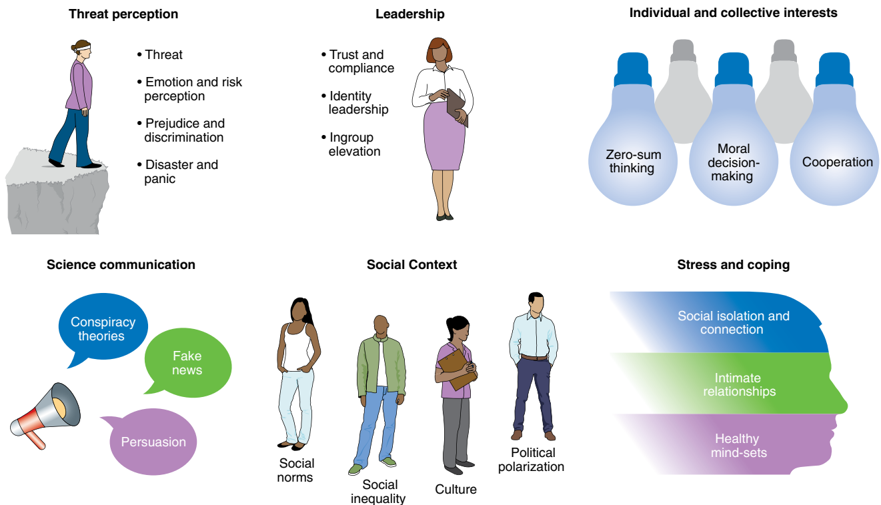
The COVID-19 pandemic represents a massive global health crisis. Because the crisis requires large-scale behaviour change and places significant psychological burdens on individuals, insights from the social and behavioural sciences can be used to help align human behaviour with the recommendations of epidemiologists and public health experts. Here we discuss evidence from a selection of research topics relevant to pandemics, including work on navigating threats, social and cultural influences on behaviour, science communication, moral decision-making, leadership, and stress and coping. In each section, we note the nature and quality of prior research, including uncertainty and unsettled issues. We identify several insights for effective response to the COVID-19 pandemic and highlight important gaps researchers should move quickly to fill in the coming weeks and months.
Overview
CoChat Summary
TL;DR
This perspective argues that social and behavioural science can help align public behaviour with COVID-19 public health recommendations across threat perception, social context, science communication, cooperation, leadership, and stress/coping. It synthesizes prior evidence and policy insights while cautioning that evidence is limited, often drawn from non-pandemic contexts, and in many areas unsettled.
Key findings
- The paper notes the scale of infectious disease threats: the bubonic plague killed approximately 25% of the European population, and by March 2020 COVID-19 had spread to more than 118,000 cases and caused 4,291 deaths in 114 countries. It also notes that 21 countries donated medical supplies to China in February, with China reciprocating widely.
- Fear appeals can change behaviour when people feel capable of dealing with the threat, but produce defensive reactions when people feel helpless; optimism bias can lead people to underestimate personal risk and ignore public health warnings.
- Social norms, inequality, culture, and political polarization shape pandemic behaviour: correcting misperceived norms can help when most people are already doing the desirable behaviour, but descriptive norms can backfire if the behaviour is undesirable unless paired with prescriptive norms.
- Effective communication and leadership may involve credible sources, messages that protect others or align with moral values, prebunking/inoculation against misinformation, accuracy nudges, shared social identity, and leaders modelling prosocial sacrifice; excessive national self-image concerns (“collective narcissism”) can backfire.
Methods
- Design: Perspective/narrative review; no primary data collection or sample. Topics were identified by the corresponding authors as potentially relevant to pandemic response and are explicitly not exhaustive.
- Evidence base: synthesizes prior social and behavioural research on threat perception, social context, science communication, moral decision-making, cooperation, leadership, and stress/coping, drawing on laboratory experiments, correlational studies, field experiments, meta-analyses, and preprints/forthcoming work.
- Analysis: narrative synthesis with policy implications and identified research gaps; no systematic search strategy or quantitative synthesis is reported.
Limitations
- Stated: due to space constraints, the paper provides only a brief summary of each topic; research on these topics is ongoing and in many cases far from settled; there is very little published social science research on the current pandemic, so discussion often draws from different circumstances and evidence quality varies substantially.
- Stated: insights and policy implications should be interpreted with caution.
- Evident: as a perspective rather than a systematic review or empirical study, it does not provide a comprehensive evidence appraisal, and its reliance on preprints and forthcoming sources limits certainty.
Model-written summary. Check it against the paper before relying on it.
Integrity signals
Registry
Cites
Statistics
Figures
Verification
Claims the paper makes
19 Valid · 5 Not valid · 37 Not checked · 13 Own results and interpretations
At least one cited source doesn’t support this claim or points to a different paper, and none confirmed it — see the verdicts below.
In the paper
“For instance, in hypothetical scenarios about deciding whether to go to work while sick, American and British participants reported they would be less willing to stay home when it was uncertain they would infect a co-worker.”
What the sources say
- Disputedcites [176] Kappes, A. et al. Uncertainty about the impact of social decisions increases prosocial behaviour. Nat. Hum. Behav. 2, 573–580 (2018). sourceExperimental — accuracy not yet measured
In the paper’s account of the infectious-disease scenario (Abstract; page not provided), participants facing uncertainty about how severely a co-worker might be affected were more likely to stay home than controls, not less. The paper distinguishes that impact uncertainty from uncertainty about whether a co-worker would be infected. Its Study 6 Methods (page not provided) describe recruitment through AMT, but do not establish the claimed American and British participant groups. (LLM, conf=0.88)
Checked by a reasoning model — may be wrong.
hedgedstates an association- Asserted: passes — The authors put it forward as true.
- Checkable: passes — It can be checked against evidence.
- Load-bearing: passes — The paper’s conclusions depend on it.
- Based: passes — The paper gives a reason why it holds.
- Disputed
The cited sources that could be checked couldn’t confirm or dispute this claim.
In the paper
“Moreover, there is mixed research regarding whether corrections may actually increase belief in the original misinformation 121,124-126 or in other misleading claims that fail to get corrected 127 .”
What the sources say
- Not checked — no full text of the sourcecites [121] Guess, A. & Coppock, A. Does counter-attitudinal information cause backlash? Results from three large survey experiments. Br. J. Polit. Sci. https://doi.org/10.1017/S0007123418000327 (2018). source
- Not matchedcites [124] Wittenberg, C. & Berinsky, A.J. Misinformation and its correction. in Social Media and Democracy: The State of the Field (eds Persily, N. & Tucker, J. A.) (Cambridge University Press, forthcoming).
Its entry has no title and year that we can search by.
- Not checked — no full text of the sourcecites [125] Swire, B. & Ecker, U.K.H. Misinformation and its correction: Cognitive mechanisms and recommendations for mass communication. in Misinformation and Mass Audiences (eds. Southwell, B. G., Thorson, E. A. & Sheble, L.) 195–2011 (University of Texas Press, 2018). source
- Not checked — no full text of the sourcecites [126] Wood, T. & Porter, E. The elusive backfire effect: mass attitudes’ steadfast factual adherence. Polit. Behav. 41, 135–163 (2018). source
- Could not verifycites [127] Pennycook, G., McPhetres, J., Zhang, Y. & Rand, D. Fighting COVID-19 misinformation on social media: Experimental evidence for a scalable accuracy nudge intervention. Preprint at PsyArXiv https://doi.org/10.31234/osf.io/uhbk9 (2020). sourceExperimental — accuracy not yet measured
Citation 127 is attached to the suggestion that corrections may increase belief in other misleading claims that go uncorrected. The Statement of Relevance and Discussion describe an accuracy nudge that improved sharing decisions, not corrections or their effects on belief in uncorrected claims. Searches for correction backfire and uncorrected misinformation found no passage addressing that point; page numbers were unavailable in our copy. (LLM, conf=0.76)
hedgedstates a possible cause- Asserted: passes — The authors put it forward as true.
- Checkable: passes — It can be checked against evidence.
- Load-bearing: passes — The paper’s conclusions depend on it.
- Based: passes — The paper gives a reason why it holds.
The sources with a verdict support this claim; the rest weren’t checked yet, have no full text we could read, or their verdicts aren’t rated yet.
In the paper
“Indeed, laboratory research has found that people prioritize local over global (or international) interests 185,186 .”
What the sources say
- Supportedcites [185] Milinski, M., Hilbe, C., Semmann, D., Sommerfeld, R. & Marotzke, J. Humans choose representatives who enforce cooperation in social dilemmas through extortion. Nat. Commun. 7, 10915 (2016). source
The Results section (‘Voters choose selfish representatives’; page unavailable) reports that participants preferentially re-elected representatives who contributed less to the shared climate account and elected candidates who pledged to contribute less than a fair share. In this simulated international dilemma, that supports the claim that participants favored their own group’s interests over the collective goal; it does not establish that everyone did so. (LLM, conf=0.85)
- Not checked — no full text of the sourcecites [186] Reinders Folmer, C. P. et al. One for all: what representing a group may do to us. J. Exp. Soc. Psychol. 48, 1047–1056 (2012). source
plain- Asserted: passes — The authors put it forward as true.
- Checkable: passes — It can be checked against evidence.
- Load-bearing: passes — The paper’s conclusions depend on it.
- Based: passes — The paper gives a reason why it holds.
- Supported
Every source the paper cites for this claim was checked and supports it.
In the paper
“However, when going to work risked infecting an elderly co-worker who would suffer a serious illness, participants reported they would be more willing to stay home 176 .”
What the sources say
- Supportedcites [176] Kappes, A. et al. Uncertainty about the impact of social decisions increases prosocial behaviour. Nat. Hum. Behav. 2, 573–580 (2018). source
The Study 6 Methods (page not provided) describe a scenario in which going to work could infect an older, vulnerable co-worker who would suffer severely, followed by a rating of willingness to go to work. The reported Study 6 findings (indexed under Abstract; page not provided) say participants given that risk information were significantly more likely to stay home than controls. (LLM, conf=0.92)
hedgedstates a cause- Asserted: passes — The authors put it forward as true.
- Checkable: passes — It can be checked against evidence.
- Load-bearing: passes — The paper’s conclusions depend on it.
- Based: passes — The paper gives a reason why it holds.
- Supported
The sources with a verdict support this claim; the rest weren’t checked yet, have no full text we could read, or their verdicts aren’t rated yet.
In the paper
“Several techniques, such as sanctioning defectors 187 or rewarding cooperators 188 , tend to increase cooperative behaviour in laboratory experiments using economic games.”
What the sources say
- Not checked — no full text of the sourcecites [187] Yamagishi, T. The provision of a sanctioning system as a public good. J. Pers. Soc. Psychol. 51, 110–116 (1986). source
- Supportedcites [188] Rand, D. G., Dreber, A., Ellingsen, T., Fudenberg, D. & Nowak, M. A. Positive interactions promote public cooperation. Science 325, 1272–1275 (2009). source
Citation 188 is attached to rewarding cooperators. The paper’s Abstract reports a laboratory comparison using repeated public goods games and finds that reward maintained public cooperation and, when both reward and punishment were available, increased contributions. (LLM, conf=0.93)
plainstates a cause- Asserted: passes — The authors put it forward as true.
- Checkable: passes — It can be checked against evidence.
- Load-bearing: unclear — It is unclear whether the paper’s conclusions depend on it.
- Based: passes — The paper gives a reason why it holds.
50 more claims · 13 with their cited sources checked
Create a free account to see all 74 claims and to verify the 2 references still open.
- It may state two separate claims as one. 13
- Probably not a substantial claim. 6
Claims other papers make about this one
Each is checked against this paper’s own text: does it say what the citing paper says it does?
The source backs part of the claim, not all of it — or backs it for a different population, condition or comparison.
In the citing paper
“COVID-19 is an international public health crisis, putting substantial burden on medical centers and increasing the psychological toll on health care workers (HCW).”
From Supporting the well-being of health care providers during the COVID-19 pandemic: The CopeColumbia response (2020) · cites this paper as [6]
Experimental — accuracy not yet measuredThe source backs part of the claim, not all of it — or backs it for a different population, condition or comparison.
In the citing paper
“these population-wide measures affected psychological well-being and mental health as well as increased social isolation [68] and loneliness.”
From Psychological correlates of perceived loneliness in college students before and during the COVID-19 stay-at-home period: a longitudinal study (2023) · cites this paper as [68]
Experimental — accuracy not yet measuredThe source backs part of the claim, not all of it — or backs it for a different population, condition or comparison.
In the citing paper
“they may eventually increase the social isolation of students and affect their psychological well-being and mental health [3].”
From Students under lockdown: Comparisons of students’ social networks and mental health before and during the COVID-19 crisis in Switzerland (2020) · cites this paper as [3]
Experimental — accuracy not yet measuredThe source backs part of the claim, not all of it — or backs it for a different population, condition or comparison.
In the citing paper
“effective interventions are hard to scale to a population level (12);”
From Psychological inoculation improves resilience against misinformation on social media (2022) · cites this paper as [12]
Experimental — accuracy not yet measuredThe source backs part of the claim, not all of it — or backs it for a different population, condition or comparison.
In the citing paper
“There is a shortage of studies that test anti-misinformation interventions in an ecologically valid manner, i.e., testing an intervention as consumers would interact with it in online environments (8, 12).”
From Psychological inoculation improves resilience against misinformation on social media (2022) · cites this paper as [12]
Experimental — accuracy not yet measured
6 more claims about this paper
Create a free account to see every claim other papers make about this one.
Citations
Cites
Granovetter, M. S. (1973) · American Journal of Sociology · doi:10.1086/225469 · Cited by 40,491
Zhou, F., Yu, T., Du, R., Fan, G., Liu, Y., Liu, Z., Xiang, J., Wang, Y., Song, B., Gu, X., et al. (2020) · The Lancet · doi:10.1016/s0140-6736(20)30566-3 · Cited by 27,263
The need to belong: Desire for interpersonal attachments as a fundamental human motivation.
Baumeister, R. F., & Leary, M. R. (1995) · Psychological Bulletin · doi:10.1037//0033-2909.117.3.497 · Cited by 23,245
Culture and the self: Implications for cognition, emotion, and motivation.
Markus, H. R., & Kitayama, S. (1991) · Psychological Review · doi:10.1037/0033-295x.98.2.224 · Cited by 21,995
Self-citationThe Psychological Impact of Quarantine and How to Reduce It: Rapid Review of the Evidence
Brooks, S. K., Webster, R. K., Smith, L. E., Woodland, L., Wessely, S., Greenberg, N., & Rubin, G. J. (2020) · doi:10.2139/ssrn.3532534 · Cited by 16,394
The psychological impact of quarantine and how to reduce it: Rapid review of the evidence
Brooks, S. K., Webster, R. K., Smith, L. E., Woodland, L., Wessely, S., Greenberg, N., & Rubin, G. J. (2020) · The Lancet · doi:10.1016/s0140-6736(20)30460-8 · Cited by 16,378
Nudge: improving decisions about health, wealth, and happiness
(2008) · Choice Reviews Online · doi:10.5860/choice.46-0977 · Cited by 11,572
Slovic, P. (1987) · Science · doi:10.1126/science.3563507 · Cited by 9,271
The Elaboration Likelihood Model of Persuasion
Petty, R. E., & Cacioppo, J. T. (1986) · Advances in Experimental Social Psychology · doi:10.1016/s0065-2601(08)60214-2 · Cited by 8,822
Self-citationThe emotional dog and its rational tail: A social intuitionist approach to moral judgment.
Haidt, J. (2001) · Psychological Review · doi:10.1037/0033-295x.108.4.814 · Cited by 8,048
Loewenstein, G. F., Weber, E. U., Hsee, C. K., & Welch, N. (2001) · Psychological Bulletin · doi:10.1037//0033-2909.127.2.267 · Cited by 7,749
TARGET ARTICLE: "Posttraumatic Growth: Conceptual Foundations and Empirical Evidence"
Tedeschi, R. G., & Calhoun, L. G. (2004) · Psychological Inquiry · doi:10.1207/s15327965pli1501_01 · Cited by 7,154
Social Media and Fake News in the 2016 Election
Allcott, H., & Gentzkow, M. (2017) · Journal of Economic Perspectives · doi:10.1257/jep.31.2.211 · Cited by 6,767
Social Influence: Compliance and Conformity
Cialdini, R. B., & Goldstein, N. J. (2004) · Annual Review of Psychology · doi:10.1146/annurev.psych.55.090902.142015 · Cited by 6,077
Individualism and Collectivism
(1976) · The Road to Serfdom · doi:10.4324/9780203991718-8 · Cited by 6,058
Loewenstein, G. F., Weber, E. U., Hsee, C. K., & Welch, N. (2001) · Psychological Bulletin · doi:10.1037/0033-2909.127.2.267 · Cited by 5,955
Five Rules for the Evolution of Cooperation
Nowak, M. A. (2006) · Science · doi:10.1126/science.1133755 · Cited by 5,894
Loneliness matters: a theoretical and empirical review of consequences and mechanisms
Hawkley, L. C., & Cacioppo, J. T. (2010) · Annals of Behavioral Medicine · doi:10.1007/s12160-010-9210-8 · Cited by 4,782
The righteous mind: why good people are divided by politics and religion
(2012) · Choice Reviews Online · doi:10.5860/choice.49-7185 · Cited by 4,348
Risk as Analysis and Risk as Feelings: Some Thoughts about Affect, Reason, Risk, and Rationality
Slovic, P., Finucane, M. L., Peters, E., & MacGregor, D. G. (2004) · Risk Analysis · doi:10.1111/j.0272-4332.2004.00433.x · Cited by 3,885
Self-citationExperimental evidence of massive-scale emotional contagion through social networks
Kramer, A. D. I., Guillory, J. E., & Hancock, J. T. (2014) · Proceedings of the National Academy of Sciences · doi:10.1073/pnas.1320040111 · Cited by 3,687
The Constructive, Destructive, and Reconstructive Power of Social Norms
Schultz, P. W., Nolan, J. M., Cialdini, R. B., Goldstein, N. J., & Griskevicius, V. (2007) · Psychological Science · doi:10.1111/j.1467-9280.2007.01917.x · Cited by 3,643
The Origins and Consequences of Affective Polarization in the United States
Iyengar, S., Lelkes, Y., Levendusky, M., Malhotra, N., & Westwood, S. J. (2019) · Annual Review of Political Science · doi:10.1146/annurev-polisci-051117-073034 · Cited by 3,603
Differences Between Tight and Loose Cultures: A 33-Nation Study
Gelfand, M. J., Raver, J. L., Nishii, L., Leslie, L. M., Lun, J., Lim, B. C., Duan, L., Almaliach, A., Ang, S., Arnadottir, J., et al. (2011) · Science · doi:10.1126/science.1197754 · Cited by 3,252
Self-citationExposure to ideologically diverse news and opinion on Facebook
Bakshy, E., Messing, S., & Adamic, L. A. (2015) · Science · doi:10.1126/science.aaa1160 · Cited by 3,245
A Meta-Analysis of Fear Appeals: Implications for Effective Public Health Campaigns
Witte, K., & Allen, M. (2000) · Health Education & Behavior · doi:10.1177/109019810002700506 · Cited by 3,216
Cialdini, R. B., Kallgren, C. A., & Reno, R. R. (1991) · Advances in Experimental Social Psychology · doi:10.1016/s0065-2601(08)60330-5 · Cited by 3,143
Misinformation and Its Correction: Continued Influence and Successful Debiasing
Lewandowsky, S., Ecker, U. K. H., Seifert, C. M., Schwarz, N., & Cook, J. (2012) · Psychological Science in the Public Interest · doi:10.1177/1529100612451018 · Cited by 2,920
Are people conditionally cooperative? Evidence from a public goods experiment
Fischbacher, U., Gächter, S., & Fehr, E. (2001) · Economics Letters · doi:10.1016/s0165-1765(01)00394-9 · Cited by 2,780
A 61-million-person experiment in social influence and political mobilization
Bond, R. M., Fariss, C. J., Jones, J. J., Kramer, A. D. I., Marlow, C., Settle, J. E., & Fowler, J. H. (2012) · Nature · doi:10.1038/nature11421 · Cited by 2,575
Self-citationThe Polarizing Impact of Science Literacy and Numeracy on Perceived Climate Change Risks
Braman, D., Kahan, D. M., Peters, E. M., Wittlin, M., Slovic, P., Ouellette, L. L., & Mandel, G. N. (2012) · Scholarly Commons - George Washington University Law School (George Washington University) · Cited by 2,451
Self-citationIndividual-Level Evidence for the Causes and Consequences of Social Capital
Brehm, J., & Rahn, W. (1997) · American Journal of Political Science · doi:10.2307/2111684 · Cited by 2,421
Alesina, A., & La Ferrara, E. (2002) · Journal of Public Economics · doi:10.1016/s0047-2727(01)00084-6 · Cited by 2,329
A Social Identity Theory of Leadership
Hogg, M. A. (2001) · Personality and Social Psychology Review · doi:10.1207/s15327957pspr0503_1 · Cited by 2,298
Advances in experimental social psychology
Berkowitz, L. J., Zanna, M. P., & Olson, J. M. (1964) · Academic Press eBooks · Cited by 2,265
Economic Deprivation and Early Childhood Development
Duncan, G. J., Jeanne Brooks-gunn, B., & Klebanov, P. K. (1994) · Child Development · doi:10.1111/j.1467-8624.1994.tb00752.x · Cited by 2,128
Pennycook, G., & Rand, D. G. (2019) · Cognition · doi:10.1016/j.cognition.2018.06.011 · Cited by 2,022
Self-citationCore Discussion Networks of Americans
Marsden, P. V. (1987) · American Sociological Review · doi:10.2307/2095397 · Cited by 1,921
Tomasello, M. (2009) · doi:10.7551/mitpress/8470.001.0001 · Cited by 1,896
Awad, E., Dsouza, S., Kim, R., Schulz, J., Henrich, J., Shariff, A., Bonnefon, J.-F., & Rahwan, I. (2018) · Nature · doi:10.1038/s41586-018-0637-6 · Cited by 1,859
Self-citationEllemers, N., Spears, R., & Doosje, B. (2002) · Annual Review of Psychology · doi:10.1146/annurev.psych.53.100901.135228 · Cited by 1,845
Self-citationLess than you think: Prevalence and predictors of fake news dissemination on Facebook
Guess, A., Nagler, J., & Tucker, J. (2019) · Science Advances · doi:10.1126/sciadv.aau4586 · Cited by 1,652
Self-citationRethinking the Emotional Brain
LeDoux, J. (2012) · Neuron · doi:10.1016/j.neuron.2012.02.004 · Cited by 1,594
Emotion shapes the diffusion of moralized content in social networks
Brady, W. J., Wills, J. A., Jost, J. T., Tucker, J. A., & Van Bavel, J. J. (2017) · Proceedings of the National Academy of Sciences · doi:10.1073/pnas.1618923114 · Cited by 1,580
Self-citationLoneliness: human nature and the need for social connection
(2008) · Choice Reviews Online · doi:10.5860/choice.46-1765 · Cited by 1,572
Persuasion theory and research
O’Keefe, D. J. (1990) · Cited by 1,555
Emotion Elicits the Social Sharing of Emotion: Theory and Empirical Review
Rimé, B. (2009) · Emotion Review · doi:10.1177/1754073908097189 · Cited by 1,546
The extended contact effect: Knowledge of cross-group friendships and prejudice.
Wright, S. C., Aron, A., McLaughlin-Volpe, T., & Ropp, S. A. (1997) · Journal of Personality and Social Psychology · doi:10.1037//0022-3514.73.1.73 · Cited by 1,443
Reputation helps solve the ‘tragedy of the commons’
Milinski, M., Semmann, D., & Krambeck, H.-J. (2002) · Nature · doi:10.1038/415424a · Cited by 1,371
The provision of a sanctioning system as a public good.
Yamagishi, T. (1986) · Journal of Personality and Social Psychology · doi:10.1037/0022-3514.51.1.110 · Cited by 1,359
The Psychology of Conspiracy Theories
Douglas, K. M., Sutton, R. M., & Cichocka, A. (2017) · Current Directions in Psychological Science · doi:10.1177/0963721417718261 · Cited by 1,316
Self-citationSocial contagion theory: examining dynamic social networks and human behavior
Christakis, N. A., & Fowler, J. H. (2013) · Statistics in Medicine · doi:10.1002/sim.5408 · Cited by 1,303
Self-citationThe Effects of Anti-Vaccine Conspiracy Theories on Vaccination Intentions
Jolley, D., & Douglas, K. M. (2014) · PLoS ONE · doi:10.1371/journal.pone.0089177 · Cited by 1,232
Self-citationLoneliness, health, and mortality in old age: A national longitudinal study
Luo, Y., Hawkley, L. C., Waite, L. J., & Cacioppo, J. T. (2012) · Social Science & Medicine · doi:10.1016/j.socscimed.2011.11.028 · Cited by 1,232
Economic Deprivation and Early Childhood Development
Duncan, G. J., Brooks‐Gunn, J., & Klebanov, P. K. (1994) · Child Development · doi:10.2307/1131385 · Cited by 1,231
Sharot, T. (2011) · Current Biology · doi:10.1016/j.cub.2011.10.030 · Cited by 1,187
Peters, E., Västfjäll, D., Slovic, P., Mertz, C. K., Mazzocco, K., & Dickert, S. (2006) · Psychological Science · doi:10.1111/j.1467-9280.2006.01720.x · Cited by 1,180
Self-citationPoverty and Disasters in the United States: A Review of Recent Sociological Findings
Fothergill, A., & Peek, L. A. (2004) · Natural Hazards · doi:10.1023/b:nhaz.0000026792.76181.d9 · Cited by 1,153
Facing the Unexpected: Disaster Preparedness and Response in the United States
Tierney, K. J. (2002) · Disaster Prevention and Management: An International Journal · doi:10.1108/dpm.2002.11.3.222.1 · Cited by 1,128
Inoculating the Public against Misinformation about Climate Change
van der Linden, S., Leiserowitz, A., Rosenthal, S., & Maibach, E. (2017) · Global Challenges · doi:10.1002/gch2.201600008 · Cited by 1,058
Attitude Change: Persuasion and Social Influence
Wood, W. (2000) · Annual Review of Psychology · doi:10.1146/annurev.psych.51.1.539 · Cited by 1,055
Perceived Threat and Authoritarianism
Feldman, S., & Stenner, K. (1997) · Political Psychology · doi:10.1111/0162-895x.00077 · Cited by 1,043
(2012) · doi:10.4324/9780203813195 · Cited by 993
Self-citationPassive Facebook usage undermines affective well-being: Experimental and longitudinal evidence.
Verduyn, P., Lee, D. S., Park, J., Shablack, H., Orvell, A., Bayer, J., Ybarra, O., Jonides, J., & Kross, E. (2015) · Journal of Experimental Psychology: General · doi:10.1037/xge0000057 · Cited by 988
Rethinking stress: The role of mindsets in determining the stress response.
Crum, A. J., Salovey, P., & Achor, S. (2013) · Journal of Personality and Social Psychology · doi:10.1037/a0031201 · Cited by 979
Self-citationThe rise of negative partisanship and the nationalization of U.S. elections in the 21st century
Abramowitz, A. I., & Webster, S. (2016) · Electoral Studies · doi:10.1016/j.electstud.2015.11.001 · Cited by 978
Moral tribes: emotion, reason, and the gap between us and them
(2014) · Choice Reviews Online · doi:10.5860/choice.51-4949 · Cited by 973
Fighting misinformation on social media using crowdsourced judgments of news source quality
Pennycook, G., & Rand, D. G. (2019) · Proceedings of the National Academy of Sciences · doi:10.1073/pnas.1806781116 · Cited by 947
Self-citationArousal and physiological toughness: implications for mental and physical health
Dienstbier, R. A. (1989) · Psychological Review · doi:10.1037/0033-295x.96.1.84 · Cited by 909
The Elusive Backfire Effect: Mass Attitudes’ Steadfast Factual Adherence
Wood, T., & Porter, E. (2019) · Political Behavior · doi:10.1007/s11109-018-9443-y · Cited by 904
The Influence of Partisan Motivated Reasoning on Public Opinion
Bolsen, T., Druckman, J. N., & Cook, F. L. (2014) · Political Behavior · doi:10.1007/s11109-013-9238-0 · Cited by 891
Self-citationPennycook, G., & Rand, D. G. (2020) · Journal of Personality · doi:10.1111/jopy.12476 · Cited by 879
Self-citationReluctance to vaccinate: Omission bias and ambiguity
Ritov, I., & Baron, J. (1990) · Journal of Behavioral Decision Making · doi:10.1002/bdm.3960030404 · Cited by 854
Money, Kisses, and Electric Shocks: On the Affective Psychology of Risk
Rottenstreich, Y., & Hsee, C. K. (2001) · Psychological Science · doi:10.1111/1467-9280.00334 · Cited by 825
Abrams, D., Wetherell, M., Cochrane, S., Hogg, M. A., & Turner, J. C. (1990) · British Journal of Social Psychology · doi:10.1111/j.2044-8309.1990.tb00892.x · Cited by 804
Conspiracy theories as part of history: The role of societal crisis situations
van Prooijen, J.-W., & Douglas, K. M. (2017) · Memory Studies · doi:10.1177/1750698017701615 · Cited by 764
Self-citationThe New Psychology of Health: Unlocking the Social Cure
Haslam, C., Jetten, J., Cruwys, T., Dingle, G. A., & Haslam, S. A. (2018) · doi:10.4324/9781315648569 · Cited by 748
Self-citationCommunities in Action: Pathways to Health Equity
Patton-López, M. M. (2022) · Journal of Nutrition Education and Behavior · doi:10.1016/j.jneb.2021.09.012 · Cited by 747
The Partisan Brain: An Identity-Based Model of Political Belief
Van Bavel, J. J., & Pereira, A. (2018) · Trends in Cognitive Sciences · doi:10.1016/j.tics.2018.01.004 · Cited by 743
The evidence for motivated reasoning in climate change preference formation
Druckman, J. N., & McGrath, M. C. (2019) · Nature Climate Change · doi:10.1038/s41558-018-0360-1 · Cited by 733
Self-citationUs and Them: Intergroup Failures of Empathy
Cikara, M., Bruneau, E. G., & Saxe, R. R. (2011) · Current Directions in Psychological Science · doi:10.1177/0963721411408713 · Cited by 725
Self-citationMcGuire, W. J. (1964) · Advances in Experimental Social Psychology · doi:10.1016/s0065-2601(08)60052-0 · Cited by 718
Positive Interactions Promote Public Cooperation
Rand, D. G., Dreber, A., Ellingsen, T., Fudenberg, D., & Nowak, M. A. (2009) · Science · doi:10.1126/science.1177418 · Cited by 715
Self-citationTightness–looseness across the 50 united states
Harrington, J. R., & Gelfand, M. J. (2014) · Proceedings of the National Academy of Sciences · doi:10.1073/pnas.1317937111 · Cited by 708
Self-citationFake news game confers psychological resistance against online misinformation
Roozenbeek, J., & van der Linden, S. (2019) · Palgrave Communications · doi:10.1057/s41599-019-0279-9 · Cited by 708
Collective narcissism and its social consequences.
de Zavala, A. G., Cichocka, A., Eidelson, R., & Jayawickreme, N. (2009) · Journal of Personality and Social Psychology · doi:10.1037/a0016904 · Cited by 704
Self-citationRumors and Health Care Reform: Experiments in Political Misinformation
Berinsky, A. J. (2017) · British Journal of Political Science · doi:10.1017/s0007123415000186 · Cited by 703
Music, pandas, and muggers: on the affective psychology of value.
Hsee, C. K., & Rottenstreich, Y. (2004) · Journal of experimental psychology. General · doi:10.1017/cbo9780511618031.033 · Cited by 691
An Experimental Study of Homophily in the Adoption of Health Behavior
Centola, D. (2011) · Science · doi:10.1126/science.1207055 · Cited by 681
Pictorial cigarette pack warnings: a meta-analysis of experimental studies
Noar, S. M., Hall, M. G., Francis, D. B., Ribisl, K. M., Pepper, J. K., & Brewer, N. T. (2016) · Tobacco Control · doi:10.1136/tobaccocontrol-2014-051978 · Cited by 674
Clayton, K., Blair, S., Busam, J. A., Forstner, S., Glance, J., Green, G., Kawata, A., Kovvuri, A., Martin, J., Morgan, E., et al. (2020) · Political Behavior · doi:10.1007/s11109-019-09533-0 · Cited by 658
Music, Pandas, and Muggers: On the Affective Psychology of Value.
Hsee, C. K., & Rottenstreich, Y. (2004) · Journal of Experimental Psychology: General · doi:10.1037/0096-3445.133.1.23 · Cited by 654
Reicher, S., Haslam, S. A., & Hopkins, N. (2005) · The Leadership Quarterly · doi:10.1016/j.leaqua.2005.06.007 · Cited by 640
Self-citationKitayama, S., Park, H., Sevincer, A. T., Karasawa, M., & Uskul, A. K. (2009) · Journal of Personality and Social Psychology · doi:10.1037/a0015999 · Cited by 639
Self-citationDynamic Norms Promote Sustainable Behavior, Even if It Is Counternormative
Sparkman, G., & Walton, G. M. (2017) · Psychological Science · doi:10.1177/0956797617719950 · Cited by 639
Political Extremism Predicts Belief in Conspiracy Theories
van Prooijen, J.-W., Krouwel, A. P. M., & Pollet, T. V. (2015) · Social Psychological and Personality Science · doi:10.1177/1948550614567356 · Cited by 626
Public health and public trust: Survey evidence from the Ebola Virus Disease epidemic in Liberia
Blair, R. A., Morse, B. S., & Tsai, L. L. (2017) · Social Science & Medicine · doi:10.1016/j.socscimed.2016.11.016 · Cited by 614
Status-quo and omission biases
Ritov, I., & Baron, J. (1992) · Journal of Risk and Uncertainty · doi:10.1007/bf00208786 · Cited by 613
Drummond, C., & Fischhoff, B. (2017) · Proceedings of the National Academy of Sciences · doi:10.1073/pnas.1704882114 · Cited by 607
Vinck, P., Pham, P. N., Bindu, K. K., Bedford, J., & Nilles, E. J. (2019) · The Lancet Infectious Diseases · doi:10.1016/s1473-3099(19)30063-5 · Cited by 595
Fake news, fast and slow: Deliberation reduces belief in false (but not true) news headlines.
Bago, B., Rand, D. G., & Pennycook, G. (2020) · Journal of Experimental Psychology: General · doi:10.1037/xge0000729 · Cited by 593
Self-citationFake news, fast and slow: Deliberation reduces belief in false (but not true) news headlines
Bago, B., Rand, D. G., & Pennycook, G. (2019) · doi:10.31234/osf.io/29b4j · Cited by 593
Self-citationThe Parties in Our Heads: Misperceptions about Party Composition and Their Consequences
Ahler, D. J., & Sood, G. (2018) · The Journal of Politics · doi:10.1086/697253 · Cited by 586
The Social Determinants of Chronic Disease
Cockerham, W. C., Hamby, B. W., & Oates, G. R. (2017) · American Journal of Preventive Medicine · doi:10.1016/j.amepre.2016.09.010 · Cited by 584
Jetten, J., Haslam, S. A., Cruwys, T., Greenaway, K. H., Haslam, C., & Steffens, N. K. (2017) · European Journal of Social Psychology · doi:10.1002/ejsp.2333 · Cited by 542
Self-citationThe Impact of Unemployment on Health: A Review of the Evidence
Jin, R. L., Shah, C. P., & Svoboda, T. J. (1997) · Journal of Public Health Policy · doi:10.2307/3343311 · Cited by 539
Trevena, L. J., Zikmund-Fisher, B. J., Edwards, A., Gaissmaier, W., Galesic, M., Han, P. K., King, J., Lawson, M. L., Linder, S. K., Lipkus, I., et al. (2013) · BMC Medical Informatics and Decision Making · doi:10.1186/1472-6947-13-s2-s7 · Cited by 538
Self-citationSocial Network Sensors for Early Detection of Contagious Outbreaks
Christakis, N. A., & Fowler, J. H. (2010) · PLoS ONE · doi:10.1371/journal.pone.0012948 · Cited by 535
Self-citationEvaluating the fake news problem at the scale of the information ecosystem
Allen, J., Howland, B., Mobius, M., Rothschild, D., & Watts, D. J. (2020) · Science Advances · doi:10.1126/sciadv.aay3539 · Cited by 528
The pivotal role of perceived scientific consensus in acceptance of science
Lewandowsky, S., Gignac, G. E., & Vaughan, S. (2013) · Nature Climate Change · doi:10.1038/nclimate1720 · Cited by 527
A Meta-Analysis of Research on Inoculation Theory
Banas, J. A., & Rains, S. A. (2010) · Communication Monographs · doi:10.1080/03637751003758193 · Cited by 510
Stressing the group: Social identity and the unfolding dynamics of responses to stress.
Haslam, S. A., & Reicher, S. (2006) · Journal of Applied Psychology · doi:10.1037/0021-9010.91.5.1037 · Cited by 502
Self-citationThe ecology of human fear: survival optimization and the nervous system
Mobbs, D., Hagan, C. C., Dalgleish, T., Silston, B., & Prévost, C. (2015) · Frontiers in Neuroscience · doi:10.3389/fnins.2015.00055 · Cited by 498
Self-citationElevation Leads to Altruistic Behavior
Schnall, S., Roper, J., & Fessler, D. M. T. (2010) · Psychological Science · doi:10.1177/0956797609359882 · Cited by 497
Self-citationPartner choice creates competitive altruism in humans
Barclay, P., & Willer, R. (2007) · Proceedings of the Royal Society B: Biological Sciences · doi:10.1098/rspb.2006.0209 · Cited by 485
Self-citationThe Hostile Audience: The Effect of Access to Broadband Internet on Partisan Affect
Lelkes, Y., Sood, G., & Iyengar, S. (2017) · American Journal of Political Science · doi:10.1111/ajps.12237 · Cited by 476
Tuskegee and the Health of Black Men*
Alsan, M., & Wanamaker, M. (2018) · The Quarterly Journal of Economics · doi:10.1093/qje/qjx029 · Cited by 464
Another view of “we”: Majority and minority group perspectives on a common ingroup identity
Dovidio, J. F., Gaertner, S. L., & Saguy, T. (2007) · European Review of Social Psychology · doi:10.1080/10463280701726132 · Cited by 446
Crum, A. J., Akinola, M., Martin, A., & Fath, S. (2017) · Anxiety, Stress, & Coping · doi:10.1080/10615806.2016.1275585 · Cited by 446
Self-citationPrevention is better than cure: addressing anti-vaccine conspiracy theories
Jolley, D., & Douglas, K. M. (2017) · Journal of Applied Social Psychology · doi:10.1111/jasp.12453 · Cited by 446
Self-citationBrady, W. J., Crockett, M. J., & Van Bavel, J. J. (2020) · Perspectives on Psychological Science · doi:10.1177/1745691620917336 · Cited by 417
Self-citationAuthoritarianism and polarization in American politics
(2010) · Choice Reviews Online · doi:10.5860/choice.47-6538 · Cited by 411
Pennycook, G., McPhetres, J., Zhang, Y., Lu, J. G., & Rand, D. G. (2020) · doi:10.31234/osf.io/uhbk9 · Cited by 390
Self-citationWith Malice toward Some: How People Make Civil Liberties Judgments
Marcus, G. E., Sullivan, J. L., Theiss-Morse, E., & Wood, S. L. (1995) · doi:10.1017/cbo9781139174046 · Cited by 387
With malice toward some: how people make civil liberties judgments
(1996) · Choice Reviews Online · doi:10.5860/choice.34-1778 · Cited by 379
Kteily, N., Hodson, G., & Bruneau, E. (2016) · Journal of Personality and Social Psychology · doi:10.1037/pspa0000044 · Cited by 376
Does Counter-Attitudinal Information Cause Backlash? Results from Three Large Survey Experiments
Guess, A., & Coppock, A. (2020) · British Journal of Political Science · doi:10.1017/s0007123418000327 · Cited by 372
Basol, M., Roozenbeek, J., & Van der Linden, S. (2020) · Journal of Cognition · doi:10.5334/joc.91 · Cited by 368
Groups in Mind: The Coalitional Roots of War and Morality
Tooby, J., & Cosmides, L. (2010) · Human Morality and Sociality · doi:10.1007/978-1-137-05001-4_8 · Cited by 363
The sciences of science communication
Fischhoff, B. (2013) · Proceedings of the National Academy of Sciences · doi:10.1073/pnas.1213273110 · Cited by 362
The Nature of Collective Resilience: Survivor Reactions to the 2005 London Bombings
Drury, J., Cocking, C., & Reicher, S. (2009) · International Journal of Mass Emergencies & Disasters · doi:10.1177/028072700902700104 · Cited by 352
Self-citationThe polarizing impact of science literacy and numeracy on perceived climate change risks
Kahan, D. M., Peters, E., Wittlin, M., Slovic, P., Ouellette, L. L., Braman, D., & Mandel, G. (2012) · Nature Climate Change · doi:10.1038/nclimate1547 · Cited by 352
Self-citationWilliams, W. C., Morelli, S. A., Ong, D. C., & Zaki, J. (2018) · Journal of Personality and Social Psychology · doi:10.1037/pspi0000132 · Cited by 352
Self-citationKim, D. A., Hwong, A. R., Stafford, D., Hughes, D. A., O'Malley, A. J., Fowler, J. H., & Christakis, N. A. (2015) · The Lancet · doi:10.1016/s0140-6736(15)60095-2 · Cited by 350
Self-citationThe tie that divides: Cross‐national evidence of the primacy of partyism
Westwood, S. J., Iyengar, S., Walgrave, S., Leonisio, R., Miller, L., & Strijbis, O. (2018) · European Journal of Political Research · doi:10.1111/1475-6765.12228 · Cited by 347
The role of social identity processes in mass emergency behaviour: An integrative review
Drury, J. (2018) · European Review of Social Psychology · doi:10.1080/10463283.2018.1471948 · Cited by 346
Self-citationDebunking in a world of tribes
Zollo, F., Bessi, A., Del Vicario, M., Scala, A., Caldarelli, G., Shekhtman, L., Havlin, S., & Quattrociocchi, W. (2017) · PLOS ONE · doi:10.1371/journal.pone.0181821 · Cited by 345
Why health communication is important in public health
Rimal, R. (2009) · Bulletin of the World Health Organization · doi:10.2471/blt.08.056713 · Cited by 340
Haslam, S. A., & Platow, M. J. (2001) · Personality and Social Psychology Bulletin · doi:10.1177/01461672012711008 · Cited by 328
Self-citationOn the benefits of explaining herd immunity in vaccine advocacy
Betsch, C., Böhm, R., Korn, L., & Holtmann, C. (2017) · Nature Human Behaviour · doi:10.1038/s41562-017-0056 · Cited by 325
Bronstein, M. V., Pennycook, G., Bear, A., Rand, D. G., & Cannon, T. D. (2019) · Journal of Applied Research in Memory and Cognition · doi:10.1016/j.jarmac.2018.09.005 · Cited by 324
Self-citationQuiñones, A. R., Botoseneanu, A., Markwardt, S., Nagel, C. L., Newsom, J. T., Dorr, D. A., & Allore, H. G. (2019) · PLOS ONE · doi:10.1371/journal.pone.0218462 · Cited by 317
Inference of trustworthiness from intuitive moral judgments.
Everett, J. A. C., Pizarro, D. A., & Crockett, M. J. (2016) · Journal of Experimental Psychology: General · doi:10.1037/xge0000165 · Cited by 317
Self-citationThe Boomerang Effect A Synthesis of Findings and a Preliminary Theoretical Framework
Byrne, S., & Hart, P. S. (2009) · Annals of the International Communication Association · doi:10.1080/23808985.2009.11679083 · Cited by 313
Depressive symptoms are associated with unrealistic negative predictions of future life events
Strunk, D. R., Lopez, H., & DeRubeis, R. J. (2006) · Behaviour Research and Therapy · doi:10.1016/j.brat.2005.07.001 · Cited by 307
Moral reframing: A technique for effective and persuasive communication across political divides
Feinberg, M., & Willer, R. (2019) · Social and Personality Psychology Compass · doi:10.1111/spc3.12501 · Cited by 302
Self-citationUsing Behavioral Science to help fight the Coronavirus
Lunn, P. D., Belton, C. A., Lavin, C., McGowan, F. P., Timmons, S., & Robertson, D. A. (2020) · Journal of Behavioral Public Administration · doi:10.30636/jbpa.31.147 · Cited by 296
‘They will not control us’: Ingroup positivity and belief in intergroup conspiracies
Cichocka, A., Marchlewska, M., Golec de Zavala, A., & Olechowski, M. (2016) · British Journal of Psychology · doi:10.1111/bjop.12158 · Cited by 295
Self-citationThe Strength of Social Norms Across Human Groups
Gelfand, M. J., Harrington, J. R., & Jackson, J. C. (2017) · Perspectives on Psychological Science · doi:10.1177/1745691617708631 · Cited by 290
Self-citationDanger, Disease, and the Nature of Prejudice(s)
Schaller, M., & Neuberg, S. L. (2012) · Advances in Experimental Social Psychology · doi:10.1016/b978-0-12-394281-4.00001-5 · Cited by 280
Life course transitions and natural disaster: Marriage, birth, and divorce following Hurricane Hugo.
Cohan, C. L., & Cole, S. W. (2002) · Journal of Family Psychology · doi:10.1037/0893-3200.16.1.14 · Cited by 279
Understanding defensive and secure in-group positivity: The role of collective narcissism
Cichocka, A. (2016) · European Review of Social Psychology · doi:10.1080/10463283.2016.1252530 · Cited by 278
Self-citationThe New Psychology of Leadership
Haslam, S. A., Reicher, S. D., & Platow, M. J. (2010) · doi:10.4324/9780203833896 · Cited by 272
Self-citationAccountability amplifies the status quo effect when change creates victims
Tetlock, P. E., & Boettger, R. (1994) · Journal of Behavioral Decision Making · doi:10.1002/bdm.3960070102 · Cited by 268
Exposure to intergroup conspiracy theories promotes prejudice which spreads across groups
Jolley, D., Meleady, R., & Douglas, K. M. (2020) · British Journal of Psychology · doi:10.1111/bjop.12385 · Cited by 268
Self-citationWise, T., Zbozinek, T. D., Michelini, G., Hagan, C. C., & mobbs, D. (2020) · doi:10.31234/osf.io/dz428 · Cited by 266
Self-citationOptimizing stress responses with reappraisal and mindset interventions: an integrated model
Jamieson, J. P., Crum, A. J., Goyer, J. P., Marotta, M. E., & Akinola, M. (2018) · Anxiety, Stress, & Coping · doi:10.1080/10615806.2018.1442615 · Cited by 265
Self-citationEffective strategies for rebutting science denialism in public discussions
Schmid, P., & Betsch, C. (2019) · Nature Human Behaviour · doi:10.1038/s41562-019-0632-4 · Cited by 264
The gateway belief model: a large-scale replication
van der Linden, S., Leiserowitz, A., & Maibach, E. (2019) · Journal of Environmental Psychology · doi:10.1016/j.jenvp.2019.01.009 · Cited by 262
Embodying Psychological Thriving: Physical Thriving in Response to Stress
Epel, E. S., McEwen, B. S., & Ickovics, J. R. (1998) · Journal of Social Issues · doi:10.1111/j.1540-4560.1998.tb01220.x · Cited by 259
Inaccurate group meta-perceptions drive negative out-group attributions in competitive contexts
Lees, J., & Cikara, M. (2019) · Nature Human Behaviour · doi:10.1038/s41562-019-0766-4 · Cited by 259
Self-citationRace, Class, Ethnicity, and Disaster Vulnerability
Bolin, B., & Kurtz, L. C. (2018) · Handbooks of Sociology and Social Research · doi:10.1007/978-3-319-63254-4_10 · Cited by 256
The construction of social norms and standards.
Miller, D. T., & Prentice, D. A. (1996) · Cited by 254
The Functions of Affect in Health Communications and in the Construction of Health Preferences
Peters, E., Lipkus, I., & Diefenbach, M. A. (2006) · Journal of Communication · doi:10.1111/j.1460-2466.2006.00287.x · Cited by 251
Self-citationA Review and Conceptual Framework for Understanding Personalized Matching Effects in Persuasion
Teeny, J. D., Siev, J. J., Briñol, P., & Petty, R. E. (2021) · Journal of Consumer Psychology · doi:10.1002/jcpy.1198 · Cited by 250
Self-citationTrusting and Joining? An Empirical Test of the Reciprocal Nature of Social Capital
Claibourn, M. P., & Martin, P. S. (2000) · Political Behavior · doi:10.1023/a:1010688913148 · Cited by 246
Source factors in persuasion: A self-validation approach
Briñol, P., & Petty, R. E. (2009) · European Review of Social Psychology · doi:10.1080/10463280802643640 · Cited by 243
Self-citationGrant, A. M., & Hofmann, D. A. (2011) · Psychological Science · doi:10.1177/0956797611419172 · Cited by 239
Societal threat and cultural variation in the strength of social norms: An evolutionary basis
Roos, P., Gelfand, M., Nau, D., & Lun, J. (2015) · Organizational Behavior and Human Decision Processes · doi:10.1016/j.obhdp.2015.01.003 · Cited by 232
Self-citationCollective Emotions and Social Resilience in the Digital Traces After a Terrorist Attack
Garcia, D., & Rimé, B. (2019) · Psychological Science · doi:10.1177/0956797619831964 · Cited by 211
Barden, J., & Petty, R. E. (2008) · Journal of Personality and Social Psychology · doi:10.1037/a0012559 · Cited by 210
Self-citationMotivated Bayesians: Feeling Moral While Acting Egoistically
Gino, F., Norton, M. I., & Weber, R. A. (2016) · Journal of Economic Perspectives · doi:10.1257/jep.30.3.189 · Cited by 208
Affective Signals of Threat Increase Perceived Proximity
Cole, S., Balcetis, E., & Dunning, D. (2013) · Psychological Science · doi:10.1177/0956797612446953 · Cited by 207
Factors Relating to Misanthropy in Contemporary American Society
Smith, T. W. (1997) · Social Science Research · doi:10.1006/ssre.1997.0592 · Cited by 202
Consumer conviction and commitment: An appraisal‐based framework for attitude certainty
Rucker, D. D., Tormala, Z. L., Petty, R. E., & Briñol, P. (2014) · Journal of Consumer Psychology · doi:10.1016/j.jcps.2013.07.001 · Cited by 202
Self-citationRevisiting the Theory of Psychological Reactance: Communicating Threats to Attitudinal Freedom
BURGOON, M., ALVARO, E., GRANDPRE, J., & VOULODAKIS, M. (2002) · The Persuasion Handbook: Developments in Theory and Practice · doi:10.4135/9781412976046.n12 · Cited by 201
Roozenbeek, J., van der Linden, S., & Nygren, T. (2020) · Harvard Kennedy School Misinformation Review · doi:10.37016//mr-2020-008 · Cited by 201
Self-citationSocioeconomic Status and Intimate Relationships
Karney, B. R. (2021) · Annual Review of Psychology · doi:10.1146/annurev-psych-051920-013658 · Cited by 194
Nationalism as collective narcissism
Cichocka, A., & Cislak, A. (2020) · Current Opinion in Behavioral Sciences · doi:10.1016/j.cobeha.2019.12.013 · Cited by 191
Self-citationOptimizing stress: An integrated intervention for regulating stress responses.
Crum, A. J., Jamieson, J. P., & Akinola, M. (2020) · Emotion · doi:10.1037/emo0000670 · Cited by 190
Self-citationThe New Psychology of Health: Unlocking the Social Cure
Haslam, C., Jetten, J., Cruwys, T., Dingle, G. A., Haslam, S. A., & Mahmood, L. (2018) · Clinical Psychology Forum · doi:10.53841/bpscpf.2018.1.311.50 · Cited by 188
Self-citationFransen, K., Haslam, S. A., Steffens, N. K., Vanbeselaere, N., De Cuyper, B., & Boen, F. (2015) · Journal of Experimental Psychology: Applied · doi:10.1037/xap0000033 · Cited by 182
Self-citationNeurocognitive Basis of Racial Ingroup Bias in Empathy
Han, S. (2018) · Trends in Cognitive Sciences · doi:10.1016/j.tics.2018.02.013 · Cited by 182
Self-citationKofta, M., Soral, W., & Bilewicz, M. (2020) · Journal of Personality and Social Psychology · doi:10.1037/pspa0000183 · Cited by 182
Deitz, S., & Meehan, K. (2019) · Annals of the American Association of Geographers · doi:10.1080/24694452.2018.1530587 · Cited by 181
Patterns of Moral Judgment Derive From Nonmoral Psychological Representations
Cushman, F., & Young, L. (2011) · Cognitive Science · doi:10.1111/j.1551-6709.2010.01167.x · Cited by 179
The science of science communication
Fischhoff, B., & Scheufele, D. A. (2013) · Proceedings of the National Academy of Sciences · doi:10.1073/pnas.1312080110 · Cited by 179
Promoting cooperation in the field
Kraft-Todd, G., Yoeli, E., Bhanot, S., & Rand, D. (2015) · Current Opinion in Behavioral Sciences · doi:10.1016/j.cobeha.2015.02.006 · Cited by 178
Self-citationDehydroepiandrosterone as a regulator of immune cell function
Hazeldine, J., Arlt, W., & Lord, J. M. (2010) · The Journal of Steroid Biochemistry and Molecular Biology · doi:10.1016/j.jsbmb.2009.12.016 · Cited by 173
Biology of Plagues: Evidence from Historical Populations
Scott, S., & Duncan, C. J. (2001) · Cambridge University Press eBooks · doi:10.1017/cbo9780511542527 · Cited by 173
Why People Cooperate: The Role of Social Motivations
Tyler, T. R. (2010) · doi:10.1515/9781400836666 · Cited by 169
Climate Change: What Psychology Can Offer in Terms of Insights and Solutions
Van Lange, P. A. M., Joireman, J., & Milinski, M. (2018) · Current Directions in Psychological Science · doi:10.1177/0963721417753945 · Cited by 166
Morality in Groups: On the Social‐Regulatory Functions of Right and Wrong
Ellemers, N., & van den Bos, K. (2012) · Social and Personality Psychology Compass · doi:10.1111/spc3.12001 · Cited by 164 · cited 2×
“…Cichocka 5,6, Mina Cikara 7, Molly J. Crockett 8, Alia J. Crum9, Karen M. Douglas 5, James N. Druckman10, John Drury 11, Oeindrila Dube2, Naomi Ellemers12, Eli J. Finkel13, James H. Fowler 14, Michele Gelfand 15, Shihui Han 16, S. Alexander Haslam 17, Jolanda Jetten 18, Shinobu Kitayama 19,…”
BackgroundSelf-citationThe dark side of meaning-making: How social exclusion leads to superstitious thinking
Graeupner, D., & Coman, A. (2017) · Journal of Experimental Social Psychology · doi:10.1016/j.jesp.2016.10.003 · Cited by 162
Clarke, L. (2002) · Contexts · doi:10.1525/ctx.2002.1.3.21 · Cited by 159
“Do the right thing:” The effects of moral suasion on cooperation
Dal Bó, E., & Dal Bó, P. (2014) · Journal of Public Economics · doi:10.1016/j.jpubeco.2014.05.002 · Cited by 157
Does online technology make us more or less sociable? A preliminary review and call for research
Waytz, A., & Gray, K. (2018) · Perspectives on Psychological Science · doi:10.1177/1745691617746509 · Cited by 157
Marchlewska, M., Cichocka, A., Łozowski, F., Górska, P., & Winiewski, M. (2019) · The Journal of Social Psychology · doi:10.1080/00224545.2019.1586637 · Cited by 156
Self-citationBook Review: Inside the Nudge Unit: How Small Changes can Make a Big Difference
Mahmoud, O. (2016) · International Journal of Market Research · doi:10.2501/ijmr-2016-010 · Cited by 152
Displacing Misinformation about Events: An Experimental Test of Causal Corrections
Nyhan, B., & Reifler, J. (2015) · Journal of Experimental Political Science · doi:10.1017/xps.2014.22 · Cited by 150
Research works printed but not linked: 3
- Berkowitz, A.D. An overview of the social norms approach. in Changing the Culture of College Drinking: A Socially Situated Health Communication Campaign (eds. Stewart, L. & Lederman, L. C.) 193–214 (Hampton Press, 2005).
- Wittenberg, C. & Berinsky, A.J. Misinformation and its correction. in Social Media and Democracy: The State of the Field (eds Persily, N. & Tucker, J. A.) (Cambridge University Press, forthcoming).
- Ransohoff, K.J. Patients on the Trolley Track: The Moral Cognition of Medical Practitioners and Public Health Professionals. (Harvard Univ. Press, 2011).
Cited by
COVID-19 and the workplace: Implications, issues, and insights for future research and action.
Kniffin, K. M., Narayanan, J., Anseel, F., Antonakis, J., Ashford, S. P., Bakker, A. B., Bamberger, P., Bapuji, H., Bhave, D. P., Choi, V. K., et al. (2021) · American Psychologist · doi:10.1037/amp0000716 · Cited by 1,712
Self-citationSusceptibility to misinformation about COVID-19 around the world
Roozenbeek, J., Schneider, C. R., Dryhurst, S., Kerr, J., Freeman, A. L. J., Recchia, G., van der Bles, A. M., & van der Linden, S. (2020) · Royal Society Open Science · doi:10.1098/rsos.201199 · Cited by 1,447
Elmer, T., Mepham, K., & Stadtfeld, C. (2020) · PLOS ONE · doi:10.1371/journal.pone.0236337 · Cited by 1,658
“While social distancing measures may successfully slow down the spread of the infection and relieve the public health systems [2], they may eventually increase the social isolation of students and affect their psychological well-being and mental health [3].”
BackgroundStress and parenting during the global COVID-19 pandemic
Brown, S. M., Doom, J. R., Lechuga-Peña, S., Watamura, S. E., & Koppels, T. (2020) · Child Abuse & Neglect · doi:10.1016/j.chiabu.2020.104699 · Cited by 1,344
COVID-19 vaccine acceptance and hesitancy in low- and middle-income countries
(2021) · doi:10.1038/s41591-021-01454-y · Cited by 1,105
Metadata
- Authors
- Bavel, J. J. V., Baicker, K., Boggio, P. S., Capraro, V., Cichocka, A., Cikara, M., Crockett, M. J., Crum, A. J., Douglas, K. M., Druckman, J. N., Drury, J., Dube, O., Ellemers, N., Finkel, E. J., Fowler, J. H., Gelfand, M., Han, S., Haslam, S. A., Jetten, J., Kitayama, S., Mobbs, D., Napper, L. E., Packer, D. J., Pennycook, G., Peters, E., Petty, R. E., Rand, D. G., Reicher, S. D., Schnall, S., Shariff, A., Skitka, L. J., Smith, S. S., Sunstein, C. R., Tabri, N., Tucker, J. A., Linden, S. V. D., Lange, P. V., Weeden, K. A., Wohl, M. J. A., Zaki, J., Zion, S. R., & Willer, R.
- Affiliations
- New York University (US)
- Universidade Presbiteriana Mackenzie (BR)
- Middlesex University London (GB)
- University of Kent (GB)
- Harvard University (US)
- Yale University (US)
- Stanford University (US)
- Northwestern University (US)
- University of Sussex (GB)
- University of Chicago (US)
- Utrecht University (NL)
- University of California San Diego (US)
- University of Maryland, College Park (US)
- Peking University (CN)
- The University of Queensland (AU)
- University of Michigan (US)
- California Institute of Technology (US)
- Lehigh University (US)
- University of Regina (CA)
- University of Oregon (US)
- The Ohio State University (US)
- Massachusetts Institute of Technology (US)
- University of St Andrews (GB)
- University of Cambridge (GB)
- University of British Columbia (CA)
- University of Illinois Chicago (US)
- University of California, Berkeley (US)
- Carleton University (CA)
- Cornell University (US)
- Corresponding author
- Bavel, Jay J. Van
- Willer, Robb
- ORCID
- Bavel, Jay J. Van
- Baicker, Katherine
- Boggio, Paulo S.
- Capraro, Valerio
- Cichocka, Aleksandra
- Cikara, Mina
- Crockett, Molly J.
- Crum, Alia J.
- Douglas, Karen M.
- Druckman, James N.
- Drury, John
- Ellemers, Naomi
- Finkel, Eli J.
- Fowler, James H.
- Gelfand, Michele
- Han, Shihui
- Haslam, S. Alexander
- Jetten, Jolanda
- Kitayama, Shinobu
- Mobbs, Dean
- Napper, Lucy E.
- Packer, Dominic J.
- Pennycook, Gordon
- Peters, Ellen
- Petty, Richard E.
- Rand, David G.
- Reicher, Stephen D.
- Schnall, Simone
- Shariff, Azim
- Skitka, Linda J.
- Sunstein, Cass R.
- Tabri, Nassim
- Tucker, Joshua A.
- Linden, Sander van der
- Weeden, Kim A.
- Wohl, Michael J. A.
- Zaki, Jamil
- Zion, Sean R.
- Willer, Robb
- Venue
- Nature Human Behaviour
- Published
- 2020-04-30
- Volume
- 4
- Issue
- 5
- Pages
- 460-471
- ISSN
- 2397-3374 (ISSN-L)
- OpenAlex
- W3016902371
- Cited by
- 4,964
- References
- 259
- Citations by year
- 2026: 177 · 2025: 288 · 2024: 483 · 2023: 741 · 2022: 1094 · 2021: 1474 · 2020: 702
- FWCI
- 175.81
- Type
- journal article
- Language
- en
- Open access
- bronze
- doi.org
- Licence
- www.springernature.com/gp/researchers/text-and-data-mining (tdm)
- www.springernature.com/gp/researchers/text-and-data-mining (vor)
- Locations
- Nature Human Behaviour (publishedVersion)
- PubMed (publishedVersion)
- Middlesex University Research Repository (Middlesex University Of London) (acceptedVersion)
- Kent Academic Repository (University of Kent) (acceptedVersion)
- DSpace@MIT (Massachusetts Institute of Technology) (submittedVersion, cc-by-nc-sa)
- Sussex Research Online (University of Sussex) (submittedVersion)
- CaltechAUTHORS (California Institute of Technology) (submittedVersion)
- RePEc: Research Papers in Economics (submittedVersion)
- BOA (University of Milano-Bicocca) (submittedVersion)
- Carleton University's Institutional Repository (MacOdrum Library, Carleton University) (submittedVersion, other-oa)
- Utrecht University Repository (Utrecht University) (submittedVersion)
- Figshare (submittedVersion)
- VU Research Portal (submittedVersion, other-oa)
- Utrecht University Repository (Utrecht University) (submittedVersion, other-oa)
- Data Archiving and Networked Services (DANS) (submittedVersion, other-oa)
- Funders
- U.S. Department of Health and Human Services (2P50 MH094258)
- National Institute of Mental Health (P50MH094258)
- Topics
- Social Sciences › Sociology and Political Science › COVID-19 Prevention and Impact
- Social Sciences › Communication › Communication and COVID-19 Impact
- Physical Sciences › Mathematics › Modeling and Simulation › COVID-19 epidemiological studies
- Keywords
- COVID-19 pandemic, pandemic response, behavior change, science communication, ethical decision-making, leadership, stress coping, psychological burden, public health recommendations
- MeSH terms
- Betacoronavirus, COVID-19, SARS-CoV-2, Adaptation, Psychological, Communicable Disease Control, Decision Making, Humans, Human Activities, Health Knowledge, Attitudes, Practice, Leadership, Pneumonia, Viral, Public Health, Quarantine, Stress, Psychological, Global Health, Coronavirus, Coronavirus Infections, Pandemics, Social Media, Epidemiological Monitoring
About these checks
Registry, retraction, Cites and statistics results are computed, not judged, with one exception: a printed reference that no index lists is read once by a model before it counts as a citation error. Claims are extracted by a model and kept only when their quote appears verbatim in the text; each cited source is then checked, with a model’s help, for whether it says what the claim relies on. Those verdicts can be wrong — read the claim’s quote and the cited source before relying on one.
The claim verdicts this report counts are experimental: their accuracy is not yet measured.
A language model drew the claims from the paper on 2026-10-10, under version 3 of the claim definition (model deepseek-v4.1-flash, prompt extract-v3).
A second model labelled each claim on 2026-10-10 (model jev-1.13-20260917, definition revision gold-guideline-v0.2).
Cited sources are checked with a language model’s help (gpt-6-sol).
Statistics and arithmetic are recomputed, not judged.
Confidence bands are shown only for fields calibrated on our annotated test set. None is calibrated yet, so no band is shown.
What counts as a claim ›How we measure confidence ›How we check this ›
Are you an author, or do you see a problem with this page? Request a review
Data sources
Bibliographic data: Semantic Scholar, OpenAlex, Crossref.
Contains information from the Semantic Scholar Academic Graph Datasets, made available under the ODC Attribution License (ODC-BY 1.0).
Semantic Scholar’s data is described in: Kinney, R., et al. (2023). The Semantic Scholar Open Data Platform. arXiv:2301.10140.
