

Using social and behavioural science to support COVID-19 pandemic response
Open accessThe DOI matches its Crossref record; 257 of the 259 references it cites were found in a registry or an index; 24 of the 89 sources its claims cite were checked for support.
Abstract
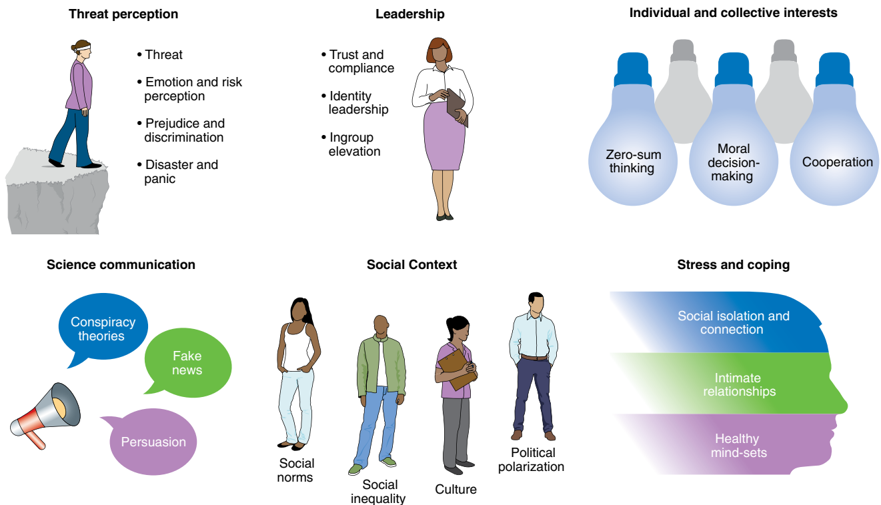
The COVID-19 pandemic represents a massive global health crisis. Because the crisis requires large-scale behaviour change and places significant psychological burdens on individuals, insights from the social and behavioural sciences can be used to help align human behaviour with the recommendations of epidemiologists and public health experts. Here we discuss evidence from a selection of research topics relevant to pandemics, including work on navigating threats, social and cultural influences on behaviour, science communication, moral decision-making, leadership, and stress and coping. In each section, we note the nature and quality of prior research, including uncertainty and unsettled issues. We identify several insights for effective response to the COVID-19 pandemic and highlight important gaps researchers should move quickly to fill in the coming weeks and months.
Overview
CoChat Summary
TL;DR
This perspective argues that social and behavioural science can help align public behaviour with COVID-19 public health recommendations across threat perception, social context, science communication, cooperation, leadership, and stress/coping. It synthesizes prior evidence and policy insights while cautioning that evidence is limited, often drawn from non-pandemic contexts, and in many areas unsettled.
Key findings
- The paper notes the scale of infectious disease threats: the bubonic plague killed approximately 25% of the European population, and by March 2020 COVID-19 had spread to more than 118,000 cases and caused 4,291 deaths in 114 countries. It also notes that 21 countries donated medical supplies to China in February, with China reciprocating widely.
- Fear appeals can change behaviour when people feel capable of dealing with the threat, but produce defensive reactions when people feel helpless; optimism bias can lead people to underestimate personal risk and ignore public health warnings.
- Social norms, inequality, culture, and political polarization shape pandemic behaviour: correcting misperceived norms can help when most people are already doing the desirable behaviour, but descriptive norms can backfire if the behaviour is undesirable unless paired with prescriptive norms.
- Effective communication and leadership may involve credible sources, messages that protect others or align with moral values, prebunking/inoculation against misinformation, accuracy nudges, shared social identity, and leaders modelling prosocial sacrifice; excessive national self-image concerns (“collective narcissism”) can backfire.
Methods
- Design: Perspective/narrative review; no primary data collection or sample. Topics were identified by the corresponding authors as potentially relevant to pandemic response and are explicitly not exhaustive.
- Evidence base: synthesizes prior social and behavioural research on threat perception, social context, science communication, moral decision-making, cooperation, leadership, and stress/coping, drawing on laboratory experiments, correlational studies, field experiments, meta-analyses, and preprints/forthcoming work.
- Analysis: narrative synthesis with policy implications and identified research gaps; no systematic search strategy or quantitative synthesis is reported.
Limitations
- Stated: due to space constraints, the paper provides only a brief summary of each topic; research on these topics is ongoing and in many cases far from settled; there is very little published social science research on the current pandemic, so discussion often draws from different circumstances and evidence quality varies substantially.
- Stated: insights and policy implications should be interpreted with caution.
- Evident: as a perspective rather than a systematic review or empirical study, it does not provide a comprehensive evidence appraisal, and its reliance on preprints and forthcoming sources limits certainty.
Model-written summary. Check it against the paper before relying on it.
Integrity signals
Registry
Cites
Statistics
Figures
Verification
Claims the paper makes
19 Valid · 5 Not valid · 37 Not checked · 13 Own results and interpretations
At least one cited source doesn’t support this claim or points to a different paper, and none confirmed it — see the verdicts below.
In the paper
“For instance, in hypothetical scenarios about deciding whether to go to work while sick, American and British participants reported they would be less willing to stay home when it was uncertain they would infect a co-worker.”
What the sources say
- Disputedcites [176] Kappes, A. et al. Uncertainty about the impact of social decisions increases prosocial behaviour. Nat. Hum. Behav. 2, 573–580 (2018). sourceExperimental — accuracy not yet measured
In the paper’s account of the infectious-disease scenario (Abstract; page not provided), participants facing uncertainty about how severely a co-worker might be affected were more likely to stay home than controls, not less. The paper distinguishes that impact uncertainty from uncertainty about whether a co-worker would be infected. Its Study 6 Methods (page not provided) describe recruitment through AMT, but do not establish the claimed American and British participant groups. (LLM, conf=0.88)
Checked by a reasoning model — may be wrong.
hedgedstates an association- Asserted: passes — The authors put it forward as true.
- Checkable: passes — It can be checked against evidence.
- Load-bearing: passes — The paper’s conclusions depend on it.
- Based: passes — The paper gives a reason why it holds.
- Disputed
The cited sources that could be checked couldn’t confirm or dispute this claim.
In the paper
“Moreover, there is mixed research regarding whether corrections may actually increase belief in the original misinformation 121,124-126 or in other misleading claims that fail to get corrected 127 .”
What the sources say
- Not checked — no full text of the sourcecites [121] Guess, A. & Coppock, A. Does counter-attitudinal information cause backlash? Results from three large survey experiments. Br. J. Polit. Sci. https://doi.org/10.1017/S0007123418000327 (2018). source
- Not matchedcites [124] Wittenberg, C. & Berinsky, A.J. Misinformation and its correction. in Social Media and Democracy: The State of the Field (eds Persily, N. & Tucker, J. A.) (Cambridge University Press, forthcoming).
Its entry has no title and year that we can search by.
- Not checked — no full text of the sourcecites [125] Swire, B. & Ecker, U.K.H. Misinformation and its correction: Cognitive mechanisms and recommendations for mass communication. in Misinformation and Mass Audiences (eds. Southwell, B. G., Thorson, E. A. & Sheble, L.) 195–2011 (University of Texas Press, 2018). source
- Not checked — no full text of the sourcecites [126] Wood, T. & Porter, E. The elusive backfire effect: mass attitudes’ steadfast factual adherence. Polit. Behav. 41, 135–163 (2018). source
- Could not verifycites [127] Pennycook, G., McPhetres, J., Zhang, Y. & Rand, D. Fighting COVID-19 misinformation on social media: Experimental evidence for a scalable accuracy nudge intervention. Preprint at PsyArXiv https://doi.org/10.31234/osf.io/uhbk9 (2020). sourceExperimental — accuracy not yet measured
Citation 127 is attached to the suggestion that corrections may increase belief in other misleading claims that go uncorrected. The Statement of Relevance and Discussion describe an accuracy nudge that improved sharing decisions, not corrections or their effects on belief in uncorrected claims. Searches for correction backfire and uncorrected misinformation found no passage addressing that point; page numbers were unavailable in our copy. (LLM, conf=0.76)
hedgedstates a possible cause- Asserted: passes — The authors put it forward as true.
- Checkable: passes — It can be checked against evidence.
- Load-bearing: passes — The paper’s conclusions depend on it.
- Based: passes — The paper gives a reason why it holds.
The sources with a verdict support this claim; the rest weren’t checked yet, have no full text we could read, or their verdicts aren’t rated yet.
In the paper
“Indeed, laboratory research has found that people prioritize local over global (or international) interests 185,186 .”
What the sources say
- Supportedcites [185] Milinski, M., Hilbe, C., Semmann, D., Sommerfeld, R. & Marotzke, J. Humans choose representatives who enforce cooperation in social dilemmas through extortion. Nat. Commun. 7, 10915 (2016). source
The Results section (‘Voters choose selfish representatives’; page unavailable) reports that participants preferentially re-elected representatives who contributed less to the shared climate account and elected candidates who pledged to contribute less than a fair share. In this simulated international dilemma, that supports the claim that participants favored their own group’s interests over the collective goal; it does not establish that everyone did so. (LLM, conf=0.85)
- Not checked — no full text of the sourcecites [186] Reinders Folmer, C. P. et al. One for all: what representing a group may do to us. J. Exp. Soc. Psychol. 48, 1047–1056 (2012). source
plain- Asserted: passes — The authors put it forward as true.
- Checkable: passes — It can be checked against evidence.
- Load-bearing: passes — The paper’s conclusions depend on it.
- Based: passes — The paper gives a reason why it holds.
- Supported
Every source the paper cites for this claim was checked and supports it.
In the paper
“However, when going to work risked infecting an elderly co-worker who would suffer a serious illness, participants reported they would be more willing to stay home 176 .”
What the sources say
- Supportedcites [176] Kappes, A. et al. Uncertainty about the impact of social decisions increases prosocial behaviour. Nat. Hum. Behav. 2, 573–580 (2018). source
The Study 6 Methods (page not provided) describe a scenario in which going to work could infect an older, vulnerable co-worker who would suffer severely, followed by a rating of willingness to go to work. The reported Study 6 findings (indexed under Abstract; page not provided) say participants given that risk information were significantly more likely to stay home than controls. (LLM, conf=0.92)
hedgedstates a cause- Asserted: passes — The authors put it forward as true.
- Checkable: passes — It can be checked against evidence.
- Load-bearing: passes — The paper’s conclusions depend on it.
- Based: passes — The paper gives a reason why it holds.
- Supported
The sources with a verdict support this claim; the rest weren’t checked yet, have no full text we could read, or their verdicts aren’t rated yet.
In the paper
“Several techniques, such as sanctioning defectors 187 or rewarding cooperators 188 , tend to increase cooperative behaviour in laboratory experiments using economic games.”
What the sources say
- Not checked — no full text of the sourcecites [187] Yamagishi, T. The provision of a sanctioning system as a public good. J. Pers. Soc. Psychol. 51, 110–116 (1986). source
- Supportedcites [188] Rand, D. G., Dreber, A., Ellingsen, T., Fudenberg, D. & Nowak, M. A. Positive interactions promote public cooperation. Science 325, 1272–1275 (2009). source
Citation 188 is attached to rewarding cooperators. The paper’s Abstract reports a laboratory comparison using repeated public goods games and finds that reward maintained public cooperation and, when both reward and punishment were available, increased contributions. (LLM, conf=0.93)
plainstates a cause- Asserted: passes — The authors put it forward as true.
- Checkable: passes — It can be checked against evidence.
- Load-bearing: unclear — It is unclear whether the paper’s conclusions depend on it.
- Based: passes — The paper gives a reason why it holds.
50 more claims · 13 with their cited sources checked
Create a free account to see all 74 claims and to verify the 2 references still open.
- It may state two separate claims as one. 13
- Probably not a substantial claim. 6
Claims other papers make about this one
Each is checked against this paper’s own text: does it say what the citing paper says it does?
The source backs part of the claim, not all of it — or backs it for a different population, condition or comparison.
In the citing paper
“COVID-19 is an international public health crisis, putting substantial burden on medical centers and increasing the psychological toll on health care workers (HCW).”
From Supporting the well-being of health care providers during the COVID-19 pandemic: The CopeColumbia response (2020) · cites this paper as [6]
Experimental — accuracy not yet measuredThe source backs part of the claim, not all of it — or backs it for a different population, condition or comparison.
In the citing paper
“these population-wide measures affected psychological well-being and mental health as well as increased social isolation [68] and loneliness.”
From Psychological correlates of perceived loneliness in college students before and during the COVID-19 stay-at-home period: a longitudinal study (2023) · cites this paper as [68]
Experimental — accuracy not yet measuredThe source backs part of the claim, not all of it — or backs it for a different population, condition or comparison.
In the citing paper
“they may eventually increase the social isolation of students and affect their psychological well-being and mental health [3].”
From Students under lockdown: Comparisons of students’ social networks and mental health before and during the COVID-19 crisis in Switzerland (2020) · cites this paper as [3]
Experimental — accuracy not yet measuredThe source backs part of the claim, not all of it — or backs it for a different population, condition or comparison.
In the citing paper
“effective interventions are hard to scale to a population level (12);”
From Psychological inoculation improves resilience against misinformation on social media (2022) · cites this paper as [12]
Experimental — accuracy not yet measuredThe source backs part of the claim, not all of it — or backs it for a different population, condition or comparison.
In the citing paper
“There is a shortage of studies that test anti-misinformation interventions in an ecologically valid manner, i.e., testing an intervention as consumers would interact with it in online environments (8, 12).”
From Psychological inoculation improves resilience against misinformation on social media (2022) · cites this paper as [12]
Experimental — accuracy not yet measured
6 more claims about this paper
Create a free account to see every claim other papers make about this one.
Citations
Cites
Granovetter, M. S. (1973) · American Journal of Sociology · doi:10.1086/225469 · Cited by 40,491
Zhou, F., Yu, T., Du, R., Fan, G., Liu, Y., Liu, Z., Xiang, J., Wang, Y., Song, B., Gu, X., et al. (2020) · The Lancet · doi:10.1016/s0140-6736(20)30566-3 · Cited by 27,263
The need to belong: Desire for interpersonal attachments as a fundamental human motivation.
Baumeister, R. F., & Leary, M. R. (1995) · Psychological Bulletin · doi:10.1037//0033-2909.117.3.497 · Cited by 23,245
Culture and the self: Implications for cognition, emotion, and motivation.
Markus, H. R., & Kitayama, S. (1991) · Psychological Review · doi:10.1037/0033-295x.98.2.224 · Cited by 21,995
Self-citationThe Psychological Impact of Quarantine and How to Reduce It: Rapid Review of the Evidence
Brooks, S. K., Webster, R. K., Smith, L. E., Woodland, L., Wessely, S., Greenberg, N., & Rubin, G. J. (2020) · doi:10.2139/ssrn.3532534 · Cited by 16,394
The psychological impact of quarantine and how to reduce it: Rapid review of the evidence
Brooks, S. K., Webster, R. K., Smith, L. E., Woodland, L., Wessely, S., Greenberg, N., & Rubin, G. J. (2020) · The Lancet · doi:10.1016/s0140-6736(20)30460-8 · Cited by 16,378
Nudge: improving decisions about health, wealth, and happiness
(2008) · Choice Reviews Online · doi:10.5860/choice.46-0977 · Cited by 11,572
Slovic, P. (1987) · Science · doi:10.1126/science.3563507 · Cited by 9,271
The Elaboration Likelihood Model of Persuasion
Petty, R. E., & Cacioppo, J. T. (1986) · Advances in Experimental Social Psychology · doi:10.1016/s0065-2601(08)60214-2 · Cited by 8,822
Self-citationThe emotional dog and its rational tail: A social intuitionist approach to moral judgment.
Haidt, J. (2001) · Psychological Review · doi:10.1037/0033-295x.108.4.814 · Cited by 8,048
Research works printed but not linked: 3
- Berkowitz, A.D. An overview of the social norms approach. in Changing the Culture of College Drinking: A Socially Situated Health Communication Campaign (eds. Stewart, L. & Lederman, L. C.) 193–214 (Hampton Press, 2005).
- Wittenberg, C. & Berinsky, A.J. Misinformation and its correction. in Social Media and Democracy: The State of the Field (eds Persily, N. & Tucker, J. A.) (Cambridge University Press, forthcoming).
- Ransohoff, K.J. Patients on the Trolley Track: The Moral Cognition of Medical Practitioners and Public Health Professionals. (Harvard Univ. Press, 2011).
Cited by
COVID-19 and the workplace: Implications, issues, and insights for future research and action.
Kniffin, K. M., Narayanan, J., Anseel, F., Antonakis, J., Ashford, S. P., Bakker, A. B., Bamberger, P., Bapuji, H., Bhave, D. P., Choi, V. K., et al. (2021) · American Psychologist · doi:10.1037/amp0000716 · Cited by 1,712
Self-citationSusceptibility to misinformation about COVID-19 around the world
Roozenbeek, J., Schneider, C. R., Dryhurst, S., Kerr, J., Freeman, A. L. J., Recchia, G., van der Bles, A. M., & van der Linden, S. (2020) · Royal Society Open Science · doi:10.1098/rsos.201199 · Cited by 1,447
Elmer, T., Mepham, K., & Stadtfeld, C. (2020) · PLOS ONE · doi:10.1371/journal.pone.0236337 · Cited by 1,658
“While social distancing measures may successfully slow down the spread of the infection and relieve the public health systems [2], they may eventually increase the social isolation of students and affect their psychological well-being and mental health [3].”
BackgroundStress and parenting during the global COVID-19 pandemic
Brown, S. M., Doom, J. R., Lechuga-Peña, S., Watamura, S. E., & Koppels, T. (2020) · Child Abuse & Neglect · doi:10.1016/j.chiabu.2020.104699 · Cited by 1,344
COVID-19 vaccine acceptance and hesitancy in low- and middle-income countries
(2021) · doi:10.1038/s41591-021-01454-y · Cited by 1,105
Browning, M. H. E. M., Larson, L. R., Sharaievska, I., Rigolon, A., McAnirlin, O., Mullenbach, L., Cloutier, S., Vu, T. M., Thomsen, J., Reigner, N., et al. (2021) · PLOS ONE · doi:10.1371/journal.pone.0245327 · Cited by 888
Ibn-Mohammed, T., Mustapha, K. B., Godsell, J., Adamu, Z., Babatunde, K. A., Akintade, D. D., Acquaye, A., Fujii, H., Ndiaye, M. M., Yamoah, F. A., et al. (2021) · Resources, Conservation and Recycling · doi:10.1016/j.resconrec.2020.105169 · Cited by 862
Preventing problematic internet use during the COVID-19 pandemic: Consensus guidance
Király, O., Potenza, M. N., Stein, D. J., King, D. L., Hodgins, D. C., Saunders, J. B., Griffiths, M. D., Gjoneska, B., Billieux, J., Brand, M., et al. (2020) · Comprehensive Psychiatry · doi:10.1016/j.comppsych.2020.152180 · Cited by 820
Imhoff, R., & Lamberty, P. (2020) · Social Psychological and Personality Science · doi:10.1177/1948550620934692 · Cited by 722
COVID-19 and vaccine hesitancy: A longitudinal study
Fridman, A., Gershon, R., & Gneezy, A. (2021) · PLOS ONE · doi:10.1371/journal.pone.0250123 · Cited by 675
Chou, W.-Y. S., & Budenz, A. (2020) · Health Communication · doi:10.1080/10410236.2020.1838096 · Cited by 675
Applying principles of behaviour change to reduce SARS-CoV-2 transmission
West, R., Michie, S., Rubin, G. J., & Amlôt, R. (2020) · Nature Human Behaviour · doi:10.1038/s41562-020-0887-9 · Cited by 658
Zacher, H., & Rudolph, C. W. (2021) · American Psychologist · doi:10.1037/amp0000702 · Cited by 643
Inoculating Against Fake News About COVID-19
van der Linden, S., Roozenbeek, J., & Compton, J. (2020) · Frontiers in Psychology · doi:10.3389/fpsyg.2020.566790 · Cited by 632
Partisanship, health behavior, and policy attitudes in the early stages of the COVID-19 pandemic
Gadarian, S. K., Goodman, S. W., & Pepinsky, T. B. (2021) · PLOS ONE · doi:10.1371/journal.pone.0249596 · Cited by 744
“Effective policy response that encourages broad prosocial behavior must attend not only to the source of the message, but also must address the deeply rooted individual partisan differences in beliefs and behavior that are unlikely to be moved by bipartisan messaging or trusted authorities alone [37].”
BackgroundMarroquín, B., Vine, V., & Morgan, R. (2020) · Psychiatry Research · doi:10.1016/j.psychres.2020.113419 · Cited by 624
(2021) · OECD Working Papers on Public Governance · doi:10.1787/b6c5478c-en · Cited by 622
Increase in suicide following an initial decline during the COVID-19 pandemic in Japan
Tanaka, T., & Okamoto, S. (2021) · Nature Human Behaviour · doi:10.1038/s41562-020-01042-z · Cited by 610
Gollwitzer, A., Martel, C., Brady, W. J., Pärnamets, P., Freedman, I. G., Knowles, E. D., & Van Bavel, J. J. (2020) · Nature Human Behaviour · doi:10.1038/s41562-020-00977-7 · Cited by 609
Pfattheicher, S., Nockur, L., Böhm, R., Sassenrath, C., & Petersen, M. B. (2020) · Psychological Science · doi:10.1177/0956797620964422 · Cited by 574
Mobilizing Policy (In)Capacity to Fight COVID-19: Understanding Variations in State Responses
Capano, G., Howlett, M., Jarvis, D. S. L., Ramesh, M., & Goyal, N. (2020) · Policy and Society · doi:10.1080/14494035.2020.1787628 · Cited by 579
“…– in the form of social distancing, travel advisories and restrictions, school and university closures, and healthcare spending – were highly correlated not only with one another but also with the economic response; specifically, loans to businesses and monetary policy (Van Bavel et al., 2020).”
BackgroundEmotional, Behavioral, and Psychological Impact of the COVID-19 Pandemic
Pedrosa, A. L., Bitencourt, L., Fróes, A. C. F., Cazumbá, M. L. B., Campos, R. G. B., de Brito, S. B. C. S., & Simões e Silva, A. C. (2020) · Frontiers in Psychology · doi:10.3389/fpsyg.2020.566212 · Cited by 579
Cauberghe, V., Van Wesenbeeck, I., De Jans, S., Hudders, L., & Ponnet, K. (2021) · Cyberpsychology, Behavior, and Social Networking · doi:10.1089/cyber.2020.0478 · Cited by 564
Behavioural science is unlikely to change the world without a heterogeneity revolution
Bryan, C. J., Tipton, E., & Yeager, D. S. (2021) · Nature Human Behaviour · doi:10.1038/s41562-021-01143-3 · Cited by 537
Devine, D., Gaskell, J., Jennings, W., & Stoker, G. (2021) · Political Studies Review · doi:10.1177/1478929920948684 · Cited by 534
Islam, M. S., Kamal, A.-H. M., Kabir, A., Southern, D. L., Khan, S. H., Hasan, S. M. M., Sarkar, T., Sharmin, S., Das, S., Roy, T., et al. (2021) · PLOS ONE · doi:10.1371/journal.pone.0251605 · Cited by 530
“Culturally compelling and context-appropriate information, supported by credible sources, are required to prevent vaccine misinformation [18].”
BackgroundImpacts of COVID-19 pandemic on urban park visitation: a global analysis
Geng, D. (., Innes, J., Wu, W., & Wang, G. (2021) · Journal of Forestry Research · doi:10.1007/s11676-020-01249-w · Cited by 531
Underestimating the Challenges of Avoiding a Ghastly Future
Bradshaw, C. J. A., Ehrlich, P. R., Beattie, A., Ceballos, G., Crist, E., Diamond, J., Dirzo, R., Ehrlich, A. H., Harte, J., Harte, M. E., et al. (2021) · Frontiers in Conservation Science · doi:10.3389/fcosc.2020.615419 · Cited by 526
Gelfand, M. J., Jackson, J. C., Pan, X., Nau, D., Pieper, D., Denison, E., Dagher, M., Van Lange, P. A. M., Chiu, C.-Y., & Wang, M. (2021) · The Lancet Planetary Health · doi:10.1016/s2542-5196(20)30301-6 · Cited by 526
Self-citationLosada-Baltar, A., Jiménez-Gonzalo, L., Gallego-Alberto, L., Pedroso-Chaparro, M. D. S., Fernandes-Pires, J., & Márquez-González, M. (2021) · The Journals of Gerontology: Series B · doi:10.1093/geronb/gbaa048 · Cited by 508
Toward effective government communication strategies in the era of COVID-19
Hyland-Wood, B., Gardner, J., Leask, J., & Ecker, U. K. H. (2021) · Humanities and Social Sciences Communications · doi:10.1057/s41599-020-00701-w · Cited by 488
“This ‘frailty’ perspective risks suppressing community solidarity and resilience (Jetten et al., 2020; van Bavel et al., 2020).”
BackgroundCommunity engagement for COVID-19 prevention and control: a rapid evidence synthesis
Gilmore, B., Ndejjo, R., Tchetchia, A., de Claro, V., Mago, E., Diallo, A. A., Lopes, C., & Bhattacharyya, S. (2020) · BMJ Global Health · doi:10.1136/bmjgh-2020-003188 · Cited by 475
Fatores associados ao comportamento da população durante o isolamento social na pandemia de COVID-19
Bezerra, A. C. V., Silva, C. E. M. D., Soares, F. R. G., & Silva, J. A. M. D. (2020) · Ciência & Saúde Coletiva · doi:10.1590/1413-81232020256.1.10792020 · Cited by 472
Psychological inoculation improves resilience against misinformation on social media
Roozenbeek, J., van der Linden, S., Goldberg, B., Rathje, S., & Lewandowsky, S. (2022) · Science Advances · doi:10.1126/sciadv.abo6254 · Cited by 472
“…to the initial misinformation ( 10 ); getting people to believe fact-checks is challenging ( 11 ); effective interventions are hard to scale to a population level ( 12 ); and testing the effectiveness of interventions in the real world (as opposed to a laboratory setting) is complicated ( 6 ).”
COVID-19 and Bangladesh: Challenges and How to Address Them
Anwar, S., Nasrullah, M., & Hosen, M. J. (2020) · Frontiers in Public Health · doi:10.3389/fpubh.2020.00154 · Cited by 463
“For instance, the Imams (a Muslim leadership position) of each mosque could play a vital role in fighting this extraordinary crisis in Bangladesh (56).”
BackgroundPetherick, A., Goldszmidt, R., Andrade, E. B., Furst, R., Hale, T., Pott, A., & Wood, A. (2021) · Nature Human Behaviour · doi:10.1038/s41562-021-01181-x · Cited by 456
COVID-19 Government Response Event Dataset (CoronaNet v.1.0)
Cheng, C., Barceló, J., Hartnett, A. S., Kubinec, R., & Messerschmidt, L. (2020) · Nature Human Behaviour · doi:10.1038/s41562-020-0909-7 · Cited by 454
Flexible employment relationships and careers in times of the COVID-19 pandemic
Spurk, D., & Straub, C. (2020) · Journal of Vocational Behavior · doi:10.1016/j.jvb.2020.103435 · Cited by 454
“…effects on or of flexible schedule or location might vary with the different phases because besides representing an objective marker for the COVID-19 pandemic, transitioning into different COVID-19 related phases might also change psychological experiences of individuals (Van Bavel et al., 2020).”
Perceived social impacts of tourism and quality-of-life: a new conceptual model
Ramkissoon, H. (2023) · Journal of Sustainable Tourism · doi:10.1080/09669582.2020.1858091 · Cited by 456
Carrying Out Rapid Qualitative Research During a Pandemic: Emerging Lessons From COVID-19
Vindrola-Padros, C., Chisnall, G., Cooper, S., Dowrick, A., Djellouli, N., Symmons, S. M., Martin, S., Singleton, G., Vanderslott, S., Vera, N., et al. (2020) · Qualitative Health Research · doi:10.1177/1049732320951526 · Cited by 448
“…health, and economic inequalities; the implementation of health care reorganization to address demands created by the pandemic; and the role and impact of different types of leadership at national and local levels can also be explored using qualitative research (Shah, 2020; Van Bavel et al., 2020).”
BackgroundGlobal Sentiments Surrounding the COVID-19 Pandemic on Twitter: Analysis of Twitter Trends
Lwin, M. O., Lu, J., Sheldenkar, A., Schulz, P. J., Shin, W., Gupta, R., & Yang, Y. (2020) · JMIR Public Health and Surveillance · doi:10.2196/19447 · Cited by 443
Pandemics: Implications for research and practice in industrial and organizational psychology
Rudolph, C. W., Allan, B., Clark, M., Hertel, G., Hirschi, A., Kunze, F., Shockley, K., Shoss, M., Sonnentag, S., & Zacher, H. (2021) · Industrial and Organizational Psychology · doi:10.1017/iop.2020.48 · Cited by 525
“10.1037/a0017376 Benach, J., Vives, A., Amable, M., Vanroelen, C., Tarafa, G., & Muntaner, C. (2014).”
BackgroundInfluentialHan, Q., Zheng, B., Cristea, M., Agostini, M., Bélanger, J. J., Gützkow, B., Kreienkamp, J., PsyCorona Collaboration, & Leander, N. P. (2023) · Psychological Medicine · doi:10.1017/s0033291721001306 · Cited by 454
‘Vaccine hesitancy’ among university students in Italy during the COVID-19 pandemic
Barello, S., Nania, T., Dellafiore, F., Graffigna, G., & Caruso, R. (2020) · European Journal of Epidemiology · doi:10.1007/s10654-020-00670-z · Cited by 422
Prevalence of Depression, Anxiety, and Stress during COVID-19 Pandemic
Lakhan, R., Agrawal, A., & Sharma, M. (2020) · Journal of Neurosciences in Rural Practice · doi:10.1055/s-0040-1716442 · Cited by 421
Pylons ablaze: Examining the role of 5G COVID‐19 conspiracy beliefs and support for violence
Jolley, D., & Paterson, J. L. (2020) · British Journal of Social Psychology · doi:10.1111/bjso.12394 · Cited by 413
Di Renzo, L., Gualtieri, P., Cinelli, G., Bigioni, G., Soldati, L., Attinà, A., Bianco, F. F., Caparello, G., Camodeca, V., Carrano, E., et al. (2020) · Nutrients · doi:10.3390/nu12072152 · Cited by 386
Positive psychology in a pandemic: buffering, bolstering, and building mental health
Waters, L., Algoe, S. B., Dutton, J., Emmons, R., Fredrickson, B. L., Heaphy, E., Moskowitz, J. T., Neff, K., Niemiec, R., Pury, C., et al. (2022) · The Journal of Positive Psychology · doi:10.1080/17439760.2021.1871945 · Cited by 377
“In addressing the short-term and longer-term ‘mental health fall-out’ from the coronavirus pandemic, calls have been made for psychological approaches to incorporate multidisciplinary lines of action (Bavel et al., 2020; Holmes et al., 2020).”
BackgroundCoroiu, A., Moran, C., Campbell, T., & Geller, A. C. (2020) · PLOS ONE · doi:10.1371/journal.pone.0239795 · Cited by 368
“Behavioural and social scientists are well positioned to help answer these questions and help guide COVID-19 prevention interventions, by incorporating messaging that targets a shared sense of identity, norms of prosocial behavior, emphasize benefits to the recipient, focus on protecting others or each other, align wi…”
BackgroundChakraborty, K., Bhatia, S., Bhattacharyya, S., Platos, J., Bag, R., & Hassanien, A. E. (2020) · Applied Soft Computing · doi:10.1016/j.asoc.2020.106754 · Cited by 375
“Different strategies and measures are taken by public to control the spread of misinfor-mation [26] which has potentially dangerous outcomes.”
Political polarization on COVID-19 pandemic response in the United States
Kerr, J., Panagopoulos, C., & van der Linden, S. (2021) · Personality and Individual Differences · doi:10.1016/j.paid.2021.110892 · Cited by 370
“…vaccine or effective antiviral treatment, scholars have increasingly noted the important role of the social sciences in evaluating public opinion and the impact of nonpharmaceutical interventions (Van Bavel et al., 2020) such as mask wearing, social distancing, hand washing, and self-isolation.”
Self-citationBertin, P., Nera, K., & Delouvée, S. (2020) · Frontiers in Psychology · doi:10.3389/fpsyg.2020.565128 · Cited by 381
COVID-19 conspiracy beliefs, health behaviors, and policy support
Earnshaw, V. A., Eaton, L. A., Kalichman, S. C., Brousseau, N. M., Hill, E. C., & Fox, A. B. (2020) · Translational Behavioral Medicine · doi:10.1093/tbm/ibaa090 · Cited by 357
Jordan, J. J., Yoeli, E., & Rand, D. G. (2021) · Scientific Reports · doi:10.1038/s41598-021-97617-5 · Cited by 350
Self-citationKarki, R., Lee, S., Mall, R., Pandian, N., Wang, Y., Sharma, B. R., Malireddi, R. S., Yang, D., Trifkovic, S., Steele, J. A., et al. (2022) · Science Immunology · doi:10.1126/sciimmunol.abo6294 · Cited by 350
Jordan, J., Yoeli, E., & Rand, D. G. (2020) · doi:10.31234/osf.io/yuq7x · Cited by 348
Self-citationVuong, Q.-H., Le, T.-T., La, V.-P., Nguyen, H. T. T., Ho, M.-T., Van Khuc, Q., & Nguyen, M.-H. (2022) · Humanities and Social Sciences Communications · doi:10.1057/s41599-022-01034-6 · Cited by 344
Collectivism predicts mask use during COVID-19
Lu, J. G., Jin, P., & English, A. S. (2021) · Proceedings of the National Academy of Sciences · doi:10.1073/pnas.2021793118 · Cited by 342
“To curb the pandemic, it is critical that people prioritize the collective welfare over personal convenience (52, 53).”
BackgroundBiddlestone, M., Green, R., & Douglas, K. M. (2020) · British Journal of Social Psychology · doi:10.1111/bjso.12397 · Cited by 330
“Supporting this idea, at the cultural level Gelfand et al. (2020) found that tighter cultures (considered more collectivist; e.g., Hong Kong, Taiwan, and South Korea) have been able to contain the spread of the virus more efficiently and effectively than looser cultures (considered more…”
BackgroundSelf-citationMadurai Elavarasan, R., & Pugazhendhi, R. (2020) · Science of The Total Environment · doi:10.1016/j.scitotenv.2020.138858 · Cited by 326
Taylor, S., & Asmundson, G. J. G. (2021) · PLOS ONE · doi:10.1371/journal.pone.0246317 · Cited by 319
“It has become increasingly apparent that behavioral science is vital for understanding how pandemics can be optimally managed, and for understanding and addressing pandemicrelated socially disruptive phenomena such as the reluctance or frank refusal to follow health guidelines such as the wearing of face masks [1, 2].”
BackgroundSteward, M. W. (1983) · Immunology · Cited by 323
National identity predicts public health support during a global pandemic
Van Bavel, J. J., Cichocka, A., Capraro, V., Sjåstad, H., Nezlek, J. B., Pavlović, T., Alfano, M., Gelfand, M. J., Azevedo, F., Birtel, M. D., et al. (2022) · Nature Communications · doi:10.1038/s41467-021-27668-9 · Cited by 311
“Speci fi cally, right-wing political beliefs were associated with less support for COVID-19 public health policies, compared to left-wing political beliefs.”
BackgroundSelf-citationPsychometric evaluation of the Arabic version of the Fear of COVID-19 Scale
Alyami, M., Henning, M., Krägeloh, C. U., & Alyami, H. (2021) · International Journal of Mental Health and Addiction · doi:10.1007/s11469-020-00316-x · Cited by 313
“…available research showing that the COVID-19 pandemic has profound psychological effects on general populations (Rajkumar 2020; Roy et al. 2020; Wang et al. 2020; Zhang et al. 2020), people with COVID-19 mild symptoms (Xiao et al. 2020) and healthcare professionals (Kang et al. 2020; Lu et al.…”
BackgroundParady, G., Taniguchi, A., & Takami, K. (2020) · Transportation Research Interdisciplinary Perspectives · doi:10.1016/j.trip.2020.100181 · Cited by 307
Zoom Exhaustion & Fatigue Scale
Fauville, G., Luo, M., Queiroz, A. C. M., Bailenson, J. N., & Hancock, J. (2021) · Computers in Human Behavior Reports · doi:10.1016/j.chbr.2021.100119 · Cited by 309
Ten considerations for effectively managing the COVID-19 transition
Habersaat, K. B., Betsch, C., Danchin, M., Sunstein, C. R., Böhm, R., Falk, A., Brewer, N. T., Omer, S. B., Scherzer, M., Sah, S., et al. (2020) · Nature Human Behaviour · doi:10.1038/s41562-020-0906-x · Cited by 297
Self-citationJacques-Aviñó, C., López-Jiménez, T., Medina-Perucha, L., de Bont, J., Gonçalves, A. Q., Duarte-Salles, T., & Berenguera, A. (2020) · BMJ Open · doi:10.1136/bmjopen-2020-044617 · Cited by 292
Schneider, C. R., Dryhurst, S., Kerr, J., Freeman, A. L. J., Recchia, G., Spiegelhalter, D., & van der Linden, S. (2021) · Journal of Risk Research · doi:10.1080/13669877.2021.1890637 · Cited by 291
“Understanding people’s perceptions of the risks associated with the virus, their reactions to the pandemic, and their behavioural response is therefore important for helping to navigate and manage the global pandemic (Cori et al. 2020; Van Bavel et al. 2020; Wardman and Lofstedt 2020).”
BackgroundSelf-citationElmer, T., Mepham, K., & Stadtfeld, C. (2020) · doi:10.31234/osf.io/ua6tq · Cited by 292
Stewardship of global collective behavior
Bak-Coleman, J. B., Alfano, M., Barfuss, W., Bergstrom, C. T., Centeno, M. A., Couzin, I. D., Donges, J. F., Galesic, M., Gersick, A. S., Jacquet, J., et al. (2021) · Proceedings of the National Academy of Sciences · doi:10.1073/pnas.2025764118 · Cited by 289
Bruine de Bruin, W., Saw, H.-W., & Goldman, D. P. (2020) · Journal of Risk and Uncertainty · doi:10.1007/s11166-020-09336-3 · Cited by 285
Vaccine Hesitancy: Contemporary Issues and Historical Background
Nuwarda, R. F., Ramzan, I., Weekes, L., & Kayser, V. (2022) · Vaccines · doi:10.3390/vaccines10101595 · Cited by 282
Dragioti, E., Li, H., Tsitsas, G., Lee, K. H., Choi, J., Kim, J., Choi, Y. J., Tsamakis, K., Estradé, A., Agorastos, A., et al. (2022) · Journal of Medical Virology · doi:10.1002/jmv.27549 · Cited by 281
“Since COVID‐19 has spread worldwide, the global negative mental health impact could be much higher.(7,8) Indeed, converging evidence suggests the COVID‐19 pandemic adversely affects mental health across different countries with different income and measures, patient subpopulations, and quarantine status.”
BackgroundSpatial analysis of COVID-19 clusters and contextual factors in New York City
Cordes, J., & Castro, M. C. (2020) · Spatial and Spatio-temporal Epidemiology · doi:10.1016/j.sste.2020.100355 · Cited by 280
Venter, Z. S., Barton, D. N., Gundersen, V., Figari, H., & Nowell, M. S. (2021) · Landscape and Urban Planning · doi:10.1016/j.landurbplan.2021.104175 · Cited by 278
The Emergence of COVID-19 in the US: A Public Health and Political Communication Crisis
Gollust, S. E., Nagler, R. H., & Fowler, E. F. (2020) · Journal of Health Politics, Policy and Law · doi:10.1215/03616878-8641506 · Cited by 277
Jørgensen, F., Bor, A., & Petersen, M. B. (2021) · British Journal of Health Psychology · doi:10.1111/bjhp.12519 · Cited by 269
Yu, H., Li, M., Li, Z., Xiang, W., Yuan, Y., Liu, Y., Li, Z., & Xiong, Z. (2020) · BMC Psychiatry · doi:10.1186/s12888-020-02826-3 · Cited by 272
“Feeling lonely and isolated from others is a common feeling during lockdown, and regularly connecting with friends and family in video or phone calls may improve the level of social support [35].”
BackgroundBasol, M., Roozenbeek, J., Berriche, M., Uenal, F., McClanahan, W. P., & Linden, S. V. D. (2021) · Big Data & Society · doi:10.1177/20539517211013868 · Cited by 271
“In practice, this distinction matters little as people are inoculated regardless of prior exposure, but theoretically it helps to elucidate the conditions under which inoculation can be effective (Compton, 2019; Compton et al., 2021; van der Linden and Roozenbeek, 2020).”
BackgroundSelf-citationHaghani, M., Bliemer, M. C. J., Goerlandt, F., & Li, J. (2020) · Safety Science · doi:10.1016/j.ssci.2020.104806 · Cited by 265
Use caution when applying behavioural science to policy
IJzerman, H., Lewis, N. A., Przybylski, A. K., Weinstein, N., DeBruine, L., Ritchie, S. J., Vazire, S., Forscher, P. S., Morey, R. D., Ivory, J. D., et al. (2020) · Nature Human Behaviour · doi:10.1038/s41562-020-00990-w · Cited by 262
Umucu, E., & Lee, B. (2020) · Rehabilitation Psychology · doi:10.1037/rep0000328 · Cited by 260
Belief in COVID‐19 Conspiracy Theories Reduces Social Distancing over Time
Bierwiaczonek, K., Kunst, J. R., & Pich, O. (2020) · Applied Psychology: Health and Well-Being · doi:10.1111/aphw.12223 · Cited by 265
Joo, D., Xu, W., Lee, J., Lee, C.-K., & Woosnam, K. M. (2021) · Journal of Destination Marketing & Management · doi:10.1016/j.jdmm.2021.100553 · Cited by 256
Yan, B., Zhang, X., Wu, L., Zhu, H., & Chen, B. (2020) · The American Review of Public Administration · doi:10.1177/0275074020942445 · Cited by 252
“Changing individuals’ behavior is critical to containing and mitigating the COVID-19 pandemic because the virus can spread via human-to-human transmission (Bavel et al., 2020).”
BackgroundLi, G., Tang, D., Song, B., Wang, C., Qunshan, S., Xu, C., Geng, H., Wu, H., He, X., & Cao, Y. (2020) · Journal of Medical Internet Research · doi:10.2196/20961 · Cited by 253
“These disruptions have had a significant impact on the physical and mental health, as well as quality of life, of individuals [7,8].”
BackgroundPhysical Fitness and Exercise During the COVID-19 Pandemic: A Qualitative Enquiry
Kaur, H., Singh, T., Arya, Y. K., & Mittal, S. (2020) · Frontiers in Psychology · doi:10.3389/fpsyg.2020.590172 · Cited by 253
Germani, A., Buratta, L., Delvecchio, E., & Mazzeschi, C. (2020) · International Journal of Environmental Research and Public Health · doi:10.3390/ijerph17103497 · Cited by 247
“The latter aspect also applies to the fear and worries of infecting others [17,24].”
BackgroundResultEuropean Resuscitation Council Guidelines 2021: Ethics of resuscitation and end of life decisions
Mentzelopoulos, S. D., Couper, K., Voorde, P. V. D., Druwé, P., Blom, M., Perkins, G. D., Lulic, I., Djakow, J., Raffay, V., Lilja, G., et al. (2021) · Resuscitation · doi:10.1016/j.resuscitation.2021.02.017 · Cited by 246
“the societal and legal changes associated with the coronavirus disease-19 (COVID-19) pandemic.(1) These changes include new”
BackgroundInfluentialCOVID-19 pandemic and its impact on social relationships and health
Long, E., Patterson, S., Maxwell, K., Blake, C., Bosó Pérez, R., Lewis, R., McCann, M., Riddell, J., Skivington, K., Wilson-Lowe, R., et al. (2022) · Journal of Epidemiology and Community Health · doi:10.1136/jech-2021-216690 · Cited by 245
Pereda, N., & Díaz-Faes, D. A. (2020) · Child and Adolescent Psychiatry and Mental Health · doi:10.1186/s13034-020-00347-1 · Cited by 243
Trust predicts COVID-19 prescribed and discretionary behavioral intentions in 23 countries
Pagliaro, S., Sacchi, S., Pacilli, M. G., Brambilla, M., Lionetti, F., Bettache, K., Bianchi, M., Biella, M., Bonnot, V., Boza, M., et al. (2021) · PLOS ONE · doi:10.1371/journal.pone.0248334 · Cited by 240
“These have suggested that cultural ‘tightness’ versus ‘looseness’ accounts for cross-national differences in compliance with requests from authorities, and that ‘individualism’ versus ‘collectivism’ explains cross-national differences in willingness to coordinate efforts with other individuals [6,17].”
BackgroundSelf-citationProsociality predicts health behaviors during the COVID-19 pandemic
Campos-Mercade, P., Meier, A. N., Schneider, F. H., & Wengström, E. (2021) · Journal of Public Economics · doi:10.1016/j.jpubeco.2021.104367 · Cited by 242
Impact of Covid-19 on field and office workforce in construction industry
Pamidimukkala, A., & Kermanshachi, S. (2021) · Project Leadership and Society · doi:10.1016/j.plas.2021.100018 · Cited by 237
How trust, mistrust and distrust shape the governance of the COVID-19 crisis
Jennings, W., Stoker, G., Valgarðsson, V., Devine, D., & Gaskell, J. (2021) · Journal of European Public Policy · doi:10.1080/13501763.2021.1942151 · Cited by 237
Capraro, V., & Barcelo, H. (2020) · doi:10.31234/osf.io/tg7vz · Cited by 228
“Social and behavioral science can be helpful in answering this question (Van Bavel et al. 2020).”
BackgroundSelf-citationPoliticization and COVID-19 vaccine resistance in the U.S.
(2022) · Progress in Molecular Biology and Translational Science · doi:10.1016/bs.pmbts.2021.10.002 · Cited by 234
“Online social media has facilitated the spread of rumors, conspiracy theories and misinformation at a speed and intensity unprecedented in history.(104)When combined with the politicization of science, the results can be 92 Toby Bolsen and Risa Palm”
Janssen, L. H. C., Kullberg, M.-L. J., Verkuil, B., van Zwieten, N., Wever, M. C. M., van Houtum, L. A. E. M., Wentholt, W. G. M., & Elzinga, B. M. (2020) · PLOS ONE · doi:10.1371/journal.pone.0240962 · Cited by 229
“As a consequence, these confinements may also lead to more tension, irritability, family conflicts, and at worse, domestic violence or child abuse [10].”
BackgroundInfluentialLazarus, J. V., Ratzan, S., Palayew, A., Billari, F. C., Binagwaho, A., Kimball, S., Larson, H. J., Melegaro, A., Rabin, K., White, T. M., et al. (2020) · PLOS ONE · doi:10.1371/journal.pone.0240011 · Cited by 232
“Moreover, crises, and particularly epidemics, raise real barriers to efforts to align individual and collective interests, which challenge the adoption of behavioural changes that are essential to prevent the spread of disease [24].”
Background
Metadata
- Authors
- Bavel, J. J. V., Baicker, K., Boggio, P. S., Capraro, V., Cichocka, A., Cikara, M., Crockett, M. J., Crum, A. J., Douglas, K. M., Druckman, J. N., Drury, J., Dube, O., Ellemers, N., Finkel, E. J., Fowler, J. H., Gelfand, M., Han, S., Haslam, S. A., Jetten, J., Kitayama, S., Mobbs, D., Napper, L. E., Packer, D. J., Pennycook, G., Peters, E., Petty, R. E., Rand, D. G., Reicher, S. D., Schnall, S., Shariff, A., Skitka, L. J., Smith, S. S., Sunstein, C. R., Tabri, N., Tucker, J. A., Linden, S. V. D., Lange, P. V., Weeden, K. A., Wohl, M. J. A., Zaki, J., Zion, S. R., & Willer, R.
- Affiliations
- New York University (US)
- Universidade Presbiteriana Mackenzie (BR)
- Middlesex University London (GB)
- University of Kent (GB)
- Harvard University (US)
- Yale University (US)
- Stanford University (US)
- Northwestern University (US)
- University of Sussex (GB)
- University of Chicago (US)
- Utrecht University (NL)
- University of California San Diego (US)
- University of Maryland, College Park (US)
- Peking University (CN)
- The University of Queensland (AU)
- University of Michigan (US)
- California Institute of Technology (US)
- Lehigh University (US)
- University of Regina (CA)
- University of Oregon (US)
- The Ohio State University (US)
- Massachusetts Institute of Technology (US)
- University of St Andrews (GB)
- University of Cambridge (GB)
- University of British Columbia (CA)
- University of Illinois Chicago (US)
- University of California, Berkeley (US)
- Carleton University (CA)
- Cornell University (US)
- Corresponding author
- Bavel, Jay J. Van
- Willer, Robb
- ORCID
- Bavel, Jay J. Van
- Baicker, Katherine
- Boggio, Paulo S.
- Capraro, Valerio
- Cichocka, Aleksandra
- Cikara, Mina
- Crockett, Molly J.
- Crum, Alia J.
- Douglas, Karen M.
- Druckman, James N.
- Drury, John
- Ellemers, Naomi
- Finkel, Eli J.
- Fowler, James H.
- Gelfand, Michele
- Han, Shihui
- Haslam, S. Alexander
- Jetten, Jolanda
- Kitayama, Shinobu
- Mobbs, Dean
- Napper, Lucy E.
- Packer, Dominic J.
- Pennycook, Gordon
- Peters, Ellen
- Petty, Richard E.
- Rand, David G.
- Reicher, Stephen D.
- Schnall, Simone
- Shariff, Azim
- Skitka, Linda J.
- Sunstein, Cass R.
- Tabri, Nassim
- Tucker, Joshua A.
- Linden, Sander van der
- Weeden, Kim A.
- Wohl, Michael J. A.
- Zaki, Jamil
- Zion, Sean R.
- Willer, Robb
- Venue
- Nature Human Behaviour
- Published
- 2020-04-30
- Volume
- 4
- Issue
- 5
- Pages
- 460-471
- ISSN
- 2397-3374 (ISSN-L)
- OpenAlex
- W3016902371
- Semantic Scholar
- d81abcd7f053b136423f1e7f57928524e8b0e1a0
- Cited by
- 4,964
- References
- 259
- Citations by year
- 2026: 177 · 2025: 288 · 2024: 483 · 2023: 741 · 2022: 1094 · 2021: 1474 · 2020: 702
- FWCI
- 175.81
- Type
- journal article
- Language
- en
- Open access
- bronze
- doi.org
- Licence
- www.springernature.com/gp/researchers/text-and-data-mining (tdm)
- www.springernature.com/gp/researchers/text-and-data-mining (vor)
- Locations
- Nature Human Behaviour (publishedVersion)
- PubMed (publishedVersion)
- Middlesex University Research Repository (Middlesex University Of London) (acceptedVersion)
- Kent Academic Repository (University of Kent) (acceptedVersion)
- DSpace@MIT (Massachusetts Institute of Technology) (submittedVersion, cc-by-nc-sa)
- Sussex Research Online (University of Sussex) (submittedVersion)
- CaltechAUTHORS (California Institute of Technology) (submittedVersion)
- RePEc: Research Papers in Economics (submittedVersion)
- BOA (University of Milano-Bicocca) (submittedVersion)
- Carleton University's Institutional Repository (MacOdrum Library, Carleton University) (submittedVersion, other-oa)
- Utrecht University Repository (Utrecht University) (submittedVersion)
- Figshare (submittedVersion)
- VU Research Portal (submittedVersion, other-oa)
- Utrecht University Repository (Utrecht University) (submittedVersion, other-oa)
- Data Archiving and Networked Services (DANS) (submittedVersion, other-oa)
- Funders
- U.S. Department of Health and Human Services (2P50 MH094258)
- National Institute of Mental Health (P50MH094258)
- Topics
- Social Sciences › Sociology and Political Science › COVID-19 Prevention and Impact
- Social Sciences › Communication › Communication and COVID-19 Impact
- Physical Sciences › Mathematics › Modeling and Simulation › COVID-19 epidemiological studies
- Keywords
- COVID-19 pandemic, pandemic response, behavior change, science communication, ethical decision-making, leadership, stress coping, psychological burden, public health recommendations
- MeSH terms
- Betacoronavirus, COVID-19, SARS-CoV-2, Adaptation, Psychological, Communicable Disease Control, Decision Making, Humans, Human Activities, Health Knowledge, Attitudes, Practice, Leadership, Pneumonia, Viral, Public Health, Quarantine, Stress, Psychological, Global Health, Coronavirus, Coronavirus Infections, Pandemics, Social Media, Epidemiological Monitoring
About these checks
Registry, retraction, Cites and statistics results are computed, not judged, with one exception: a printed reference that no index lists is read once by a model before it counts as a citation error. Claims are extracted by a model and kept only when their quote appears verbatim in the text; each cited source is then checked, with a model’s help, for whether it says what the claim relies on. Those verdicts can be wrong — read the claim’s quote and the cited source before relying on one.
The claim verdicts this report counts are experimental: their accuracy is not yet measured.
A language model drew the claims from the paper on 2026-10-10, under version 3 of the claim definition (model deepseek-v4.1-flash, prompt extract-v3).
A second model labelled each claim on 2026-10-10 (model jev-1.13-20260917, definition revision gold-guideline-v0.2).
Cited sources are checked with a language model’s help (gpt-6-sol).
Statistics and arithmetic are recomputed, not judged.
Confidence bands are shown only for fields calibrated on our annotated test set. None is calibrated yet, so no band is shown.
What counts as a claim ›How we measure confidence ›How we check this ›
Are you an author, or do you see a problem with this page? Request a review
Data sources
Bibliographic data: Semantic Scholar, OpenAlex, Crossref.
Contains information from the Semantic Scholar Academic Graph Datasets, made available under the ODC Attribution License (ODC-BY 1.0).
Semantic Scholar’s data is described in: Kinney, R., et al. (2023). The Semantic Scholar Open Data Platform. arXiv:2301.10140.
