

Using social and behavioural science to support COVID-19 pandemic response
Open accessThe DOI matches its Crossref record; 257 of the 259 references it cites were found in a registry or an index; 24 of the 89 sources its claims cite were checked for support.
Abstract
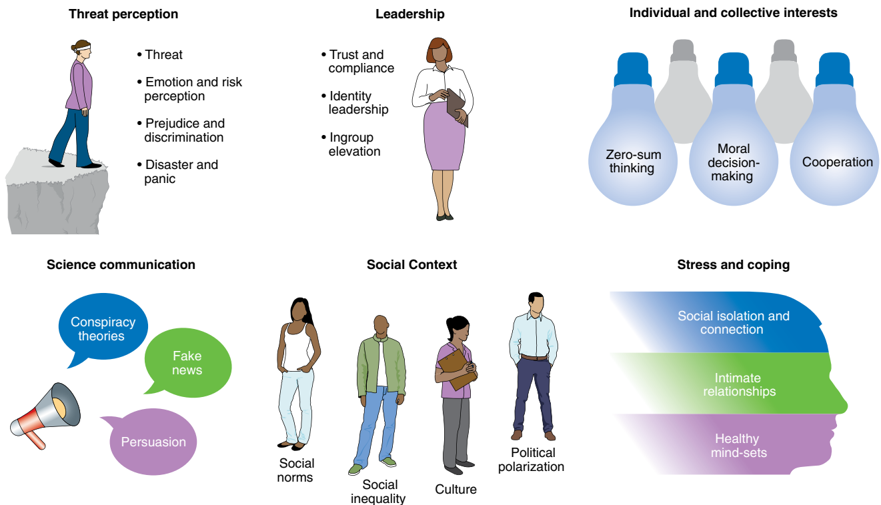
The COVID-19 pandemic represents a massive global health crisis. Because the crisis requires large-scale behaviour change and places significant psychological burdens on individuals, insights from the social and behavioural sciences can be used to help align human behaviour with the recommendations of epidemiologists and public health experts. Here we discuss evidence from a selection of research topics relevant to pandemics, including work on navigating threats, social and cultural influences on behaviour, science communication, moral decision-making, leadership, and stress and coping. In each section, we note the nature and quality of prior research, including uncertainty and unsettled issues. We identify several insights for effective response to the COVID-19 pandemic and highlight important gaps researchers should move quickly to fill in the coming weeks and months.
Overview
CoChat Summary
TL;DR
This perspective argues that social and behavioural science can help align public behaviour with COVID-19 public health recommendations across threat perception, social context, science communication, cooperation, leadership, and stress/coping. It synthesizes prior evidence and policy insights while cautioning that evidence is limited, often drawn from non-pandemic contexts, and in many areas unsettled.
Key findings
- The paper notes the scale of infectious disease threats: the bubonic plague killed approximately 25% of the European population, and by March 2020 COVID-19 had spread to more than 118,000 cases and caused 4,291 deaths in 114 countries. It also notes that 21 countries donated medical supplies to China in February, with China reciprocating widely.
- Fear appeals can change behaviour when people feel capable of dealing with the threat, but produce defensive reactions when people feel helpless; optimism bias can lead people to underestimate personal risk and ignore public health warnings.
- Social norms, inequality, culture, and political polarization shape pandemic behaviour: correcting misperceived norms can help when most people are already doing the desirable behaviour, but descriptive norms can backfire if the behaviour is undesirable unless paired with prescriptive norms.
- Effective communication and leadership may involve credible sources, messages that protect others or align with moral values, prebunking/inoculation against misinformation, accuracy nudges, shared social identity, and leaders modelling prosocial sacrifice; excessive national self-image concerns (“collective narcissism”) can backfire.
Methods
- Design: Perspective/narrative review; no primary data collection or sample. Topics were identified by the corresponding authors as potentially relevant to pandemic response and are explicitly not exhaustive.
- Evidence base: synthesizes prior social and behavioural research on threat perception, social context, science communication, moral decision-making, cooperation, leadership, and stress/coping, drawing on laboratory experiments, correlational studies, field experiments, meta-analyses, and preprints/forthcoming work.
- Analysis: narrative synthesis with policy implications and identified research gaps; no systematic search strategy or quantitative synthesis is reported.
Limitations
- Stated: due to space constraints, the paper provides only a brief summary of each topic; research on these topics is ongoing and in many cases far from settled; there is very little published social science research on the current pandemic, so discussion often draws from different circumstances and evidence quality varies substantially.
- Stated: insights and policy implications should be interpreted with caution.
- Evident: as a perspective rather than a systematic review or empirical study, it does not provide a comprehensive evidence appraisal, and its reliance on preprints and forthcoming sources limits certainty.
Model-written summary. Check it against the paper before relying on it.
Integrity signals
Registry
Cites
Statistics
Figures
Verification
Claims the paper makes
19 Valid · 5 Not valid · 37 Not checked · 13 Own results and interpretations
At least one cited source doesn’t support this claim or points to a different paper, and none confirmed it — see the verdicts below.
In the paper
“For instance, in hypothetical scenarios about deciding whether to go to work while sick, American and British participants reported they would be less willing to stay home when it was uncertain they would infect a co-worker.”
What the sources say
- Disputedcites [176] Kappes, A. et al. Uncertainty about the impact of social decisions increases prosocial behaviour. Nat. Hum. Behav. 2, 573–580 (2018). sourceExperimental — accuracy not yet measured
In the paper’s account of the infectious-disease scenario (Abstract; page not provided), participants facing uncertainty about how severely a co-worker might be affected were more likely to stay home than controls, not less. The paper distinguishes that impact uncertainty from uncertainty about whether a co-worker would be infected. Its Study 6 Methods (page not provided) describe recruitment through AMT, but do not establish the claimed American and British participant groups. (LLM, conf=0.88)
Checked by a reasoning model — may be wrong.
hedgedstates an association- Asserted: passes — The authors put it forward as true.
- Checkable: passes — It can be checked against evidence.
- Load-bearing: passes — The paper’s conclusions depend on it.
- Based: passes — The paper gives a reason why it holds.
- Disputed
The cited sources that could be checked couldn’t confirm or dispute this claim.
In the paper
“Moreover, there is mixed research regarding whether corrections may actually increase belief in the original misinformation 121,124-126 or in other misleading claims that fail to get corrected 127 .”
What the sources say
- Not checked — no full text of the sourcecites [121] Guess, A. & Coppock, A. Does counter-attitudinal information cause backlash? Results from three large survey experiments. Br. J. Polit. Sci. https://doi.org/10.1017/S0007123418000327 (2018). source
- Not matchedcites [124] Wittenberg, C. & Berinsky, A.J. Misinformation and its correction. in Social Media and Democracy: The State of the Field (eds Persily, N. & Tucker, J. A.) (Cambridge University Press, forthcoming).
Its entry has no title and year that we can search by.
- Not checked — no full text of the sourcecites [125] Swire, B. & Ecker, U.K.H. Misinformation and its correction: Cognitive mechanisms and recommendations for mass communication. in Misinformation and Mass Audiences (eds. Southwell, B. G., Thorson, E. A. & Sheble, L.) 195–2011 (University of Texas Press, 2018). source
- Not checked — no full text of the sourcecites [126] Wood, T. & Porter, E. The elusive backfire effect: mass attitudes’ steadfast factual adherence. Polit. Behav. 41, 135–163 (2018). source
- Could not verifycites [127] Pennycook, G., McPhetres, J., Zhang, Y. & Rand, D. Fighting COVID-19 misinformation on social media: Experimental evidence for a scalable accuracy nudge intervention. Preprint at PsyArXiv https://doi.org/10.31234/osf.io/uhbk9 (2020). sourceExperimental — accuracy not yet measured
Citation 127 is attached to the suggestion that corrections may increase belief in other misleading claims that go uncorrected. The Statement of Relevance and Discussion describe an accuracy nudge that improved sharing decisions, not corrections or their effects on belief in uncorrected claims. Searches for correction backfire and uncorrected misinformation found no passage addressing that point; page numbers were unavailable in our copy. (LLM, conf=0.76)
hedgedstates a possible cause- Asserted: passes — The authors put it forward as true.
- Checkable: passes — It can be checked against evidence.
- Load-bearing: passes — The paper’s conclusions depend on it.
- Based: passes — The paper gives a reason why it holds.
The sources with a verdict support this claim; the rest weren’t checked yet, have no full text we could read, or their verdicts aren’t rated yet.
In the paper
“Indeed, laboratory research has found that people prioritize local over global (or international) interests 185,186 .”
What the sources say
- Supportedcites [185] Milinski, M., Hilbe, C., Semmann, D., Sommerfeld, R. & Marotzke, J. Humans choose representatives who enforce cooperation in social dilemmas through extortion. Nat. Commun. 7, 10915 (2016). source
The Results section (‘Voters choose selfish representatives’; page unavailable) reports that participants preferentially re-elected representatives who contributed less to the shared climate account and elected candidates who pledged to contribute less than a fair share. In this simulated international dilemma, that supports the claim that participants favored their own group’s interests over the collective goal; it does not establish that everyone did so. (LLM, conf=0.85)
- Not checked — no full text of the sourcecites [186] Reinders Folmer, C. P. et al. One for all: what representing a group may do to us. J. Exp. Soc. Psychol. 48, 1047–1056 (2012). source
plain- Asserted: passes — The authors put it forward as true.
- Checkable: passes — It can be checked against evidence.
- Load-bearing: passes — The paper’s conclusions depend on it.
- Based: passes — The paper gives a reason why it holds.
- Supported
Every source the paper cites for this claim was checked and supports it.
In the paper
“However, when going to work risked infecting an elderly co-worker who would suffer a serious illness, participants reported they would be more willing to stay home 176 .”
What the sources say
- Supportedcites [176] Kappes, A. et al. Uncertainty about the impact of social decisions increases prosocial behaviour. Nat. Hum. Behav. 2, 573–580 (2018). source
The Study 6 Methods (page not provided) describe a scenario in which going to work could infect an older, vulnerable co-worker who would suffer severely, followed by a rating of willingness to go to work. The reported Study 6 findings (indexed under Abstract; page not provided) say participants given that risk information were significantly more likely to stay home than controls. (LLM, conf=0.92)
hedgedstates a cause- Asserted: passes — The authors put it forward as true.
- Checkable: passes — It can be checked against evidence.
- Load-bearing: passes — The paper’s conclusions depend on it.
- Based: passes — The paper gives a reason why it holds.
- Supported
The sources with a verdict support this claim; the rest weren’t checked yet, have no full text we could read, or their verdicts aren’t rated yet.
In the paper
“Several techniques, such as sanctioning defectors 187 or rewarding cooperators 188 , tend to increase cooperative behaviour in laboratory experiments using economic games.”
What the sources say
- Not checked — no full text of the sourcecites [187] Yamagishi, T. The provision of a sanctioning system as a public good. J. Pers. Soc. Psychol. 51, 110–116 (1986). source
- Supportedcites [188] Rand, D. G., Dreber, A., Ellingsen, T., Fudenberg, D. & Nowak, M. A. Positive interactions promote public cooperation. Science 325, 1272–1275 (2009). source
Citation 188 is attached to rewarding cooperators. The paper’s Abstract reports a laboratory comparison using repeated public goods games and finds that reward maintained public cooperation and, when both reward and punishment were available, increased contributions. (LLM, conf=0.93)
plainstates a cause- Asserted: passes — The authors put it forward as true.
- Checkable: passes — It can be checked against evidence.
- Load-bearing: unclear — It is unclear whether the paper’s conclusions depend on it.
- Based: passes — The paper gives a reason why it holds.
50 more claims · 13 with their cited sources checked
Create a free account to see all 74 claims and to verify the 2 references still open.
- It may state two separate claims as one. 13
- Probably not a substantial claim. 6
Claims other papers make about this one
Each is checked against this paper’s own text: does it say what the citing paper says it does?
The source backs part of the claim, not all of it — or backs it for a different population, condition or comparison.
In the citing paper
“COVID-19 is an international public health crisis, putting substantial burden on medical centers and increasing the psychological toll on health care workers (HCW).”
From Supporting the well-being of health care providers during the COVID-19 pandemic: The CopeColumbia response (2020) · cites this paper as [6]
Experimental — accuracy not yet measuredThe source backs part of the claim, not all of it — or backs it for a different population, condition or comparison.
In the citing paper
“these population-wide measures affected psychological well-being and mental health as well as increased social isolation [68] and loneliness.”
From Psychological correlates of perceived loneliness in college students before and during the COVID-19 stay-at-home period: a longitudinal study (2023) · cites this paper as [68]
Experimental — accuracy not yet measuredThe source backs part of the claim, not all of it — or backs it for a different population, condition or comparison.
In the citing paper
“they may eventually increase the social isolation of students and affect their psychological well-being and mental health [3].”
From Students under lockdown: Comparisons of students’ social networks and mental health before and during the COVID-19 crisis in Switzerland (2020) · cites this paper as [3]
Experimental — accuracy not yet measuredThe source backs part of the claim, not all of it — or backs it for a different population, condition or comparison.
In the citing paper
“effective interventions are hard to scale to a population level (12);”
From Psychological inoculation improves resilience against misinformation on social media (2022) · cites this paper as [12]
Experimental — accuracy not yet measuredThe source backs part of the claim, not all of it — or backs it for a different population, condition or comparison.
In the citing paper
“There is a shortage of studies that test anti-misinformation interventions in an ecologically valid manner, i.e., testing an intervention as consumers would interact with it in online environments (8, 12).”
From Psychological inoculation improves resilience against misinformation on social media (2022) · cites this paper as [12]
Experimental — accuracy not yet measured
6 more claims about this paper
Create a free account to see every claim other papers make about this one.
Citations
Cites
Granovetter, M. S. (1973) · American Journal of Sociology · doi:10.1086/225469 · Cited by 40,491
Zhou, F., Yu, T., Du, R., Fan, G., Liu, Y., Liu, Z., Xiang, J., Wang, Y., Song, B., Gu, X., et al. (2020) · The Lancet · doi:10.1016/s0140-6736(20)30566-3 · Cited by 27,263
The need to belong: Desire for interpersonal attachments as a fundamental human motivation.
Baumeister, R. F., & Leary, M. R. (1995) · Psychological Bulletin · doi:10.1037//0033-2909.117.3.497 · Cited by 23,245
Culture and the self: Implications for cognition, emotion, and motivation.
Markus, H. R., & Kitayama, S. (1991) · Psychological Review · doi:10.1037/0033-295x.98.2.224 · Cited by 21,995
Self-citationThe Psychological Impact of Quarantine and How to Reduce It: Rapid Review of the Evidence
Brooks, S. K., Webster, R. K., Smith, L. E., Woodland, L., Wessely, S., Greenberg, N., & Rubin, G. J. (2020) · doi:10.2139/ssrn.3532534 · Cited by 16,394
The psychological impact of quarantine and how to reduce it: Rapid review of the evidence
Brooks, S. K., Webster, R. K., Smith, L. E., Woodland, L., Wessely, S., Greenberg, N., & Rubin, G. J. (2020) · The Lancet · doi:10.1016/s0140-6736(20)30460-8 · Cited by 16,378
Nudge: improving decisions about health, wealth, and happiness
(2008) · Choice Reviews Online · doi:10.5860/choice.46-0977 · Cited by 11,572
Slovic, P. (1987) · Science · doi:10.1126/science.3563507 · Cited by 9,271
The Elaboration Likelihood Model of Persuasion
Petty, R. E., & Cacioppo, J. T. (1986) · Advances in Experimental Social Psychology · doi:10.1016/s0065-2601(08)60214-2 · Cited by 8,822
Self-citationThe emotional dog and its rational tail: A social intuitionist approach to moral judgment.
Haidt, J. (2001) · Psychological Review · doi:10.1037/0033-295x.108.4.814 · Cited by 8,048
Research works printed but not linked: 3
- Berkowitz, A.D. An overview of the social norms approach. in Changing the Culture of College Drinking: A Socially Situated Health Communication Campaign (eds. Stewart, L. & Lederman, L. C.) 193–214 (Hampton Press, 2005).
- Wittenberg, C. & Berinsky, A.J. Misinformation and its correction. in Social Media and Democracy: The State of the Field (eds Persily, N. & Tucker, J. A.) (Cambridge University Press, forthcoming).
- Ransohoff, K.J. Patients on the Trolley Track: The Moral Cognition of Medical Practitioners and Public Health Professionals. (Harvard Univ. Press, 2011).
Cited by
Items 401–500 of 5,015
Family Science in the Context of the COVID‐19 Pandemic: Solutions and New Directions
Brock, R. L., & Laifer, L. M. (2020) · Family Process · doi:10.1111/famp.12582 · Cited by 79
“In addition to the stress associated with major transitions and role changes, many families have been forced into proximity with one another for an extended period of time (Van Bavel et al., 2020).”
BackgroundAccounting for Global COVID-19 Diffusion Patterns, January–April 2020
Jinjarak, Y., Ahmed, R., Nair-Desai, S., Xin, W., & Aizenman, J. (2020) · Economics of Disasters and Climate Change · doi:10.1007/s41885-020-00071-2 · Cited by 81
“…as the proportion of elderly and urban populations, the nation’s level of democracy, etc., may influence mortality dynamics both directly through the size of vulnerable populations, and indirectly through citizens’ perceptions and behavioral responses to stringent policies (Van Bavel et al. 2020).”
BackgroundSexuality, sexual well being, and intimacy during COVID-19 pandemic: An advocacy perspective
Rao, T. S., & Banerjee, D. (2020) · Indian Journal of Psychiatry · doi:10.4103/psychiatry.indianjpsychiatry_484_20 · Cited by 102
“[28] This eventually affects the interpersonal relationship, closeness, sexual practices, and an overall lead to discord and emotional distancing in couples.[29] Looking from the other side, recreational sex when billions are stranded at home, without family planning measures, can lead to increased abortions and popul…”
BackgroundAll We Need Is Trust: How the COVID-19 Outbreak Reconfigured Trust in Italian Public Institutions
Falcone, R., Colí, E., Felletti, S., Sapienza, A., Castelfranchi, C., & Paglieri, F. (2020) · Frontiers in Psychology · doi:10.3389/fpsyg.2020.561747 · Cited by 106
Nudging Public Employees Through Descriptive Social Norms in Healthcare Organizations
Bellè, N., & Cantarelli, P. (2021) · Public Administration Review · doi:10.1111/puar.13353 · Cited by 85
“Finally, we contribute to understanding the impact of social norms on vaccination programs (e.g. Van Bavel et al. 2020; Chen and Stevens 2017; Corace et al. 2016; Dempsey et al. 2018; Ng et al. 2020).”
BackgroundInfluentialHerrera‐Peco, I., Jiménez-Gómez, B., Magdalena, C. S. R., Deudero, J. J. P., García‐Puente, M., de Gracia, E. B., & Ruíz-Núñez, C. (2021) · Vaccines · doi:10.3390/vaccines9060656 · Cited by 91
“This can generate abnormal behaviors both at individual and social levels, due to the loss of trust in health authorities, the blaming of people who belong to different ethnic, social, or political groups, and the development of conspiratorial thoughts [23].”
BackgroundGlobal water security: A shining star in the dark sky of achieving the sustainable development goals
Irannezhad, M., Ahmadi, B., Liu, J., Chen, D., & Matthews, J. H. (2021) · Sustainable Horizons · doi:10.1016/j.horiz.2021.100005 · Cited by 95
Optimism Bias during the Covid-19 Pandemic: Empirical Evidence from Romania and Italy
Druică, E., Musso, F., & Ianole-Călin, R. (2020) · Games · doi:10.3390/g11030039 · Cited by 95
“If public risk perception was important from the beginning of the process, it becomes paramount at this point [2,3].”
BackgroundNaser, A. Y., AL‐Hadithi, H. T., Dahmash, E. Z., Alwafi, H. H., Alwan, S. S., & Abdullah, Z. A. (2020) · International Journal of Social Psychiatry · doi:10.1177/0020764020966631 · Cited by 91
Vijaykumar, S., Jin, Y., Rogerson, D., Lu, X., Sharma, S., Maughan, A. D., Fadel, B., de Oliveira-Costa, M. S., Pagliari, C., & Morris, D. (2021) · Humanities and Social Sciences Communications · doi:10.1057/s41599-021-00752-7 · Cited by 117
Travaglino, G. A., & Moon, C. (2021) · Frontiers in Psychology · doi:10.3389/fpsyg.2021.565845 · Cited by 106
Wollast, R., Schmitz, M., Bigot, A., & Luminet, O. (2021) · PLoS ONE · doi:10.1371/journal.pone.0258320 · Cited by 94
“Behavioral changes as a response to these public health recommendations are heavily dependent on the acquisition of new social norms of interaction [3].”
Loomba, S., de Figueiredo, A., Piatek, S. J., de Graaf, K., & Larson, H. J. (2020) · medRxiv · doi:10.1101/2020.10.22.20217513 · Cited by 75
Luttrell, A., & Petty, R. E. (2020) · Social Psychological and Personality Science · doi:10.1177/1948550620947853 · Cited by 87
Self-citationMindfulness buffers the impact of COVID-19 outbreak information on sleep duration.
Zheng, M. X., Yao, J., & Narayanan, J. (2020) · doi:10.31234/osf.io/wuh94 · Cited by 77
Whither compassionate leadership? A systematic review
Ramachandran, S., Balasubramanian, S., James, W. F., & Al Masaeid, T. (2024) · Management Review Quarterly · doi:10.1007/s11301-023-00340-w · Cited by 116
Vai, B., Cazzetta, S., Ghiglino, D., Parenti, L., Saibene, G., Toti, M., Verga, C., Wykowska, A., & Benedetti, F. (2020) · Frontiers in Psychology · doi:10.3389/fpsyg.2020.563426 · Cited by 86
Science Communication in the Age of Misinformation
Goldstein, C. M., Murray, E. J., Beard, J., Schnoes, A. M., & Wang, M. L. (2020) · Annals of Behavioral Medicine · doi:10.1093/abm/kaaa088 · Cited by 96
“This is an important tenet of scientific communication in general and is particularly relevant for rapidly evolving and life-threatening public health crises, such as the COVID-19 pandemic.”
BackgroundInfluentialWhat factors underlie attitudes regarding protective mask use during the COVID-19 pandemic?
Mallinas, S. R., Maner, J. K., & Plant, E. A. (2021) · Personality and Individual Differences · doi:10.1016/j.paid.2021.111038 · Cited by 82
Tadesse, T., Alemu, T., Amogne, G., et al. (2020) · Infection and Drug Resistance · doi:10.2147/idr.s275933 · Cited by 75
Guglielmi, S., Sani, G. M. D., Molteni, F., Biolcati, F., Chiesi, A. M., Ladini, R., Maraffi, M., Pedrazzani, A., & Vezzoni, C. (2020) · International Journal of Sociology and Social Policy · doi:10.1108/ijssp-07-2020-0342 · Cited by 83
“From a public policy perspective, due to the increased risk of “emerging viruses” (Morse 1990; Janes et al., 2012; Van Bavel et al., 2020), it is critical to understand the circumstances under which the public is willing to sacrifice its own freedom for a “greater good”, such as the limitation of…”
BackgroundHeiss, R., Gell, S., Röthlingshöfer, E., & Zoller, C. (2021) · Personality and Individual Differences · doi:10.1016/j.paid.2021.110672 · Cited by 91
“However, considering those questions is especially important during crises such as the COVID-19 pandemic, when strong fears of economic and social consequences prevail and individual behaviour becomes vital to counteracting critical threats (Van Bavel et al., 2020).”
Panic Buying and Consumption Displacement during COVID-19: Evidence from New Zealand
Hall, C. M., Fieger, P., Prayag, G., & Dyason, D. (2021) · Economies · doi:10.3390/economies9020046 · Cited by 91
“Fear, panic and insecurity are an integral human response to crisis and disaster, with responses being dependent on a range of individual and socio-economic factors (e.g., culture, economic security, gender, personality) as well as proximity to the source of risk (Bonneux and Van Damme 2006; Michie and West 2020; Qian…”
BackgroundVasilopoulos, P., McAvay, H., Brouard, S., & Foucault, M. (2023) · European Journal of Political Research · doi:10.1111/1475-6765.12513 · Cited by 99
Vax attacks: How conspiracy theory belief undermines vaccine support
Farhart, C. E., Douglas-Durham, E., Trujillo, K. L., & Vitriol, J. A. (2022) · Progress in molecular biology and translational science · doi:10.1016/bs.pmbts.2021.11.001 · Cited by 84
“Additionally, encouraging collectivism in messaging could increase engagement with protective behaviors.(97,98) However, given prior experience with Zika and yellow fever, corrective information may not entirely reduce misperceptions or improve support for control policies and intentions to engage in preventive behavi…”
Machine Learning Techniques for Sentiment Analysis of COVID-19-Related Twitter Data
Braig, N., Benz, A., Voth, S., Breitenbach, J., & Buettner, R. (2023) · IEEE Access · doi:10.1109/access.2023.3242234 · Cited by 112
“For our last cluster that captures literature related to the COVID-19 pandemic, we used the keywords of the study by Yousefinaghani et al. [12] as guidance and further considered the term ‘‘pandemic’’ as highlighted by van Bavel et al. [1].”
BackgroundMethodInfluentialCOVID-19 information disorder: six types of harmful information during the pandemic in Europe
Hansson, S., Orru, K., Torpan, S., Bäck, A., Kažemekaitytė, A., Meyer, S. F., Ludvigsen, J., Savadori, L., Galvagni, A., & Pigrée, A. (2021) · Journal of Risk Research · doi:10.1080/13669877.2020.1871058 · Cited by 107
Kaslow, N. J., Friis-Healy, E. A., Cattie, J. E., Cook, S. C., Crowell, A. L., Cullum, K. A., del Rio, C., Marshall-Lee, E. D., LoPilato, A. M., VanderBroek-Stice, L., et al. (2020) · American Psychologist · doi:10.1037/amp0000694 · Cited by 74
Cooperation and Trust Across Societies During the COVID-19 Pandemic
Romano, A., Spadaro, G., Balliet, D. P., Joireman, J. A., Lissa, C. J. V., Jin, S., Agostini, M., Bélanger, J. J., Gützkow, B., Kreienkamp, J., et al. (2021) · Journal of Cross-Cultural Psychology · doi:10.1177/0022022120988913 · Cited by 87
“Indeed, although a long tradition of research on social dilemmas has yielded useful insights into cooperation within controlled lab settings and several real-world settings (Joireman et al., 2004; Ostrom, 1990; Rustagi et al., 2010; Van Vugt & Samuelson, 1999), no published work has directly tested whether theory and…”
BackgroundInfluentialBonetto, É., Dezecache, G., Nugier, A., Inigo, M., Mathias, J., Huet, S., Pellerin, N., Corman, M., Bertrand, P., Raufaste, É., et al. (2021) · PLoS ONE · doi:10.1371/journal.pone.0253430 · Cited by 92
Vlasschaert, C., Topf, J. M., & Hiremath, S. S. (2020) · Advances in Chronic Kidney Disease · doi:10.1053/j.ackd.2020.08.003 · Cited by 79
“Perceived trustworthiness and expertise of a message’s source correlate with the influence it will have.(31,32) Health”
McKune, S. L., Acosta, D., Diaz, N., Brittain, K., Beaulieu, D. J., Maurelli, A. T., & Nelson, E. J. (2021) · BMC Public Health · doi:10.1186/s12889-021-10540-2 · Cited by 73
“Participants who answered 143 “a lot” (4) to two or more questions in a group or “always/constantly” (5) to any one of the 144 questions in the group were considered High Risk; participants who answered “a lot” (4) only 145 once, with all other questions at a 3 or below, were considered Medium Risk; and any 146 partic…”
Background#COVID-19: Forms and drivers of social media users’ engagement behavior toward a global crisis
Azer, J., Blasco‐Arcas, L., & Harrigan, P. (2021) · Journal of Business Research · doi:10.1016/j.jbusres.2021.06.030 · Cited by 96
Panneer, S., Kantamaneni, K., Palaniswamy, U., Bhat, L. D., Pushparaj, R. R. B., Nayar, K. R., Manuel, H. S., Flower, F. X. L. L., & Rice, L. (2022) · Healthcare · doi:10.3390/healthcare10050770 · Cited by 93
Tang, B., Zhou, W., Wang, X., Wu, H., Xiao, Y., & Tang, S. (2022) · Bulletin of Mathematical Biology · doi:10.1007/s11538-022-01061-z · Cited by 78
Insights into the accuracy of social scientists’ forecasts of societal change
Collaborative, T. F., Grossmann, I., Rotella, A., Hutcherson, C. A. C., Sharpinskyi, K., Varnum, M. E. W., Achter, S., Dhami, M. K., Guo, X., Kara-Yakoubian, M., et al. (2023) · Nature Human Behaviour · doi:10.1038/s41562-022-01517-1 · Cited by 91
McCunn, L. J. (2020) · Cities & Health · doi:10.1080/23748834.2020.1795385 · Cited by 72
“…has affected public health and safety around the world – and city planners, government decision-makers, health practitioners, and social scientists are working to examine the multifactorial nature of how people think, feel, and behave under isolated conditions (e.g., Van Bavel et al. 2020).”
BackgroundImpact of COVID-19 Pandemic on the Human Behavior
Hussain, M. W., Mirza, T., & Hassan, M. M. (2020) · International Journal of Education and Management Engineering · doi:10.5815/ijeme.2020.05.05 · Cited by 102
“Van Bavel and et al [83] did a research on COVID-19 pandemic response by using social and behavioral science.”
BackgroundReliance on scientists and experts during an epidemic: Evidence from the COVID-19 outbreak in Italy
Battiston, P., Kashyap, R., & Rotondi, V. (2020) · SSM - Population Health · doi:10.1016/j.ssmph.2020.100721 · Cited by 92
Niu, Z., Zhou, Q., Hu, P., & Wang, T. (2021) · Health Communication · doi:10.1080/10410236.2021.1880684 · Cited by 85
Scandurra, C., Bochicchio, V., Dolce, P., Valerio, P., Muzii, B., & Maldonato, M. N. (2021) · Current Psychology · doi:10.1007/s12144-021-02059-x · Cited by 86
“Furthermore, previous studies have highlighted that compliance with governmental regulations is higher when the political leaders construct a shared social identity and are perceived as acting in the general interest (Haslam & Reicher, 2017; Van Bavel et al., 2020).”
BackgroundCommunication outside of the home through social media during COVID-19
Pennington, N. (2021) · Computers in Human Behavior Reports · doi:10.1016/j.chbr.2021.100118 · Cited by 90
“Identifying how social interaction needs can be met during the pandemic is crucial in helping individuals cope with stress during global crises (Van Bavel et al., 2020).”
Khudaykulov, A., Changjun, Z., Obrenovic, B., Godinić, D., Alsharif, H. Z. H., & Jakhongirov, I. (2022) · Current Psychology · doi:10.1007/s12144-022-02883-9 · Cited by 89
“We draw our inferences from prior works by Teasdale et al. (2012) and Van Bavel et al. (2020).”
The Negative Impact of Social Media during COVID-19 Pandemic
Lelisho, M. E., Pandey, D., Alemu, B. D., Pandey, B. K., & Tareke, S. A. (2022) · Trends in Psychology · doi:10.1007/s43076-022-00192-5 · Cited by 72
“Direct access to content through platforms such as Facebook, Twitter, YouTube, Instagram, Telegram, and others leaves users vulnerable to rumors and questionable information (Bavel et al., 2020).”
BackgroundWang, Y., Yan, Z., Wang, D., Yang, M., Li, Z., Gong, X., Wu, D., Zhai, L., Zhang, W., & Wang, Y. (2022) · BMC Infectious Diseases · doi:10.1186/s12879-022-07472-6 · Cited by 89
Political polarization and health
Bavel, J. J. V., Gadarian, S. K., Knowles, E. D., & Ruggeri, K. (2024) · Nature Medicine · doi:10.1038/s41591-024-03307-w · Cited by 115
“For instance, during the Ebola outbreak, health officials leveraged trusted community leaders to provide health information and guidance 113 .”
Self-citationThe Intelligent Lockdown: Compliance with COVID-19 Mitigation Measures in the NetherlandsPreprint
Kuiper, M. E., de Bruijn, A. L., Folmer, C. R., Olthuis, E., Brownlee, M., Kooistra, E. B., Fine, A., & van Rooij, B. (2020) · SSRN Electronic Journal · doi:10.31234/osf.io/5wdb3 · Cited by 132
Too bored to bother? Boredom as a potential threat to the efficacy of pandemic containment measures
Martarelli, C., & Wolff, W. (2020) · Humanities and Social Sciences Communications · doi:10.1057/s41599-020-0512-6 · Cited by 84
“For example, variables such as fear of the virus (Harper et al., 2020), understanding of the risk posed by the virus (Pennycook et al., 2020), or socio-cultural context (e.g., inequalities in access to resources, economic disadvantage, racial discrimination, culture, ideological differences; Van Bavel et al., 2020) al…”
BackgroundKo, N., Lu, W.-H., Chen, Y., Li, D., Chang, Y., Wu, C.-F., Wang, P., & Yen, C. (2020) · International Journal of Environmental Research and Public Health · doi:10.3390/ijerph17165822 · Cited by 79
“However, anxiety is one of most common affective responses to the respiratory infectious disease epidemics or pandemics [41].”
BackgroundWang, Y. (2020) · Safety Science · doi:10.1016/j.ssci.2020.105138 · Cited by 84
Non-interaction and identity change in Covid-19 tourism
Zhang, C. X., Wang, L., & Rickly, J. M. (2021) · Annals of Tourism Research · doi:10.1016/j.annals.2021.103211 · Cited by 80
Learning about COVID-19-related stigma, quarantine and isolation experiences in Finland
Lohiniva, A., Dub, T., Hagberg, L., & Nohynek, H. (2021) · PLoS ONE · doi:10.1371/journal.pone.0247962 · Cited by 83
“Several studies have investigated the psychological experience of quarantined individuals during major infectious disease outbreaks [33–35], but less focus has been given to social and behavioral research that is necessary to develop meaningful support strategies for those isolated or quarantined [36].”
BackgroundSchneider, J., Talamonti, D., Gibson, B., & Forshaw, M. J. (2021) · Journal of Health Psychology · doi:10.1177/13591053211012759 · Cited by 101
Alavudeen, S. S., Easwaran, V., Mir, J. I., Shahrani, S., Aseeri, A. A., Khan, N. A., Almodeer, A. M., & Asiri, A. A. (2021) · Saudi Pharmaceutical Journal · doi:10.1016/j.jsps.2021.05.009 · Cited by 81
Risk communication and COVID-19 in Europe: lessons for future public health crises
Warren, G. W., & Löfstedt, R. E. (2021) · Journal of Risk Research · doi:10.1080/13669877.2021.1947874 · Cited by 92
Mäkiniemi, J.-P., Oksanen, A., & Mäkikangas, A. (2021) · International Journal of Environmental Research and Public Health · doi:10.3390/ijerph18137146 · Cited by 117
Cruz, M. F., Rodríguez, J. Á., Ruiz, I. Á., López, M. C., Camargo, C. D. B., Rosas, F. D., Castellón, E. M. G., González, D. G., Fernández, A. H., Ibáñez-Cubillas, P., et al. (2020) · Frontiers in Psychology · doi:10.3389/fpsyg.2020.565503 · Cited by 93
From face-to-face learning to web base learning: How are student readiness?
Widodo, A., Nursaptini, N., Novitasari, S., Sutisna, D., & Umar, U. (2020) · Premiere Educandum Jurnal Pendidikan Dasar dan Pembelajaran · doi:10.25273/pe.v10i2.6801 · Cited by 80
“There is not much that each individual can do apart from maintaining distance and social distancing (Bavel et al., 2020).”
BackgroundBauer, S., Contreras, S., Dehning, J., Linden, M., Iftekhar, E. N., Mohr, S., Olivera‐Nappa, Á., & Priesemann, V. (2021) · PLoS Computational Biology · doi:10.1371/journal.pcbi.1009288 · Cited by 80
“Therefore, the second wave has been more challenging to tame [12] although NPIs, in principle, can be highly effective, as seen in the first wave [13, 14].”
BackgroundCommunity lockdowns in social networks hardly mitigate epidemic spreading
Gosak, M., Duh, M., Markovič, R., & Perc, M. (2021) · New Journal of Physics · doi:10.1088/1367-2630/abf459 · Cited by 77
Social factors and worry associated with COVID-19: Evidence from a large survey in China
Zhou, M., & Guo, W. (2021) · Social Science & Medicine · doi:10.1016/j.socscimed.2021.113934 · Cited by 76
Herbert, C., Bolock, A. E., & Abdennadher, S. (2021) · BMC Psychology · doi:10.1186/s40359-021-00574-x · Cited by 99
“of how individual people experience and psychologically react to the current COVID-19 pandemic, how they think, feel, suffer and cope with the situation, and how they are handling threat perception, how they perceive and regulate emotions and behaviour [10].”
BackgroundIdentity Leadership, Social Identity Continuity, and Well-Being at Work During COVID-19
Krug, H., Haslam, S. A., Otto, K., & Steffens, N. K. (2021) · Frontiers in Psychology · doi:10.3389/fpsyg.2021.684475 · Cited by 95
Self-citationLarsen, E. M., Donaldson, K. R., Liew, M., & Mohanty, A. (2020) · doi:10.31234/osf.io/mb65f · Cited by 71
“An important task of behavioral scientists in a global health crisis is to identify individual traits and predispositions that are associated with CT or susceptibility to misinformation in young adults in order to inform interventions and methods of science communication (11, 12).”
BackgroundAl-Hashedi, A., Al-Fuhaidi, B., Mohsen, A. M., Ali, Y., Gamal Al-Kaf, H. A., Al-Sorori, W., & Maqtary, N. (2022) · Applied Computational Intelligence and Soft Computing · doi:10.1155/2022/6614730 · Cited by 70
Fontana, M. T. (2020) · Journal of Chemical Education · doi:10.1021/acs.jchemed.0c00722 · Cited by 92
Storópoli, J., Neto, W. L. B. D. S., & Mesch, G. S. (2020) · Social Science & Medicine · doi:10.1016/j.socscimed.2020.113477 · Cited by 79
Recalibrating pandemic risk leadership: Thirteen crisis ready strategies for COVID-19
Wardman, J. K. (2020) · Journal of Risk Research · doi:10.1080/13669877.2020.1842989 · Cited by 94
Mieth, L., Mayer, M. M., Hoffmann, A., Buchner, A., & Bell, R. (2021) · BMC Public Health · doi:10.1186/s12889-020-10109-5 · Cited by 73
Emotions of COVID-19: Content Analysis of Self-Reported Information Using Artificial Intelligence
Adikari, A., Nawaratne, R., Silva, D. D., Ranasinghe, S., Alahakoon, O., & Alahakoon, D. (2021) · Journal of Medical Internet Research · doi:10.2196/27341 · Cited by 79
“This is indicative of the central emotional response during a pandemic being fear [2].”
BackgroundEvaluating the Role of Social Norms in Fostering Pro-Environmental Behaviors
Perry, G. L. W., Richardson, S. J., Harré, N., Hodges, D., Lyver, P. O., Maseyk, F. J. F., Taylor, R., Todd, J. H., Tylianakis, J. M., Yletyinen, J., et al. (2021) · Frontiers in Environmental Science · doi:10.3389/fenvs.2021.620125 · Cited by 105
“misinformation) about the benefits and outcomes of their environmental behaviors (Bavel et al., 2020).”
BackgroundExposure to COVID-19 is associated with increased altruism, particularly at the local level
Grimalda, G. F., Buchan, N. R., Ozturk, O. D., Pinate, A. C., Urso, G., & Brewer, M. B. (2021) · Scientific Reports · doi:10.1038/s41598-021-97234-2 · Cited by 92
Tomczyk, S., Barth, S., Schmidt, S., & Muehlan, H. (2021) · Journal of Medical Internet Research · doi:10.2196/25447 · Cited by 69
“Current research on the COVID-19 pandemic underlines the predictive validity of the TPB for protective behaviors, with a particularly strong impact of subjective norms and efficacy beliefs [30,43,44].”
Meaning making helps cope with COVID-19: A longitudinal study
Yang, Z., Ji, L., Yang, Y., Wang, Y., Zhu, L., & Cai, H. (2021) · Personality and Individual Differences · doi:10.1016/j.paid.2021.110670 · Cited by 86
McCarthy, M., Murphy, K., Sargeant, E., & Williamson, H. (2021) · Policing & Society · doi:10.1080/10439463.2020.1869235 · Cited by 79
“Defiance during COVID-19 Trust in authorities is crucial during pandemics and has been found to promote compliance with preventative health behaviours (Rubin et al. 2009, Bish and Michie 2010, Liao et al. 2010, Prati et al. 2011, Kooistra et al. 2020, Van Bavel et al. 2020, Van Rooij et al. 2020).”
BackgroundInfluentialGarcía-Milon, A., Pascual, C. O., & Ayensa, E. J. (2021) · Tourism Management · doi:10.1016/j.tourman.2021.104361 · Cited by 81
Canale, N., Marino, C., Lenzi, M., Vieno, A., Griffiths, M. D., Gaboardi, M., Giraldo, M., Cervone, C., & Santinello, M. (2021) · Journal of Happiness Studies · doi:10.1007/s10902-021-00421-1 · Cited by 95
Gianfredi, V., Provenzano, S., & Santangelo, O. E. (2021) · Public Health · doi:10.1016/j.puhe.2021.06.024 · Cited by 75
Knox, L., Karantzas, G. C., Romano, D. A., Feeney, J. A., & Simpson, J. A. (2022) · Current Opinion in Psychology · doi:10.1016/j.copsyc.2022.101315 · Cited by 80
Why Is All COVID-19 News Bad News?
Sacerdote, B., Sehgal, R., & Cook, M. (2020) · National Bureau of Economic Research · doi:10.3386/w28110 · Cited by 92
Oscillatory dynamics in the dilemma of social distancing.Preprint
Glaubitz, A., & Fu, F. (2020) · PubMed Central · Cited by 67
Wang, X., Zhang, M., Fan, W., & Zhao, K. (2022) · Journal of the Association for Information Science and Technology · doi:10.1002/asi.24576 · Cited by 67
Shahzad, F., Du, J., Khan, I., Fateh, A., Shahbaz, M., Abbas, A. J., & Wattoo, M. U. (2020) · International Journal of Environmental Research and Public Health · doi:10.3390/ijerph17145102 · Cited by 87
“Intense fear produces the greatest behavioural changes when people experience physical and psychosomatic disorders such as anxiety, depression, and emotional exhaustion [38–40]; whereas intense fear can lead to aggressive and defensive responses [26].”
BackgroundYang, Y., Li, O., Peng, X., & Wang, L. (2020) · Frontiers in Psychology · doi:10.3389/fpsyg.2020.588580 · Cited by 78
Paul, R. (2020) · European Policy Analysis · doi:10.1002/epa2.1105 · Cited by 80
Stigma and misconceptions in the time of the COVID-19 pandemic: A field experiment in India
Islam, A., Pakrashi, D., Vlassopoulos, M., & Wang, L. C. (2021) · Social Science & Medicine · doi:10.1016/j.socscimed.2021.113966 · Cited by 82
Pardhan, S., & Drydakis, N. (2021) · Frontiers in Public Health · doi:10.3389/fpubh.2020.582140 · Cited by 75
“, number of acute care beds, hospital beds and number of physicians; (15), and social support (16).”
BackgroundThe effect of spokesperson attribution on public health message sharing during the COVID-19 pandemic
Abu-Akel, A. M., Spitz, A., & West, R. (2021) · PLoS ONE · doi:10.1371/journal.pone.0245100 · Cited by 80
“A large body of work has investigated the question of how to frame public messages in order to maximize their persuasiveness [7, 8], and identified as key characteristics evidencebased information [9], message style and content features [10], emphasizing the benefit to the recipient [11], and aligning with the recipie…”
Background“Don’t Tell Me What to Do”: Resistance to Climate Change Messages Suggesting Behavior Changes
Palm, R. I., Bolsen, T., & Kingsland, J. T. (2020) · Weather Climate and Society · doi:10.1175/wcas-d-19-0141.1 · Cited by 71
“On the basis of this literature, we pose the following research question (research question 1): Do messages that recommend personal behavior change or collective policies to combat climate change affect individuals’ (i) willingness to take personal steps or support collective actions to address climate change, (ii) su…”
BackgroundInfluentialIntergenerational conflicts of interest and prosocial behavior during the COVID-19 pandemic
Jin, S., Balliet, D. P., Romano, A., Spadaro, G., Lissa, C. J. V., Agostini, M., Bélanger, J. J., Gützkow, B., Kreienkamp, J., Abakoumkin, G., et al. (2020) · Personality and Individual Differences · doi:10.1016/j.paid.2020.110535 · Cited by 77
Self-citationHow China controls the Covid-19 epidemic through public health expenditure and policy?
Jin, H., Li, B., & Jakovljević, M. (2022) · Journal of Medical Economics · doi:10.1080/13696998.2022.2054202 · Cited by 68
Rajkumar, E., Rajan, A. M., Daniel, M., Lakshmı, R., Romate, J., George, A. J., Abraham, J., & Varghese, J. (2022) · Heliyon · doi:10.1016/j.heliyon.2022.e09765 · Cited by 92
“…of concern as preliminary research evidence reported that quarantine measures apparently posed a signi fi cant psychological burden on individuals (Bavel et al., 2020), and studies conducted in the context of SARS outbreak revealed that the quarantined individuals experienced substantial…”
Combating Misinformation by Sharing the Truth: a Study on the Spread of Fact-Checks on Social Media
Li, J., & Chang, X. (2022) · Information Systems Frontiers · doi:10.1007/s10796-022-10296-z · Cited by 103
“On platforms like Twitter, some key opinion leaders’ COVID-related claims can quickly become viral (Rufai & Bunce, 2020) and influence people’s judgment on the pandemic (Van Bavel et al., 2020; Wang et al., 2021).”
BackgroundSong, H., So, J., Shim, M., Kim, J., Kim, E., & Lee, K. (2022) · Computers in Human Behavior · doi:10.1016/j.chb.2022.107439 · Cited by 75
Tural, D. A., Emiralioğlu, N., Hesapçıoğlu, S. T., Karahan, S., Özsezen, B., Sunman, B., Büyükşahin, H. N., Yalçın, E., Doğru, D., Özçelik, U., et al. (2020) · Pediatric Pulmonology · doi:10.1002/ppul.25082 · Cited by 73
Who complies with COVID-19 transmission mitigation behavioral guidelines?
Nofal, A. M., Cacciotti, G., & Lee, N. J. (2020) · PLoS ONE · doi:10.1371/journal.pone.0240396 · Cited by 78
“As Bavel, Baicker [2] explain, the paper demonstrates that three main factors contribute to the outspread of a pandemic: (1) individuals do not appreciate the risks they undertake, (2) people are resistant to shutting themselves up in strict isolation as a means to contain the outbreak of a pandemic, and (3) people in…”
BackgroundUlfa, Z. D., & Mikdar, U. Z. (2020) · JOSSAE (Journal of Sport Science and Education) · doi:10.26740/jossae.v5n2.p124-138 · Cited by 70
White, S. J., Barello, S., Cao di San Marco, E., Colombo, C., Eeckman, E., Gilligan, C., Graffigna, G., Jirasevijinda, T., Mosconi, P., Mullan, J., et al. (2021) · Patient Education and Counseling · doi:10.1016/j.pec.2020.12.025 · Cited by 64
Maraqa, B. N., Nazzal, Z. A. S., & Zink, T. (2021) · Frontiers in Medicine · doi:10.3389/fmed.2020.576820 · Cited by 71
“Research shows that good leadership is imperative in a pandemic (31) and even more important as the pandemic continues (30, 32).”
BackgroundLee, J., Bullen, C., Amor, Y. B., Bush, S. R., Colombo, F., Gaviría, A., Karim, S. S. A., Kim, B., Lavis, J. N., Lazarus, J. V., et al. (2021) · International Health · doi:10.1093/inthealth/ihab022 · Cited by 71
Metadata
- Authors
- Bavel, J. J. V., Baicker, K., Boggio, P. S., Capraro, V., Cichocka, A., Cikara, M., Crockett, M. J., Crum, A. J., Douglas, K. M., Druckman, J. N., Drury, J., Dube, O., Ellemers, N., Finkel, E. J., Fowler, J. H., Gelfand, M., Han, S., Haslam, S. A., Jetten, J., Kitayama, S., Mobbs, D., Napper, L. E., Packer, D. J., Pennycook, G., Peters, E., Petty, R. E., Rand, D. G., Reicher, S. D., Schnall, S., Shariff, A., Skitka, L. J., Smith, S. S., Sunstein, C. R., Tabri, N., Tucker, J. A., Linden, S. V. D., Lange, P. V., Weeden, K. A., Wohl, M. J. A., Zaki, J., Zion, S. R., & Willer, R.
- Affiliations
- New York University (US)
- Universidade Presbiteriana Mackenzie (BR)
- Middlesex University London (GB)
- University of Kent (GB)
- Harvard University (US)
- Yale University (US)
- Stanford University (US)
- Northwestern University (US)
- University of Sussex (GB)
- University of Chicago (US)
- Utrecht University (NL)
- University of California San Diego (US)
- University of Maryland, College Park (US)
- Peking University (CN)
- The University of Queensland (AU)
- University of Michigan (US)
- California Institute of Technology (US)
- Lehigh University (US)
- University of Regina (CA)
- University of Oregon (US)
- The Ohio State University (US)
- Massachusetts Institute of Technology (US)
- University of St Andrews (GB)
- University of Cambridge (GB)
- University of British Columbia (CA)
- University of Illinois Chicago (US)
- University of California, Berkeley (US)
- Carleton University (CA)
- Cornell University (US)
- Corresponding author
- Bavel, Jay J. Van
- Willer, Robb
- ORCID
- Bavel, Jay J. Van
- Baicker, Katherine
- Boggio, Paulo S.
- Capraro, Valerio
- Cichocka, Aleksandra
- Cikara, Mina
- Crockett, Molly J.
- Crum, Alia J.
- Douglas, Karen M.
- Druckman, James N.
- Drury, John
- Ellemers, Naomi
- Finkel, Eli J.
- Fowler, James H.
- Gelfand, Michele
- Han, Shihui
- Haslam, S. Alexander
- Jetten, Jolanda
- Kitayama, Shinobu
- Mobbs, Dean
- Napper, Lucy E.
- Packer, Dominic J.
- Pennycook, Gordon
- Peters, Ellen
- Petty, Richard E.
- Rand, David G.
- Reicher, Stephen D.
- Schnall, Simone
- Shariff, Azim
- Skitka, Linda J.
- Sunstein, Cass R.
- Tabri, Nassim
- Tucker, Joshua A.
- Linden, Sander van der
- Weeden, Kim A.
- Wohl, Michael J. A.
- Zaki, Jamil
- Zion, Sean R.
- Willer, Robb
- Venue
- Nature Human Behaviour
- Published
- 2020-04-30
- Volume
- 4
- Issue
- 5
- Pages
- 460-471
- ISSN
- 2397-3374 (ISSN-L)
- OpenAlex
- W3016902371
- Semantic Scholar
- d81abcd7f053b136423f1e7f57928524e8b0e1a0
- Cited by
- 4,964
- References
- 259
- Citations by year
- 2026: 177 · 2025: 288 · 2024: 483 · 2023: 741 · 2022: 1094 · 2021: 1474 · 2020: 702
- FWCI
- 175.81
- Type
- journal article
- Language
- en
- Open access
- bronze
- doi.org
- Licence
- www.springernature.com/gp/researchers/text-and-data-mining (tdm)
- www.springernature.com/gp/researchers/text-and-data-mining (vor)
- Locations
- Nature Human Behaviour (publishedVersion)
- PubMed (publishedVersion)
- Middlesex University Research Repository (Middlesex University Of London) (acceptedVersion)
- Kent Academic Repository (University of Kent) (acceptedVersion)
- DSpace@MIT (Massachusetts Institute of Technology) (submittedVersion, cc-by-nc-sa)
- Sussex Research Online (University of Sussex) (submittedVersion)
- CaltechAUTHORS (California Institute of Technology) (submittedVersion)
- RePEc: Research Papers in Economics (submittedVersion)
- BOA (University of Milano-Bicocca) (submittedVersion)
- Carleton University's Institutional Repository (MacOdrum Library, Carleton University) (submittedVersion, other-oa)
- Utrecht University Repository (Utrecht University) (submittedVersion)
- Figshare (submittedVersion)
- VU Research Portal (submittedVersion, other-oa)
- Utrecht University Repository (Utrecht University) (submittedVersion, other-oa)
- Data Archiving and Networked Services (DANS) (submittedVersion, other-oa)
- Funders
- U.S. Department of Health and Human Services (2P50 MH094258)
- National Institute of Mental Health (P50MH094258)
- Topics
- Social Sciences › Sociology and Political Science › COVID-19 Prevention and Impact
- Social Sciences › Communication › Communication and COVID-19 Impact
- Physical Sciences › Mathematics › Modeling and Simulation › COVID-19 epidemiological studies
- Keywords
- COVID-19 pandemic, pandemic response, behavior change, science communication, ethical decision-making, leadership, stress coping, psychological burden, public health recommendations
- MeSH terms
- Betacoronavirus, COVID-19, SARS-CoV-2, Adaptation, Psychological, Communicable Disease Control, Decision Making, Humans, Human Activities, Health Knowledge, Attitudes, Practice, Leadership, Pneumonia, Viral, Public Health, Quarantine, Stress, Psychological, Global Health, Coronavirus, Coronavirus Infections, Pandemics, Social Media, Epidemiological Monitoring
About these checks
Registry, retraction, Cites and statistics results are computed, not judged, with one exception: a printed reference that no index lists is read once by a model before it counts as a citation error. Claims are extracted by a model and kept only when their quote appears verbatim in the text; each cited source is then checked, with a model’s help, for whether it says what the claim relies on. Those verdicts can be wrong — read the claim’s quote and the cited source before relying on one.
The claim verdicts this report counts are experimental: their accuracy is not yet measured.
A language model drew the claims from the paper on 2026-10-10, under version 3 of the claim definition (model deepseek-v4.1-flash, prompt extract-v3).
A second model labelled each claim on 2026-10-10 (model jev-1.13-20260917, definition revision gold-guideline-v0.2).
Cited sources are checked with a language model’s help (gpt-6-sol).
Statistics and arithmetic are recomputed, not judged.
Confidence bands are shown only for fields calibrated on our annotated test set. None is calibrated yet, so no band is shown.
What counts as a claim ›How we measure confidence ›How we check this ›
Are you an author, or do you see a problem with this page? Request a review
Data sources
Bibliographic data: Semantic Scholar, OpenAlex, Crossref.
Contains information from the Semantic Scholar Academic Graph Datasets, made available under the ODC Attribution License (ODC-BY 1.0).
Semantic Scholar’s data is described in: Kinney, R., et al. (2023). The Semantic Scholar Open Data Platform. arXiv:2301.10140.
