

Using social and behavioural science to support COVID-19 pandemic response
Open accessThe DOI matches its Crossref record; 257 of the 259 references it cites were found in a registry or an index; 24 of the 89 sources its claims cite were checked for support.
Abstract
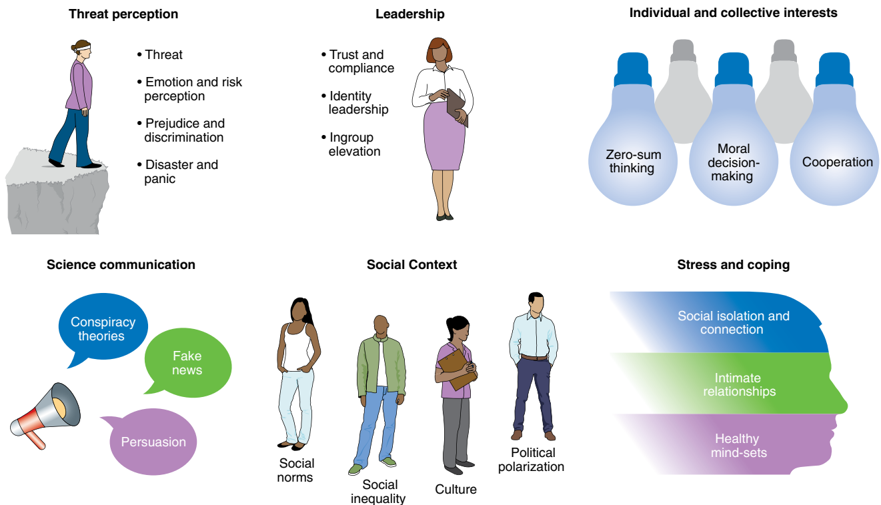
The COVID-19 pandemic represents a massive global health crisis. Because the crisis requires large-scale behaviour change and places significant psychological burdens on individuals, insights from the social and behavioural sciences can be used to help align human behaviour with the recommendations of epidemiologists and public health experts. Here we discuss evidence from a selection of research topics relevant to pandemics, including work on navigating threats, social and cultural influences on behaviour, science communication, moral decision-making, leadership, and stress and coping. In each section, we note the nature and quality of prior research, including uncertainty and unsettled issues. We identify several insights for effective response to the COVID-19 pandemic and highlight important gaps researchers should move quickly to fill in the coming weeks and months.
Overview
CoChat Summary
TL;DR
This perspective argues that social and behavioural science can help align public behaviour with COVID-19 public health recommendations across threat perception, social context, science communication, cooperation, leadership, and stress/coping. It synthesizes prior evidence and policy insights while cautioning that evidence is limited, often drawn from non-pandemic contexts, and in many areas unsettled.
Key findings
- The paper notes the scale of infectious disease threats: the bubonic plague killed approximately 25% of the European population, and by March 2020 COVID-19 had spread to more than 118,000 cases and caused 4,291 deaths in 114 countries. It also notes that 21 countries donated medical supplies to China in February, with China reciprocating widely.
- Fear appeals can change behaviour when people feel capable of dealing with the threat, but produce defensive reactions when people feel helpless; optimism bias can lead people to underestimate personal risk and ignore public health warnings.
- Social norms, inequality, culture, and political polarization shape pandemic behaviour: correcting misperceived norms can help when most people are already doing the desirable behaviour, but descriptive norms can backfire if the behaviour is undesirable unless paired with prescriptive norms.
- Effective communication and leadership may involve credible sources, messages that protect others or align with moral values, prebunking/inoculation against misinformation, accuracy nudges, shared social identity, and leaders modelling prosocial sacrifice; excessive national self-image concerns (“collective narcissism”) can backfire.
Methods
- Design: Perspective/narrative review; no primary data collection or sample. Topics were identified by the corresponding authors as potentially relevant to pandemic response and are explicitly not exhaustive.
- Evidence base: synthesizes prior social and behavioural research on threat perception, social context, science communication, moral decision-making, cooperation, leadership, and stress/coping, drawing on laboratory experiments, correlational studies, field experiments, meta-analyses, and preprints/forthcoming work.
- Analysis: narrative synthesis with policy implications and identified research gaps; no systematic search strategy or quantitative synthesis is reported.
Limitations
- Stated: due to space constraints, the paper provides only a brief summary of each topic; research on these topics is ongoing and in many cases far from settled; there is very little published social science research on the current pandemic, so discussion often draws from different circumstances and evidence quality varies substantially.
- Stated: insights and policy implications should be interpreted with caution.
- Evident: as a perspective rather than a systematic review or empirical study, it does not provide a comprehensive evidence appraisal, and its reliance on preprints and forthcoming sources limits certainty.
Model-written summary. Check it against the paper before relying on it.
Integrity signals
Registry
Cites
Statistics
Figures
Verification
Claims the paper makes
19 Valid · 5 Not valid · 37 Not checked · 13 Own results and interpretations
At least one cited source doesn’t support this claim or points to a different paper, and none confirmed it — see the verdicts below.
In the paper
“For instance, in hypothetical scenarios about deciding whether to go to work while sick, American and British participants reported they would be less willing to stay home when it was uncertain they would infect a co-worker.”
What the sources say
- Disputedcites [176] Kappes, A. et al. Uncertainty about the impact of social decisions increases prosocial behaviour. Nat. Hum. Behav. 2, 573–580 (2018). sourceExperimental — accuracy not yet measured
In the paper’s account of the infectious-disease scenario (Abstract; page not provided), participants facing uncertainty about how severely a co-worker might be affected were more likely to stay home than controls, not less. The paper distinguishes that impact uncertainty from uncertainty about whether a co-worker would be infected. Its Study 6 Methods (page not provided) describe recruitment through AMT, but do not establish the claimed American and British participant groups. (LLM, conf=0.88)
Checked by a reasoning model — may be wrong.
hedgedstates an association- Asserted: passes — The authors put it forward as true.
- Checkable: passes — It can be checked against evidence.
- Load-bearing: passes — The paper’s conclusions depend on it.
- Based: passes — The paper gives a reason why it holds.
- Disputed
The cited sources that could be checked couldn’t confirm or dispute this claim.
In the paper
“Moreover, there is mixed research regarding whether corrections may actually increase belief in the original misinformation 121,124-126 or in other misleading claims that fail to get corrected 127 .”
What the sources say
- Not checked — no full text of the sourcecites [121] Guess, A. & Coppock, A. Does counter-attitudinal information cause backlash? Results from three large survey experiments. Br. J. Polit. Sci. https://doi.org/10.1017/S0007123418000327 (2018). source
- Not matchedcites [124] Wittenberg, C. & Berinsky, A.J. Misinformation and its correction. in Social Media and Democracy: The State of the Field (eds Persily, N. & Tucker, J. A.) (Cambridge University Press, forthcoming).
Its entry has no title and year that we can search by.
- Not checked — no full text of the sourcecites [125] Swire, B. & Ecker, U.K.H. Misinformation and its correction: Cognitive mechanisms and recommendations for mass communication. in Misinformation and Mass Audiences (eds. Southwell, B. G., Thorson, E. A. & Sheble, L.) 195–2011 (University of Texas Press, 2018). source
- Not checked — no full text of the sourcecites [126] Wood, T. & Porter, E. The elusive backfire effect: mass attitudes’ steadfast factual adherence. Polit. Behav. 41, 135–163 (2018). source
- Could not verifycites [127] Pennycook, G., McPhetres, J., Zhang, Y. & Rand, D. Fighting COVID-19 misinformation on social media: Experimental evidence for a scalable accuracy nudge intervention. Preprint at PsyArXiv https://doi.org/10.31234/osf.io/uhbk9 (2020). sourceExperimental — accuracy not yet measured
Citation 127 is attached to the suggestion that corrections may increase belief in other misleading claims that go uncorrected. The Statement of Relevance and Discussion describe an accuracy nudge that improved sharing decisions, not corrections or their effects on belief in uncorrected claims. Searches for correction backfire and uncorrected misinformation found no passage addressing that point; page numbers were unavailable in our copy. (LLM, conf=0.76)
hedgedstates a possible cause- Asserted: passes — The authors put it forward as true.
- Checkable: passes — It can be checked against evidence.
- Load-bearing: passes — The paper’s conclusions depend on it.
- Based: passes — The paper gives a reason why it holds.
The sources with a verdict support this claim; the rest weren’t checked yet, have no full text we could read, or their verdicts aren’t rated yet.
In the paper
“Indeed, laboratory research has found that people prioritize local over global (or international) interests 185,186 .”
What the sources say
- Supportedcites [185] Milinski, M., Hilbe, C., Semmann, D., Sommerfeld, R. & Marotzke, J. Humans choose representatives who enforce cooperation in social dilemmas through extortion. Nat. Commun. 7, 10915 (2016). source
The Results section (‘Voters choose selfish representatives’; page unavailable) reports that participants preferentially re-elected representatives who contributed less to the shared climate account and elected candidates who pledged to contribute less than a fair share. In this simulated international dilemma, that supports the claim that participants favored their own group’s interests over the collective goal; it does not establish that everyone did so. (LLM, conf=0.85)
- Not checked — no full text of the sourcecites [186] Reinders Folmer, C. P. et al. One for all: what representing a group may do to us. J. Exp. Soc. Psychol. 48, 1047–1056 (2012). source
plain- Asserted: passes — The authors put it forward as true.
- Checkable: passes — It can be checked against evidence.
- Load-bearing: passes — The paper’s conclusions depend on it.
- Based: passes — The paper gives a reason why it holds.
- Supported
Every source the paper cites for this claim was checked and supports it.
In the paper
“However, when going to work risked infecting an elderly co-worker who would suffer a serious illness, participants reported they would be more willing to stay home 176 .”
What the sources say
- Supportedcites [176] Kappes, A. et al. Uncertainty about the impact of social decisions increases prosocial behaviour. Nat. Hum. Behav. 2, 573–580 (2018). source
The Study 6 Methods (page not provided) describe a scenario in which going to work could infect an older, vulnerable co-worker who would suffer severely, followed by a rating of willingness to go to work. The reported Study 6 findings (indexed under Abstract; page not provided) say participants given that risk information were significantly more likely to stay home than controls. (LLM, conf=0.92)
hedgedstates a cause- Asserted: passes — The authors put it forward as true.
- Checkable: passes — It can be checked against evidence.
- Load-bearing: passes — The paper’s conclusions depend on it.
- Based: passes — The paper gives a reason why it holds.
- Supported
The sources with a verdict support this claim; the rest weren’t checked yet, have no full text we could read, or their verdicts aren’t rated yet.
In the paper
“Several techniques, such as sanctioning defectors 187 or rewarding cooperators 188 , tend to increase cooperative behaviour in laboratory experiments using economic games.”
What the sources say
- Not checked — no full text of the sourcecites [187] Yamagishi, T. The provision of a sanctioning system as a public good. J. Pers. Soc. Psychol. 51, 110–116 (1986). source
- Supportedcites [188] Rand, D. G., Dreber, A., Ellingsen, T., Fudenberg, D. & Nowak, M. A. Positive interactions promote public cooperation. Science 325, 1272–1275 (2009). source
Citation 188 is attached to rewarding cooperators. The paper’s Abstract reports a laboratory comparison using repeated public goods games and finds that reward maintained public cooperation and, when both reward and punishment were available, increased contributions. (LLM, conf=0.93)
plainstates a cause- Asserted: passes — The authors put it forward as true.
- Checkable: passes — It can be checked against evidence.
- Load-bearing: unclear — It is unclear whether the paper’s conclusions depend on it.
- Based: passes — The paper gives a reason why it holds.
50 more claims · 13 with their cited sources checked
Create a free account to see all 74 claims and to verify the 2 references still open.
- It may state two separate claims as one. 13
- Probably not a substantial claim. 6
Claims other papers make about this one
Each is checked against this paper’s own text: does it say what the citing paper says it does?
The source backs part of the claim, not all of it — or backs it for a different population, condition or comparison.
In the citing paper
“COVID-19 is an international public health crisis, putting substantial burden on medical centers and increasing the psychological toll on health care workers (HCW).”
From Supporting the well-being of health care providers during the COVID-19 pandemic: The CopeColumbia response (2020) · cites this paper as [6]
Experimental — accuracy not yet measuredThe source backs part of the claim, not all of it — or backs it for a different population, condition or comparison.
In the citing paper
“these population-wide measures affected psychological well-being and mental health as well as increased social isolation [68] and loneliness.”
From Psychological correlates of perceived loneliness in college students before and during the COVID-19 stay-at-home period: a longitudinal study (2023) · cites this paper as [68]
Experimental — accuracy not yet measuredThe source backs part of the claim, not all of it — or backs it for a different population, condition or comparison.
In the citing paper
“they may eventually increase the social isolation of students and affect their psychological well-being and mental health [3].”
From Students under lockdown: Comparisons of students’ social networks and mental health before and during the COVID-19 crisis in Switzerland (2020) · cites this paper as [3]
Experimental — accuracy not yet measuredThe source backs part of the claim, not all of it — or backs it for a different population, condition or comparison.
In the citing paper
“effective interventions are hard to scale to a population level (12);”
From Psychological inoculation improves resilience against misinformation on social media (2022) · cites this paper as [12]
Experimental — accuracy not yet measuredThe source backs part of the claim, not all of it — or backs it for a different population, condition or comparison.
In the citing paper
“There is a shortage of studies that test anti-misinformation interventions in an ecologically valid manner, i.e., testing an intervention as consumers would interact with it in online environments (8, 12).”
From Psychological inoculation improves resilience against misinformation on social media (2022) · cites this paper as [12]
Experimental — accuracy not yet measured
6 more claims about this paper
Create a free account to see every claim other papers make about this one.
Citations
Cites
Granovetter, M. S. (1973) · American Journal of Sociology · doi:10.1086/225469 · Cited by 40,491
Zhou, F., Yu, T., Du, R., Fan, G., Liu, Y., Liu, Z., Xiang, J., Wang, Y., Song, B., Gu, X., et al. (2020) · The Lancet · doi:10.1016/s0140-6736(20)30566-3 · Cited by 27,263
The need to belong: Desire for interpersonal attachments as a fundamental human motivation.
Baumeister, R. F., & Leary, M. R. (1995) · Psychological Bulletin · doi:10.1037//0033-2909.117.3.497 · Cited by 23,245
Culture and the self: Implications for cognition, emotion, and motivation.
Markus, H. R., & Kitayama, S. (1991) · Psychological Review · doi:10.1037/0033-295x.98.2.224 · Cited by 21,995
Self-citationThe Psychological Impact of Quarantine and How to Reduce It: Rapid Review of the Evidence
Brooks, S. K., Webster, R. K., Smith, L. E., Woodland, L., Wessely, S., Greenberg, N., & Rubin, G. J. (2020) · doi:10.2139/ssrn.3532534 · Cited by 16,394
The psychological impact of quarantine and how to reduce it: Rapid review of the evidence
Brooks, S. K., Webster, R. K., Smith, L. E., Woodland, L., Wessely, S., Greenberg, N., & Rubin, G. J. (2020) · The Lancet · doi:10.1016/s0140-6736(20)30460-8 · Cited by 16,378
Nudge: improving decisions about health, wealth, and happiness
(2008) · Choice Reviews Online · doi:10.5860/choice.46-0977 · Cited by 11,572
Slovic, P. (1987) · Science · doi:10.1126/science.3563507 · Cited by 9,271
The Elaboration Likelihood Model of Persuasion
Petty, R. E., & Cacioppo, J. T. (1986) · Advances in Experimental Social Psychology · doi:10.1016/s0065-2601(08)60214-2 · Cited by 8,822
Self-citationThe emotional dog and its rational tail: A social intuitionist approach to moral judgment.
Haidt, J. (2001) · Psychological Review · doi:10.1037/0033-295x.108.4.814 · Cited by 8,048
Research works printed but not linked: 3
- Berkowitz, A.D. An overview of the social norms approach. in Changing the Culture of College Drinking: A Socially Situated Health Communication Campaign (eds. Stewart, L. & Lederman, L. C.) 193–214 (Hampton Press, 2005).
- Wittenberg, C. & Berinsky, A.J. Misinformation and its correction. in Social Media and Democracy: The State of the Field (eds Persily, N. & Tucker, J. A.) (Cambridge University Press, forthcoming).
- Ransohoff, K.J. Patients on the Trolley Track: The Moral Cognition of Medical Practitioners and Public Health Professionals. (Harvard Univ. Press, 2011).
Cited by
Items 101–200 of 5,015
Delmastro, M., & Zamariola, G. (2020) · Scientific Reports · doi:10.1038/s41598-020-79850-6 · Cited by 229
The effects of COVID-19 pandemic on perceived stress and psychobiosocial states in Italian athletes
di Fronso, S., Costa, S., Montesano, C., Di Gruttola, F., Ciofi, E. G., Morgilli, L., Robazza, C., & Bertollo, M. (2022) · International Journal of Sport and Exercise Psychology · doi:10.1080/1612197x.2020.1802612 · Cited by 225
“Highly aware that any behavioural science can provide valuable insights for managing the pandemic and its impact (Van Bavel et al., 2020), these professionals are providing individual and team meetings via the internet to “shorten the distance” and ensure the physical and psychological health of…”
BackgroundStrategies to Prevent Healthcare-Associated Infections: A Narrative Overview
Haque, M., McKimm, J., Sartelli, M., Dhingra, S., Labricciosa, F. M., Islam, S., Jahan, D., Nusrat, T., Chowdhury, T. S., Coccolini, F., et al. (2020) · Risk Management and Healthcare Policy · doi:10.2147/rmhp.s269315 · Cited by 225
Antecedents and consequences of panic buying: The case of COVID‐19
Prentice, C., Quach, S., & Thaichon, P. (2022) · International Journal of Consumer Studies · doi:10.1111/ijcs.12649 · Cited by 221
The local governance of COVID-19: Disease prevention and social security in rural India
Dutta, A., & Fischer, H. W. (2021) · World Development · doi:10.1016/j.worlddev.2020.105234 · Cited by 218
Haslam, S. A., Haslam, C., Cruwys, T., Jetten, J., Bentley, S. V., Fong, P., & Steffens, N. K. (2022) · Current Opinion in Psychology · doi:10.1016/j.copsyc.2021.07.013 · Cited by 211
Self-citationTeovanović, P., Lukić, P., Zupan, Z., Lazić, A., Ninković, M., & Žeželj, I. (2021) · Applied Cognitive Psychology · doi:10.1002/acp.3770 · Cited by 200
Racism and nationalism during and beyond the COVID-19 pandemic
Elias, A., Ben, J., Mansouri, F., & Paradies, Y. (2021) · Ethnic and Racial Studies · doi:10.1080/01419870.2020.1851382 · Cited by 211
Bono, G., Reil, K., & Hescox, J. (2020) · International Journal of Wellbeing · doi:10.5502/ijw.v10i3.1331 · Cited by 208
“Some scholars note that renewed ethnocentrism during pandemics can also impact discrimination and prejudice, exacerbating pre-existing feelings of racism against diverse students (Bavel et al., 2020), a phenomenon evident in U.”
BackgroundYang, Y., Zhang, C. X., & Rickly, J. M. (2021) · Annals of Tourism Research · doi:10.1016/j.annals.2021.103313 · Cited by 206
“Psychologists argue that fear is a common response to a pandemic (Van Bavel et al., 2020).”
Saud, M., Mashud, M., & Ida, R. (2020) · Journal of Public Affairs · doi:10.1002/pa.2417 · Cited by 205
COVID-19 Misinformation Trends in Australia: Prospective Longitudinal National Survey
Pickles, K., Cvejic, E., Nickel, B., Copp, T., Bonner, C., Leask, J., Ayre, J., Batcup, C., Cornell, S., Dakin, T., et al. (2021) · Journal of Medical Internet Research · doi:10.2196/23805 · Cited by 205
“Finally, partnerships between public health authorities and trusted organizations to deliver information and correct misinformation should be utilized where possible [38].”
Five Lessons from COVID-19 for Advancing Climate Change Mitigation
Klenert, D., Funke, F., Mattauch, L., & O’Callaghan, B. (2020) · Environmental and Resource Economics · doi:10.1007/s10640-020-00453-w · Cited by 214
Maaravi, Y., Levy, A., Gur, T., Confino, D., & Segal, S. (2021) · Frontiers in Public Health · doi:10.3389/fpubh.2021.627559 · Cited by 201
“We picked Israel since the country scored 54 on Hofstede’s individualism-collectivism model, which is approximately the mid-range of the 69 countries (6-91).”
BackgroundModelling optimal vaccination strategy for SARS-CoV-2 in the UK
Moore, S., Hill, E. M., Dyson, L., Tildesley, M. J., & Keeling, M. J. (2021) · PLOS Computational Biology · doi:10.1371/journal.pcbi.1008849 · Cited by 196
“This still remains an open question [56] and is a key policy consideration as restrictions are varied.”
BackgroundRamkissoon, H. (2020) · Frontiers in Psychology · doi:10.3389/fpsyg.2020.02248 · Cited by 198
Druckman, J. N., Klar, S., Krupnikov, Y., Levendusky, M., & Ryan, J. B. (2021) · Journal of Experimental Political Science · doi:10.1017/xps.2020.28 · Cited by 193
Self-citationHagger, M. S., Smith, S. R., Keech, J. J., Moyers, S. A., & Hamilton, K. (2020) · Annals of Behavioral Medicine · doi:10.1093/abm/kaaa073 · Cited by 196
“There have, therefore, been calls for research informed by behavioral science that identifies key determinants of preventive behaviors in the context of the current pandemic, particularly social distancing [7, 8].”
BackgroundSelf-citationChen, X., & Chen, H. (2020) · International Journal of Environmental Research and Public Health · doi:10.3390/ijerph17124437 · Cited by 195
“Research on social and behavioral sciences provides insights for effective responses to the COVID-19 pandemic [24].”
BackgroundCOVID-19, mental health and religion: an agenda for future research
Dein, S., Loewenthal, K., Lewis, C. A., & Pargament, K. I. (2020) · Mental Health, Religion & Culture · doi:10.1080/13674676.2020.1768725 · Cited by 195
“When the mental health impact of the COVID-19 pandemic began to be appreciated, attempts were made to assess this impact (e.g., Ho et al., in press; Van Bavel et al., 2020; Wang et al., 2020).”
BackgroundJovančević, A., & Milićević, N. (2020) · Personality and Individual Differences · doi:10.1016/j.paid.2020.110216 · Cited by 193
Ransing, R., Adiukwu, F., Pereira-Sanchez, V., Ramalho, R., Orsolini, L., Teixeira, A. L. S., Gonzalez-Diaz, J. M., Pinto da Costa, M., Soler-Vidal, J., Bytyçi, D. G., et al. (2020) · Asian Journal of Psychiatry · doi:10.1016/j.ajp.2020.102085 · Cited by 191
“Previous epidemiological reports suggest that the public demands up-to-date information on an ongoing basis throughout the period (Van Bavel et al., 2020; Zandifar and Badrfam, 2020).”
BackgroundImpact of COVID-19 on Public Mental Health and the Buffering Effect of a Sense of Coherence
Schäfer, S. K., Sopp, M. R., Schanz, C. G., Staginnus, M., Göritz, A. S., & Michael, T. (2020) · Psychotherapy and Psychosomatics · doi:10.1159/000510752 · Cited by 192
Resilience against crises: COVID-19 and lessons from natural disasters
Sakurai, M., & Chughtai, H. (2020) · European Journal of Information Systems · doi:10.1080/0960085x.2020.1814171 · Cited by 191
Oleksy, T., Wnuk, A., Maison, D., & Łyś, A. (2021) · Personality and Individual Differences · doi:10.1016/j.paid.2020.110289 · Cited by 188
“Unfortunately, they could have also numerous negative social consequences (Van Bavel et al., 2020), and this induced the World Health Organization (WHO) to state that we are ‘not just fighting an epidemic; we're fighting an infodemic.”
Lee, F., & Suryohusodo, A. A. (2022) · Frontiers in Public Health · doi:10.3389/fpubh.2022.957630 · Cited by 192
“Social norms and culture are factors that could influence one’s behavior and there are situations when these are prioritized more than security thereby making the pandemic difficult to be controlled (42).”
BackgroundKim, S., & Kim, S. (2020) · International Journal of Environmental Research and Public Health · doi:10.3390/ijerph17228666 · Cited by 187
“[33] explain that social networks can amplify the spread of specific behaviors that are both harmful and beneficial during a pandemic.”
BackgroundCOVID-19, activity and mobility patterns in Bogotá. Are we ready for a ‘15-minute city’?
Guzman, L. A., Arellana, J., Oviedo, D., & Moncada Aristizábal, C. A. (2021) · Travel Behaviour and Society · doi:10.1016/j.tbs.2021.04.008 · Cited by 188
Organizational Culture and COVID‐19
Spicer, A. (2020) · Journal of Management Studies · doi:10.1111/joms.12625 · Cited by 187
Iorfa, S. K., Ottu, I. F. A., Oguntayo, R., Ayandele, O., Kolawole, S. O., Gandi, J. C., Dangiwa, A. L., & Olapegba, P. O. (2020) · Frontiers in Psychology · doi:10.3389/fpsyg.2020.566773 · Cited by 187
The consequences of COVID-19 on social interactions: an online study on face covering
Calbi, M., Langiulli, N., Ferroni, F., Montalti, M., Kolesnikov, A., Gallese, V., & Umiltà, M. A. (2021) · Scientific Reports · doi:10.1038/s41598-021-81780-w · Cited by 186
Global Behaviors and Perceptions at the Onset of the COVID-19 Pandemic
Fetzer, T., Witte, M., Hensel, L., Jachimowicz, J., Haushofer, J., Ivchenko, A., Caria, S., Reutskaja, E., Roth, C., Fiorin, S., et al. (2020) · National Bureau of Economic Research · doi:10.3386/w27082 · Cited by 185
Inefficiency of SIR models in forecasting COVID-19 epidemic: a case study of Isfahan
Moein, S., Nickaeen, N., Roointan, A., Borhani, N., Heidary, Z., Javanmard, S. H., Ghaisari, J., & Gheisari, Y. (2021) · Scientific Reports · doi:10.1038/s41598-021-84055-6 · Cited by 181
Tong, K. K., Chen, J. H., Yu, E. W., & Wu, A. M. S. (2020) · Applied Psychology: Health and Well-Being · doi:10.1111/aphw.12230 · Cited by 183
“Some researchers have proposed investigating different cultural dimensions, such as tightness or looseness of social norms, to understand COVID-19-related responses (Bavel et al., 2020).”
BackgroundSocial capital and the spread of covid-19: Insights from european countries
Bartscher, A. K., Seitz, S., Siegloch, S., Slotwinski, M., & Wehrhöfer, N. (2021) · Journal of Health Economics · doi:10.1016/j.jhealeco.2021.102531 · Cited by 182
Wolff, W., Martarelli, C. S., Schüler, J., & Bieleke, M. (2020) · International Journal of Environmental Research and Public Health · doi:10.3390/ijerph17155420 · Cited by 173
“For example, it is important to assess how boredom and self-control interact with other variables that have been shown to covary with adherence to the pandemic containment measures, like fear of SARS-CoV-2 [40], individual reasoning skills [41], or the socio-cultural context [42].”
BackgroundSallam, M., Dababseh, D., Yaseen, A., Al-Haidar, A., Taim, D., Eid, H., Ababneh, N. A., Bakri, F. G., & Mahafzah, A. (2020) · PLOS ONE · doi:10.1371/journal.pone.0243264 · Cited by 180
“However, dangerous speculations about the virus might diminish the efforts in controlling the spread of infection [8, 20].”
BackgroundPublic Health Messaging during the COVID-19 Pandemic and Beyond: Lessons from Communication Science
Nan, X., Iles, I. A., Yang, B., & Ma, Z. (2022) · Health Communication · doi:10.1080/10410236.2021.1994910 · Cited by 182
“Public health communication interventions must be supplemented with other behavior interventions, environmental changes, and even legislation (Bavel et al., 2020; Finset et al., 2020; National Academies of Sciences, Engineering and Medicine, 2020).”
BackgroundMollaioli, D., Sansone, A., Ciocca, G., Limoncin, E., Colonnello, E., Di Lorenzo, G., & Jannini, E. A. (2021) · The Journal of Sexual Medicine · doi:10.1016/j.jsxm.2020.10.008 · Cited by 181
Risk Perception and Protective Behaviors During the Rise of the COVID-19 Outbreak in Italy
Savadori, L., & Lauriola, M. (2021) · Frontiers in Psychology · doi:10.3389/fpsyg.2020.577331 · Cited by 180
“Social norms have been recently included among the social factors that might trigger protective behaviors during the COVID-19 epidemic (Andrews et al., 2020; Bavel et al., 2020).”
BackgroundMeyer, B., Zill, A., Dilba, D., Gerlach, R., & Schumann, S. (2021) · International Journal of Psychology · doi:10.1002/ijop.12743 · Cited by 179
“Whereas most JD-R research focused on independent effects of job characteristics on health-related outcomes, COR theory suggests that demands deplete resources, and that the (temporal) processes associated with resource depletion cause emotional exhaustion (van Woerkom et al., 2016).”
BackgroundLavazza, A., & Farina, M. (2020) · Frontiers in Public Health · doi:10.3389/fpubh.2020.00356 · Cited by 178
“This is particularly important in the context of the Covid-19 pandemic (21).”
BackgroundPotentially long-lasting effects of the pandemic on scientists
Gao, J., Yin, Y., Myers, K. R., Lakhani, K. R., & Wang, D. (2021) · Nature Communications · doi:10.1038/s41467-021-26428-z · Cited by 177
Does “ AI ” stand for augmenting inequality in the era of covid-19 healthcare?
Leslie, D., Mazumder, A., Peppin, A., Wolters, M. K., & Hagerty, A. (2021) · BMJ · doi:10.1136/bmj.n304 · Cited by 177
Mental disorders following COVID-19 and other epidemics: a systematic review and meta-analysis
Leung, C. M. C., Ho, M. K., Bharwani, A. A., Cogo-Moreira, H., Wang, Y., Chow, M. S. C., Fan, X., Galea, S., Leung, G. M., & Ni, M. Y. (2022) · Translational Psychiatry · doi:10.1038/s41398-022-01946-6 · Cited by 174
“Yet the psychobehavioural responses to epidemics depend on a interplay between threat perception, stress and coping, individual and collective interests, social context, leadership, and risk communication [130, 132].”
BackgroundSocial norms, social identities and the COVID‐19 pandemic: Theory and recommendations
Neville, F. G., Templeton, A., Smith, J. R., & Louis, W. R. (2021) · Social and Personality Psychology Compass · doi:10.1111/spc3.12596 · Cited by 172
“When respondents were presented with vignettes about deviation from norms related to COVID‐19 guidance by either in‐ group members (fellow nationals) or outgroup members (other national groups), it resulted in negative emotions towards the norm deviators in both groups, and support for retributive measures (stronger t…”
BackgroundInfluentialLancet COVID-19 Commission Statement on the occasion of the 75th session of the UN General Assembly
Sachs, J. D., Abdool Karim, S., Aknin, L., Allen, J., Brosbøl, K., Cuevas Barron, G., Daszak, P., Espinosa, M. F., Gaspar, V., Gaviria, A., et al. (2020) · The Lancet · doi:10.1016/s0140-6736(20)31927-9 · Cited by 171
Interventions to reduce partisan animosity
Hartman, R., Blakey, W., Womick, J., Bail, C., Finkel, E. J., Han, H., Sarrouf, J., Schroeder, J., Sheeran, P., Van Bavel, J. J., et al. (2022) · Nature Human Behaviour · doi:10.1038/s41562-022-01442-3 · Cited by 171
Self-citationFace Masks During the COVID-19 Pandemic: A Simple Protection Tool With Many Meanings
Martinelli, L., Kopilaš, V., Vidmar, M., Heavin, C., Machado, H., Todorović, Z., Buzas, N., Pot, M., Prainsack, B., & Gajović, S. (2021) · Frontiers in Public Health · doi:10.3389/fpubh.2020.606635 · Cited by 169
“Its use is deeply connected to social and cultural practices, as well as political, ethical, and health-related concerns, personal, and social meanings (18, 19).”
BackgroundInfluence of perceived threat of Covid-19 and HEXACO personality traits on toilet paper stockpiling
Garbe, L., Rau, R., & Toppe, T. (2020) · PLOS ONE · doi:10.1371/journal.pone.0234232 · Cited by 186
Bicchieri, C., Fatas, E., Aldama, A., Casas, A., Deshpande, I., Lauro, M., Parilli, C., Spohn, M., Pereira, P., & Wen, R. (2021) · PLOS ONE · doi:10.1371/journal.pone.0252892 · Cited by 167
Human–dog relationships during the COVID-19 pandemic: booming dog adoption during social isolation
Morgan, L., Protopopova, A., Birkler, R. I. D., Itin-Shwartz, B., Sutton, G. A., Gamliel, A., Yakobson, B., & Raz, T. (2020) · Humanities and Social Sciences Communications · doi:10.1057/s41599-020-00649-x · Cited by 165
Seale, H., Dyer, C. E. F., Abdi, I., Rahman, K. M., Sun, Y., Qureshi, M. O., Dowell-Day, A., Sward, J., & Islam, M. S. (2020) · BMC Infectious Diseases · doi:10.1186/s12879-020-05340-9 · Cited by 162
Chen, X., Zhang, S. X., Jahanshahi, A. A., Alvarez-Risco, A., Dai, H., Li, J., & Ibarra, V. G. (2020) · JMIR Public Health and Surveillance · doi:10.2196/20737 · Cited by 162
“The most popular examples related to the pandemic include “COVID-19 was developed in a lab,” “people developed COVID-19 to destroy Donald Trump’s presidency,” “COVID-19 is caused by 5G and is a form of radiation poisoning transmitted through radio waves,” and “COVID-19 is Bill Gates’s attempt to take over the medical…”
BackgroundThe use of medicinal plants to prevent COVID-19 in Nepal
Khadka, D., Dhamala, M. K., Li, F., Aryal, P. C., Magar, P. R., Bhatta, S., Thakur, M. S., Basnet, A., Cui, D., & Shi, S. (2021) · Journal of Ethnobiology and Ethnomedicine · doi:10.1186/s13002-021-00449-w · Cited by 163
“The COVID-19 pandemic has created a large crisis, and it needs large-scale behavior changes [101].”
BackgroundEncouraging COVID-19 Vaccine Uptake Through Effective Health Communication
Motta, M., Sylvester, S., Callaghan, T., & Lunz-Trujillo, K. (2021) · Frontiers in Political Science · doi:10.3389/fpos.2021.630133 · Cited by 159
Seddig, D., Maskileyson, D., Davidov, E., Ajzen, I., & Schmidt, P. (2022) · Social Science & Medicine · doi:10.1016/j.socscimed.2022.114981 · Cited by 162
Risk Attitudes and Human Mobility During the COVID-19 PandemicPreprint
Chan, H. F., Torgler, B., Skali, A., Stadelmann, D., & Savage, D. A. (2020) · RePEc: Research Papers in Economics · doi:10.17605/osf.io/7bxqp · Cited by 162
Fighting fake news in the COVID-19 era: policy insights from an equilibrium model
Hartley, K., & Vu, M. K. (2020) · Policy Sciences · doi:10.1007/s11077-020-09405-z · Cited by 160
van de Groep, S., Zanolie, K., Green, K. H., Sweijen, S., & Crone, E. A. (2020) · PLoS ONE · doi:10.1371/journal.pone.0240349 · Cited by 183
“The COVID-19 pandemic in 2020 represents a massive and challenging global health crisis [9].”
BackgroundInfluentialStress of university students before and after campus closure in response to COVID‐19
von Keyserlingk, L., Yamaguchi‐Pedroza, K., Arum, R., & Eccles, J. S. (2022) · Journal of Community Psychology · doi:10.1002/jcop.22561 · Cited by 160
Consideration of culture is vital if we are to achieve the Sustainable Development Goals
Zheng, X., Wang, R., Hoekstra, A. Y., Krol, M. S., Zhang, Y., Guo, K., Sanwal, M., Sun, Z., Zhu, J., Zhang, J., et al. (2021) · One Earth · doi:10.1016/j.oneear.2021.01.012 · Cited by 158
“Specifically, culture influences the achievement of goals related to physical health and psychological well-being.(7) Culture affects physical health (SDG targets 3.”
BackgroundHearne, B. N., & Niño, M. (2021) · Journal of Racial and Ethnic Health Disparities · doi:10.1007/s40615-020-00941-1 · Cited by 180
An anchor in troubled times: Trust in science before and within the COVID-19 pandemic
Bromme, R., Mede, N. G., Thomm, E., Kremer, B., & Ziegler, R. (2022) · PLoS ONE · doi:10.1371/journal.pone.0262823 · Cited by 201
“The COVID-19 pandemic is a new challenge for people all over the world, and it is one that can only be understood and managed based on scientific knowledge (meant in the general sense of Wissenschaft, which includes social sciences and humanities, [1]).”
BackgroundMoroń, M., & Biolik-Moroń, M. (2020) · Personality and Individual Differences · doi:10.1016/j.paid.2020.110348 · Cited by 209
RETRACTED: COVID-19 as an “Infodemic” in Public Health: Critical Role of the Social Media
Banerjee, D., & Meena, K. S. (2021) · Frontiers in Public Health · doi:10.3389/fpubh.2021.610623 · Cited by 154
“Croucher et al. (31) reported increased xenophobic sentiments, social stigma, racism and prejudice against the “Asian” communities in the United States (U.S.) due to increased use of social media during the pandemic.”
BackgroundRetractedOkuyan, C. B., & Begen, M. A. (2021) · Perspectives In Psychiatric Care · doi:10.1111/ppc.12847 · Cited by 210
“It may be possible to reduce or eliminate such adverse effects with help of social interactions and bonds.(54) It is important to maintain daily routines while working at home such as taking a shower, getting dressed formally and having breakfast as if one leaves their home for”
BackgroundUnderstanding COVID-19 diffusion requires an interdisciplinary, multi-dimensional approach
Bontempi, E., Vergalli, S., & Squazzoni, F. (2020) · Environmental Research · doi:10.1016/j.envres.2020.109814 · Cited by 151
Pandita, S., Mishra, H. G., & Chib, S. (2020) · Children and Youth Services Review · doi:10.1016/j.childyouth.2020.105783 · Cited by 211
Quantifying the effects of fake news on behavior: Evidence from a study of COVID-19 misinformation.
Greene, C. M., & Murphy, G. (2021) · Journal of Experimental Psychology: Applied · doi:10.1037/xap0000371 · Cited by 150
Al-Hasan, A., Yim, D., & Khuntia, J. (2020) · Journal of Medical Internet Research · doi:10.2196/20634 · Cited by 169
“Social networks can amplify the spread of behavior regardless of whether the behavior is harmful or beneficial to the pandemic [39,40].”
BackgroundInfluentialThe social threats of COVID-19 for people with chronic pain
Karos, K., McParland, J. L., Bunzli, S., Devan, H., Hirsh, A., Kapos, F. P., Keogh, E., Moore, D., Tracy, L. M., & Ashton-James, C. E. (2020) · Pain · doi:10.1097/j.pain.0000000000002004 · Cited by 149
“Introduction 1 The COVID-19 (SARS-CoV-2) pandemic has changed the social environment in 2 which people live and work, as well as the social systems they rely on [39; 88].”
BackgroundCodagnone, C., Bogliacino, F., Gómez, C., Charris, R., Montealegre, F., Liva, G., Lupiáñez-Villanueva, F., Folkvord, F., & Veltri, G. A. (2020) · PLOS ONE · doi:10.1371/journal.pone.0240876 · Cited by 147
“Within social sciences, the current research has focused on perception and attitudes [25], on the threat posed by COVID-19 related fake news [26, 27], and on designing nudges and other social and behavioural measures to support the COVID-19 pandemic response [28, 29], among the others.”
BackgroundSahin, O., Salim, H., Suprun, E. V., Richards, R., MacAskill, S., Heilgeist, S., Rutherford, S., Stewart, R. A., & Beal, C. (2020) · Systems · doi:10.3390/systems8020020 · Cited by 168
Koçak, O., Koçak, O., & Younis, M. Z. (2021) · International Journal of Environmental Research and Public Health · doi:10.3390/ijerph18041836 · Cited by 181
“Initially, COVID-19 was not taken seriously, and after it was known what the infection would cause, a sense of panic and anxiety emerged [20].”
BackgroundInfluentialRisk of burnout in French entrepreneurs during the COVID-19 crisis
Torrès, O., Benzari, A., Fisch, C. O., Mukerjee, J., Swalhi, A., & Thurik, R. (2021) · Small Business Economics · doi:10.1007/s11187-021-00516-2 · Cited by 171
Wearing a face mask against Covid-19 results in a reduction of social distancing
Cartaud, A., Quesque, F., & Coello, Y. (2020) · PLoS ONE · doi:10.1371/journal.pone.0243023 · Cited by 158
“Recent works [34] highlighted the difficulty of making public policy and government decisions based solely on rationalization, as multiple cognitive biases stand in the way of risk prevention in social contexts.”
BackgroundTu, Y., Li, D., & Wang, H. (2021) · International Journal of Hospitality Management · doi:10.1016/j.ijhm.2021.102912 · Cited by 177
CoMix: comparing mixing patterns in the Belgian population during and after lockdown
Coletti, P., Wambua, J., Gimma, A., Willem, L., Vercruysse, S., Vanhoutte, B., Jarvis, C. I., van Zandvoort, K., Edmunds, J., Beutels, P., et al. (2020) · Scientific Reports · doi:10.1038/s41598-020-78540-7 · Cited by 152
Das, S. S., & Tiwari, A. K. (2020) · Tourism Recreation Research · doi:10.1080/02508281.2020.1830341 · Cited by 180
“This is because, older people are aware that they are at the highest risk for severe COVID-19 symptoms (Bavel et al., 2020) and have stronger intention to comply with the preventive measures recommended by the government (Bults et al., 2011).”
BackgroundMækelæ, M. J., Reggev, N., Dutra, N. B., Tamayo, R. M., Silva-Sobrinho, R. A., Klevjer, K., & Pfuhl, G. (2020) · Royal Society Open Science · doi:10.1098/rsos.200644 · Cited by 159
Hou, X. H., Gao, S., Li, Q., Kang, Y., Chen, N., Chen, K., Rao, J., Ellenberg, J. S., & Patz, J. A. (2021) · Proceedings of the National Academy of Sciences · doi:10.1073/pnas.2020524118 · Cited by 153
Cyberchondria in the time of the COVID ‐19 pandemic
Starcevic, V., Schimmenti, A., Billieux, J., & Berle, D. (2021) · Human Behavior and Emerging Technologies · doi:10.1002/hbe2.233 · Cited by 141
Kerr, J. R., Schneider, C. R., Recchia, G. L., Dryhurst, S., Sahlin, U., Dufouil, C., Arwidson, P., Freeman, A. L. J., & van der Linden, S. (2021) · BMJ Open · doi:10.1136/bmjopen-2020-048025 · Cited by 163
Self-citationRates of SARS-CoV-2 transmission and vaccination impact the fate of vaccine-resistant strains
Rella, S. A., Kulikova, Y. A., Dermitzakis, E. T., & Kondrashov, F. A. (2021) · Scientific Reports · doi:10.1038/s41598-021-95025-3 · Cited by 146
Wright, L., Steptoe, A., & Fancourt, D. (2021) · The Lancet Regional Health - Europe · doi:10.1016/j.lanepe.2021.100061 · Cited by 136
“With regards to confidence in institutions, trust and confidence in government can increase motivations to comply by assuring citizens that guidelines are necessary and effective [4].”
BackgroundHow confidence in health care systems affects mobility and compliance during the COVID-19 pandemic
Chan, H. F., Brumpton, M., Macintyre, A., Arapoc, J. A., Savage, D. A., Skali, A., Stadelmann, D., & Torgler, B. (2020) · PLoS ONE · doi:10.1371/journal.pone.0240644 · Cited by 154
“[24] pointed out the path forward for several of these behavioral interventions.”
BackgroundOldeweme, A., Märtins, J., Westmattelmann, D., & Schewe, G. (2021) · Journal of Medical Internet Research · doi:10.2196/25893 · Cited by 164
“In addition, the four described uncertainties are further reinforced by unverified information and fake news [41-43].”
BackgroundCOVID-19, Fake News, and Vaccines: Should Regulation Be Implemented?
Marco-Franco, J. E., Barros, P. P., Vivas-Orts, D., González-de-Julián, S., & Vivas-Consuelo, D. (2021) · International Journal of Environmental Research and Public Health · doi:10.3390/ijerph18020744 · Cited by 164
Digitalization impacts the COVID-19 pandemic and the stringency of government measures
Heinrichs, H., Mueller, F., Rohfleisch, L., Schulz, V., Talbot, S. R., & Kiessling, F. M. (2022) · Scientific Reports · doi:10.1038/s41598-022-24726-0 · Cited by 141
Psychometric Evaluation of the Fear of COVID-19 Scale Among Chinese Population
Chi, X., Chen, S., Chen, Y., Chen, D., Yu, Q., Guo, T., Cao, Q., Zheng, X., Huang, S., Hossain, M. M., et al. (2022) · International Journal of Mental Health and Addiction · doi:10.1007/s11469-020-00441-7 · Cited by 137
“Fear, as a type of emotion, typically consists of three components within two dimensions (emotional reaction and physical experience (behavioral response and physiological arousal)) (Dror 2014; Gross and Feldman Barrett 2011; Van Bavel et al. 2020).”
BackgroundRaude, J., Lecrique, J.-M., Lasbeur, L., Léon, C., Guignard, R., du Roscoät, E., & Arwidson, P. (2020) · Frontiers in Psychology · doi:10.3389/fpsyg.2020.584500 · Cited by 160
“However, we still do not know much about how people respond to the COVID-19 epidemic, as well as the causes and motives of the engagement in the health protective behaviors recommended by the national and regional governments (Van Bavel et al., 2020).”
BackgroundLieberoth, A., Lin, S.-Y., Stöckli, S., Han, H., Kowal, M., Gelpí, R., Chrona, S., Tran, T. P., Jeftić, A., Rasmussen, J. S., et al. (2021) · Royal Society Open Science · doi:10.1098/rsos.200589 · Cited by 156
“Further, it has been suggested that cultural variables such as the degree of collectivism, or social ‘tightness’, may lead to different attitudes regarding compliance with social norms [3], and one study observed that cultural differences in relational mobility, or the perceived easiness to engage with strangers and f…”
Global evidence of expressed sentiment alterations during the COVID-19 pandemic
Wang, J., Fan, Y., Palacios, J., Chai, Y., Guetta-Jeanrenaud, N., Obradovich, N., Zhou, C., & Zheng, S. (2022) · Nature Human Behaviour · doi:10.1038/s41562-022-01312-y · Cited by 133
“Previous studies have shown how nations with loose cultures (that is, having lenient norms and punishments for deviance) had more difficulty coordinating in the face of the pandemic 33,34 .”
BackgroundEvamdrou, M., Falkingham, J. C., Qin, M., et al. (2020) · doi:10.31235/osf.io/962dy · Cited by 136
“The research here indicates that assistance with such tasks seems to have increased, reflecting the rise of volunteering and community action during this period (Booth, 2020; Local Government Association, 2020; Van Bavel et al. 2020), although not all older people living alone reported a rise and the majority reported…”
BackgroundRisk attitudes and human mobility during the COVID-19 pandemic
Chan, H. F., Skali, A., Savage, D. A., Stadelmann, D., & Torgler, B. (2020) · Scientific Reports · doi:10.1038/s41598-020-76763-2 · Cited by 196
Witteveen, A. B., Young, S. Y., Cuijpers, P. J., Ayuso‐Mateos, J. L., Barbui, C., Bertolini, F., Cabello, M., Cadorin, C., Downes, N., Franzoi, D., et al. (2023) · PLoS Medicine · doi:10.1371/journal.pmed.1004206 · Cited by 163
Γούμενου, Μ., Sarigiannis, D. A., Tsatsakis, A. M., Anesti, O., Docea, A. O., Petrakis, D., Tsoukalas, D., Kostoff, R. N., Rakitskii, V., Spandidos, D. A., et al. (2020) · Molecular Medicine Reports · doi:10.3892/mmr.2020.11079 · Cited by 158
Morse, J. W., Gladkikh, T. M., Hackenburg, D. M., & Gould, R. K. (2020) · PLoS ONE · doi:10.1371/journal.pone.0243697 · Cited by 159
“By framing nature interactions too narrowly, public health campaigns may unknowingly limit their reach and effectiveness [84].”
BackgroundIdentifying Fake News on Social Networks Based on Natural Language Processing: Trends and Challenges
de Oliveira, N. R., Pisa, P. S., Lopez, M. A., Medeiros, D. S. V., & Mattos, D. M. F. (2021) · Information · doi:10.3390/info12010038 · Cited by 176
“Recent studies show the correlation between social media usage and misinformation during the pandemic [76,77].”
Background
Metadata
- Authors
- Bavel, J. J. V., Baicker, K., Boggio, P. S., Capraro, V., Cichocka, A., Cikara, M., Crockett, M. J., Crum, A. J., Douglas, K. M., Druckman, J. N., Drury, J., Dube, O., Ellemers, N., Finkel, E. J., Fowler, J. H., Gelfand, M., Han, S., Haslam, S. A., Jetten, J., Kitayama, S., Mobbs, D., Napper, L. E., Packer, D. J., Pennycook, G., Peters, E., Petty, R. E., Rand, D. G., Reicher, S. D., Schnall, S., Shariff, A., Skitka, L. J., Smith, S. S., Sunstein, C. R., Tabri, N., Tucker, J. A., Linden, S. V. D., Lange, P. V., Weeden, K. A., Wohl, M. J. A., Zaki, J., Zion, S. R., & Willer, R.
- Affiliations
- New York University (US)
- Universidade Presbiteriana Mackenzie (BR)
- Middlesex University London (GB)
- University of Kent (GB)
- Harvard University (US)
- Yale University (US)
- Stanford University (US)
- Northwestern University (US)
- University of Sussex (GB)
- University of Chicago (US)
- Utrecht University (NL)
- University of California San Diego (US)
- University of Maryland, College Park (US)
- Peking University (CN)
- The University of Queensland (AU)
- University of Michigan (US)
- California Institute of Technology (US)
- Lehigh University (US)
- University of Regina (CA)
- University of Oregon (US)
- The Ohio State University (US)
- Massachusetts Institute of Technology (US)
- University of St Andrews (GB)
- University of Cambridge (GB)
- University of British Columbia (CA)
- University of Illinois Chicago (US)
- University of California, Berkeley (US)
- Carleton University (CA)
- Cornell University (US)
- Corresponding author
- Bavel, Jay J. Van
- Willer, Robb
- ORCID
- Bavel, Jay J. Van
- Baicker, Katherine
- Boggio, Paulo S.
- Capraro, Valerio
- Cichocka, Aleksandra
- Cikara, Mina
- Crockett, Molly J.
- Crum, Alia J.
- Douglas, Karen M.
- Druckman, James N.
- Drury, John
- Ellemers, Naomi
- Finkel, Eli J.
- Fowler, James H.
- Gelfand, Michele
- Han, Shihui
- Haslam, S. Alexander
- Jetten, Jolanda
- Kitayama, Shinobu
- Mobbs, Dean
- Napper, Lucy E.
- Packer, Dominic J.
- Pennycook, Gordon
- Peters, Ellen
- Petty, Richard E.
- Rand, David G.
- Reicher, Stephen D.
- Schnall, Simone
- Shariff, Azim
- Skitka, Linda J.
- Sunstein, Cass R.
- Tabri, Nassim
- Tucker, Joshua A.
- Linden, Sander van der
- Weeden, Kim A.
- Wohl, Michael J. A.
- Zaki, Jamil
- Zion, Sean R.
- Willer, Robb
- Venue
- Nature Human Behaviour
- Published
- 2020-04-30
- Volume
- 4
- Issue
- 5
- Pages
- 460-471
- ISSN
- 2397-3374 (ISSN-L)
- OpenAlex
- W3016902371
- Semantic Scholar
- d81abcd7f053b136423f1e7f57928524e8b0e1a0
- Cited by
- 4,964
- References
- 259
- Citations by year
- 2026: 177 · 2025: 288 · 2024: 483 · 2023: 741 · 2022: 1094 · 2021: 1474 · 2020: 702
- FWCI
- 175.81
- Type
- journal article
- Language
- en
- Open access
- bronze
- doi.org
- Licence
- www.springernature.com/gp/researchers/text-and-data-mining (tdm)
- www.springernature.com/gp/researchers/text-and-data-mining (vor)
- Locations
- Nature Human Behaviour (publishedVersion)
- PubMed (publishedVersion)
- Middlesex University Research Repository (Middlesex University Of London) (acceptedVersion)
- Kent Academic Repository (University of Kent) (acceptedVersion)
- DSpace@MIT (Massachusetts Institute of Technology) (submittedVersion, cc-by-nc-sa)
- Sussex Research Online (University of Sussex) (submittedVersion)
- CaltechAUTHORS (California Institute of Technology) (submittedVersion)
- RePEc: Research Papers in Economics (submittedVersion)
- BOA (University of Milano-Bicocca) (submittedVersion)
- Carleton University's Institutional Repository (MacOdrum Library, Carleton University) (submittedVersion, other-oa)
- Utrecht University Repository (Utrecht University) (submittedVersion)
- Figshare (submittedVersion)
- VU Research Portal (submittedVersion, other-oa)
- Utrecht University Repository (Utrecht University) (submittedVersion, other-oa)
- Data Archiving and Networked Services (DANS) (submittedVersion, other-oa)
- Funders
- U.S. Department of Health and Human Services (2P50 MH094258)
- National Institute of Mental Health (P50MH094258)
- Topics
- Social Sciences › Sociology and Political Science › COVID-19 Prevention and Impact
- Social Sciences › Communication › Communication and COVID-19 Impact
- Physical Sciences › Mathematics › Modeling and Simulation › COVID-19 epidemiological studies
- Keywords
- COVID-19 pandemic, pandemic response, behavior change, science communication, ethical decision-making, leadership, stress coping, psychological burden, public health recommendations
- MeSH terms
- Betacoronavirus, COVID-19, SARS-CoV-2, Adaptation, Psychological, Communicable Disease Control, Decision Making, Humans, Human Activities, Health Knowledge, Attitudes, Practice, Leadership, Pneumonia, Viral, Public Health, Quarantine, Stress, Psychological, Global Health, Coronavirus, Coronavirus Infections, Pandemics, Social Media, Epidemiological Monitoring
About these checks
Registry, retraction, Cites and statistics results are computed, not judged, with one exception: a printed reference that no index lists is read once by a model before it counts as a citation error. Claims are extracted by a model and kept only when their quote appears verbatim in the text; each cited source is then checked, with a model’s help, for whether it says what the claim relies on. Those verdicts can be wrong — read the claim’s quote and the cited source before relying on one.
The claim verdicts this report counts are experimental: their accuracy is not yet measured.
A language model drew the claims from the paper on 2026-10-10, under version 3 of the claim definition (model deepseek-v4.1-flash, prompt extract-v3).
A second model labelled each claim on 2026-10-10 (model jev-1.13-20260917, definition revision gold-guideline-v0.2).
Cited sources are checked with a language model’s help (gpt-6-sol).
Statistics and arithmetic are recomputed, not judged.
Confidence bands are shown only for fields calibrated on our annotated test set. None is calibrated yet, so no band is shown.
What counts as a claim ›How we measure confidence ›How we check this ›
Are you an author, or do you see a problem with this page? Request a review
Data sources
Bibliographic data: Semantic Scholar, OpenAlex, Crossref.
Contains information from the Semantic Scholar Academic Graph Datasets, made available under the ODC Attribution License (ODC-BY 1.0).
Semantic Scholar’s data is described in: Kinney, R., et al. (2023). The Semantic Scholar Open Data Platform. arXiv:2301.10140.
