

The DOI matches its Crossref record; 126 of the 126 references it cites were found in a registry or an index; 49 of the 129 sources its claims cite were checked for support.
Optical skyrmions and other topological quasiparticles of light
Open accessPublished version of a preprint
Overview
AI snapshot
Written from the paper’s full text.
TL;DR
This review presents a unified topological framework for optical skyrmions and related quasiparticles, covering their classification, generation, control, and applications. It surveys realizations in evanescent, structured, free-space, space-time, and momentum-space optical fields and outlines open challenges.
Key findings
- Optical skyrmions are topologically protected vector textures in electromagnetic fields, classified by skyrmion number \(s\), polarity \(p\), vorticity \(m\), and helicity \(\gamma\); types include Néel, Bloch, anti-skyrmion, higher-order skyrmions, skyrmionium, bimeron, bimeronium, and 3D hopfions.
- They have been realized or proposed in evanescent SPP fields (field-skyrmion lattices and spin skyrmions), structured media (chiral liquid crystals, nonlinear photonic crystals), free-space beams (Stokes skyrmions, tightly focused beams), space-time pulses (toroidal/supertoroidal pulses), and momentum space (meron textures in photonic crystal bands).
- Reported application-relevant features include deep-subwavelength spin features down to \(\lambda/60\) or \(\sim 10\) nm, frequency sensing with sensitivity \(>4.82\%\) and accuracy \(\approx 99.99\%\) in an area \(26\times10^{-5}\lambda^2\), and displacement sensing with pico-metric resolution and angstrom/picometer sensitivity over a linear range exceeding hundreds of nanometers.
- Topological protection is described for free-space skyrmionic beams and vectorial structured light, which can be resilient to perturbations in complex media except for catastrophic events such as strong scattering.
Methods
- This is a review article, not a primary experimental or theoretical study; it synthesizes existing literature within a unified topological framework based on the Skyrme model and mappings from parameter space to real space.
- The framework defines skyrmion number and additional topological numbers (polarity, vorticity, helicity) and applies them across optical field types: electric field, spin angular momentum, polarization Stokes vector, pseudospin, and space-time or momentum-space representations.
- The review surveys generation, topological control, and potential applications across evanescent, structured, free-space, space-time, and momentum-space optical systems.
Limitations
- Stated: the field is still in its infancy, with many fundamental theoretical questions unresolved and applications still to be explored; the exact Hamiltonian for photonic skyrmionic interactions is yet to be fully formulated; higher-order skyrmions in ultrashort pulses remain to be explored; and the \(k\pi\)-bimeron is yet to be found experimentally.
- Stated: care should be taken to distinguish vector textures exhibiting true topological quasiparticle properties from lookalikes without topological protection.
- Evident: as a review, it reports and interprets results and proposals from other works rather than presenting new primary data; several cited realizations are theoretical or proposed rather than experimentally demonstrated.
Model-written summary. Check it against the paper before relying on it.
Integrity signals
Registry
Cites
Statistics
Figures
Verification
Claims the paper makes
52 Own interpretation · 26 Not checked yet · 21 Couldn’t confirm · 18 Sources not found · 9 No full text of the sources · 8 Partly supported · 5 No basis given · 3 Not supported · accuracy not yet measured
At least one cited source doesn’t support this claim or points to a different paper, and none confirmed it — see the verdicts below.
In the paper
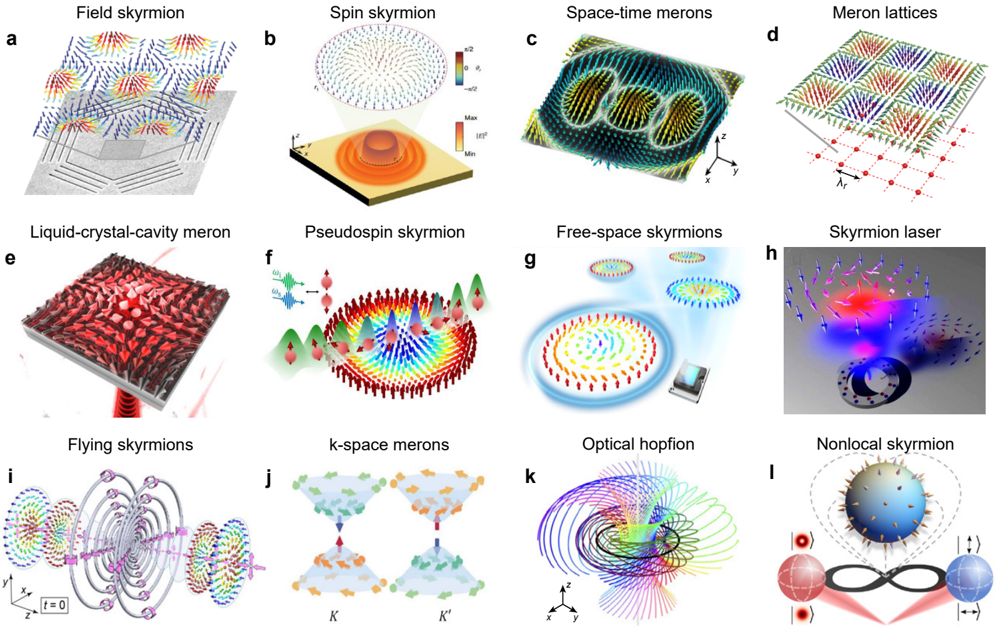
“The meron textures of the polarization Stokes field was experimentally generated by confining light into a liquid-crystal-filled microcavity (Fig. 4e) [57].”
§ Optical skyrmions and other topological quasiparticles of light > Skyrmions and merons in structured media
What the sources say
- Disputedcites [57] Lin, W., Ota, Y., Arakawa, Y. & Iwamoto, S. Microcavity-based generation of full Poincaré beams with arbitrary skyrmion numbers. Phys. Rev. Res. 3, 023055 (2021). sourceExperimental — accuracy not yet measured
The main text (page unavailable) says the authors numerically modeled full Poincaré beams from a silicon microring cavity, rather than experimentally generating meron textures in a liquid-crystal-filled cavity. The cited paper’s Stokes-vector discussion concerns those modeled beams; it does not change the contrary device and method descriptions. (LLM, conf=0.90)
Checked by a reasoning model — may be wrong.
plaindirect- Asserted: passes — The authors put it forward as true.
- Checkable: passes — It can be checked against evidence.
- Load-bearing: unclear — It is unclear whether the paper’s conclusions depend on it.
- Based: passes — The paper gives a reason why it holds.
- Disputed
At least one cited source doesn’t support this claim or points to a different paper, and none confirmed it — see the verdicts below.
In the paper
“The first implementation of optical quasiparticles in momentum-space was demonstrated by engineering the band structure of a photonic crystal with a broken symmetry to enable meron textures formed by Stokes vectors in the Brillouin zone (Fig. 4j) [76].”
§ Optical skyrmions and other topological quasiparticles of light > Skyrmions in momentum-space
What the sources say
- Disputedcites [76] Ehrmanntraut, D. et al. Optical second-order skyrmionic hopfion. Optica 10, 725–731 (2023). sourceExperimental — accuracy not yet measured
The Abstract describes an experimental second-order skyrmionic hopfion in the polarization and phase texture of a paraxial light field in three-dimensional space. The Results describe constructing it by superimposing two structured beams, not by engineering a photonic crystal band structure to produce momentum-space merons. (LLM, conf=0.86)
Checked by a reasoning model — may be wrong.
boosteddirect- Asserted: passes — The authors put it forward as true.
- Checkable: passes — It can be checked against evidence.
- Load-bearing: unclear — It is unclear whether the paper’s conclusions depend on it.
- Based: passes — The paper gives a reason why it holds.
- Disputed
The cited sources that could be checked couldn’t confirm or dispute this claim.
In the paper
“Tight focusing was shown to enable optical spin skyrmions where Néel-and Bloch-type textures can be controlled by slightly tuning the input light (Fig. 4g) [63].”
§ Optical skyrmions and other topological quasiparticles of light > Skyrmions in free-space fields
What the sources say
- Could not verifycites [63] Zdagkas, A. et al. Observation of toroidal pulses of light. Nat. Photon. 16, 523–528 (2022). sourceExperimental — accuracy not yet measured
The Abstract reports generating toroidal light pulses and mentions skyrmions only as a possible subject of future light–matter interaction studies. Searches for optical spin skyrmions and for skyrmions found no passage about tight focusing or controlling Néel- and Bloch-type textures by tuning the input light. The indexed passages provide no page numbers. (LLM, conf=0.76)
plaindirect- Asserted: passes — The authors put it forward as true.
- Checkable: passes — It can be checked against evidence.
- Load-bearing: passes — The paper’s conclusions depend on it.
- Based: passes — The paper gives a reason why it holds.
- Could not verify
The cited sources that could be checked couldn’t confirm or dispute this claim.
In the paper
“This results in an effective”
§ Optical skyrmions and other topological quasiparticles of light > Skyrmions and merons in structured media
What the sources say
- Could not verifycites [59] Nape, I. et al. Revealing the invariance of vectorial structured light in complex media. Nat. Photon. 16, 538–546 (2022). sourceExperimental — accuracy not yet measured
The Experimental demonstration and Discussion and conclusion sections address distortion and invariance of vectorial structured light, not effective magnetization. A search for magnetization and nonlinear media found no passage in our copy supporting the attributed claim. Page numbers were not available. (LLM, conf=0.76)
- Could not verifycites [60] Zdagkas, A., Papasimakis, N., Savinov, V. & Zheludev, N. I. Space-time nonseparable pulses: constructing isodiffracting donut pulses from plane waves and single cycle pulses. Phys. Rev. A 102, 063512 (2020). sourceExperimental — accuracy not yet measured
The Introduction (page unavailable) discusses flying-donut pulses engaging toroidal and anapole excitations in dielectric particles, but does not describe effective magnetization in a specially designed nonlinear medium. Searches for the quoted phrase and for nonlinear-medium magnetization found no passage addressing that claim. (LLM, conf=0.74)
plaindirect- Asserted: passes — The authors put it forward as true.
- Checkable: passes — It can be checked against evidence.
- Load-bearing: passes — The paper’s conclusions depend on it.
- Based: passes — The paper gives a reason why it holds.
- Could not verify
The cited sources that could be checked couldn’t confirm or dispute this claim.
In the paper
“Optical field-skyrmion lattice was first observed in the evanescent electric field of the SPP waves interfering in a resonator of a six-fold symmetry [18].”
§ Optical skyrmions and other topological quasiparticles of light > Field skyrmions.
What the sources say
- Could not verifycites [18] Ward, R. S. Hopf solitons on $${{\mathscr{S}}}^{3}$$ and $${{\mathscr{S}}}^{3}$$. Nonlinearity 12, 241–246 (1999). sourceExperimental — accuracy not yet measured
The Introduction and Concluding Remarks discuss theoretical Hopf solitons in the Skyrme-Faddeev model, not an optical observation. Searches for optical skyrmion lattices, surface-plasmon polaritons, evanescent electric fields, and six-fold resonators found no passage addressing the claimed first observation. (LLM, conf=0.78)
plain- Asserted: passes — The authors put it forward as true.
- Checkable: passes — It can be checked against evidence.
- Load-bearing: unclear — It is unclear whether the paper’s conclusions depend on it.
- Based: passes — The paper gives a reason why it holds.
- Could not verify
The cited sources support only part of this claim — read each source’s verdict below.
In the paper
“Bloch-type spin-skyrmions were theoretically proposed in a designer multilayer chiral liquid crystal structure [56], in which chirality-dependent twisted features occur in the spin vector field.”
§ Optical skyrmions and other topological quasiparticles of light > Skyrmions and merons in structured media
What the sources say
- Partly supportedcites [56] Shen, Y., Mart´ınez, E. C. & Rosales-Guzm´an, C. Generation of optical skyrmions with tunable topological textures. ACS Photon. 9, 296–303 (2022). sourceExperimental — accuracy not yet measured
The Introduction reports Bloch-type optical skyrmions in optical chiral multilayers, so it supports that part of the claim. It does not describe a designer multilayer chiral liquid-crystal structure or chirality-dependent twisting of a spin vector field; its mention of spin-field skyrmions concerns a separate, tightly focused vortex beam. Page numbers are unavailable in our copy. (LLM, conf=0.86)
plaincorrelational- Asserted: passes — The authors put it forward as true.
- Checkable: passes — It can be checked against evidence.
- Load-bearing: passes — The paper’s conclusions depend on it.
- Based: passes — The paper gives a reason why it holds.
- Partly supported
The cited sources that could be checked couldn’t confirm or dispute this claim.
In the paper
“In parallel, a stable, individual skyrmions formed by the spin distribution of a SPP field in the presence of spin-orbit coupling was demonstrated [19].”
§ Optical skyrmions and other topological quasiparticles of light > Abstract
What the sources say
- Could not verifycites [19] Rybakov, F. N. et al. Magnetic hopfions in solids. APL Mater. 10, 111113 (2022). sourceExperimental — accuracy not yet measured
The Introduction (page unavailable) discusses stable magnetic hopfions in materials with competing exchange interactions, not a demonstrated skyrmion in a surface-plasmon polariton field. Searches for SPP, optical spin textures, and spin-orbit coupling found no passage in our copy addressing the claimed demonstration. (LLM, conf=0.78)
boosteddirect- Asserted: passes — The authors put it forward as true.
- Checkable: passes — It can be checked against evidence.
- Load-bearing: passes — The paper’s conclusions depend on it.
- Based: passes — The paper gives a reason why it holds.
- Could not verify
The cited sources that could be checked couldn’t confirm or dispute this claim.
In the paper
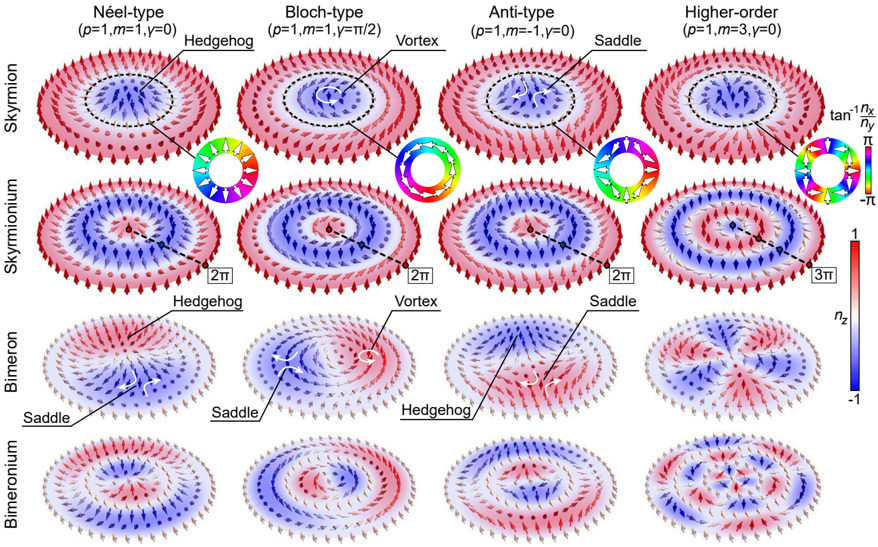
“The above topological classification is also applicable to merons and bimerons [35,36] (Fig. 2).”
§ Optical skyrmions and other topological quasiparticles of light > Box 1 | Topological mapping of a vector field and characteristics.
What the sources say
- Could not verifycites [35] Shi, P., Du, L., Li, C., Zayats, A. V. & Yuan, X. Transverse spin dynamics in structured electromagnetic guided waves. Proc. Natl Acad. Sci. USA 118, e2018816118 (2021). sourceExperimental — accuracy not yet measured
The Results and Discussion describes topological invariants of structured electromagnetic waves and compares a spin-variation pattern to a topological soliton. Our copy does not discuss merons or bimerons or say that the classification applies to them (searched: “merons and bimerons,” “topological classification,” and related spin-texture terms). The indexed passages provide no page numbers. (LLM, conf=0.72)
- Could not verifycites [36] Lei, X., Du, L., Yuan, X. & Zayats, A. V. Optical spin–orbit coupling in the presence of magnetization: photonic skyrmion interaction with magnetic domains. Nanophotonics 10, 3667–3675 (2021). sourceExperimental — accuracy not yet measured
The Introduction mentions photonic merons as topological structures, and §2.2 defines a skyrmion number for photonic skyrmions. Neither passage says that this classification applies to merons, and a search for bimerons found no discussion of them in our copy. No page numbers were provided. (LLM, conf=0.72)
plaincorrelational- Asserted: passes — The authors put it forward as true.
- Checkable: passes — It can be checked against evidence.
- Load-bearing: unclear — It is unclear whether the paper’s conclusions depend on it.
- Based: passes — The paper gives a reason why it holds.
- Could not verify
The cited sources that could be checked couldn’t confirm or dispute this claim.
In the paper
“The experimental generation of toroidal pulses can be achieved using a radially polarised pulse interaction with a gradient metasurface designed to achieve space-time coupling [81].”
§ Optical skyrmions and other topological quasiparticles of light > Skyrmions in space-time
What the sources say
- Could not verifycites [81] Železný J., Wadley, P., Olejník, K., Hoffmann. A. & Ohno, H. Spin transport and spin torque in antiferromagnetic devices. Nat. Phys. 14, 220–228 (2018). sourceExperimental — accuracy not yet measured
The Spin-orbit torque switching section discusses electrical current pulses used to switch antiferromagnetic moments, not toroidal pulses. Searches for radially polarised pulses, gradient metasurfaces and space-time coupling found no passage addressing the claimed generation method. No page numbers are available in our copy. (LLM, conf=0.77)
plaindirect- Asserted: passes — The authors put it forward as true.
- Checkable: passes — It can be checked against evidence.
- Load-bearing: unclear — It is unclear whether the paper’s conclusions depend on it.
- Based: passes — The paper gives a reason why it holds.
- Could not verify
The cited sources that could be checked couldn’t confirm or dispute this claim.
In the paper
“Optical plasmonic field-and spin-skyrmions were verified to possess deep-subwavelength features with sufficient light intensities [19,40], which meets the emerging requirements of superresolution imaging and metrology.”
§ Optical skyrmions and other topological quasiparticles of light > Microscopy, metrology, and sensing
What the sources say
- Could not verifycites [19] Rybakov, F. N. et al. Magnetic hopfions in solids. APL Mater. 10, 111113 (2022). sourceExperimental — accuracy not yet measured
The Introduction and Results and discussions sections address magnetic hopfions and magnetic skyrmions, not optical plasmonic field- or spin-skyrmions. Searches for deep-subwavelength features, light intensity, and plasmonic skyrmions found no passage in our copy that verifies the attributed claim. (LLM, conf=0.76)
- Not checked — no full text of the sourcecites [40] Zhang, Q. et al. Optical topological lattices of Bloch type skyrmion and meron topologies. Photon. Res. 10, 947–957 (2022). source
boostedcorrelational- Asserted: passes — The authors put it forward as true.
- Checkable: passes — It can be checked against evidence.
- Load-bearing: passes — The paper’s conclusions depend on it.
- Based: passes — The paper gives a reason why it holds.
- Could not verify
- Probably not a substantial claim. 37
- It may state two separate claims as one. 34
At least one cited source doesn’t support this claim or points to a different paper, and none confirmed it — see the verdicts below.
In the paper
“In the case of large values of vorticity associated with larger value of a skyrmion number, the skyrmions are designated as higher-order skyrmions [29] (Fig. 2).”
§ Optical skyrmions and other topological quasiparticles of light > Box 1 | Topological mapping of a vector field and characteristics.
What the sources say
- Disputedcites [29] Deng, Z.-L., Shi, T., Krasnok, A., Li, X. & Alù, A. Observation of localized magnetic plasmon skyrmions. Nat. Commun. 13, 8 (2022). sourceExperimental — accuracy not yet measured
In Results, under “Theoretical modeling and design of LSP skyrmions” (page unavailable), the paper describes higher-order modes as having multiple radial twists, but says their total skyrmion number is 1 for odd modes and 0 for even modes—not a larger number. The cited passage does not identify large vorticity as the criterion for calling them higher-order skyrmions. (LLM, conf=0.88)
Checked by a reasoning model — may be wrong.
plaincorrelational- Asserted: passes — The authors put it forward as true.
- Checkable: passes — It can be checked against evidence.
- Load-bearing: fails — The paper’s conclusions may not depend on it.
- Based: passes — The paper gives a reason why it holds.
Probably not a substantial claim. The paper’s conclusions may not depend on it.
- Disputed
The cited sources that could be checked couldn’t confirm or dispute this claim.
In the paper
“Based on the generalized topological transformation, the bimeron has the texture composed by two merons with opposite polarities [34].”
§ Optical skyrmions and other topological quasiparticles of light > Box 1 | Topological mapping of a vector field and characteristics.
What the sources say
- Could not verifycites [34] Shi, P., Du, L. & Yuan, X. Strong spin–orbit interaction of photonic skyrmions at the general optical interface. Nanophotonics 9, 4619–4628 (2020). sourceExperimental — accuracy not yet measured
Section 2 discusses photonic skyrmion spin textures and reversals of spin orientation at an optical interface, but does not describe a bimeron as two merons with opposite polarities. Searches for “bimeron,” “meron,” and “generalized topological transformation” found no passage addressing that claim in our copy. (LLM, conf=0.72)
plaincorrelational- Asserted: passes — The authors put it forward as true.
- Checkable: passes — It can be checked against evidence.
- Load-bearing: fails — The paper’s conclusions may not depend on it.
- Based: passes — The paper gives a reason why it holds.
Probably not a substantial claim. The paper’s conclusions may not depend on it.
- Could not verify
The cited sources support only part of this claim — read each source’s verdict below.
In the paper
“While optical field-skyrmions which can be switched between Néel-and Bloch-types were reported [43], the existence of Bloch-type skyrmions was promptly disproved [44,45].”
§ Optical skyrmions and other topological quasiparticles of light > Field skyrmions.
What the sources say
- Could not verifycites [43] Król, M. et al. Observation of second-order meron polarization textures in optical microcavities. Optica 8, 255–261 (2021). sourceExperimental — accuracy not yet measured
The paper reports second-order meron and antimeron polarization textures in an optical microcavity (Abstract; no page given). The passages found for “Bloch-type,” “Néel,” and switching describe meron textures, not a report of switchable Néel- and Bloch-type optical skyrmions or a disproof of Bloch-type skyrmions. The citing sentence attaches separate citations to the report and the disproof, but neither point is established by our copy of this source. (LLM, conf=0.76)
- Partly supportedcites [44] Karnieli, A., Tsesses, S., Bartal, G. & Arie, A. Emulating spin transport with nonlinear optics, from high-order skyrmions to the topological hall effect. Nat. Commun. 12, 1092 (2021). sourceExperimental — accuracy not yet measured
In Results, under “Simulating the topological Hall effect from single skyrmions with light” (page not provided), the paper describes Néel- and Bloch-type synthetic magnetization textures using different phase parameters. It does not report optical field-skyrmions being switched between those types; it says the model can be changed to accommodate them. The separate disproval claim is attributed to [44,45], not this source. (LLM, conf=0.84)
- Could not verifycites [45] Karnieli, A., Li, Y. & Arie, A. The geometric phase in nonlinear frequency conversion. Front. Phys. 17, 12301 (2022). sourceExperimental — accuracy not yet measured
The discussion on p. 12301-14 describes proposed nonlinear-optical skyrmionic textures and their calculated effects, but does not address whether Bloch-type optical field-skyrmions exist. Searches for “Bloch-type skyrmions,” “disproved,” and “Néel” found no passage in our copy supporting the disproof attributed to this source. (LLM, conf=0.76)
plain- Asserted: passes — The authors put it forward as true.
- Checkable: passes — It can be checked against evidence.
- Load-bearing: unclear — It is unclear whether the paper’s conclusions depend on it.
- Based: passes — The paper gives a reason why it holds.
It may state two separate claims as one.
- Could not verify
The cited sources that could be checked couldn’t confirm or dispute this claim.
In the paper
“Plasmonic spin field has recently been also used to tailor more complex skyrmionic structures, such as the merons with fractional topological charges [51,52], whereby a novel quasiparticle triplet-meron structure were designed and generated (Fig. 4c), with nanometric and femtosecond space-time resolution [51].”
§ Optical skyrmions and other topological quasiparticles of light > Spin skyrmions.
What the sources say
- Could not verifycites [51] Gao, S. et al. Paraxial skyrmionic beams. Phys. Rev. A 102, 053513 (2020). sourceExperimental — accuracy not yet measured
The Introduction says optical skyrmions have been observed through interference of plasmon polaritons, but does not discuss merons or fractional topological charges. Searches for merons, triplet-meron structures, and nanometric or femtosecond resolution found no supporting passage in our copy; the Conclusions instead discuss paraxial vector vortex beams and say related experiments will be reported elsewhere. (LLM, conf=0.78)
- Not checked — no full text of the sourcecites [52] Beckley, A. M., Brown, T. G. & Alonso, M. A. Full Poincaré beams. Opt. Express 18, 10777–10785 (2010). source
plaindirect- Asserted: passes — The authors put it forward as true.
- Checkable: passes — It can be checked against evidence.
- Load-bearing: unclear — It is unclear whether the paper’s conclusions depend on it.
- Based: passes — The paper gives a reason why it holds.
It may state two separate claims as one.
- Could not verify
The cited sources that could be checked couldn’t confirm or dispute this claim.
In the paper
“A natural generalization of skyrionium is a kπ-skyrmion with the raidal multi-(kπ-)twist structure [32], also known as a target skyrmion [33], which replaces the radial 2π-twist structure with kπ-twist structure and controls the skyrmion number between 0 and 1 (or -1).”
§ Optical skyrmions and other topological quasiparticles of light > Box 1 | Topological mapping of a vector field and characteristics.
What the sources say
- Could not verifycites [32] Meiler, T., Frank, B. & Giessen, H. Dynamic tailoring of an optical skyrmion lattice in surface plasmon polaritons: comment. Opt. Express 28, 33614–33615 (2020). sourceExperimental — accuracy not yet measured
The paper’s discussion of skyrmion number (pp. 33614–33615) concerns a flat magnetic-field vortex in surface plasmon polaritons, for which it calculates a number of zero. A search for kπ-skyrmions, skyrmionium, radial multi-twists, and the claimed range of skyrmion numbers found no passage addressing those points. (LLM, conf=0.76)
- Could not verifycites [33] Lei, X. et al. Photonic spin lattices: symmetry constraints for skyrmion and meron topologies. Phys. Rev. Lett. 127, 237403 (2021). sourceExperimental — accuracy not yet measured
The supplied passages describe photonic spin-skyrmion and meron lattices, including skyrmion numbers of 1 and ±½, but do not address kπ-skyrmions as radial multi-twist generalizations of skyrmionium. Searches for “kπ-skyrmion,” “skyrmionium,” “target skyrmion,” and “2π twist” found no passage addressing that attributed point. The passages are labeled Abstract in our copy; no page number is available. (LLM, conf=0.75)
plaindirect- Asserted: passes — The authors put it forward as true.
- Checkable: passes — It can be checked against evidence.
- Load-bearing: fails — The paper’s conclusions may not depend on it.
- Based: passes — The paper gives a reason why it holds.
Probably not a substantial claim. The paper’s conclusions may not depend on it. It may state two separate claims as one.
- Could not verify
The cited sources that could be checked couldn’t confirm or dispute this claim.
In the paper
“The Stokes bimerons were recently generalized into multiskyrmion structures with increasingly complex topologies [89,90].”
§ Optical skyrmions and other topological quasiparticles of light > Optical bimerons, bimeroniums, and multiskyrmions.
What the sources say
- Could not verifycites [89] Jiang, Y. et al. Twisted magnon as a magnetic tweezer. Phys. Rev. Lett. 124, 217204 (2020). sourceExperimental — accuracy not yet measured
The paper’s discussion and conclusion describe twisted magnons driving the motion of a magnetic skyrmion (section “Twisted magnon as a magnetic tweezer”; page unavailable). Searches for “Stokes bimerons” and “multiskyrmion” found no passage about generalizing bimerons into more complex structures. (LLM, conf=0.72)
- Could not verifycites [90] Wang, X.-G. et al. The optical tweezer of skyrmions. npj Comput. Mater. 6, 140 (2020). sourceExperimental — accuracy not yet measured
The Abstract (page unavailable) describes magnetic skyrmions and a laser-based method for trapping them, but does not address Stokes bimerons or their generalization. Searches for “Stokes bimerons,” “multiskyrmion,” and related terms found no passage in our copy supporting the attributed claim. (LLM, conf=0.72)
plaindirect- Asserted: passes — The authors put it forward as true.
- Checkable: passes — It can be checked against evidence.
- Load-bearing: fails — The paper’s conclusions may not depend on it.
- Based: passes — The paper gives a reason why it holds.
Probably not a substantial claim. The paper’s conclusions may not depend on it.
- Could not verify
The cited sources support only part of this claim — read each source’s verdict below.
In the paper
“and can be driven by the skyrmion Hall effect [61,62], spin-orbit torque [99,100], and even the light [101][102][103][104][105].”
§ Optical skyrmions and other topological quasiparticles of light > Light-matter interactions
What the sources say
- Not checked — no full text of the sourcecites [61] Hellwarth, R. & Nouchi, P. Focused one-cycle electromagnetic pulses. Phys. Rev. E 54, 889 (1996). source
- Not matchedcites [62] Shen, Y., Hou, Y., Papasimakis, N. & Zheludev, N. I. Supertoroidal light pulses as electromagnetic skyrmions propagating in free space. Nat. Commun. 12, 5891 (2021).
Couldn’t be matched to a paper in Crossref, so it can’t be checked.
- Not matchedcites [99] Ornelas, P., Nape, I., Koch, R. D. M. & Forbes, A. Nonlocal skyrmions as topologically resilient quantum entangled states of light. Preprint at https://arxiv.org/abs/2210.04690 (2022).
Couldn’t be matched to a paper in Crossref, so it can’t be checked.
- Could not verifycites [100] Galiffi, E. et al. Photonics of time-varying media. Adv. Photon. 4, 014002 (2022). sourceExperimental — accuracy not yet measured
Section 5.2.2 (page unavailable) describes optical switching of magnetization and optical excitation of spin currents, but does not address driving skyrmions with light. Searches for skyrmion driving, the skyrmion Hall effect, and spin-orbit torque found no passage establishing the claim about skyrmions. (LLM, conf=0.72)
- Not checked — no full text of the sourcecites [101] Ge, H. et al. Observation of acoustic skyrmions. Phys. Rev. Lett. 127, 144502 (2021). source
- Could not verifycites [102] Muelas-Hurtado, R. D. et al. Observation of polarization singularities and topological textures in sound waves. Phys. Rev. Lett. 129, 204301 (2022). sourceExperimental — accuracy not yet measured
The citation is attached to the claim that skyrmions can be driven by light. The main-text passage on three-wave interference reports a skyrmion lattice in propagating sound waves, while the References list mentions optical skyrmions; neither says that light drives skyrmions. Searches for light-driven skyrmions and the cited sentence found no supporting passage in our copy. (LLM, conf=0.76)
- Not checked — no full text of the sourcecites [103] Hu, P. et al. Observation of localized acoustic skyrmions. Appl. Phys. Lett. 122, 022201 (2023). source
- Partly supportedcites [104] Cao, L., Wan, S., Zeng, Y., Zhu, Y. & Assouar, B. Observation of phononic skyrmions based on hybrid spin of elastic waves. Sci. Adv. 9, eadf3652 (2023). sourceExperimental — accuracy not yet measured
For this source, the relevant part of the citing sentence is the claim that skyrmions can be driven by light. The Discussion mentions optomechanical coupling with light as a possible route to future skyrmion systems, but the Results describe moving the observed phononic skyrmion lattice by changing excitation-source phases, not by light. The source therefore supports a possible connection to light, not the stated light-driven motion. (LLM, conf=0.82)
- Partly supportedcites [105] Parmee, C. D., Dennis, M. R. & Ruostekoski, J. Optical excitations of skyrmions, knotted solitons, and defects in atoms. Commun. Phys. 5, 54 (2022). sourceExperimental — accuracy not yet measured
The Introduction and Section II (page unavailable) describe using structured light to create skyrmionic optical excitations in atomic ensembles. This supports the light-related part for skyrmion formation, but the passages do not show light driving the motion of an existing skyrmion. The Hall effect and spin-orbit torque have separate citations in the citing sentence and are not attributed to this source. (LLM, conf=0.82)
plaindirect- Asserted: passes — The authors put it forward as true.
- Checkable: passes — It can be checked against evidence.
- Load-bearing: unclear — It is unclear whether the paper’s conclusions depend on it.
- Based: passes — The paper gives a reason why it holds.
It may state two separate claims as one.
The cited sources that could be checked couldn’t confirm or dispute this claim.
In the paper
“The optical hopfions were recently extended to higher-order quasiparticles and their topologically protected transport in free space was demonstrated [92].”
§ Optical skyrmions and other topological quasiparticles of light > Optical bimerons, bimeroniums, and multiskyrmions.
What the sources say
- Could not verifycites [92] Tengdin, P. et al. Imaging the ultrafast coherent control of a skyrmion crystal. Phys. Rev. 12, 041030 (2022). sourceExperimental — accuracy not yet measured
The Introduction and Discussion describe laser-controlled rotation of a magnetic skyrmion crystal, not optical hopfions. Searches for optical hopfions, higher-order quasiparticles, and protected transport in free space found no passage addressing the cited claim. (LLM, conf=0.78)
boosteddirect- Asserted: passes — The authors put it forward as true.
- Checkable: passes — It can be checked against evidence.
- Load-bearing: unclear — It is unclear whether the paper’s conclusions depend on it.
- Based: passes — The paper gives a reason why it holds.
It may state two separate claims as one.
- Could not verify
The cited sources that could be checked couldn’t confirm or dispute this claim.
In the paper
“Optical skyrmions can interact with magnetic skyrmions allowing for a route to manipulate these magnetic particles [103][104][105].”
§ Optical skyrmions and other topological quasiparticles of light > Light-matter interactions
What the sources say
- Not checked — no full text of the sourcecites [103] Hu, P. et al. Observation of localized acoustic skyrmions. Appl. Phys. Lett. 122, 022201 (2023). source
- Could not verifycites [104] Cao, L., Wan, S., Zeng, Y., Zhu, Y. & Assouar, B. Observation of phononic skyrmions based on hybrid spin of elastic waves. Sci. Adv. 9, eadf3652 (2023). sourceExperimental — accuracy not yet measured
The Introduction mentions magnetic skyrmions and the extension of skyrmions to photonics, but does not describe an interaction between them. The Discussion addresses coupling between elastic and electromagnetic waves, not using optical skyrmions to manipulate magnetic skyrmions. Searches for optical–magnetic interaction and manipulation found no supporting passage in our copy. (LLM, conf=0.76)
- Could not verifycites [105] Parmee, C. D., Dennis, M. R. & Ruostekoski, J. Optical excitations of skyrmions, knotted solitons, and defects in atoms. Commun. Phys. 5, 54 (2022). sourceExperimental — accuracy not yet measured
The Baby-Skyrmions section describes optical fields used to prepare skyrmionic textures in an atomic ensemble, and the 3D Skyrmions section discusses light–matter coupling. Neither the supplied passages nor searches for magnetic-skyrmion interaction and manipulation address optical skyrmions interacting with magnetic skyrmions to manipulate them. No page numbers were provided in our copy. (LLM, conf=0.76)
plaindirect- Asserted: passes — The authors put it forward as true.
- Checkable: passes — It can be checked against evidence.
- Load-bearing: unclear — It is unclear whether the paper’s conclusions depend on it.
- Based: passes — The paper gives a reason why it holds.
It may state two separate claims as one.
The cited sources that could be checked couldn’t confirm or dispute this claim.
In the paper
“Similarly, bimeronium is a quasiparticle which can be obtained by adding radial kπ twist structure to a fundamental bimeron (akin to the concept of skyrmionium) [38].”
§ Optical skyrmions and other topological quasiparticles of light > Optical bimerons, bimeroniums, and multiskyrmions.
What the sources say
- Could not verifycites [38] Xiong, L. et al. Polaritonic vortices with a half-integer charge. Nano Lett. 21, 9256–9261 (2021). sourceExperimental — accuracy not yet measured
The discussion on p. 4 describes merons and their half-integer topological charge, but does not address bimeronium or its proposed construction. Searches for “bimeronium,” “radial kπ twist,” “bimeron,” and “skyrmionium” found no passage in our copy supporting the attributed claim. (LLM, conf=0.76)
plaindirect- Asserted: passes — The authors put it forward as true.
- Checkable: passes — It can be checked against evidence.
- Load-bearing: fails — The paper’s conclusions may not depend on it.
- Based: passes — The paper gives a reason why it holds.
Probably not a substantial claim. The paper’s conclusions may not depend on it.
- Could not verify
The cited sources that could be checked couldn’t confirm or dispute this claim.
In the paper
“While the optical bimerons were only recently first proposed in paraxial vector beams [69].”
§ Optical skyrmions and other topological quasiparticles of light > Optical bimerons, bimeroniums, and multiskyrmions.
What the sources say
- Could not verifycites [69] Loder, F., Kampf, A. P., Kopp, T. & Braak, D. Momentum-space spin texture in a topological superconductor. Phys. Rev. B 96, 024508 (2017). sourceExperimental — accuracy not yet measured
The paper’s skyrmion and meron passages discuss momentum-space spin textures in superconductors, not optical bimerons. Searches for optical bimerons and paraxial vector beams found no passage addressing where optical bimerons were first proposed. (LLM, conf=0.76)
plain- Asserted: passes — The authors put it forward as true.
- Checkable: passes — It can be checked against evidence.
- Load-bearing: fails — The paper’s conclusions may not depend on it.
- Based: passes — The paper gives a reason why it holds.
Probably not a substantial claim. The paper’s conclusions may not depend on it.
- Could not verify
The cited sources that could be checked couldn’t confirm or dispute this claim.
In the paper
“In condensed matter physics, skyrmions can be formed due to the Dzyaloshinskii-Moriya interaction (DMI) [97], dipole-dipole interaction [98]”
§ Optical skyrmions and other topological quasiparticles of light > Light-matter interactions
What the sources say
- Could not verifycites [97] Shen, Y. et al. Optical vortices 30 years on: OAM manipulation from topological charge to multiple singularities. Light Sci. Appl. 8, 90 (2019). sourceExperimental — accuracy not yet measured
The paper’s ‘Polarization and vector vortices’ section discusses optical vortex structures, not the formation of condensed-matter skyrmions. Searches for ‘skyrmion,’ ‘Dzyaloshinskii,’ and ‘dipole-dipole’ found no passage in our copy addressing either proposed interaction. No page numbers are available in the indexed passages. (LLM, conf=0.77)
- Could not verifycites [98] Wan, Z., Wang, H., Liu, Q., Fu, X. & Shen, Y. Ultra-degree-of-freedom structured light for ultracapacity information carriers. ACS Photon. 10, 2149–2164 (2023). sourceExperimental — accuracy not yet measured
The cited paper’s Ray-Wave Structured Light section discusses optical skyrmions, but does not address how skyrmions form in condensed matter. Searches for dipole–dipole and Dzyaloshinskii–Moriya interactions found no passage stating the claimed mechanisms; the returned passages concern structured light and references (pages unavailable). (LLM, conf=0.76)
plaindirect- Asserted: passes — The authors put it forward as true.
- Checkable: passes — It can be checked against evidence.
- Load-bearing: fails — The paper’s conclusions may not depend on it.
- Based: passes — The paper gives a reason why it holds.
Probably not a substantial claim. The paper’s conclusions may not depend on it.
- Could not verify
The cited sources that could be checked couldn’t confirm or dispute this claim.
In the paper
“The most important applications of magnetic skyrmions are the high-density information storage in modern spintronics [98].”
§ Optical skyrmions and other topological quasiparticles of light > Optical communications and informatics
What the sources say
- Could not verifycites [98] Wan, Z., Wang, H., Liu, Q., Fu, X. & Shen, Y. Ultra-degree-of-freedom structured light for ultracapacity information carriers. ACS Photon. 10, 2149–2164 (2023). sourceExperimental — accuracy not yet measured
The Ray-Wave Structured Light section discusses optical skyrmions, and the cited passages on information capacity concern structured light and optical communication. Searches for magnetic skyrmions, spintronics, and high-density information storage found no passage addressing the claimed application. (LLM, conf=0.75)
plaincorrelational- Asserted: passes — The authors put it forward as true.
- Checkable: passes — It can be checked against evidence.
- Load-bearing: fails — The paper’s conclusions may not depend on it.
- Based: passes — The paper gives a reason why it holds.
Probably not a substantial claim. The paper’s conclusions may not depend on it.
- Could not verify
The cited sources support only part of this claim — read each source’s verdict below.
In the paper
“The momentum-space magnetic skyrmions were previously studied to demonstrate anomalous Hall effect in magnets [86,87].”
§ Optical skyrmions and other topological quasiparticles of light > Skyrmions in momentum-space
What the sources say
- Could not verifycites [86] Shi, P., Du, L., Li, M. & Yuan, X. Symmetry-protected photonic chiral spin textures by spin–orbit coupling. Laser Photon. Rev. 15, 2000554 (2021). sourceExperimental — accuracy not yet measured
The Introduction discusses momentum-space chiral textures in photonic structures and separately describes magnetic skyrmions, but it does not connect momentum-space magnetic skyrmions to the anomalous Hall effect. Searches for “anomalous Hall effect in magnets” and “momentum-space magnetic skyrmions” found no passage addressing that claim. (LLM, conf=0.72)
- Partly supportedcites [87] Wu, H.-J. et al. Conformal frequency conversion for arbitrary vectorial structured light. Optica 9, 187–196 (2022). sourceExperimental — accuracy not yet measured
The “Optical Skyrmions” passage in section C says skyrmions have previously been studied in magnetic materials. It does not say those studies concerned momentum-space magnetic skyrmions or demonstrated the anomalous Hall effect. (LLM, conf=0.78)
plaindirect- Asserted: passes — The authors put it forward as true.
- Checkable: passes — It can be checked against evidence.
- Load-bearing: fails — The paper’s conclusions may not depend on it.
- Based: passes — The paper gives a reason why it holds.
Probably not a substantial claim. The paper’s conclusions may not depend on it.
- Could not verify
In the paper
“The skyrmionium has zero total skyrmion number and a radial 2π-twist structure (”
§ Optical skyrmions and other topological quasiparticles of light > Box 1 | Topological mapping of a vector field and characteristics.
What the sources say
- Not checked — no full text of the sourcecites [31] Bai, C., Chen, J., Zhang, Y., Zhang, D. & Zhan, Q. Dynamic tailoring of an optical skyrmion lattice in surface plasmon polaritons. Opt. Express 28, 10320–10328 (2020). source
plain- Asserted: passes — The authors put it forward as true.
- Checkable: passes — It can be checked against evidence.
- Load-bearing: fails — The paper’s conclusions may not depend on it.
- Based: passes — The paper gives a reason why it holds.
Probably not a substantial claim. The paper’s conclusions may not depend on it. It may state two separate claims as one.
A conclusion the paper draws from its own results — it cites no other source for it, so there is none to check. The quote shows it is in the paper.
In the paper
“A skyrmion with opposite vorticity m = -1, termed anti-skyrmion, has a very different to conventional skyrmion saddle texture (Fig. ??c).”
§ Optical skyrmions and other topological quasiparticles of light > Box 1 | Topological mapping of a vector field and characteristics.
plaincorrelational- Asserted: passes — The authors put it forward as true.
- Checkable: passes — It can be checked against evidence.
- Load-bearing: fails — The paper’s conclusions may not depend on it.
- Based: fails — The paper may give no reason why it holds.
Probably not a substantial claim. The paper’s conclusions may not depend on it. The paper may give no reason why it holds.
In the paper
“The radial kπ-twist structures of the spin-skyrmion possess deep-subwavelength features, opening a new pathway for super-resolution imaging and microscopy [19].”
§ Optical skyrmions and other topological quasiparticles of light > Spin skyrmions.
What the sources say
- Not checked yetcites [19] Rybakov, F. N. et al. Magnetic hopfions in solids. APL Mater. 10, 111113 (2022). source
plaindirect- Asserted: passes — The authors put it forward as true.
- Checkable: passes — It can be checked against evidence.
- Load-bearing: passes — The paper’s conclusions depend on it.
- Based: passes — The paper gives a reason why it holds.
It may state two separate claims as one.
A conclusion the paper draws from its own results — it cites no other source for it, so there is none to check. The quote shows it is in the paper.
In the paper
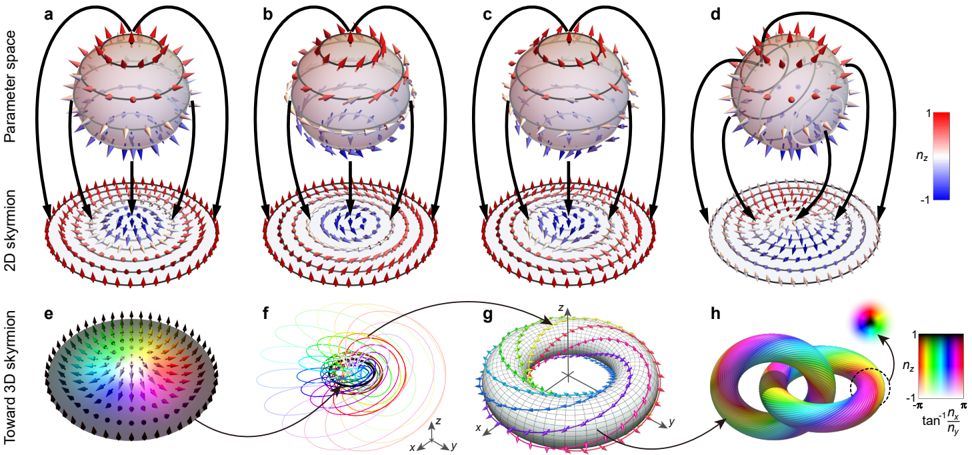
“A skyrmion can be divided into two merons with a half skyrmion number, each corresponding to a half unwrapping from the parameter sphere.”
§ Optical skyrmions and other topological quasiparticles of light > Box 1 | Topological mapping of a vector field and characteristics.
plaindirect- Asserted: passes — The authors put it forward as true.
- Checkable: passes — It can be checked against evidence.
- Load-bearing: fails — The paper’s conclusions may not depend on it.
- Based: passes — The paper gives a reason why it holds.
Probably not a substantial claim. The paper’s conclusions may not depend on it.
The paper states this without a source or data behind it here, so there is nothing to check it against. The quote shows it is in the paper.
In the paper
“In paraxial beams, the electromagnetic field is a purely transverse in non-absorbing media, therefore, the field vectors always lie in a plane normal to the propagation direction.”
§ Optical skyrmions and other topological quasiparticles of light > Skyrmions in free-space fields
plaindirect- Asserted: passes — The authors put it forward as true.
- Checkable: passes — It can be checked against evidence.
- Load-bearing: passes — The paper’s conclusions depend on it.
- Based: fails — The paper may give no reason why it holds.
Probably not a substantial claim. The paper may give no reason why it holds. It may state two separate claims as one.
A conclusion the paper draws from its own results — it cites no other source for it, so there is none to check. The quote shows it is in the paper.
In the paper
“If the sphere is unwrapped not from the pole but from a point on the equator, a bimeron quasiparticle is obtained (Fig. ??d).”
§ Optical skyrmions and other topological quasiparticles of light > Box 1 | Topological mapping of a vector field and characteristics.
plaindirect- Asserted: passes — The authors put it forward as true.
- Checkable: passes — It can be checked against evidence.
- Load-bearing: fails — The paper’s conclusions may not depend on it.
- Based: passes — The paper gives a reason why it holds.
Probably not a substantial claim. The paper’s conclusions may not depend on it.
In the paper
“The spin vectors in a tightly focused vortex beam may look like a Néel-type skyrmion-like texture in the focal plane near the beam axis, however, it is not a rigorous analogue of a skyrmion and a skyrmion number can not be assigned [19].”
§ Optical skyrmions and other topological quasiparticles of light > Skyrmions in free-space fields
What the sources say
- Not checked yetcites [19] Rybakov, F. N. et al. Magnetic hopfions in solids. APL Mater. 10, 111113 (2022). source
hedged- Asserted: passes — The authors put it forward as true.
- Checkable: passes — It can be checked against evidence.
- Load-bearing: unclear — It is unclear whether the paper’s conclusions depend on it.
- Based: passes — The paper gives a reason why it holds.
It may state two separate claims as one.
A conclusion the paper draws from its own results — it cites no other source for it, so there is none to check. The quote shows it is in the paper.
In the paper
“The reason is that a diffraction-free propagating beam is boundary-free and, therefore, is unable to form a well-defined topological structure, in contrast to an evanescent optical vortexes.”
§ Optical skyrmions and other topological quasiparticles of light > Skyrmions in free-space fields
plaindirect- Asserted: passes — The authors put it forward as true.
- Checkable: passes — It can be checked against evidence.
- Load-bearing: passes — The paper’s conclusions depend on it.
- Based: passes — The paper gives a reason why it holds.
It may state two separate claims as one.
A conclusion the paper draws from its own results — it cites no other source for it, so there is none to check. The quote shows it is in the paper.
In the paper
“They exist in the evanescent fields carry-ing orbital angular momentum (OAM), and can be realised by exciting a waveguided mode with a light having OAM.”
§ Optical skyrmions and other topological quasiparticles of light > Spin skyrmions.
plaindirect- Asserted: passes — The authors put it forward as true.
- Checkable: passes — It can be checked against evidence.
- Load-bearing: passes — The paper’s conclusions depend on it.
- Based: passes — The paper gives a reason why it holds.
It may state two separate claims as one.
A conclusion the paper draws from its own results — it cites no other source for it, so there is none to check. The quote shows it is in the paper.
In the paper
“The propagation direction of a guided mode and the direction of its transverse spin (due to the longitudinal field component) are intimately locked, and one cannot be changed without the other.”
§ Optical skyrmions and other topological quasiparticles of light > Unifying field-and spin-skyrmion manifestations.
plaincorrelational- Asserted: passes — The authors put it forward as true.
- Checkable: passes — It can be checked against evidence.
- Load-bearing: passes — The paper’s conclusions depend on it.
- Based: unclear — It is unclear why the paper says it holds.
It may state two separate claims as one.
None of the sources cited for this claim have been checked yet.
In the paper
“Such optical skyrmions are most closely related to their magnetic counterparts and can exist as individual isolated quasiparticles [19] as well as form hexagonal lattices [46].”
§ Optical skyrmions and other topological quasiparticles of light > Spin skyrmions.
What the sources say
- Not checked yetcites [19] Rybakov, F. N. et al. Magnetic hopfions in solids. APL Mater. 10, 111113 (2022). source
Checked before — its earlier verdict is held back until a new check runs.
- Not checked — no full text of the sourcecites [46] Karnieli, A. & Arie, A. All-optical stern-gerlach effect. Phys. Rev. Lett. 120, 053901 (2018). source
plain- Asserted: passes — The authors put it forward as true.
- Checkable: passes — It can be checked against evidence.
- Load-bearing: unclear — It is unclear whether the paper’s conclusions depend on it.
- Based: passes — The paper gives a reason why it holds.
It may state two separate claims as one.
- Not checked yet
A conclusion the paper draws from its own results — it cites no other source for it, so there is none to check. The quote shows it is in the paper.
In the paper
“Each pair of gratings on opposite sides of the hexagon supports a standing wave and the skyrmion textures are formed by superposition of the electric fields of the standing waves along variant spatial directions (Fig. 4a).”
§ Optical skyrmions and other topological quasiparticles of light > Field skyrmions.
plaindirect- Asserted: passes — The authors put it forward as true.
- Checkable: passes — It can be checked against evidence.
- Load-bearing: passes — The paper’s conclusions depend on it.
- Based: passes — The paper gives a reason why it holds.
It may state two separate claims as one.
None of the sources cited for this claim have been checked yet.
In the paper
“Skyrmions have many generalized forms in the quasiparticle family, a typical example of which is skyrmionium, a coupled state connecting two skyrmions with opposite polarities and resulting into skyrmion number of s = 1 -1 = 0 [30].”
§ Optical skyrmions and other topological quasiparticles of light > Box 1 | Topological mapping of a vector field and characteristics.
What the sources say
- Not checked yetcites [30] Yang, J. et al. Symmetry-protected spoof localized surface plasmonic skyrmion. Laser Photon. Rev. 16, 2200007 (2022). source
Checked before — its earlier verdict is held back until a new check runs.
plaindirect- Asserted: passes — The authors put it forward as true.
- Checkable: passes — It can be checked against evidence.
- Load-bearing: fails — The paper’s conclusions may not depend on it.
- Based: passes — The paper gives a reason why it holds.
Probably not a substantial claim. The paper’s conclusions may not depend on it. It may state two separate claims as one.
- Not checked yet
A conclusion the paper draws from its own results — it cites no other source for it, so there is none to check. The quote shows it is in the paper.
In the paper
“Physical realisation of different unwrapping styles is related to a particular system properties.”
§ Optical skyrmions and other topological quasiparticles of light > Box 1 | Topological mapping of a vector field and characteristics.
plaincorrelational- Asserted: passes — The authors put it forward as true.
- Checkable: passes — It can be checked against evidence.
- Load-bearing: fails — The paper’s conclusions may not depend on it.
- Based: passes — The paper gives a reason why it holds.
Probably not a substantial claim. The paper’s conclusions may not depend on it.
A conclusion the paper draws from its own results — it cites no other source for it, so there is none to check. The quote shows it is in the paper.
In the paper
“In contrast to the skyrmion representation with a fixed spiny sphere, a bimeron can be obtained by switching the coordinates of longitude and latitude or tilting the sphere.”
§ Optical skyrmions and other topological quasiparticles of light > Box 1 | Topological mapping of a vector field and characteristics.
plaindirect- Asserted: passes — The authors put it forward as true.
- Checkable: passes — It can be checked against evidence.
- Load-bearing: unclear — It is unclear whether the paper’s conclusions depend on it.
- Based: passes — The paper gives a reason why it holds.
It may state two separate claims as one.
A conclusion the paper draws from its own results — it cites no other source for it, so there is none to check. The quote shows it is in the paper.
In the paper
“For optical skyrmions, symmetry breaking is one of the factors that defines an unwrapping style.”
§ Optical skyrmions and other topological quasiparticles of light > Box 1 | Topological mapping of a vector field and characteristics.
plaindirect- Asserted: passes — The authors put it forward as true.
- Checkable: passes — It can be checked against evidence.
- Load-bearing: fails — The paper’s conclusions may not depend on it.
- Based: passes — The paper gives a reason why it holds.
Probably not a substantial claim. The paper’s conclusions may not depend on it.
A conclusion the paper draws from its own results — it cites no other source for it, so there is none to check. The quote shows it is in the paper.
In the paper
“A bimeron can similarly be described by a unit sphere mapping but with a more general wrapping style (Box 1).”
§ Optical skyrmions and other topological quasiparticles of light > Box 1 | Topological mapping of a vector field and characteristics.
plaincorrelational- Asserted: passes — The authors put it forward as true.
- Checkable: passes — It can be checked against evidence.
- Load-bearing: fails — The paper’s conclusions may not depend on it.
- Based: passes — The paper gives a reason why it holds.
Probably not a substantial claim. The paper’s conclusions may not depend on it.
A conclusion the paper draws from its own results — it cites no other source for it, so there is none to check. The quote shows it is in the paper.
In the paper
“Geometrically, the distinction of an anti-skyrmion is a counter-clockwise vector distribution along the perimeter encircling a skyrmion center; the vectors of an anti-skyrmion wrap around the center clockwise (-2π), while the vectors of a skyrmion wrap around the centre counter-clockwise (2π) (Fig. 2).”
§ Optical skyrmions and other topological quasiparticles of light > Box 1 | Topological mapping of a vector field and characteristics.
plain- Asserted: passes — The authors put it forward as true.
- Checkable: passes — It can be checked against evidence.
- Load-bearing: fails — The paper’s conclusions may not depend on it.
- Based: passes — The paper gives a reason why it holds.
Probably not a substantial claim. The paper’s conclusions may not depend on it. It may state two separate claims as one.
A conclusion the paper draws from its own results — it cites no other source for it, so there is none to check. The quote shows it is in the paper.
In the paper
“The described above topological classifications can be extended to considerations of any quasiparticle, for example, the kπ-bimeron with additional radial multi-twist structure in bimeronium (fourth plot in the fourth row of Fig. 2), which yet to be found experimentally.”
§ Optical skyrmions and other topological quasiparticles of light > Box 1 | Topological mapping of a vector field and characteristics.
plain- Asserted: passes — The authors put it forward as true.
- Checkable: passes — It can be checked against evidence.
- Load-bearing: fails — The paper’s conclusions may not depend on it.
- Based: fails — The paper may give no reason why it holds.
Probably not a substantial claim. The paper’s conclusions may not depend on it. The paper may give no reason why it holds.
None of the sources cited for this claim have been checked yet.
In the paper
“Spoof SPP, the surface electromagnetic waves that propagate along planar interfaces with sign-changing permittivities were also reported to generate skyrmion-like structures for the fields in a resonator [41,42], but their topological protection needs to be further investigated.”
§ Optical skyrmions and other topological quasiparticles of light > Field skyrmions.
What the sources say
- Not checked — no full text of the sourcecites [41] Ghosh, A., Yang, S., Dai, Y. & Petek, H. The spin texture topology of polygonal plasmon fields. ACS Photon. 10, 13–23 (2023). source
- Not checked yetcites [42] Zhang, Q., Xie, Z., Du, L., Shi, P. & Yuan, X. Bloch-type photonic skyrmions in optical chiral multilayers. Phys. Rev. Res. 3, 023109 (2021). source
Checked before — its earlier verdict is held back until a new check runs.
plaindirect- Asserted: passes — The authors put it forward as true.
- Checkable: passes — It can be checked against evidence.
- Load-bearing: fails — The paper’s conclusions may not depend on it.
- Based: passes — The paper gives a reason why it holds.
Probably not a substantial claim. The paper’s conclusions may not depend on it. It may state two separate claims as one.
A conclusion the paper draws from its own results — it cites no other source for it, so there is none to check. The quote shows it is in the paper.
In the paper
“A skyrmion with s = 1 but with the vector structure arranged along tangent direction (Fig. ??b) represents a vortex (Bloch-type) texture with γ = π/2, which is different from a hedgehog (Néel-type) texture with γ = 0 (Fig. ??a).”
§ Optical skyrmions and other topological quasiparticles of light > Box 1 | Topological mapping of a vector field and characteristics.
plaincorrelational- Asserted: passes — The authors put it forward as true.
- Checkable: passes — It can be checked against evidence.
- Load-bearing: fails — The paper’s conclusions may not depend on it.
- Based: passes — The paper gives a reason why it holds.
Probably not a substantial claim. The paper’s conclusions may not depend on it. It may state two separate claims as one.
A conclusion the paper draws from its own results — it cites no other source for it, so there is none to check. The quote shows it is in the paper.
In the paper
“As discussed above, the optical skyrmions in evanescent fields are limited to Néel-type topological textures, and it is a challenge to generate optical Bloch-type skyrmions at the interface of homogeneous media.”
§ Optical skyrmions and other topological quasiparticles of light > Skyrmions and merons in structured media
plain- Asserted: passes — The authors put it forward as true.
- Checkable: passes — It can be checked against evidence.
- Load-bearing: passes — The paper’s conclusions depend on it.
- Based: passes — The paper gives a reason why it holds.
It may state two separate claims as one.
In the paper
“In the case of m = -1, the topology is defined as anti-skyrmion with a saddle (anti-vortex) texture [28].”
§ Optical skyrmions and other topological quasiparticles of light > Box 1 | Topological mapping of a vector field and characteristics.
What the sources say
- Not checked — no full text of the sourcecites [28] Davis, T. J. et al. Ultrafast vector imaging of plasmonic skyrmion dynamics with deep subwavelength resolution. Science 368, eaba6415 (2020). source
plaincorrelational- Asserted: passes — The authors put it forward as true.
- Checkable: passes — It can be checked against evidence.
- Load-bearing: fails — The paper’s conclusions may not depend on it.
- Based: passes — The paper gives a reason why it holds.
Probably not a substantial claim. The paper’s conclusions may not depend on it.
In the paper
“Spin-skyrmion and spinmeron lattices are formed due to a broken rotational symmetry of the field with orbital angular momentum, with 6-fold symmetry being responsible for a skyrmion lattice and 4-fold symmetry for a meron lattice in the appropriately shaped resonator (Fig. 4d) [46,[53][54][55].”
§ Optical skyrmions and other topological quasiparticles of light > Unifying field-and spin-skyrmion manifestations.
What the sources say
- Not matchedcites [46,[53][54][55]
Couldn’t be matched to a paper in Crossref, so it can’t be checked.
plaindirect- Asserted: passes — The authors put it forward as true.
- Checkable: passes — It can be checked against evidence.
- Load-bearing: passes — The paper’s conclusions depend on it.
- Based: passes — The paper gives a reason why it holds.
It may state two separate claims as one.
- Not matched
A conclusion the paper draws from its own results — it cites no other source for it, so there is none to check. The quote shows it is in the paper.
In the paper
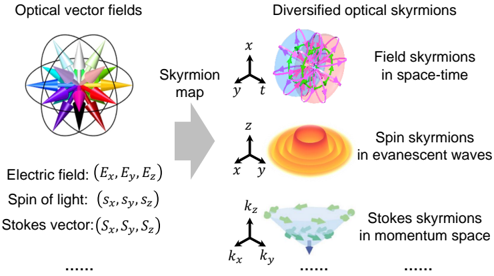
“Optical skyrmions and other quasiparticles can be constructed with various 3D vector fields, which in optics can be, for example, the electric field (E x , E y , E z ), spin angular momentum (s x , s y , s z ), polarization Stokes vec-tor (S x , S y , S z ), pseudospin (k x , k y , k z ), etc.”
§ Optical skyrmions and other topological quasiparticles of light > Optical skyrmions
plaincorrelational- Asserted: passes — The authors put it forward as true.
- Checkable: passes — It can be checked against evidence.
- Load-bearing: passes — The paper’s conclusions depend on it.
- Based: passes — The paper gives a reason why it holds.
Probably not a substantial claim.
None of the sources cited for this claim have been checked yet.
In the paper
“A Stokes skyrmion was introduced corresponding to a spatial variation of a polarization pattern in a vector beam [65,66].”
§ Optical skyrmions and other topological quasiparticles of light > Skyrmions in free-space fields
What the sources say
- Not checked yetcites [65] Wan, C., Shen, Y., Chong, A. & Zhan, Q. Scalar optical hopfons. eLight 2, 22 (2022). source
Checked before — its earlier verdict is held back until a new check runs.
- Not checked yetcites [66] Shen, Y., Papasimakis, N. & Zheludev, N. I. Non diffracting supertoroidal pulses: optical "Kármán vortex streets". Preprint at https://arxiv.org/abs/2204.05676 (2022). source
Checked before — its earlier verdict is held back until a new check runs.
plaincorrelational- Asserted: passes — The authors put it forward as true.
- Checkable: passes — It can be checked against evidence.
- Load-bearing: passes — The paper’s conclusions depend on it.
- Based: passes — The paper gives a reason why it holds.
Probably not a substantial claim.
- Not checked yet
None of the sources cited for this claim have been checked yet.
In the paper
“Recently, a new concept of bimeronium was proposed as an extension of bimeron [38], similar to skyrmionium evolved from skyrmion, with similar topological classification.”
§ Optical skyrmions and other topological quasiparticles of light > Box 1 | Topological mapping of a vector field and characteristics.
What the sources say
- Not checked yetcites [38] Xiong, L. et al. Polaritonic vortices with a half-integer charge. Nano Lett. 21, 9256–9261 (2021). source
Checked before — its earlier verdict is held back until a new check runs.
plaincorrelational- Asserted: passes — The authors put it forward as true.
- Checkable: passes — It can be checked against evidence.
- Load-bearing: fails — The paper’s conclusions may not depend on it.
- Based: passes — The paper gives a reason why it holds.
Probably not a substantial claim. The paper’s conclusions may not depend on it.
- Not checked yet
A conclusion the paper draws from its own results — it cites no other source for it, so there is none to check. The quote shows it is in the paper.
In the paper
“The spin-skyrmion and spin-meron textures correspond to the lowest energy of the electromagnetic field configuration, therefore, energetically stable.”
§ Optical skyrmions and other topological quasiparticles of light > Unifying field-and spin-skyrmion manifestations.
plaindirect- Asserted: passes — The authors put it forward as true.
- Checkable: passes — It can be checked against evidence.
- Load-bearing: passes — The paper’s conclusions depend on it.
- Based: unclear — It is unclear why the paper says it holds.
It may state two separate claims as one.
A conclusion the paper draws from its own results — it cites no other source for it, so there is none to check. The quote shows it is in the paper.
In the paper
“The related skyrmions in the pulse always exhibit a constant vorticity of 1, while the polarity alternates between +1 and -1 due to the optical cycle evolution.”
§ Optical skyrmions and other topological quasiparticles of light > Skyrmions in space-time
plaindirect- Asserted: passes — The authors put it forward as true.
- Checkable: passes — It can be checked against evidence.
- Load-bearing: unclear — It is unclear whether the paper’s conclusions depend on it.
- Based: passes — The paper gives a reason why it holds.
It may state two separate claims as one.
A conclusion the paper draws from its own results — it cites no other source for it, so there is none to check. The quote shows it is in the paper.
In the paper
“More complex cases of topological quasiparticles are also possible, such as a skyrmionium, which requires a radial twisting number, a bimeron obtained with a tilted parameter sphere and unwrapping from the equator, as well as 3D quasiparticles (Box 1).”
§ Optical skyrmions and other topological quasiparticles of light > Optical quasiparticles beyond skyrmions and merons
hedged- Asserted: passes — The authors put it forward as true.
- Checkable: passes — It can be checked against evidence.
- Load-bearing: unclear — It is unclear whether the paper’s conclusions depend on it.
- Based: passes — The paper gives a reason why it holds.
It may state two separate claims as one.
The paper states this without a source or data behind it here, so there is nothing to check it against. The quote shows it is in the paper.
In the paper
“An optical bimeronium can be realized by replacing the scalar mode bases of a bimeronic beam with higher-order vortex modes or Bessel beams.”
§ Optical skyrmions and other topological quasiparticles of light > Optical bimerons, bimeroniums, and multiskyrmions.
plaindirect- Asserted: passes — The authors put it forward as true.
- Checkable: passes — It can be checked against evidence.
- Load-bearing: fails — The paper’s conclusions may not depend on it.
- Based: fails — The paper may give no reason why it holds.
Probably not a substantial claim. The paper’s conclusions may not depend on it. The paper may give no reason why it holds.
A conclusion the paper draws from its own results — it cites no other source for it, so there is none to check. The quote shows it is in the paper.
In the paper
“Similar topology-based protocols of information encoding, processing and transport can be envisaged in optics.”
§ Optical skyrmions and other topological quasiparticles of light > Optical communications and informatics
plainconditional- Asserted: passes — The authors put it forward as true.
- Checkable: fails — It may be too vague to check against evidence.
- Load-bearing: fails — The paper’s conclusions may not depend on it.
- Based: passes — The paper gives a reason why it holds.
Probably not a substantial claim. It may be too vague to check against evidence. The paper’s conclusions may not depend on it.
None of the sources cited for this claim could be matched to a paper in Crossref, so there is nothing to check it against.
In the paper
“The topological approaches developed for optical skyrmions can also be transferred to other wave fields such as acoustic (sound) waves [122][123][124], elastic waves [125], and atomic waves [126].”
§ Optical skyrmions and other topological quasiparticles of light > Outlook
What the sources say
- Not matchedcites [122]
Couldn’t be matched to a paper in Crossref, so it can’t be checked.
- Not matchedcites [123]
Couldn’t be matched to a paper in Crossref, so it can’t be checked.
- Not matchedcites [124]
Couldn’t be matched to a paper in Crossref, so it can’t be checked.
- Not matchedcites [125]
Couldn’t be matched to a paper in Crossref, so it can’t be checked.
- Not matchedcites [126]
Couldn’t be matched to a paper in Crossref, so it can’t be checked.
plaindirect- Asserted: passes — The authors put it forward as true.
- Checkable: passes — It can be checked against evidence.
- Load-bearing: fails — The paper’s conclusions may not depend on it.
- Based: passes — The paper gives a reason why it holds.
Probably not a substantial claim. The paper’s conclusions may not depend on it.
- Not matched
A conclusion the paper draws from its own results — it cites no other source for it, so there is none to check. The quote shows it is in the paper.
In the paper
“The diversity and stability of particlelike topologies allows consideration of the particle physics and condensed matter physics effects in optics in order to study and tailor light-matter interactions for quantum and topological technologies.”
§ Optical skyrmions and other topological quasiparticles of light > Potential applications
plaindirect- Asserted: passes — The authors put it forward as true.
- Checkable: fails — It may be too vague to check against evidence.
- Load-bearing: passes — The paper’s conclusions depend on it.
- Based: passes — The paper gives a reason why it holds.
Probably not a substantial claim. It may be too vague to check against evidence.
None of the sources cited for this claim have been checked yet.
In the paper
“(ii) ultrafast-the skyrmion texture can be resolved on femtosecond scales and at optical single-cycle field level [51,75]”
§ Optical skyrmions and other topological quasiparticles of light > Potential applications
What the sources say
- Not checked yetcites [51] Gao, S. et al. Paraxial skyrmionic beams. Phys. Rev. A 102, 053513 (2020). source
Checked before — its earlier verdict is held back until a new check runs.
- Not matchedcites [75] Shen, Y. et al. Topological transformation and freespace transport of photonic hopfons. Adv. Photon. 5, 015001 (2023).
Couldn’t be matched to a paper in Crossref, so it can’t be checked.
plain- Asserted: passes — The authors put it forward as true.
- Checkable: passes — It can be checked against evidence.
- Load-bearing: passes — The paper’s conclusions depend on it.
- Based: passes — The paper gives a reason why it holds.
It may state two separate claims as one.
- Not checked yet
A conclusion the paper draws from its own results — it cites no other source for it, so there is none to check. The quote shows it is in the paper.
In the paper
“Optical skyrmions stand at the crossroads of spintronics and structured light and may lead to new protocols in optical communications and informatics, by transferring methods from spintronics to structured light and utilising various degrees of freedom provided by topologically protected vectorial field textures.”
§ Optical skyrmions and other topological quasiparticles of light > Optical communications and informatics
hedgedconditional- Asserted: passes — The authors put it forward as true.
- Checkable: fails — It may be too vague to check against evidence.
- Load-bearing: passes — The paper’s conclusions depend on it.
- Based: passes — The paper gives a reason why it holds.
Probably not a substantial claim. It may be too vague to check against evidence.
A conclusion the paper draws from its own results — it cites no other source for it, so there is none to check. The quote shows it is in the paper.
In the paper
“Similarly, once a optical skyrmionic pattern is designed in a free-space by the mode nonseparability and Gouy-phase locking discussed above, the topology and skyrmion number is invariant upon light propagation and resilient to perturbations, except for catastrophic events, such as strong scattering.”
§ Optical skyrmions and other topological quasiparticles of light > Skyrmions in free-space fields
plaindirect- Asserted: passes — The authors put it forward as true.
- Checkable: passes — It can be checked against evidence.
- Load-bearing: passes — The paper’s conclusions depend on it.
- Based: passes — The paper gives a reason why it holds.
It may state two separate claims as one.
A conclusion the paper draws from its own results — it cites no other source for it, so there is none to check. The quote shows it is in the paper.
In the paper
“For quantum technologies, since skyrmions are characterised by multiple topological charges, e.g.polarity and vorticity, exotic biparticle entangled states can be considered with more degrees of freedom.”
§ Optical skyrmions and other topological quasiparticles of light > Optical communications and informatics
plaindirect- Asserted: passes — The authors put it forward as true.
- Checkable: passes — It can be checked against evidence.
- Load-bearing: passes — The paper’s conclusions depend on it.
- Based: passes — The paper gives a reason why it holds.
Probably not a substantial claim.
A conclusion the paper draws from its own results — it cites no other source for it, so there is none to check. The quote shows it is in the paper.
In the paper
“The realisation of optical counterparts of skyrmion quasiparticles has enabled the novel topological approach for controlling electromagnetic fields.”
§ Optical skyrmions and other topological quasiparticles of light > Outlook
plaindirect- Asserted: passes — The authors put it forward as true.
- Checkable: passes — It can be checked against evidence.
- Load-bearing: passes — The paper’s conclusions depend on it.
- Based: fails — The paper may give no reason why it holds.
Probably not a substantial claim. The paper may give no reason why it holds.
None of the sources cited for this claim have been checked yet.
In the paper
“The situation is different in the case of the few-cycle ultrafast pulses, which represent space-time nonseparable solutions of the Maxwell's equations [79].In the latter case, propagating skyrmions can be achieved with the toroidal light pulses [80].”
§ Optical skyrmions and other topological quasiparticles of light > Skyrmions in space-time
What the sources say
- Not checked yetcites [79] Ackerman, P. J. & Smalyukh, I. I. Diversity of knot solitons in liquid crystals manifested by linking of preimages in torons and hopfons. Phys. Rev. 7, 011006 (2017). source
Checked before — its earlier verdict is held back until a new check runs.
- Not checked — no full text of the sourcecites [80] Yang, H., Liang, J. & Cui, Q. First-principles calculations for Dzyaloshinskii–Moriya interaction. Nat. Rev. Phys. 5, 43–61 (2023). source
plaindirect- Asserted: passes — The authors put it forward as true.
- Checkable: passes — It can be checked against evidence.
- Load-bearing: passes — The paper’s conclusions depend on it.
- Based: passes — The paper gives a reason why it holds.
It may state two separate claims as one.
- Not checked yet
A conclusion the paper draws from its own results — it cites no other source for it, so there is none to check. The quote shows it is in the paper.
In the paper
“Such pulses induce multiple singularities in their electromagnetic field, which form vortex-ring-like configurations, and skyrmionic topology can be observed in their transverse cross-section.”
§ Optical skyrmions and other topological quasiparticles of light > Skyrmions in space-time
plaindirect- Asserted: passes — The authors put it forward as true.
- Checkable: passes — It can be checked against evidence.
- Load-bearing: passes — The paper’s conclusions depend on it.
- Based: passes — The paper gives a reason why it holds.
It may state two separate claims as one.
None of the sources cited for this claim have been checked yet.
In the paper
“Spin textures in a momentum space provide a direct approach to visualizing the local Berry curvature, enabling robust and direct manipulation of polarization of light [76] and space-time coupling of light wave packets [85].”
§ Optical skyrmions and other topological quasiparticles of light > Skyrmions in momentum-space
What the sources say
- Not checked yetcites [76] Ehrmanntraut, D. et al. Optical second-order skyrmionic hopfion. Optica 10, 725–731 (2023). source
Checked before — its earlier verdict is held back until a new check runs.
- Not checked — no full text of the sourcecites [85] Zhao, H. J., Chen, P., Prosandeev, S., Artyukhin, S. & Bellaiche, L. Dzyaloshinskii–Moriya-like interaction in ferroelectrics and antiferroelectrics. Nat. Mater. 20, 341–345 (2021). source
plaindirect- Asserted: passes — The authors put it forward as true.
- Checkable: passes — It can be checked against evidence.
- Load-bearing: passes — The paper’s conclusions depend on it.
- Based: passes — The paper gives a reason why it holds.
It may state two separate claims as one.
- Not checked yet
A conclusion the paper draws from its own results — it cites no other source for it, so there is none to check. The quote shows it is in the paper.
In the paper
“To be classified as a skyrmion, the vector texture described by a topological number must be protected upon propagation.”
§ Optical skyrmions and other topological quasiparticles of light > Skyrmions in free-space fields
plainconditional- Asserted: passes — The authors put it forward as true.
- Checkable: passes — It can be checked against evidence.
- Load-bearing: passes — The paper’s conclusions depend on it.
- Based: passes — The paper gives a reason why it holds.
Probably not a substantial claim.
A conclusion the paper draws from its own results — it cites no other source for it, so there is none to check. The quote shows it is in the paper.
In the paper
“If the modes have misaligned Gouy phases, the beam will not be topologically protected and show variant topological charge upon propagation.”
§ Optical skyrmions and other topological quasiparticles of light > Skyrmions in free-space fields
plaindirect- Asserted: passes — The authors put it forward as true.
- Checkable: passes — It can be checked against evidence.
- Load-bearing: passes — The paper’s conclusions depend on it.
- Based: passes — The paper gives a reason why it holds.
It may state two separate claims as one.
The paper states this without a source or data behind it here, so there is nothing to check it against. The quote shows it is in the paper.
In the paper
“The bimeronic beam can be obtained by modifying a skyrmionic beam, which requires a superposition with two specially designed spatial modes with two different non-orthogonal polarizations (a skyrmionic beam requires them to be orthogonal).”
§ Optical skyrmions and other topological quasiparticles of light > Optical bimerons, bimeroniums, and multiskyrmions.
plaindirect- Asserted: passes — The authors put it forward as true.
- Checkable: passes — It can be checked against evidence.
- Load-bearing: unclear — It is unclear whether the paper’s conclusions depend on it.
- Based: passes — The paper gives a reason why it holds.
It may state two separate claims as one.
None of the sources cited for this claim could be matched to a paper in Crossref, so there is nothing to check it against.
In the paper
“In turn, applying optical concepts to magnetism, magnetic skyrmions have been used as a magnetic tweezers with a similar mechanism to optical tweezers with twisted light [111][112][113].”
§ Optical skyrmions and other topological quasiparticles of light > Light-matter interactions
What the sources say
- Not matchedcites [111]
Couldn’t be matched to a paper in Crossref, so it can’t be checked.
- Not matchedcites [112]
Couldn’t be matched to a paper in Crossref, so it can’t be checked.
- Not matchedcites [113]
Couldn’t be matched to a paper in Crossref, so it can’t be checked.
plaincorrelational- Asserted: passes — The authors put it forward as true.
- Checkable: passes — It can be checked against evidence.
- Load-bearing: fails — The paper’s conclusions may not depend on it.
- Based: passes — The paper gives a reason why it holds.
Probably not a substantial claim. The paper’s conclusions may not depend on it.
- Not matched
None of the sources cited for this claim have been checked yet.
In the paper
“Momentum-space spin textures in photonic systems promise intriguing physical insights related to Dirac monopoles and photon spin quantization, whereby the magnetic monopole charge quantization in momentum space can arise from spin-1 skyrmion properties of polaritons.[88].”
§ Optical skyrmions and other topological quasiparticles of light > Skyrmions in momentum-space
What the sources say
- Not checked yetcites [88] Wätzel, J. & Berakdar, J. Topological light fields for highly non-linear charge quantum dynamics and high harmonic generation. Opt. Express 28, 19469–19481 (2020). source
Checked before — its earlier verdict is held back until a new check runs.
plaindirect- Asserted: passes — The authors put it forward as true.
- Checkable: passes — It can be checked against evidence.
- Load-bearing: unclear — It is unclear whether the paper’s conclusions depend on it.
- Based: passes — The paper gives a reason why it holds.
It may state two separate claims as one.
- Not checked yet
None of the sources cited for this claim have been checked yet.
In the paper
“(iii) diversity of topologies-the vector textures of skyrmions can be characterized by multiple topological numbers and extended to higher dimensional cases [69,70]”
§ Optical skyrmions and other topological quasiparticles of light > Potential applications
What the sources say
- Not checked yetcites [69] Loder, F., Kampf, A. P., Kopp, T. & Braak, D. Momentum-space spin texture in a topological superconductor. Phys. Rev. B 96, 024508 (2017). source
- Not matchedcites [70] Lin, M., Du, L. & Yuan, X. Photonic pseudospin skyrmion in momentum space. IEEE Photon. J. 15, 6500106 (2022).
Couldn’t be matched to a paper in Crossref, so it can’t be checked.
plaincorrelational- Asserted: passes — The authors put it forward as true.
- Checkable: passes — It can be checked against evidence.
- Load-bearing: unclear — It is unclear whether the paper’s conclusions depend on it.
- Based: passes — The paper gives a reason why it holds.
It may state two separate claims as one.
None of the sources cited for this claim have been checked yet.
In the paper
“In magnetic skyrmionic racetrack memory for high-density information storage, the information is encoded in the presence and absence of skyrmions [98].”
§ Optical skyrmions and other topological quasiparticles of light > Optical communications and informatics
What the sources say
- Not checked yetcites [98] Wan, Z., Wang, H., Liu, Q., Fu, X. & Shen, Y. Ultra-degree-of-freedom structured light for ultracapacity information carriers. ACS Photon. 10, 2149–2164 (2023). source
Checked before — its earlier verdict is held back until a new check runs.
plaindirect- Asserted: passes — The authors put it forward as true.
- Checkable: passes — It can be checked against evidence.
- Load-bearing: fails — The paper’s conclusions may not depend on it.
- Based: passes — The paper gives a reason why it holds.
Probably not a substantial claim. The paper’s conclusions may not depend on it.
- Not checked yet
A conclusion the paper draws from its own results — it cites no other source for it, so there is none to check. The quote shows it is in the paper.
In the paper
“The complex topology of skyrmions may provide great potential to explore higher-dimensional quantum states for quantum technologies which are difficult to reach otherwise.”
§ Optical skyrmions and other topological quasiparticles of light > Outlook
hedgedconditional- Asserted: passes — The authors put it forward as true.
- Checkable: fails — It may be too vague to check against evidence.
- Load-bearing: fails — The paper’s conclusions may not depend on it.
- Based: fails — The paper may give no reason why it holds.
Probably not a substantial claim. It may be too vague to check against evidence. The paper’s conclusions may not depend on it. The paper may give no reason why it holds.
Claims other papers make about this one
Each is checked against this paper’s own text: does it say what the citing paper says it does?
The source backs part of the claim, not all of it — or backs it for a different population, condition or comparison.
In the citing paper
“where the mapping from real-space to a given parameter space is preserved, so long as the channel can be described as a smooth deformation of the map.”
From Topological robustness of optical skyrmions through a real-world free-space link (2026) · cites this paper as [52]
Experimental — accuracy not yet measuredThe check wasn’t confident either way, so it gives no verdict — never disputed.
In the citing paper
“Such dissipative and entangling circuits have recently been shown to enable methods for preparing a wide range of ground states, facilitating the representation of nontrivial thermal states with significantly enhanced noise resilience 47 , and able to eliminate the barren plateau effect in the training of quantum neural networks 48 .”
From Quantum skyrmions and high dimensional entanglement mediated by nanophotonics (2026) · cites this paper as [47]
Experimental — accuracy not yet measured
Self-check
Percentages, sums and reported differences re-computed from the paper’s own numbers.
Each contradiction between two passages listed here was confirmed by an independent check.
Rated minor: it would not touch a result — a value no result rests on, a p-value that stays on the same side of the significance level, or a conflict that is clerical, resolved elsewhere in the paper, or outside its own findings.
In the paper
§ Optical skyrmions and other topological quasiparticles of light > Spin skyrmions.
“a novel quasiparticle triplet-meron structure were designed and generated (Fig. 4c)”
§ Optical skyrmions and other topological quasiparticles of light > Outlook
“c, An optical spin-skyrmion in a SPP wave generated with an Archimedean geometric structure[51].”
Rated minor: it would not touch a result — a value no result rests on, a p-value that stays on the same side of the significance level, or a conflict that is clerical, resolved elsewhere in the paper, or outside its own findings.
In the paper
§ Optical skyrmions and other topological quasiparticles of light > Box 1 | Topological mapping of a vector field and characteristics.
“(χ 1 , χ 2 , χ 3 , χ 4 ) = x r sin f, y r sin f, z r sin f, cos f”
§ Optical skyrmions and other topological quasiparticles of light > Box 1 | Topological mapping of a vector field and characteristics.
“This calls the mapping from a 3D parametric space (spin space) to a 2D real space by setting z = 0 and f = 0, resulting in a 2D baby skyrmion”
Rated minor: it would not touch a result — a value no result rests on, a p-value that stays on the same side of the significance level, or a conflict that is clerical, resolved elsewhere in the paper, or outside its own findings.
In the paper
§ Optical skyrmions and other topological quasiparticles of light > Box 1 | Topological mapping of a vector field and characteristics.
“s = 1 4π rσ 0 dr 2π 0 dϕ dβ(r) dr dα(ϕ) dϕ sin β(r)”
§ Optical skyrmions and other topological quasiparticles of light > Box 1 | Topological mapping of a vector field and characteristics.
“= 1 4π [cos β(r)] r=rσ r=0 [α(ϕ)] ϕ=2π ϕ=0 = p • m(2)”
Citations
Cites
Skyrmion Lattice in a Chiral Magnet
Mühlbauer, S., Binz, B., Jonietz, F., Pfleiderer, C., Rosch, A., Neubauer, A., Georgii, R., & Böni, P. (2009) · Science · doi:10.1126/science.1166767 · Cited by 4,794
Topological properties and dynamics of magnetic skyrmions
Nagaosa, N., & Tokura, Y. (2013) · Nature Nanotechnology · doi:10.1038/nnano.2013.243 · Cited by 4,076
Real-space observation of a two-dimensional skyrmion crystal
Yu, X., Onose, Y., Kanazawa, N., Park, J. H., Han, J. H., Matsui, Y., Nagaosa, N., & Tokura, Y. (2010) · Nature · doi:10.1038/nature09124 · Cited by 3,453
A unified field theory of mesons and baryons
Skyrme, T. H. R. (1962) · Nuclear Physics · doi:10.1016/0029-5582(62)90775-7 · Cited by 2,596
Magnetic skyrmions: advances in physics and potential applications
FERT, A., Reyren, N., & Cros, V. (2017) · Nature Reviews Materials · doi:10.1038/natrevmats.2017.31 · Cited by 2,447
Skyrme, T. H. R. (1961) · Proceedings of the Royal Society of London A Mathematical and Physical Sciences · doi:10.1098/rspa.1961.0018 · Cited by 2,254
Optical vortices 30 years on: OAM manipulation from topological charge to multiple singularities
Shen, Y., Wang, X., Xie, Z., Min, C., Fu, X., Liu, Q., Gong, M., & Yuan, X. (2019) · Light: Science & Applications · doi:10.1038/s41377-019-0194-2 · Cited by 2,219
Self-citationManton, N. S., & Sutcliffe, P. (2004) · Cambridge University Press eBooks · doi:10.1017/cbo9780511617034 · Cited by 1,731
Forbes, A., Oliveira, M. D., & Dennis, M. R. (2021) · Nature Photonics · doi:10.1038/s41566-021-00780-4 · Cited by 1,422
Direct observation of the skyrmion Hall effect
Jiang, W., Zhang, X., Yu, G., Zhang, W., Wang, X., Jungfleisch, M. B., Pearson, J. E., Cheng, X. M., Heinonen, O., Wang, K. L., et al. (2016) · Nature Physics · doi:10.1038/nphys3883 · Cited by 1,268
Research works printed but not linked: 1
- Shen, Y. et al. Topological transformation and freespace transport of photonic hopfons. Adv. Photon. 5, 015001 (2023).
Cited by
Sorted by citations
Non-local skyrmions as topologically resilient quantum entangled states of light
Ornelas, P., Nape, I., de Mello Koch, R., & Forbes, A. (2024) · Nature Photonics · doi:10.1038/s41566-023-01360-4 · Cited by 167
Ultra-Degree-of-Freedom Structured Light for Ultracapacity Information Carriers
Wan, Z., Wang, H., Liu, Q., Fu, X., & Shen, Y. (2023) · ACS Photonics · doi:10.1021/acsphotonics.2c01640 · Cited by 156
Self-citationAdvances in light transverse momenta and optical lateral forces
Shi, Y., Xu, X., Nieto‐Vesperinas, M., Song, Q., Liu, A. Q., Cipparrone, G., Su, Z., Yao, B., Wang, Z., Qiu, C., et al. (2023) · Advances in Optics and Photonics · doi:10.1364/aop.489300 · Cited by 117
Spatiotemporal sculpturing of light: a tutorial
Zhan, Q. (2024) · Advances in Optics and Photonics · doi:10.1364/aop.507558 · Cited by 110
Topological protection of optical skyrmions through complex media
Wang, A. A., Zhao, Z., Ma, Y., Cai, Y., Zhang, R., Shang, X., Zhang, Y., Qin, J., Pong, Z.-K., Marozsák, T., et al. (2024) · Light: Science & Applications · doi:10.1038/s41377-024-01659-z · Cited by 102
Metadata
- Authors
- Shen, Y., Zhang, Q., Shi, P., Du, L., Yuan, X., & Zayats, A. V.
- Affiliations
- Nanyang Technological University (SG)
- Shenzhen University (CN)
- King's College London (GB)
- Corresponding author
- Shen, Yijie
- Yuan, Xiaocong
- Zayats, Anatoly V.
- Venue
- Nature Photonics
- Published
- 2023-12-28
- Volume
- 18
- Issue
- 1
- Pages
- 15-25
- ISSN
- 1749-4885 (ISSN-L)
- 1749-4893
- OpenAlex
- W4390345325
- Cited by
- 469
- References
- 103
- Citations by year
- 2026: 178 · 2025: 184 · 2024: 93 · 2023: 13
- FWCI
- 49.19
- Type
- journal article
- Language
- en
- Open access
- green
- arxiv.org
- Licence
- Locations
- Nature Photonics (publishedVersion)
- arXiv (Cornell University) (submittedVersion, cc-by)
- Figshare (submittedVersion, public-domain)
- Research Portal (King's College London) (submittedVersion, other-oa)
- arXiv (Cornell University) (cc-by)
- Funders
- National Natural Science Foundation of China (2020B0301030009, (U1701661), 12047540, 61935013, 12174266)
- H2020 European Research Council (789340)
- Topics
- Physical Sciences › Physics and Astronomy › Atomic and Molecular Physics, and Optics › Orbital Angular Momentum in Optics
- Physical Sciences › Physics and Astronomy › Condensed Matter Physics › Topological Materials and Phenomena
- Physical Sciences › Physics and Astronomy › Atomic and Molecular Physics, and Optics › Quantum Mechanics and Non-Hermitian Physics
- Keywords
- optical skyrmions, topological quasiparticles, structured light, evanescent waves, optical forces, topological classification, optical imaging, optical metrology
About these checks
Registry, retraction, Cites and statistics results are computed, not judged, with one exception: a printed reference that no index lists is read once by a model before it counts as a citation error. Claims are extracted by a model and kept only when their quote appears verbatim in the text; each cited source is then checked, with a model’s help, for whether it says what the claim relies on. Those verdicts can be wrong — read the claim’s quote and the cited source before relying on one.
A language model drew the claims from the paper on 2026-11-10, under version 3 of the claim definition (model deepseek-v4.1-flash, prompt extract-v3).
A second model labelled each claim on 2026-11-10 (model jev-1.13-20260917, definition revision gold-guideline-v0.2).
Cited sources are checked with a language model’s help (gpt-6-sol).
Statistics and arithmetic are recomputed, not judged.
Confidence bands are shown only for fields calibrated on our annotated test set. None is calibrated yet, so no band is shown.
What counts as a claim ›How we measure confidence ›How we check this ›
Are you an author, or do you see a problem with this page? Request a review
