

Toroidal topology of population activity in grid cells
Open accessPublished version of a preprint
The DOI matches its Crossref record; 85 of the 85 references it cites were found in a registry or an index.
Abstract
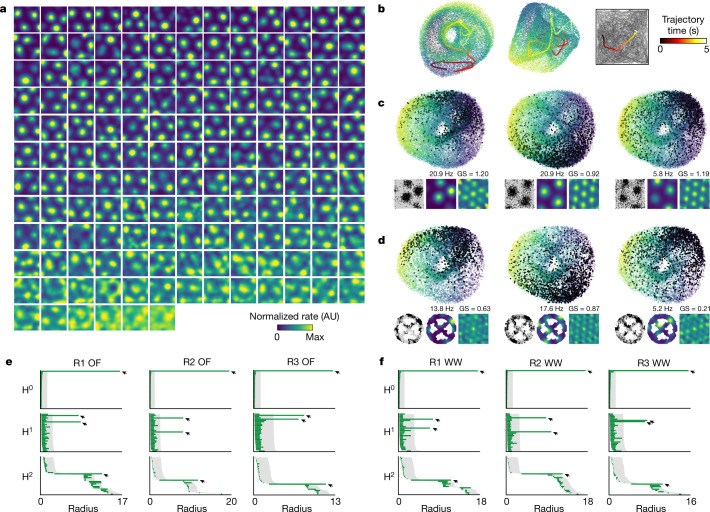
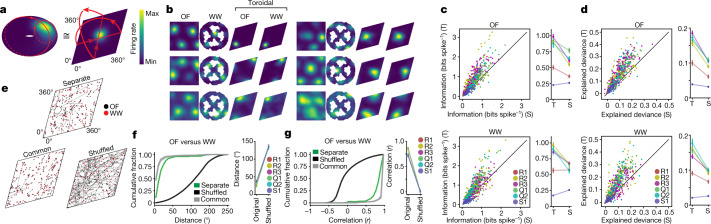
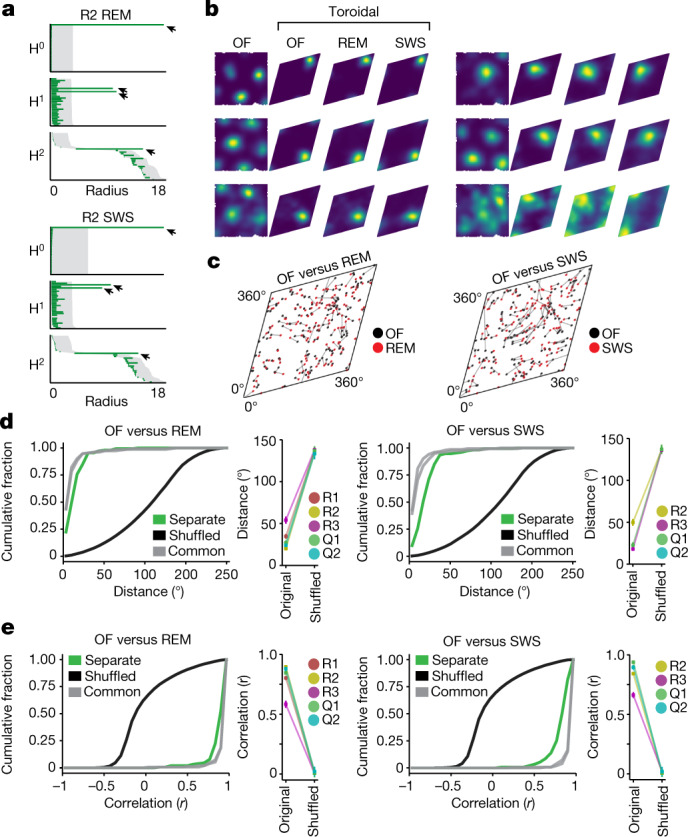
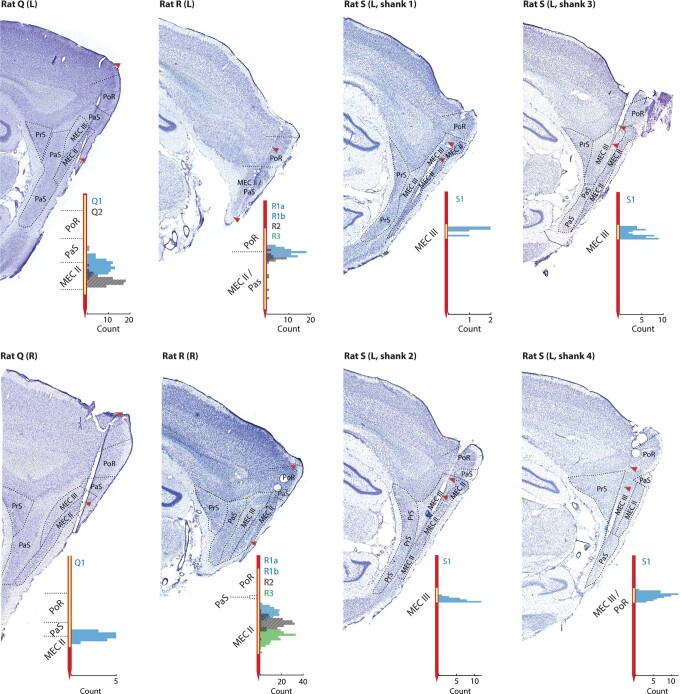
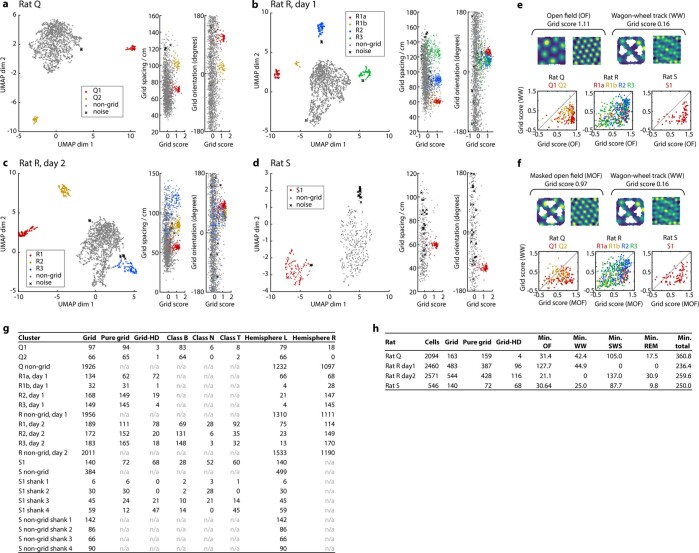
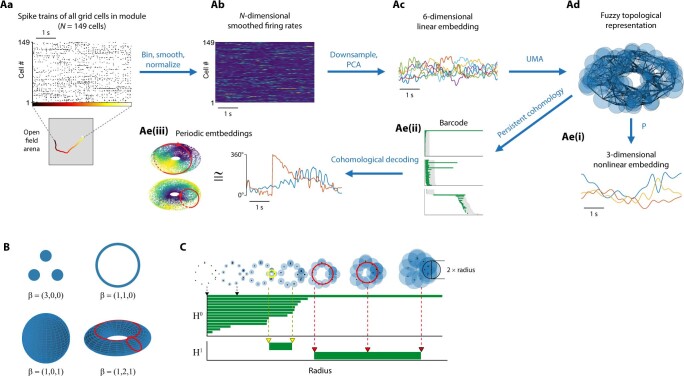
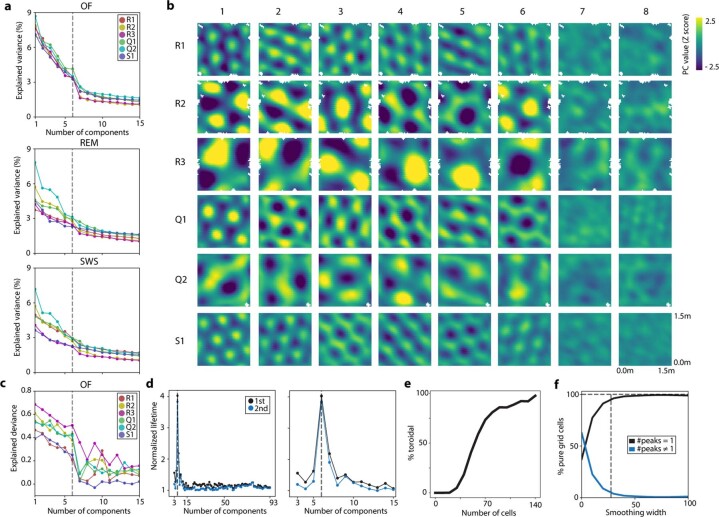
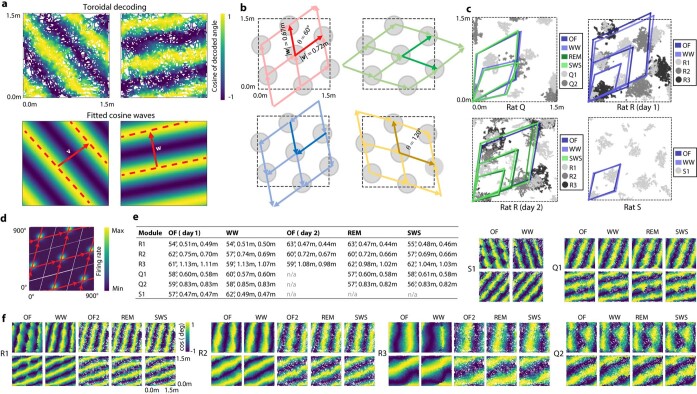
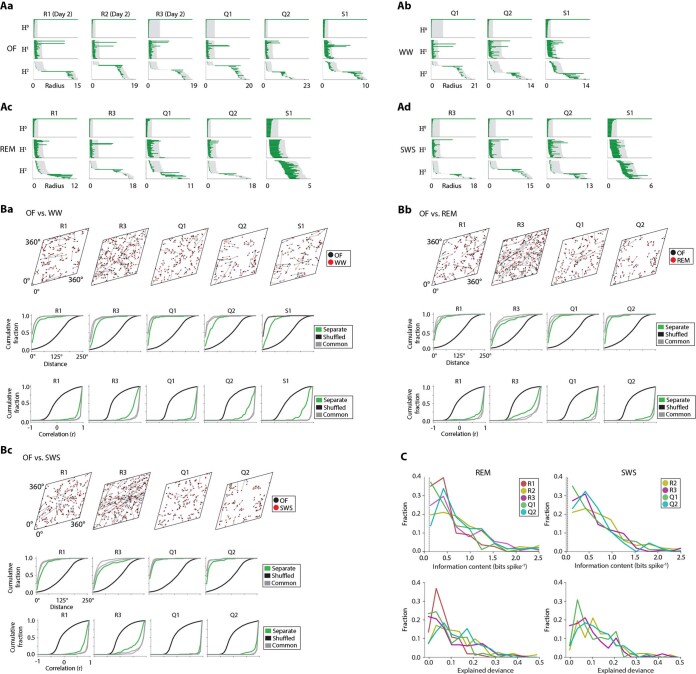
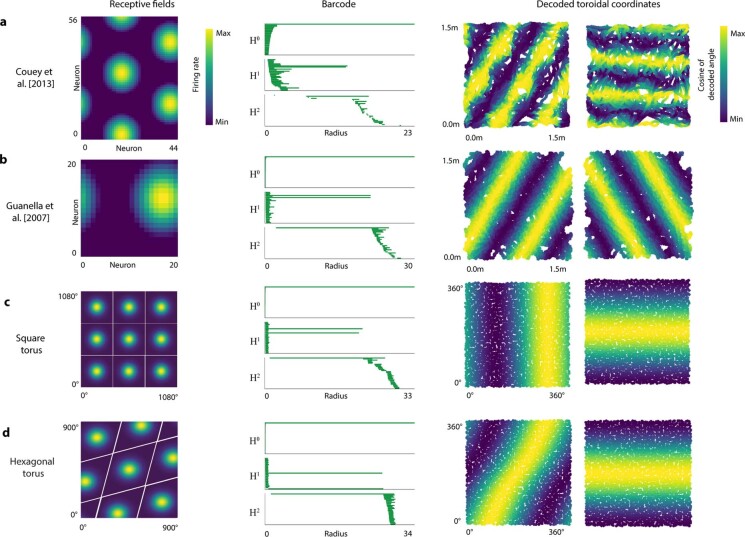
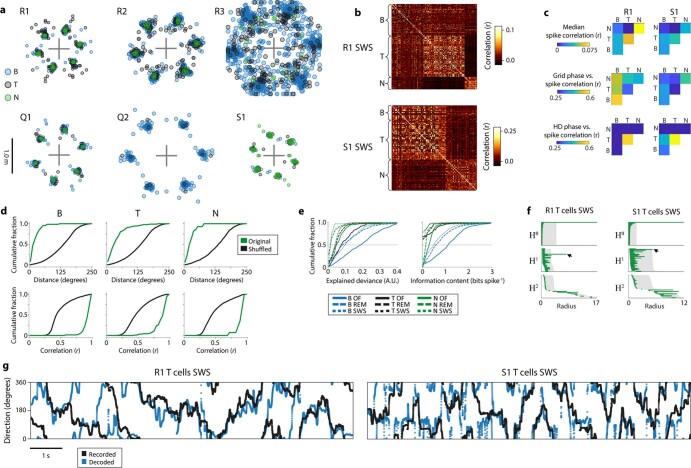
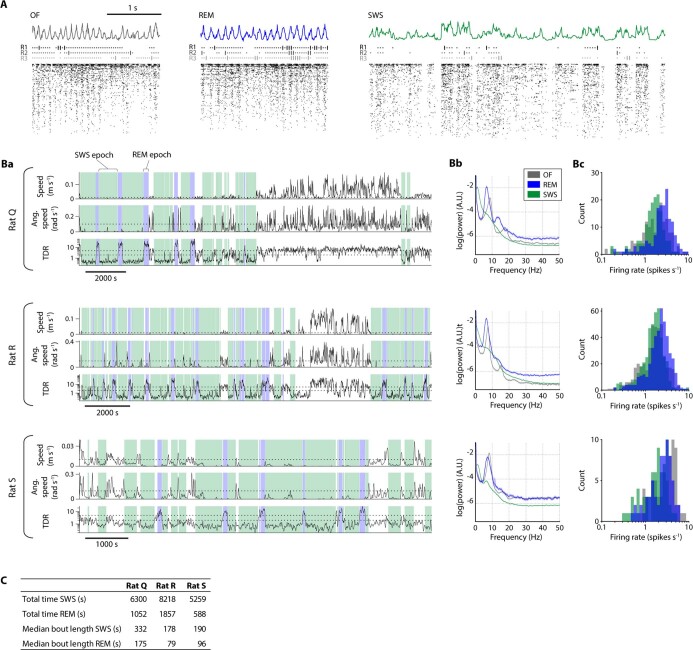
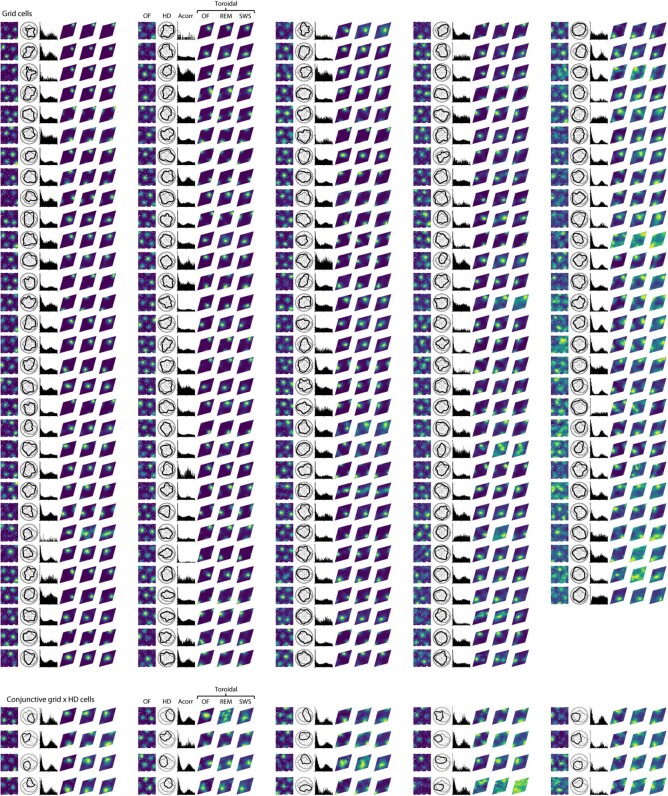
The medial entorhinal cortex is part of a neural system for mapping the position of an individual within a physical environment 1 . Grid cells, a key component of this system, fire in a characteristic hexagonal pattern of locations 2 , and are organized in modules 3 that collectively form a population code for the animal’s allocentric position 1 . The invariance of the correlation structure of this population code across environments 4,5 and behavioural states 6,7 , independent of specific sensory inputs, has pointed to intrinsic, recurrently connected continuous attractor networks (CANs) as a possible substrate of the grid pattern 1,8–11 . However, whether grid cell networks show continuous attractor dynamics, and how they interface with inputs from the environment, has remained unclear owing to the small samples of cells obtained so far. Here, using simultaneous recordings from many hundreds of grid cells and subsequent topological data analysis, we show that the joint activity of grid cells from an individual module resides on a toroidal manifold, as expected in a two-dimensional CAN. Positions on the torus correspond to positions of the moving animal in the environment. Individual cells are preferentially active at singular positions on the torus. Their positions are maintained between environments and from wakefulness to sleep, as predicted by CAN models for grid cells but not by alternative feedforward models 12 . This demonstration of network dynamics on a toroidal manifold provides a population-level visualization of CAN dynamics in grid cells.
Overview
The claims and statistics of this paper haven’t been checked yet.
Free: it reads the open-access text and checks the first 5 claims that cite a source we can check. Create a free account to check every claim.
Integrity signals
Registry
Cites
Statistics
Figures
Verification
Claims the paper makes
The claims and statistics of this paper haven’t been checked yet.
Free: it reads the open-access text and checks the first 5 claims that cite a source we can check. Create a free account to check every claim.
Claims other papers make about this one
Each is checked against this paper’s own text: does it say what the citing paper says it does?
The cited source says what the claim attributes to it.
In the citing paper
“For all topological analyses, the six-dimensional pointcloud was further downsampled using the procedure proposed by Gardner et al. This was done to reduce the impact of spurious activity, as persistent homology can be sensitive to outliers.11”
From Coherently remapping toroidal cells but not Grid cells are responsible for path integration in virtual agents (2023) · cites this paper as [11]
The cited source says what the claim attributes to it.
In the citing paper
“This was done to reduce the impact of spurious activity, as persistent homology can be sensitive to outliers.11”
From Coherently remapping toroidal cells but not Grid cells are responsible for path integration in virtual agents (2023) · cites this paper as [11]
Self-check
Percentages, sums and reported differences re-computed from the paper’s own numbers.
The self-check needs the paper’s full text.
Citations
Cites
UMAP: Uniform Manifold Approximation and Projection
McInnes, L., Healy, J., Saul, N., & Großberger, L. (2018) · Journal of Open Source Software · doi:10.21105/joss.00861 · Cited by 9,826
UMAP: Uniform Manifold Approximation and Projection for Dimension Reduction
McInnes, L., Healy, J., & Melville, J. (2018) · arXiv · doi:10.48550/arxiv.1802.03426 · Cited by 7,101
Microstructure of a spatial map in the entorhinal cortex
Hafting, T., Fyhn, M., Molden, S., Moser, M.-B., & Moser, E. I. (2005) · Nature · doi:10.1038/nature03721 · Cited by 4,068
Self-citationFully integrated silicon probes for high-density recording of neural activity
Jun, J. J., Steinmetz, N. A., Siegle, J. H., Denman, D. J., Bauza, M., Barbarits, B., Lee, A. K., Anastassiou, C. A., Andrei, A., Aydın, Ç., et al. (2017) · Nature · doi:10.1038/nature24636 · Cited by 2,190
Self-citationDynamics of pattern formation in lateral-inhibition type neural fields
Amari, S.-I. (1977) · Biological Cybernetics · doi:10.1007/bf00337259 · Cited by 2,060
Path integration and the neural basis of the 'cognitive map'
McNaughton, B. L., Battaglia, F. P., Jensen, O., Moser, E. I., & Moser, M.-B. (2006) · Nature Reviews Neuroscience · doi:10.1038/nrn1932 · Cited by 2,024
Self-citationTaube, J., Muller, R., & Ranck, J. (1990) · The Journal of Neuroscience · doi:10.1523/jneurosci.10-02-00420.1990 · Cited by 1,809
Conjunctive Representation of Position, Direction, and Velocity in Entorhinal Cortex
Sargolini, F., Fyhn, M., Hafting, T., McNaughton, B. L., Witter, M. P., Moser, M.-B., & Moser, E. I. (2006) · Science · doi:10.1126/science.1125572 · Cited by 1,485
Self-citationMemory of sequential experience in the hippocampus during slow wave sleep
Lee, A. K., & Wilson, M. A. (2002) · Neuron · doi:10.1016/s0896-6273(02)01096-6 · Cited by 1,296
Neuropixels 2.0: A miniaturized high-density probe for stable, long-term brain recordings.
Steinmetz, N. A., Aydin, C., Lebedeva, A., Okun, M., Pachitariu, M., Bauza, M., Beau, M., Bhagat, J., Böhm, C., Broux, M., et al. (2021) · Science · doi:10.1126/science.abf4588 · Cited by 1,173
Self-citationCompte, A. (2000) · Cerebral Cortex · doi:10.1093/cercor/10.9.910 · Cited by 1,143
Theory of orientation tuning in visual cortex.
Ben-Yishai, R., Bar-Or, R. L., & Sompolinsky, H. (1995) · Proceedings of the National Academy of Sciences · doi:10.1073/pnas.92.9.3844 · Cited by 1,086
Zhang, K. (1996) · The Journal of Neuroscience · doi:10.1523/jneurosci.16-06-02112.1996 · Cited by 1,001
The hippocampus as a predictive map
Stachenfeld, K. L., Botvinick, M. M., & Gershman, S. J. (2017) · Nature Neuroscience · doi:10.1038/nn.4650 · Cited by 1,000
Path integration and cognitive mapping in a continuous attractor neural network model
Samsonovich, A., & McNaughton, B. L. (1997) · The Journal of Neuroscience · doi:10.1523/jneurosci.17-15-05900.1997 · Cited by 989
Deciphering The Hippocampal Polyglot: the Hippocampus as a Path Integration System
McNAUGHTON, B. L., Barnes, C. A., Gerrard, J. L., Gothard, K., Jung, M. W., Knierim, J. J., Kudrimoti, H., Qin, Y., Skaggs, W. E., Suster, M., et al. (1996) · Journal of Experimental Biology · doi:10.1242/jeb.199.1.173 · Cited by 915
Accurate Path Integration in Continuous Attractor Network Models of Grid Cells
Burak, Y., & Fiete, I. R. (2009) · PLoS Computational Biology · doi:10.1371/journal.pcbi.1000291 · Cited by 779
Self-citationHippocampal remapping and grid realignment in entorhinal cortex
Fyhn, M., Hafting, T., Treves, A., Moser, M.-B., & Moser, E. I. (2007) · Nature · doi:10.1038/nature05601 · Cited by 749
Self-citationGray, C. M., Maldonado, P. E., Wilson, M., & McNaughton, B. (1995) · Journal of Neuroscience Methods · doi:10.1016/0165-0270(95)00085-2 · Cited by 742
Neural dynamics for landmark orientation and angular path integration
Seelig, J. D., & Jayaraman, V. (2015) · Nature · doi:10.1038/nature14446 · Cited by 718
The entorhinal grid map is discretized
Stensola, H., Stensola, T., Solstad, T., Frøland, K., Moser, M.-B., & Moser, E. I. (2012) · Nature · doi:10.1038/nature11649 · Cited by 701
Self-citationDecision Making in Recurrent Neuronal Circuits
Wang, X.-J. (2008) · Neuron · doi:10.1016/j.neuron.2008.09.034 · Cited by 679
Development of the Spatial Representation System in the Rat
Langston, R. F., Ainge, J. A., Couey, J. J., Canto, C. B., Bjerknes, T. L., Witter, M. P., Moser, E. I., & Moser, M.-B. (2010) · Science · doi:10.1126/science.1188210 · Cited by 667
Self-citationA Spin Glass Model of Path Integration in Rat Medial Entorhinal Cortex
Fuhs, M. C., & Touretzky, D. S. (2006) · The Journal of Neuroscience · doi:10.1523/jneurosci.4353-05.2006 · Cited by 633
Development of the Hippocampal Cognitive Map in Preweanling Rats
Wills, T. J., Cacucci, F., Burgess, N., & O'Keefe, J. (2010) · Science · doi:10.1126/science.1188224 · Cited by 616
Opening the black box: low-dimensional dynamics in high-dimensional recurrent neural networks
Sussillo, D., & Barak, O. (2013) · Neural Computation · doi:10.1162/neco_a_00409 · Cited by 575
Flexible control of mutual inhibition: a neural model of two-interval discrimination
Machens, C. K., Romo, R., & Brody, C. D. (2005) · Science · doi:10.1126/science.1104171 · Cited by 535
How the brain keeps the eyes still
Seung, H. S. (1996) · Proceedings of the National Academy of Sciences · doi:10.1073/pnas.93.23.13339 · Cited by 534
Experience-dependent rescaling of entorhinal grids
Barry, C., Hayman, R., Burgess, N., & Jeffery, K. J. (2007) · Nature Neuroscience · doi:10.1038/nn1905 · Cited by 532
Bump attractor dynamics in prefrontal cortex explains behavioral precision in spatial working memory
Wimmer, K., Nykamp, D. Q., Constantinidis, C., & Compte, A. (2014) · Nature Neuroscience · doi:10.1038/nn.3645 · Cited by 470
Recurrent inhibitory circuitry as a mechanism for grid formation
Couey, J. J., Witoelar, A., Zhang, S.-J., Zheng, K., Ye, J., Dunn, B., Czajkowski, R., Moser, M.-B., Moser, E. I., Roudi, Y., et al. (2013) · Nature Neuroscience · doi:10.1038/nn.3310 · Cited by 422
Self-citationRing attractor dynamics in the Drosophila central brain
Kim, S. S., Rouault, H., Druckmann, S., & Jayaraman, V. (2017) · Science · doi:10.1126/science.aal4835 · Cited by 417
(1995) · PubMed · Cited by 411
Clique topology reveals intrinsic geometric structure in neural correlations
Giusti, C., Pastalkova, E., Curto, C., & Itskov, V. (2015) · Proceedings of the National Academy of Sciences · doi:10.1073/pnas.1506407112 · Cited by 381
Grid cell symmetry is shaped by environmental geometry
Krupic, J., Bauza, M., Burton, S., Barry, C., & O’Keefe, J. (2015) · Nature · doi:10.1038/nature14153 · Cited by 373
Chaudhuri, R., Gerçek, B., Pandey, B., Peyrache, A., & Fiete, I. (2019) · Nature Neuroscience · doi:10.1038/s41593-019-0460-x · Cited by 373
Theta and gamma coordination of hippocampal networks during waking and rapid eye movement sleep.
Montgomery, S. M., Sirota, A., & Buzsaki, G. (2008) · Journal of Neuroscience · doi:10.1523/jneurosci.1227-08.2008 · Cited by 371
Initialization is critical for preserving global data structure in both t-SNE and UMAP
Kobak, D., & Linderman, G. C. (2021) · Nature Biotechnology · doi:10.1038/s41587-020-00809-z · Cited by 365
A coupled attractor model of the rodent head direction system
Redish, A. D., Elga, A. N., & Touretzky, D. S. (1996) · Network: Computation in Neural Systems · doi:10.1088/0954-898x_7_4_004 · Cited by 344
A neural circuit architecture for angular integration in Drosophila
Green, J., Adachi, A., Shah, K. K., Hirokawa, J. D., Magani, P. S., & Maimon, G. (2017) · Nature · doi:10.1038/nature22343 · Cited by 331
A Multiplexed, Heterogeneous, and Adaptive Code for Navigation in Medial Entorhinal Cortex
Hardcastle, K., Maheswaranathan, N., Ganguli, S., & Giocomo, L. M. (2017) · Neuron · doi:10.1016/j.neuron.2017.03.025 · Cited by 312
Specific evidence of low-dimensional continuous attractor dynamics in grid cells
Yoon, K., Buice, M. A., Barry, C., Hayman, R., Burgess, N., & Fiete, I. R. (2013) · Nature Neuroscience · doi:10.1038/nn.3450 · Cited by 296
The entorhinal cognitive map is attracted to goals
Boccara, C. N., Nardin, M., Stella, F., O’Neill, J., & Csicsvari, J. (2019) · Science · doi:10.1126/science.aav4837 · Cited by 288
Internally organized mechanisms of the head direction sense
Peyrache, A., Lacroix, M. M., Petersen, P. C., & Buzsáki, G. (2015) · Nature Neuroscience · doi:10.1038/nn.3968 · Cited by 285
Ripser: efficient computation of Vietoris–Rips persistence barcodes
Bauer, U. (2021) · Journal of Applied and Computational Topology · doi:10.1007/s41468-021-00071-5 · Cited by 280
Three-dimensional head-direction coding in the bat brain
Finkelstein, A., Derdikman, D., Rubin, A., Foerster, J. N., Las, L., & Ulanovsky, N. (2015) · Nature · doi:10.1038/nature14031 · Cited by 274
The emergence of grid cells: Intelligent design or just adaptation?
Kropff, E., & Treves, A. (2008) · Hippocampus · doi:10.1002/hipo.20520 · Cited by 250
Remembered reward locations restructure entorhinal spatial maps
Butler, W. N., Hardcastle, K., & Giocomo, L. M. (2019) · Science · doi:10.1126/science.aav5297 · Cited by 232
Shearing-induced asymmetry in entorhinal grid cells
Stensola, T., Stensola, H., Moser, M.-B., & Moser, E. I. (2015) · Nature · doi:10.1038/nature14151 · Cited by 223
Self-citationA MODEL OF GRID CELLS BASED ON A TWISTED TORUS TOPOLOGY
GUANELLA, A., KIPER, D., & VERSCHURE, P. (2007) · International Journal of Neural Systems · doi:10.1142/s0129065707001093 · Cited by 221
Ripser.py: A Lean Persistent Homology Library for Python
Tralie, C., Saul, N., & Bar-On, R. (2018) · Journal of Open Source Software · doi:10.21105/joss.00925 · Cited by 219
Persistence-Based Clustering in Riemannian Manifolds
Chazal, F., Guibas, L. J., Oudot, S. Y., & Skraba, P. (2013) · Journal of the ACM · doi:10.1145/2535927 · Cited by 217
Topological analysis of population activity in visual cortex
Singh, G., Memoli, F., Ishkhanov, T., Sapiro, G., Carlsson, G., & Ringach, D. L. (2008) · Journal of Vision · doi:10.1167/8.8.11 · Cited by 213
A Topological Paradigm for Hippocampal Spatial Map Formation Using Persistent Homology
Dabaghian, Y., Mémoli, F., Frank, L., & Carlsson, G. (2012) · PLoS Computational Biology · doi:10.1371/journal.pcbi.1002581 · Cited by 197
A unified theory for the computational and mechanistic origins of grid cells
Sorscher, B., Mel, G. C., Ocko, S. A., Giocomo, L. M., & Ganguli, S. (2022) · Neuron · doi:10.1016/j.neuron.2022.10.003 · Cited by 179
Dordek, Y., Soudry, D., Meir, R., & Derdikman, D. (2016) · eLife · doi:10.7554/elife.10094 · Cited by 175
EPIC: An Energy-Efficient, High-Performance GPGPU Computing Research InfrastructurePreprint
Själander, M., Jahre, M., Tufte, G., & Reißmann, N. (2019) · arXiv (Cornell University) · doi:10.48550/arxiv.1912.05848 · Cited by 156
Yoganarasimha, D., Yu, X., & Knierim, J. J. (2006) · The Journal of Neuroscience · doi:10.1523/jneurosci.3885-05.2006 · Cited by 149
Stellate cells drive maturation of the entorhinal-hippocampal circuit
Donato, F., Jacobsen, R. I., Moser, M.-B., & Moser, E. I. (2017) · Science · doi:10.1126/science.aai8178 · Cited by 138
Self-citationRevealing neural correlates of behavior without behavioral measurements
Rubin, A., Sheintuch, L., Brande-Eilat, N., Pinchasof, O., Rechavi, Y., Geva, N., & Ziv, Y. (2019) · Nature Communications · doi:10.1038/s41467-019-12724-2 · Cited by 135
Functional dissection of circuitry in a neural integrator
Aksay, E., Olasagasti, I., Mensh, B. D., Baker, R., Goldman, M. S., & Tank, D. W. (2007) · Nature Neuroscience · doi:10.1038/nn1877 · Cited by 134
Correlation structure of grid cells is preserved during sleep
Gardner, R. J., Lu, L., Wernle, T., Moser, M.-B., & Moser, E. I. (2019) · Nature Neuroscience · doi:10.1038/s41593-019-0360-0 · Cited by 134
Self-citationLocally ordered representation of 3D space in the entorhinal cortex
Ginosar, G., Aljadeff, J., Burak, Y., Sompolinsky, H., Las, L., & Ulanovsky, N. (2021) · Nature · doi:10.1038/s41586-021-03783-x · Cited by 111
Self-citationTrettel, S. G., Trimper, J. B., Hwaun, E., Fiete, I. R., & Colgin, L. L. (2019) · Nature Neuroscience · doi:10.1038/s41593-019-0359-6 · Cited by 108
Persistent Cohomology and Circular Coordinates
de Silva, V., Morozov, D., & Vejdemo-Johansson, M. (2011) · Discrete & Computational Geometry · doi:10.1007/s00454-011-9344-x · Cited by 97
Decoding of Neural Data Using Cohomological Feature Extraction
Rybakken, E., Baas, N. A., & Dunn, B. A. (2018) · Neural Computation · doi:10.1162/neco_a_01150 · Cited by 76
Self-citationLearning place cells, grid cells and invariances with excitatory and inhibitory plasticity
Weber, S. N., & Sprekeler, H. (2018) · eLife · doi:10.7554/elife.34560 · Cited by 58
Grid alignment in entorhinal cortex
Si, B., Kropff, E., & Treves, A. (2012) · Biological Cybernetics · doi:10.1007/s00422-012-0513-7 · Cited by 58
Task-dependent mixed selectivity in the subiculum
Ledergerber, D., Battistin, C., Blackstad, J. S., Gardner, R. J., Witter, M. P., Moser, M., Roudi, Y., & Moser, E. I. (2021) · Cell Reports · doi:10.1016/j.celrep.2021.109175 · Cited by 57
Self-citationLearning to represent continuous variables in heterogeneous neural networks
Darshan, R., & Rivkind, A. (2022) · Cell Reports · doi:10.1016/j.celrep.2022.110612 · Cited by 56
Interspike Intervals Reveal Functionally Distinct Cell Populations in the Medial Entorhinal Cortex
Latuske, P., Toader, O., & Allen, K. (2015) · Journal of Neuroscience · doi:10.1523/jneurosci.0276-15.2015 · Cited by 54
Lukashin, A. V., & Georgopoulos, A. P. (1993) · Biological Cybernetics · doi:10.1007/bf01185423 · Cited by 45
Evaluating State Space Discovery by Persistent Cohomology in the Spatial Representation System
Kang, L., Xu, B., & Morozov, D. (2021) · Frontiers in Computational Neuroscience · doi:10.3389/fncom.2021.616748 · Cited by 42
Newman, E. L., & Hasselmo, M. E. (2014) · Frontiers in Systems Neuroscience · doi:10.3389/fnsys.2014.00193 · Cited by 40
Learning to represent continuous variables in heterogeneous neural networksPreprint
Darshan, R., & Rivkind, A. (2021) · bioRxiv · doi:10.1101/2021.06.01.446635 · Cited by 40
Continuous attractors with morphed/correlated maps
Romani, S., & Tsodyks, M. (2010) · PLoS Computational Biology · doi:10.1371/journal.pcbi.1000869 · Cited by 39
A single-cell spiking model for the origin of grid-cell patterns
D’Albis, T., & Kempter, R. (2017) · PLoS Computational Biology · doi:10.1371/journal.pcbi.1005782 · Cited by 39
Koyluoglu, O. O., Pertzov, Y., Manohar, S., Husain, M., & Fiete, I. (2017) · eLife · doi:10.7554/elife.22225 · Cited by 34
Hippocampal Spike-Timing Correlations Lead to Hexagonal Grid Fields
Monsalve‐Mercado, M. M., & Leibold, C. (2017) · Physical Review Letters · doi:10.1103/physrevlett.119.038101 · Cited by 29
A unified theory for the computational and mechanistic origins of grid cellsPreprint
Sorscher, B., Mel, G. C., Ocko, S. A., et al. (2020) · bioRxiv (Cold Spring Harbor Laboratory) · doi:10.1101/2020.12.29.424583 · Cited by 28
Sparse Circular Coordinates via Principal $$\mathbb {Z}$$-Bundles
Perea, J. A. (2020) · Abel symposia · doi:10.1007/978-3-030-43408-3_17 · Cited by 19
Topological De-Noising: Strengthening the Topological SignalPreprint
Kloke, J., & Carlsson, G. (2009) · arXiv.org · doi:10.48550/arxiv.0910.5947 · Cited by 18
Using persistent homology to reveal hidden covariates in systems governed by the kinetic Ising model
Spreemann, G., Dunn, B. A., Botnan, M. B., & Baas, N. A. (2018) · Physical review. E · doi:10.1103/physreve.97.032313 · Cited by 11
Self-citationCsordás, D. É., Fischer, C., Nagele, J., Stemmler, M., & Herz, A. V. M. (2020) · Journal of Neuroscience · doi:10.1523/jneurosci.2569-19.2020 · Cited by 11
On the concept of space in neuroscience
Baas, N. A. (2016) · Current Opinion in Systems Biology · doi:10.1016/j.coisb.2016.12.002 · Cited by 7
Self-citation
Research works printed but not linked: 6
- Skaggs W Mcnaughton B Gothard K An information-theoretic approach to deciphering the hippocampal code Adv. Neural Inf. Process. Syst. 1992 5 1030 1037
- Bellman, R. Dynamic Programming (Princeton Univ. Press, 1957).
- Spivak, D. I. Metric realization of fuzzy simplicial sets https://www.semanticscholar.org/paper/metric-realization-of-fuzzy-simplicial-sets-spivak/a73fb9d562a3850611d2615ac22c3a8687fa745e (Semantic Scholar, 2009).
- Hatcher, A. Algebraic Topology (Cambridge University Press, 2002).
- Tsodyks M Sejnowski TJ Associative memory and hippocampal place cells Int. J. Neural Syst. 1995 6 81 86
- Stepanyuk A Self-organization of grid fields under supervision of place cells in a neuron model with associative plasticity Biol. Inspired Cogn. Archit. 2015 13 48 62
Cited by
Learnable latent embeddings for joint behavioural and neural analysis
Schneider, S., Lee, J. H., & Mathis, M. W. (2023) · Nature · doi:10.1038/s41586-023-06031-6 · Cited by 348
Large-scale neural recordings call for new insights to link brain and behavior
Urai, A. E., Doiron, B., Leifer, A. M., & Churchland, A. K. (2022) · Nature Neuroscience · doi:10.1038/s41593-021-00980-9 · Cited by 328
“In another example, (Gardner et al., 2021) found that the activity of grid cells in the”
BackgroundAttractor and integrator networks in the brain
Khona, M., & Fiete, I. R. (2022) · Nature Reviews Neuroscience · doi:10.1038/s41583-022-00642-0 · Cited by 306
“Part e is adapted from ref.(20), Springer Nature.”
BackgroundThe structures and functions of correlations in neural population codes
Panzeri, S., Moroni, M., Safaai, H., & Harvey, C. D. (2022) · Nature Reviews Neuroscience · doi:10.1038/s41583-022-00606-4 · Cited by 246
“The effects of higher-order correlations are particularly prominent for larger populations 62,70 , suggesting that future studies of large-scale recordings of hundreds or thousands of neurons should systematically consider these higher-order correlations.”
BackgroundWhittington, J. C. R., McCaffary, D., Bakermans, J. J. W., & Behrens, T. E. J. (2022) · Nature Neuroscience · doi:10.1038/s41593-022-01153-y · Cited by 231
Metadata
- Authors
- Gardner, R. J., Hermansen, E., Pachitariu, M., Burak, Y., Baas, N. A., Dunn, B. A., Moser, M.-B., & Moser, E. I.
- Affiliations
- Norwegian University of Science and Technology (NO)
- Howard Hughes Medical Institute (US)
- Hebrew University of Jerusalem (IL)
- Corresponding author
- Gardner, Richard J.
- Baas, Nils A.
- Dunn, Benjamin A.
- Moser, Edvard I.
- ORCID
- Venue
- Nature
- Published
- 2022-01-12
- Volume
- 602
- Issue
- 7895
- Pages
- 123-128
- ISSN
- 0028-0836 (ISSN-L)
- 1476-4687
- PMC
- PMC8810387
- OpenAlex
- W4205399426
- Cited by
- 428
- References
- 80
- Citations by year
- 2026: 79 · 2025: 108 · 2024: 99 · 2023: 89 · 2022: 48
- FWCI
- 44.35
- Type
- journal article
- Language
- en
- Open access
- hybrid
- doi.org
- Licence
- cc-by
- creativecommons.org/licenses/by/4.0 (tdm)
- creativecommons.org/licenses/by/4.0 (vor)
- Locations
- Nature (publishedVersion, cc-by)
- PubMed Central (publishedVersion, cc-by)
- PubMed (publishedVersion)
- Funders
- Kavli Foundation
- Norges Teknisk-Naturvitenskapelige Universitet
- Gatsby Charitable Foundation
- Israel Science Foundation
- Norges Forskningsråd (223262, 295721)
- Mattilsynet
- Division of Mathematical Sciences
- H2020 European Research Council (951319)
- Topics
- Life Sciences › Neuroscience › Cognitive Neuroscience › Memory and Neural Mechanisms
- Life Sciences › Neuroscience › Cognitive Neuroscience › Neural dynamics and brain function
- Social Sciences › Psychology › Experimental and Cognitive Psychology › Spatial Cognition and Navigation
- Keywords
- grid cells, continuous attractor networks, toroidal manifold, population activity, medial entorhinal cortex, spatial representation, topological data analysis, recurrent connectivity, sleep and wakefulness
- MeSH terms
- Grid Cells, Action Potentials, Animals, Male, Models, Neurological, Sleep, Space Perception, Wakefulness, Entorhinal Cortex, Rats, Long-Evans, Rats
About these checks
Registry, retraction, Cites and statistics results are computed, not judged, with one exception: a printed reference that no index lists is read once by a model before it counts as a citation error. Claims are extracted by a model and kept only when their quote appears verbatim in the text; each cited source is then checked, with a model’s help, for whether it says what the claim relies on. Those verdicts can be wrong — read the claim’s quote and the cited source before relying on one.
Statistics and arithmetic are recomputed, not judged.
Confidence bands are shown only for fields calibrated on our annotated test set. None is calibrated yet, so no band is shown.
What counts as a claim ›How we measure confidence ›How we check this ›
Are you an author, or do you see a problem with this page? Request a review
Data sources
Bibliographic data: Semantic Scholar, OpenAlex, Crossref.
Contains information from the Semantic Scholar Academic Graph Datasets, made available under the ODC Attribution License (ODC-BY 1.0).
Semantic Scholar’s data is described in: Kinney, R., et al. (2023). The Semantic Scholar Open Data Platform. arXiv:2301.10140.
