

Toroidal topology of population activity in grid cells
Open accessPublished version of a preprint
The DOI matches its Crossref record; 85 of the 85 references it cites were found in a registry or an index.
Abstract
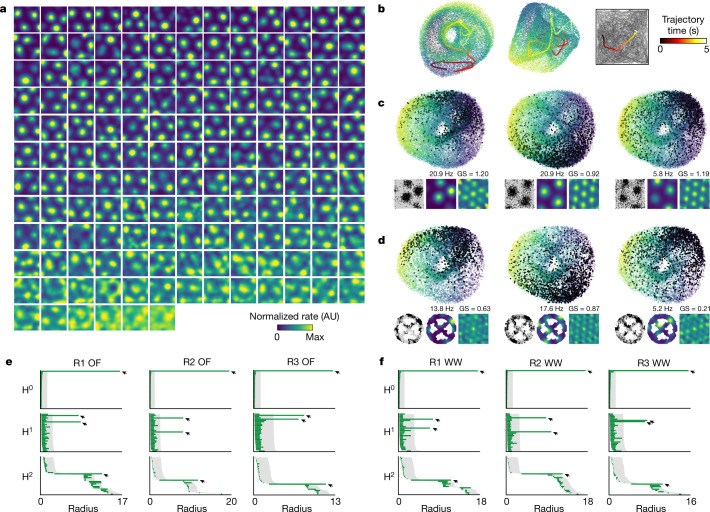
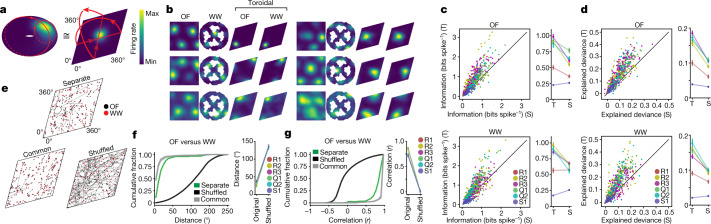
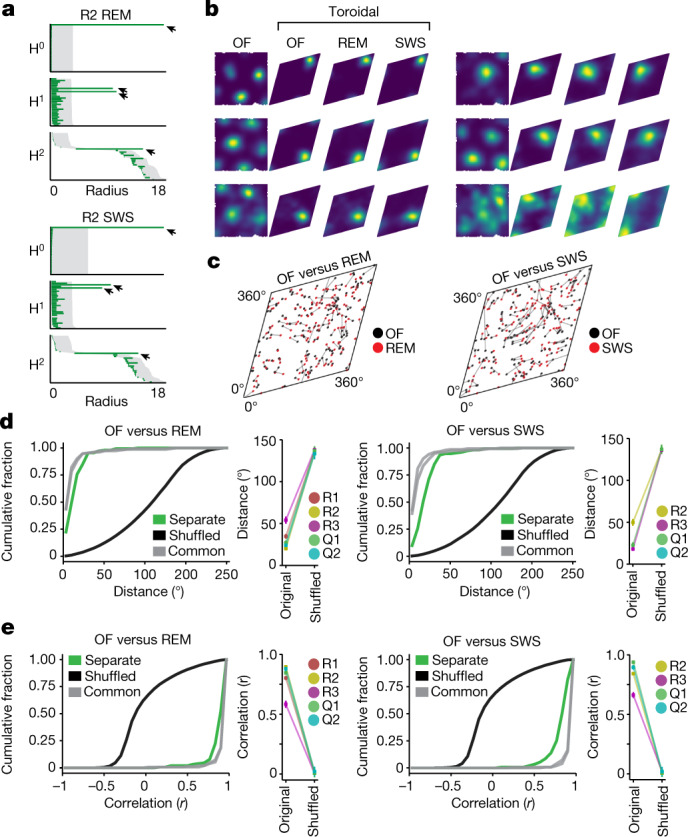
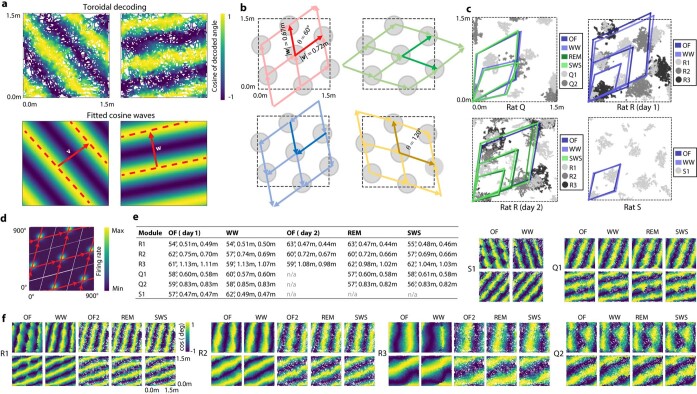
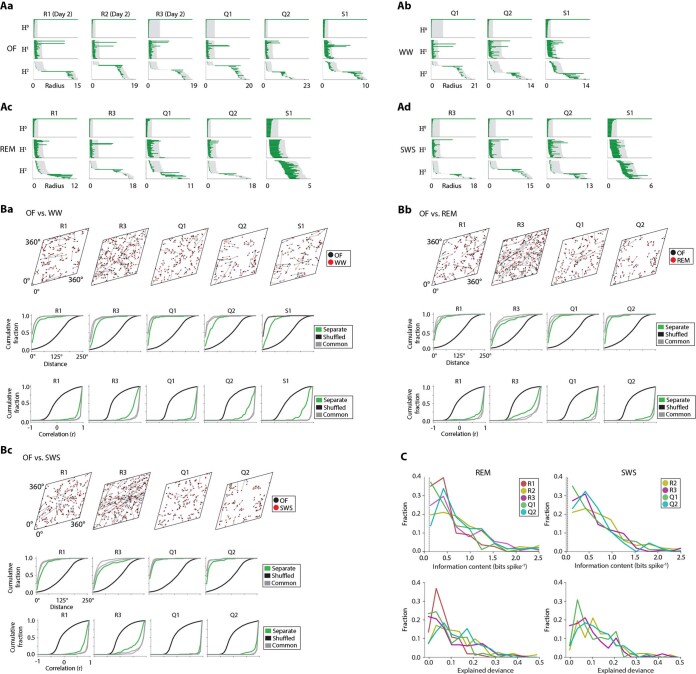
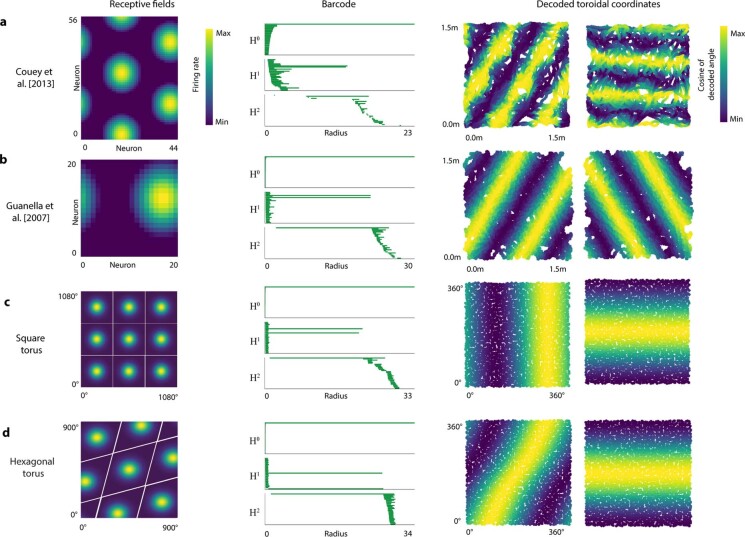
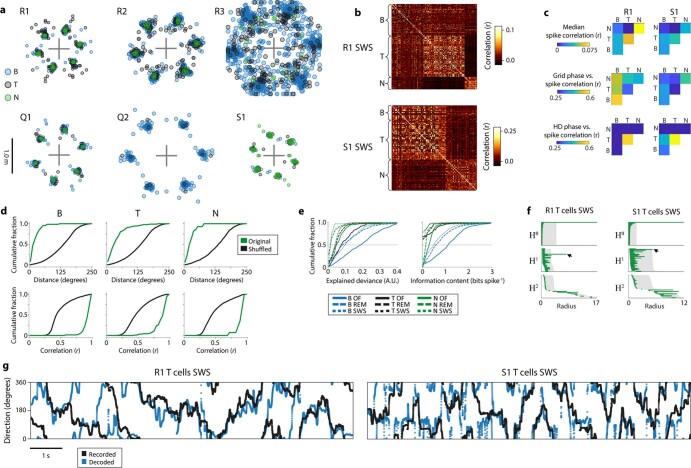
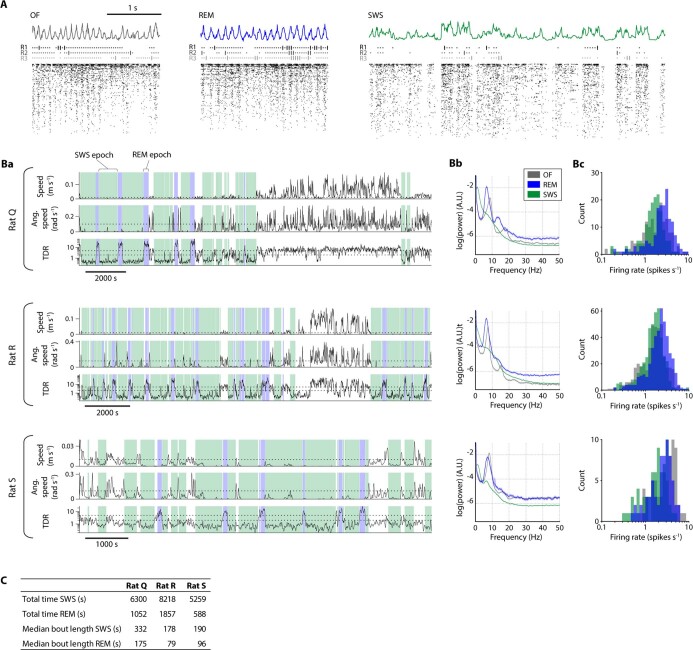
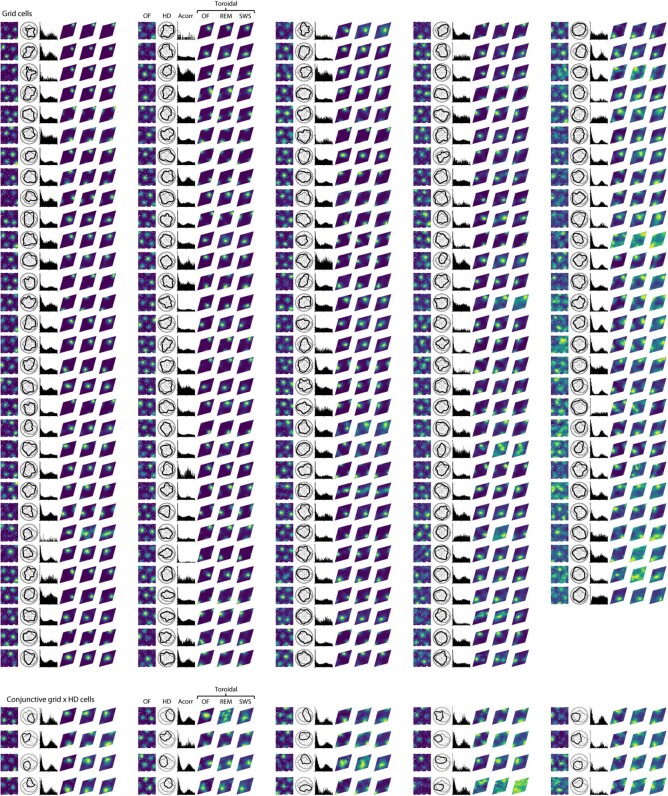
The medial entorhinal cortex is part of a neural system for mapping the position of an individual within a physical environment 1 . Grid cells, a key component of this system, fire in a characteristic hexagonal pattern of locations 2 , and are organized in modules 3 that collectively form a population code for the animal’s allocentric position 1 . The invariance of the correlation structure of this population code across environments 4,5 and behavioural states 6,7 , independent of specific sensory inputs, has pointed to intrinsic, recurrently connected continuous attractor networks (CANs) as a possible substrate of the grid pattern 1,8–11 . However, whether grid cell networks show continuous attractor dynamics, and how they interface with inputs from the environment, has remained unclear owing to the small samples of cells obtained so far. Here, using simultaneous recordings from many hundreds of grid cells and subsequent topological data analysis, we show that the joint activity of grid cells from an individual module resides on a toroidal manifold, as expected in a two-dimensional CAN. Positions on the torus correspond to positions of the moving animal in the environment. Individual cells are preferentially active at singular positions on the torus. Their positions are maintained between environments and from wakefulness to sleep, as predicted by CAN models for grid cells but not by alternative feedforward models 12 . This demonstration of network dynamics on a toroidal manifold provides a population-level visualization of CAN dynamics in grid cells.
Overview
The claims and statistics of this paper haven’t been checked yet.
Free: it reads the open-access text and checks the first 5 claims that cite a source we can check. Create a free account to check every claim.
Integrity signals
Registry
Cites
Statistics
Figures
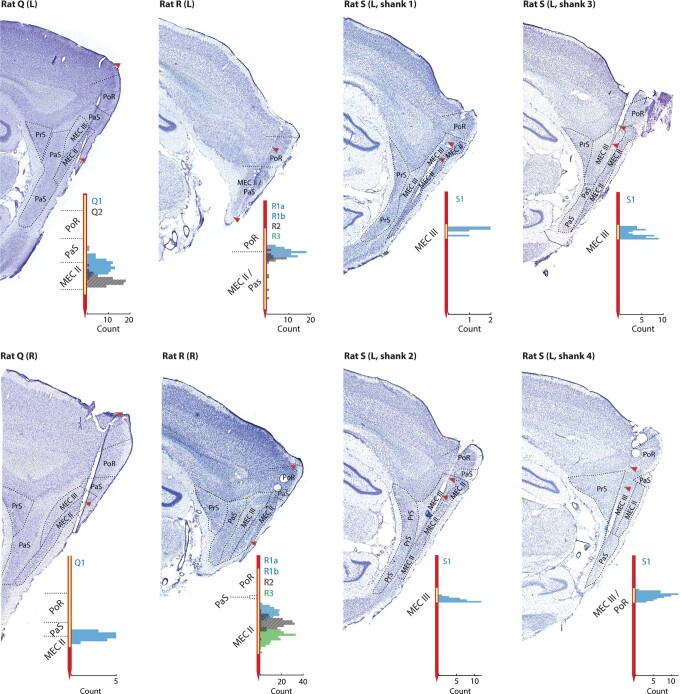
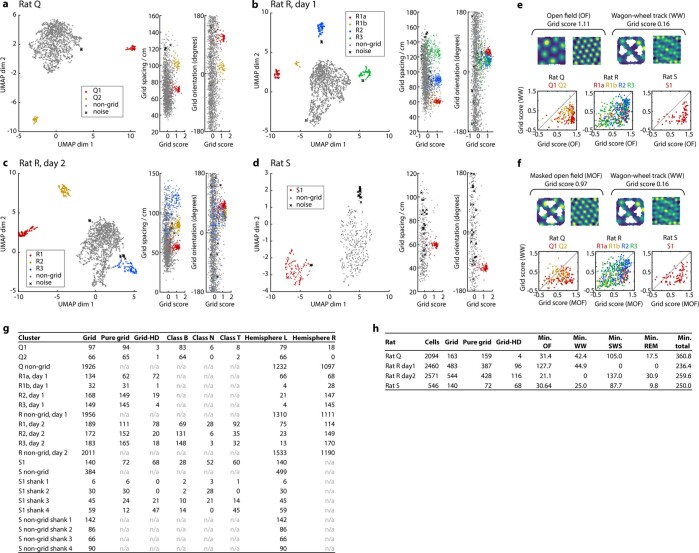
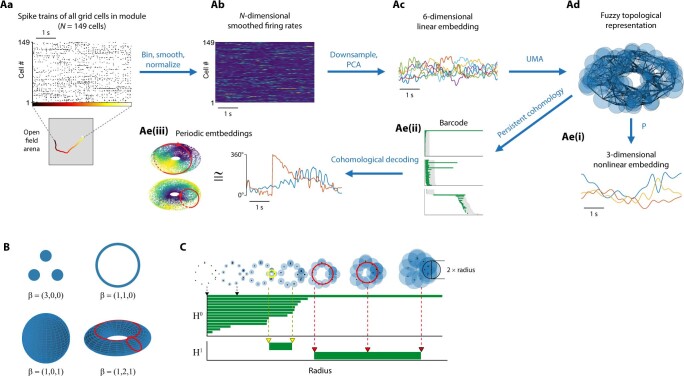
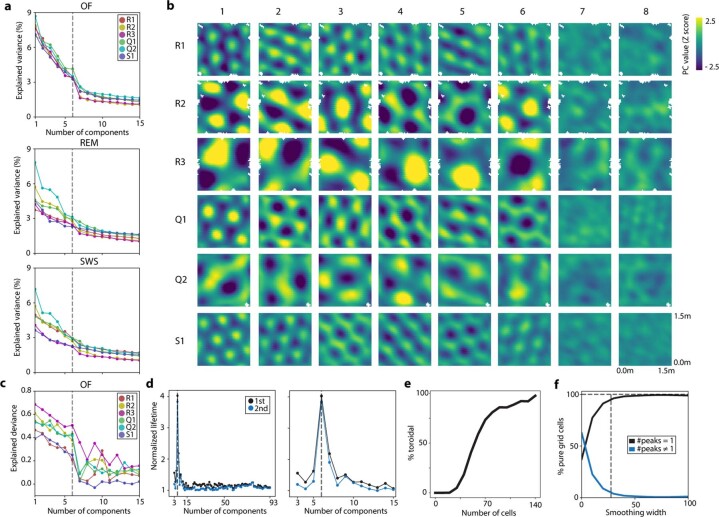
Verification
Claims the paper makes
The claims and statistics of this paper haven’t been checked yet.
Free: it reads the open-access text and checks the first 5 claims that cite a source we can check. Create a free account to check every claim.
Claims other papers make about this one
Each is checked against this paper’s own text: does it say what the citing paper says it does?
The cited source says what the claim attributes to it.
In the citing paper
“For all topological analyses, the six-dimensional pointcloud was further downsampled using the procedure proposed by Gardner et al. This was done to reduce the impact of spurious activity, as persistent homology can be sensitive to outliers.11”
From Coherently remapping toroidal cells but not Grid cells are responsible for path integration in virtual agents (2023) · cites this paper as [11]
The cited source says what the claim attributes to it.
In the citing paper
“This was done to reduce the impact of spurious activity, as persistent homology can be sensitive to outliers.11”
From Coherently remapping toroidal cells but not Grid cells are responsible for path integration in virtual agents (2023) · cites this paper as [11]
Self-check
Percentages, sums and reported differences re-computed from the paper’s own numbers.
The self-check needs the paper’s full text.
Citations
Cites
UMAP: Uniform Manifold Approximation and Projection
McInnes, L., Healy, J., Saul, N., & Großberger, L. (2018) · Journal of Open Source Software · doi:10.21105/joss.00861 · Cited by 9,826
UMAP: Uniform Manifold Approximation and Projection for Dimension Reduction
McInnes, L., Healy, J., & Melville, J. (2018) · arXiv · doi:10.48550/arxiv.1802.03426 · Cited by 7,101
Microstructure of a spatial map in the entorhinal cortex
Hafting, T., Fyhn, M., Molden, S., Moser, M.-B., & Moser, E. I. (2005) · Nature · doi:10.1038/nature03721 · Cited by 4,068
Self-citationFully integrated silicon probes for high-density recording of neural activity
Jun, J. J., Steinmetz, N. A., Siegle, J. H., Denman, D. J., Bauza, M., Barbarits, B., Lee, A. K., Anastassiou, C. A., Andrei, A., Aydın, Ç., et al. (2017) · Nature · doi:10.1038/nature24636 · Cited by 2,190
Self-citationDynamics of pattern formation in lateral-inhibition type neural fields
Amari, S.-I. (1977) · Biological Cybernetics · doi:10.1007/bf00337259 · Cited by 2,060
Path integration and the neural basis of the 'cognitive map'
McNaughton, B. L., Battaglia, F. P., Jensen, O., Moser, E. I., & Moser, M.-B. (2006) · Nature Reviews Neuroscience · doi:10.1038/nrn1932 · Cited by 2,024
Self-citationTaube, J., Muller, R., & Ranck, J. (1990) · The Journal of Neuroscience · doi:10.1523/jneurosci.10-02-00420.1990 · Cited by 1,809
Conjunctive Representation of Position, Direction, and Velocity in Entorhinal Cortex
Sargolini, F., Fyhn, M., Hafting, T., McNaughton, B. L., Witter, M. P., Moser, M.-B., & Moser, E. I. (2006) · Science · doi:10.1126/science.1125572 · Cited by 1,485
Self-citationMemory of sequential experience in the hippocampus during slow wave sleep
Lee, A. K., & Wilson, M. A. (2002) · Neuron · doi:10.1016/s0896-6273(02)01096-6 · Cited by 1,296
Neuropixels 2.0: A miniaturized high-density probe for stable, long-term brain recordings.
Steinmetz, N. A., Aydin, C., Lebedeva, A., Okun, M., Pachitariu, M., Bauza, M., Beau, M., Bhagat, J., Böhm, C., Broux, M., et al. (2021) · Science · doi:10.1126/science.abf4588 · Cited by 1,173
Self-citation
Research works printed but not linked: 6
- Skaggs W Mcnaughton B Gothard K An information-theoretic approach to deciphering the hippocampal code Adv. Neural Inf. Process. Syst. 1992 5 1030 1037
- Bellman, R. Dynamic Programming (Princeton Univ. Press, 1957).
- Spivak, D. I. Metric realization of fuzzy simplicial sets https://www.semanticscholar.org/paper/metric-realization-of-fuzzy-simplicial-sets-spivak/a73fb9d562a3850611d2615ac22c3a8687fa745e (Semantic Scholar, 2009).
- Hatcher, A. Algebraic Topology (Cambridge University Press, 2002).
- Tsodyks M Sejnowski TJ Associative memory and hippocampal place cells Int. J. Neural Syst. 1995 6 81 86
- Stepanyuk A Self-organization of grid fields under supervision of place cells in a neuron model with associative plasticity Biol. Inspired Cogn. Archit. 2015 13 48 62
Cited by
Learnable latent embeddings for joint behavioural and neural analysis
Schneider, S., Lee, J. H., & Mathis, M. W. (2023) · Nature · doi:10.1038/s41586-023-06031-6 · Cited by 348
Large-scale neural recordings call for new insights to link brain and behavior
Urai, A. E., Doiron, B., Leifer, A. M., & Churchland, A. K. (2022) · Nature Neuroscience · doi:10.1038/s41593-021-00980-9 · Cited by 328
“In another example, (Gardner et al., 2021) found that the activity of grid cells in the”
BackgroundAttractor and integrator networks in the brain
Khona, M., & Fiete, I. R. (2022) · Nature Reviews Neuroscience · doi:10.1038/s41583-022-00642-0 · Cited by 306
“Part e is adapted from ref.(20), Springer Nature.”
BackgroundThe structures and functions of correlations in neural population codes
Panzeri, S., Moroni, M., Safaai, H., & Harvey, C. D. (2022) · Nature Reviews Neuroscience · doi:10.1038/s41583-022-00606-4 · Cited by 246
“The effects of higher-order correlations are particularly prominent for larger populations 62,70 , suggesting that future studies of large-scale recordings of hundreds or thousands of neurons should systematically consider these higher-order correlations.”
BackgroundWhittington, J. C. R., McCaffary, D., Bakermans, J. J. W., & Behrens, T. E. J. (2022) · Nature Neuroscience · doi:10.1038/s41593-022-01153-y · Cited by 231
A unifying perspective on neural manifolds and circuits for cognition
Langdon, C., Genkin, M., & Engel, T. A. (2023) · Nature Reviews Neuroscience · doi:10.1038/s41583-023-00693-x · Cited by 207
Jazayeri, M., & Ostojic, S. (2021) · Current Opinion in Neurobiology · doi:10.1016/j.conb.2021.08.002 · Cited by 196
“…carry abstract information about sensory variables such as magnitude [38], navigation variables such as head direction (Fig 1c) [11] or position [20,23,25] , and other latent variables including behavioral context [4,10,15,39], contents of working memory [40], beliefs about rules [41], attentional…”
BackgroundReconstructing computational system dynamics from neural data with recurrent neural networks
Durstewitz, D., Koppe, G., & Thurm, M. I. (2023) · Nature reviews. Neuroscience · doi:10.1038/s41583-023-00740-7 · Cited by 231
A unified theory for the computational and mechanistic origins of grid cells
Sorscher, B., Mel, G. C., Ocko, S. A., Giocomo, L. M., & Ganguli, S. (2022) · Neuron · doi:10.1016/j.neuron.2022.10.003 · Cited by 179
Neuronal ensembles: Building blocks of neural circuits
Yuste, R., Cossart, R., & Yaksi, E. (2024) · Neuron · doi:10.1016/j.neuron.2023.12.008 · Cited by 159
Preparatory activity and the expansive null-space
Churchland, M. M., & Shenoy, K. V. (2024) · Nature reviews. Neuroscience · doi:10.1038/s41583-024-00796-z · Cited by 164
“Facilitating such links to behaviour is a common goal of non-linear dimensionality reduction 170–172 , which attempts to describe neural manifolds using as few dimensions as possible.”
Large-scale high-density brain-wide neural recording in nonhuman primates
Trautmann, E. M., Hesse, J. K., Stine, G. M., Xia, R., Zhu, S., O’Shea, D. J., Karsh, B., Colonell, J. I., Lanfranchi, F. F., Vyas, S., et al. (2025) · Nature Neuroscience · doi:10.1038/s41593-025-01976-5 · Cited by 150
“High-channel count electrophysiological recording devices such as Neuropixels probes 1,2 are transforming neuroscience with rodent models by enabling recording from large populations of neurons anywhere in the rodent brain 3–9 .”
Self-citationA neural manifold view of the brain
Perich, M. G., Narain, D., & Gallego, J. Á. (2025) · Nature Neuroscience · doi:10.1038/s41593-025-02031-z · Cited by 177
“For example, RNN models led to the proposal that the activity of grid cells in the entorhinal cortex would live on a toroidal manifold 190,200 , a prediction that has been recently verified with experimental recordings 50 .”
InfluentialManley, J., Lu, S., Barber, K., Demas, J., Kim, H., Meyer, D., Traub, F. M., & Vaziri, A. (2024) · Neuron · doi:10.1016/j.neuron.2024.02.011 · Cited by 143
An introduction to multiparameter persistence
Botnan, M. B., & Lesnick, M. (2023) · EMS series of congress reports · doi:10.4171/ecr/19/4 · Cited by 163
Topalovic, U., Barclay, S., Ling, C., Alzuhair, A., Yu, W., Hokhikyan, V., Chandrakumar, H., Rozgic, D., Jiang, W., Basir-Kazeruni, S., et al. (2023) · Nature Neuroscience · doi:10.1038/s41593-023-01260-4 · Cited by 133
Left–right-alternating theta sweeps in entorhinal–hippocampal maps of space
Vollan, A. Z., Gardner, R. J., Moser, M., & Moser, E. I. (2025) · Nature · doi:10.1038/s41586-024-08527-1 · Cited by 114
“The contribution of subtypes of grid cells 5,31–33 was assessed by omitting either burst-firing (bursty) grid cells or non-bursty grid cells from the decoder (Extended Data Fig.”
InfluentialSelf-citationEpisodic and associative memory from spatial scaffolds in the hippocampus
Chandra, S., Sharma, S., Chaudhuri, R., & Fiete, I. (2025) · Nature · doi:10.1038/s41586-024-08392-y · Cited by 131
A cellular basis for mapping behavioural structure
El-Gaby, M., Harris, A. L., Whittington, J. C. R., Dorrell, W., Bhomick, A., Walton, M. E., Akam, T., & Behrens, T. E. J. (2024) · Nature · doi:10.1038/s41586-024-08145-x · Cited by 114
Decoding the brain: From neural representations to mechanistic models
Mathis, M. W., Rotondo, A. P., Chang, E. F., Tolias, A. S., & Mathis, A. (2024) · Cell · doi:10.1016/j.cell.2024.08.051 · Cited by 130
Barcoding of episodic memories in the hippocampus of a food-caching bird
Chettih, S. N., Mackevicius, E. L., Hale, S., & Aronov, D. (2024) · Cell · doi:10.1016/j.cell.2024.02.032 · Cited by 93
Distance-tuned neurons drive specialized path integration calculations in medial entorhinal cortex
Campbell, M. G., Attinger, A., Ocko, S. A., Ganguli, S., & Giocomo, L. M. (2021) · Cell Reports · doi:10.1016/j.celrep.2021.109669 · Cited by 77
“The ability to record many such cells simultaneously (maximum 111 here) will open avenues for investigation into the geometry of this low-dimensional activity space (Gardner et al., 2021).”
Hippocampal spatial representations exhibit a hyperbolic geometry that expands with experience
Zhang, H., Rich, P. D., Lee, A. K., & Sharpee, T. O. (2022) · Nature Neuroscience · doi:10.1038/s41593-022-01212-4 · Cited by 84
Ultra-high-density Neuropixels probes improve detection and identification in neuronal recordings
Ye, Z., Shelton, A. M., Shaker, J. R., Boussard, J., Colonell, J. I., Birman, D., Manavi, S., Chen, S., Windolf, C., Hurwitz, C., et al. (2025) · Neuron · doi:10.1016/j.neuron.2025.08.030 · Cited by 78
Remapping revisited: how the hippocampus represents different spaces
Fenton, A. A. (2024) · Nature reviews. Neuroscience · doi:10.1038/s41583-024-00817-x · Cited by 71
“This cofiring invariance gives rise to strong network states and a toroidal topology of the population activity 260–263 , which has been observed in large-ensemble MEC recordings 33,34 .”
Mechanisms of memory-supporting neuronal dynamics in hippocampal area CA3
Li, Y., Briguglio, J. J., Romani, S., & Magee, J. C. (2024) · Cell · doi:10.1016/j.cell.2024.09.041 · Cited by 70
Neural manifold analysis of brain circuit dynamics in health and disease
Mitchell‐Heggs, R., Prado, S. V., Gava, G. P., Go, M. A., & Schultz, S. R. (2022) · Journal of Computational Neuroscience · doi:10.1007/s10827-022-00839-3 · Cited by 79
“To address these short-comings one can use algorithms that either provide a linear solution such as PCA-based methods (Gardner et al, 2022) or that focus on local structure such as LEM (Rubin et al, 2019).”
BackgroundMethodInfluentialPrinciples and Operation of Virtual Brain Twins
Hashemi, M., Depannemaecker, D., Saggio, M. L., Triebkorn, P., Rabuffo, G., Fousek, J., Ziaeemehr, A., Ší́p, V., Athanasiadis, A., Breyton, M., et al. (2025) · IEEE Reviews in Biomedical Engineering · doi:10.1109/rbme.2025.3562951 · Cited by 112
“Over the past years, manifolds have found conceptual entry in the neuroscience literature, where neuronal dynamics have been visualized on manifolds using various dimensionality reduction techniques [64], [65], [66], [67], [68], [69].”
Schaeffer, R., Khona, M., & Fiete, I. (2022) · neural information processing systems · doi:10.52202/068431-1168 · Cited by 53
Minute-scale oscillatory sequences in medial entorhinal cortex
Cogno, S. G., Obenhaus, H. A., Lautrup, A., Jacobsen, R. I., Clopath, C., Andersson, S. O., Donato, F., Moser, M., & Moser, E. I. (2023) · Nature · doi:10.1038/s41586-023-06864-1 · Cited by 69
Self-citationGrid-cell modules remain coordinated when neural activity is dissociated from external sensory cues
Waaga, T., Agmon, H., Normand, V. A., Nagelhus, A., Gardner, R. J., Moser, M., Moser, E. I., & Burak, Y. (2022) · Neuron · doi:10.1016/j.neuron.2022.03.011 · Cited by 64
Self-citationAre grid cells used for navigation? On local metrics, subjective spaces, and black holes
Ginosar, G., Aljadeff, J., Las, L., Derdikman, D., & Ulanovsky, N. (2023) · Neuron · doi:10.1016/j.neuron.2023.03.027 · Cited by 57
“This was done in part in Gardner et al.(36) by using a ‘‘wagon-wheel’’ maze.”
BackgroundResultInfluentialGeometric transformation of cognitive maps for generalization across hippocampal-prefrontal circuits
Tang, W., Shin, J. D., & Jadhav, S. P. (2023) · Cell Reports · doi:10.1016/j.celrep.2023.112246 · Cited by 59
“86,87 To compare the neural manifolds between the novel and familiar environment, the UMAP transformation calculated for the N’ session was re-applied to the population activity of the F session, by applying the fitted N’ UMAP transformation as the ‘template_file’ to the ‘run_umap’ function in the…”
Generalized Shape Metrics on Neural Representations
Williams, A. H., Kunz, E. M., Kornblith, S., & Linderman, S. W. (2021) · PubMed · doi:10.48550/arxiv.2110.14739 · Cited by 194
“For example, the topology of neural representations has received substantial interest in recent years [50–53].”
BackgroundTransitions in dynamical regime and neural mode during perceptual decisions
Luo, T. Z., Kim, T. D., Gupta, D., Bondy, A., Kopec, C. D., Elliott, V. A., DePasquale, B., & Brody, C. D. (2025) · Nature · doi:10.1038/s41586-025-09528-4 · Cited by 69
“Theories of attractor dynamics have been successful at capturing several brain functions 5 , including motor planning 6 and neural representations of space 7,8 .”
Functional network topography of the medial entorhinal cortex
Obenhaus, H. A., Zong, W., Jacobsen, R. I., Rose, T., Donato, F., Chen, L., Cheng, H., Bonhoeffer, T., Moser, M., & Moser, E. I. (2022) · Proceedings of the National Academy of Sciences · doi:10.1073/pnas.2121655119 · Cited by 59
“These involve, in the case of grid cells, the formation of internally generated spatial firing patterns anchored to the overall layout of the environment the animal is in (20, 54) and, in the case of OV cells, the formation of firing fields that anchor to and move flexibly with objects within that same environment (24…”
BackgroundSelf-citationObject-centered population coding in CA1 of the hippocampus
Nagelhus, A., Andersson, S. O., Cogno, S. G., Moser, E. I., & Moser, M. (2023) · Neuron · doi:10.1016/j.neuron.2023.04.008 · Cited by 60
Self-citationCentering cognitive neuroscience on task demands and generalization
Nau, M., Schmid, A. C., Kaplan, S. M., Baker, C. I., & Kravitz, D. J. (2024) · Nature Neuroscience · doi:10.1038/s41593-024-01711-6 · Cited by 61
“…patterns that generalize across tasks and data modalities (for example, computational modeling of toroidal attractor dynamics in entorhinal grid cells 25 ), and inform our understanding of neural activity, cell diversity, local architecture, connectivity and plasticity across spatiotemporal scales.”
Nonlinear manifolds underlie neural population activity during behaviourPreprint
Fortunato, C., Bennasar-Vázquez, J., Park, J., Chang, J. C., Miller, L. E., Dudman, J. T., Perich, M. G., & Gallego, J. Á. (2023) · bioRxiv (Cold Spring Harbor Laboratory) · doi:10.1101/2023.07.18.549575 · Cited by 58
“These insights range from behavioural flexibility 11,12 and stability 13,14 , to motor learning 5,15–19 , principles of overt 20–23 and covert behaviour 24–27 , and representations of time 28–30 and space 7,31 .”
InfluentialComputational role of structure in neural activity and connectivity
Ostojic, S., & Fusi, S. (2024) · Trends in Cognitive Sciences · doi:10.1016/j.tics.2024.03.003 · Cited by 60
Gershman, S. J., Fiete, I., & Irie, K. (2025) · Neuron · doi:10.1016/j.neuron.2025.02.029 · Cited by 71
Levy, E. R. J., Segura-Carrillo, S., Park, E., Redman, W. T., Hurtado, J., Chung, S., & Fenton, A. A. (2023) · Cell Reports · doi:10.1016/j.celrep.2023.113142 · Cited by 55
One-shot entorhinal maps enable flexible navigation in novel environments
Wen, J. H., Sorscher, B., Jones, E. A. A., Ganguli, S., & Giocomo, L. M. (2024) · Nature · doi:10.1038/s41586-024-08034-3 · Cited by 54
“34.”
InfluentialNoninvasive modulation of the hippocampal-entorhinal complex during spatial navigation in humans
Beanato, E., Moon, H.-J., Windel, F., Vassiliadis, P., Wessel, M. J., Popa, T., Pauline, M., Neufeld, E., Falco, E. D., Gauthier, B., et al. (2024) · Science Advances · doi:10.1126/sciadv.ado4103 · Cited by 53
“The hexagonal firing fields of grid cells (i.e., grid code) have been proposed to originate from the delicately tuned interconnection of multiple neurons in the regions based on rodent studies ( 62 , 63 ).”
BackgroundMARBLE: interpretable representations of neural population dynamics using geometric deep learning
Gosztolai, A., Peach, R. L., Arnaudon, A., Barahona, M., & Vandergheynst, P. (2025) · Nature Methods · doi:10.1038/s41592-024-02582-2 · Cited by 75
“Similarly to manifold learning, topological data analysis infers invariant structures, for example, loops 6 and tori 9 , from neural states without explicitly learning dynamics.”
Angular and linear speed cells in the parahippocampal circuits
Spalla, D., Treves, A., & Boccara, C. N. (2022) · Nature Communications · doi:10.1038/s41467-022-29583-z · Cited by 46
Sebastian, E. R., Quintanilla, J. P., Sánchez-Aguilera, A., Esparza, J., Cid, E., & de la Prida, L. M. (2023) · Nature Neuroscience · doi:10.1038/s41593-023-01471-9 · Cited by 47
Learning to represent continuous variables in heterogeneous neural networks
Darshan, R., & Rivkind, A. (2022) · Cell Reports · doi:10.1016/j.celrep.2022.110612 · Cited by 56
The dynamics and geometry of choice in the premotor cortex
Genkin, M., Shenoy, K. V., Chandrasekaran, C., & Engel, T. A. (2025) · Nature · doi:10.1038/s41586-025-09199-1 · Cited by 50
Pynapple, a toolbox for data analysis in neuroscience
Viejo, G. D., Levenstein, D., Carrasco, S. S., Mehrotra, D., Mahallati, S., Vite, G. R., Denny, H., Sjulson, L., Battaglia, F. P., & Peyrache, A. (2023) · eLife · doi:10.7554/elife.85786 · Cited by 43
“Recent advances in the application of manifold theory to neural data analysis have allowed neuro-scientists to project high-dimensional data into three or fewer dimensions ( Chaudhuri et al., 2019 ; Viejo and Peyrache, 2020 ; Gardner et al., 2022 ).”
BackgroundAbbaspourazad, H., Erturk, E., Pesaran, B., & Shanechi, M. M. (2023) · Nature Biomedical Engineering · doi:10.1038/s41551-023-01106-1 · Cited by 59
“This gives an advantage to LFADS in terms of modelling the dynamics because it gives LFADS a higher dynamics state dimension of 64 compared with DFINE that has this dimension at 16.”
InfluentialSubicular neurons encode concave and convex geometries
Sun, Y., Nitz, D. A., Xu, X., & Giocomo, L. M. (2024) · Nature · doi:10.1038/s41586-024-07139-z · Cited by 43
“We implemented a two-step dimensionality reduction method based on a prior publication 42 .”
Predictive sequence learning in the hippocampal formation
Chen, Y., Zhang, H., Cameron, M., & B, T. J. S. A. (2024) · Neuron · doi:10.1016/j.neuron.2024.05.024 · Cited by 48
Analysis methods for large-scale neuronal recordings
Stringer, C., & Pachitariu, M. (2024) · Science · doi:10.1126/science.adp7429 · Cited by 51
Self-citationStatistical exploration of the manifold hypothesis
Whiteley, N., Gray, A., & Rubin‐Delanchy, P. (2026) · Journal of the Royal Statistical Society Series B (Statistical Methodology) · doi:10.1093/jrsssb/qkag055 · Cited by 44
A universal null-distribution for topological data analysis
Bobrowski, O., & Skraba, P. (2023) · Scientific Reports · doi:10.1038/s41598-023-37842-2 · Cited by 36
“Persistent homology has been applied successfully in numerous applications developed over the last decade, in areas such as neuroscience [5, 27, 29, 44], medicine and biology [15, 21, 37, 38], material sciences [31, 34, 36, 40, 43], dynamical systems [35, 52, 55], and cosmology [3, 45, 54].”
Ketamine evoked disruption of entorhinal and hippocampal spatial maps
Masuda, F. K., Jones, E. A. A., Sun, Y., & Giocomo, L. M. (2023) · Nature Communications · doi:10.1038/s41467-023-41750-4 · Cited by 40
Bush, N. E., & Ramirez, J. (2024) · Nature Neuroscience · doi:10.1038/s41593-023-01520-3 · Cited by 36
“Growing adoption of large-scale population recording and analysis techniques has driven widespread appreciation of low-dimensional patterns as a ubiquitous feature of neural circuits 49,53 .”
Evaluating State Space Discovery by Persistent Cohomology in the Spatial Representation System
Kang, L., Xu, B., & Morozov, D. (2021) · Frontiers in Computational Neuroscience · doi:10.3389/fncom.2021.616748 · Cited by 42
Predictive grid coding in the medial entorhinal cortex
Ouchi, A., & Fujisawa, S. (2024) · Science · doi:10.1126/science.ado4166 · Cited by 41
Esparza, J., Quintanilla, J. P., Cid, E., Medeiros, A. C., Gallego, J. Á., & de la Prida, L. M. (2025) · Neuron · doi:10.1016/j.neuron.2025.01.022 · Cited by 35
Time, space, memory and brain–body rhythms
Buzsáki, G. (2025) · Nature reviews. Neuroscience · doi:10.1038/s41583-025-00987-2 · Cited by 42
“Similar degrees of compression have been reported in the rotation speed of the head-direction system 210 and the entorhinal grid neuron system 211 .”
The chicken and egg problem of grid cells and place cells
Morris, G., & Derdikman, D. (2022) · Trends in Cognitive Sciences · doi:10.1016/j.tics.2022.11.003 · Cited by 36
Histological E-data Registration in rodent Brain Spaces
Fuglstad, J. G., Saldanha, P., Paglia, J., & Whitlock, J. R. (2023) · eLife · doi:10.7554/elife.83496 · Cited by 36
Event structure sculpts neural population dynamics in the lateral entorhinal cortex
Kanter, B. R., Lykken, C. M., Polti, I., Moser, M., & Moser, E. I. (2025) · Science · doi:10.1126/science.adr0927 · Cited by 35
Self-citationCommon population codes produce extremely nonlinear neural manifolds
De, A., & Chaudhuri, R. (2023) · Proceedings of the National Academy of Sciences · doi:10.1073/pnas.2305853120 · Cited by 39
Learning accurate path integration in ring attractor models of the head direction system
Vafidis, P., Owald, D., D’Albis, T., & Kempter, R. (2022) · eLife · doi:10.7554/elife.69841 · Cited by 30
Local origin of excitatory–inhibitory tuning equivalence in a cortical network
Duszkiewicz, A. J., Orhan, P., Carrasco, S. S., Brown, E. H., Owczarek, E., Vite, G. R., Wood, E. R., & Peyrache, A. (2024) · Nature Neuroscience · doi:10.1038/s41593-024-01588-5 · Cited by 31
Schøyen, V., Pettersen, M. B., Holzhausen, K., Fyhn, M., Malthe-Sørenssen, A., & Lepperød, M. E. (2023) · iScience · doi:10.1016/j.isci.2023.108102 · Cited by 28
“11,36 We found that the activity of a subpopulation of units in the trained network formed a low-dimensional toroidal manifold that persisted across environments.”
BackgroundNeural manifolds in V1 change with top-down signals from V4 targeting the foveal region
Morales-Gregorio, A., Kurth, A. C., Ito, J., Kleinjohann, A., Barthélemy, F. V., Brochier, T., Grün, S., & van Albada, S. J. (2024) · Cell Reports · doi:10.1016/j.celrep.2024.114371 · Cited by 28
The topology and geometry of neural representations
Lin, B., & Kriegeskorte, N. (2024) · Proceedings of the National Academy of Sciences · doi:10.1073/pnas.2317881121 · Cited by 42
“Here we build on the early topological analyses of neural population activity patterns [50, 47, 51, 38] and introduce a new family of summary statistics that can characterize the geometry as well as the topology of neural activity patterns.”
BackgroundMethodExploring the role of dimensionality transformation in episodic memory
Kerrén, C., Reznik, D., Doeller, C. F., & Griffiths, B. (2025) · Trends in Cognitive Sciences · doi:10.1016/j.tics.2025.01.007 · Cited by 30
“Sometimes, non-linear methods can be used to interpret results from linear techniques [123].”
Global modules robustly emerge from local interactions and smooth gradients
Khona, M., Chandra, S., & Fiete, I. (2025) · Nature · doi:10.1038/s41586-024-08541-3 · Cited by 39
“1e,f) 16,18 .”
Peng, J.-J., Throm, B., Jazi, M. N., Yen, T.-Y., Pizzarelli, R., Monyer, H., & Allen, K. (2025) · Nature Neuroscience · doi:10.1038/s41593-025-02054-6 · Cited by 30
“This approach and similar module-level analysis 32,34,58 will contribute to understanding grid cell functions in a broader spectrum of behaviors.”
Representations and generalization in artificial and brain neural networks
Li, Q., Sorscher, B., & Sompolinsky, H. (2024) · Proceedings of the National Academy of Sciences · doi:10.1073/pnas.2311805121 · Cited by 27
Schøyen (2022) · doi:10.1101/2022.08.18.504379 · Cited by 27
De novo motor learning creates structure in neural activity that shapes adaptation
Chang, J. C., Perich, M. G., Miller, L. E., Gallego, J. Á., & Clopath, C. (2024) · Nature Communications · doi:10.1038/s41467-024-48008-7 · Cited by 28
Distinct manifold encoding of navigational information in the subiculum and hippocampus
Nakai, S., Kitanishi, T., & Mizuseki, K. (2024) · Science Advances · doi:10.1126/sciadv.adi4471 · Cited by 29
“Neural manifolds have been identified in various systems, including head direction cells in the anterodorsal thalamic nucleus ( 44 ), value-coding cells in the retrosplenial cortex ( 45 ), grid cells in the entorhinal cortex ( 46 ), and place cells in the CA1 ( 47–49 ).”
InfluentialA systems model of alternating theta sweeps via firing rate adaptation
Ji, Z., Chu, T., Wu, S., & Burgess, N. (2025) · Current Biology · doi:10.1016/j.cub.2024.08.059 · Cited by 28
Learning attentional templates for value-based decision-making
Jahn, C. I., Markov, N. T., Morea, B. M., Daw, N. D., Ebitz, R. B., & Buschman, T. J. (2024) · Cell · doi:10.1016/j.cell.2024.01.041 · Cited by 29
Linking neural manifolds to circuit structure in recurrent networks
Pezon, L., Schmutz, V., & Gerstner, W. (2026) · Neuron · doi:10.1016/j.neuron.2025.12.047 · Cited by 29
A Primer on Topological Data Analysis to Support Image Analysis Tasks in Environmental Science
Hoef, L. V., Adams, H., King, E. J., & Ebert‐Uphoff, I. (2022) · Artificial Intelligence for the Earth Systems · doi:10.1175/aies-d-22-0039.1 · Cited by 35
Uncovering 2-D toroidal representations in grid cell ensemble activity during 1-D behavior
Hermansen, E., Klindt, D. A., & Dunn, B. A. (2024) · Nature Communications · doi:10.1038/s41467-024-49703-1 · Cited by 31
“In the case of grid cells, their population representation has been found to be toroidal, describing the two periodicities of the grid cell pattern in 2-D environments [10].”
InfluentialSelf-citationMuessig, L., Ribeiro Rodrigues, F., Bjerknes, T. L., Towse, B. W., Barry, C., Burgess, N., Moser, E. I., Moser, M.-B., Cacucci, F., & Wills, T. J. (2024) · Nature Communications · doi:10.1038/s41467-024-45098-1 · Cited by 23
“A hypothesisput forwardto explain such coherence is that BVCs form a continuous attractor representation of allocentric position, analogous to the directional continuous attractor formed by head direction and grid cells 59 – 63 .”
Self-citationA unifying framework from neural superposition to sparse interpretable codes
Klindt, D. A., O’Neill, C., Reizinger, P., Maurer, H., & Miolane, N. (2026) · Nature Machine Intelligence · doi:10.1038/s42256-026-01259-z · Cited by 26
“Such deviations could arise from metabolic constraints such as neural response saturation 156 , for example, in the representation of unbounded physical location into the toroidal representation of space in the hippocampus 157 .”
Neural Processing of Naturalistic Echolocation Signals in Bats
Beetz, M. J., & Hechavarría, J. C. (2022) · Frontiers in Neural Circuits · doi:10.3389/fncir.2022.899370 · Cited by 22
Neural ensembles in navigation: From single cells to population codes
Jones, E. A. A., & Giocomo, L. M. (2022) · Current Opinion in Neurobiology · doi:10.1016/j.conb.2022.102665 · Cited by 24
Medial entorhinal cortex mediates learning of context-dependent interval timing behavior
Bigus, E. R., Lee, H., Bowler, J. C., Shi, J., & Heys, J. G. (2024) · Nature Neuroscience · doi:10.1038/s41593-024-01683-7 · Cited by 25
“There has been a growing body of evidence that a continuous attractor network (CAN), mediated by local recurrent synaptic connectivity in MEC, drives the neural dynamics of spatially selective grid cells 33–36 .”
Relational Persistent Homology for Multispecies Data with Application to the Tumor Microenvironment
Stolz, B. J., Dhesi, J., Bull, J., Harrington, H., Byrne, H., & Yoon, I. (2023) · Bulletin of Mathematical Biology · doi:10.1007/s11538-024-01353-6 · Cited by 21
“…et al 2018; Aukerman et al 2020; Nicolau et al 2011; Bhaskar et al 2021; Nardini et al 2021; Stolz et al 2020; Yang et al 2023), neuroscience (Gardner et al 2022; Curto and Itskov 2008; Dabaghian et al 2012; Giusti et al 2015), and genomics (Masoomy et al 2021; Cámara 2017; Benjamin et al…”
Gershman, S. J., Fiete, I., & Irie, K. (2025) · arXiv · doi:10.48550/arxiv.2501.02950 · Cited by 21
“Consisent with the non-learned assumption, grid cells exhibit a fixed relational organization regardless of environment and behavioral state 57–60 .”
On the Expressivity of Persistent Homology in Graph LearningPreprint
Ballester, R., & Rieck, B. (2023) · arXiv (Cornell University) · doi:10.48550/arxiv.2302.09826 · Cited by 21
Shi, Y., Cui, H. F., Li, X., Chen, L., Zhang, C., Zhao, X., Li, X., Shao, Q., Sun, Q., Yan, K., et al. (2023) · Cell Reports · doi:10.1016/j.celrep.2023.112782 · Cited by 22
Grid cells in rats deprived of geometric experience during development
Kruge, I. U., Waaga, T., Waaga, T., Moser, E. I., & Moser, M. (2023) · Proceedings of the National Academy of Sciences · doi:10.1073/pnas.2310820120 · Cited by 21
“…only the alignment with the external environment is influenced; however, with the recent development of miniaturized Neuropixels probes (35, 37), it will be possible to determine if grid cell topology is present from the earliest days of circuit maturation, before the onset of spatial…”
Self-citationHexagons all the way down: grid cells as a conformal isometric map of space
Schøyen, V. S., Beshkov, K., Pettersen, M. B., Hermansen, E., Holzhausen, K., Malthe‐Sørenssen, A., Fyhn, M., & Lepperød, M. E. (2025) · PLoS Computational Biology · doi:10.1371/journal.pcbi.1012804 · Cited by 23
Self-citationAdaptive modulation of theta sweeps in the brain’s navigation circuit
Vollan, A. Z., Schellenberger, M., Gardner, R. J., Moser, M., & Moser, E. I. (2026) · Science · doi:10.1126/science.aef4184 · Cited by 19
Self-citationTowards a New Paradigm for Brain-inspired Computer Vision
Zou, X., Huang, T., & Wu, S. (2022) · Machine Intelligence Research · doi:10.1007/s11633-022-1370-z · Cited by 22
“U(x, t) r(x, t) A CANN is canonical network model which has been successfully used to explain the representations of continuous variables in neural system, including motion direction, object orientation, head direction, spatial location, etc.[45] Its biological relevance was also supported by recent neuroscience exper…”
MethodA Critical Perspective on Neural Mechanisms in Cognitive Neuroscience: Towards Unification
van Bree, S. (2023) · Perspectives on Psychological Science · doi:10.1177/17456916231191744 · Cited by 19
“Instead, they cast them as instruments that elegantly capture large swathes of interacting parts with the potential to reveal details about a mechanism’s organizational features (Gardner et al., 2022; Langdon et al., 2023).”
BackgroundTopological Neuroscience: Linking Circuits to Function
Curto, C., & Sanderson, N. (2025) · Annual Review of Neuroscience · doi:10.1146/annurev-neuro-112723-034315 · Cited by 23
Self-Supervised Grid Cells Without Path IntegrationPreprint
Pettersen, M. B., Schøyen, V. S., Østby, M. D., Malthe‐Sørenssen, A., & Lepperød, M. E. (2024) · bioRxiv (Cold Spring Harbor Laboratory) · doi:10.1101/2024.05.30.596577 · Cited by 19
“Both models show one 0D, two 1D, and one 2D hole, indicating a toroidal manifold, which is also evident in the accompanying UMAP projection, consistent with recent experimental evidence in biological grid cells [Gardner et al., 2022].”
Computing With Residue Numbers in High-Dimensional Representation
Kymn, C. J., Kleyko, D. V., Frady, E. P., Bybee, C., Kanerva, P., Sommer, F. T., & Olshausen, B. A. (2024) · Neural Computation · doi:10.1162/neco_a_01723 · Cited by 21
Metadata
- Authors
- Gardner, R. J., Hermansen, E., Pachitariu, M., Burak, Y., Baas, N. A., Dunn, B. A., Moser, M.-B., & Moser, E. I.
- Affiliations
- Norwegian University of Science and Technology (NO)
- Howard Hughes Medical Institute (US)
- Hebrew University of Jerusalem (IL)
- Corresponding author
- Gardner, Richard J.
- Baas, Nils A.
- Dunn, Benjamin A.
- Moser, Edvard I.
- ORCID
- Venue
- Nature
- Published
- 2022-01-12
- Volume
- 602
- Issue
- 7895
- Pages
- 123-128
- ISSN
- 0028-0836 (ISSN-L)
- 1476-4687
- PMC
- PMC8810387
- OpenAlex
- W4205399426
- Cited by
- 428
- References
- 80
- Citations by year
- 2026: 79 · 2025: 108 · 2024: 99 · 2023: 89 · 2022: 48
- FWCI
- 44.35
- Type
- journal article
- Language
- en
- Open access
- hybrid
- doi.org
- Licence
- cc-by
- creativecommons.org/licenses/by/4.0 (tdm)
- creativecommons.org/licenses/by/4.0 (vor)
- Locations
- Nature (publishedVersion, cc-by)
- PubMed Central (publishedVersion, cc-by)
- PubMed (publishedVersion)
- Funders
- Kavli Foundation
- Norges Teknisk-Naturvitenskapelige Universitet
- Gatsby Charitable Foundation
- Israel Science Foundation
- Norges Forskningsråd (223262, 295721)
- Mattilsynet
- Division of Mathematical Sciences
- H2020 European Research Council (951319)
- Topics
- Life Sciences › Neuroscience › Cognitive Neuroscience › Memory and Neural Mechanisms
- Life Sciences › Neuroscience › Cognitive Neuroscience › Neural dynamics and brain function
- Social Sciences › Psychology › Experimental and Cognitive Psychology › Spatial Cognition and Navigation
- Keywords
- grid cells, continuous attractor networks, toroidal manifold, population activity, medial entorhinal cortex, spatial representation, topological data analysis, recurrent connectivity, sleep and wakefulness
- MeSH terms
- Grid Cells, Action Potentials, Animals, Male, Models, Neurological, Sleep, Space Perception, Wakefulness, Entorhinal Cortex, Rats, Long-Evans, Rats
About these checks
Registry, retraction, Cites and statistics results are computed, not judged, with one exception: a printed reference that no index lists is read once by a model before it counts as a citation error. Claims are extracted by a model and kept only when their quote appears verbatim in the text; each cited source is then checked, with a model’s help, for whether it says what the claim relies on. Those verdicts can be wrong — read the claim’s quote and the cited source before relying on one.
Statistics and arithmetic are recomputed, not judged.
Confidence bands are shown only for fields calibrated on our annotated test set. None is calibrated yet, so no band is shown.
What counts as a claim ›How we measure confidence ›How we check this ›
Are you an author, or do you see a problem with this page? Request a review
Data sources
Bibliographic data: Semantic Scholar, OpenAlex, Crossref.
Contains information from the Semantic Scholar Academic Graph Datasets, made available under the ODC Attribution License (ODC-BY 1.0).
Semantic Scholar’s data is described in: Kinney, R., et al. (2023). The Semantic Scholar Open Data Platform. arXiv:2301.10140.
