

A Drosophila computational brain model reveals sensorimotor processing
Open accessPublished version of a preprint
The DOI matches its Crossref record; 104 of the 104 references it cites were found in a registry or an index; 79 of the 94 sources its claims cite were checked for support.
Abstract
We create a leaky integrate-and-fire computational model of the entire Drosophila brain, on the basis of neural connectivity and neurotransmitter identity, to study circuit properties of feeding and grooming behaviours.
Overview
CoChat Summary
## TL;DR
The paper builds a whole-brain leaky integrate-and-fire model of the adult Drosophila central brain using FlyWire connectivity and neurotransmitter predictions, and shows it can predict sensorimotor transformations in feeding and grooming circuits. Across 164 experimentally testable predictions, 91% matched empirical results, with especially strong performance on taste pathways and the antennal grooming circuit.
## Key findings
- The model used all FlyWire neurons: 127,400 proofread neurons from connectome materialization v.630, with more than 125,000 neurons and 50 million synaptic connections in the underlying adult central brain connectome.
- Across 164 predictions that could be tested empirically, 91% were consistent with experimental results; excluding the optogenetic split-GAL4 experiments, accuracy was 84%.
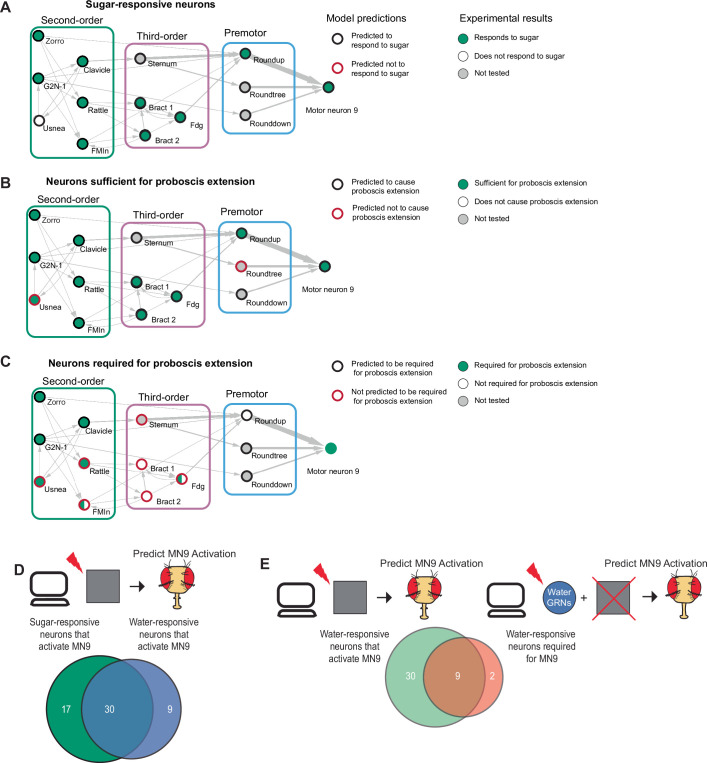
- For feeding initiation, the model predicted that activating sugar GRNs activates proboscis motor neurons including MN6, MN8, MN9, and MN11; in total, it identified 47 neurons predicted to be sugar-responsive and sufficient for feeding initiation, with 14 also predicted to be required for MN9 activity.
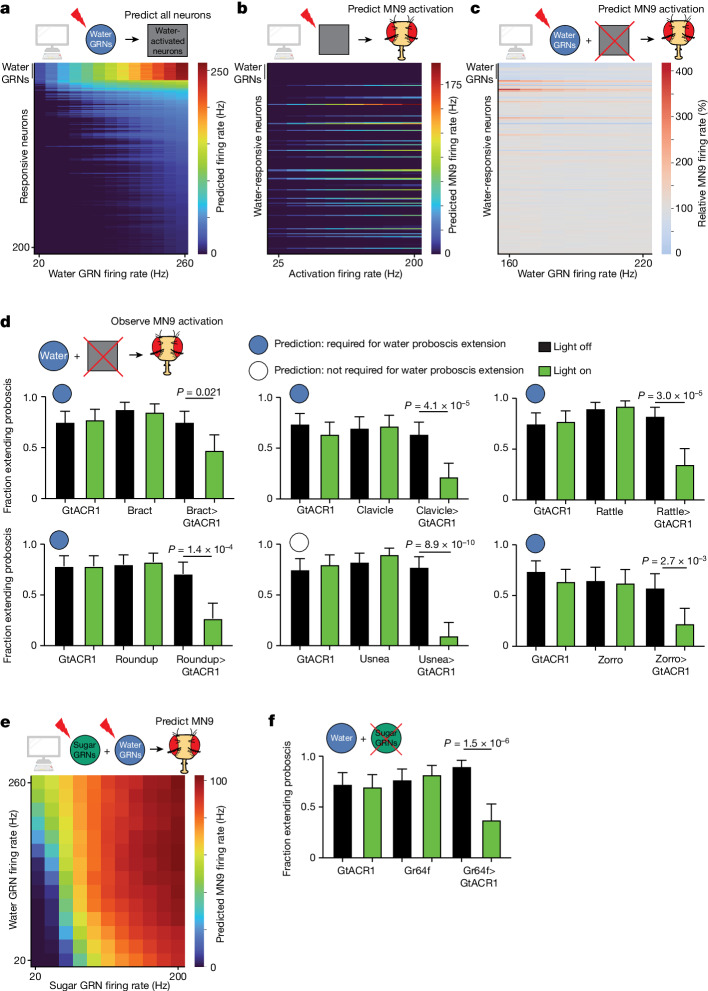
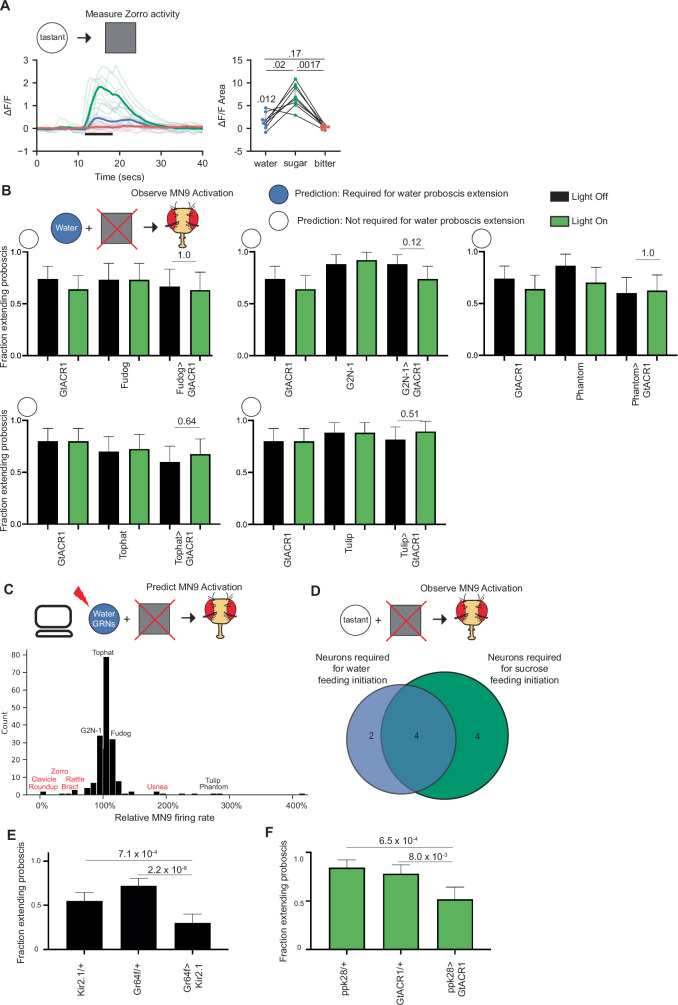
- In the water pathway, the model identified 39 water-responsive neurons sufficient for MN9 activation and 9 neurons predicted to be both necessary and sufficient for water feeding initiation; experiments confirmed water responses in Fudog and Zorro and showed 5 of 6 predicted water-silencing neurons decreased proboscis extension.
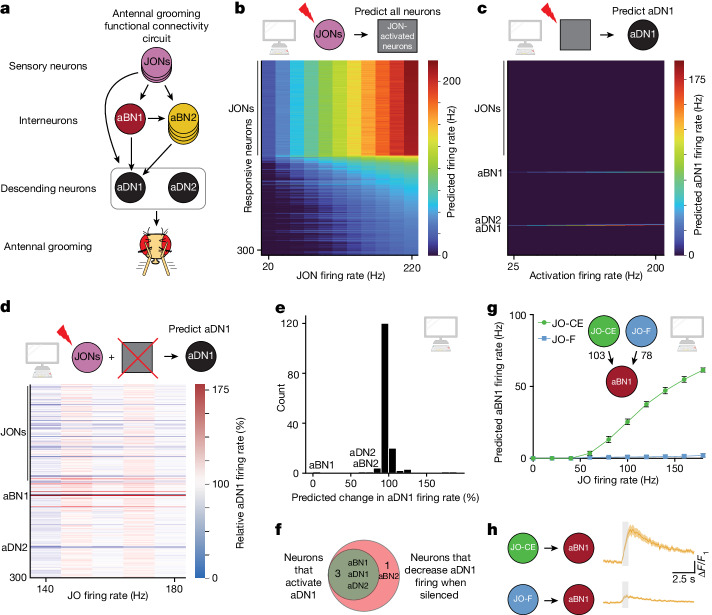
- For antennal grooming, the model identified aBN1, aBN2, aDN1, and aDN2 as JON-responsive; it predicted that JO-CE activates aBN1 robustly while JO-F does not, which was confirmed by calcium imaging.
## Methods
- Built a whole-brain leaky integrate-and-fire spiking model in Brian2 using FlyWire synaptic weights and neurotransmitter predictions, with Wsyn = 0.275 mV as the single free parameter; baseline firing was assumed to be 0 Hz.
- Simulated sensory input by driving specific neurons with Poisson-distributed firing and ran 30 simulations of 1,000 ms per experiment; for taste circuits, activation frequencies ranged from 10–200 Hz for sugar and 20–260 Hz for water.
- Validated predictions with optogenetics, silencing, calcium imaging, and behavioural PER assays in flies, including screens of SEZ split-GAL4 lines and experiments on taste and antennal grooming circuits.
## Limitations
- Stated by the paper: the model treats neurons as only excitatory or inhibitory, ignores neural morphology, receptor dynamics, gap junctions, neuropeptides, neuromodulation, and non-spiking neurons, and assumes basal firing of 0 Hz; therefore, absolute firing rates are unlikely to be accurate.
- Stated by the paper: the model may perform poorly in circuits with extensive basal inhibition or extensive neuromodulation/extrasynaptic signalling, and its accuracy is limited by the accuracy of the underlying synapse and neurotransmitter predictions.
- Evident from the text: many validations are based on a relatively small number of specifically chosen circuits and genetic lines, so the results may not generalize to all brain regions or behaviours.
Model-written summary. Check it against the paper before relying on it.
Integrity signals
Registry
Cites
Statistics
Figures


Verification
Claims the paper makes
42 Valid · 4 Not valid · 2 Not checked · 111 Own results and interpretations
At least one cited source doesn’t support this claim or points to a different paper, and none confirmed it — see the verdicts below.
In the paper
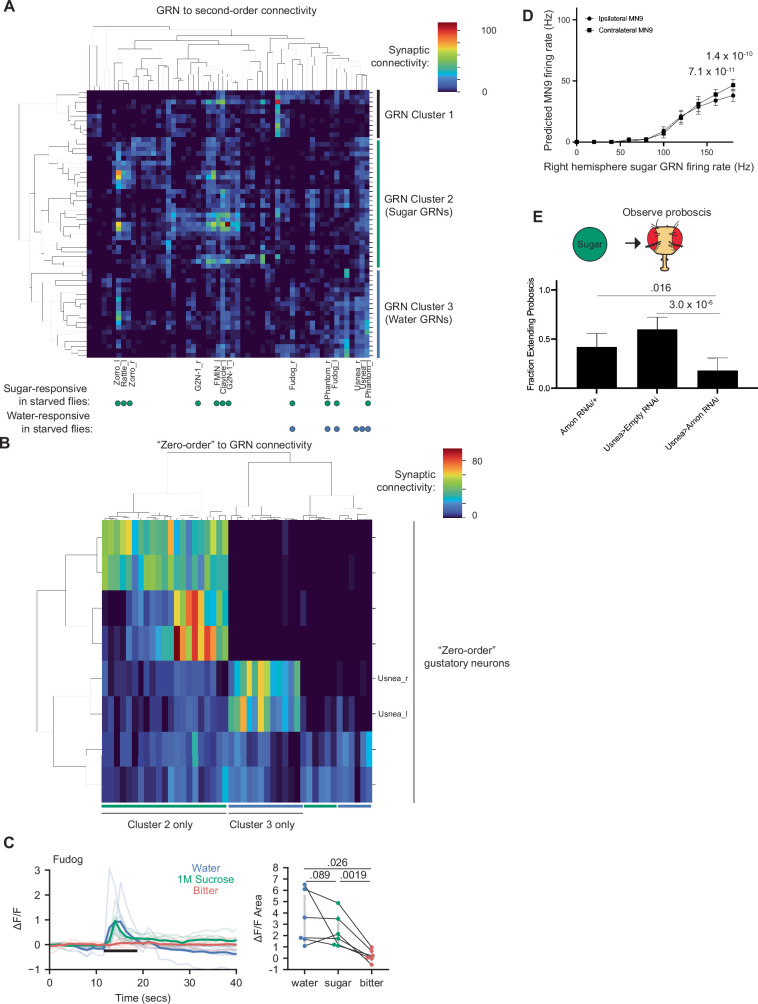
“Our calcium imaging experiments (Extended Data Figs. 1c and 3a) combined with previous experiments4 confirm that five neurons predicted to respond to sugar and water do respond to both sugar and water in vivo: Clavicle, Fudog, Phantom, Rattle and Zorro.”
§ A Drosophila computational brain model reveals sensorimotor processing > Main
What the sources say
- Disputedcites [4] Shiu, P. K., Sterne, G. R., Engert, S., Dickson, B. J. & Scott, K. Taste quality and hunger interactions in a feeding sensorimotor circuit. eLife 11, e79887 (2022). sourceExperimental — accuracy not yet measured
The Results section, “Feeding initiation neurons respond to sugar taste detection” (page unavailable), reports that Phantom responded to both water and sugar, but Clavicle did so only in a thirsty-like state. It says the other sugar-responsive neurons did not respond to water in food-deprived flies, contrary to the claim that all five named neurons were confirmed to respond to both. (LLM, conf=0.88)
Checked by a reasoning model — may be wrong.
plainstates an association- Asserted: passes — The authors put it forward as true.
- Checkable: passes — It can be checked against evidence.
- Load-bearing: passes — The paper’s conclusions depend on it.
- Based: passes — The paper gives a reason why it holds.
- Disputed
At least one cited source doesn’t support this claim or points to a different paper, and none confirmed it — see the verdicts below.
In the paper
“Thus, we conclude that cluster 2 corresponds to sugar GRNs, consistent with their previous assignment23, and cluster 3 corresponds to water GRNs.”
§ A Drosophila computational brain model reveals sensorimotor processing > Methods > Classification of GRNs Bitter and Ir94e GRNs were identified previously by their distinctive morphology23. Water and sugar GRNs were identified previously by morphology; to confirm these assignments and to incorporate new GRNs identified in Flywire, we performed hierarchical clustering using the connectivity of GRNs onto second-order neurons, using cosine distance as a measure of similarity70. This identified three broad clusters of GRNs (Extended Data Fig. 1a). We compared this clustering with the response properties of second-order neurons in starved flies, the nutritional state for which we have the most complete data4. Cluster 2 GRNs synapse onto, among others, G2N-1 and FMIN, which respond exclusively to sugar. Cluster 3 neurons synapse comparatively strongly onto Fudog and Phantom, which respond to both water and sugar in starved flies; cluster 3 neurons also synapse more strongly, on average, onto Usnea than cluster 2 neurons. Usnea responds exclusively to water. Thus, we conclude that cluster 2 corresponds to sugar GRNs, consistent with their previous assignment23, and cluster 3 corresponds to water GRNs. We speculate that cluster 1 GRNs are Ppk23-glut GRNs31 that may respond to salt; however, little is known about this pathway, making testing this hypothesis challenging. We also examined the connectivity of ‘zero-order’ gustatory neurons onto cluster 2 and 3 GRNs. This clustering corresponds strongly with the GRN to second-order clustering (Extended Data Fig. 1), verifying that these clusters reflect distinct taste modalities. As a conservative measure, we chose to examine only those sugar GRNs that fully correspond between the GRN to second-order clustering and the zero-order to GRN clustering. Recently, the FlyWire brain (FAFB) dataset (on the basis of which the Flywire dataset was prepared) was found to be left–right inverted1,2. In this paper, we refer to the true biological side. Thus, we note that ‘right hemisphere GRNs’ in this paper correspond to ‘left hemisphere GRNs’ described previously4,23.
What the sources say
- Disputedcites [23] Engert, S., Sterne, G. R., Bock, D. D. & Scott, K. Drosophila gustatory projections are segregated by taste modality and connectivity. eLife 11, e78110 (2022). sourceExperimental — accuracy not yet measured
The Results section (‘Different GRN classes can be identified by morphology and connectivity’) assigns group 2 to bitter GRNs, not sugar GRNs. It identifies group 4 as the hypothesized sugar-GRN group. The paper calls these clusters ‘groups,’ so its numbering does not support the cited assignment of cluster 2. (LLM, conf=0.88)
Checked by a reasoning model — may be wrong.
plainstates an association- Asserted: passes — The authors put it forward as true.
- Checkable: passes — It can be checked against evidence.
- Load-bearing: passes — The paper’s conclusions depend on it.
- Based: passes — The paper gives a reason why it holds.
- Disputed
At least one cited source doesn’t support this claim or points to a different paper, and none confirmed it — see the verdicts below.
In the paper
“Because GRN reconstructions on the left hemisphere are more complete23, probably due to challenges imaging and reconstructing neurons at the brain’s periphery, we performed unilateral left hemisphere activation for all simulations, except for Extended Data Fig. 1d.”
§ A Drosophila computational brain model reveals sensorimotor processing > Methods > Computational modelling of water and sugar GRN activity
What the sources say
- Disputedcites [23] Engert, S., Sterne, G. R., Bock, D. D. & Scott, K. Drosophila gustatory projections are segregated by taste modality and connectivity. eLife 11, e78110 (2022). sourceExperimental — accuracy not yet measured
The Introduction and Discussion report that 83–96% of expected GRNs were reconstructed on the right hemisphere, compared with 54–63% on the left. The Results section (“GRN axons contain presynaptic and postsynaptic sites”) also says EM-volume misalignments prevented identification of additional left-hemisphere GRNs. The source therefore says the right, not the left, is more complete. (LLM, conf=0.90)
Checked by a reasoning model — may be wrong.
hedged- Asserted: passes — The authors put it forward as true.
- Checkable: passes — It can be checked against evidence.
- Load-bearing: passes — The paper’s conclusions depend on it.
- Based: passes — The paper gives a reason why it holds.
- Disputed
At least one cited source doesn’t support this claim or points to a different paper, and none confirmed it — see the verdicts below.
In the paper
“Thus, we conclude that cluster 2 corresponds to sugar GRNs, consistent with their previous assignment23, and cluster 3 corresponds to water GRNs.”
§ A Drosophila computational brain model reveals sensorimotor processing > Methods > Classification of GRNs Bitter and Ir94e GRNs were identified previously by their distinctive morphology23. Water and sugar GRNs were identified previously by morphology; to confirm these assignments and to incorporate new GRNs identified in Flywire, we performed hierarchical clustering using the connectivity of GRNs onto second-order neurons, using cosine distance as a measure of similarity70. This identified three broad clusters of GRNs (Extended Data Fig. 1a). We compared this clustering with the response properties of second-order neurons in starved flies, the nutritional state for which we have the most complete data4. Cluster 2 GRNs synapse onto, among others, G2N-1 and FMIN, which respond exclusively to sugar. Cluster 3 neurons synapse comparatively strongly onto Fudog and Phantom, which respond to both water and sugar in starved flies; cluster 3 neurons also synapse more strongly, on average, onto Usnea than cluster 2 neurons. Usnea responds exclusively to water. Thus, we conclude that cluster 2 corresponds to sugar GRNs, consistent with their previous assignment23, and cluster 3 corresponds to water GRNs. We speculate that cluster 1 GRNs are Ppk23-glut GRNs31 that may respond to salt; however, little is known about this pathway, making testing this hypothesis challenging. We also examined the connectivity of ‘zero-order’ gustatory neurons onto cluster 2 and 3 GRNs. This clustering corresponds strongly with the GRN to second-order clustering (Extended Data Fig. 1), verifying that these clusters reflect distinct taste modalities. As a conservative measure, we chose to examine only those sugar GRNs that fully correspond between the GRN to second-order clustering and the zero-order to GRN clustering. Recently, the FlyWire brain (FAFB) dataset (on the basis of which the Flywire dataset was prepared) was found to be left–right inverted1,2. In this paper, we refer to the true biological side. Thus, we note that ‘right hemisphere GRNs’ in this paper correspond to ‘left hemisphere GRNs’ described previously4,23.
What the sources say
- Disputedcites [23] Engert, S., Sterne, G. R., Bock, D. D. & Scott, K. Drosophila gustatory projections are segregated by taste modality and connectivity. eLife 11, e78110 (2022). sourceExperimental — accuracy not yet measured
In Results (‘Different GRN classes can be identified by morphology and connectivity’), the source assigns group 3 to candidate low-salt GRNs, not water GRNs. It identifies group 6 as the best match for water GRNs. These are the source’s own group numbers; the passage does not establish how they relate to clusters numbered in the citing paper. (LLM, conf=0.88)
Checked by a reasoning model — may be wrong.
plainstates an association- Asserted: passes — The authors put it forward as true.
- Checkable: passes — It can be checked against evidence.
- Load-bearing: passes — The paper’s conclusions depend on it.
- Based: passes — The paper gives a reason why it holds.
- Disputed
Every source the paper cites for this claim was checked and supports it.
In the paper
“Here we create a leaky integrate-and-fire computational model of the entire Drosophila brain, on the basis of neural connectivity and neurotransmitter identity3, to study circuit properties of feeding and grooming behaviours.”
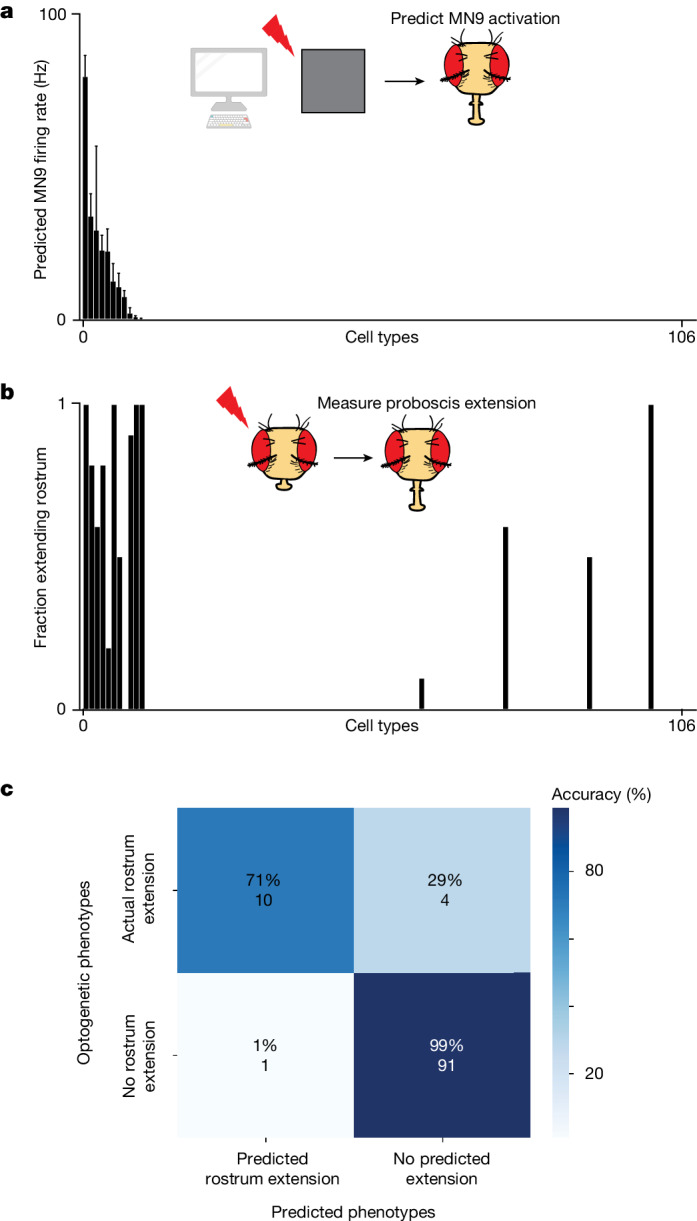
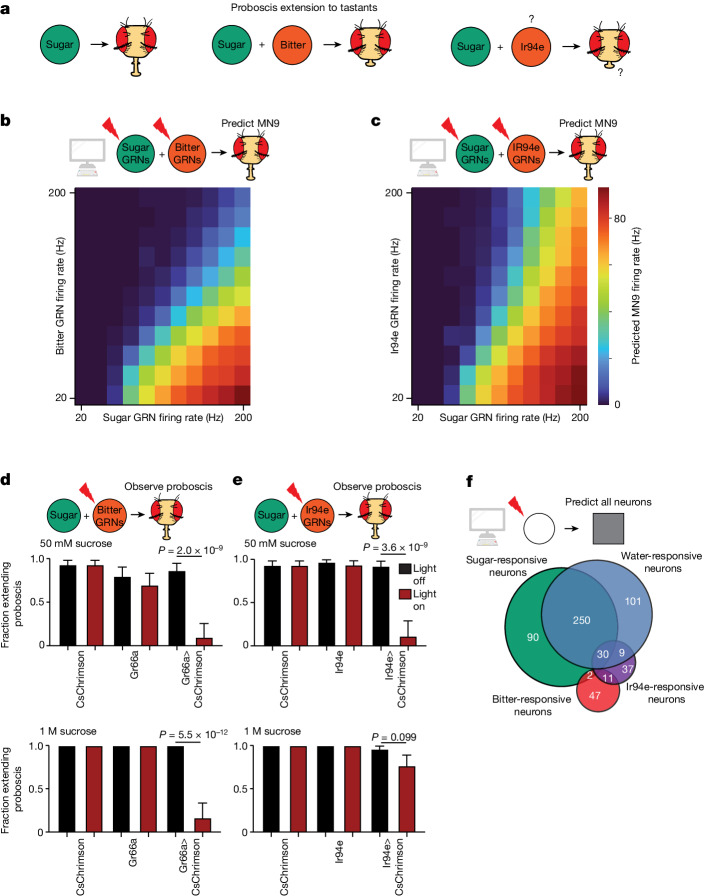
§ A Drosophila computational brain model reveals sensorimotor processing > Abstract The recent assembly of the adult Drosophila melanogaster central brain connectome, containing more than 125,000 neurons and 50 million synaptic connections, provides a template for examining sensory processing throughout the brain1,2. Here we create a leaky integrate-and-fire computational model of the entire Drosophila brain, on the basis of neural connectivity and neurotransmitter identity3, to study circuit properties of feeding and grooming behaviours. We show that activation of sugar-sensing or water-sensing gustatory neurons in the computational model accurately predicts neurons that respond to tastes and are required for feeding initiation4. In addition, using the model to activate neurons in the feeding region of the Drosophila brain predicts those that elicit motor neuron firing5—a testable hypothesis that we validate by optogenetic activation and behavioural studies. Activating different classes of gustatory neurons in the model makes accurate predictions of how several taste modalities interact, providing circuit-level insight into aversive and appetitive taste processing. Additionally, we applied this model to mechanosensory circuits and found that computational activation of mechanosensory neurons predicts activation of a small set of neurons comprising the antennal grooming circuit, and accurately describes the circuit response upon activation of different mechanosensory subtypes6–10. Our results demonstrate that modelling brain circuits using only synapse-level connectivity and predicted neurotransmitter identity generates experimentally testable hypotheses and can describe complete sensorimotor transformations.
What the sources say
- Supportedcites [3] Eckstein, N. et al. Neurotransmitter classification from electron microscopy images at synaptic sites in Drosophila melanogaster. Cell 187, 2574–2594.e23 (2024). source
The citation is attached to “neurotransmitter identity,” not to the citing authors’ statement that they created a leaky integrate-and-fire model. The source’s Abstract reports transmitter predictions across a Drosophila whole brain, and its Results (“An overview of neurotransmitter usage in the nervous system”) report neuron-level predictions for the FAFB-FlyWire dataset. (LLM, conf=0.93)
plain- Asserted: passes — The authors put it forward as true.
- Checkable: passes — It can be checked against evidence.
- Load-bearing: passes — The paper’s conclusions depend on it.
- Based: passes — The paper gives a reason why it holds.
- Supported
88 more claims · 16 with their cited sources checked
Create a free account to see all 159 claims and to verify the 2 references still open.
- It may state two separate claims as one. 51
- Probably not a substantial claim. 20
Claims other papers make about this one
Each is checked against this paper’s own text: does it say what the citing paper says it does?
The cited source says what the claim attributes to it.
In the citing paper
“Shiu et al.34 and Pospisil et al.39 use the connectome to model Drosophila brain dynamics and include connection weights (number of synapses) and putative connection signs (excitatory or inhibitory).”
From Neuronal wiring diagram of an adult brain (2024) · cites this paper as [34]
The cited source says what the claim attributes to it.
In the citing paper
“This effort has now been extended to leverage the full connectome34,39 and to—for example—predict taste responses of neurons34.”
From Neuronal wiring diagram of an adult brain (2024) · cites this paper as [34]
In the citing paper
“Here, using connectome-informed models7–9 and functional studies, we explain two fundamental mechanisms by which Drosophila implement context-appropriate halting.”
From Neural circuit mechanisms underlying context-specific halting in Drosophila (2024) · cites this paper as [7]
In the citing paper
“Notably, connectomics revealed that this halting pathway diverges from the previously described proboscis extension pathway7,41 (Fig. 5a).”
From Neural circuit mechanisms underlying context-specific halting in Drosophila (2024) · cites this paper as [7]
Citations
Cites
Fiji: an open-source platform for biological-image analysis
Schindelin, J., Arganda-Carreras, I., Frise, E., Kaynig, V., Longair, M., Pietzsch, T., Preibisch, S., Rueden, C., Saalfeld, S., Schmid, B., et al. (2012) · Nature Methods · doi:10.1038/nmeth.2019 · Cited by 66,890 · cited 2×
“First, in Fiji, z stacks for each timepoint were maximum intensity projected and then movement corrected using the StackReg plugin with ‘Rigid Body’ or ‘Translation’ transformation 79 .”
MethodUltrasensitive fluorescent proteins for imaging neuronal activity
Chen, T.-W., Wardill, T. J., Sun, Y., Pulver, S. R., Renninger, S. L., Baohan, A., Schreiter, E. R., Kerr, R. A., Orger, M. B., Jayaraman, V., et al. (2013) · Nature · doi:10.1038/nature12354 · Cited by 6,474
A pyramid approach to subpixel registration based on intensity
Thevenaz, P., Ruttimann, U. E., & Unser, M. (1998) · IEEE Transactions on Image Processing · doi:10.1109/83.650848 · Cited by 3,078
Independent optical excitation of distinct neural populations
Klapoetke, N. C., Murata, Y., Kim, S. S., Pulver, S. R., Birdsey-Benson, A., Cho, Y. K., Morimoto, T. K., Chuong, A. S., Carpenter, E. J., Tian, Z., et al. (2014) · Nature Methods · doi:10.1038/nmeth.2836 · Cited by 2,344 · cited 1×
“Experiments were performed as in the GtAcr1 experiments, except that flies were exposed to red light rather than green light 77 .”
MethodNeuronal Dynamics: From Single Neurons to Networks and Models of Cognition
Gerstner, W., Kistler, W. M., Naud, R., & Paninski, L. (2014) · doi:10.1017/cbo9781107447615 · Cited by 1,515 · cited 4×
“…that generate behaviour, we implement a simple leaky integrate-and-fire model using the connection weights derived from the entire adult Drosophila central brain connectome of reconstructed electron microscopy neurons 1,17–20 , as well as neurotransmitter predictions for each neuron 3,21 .”
MethodInfluentialA connectome and analysis of the adult Drosophila central brain
Scheffer, L. K., Xu, C. S., Januszewski, M., Lu, Z., Takemura, S.-Y., Hayworth, K. J., Huang, G. B., Shinomiya, K., Maitlin-Shepard, J., Berg, S., et al. (2020) · eLife · doi:10.7554/elife.57443 · Cited by 1,128 · cited 3×
“Two different approaches have been used thus far to analyze the recent Drosophila hemibrain and larval connectomes 13,16 .”
BackgroundMethodSelf-citationA Complete Electron Microscopy Volume of the Brain of Adult Drosophila melanogaster
Zheng, Z., Lauritzen, J. S., Perlman, E., Robinson, C. G., Nichols, M., Milkie, D., Torrens, O., Price, J., Fisher, C. B., Sharifi, N., et al. (2018) · Cell · doi:10.1016/j.cell.2018.06.019 · Cited by 1,050 · cited 3×
“We find that computational activation of labellar sugar-sensing GRNs activates several proboscis MNs involved in feeding, including MNs 6, 8, 9 and 11 (Fig.”
BackgroundSelf-citationThe organization of the chemosensory system in Drosophila melanogaster: a rewiew
Stocker, R. F. (1994) · Cell and Tissue Research · doi:10.1007/bf00305372 · Cited by 950 · cited 1×
“GRNs respond to specific taste categories, such as appetitive sugar or aversive bitter compounds, resulting in acceptance (that is, proboscis extension and feeding) or avoidance, respectively 24,33,35,38 .”
BackgroundNeuromodulation of neuronal circuits: back to the future
Marder, E. (2012) · Neuron · doi:10.1016/j.neuron.2012.09.010 · Cited by 904
Brian 2, an intuitive and efficient neural simulator
Stimberg, M., Brette, R., & Goodman, D. F. (2019) · eLife · doi:10.7554/elife.47314 · Cited by 749
A chemosensory gene family encoding candidate gustatory and olfactory receptors in Drosophila.
Scott, K., Brady, R., Cravchik, A., Morozov, P., Rzhetsky, A., Zuker, C., & Axel, R. (2001) · Cell · doi:10.1016/s0092-8674(01)00263-x · Cited by 720
Self-citationUnderstanding circuit dynamics using the stomatogastric nervous system of lobsters and crabs.
Marder, E., & Bucher, D. (2007) · Annual Review of Physiology · doi:10.1146/annurev.physiol.69.031905.161516 · Cited by 681 · cited 1×
“Moreover, studies of the connectomes of C. elegans and the crustacean stomato-gastric ganglion demonstrate that connectivity knowledge constrains, but does not dictate, a particular circuit mechanism 56–58 .”
BackgroundNeuronal wiring diagram of an adult brain
Dorkenwald, S., Matsliah, A., Sterling, A. R., Schlegel, P., Yu, S.-C., McKellar, C. E., Lin, A., Costa, M., Eichler, K., Yin, Y., et al. (2024) · Nature · doi:10.1038/s41586-024-07558-y · Cited by 570
Self-citationFrom the connectome to brain function
Bargmann, C. I., & Marder, E. (2013) · Nature Methods · doi:10.1038/nmeth.2451 · Cited by 561
Motor control in a Drosophila taste circuit
Gordon, M. D., & Scott, K. (2009) · Neuron · doi:10.1016/j.neuron.2008.12.033 · Cited by 531 · cited 4×
“In addition, extensive experimental analysis provides a ground truth for computational studies 4,5,23–32 .”
BackgroundMethodInfluentialSelf-citationBeyond the connectome: how neuromodulators shape neural circuits
Bargmann, C. I. (2012) · BioEssays · doi:10.1002/bies.201100185 · Cited by 505 · cited 1×
“Furthermore, the model does not account for gap junctions, non-spiking neurons, internal state or long-range neuropeptides, and assumes that the basal firing of each neuron is zero 51–55 .”
BackgroundA multilevel multimodal circuit enhances action selection in drosophila
Ohyama, T., Schneider-Mizell, C. M., Fetter, R. D., Aleman, J. V., Franconville, R., Rivera-Alba, M., Mensh, B. D., Branson, K. M., Simpson, J. H., Truman, J. W., et al. (2015) · Nature · doi:10.1038/nature14297 · Cited by 502
Self-citationGap junctions in the brain: where, what type, how many and why?
Dermietzel, R., & Spray, D. C. (1993) · Trends in Neurosciences · doi:10.1016/0166-2236(93)90151-b · Cited by 499
Taste Representations in the Drosophila Brain
Wang, Z., Singhvi, A., Kong, P., & Scott, K. (2004) · Cell · doi:10.1016/j.cell.2004.06.011 · Cited by 490
Self-citationTwo Gr Genes Underlie Sugar Reception in Drosophila
Dahanukar, A., Lei, Y.-T., Kwon, J. Y., & Carlson, J. R. (2007) · Neuron · doi:10.1016/j.neuron.2007.10.024 · Cited by 480 · cited 1×
“We chose W syn such that activation of sugar GRNs at 100 Hz resulted in roughly 80% of maximal MN9 firing 64,65 .”
MethodThe connectome of an insect brain
Winding, M., Pedigo, B. D., Barnes, C. L., Patsolic, H. G., Park, Y., Kazimiers, T., Fushiki, A., Andrade, I. V., Khandelwal, A., Valdes-Aleman, J., et al. (2023) · Science · doi:10.1126/science.add9330 · Cited by 435
Taste Perception and Coding in Drosophila
Thorne, N., Chromey, C., Bray, S., & Amrein, H. (2004) · Current Biology · doi:10.1016/j.cub.2004.05.019 · Cited by 419
Whole-brain annotation and multi-connectome cell typing of Drosophila
Schlegel, P., Yin, Y., Bates, A. S., Dorkenwald, S., Eichler, K., Brooks, P., Han, D. S., Gkantia, M., dos Santos, M., Munnelly, E. J., et al. (2024) · Nature · doi:10.1038/s41586-024-07686-5 · Cited by 413 · cited 5×
“Recently, the FlyWire brain (FAFB) dataset (on the basis of which the Flywire dataset was prepared) was found to be left–right inverted 1,2 .”
BackgroundMethodInfluentialThe neural basis of Drosophila gravity-sensing and hearing
Kamikouchi, A., Inagaki, H. K., Effertz, T., Hendrich, O., Fiala, A., Göpfert, M. C., & Ito, K. (2009) · Nature · doi:10.1038/nature07810 · Cited by 406
The connectome of the adult Drosophila mushroom body provides insights into function
Li, F., Lindsey, J. W., Marin, E. C., Otto, N., Dreher, M., Dempsey, G., Stark, I., Bates, A. S., Pleijzier, M. W., Schlegel, P., et al. (2020) · eLife · doi:10.7554/elife.62576 · Cited by 388 · cited 1×
“Water and sugar GRNs were identified previously by morphology; to confirm these assignments and to incorporate new GRNs identified in Flywire, we performed hierarchical clustering using the connectivity of GRNs onto second-order neurons, using cosine distance as a measure of similarity 70 .”
MethodRecent advances in neuropeptide signaling in Drosophila, from genes to physiology and behavior
Nässel, D. R., & Zandawala, M. (2019) · Progress in Neurobiology · doi:10.1016/j.pneurobio.2019.02.003 · Cited by 355
Inagaki, H. K., Ben-Tabou de-Leon, S., Wong, A. M., Jagadish, S., Ishimoto, H., Barnea, G., Kitamoto, T., Axel, R., & Anderson, D. J. (2012) · Cell · doi:10.1016/j.cell.2011.12.022 · Cited by 325 · cited 1×
“We chose W syn such that activation of sugar GRNs at 100 Hz resulted in roughly 80% of maximal MN9 firing 64,65 .”
MethodThe molecular basis for water taste in Drosophila
Cameron, P., Hiroi, M., Ngai, J., & Scott, K. (2010) · Nature · doi:10.1038/nature09011 · Cited by 306
Self-citationFunctional consequences of neuropeptide and small-molecule co-transmission
Nusbaum, M. P., Blitz, D. M., & Marder, E. (2017) · Nature Reviews Neuroscience · doi:10.1038/nrn.2017.56 · Cited by 302
Glutamate is an inhibitory neurotransmitter in the Drosophila olfactory system
Liu, W. W., & Wilson, R. I. (2013) · Proceedings of the National Academy of Sciences · doi:10.1073/pnas.1220560110 · Cited by 297 · cited 2×
“We assume GABAergic and glutamatergic neurons are inhibitory 66 , and that each neuron is either exclusively inhibitory or excitatory.”
BackgroundResultCosta, M., Manton, J. D., Ostrovsky, A. D., Prohaska, S., & Jefferis, G. S. X. E. (2016) · Neuron · doi:10.1016/j.neuron.2016.06.012 · Cited by 294
Self-citationFlyWire: online community for whole-brain connectomics
Dorkenwald, S., McKellar, C. E., Macrina, T., Kemnitz, N., Lee, K., Lu, R., Wu, J., Popovych, S., Mitchell, E., Nehoran, B., et al. (2022) · Nature Methods · doi:10.1038/s41592-021-01330-0 · Cited by 289 · cited 1×
“…that generate behaviour, we implement a simple leaky integrate-and-fire model using the connection weights derived from the entire adult Drosophila central brain connectome of reconstructed electron microscopy neurons 1,17–20 , as well as neurotransmitter predictions for each neuron 3,21 .”
MethodSelf-citationA Gr receptor is required for response to the sugar trehalose in taste neurons of Drosophila
Dahanukar, A., Foster, K., van der Goes van Naters, W. M., & Carlson, J. R. (2001) · Nature Neuroscience · doi:10.1038/nn765 · Cited by 286 · cited 1×
“GRNs respond to specific taste categories, such as appetitive sugar or aversive bitter compounds, resulting in acceptance (that is, proboscis extension and feeding) or avoidance, respectively 24,33,35,38 .”
BackgroundEckstein, N., Bates, A. S., Champion, A., Du, M., Yin, Y., Schlegel, P., Lu, A. K.-Y., Rymer, T., Finley-May, S., Paterson, T., et al. (2024) · Cell · doi:10.1016/j.cell.2024.03.016 · Cited by 277 · cited 6×
“Here we create a leaky integrate-and-fire computational model of the entire Drosophila brain, on the basis of neural connectivity and neurotransmitter identity 3 , to study circuit properties of feeding and grooming behaviours.”
BackgroundMethodInfluentialSelf-citationCircadian neuron feedback controls the Drosophila sleep–activity profile
Guo, F., Yu, J., Jung, H. J., Abruzzi, K. C., Luo, W., Griffith, L. C., & Rosbash, M. (2016) · Nature · doi:10.1038/nature19097 · Cited by 277 · cited 1×
“Although glutamate can be either excitatory or inhibitory in Droso phila , by default we assume that glutamate is inhibitory, consistent with previous experimental work and computational modelling 1,18,66,68,69 .”
ResultOptogenetic inhibition of behavior with anion channelrhodopsins
Mohammad, F., Stewart, J. C., Ott, S., Chlebikova, K., Chua, J. Y., Koh, T.-W., Ho, J., & Claridge-Chang, A. (2017) · Nature Methods · doi:10.1038/nmeth.4148 · Cited by 276 · cited 1×
“76).”
Dopaminergic modulation of sucrose acceptance behavior in Drosophila
Marella, S., Mann, K., & Scott, K. (2012) · Neuron · doi:10.1016/j.neuron.2011.12.032 · Cited by 240
Self-citationThe emergence and influence of internal states
Flavell, S. W., Gogolla, N., Lovett-Barron, M., & Zelikowsky, M. (2022) · Neuron · doi:10.1016/j.neuron.2022.04.030 · Cited by 234 · cited 1×
“Furthermore, the model does not account for gap junctions, non-spiking neurons, internal state or long-range neuropeptides, and assumes that the basal firing of each neuron is zero 51–55 .”
BackgroundGenetic Reagents for Making Split-GAL4 Lines in Drosophila
Dionne, H., Hibbard, K. L., Cavallaro, A., Kao, J.-C., & Rubin, G. M. (2018) · Genetics · doi:10.1534/genetics.118.300682 · Cited by 232 · cited 1×
“Identification of SEZ split-GAL4 neurons in the Flywire volume and computational activation A total of 106 out of 138 cell types of SEZ split-GAL4 library were identified in the Flywire volume 44,71 .”
MethodPeripheral coding of bitter taste in Drosophila
Meunier, N., Marion‐Poll, F., Rospars, J., & Tanimura, T. (2003) · Journal of Neurobiology · doi:10.1002/neu.10235 · Cited by 223 · cited 1×
“Bitter detection inhibits proboscis extension motor activity 45 (Fig.”
BackgroundGustatory Processing in Drosophila melanogaster
Scott, K. (2018) · Annual Review of Entomology · doi:10.1146/annurev-ento-020117-043331 · Cited by 215 · cited 5×
“GRNs respond to specific taste categories, such as appetitive sugar or aversive bitter compounds, resulting in acceptance (that is, proboscis extension and feeding) or avoidance, respectively 24,33,35,38 .”
BackgroundInfluentialSelf-citationInagaki, H. K., Panse, K. M., & Anderson, D. J. (2014) · Neuron · doi:10.1016/j.neuron.2014.09.032 · Cited by 214
Gap junctions in the nervous system
Rozental, R., Giaume, C., & Spray, D. C. (2000) · Brain Research Reviews · doi:10.1016/s0165-0173(99)00095-8 · Cited by 212
A suppression hierarchy among competing motor programs drives sequential grooming in Drosophila
Seeds, A. M., Ravbar, P., Chung, P., Hampel, S., Midgley, F. M., Mensh, B. D., & Simpson, J. H. (2014) · eLife · doi:10.7554/elife.02951 · Cited by 200
Self-citationComplete Connectomic Reconstruction of Olfactory Projection Neurons in the Fly Brain
Bates, A. S., Schlegel, P., Roberts, R. J. V., Drummond, N., Tamimi, I. F. M., Turnbull, R., Zhao, X., Marin, E. C., Popovici, P. D., Dhawan, S., et al. (2020) · Current Biology · doi:10.1016/j.cub.2020.06.042 · Cited by 198
Information flow, cell types and stereotypy in a full olfactory connectome
Schlegel, P., Bates, A. S., Stürner, T., Jagannathan, S. R., Drummond, N., Hsu, J., Serratosa Capdevila, L., Javier, A., Marin, E. C., Barth-Maron, A., et al. (2021) · eLife · doi:10.7554/elife.66018 · Cited by 178
Self-citationA neural command circuit for grooming movement control
Hampel, S., Franconville, R., Simpson, J. H., & Seeds, A. M. (2015) · eLife · doi:10.7554/elife.08758 · Cited by 177
Self-citationComplete Connectomic Reconstruction of Olfactory Projection Neurons in the Fly BrainPreprint
Bates, A. S., Schlegel, P., Roberts, R. J. V., et al. (2020) · bioRxiv · doi:10.1101/2020.01.19.911453 · Cited by 176 · cited 1×
“These .nrrd files were converted to .swc in natverse 72 , and uploaded to the Flywire gateway (https:// flywiregateway.pniapps.org/upload).”
MethodAutomatic detection of synaptic partners in a whole-brain Drosophila electron microscopy data set
Buhmann, J., Sheridan, A., Malin-Mayor, C., Schlegel, P., Gerhard, S., Kazimiers, T., Krause, R., Nguyen, T. M., Heinrich, L., Lee, W.-C. A., et al. (2021) · Nature Methods · doi:10.1038/s41592-021-01183-7 · Cited by 175 · cited 3×
“…are taken from previous D. melanogaster modelling or electrophysiology efforts 18,19 , from the synaptic weights from the Flywire connectome 1,21 and from the neurotransmitter predictions 3 , except for W syn —the single free parameter of the model, which corresponds to the magnitude of the…”
BackgroundMethodSelf-citationDolan, M.-J., Frechter, S., Bates, A. S., Dan, C., Huoviala, P., Roberts, R. J., Schlegel, P., Dhawan, S., Tabano, R., Dionne, H., et al. (2019) · eLife · doi:10.7554/elife.43079 · Cited by 169
Self-citationA complex peripheral code for salt taste in Drosophila
Jaeger, A. H., Stanley, M., Weiss, Z. F., Musso, P.-Y., Chan, R. C., Zhang, H., Feldman-Kiss, D., & Gordon, M. D. (2018) · eLife · doi:10.7554/elife.37167 · Cited by 157 · cited 3×
“Ir94e neurons respond to low salt concentrations and the presentation of male genitals, among other substances 31,38 , and are suggested to play a role in mediating attraction to low salt 31 .”
BackgroundSignal Propagation in Drosophila Central Neurons
Gouwens, N. W., & Wilson, R. I. (2009) · The Journal of Neuroscience · doi:10.1523/jneurosci.0764-09.2009 · Cited by 156
Coupled sensing of hunger and thirst signals balances sugar and water consumption
Jourjine, N., Mullaney, B. C., Mann, K., & Scott, K. (2016) · Cell · doi:10.1016/j.cell.2016.06.046 · Cited by 154
Self-citationNeural signal propagation atlas of Caenorhabditis elegans
Randi, F., Sharma, A. K., Dvali, S., & Leifer, A. M. (2023) · Nature · doi:10.1038/s41586-023-06683-4 · Cited by 153
Transforming representations of movement from body- to world-centric space
Lu, J., Behbahani, A. H., Hamburg, L., Westeinde, E. A., Dawson, P. M., Lyu, C., Maimon, G., Dickinson, M. H., Druckmann, S., & Wilson, R. I. (2022) · Nature · doi:10.1038/s41586-021-04191-x · Cited by 152
Chen, Z., Wang, Q., & Wang, Z. (2010) · The Journal of Neuroscience · doi:10.1523/jneurosci.0627-10.2010 · Cited by 146
A single pair of interneurons commands the Drosophila feeding motor program
Flood, T. F., Iguchi, S., Gorczyca, M., White, B., Ito, K., & Yoshihara, M. (2013) · Nature · doi:10.1038/nature12208 · Cited by 140 · cited 1×
“1d) hemisphere GRNs are activated, consistent with behavioural experiments showing that unilateral taste detection on the legs promotes proboscis extension that is curved and directed towards the food source 26,40 .”
BackgroundDrosophila sensory receptors—a set of molecular Swiss Army Knives
Montell, C. (2021) · Genetics · doi:10.1093/genetics/iyaa011 · Cited by 140 · cited 3×
“…model predicts a large network activated by sugar taste detection that includes known sugar-responsive MNs. Sugar taste detection influences activity in nutritive state and memory circuits, and modulates a broad range of behaviours, including feeding, oviposition and foraging 33,37,41 .”
BackgroundConnectome-constrained networks predict neural activity across the fly visual system
Lappalainen, J. K., Tschopp, F. D., Prakhya, S., McGill, M., Nern, A., Shinomiya, K., Takemura, S.-Y., Gruntman, E., Macke, J. H., & Turaga, S. C. (2024) · Nature · doi:10.1038/s41586-024-07939-3 · Cited by 128 · cited 2×
“15), and need a clearly defined behavioural task.”
BackgroundMarin, E. C., Büld, L., Theiss, M., Sarkissian, T., Roberts, R. J. V., Turnbull, R., Tamimi, I. F. M., Pleijzier, M. W., Laursen, W. J., Drummond, N., et al. (2020) · Current Biology · doi:10.1016/j.cub.2020.06.028 · Cited by 121
Self-citationCobalt filling of sensory projections from internal and external mouthparts in Drosophila
Stocker, R. F., & Schorderet, M. (1981) · Cell and Tissue Research · doi:10.1007/bf00238648 · Cited by 118
Heinrich, L., Funke, J., Pape, C., Nunez-Iglesias, J., & Saalfeld, S. (2018) · Lecture Notes in Computer Science · doi:10.1007/978-3-030-00934-2_36 · Cited by 117
Self-citationEckstein, N., Bates, A. S., Champion, A., Du, M., Yin, Y., Schlegel, P., Lu, A. K.-Y., Rymer, T., Finley-May, S., Paterson, T., et al. (2020) · doi:10.1101/2020.06.12.148775 · Cited by 115
Self-citationRepresentations of taste modality in the Drosophila brain
Harris, D. T., Kallman, B. R., Mullaney, B. C., & Scott, K. (2015) · Neuron · doi:10.1016/j.neuron.2015.05.026 · Cited by 111 · cited 2×
“In contrast, our model predicts central neurons that respond to both sugar and water taste activation, as well as sugar-specific and water-specific neurons, consistent with brainwide calcium imaging studies 29,46 .”
MethodResultSelf-citationDual Mechanism for Bitter Avoidance in Drosophila
French, A. S., Sellier, M.-J., Ali Agha, M., Guigue, A., Chabaud, M.-A., Reeb, P. D., Mitra, A., Grau, Y., Soustelle, L., & Marion-Poll, F. (2015) · The Journal of Neuroscience · doi:10.1523/jneurosci.1312-14.2015 · Cited by 105
Whole-brain annotation and multi-connectome cell typing quantifies circuit stereotypy in Drosophila
Schlegel, P., Yin, Y., Bates, A. S., Dorkenwald, S., Eichler, K., Brooks, P., Han, D. S., Gkantia, M., dos Santos, M., Munnelly, E. J., et al. (2023) · doi:10.1101/2023.06.27.546055 · Cited by 102
Self-citationPresynaptic gain control drives sweet and bitter taste integration in Drosophila
Chu, B., Chui, V., Mann, K., & Gordon, M. D. (2014) · Current Biology · doi:10.1016/j.cub.2014.07.020 · Cited by 100
Sterne, G. R., Otsuna, H., Dickson, B. J., & Scott, K. (2021) · eLife · doi:10.7554/elife.71679 · Cited by 93 · cited 3×
“Identification of SEZ split-GAL4 neurons in the Flywire volume and computational activation A total of 106 out of 138 cell types of SEZ split-GAL4 library were identified in the Flywire volume 44,71 .”
BackgroundMethodSelf-citationRing Attractor Dynamics Emerge from a Spiking Model of the Entire Protocerebral Bridge
Kakaria, K. S., & de Bivort, B. L. (2017) · Frontiers in Behavioral Neuroscience · doi:10.3389/fnbeh.2017.00008 · Cited by 89 · cited 7×
“All biophysical parameters are taken from previous D. melanogaster modelling or electrophysiology efforts 18,19 , from the synaptic weights from the Flywire connectome 1,21 and from the neurotransmitter predictions 3 , except for W syn —the single free parameter of the model, which corresponds to…”
MethodResultInfluentialThe head direction circuit of two insect species
Pisokas, I., Heinze, S., & Webb, B. (2020) · eLife · doi:10.7554/elife.53985 · Cited by 84
Miyazaki, T., & Ito, K. (2010) · Journal of Comparative Neurology · doi:10.1002/cne.22433 · Cited by 83
Generating parallel representations of position and identity in the olfactory system
Taisz, I., Donà, E., Münch, D., Bailey, S. N., Morris, B. J., Meechan, K. I., Stevens, K. M., Varela-Martínez, I., Gkantia, M., Schlegel, P., et al. (2023) · Cell · doi:10.1016/j.cell.2023.04.038 · Cited by 79
Self-citationSimultaneous activation of parallel sensory pathways promotes a grooming sequence in Drosophila
Hampel, S., McKellar, C. E., Simpson, J. H., & Seeds, A. M. (2017) · eLife · doi:10.7554/elife.28804 · Cited by 70
Self-citationFlyWire: Online community for whole-brain connectomicsPreprint
Dorkenwald, S., McKellar, C. E., Macrina, T., et al. (2020) · bioRxiv (Cold Spring Harbor Laboratory) · doi:10.1101/2020.08.30.274225 · Cited by 70
Motor neurons controlling fluid ingestion in Drosophila
Manzo, A., Silies, M., Gohl, D. M., & Scott, K. (2012) · Proceedings of the National Academy of Sciences · doi:10.1073/pnas.1120305109 · Cited by 69 · cited 2×
“1d and Supplementary Table 1) 39 .”
Self-citationThe neuronal logic of how internal states control food choice
Münch, D., Goldschmidt, D., & Ribeiro, C. (2022) · Nature · doi:10.1038/s41586-022-04909-5 · Cited by 68 · cited 1×
“In contrast, our model predicts central neurons that respond to both sugar and water taste activation, as well as sugar-specific and water-specific neurons, consistent with brainwide calcium imaging studies 29,46 .”
ResultDevineni, A. V., Sun, B., Zhukovskaya, A., & Axel, R. (2019) · eLife · doi:10.7554/elife.47677 · Cited by 68
A Pair of Interneurons Influences the Choice between Feeding and Locomotion in Drosophila
Mann, K., Gordon, M. D., & Scott, K. (2013) · Neuron · doi:10.1016/j.neuron.2013.06.018 · Cited by 66 · cited 1×
“PER was scored as previously described 4,74 .”
Self-citationMotor control of Drosophila feeding behavior
Schwarz, O., Bohra, A. A., Liu, X., Reichert, H., VijayRaghavan, K., & Pielage, J. (2017) · eLife · doi:10.7554/elife.19892 · Cited by 62
Neural network organization for courtship-song feature detection in Drosophila
Baker, C. A., McKellar, C., Pang, R., Nern, A., Dorkenwald, S., Pacheco, D. A., Eckstein, N., Funke, J., Dickson, B. J., & Murthy, M. (2022) · Current Biology · doi:10.1016/j.cub.2022.06.019 · Cited by 57
Self-citationTaste quality and hunger interactions in a feeding sensorimotor circuit
Shiu, P. K., Sterne, G. R., Engert, S., Dickson, B. J., & Scott, K. (2022) · eLife · doi:10.7554/elife.79887 · Cited by 56
Self-citationMapping model units to visual neurons reveals population code for social behaviour
Cowley, B. R., Calhoun, A. J., Rangarajan, N., Ireland, E., Turner, M. H., Pillow, J. W., & Murthy, M. (2024) · Nature · doi:10.1038/s41586-024-07451-8 · Cited by 55 · cited 1×
“A second approach is to train a deep neural network to perform a task, and measure how neurons in that model compare with actual neurons in the brain 15,48 .”
BackgroundNeural circuit mechanisms underlying context-specific halting in Drosophila
Sapkal, N., Mancini, N., Kumar, D. S., Spiller, N., Murakami, K., Vitelli, G., Bargeron, B., Maier, K., Eichler, K., Jefferis, G. S. X. E., et al. (2024) · Nature · doi:10.1038/s41586-024-07854-7 · Cited by 54 · cited 1×
“For example, by activating neurons involved in locomotion simultaneously with sugar-sensing neurons, which are known to inhibit locomotion, Sapkal et al. use our computational model to correctly identify neurons that regulate walking, thereby identifying circuits involved in foraging 49 .”
BackgroundSelf-citationNeural circuit mechanisms underlying context-specific halting in Drosophila
Sapkal, N., Mancini, N., Kumar, D. S., Spiller, N., Murakami, K., Vitelli, G., Bargeron, B., Maier, K., Eichler, K., Jefferis, G. S. X. E., et al. (2023) · doi:10.1101/2023.09.25.559438 · Cited by 54
Self-citationOf what use is connectomics? A personal perspective on the Drosophila connectome
Meinertzhagen, I. A. (2018) · Journal of Experimental Biology · doi:10.1242/jeb.164954 · Cited by 53
Paul, M. M., Pauli, M., Ehmann, N., Hallermann, S., Sauer, M., Kittel, R. J., & Heckmann, M. (2015) · Frontiers in Cellular Neuroscience · doi:10.3389/fncel.2015.00029 · Cited by 52 · cited 1×
“All parameters are taken from previous Drosophila modelling or electrophysiology efforts 18,19,61,62 , from the synaptic weights from the Flywire connectome (public materialization v.630) 18,19 , or from the neurotransmitter predictions 3,63 , except for W syn , the single free parameter of the…”
MethodSpatial Comparisons of Mechanosensory Information Govern the Grooming Sequence in Drosophila
Zhang, N., Guo, L., & Simpson, J. H. (2020) · Current Biology · doi:10.1016/j.cub.2020.01.045 · Cited by 50 · cited 3×
“…this model to mechanosensory circuits and found that computational activation of mechanosensory neurons predicts activation of a small set of neurons comprising the antennal grooming circuit, and accurately describes the circuit response upon activation of different mechanosensory subtypes 6–10 .”
BackgroundMethodInfluentialRhea, J. M., Wegener, C., & Bender, M. (2010) · PLoS Genetics · doi:10.1371/journal.pgen.1000967 · Cited by 48 · cited 1×
“To test this, we performed cell-specific knockdown of the gene Amontillado —a prohormone convertase required for neuropeptide processing in Drosophila 42,43 .”
MethodControlling motor neurons of every muscle for fly proboscis reaching
McKellar, C. E., Siwanowicz, I., Dickson, B. J., & Simpson, J. H. (2020) · eLife · doi:10.7554/elife.54978 · Cited by 44 · cited 9×
“In addition, extensive experimental analysis provides a ground truth for computational studies 4,5,23–32 .”
BackgroundMethodInfluentialSelf-citationRayburn, L. Y. M., Gooding, H. C., Choksi, S. P., Maloney, D., Kidd, A. R., Siekhaus, D. E., & Bender, M. (2003) · Genetics · doi:10.1093/genetics/163.1.227 · Cited by 43
Drosophila gustatory projections are segregated by taste modality and connectivity
Engert, S., Sterne, G. R., Bock, D. D., & Scott, K. (2022) · eLife · doi:10.7554/elife.78110 · Cited by 38 · cited 17×
“In addition, extensive experimental analysis provides a ground truth for computational studies 4,5,23–32 .”
BackgroundMethodInfluentialSelf-citationDrosophila gustatory projections are segregated by taste modality and connectivity
Engert, S., Sterne, G. R., Bock, D. D., & Scott, K. (2021) · bioRxiv (Cold Spring Harbor Laboratory) · doi:10.1101/2021.12.08.471796 · Cited by 38
Self-citationA Single-Cell Level and Connectome-Derived Computational Model of the Drosophila Brain
Huang, Y.-C., Wang, C.-T., Su, T.-S., Kao, K.-W., Lin, Y.-J., Chuang, C.-C., Chiang, A., & Lo, C. (2019) · Frontiers in Neuroinformatics · doi:10.3389/fninf.2018.00099 · Cited by 36
Hampel, S., Eichler, K., Yamada, D., Bock, D. D., Kamikouchi, A., & Seeds, A. M. (2020) · eLife · doi:10.7554/elife.59976 · Cited by 35
Self-citationMiyazaki, T., Lin, T.-Y., Ito, K., Lee, C.-H., & Stopfer, M. (2015) · Journal of Neurogenetics · doi:10.3109/01677063.2015.1054993 · Cited by 34
Lappalainen, J. K., Tschopp, F. D., Prakhya, S., McGill, M., Nern, A., Shinomiya, K., Takemura, S.-Y., Gruntman, E., Macke, J. H., & Turaga, S. C. (2023) · doi:10.1101/2023.03.11.532232 · Cited by 31
Hartenstein, V., Omoto, J. J., Ngo, K. T., Wong, D., Kuert, P. A., Reichert, H., Lovick, J. K., & Younossi‐Hartenstein, A. (2018) · Journal of Comparative Neurology · doi:10.1002/cne.24287 · Cited by 31
A connectome is not enough – what is still needed to understand the brain of Drosophila?
Scheffer, L. K., & Meinertzhagen, I. A. (2021) · Journal of Experimental Biology · doi:10.1242/jeb.242740 · Cited by 27
A neuromorphic model of olfactory processing and sparse coding in the Drosophila larva brain
Jürgensen, A.-M., Khalili, A., Chicca, E., Indiveri, G., & Nawrot, M. P. (2021) · Neuromorphic Computing and Engineering · doi:10.1088/2634-4386/ac3ba6 · Cited by 23 · cited 2×
“We implement a leaky integrate-and-fire model as previously described 18,19,59–61 with α-synapse dynamics, using the following three differential equations and parameters: W syn = 0.275 mV (free parameter; synaptic weight, that is, how much each synapse influences downstream membrane potential); g…”
MethodInfluentialA neural correlate of individual odor preference in Drosophila
Churgin, M. A., Lavrentovich, D. O., Smith, M. A., Gao, R., Boyden, E. S., & de Bivort, B. L. (2025) · eLife · doi:10.7554/elife.90511 · Cited by 23
Lazar, A. A., Liu, T., Turkcan, M. K., & Zhou, Y. (2021) · eLife · doi:10.7554/elife.62362 · Cited by 21 · cited 2×
“We implement a leaky integrate-and-fire model as previously described 18,19,59–61 with α-synapse dynamics, using the following three differential equations and parameters: W syn = 0.275 mV (free parameter; synaptic weight, that is, how much each synapse influences downstream membrane potential); g…”
MethodInfluentialAutomatic Detection of Synaptic Partners in a Whole-Brain Drosophila EM Dataset
Buhmann, J., Sheridan, A., Gerhard, S., Krause, R., Nguyen, T., Heinrich, L., Schlegel, P., Lee, W.-C. A., Wilson, R., Saalfeld, S., et al. (2019) · doi:10.1101/2019.12.12.874172 · Cited by 21
Self-citationYetman, S., & Pollack, G. S. (1987) · Journal of Comparative Physiology A · doi:10.1007/bf00613026 · Cited by 20 · cited 1×
“1d) hemisphere GRNs are activated, consistent with behavioural experiments showing that unilateral taste detection on the legs promotes proboscis extension that is curved and directed towards the food source 26,40 .”
BackgroundGenerating Parallel Representations of Position and Identity in the Olfactory SystemPreprint
Taisz, I., Doná, E., Münch, D., et al. (2022) · SSRN Electronic Journal · doi:10.2139/ssrn.4129429 · Cited by 7
Research works printed but not linked: 1
- Dethier, V. G. The Hungry Fly: a Physiological Study of the Behavior Associated With Feeding (Harvard Univ. Press, 1976).
Cited by
Neuronal wiring diagram of an adult brain
Dorkenwald, S., Matsliah, A., Sterling, A. R., Schlegel, P., Yu, S.-C., McKellar, C. E., Lin, A., Costa, M., Eichler, K., Yin, Y., et al. (2024) · Nature · doi:10.1038/s41586-024-07558-y · Cited by 570
“Also included are neurons that extend into the brain through the nerves and neck connective, which are essential for tracing sensorimotor pathways, as illustrated here and in the accompanying studies 11,12,34,36–45 .”
BackgroundInfluentialSelf-citationWhole-brain annotation and multi-connectome cell typing of Drosophila
Schlegel, P., Yin, Y., Bates, A. S., Dorkenwald, S., Eichler, K., Brooks, P., Han, D. S., Gkantia, M., dos Santos, M., Munnelly, E. J., et al. (2024) · Nature · doi:10.1038/s41586-024-07686-5 · Cited by 413
“It will also make numerous network analyses possible as well as substantially reduce the degrees of freedom in brain scale modelling 65,66 .”
BackgroundNeuronal wiring diagram of an adult brain
Dorkenwald, S., Matsliah, A., Sterling, A. R., Schlegel, P., Yu, S.-C., McKellar, C. E., Lin, A., Costa, M., Eichler, K., Yin, Y., et al. (2023) · doi:10.1101/2023.06.27.546656 · Cited by 149
Self-citationConnectome-constrained networks predict neural activity across the fly visual system
Lappalainen, J. K., Tschopp, F. D., Prakhya, S., McGill, M., Nern, A., Shinomiya, K., Takemura, S.-Y., Gruntman, E., Macke, J. H., & Turaga, S. C. (2024) · Nature · doi:10.1038/s41586-024-07939-3 · Cited by 128
Whole-brain annotation and multi-connectome cell typing quantifies circuit stereotypy in Drosophila
Schlegel, P., Yin, Y., Bates, A. S., Dorkenwald, S., Eichler, K., Brooks, P., Han, D. S., Gkantia, M., dos Santos, M., Munnelly, E. J., et al. (2023) · doi:10.1101/2023.06.27.546055 · Cited by 102
Self-citation
Metadata
- Authors
- Shiu, P. K., Sterne, G. R., Spiller, N., Franconville, R., Sandoval, A., Zhou, J., Simha, N., Kang, C. H., Yu, S., Kim, J. S., Dorkenwald, S., Matsliah, A., Schlegel, P., Yu, S.-C., McKellar, C. E., Sterling, A., Costa, M., Eichler, K., Bates, A. S., Eckstein, N., Funke, J., Jefferis, G. S. X. E., Murthy, M., Bidaye, S. S., Hampel, S., Seeds, A. M., & Scott, K.
- Affiliations
- University of California, Berkeley (US)
- University of Rochester Medicine (US)
- Max Planck Florida Institute for Neuroscience (US)
- Howard Hughes Medical Institute (US)
- Sungkyunkwan University (KR)
- Princeton University (US)
- MRC Laboratory of Molecular Biology (GB)
- University of Cambridge (GB)
- University of Puerto Rico, Medical Sciences Campus (PR)
- Corresponding author
- Shiu, Philip K.
- ORCID
- Shiu, Philip K.
- Sterne, Gabriella R.
- Spiller, Nico
- Franconville, Romain
- Sandoval, Andrea
- Simha, Neha
- Yu, Seongbong
- Kim, Jinseop S.
- Dorkenwald, Sven
- Matsliah, Arie
- Schlegel, Philipp
- Yu, Szi-chieh
- McKellar, Claire E.
- Sterling, Amy
- Costa, Marta
- Eichler, Katharina
- Bates, Alexander Shakeel
- Eckstein, Nils
- Funke, Jan
- Jefferis, Gregory S. X. E.
- Murthy, Mala
- Bidaye, Salil S.
- Hampel, Stefanie
- Seeds, Andrew M.
- Scott, Kristin
- Venue
- Nature
- Published
- 2024-10-02
- Volume
- 634
- Issue
- 8032
- Pages
- 210-219
- ISSN
- 0028-0836 (ISSN-L)
- 1476-4687
- PMC
- PMC11446845
- OpenAlex
- W4403062868
- Semantic Scholar
- 1c747c588fa46133a6e0146d1eeb81c5be67150a
- Cited by
- 97
- References
- 84
- Citations by year
- 2026: 39 · 2025: 35 · 2024: 20
- FWCI
- 16.38
- Type
- journal article
- Language
- en
- Open access
- hybrid
- doi.org
- Licence
- cc-by
- creativecommons.org/licenses/by/4.0 (tdm)
- creativecommons.org/licenses/by/4.0 (vor)
- Locations
- Nature (publishedVersion, cc-by)
- bioRxiv (Cold Spring Harbor Laboratory) (acceptedVersion, cc-by-nc-nd)
- PubMed Central (publishedVersion, cc-by)
- PubMed (publishedVersion)
- PubMed Central (submittedVersion, cc-by-nc-nd)
- Apollo (University of Cambridge) (submittedVersion, cc-by)
- RePEc: Research Papers in Economics (submittedVersion)
- Funders
- National Science Foundation (2014862)
- Wellcome Trust (220343/Z/20/Z, 203261/Z/16/Z)
- National Institutes of Health (1rf1ns121911-01)
- National Institute of Mental Health (RF1MH117815, RF1MH129268, RF1MH120679)
- National Institute on Deafness and Other Communication Disorders (F32DC018225, R01DC013280)
- National Institute of Diabetes and Digestive and Kidney Diseases (F32DK117671)
- National Institute of Neurological Disorders and Stroke (RF1 NS121911, U24NS126935, R01NS121911, R35NS111580)
- Topics
- Life Sciences › Neuroscience › Cellular and Molecular Neuroscience › Neurobiology and Insect Physiology Research
- Life Sciences › Neuroscience › Cognitive Neuroscience › Neural dynamics and brain function
- Life Sciences › Neuroscience › Cellular and Molecular Neuroscience › Neuroscience and Neuropharmacology Research
- Keywords
- Drosophila melanogaster, computational models of the brain, leaky integrate-and-fire neurons, brain connectome, sensorimotor processing, gustatory neurons, taste processing, feeding behaviour, grooming, mechanosensory neurons, neurotransmitter identity
About these checks
Registry, retraction, Cites and statistics results are computed, not judged, with one exception: a printed reference that no index lists is read once by a model before it counts as a citation error. Claims are extracted by a model and kept only when their quote appears verbatim in the text; each cited source is then checked, with a model’s help, for whether it says what the claim relies on. Those verdicts can be wrong — read the claim’s quote and the cited source before relying on one.
The claim verdicts this report counts are experimental: their accuracy is not yet measured.
A language model drew the claims from the paper on 2026-10-10, under version 3 of the claim definition (model deepseek-v4.1-flash, prompt extract-v3).
A second model labelled each claim on 2026-10-10 (model jev-1.13-20260917, definition revision gold-guideline-v0.2).
Cited sources are checked with a language model’s help (gpt-6-sol).
Statistics and arithmetic are recomputed, not judged.
Confidence bands are shown only for fields calibrated on our annotated test set. None is calibrated yet, so no band is shown.
What counts as a claim ›How we measure confidence ›How we check this ›
Are you an author, or do you see a problem with this page? Request a review
Data sources
Bibliographic data: Semantic Scholar, OpenAlex, Crossref.
Contains information from the Semantic Scholar Academic Graph Datasets, made available under the ODC Attribution License (ODC-BY 1.0).
Semantic Scholar’s data is described in: Kinney, R., et al. (2023). The Semantic Scholar Open Data Platform. arXiv:2301.10140.
