

Quantum error correction below the surface code threshold
Open accessThe DOI matches its Crossref record; 72 of the 73 references it cites were found in a registry or an index; 30 of the 38 sources its claims cite were checked for support.
Abstract
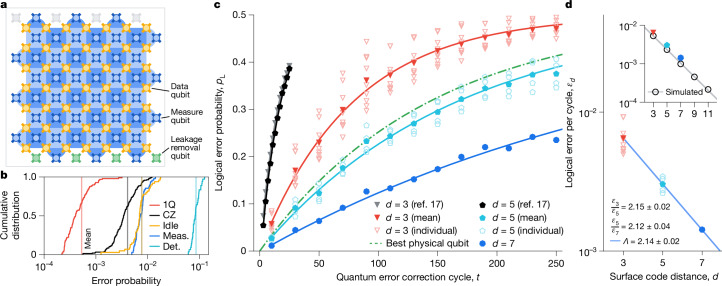
Quantum error correction [1, 2, 3, 4] provides a path to reach practical quantum computing by combining multiple physical qubits into a logical qubit, where the logical error rate is suppressed exponentially as more qubits are added. However, this exponential suppression only occurs if the physical error rate is below a critical threshold. Here, we present two below-threshold surface code memories on our newest generation of superconducting processors, Willow: a distance-7 code, and a distance-5 code integrated with a real-time decoder. The logical error rate of our larger quantum memory is suppressed by a factor of $$\varLambda \mathrm{=2.14}\pm 0.02$$ when increasing the code distance by two, culminating in a 101-qubit distance-7 code with 0.143% ± 0.003% error per cycle of error correction. This logical memory is also beyond break-even, exceeding its best physical qubit’s lifetime by a factor of $$2.4\pm 0.3$$ . Our system maintains below-threshold performance when decoding in real time, achieving an average decoder latency of 63 μs at distance-5 up to a million cycles, with a cycle time of 1.1 μs. We also run repetition codes up to distance-29 and find that logical performance is limited by rare correlated error events occurring approximately once every hour, or $$3$$ $$\times $$ $${10}^{9}$$ cycles. Our results present device performance that, if scaled, could realize the operational requirements of large scale fault-tolerant quantum algorithms.
Overview
CoChat Summary
TL;DR
Google Quantum AI reports below-threshold surface code memories on superconducting Willow processors, including a distance-7 code with logical error suppressed by Λ = 2.14 ± 0.02 per distance increase of 2.
The distance-7 logical qubit exceeds its best physical qubit lifetime by a factor of 2.4 ± 0.3, and real-time decoding at distance 5 maintains below-threshold performance with 63 ± 17 μs average latency.
Key findings
- A distance-7 surface code memory achieved ε7 = (1.43 ± 0.03) × 10−3 logical error per cycle with a neural-network decoder, giving Λ = 2.14 ± 0.02; with ensembled matching synthesis, Λ = 2.04 ± 0.02 and ε7 = (1.71 ± 0.03) × 10−3.
- The distance-7 logical qubit lifetime was 291 ± 6 μs, exceeding its best constituent physical qubit lifetime (119 ± 13 μs) by a factor of 2.4 ± 0.3.
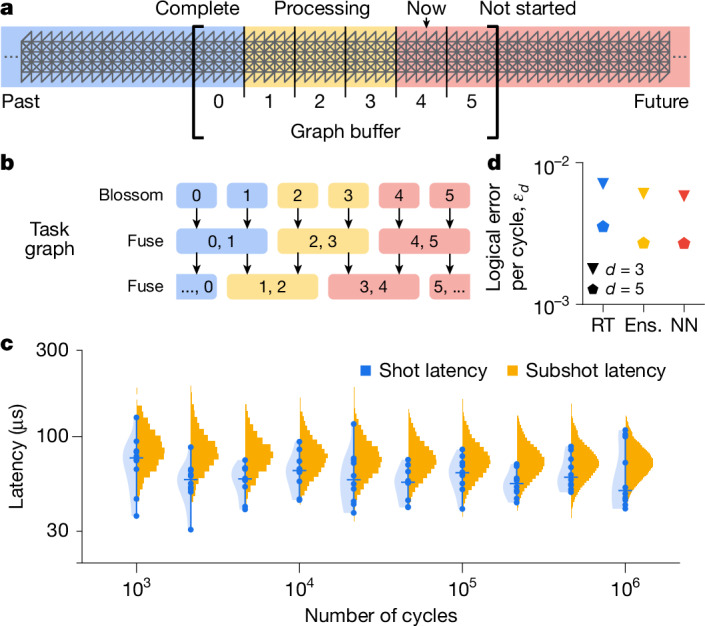
- Real-time decoding at distance 5 achieved ε5 = 0.35% ± 0.01% and Λ = 2.0 ± 0.1, with average decoder latency 63 ± 17 μs up to 106 cycles and a 1.1 μs cycle time; offline neural-network decoding gave ε5 = 0.269% ± 0.008% and Λ = 2.18 ± 0.09.
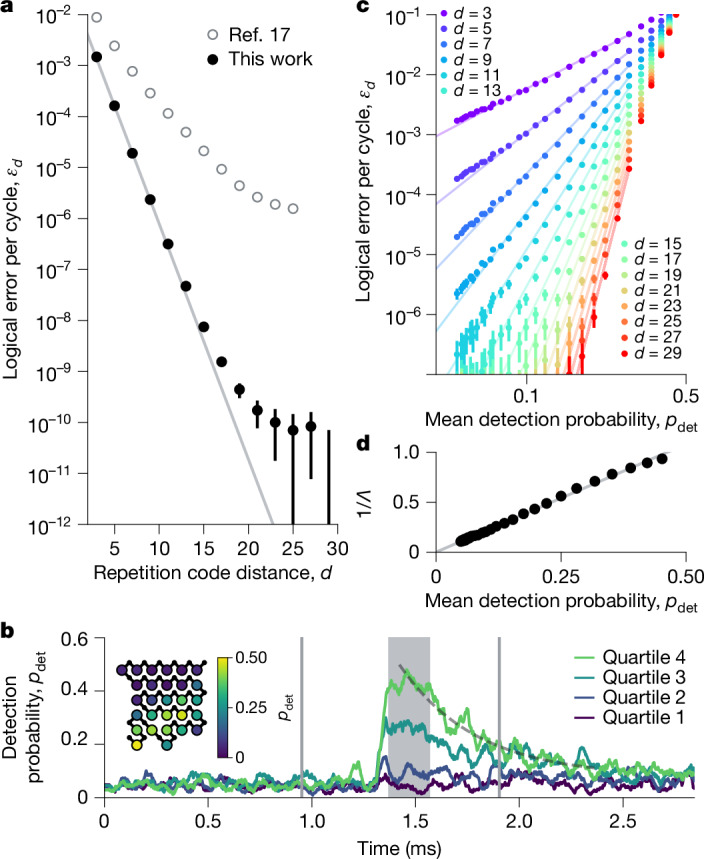
- Repetition codes up to distance 29 gave Λ = 8.4 ± 0.1 between d = 5 and d = 11, but a logical error floor of 10−10 appeared at d ≥ 15, attributed to rare correlated error bursts occurring approximately once per hour or 3 × 10⁹ cycles; six large bursts occurred over 2 × 10¹⁰ cycles.
Methods
- Experiments used superconducting transmon Willow processors: a 105-qubit processor for the distance-7 surface code (49 data qubits, 48 measure qubits, 4 leakage-removal qubits) and a 72-qubit processor for distance-5 real-time decoding and repetition codes; mean coherence times were T1 = 68 μs and T2,CPMG = 89 μs.
- Surface code memory operation prepared a logical eigenstate, repeated syndrome extraction cycles with data-qubit leakage removal, measured individual data qubits, and fit logical error per cycle up to 250 cycles; Λ was computed by linear regression of ln[εd] versus d, averaging nine distance-3 and four distance-5 subgrids.
- Decoding used a neural-network decoder and a harmonized ensemble of correlated minimum-weight perfect matching decoders with matching synthesis; real-time decoding used sparse blossom with a constant-sized graph buffer. Repetition-code experiments used 2 × 10⁷ shots of a distance-29 code with 1,000 cycles, totaling 2 × 10¹⁰ cycles and 5.5 h of processor execution.
Limitations
- Paper-stated: scaling to algorithmically relevant error rates is resource intensive; extrapolation suggests a 10−6 error rate would require a distance-27 logical qubit using 1,457 physical qubits, and real-time decoding challenges grow quadratically with code distance.
- Paper-stated: the repetition-code noise floor of 10−10 is caused by correlated bursts whose origin is not understood, and these events may affect surface codes differently; the error budget overpredicts Λ by 14%, indicating some error effects remain uncaptured.
- Evident from text: real-time decoding is demonstrated at distance 5, while the distance-7 result uses offline decoders; the work focuses on memory rather than logical computation, and feedback for non-Clifford gates has not yet been implemented.
Model-written summary. Check it against the paper before relying on it.
Integrity signals
Registry
Cites
Statistics
Figures
Verification
Claims the paper makes
12 Valid · 5 Not valid · 1 Not checked · 45 Own results and interpretations
Some cited sources support this claim and some don’t — read each source’s verdict below.
In the paper
“Although many platforms have demonstrated different features of quantum error correction14–20, no quantum processor has definitively shown below-threshold performance.”
§ Quantum error correction below the surface code threshold > Main
What the sources say
- Not checked — no full text of the sourcecites [14] Ryan-Anderson, C. et al. Realization of real-time fault-tolerant quantum error correction. Phys. Rev. X 11, 041058 (2021). source
- Supportedcites [15] Krinner, S. et al. Realizing repeated quantum error correction in a distance-three surface code. Nature 605, 669–674 (2022). 35614249 source
The citation range 14–20 is attached to the first clause, about platforms demonstrating features of quantum error correction. The paper reports repeated surface-code error correction on a superconducting processor (p. 1), so it supports that clause. The separate assertion that no processor has definitively shown below-threshold performance is not attributed to this citation by the sentence’s placement. (LLM, conf=0.90)
- Not checked — no full text of the sourcecites [16] Sivak, V. V. et al. Real-time quantum error correction beyond break-even. Nature 616, 50–55 (2023). 36949196 source
- Supportedcites [17] Google Quantum AI. Suppressing quantum errors by scaling a surface code logical qubit. Nature 614, 676–681 (2023). 36813892 PMC9946823 source
The Main section says earlier quantum-error-correction demonstrations left open whether increasing code size would reduce logical errors in a real device. The ‘Towards large-scale quantum error correction’ section says this paper’s own device is close to threshold but estimates that its components must improve by at least 20% to move below it. Together, these passages support the claim that no processor had definitively demonstrated below-threshold performance at the time. (LLM, conf=0.84)
- Disputedcites [18] Bluvstein, D. et al. Logical quantum processor based on reconfigurable atom arrays. Nature 626, 58–65 (2024). 38056497 PMC10830422 sourceExperimental — accuracy not yet measured
The Methods section (‘Overview of QEC methods’; page unavailable) says that improved performance with increasing code distance in the paper’s preparation and entangling circuit ‘implies that we surpass the threshold of this circuit.’ That is contrary to the unqualified claim that no quantum processor has shown below-threshold performance, although the paper limits its finding to a particular circuit. (LLM, conf=0.87)
Checked by a reasoning model — may be wrong.
- Could not verifycites [19] Gupta, R. S. et al. Encoding a magic state with beyond break-even fidelity. Nature 625, 259–263 (2024). 38200302 PMC10781628 sourceExperimental — accuracy not yet measured
The Experimental results section reports state-preparation infidelities on an IBM processor, and the Discussion describes progress toward fault-tolerant computing. Neither establishes whether any quantum processor has definitively shown below-threshold performance. Searches for “below-threshold performance,” “threshold,” and decreasing logical error rates with increasing code size found no passage that addresses the claim. (LLM, conf=0.73)
- Disputedcites [20] Da Silva, M. et al. Demonstration of logical qubits and repeated error correction with better-than-physical error rates. Preprint at https://arxiv.org/abs/2404.02280 (2024). sourceExperimental — accuracy not yet measured
The Abstract says that, to the authors’ knowledge, earlier experiments had not convincingly shown logical error rates better than physical error rates. But Reference note 19 updates that account, explicitly noting that definitive sub-threshold performance had since been demonstrated. That contradicts the unqualified claim that no processor has shown it. (LLM, conf=0.88)
Checked by a reasoning model — may be wrong.
plain- Asserted: passes — The authors put it forward as true.
- Checkable: passes — It can be checked against evidence.
- Load-bearing: passes — The paper’s conclusions depend on it.
- Based: passes — The paper gives a reason why it holds.
Every source the paper cites for this claim was checked and supports it.
In the paper
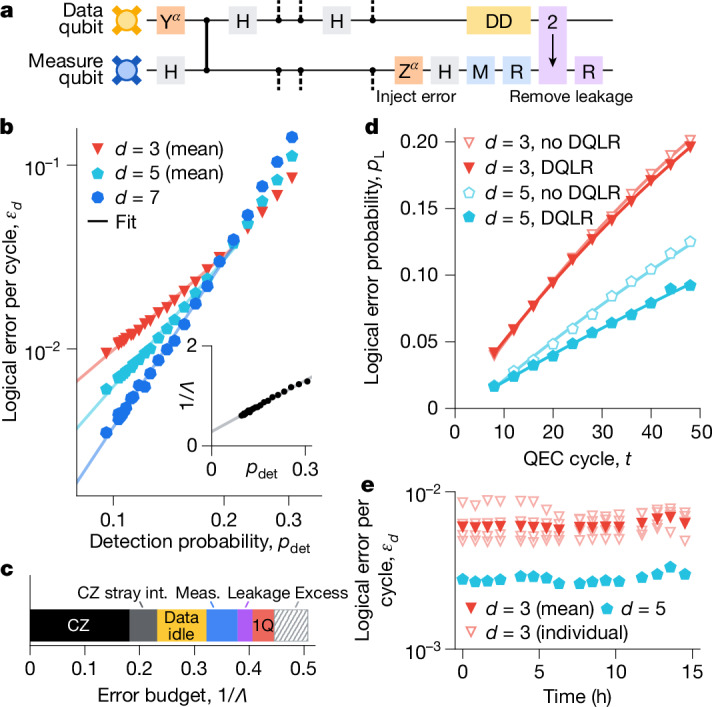
“We find that the three curves cross near a detection probability of 20%, roughly consistent with the crossover regime explored elsewhere17.”
§ Quantum error correction below the surface code threshold > Logical error sensitivity
What the sources say
- Supportedcites [17] Google Quantum AI. Suppressing quantum errors by scaling a surface code logical qubit. Nature 614, 676–681 (2023). 36813892 PMC9946823 source
The Decoding and logical error probabilities section says the distance-5 code improved until it overtook the distance-3 code. The Error detectors section reports weight-4 detection probabilities of 0.185 and 0.175 for those codes, respectively. Together, these support the cited comparison to a crossover regime near 20%; the citing authors’ three-curve result is their own finding, not a result attributed to this source. (LLM, conf=0.85)
hedgedstates an association- Asserted: passes — The authors put it forward as true.
- Checkable: passes — It can be checked against evidence.
- Load-bearing: unclear — It is unclear whether the paper’s conclusions depend on it.
- Based: passes — The paper gives a reason why it holds.
- Supported
The cited sources support only part of this claim — read each source’s verdict below.
In the paper
“These results indicate that superconducting processors can remain stable for the hours-long timescales required for large-scale fault-tolerant algorithms21.”
§ Quantum error correction below the surface code threshold > Logical error sensitivity
What the sources say
- Partly supportedcites [21] Gidney, C. & Ekerå, M. How to factor 2,048 bit RSA integers in 8 hours using 20 million noisy qubits. Quantum 5, 433 (2021). sourceExperimental — accuracy not yet measured
Section 2.11 (page unavailable) estimates an approximately seven-hour run to factor a 2048-bit integer. Section 1.1 (page unavailable) says the estimate assumes a large-scale superconducting platform and cautions that it is a ballpark projection. The paper does not show that superconducting processors can remain stable for those hours. (LLM, conf=0.88)
hedgedstates a cause- Asserted: passes — The authors put it forward as true.
- Checkable: passes — It can be checked against evidence.
- Load-bearing: passes — The paper’s conclusions depend on it.
- Based: passes — The paper gives a reason why it holds.
- Partly supported
The cited sources support only part of this claim — read each source’s verdict below.
In the paper
“If the physical operations are below a critical noise threshold, the logical error rate should be suppressed exponentially as we increase the number of physical qubits per logical qubit.”
§ Quantum error correction below the surface code threshold > Main
What the sources say
- Not checked — no full text of the sourcecites [1] Shor, P. W. Scheme for reducing decoherence in quantum computer memory. Phys. Rev. A 52, R2493 (1995). 9912632 source
- Partly supportedcites [3] Dennis, E., Kitaev, A. Y., Landahl, A. & Preskill, J. Topological quantum memory. J. Math. Phys. 43, 4452–4505 (2002). sourceExperimental — accuracy not yet measured
The Computation threshold section (p. 23) says that below threshold, encoded-gate error probability decreases exponentially with the lattice's linear size L. It also gives the code-block size as 2L² physical qubits, so the paper does not support exponential suppression in the number of physical qubits per logical qubit; for this code, the stated scaling is exponential in its square root. (LLM, conf=0.88)
- Partly supportedcites [4] Kitaev, A. Y. Fault-tolerant quantum computation by anyons. Ann. Phys. 303, 2–30 (2003). sourceExperimental — accuracy not yet measured
Section 1 (p. 4) says the toric code works when the error rate is below a threshold, and Section 3 (p. 5) gives an unrecoverable-error probability of exp(−ak). But Section 1 (p. 2) defines the code using n = 2k² physical qubits for a fixed-size protected space. The exponential suppression is therefore in k, not in the number of physical qubits per logical qubit as the citing sentence suggests. (LLM, conf=0.87)
- Supportedcites [13] Fowler, A. G., Mariantoni, M., Martinis, J. M. & Cleland, A. N. Surface codes: towards practical large-scale quantum computation. Phys. Rev. A 86, 032324 (2012). source
Section VII, Error Detection (p. 11), states that below the physical-error threshold, the logical error rate falls exponentially as code distance increases; above the threshold, it increases instead. The statistical model (p. 12) relates greater distance to more physical qubits per logical qubit. The paper specifies exponential suppression with distance, rather than with the physical-qubit count itself. (LLM, conf=0.91)
hedgedstates a possible cause- Asserted: passes — The authors put it forward as true.
- Checkable: passes — It can be checked against evidence.
- Load-bearing: passes — The paper’s conclusions depend on it.
- Based: passes — The paper gives a reason why it holds.
Every source the paper cites for this claim was checked and supports it.
In the paper
“Along with a high-fidelity processor, fault-tolerant quantum computing also requires a classical co-processor that can decode errors in real time.”
§ Quantum error correction below the surface code threshold > Real-time decoding
What the sources say
- Supportedcites [23] Terhal, B. M. Quantum error correction for quantum memories. Rev. Mod. Phys. 87, 307–346 (2015). source
Section II.F (p. 19) says fault-tolerance threshold results typically assume fast, accurate classical processing of error information that does not delay computation. Section II.G.3 (p. 23) adds that decoding in a fault-tolerant computer must not accumulate a growing backlog of syndrome data. The paper does not prescribe a particular co-processor design, but it supports the claimed need for timely classical decoding. (LLM, conf=0.88)
plainstates a cause- Asserted: passes — The authors put it forward as true.
- Checkable: passes — It can be checked against evidence.
- Load-bearing: passes — The paper’s conclusions depend on it.
- Based: passes — The paper gives a reason why it holds.
- Supported
34 more claims · 3 with their cited sources checked
Create a free account to see all 63 claims and every source verdict.
- Probably not a substantial claim. 5
- It may state two separate claims as one. 20
- Borderline: one of the tests for a substantial claim is unclear. 1
- The quote only partly states this claim. 1
Claims other papers make about this one
Each is checked against this paper’s own text: does it say what the citing paper says it does?
The cited source says what the claim attributes to it.
In the citing paper
“Recently, QEC experiments have been performed in various hardware platforms, including superconducting quantum circuits25–28, trapped ions29 and neutral atoms30.”
From Hardware-efficient quantum error correction via concatenated bosonic qubits (2025) · cites this paper as [28]
The cited source says what the claim attributes to it.
In the citing paper
“Some of these experiments are approaching26, or have surpassed28, the threshold at which scaling of the error-correcting code size leads to exponential improvements in the logical qubit error rate.”
From Hardware-efficient quantum error correction via concatenated bosonic qubits (2025) · cites this paper as [28]
The cited source says what the claim attributes to it.
In the citing paper
“Nevertheless, recent advances in superconducting qubit performance8, improvements in decoding algorithms39,40,45–47 and optimized error-syndrome extraction circuits44,47 now open new possibilities for implementing the colour code on existing hardware.”
From Scaling and logic in the colour code on a superconducting quantum processor (2025) · cites this paper as [8]
The check wasn’t confident either way, so it gives no verdict — never disputed.
In the citing paper
“At present, the surface code achieves better logical error suppression (on the same processor, ; ref. 8), but simulations suggest that improving physical error rates by about a factor of four could render the colour code more qubit-efficient than the surface code (Supplementary Information section I).”
From Scaling and logic in the colour code on a superconducting quantum processor (2025) · cites this paper as [8]
Experimental — accuracy not yet measured
Citations
Cites
Quantum supremacy using a programmable superconducting processor
Arute, F., Arya, K., Babbush, R., Bacon, D., Bardin, J. C., Barends, R., Biswas, R., Boixo, S., Brandao, F. G. S. L., Buell, D. A., et al. (2019) · Nature · doi:10.1038/s41586-019-1666-5 · Cited by 7,720 · cited 2×
“In particular, software syndrome decoding can handle broken or disabled components [25], allows easing of hardware requirements [26], and promises support for novel and customized constructions for early fault-tolerant quantum algorithms.”
Self-citationFault-tolerant quantum computation by anyons
Kitaev, A. Y. (2003) · Annals of Physics · doi:10.1016/s0003-4916(02)00018-0 · Cited by 7,238 · cited 2×
“We optimize single-and two-qubit gate frequency trajectories via the Snake optimizer [4].”
Scheme for reducing decoherence in quantum computer memory
Shor, P. W. (1995) · Physical Review A · doi:10.1103/physreva.52.r2493 · Cited by 4,479 · cited 9×
“Finally, the noisy circuit is parsed and passed to the Pauli+ simulator [1], which generates samples of simulated experimental data.”
InfluentialPolynomial-time algorithms for prime factorization and discrete logarithms on a quantum computer
Shor, P. W. (1999) · SIAM Review · doi:10.1137/s0036144598347011 · Cited by 3,904
Charge-insensitive qubit design derived from the Cooper pair box
Koch, J., Yu, T. M., Gambetta, J., Houck, A. A., Schuster, D. I., Majer, J., Blais, A., Devoret, M. H., Girvin, S. M., & Schoelkopf, R. J. (2007) · Physical Review A · doi:10.1103/physreva.76.042319 · Cited by 3,351 · cited 2×
“In particular, software syndrome decoding can handle broken or disabled components [25], allows easing of hardware requirements [26], and promises support for novel and customized constructions for early fault-tolerant quantum algorithms.”
Self-citationLloyd, S. (1996) · Science · doi:10.1126/science.273.5278.1073 · Cited by 3,088 · cited 2×
“Quantum computing promises computational speedups in quantum chemistry [5], quantum simulation [6], cryptography [7], and optimization [8].”
Surface codes: Towards practical large-scale quantum computation
Fowler, A. G., Mariantoni, M., Martinis, J. M., & Cleland, A. N. (2012) · Physical Review A · doi:10.1103/physreva.86.032324 · Cited by 3,059 · cited 2×
“We note there are other accurate decoders that would be interesting to test on this data, including beliefmatch-ing [13], BP+OSD [14], and tensor network decoding [1].”
Self-citationA Quantum Adiabatic Evolution Algorithm Applied to Random Instances of an NP-Complete Problem
Farhi, E., Goldstone, J., Gutmann, S., Lapan, J., Lundgren, A., & Preda, D. (2001) · Science · doi:10.1126/science.1057726 · Cited by 2,056 · cited 7×
“4% in this case) generated by Stim [7], and neural network [8]).”
InfluentialSelf-citationDennis, E., Kitaev, A., Landahl, A., & Preskill, J. (2002) · Journal of Mathematical Physics · doi:10.1063/1.1499754 · Cited by 1,768 · cited 2×
“1b). pulse duration, and readout pulse power are jointly optimized [3] to attain simultaneous high fidelity mid-circuit readout.”
Simulated Quantum Computation of Molecular Energies
Aspuru-Guzik, A., Dutoi, A. D., Love, P. J., & Head-Gordon, M. (2005) · Science · doi:10.1126/science.1113479 · Cited by 1,418 · cited 2×
“Quantum computing promises computational speedups in quantum chemistry [5], quantum simulation [6], cryptography [7], and optimization [8].”
Cited by
Hardware-efficient quantum error correction via concatenated bosonic qubits
Putterman, H., Noh, K., Hann, C. T., MacCabe, G. S., Aghaeimeibodi, S., Patel, R. N., Lee, M., Jones, W. M., Moradinejad, H., Rodriguez, R., et al. (2025) · Nature · doi:10.1038/s41586-025-08642-7 · Cited by 108
Self-citationQuantum error correction of qudits beyond break-even
Brock, B. L., Singh, S., Eickbusch, A., Sivak, V. V., Ding, A. Z., Frunzio, L., Girvin, S. M., & Devoret, M. H. (2025) · Nature · doi:10.1038/s41586-025-08899-y · Cited by 64
“Our optimized GKP qutrit (ququart) lived longer, on average, than the best physical qutrit (ququart) available in our system by a factor of 1.82 ± 0.03 (1.87 ± 0.03), making this one of only a handful of experiments to beat the break-even point of QEC for quantum memories 22,28–30 .”
InfluentialSelf-citationTuokkola, M., Sunada, Y., Kivijärvi, H., Albanese, J., Grönberg, L., Kaikkonen, J.-P., Vesterinen, V., Govenius, J., & Möttönen, M. (2025) · Nature Communications · doi:10.1038/s41467-025-61126-0 · Cited by 132
Experimental demonstration of logical magic state distillation
Rodriguez, P. S., Robinson, J. M., Jepsen, N., He, Z., Duckering, C., Zhao, C., Wu, K.-H., Campo, J., Bagnall, K. R., Kwon, M., et al. (2025) · Nature · doi:10.1038/s41586-025-09367-3 · Cited by 243
“The 5-to-1 distillation protocol consists of running the unencoding circuit of the [[5 , 1 , 3]] perfect code, followed by measurements of the four logical qubits that correspond to stabilizers of the distillation code.”
InfluentialSelf-citationMillisecond lifetimes and coherence times in 2D transmon qubits
Bland, M. P., Bahrami, F., Martinez, J. G. C., Prestegaard, P. H., Smitham, B. M., Joshi, A., Hedrick, E., Kumar, S., Yang, A., Pakpour‐Tabrizi, A. C., et al. (2025) · Nature · doi:10.1038/s41586-025-09687-4 · Cited by 214
Scaling and logic in the colour code on a superconducting quantum processor
Lacroix, N., Bourassa, A., Heras, F. J. H., Zhang, L. M., Bausch, J., Senior, A. W., Edlich, T., Shutty, N., Sivak, V., Bengtsson, A., et al. (2025) · Nature · doi:10.1038/s41586-025-09061-4 · Cited by 51
“However, most practical quantum computing applications require gate error rates far below what current physical devices can achieve [31].”
InfluentialSelf-citationArtificial Intelligence Index Report 2025
Maslej, N., Fattorini, L., Perrault, R., Gil, Y., Parli, V., Kariuki, N., Capstick, E., Reuel, A., Brynjolfsson, E., Etchemendy, J., et al. (2025) · arXiv · doi:10.48550/arxiv.2504.07139 · Cited by 50
Self-citationQuantum Machine Learning in Drug Discovery: Applications in Academia and Pharmaceutical Industries
Smaldone, A. M., Shee, Y., Kyro, G. W., Xu, C., Vu, N. P., Dutta, R., Farag, M. H., Galda, A., Kumar, S., Kyoseva, E. S., et al. (2025) · Chemical Reviews · doi:10.1021/acs.chemrev.4c00678 · Cited by 90
Beyond NISQ: The Megaquop Machine
Preskill, J. P. (2025) · ACM Transactions on Quantum Computing · doi:10.1145/3723153 · Cited by 151
Advancements in superconducting quantum computing
Jiang, Y.-Y., Deng, C., Fan, H., Li, B.-Y., Sun, L., Tan, X., Wang, W., Xue, G., Yan, F., Yu, H., et al. (2025) · National Science Review · doi:10.1093/nsr/nwaf246 · Cited by 85
“Recent results from Acharya et al. [110 ] show that the logical qubit error rate has now fallen below that of physical qubits, marking the critical break-even point–a significant milestone in QEC.”
Self-citationSpring, P., Milanovic, L., Sunada, Y., Wang, S., van Loo, A. F., Tamate, S., & Nakamura, Y. (2025) · PRX Quantum · doi:10.1103/prxquantum.6.020345 · Cited by 94
“This is significant for the exceution of quantum error correction codes such as the surface code [1–6], which require the measurement of ancilla qubits at the end of every error-correction cycle.”
Self-citationSuperconducting quantum computers: who is leading the future?
AbuGhanem, M. (2025) · EPJ Quantum Technology · doi:10.1140/epjqt/s40507-025-00405-7 · Cited by 61
Zhang, Z., Wu, Y., & Ma, X. (2025) · Energy Conversion and Management · doi:10.1016/j.enconman.2025.119694 · Cited by 33
Computational capacity of life in relation to the universe
Kurian, P. (2025) · Science Advances · doi:10.1126/sciadv.adt4623 · Cited by 31
“At the time of this writing, one of the most promising implementations for effective quantum error correction uses a lattice-based surface code ( 56 ) of distance d , combining 2 d 2 − 1 multiple physical qubits into a logical qubit and exponentially suppressing the logical error rate ϵ with the…”
Single-Electron Spin Qubits in Silicon for Quantum Computing
Hu, G., Huang, W., Cai, R., Wang, L., Yang, C. H., Cao, G., Xue, X., Huang, P., & He, Y. (2025) · Intelligent Computing · doi:10.34133/icomputing.0115 · Cited by 33
Nation, P. D., Saki, A. A., Brandhofer, S., Bello, L., Garion, S., Treinish, M., & Javadi-Abhari, A. (2025) · Nature Computational Science · doi:10.1038/s43588-025-00792-y · Cited by 90
Demonstration of low-overhead quantum error correction codes
Wang, K., Lu, Z., Zhang, C., Liu, G., Chen, J., Wang, Y., Wu, Y., Xu, S., Zhu, X., Jin, F., et al. (2026) · Nature Physics · doi:10.1038/s41567-025-03157-4 · Cited by 124
“Many existing codes fall short in this aspect, including the surface code 9,31,32 that for 20 years was the leading Article https://doi.org/10.1038/s41567-025-03157-4 stabilizers) or Z j (measuring Z -type stabilizers), with j ranging from 1 to 9.”
InfluentialSelf-citationTowards simulating fluid flows with quantum computing
Bharadwaj, S. S., & Sreenivasan, K. R. (2025) · Sadhana · doi:10.1007/s12046-024-02660-3 · Cited by 30
Piispanen, L. J., Pfaffhauser, M., Wootton, J. R., Togelius, J., & Kultima, A. (2025) · EPJ Quantum Technology · doi:10.1140/epjqt/s40507-025-00308-7 · Cited by 44
“…technologies – technologies which rely on quantum physical phenomena – began its theoretical foundation in the early 1900s and is now at the stage of entering large markets with devices that allow for the manipulation of quantum phenomena with unprecedented precision and fault tolerance [50–52].”
Ali, S., Wadho, S. A., Talpur, K. R., Talpur, B. A., Alshudukhi, K. S., Humayun, M., Talpur, S. R., Mamun, M. A. A., Naseem, M., Abro, A., et al. (2025) · Computers & Electrical Engineering · doi:10.1016/j.compeleceng.2025.110649 · Cited by 33
Quantum Algorithms for Quantum Molecular Systems: A Survey
Zhang, Y., Zhang, X., Sun, J., Lin, H., Huang, Y., Lv, D., & Yuan, X. (2025) · Wiley Interdisciplinary Reviews Computational Molecular Science · doi:10.1002/wcms.70020 · Cited by 38
“On the other hand, significant theoretical [24–26] and experimental [27–29] advancements have demonstrated the feasibility of quantum error correction (QEC), a cornerstone for achieving universal quantum computing.”
Self-citationSystem characterization of dispersive readout in superconducting qubits
Sank, D., Opremcak, A., Bengtsson, A., Khezri, M., Chen, J., Naaman, O., & Korotkov, A. N. (2025) · Physical Review Applied · doi:10.1103/physrevapplied.23.024055 · Cited by 35
Self-citationA Perspective on Quantum Computing Applications in Quantum Chemistry Using 25–100 Logical Qubits
Alexeev, Y., Batista, V. S., Bauman, N. P., Bertels, L. W., Claudino, D., Dutta, R., Gagliardi, L., Godwin, S., Govind, N., Head‐Gordon, M., et al. (2025) · Journal of Chemical Theory and Computation · doi:10.1021/acs.jctc.5c01038 · Cited by 53
“Because they can be simulated efficiently on classical hardware [32, 42, 43, 149], they enable cross-checking of quantum compilation, execution, and error correction pipelines at a scale comparable to chemically relevant circuits.”
InfluentialSelf-citationProbing non-equilibrium topological order on a quantum processor
Will, M., Cochran, T. A., Rosenberg, E. N., Jobst, B., Eassa, N. M., Roushan, P., Knap, M., Gammon-Smith, A., & Pollmann, F. (2025) · Nature · doi:10.1038/s41586-025-09456-3 · Cited by 57
Self-citationCaesura, A., Cortes, C. L., Pol, W., Sim, S., Steudtner, M., Anselmetti, G.-L., Degroote, M., Moll, N., Santagati, R., Streif, M., et al. (2025) · PRX Quantum · doi:10.1103/yngp-5fpm · Cited by 63
Automating quantum computing laboratory experiments with an agent-based AI framework
Cao, S., Zhang, Z., Alghadeer, M., Fasciati, S. D., Piscitelli, M., Bakr, M. S., Leek, P., & Aspuru‐Guzik, A. (2025) · Patterns · doi:10.1016/j.patter.2025.101372 · Cited by 78
Constant-Overhead Fault-Tolerant Bell-Pair Distillation Using High-Rate Codes
Ataides, J. P. B., Zhou, H., Xu, Q., Baranes, G., Li, B., Lukin, M. D., & Jiang, L. (2025) · Physical Review Letters · doi:10.1103/s39k-r2kq · Cited by 44
Chen, Y., McNeil, A. M., Park, T., Wilson, B. A., Iyer, V., Bezick, M., Choi, J.-I., Ojha, R., Mahendran, P., Singh, D. K., et al. (2025) · Nanophotonics · doi:10.1515/nanoph-2025-0049 · Cited by 31
“Quantum information science is a rapidly growing field, with recent breakthrough demonstrations accelerating enthusiasm for its potential [153], [154].”
Self-citationChallenges and opportunities for quantum information hardware
Awschalom, D. D., Bernien, H., Hanson, R., Oliver, W. D., & Vučković, J. (2025) · Science · doi:10.1126/science.adz8659 · Cited by 56
Self-citationLow-loss superconducting resonators fabricated from tantalum films grown at room temperature
Marcaud, G., Perello, D., Chen, C., Umbarkar, E. A., Weiland, C. R., Gao, J., Díez, S., Ly, V., Mahuli, N., D’Souza, N., et al. (2025) · Communications Materials · doi:10.1038/s43246-025-00897-x · Cited by 33
Efficient implementation of arbitrary two-qubit gates using unified control
Chen, Z., Liu, W., Ma, Y., Sun, W., Wang, R., Wang, H., Xu, H., Xue, G., Yan, H., Yang, Z., et al. (2025) · Nature Physics · doi:10.1038/s41567-025-02990-x · Cited by 52
Self-citationQuantum Machine Learning for 6G Network Intelligence and Adversarial Threats
Nguyen, V.-L., Nguyen, L.-H., Hwang, R., Canberk, B., & Duong, T. Q. (2025) · IEEE Communications Standards Magazine · doi:10.1109/mcomstd.2025.3575261 · Cited by 22
“In December 2024, Google has introduced a 105-qubit chip that it claims can solve a problem in five minutes, which would take the world’s fastest supercomputers 10 septillion years to complete [8].”
Helios: A 98-qubit trapped-ion quantum computer
Ransford, A., & Bohnet, J. (2025) · doi:10.21203/rs.3.rs-8130124/v1 · Cited by 16
A 98-qubit trapped-ion quantum computer with all-to-all connectivity
Ransford, A., Allman, M. S., Arkinstall, J., Campora, J. P., Cooper, S. F., Delaney, R. D., Dreiling, J. M., Estey, B., Figgatt, C., Hall, A., et al. (2026) · Nature · doi:10.1038/s41586-026-10676-4 · Cited by 16
Qutrit toric code and parafermions in trapped ions
Iqbal, M., Lyons, A., Lo, C. F. B., Tantivasadakarn, N., Dreiling, J., Foltz, C., Gatterman, T. M., Gresh, D., Hewitt, N., Holliman, C. A., et al. (2025) · Nature Communications · doi:10.1038/s41467-025-61391-z · Cited by 43
“An appealing direction for future work is to explore syndrome measurements and repeat-until-success protocols, which have thus far led to a break-even for state preparation and measurement errors for simpler code states 6,7,49 – 51 .”
Efficient Formal Verification of Quantum Error Correcting Programs
Huang, Q., Zhou, L., Fang, W. S., Zhao, M., & Ying, M. (2025) · Proceedings of the ACM on Programming Languages · doi:10.1145/3729293 · Cited by 36
Efficient Detection of Strong-to-Weak Spontaneous Symmetry Breaking via the Rényi-1 Correlator
Weinstein, Z. (2025) · Physical Review Letters · doi:10.1103/physrevlett.134.150405 · Cited by 77
Quantum computing and the implementation of precision medicine
Nassir, N., Hashmi, M., Raji, K. G., Jamalalail, B. A., Maksymowsky, A., Scherer, S. W., Alsheikh-Ali, A. A. A., & Uddin, M. J. (2025) · npj Genomic Medicine · doi:10.1038/s41525-025-00537-w · Cited by 31
“Willow utilizes photonic qubits and demonstrates the potential for improved error rates as system complexity increases.”
InfluentialOptimizing Quantum Error-Correction Protocols with Erasure Qubits
Gu, S., Vaknin, Y., Retzker, A., & Kubica, A. (2025) · PRX Quantum · doi:10.1103/985g-58gd · Cited by 37
“More generally, state-of-the-art decoherence rates compared with gate and measurement times would suggest that both transmons and dual-rail qubits have long surpassed the QEC threshold, whereas this is a result that was only achieved recently [23, 36, 37].”
Quantum Error Correction resilient against Atom Loss
Perrin, H., Jandura, S., & Pupillo, G. (2025) · Quantum · doi:10.22331/q-2025-10-13-1884 · Cited by 42
Quantum Artificial Intelligence Scalability in the NISQ Era: Pathways to Quantum Utility
Moreau, G. S., Pisani, L., Profir, M., Podda, C., Leoni, L., & Cao, G. (2025) · Advanced Quantum Technologies · doi:10.1002/qute.202400716 · Cited by 27
Error Correction of Transversal cnot Gates for Scalable Surface-Code Computation
Sahay, K., Lin, Y., Huang, S., Brown, K. R., & Puri, S. (2025) · PRX Quantum · doi:10.1103/prxquantum.6.020326 · Cited by 46
He, T., Lin, W., Wang, R., Li, Y., Bei, J., Cai, J., Cao, S., Chen, D., Chen, K., Chen, X., et al. (2025) · Physical Review Letters · doi:10.1103/rqkg-dw31 · Cited by 14
Self-citationLong-Range Nonstabilizerness and Phases of Matter
Korbany, D. A., Gullans, M. J., & Piroli, L. (2025) · Physical Review Letters · doi:10.1103/1hlj-h6t9 · Cited by 66
Compare the pair: Rotated versus unrotated surface codes at equal logical error rates
O'Rourke, A. R., & Devitt, S. J. (2025) · Physical Review Research · doi:10.1103/physrevresearch.7.033074 · Cited by 45
Low-Density Parity-Check Codes as Stable Phases of Quantum Matter
Yin, C., & Lucas, A. (2025) · PRX Quantum · doi:10.1103/361k-nj4b · Cited by 35
Yang, X., Yang, Z., Porter, M., Shao, L., & Zhang, Y. (2025) · IEEE Transactions on Power Electronics · doi:10.1109/tpel.2025.3601008 · Cited by 15
Self-citationLongitudinal and Nonlinear Coupling for High-Fidelity Readout of a Superconducting Qubit
Wang, C., Liu, F.-M., Chen, H. H., Du, Y.-F., Ying, C., Wang, J., Huo, Y.-H., Peng, C.-Z., Zhu, X., Chen, M.-C., et al. (2025) · Physical Review Letters · doi:10.1103/98n9-13y4 · Cited by 34
Machine learning for estimation and control of quantum systems
Ma, H., Qi, B., Petersen, I. R., Wu, R.-B., RABITZ, H. A., & Dong, D. (2025) · National Science Review · doi:10.1093/nsr/nwaf269 · Cited by 40
“Recent advancements by Google have demonstrated quantum error correction below the surface code threshold, marking a significant step towards scalable fault-tolerant quantum computation [179 ].”
Liu, H.-T., Chen, B., Zhang, J., Xiao, Y.-X., Li, T., Huang, K., Wang, Z., Li, H., Zhao, K., Xu, Y., et al. (2025) · Physical Review Letters · doi:10.1103/lvb9-pfr3 · Cited by 28
Low-loss lumped-element inductors made from granular aluminum
Gupta, V., Winkel, P., Thakur, N., van Vlaanderen, P., Wang, Y., Ganjam, S., Frunzio, L., & Schoelkopf, R. J. (2025) · Physical Review Applied · doi:10.1103/physrevapplied.23.054067 · Cited by 28
“Superconducting architectures for quantum information processing are growing increasingly complex [1–6], as individual circuit components are being optimized to perform specific functions like storage [7–10], gates [11– 15] or logical readout [16–19].”
Self-citationHockings, E. T., Doherty, A. C., & Harper, R. (2025) · PRX Quantum · doi:10.1103/prxquantum.6.010334 · Cited by 37
Opportunities and challenges of quantum computing for climate modeling
Schwabe, M., Pastori, L., de Vega, I., Gentine, P., Iapichino, L., Lahtinen, V., Leib, M., Lorenz, J. M., & Eyring, V. (2025) · Environmental Data Science · doi:10.1017/eds.2025.10010 · Cited by 23
“Given the substantial resource overhead needed for quantum error correction (Davenport et al., 2023), its practical implementation can be considered in its infancy despite recent rapid advances (Google Quantum AI and Collaborators, 2024).”
Efficient fault-tolerant code switching via one-way transversal CNOT gates
Heußen, S., & Hilder, J. (2025) · Quantum · doi:10.22331/q-2025-09-03-1846 · Cited by 12
“Re-markably, these added components have demonstrated improvements of overall circuit performance in real devices compared to a non-FT implementation, despite being noisy themselves [4–11].”
Preserving phase coherence and linearity in cat qubits with exponential bit-flip suppression
Putterman, H., Noh, K., Patel, R. N., Peairs, G. A., MacCabe, G. S., Lee, M., Aghaeimeibodi, S., Hann, C. T., Jarrige, I., Marcaud, G., et al. (2024) · arXiv · doi:10.48550/arxiv.2409.17556 · Cited by 12
Leveraging Qubit Loss Detection in Fault-Tolerant Quantum Algorithms
Baranes, G., Cain, M., Ataides, J. P. B., Bluvstein, D., Sinclair, J., Vuletić, V., Zhou, H., & Lukin, M. D. (2026) · Physical Review X · doi:10.1103/ycwc-3myc · Cited by 66
“While the present work mostly employs an MLE inner decoder, its limited scalability for large-scale logical algorithms underscores the need for further refinement, possibly through alternative strategies, such as matching decoders [9, 49, 54] or machine learning-based de-coders [9, 56].”
InfluentialNonseparability of multipartite systems in dilaton black hole
Wu, S.-M., Teng, X.-W., Li, W.-M., Wang, Y.-X., & Lu, J. (2025) · Journal of Cosmology and Astroparticle Physics · doi:10.1088/1475-7516/2025/09/030 · Cited by 28
Self-citationPhoton Number-Resolving Quantum Reservoir Computing
Nerenberg, S., Neill, O. D., Marcucci, G., & Faccio, D. (2024) · Optica Quantum · doi:10.1364/opticaq.553294 · Cited by 27
Blueprint for fault-tolerant quantum computation with topological qubit arrays
Aasen, D., Aghaee, M., Alam, Z., Andrzejczuk, M., Antipov, A., Astafev, M., Avilovas, L., Barzegar, A., Bauer, B., Becker, J., et al. (2025) · Physical Review Research · doi:10.1103/qx36-4rv1 · Cited by 110
Self-citationActive Leakage Cancellation in Single Qubit Gates
Chiaro, B., & Zhang, Y. (2025) · Physical Review Letters · doi:10.1103/4kz9-w97h · Cited by 23
“[1,2].”
Self-citationEfficient quantum circuit compilation for near-term quantum advantage
Guo, Y., & Yang, S. (2025) · EPJ Quantum Technology · doi:10.1140/epjqt/s40507-025-00368-9 · Cited by 27
“…the native entangling gates employed in a variety of quantum processors, including the CZ gate used in IBM’s Heron and Google’s Willow processors [38], as well as in neutral-atom quantum computers [55]; the ECR gate utilized in IBM’s Eagle processor [42]; and the Mølmer–Sørensen (MS) gate in…”
Dependency-Aware Compilation for Surface Code Quantum Architectures
Molavi, A., Xu, A., Tannu, S., & Albarghouthi, A. (2025) · Proceedings of the ACM on Programming Languages · doi:10.1145/3720416 · Cited by 53
“Experimentalists have recently demonstrated error suppression for a single logical qubit [26, 52, 66] and small multi-qubit systems [11, 20, 27, 51].”
Toward scalable fault-tolerant photonic quantum computers
AbuGhanem, M. (2026) · The Journal of Supercomputing · doi:10.1007/s11227-025-08132-7 · Cited by 17
An 11-qubit atom processor in silicon
Edlbauer, H., Wang, J., Huq, A. M. S., Thorvaldson, I., Jones, M. T., Misha, S. H., Pappas, W. J., Moehle, C. M., Hsueh, Y., Bornemann, H., et al. (2025) · Nature · doi:10.1038/s41586-025-09827-w · Cited by 49
Quasiparticle Poisoning of Superconducting Qubits with Active Gamma Irradiation
Larson, C. P., Yelton, E., Dodge, K., Okubo, K., Batarekh, J., Iaia, V., Kurinsky, N., & Plourde, B. L. T. (2025) · PRX Quantum · doi:10.1103/2lyd-8swv · Cited by 22
Diverse Superatomic Magnetic and Spin Properties of Au144(SC8H9)60 Clusters
Foxley, J., Tofanelli, M. A., Knappenberger, J. A., Ackerson, C. J., & Knappenberger, K. L. (2025) · ACS Central Science · doi:10.1021/acscentsci.5c00139 · Cited by 9
Enhanced feature encoding and classification on distributed quantum hardware
Moretti, R., Giachero, A., Radescu, V. A. M., & Grossi, M. (2025) · Machine Learning Science and Technology · doi:10.1088/2632-2153/adb4bc · Cited by 16
“…the latest superconducting quantum processors already exhibit higher gate fidelities than those used in this study [81, 83] and, crucially, superconducting QPUs are beginning to meet the thresholds required for quantum error correction [84], which is a key milestone for scaling quantum systems.”
Modeling Short-Range Microwave Networks to Scale Superconducting Quantum Computation
LaRacuente, N. D., Smith, K. N., Imany, P., Silverman, K. L., & Chong, F. T. (2025) · Quantum · doi:10.22331/q-2025-01-08-1581 · Cited by 52
“Additionally, early demonstrations of logical qubits are emerging [12, 13].”
Improved Belief Propagation Decoding Algorithms for Surface Codes
Chen, J., Yi, Z., Liang, Z., & Wang, X. (2025) · IEEE Transactions on Quantum Engineering · doi:10.1109/tqe.2025.3577769 · Cited by 21
“BP can be implemented over both GF(4) [20, 22–27] and GF(2) [28–31], where the Pauli operators are represented.”
End-to-End Workflow for Machine-Learning-Based Qubit Readout With QICK and hls4ml
Guglielmo, G. D., Du, B., Campos, J., Boltasseva, A. E., Dixit, A. V., Fahim, F., Kudyshev, Z. A., Lopez, S., Ma, R., Perdue, G., et al. (2025) · IEEE Transactions on Quantum Engineering · doi:10.1109/tqe.2025.3604712 · Cited by 33
Strategies for implementing quantum error correction in molecular rotation
Furey, B. J., Wu, Z., Isaza-Monsalve, M., Walser, S., Mattivi, E., Nardi, R., & Schindler, P. (2024) · Quantum · doi:10.22331/q-2024-12-27-1578 · Cited by 14
“QEC protects quantum information by storing it re-dundantly, either over multiple physical information carriers, such as atomic ions or superconducting qubits [2], or in the complex Hilbert space of a single physical information carrier [9–13].”
Experimental demonstration of quantum continual learning with superconducting qubits
Zhang, C., Lu, Z., Zhao, L., Xu, S., Li, W., Wang, K., Chen, J., Wu, Y., Jin, F., Zhu, X., et al. (2026) · npj Quantum Information · doi:10.1038/s41534-025-01174-y · Cited by 17
“In parallel, the fi eld of quantum computing has also made striking progress recently, with the experimental demonstration of quantum supremacy 14 – 16 and error correction codes 17 – 20 marked as the latest breakthroughs.”
Self-citationAll-nitride superconducting qubits based on atomic layer deposition
Wang, D., Wu, Y., Pieczulewski, N. A., Garg, P., Pace, M. C. C., Bøttcher, C. G. L., Mazumder, B., Muller, D. A., & Tang, H. X. (2026) · Nature Materials · doi:10.1038/s41563-025-02448-8 · Cited by 18
Advancing single-cell omics and cell-based therapeutics with quantum computing
Bose, A., Rhrissorrakrai, K., Utro, F., Parida, L., Basu, S., Born, J., Capponi, S., Chalkia, D., Chan, T. A.-T., Doğa, H., et al. (2026) · Nature Reviews Molecular Cell Biology · doi:10.1038/s41580-025-00918-0 · Cited by 23
Hellings, C., Lacroix, N., Remm, A., Boell, R., Herrmann, J., Lazar, S., Krinner, S., Swiadek, F., Andersen, C. K., Eichler, C., et al. (2025) · Physical Review Research · doi:10.1103/1qhb-r4fb · Cited by 32
Self-citationQuantum cryptography and data protection for medical devices before and after they meet Q-Day
Freyer, O., Ostermann, M., Minssen, T., & Gilbert, S. (2025) · npj Digital Medicine · doi:10.1038/s41746-025-02082-3 · Cited by 16
In the Shadow of the Hadamard Test: Using the Garbage State for Good and Further Modifications
Faehrmann, P. K., Eisert, J., & Kueng, R. (2025) · Physical Review Letters · doi:10.1103/cqjw-kl8s · Cited by 19
Efficient Preparation of Solvable Anyons with Adaptive Quantum Circuits
Ren, Y., Tantivasadakarn, N., & Williamson, D. J. (2025) · Physical Review X · doi:10.1103/b9hf-gx4f · Cited by 32
“Moreover, near-term quantum devices have finally reached the prerequisites that allow us to efficiently prepare both Abelian and non-Abelian topological phases of matter using adaptive circuits, as has been demonstrated recently [18–21].”
Detrimental non-Markovian errors for surface code memory
Kam, J. F., Gicev, S., Modi, K. K., Southwell, A., & Usman, M. (2025) · Quantum Science and Technology · doi:10.1088/2058-9565/adebab · Cited by 31
Surface melting–driven hydrogen absorption for high-pressure polyhydride synthesis
Sato, R., Conway, L. J., Zhang, D., Pickard, C. J., Akagi, K., Sau, K., Li, H., & Orimo, S. (2025) · Proceedings of the National Academy of Sciences · doi:10.1073/pnas.2413480122 · Cited by 9
What can unitary sequences tell us about multi-time physics?
White, G. A. L., Pollock, F. A., Hollenberg, L. C. L., Hill, C. D., & Modi, K. K. (2025) · Quantum · doi:10.22331/q-2025-04-08-1695 · Cited by 44
Preserving Phase Coherence and Linearity in Cat Qubits with Exponential Bit-Flip Suppression
(2025) · doi:10.1103/physrevx.15.011070 · Cited by 12
“More generally, pushing the limits of cat qubit bit-flip times and noise bias will open up new opportunities to study error mechanisms in superconducting quantum circuits that are rare events and occur on long timescales [46, 47].”
Suppression of Motional Dephasing Using State Mapping
Jiao, Y., Li, C., Shi, X., Fan, J., Bai, J., Jia, S., Zhao, J., & Adams, C. S. (2025) · Physical Review Letters · doi:10.1103/physrevlett.134.053604 · Cited by 15
Jiang, J., & Wang, Y. (2024) · Mathematics · doi:10.3390/math13010090 · Cited by 10
Shortcut to chemically accurate quantum computing via density-based basis-set correction
Traoré, D., Adjoua, O., Feniou, C., Lygatsika, I.-M., Maday, Y., Posenitskiy, E., Hammernik, K., Peruzzo, A., Toulouse, J., Giner, E., et al. (2024) · Communications Chemistry · doi:10.1038/s42004-024-01348-3 · Cited by 18
“Prior to the AO-product selection and in order to ensure orbital symmetry of the resulting SABS, we pre-process the initial basis B and first contract all angular components (e.g. all three p-type components p x , p y , p z ) of GTOs.”
AI-Driven Chemometrics for Multi-omics Data Integration: Advances, Challenges, and Future Directions
Polu, P. R. (2026) · Critical Reviews in Analytical Chemistry · doi:10.1080/10408347.2026.2657553 · Cited by 14
Simulating fluid vortex interactions on a superconducting quantum processor
Wang, Z., Zhong, J., Wang, K., Zhu, Z., Bao, Z., Zhu, C., Zhao, W., Zhao, Y., Yang, Y., Song, C., et al. (2026) · Nature Communications · doi:10.1038/s41467-026-69168-8 · Cited by 15
“4e, f reveals that the former exhibits perfect agreement with ground truth data, whereas the latter demonstrates signi fi cant positional deviations indicative of strong viscous dissipation effects.”
Lattice surgery realized on two distance-three repetition codes with superconducting qubits
Besedin, I. S., Kerschbaum, M., Knoll, J., Hesner, I., Bödeker, L., Colmenárez, L., Hofele, L., Lacroix, N., Hellings, C., Swiadek, F., et al. (2026) · Nature Physics · doi:10.1038/s41567-025-03090-6 · Cited by 67
“In future experiments, leakage reduction units [43, 44] can be used to convert leakage errors into Pauli errors, which has been shown to improve error correction performance for codes with distance larger than three [14].”
Self-citationFault-Tolerant Stabilizer Measurements in Surface Codes with Three-Qubit Gates
Old, J., Tasler, S., Hartmann, M. J., & Müller, M. (2025) · Physical Review Letters · doi:10.1103/sblg-fbq4 · Cited by 16
“Recently, it has been shown that distance-5 and 7 codes can be operated below the threshold, i.e. the logical error rate of the encoded logical qubit decreases with increasing code distance [16].”
Hashim, A., Yuan, M., Gokhale, P., Chen, L., Jünger, C., Fruitwala, N., Xu, Y., Huang, G., Nowrouzi, K., Jiang, L., et al. (2025) · APL Quantum · doi:10.1063/5.0291637 · Cited by 25
Quantum Computing for Genomics: Conceptual Challenges and Practical Perspectives
Maurizio, A., & Mazzola, G. (2025) · PRX Life · doi:10.1103/h49j-bsc6 · Cited by 23
“[27] The first experimental demonstrations of error correction are currently being established,[28–31] so it is possible that fault-tolerant digital quantum computers will be achieved in the future.”
Gradient-descent methods for fast quantum state tomography
Gaikwad, A., Torres, M. S., Ahmed, S., & Kockum, A. F. (2025) · Quantum Science and Technology · doi:10.1088/2058-9565/ae0baa · Cited by 23
“Quantum computers have advanced from theoretical concept [1] to practical reality with devices encompassing hundreds of qubits [2–5].”
Quantum computing for faster enzyme discovery and engineering
Damborský, J., Kouba, P., Šivic, J., Vasina, M., Bednář, D., & Mazurenko, S. (2025) · Nature Catalysis · doi:10.1038/s41929-025-01410-w · Cited by 11
Unlocking early fault-tolerant quantum computing with mitigated magic dilution
Luthra, S., Moylett, A. E., Browne, D. E., & Campbell, E. T. (2025) · Quantum Science and Technology · doi:10.1088/2058-9565/ae0aef · Cited by 14
“Recent progress in experimental demonstrations of quantum error correction and logical computation [1–5] has encouraged research towards practical applications of early fault-tolerant quantum computers [6–9].”
Self-citationAdvances of Quantum Key Distribution and Network Nonlocality
Geng, M. (2025) · Entropy · doi:10.3390/e27090950 · Cited by 9
Supply Chain Malware Detection via Classical and Quantum Kernel Methods in Embedded Systems
Passo, S. J. G., Kothavade, V. H., & Prevost, J. J. (2025) · International Conference on Dependable Systems and Networks workshops · doi:10.1109/dsn-w65791.2025.00063 · Cited by 7
“Qubit decoherence is a phenomenon where quantum states lose their coherence due to interactions with the environment, leading to errors in quantum computations [19].”
Multiplexed readout of superconducting qubits using a three-dimensional reentrant-cavity filter
Bakr, M. S., Fasciati, S. D., Cao, S., Campanaro, G., Wills, J., Alghadeer, M., Piscitelli, M., Shteynas, B., Chidambaram, V., & Leek, P. (2025) · Physical Review Applied · doi:10.1103/physrevapplied.23.054089 · Cited by 15
Ding, Q., Oppenheim, A. V., Boufounos, P. T., Gustavsson, S., Grover, J. A., Baran, T. A., & Oliver, W. D. (2025) · Physical Review Applied · doi:10.1103/yskp-mfcr · Cited by 16
“3% average reduction in gate infidelity of the Chebyshev-based trajectories is considerable, as physical error rates are exponentially leveraged in the suppression of logical error rates [48].”
Self-citationGeneralized Toric Codes on Twisted Tori for Quantum Error Correction
Liang, Z., Liu, K., Song, H., & Chen, Y.-A. (2025) · PRX Quantum · doi:10.1103/rmy6-9n89 · Cited by 76
“This implies that the polynomials [[12 , 4 , 2]] xy xy (0 , 3) (2 , 1) 1.33 [[14 , 6 , 2]] y x (0 , 7) (1 , 2) 1.71 [[18 , 4 , 4]] xy xy (0 , 3) (3 , 0) 3.563.563.56 [[24 , 4 , 4]] xy xy (0 , 3) (4 , 2) 2.67 [[28 , 6 , 4]] x − 1 y xy (0 , 7) (2 , 3) 3.43 [[30 , 4 , 6]] x 2 x 2 x 2 (0 , 3) (5 , 1)…”
InfluentialSelf-citationScaling up to problem sizes: an environmental life cycle assessment of quantum computing
Cordier, S., Thibault, K., Arpin, M.-L., & Amor, B. (2025) · Quantum Science and Technology · doi:10.1088/2058-9565/adc0ba · Cited by 17
“However, QEC surface codes require classical overhead for decoding syndromes [ 17, 18].”
Metadata
- Authors
- Collaborators, G. Q. A. A., Acharya, R., Abanin, D. A., Aghababaie-Beni, L., Aleiner, I., Andersen, T. I., Ansmann, M., Arute, F., Arya, K., Asfaw, A., Astrakhantsev, N., Atalaya, J., Babbush, R., Bacon, D., Ballard, B., Bardin, J. C., Bausch, J., Bengtsson, A., Bilmes, A., Blackwell, S., Boixo, S., Bortoli, G., Bourassa, A., Bovaird, J., Brill, L., Broughton, M., Browne, D. A., Buchea, B., Buckley, B. B., Buell, D. A., Burger, T., Burkett, B., Bushnell, N., Cabrera, A., Campero, J., Chang, H.-S., Chen, Y., Chen, Z., Chiaro, B., Chik, D., Chou, C., Claes, J., Cleland, A. Y., Cogan, J., Collins, R., Conner, P., Courtney, W., Crook, A. L., Curtin, B., Das, S., Davies, A., De Lorenzo, L., Debroy, D. M., Demura, S., Devoret, M., Di Paolo, A., Donohoe, P., Drozdov, I., Dunsworth, A., Earle, C., Edlich, T., Eickbusch, A., Elbag, A. M., Elzouka, M., Erickson, C., Faoro, L., Farhi, E., Ferreira, V. S., Burgos, L. F., Forati, E., Fowler, A. G., Foxen, B., Ganjam, S., Garcia, G., Gasca, R., Genois, É., Giang, W., Gidney, C., Gilboa, D., Gosula, R., Dau, A. G., Graumann, D., Greene, A., Gross, J. A., Habegger, S., Hall, J., Hamilton, M. C., Hansen, M., Harrigan, M. P., Harrington, S. D., Heras, F. J. H., Heslin, S., Heu, P., Higgott, O., Hill, G., Hilton, J., Holland, G., Hong, S., Huang, H.-Y., Huff, A., Huggins, W. J., Ioffe, L. B., Isakov, S. V., Iveland, J., Jeffrey, E., Jiang, Z., Jones, C., Jordan, S., Joshi, C., Juhas, P., Kafri, D., Kang, H., Karamlou, A. H., Kechedzhi, K., Kelly, J., Khaire, T., Khattar, T., Khezri, M., Kim, S., Klimov, P. V., Klots, A. R., Kobrin, B., Kohli, P., Korotkov, A. N., Kostritsa, F., Kothari, R., Kozlovskii, B., Kreikebaum, J. M., Kurilovich, V. D., Lacroix, N., Landhuis, D., Lange-Dei, T., Langley, B. W., Laptev, P., Lau, K.-M., Le Guevel, L., Ledford, J., Lee, J., Lee, K., Lensky, Y. D., Leon, S., Lester, B. J., Li, W. Y., Li, Y., Lill, A. T., Liu, W., Livingston, W. P., Locharla, A., Lucero, E., Lundahl, D., Lunt, A., Madhuk, S., Malone, F. D., Maloney, A., Mandrà, S., Manyika, J., Martin, L. S., Martin, O., Martin, S., Maxfield, C., McClean, J. R., McEwen, M., Meeks, S., Megrant, A., Mi, X., Miao, K. C., Mieszala, A., Molavi, R., Molina, S., Montazeri, S., Morvan, A., Movassagh, R., Mruczkiewicz, W., Naaman, O., Neeley, M., Neill, C., Nersisyan, A., Neven, H., Newman, M., Ng, J. H., Nguyen, A., Nguyen, M., Ni, C.-H., Niu, M. Y., O’Brien, T. E., Oliver, W. D., Opremcak, A., Ottosson, K., Petukhov, A., Pizzuto, A., Platt, J., Potter, R., Pritchard, O., Pryadko, L. P., Quintana, C., Ramachandran, G., Reagor, M. J., Redding, J., Rhodes, D. M., Roberts, G., Rosenberg, E., Rosenfeld, E., Roushan, P., Rubin, N. C., Saei, N., Sank, D., Sankaragomathi, K., Satzinger, K. J., Schurkus, H. F., Schuster, C., Senior, A. W., Shearn, M. J., Shorter, A., Shutty, N., Shvarts, V., Singh, S., Sivak, V., Skruzny, J., Small, S., Smelyanskiy, V., Smith, W. C., Somma, R. D., Springer, S., Sterling, G., Strain, D., Suchard, J., Szasz, A., Sztein, A., Thor, D., Torres, A., Torunbalci, M. M., Vaishnav, A., Vargas, J., Vdovichev, S., Vidal, G., Villalonga, B., Heidweiller, C. V., Waltman, S., Wang, S. X., Ware, B., Weber, K., Weidel, T., White, T., Wong, K., Woo, B. W. K., Xing, C., Yao, Z. J., Yeh, P., Ying, B., Yoo, J., Yosri, N., Young, G., Zalcman, A., Zhang, Y., Zhu, N., & Zobrist, N.
- Affiliations
- Google (United States) (US)
- University of California, Riverside (US)
- Corresponding author
- Neven, Hartmut
- ORCID
- Acharya, Rajeev
- Abanin, Dmitry A.
- Aleiner, Igor
- Andersen, Trond I.
- Ansmann, Markus
- Arute, Frank
- Arya, Kunal
- Asfaw, Abraham
- Astrakhantsev, Nikita
- Atalaya, Juan
- Babbush, Ryan
- Bacon, Dave
- Bardin, Joseph C.
- Bausch, Johannes
- Bengtsson, Andreas
- Bilmes, Alexander
- Blackwell, Sam
- Boixo, Sergio
- Bortoli, Gina
- Bourassa, Alexandre
- Bovaird, Jenna
- Broughton, Michael
- Buckley, Bob B.
- Burkett, Brian
- Bushnell, Nicholas
- Chang, Hung-Shen
- Chen, Yu
- Chen, Zijun
- Chiaro, Ben
- Claes, Jahan
- Cleland, Agnetta Y.
- Cogan, Josh
- Collins, Roberto
- Crook, Alexander L.
- Curtin, Ben
- Das, Sayan
- Davies, Alex
- Demura, Sean
- Devoret, Michel
- Di Paolo, Agustin
- Drozdov, Ilya
- Dunsworth, Andrew
- Edlich, Thomas
- Eickbusch, Alec
- Erickson, Catherine
- Farhi, Edward
- Ferreira, Vinicius S.
- Forati, Ebrahim
- Fowler, Austin G.
- Foxen, Brooks
- Ganjam, Suhas
- Gasca, Robert
- Genois, Élie
- Gosula, Raja
- Dau, Alejandro Grajales
- Greene, Alex
- Gross, Jonathan A.
- Habegger, Steve
- Hall, John
- Harrigan, Matthew P.
- Harrington, Sean D.
- Heras, Francisco J. H.
- Higgott, Oscar
- Hong, Sabrina
- Huang, Hsin-Yuan
- Huggins, William J.
- Ioffe, Lev B.
- Iveland, Justin
- Jeffrey, Evan
- Jiang, Zhang
- Jordan, Stephen
- Joshi, Chaitali
- Juhas, Pavol
- Kafri, Dvir
- Karamlou, Amir H.
- Kechedzhi, Kostyantyn
- Kelly, Julian
- Khattar, Tanuj
- Khezri, Mostafa
- Kim, Seon
- Klimov, Paul V.
- Kohli, Pushmeet
- Korotkov, Alexander N.
- Kothari, Robin
- Kreikebaum, John Mark
- Kurilovich, Vladislav D.
- Lacroix, Nathan
- Landhuis, David
- Le Guevel, Loïck
- Lee, Joonho
- Lee, Kenny
- Lensky, Yuri D.
- Lester, Brian J.
- Lill, Alexander T.
- Liu, Wayne
- Livingston, William P.
- Locharla, Aditya
- Lucero, Erik
- Malone, Fionn D.
- Mandrà, Salvatore
- Martin, Leigh S.
- Martin, Orion
- McClean, Jarrod R.
- McEwen, Matt
- Megrant, Anthony
- Mi, Xiao
- Miao, Kevin C.
- Montazeri, Shirin
- Morvan, Alexis
- Movassagh, Ramis
- Mruczkiewicz, Wojciech
- Naaman, Ofer
- Neeley, Matthew
- Neill, Charles
- Nersisyan, Ani
- Neven, Hartmut
- Ng, Jiun How
- Ni, Chia-Hung
- Niu, Murphy Yuezhen
- O’Brien, Thomas E.
- Oliver, William D.
- Pizzuto, Alex
- Platt, John
- Potter, Rebecca
- Pryadko, Leonid P.
- Quintana, Chris
- Reagor, Matthew J.
- Rhodes, David M.
- Roberts, Gabrielle
- Rosenberg, Eliott
- Rosenfeld, Emma
- Roushan, Pedram
- Rubin, Nicholas C.
- Sank, Daniel
- Sankaragomathi, Kannan
- Satzinger, Kevin J.
- Schurkus, Henry F.
- Senior, Andrew W.
- Shearn, Michael J.
- Shutty, Noah
- Sivak, Volodymyr
- Smelyanskiy, Vadim
- Smith, W. Clarke
- Somma, Rolando D.
- Sterling, George
- Szasz, Aaron
- Thor, Douglas
- Vargas, Justin
- Villalonga, Benjamin
- Heidweiller, Catherine Vollgraff
- Waltman, Steven
- Wang, Shannon X.
- Ware, Brayden
- White, Theodore
- Woo, Bryan W. K.
- Xing, Cheng
- Yao, Z. Jamie
- Yeh, Ping
- Ying, Bicheng
- Yoo, Juhwan
- Yosri, Noureldin
- Zalcman, Adam
- Zhang, Yaxing
- Zhu, Ningfeng
- Zobrist, Nicholas
- Venue
- Nature
- Published
- 2024-12-09
- Volume
- 638
- Issue
- 8052
- Pages
- 920-926
- ISSN
- 0028-0836 (ISSN-L)
- 1476-4687
- PMC
- PMC11864966
- OpenAlex
- W4405183524
- Semantic Scholar
- 698baad0cc98285b33e204c74e463e3840a64294
- Cited by
- 778
- References
- 68
- Citations by year
- 2026: 377 · 2025: 392 · 2024: 9
- FWCI
- 114.48
- Type
- journal article
- Language
- en
- Update notices
- correction (2026-04-28)
- Open access
- hybrid
- doi.org
- Licence
- cc-by-nc-nd
- creativecommons.org/licenses/by-nc-nd/4.0 (tdm)
- creativecommons.org/licenses/by-nc-nd/4.0 (vor, 51 d)
- Locations
- Nature (publishedVersion, cc-by-nc-nd)
- PubMed Central (publishedVersion, cc-by-nc-nd)
- PubMed (publishedVersion)
- Repository for Publications and Research Data (ETH Zurich) (publishedVersion, cc-by-nc-nd)
- arXiv (Cornell University) (submittedVersion, cc-by)
- arXiv (Cornell University) (cc-by)
- ETH Zürich Research Collection
- Funders
- Curtin University of Technology
- Topics
- Physical Sciences › Computer Science › Artificial Intelligence › Quantum Computing Algorithms and Architecture
- Physical Sciences › Physics and Astronomy › Atomic and Molecular Physics, and Optics › Quantum Information and Cryptography
- Physical Sciences › Physics and Astronomy › Atomic and Molecular Physics, and Optics › Quantum many-body systems
- Keywords
- quantum error correction, surface code, superconducting qubits, logical error rate, real-time decoding, repetition codes, correlated errors, quantum memory, fault-tolerant quantum computing
About these checks
Registry, retraction, Cites and statistics results are computed, not judged, with one exception: a printed reference that no index lists is read once by a model before it counts as a citation error. Claims are extracted by a model and kept only when their quote appears verbatim in the text; each cited source is then checked, with a model’s help, for whether it says what the claim relies on. Those verdicts can be wrong — read the claim’s quote and the cited source before relying on one.
The claim verdicts this report counts are experimental: their accuracy is not yet measured.
A language model drew the claims from the paper on 2026-09-29, under version 3 of the claim definition (model deepseek-v4.1-flash, prompt extract-v3).
A second model labelled each claim on 2026-09-29 (model jev-1.13-20260917, definition revision gold-guideline-v0.2).
Cited sources are checked with a language model’s help (gpt-6-sol).
Statistics and arithmetic are recomputed, not judged.
Confidence bands are shown only for fields calibrated on our annotated test set. None is calibrated yet, so no band is shown.
What counts as a claim ›How we measure confidence ›How we check this ›
Are you an author, or do you see a problem with this page? Request a review
Data sources
Bibliographic data: Semantic Scholar, OpenAlex, Crossref.
Contains information from the Semantic Scholar Academic Graph Datasets, made available under the ODC Attribution License (ODC-BY 1.0).
Semantic Scholar’s data is described in: Kinney, R., et al. (2023). The Semantic Scholar Open Data Platform. arXiv:2301.10140.
