

Quantum error correction below the surface code threshold
Open accessThe DOI matches its Crossref record; 72 of the 73 references it cites were found in a registry or an index; 30 of the 38 sources its claims cite were checked for support.
Abstract
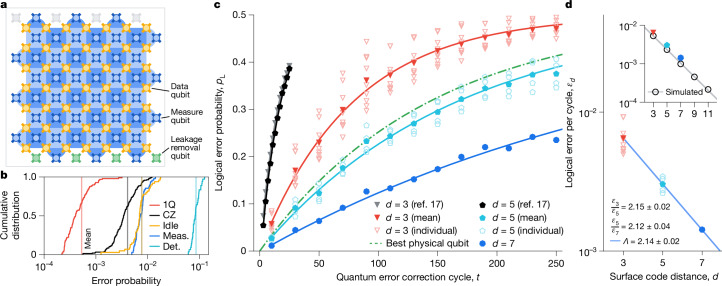
Quantum error correction [1, 2, 3, 4] provides a path to reach practical quantum computing by combining multiple physical qubits into a logical qubit, where the logical error rate is suppressed exponentially as more qubits are added. However, this exponential suppression only occurs if the physical error rate is below a critical threshold. Here, we present two below-threshold surface code memories on our newest generation of superconducting processors, Willow: a distance-7 code, and a distance-5 code integrated with a real-time decoder. The logical error rate of our larger quantum memory is suppressed by a factor of $$\varLambda \mathrm{=2.14}\pm 0.02$$ when increasing the code distance by two, culminating in a 101-qubit distance-7 code with 0.143% ± 0.003% error per cycle of error correction. This logical memory is also beyond break-even, exceeding its best physical qubit’s lifetime by a factor of $$2.4\pm 0.3$$ . Our system maintains below-threshold performance when decoding in real time, achieving an average decoder latency of 63 μs at distance-5 up to a million cycles, with a cycle time of 1.1 μs. We also run repetition codes up to distance-29 and find that logical performance is limited by rare correlated error events occurring approximately once every hour, or $$3$$ $$\times $$ $${10}^{9}$$ cycles. Our results present device performance that, if scaled, could realize the operational requirements of large scale fault-tolerant quantum algorithms.
Overview
CoChat Summary
TL;DR
Google Quantum AI reports below-threshold surface code memories on superconducting Willow processors, including a distance-7 code with logical error suppressed by Λ = 2.14 ± 0.02 per distance increase of 2.
The distance-7 logical qubit exceeds its best physical qubit lifetime by a factor of 2.4 ± 0.3, and real-time decoding at distance 5 maintains below-threshold performance with 63 ± 17 μs average latency.
Key findings
- A distance-7 surface code memory achieved ε7 = (1.43 ± 0.03) × 10−3 logical error per cycle with a neural-network decoder, giving Λ = 2.14 ± 0.02; with ensembled matching synthesis, Λ = 2.04 ± 0.02 and ε7 = (1.71 ± 0.03) × 10−3.
- The distance-7 logical qubit lifetime was 291 ± 6 μs, exceeding its best constituent physical qubit lifetime (119 ± 13 μs) by a factor of 2.4 ± 0.3.
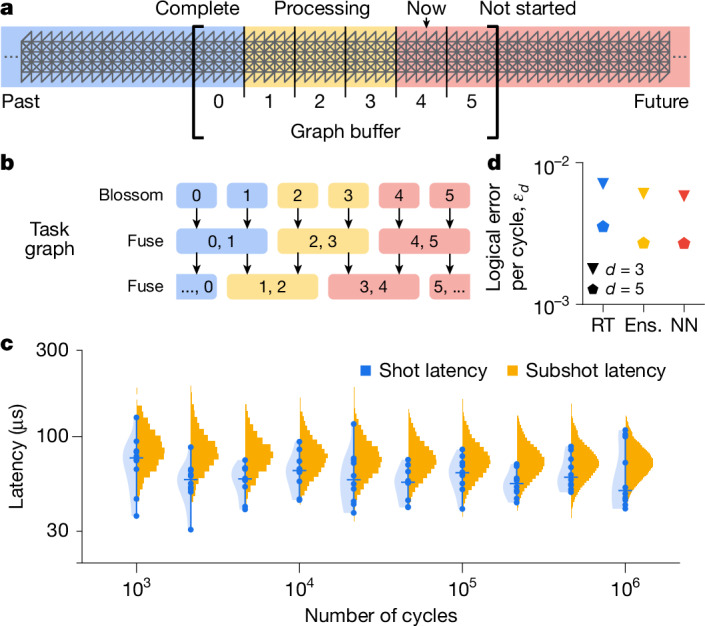
- Real-time decoding at distance 5 achieved ε5 = 0.35% ± 0.01% and Λ = 2.0 ± 0.1, with average decoder latency 63 ± 17 μs up to 106 cycles and a 1.1 μs cycle time; offline neural-network decoding gave ε5 = 0.269% ± 0.008% and Λ = 2.18 ± 0.09.
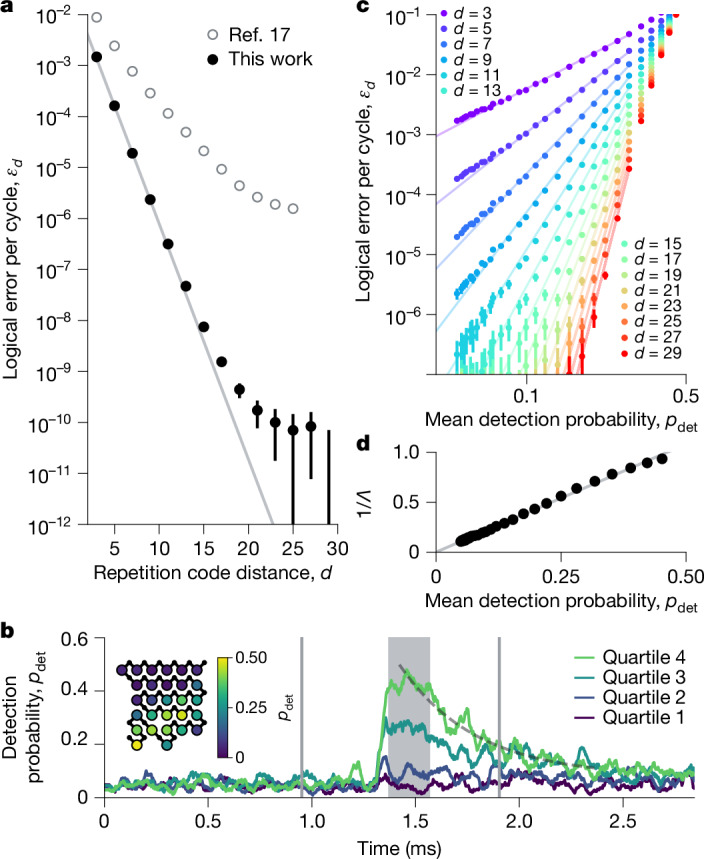
- Repetition codes up to distance 29 gave Λ = 8.4 ± 0.1 between d = 5 and d = 11, but a logical error floor of 10−10 appeared at d ≥ 15, attributed to rare correlated error bursts occurring approximately once per hour or 3 × 10⁹ cycles; six large bursts occurred over 2 × 10¹⁰ cycles.
Methods
- Experiments used superconducting transmon Willow processors: a 105-qubit processor for the distance-7 surface code (49 data qubits, 48 measure qubits, 4 leakage-removal qubits) and a 72-qubit processor for distance-5 real-time decoding and repetition codes; mean coherence times were T1 = 68 μs and T2,CPMG = 89 μs.
- Surface code memory operation prepared a logical eigenstate, repeated syndrome extraction cycles with data-qubit leakage removal, measured individual data qubits, and fit logical error per cycle up to 250 cycles; Λ was computed by linear regression of ln[εd] versus d, averaging nine distance-3 and four distance-5 subgrids.
- Decoding used a neural-network decoder and a harmonized ensemble of correlated minimum-weight perfect matching decoders with matching synthesis; real-time decoding used sparse blossom with a constant-sized graph buffer. Repetition-code experiments used 2 × 10⁷ shots of a distance-29 code with 1,000 cycles, totaling 2 × 10¹⁰ cycles and 5.5 h of processor execution.
Limitations
- Paper-stated: scaling to algorithmically relevant error rates is resource intensive; extrapolation suggests a 10−6 error rate would require a distance-27 logical qubit using 1,457 physical qubits, and real-time decoding challenges grow quadratically with code distance.
- Paper-stated: the repetition-code noise floor of 10−10 is caused by correlated bursts whose origin is not understood, and these events may affect surface codes differently; the error budget overpredicts Λ by 14%, indicating some error effects remain uncaptured.
- Evident from text: real-time decoding is demonstrated at distance 5, while the distance-7 result uses offline decoders; the work focuses on memory rather than logical computation, and feedback for non-Clifford gates has not yet been implemented.
Model-written summary. Check it against the paper before relying on it.
Integrity signals
Registry
Cites
Statistics
Figures
Verification
Claims the paper makes
12 Valid · 5 Not valid · 1 Not checked · 45 Own results and interpretations
Some cited sources support this claim and some don’t — read each source’s verdict below.
In the paper
“Although many platforms have demonstrated different features of quantum error correction14–20, no quantum processor has definitively shown below-threshold performance.”
§ Quantum error correction below the surface code threshold > Main
What the sources say
- Not checked — no full text of the sourcecites [14] Ryan-Anderson, C. et al. Realization of real-time fault-tolerant quantum error correction. Phys. Rev. X 11, 041058 (2021). source
- Supportedcites [15] Krinner, S. et al. Realizing repeated quantum error correction in a distance-three surface code. Nature 605, 669–674 (2022). 35614249 source
The citation range 14–20 is attached to the first clause, about platforms demonstrating features of quantum error correction. The paper reports repeated surface-code error correction on a superconducting processor (p. 1), so it supports that clause. The separate assertion that no processor has definitively shown below-threshold performance is not attributed to this citation by the sentence’s placement. (LLM, conf=0.90)
- Not checked — no full text of the sourcecites [16] Sivak, V. V. et al. Real-time quantum error correction beyond break-even. Nature 616, 50–55 (2023). 36949196 source
- Supportedcites [17] Google Quantum AI. Suppressing quantum errors by scaling a surface code logical qubit. Nature 614, 676–681 (2023). 36813892 PMC9946823 source
The Main section says earlier quantum-error-correction demonstrations left open whether increasing code size would reduce logical errors in a real device. The ‘Towards large-scale quantum error correction’ section says this paper’s own device is close to threshold but estimates that its components must improve by at least 20% to move below it. Together, these passages support the claim that no processor had definitively demonstrated below-threshold performance at the time. (LLM, conf=0.84)
- Disputedcites [18] Bluvstein, D. et al. Logical quantum processor based on reconfigurable atom arrays. Nature 626, 58–65 (2024). 38056497 PMC10830422 sourceExperimental — accuracy not yet measured
The Methods section (‘Overview of QEC methods’; page unavailable) says that improved performance with increasing code distance in the paper’s preparation and entangling circuit ‘implies that we surpass the threshold of this circuit.’ That is contrary to the unqualified claim that no quantum processor has shown below-threshold performance, although the paper limits its finding to a particular circuit. (LLM, conf=0.87)
Checked by a reasoning model — may be wrong.
- Could not verifycites [19] Gupta, R. S. et al. Encoding a magic state with beyond break-even fidelity. Nature 625, 259–263 (2024). 38200302 PMC10781628 sourceExperimental — accuracy not yet measured
The Experimental results section reports state-preparation infidelities on an IBM processor, and the Discussion describes progress toward fault-tolerant computing. Neither establishes whether any quantum processor has definitively shown below-threshold performance. Searches for “below-threshold performance,” “threshold,” and decreasing logical error rates with increasing code size found no passage that addresses the claim. (LLM, conf=0.73)
- Disputedcites [20] Da Silva, M. et al. Demonstration of logical qubits and repeated error correction with better-than-physical error rates. Preprint at https://arxiv.org/abs/2404.02280 (2024). sourceExperimental — accuracy not yet measured
The Abstract says that, to the authors’ knowledge, earlier experiments had not convincingly shown logical error rates better than physical error rates. But Reference note 19 updates that account, explicitly noting that definitive sub-threshold performance had since been demonstrated. That contradicts the unqualified claim that no processor has shown it. (LLM, conf=0.88)
Checked by a reasoning model — may be wrong.
plain- Asserted: passes — The authors put it forward as true.
- Checkable: passes — It can be checked against evidence.
- Load-bearing: passes — The paper’s conclusions depend on it.
- Based: passes — The paper gives a reason why it holds.
Every source the paper cites for this claim was checked and supports it.
In the paper
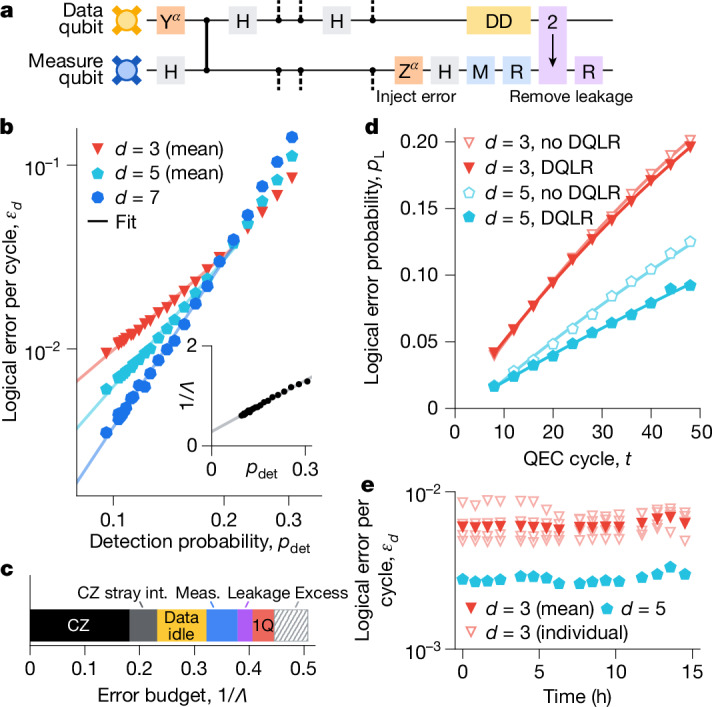
“We find that the three curves cross near a detection probability of 20%, roughly consistent with the crossover regime explored elsewhere17.”
§ Quantum error correction below the surface code threshold > Logical error sensitivity
What the sources say
- Supportedcites [17] Google Quantum AI. Suppressing quantum errors by scaling a surface code logical qubit. Nature 614, 676–681 (2023). 36813892 PMC9946823 source
The Decoding and logical error probabilities section says the distance-5 code improved until it overtook the distance-3 code. The Error detectors section reports weight-4 detection probabilities of 0.185 and 0.175 for those codes, respectively. Together, these support the cited comparison to a crossover regime near 20%; the citing authors’ three-curve result is their own finding, not a result attributed to this source. (LLM, conf=0.85)
hedgedstates an association- Asserted: passes — The authors put it forward as true.
- Checkable: passes — It can be checked against evidence.
- Load-bearing: unclear — It is unclear whether the paper’s conclusions depend on it.
- Based: passes — The paper gives a reason why it holds.
- Supported
The cited sources support only part of this claim — read each source’s verdict below.
In the paper
“These results indicate that superconducting processors can remain stable for the hours-long timescales required for large-scale fault-tolerant algorithms21.”
§ Quantum error correction below the surface code threshold > Logical error sensitivity
What the sources say
- Partly supportedcites [21] Gidney, C. & Ekerå, M. How to factor 2,048 bit RSA integers in 8 hours using 20 million noisy qubits. Quantum 5, 433 (2021). sourceExperimental — accuracy not yet measured
Section 2.11 (page unavailable) estimates an approximately seven-hour run to factor a 2048-bit integer. Section 1.1 (page unavailable) says the estimate assumes a large-scale superconducting platform and cautions that it is a ballpark projection. The paper does not show that superconducting processors can remain stable for those hours. (LLM, conf=0.88)
hedgedstates a cause- Asserted: passes — The authors put it forward as true.
- Checkable: passes — It can be checked against evidence.
- Load-bearing: passes — The paper’s conclusions depend on it.
- Based: passes — The paper gives a reason why it holds.
- Partly supported
The cited sources support only part of this claim — read each source’s verdict below.
In the paper
“If the physical operations are below a critical noise threshold, the logical error rate should be suppressed exponentially as we increase the number of physical qubits per logical qubit.”
§ Quantum error correction below the surface code threshold > Main
What the sources say
- Not checked — no full text of the sourcecites [1] Shor, P. W. Scheme for reducing decoherence in quantum computer memory. Phys. Rev. A 52, R2493 (1995). 9912632 source
- Partly supportedcites [3] Dennis, E., Kitaev, A. Y., Landahl, A. & Preskill, J. Topological quantum memory. J. Math. Phys. 43, 4452–4505 (2002). sourceExperimental — accuracy not yet measured
The Computation threshold section (p. 23) says that below threshold, encoded-gate error probability decreases exponentially with the lattice's linear size L. It also gives the code-block size as 2L² physical qubits, so the paper does not support exponential suppression in the number of physical qubits per logical qubit; for this code, the stated scaling is exponential in its square root. (LLM, conf=0.88)
- Partly supportedcites [4] Kitaev, A. Y. Fault-tolerant quantum computation by anyons. Ann. Phys. 303, 2–30 (2003). sourceExperimental — accuracy not yet measured
Section 1 (p. 4) says the toric code works when the error rate is below a threshold, and Section 3 (p. 5) gives an unrecoverable-error probability of exp(−ak). But Section 1 (p. 2) defines the code using n = 2k² physical qubits for a fixed-size protected space. The exponential suppression is therefore in k, not in the number of physical qubits per logical qubit as the citing sentence suggests. (LLM, conf=0.87)
- Supportedcites [13] Fowler, A. G., Mariantoni, M., Martinis, J. M. & Cleland, A. N. Surface codes: towards practical large-scale quantum computation. Phys. Rev. A 86, 032324 (2012). source
Section VII, Error Detection (p. 11), states that below the physical-error threshold, the logical error rate falls exponentially as code distance increases; above the threshold, it increases instead. The statistical model (p. 12) relates greater distance to more physical qubits per logical qubit. The paper specifies exponential suppression with distance, rather than with the physical-qubit count itself. (LLM, conf=0.91)
hedgedstates a possible cause- Asserted: passes — The authors put it forward as true.
- Checkable: passes — It can be checked against evidence.
- Load-bearing: passes — The paper’s conclusions depend on it.
- Based: passes — The paper gives a reason why it holds.
Every source the paper cites for this claim was checked and supports it.
In the paper
“Along with a high-fidelity processor, fault-tolerant quantum computing also requires a classical co-processor that can decode errors in real time.”
§ Quantum error correction below the surface code threshold > Real-time decoding
What the sources say
- Supportedcites [23] Terhal, B. M. Quantum error correction for quantum memories. Rev. Mod. Phys. 87, 307–346 (2015). source
Section II.F (p. 19) says fault-tolerance threshold results typically assume fast, accurate classical processing of error information that does not delay computation. Section II.G.3 (p. 23) adds that decoding in a fault-tolerant computer must not accumulate a growing backlog of syndrome data. The paper does not prescribe a particular co-processor design, but it supports the claimed need for timely classical decoding. (LLM, conf=0.88)
plainstates a cause- Asserted: passes — The authors put it forward as true.
- Checkable: passes — It can be checked against evidence.
- Load-bearing: passes — The paper’s conclusions depend on it.
- Based: passes — The paper gives a reason why it holds.
- Supported
34 more claims · 3 with their cited sources checked
Create a free account to see all 63 claims and every source verdict.
- Probably not a substantial claim. 5
- It may state two separate claims as one. 20
- Borderline: one of the tests for a substantial claim is unclear. 1
- The quote only partly states this claim. 1
Claims other papers make about this one
Each is checked against this paper’s own text: does it say what the citing paper says it does?
The cited source says what the claim attributes to it.
In the citing paper
“Recently, QEC experiments have been performed in various hardware platforms, including superconducting quantum circuits25–28, trapped ions29 and neutral atoms30.”
From Hardware-efficient quantum error correction via concatenated bosonic qubits (2025) · cites this paper as [28]
The cited source says what the claim attributes to it.
In the citing paper
“Some of these experiments are approaching26, or have surpassed28, the threshold at which scaling of the error-correcting code size leads to exponential improvements in the logical qubit error rate.”
From Hardware-efficient quantum error correction via concatenated bosonic qubits (2025) · cites this paper as [28]
The cited source says what the claim attributes to it.
In the citing paper
“Nevertheless, recent advances in superconducting qubit performance8, improvements in decoding algorithms39,40,45–47 and optimized error-syndrome extraction circuits44,47 now open new possibilities for implementing the colour code on existing hardware.”
From Scaling and logic in the colour code on a superconducting quantum processor (2025) · cites this paper as [8]
The check wasn’t confident either way, so it gives no verdict — never disputed.
In the citing paper
“At present, the surface code achieves better logical error suppression (on the same processor, ; ref. 8), but simulations suggest that improving physical error rates by about a factor of four could render the colour code more qubit-efficient than the surface code (Supplementary Information section I).”
From Scaling and logic in the colour code on a superconducting quantum processor (2025) · cites this paper as [8]
Experimental — accuracy not yet measured
Citations
Cites
Quantum supremacy using a programmable superconducting processor
Arute, F., Arya, K., Babbush, R., Bacon, D., Bardin, J. C., Barends, R., Biswas, R., Boixo, S., Brandao, F. G. S. L., Buell, D. A., et al. (2019) · Nature · doi:10.1038/s41586-019-1666-5 · Cited by 7,720 · cited 2×
“In particular, software syndrome decoding can handle broken or disabled components [25], allows easing of hardware requirements [26], and promises support for novel and customized constructions for early fault-tolerant quantum algorithms.”
Self-citationFault-tolerant quantum computation by anyons
Kitaev, A. Y. (2003) · Annals of Physics · doi:10.1016/s0003-4916(02)00018-0 · Cited by 7,238 · cited 2×
“We optimize single-and two-qubit gate frequency trajectories via the Snake optimizer [4].”
Scheme for reducing decoherence in quantum computer memory
Shor, P. W. (1995) · Physical Review A · doi:10.1103/physreva.52.r2493 · Cited by 4,479 · cited 9×
“Finally, the noisy circuit is parsed and passed to the Pauli+ simulator [1], which generates samples of simulated experimental data.”
InfluentialPolynomial-time algorithms for prime factorization and discrete logarithms on a quantum computer
Shor, P. W. (1999) · SIAM Review · doi:10.1137/s0036144598347011 · Cited by 3,904
Charge-insensitive qubit design derived from the Cooper pair box
Koch, J., Yu, T. M., Gambetta, J., Houck, A. A., Schuster, D. I., Majer, J., Blais, A., Devoret, M. H., Girvin, S. M., & Schoelkopf, R. J. (2007) · Physical Review A · doi:10.1103/physreva.76.042319 · Cited by 3,351 · cited 2×
“In particular, software syndrome decoding can handle broken or disabled components [25], allows easing of hardware requirements [26], and promises support for novel and customized constructions for early fault-tolerant quantum algorithms.”
Self-citationLloyd, S. (1996) · Science · doi:10.1126/science.273.5278.1073 · Cited by 3,088 · cited 2×
“Quantum computing promises computational speedups in quantum chemistry [5], quantum simulation [6], cryptography [7], and optimization [8].”
Surface codes: Towards practical large-scale quantum computation
Fowler, A. G., Mariantoni, M., Martinis, J. M., & Cleland, A. N. (2012) · Physical Review A · doi:10.1103/physreva.86.032324 · Cited by 3,059 · cited 2×
“We note there are other accurate decoders that would be interesting to test on this data, including beliefmatch-ing [13], BP+OSD [14], and tensor network decoding [1].”
Self-citationA Quantum Adiabatic Evolution Algorithm Applied to Random Instances of an NP-Complete Problem
Farhi, E., Goldstone, J., Gutmann, S., Lapan, J., Lundgren, A., & Preda, D. (2001) · Science · doi:10.1126/science.1057726 · Cited by 2,056 · cited 7×
“4% in this case) generated by Stim [7], and neural network [8]).”
InfluentialSelf-citationDennis, E., Kitaev, A., Landahl, A., & Preskill, J. (2002) · Journal of Mathematical Physics · doi:10.1063/1.1499754 · Cited by 1,768 · cited 2×
“1b). pulse duration, and readout pulse power are jointly optimized [3] to attain simultaneous high fidelity mid-circuit readout.”
Simulated Quantum Computation of Molecular Energies
Aspuru-Guzik, A., Dutoi, A. D., Love, P. J., & Head-Gordon, M. (2005) · Science · doi:10.1126/science.1113479 · Cited by 1,418 · cited 2×
“Quantum computing promises computational speedups in quantum chemistry [5], quantum simulation [6], cryptography [7], and optimization [8].”
Quantum error correction for quantum memories
Terhal, B. M. (2015) · Reviews of Modern Physics · doi:10.1103/revmodphys.87.307 · Cited by 1,354 · cited 3×
“This is because some logical operations are non-deterministic; they depend on logical measurement outcomes that must be correctly interpreted on the fly [23].”
InfluentialLogical quantum processor based on reconfigurable atom arrays
Bluvstein, D., Evered, S. J., Geim, A. A., Li, S. H., Zhou, H., Manovitz, T., Ebadi, S., Cain, M., Kalinowski, M., Hangleiter, D., et al. (2024) · Nature · doi:10.1038/s41586-023-06927-3 · Cited by 1,119 · cited 2×
“[18] and PyMatching [19].”
Suppressing quantum errors by scaling a surface code logical qubit
Google Quantum, A. I., Acharya, R., Aleiner, I., Allen, R., Andersen, T. I., Ansmann, M., Arute, F., Arya, K., Asfaw, A., Atalaya, J., et al. (2023) · Nature · doi:10.1038/s41586-022-05434-1 · Cited by 1,103 · cited 8×
“[29], it was shown that data qubit leakage removal is instrumental to achieving the exponential suppression of logical errors with code distance when physical errors are well below the error threshold.”
InfluentialSelf-citationExtending the lifetime of a quantum bit with error correction in superconducting circuits
Ofek, N., Petrenko, A., Heeres, R., Reinhold, P., Leghtas, Z., Vlastakis, B., Liu, Y., Frunzio, L., Girvin, S. M., Jiang, L., et al. (2016) · Nature · doi:10.1038/nature18949 · Cited by 941 · cited 4×
“[36, 39, 40], we define the gain G as an improvement of the effective lifetime of an error-corrected logical qubit over the best physical qubit in the same sys-tem (with the break-even point corresponding to G = 1).”
InfluentialSelf-citationHow to factor 2048 bit RSA integers in 8 hours using 20 million noisy qubits
Gidney, C., & Ekerå, M. (2021) · Quantum · doi:10.22331/q-2021-04-15-433 · Cited by 830 · cited 3×
“3b-c, observing good agreement with O ( p ( d +1) / 2 ) error suppression.”
Self-citationStabilizer Codes and Quantum Error Correction
Gottesman, D. (1997) · arXiv · doi:10.48550/arxiv.quant-ph/9705052 · Cited by 753
A simple formula for the average gate fidelity of a quantum dynamical operation
Nielsen, M. A. (2002) · Physics Letters A · doi:10.1016/s0375-9601(02)01272-0 · Cited by 725 · cited 1×
“As shown in Ref.”
Realizing repeated quantum error correction in a distance-three surface code
Krinner, S., Lacroix, N., Remm, A., Di Paolo, A., Genois, E., Leroux, C., Hellings, C., Lazar, S., Swiadek, F., Herrmann, J., et al. (2022) · Nature · doi:10.1038/s41586-022-04566-8 · Cited by 686 · cited 2×
“Overall, we find that addressing leakage is crucial to operating surface codes with transmon qubits [15, 33, 39].”
High-threshold and low-overhead fault-tolerant quantum memory
Bravyi, S., Cross, A. W., Gambetta, J. M., Maslov, D., Rall, P., & Yoder, T. J. (2024) · Nature · doi:10.1038/s41586-024-07107-7 · Cited by 456
Real-time quantum error correction beyond break-even
Sivak, V. V., Eickbusch, A., Royer, B., Singh, S., Tsioutsios, I., Ganjam, S., Miano, A., Brock, B. L., Ding, A. Z., Frunzio, L., et al. (2023) · Nature · doi:10.1038/s41586-023-05782-6 · Cited by 407 · cited 8×
“[16] for the surface code and train the prior on a “calibration dataset” of duration 13 cycles, which precedes the rest of the ex-periment.”
InfluentialSelf-citationExponential suppression of bit or phase errors with cyclic error correction
Google Quantum, A. I., Chen, Z., Satzinger, K. J., Atalaya, J., Korotkov, A. N., Dunsworth, A., Sank, D., Quintana, C., McEwen, M., Barends, R., et al. (2021) · Nature · doi:10.1038/s41586-021-03588-y · Cited by 393 · cited 1×
“This result constitutes a four orders-of-magnitude improvement compared to the lowest logical error per cycle achieved in previous experiments [33].”
Self-citationRealization of Real-Time Fault-Tolerant Quantum Error Correction
Ryan-Anderson, C., Bohnet, J. G., Lee, K., Gresh, D., Hankin, A., Gaebler, J. P., Francois, D., Chernoguzov, A., Lucchetti, D., Brown, N. C., et al. (2021) · Physical Review X · doi:10.1103/physrevx.11.041058 · Cited by 306 · cited 2×
“We note there are other accurate decoders that would be interesting to test on this data, including beliefmatch-ing [13], BP+OSD [14], and tensor network decoding [1].”
Bonilla Ataides, J. P., Tuckett, D. K., Bartlett, S. D., Flammia, S. T., & Brown, B. J. (2021) · Nature Communications · doi:10.1038/s41467-021-22274-1 · Cited by 262 · cited 2×
“Note that this metric does not favor qubits with extremely biased noise [32–34 S4.”
Fault-tolerant quantum computation for local non-Markovian noise
Terhal, B. M., & Burkard, G. (2005) · Physical Review A · doi:10.1103/physreva.71.012336 · Cited by 181 · cited 2×
“This is an important contributor to the overall reaction time, T react , which is the time it takes the quantum computer’s control system to react to a logical measurement by executing a dependent logical operation [22].”
PyMatching: A Python Package for Decoding Quantum Codes with Minimum-Weight Perfect Matching
Higgott, O. (2022) · ACM Transactions on Quantum Computing · doi:10.1145/3505637 · Cited by 181
Self-citationSparse blossom: correcting a million errors per core second with minimum-weight matching
Higgott, O., & Gidney, C. (2025) · Quantum · doi:10.22331/q-2025-01-20-1600 · Cited by 180 · cited 1×
“We employ a specialized version of the Sparse Blossom algorithm [42] optimized to quickly resolve local configurations of errors common in surface code decoding, using a parallelization strategy similar to Ref.”
Self-citationBeating the break-even point with a discrete-variable-encoded logical qubit
Ni, Z., Li, S., Deng, X., Cai, Y., Zhang, L., Wang, W., Yang, Z.-B., Yu, H., Yan, F., Liu, S., et al. (2023) · Nature · doi:10.1038/s41586-023-05784-4 · Cited by 176 · cited 3×
“This equation allows us to establish a strict upper bound on Γ logical , since Simulations suggest [37, 38] that in the surface code p Y ∼ p X p Z is suppressed compared to p X and p Z , because Y errors predominantly occur as independent X and Z errors.”
Kivlichan, I. D., Gidney, C., Berry, D. W., Wiebe, N., McClean, J., Sun, W., Jiang, Z., Rubin, N., Fowler, A., Aspuru-Guzik, A., et al. (2020) · Quantum · doi:10.22331/q-2020-07-16-296 · Cited by 173 · cited 5×
“9% fidelity entangling gates [9, 10], far short of the 10 − 10 error rates needed for many applications [11, 12].”
InfluentialSelf-citationConstant-overhead fault-tolerant quantum computation with reconfigurable atom arrays
Xu, Q., Bonilla Ataides, J. P., Pattison, C. A., Raveendran, N., Bluvstein, D., Wurtz, J., Vasić, B., Lukin, M. D., Jiang, L., & Zhou, H. (2024) · Nature Physics · doi:10.1038/s41567-024-02479-z · Cited by 157
Sparse Blossom: correcting a million errors per core second with minimum-weight matching
Higgott, O., & Gidney, C. (2023) · arXiv · doi:10.48550/arxiv.2303.15933 · Cited by 148
Self-citationA real-time, scalable, fast and resource-efficient decoder for a quantum computer
Barber, B., Barnes, K. M., Bialas, T., Buğdaycı, O., Campbell, E. T., Gillespie, N. I., Johar, K., Rajan, R., Richardson, A. W., Skorić, L., et al. (2025) · Nature Electronics · doi:10.1038/s41928-024-01319-5 · Cited by 131
Encoding a magic state with beyond break-even fidelity
Gupta, R. S., Sundaresan, N., Alexander, T., Wood, C. J., Merkel, S. T., Healy, M. B., Hillenbrand, M., Jochym-O’Connor, T., Wootton, J. R., Yoder, T. J., et al. (2024) · Nature · doi:10.1038/s41586-023-06846-3 · Cited by 115 · cited 1×
“[18] and PyMatching [19].”
Litinski, D., & Nickerson, N. (2022) · arXiv (Cornell University) · doi:10.48550/arxiv.2211.15465 · Cited by 109
Learning high-accuracy error decoding for quantum processors
Bausch, J., Senior, A. W., Heras, F. J. H., Edlich, T., Davies, A., Newman, M., Jones, C., Satzinger, K., Niu, M. Y., Blackwell, S., et al. (2024) · Nature · doi:10.1038/s41586-024-08148-8 · Cited by 106 · cited 3×
“Teal: weight-4 detection probabilities (distance-7, averaged over 250 cycles). c , Logical error probability, p L , for a range of memory experiment durations.”
Self-citationOvercoming leakage in quantum error correction
Miao, K. C., McEwen, M., Atalaya, J., Kafri, D., Pryadko, L. P., Bengtsson, A., Opremcak, A., Satzinger, K. J., Chen, Z., Klimov, P. V., et al. (2023) · Nature Physics · doi:10.1038/s41567-023-02226-w · Cited by 99 · cited 5×
“For data qubits, DQLR swaps leakage excitations to measure qubits (or additional leakage removal qubits) [33].”
InfluentialSelf-citationOptimizing quantum gates towards the scale of logical qubits
Klimov, P. V., Bengtsson, A., Quintana, C., Bourassa, A., Hong, S., Dunsworth, A., Satzinger, K. J., Livingston, W. P., Sivak, V., Niu, M. Y., et al. (2024) · Nature Communications · doi:10.1038/s41467-024-46623-y · Cited by 97 · cited 2×
“(8) we obtain For a qubit encoded in the surface code, we model a logical Pauli channel [35, 36] with error probabilities p X , p Y and p Z per cycle.”
Self-citationInplace Access to the Surface Code Y Basis
Gidney, C. (2024) · Quantum · doi:10.22331/q-2024-04-08-1310 · Cited by 97 · cited 2×
“One illustrative consequence of this is that the lifetime of Y eigenstates in the surface code would be approximately twice shorter than the X and Z eigenstates, although due to a more complicated preparation [37], we do not measure this lifetime in our experiment.”
Self-citationGidney, C., Newman, M., Brooks, P., & Jones, C. (2025) · Nature Communications · doi:10.1038/s41467-025-59714-1 · Cited by 85
Self-citationEarly fault-tolerant simulations of the Hubbard model
Campbell, E. T. (2022) · Quantum Science and Technology · doi:10.1088/2058-9565/ac3110 · Cited by 81 · cited 5×
“9% fidelity entangling gates [9, 10], far short of the 10 − 10 error rates needed for many applications [11, 12].”
InfluentialUniversal Quantum Computing with Twist-Free and Temporally Encoded Lattice Surgery
Chamberland, C., & Campbell, E. T. (2022) · PRX Quantum · doi:10.1103/prxquantum.3.010331 · Cited by 80 · cited 1×
“Each datapoint represents 10 5 repetitions decoded with the neural network and is averaged over logical basis ( X L and Z L ).”
Parallel window decoding enables scalable fault tolerant quantum computation
Skoric, L., Browne, D. E., Barnes, K. M., Gillespie, N. I., & Campbell, E. T. (2023) · Nature Communications · doi:10.1038/s41467-023-42482-1 · Cited by 80 · cited 1×
“However, we do expect that many of our high-accuracy decoding methods can eventually be made real-time by introducing techniques like layered or win-dowed decoding [28, 44, 45].”
Self-citationModular decoding: parallelizable real-time decoding for quantum computersPreprint
Bombín, H., Dawson, C., Liu, Y.-H., Nickerson, N., Pastawski, F., & Roberts, S. (2023) · arXiv (Cornell University) · doi:10.48550/arxiv.2303.04846 · Cited by 76 · cited 1×
“1b alongside equivalent measurements on the 72-qubit processor.”
Stability Experiments: The Overlooked Dual of Memory Experiments
Gidney, C. (2022) · Quantum · doi:10.22331/q-2022-08-24-786 · Cited by 66 · cited 1×
“While this work focuses on building a robust memory, additional challenges will arise in logical computation [58, 59].”
Self-citationLeakage detection for a transmon-based surface code
Varbanov, B. M., Battistel, F., Tarasinski, B. M., Ostroukh, V. P., O’Brien, T. E., DiCarlo, L., & Terhal, B. M. (2020) · npj Quantum Information · doi:10.1038/s41534-020-00330-w · Cited by 63 · cited 4×
“Overall, we find that addressing leakage is crucial to operating surface codes with transmon qubits [15, 33, 39].”
InfluentialLogical Blocks for Fault-Tolerant Topological Quantum Computation
Bombín, H., Dawson, C., Mishmash, R. V., Nickerson, N., Pastawski, F., & Roberts, S. (2023) · PRX Quantum · doi:10.1103/prxquantum.4.020303 · Cited by 59 · cited 1×
“On the classical side, we must ensure that software elements including our calibration protocols, real-time decoders, and logical compilers can scale to the sizes and complexities needed to run multi-surface-code operations [60].”
Quantum Computing is Scalable on a Planar Array of Qubits with Fabrication Defects
Strikis, A., Benjamin, S. C., & Brown, B. J. (2023) · Physical Review Applied · doi:10.1103/physrevapplied.19.064081 · Cited by 57 · cited 2×
“[39, 41].”
Resisting High-Energy Impact Events through Gap Engineering in Superconducting Qubit Arrays
McEwen, M., Miao, K. C., Atalaya, J., Bilmes, A., Crook, A., Bovaird, J., Kreikebaum, J. M., Zobrist, N., Jeffrey, E., Ying, B., et al. (2024) · Physical Review Letters · doi:10.1103/physrevlett.133.240601 · Cited by 55 · cited 3×
“[36, 39, 40], we define the gain G as an improvement of the effective lifetime of an error-corrected logical qubit over the best physical qubit in the same sys-tem (with the break-even point corresponding to G = 1).”
Self-citationLocal Predecoder to Reduce the Bandwidth and Latency of Quantum Error Correction
Smith, S. C., Brown, B. J., & Bartlett, S. D. (2023) · Physical Review Applied · doi:10.1103/physrevapplied.19.034050 · Cited by 52
Fusion Blossom: Fast MWPM Decoders for QEC
Wu, Y., & Zhong, L. (2023) · 2023 IEEE International Conference on Quantum Computing and Engineering (QCE) · doi:10.1109/qce57702.2023.00107 · Cited by 47 · cited 2×
“For example, if an edge e in C corresponds to an X error at a particular location of a CSS surface code circuit, then from our knowledge of the noise model we know that a Y error could have occurred at the same location and hence we lower the edge weight corresponding to a Z error at the same…”
Computational Power of Random Quantum Circuits in Arbitrary Geometries
(2025) · doi:10.1103/physrevx.15.021052 · Cited by 45 · cited 4×
“We re-mark that the sensitivities ( w i ) are obtained assuming perfect DQLR and using a correlated matching decoder for efficiency [10].”
InfluentialThe computational power of random quantum circuits in arbitrary geometries
DeCross, M., Haghshenas, R., Liu, M., Rinaldi, E., Gray, J., Alexeev, Y., Baldwin, C. H., Bartolotta, J. P., Bohn, M., Chertkov, E., et al. (2024) · arXiv · doi:10.48550/arxiv.2406.02501 · Cited by 45
Optimization of Decoder Priors for Accurate Quantum Error Correction
Sivak, V., Newman, M., & Klimov, P. V. (2024) · Physical Review Letters · doi:10.1103/physrevlett.133.150603 · Cited by 43
Self-citationScalable Surface-Code Decoders with Parallelization in Time
Tan, X., Zhang, F., Chao, R., Shi, Y., & Chen, J. (2023) · PRX Quantum · doi:10.1103/prxquantum.4.040344 · Cited by 42 · cited 1×
“However, we do expect that many of our high-accuracy decoding methods can eventually be made real-time by introducing techniques like layered or win-dowed decoding [28, 44, 45].”
Demonstration of logical qubits and repeated error correction with better-than-physical error rates
Paetznick, A., da Silva, M. P., Ryan-Anderson, C., Bello-Rivas, J. M., Campora, J. P., Chernoguzov, A., Dreiling, J. M., Foltz, C., Frachon, F., Gaebler, J. P., et al. (2024) · arXiv · doi:10.48550/arxiv.2404.02280 · Cited by 42 · cited 2×
“Because the experimental data in this paper is of much longer duration (250 cycles vs. 25 for the data in [1]) we add gated recurrence to the state update [20].”
Efficient Near-Optimal Decoding of the Surface Code through Ensembling
Shutty, N., Newman, M., & Villalonga, B. (2026) · Physical Review Letters · doi:10.48550/arxiv.2401.12434 · Cited by 42
Self-citationCorrelated Decoding of Logical Algorithms with Transversal Gates
Cain, M., Zhao, C., Zhou, H., Meister, N., Ataides, J. P. B., Jaffe, A., Bluvstein, D., & Lukin, M. D. (2024) · Physical Review Letters · doi:10.1103/physrevlett.133.240602 · Cited by 37 · cited 1×
“We further expect these overheads will reduce with advances in error correction protocols [48–54] and decoding [55–57].”
FPGA-based Distributed Union-Find Decoder for Surface Codes
(2024) · doi:10.36227/techrxiv.171624125.57457222/v1 · Cited by 36
Optimal complexity correction of correlated errors in the surface code
Fowler, A. G. (2013) · arXiv · doi:10.48550/arxiv.1310.0863 · Cited by 36
Self-citationFPGA-Based Distributed Union-Find Decoder for Surface Codes
(2024) · doi:10.1109/tqe.2024.3467271 · Cited by 36
Tailoring quantum error correction to spin qubits
Hetényi, B., & Wootton, J. R. (2024) · Physical Review A · doi:10.1103/physreva.109.032433 · Cited by 29
Benchmarking Quantum Processor Performance at Scale
McKay, D. C., Hincks, I., Pritchett, E. J., Carroll, M., Govia, L. C. G., & Merkel, S. T. (2023) · arXiv · doi:10.48550/arxiv.2311.05933 · Cited by 29 · cited 5×
“[9] with an ensemble size of 101 (unless otherwise specified), 4. a correlated matching decoder similar to that described in Ref.”
InfluentialPipelined correlated minimum weight perfect matching of the surface code
Paler, A., & Fowler, A. G. (2023) · Quantum · doi:10.22331/q-2023-12-12-1205 · Cited by 22 · cited 1×
“We also use a greedy edge reweighting strategy to increase accuracy by accounting for correlations induced by Y -type errors [29, 47].”
Self-citationImproved accuracy for decoding surface codes with matching synthesisPreprint
Jones, C. (2024) · arXiv (Cornell University) · doi:10.48550/arxiv.2408.12135 · Cited by 20
Self-citationConstant-Overhead Fault-Tolerant Quantum Computation with Reconfigurable Atom ArraysPreprint
Xu, Q., Ataides, J. P. B., Pattison, C. A., et al. (2023) · arXiv (Cornell University) · doi:10.48550/arxiv.2308.08648 · Cited by 7
A real-time, scalable, fast and highly resource efficient decoder for a quantum computerPreprint
Barber, B., Barnes, K. M., Bialas, T., et al. (2023) · arXiv (Cornell University) · doi:10.48550/arxiv.2309.05558 · Cited by 7
Using detector likelihood for benchmarking quantum error correction
Hesner, I., Hetényi, B., & Wootton, J. R. (2025) · Physical Review A · doi:10.1103/physreva.111.052452 · Cited by 3 · cited 2×
“From surface code data, we can characterize the physical error rate of the processor using the bulk error detection probability [34].”
Data for "Quantum error correction below the surface code threshold"
Google Quantum, A. I. (2024) · Zenodo (CERN European Organization for Nuclear Research) · doi:10.5281/zenodo.13273330 · Cited by 3
Correlated decoding of logical algorithms with transversal gatesPreprint
Cain, M., Chen, Z., Zhou, H., et al. (2024) · arXiv (Cornell University) · doi:10.48550/arxiv.2403.03272 · Cited by 2 · cited 1×
“We further expect these overheads will reduce with advances in error correction protocols [48–54] and decoding [55–57].”
Self-citationYoked surface codesPreprint
Gidney, C., Newman, M., Brooks, P., et al. (2023) · arXiv (Cornell University) · doi:10.48550/arxiv.2312.04522
Self-citationUsing Detector Likelihood for Benchmarking Quantum Error CorrectionPreprint
Hesner, I., Hetényi, B., & Wootton, J. R. (2024) · arXiv (Cornell University) · doi:10.48550/arxiv.2408.02082
FPGA-based Distributed Union-Find Decoder for Surface Codes
Liyanage, N., Wu, Y., Tagare, S., et al. (2024) · arXiv · doi:10.48550/arxiv.2406.08491
Spatially parallel decoding for multi-qubit lattice surgery
Lin, S. F., Peterson, E. C., Sankar, K., et al. (2024) · arXiv · doi:10.48550/arxiv.2403.01353
Cited by
Hardware-efficient quantum error correction via concatenated bosonic qubits
Putterman, H., Noh, K., Hann, C. T., MacCabe, G. S., Aghaeimeibodi, S., Patel, R. N., Lee, M., Jones, W. M., Moradinejad, H., Rodriguez, R., et al. (2025) · Nature · doi:10.1038/s41586-025-08642-7 · Cited by 108
Self-citationQuantum error correction of qudits beyond break-even
Brock, B. L., Singh, S., Eickbusch, A., Sivak, V. V., Ding, A. Z., Frunzio, L., Girvin, S. M., & Devoret, M. H. (2025) · Nature · doi:10.1038/s41586-025-08899-y · Cited by 64
“Our optimized GKP qutrit (ququart) lived longer, on average, than the best physical qutrit (ququart) available in our system by a factor of 1.82 ± 0.03 (1.87 ± 0.03), making this one of only a handful of experiments to beat the break-even point of QEC for quantum memories 22,28–30 .”
InfluentialSelf-citationTuokkola, M., Sunada, Y., Kivijärvi, H., Albanese, J., Grönberg, L., Kaikkonen, J.-P., Vesterinen, V., Govenius, J., & Möttönen, M. (2025) · Nature Communications · doi:10.1038/s41467-025-61126-0 · Cited by 132
Experimental demonstration of logical magic state distillation
Rodriguez, P. S., Robinson, J. M., Jepsen, N., He, Z., Duckering, C., Zhao, C., Wu, K.-H., Campo, J., Bagnall, K. R., Kwon, M., et al. (2025) · Nature · doi:10.1038/s41586-025-09367-3 · Cited by 243
“The 5-to-1 distillation protocol consists of running the unencoding circuit of the [[5 , 1 , 3]] perfect code, followed by measurements of the four logical qubits that correspond to stabilizers of the distillation code.”
InfluentialSelf-citationMillisecond lifetimes and coherence times in 2D transmon qubits
Bland, M. P., Bahrami, F., Martinez, J. G. C., Prestegaard, P. H., Smitham, B. M., Joshi, A., Hedrick, E., Kumar, S., Yang, A., Pakpour‐Tabrizi, A. C., et al. (2025) · Nature · doi:10.1038/s41586-025-09687-4 · Cited by 214
Metadata
- Authors
- Collaborators, G. Q. A. A., Acharya, R., Abanin, D. A., Aghababaie-Beni, L., Aleiner, I., Andersen, T. I., Ansmann, M., Arute, F., Arya, K., Asfaw, A., Astrakhantsev, N., Atalaya, J., Babbush, R., Bacon, D., Ballard, B., Bardin, J. C., Bausch, J., Bengtsson, A., Bilmes, A., Blackwell, S., Boixo, S., Bortoli, G., Bourassa, A., Bovaird, J., Brill, L., Broughton, M., Browne, D. A., Buchea, B., Buckley, B. B., Buell, D. A., Burger, T., Burkett, B., Bushnell, N., Cabrera, A., Campero, J., Chang, H.-S., Chen, Y., Chen, Z., Chiaro, B., Chik, D., Chou, C., Claes, J., Cleland, A. Y., Cogan, J., Collins, R., Conner, P., Courtney, W., Crook, A. L., Curtin, B., Das, S., Davies, A., De Lorenzo, L., Debroy, D. M., Demura, S., Devoret, M., Di Paolo, A., Donohoe, P., Drozdov, I., Dunsworth, A., Earle, C., Edlich, T., Eickbusch, A., Elbag, A. M., Elzouka, M., Erickson, C., Faoro, L., Farhi, E., Ferreira, V. S., Burgos, L. F., Forati, E., Fowler, A. G., Foxen, B., Ganjam, S., Garcia, G., Gasca, R., Genois, É., Giang, W., Gidney, C., Gilboa, D., Gosula, R., Dau, A. G., Graumann, D., Greene, A., Gross, J. A., Habegger, S., Hall, J., Hamilton, M. C., Hansen, M., Harrigan, M. P., Harrington, S. D., Heras, F. J. H., Heslin, S., Heu, P., Higgott, O., Hill, G., Hilton, J., Holland, G., Hong, S., Huang, H.-Y., Huff, A., Huggins, W. J., Ioffe, L. B., Isakov, S. V., Iveland, J., Jeffrey, E., Jiang, Z., Jones, C., Jordan, S., Joshi, C., Juhas, P., Kafri, D., Kang, H., Karamlou, A. H., Kechedzhi, K., Kelly, J., Khaire, T., Khattar, T., Khezri, M., Kim, S., Klimov, P. V., Klots, A. R., Kobrin, B., Kohli, P., Korotkov, A. N., Kostritsa, F., Kothari, R., Kozlovskii, B., Kreikebaum, J. M., Kurilovich, V. D., Lacroix, N., Landhuis, D., Lange-Dei, T., Langley, B. W., Laptev, P., Lau, K.-M., Le Guevel, L., Ledford, J., Lee, J., Lee, K., Lensky, Y. D., Leon, S., Lester, B. J., Li, W. Y., Li, Y., Lill, A. T., Liu, W., Livingston, W. P., Locharla, A., Lucero, E., Lundahl, D., Lunt, A., Madhuk, S., Malone, F. D., Maloney, A., Mandrà, S., Manyika, J., Martin, L. S., Martin, O., Martin, S., Maxfield, C., McClean, J. R., McEwen, M., Meeks, S., Megrant, A., Mi, X., Miao, K. C., Mieszala, A., Molavi, R., Molina, S., Montazeri, S., Morvan, A., Movassagh, R., Mruczkiewicz, W., Naaman, O., Neeley, M., Neill, C., Nersisyan, A., Neven, H., Newman, M., Ng, J. H., Nguyen, A., Nguyen, M., Ni, C.-H., Niu, M. Y., O’Brien, T. E., Oliver, W. D., Opremcak, A., Ottosson, K., Petukhov, A., Pizzuto, A., Platt, J., Potter, R., Pritchard, O., Pryadko, L. P., Quintana, C., Ramachandran, G., Reagor, M. J., Redding, J., Rhodes, D. M., Roberts, G., Rosenberg, E., Rosenfeld, E., Roushan, P., Rubin, N. C., Saei, N., Sank, D., Sankaragomathi, K., Satzinger, K. J., Schurkus, H. F., Schuster, C., Senior, A. W., Shearn, M. J., Shorter, A., Shutty, N., Shvarts, V., Singh, S., Sivak, V., Skruzny, J., Small, S., Smelyanskiy, V., Smith, W. C., Somma, R. D., Springer, S., Sterling, G., Strain, D., Suchard, J., Szasz, A., Sztein, A., Thor, D., Torres, A., Torunbalci, M. M., Vaishnav, A., Vargas, J., Vdovichev, S., Vidal, G., Villalonga, B., Heidweiller, C. V., Waltman, S., Wang, S. X., Ware, B., Weber, K., Weidel, T., White, T., Wong, K., Woo, B. W. K., Xing, C., Yao, Z. J., Yeh, P., Ying, B., Yoo, J., Yosri, N., Young, G., Zalcman, A., Zhang, Y., Zhu, N., & Zobrist, N.
- Affiliations
- Google (United States) (US)
- University of California, Riverside (US)
- Corresponding author
- Neven, Hartmut
- ORCID
- Acharya, Rajeev
- Abanin, Dmitry A.
- Aleiner, Igor
- Andersen, Trond I.
- Ansmann, Markus
- Arute, Frank
- Arya, Kunal
- Asfaw, Abraham
- Astrakhantsev, Nikita
- Atalaya, Juan
- Babbush, Ryan
- Bacon, Dave
- Bardin, Joseph C.
- Bausch, Johannes
- Bengtsson, Andreas
- Bilmes, Alexander
- Blackwell, Sam
- Boixo, Sergio
- Bortoli, Gina
- Bourassa, Alexandre
- Bovaird, Jenna
- Broughton, Michael
- Buckley, Bob B.
- Burkett, Brian
- Bushnell, Nicholas
- Chang, Hung-Shen
- Chen, Yu
- Chen, Zijun
- Chiaro, Ben
- Claes, Jahan
- Cleland, Agnetta Y.
- Cogan, Josh
- Collins, Roberto
- Crook, Alexander L.
- Curtin, Ben
- Das, Sayan
- Davies, Alex
- Demura, Sean
- Devoret, Michel
- Di Paolo, Agustin
- Drozdov, Ilya
- Dunsworth, Andrew
- Edlich, Thomas
- Eickbusch, Alec
- Erickson, Catherine
- Farhi, Edward
- Ferreira, Vinicius S.
- Forati, Ebrahim
- Fowler, Austin G.
- Foxen, Brooks
- Ganjam, Suhas
- Gasca, Robert
- Genois, Élie
- Gosula, Raja
- Dau, Alejandro Grajales
- Greene, Alex
- Gross, Jonathan A.
- Habegger, Steve
- Hall, John
- Harrigan, Matthew P.
- Harrington, Sean D.
- Heras, Francisco J. H.
- Higgott, Oscar
- Hong, Sabrina
- Huang, Hsin-Yuan
- Huggins, William J.
- Ioffe, Lev B.
- Iveland, Justin
- Jeffrey, Evan
- Jiang, Zhang
- Jordan, Stephen
- Joshi, Chaitali
- Juhas, Pavol
- Kafri, Dvir
- Karamlou, Amir H.
- Kechedzhi, Kostyantyn
- Kelly, Julian
- Khattar, Tanuj
- Khezri, Mostafa
- Kim, Seon
- Klimov, Paul V.
- Kohli, Pushmeet
- Korotkov, Alexander N.
- Kothari, Robin
- Kreikebaum, John Mark
- Kurilovich, Vladislav D.
- Lacroix, Nathan
- Landhuis, David
- Le Guevel, Loïck
- Lee, Joonho
- Lee, Kenny
- Lensky, Yuri D.
- Lester, Brian J.
- Lill, Alexander T.
- Liu, Wayne
- Livingston, William P.
- Locharla, Aditya
- Lucero, Erik
- Malone, Fionn D.
- Mandrà, Salvatore
- Martin, Leigh S.
- Martin, Orion
- McClean, Jarrod R.
- McEwen, Matt
- Megrant, Anthony
- Mi, Xiao
- Miao, Kevin C.
- Montazeri, Shirin
- Morvan, Alexis
- Movassagh, Ramis
- Mruczkiewicz, Wojciech
- Naaman, Ofer
- Neeley, Matthew
- Neill, Charles
- Nersisyan, Ani
- Neven, Hartmut
- Ng, Jiun How
- Ni, Chia-Hung
- Niu, Murphy Yuezhen
- O’Brien, Thomas E.
- Oliver, William D.
- Pizzuto, Alex
- Platt, John
- Potter, Rebecca
- Pryadko, Leonid P.
- Quintana, Chris
- Reagor, Matthew J.
- Rhodes, David M.
- Roberts, Gabrielle
- Rosenberg, Eliott
- Rosenfeld, Emma
- Roushan, Pedram
- Rubin, Nicholas C.
- Sank, Daniel
- Sankaragomathi, Kannan
- Satzinger, Kevin J.
- Schurkus, Henry F.
- Senior, Andrew W.
- Shearn, Michael J.
- Shutty, Noah
- Sivak, Volodymyr
- Smelyanskiy, Vadim
- Smith, W. Clarke
- Somma, Rolando D.
- Sterling, George
- Szasz, Aaron
- Thor, Douglas
- Vargas, Justin
- Villalonga, Benjamin
- Heidweiller, Catherine Vollgraff
- Waltman, Steven
- Wang, Shannon X.
- Ware, Brayden
- White, Theodore
- Woo, Bryan W. K.
- Xing, Cheng
- Yao, Z. Jamie
- Yeh, Ping
- Ying, Bicheng
- Yoo, Juhwan
- Yosri, Noureldin
- Zalcman, Adam
- Zhang, Yaxing
- Zhu, Ningfeng
- Zobrist, Nicholas
- Venue
- Nature
- Published
- 2024-12-09
- Volume
- 638
- Issue
- 8052
- Pages
- 920-926
- ISSN
- 0028-0836 (ISSN-L)
- 1476-4687
- PMC
- PMC11864966
- OpenAlex
- W4405183524
- Semantic Scholar
- 698baad0cc98285b33e204c74e463e3840a64294
- Cited by
- 778
- References
- 68
- Citations by year
- 2026: 377 · 2025: 392 · 2024: 9
- FWCI
- 114.48
- Type
- journal article
- Language
- en
- Update notices
- correction (2026-04-28)
- Open access
- hybrid
- doi.org
- Licence
- cc-by-nc-nd
- creativecommons.org/licenses/by-nc-nd/4.0 (tdm)
- creativecommons.org/licenses/by-nc-nd/4.0 (vor, 51 d)
- Locations
- Nature (publishedVersion, cc-by-nc-nd)
- PubMed Central (publishedVersion, cc-by-nc-nd)
- PubMed (publishedVersion)
- Repository for Publications and Research Data (ETH Zurich) (publishedVersion, cc-by-nc-nd)
- arXiv (Cornell University) (submittedVersion, cc-by)
- arXiv (Cornell University) (cc-by)
- ETH Zürich Research Collection
- Funders
- Curtin University of Technology
- Topics
- Physical Sciences › Computer Science › Artificial Intelligence › Quantum Computing Algorithms and Architecture
- Physical Sciences › Physics and Astronomy › Atomic and Molecular Physics, and Optics › Quantum Information and Cryptography
- Physical Sciences › Physics and Astronomy › Atomic and Molecular Physics, and Optics › Quantum many-body systems
- Keywords
- quantum error correction, surface code, superconducting qubits, logical error rate, real-time decoding, repetition codes, correlated errors, quantum memory, fault-tolerant quantum computing
About these checks
Registry, retraction, Cites and statistics results are computed, not judged, with one exception: a printed reference that no index lists is read once by a model before it counts as a citation error. Claims are extracted by a model and kept only when their quote appears verbatim in the text; each cited source is then checked, with a model’s help, for whether it says what the claim relies on. Those verdicts can be wrong — read the claim’s quote and the cited source before relying on one.
The claim verdicts this report counts are experimental: their accuracy is not yet measured.
A language model drew the claims from the paper on 2026-09-29, under version 3 of the claim definition (model deepseek-v4.1-flash, prompt extract-v3).
A second model labelled each claim on 2026-09-29 (model jev-1.13-20260917, definition revision gold-guideline-v0.2).
Cited sources are checked with a language model’s help (gpt-6-sol).
Statistics and arithmetic are recomputed, not judged.
Confidence bands are shown only for fields calibrated on our annotated test set. None is calibrated yet, so no band is shown.
What counts as a claim ›How we measure confidence ›How we check this ›
Are you an author, or do you see a problem with this page? Request a review
Data sources
Bibliographic data: Semantic Scholar, OpenAlex, Crossref.
Contains information from the Semantic Scholar Academic Graph Datasets, made available under the ODC Attribution License (ODC-BY 1.0).
Semantic Scholar’s data is described in: Kinney, R., et al. (2023). The Semantic Scholar Open Data Platform. arXiv:2301.10140.
