

Laser writing in glass for dense, fast and efficient archival data storage
Open accessThe DOI matches its Crossref record; 33 of the 34 references it cites were found in a registry or an index, and 1 are not checked yet; 18 of the 72 sources its claims cite were checked for support.
Abstract
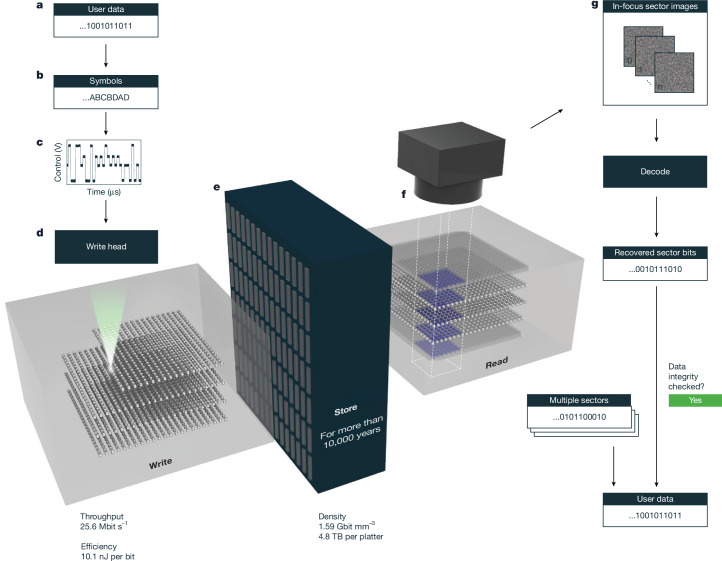
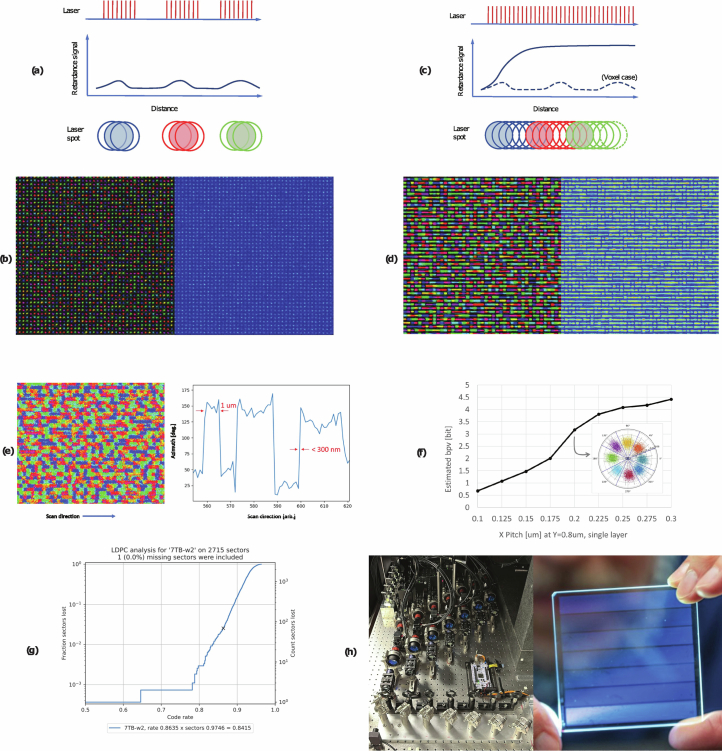
Long-term preservation of digital information is vital for safeguarding the knowledge of humanity for future generations. Existing archival storage solutions, such as magnetic tapes and hard disk drives, suffer from limited media lifespans that render them unsuitable for long-term data retention1–3. Optical storage approaches, particularly laser writing in robust media such as glass, have emerged as promising alternatives with the potential for increased longevity. Previous work4–16 has predominantly optimized individual aspects such as data density but has not demonstrated an end-to-end system, including writing, storing and retrieving information. Here we report an optical archival storage technology based on femtosecond laser direct writing in glass that addresses the practical demands of archival storage, which we call Silica. We achieve a data density of 1.59 Gbit mm−3 in 301 layers for a capacity of 4.8 TB in a 120 mm square, 2 mm thick piece of glass. The demonstrated write regimes enable a write throughput of 25.6 Mbit s−1 per beam, limited by the laser repetition rate, with an energy efficiency of 10.1 nJ per bit. Moreover, we extend the storage ability to borosilicate glass, offering a lower-cost medium and reduced writing and reading complexity. Accelerated ageing tests on written voxels in borosilicate suggest data lifetimes exceeding 10,000 years. An optical archival storage technology based on femtosecond laser direct writing in glass addresses the practical demands of archival storage.
Verified 2026-11-22 · 1 reference not checked yet
Overview
CoChat Summary
## TL;DR
Silica is an end-to-end archival storage system based on femtosecond laser writing in glass that writes, reads, and decodes data with fully automated hardware and machine-learning-based decoding. The paper reports up to 1.59 Gbit mm−3 density, 25.6 Mbit s−1 write throughput per beam, 10.1 nJ per bit write efficiency, and an extrapolated data lifetime exceeding 10,000 years.
## Key findings
- Using birefringent voxels in fused silica, the system achieves 1.59 Gbit mm−3 data density, 4.84 TB per platter usable capacity, 301 layers, 0.500 μm × 0.485 μm voxel pitch, 25.6 Mbit s−1 write throughput, and 10.1 nJ per bit write efficiency.
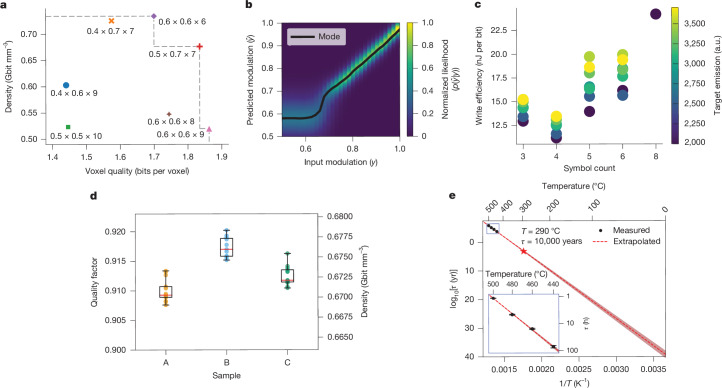
- Using phase voxels in borosilicate, the system achieves 0.678 Gbit mm−3, 2.02 TB per platter, 258 layers, 0.5 μm × 0.7 μm voxel pitch, 18.4 Mbit s−1 throughput, and 8.85 nJ per bit write efficiency.
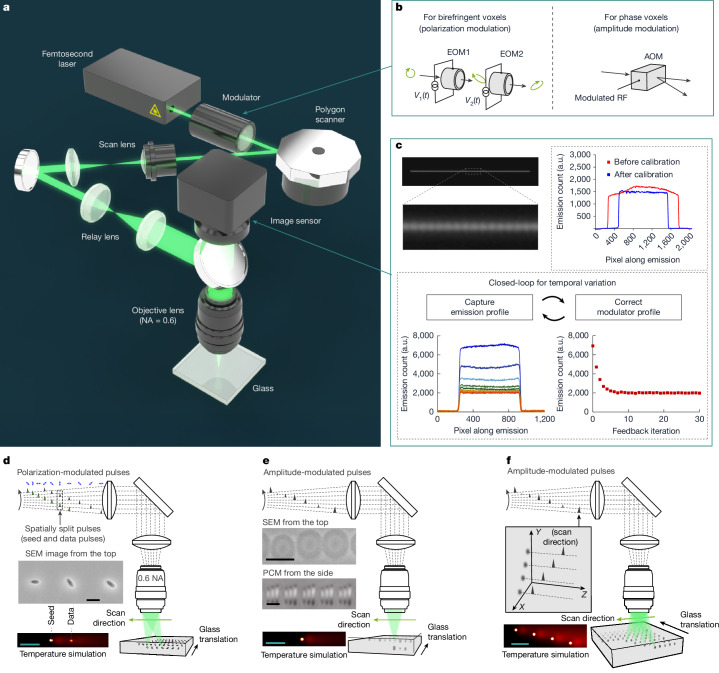
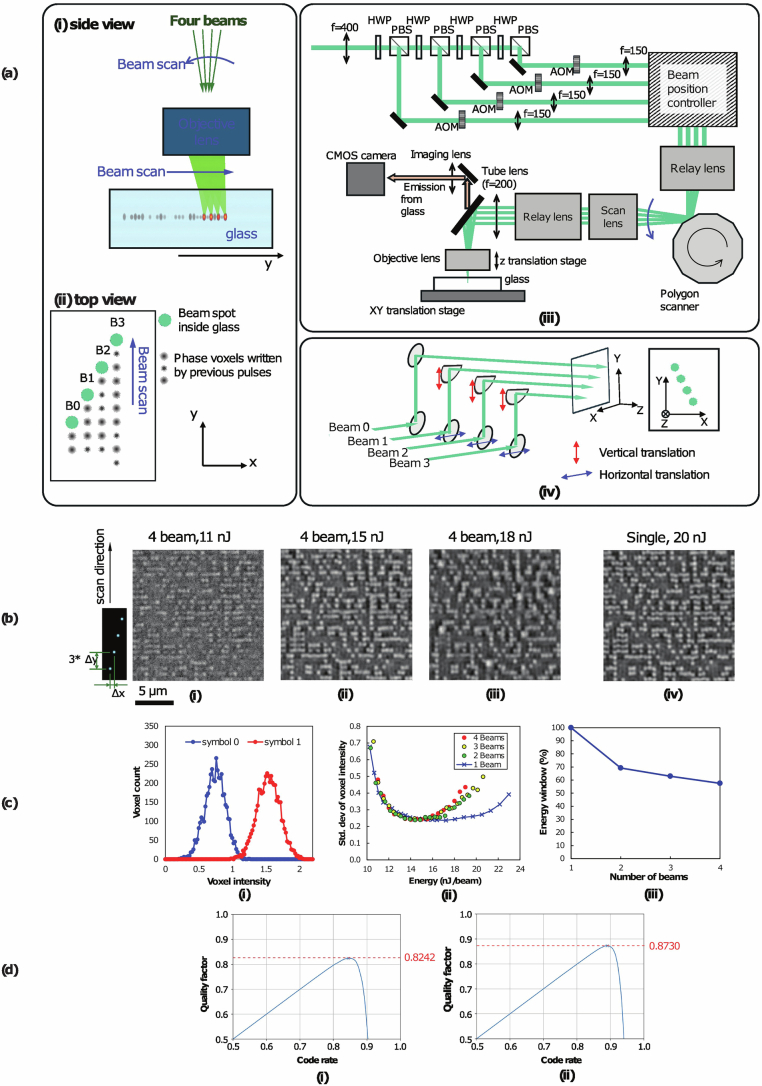
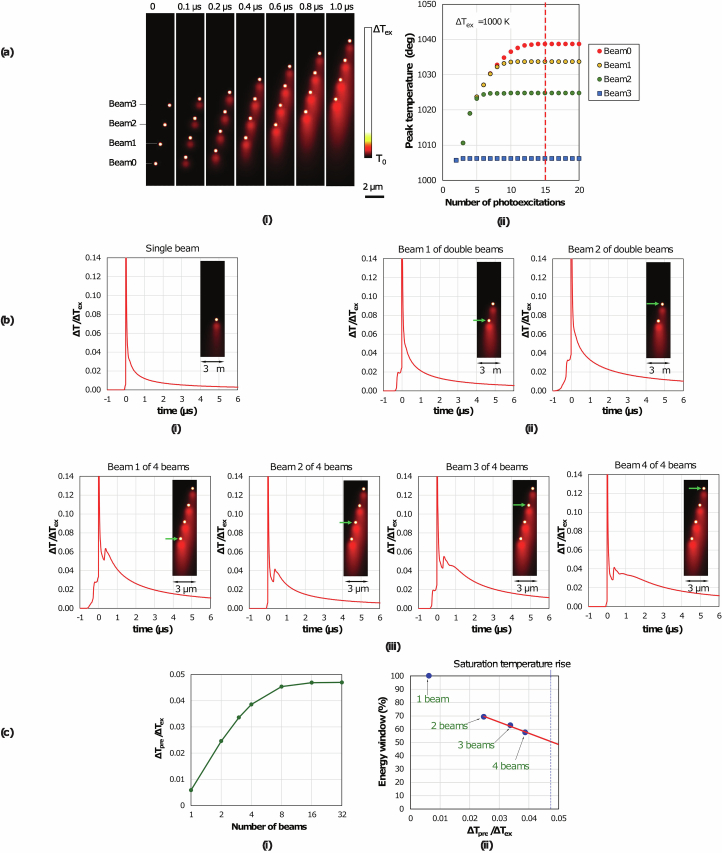
- A four-beam multibeam writing setup reaches 65.9 Mbit s−1 without thermal damage; the authors state thermal simulations suggest 16 or more beams should be possible.
- Accelerated ageing of phase voxels suggests modification lifetimes exceeding 10,000 years at 290 °C, implying even longer at room temperature.
## Methods
- End-to-end archival system built around femtosecond laser direct writing in glass, with two voxel regimes: birefringent voxels in fused silica and phase voxels in borosilicate.
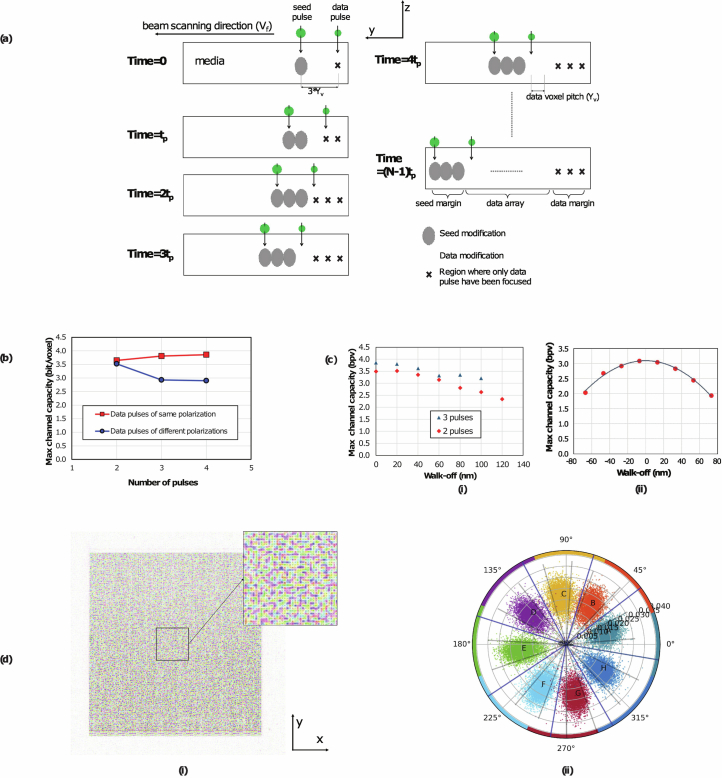
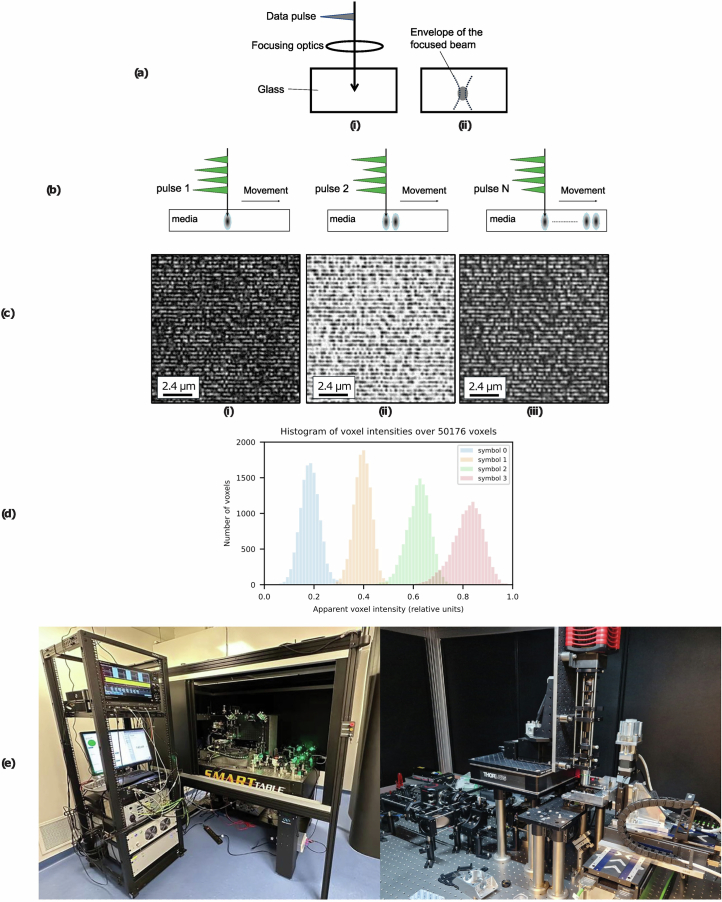
- Writing uses a 10 MHz laser and polygon scanning; birefringent writing uses pseudo-single-pulse seed/data pulses and polarization modulation, while phase writing uses single-pulse amplitude modulation and a multibeam variant with four independently modulated beams.
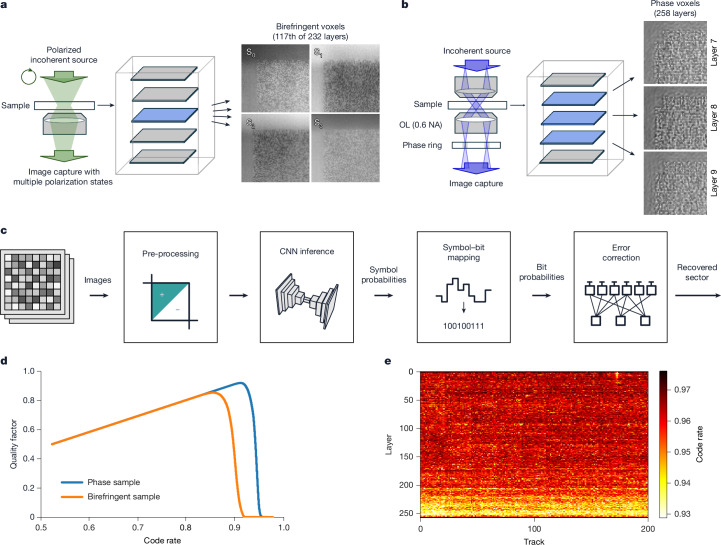
- Reading uses wide-field microscopy: polarization-resolved imaging for birefringent voxels and Zernike phase-contrast microscopy for phase voxels.
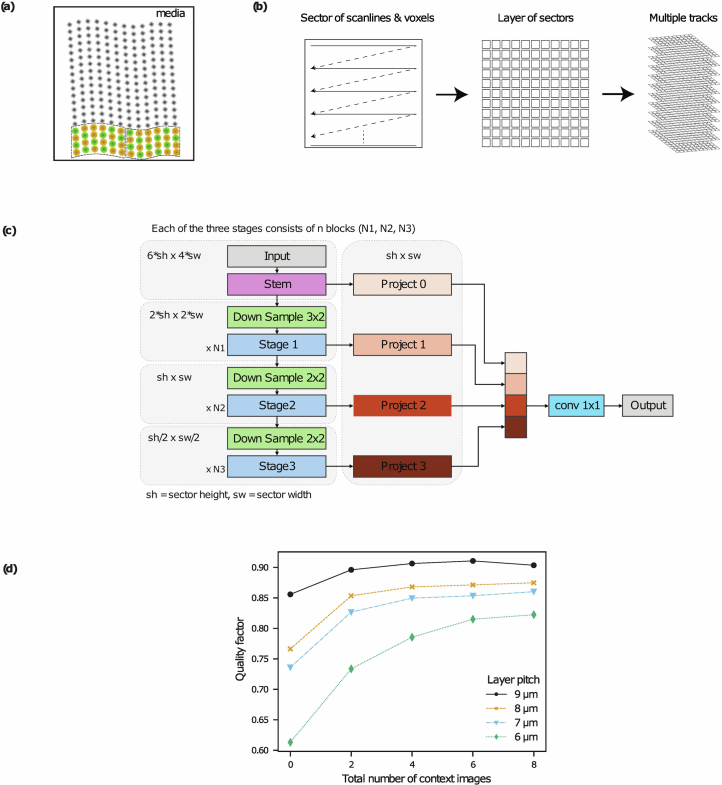
- Decoding uses a CNN plus LDPC and erasure coding; the paper also optimizes symbol sets and modulation levels using mutual information and Pareto-front style trade-offs.
## Limitations
- The lifetime test for phase voxels reflects thermal stability under isolated conditions and “does not account for external influences, such as mechanical stress or chemical corrosion” (stated in the paper).
- For phase voxels, Zernike phase contrast has inherently poor optical sectioning, increasing axial cross-talk; the authors mitigate this with dual-image acquisition (stated in the paper).
- The paper notes that read throughput was not considered because it is “not a significant cost component” of the system (text makes evident that read-speed performance was not fully evaluated here).
Model-written summary. Check it against the paper before relying on it.
Integrity signals
Registry
Cites
Statistics
Figures
Verification
Claims the paper makes
11 Valid · 7 Not valid · 17 Not checked · 65 Own results and interpretations
Some cited sources support this claim and some don’t — read each source’s verdict below.
In the paper
“Previous work4–16 has predominantly optimized individual aspects such as data density but has not demonstrated an end-to-end system, including writing, storing and retrieving information.”
§ Laser writing in glass for dense, fast and efficient archival data storage > Abstract
What the sources say
- Not checked — no full text of the sourcecites [4] Glezer, E. N. et al. Three-dimensional optical storage inside transparent materials. Opt. Lett. 21, 2023–2025 (1996). 19881880 source
- Not checked — no full text of the sourcecites [5] Taylor, R., Hnatovsky, C. & Simova, E. Applications of femtosecond laser induced self-organized planar nanocracks inside fused silica glass. Laser Photonics Rev. 2, 26–46 (2008). source
- Not checked — no full text of the sourcecites [6] Shimotsuma, Y. et al. Ultrafast manipulation of self-assembled form birefringence in glass. Adv. Mater. 22, 4039–4043 (2010). 20734374 source
- Not checked — no full text of the sourcecites [7] Zhang, J., Gecevičius, M., Beresna, M. & Kazansky, P. G. Seemingly unlimited lifetime data storage in nanostructured glass. Phys. Rev. Lett. 112, 033901 (2014). 24484138 source
- Disputedcites [8] Zhang, Q., Xia, Z. & Gu, M. High-capacity optical long data memory based on enhanced Young’s modulus in nanoplasmonic hybrid glass composites. Nat. Commun. 9, 1183 (2018). 29568055 PMC5864957 sourceExperimental — accuracy not yet measured
The Results section, “Long data memory in nanoplasmonic hybrid glass composites” (page unavailable), describes recording patterns, testing their storage through accelerated aging, and reading and comparing the retrieved images. This contradicts the claim that this work demonstrated only an individual aspect such as density and not writing, storing, and retrieving information. The 600-year storage period was simulated by accelerated aging, not observed in real time. (LLM, conf=0.88)
Checked by a reasoning model — may be wrong.
- Partly supportedcites [9] Sakakura, M., Lei, Y., Wang, L., Yu, Y.-H. & Kazansky, P. G. Ultralow-loss geometric phase and polarization shaping by ultrafast laser writing in silica glass. Light Sci. Appl. 9, 15 (2020). 32047624 PMC7000703 sourceExperimental — accuracy not yet measured
The Discussion (page unavailable) says the paper's low-loss birefringent modification enables high-density multiplex data storage in silica glass. It does not assess whether previous work predominantly optimized individual aspects or establish that no end-to-end writing, storage and retrieval system had been demonstrated. (LLM, conf=0.70)
- Not checked yetcites [10] Lei, Y. et al. High speed ultrafast laser anisotropic nanostructuring by energy deposition control via near-field enhancement. Optica 8, 1365–1371 (2021). source
Checked before — its earlier verdict is held back until a new check runs.
- Not checked — no full text of the sourcecites [11] Gao, J., Yan, Z., Wang, H. & Zhang, J. Rapid generation of birefringent nanostructures by spatially and energy manipulated femtosecond lasers for ultra-high speed 5D optical recording exceeding MB/s. Opt. Express 32, 32879–32894 (2024). 39573003 source
- Not checked — no full text of the sourcecites [12] Gao, L., Zhang, Q., Evans, R. A. & Gu, M. 4D ultra-high-density long data storage supported by a solid-state optically active polymeric material with high thermal stability. Adv. Opt. Mater. 9, 2100487 (2021). source
- Not checked — no full text of the sourcecites [13] Ryan, C. et al. Roll-to-roll fabrication of multilayer films for high capacity optical data storage. Adv. Mater. 24, 5222–5226 (2012). 22791315 source
plain- Asserted: passes — The authors put it forward as true.
- Checkable: passes — It can be checked against evidence.
- Load-bearing: passes — The paper’s conclusions depend on it.
- Based: passes — The paper gives a reason why it holds.
The sources with a verdict support this claim; the rest weren’t checked yet, have no full text we could read, or their verdicts aren’t rated yet.
In the paper
“Three types of birefringent voxels have been observed in fused silica glass. Our preferred type is elongated nanovoids10, which we discuss in detail below. Alternatively, we can use either (1) nanogratings5–7,29 or (2) ensembles of elongated nanopores9.”
§ Laser writing in glass for dense, fast and efficient archival data storage > Writing data > Pseudo-single-pulse writing of birefringent voxels
What the sources say
- Not checked yetcites [10] Lei, Y. et al. High speed ultrafast laser anisotropic nanostructuring by energy deposition control via near-field enhancement. Optica 8, 1365–1371 (2021). source
Checked before — its earlier verdict is held back until a new check runs.
- Not checked — no full text of the sourcecites [5] Taylor, R., Hnatovsky, C. & Simova, E. Applications of femtosecond laser induced self-organized planar nanocracks inside fused silica glass. Laser Photonics Rev. 2, 26–46 (2008). source
- Not checked — no full text of the sourcecites [6] Shimotsuma, Y. et al. Ultrafast manipulation of self-assembled form birefringence in glass. Adv. Mater. 22, 4039–4043 (2010). 20734374 source
- Not checked — no full text of the sourcecites [7] Zhang, J., Gecevičius, M., Beresna, M. & Kazansky, P. G. Seemingly unlimited lifetime data storage in nanostructured glass. Phys. Rev. Lett. 112, 033901 (2014). 24484138 source
- Not checked — no full text of the sourcecites [29] Shimotsuma, Y., Kazansky, P. G., Qiu, J. & Hirao, K. Self-organized nanogratings in glass irradiated by ultrashort light pulses. Phys. Rev. Lett. 91, 247405 (2003). 14683157 source
- Supportedcites [9] Sakakura, M., Lei, Y., Wang, L., Yu, Y.-H. & Kazansky, P. G. Ultralow-loss geometric phase and polarization shaping by ultrafast laser writing in silica glass. Light Sci. Appl. 9, 15 (2020). 32047624 PMC7000703 source
The Results section reports randomly distributed nanopores in silica glass that become elongated and produce birefringence. This supports the elongated-nanopore type for which this paper is cited; the other types have separate citations in the citing sentence. Page numbers are unavailable in our copy. (LLM, conf=0.92)
plain- Asserted: passes — The authors put it forward as true.
- Checkable: passes — It can be checked against evidence.
- Load-bearing: passes — The paper’s conclusions depend on it.
- Based: passes — The paper gives a reason why it holds.
- Not checked yet
The sources with a verdict support this claim; the rest weren’t checked yet, have no full text we could read, or their verdicts aren’t rated yet.
In the paper
“Existing works are limited in throughput and efficiency, in part because many rely on multiple laser pulses per voxel10,24–26.”
§ Laser writing in glass for dense, fast and efficient archival data storage > Writing data
What the sources say
- Not checked yetcites [10] Lei, Y. et al. High speed ultrafast laser anisotropic nanostructuring by energy deposition control via near-field enhancement. Optica 8, 1365–1371 (2021). source
Checked before — its earlier verdict is held back until a new check runs.
- Supportedcites [24] Lei, Y. et al. Efficient ultrafast laser writing with elliptical polarization. Light Sci. Appl. 12, 74 (2023). 36918535 PMC10015004 source
In Results and discussion (page unavailable), the paper says dozens of laser pulses are required to record one birefringent voxel. It also reports that reducing the pulse count from 30 to 20 yields about 1.5 times higher data-writing speed, supporting the claimed link between multiple pulses per voxel and limited throughput. (LLM, conf=0.88)
- Supportedcites [25] Wang, H. et al. 100-layer error-free 5d optical data storage by ultrafast laser nanostructuring in glass. Laser Photonics Rev. 16, 2100563 (2022). source
In §2.2 (page unavailable), the paper reports writing voxels with up to 30 pulses and links reducing the pulse count to a higher recording speed. The Conclusion (page unavailable) likewise proposes reducing the pulse number as part of a route to faster writing. It therefore supports the cited point as an example of multipulse-per-voxel work whose throughput is constrained in part by pulse count. (LLM, conf=0.87)
- Supportedcites [26] Yao, H., Pugliese, D., Lancry, M. & Dai, Y. Ultrafast laser direct writing nanogratings and their engineering in transparent materials. Laser Photonics Rev. 18, 2300891 (2024). source
In §2.6.1, “5D Optical Data Storage” (page unavailable), the review says a storage technology has low writing speed and high energy consumption because it requires many pulses, and contrasts this with technologies needing few pulses per voxel or ideally one. This supports the attributed link between multiple pulses and limited throughput and efficiency in the optical-storage context. (LLM, conf=0.88)
plainstates a cause- Asserted: passes — The authors put it forward as true.
- Checkable: passes — It can be checked against evidence.
- Load-bearing: passes — The paper’s conclusions depend on it.
- Based: passes — The paper gives a reason why it holds.
- Not checked yet
The cited sources support only part of this claim — read each source’s verdict below.
In the paper
“The optimal operating parameters for Silica are expected to vary with glass composition21 because the intrinsic material properties influence voxel formation behaviour.”
§ Laser writing in glass for dense, fast and efficient archival data storage > Silica system analysis > Optimizing parameters at each pitch
What the sources say
- Partly supportedcites [21] Ktafi, I. et al. A new approach toward extreme thermal stability of femtosecond laser induced modifications in glasses. Laser Photonics Rev. 19, 2401086 (2025). sourceExperimental — accuracy not yet measured
Section 3.1 reports the laser-written response across silica, aluminosilicate, and zirconium aluminosilicate glasses as pulse energy changes; Section 4 describes different structures formed in those compositions. This supports the expectation that composition affects modification formation, but the paper does not establish composition-specific optimal operating parameters or discuss voxel formation explicitly. (LLM, conf=0.82)
hedgedstates a possible cause- Asserted: passes — The authors put it forward as true.
- Checkable: passes — It can be checked against evidence.
- Load-bearing: unclear — It is unclear whether the paper’s conclusions depend on it.
- Based: passes — The paper gives a reason why it holds.
- Partly supported
The cited sources support only part of this claim — read each source’s verdict below.
In the paper
“White light emission arises during writing from the generation of a dense and hot plasma during voxel formation28.”
§ Laser writing in glass for dense, fast and efficient archival data storage > Methods > Write
What the sources say
- Partly supportedcites [28] Jürgens, P., Garcia, C. L., Balling, P., Fennel, T. & Mermillod-Blondin, A. Diagnostics of fs laser-induced plasmas in solid dielectrics. Laser Photonics Rev. 18, 2301114 (2024). sourceExperimental — accuracy not yet measured
The Introduction says ultrashort laser irradiation can turn a dielectric into a dense, hot plasma. Section 2.1.2 describes plasma emission during glass processing and laser writing, but does not identify that emission as white light or specifically connect it to voxel formation; it also notes that some emission can come from point defects. (LLM, conf=0.82)
plainstates a cause- Asserted: passes — The authors put it forward as true.
- Checkable: passes — It can be checked against evidence.
- Load-bearing: unclear — It is unclear whether the paper’s conclusions depend on it.
- Based: passes — The paper gives a reason why it holds.
- Partly supported
45 more claims
Create a free account to see all 100 claims and to verify the 13 references still open.
- It may state two separate claims as one. 34
- Probably not a substantial claim. 21
Citations
Cites
Writing waveguides in glass with a femtosecond laser
Davis, K. M., Miura, K., Sugimoto, N., & Hirao, K. (1996) · Optics Letters · doi:10.1364/ol.21.001729 · Cited by 2,622
Self-Organized Nanogratings in Glass Irradiated by Ultrashort Light Pulses
Shimotsuma, Y., Kazansky, P. G., Qiu, J., & Hirao, K. (2003) · Physical Review Letters · doi:10.1103/physrevlett.91.247405 · Cited by 1,292
Phase contrast, a new method for the microscopic observation of transparent objects
Zernike, F. (1942) · Physica · doi:10.1016/s0031-8914(42)80035-x · Cited by 1,068
Three-dimensional optical storage inside transparent materials
Glezer, E. N., Milosavljevic, M., Huang, L., Finlay, R. J., Her, T.-H., Callan, J. P., & Mazur, E. (1996) · Optics Letters · doi:10.1364/ol.21.002023 · Cited by 985
Three-dimensional optical data storage in refractive media by two-photon point excitation
Strickler, J. H., & Webb, W. W. (1991) · Optics Letters · doi:10.1364/ol.16.001780 · Cited by 627
Seemingly Unlimited Lifetime Data Storage in Nanostructured Glass
Zhang, J., Gecevičius, M., Beresna, M., & Kazansky, P. G. (2014) · Physical Review Letters · doi:10.1103/physrevlett.112.033901 · Cited by 414
Applications of femtosecond laser induced self‐organized planar nanocracks inside fused silica glass
Taylor, R., Hnatovsky, C., & Simova, E. (2008) · Laser & Photonics Reviews · doi:10.1002/lpor.200710031 · Cited by 345
Techniques for fast and sensitive measurements of two-dimensional birefringence distributions
Shribak, M., & Oldenbourg, R. (2003) · Applied Optics · doi:10.1364/ao.42.003009 · Cited by 324
Ultralow-loss geometric phase and polarization shaping by ultrafast laser writing in silica glass
Sakakura, M., Lei, Y., Wang, L., Yu, Y.-H., & Kazansky, P. G. (2020) · Light: Science & Applications · doi:10.1038/s41377-020-0250-y · Cited by 265
Self-citationWriting of permanent birefringent microlayers in bulk fused silica with femtosecond laser pulses
Sudrie, L., Franco, M., Prade, B., & Mysyrowicz, A. (1999) · Optics Communications · doi:10.1016/s0030-4018(99)00562-3 · Cited by 252
Aberration correction for confocal imaging in refractive‐index‐mismatched media
Booth, M. J., Neil, M. A. A., & Wilson, T. (1998) · Journal of Microscopy · doi:10.1111/j.1365-2818.1998.99999.x · Cited by 248
Ultrafast Manipulation of Self‐Assembled Form Birefringence in Glass
Shimotsuma, Y., Sakakura, M., Kazansky, P. G., Beresna, M., Qiu, J., Miura, K., & Hirao, K. (2010) · Advanced Materials · doi:10.1002/adma.201000921 · Cited by 247
Self-citationWILSON, T. (2011) · Journal of Microscopy · doi:10.1111/j.1365-2818.2011.03549.x · Cited by 237
Fundamentals of Inorganic Glassmaking
Varshneya, A. K. (1994) · Fundamentals of Inorganic Glasses · doi:10.1016/b978-0-08-057150-8.50025-2 · Cited by 192
OpenAirInterface: Democratizing innovation in the 5G Era
Kaltenberger, F., Silva, A. P., Gosain, A., Wang, L., & Nguyen, T.-T. (2020) · Computer Networks · doi:10.1016/j.comnet.2020.107284 · Cited by 147
Understanding latent sector errors and how to protect against them
Schroeder, B., Damouras, S., & Gill, P. (2010) · ACM Transactions on Storage · doi:10.1145/1837915.1837917 · Cited by 131
Disk scrubbing in large archival storage systems
Schwarz, T. J. E., Xin, Q., Miller, E. L., Long, D. D. E., Hospodor, A., & Ng, S. (2004) · The IEEE Computer Society's 12th Annual International Symposium on Modeling, Analysis, and Simulation of Computer and Telecommunications Systems, 2004. (MASCOTS 2004). Proceedings. · doi:10.1109/mascot.2004.1348296 · Cited by 128
100‐Layer Error‐Free 5D Optical Data Storage by Ultrafast Laser Nanostructuring in Glass
Wang, H., Lei, Y., Wang, L., Sakakura, M., Yu, Y., Shayeganrad, G., & Kazansky, P. G. (2022) · Laser & Photonics Reviews · doi:10.1002/lpor.202100563 · Cited by 123
Self-citationUltrafast Laser Direct Writing Nanogratings and their Engineering in Transparent Materials
Yao, H., Pugliese, D., Lancry, M., & Dai, Y. (2024) · Laser & Photonics Reviews · doi:10.1002/lpor.202300891 · Cited by 115
Lei, Y., Sakakura, M., Wang, L., Yu, Y., Wang, H., Shayeganrad, G., & Kazansky, P. G. (2021) · Optica · doi:10.1364/optica.433765 · Cited by 95
Self-citationZhang, Q., Xia, Z., Cheng, Y.-B., & Gu, M. (2018) · Nature Communications · doi:10.1038/s41467-018-03589-y · Cited by 87
Wilson, T. (1985) · Scanning · doi:10.1002/sca.4950070203 · Cited by 87
Roll‐to‐Roll Fabrication of Multilayer Films for High Capacity Optical Data Storage
Ryan, C., Christenson, C. W., Valle, B., Saini, A., Lott, J., Johnson, J., Schiraldi, D., Weder, C., Baer, E., Singer, K. D., et al. (2012) · Advanced Materials · doi:10.1002/adma.201200669 · Cited by 61
Efficient ultrafast laser writing with elliptical polarization
Lei, Y., Shayeganrad, G., Wang, H., Sakakura, M., Yu, Y., Wang, L., Kliukin, D., Skuja, L., Svirko, Y., & Kazansky, P. G. (2023) · Light: Science & Applications · doi:10.1038/s41377-023-01098-2 · Cited by 48
Self-citationUltrafast Laser Writing in Different Types of Silica Glass
Lei, Y., Wang, H., Skuja, L., Kühn, B., Franz, B., Svirko, Y., & Kazansky, P. G. (2023) · Laser & Photonics Reviews · doi:10.1002/lpor.202200978 · Cited by 31
Gao, L., Zhang, Q., Evans, R. A., & Gu, M. (2021) · Advanced Optical Materials · doi:10.1002/adom.202100487 · Cited by 28
Practical scrubbing: Getting to the bad sector at the right time
Amvrosiadis, G., Oprea, A., & Schroeder, B. (2012) · IEEE/IFIP International Conference on Dependable Systems and Networks (DSN 2012) · doi:10.1109/dsn.2012.6263919 · Cited by 20
Diagnostics of fs Laser‐Induced Plasmas in Solid Dielectrics
Jürgens, P., Garcia, C. L., Balling, P., Fennel, T., & Mermillod‐Blondin, A. (2024) · Laser & Photonics Reviews · doi:10.1002/lpor.202301114 · Cited by 14
Project Silica: Towards Sustainable Cloud Archival Storage in Glass
Anderson, P., Aranas, E., Assaf, Y., Behrendt, R., Black, R., Caballero, M., Cameron, P., Canakci, B., Chatzieleftheriou, A., Clarke, R., et al. (2025) · ACM Transactions on Storage · doi:10.1145/3708996 · Cited by 13
Self-citationGao, J., Yan, Z., Wang, H., & Zhang, J. (2024) · Optics Express · doi:10.1364/oe.530732 · Cited by 11
Ktafi, I., Kong, J., Cavillon, M., Poumellec, B., Yembele, M., Valois, R., Allix, M., Peng, G., & Lancry, M. (2025) · Laser & Photonics Reviews · doi:10.1002/lpor.202401086 · Cited by 10
100-Layer recording in fused silica for semi permanent data storage
Imai, R., Shiozawa, M., Shintani, T., Watanabe, T., Mori, S., Shimotsuma, Y., Sakakura, M., Miura, K., & Watanabe, K. (2015) · Japanese Journal of Applied Physics · doi:10.7567/jjap.54.09mc02 · Cited by 9
Self-citationLoopless Gray code enumeration and the Tower of Bucharest
Herter, F., & Rote, G. (2018) · Theoretical Computer Science · doi:10.1016/j.tcs.2017.11.017 · Cited by 9
RASCAL: A Scalable, High-redundancy Robot for Automated Storage and Retrieval Systems
Black, R. T., Caballero, M., Chatzieleftheriou, A., Deegan, T., Heard, P., Hong, F., Joyce, R., Legtchenko, S., Rowstron, A. I. T., Smith, A., et al. (2024) · Proceedings - IEEE International Conference on Robotics and Automation/Proceedings · doi:10.1109/icra57147.2024.10610551 · Cited by 1
Self-citation
Research works printed but not linked: 4
- Ashby, M. & Jones, D. Engineering Materials 1: An Introduction to Properties, Applications and Design 3rd edn (Elsevier, 2005).
- Anderson, P. et al. Glass: a new media for a new era? In Proc. 10th USENIX Conference on Hot Topics in Storage and File Systems 13 (USENIX Association, 2018).
- MacKay, D. J. C. Information Theory, Inference and Learning Algorithms (Cambridge Univ. Press, 2003).
- Kingma, D. P. & Ba, J. Adam: a method for stochastic optimization. In Proc. 3rd International Conference on Learning Representations (ICLR) (2015).
Cited by
Property-driven analysis of glasses for data storage via femtosecond laser writing
Lawson, T., Drevinskas, R., Sakakura, M., Whittaker, C., Donnelly, A., Thomsen, B. C., & Black, R. (2026) · Optica · doi:10.1364/optica.592661 · Cited by 4
Self-citationLaser Matter Interactions Inside the Bulk of Materials: Silicon’s Perspective
Das, A. (2026) · IntechOpen eBooks · doi:10.5772/intechopen.1017473
Terasawa, E., Satoh, D., Shibuya, T., Ogawa, H., Tanaka, M., & Kuroda, R. (2026) · Optics Continuum · doi:10.1364/optcon.612354
Liu, S.-J., & Wang, Y.-W. (2026) · Manufacturing Letters · doi:10.1016/j.mfglet.2026.07.082
ЦАРЕВ, В. С., Pryamikov, A., Алагашев, Г. К., & Охримчук, А. Г. (2026) · Physics of Wave Phenomena · doi:10.3103/s1541308x26700123
Metadata
- Authors
- Microsoft Research Project Silica Team, Allison, J., Anderson, P., Aranas, E., Assaf, Y., Black, R., Caballero, M., Canakci, B., Chattaway, J. A., Chatzieleftheriou, A., Clegg, J., Cletheroe, D., Cooper, B., Deegan, T., Donnelly, A., Drevinskas, R., Feng, Z., Gkantsidis, C., Gomez Diaz, A., Haller, I., Hong, F., Ilieva, T., Joyce, R., Kapitany, V., Kunkel, M., Lara, D., Lawson, T., Legtchenko, S., Liu, F., Liu, X., Magalhaes, B., Nowozin, S., Overweg, H., Rowstron, A., Sakakura, M., Schreiner, N., Smith, A., Snowdon, O., Stefanovici, I., Sweeney, D., Verkes, G., Wainman, P., Whittaker, C., Wilke Berenguer, P., Williams, H., Winkler, T., & Winzeck, S.
- Affiliations
- Microsoft Research (United Kingdom) (GB)
- Corresponding author
- Black, Richard
- Donnelly, Austin
- Stefanovici, Ioan
- ORCID
- Allison, James
- Anderson, Patrick
- Aranas, Erika
- Assaf, Youssef
- Black, Richard
- Caballero, Marco
- Canakci, Burcu
- Chattaway, John Antony
- Chatzieleftheriou, Andromachi
- Cletheroe, Daniel
- Cooper, Bridgette
- Deegan, Tim
- Donnelly, Austin
- Drevinskas, Rokas
- Feng, Zhonghe
- Gkantsidis, Christos
- Haller, Istvan
- Hong, Freddie
- Ilieva, Teodora
- Joyce, Russell
- Kunkel, Mint
- Lara, David
- Lawson, Takashi
- Legtchenko, Sergey
- Liu, Fanglin
- Liu, Xiaoqi
- Magalhaes, Bruno
- Nowozin, Sebastian
- Overweg, Hiske
- Rowstron, Antony
- Sakakura, Masaaki
- Schreiner, Nina
- Smith, Adam
- Stefanovici, Ioan
- Sweeney, David
- Verkes, Govert
- Wainman, Phil
- Wilke Berenguer, Pablo
- Winkler, Thomas
- Winzeck, Stefan
- Venue
- Nature
- Published
- 2026-02-18
- Volume
- 650
- Issue
- 8102
- Pages
- 606-612
- ISSN
- 0028-0836 (ISSN-L)
- 1476-4687
- PMC
- PMC12916313
- OpenAlex
- W7130374112
- Semantic Scholar
- 365bf1c7c0cba68502d105fe151af925fa09b48e
- Cited by
- 25
- References
- 33
- Citations by year
- 2026: 25
- FWCI
- 70.28
- Type
- journal article
- Language
- en
- Open access
- hybrid
- doi.org
- Licence
- cc-by-nc-nd
- creativecommons.org/licenses/by-nc-nd/4.0 (tdm)
- creativecommons.org/licenses/by-nc-nd/4.0 (vor)
- Locations
- Nature (publishedVersion, cc-by-nc-nd)
- PubMed (publishedVersion)
- PubMed Central (publishedVersion, cc-by-nc-nd)
- Topics
- Physical Sciences › Engineering › Industrial and Manufacturing Engineering › Laser Material Processing Techniques
- Physical Sciences › Materials Science › Materials Chemistry › Phase-change materials and chalcogenides
- Physical Sciences › Computer Science › Computer Networks and Communications › Advanced Data Storage Technologies
- Keywords
- femtosecond laser direct writing, data density, borosilicate glass, data lifetime, accelerated aging, write throughput, energy efficiency, long-term digital preservation, silica
About these checks
Registry, retraction, Cites and statistics results are computed, not judged, with one exception: a printed reference that no index lists is read once by a model before it counts as a citation error. Claims are extracted by a model and kept only when their quote appears verbatim in the text; each cited source is then checked, with a model’s help, for whether it says what the claim relies on. Those verdicts can be wrong — read the claim’s quote and the cited source before relying on one.
The claim verdicts this report counts are experimental: their accuracy is not yet measured.
A language model drew the claims from the paper on 2026-10-11, under version 3 of the claim definition (model deepseek-v4.1-flash, prompt extract-v3).
A second model labelled each claim on 2026-10-11 (model jev-1.13-20260917, definition revision gold-guideline-v0.2).
Cited sources are checked with a language model’s help (gpt-6-sol).
Statistics and arithmetic are recomputed, not judged.
Confidence bands are shown only for fields calibrated on our annotated test set. None is calibrated yet, so no band is shown.
What counts as a claim ›How we measure confidence ›How we check this ›
Are you an author, or do you see a problem with this page? Request a review
Data sources
Bibliographic data: Semantic Scholar, OpenAlex, Crossref.
Contains information from the Semantic Scholar Academic Graph Datasets, made available under the ODC Attribution License (ODC-BY 1.0).
Semantic Scholar’s data is described in: Kinney, R., et al. (2023). The Semantic Scholar Open Data Platform. arXiv:2301.10140.
