

Senolytics improve physical function and increase lifespan in old age
Open accessThe DOI matches its Crossref record; 66 of the 66 references it cites were found in a registry or an index; 7 of the 9 sources its claims cite were checked for support.
Abstract
Physical function declines in old age, portending disability, increased health expenditures, and mortality. Cellular senescence, leading to tissue dysfunction, may contribute to these consequences of aging, but whether senescence can directly drive age-related pathology and be therapeutically targeted is still unclear. Here we demonstrate that transplanting relatively small numbers of senescent cells into young mice is sufficient to cause persistent physical dysfunction, as well as to spread cellular senescence to host tissues. Transplanting even fewer senescent cells had the same effect in older recipients and was accompanied by reduced survival, indicating the potency of senescent cells in shortening health- and lifespan. The senolytic cocktail, dasatinib plus quercetin, which causes selective elimination of senescent cells, decreased the number of naturally occurring senescent cells and their secretion of frailty-related proinflammatory cytokines in explants of human adipose tissue. Moreover, intermittent oral administration of senolytics to both senescent cell-transplanted young mice and naturally aged mice alleviated physical dysfunction and increased post-treatment survival by 36% while reducing mortality hazard to 65%. Our study provides proof-of-concept evidence that senescent cells can cause physical dysfunction and decreased survival even in young mice, while senolytics can enhance remaining health- and lifespan in old mice.
Overview
CoChat Summary
TL;DR
Transplanting small numbers of senescent cells into mice caused persistent physical dysfunction and, in older recipients, reduced survival; intermittent senolytics (dasatinib plus quercetin, D+Q) alleviated dysfunction and extended remaining lifespan in old mice. D+Q also reduced senescent-cell markers and SASP cytokine secretion in human adipose tissue explants.
Key findings
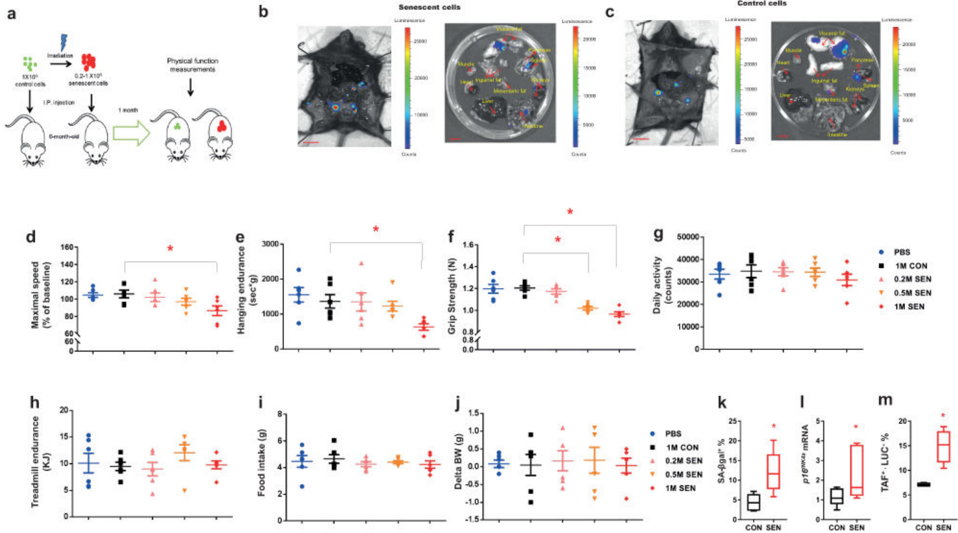
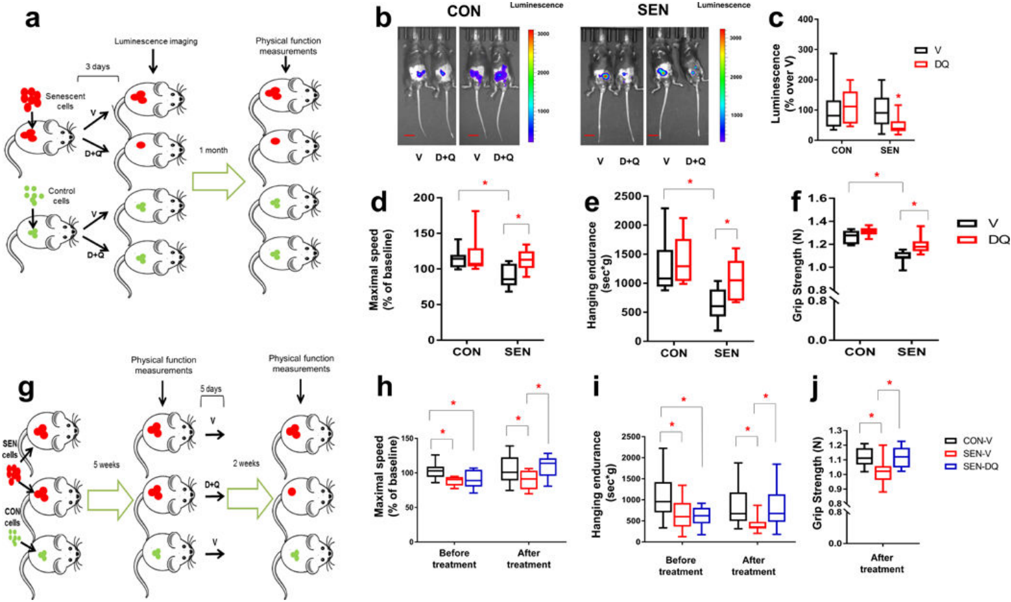
- In young 6-month-old mice, transplanting 10^6 senescent preadipocytes lowered maximal walking speed, hanging endurance, and grip strength by 1 month versus controls; 0.5 × 10^6 senescent cells was sufficient to impair grip strength and walking speed, while 0.2 × 10^6 had no detectable effects. The authors estimate this corresponds to 0.01–0.03% of body cells or 0.28% locally.
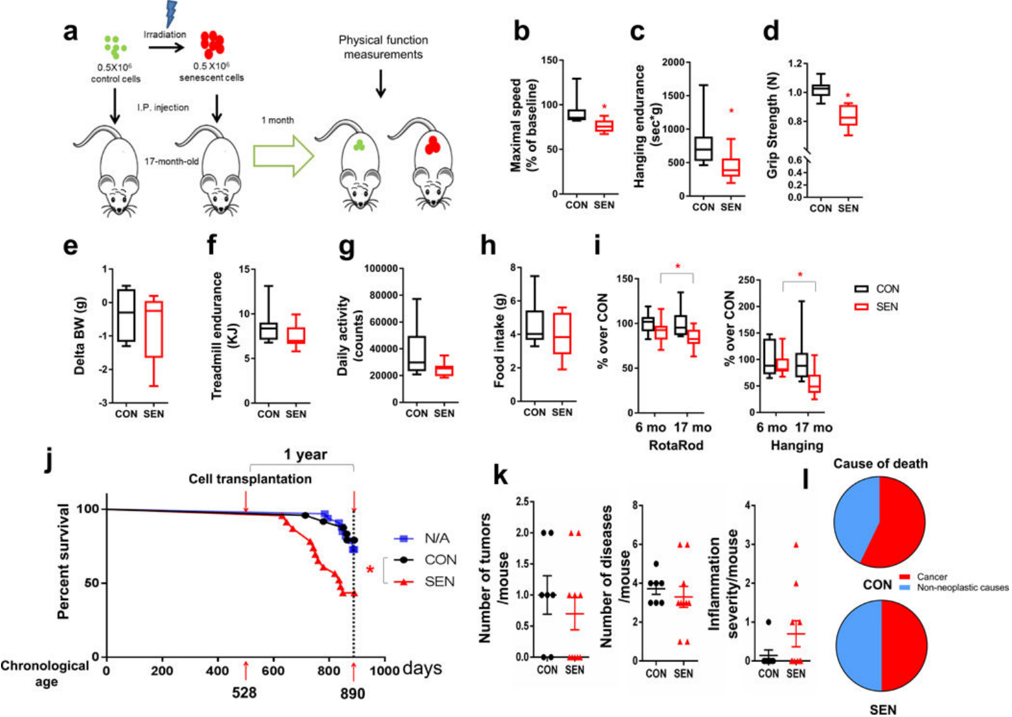
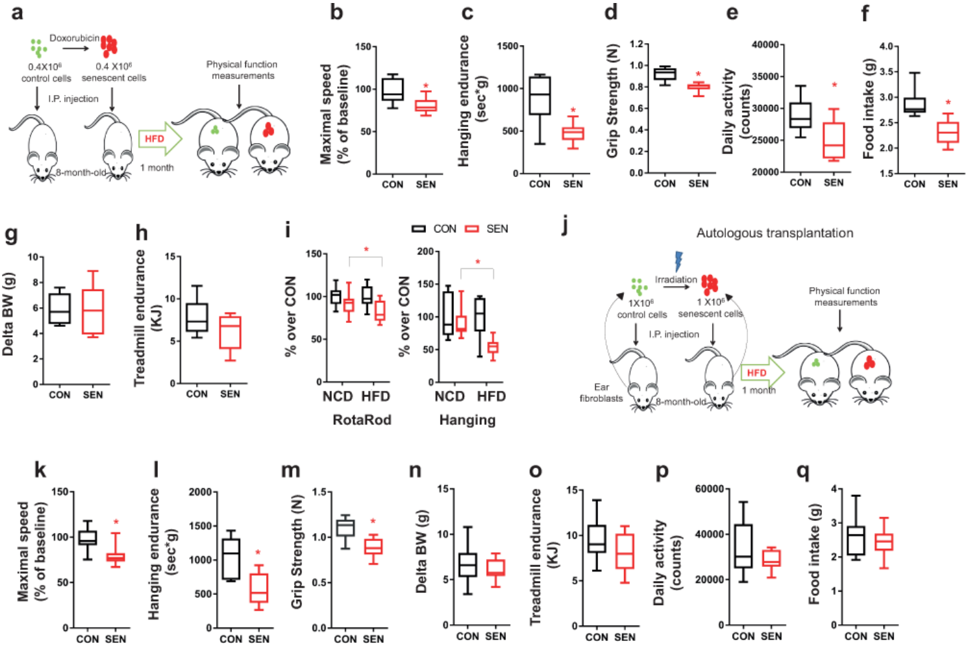
- In 17-month-old mice, 0.5 × 10^6 senescent cells caused lower walking speed, hanging endurance, and grip strength, and was associated with a 5.2-fold higher risk of death over the following year (mortality hazard ratio, P = 0.006). High-fat diet exacerbated senescent-cell-induced dysfunction.
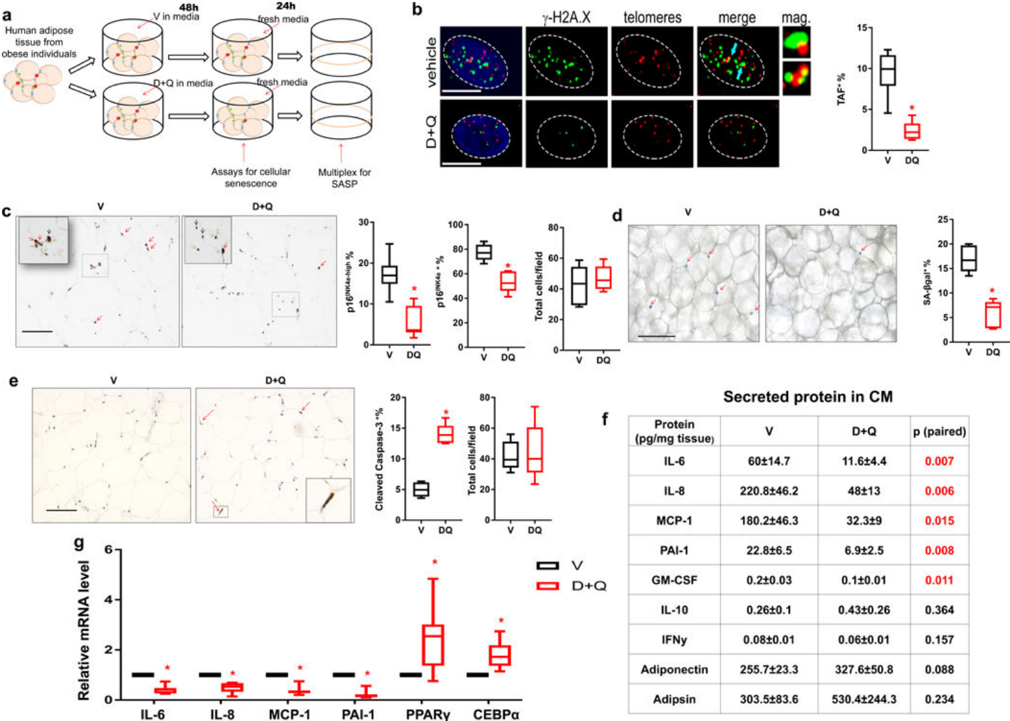
- In human omental adipose tissue explants from 8 obese subjects (BMI 45.5 ± 9.1 kg/m²; age 45.7 ± 8.3 years), D+Q (1 μM dasatinib + 20 μM quercetin) for 48 h reduced TAF+, p16INK4A-high, and SA-βgal+ cells, increased apoptosis, and lowered secretion of IL-6, IL-8, MCP-1, PAI-1, and GM-CSF.
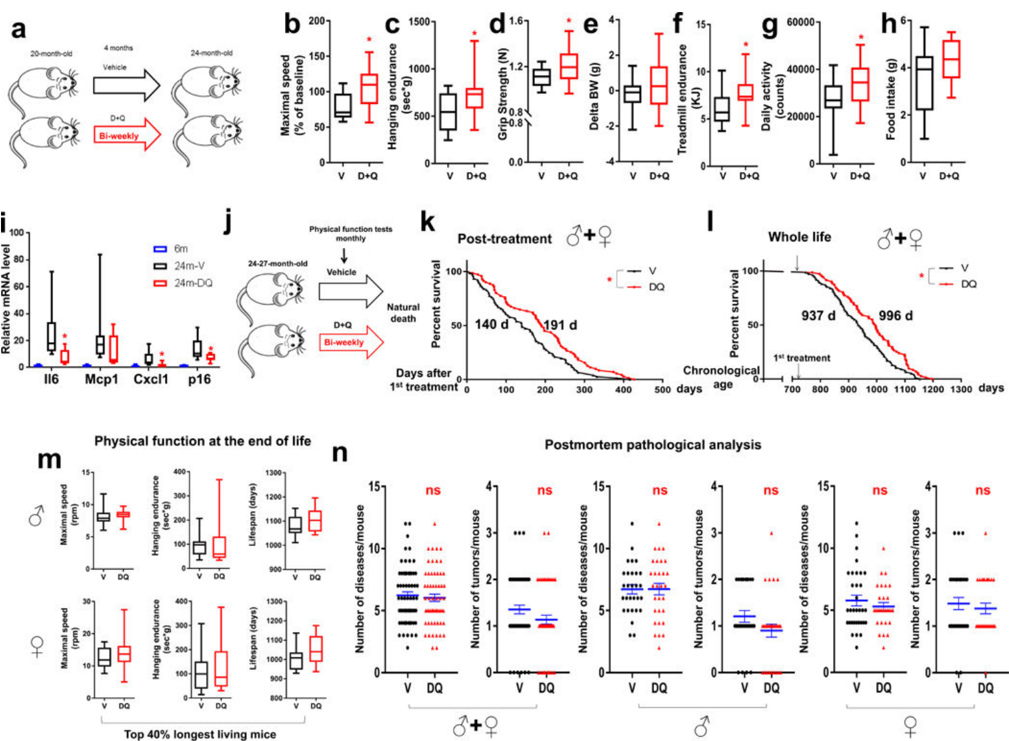
- In aged mice, intermittent D+Q starting at 24–27 months increased median post-treatment lifespan by 36% and reduced mortality hazard to 64.9% (P = 0.01), while physical function in the last 2 months of life was not lower than vehicle-treated mice.
Methods
- Mouse transplantation studies used senescent or control preadipocytes, mainly induced by 10 Gy radiation (>85% senescent), injected intraperitoneally into young (6-month), older (17-month), high-fat-diet, autologous, and SCID-beige models; physical function was assessed by RotaRod, grip strength, hanging test, treadmill, and daily activity/food intake.
- Human omental adipose tissue explants from obese subjects were treated ex vivo with D+Q or vehicle for 48 h, then assessed by SA-βgal, TAF, p16INK4A immunostaining, apoptosis markers, and multiplex cytokine analysis of conditioned medium.
- Aged-mouse studies treated 20-month-old mice with D+Q or vehicle intermittently for 4 months, and 24–27-month-old mice every 2 weeks for 3 consecutive days; survival was analyzed with Cox proportional hazard models, with INK-ATTAC/AP20187 used as a genetic clearance comparison.
Limitations
- The paper states that efficacy of senolytics in tissues from older humans needs to be compared with explants from obese subjects, and that preclinical toxicity studies and optimized regimens are required before trials in relatively healthy humans; it also notes dasatinib can have serious side effects such as pulmonary edema after 8–48 months of daily administration, though mouse side effects may differ from humans.
- The paper states that no statistical power analysis was used; sample sizes were based on previous experiments.
- Evident from the text: the causal transplantation and lifespan evidence is in mice, while the human data are ex vivo adipose explants rather than clinical outcomes; the study also focuses mainly on preadipocytes/adipose tissue and selected senolytic agents.
Model-written summary. Check it against the paper before relying on it.
Integrity signals
Registry
Cites
Statistics
Figures
Verification
Claims the paper makes
3 Valid · 2 Not valid · 1 Not checked · 124 Own results and interpretations
The cited sources support only part of this claim — read each source’s verdict below.
In the paper
“That D+Q can specifically kill senescent cells in human adipose tissue is supported by the following evidence: 1) We previously showed that D+Q induce apoptosis only in senescent human cells, rather than non-senescent control cells in vitro35; 2) D+Q significantly decreased senescent cells by three different assessments, while D+Q did not reduce the overall number of cells in adipose tissue; and 3”
§ Senolytics Improve Physical Function and Increase Lifespan in Old Age > Discussion
What the sources say
- Partly supportedcites [35] 35. Zhu Y The Achilles’ heel of senescent cells: from transcriptome to senolytic drugs Aging Cell 14 644 658 2015 25754370 10.1111/acel.12344 PMC4531078 sourceExperimental — accuracy not yet measured
In Results, 'Candidate senolytic drugs in vitro' (page unavailable), D+Q selectively reduced the viability of senescent human preadipocytes and endothelial cells, while parallel nonsenescent cultures increased in number. The passage supports selective killing, but does not establish that the cell death was specifically apoptosis or that no nonsenescent control cells underwent apoptosis. (LLM, conf=0.86)
plainstates a cause- Asserted: passes — The authors put it forward as true.
- Checkable: passes — It can be checked against evidence.
- Load-bearing: passes — The paper’s conclusions depend on it.
- Based: passes — The paper gives a reason why it holds.
- Partly supported
The cited sources that could be checked couldn’t confirm or dispute this claim.
In the paper
“We used preadipocytes for transplantation since these cells appear to be less susceptible to immune rejection than other cell types26, a reason for their increasing clinical use in cell transplantation studies.”
§ Senolytics Improve Physical Function and Increase Lifespan in Old Age > Discussion
What the sources say
- Could not verifycites [26] 26. Ryan JM Barry FP Murphy JM Mahon BP Mesenchymal stem cells avoid allogeneic rejection J Inflamm (Lond) 2 8 2005 16045800 10.1186/1476-9255-2-8 PMC1215510 sourceExperimental — accuracy not yet measured
The sections “MSC evade allorejection” and “MSC are hypoimmunogenic” discuss reduced immune rejection of mesenchymal stem cells, not preadipocytes. Searches for preadipocytes and adipose-derived cells found no passage in our copy establishing that preadipocytes are less susceptible to rejection than other cell types. (LLM, conf=0.74)
hedgedstates an association- Asserted: passes — The authors put it forward as true.
- Checkable: passes — It can be checked against evidence.
- Load-bearing: passes — The paper’s conclusions depend on it.
- Based: passes — The paper gives a reason why it holds.
- Could not verify
The cited sources support only part of this claim — read each source’s verdict below.
In the paper
“Several studies have shown that the percentage of senescent cells in adipose tissue from aged animals can be up to 2-10%14,15,20, indicating there might be at least 7 million endogenous senescent cells in adipose tissue of aged mice.”
§ Senolytics Improve Physical Function and Increase Lifespan in Old Age > Discussion
What the sources say
- Could not verifycites [14] 14. Xu M JAK inhibition alleviates the cellular senescence-associated secretory phenotype and frailty in old age Proc Natl Acad Sci U S A 112 E6301 6310 2015 26578790 10.1073/pnas.1515386112 PMC4655580 sourceExperimental — accuracy not yet measured
The paper’s Abstract describes a capillary analog of muscle contraction, not senescent cells in adipose tissue. Searches for senescent cells, aged animals, adipose tissue, and the 2–10% figure found no passage addressing the claim. (LLM, conf=0.78)
- Partly supportedcites [15] 15. Xu M Targeting senescent cells enhances adipogenesis and metabolic function in old age Elife 4 e12997 2015 26687007 10.7554/eLife.12997 PMC4758946 sourceExperimental — accuracy not yet measured
The Introduction says senescent cells accumulate in adipose tissue with aging. The Results (Figure 4 caption) say the authors measured the percentage of senescence-marker-positive cells in white adipose tissue from 18-month-old mice, but the available text does not give the claimed 2–10% range. (LLM, conf=0.82)
- Partly supportedcites [20] 20. Baker DJ Naturally occurring p16(Ink4a)-positive cells shorten healthy lifespan Nature 530 184 189 2016 26840489 10.1038/nature16932 PMC4845101 sourceExperimental — accuracy not yet measured
The section “ATTAC clears senescent adipocyte progenitor cells” reports senescence-associated cells in aged mouse adipose tissue, but quantifies X-Gal-positive cells at 1.6% of total inguinal white adipose tissue cells in untreated controls. It does not establish the attributed 2–10% range. (LLM, conf=0.85)
plain- Asserted: passes — The authors put it forward as true.
- Checkable: passes — It can be checked against evidence.
- Load-bearing: unclear — It is unclear whether the paper’s conclusions depend on it.
- Based: passes — The paper gives a reason why it holds.
- Could not verify
The cited sources support only part of this claim — read each source’s verdict below.
In the paper
“D can have side effects, occasionally including serious ones such as pulmonary edema, which can occur after 8-48 months of daily administration55.”
§ Senolytics Improve Physical Function and Increase Lifespan in Old Age > Discussion
What the sources say
- Partly supportedcites [55] 55. Montani D Pulmonary arterial hypertension in patients treated by dasatinib Circulation 125 2128 2137 2012 22451584 10.1161/CIRCULATIONAHA.111.079921 sourceExperimental — accuracy not yet measured
The SCAPs section (page not provided) discusses the risk of side effects from continuous senolytic exposure and identifies dasatinib as a senolytic. It does not identify pulmonary edema as a dasatinib side effect or give an 8–48-month timeframe for daily administration. (LLM, conf=0.84)
plainstates a possible cause- Asserted: passes — The authors put it forward as true.
- Checkable: passes — It can be checked against evidence.
- Load-bearing: passes — The paper’s conclusions depend on it.
- Based: passes — The paper gives a reason why it holds.
- Partly supported
A result the paper reports from its own data — it cites no other source for it, so there is none to check. The quote shows it is in the paper.
In the paper
“D+Q increased expression of PPARγ and CEBPα, two key transcription factors that are required for adipose tissue function through regulating adipogenesis and adipose tissue insulin responsiveness15,37 (Fig. 4g).”
§ Senolytics Improve Physical Function and Increase Lifespan in Old Age > Results > D+Q reduces senescent cell burden and decreases pro-inflammatory cytokine secretion in human adipose tissue
plainstates a cause- Asserted: passes — The authors put it forward as true.
- Checkable: passes — It can be checked against evidence.
- Load-bearing: unclear — It is unclear whether the paper’s conclusions depend on it.
- Based: passes — The paper gives a reason why it holds.
78 more claims
Create a free account to see all 130 claims and every source verdict.
- Probably not a substantial claim. 20
- It may state two separate claims as one. 32
Claims other papers make about this one
Each is checked against this paper’s own text: does it say what the citing paper says it does?
The source backs part of the claim, not all of it — or backs it for a different population, condition or comparison.
In the citing paper
“In preclinical studies, co-administration of Dasatinib and Quercetin (DQ) improved aspects related to physical function (e.g., endurance and speed) and cognition (e.g., reduced neurofibrillary tangle density/neuron loss).7,15,24”
From A pilot study of senolytics to improve cognition and mobility in older adults at risk for Alzheimer's disease (2025) · cites this paper as [7]
Experimental — accuracy not yet measuredThe source backs part of the claim, not all of it — or backs it for a different population, condition or comparison.
In the citing paper
“In 30–70% of senescent cells, this SASP entails pro-inflammatory, proapoptotic and pro-fibrotic factors7,31,40,59–64, some of which can cause previously non-senescent cells to become senescent both locally and at a distance in an endocrine manner24,39,47.”
From Cellular senescence and senolytics: the path to the clinic (2022) · cites this paper as [24]
Experimental — accuracy not yet measuredThe source backs part of the claim, not all of it — or backs it for a different population, condition or comparison.
In the citing paper
“Many such stressors activate DNA damage response signaling and activation of the p53/p21CIP1/WAF1, p16INK4a/retinoblastoma protein or other pathways, resulting in cell cycle arrest and the development of a senescence-associated secretory phenotype (SASP)24,40,48−53”
From Cellular senescence and senolytics: the path to the clinic (2022) · cites this paper as [24]
Experimental — accuracy not yet measuredThe source backs part of the claim, not all of it — or backs it for a different population, condition or comparison.
In the citing paper
“However, if a threshold burden of senescent cells is exceeded, senescent cells can accumulate, perhaps because proapoptotic SASP-expressing senescent cells induce paracrine and endocrine spread of senescence at a rate exceeding immune clearance of preexisting and newly formed senescent cells24,62”
From Cellular senescence and senolytics: the path to the clinic (2022) · cites this paper as [24]
Experimental — accuracy not yet measuredThe source backs part of the claim, not all of it — or backs it for a different population, condition or comparison.
In the citing paper
“This sterile inflammatory state can provoke dysfunction of neighboring and distant non-senescent cells, such as progenitor cells, contributing to impaired tissue function and reduced regenerative capacity18,21,24,26,34.”
From Cellular senescence and senolytics: the path to the clinic (2022) · cites this paper as [24]
Experimental — accuracy not yet measured
55 more claims about this paper
Create a free account to see every claim other papers make about this one.
Self-check
Percentages, sums and reported differences re-computed from the paper’s own numbers.
Each contradiction between two passages listed here was confirmed by an independent check.
Rated minor: it would not touch a result — a value no result rests on, a p-value that stays on the same side of the significance level, or a conflict that is clerical, resolved elsewhere in the paper, or outside its own findings.
In the paper
§ Senolytics Improve Physical Function and Increase Lifespan in Old Age > Results > Clearance of senescent cells alleviates physical dysfunction and increases late-life survival without extending morbidity in aged mice
“concordant with lower secretion of SASP factors by human adipose tissue treated by D+Q (Fig. 4g).”
§ Senolytics Improve Physical Function and Increase Lifespan in Old Age > Results > D+Q reduces senescent cell burden and decreases pro-inflammatory cytokine secretion in human adipose tissue
“D+Q increased expression of PPARγ and CEBPα, two key transcription factors that are required for adipose tissue function through regulating adipogenesis and adipose tissue insulin responsiveness15,37 (Fig. 4g).”
Rated minor: it would not touch a result — a value no result rests on, a p-value that stays on the same side of the significance level, or a conflict that is clerical, resolved elsewhere in the paper, or outside its own findings.
In the paper
§ Senolytics Improve Physical Function and Increase Lifespan in Old Age > Results > D+Q reduces senescent cell burden and decreases pro-inflammatory cytokine secretion in human adipose tissue
“BMI 45.5±9.1 kg/m2; age 45.7±8.3 years”
§ Senolytics Improve Physical Function and Increase Lifespan in Old Age > Online Methods > Human Adipose Tissue Explants
“Ages of subjects were 45.8±8.2 years (means ± SD; range 36–58). Mean body mass index (BMI) was 45.5±9.1 kg/m2”
Citations
Cites
Frailty in Older Adults: Evidence for a Phenotype
Fried, L. P., Tangen, C. M., Walston, J., Newman, A. B., Hirsch, C., Gottdiener, J., Seeman, T., Tracy, R., Kop, W. J., Burke, G., et al. (2001) · The Journals of Gerontology Series A: Biological Sciences and Medical Sciences · doi:10.1093/gerona/56.3.m146 · Cited by 24,907
The metabolic phenotype in obesity: Fat mass, body fat distribution, and adipose tissue function
Goossens, G. H. (2017) · Obesity Facts · doi:10.1159/000471488 · Cited by 8,481
Cellular senescence: when bad things happen to good cells
Campisi, J., & d'Adda di Fagagna, F. (2007) · Nature Reviews Molecular Cell Biology · doi:10.1038/nrm2233 · Cited by 4,441
Clearance of p16Ink4a-positive senescent cells delays ageing-associated disorders
Baker, D. J., Wijshake, T., Tchkonia, T., LeBrasseur, N. K., Childs, B. G., van de Sluis, B., Kirkland, J. L., & van Deursen, J. M. (2011) · Nature · doi:10.1038/nature10600 · Cited by 3,670
Self-citationAging, natural death, and the compression of morbidity
Fries, J. F. (1980) · New England Journal of Medicine · doi:10.1056/nejm198007173030304 · Cited by 3,356
Prevalence of frailty in community-dwelling older persons: a systematic review
Collard, R. M., Boter, H., Schoevers, R. A., & Oude Voshaar, R. C. (2012) · Journal of the American Geriatrics Society · doi:10.1111/j.1532-5415.2012.04054.x · Cited by 3,073
Naturally occurring p16Ink4a-positive cells shorten healthy lifespan
Baker, D. J., Childs, B. G., Durik, M., Wijers, M. E., Sieben, C. J., Zhong, J., A. Saltness, R., Jeganathan, K. B., Verzosa, G. C., Pezeshki, A., et al. (2016) · Nature · doi:10.1038/nature16932 · Cited by 2,876
Self-citationThe Achilles' heel of senescent cells: from transcriptome to senolytic drugs
Zhu, Y., Tchkonia, T., Pirtskhalava, T., Gower, A. C., Ding, H., Giorgadze, N., Palmer, A. K., Ikeno, Y., Hubbard, G. B., Lenburg, M., et al. (2015) · Aging Cell · doi:10.1111/acel.12344 · Cited by 2,584
Self-citationA complex secretory program orchestrated by the inflammasome controls paracrine senescence
Acosta, J. C., Banito, A., Wuestefeld, T., Georgilis, A., Janich, P., Morton, J. P., Athineos, D., Kang, T.-W., Lasitschka, F., Andrulis, M., et al. (2013) · Nature Cell Biology · doi:10.1038/ncb2784 · Cited by 2,278
The Frailty Syndrome: Definition and Natural History
Xue, Q.-L. (2011) · Clinics in Geriatric Medicine · doi:10.1016/j.cger.2010.08.009 · Cited by 2,061
Cited by
Items 501–600 of 2,334
Licochalcone D Ameliorates Oxidative Stress-Induced Senescence via AMPK Activation
Maharajan, N., Ganesan, C. D., Moon, C., Jang, C. H., Oh, W. K., & Cho, G.-W. (2021) · International Journal of Molecular Sciences · doi:10.3390/ijms22147324 · Cited by 69
The flavonoid corylin exhibits lifespan extension properties in mouse
Wang, T., Tseng, W.-C., Leu, Y., Chen, C., Lee, W.-C., Chi, Y.-C., Cheng, S.-F., Lai, C.-Y., Kuo, C.-H., Yang, S., et al. (2022) · Nature Communications · doi:10.1038/s41467-022-28908-2 · Cited by 63
Chen, W., Altshuler, R. D., Daschner, P., Salvador-Morales, C., Germain, D. S., Guida, J., Prasanna, P. G. S., & Buchsbaum, J. C. (2024) · JNCI Journal of the National Cancer Institute · doi:10.1093/jnci/djae163 · Cited by 70
Raffaele, M., Kovacovicova, K., Frohlich, J., Lo Re, O., Giallongo, S., Oben, J. A., Faldyna, M., Leva, L., Giannone, A. G., Cabibi, D., et al. (2021) · Cell Communication and Signaling · doi:10.1186/s12964-021-00731-0 · Cited by 60
Farr, J. N., Kaur, J., Doolittle, M. L., & Khosla, S. (2020) · Current Osteoporosis Reports · doi:10.1007/s11914-020-00619-x · Cited by 60
Self-citationAging of the Hematopoietic Stem Cell Niche: New Tools to Answer an Old Question
Matteini, F., Mulaw, M. A., & Florian, M. C. (2021) · Frontiers in Immunology · doi:10.3389/fimmu.2021.738204 · Cited by 64
The Role of Glial Cell Senescence in Alzheimer's Disease
Alshaebi, F., Sciortino, A., & Kayed, R. (2025) · Journal of Neurochemistry · doi:10.1111/jnc.70051 · Cited by 60
“Senolytic therapy has been shown to extend lifespan and ameliorate several age-related conditions in mice (Yousefzadeh et al. 2018; Xu et al. 2018; Mikawa et al. 2024).”
Allostatic load and ageing: linking the microbiome and nutrition with age-related health
Shiels, P. G., Buchanan, S., Selman, C., & Stenvinkel, P. (2019) · Biochemical Society Transactions · doi:10.1042/bst20190110 · Cited by 60
Low-dose quercetin positively regulates mouse healthspan
Geng, L., Liu, Z., Wang, S., Sun, S., Ma, S., Liu, X., Chan, P., Sun, L., Song, M., Zhang, W., et al. (2019) · Protein & Cell · doi:10.1007/s13238-019-0646-8 · Cited by 58
Terao, R., Lee, T. J., Colasanti, J. J., Pfeifer, C. W., Lin, J. B., Santeford, A. C., Hase, K., Yamaguchi, S., Du, D., Sohn, B. S., et al. (2024) · Cell Reports · doi:10.1016/j.celrep.2024.114102 · Cited by 69
Endothelial Cell Senescence Effect on the Blood-Brain Barrier in Stroke and Cognitive Impairment
Real, M. G. C., Falcione, S. R., Boghozian, R., Clarke, M., Todoran, R., Pierre, A. S., Zhang, Y., Joy, T., & Jickling, G. C. (2024) · Neurology · doi:10.1212/wnl.0000000000210063 · Cited by 70
Telomere function and regulation from mouse models to human ageing and disease
Jones-Weinert, C. W., Mainz, L., & Karlseder, J. (2024) · Nature Reviews Molecular Cell Biology · doi:10.1038/s41580-024-00800-5 · Cited by 70
He, L., Li, M., Wang, X., Wu, X., Yue, G., Wang, T., Zhou, Y., Lei, B., & Zhou, G. (2024) · BMC Biology · doi:10.1186/s12915-023-01780-2 · Cited by 67
“Senolytics have been proposed as potential therapeutic agents for age-related diseases due to their specific effects on senescent cells [37, 38].”
BackgroundDietary Polyphenols as Anti-Aging Agents: Targeting the Hallmarks of Aging
Liu, Y., Fang, M., Tu, X., Mo, X., Zhang, L., Yang, B., Wang, F., Kim, Y., Huang, C., Chen, L., et al. (2024) · Nutrients · doi:10.3390/nu16193305 · Cited by 71
Roadmap for alleviating the manifestations of ageing in the cardiovascular system
Liberale, L., Tual-Chalot, S., Sedej, S., Ministrini, S., Georgiopoulos, G., Grunewald, M., Bäck, M., Bochaton-Piallat, M.-L., Boon, R. A., Ramos, G. C., et al. (2025) · Nature Reviews Cardiology · doi:10.1038/s41569-025-01130-5 · Cited by 59
“SASP can have paracrine effects on neighbouring cells to spread the senescent phenotype 55 and also mediate endocrine effects that lead to low-grade, chronic inflammation that ultimately erodes health 56 .”
Self-citationWang, B., Wang, L., Gasek, N. S., Kuo, C.-L., Nie, J., Kim, T., Yan, P., Zhu, J., Torrance, B. L., Zhou, Y., et al. (2024) · Cell Metabolism · doi:10.1016/j.cmet.2024.07.006 · Cited by 59
Self-citationThadathil, N., Selvarani, R., Mohammed, S., Nicklas, E. H., Tran, A. L., Kamal, M., Luo, W., Brown, J. L., Lawrence, M. M., Borowik, A., et al. (2022) · Aging Cell · doi:10.1111/acel.13676 · Cited by 64
Aging and injury drive neuronal senescence in the dorsal root ganglia
Donovan, L. J., Brewer, C. L., Bond, S. F., Laslavic, A. M., Lopez, A. P., Colman, L., Jordan, C. E., Hansen, L., Gonzalez, O. C., Pujari, A., et al. (2025) · Nature Neuroscience · doi:10.1038/s41593-025-01954-x · Cited by 63
First evidence that senolytics are effective at decreasing senescent cells in humans
Ellison-Hughes, G. M. (2020) · EBioMedicine · doi:10.1016/j.ebiom.2019.09.053 · Cited by 57
Targeting normal and cancer senescent cells as a strategy of senotherapy
Sikora, E., Bielak-Zmijewska, A., & Mosieniak, G. (2019) · Ageing Research Reviews · doi:10.1016/j.arr.2019.100941 · Cited by 56
Du, D., Tang, X., Li, Y., Gao, Y., Chen, R., Chen, Q., Wen, J., Wu, T., Zhang, Y., Lu, H., et al. (2022) · Oxidative Medicine and Cellular Longevity · doi:10.1155/2022/9144644 · Cited by 53
MicroRNAs are critical regulators of senescence and aging in mesenchymal stem cells
Potter, M. L., Hill, W., Isales, C. M., Hamrick, M. W., & Fulzele, S. (2020) · Bone · doi:10.1016/j.bone.2020.115679 · Cited by 63
DNA damage responses in ageing
da Silva, P. F. L., & Schumacher, B. (2019) · Open Biology · doi:10.1098/rsob.190168 · Cited by 55
Periodontal Disease and Senescent Cells: New Players for an Old Oral Health Problem?
Aquino-Martínez, R., Khosla, S., Farr, J. N., & Monroe, D. G. (2020) · International Journal of Molecular Sciences · doi:10.3390/ijms21207441 · Cited by 67
Self-citationMaurer, S., Kirsch, V., Ruths, L., Brenner, R. E., & Riegger, J. (2024) · Aging Cell · doi:10.1111/acel.14361 · Cited by 66
Extending human healthspan and longevity: a symposium report
DeVito, L. M., Barzilai, N., Cuervo, A. M., Niedernhofer, L. J., Milman, S., Levine, M. E., Promislow, D., Ferrucci, L., Kuchel, G. A., Mannick, J. B., et al. (2021) · Annals of the New York Academy of Sciences · doi:10.1111/nyas.14681 · Cited by 61
Self-citationNAD+ Metabolism in Aging and Cancer
Demarest, T. G., Babbar, M., Okur, M. N., Dan, X., Croteau, D. L., Fakouri, N. B., Mattson, M. P., & Bohr, V. A. (2019) · Annual Review of Cancer Biology · doi:10.1146/annurev-cancerbio-030518-055905 · Cited by 57
Cellular senescence as a possible link between prostate diseases of the ageing male
Fiard, G., Stavrinides, V., Chambers, E. S., Heavey, S., Freeman, A., Ball, R., Akbar, A. N., & Emberton, M. (2021) · Nature Reviews Urology · doi:10.1038/s41585-021-00496-8 · Cited by 64
Alveolar type 2 epithelial cell senescence and radiation-induced pulmonary fibrosis
Zhou, S., Zhu, J., Zhou, P., & Gu, Y. (2022) · Frontiers in Cell and Developmental Biology · doi:10.3389/fcell.2022.999600 · Cited by 61
Li, Y., Li, C., Zhou, Q., Liu, X., Qiao, Y., Xie, T., Sun, H., Ong, M. T., & Wang, H. (2025) · Nature Communications · doi:10.1038/s41467-025-61403-y · Cited by 73
“Of note, senolytic treatment with dasatinib/quercetin also increased muscle strength and function in aged mice 22 .”
Azazmeh, N., Assouline, B., Winter, E., Ruppo, S., Nevo, Y., Maly, A., Meir, K., Witkiewicz, A. K., Cohen, J., Rizou, S. V., et al. (2020) · Nature Communications · doi:10.1038/s41467-020-16475-3 · Cited by 57
Doolittle, M. L., Saul, D., Kaur, J., Rowsey, J. L., Vos, S. J., Pavelko, K. D., Farr, J. N., Monroe, D. G., & Khosla, S. (2023) · Nature Communications · doi:10.1038/s41467-023-40393-9 · Cited by 57
“5A): a combination senolytic therapy that targets SCAPs and which we have previously shown to reduce frailty and prevent bone loss in aged mice 14,16,85 .”
Self-citationVascular Ageing: Mechanisms, Risk Factors, and Treatment Strategies
Ya, J., & Bayraktutan, U. (2023) · International Journal of Molecular Sciences · doi:10.3390/ijms241411538 · Cited by 57
Tanaka, Y., & Takahashi, A. (2020) · The Journal of Biochemistry · doi:10.1093/jb/mvaa109 · Cited by 65
Calabrò, A., Accardi, G., Aiello, A., Caruso, C., Galimberti, D., & Candore, G. (2024) · International Journal of Molecular Sciences · doi:10.3390/ijms25031792 · Cited by 53
“Therefore, the development of study models is crucial to understand the behaviour of SCs in physiological conditions, throughout the ageing process, and to gain a better understanding of how to effectively utilize senotherapeutic agents [22,61,65,68,69].”
BackgroundMethodTranslating the Biology of Aging into New Therapeutics for Alzheimer's Disease: Senolytics
Riessland, M., & Orr, M. E. (2023) · The Journal of Prevention of Alzheimer's Disease · doi:10.14283/jpad.2023.104 · Cited by 52
“In tau transgenic mice we saw improvements in brain structure and function by reducing senescent cell burden by 30% with an intermittent treatment strategy (35), which is consistent with preclinical studies on other models of aging and/or disease (37, 45, 46, 101–103 , 108– 112).”
ResultDoolittle, M. L., Saul, D., Kaur, J., Rowsey, J. L., Vos, S. J., Pavelko, K. D., Farr, J. N., Monroe, D. G., & Khosla, S. (2023) · doi:10.1101/2023.01.12.523760 · Cited by 57
Self-citationIncreased cellular senescence in doxorubicin-induced murine ovarian injury: effect of senolytics
Gao, Y., Wu, T., Tang, X., Wen, J., Zhang, Y., Zhang, J., & Wang, S. (2023) · GeroScience · doi:10.1007/s11357-023-00728-2 · Cited by 56
Age-associated inflammation and implications for skeletal muscle responses to exercise
Kunz, H. E., & Lanza, I. R. (2023) · Experimental Gerontology · doi:10.1016/j.exger.2023.112177 · Cited by 56
“Senolytics 20-Month old mice (Xu et al., 2018) Biweekly Dasatinib (5 mg/kg) and Quercetin (50 mg/kg)”
BackgroundTranslational Control during Cellular Senescence
Payea, M. J., Anerillas, C., Tharakan, R., & Gorospe, M. (2021) · Molecular and Cellular Biology · doi:10.1128/mcb.00512-20 · Cited by 54
Rivera, J., & José, E. S. (2019) · Frontiers in Pharmacology · doi:10.3389/fphar.2019.01011 · Cited by 58
Boswellic acids/Boswellia serrata extract as a potential COVID-19 therapeutic agent in the elderly
Gomaa, A. A., Mohamed, H. S., Abd-ellatief, R. B., & Gomaa, M. A. (2021) · Inflammopharmacology · doi:10.1007/s10787-021-00841-8 · Cited by 64
Long-term cardiovascular complications following sepsis: is senescence the missing link?
Merdji, H., Schini‐Kerth, V. B., Meziani, F., & Toti, F. (2021) · Annals of Intensive Care · doi:10.1186/s13613-021-00937-y · Cited by 66
Schwab, N., Taskina, D., Leung, E., Innes, B. T., Bader, G. D., & Hazrati, L. (2022) · Frontiers in Neuroscience · doi:10.3389/fnins.2022.1027116 · Cited by 60
Inflammation unites diverse acute and chronic diseases
Libby, P., Smith, R. D., Rubin, E. J., Glassberg, M. K., Farkouh, M. E., & Rosenson, R. S. (2024) · European Journal of Clinical Investigation · doi:10.1111/eci.14280 · Cited by 62
“34”
Aging and Options to Halt Declining Immunity to Virus Infections
Palacios-Pedrero, M. Á., Osterhaus, A. D. M. E., Becker, T., Elbahesh, H., Rimmelzwaan, G. F., & Saletti, G. (2021) · Frontiers in Immunology · doi:10.3389/fimmu.2021.681449 · Cited by 61
Livshits, G., & Kalinkovich, A. (2023) · Ageing Research Reviews · doi:10.1016/j.arr.2023.101852 · Cited by 58
Mullen, M. T., Nelson, A. L., Goff, A., Billings, J., Kloser, H., Huard, C., Mitchell, J., Hambright, W. S., Ravuri, S. K., & Huard, J. (2023) · Stem Cells · doi:10.1093/stmcls/sxad036 · Cited by 57
Oxidative stress and cell senescence as drivers of ageing: Chicken and egg
von Zglinicki, T. (2024) · Ageing Research Reviews · doi:10.1016/j.arr.2024.102558 · Cited by 62
Senescence-Associated Secretory Phenotype as a Hinge Between Cardiovascular Diseases and Cancer
Banerjee, P., Kotla, S., Velatooru, L. R., Abe, R. J., Olmsted‐Davis, E. A., Cooke, J. P., Schadler, K., Deswal, A. M., Herrmann, J., Lin, S. H., et al. (2021) · Frontiers in Cardiovascular Medicine · doi:10.3389/fcvm.2021.763930 · Cited by 58
Nardini, C., Moreau, J.-F., Gensous, N., Ravaioli, F., Garagnani, P., & Bacalini, M. G. (2018) · Seminars in Immunology · doi:10.1016/j.smim.2018.10.009 · Cited by 54
Mechanisms of enhanced quiescence in neural stem cell aging
Audesse, A. J., & Webb, A. E. (2020) · Mechanisms of Ageing and Development · doi:10.1016/j.mad.2020.111323 · Cited by 63
The role of lipid-based signalling in wound healing and senescence
Pils, V., Terlecki‐Ζaniewicz, L., Schosserer, M., Grillari, J., & Lämmermann, I. (2021) · Mechanisms of Ageing and Development · doi:10.1016/j.mad.2021.111527 · Cited by 61
Cardiovascular aging: spotlight on mitochondria
Ali, M. A., Gioscia‐Ryan, R. A., Yang, D., Sutton, N. R., & Tyrrell, D. J. (2023) · American Journal of Physiology-Heart and Circulatory Physiology · doi:10.1152/ajpheart.00632.2023 · Cited by 59
Therapeutic opportunities for senolysis in cardiovascular disease
Sweeney, M., Cook, S. A., & Gil, J. (2022) · FEBS Journal · doi:10.1111/febs.16351 · Cited by 56
Role of Senescent Cells in Cutaneous Wound Healing
Andrade, A. M., Sun, M., Gasek, N. S., Hargis, G. R., Sharafieh, R., & Xu, M. (2022) · Biology · doi:10.3390/biology11121731 · Cited by 60
Self-citationAre immunosenescent T cells really senescent?
Slaets, H., Veeningen, N., de Keizer, P. L. J., Hellings, N., & Hendrix, S. (2024) · Aging Cell · doi:10.1111/acel.14300 · Cited by 62
“In addition, recent independent studies showed that injection of senescent adipocyte progenitor cells, as well as blood exchange from aged into young mice, is sufficient to induce cellular senescence in multiple tissues (Jeon et al., 2022; Xu et al., 2018; Yousefzadeh et al., 2020).”
BackgroundFang, Y., Medina, D., Stockwell, R., McFadden, S., Quinn, K., Peck, M. R., Bartke, A., Hascup, K. N., & Hascup, E. R. (2021) · doi:10.1101/2021.11.08.467509 · Cited by 53
Senolytics: Eliminating Senescent Cells and Alleviating Intervertebral Disc Degeneration
Wu, Y., Shen, S., Shi, Y., Tian, N., Zhou, Y., & Zhang, X. (2022) · Frontiers in Bioengineering and Biotechnology · doi:10.3389/fbioe.2022.823945 · Cited by 62
(2023) · doi:10.1007/s11357-023-00843-0 · Cited by 53
Potential role of senescence in radiation-induced damage of the aged skeleton
Chandra, A., Park, S. S., & Pignolo, R. J. (2018) · Bone · doi:10.1016/j.bone.2018.12.006 · Cited by 55
Cellular senescence in the tumor microenvironment and context‐specific cancer treatment strategies
Yasuda, T., Baba, H., & Ishimoto, T. (2021) · FEBS Journal · doi:10.1111/febs.16231 · Cited by 61
Emerging rejuvenation strategies—Reducing the biological age
Zhang, B., Trapp, A., Kerepesi, C., & Gladyshev, V. N. (2022) · Aging Cell · doi:10.1111/acel.13538 · Cited by 51
Wang, H., Zhao, Y., & Zhang, Z. (2019) · Biochemical and Biophysical Research Communications · doi:10.1016/j.bbrc.2018.12.161 · Cited by 59
Rojas-Vázquez, S., Lozano‐Torres, B., García‐Fernández, A., Galiana, I., Pérez‐Villalba, A., Martí‐Rodrigo, P., Palop, M. J., Domínguez, M., Orzáez, M., Sancenón, F., et al. (2024) · Nature Communications · doi:10.1038/s41467-024-44903-1 · Cited by 57
“Senolysis, or the selective pharmacological killing of senescent cells, is thus being explored as a potentially promising intervention to promote tissue rejuvenation and health 15,16 .”
Chondrocyte Aging: The Molecular Determinants and Therapeutic Opportunities
Ramasamy, T. S., Yee, Y. M., & Khan, I. M. (2021) · Frontiers in Cell and Developmental Biology · doi:10.3389/fcell.2021.625497 · Cited by 54
Sessions, G. A., Copp, M. E., Liu, J., Sinkler, M. A., D'Costa, S., & Diekman, B. O. (2019) · The FASEB Journal · doi:10.1096/fj.201900815rr · Cited by 52
Elevated skin senescence in young mice causes delayed wound healing
Thanapaul, R. J. R. S., Shvedova, M., Shin, G. H., Crouch, J. D., & Roh, D. S. (2022) · GeroScience · doi:10.1007/s11357-022-00551-1 · Cited by 52
Induction of ferroptosis selectively eliminates senescent tubular cells
Liao, C. M., Wulfmeyer, V. C., Chen, R., Erlangga, Z., Sinning, J., von Mäßenhausen, A., Sörensen-Zender, I., Beer, K., von Vietinghoff, S., Haller, H. G., et al. (2022) · American Journal of Transplantation · doi:10.1111/ajt.17102 · Cited by 59
Targeting Cell Senescence for the Treatment of Age-Related Bone Loss
Pignolo, R. J., Samsonraj, R. M., Law, S. F., Wang, H., & Chandra, A. (2019) · Current Osteoporosis Reports · doi:10.1007/s11914-019-00504-2 · Cited by 54
Aging and Mesenchymal Stem Cells: Therapeutic Opportunities and Challenges in the Older Group
Chen, H., Liu, O., Chen, S., & Zhou, Y. (2021) · Gerontology · doi:10.1159/000516668 · Cited by 57
Gene Therapy Strategies Targeting Aging-Related Diseases
Yu, J., Li, T., & Zhu, J. (2022) · Aging and Disease · doi:10.14336/ad.2022.00725 · Cited by 70
Pancreatic β-cell senescence in diabetes: mechanisms, markers and therapies
Cha, J., Aguayo‐Mazzucato, C., & Thompson, P. J. (2023) · Frontiers in Endocrinology · doi:10.3389/fendo.2023.1212716 · Cited by 55
The complex interplay between aging and cancer
Trastus, L. A., & di Fagagna, F. D. (2025) · Nature Aging · doi:10.1038/s43587-025-00827-z · Cited by 65
“Accordingly, senotherapies such as senomorphics (that act mainly by inhibiting the SASP) and senolyt-ics (that kill senescent cells), including senolysis mediated by chimeric antigen receptor (CAR) T cells 125 , improved several age-related conditions in numerous in vivo studies 102,114,120 .”
Geroprotectors: A role in the treatment of frailty
Trendelenburg, A., Scheuren, A. C., Potter, P. K., Müller, R., & Bellantuono, I. (2019) · Mechanisms of Ageing and Development · doi:10.1016/j.mad.2019.03.002 · Cited by 55
Lee, E., Carreras-Gallo, N., Lopez, L., Turner, L., Lin, A., Mendez, T. L., Went, H., Tomusiak, A., Verdin, E. M., Corley, M. J., et al. (2024) · Aging · doi:10.18632/aging.205581 · Cited by 59
“Combined treatment 56 with Dasatinib and Quercetin (DQ) has been demonstrated to decrease senescent cell burden 57 in humans in multiple tissues [12], [17]–[20]; improve pulmonary and physical function along 58 with survival in mice while lessening their age-dependent intervertebral disc degeneration [7], 59 [21], [22…”
BackgroundDiverse Roles of Cellular Senescence in Skeletal Muscle Inflammation, Regeneration, and Therapeutics
Saito, Y., & Chikenji, T. (2021) · Frontiers in Pharmacology · doi:10.3389/fphar.2021.739510 · Cited by 57
Chronic hyperinsulinemia promotes human hepatocyte senescence
Baboota, R. K., Spinelli, R., Erlandsson, M. C., Brandão, B. B., Lino, M., Yang, H., Mardinoğlu, A., Bokarewa, M. I., Boucher, J., Kahn, C. R., et al. (2022) · Molecular Metabolism · doi:10.1016/j.molmet.2022.101558 · Cited by 231
Inflammaging, cellular senescence, and cognitive aging after traumatic brain injury
Lu, Y., Jarrahi, A., Moore, N. D., Bartoli, M., Brann, D. W., Baban, B., & Dhandapani, K. M. (2023) · Neurobiology of Disease · doi:10.1016/j.nbd.2023.106090 · Cited by 54
Transient metabolic improvement in obese mice treated with navitoclax or dasatinib/quercetin
Sierra-Ramirez, A., López-Aceituno, J. L., Costa-Machado, L. F., Plaza, A., Barradas, M., & Fernandez-Marcos, P. J. (2020) · Aging · doi:10.18632/aging.103607 · Cited by 47
New insights into the role of Klotho in inflammation and fibrosis: molecular and cellular mechanisms
Zhao, X., Han, D., Zhao, C., Yang, F., Wang, Z., Gao, Y., Jin, M., & Tao, R. (2024) · Frontiers in Immunology · doi:10.3389/fimmu.2024.1454142 · Cited by 58
“Therefore, modulating in fl ammation by regulating senescent immune cells with anti-aging medications, such as Klotho, might ameliorate fi brotic diseases (Table 2) (37).”
BackgroundZhou, Z., Zhao, P., Wang, C., Yang, P., Xie, Y., & Fei, J. (2020) · Microchimica Acta · doi:10.1007/s00604-019-4106-1 · Cited by 51
Senescent cells in cancer therapy: why and how to remove them
Zhang, J., Zhang, D., & Yu, B. (2021) · Cancer Letters · doi:10.1016/j.canlet.2021.07.002 · Cited by 59
Yu, L., Wen, H., Liu, C., Wang, C., Yu, H., Zhang, K., Han, Q., Liu, Y., Han, Z., Li, Z., et al. (2023) · Bioactive Materials · doi:10.1016/j.bioactmat.2023.06.011 · Cited by 32
Cellular Senescence and Periodontitis: Mechanisms and Therapeutics
Chen, S., Zhou, D., Liu, O., Chen, H., Wang, Y., & Zhou, Y. (2022) · Biology · doi:10.3390/biology11101419 · Cited by 65
Shi, Z., Zhang, C., Lei, H., Chen, C., Cao, Z., Song, Y., Chen, G., Wu, F., Zhou, J., Lu, Y., et al. (2022) · Journal of Agricultural and Food Chemistry · doi:10.1021/acs.jafc.2c06212 · Cited by 53
Cellular Senescence in Aging, Tissue Repair, and Regeneration
Shvedova, M., Thanapaul, R. J. R. S., Thompson, E. L., Niedernhofer, L. J., & Roh, D. S. (2021) · Plastic & Reconstructive Surgery · doi:10.1097/prs.0000000000009667 · Cited by 56
Self-citationThe impact of ageing mechanisms on musculoskeletal system diseases in the elderly
Cai, Y., Han, Z., Cheng, H., Li, H., Wang, K., Chen, J., Liu, Z., Xie, Y., Lin, Y., Zhou, S., et al. (2024) · Frontiers in Immunology · doi:10.3389/fimmu.2024.1405621 · Cited by 60
Tang, H., Geng, A., Zhang, T., Wang, C., Jiang, Y., & Mao, Z. (2019) · Protein & Cell · doi:10.1007/s13238-018-0591-y · Cited by 47
DPP4 inhibition impairs senohemostasis to improve plaque stability in atherosclerotic mice
Herman, A. B., Tsitsipatis, D., Anerillas, C., Mazan-Mamczarz, K., Carr, A. E., Gregg, J. M., Wang, M., Zhang, J., Michel, M., Henry-Smith, C. A., et al. (2023) · Journal of Clinical Investigation · doi:10.1172/jci165933 · Cited by 50
Wang, Y., Liu, L., Song, Y., Yu, X., & Deng, H. (2022) · Protein & Cell · doi:10.1007/s13238-021-00894-z · Cited by 53
Dowery, R., Benhamou, D., Ben‐Chetrit, E., Harel, O., Nevelsky, A., Zisman‐Rozen, S., Braun‐Moscovici, Y., Balbir‐Gurman, A., Avivi, I. M., Shechter, A., et al. (2021) · Blood · doi:10.1182/blood.2021012428 · Cited by 54
Age‐associated adipose tissue inflammation promotes monocyte chemotaxis and enhances atherosclerosis
Song, J., Farris, D. M., Ariza, P., Moorjani, S., Varghese, M., Blin, M. G., Chen, J., Tyrrell, D. J., Zhang, M., Singer, K., et al. (2023) · Aging Cell · doi:10.1111/acel.13783 · Cited by 52
Is There a Positive Side to T Cell Exhaustion?
Pawelec, G. (2019) · Frontiers in Immunology · doi:10.3389/fimmu.2019.00111 · Cited by 58
Liu, L., Yue, X., Sun, Z., Hambright, W. S., Feng, Q., Cui, Y., Huard, J., Robbins, P. D., Wang, Z., & Mu, X. (2022) · Aging · doi:10.18632/aging.204275 · Cited by 49
Self-citationLi, X., Wang, J., Zhang, M., Li, X., Fan, Y., Zhou, X., Sun, Y., & Qiu, Z. (2024) · Diabetes Obesity and Metabolism · doi:10.1111/dom.15694 · Cited by 53
Chen, J., Deng, J. C., Zemans, R. L., Bahmed, K., Kośmider, B., Zhang, M., Peters-Golden, M. L., & Goldstein, D. R. (2022) · Nature Communications · doi:10.1038/s41467-022-34593-y · Cited by 54
Arauna, D., Furrianca, M. C., Espinosa‐Parrilla, Y., Fuentes, E., Alarcón, M. A., & Palomo, I. F. (2019) · Molecules · doi:10.3390/molecules24234259 · Cited by 54
The paradox of senescent-marker positive cancer cells: challenges and opportunities
O’Sullivan, E. A., Wallis, R., Mossa, F., & Bishop, C. L. (2024) · npj Aging · doi:10.1038/s41514-024-00168-y · Cited by 62
“Early senolytics included combination treatment with Dasatanib and Quercertin, which have been successfully used to limit age-https relatedfunctionaldeclineinmice 82,83 .”
MethodSenolytics: Potential for Alleviating Diabetes and Its Complications
Palmer, A. K., Tchkonia, T., & Kirkland, J. L. (2021) · Endocrinology · doi:10.1210/endocr/bqab058 · Cited by 46
Self-citation
Metadata
- Authors
- Xu, M., Pirtskhalava, T., Farr, J. N., Weigand, B. M., Palmer, A. K., Weivoda, M. M., Inman, C. L., Ogrodnik, M. B., Hachfeld, C. M., Fraser, D. G., Onken, J. L., Johnson, K. O., Verzosa, G. C., Langhi, L. G. P., Weigl, M., Giorgadze, N., LeBrasseur, N. K., Miller, J. D., Jurk, D., Singh, R. J., Allison, D. B., Ejima, K., Hubbard, G. B., Ikeno, Y., Cubro, H., Garovic, V. D., Hou, X., Weroha, S. J., Robbins, P. D., Niedernhofer, L. J., Khosla, S., Tchkonia, T., & Kirkland, J. L.
- Affiliations
- Mayo Clinic (US)
- Newcastle University (GB)
- University of Alabama at Birmingham (US)
- The University of Texas at San Antonio Health Science Center (US)
- Scripps Research Institute (US)
- Corresponding author
- Xu, Ming
- Kirkland, James L.
- ORCID
- Xu, Ming
- Pirtskhalava, Tamar
- Farr, Joshua N.
- Palmer, Allyson K.
- Weivoda, Megan M.
- Ogrodnik, Mikolaj B.
- Johnson, Kurt O.
- Weigl, Moritz
- LeBrasseur, Nathan K.
- Miller, Jordan D.
- Jurk, Diana
- Singh, Ravinder J.
- Allison, David B.
- Ejima, Keisuke
- Ikeno, Yuji
- Garovic, Vesna D.
- Hou, Xiaonan
- Weroha, S. John
- Robbins, Paul D.
- Niedernhofer, Laura J.
- Khosla, Sundeep
- Kirkland, James L.
- Venue
- Nature Medicine
- Published
- 2018-07-09
- Volume
- 24
- Issue
- 8
- Pages
- 1246-1256
- ISSN
- 1078-8956 (ISSN-L)
- 1546-170X
- PMC
- PMC6082705
- OpenAlex
- W2860743873
- Semantic Scholar
- 918fb15a620d71230dc7ee961c0c2cfce924e9a7
- Cited by
- 2,287
- References
- 66
- Citations by year
- 2026: 275 · 2025: 310 · 2024: 327 · 2023: 306 · 2022: 304 · 2021: 275 · 2020: 257 · 2019: 182 · 2018: 47
- FWCI
- 130.81
- Type
- journal article
- Language
- en
- Open access
- green
- www.ncbi.nlm.nih.gov
- Licence
- www.springer.com/tdm (tdm)
- www.springer.com/tdm (vor)
- Locations
- Nature Medicine (publishedVersion)
- PubMed (publishedVersion)
- Europe PMC (PubMed Central) (acceptedVersion)
- PubMed Central (acceptedVersion)
- Newcastle University ePrints (Newcastle Univesity)
- Funders
- National Institutes of Health (UL1TR002377)
- National Institute on Aging (P01AG043376, F30AG046061, R01AG048792, R01AG044376, P01AG004875, R01AG013925, R21AG049182, P30AG013319, R37AG013925, U19AG056278, P30AG050886)
- National Heart, Lung, and Blood Institute (R01HL141819)
- National Institute of Diabetes and Digestive and Kidney Diseases (P30DK050456)
- National Institute of Arthritis and Musculoskeletal and Skin Diseases (K01AR070281, K01AR070241)
- National Center for Advancing Translational Sciences
- Topics
- Life Sciences › Biochemistry, Genetics and Molecular Biology › Cell Biology › Telomeres, Telomerase, and Senescence
- Life Sciences › Biochemistry, Genetics and Molecular Biology › Aging › Genetics, Aging, and Longevity in Model Organisms
- Health Sciences › Medicine › Geriatrics and Gerontology › Sirtuins and Resveratrol in Medicine
- Keywords
- senolytics, cellular senescence, physical function, lifespan extension, aging, dasatinib, quercetin, frailty, inflammatory cytokines, adipose tissue, mortality, healthspan
- MeSH terms
- Dasatinib, Adipose Tissue, Animals, Longevity, Mice, Inbred C57BL, Quercetin, Stress, Physiological, Survival Analysis, Cytokines, Cellular Senescence, Cell Transplantation, Inflammation Mediators, Diet, High-Fat
About these checks
Registry, retraction, Cites and statistics results are computed, not judged, with one exception: a printed reference that no index lists is read once by a model before it counts as a citation error. Claims are extracted by a model and kept only when their quote appears verbatim in the text; each cited source is then checked, with a model’s help, for whether it says what the claim relies on. Those verdicts can be wrong — read the claim’s quote and the cited source before relying on one.
The claim verdicts this report counts are experimental: their accuracy is not yet measured.
A language model drew the claims from the paper on 2026-11-08, under version 3 of the claim definition (model deepseek-v4.1-flash, prompt extract-v3).
A second model labelled each claim on 2026-11-08 (model jev-1.13-20260917, definition revision gold-guideline-v0.2).
Cited sources are checked with a language model’s help (gpt-6-sol).
Statistics and arithmetic are recomputed, not judged.
Confidence bands are shown only for fields calibrated on our annotated test set. None is calibrated yet, so no band is shown.
What counts as a claim ›How we measure confidence ›How we check this ›
Are you an author, or do you see a problem with this page? Request a review
Data sources
Bibliographic data: Semantic Scholar, OpenAlex, Crossref.
Contains information from the Semantic Scholar Academic Graph Datasets, made available under the ODC Attribution License (ODC-BY 1.0).
Semantic Scholar’s data is described in: Kinney, R., et al. (2023). The Semantic Scholar Open Data Platform. arXiv:2301.10140.
