

Skin-interfaced biosensors for advanced wireless physiological monitoring in neonatal and pediatric intensive-care units
Open accessThe DOI matches its Crossref record; 54 of the 55 references it cites were found in a registry or an index; 19 of the 45 sources its claims cite were checked for support.
Abstract
Standard clinical care in neonatal and pediatric intensive-care units (NICUs and PICUs, respectively) involves continuous monitoring of vital signs with hard-wired devices that adhere to the skin and, in certain instances, can involve catheter-based pressure sensors inserted into the arteries. These systems entail risks of causing iatrogenic skin injuries, complicating clinical care and impeding skin-to-skin contact between parent and child. Here we present a wireless, non-invasive technology that not only offers measurement equivalency to existing clinical standards for heart rate, respiration rate, temperature and blood oxygenation, but also provides a range of important additional features, as supported by data from pilot clinical studies in both the NICU and PICU. These new modalities include tracking movements and body orientation, quantifying the physiological benefits of skin-to-skin care, capturing acoustic signatures of cardiac activity, recording vocal biomarkers associated with tonality and temporal characteristics of crying and monitoring a reliable surrogate for systolic blood pressure. These platforms have the potential to substantially enhance the quality of neonatal and pediatric critical care. Soft electronic patches worn on the skin of infants or children in intensive-care units have a wide range of capabilities in aiding critical care, including monitoring of hemodynamic parameters, cardiac activity, movement and crying.
Overview
CoChat Summary
TL;DR
A pair of soft, skin-interfaced wireless biosensors was developed for neonatal and pediatric intensive care, with pilot studies showing clinical-quality vital signs plus added modalities such as movement/orientation, kangaroo-care tracking, seismocardiography, cry analysis, and a systolic blood pressure surrogate. The system was tested in 50 NICU/PICU patients across a wide age range, with comparisons to standard clinical instruments.
Key findings
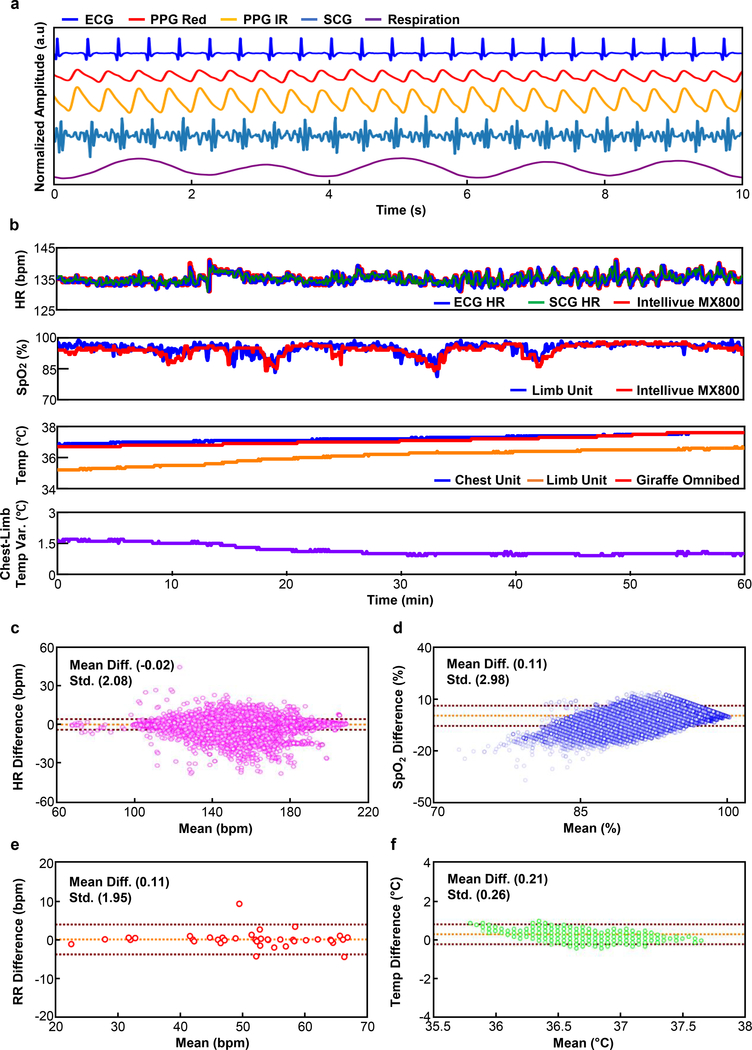
- In NICU/PICU pilot studies, the wireless system measured HR, SpO2, temperature, and RR with close agreement to standard monitoring: mean differences were −0.02 bpm for HR, 0.11% for SpO2, and 0.21 °C for temperature (n = 3); RR mean difference was 0.11 breaths per minute with SD 1.95 (n = 6, 41 data points).
- SpO2 accuracy root mean square was 2.99%, and a larger comparison included over 0.4 million aggregated HR/SpO2 data points from n = 20 patients, within FDA regulatory guidelines for HR and reflectance-mode SpO2.
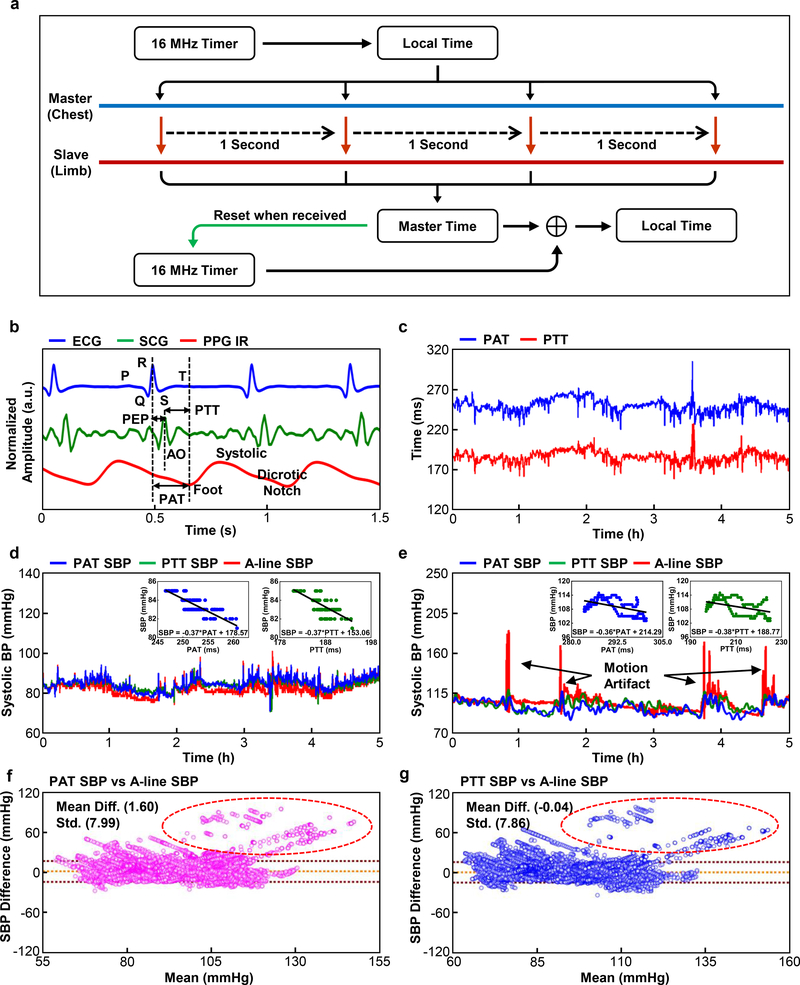
- Time-synchronized chest and limb units enabled PAT- and PTT-derived systolic blood pressure estimates versus arterial-line measurements, with mean differences of 1.60 and −0.04 mmHg and SDs of 7.99 and 7.86 mmHg, respectively (n = 5), within ANSI/AAMI SP10 limits.
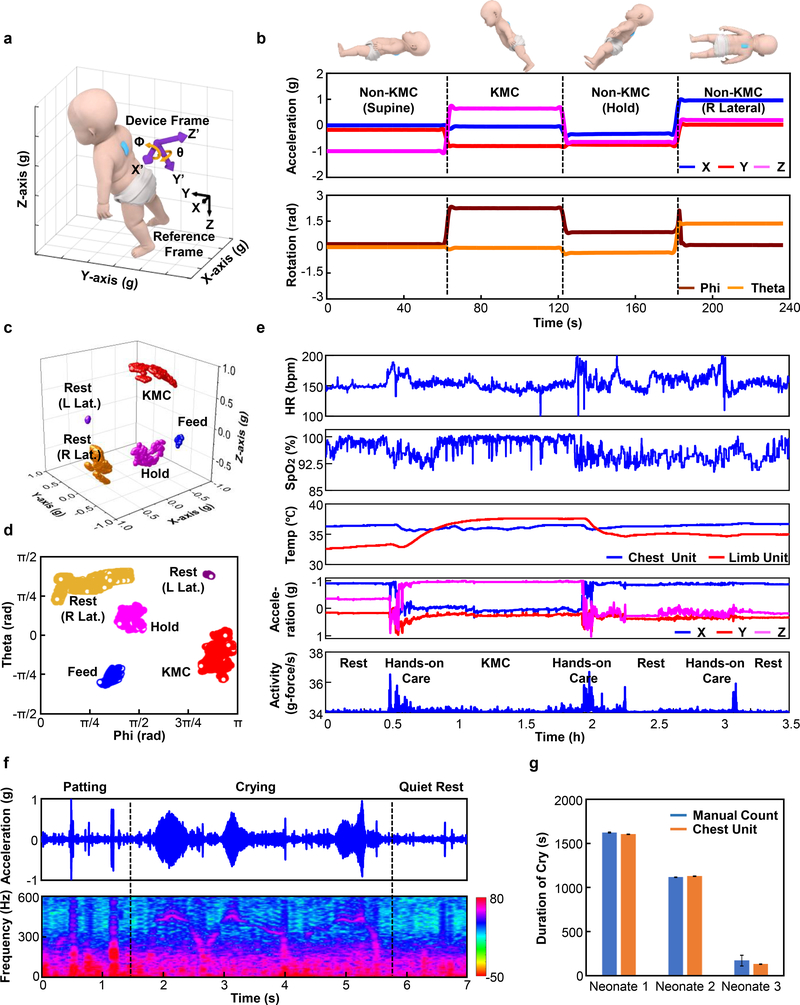
- Additional modalities included kangaroo-care orientation/activity tracking, SCG, and cry analysis: KC events showed phi/theta of 2.85 ± 0.10 rad and −0.29 ± 0.28 rad over 2.4 h; activity was 0.07 ± 0.02 g/s during rest/KC versus 0.24 ± 0.05 g/s during hands-on care; 11 cry events in n = 3 infants showed duration difference −3.9 ± 13.9 s and fundamental frequency 410.7 ± 47.9 Hz.
Methods
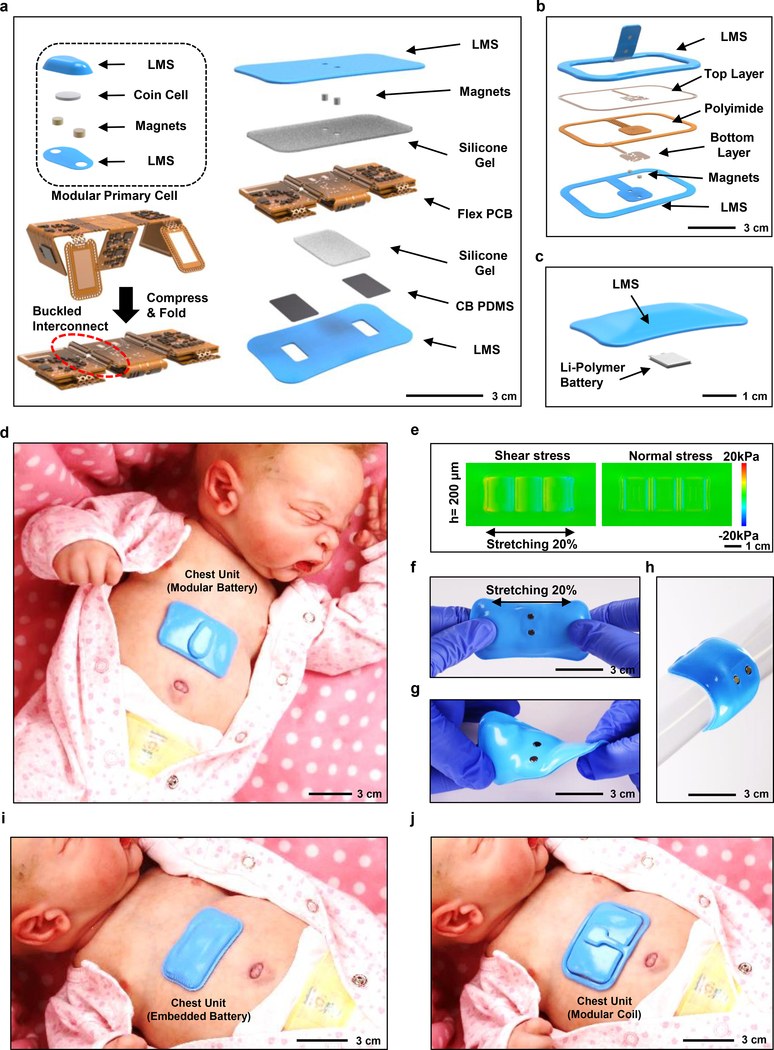
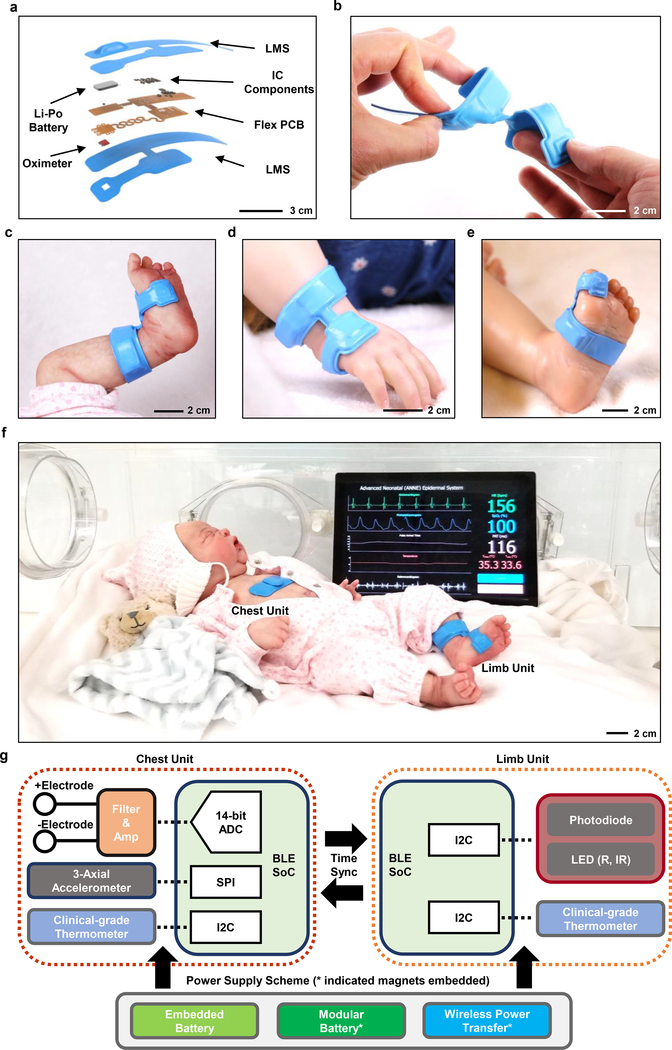
- Design: two mechanically soft, wireless devices—a chest unit for ECG, accelerometry, temperature, and acoustic/vibration signals, and a limb unit for reflectance PPG and temperature—using Bluetooth Low Energy, with modular/embedded/battery-free power options.
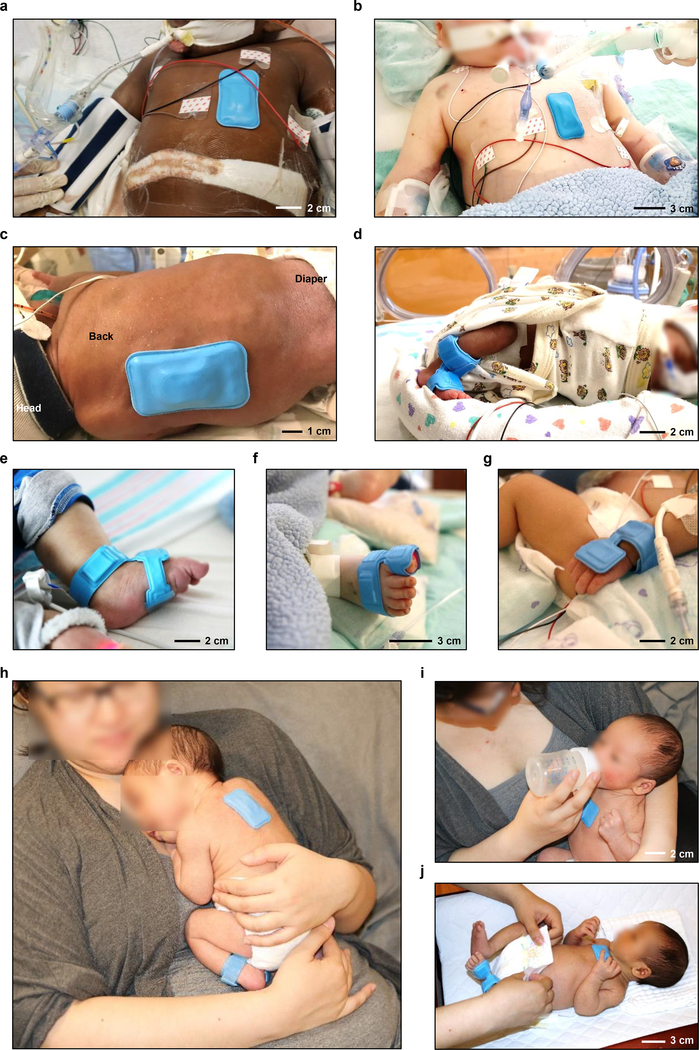
- Data/sample: pilot clinical studies in NICU and PICU patients, including 50 patients for safety/skin tolerability across 23–40 weeks gestational age and 1 week–4 years chronological age; vital-sign comparisons used smaller subsets (e.g., n = 3 for HR/SpO2/temperature, n = 6 for RR, n = 20 for aggregated HR/SpO2, n = 5 for BP).
- Analysis: Bland-Altman comparisons against standard clinical monitors; time-synchronized PAT/PTT calibrated against arterial-line SBP; accelerometer filtering for KC orientation/activity and cry detection; MANOVA for position/activity comparisons.
Limitations
- The paper states that in instances of low SpO2 (<90%), mean disagreement was higher than the overall comparison, likely reflecting different SpO2 de-noising algorithms rather than a true measurement difference.
- The paper notes that comparisons reflect real-world vital-sign calculations during clinical care, feeding, imaging, and other procedures, so motion artifact and noise are inherent and processed differently between the experimental system and clinical comparator.
- Evident from the text: key validation cohorts were small (e.g., n = 3 for HR/SpO2/temperature, n = 5 for BP, n = 3 for KC/cry), thermal safety testing used a subset of 3 patients over 24 h, and BP estimation required initial calibration against 5 min of arterial-line SBP data.
Model-written summary. Check it against the paper before relying on it.
Integrity signals
Registry
Cites
Statistics
Figures
Verification
Claims the paper makes
9 Valid · 9 Not valid · 13 Not checked · 63 Own results and interpretations
The cited sources support only part of this claim — read each source’s verdict below.
In the paper
“Ultimately, both PAT and PTT depend on vascular system geometry, elasticity, SBP, and other factors30,33,34.”
§ Skin-Interfaced Biosensors and Pilot Studies for Advanced Wireless Physiological Monitoring in Neonatal and Pediatric Intensive Care Units > Results > Time-synchronized Bi-nodal Communication for Non-invasive Blood Pressure Monitoring
What the sources say
- Partly supportedcites [30] Ma Y, Relation between blood pressure and pulse wave velocity for human arteries. PNAS 115, 11144– 11149 (2018). 30322935 PMC6217416 sourceExperimental — accuracy not yet measured
The In Vitro Experiments section relates pulse transit time to pulse wave velocity and reports pulse arrival times measured with ECG and PPG. It also states that the pressure–velocity relation depends on arterial material properties and geometry. The reported human measurements concern diastolic blood pressure, however, so the paper does not establish the stated dependence on SBP for both PAT and PTT. (LLM, conf=0.84)
- Not matchedcites [33] Kangaroo mother care: a practical guide, (World Health Organization, Dept. of Reproductive Health and Research, 2003).
Its entry has no title and year that we can search by.
- Not checked — no full text of the sourcecites [34] Liu G-Z, Guo Y-W, Zhu Q-S, Huang B-Y & Wang L Estimation of respiration rate from three-dimensional acceleration data based on body sensor network. Telemed. J. E-Health 17, 705– 711 (2011). 22035321 PMC3203837 source
plainstates an association- Asserted: passes — The authors put it forward as true.
- Checkable: passes — It can be checked against evidence.
- Load-bearing: unclear — It is unclear whether the paper’s conclusions depend on it.
- Based: passes — The paper gives a reason why it holds.
- Partly supported
The cited sources support only part of this claim — read each source’s verdict below.
In the paper
“Cry analysis can serve as a non-invasive method to analyze the neurophysiological state, often influenced by birth trauma, brain injury or pain stress13.”
§ Skin-Interfaced Biosensors and Pilot Studies for Advanced Wireless Physiological Monitoring in Neonatal and Pediatric Intensive Care Units > Results > Advanced Use Cases: Kangaroo Care and Cry Analysis
What the sources say
- Partly supportedcites [13] Shinya Y, Kawai M, Niwa F, Imafuku M & Myowa M Fundamental frequency variation of neonatal spontaneous crying predicts language acquisition in preterm and term infants. Front. Psychol. 8, 2195 (2017). 29312060 PMC5744644 sourceExperimental — accuracy not yet measured
The Introduction (page not specified) describes cry acoustics as a non-invasive index of neonatal neurophysiological states, including pain stress, and links abnormal cry frequency to neurological disturbances. It does not specifically identify birth trauma or brain injury as influences, so those examples are not supported by our copy. (LLM, conf=0.88)
plainstates an association- Asserted: passes — The authors put it forward as true.
- Checkable: passes — It can be checked against evidence.
- Load-bearing: passes — The paper’s conclusions depend on it.
- Based: passes — The paper gives a reason why it holds.
- Partly supported
The cited sources that could be checked couldn’t confirm or dispute this claim.
In the paper
“The fundamental frequency of 410.7 ± 47.9 (Supplementary Fig.24e) is consistent with published results46.”
§ Skin-Interfaced Biosensors and Pilot Studies for Advanced Wireless Physiological Monitoring in Neonatal and Pediatric Intensive Care Units > Results > Advanced Use Cases: Kangaroo Care and Cry Analysis
What the sources say
- Could not verifycites [46] Inan Omer T, Novel wearable seismocardiography and machine learning algorithms can assess clinical status of heart failure patients. Circ. Heart Fail. 11, e004313 (2018). 29330154 PMC5769154 sourceExperimental — accuracy not yet measured
The Methods (Pre-Processing and Feature Extraction; page unavailable) discuss frequency components of cardiac seismocardiography signals, not crying. Searches for crying, vocal pitch, and the reported frequency found no passage in our copy addressing whether 410.7 ± 47.9 is consistent with published results. (LLM, conf=0.77)
plain- Asserted: passes — The authors put it forward as true.
- Checkable: passes — It can be checked against evidence.
- Load-bearing: unclear — It is unclear whether the paper’s conclusions depend on it.
- Based: passes — The paper gives a reason why it holds.
- Could not verify
The cited sources support only part of this claim — read each source’s verdict below.
In the paper
“Continuous monitoring of vital signs is essential, yet existing technologies require the use of multiple electrodes and interfaces attached to the skin with adhesive tapes and connected by wires to electronic processing systems that are often tethered to the wall.”
§ Skin-Interfaced Biosensors and Pilot Studies for Advanced Wireless Physiological Monitoring in Neonatal and Pediatric Intensive Care Units > Abstract
What the sources say
- Partly supportedcites [3] Bonner O, Beardsall K, Crilly N & Lasenby J ‘ There were more wires than him’: the potential for wireless patient monitoring in neonatal intensive care. BMJ Innov. 3, 12– 18 (2017). PMC5293857 28250963 sourceExperimental — accuracy not yet measured
The Introduction (page unavailable) describes multiple vital-sign sensors in a neonatal intensive care unit connected by wires to a monitoring unit outside the incubator. The Results (page unavailable) describe adhesive ECG and temperature probes, but say the pulse oximeter is secured with Velcro. The paper does not establish that the monitoring units are tethered to a wall or that all the interfaces use adhesive tape. (LLM, conf=0.87)
plain- Asserted: passes — The authors put it forward as true.
- Checkable: passes — It can be checked against evidence.
- Load-bearing: passes — The paper’s conclusions depend on it.
- Based: passes — The paper gives a reason why it holds.
- Partly supported
The cited sources that could be checked couldn’t confirm or dispute this claim.
In the paper
“The data show that skin-to-skin contact during KC produced a pronounced, gradual increase in the peripheral skin temperature, consistent with expectation and as demonstrated in previous studies39.”
§ Skin-Interfaced Biosensors and Pilot Studies for Advanced Wireless Physiological Monitoring in Neonatal and Pediatric Intensive Care Units > Results > Advanced Use Cases: Kangaroo Care and Cry Analysis
What the sources say
- Could not verifycites [39] Huntsman RJ, Lowry NJ & Sankaran K Nonepileptic motor phenomena in the neonate. Paediatr. Child Health 13, 680– 684 (2008). 19436521 PMC2606074 sourceExperimental — accuracy not yet measured
The paper’s passages on neonatal tremor and jitteriness (section labeled Abstract; page unavailable) do not address Kangaroo Care or peripheral skin temperature. Searches for skin-to-skin contact, thermoregulation, and a gradual temperature increase found no passage supporting the attributed finding. (LLM, conf=0.78)
boostedstates a cause- Asserted: passes — The authors put it forward as true.
- Checkable: passes — It can be checked against evidence.
- Load-bearing: unclear — It is unclear whether the paper’s conclusions depend on it.
- Based: passes — The paper gives a reason why it holds.
- Could not verify
45 more claims
Create a free account to see all 94 claims and to verify the 2 references still open.
- It may state two separate claims as one. 39
- Probably not a substantial claim. 10
Claims other papers make about this one
Each is checked against this paper’s own text: does it say what the citing paper says it does?
The source backs part of the claim, not all of it — or backs it for a different population, condition or comparison.
In the citing paper
“Previous reports validated the performance of an FDA-cleared physiological monitoring system against gold standard monitoring platforms [18–23].”
From Pregnancy outcomes in infertility patients diagnosed with sleep disordered breathing with wireless wearable sensors (2022) · cites this paper as [19]
Experimental — accuracy not yet measuredThe source backs part of the claim, not all of it — or backs it for a different population, condition or comparison.
In the citing paper
“In previous work, we demonstrate the ability for the chest- and finger-mounted sensors to monitor vital signs in both children and adults; the abdominal sensor allows for maternal–fetal monitoring of pregnant women in both high- and low-resource settings as well as the clinical and home settings (22, 23).”
From Comprehensive pregnancy monitoring with a network of wireless, soft, and flexible sensors in high- and low-resource health settings (2021) · cites this paper as [22]
Experimental — accuracy not yet measuredThe source backs part of the claim, not all of it — or backs it for a different population, condition or comparison.
In the citing paper
“Additionally, as demonstrated by our previous work, neonatal vital signs can also be tracked with the same sensors in both high-resource and low-resource settings as well as support kangaroo care (22, 48).”
From Comprehensive pregnancy monitoring with a network of wireless, soft, and flexible sensors in high- and low-resource health settings (2021) · cites this paper as [22]
Experimental — accuracy not yet measuredThe source backs part of the claim, not all of it — or backs it for a different population, condition or comparison.
In the citing paper
“Previous wearables have been designed to condense the complicated setups in NICU monitoring into miniaturized wearables for facilitated monitoring4–6; however, they encounter problems with device longevity with either single-use or short-term use before replacement.”
From Soft, all-in-one, nanomembrane wearable system for advancing neonatal health monitoring in Ethiopia (2025) · cites this paper as [5]
Experimental — accuracy not yet measuredThe cited source says what the claim attributes to it.
In the citing paper
“and have been used in neonatal and pediatric intensive care units. 4,5”
From Advanced wireless monitoring for children in the cardiac perioperative setting (2023) · cites this paper as [5]
2 more claims about this paper
Create a free account to see every claim other papers make about this one.
Citations
Cites
STATISTICAL METHODS FOR ASSESSING AGREEMENT BETWEEN TWO METHODS OF CLINICAL MEASUREMENT
Martin Bland, J., & Altman, D. (1986) · The Lancet · doi:10.1016/s0140-6736(86)90837-8 · Cited by 47,965
Pickering, T. G., Hall, J. E., Appel, L. J., Falkner, B. E., Graves, J., Hill, M. N., Jones, D. W., Kurtz, T., Sheps, S. G., & Roccella, E. J. (2005) · Circulation · doi:10.1161/01.cir.0000154900.76284.f6 · Cited by 3,985
Pickering, T. G., Hall, J. E., Appel, L. J., Falkner, B. E., Graves, J., Hill, M. N., Jones, D. W., Kurtz, T., Sheps, S. G., & Roccella, E. J. (2005) · Hypertension · doi:10.1161/01.hyp.0000150859.47929.8e · Cited by 2,051
Scheer, B., Perel, A., & Pfeiffer, U. J. (2002) · Critical Care · doi:10.1186/cc1489 · Cited by 854
Binodal, wireless epidermal electronic systems with in-sensor analytics for neonatal intensive care
Chung, H. U., Kim, B. H., Lee, J. Y., Lee, J., Xie, Z., Ibler, E. M., Lee, K., Banks, A., Jeong, J. Y., Kim, J., et al. (2019) · Science · doi:10.1126/science.aau0780 · Cited by 807
Self-citationKangaroo Mother Care and Neonatal Outcomes: A Meta-analysis
Boundy, E. O., Dastjerdi, R., Spiegelman, D., Fawzi, W. W., Missmer, S. A., Lieberman, E., Kajeepeta, S., Wall, S., & Chan, G. J. (2016) · Pediatrics · doi:10.1542/peds.2015-2238 · Cited by 661
Pulse transit time measured from the ECG: an unreliable marker of beat-to-beat blood pressure
Payne, R. A., Symeonides, C. N., Webb, D. J., & Maxwell, S. R. J. (2006) · Journal of Applied Physiology · doi:10.1152/japplphysiol.00657.2005 · Cited by 418
Liu, Y., Norton, J. J. S., Qazi, R., Zou, Z., Ammann, K. R., Liu, H., Yan, L., Tran, P. L., Jang, K.-I., Lee, J. W., et al. (2016) · Science Advances · doi:10.1126/sciadv.1601185 · Cited by 397
Self-citationXu, J., Murphy, S. L., Kochanek, K. D., Bastian, B. A., & Arias, E. (2018) · PubMed · Cited by 391
Radial Artery Cannulation: A Comprehensive Review of Recent Anatomic and Physiologic Investigations
Brzezinski, M., Luisetti, T., & London, M. J. (2009) · Anesthesia & Analgesia · doi:10.1213/ane.0b013e3181bbd416 · Cited by 354
Research works printed but not linked: 1
- Wheeler DS, Wong HR & Shanley TP Pediatric critical care medicine: basic science and clinical evidence, (Springer, London, 2007).
Cited by
Items 401–476 of 476
Wearable Biosensor Utilizing Chitosan Biopolymer for Uric Acid Monitoring
Sato, M., Kamiyama, T., Iitani, K., Yano, K., Mitsubayashi, K., & Arakawa, T. (2023) · Journal of Robotics and Mechatronics · doi:10.20965/jrm.2023.p1131 · Cited by 1
Lauw, C. J., Rahman, J. S., Brankovic, A., et al. (2023) · Proceedings of the Annual International Conference of the IEEE Engineering in Medicine and Biology Society · doi:10.1109/embc40787.2023.10340576 · Cited by 1
Advances in Maternity Technology
Bates, M. (2023) · IEEE Pulse · doi:10.1109/mpuls.2024.3353653 · Cited by 1
Takeshita, T., Yoshida, M., Kobayashi, T., & Takei, Y. (2024) · Sensors and Actuators A Physical · doi:10.1016/j.sna.2024.115259 · Cited by 1
Williams, E. E., Ascherl, R., Gaertner, V. D., Sibrecht, G., Kurul, Ş., Herrmann, M.-L., Szakmár, E., Raffaeli, G., Bresesti, I., & Jost, K. (2025) · Journal of Clinical Monitoring and Computing · doi:10.1007/s10877-025-01310-1 · Cited by 3
Optical difference in the frequency domain to suppress disturbance for wearable electronics
Li, H., Wang, Z., Cao, Y. K., Ma, Y., & Feng, X. (2020) · Biomedical Optics Express · doi:10.1364/boe.403033 · Cited by 1
Borges, I. V. G., Santos, A. C. M., & Gonçalves, V. D. P. C. (2021) · Amplamente Cursos e Formação Continuada eBooks · doi:10.47538/ac-2021.05-16 · Cited by 1
Walter, J. R., Kim, D. H., Myers, D., Hill, M. A., Snoll, B., Lee, J. Y., Kulikova, E., Fagan, K., Cauinian, R., Nguyen, L., et al. (2022) · Journal of the American Geriatrics Society · doi:10.1111/jgs.17673 · Cited by 1
Self-citationZhang, H., & Zhang, Y. (2022) · BioMed Research International · doi:10.1155/2022/7232638 · Cited by 1
RetractedHidden in Plain Sight: The History, Science, and Engineering of Microfluidic Technology
Folch, A. (2022) · The MIT Press eBooks · doi:10.7551/mitpress/14236.001.0001 · Cited by 3
Self-Adaptive Spike Voltage-dependent Plasticity Emulated by a Metalloporphyrin-Based MemristorPreprint
Wang, Z., Wang, L., Wu, Y., Bian, L., Nagai, M., Jv, R., Xie, L., Ling, H., Li, Q., Bian, H., et al. (2020) · Research Square · doi:10.21203/rs.3.rs-114838/v1 · Cited by 1
State-of-the-art Deep Learning Methods on Electrocardiogram Data: A Systematic Review (Preprint)Preprint
Πετμεζάς, Γ., Stefanopoulos, L., Kilintzis, V., Tzavelis, A., Rogers, J. A., Katsaggelos, A. K., & Maglaveras, N. (2022) · doi:10.2196/preprints.38454 · Cited by 1
Self-citationDevelopment of Wearable Multi-Lead ECG Measurement Device using Cubic Flocked ElectrodePreprint
Takeshita, T., Yoshida, M., Takei, Y., et al. (2022) · Research Square · doi:10.21203/rs.3.rs-1810447/v1 · Cited by 1
Lee, S. H., Lee, K.-R., Kim, T., Im, S., Lee, Y. J., Jeong, S., Shin, H., Kim, M., Lee, J., Kim, D., et al. (2023) · Research Square · doi:10.21203/rs.3.rs-2844027/v1 · Cited by 1
Self-citationA Wireless Neonatal Intensive Care Unit: Fiction or Closer Reality?
Sénéchal, E., Chung, H. U., Rogers, J. A., & SantʼAnna, G. (2025) · Neonatology · doi:10.1159/000547056 · Cited by 2
Self-citationTrådløs overvåking av premature
Benestad, H. B. (2020) · Tidsskrift for Den norske legeforening · doi:10.4045/tidsskr.20.0300
Pediatric Cerebral Hemodynamic Monitoring Goes Wireless
Hurley, D. (2021) · Neurology Today · doi:10.1097/01.nt.0000733412.90842.87
Weese‐Mayer, D. E., & Gonik, R. (2021) · Clinical Autonomic Research · doi:10.1007/s10286-021-00807-4
Self-citationCENÁRIO DA GESTAÇÃO E DO PARTO NO CONTEXTO DA PANDEMIA POR COVID-19
Azevedo, A. L. F., Rezende, G. A. M., Ignácio, F. L., da Fonseca, J. R. C. S., Lima, M. L., & Dutra, J. P. (2021) · Amplamente Cursos e Formação Continuada eBooks · doi:10.47538/ac-2021.05-06
Andrade, S. S. D. C., & de Queiroz, V. C. (2021) · Amplamente Cursos e Formação Continuada eBooks · doi:10.47538/ac-2021.05-c1
LINHA DE FRENTE: GRADUANDOS DE ENFERMAGEM NO COMBATE AO CORONAVÍRUS EM MATERNIDADE DE REFERÊNCIA
Silva, Í. D. S., Xavier, P. B., da Fonseca, E. N. R., Safra, G., Almeida, J. L. S., & de Negreiros, R. V. (2021) · Amplamente Cursos e Formação Continuada eBooks · doi:10.47538/ac-2021.05-15
ASSISTÊNCIA DE ENFERMAGEM NO PRÉ-NATAL DE BAIXO RISCO NA ESTRATÉGIA SAÚDE DA FAMÍLIA
Silva, M. H. R. C., Januário, D. C., Delmiro, A. R. D. C. A., Bezerra, I. C. D. S., Holanda, A. D. L. F., & dos Santos, J. B. (2021) · Amplamente Cursos e Formação Continuada eBooks · doi:10.47538/ac-2021.05-04
O ENFERMEIRO NO CENTRO CIRÚRGICO E A SEGURANÇA DO PACIENTE
Costa, S. S. L. (2021) · Amplamente Cursos e Formação Continuada eBooks · doi:10.47538/ac-2021.05-17
Aguiar, M. B., Passos, X. S., & Riesco, T. B. (2021) · Amplamente Cursos e Formação Continuada eBooks · doi:10.47538/ac-2021.05-18
A PREVALÊNCIA DA INCONTINÊNCIA URINÁRIA NA GESTAÇÃO E AVALIAÇÃO DA QUALIDADE DE VIDA
Pereira, A. T. B., Laurentino, J. A., Pedroso, T. R., Fernandes, Y. P., & da Rocha, M. R. M. (2021) · Amplamente Cursos e Formação Continuada eBooks · doi:10.47538/ac-2021.05-02
FATORES DE RISCO E AGRAVOS RELACIONADOS À MORTALIDADE MATERNA
Fortunato, R. C. D. S., Fernandes, D. V., Matos, S. D. D. O., Cantante, A. P., de Abreu, M. D. S. N., & de Lucena, A. L. R. (2021) · Amplamente Cursos e Formação Continuada eBooks · doi:10.47538/ac-2021.05-13
IMPLICAÇÕES MATERNAS E FETAIS ASSOCIADAS AO MIOMA NA GRAVIDEZ
Racilan, A. M., Vieira, B. L. A., Fernandes, G. D., Gomes, D. V., de Sousa, M. T., & Pedrosa, V. M. S. (2021) · Amplamente Cursos e Formação Continuada eBooks · doi:10.47538/ac-2021.05-14
CIRURGIA INTRAUTERINA PARA O TRATAMENTO DE MIELOMENINGOCELE
Machado, L. B., Machado, J. B., Hibner, M. E. R. B., & Fonseca, C. G. (2021) · Amplamente Cursos e Formação Continuada eBooks · doi:10.47538/ac-2021.05-07
CONHECIMENTO DE GESTANTES ACERCA DOS CUIDADOS AO RECÉMNASCIDO: REVISÃO INTEGRATIVA DA LITERATURA
de Souza, I. V. B., da Silva, A. B., da Silva, T. P. B., dos Santos, R. M., Lourenço, K. D. M., & Rodrigues, B. B. C. (2021) · Amplamente Cursos e Formação Continuada eBooks · doi:10.47538/ac-2021.05-09
PARTICIPAÇÃO DO PAI DURANTE O PRÉ-NATAL: PERCEPÇÃO DE GESTANTES
Santos, Y. G. T., Holanda, A. D. L. F., Lins, M. D. L. V., Rodrigues, E. S. R. C., Caracas, M. M. T., & César, E. S. R. (2021) · Amplamente Cursos e Formação Continuada eBooks · doi:10.47538/ac-2021.05-19
Wearable Devices Toward Medical and Healthcare Applications
Takei, K. (2022) · The Journal of the Institute of Electrical Engineers of Japan · doi:10.1541/ieejjournal.142.560
Parental satisfaction with infusion carrier in child care
Saptanto, A., & Dewi, A. (2023) · World Journal of Advanced Research and Reviews · doi:10.30574/wjarr.2023.17.1.0072
Sung, M. (2023) · International Journal of Students Research in Technology & Management · doi:10.18510/ijsrtm.2023.1113
Point of Care Device for Measurement of Vital Parameters
Korde, M. S., Essaji, H., Bhalerao, P., Kaushik, V., Mohadikar, C., Sharma, A., & Laddhad, R. (2023) · Lecture notes in networks and systems · doi:10.1007/978-981-99-0838-7_27
Replacing Monitoring Electrodes on Infant Skin Every 12 Versus 24 Hours
Demirci, K., Uğur, E., & Öntürk, Z. K. (2023) · Advances in Skin & Wound Care · doi:10.1097/asw.0000000000000010
Wearable Antennas for On‐/Off‐Body Communications
Guo, Y., Feng, Y., & Liu, C. (2024) · doi:10.1002/9781119189947.ch5
Self-citationMechanics of Transient Electronics
Dutta, A., & Cheng, H. (2024) · Wiley eBooks · doi:10.1002/9783527842308.ch15
Gong, L., Zhao, L. L., Zhu, L., Luo, Z., & He, Q. (2024) · International Conference on Interactive Intelligent Systems and Techniques (IIST) · doi:10.1109/iist62526.2024.00068
Prototype Device for Neonatal Jaundice Phototherapy with Dynamic Physiological Monitoring Function
Guo, K., He, Z., Zou, Z., Zhang, B., Zhang, J., Xiao, Z., & Yang, G. (2025) · Journal of Shanghai Jiaotong University (Science) · doi:10.1007/s12204-024-2774-4 · Cited by 1
Surface Functionalization of Elastomers with Biopolymers
Morin, E. J., Muzzy, E. M., & Carlini, A. S. (2025) · Methods in molecular biology · doi:10.1007/978-1-0716-4402-7_13
Self-citationWearable health monitoring system using multispectral sensing with visible and near-infrared light
Li, D., & Li, T. (2025) · Optical Diagnostics and Sensing: Toward Point-of-Care Diagnostics · doi:10.1117/12.3044071
Wearable Smart Textile Band for Continuous Equine Health MonitoringPreprint
Park, T., Hong, S., Murray, L., et al. (2025) · SSRN Electronic Journal · doi:10.2139/ssrn.5363938
Self-citationOn-Chip Refractive Index Sensor based on Micro-Ring Resonator with Microstructure Slot
Tang, X. L., Cai, Z., Zhou, J., et al. (2025) · International Conference on Optical Communications and Networks (ICOCN) · doi:10.1109/icocn67308.2025.11145656
Sénéchal, E., Radeschi, D. J., Jeanne, E., Ruiz, A. S., Dulmage, B., Shalish, W., Kearney, R. E., & SantʼAnna, G. (2025) · Sensors · doi:10.3390/s25185647 · Cited by 3
“There are only a limited number of studies exploring the performance of wireless SpO 2 sensors in hospitalized infants [18–20 , 26–31].”
InfluentialTouchless monitoring of neonatal activity–a welcome technological leap in NICU care
Vesoulis, Z. A., Sprehe, D., & Kopotic, R. J. (2025) · Pediatric Research · doi:10.1038/s41390-025-04408-z
Biosensors: a breakthrough tool for rapid disease detection
Upadhyay, L. S. B., & Sharma, U. (2025) · Microsystem Technologies · doi:10.1007/s00542-025-05944-8 · Cited by 2
Tracking Limb Movement in Preterm Infants Using an Inertial Measurement Bracelet
Kalhoro, I., Blodgett, L., Jafari, R., Sternad, D., & Paydarfar, D. (2025) · Annual International Conference of the IEEE Engineering in Medicine and Biology Society (EMBC) · doi:10.1109/embc58623.2025.11252707
“To address this, we plan to incorporate wireless power transfer, eliminating the need to remove the device for recharging as well as reducing the number of gaps in the data [26].”
InfluentialConjugated polymer based nanocomposites for pressure and strain sensors
Joshi, S. S., Sabri, Y. M., Ippolito, S. J., & Manorama, S. V. (2025) · Elsevier eBooks · doi:10.1016/b978-0-443-29011-4.00007-9
Bioelectronic Wearable Sensors Produced by Computerized Embroidery Using a Dual Thread Approach
Weinstein, T., Li, X., Kurt, H., Olenik, S., Collins, A., Flauzino, J. M. R., Adeel, M., Gonzalez‐Macia, L., Yüce, M., & Güder, F. (2026) · Small · doi:10.1002/smll.75624
Sakamoto, N., Kudo, H., Hamada, K., et al. (2026) · Lecture notes of the Institute for Computer Sciences, Social Informatics and Telecommunications Engineering · doi:10.1007/978-3-032-10554-7_1
Mascia, G., Frering, H. E., Althoff, R. R., Coney, E., Rivera, D. H., Toomer-Sanders, Z. M., Erdie-Lalena, C. R., Dame, M. H., Brown, L. B., Evans, D. A., et al. (2026) · Frontiers in Digital Health · doi:10.3389/fdgth.2025.1641845 · Cited by 1
Detecting sleep stages after stroke using wearable sensors: machine learning design and challenges
Sindorf, J., O’Brien, M. K., Sunderrajan, A., Arora, V., & Jayaraman, A. (2026) · BMJ Digital Health & AI · doi:10.1136/bmjdhai-2025-000164
HI-MobileNet: A Lightweight Deep Learning Framework for Automated Diagnosis of Harlequin Ichthyosis
Palliparambil, A. J. J., Shaji, A. P., & Rajan, R. (2025) · IEEE Recent Advances in Intelligent Computational Systems · doi:10.1109/raics66191.2025.11332605
“Prior work on HI has primarily relied on clinical criteria, but AI-driven methods using MobileNetV2 for neonatal skin analysis demonstrate unprecedented potential [22].”
Marca, V. L., Chatty, T., Tandon, A. A., & Drummond, C. K. (2026) · Computers · doi:10.3390/computers15020109
“Constructed from soft, flexible electronics, these innovations enable the continuous tracking of heart rate, blood pressure, temperature, and oxygen saturation without the constraints of traditional wired systems [57,85,87].”
Smart wearable sensing systems mediating the digital monitoring of loneliness – A review
Mexia, N., Molteni, E., Ratcliffe, J., Probst, F., Matcham, F., Rees, J., Ourselin, S., Antonelli, M., Tinker, A., Liu, W., et al. (2026) · Materials Today Electronics · doi:10.1016/j.mtelec.2026.100202
Huang, R., Wang, Y., Long, G., et al. (2026) · Science Advances · doi:10.1126/sciadv.aeb5852
Angelucci, A., Aliverti, A., Vandoni, M., Lucini, D., Larizza, C., Pellino, V. C., Zuccotti, G. V., & Calcaterra, V. (2026) · Journal of Medical Internet Research · doi:10.2196/76166
“Certain US Food and Drug Administration–cleared medical-grade patches, such as ANNE One (Sibel Health Inc) [26,27], have been successfully deployed for continuous vital sign monitoring in neonates and infants, particularly in intensive care settings [27].”
Goedicke‐Fritz, S., Schmiech, D., Thull, R., Kaiser, E., Körbel, C., Laschke, M. W., Marnach, A., Müller, S., Tutdibi, E., Nourkami‐Tutdibi, N., et al. (2026) · Sensors · doi:10.3390/s26072139
“Cable-reducing approaches for monitoring vital signs, including respiration and heart rate, are promising, but adhesive pads remain necessary for fragile neonatal skin [14,15]. https://doi.org/10.3390/s26072139”
InfluentialEmerging artificial intelligence in thyroid cancer intervention: an overview
Omenka, O. S., Suardi, N., Mustafa, I. S., & Oke, A. O. (2026) · Neural Computing and Applications · doi:10.1007/s00521-026-11986-4
Yi, C., Zhang, Z., Xiang, S., Qian, J., & Jin, H. (2026) · ACS Applied Materials & Interfaces · doi:10.1021/acsami.6c02676
Lahade, S., Ross, N., & O’Sullivan, T. D. (2026) · Journal of Physics Photonics · doi:10.1088/2515-7647/ae6ae4 · Cited by 2
Artificial structures for human‐machine interfaces with closed‐loop interaction
Hu, T., Pan, T., Chen, S., Zhang, Y., & Lin, Y. (2026) · FlexMat. · doi:10.1002/flm2.70113
Preeti, K., Sharma, M. K., Rana, A. S., Saini, D. K., Luhar, S., Bharti, A. C., Kaushik, A. K., & Sharma, S. K. (2026) · ACS Applied Nano Materials · doi:10.1021/acsanm.6c00397 · Cited by 1
Shi, W., Mi, L., Chen, J., Liu, B., Wang, M., Dai, Z., Liu, B., Gao, R., Lin, Y., Guo, W., et al. (2026) · Advanced Science · doi:10.1002/advs.76775
Li, Y., He, Z., Chen, X., Pan, L., Yu, Y., & Liu, C. (2026) · Advanced Materials Technologies · doi:10.1002/admt.71214 · Cited by 1
Self-citationLightweight framework for time-varying error compensation in soft strain sensors
Phan, M. T., Dao, P. L., Ngo, S. T., Phan, N. A., Cao, P., Krishnan, G., Hsiao‐Wecksler, E. T., Pham, H., & Thai, M. T. (2026) · Sensors and Actuators Reports · doi:10.1016/j.snr.2026.100499 · Cited by 1
Fang, W., Wang, Y., Yang, Z., Zheng, H., Wu, Y., Chen, R., Wang, R., Tang, H., Tang, M., & Ye, X. (2026) · Frontiers in Immunology · doi:10.3389/fimmu.2026.1785073
Wearable Sensors for Pediatrics: Evolution, Challenges, and Opportunities in Living Environments
Cosoli, G., Bencivenga, C., Arnesano, M., Verdini, F., & D’Alvia, L. (2026) · IEEE International Workshop on Metrology for Living Environment (MetroLivEnv) · doi:10.1109/metrolivenv70468.2026.11659921
“While individual research groups (e.g., [6], [20]) collect high-quality clinical data, there is a lack of large-scale, multi-center open-access benchmark datasets that pair wearable raw data (PPG, ECG, accelerometry) with synchronized hospital gold-standard references.”
InfluentialWireless IoT-enabled microneedle electroceutical for personalized and connected pain management
Kim, H., Bang, S. K., Kang, S.-Y., Kim, S. W., Yang, J., Kim, D., Kim, C. Y., Han, S., Jang, Y., Lee, J., et al. (2026) · Nature Communications · doi:10.1038/s41467-026-76527-y · Cited by 2
“Overall, these limitations could be mitigated by developing more accurate pain classi fi cation models incorporating multimodal sensing 103,104 , including blood pressure, skin conductance, facialexpression,andpatient-reportedoutcomes 1,47,105 .”
Self-citationConformal mechanics of serpentine meshes for millimeter-scale neural probes
Batay, S., Zhou, Y., Pathirana, P. V., Seymour, J. P., & Avila, R. O. (2026) · Mechanics of Materials · doi:10.1016/j.mechmat.2026.105860
Self-citationLi, M., Li, W., Pi, M., et al. (2026) · ACS Applied Materials & Interfaces · doi:10.1021/acsami.6c11197
Xu, W., Bai, Y., Yang, X., Zhao, S., Liu, X., Lei, X., Zhang, R., & Dong, W. (2026) · Journal of Tissue Viability · doi:10.1016/j.jtv.2026.101054
Broadband wearable acoustic sensing for continuous cardiopulmonary monitoring
Wu, P., Liu, T., Li, D., Dou, H., Yang, J., Wang, H., Guo, H., & Mu, X. (2026) · Microsystems & Nanoengineering · doi:10.1038/s41378-026-01460-5
“The transition to digital stethoscopes has enabled the conversion of acoustic signals into electrical signals for ampli fi cation, fi ltering, and quantitative analysis, thereby improving diagnostic consistency 27 – 33 .”
Metadata
- Authors
- Chung, H. U., Rwei, A. Y., Hourlier-Fargette, A., Xu, S., Lee, K., Dunne, E. C., Xie, Z., Liu, C., Carlini, A., Kim, D. H., Ryu, D., Kulikova, E., Cao, J., Odland, I. C., Fields, K. B., Hopkins, B., Banks, A., Ogle, C., Grande, D., Park, J. B., Kim, J., Irie, M., Jang, H., Lee, J., Park, Y., Kim, J., Jo, H. H., Hahm, H., Avila, R., Xu, Y., Namkoong, M., Kwak, J. W., Suen, E., Paulus, M. A., Kim, R. J., Parsons, B. V., Human, K. A., Kim, S. S., Patel, M., Reuther, W., Kim, H. S., Lee, S. H., Leedle, J. D., Yun, Y., Rigali, S., Son, T., Jung, I., Arafa, H., Soundararajan, V. R., Ollech, A., Shukla, A., Bradley, A., Schau, M., Rand, C. M., Marsillio, L. E., Harris, Z. L., Huang, Y., Hamvas, A., Paller, A. S., Weese-Mayer, D. E., Lee, J. Y., & Rogers, J. A.
- Affiliations
- Northwestern University (US)
- Lurie Children's Hospital (US)
- Dalian University of Technology (CN)
- Sibel (United States) (US)
- University of Illinois Urbana-Champaign (US)
- North Carolina State University (US)
- Kyung Hee University (KR)
- Corresponding author
- Lee, Jong Yoon
- Rogers, John A.
- ORCID
- Chung, Ha Uk
- Rwei, Alina Y.
- Hourlier-Fargette, Aurélie
- Xu, Shuai
- Lee, KunHyuck
- Dunne, Emma C.
- Xie, Zhaoqian
- Liu, Claire
- Carlini, Andrea
- Kim, Dong Hyun
- Cao, Jingyue
- Odland, Ian C.
- Banks, Anthony
- Grande, Dominic
- Park, Jun Bin
- Kim, Jongwon
- Jang, Hokyung
- Park, Yerim
- Jo, Han Heul
- Avila, Raudel
- Xu, Yeshou
- Namkoong, Myeong
- Kwak, Jean Won
- Human, Kelia A.
- Patel, Manish
- Reuther, William
- Lee, Sung Hoon
- Yun, Yeojeong
- Jung, Inhwa
- Arafa, Hany
- Ollech, Ayelet
- Rand, Casey M.
- Marsillio, Lauren E.
- Harris, Zena L.
- Huang, Yonggang
- Hamvas, Aaron
- Paller, Amy S.
- Weese-Mayer, Debra E.
- Lee, Jong Yoon
- Rogers, John A.
- Venue
- Nature Medicine
- Published
- 2020-03
- Volume
- 26
- Issue
- 3
- Pages
- 418-429
- ISSN
- 1078-8956 (ISSN-L)
- 1546-170X
- PMC
- PMC7315772
- OpenAlex
- W3012163988
- Semantic Scholar
- 9be51710140598d05f71429da3bc79c90db9cace
- Cited by
- 482
- References
- 55
- Citations by year
- 2026: 49 · 2025: 77 · 2024: 76 · 2023: 85 · 2022: 77 · 2021: 89 · 2020: 29
- FWCI
- 21.94
- Type
- journal article
- Language
- en
- Open access
- green
- www.ncbi.nlm.nih.gov
- Licence
- cc-by
- www.springer.com/tdm (tdm)
- www.springer.com/tdm (vor)
- Locations
- Nature Medicine (publishedVersion)
- PubMed (publishedVersion)
- PubMed Central (acceptedVersion, cc-by)
- eScholarship (California Digital Library) (submittedVersion, cc-by)
- Funders
- Bill and Melinda Gates Foundation (OPP1182909, OPP1193311)
- Gerber Foundation
- Topics
- Physical Sciences › Engineering › Biomedical Engineering › Non-Invasive Vital Sign Monitoring
- Physical Sciences › Engineering › Biomedical Engineering › Advanced Sensor and Energy Harvesting Materials
- Physical Sciences › Engineering › Biomedical Engineering › Wireless Body Area Networks
- Keywords
- wireless physiological monitoring, neonatal intensive care, pediatric intensive care, non-invasive vital sign monitoring, skin-to-skin care, vocal biomarkers, crying
- MeSH terms
- Child, Child, Preschool, Electrocardiography, Equipment Design, Humans, Infant, Newborn, Intensive Care Units, Neonatal, Monitoring, Physiologic, Skin, Time Factors, Intensive Care Units, Pediatric, Biosensing Techniques, Photoplethysmography, Blood Pressure Monitoring, Ambulatory, Wireless Technology
About these checks
Registry, retraction, Cites and statistics results are computed, not judged, with one exception: a printed reference that no index lists is read once by a model before it counts as a citation error. Claims are extracted by a model and kept only when their quote appears verbatim in the text; each cited source is then checked, with a model’s help, for whether it says what the claim relies on. Those verdicts can be wrong — read the claim’s quote and the cited source before relying on one.
The claim verdicts this report counts are experimental: their accuracy is not yet measured.
A language model drew the claims from the paper on 2026-10-10, under version 3 of the claim definition (model deepseek-v4.1-flash, prompt extract-v3).
A second model labelled each claim on 2026-10-10 (model jev-1.13-20260917, definition revision gold-guideline-v0.2).
Cited sources are checked with a language model’s help (gpt-6-sol).
Statistics and arithmetic are recomputed, not judged.
Confidence bands are shown only for fields calibrated on our annotated test set. None is calibrated yet, so no band is shown.
What counts as a claim ›How we measure confidence ›How we check this ›
Are you an author, or do you see a problem with this page? Request a review
Data sources
Bibliographic data: Semantic Scholar, OpenAlex, Crossref.
Contains information from the Semantic Scholar Academic Graph Datasets, made available under the ODC Attribution License (ODC-BY 1.0).
Semantic Scholar’s data is described in: Kinney, R., et al. (2023). The Semantic Scholar Open Data Platform. arXiv:2301.10140.
