

A roadmap to increase diversity in genomic studies
Open accessThe DOI matches its Crossref record; 63 of the 63 references it cites were found in a registry or an index.
Abstract
Two decades ago, the sequence of the first human genome was published. Since then, advances in genome technologies have resulted in whole-genome sequencing and microarray-based genotyping of millions of human genomes. However, genetic and genomic studies are predominantly based on populations of European ancestry. As a result, the potential benefits of genomic research-including better understanding of disease etiology, early detection and diagnosis, rational drug design and improved clinical care-may elude the many underrepresented populations. Here, we describe factors that have contributed to the imbalance in representation of different populations and, leveraging our experiences in setting up genomic studies in diverse global populations, we propose a roadmap to enhancing inclusion and ensuring equal health benefits of genomics advances. Our Perspective highlights the importance of sincere, concerted global efforts toward genomic equity to ensure the benefits of genomic medicine are accessible to all.
Overview
The claims and statistics of this paper haven’t been checked yet.
Free: it reads the open-access text and checks the first 5 claims that cite a source we can check. Create a free account to check every claim.
Integrity signals
Registry
Cites
Statistics
Figures
Verification
Claims the paper makes
The claims and statistics of this paper haven’t been checked yet.
Free: it reads the open-access text and checks the first 5 claims that cite a source we can check. Create a free account to check every claim.
Claims other papers make about this one
Each is checked against this paper’s own text: does it say what the citing paper says it does?
The source backs part of the claim, not all of it — or backs it for a different population, condition or comparison.
In the citing paper
“The lack of diversity in genetic studies on EduYears could lead to social and health disparities due to inadequate comprehension of EduYears and its impact on socioeconomic and health outcomes in understudied populations15.”
From Shared genetic architectures of educational attainment in East Asian and European populations (2024) · cites this paper as [15]
Experimental — accuracy not yet measuredIn the citing paper
“Large open datasets are more likely to come from the Global North, may prioritize research questions from these populations, and can have limited generalizability (e.g., the overrepresentation of European ancestry in genomic studies [115]).”
From Open Science 2.0: Towards a truly collaborative research ecosystem (2023) · cites this paper as [115]
Self-check
Percentages, sums and reported differences re-computed from the paper’s own numbers.
The self-check needs the paper’s full text.
Citations
Cites
The mutational constraint spectrum quantified from variation in 141,456 humans
Karczewski, K. J., Francioli, L. C., Tiao, G., Cummings, B. B., Alföldi, J., Wang, Q., Collins, R. L., Laricchia, K. M., Ganna, A., Birnbaum, D. P., et al. (2020) · Nature · doi:10.1038/s41586-020-2308-7 · Cited by 9,434
Buniello, A., MacArthur, J. A. L., Cerezo, M., Harris, L. W., Hayhurst, J., Malangone, C., McMahon, A., Morales, J., Mountjoy, E., Sollis, E., et al. (2019) · Nucleic Acids Research · doi:10.1093/nar/gky1120 · Cited by 4,000
Clinical use of current polygenic risk scores may exacerbate health disparities
Martin, A. R., Kanai, M., Kamatani, Y., Okada, Y., Neale, B. M., & Daly, M. J. (2019) · Nature Genetics · doi:10.1038/s41588-019-0379-x · Cited by 2,821
Self-citationThe personal and clinical utility of polygenic risk scores
Torkamani, A., Wineinger, N. E., & Topol, E. J. (2018) · Nature Reviews Genetics · doi:10.1038/s41576-018-0018-x · Cited by 1,623
The Missing Diversity in Human Genetic Studies
Sirugo, G., Williams, S. M., & Tishkoff, S. A. (2019) · Cell · doi:10.1016/j.cell.2019.02.048 · Cited by 1,516
Human Demographic History Impacts Genetic Risk Prediction across Diverse Populations
Martin, A. R., Gignoux, C. R., Walters, R. K., Wojcik, G. L., Neale, B. M., Gravel, S., Daly, M. J., Bustamante, C. D., & Kenny, E. E. (2017) · The American Journal of Human Genetics · doi:10.1016/j.ajhg.2017.03.004 · Cited by 1,391
Self-citationCohen, J., Pertsemlidis, A., Kotowski, I. K., Graham, R., Garcia, C. K., & Hobbs, H. H. (2005) · Nature Genetics · doi:10.1038/ng1509 · Cited by 1,381
Genomic Risk Prediction of Coronary Artery Disease in 480,000 Adults
Inouye, M., Abraham, G., Nelson, C. P., Wood, A. M., Sweeting, M. J., Dudbridge, F., Lai, F. Y., Kaptoge, S., Brozynska, M., Wang, T., et al. (2018) · Journal of the American College of Cardiology · doi:10.1016/j.jacc.2018.07.079 · Cited by 793
Genetics of blood lipids among ∼300,000 multi-ethnic participants of the Million Veteran Program
Global Lipids Genetics Consortium, Klarin, D., Myocardial Infarction Genetics (MIGen) Consortium, The Geisinger-Regeneron DiscovEHR Collaboration, Program, T. V. M. V., Damrauer, S. M., Cho, K., Sun, Y. V., Teslovich, T. M., Honerlaw, J., et al. (2018) · Nature Genetics · doi:10.1038/s41588-018-0222-9 · Cited by 625
Diversity in clinical and biomedical research: a promise yet to be fulfilled
Oh, S. S., Galanter, J., Thakur, N., Pino-Yanes, M., Barcelo, N. E., White, M. J., de Bruin, D. M., Greenblatt, R. M., Bibbins-Domingo, K., Wu, A. H. B., et al. (2015) · PLOS Medicine · doi:10.1371/journal.pmed.1001918 · Cited by 585
Cited by
Items 501–600 of 776
Shema, Y., Sinyangwe, S., & Ayodele, F. A. (2026) · bioRxiv (Cold Spring Harbor Laboratory) · doi:10.64898/2026.05.18.725948 · Cited by 1
Proteogenomic origins of disease in British South AsiansPreprint
Williamson, A., Carrasco-Zanini, J., Zoodsma, M., Koprulu, M., Zaidi, A., Hunt, K. A., Taylor-Brill, E. S., Kohleick, L., Chinnery, P. F., Newman, W. G., et al. (2026) · medRxiv · doi:10.64898/2026.07.07.26357222 · Cited by 1
Institute for Molecular Biosciences - Sci Fi 5
Uq, C., & Library, F. (2006)
Spotted around the web: Ultrasound, microbial metabolites, profound autism
Adams, J. U. (2022) · The Transmitter · doi:10.53053/rzam6952
THOMPSON, R. (2022) · Cronfa (Swansea University) · doi:10.23889/suthesis.61187 · Cited by 1
Missing heritability found for height
Kuchenbaecker, K. B. (2022) · Nature · doi:10.1038/d41586-022-03029-4
Self-citationGeneviève, L. D., Elger, B. S., & Wangmo, T. (2022) · Cambridge Prisms Precision Medicine · doi:10.1017/pcm.2022.9.pr5
Geneviève, L. D., Elger, B. S., & Wangmo, T. (2022) · Cambridge Prisms Precision Medicine · doi:10.1017/pcm.2022.9.pr3
Geneviève, L. D., Elger, B. S., & Wangmo, T. (2022) · Cambridge Prisms Precision Medicine · doi:10.1017/pcm.2022.9.pr2
Smith, T. F. (2022) · Cambridge Prisms Precision Medicine · doi:10.1017/pcm.2022.9.pr1
Geneviève, L. D., Elger, B. S., & Wangmo, T. (2022) · Cambridge Prisms Precision Medicine · doi:10.1017/pcm.2022.9.pr4
(2022) · Cambridge Prisms Precision Medicine · doi:10.1017/pcm.2022.13.pr4
(2022) · Cambridge Prisms Precision Medicine · doi:10.1017/pcm.2022.13.pr3
(2022) · Cambridge Prisms Precision Medicine · doi:10.1017/pcm.2022.13.pr7
(2022) · Cambridge Prisms Precision Medicine · doi:10.1017/pcm.2022.13.pr2
Hohmann, E., King, B., Laroche, R. A. S., Wilkinson, A., & Wilkinson, A. F. (2023) · Journal of Science Policy & Governance · doi:10.38126/jspg210305
“This imbalance needs to be addressed to improve equity and access (Fatumo et al. 2022).”
BackgroundInfluential(2022) · Cambridge Prisms Precision Medicine · doi:10.1017/pcm.2022.13.pr8
(2022) · Cambridge Prisms Precision Medicine · doi:10.1017/pcm.2022.13.pr6
Gill, D. (2022) · Cambridge Prisms Precision Medicine · doi:10.1017/pcm.2022.13.pr5
Gill, D. (2022) · Cambridge Prisms Precision Medicine · doi:10.1017/pcm.2022.13.pr1
(2023) · The MIT Press eBooks · doi:10.7551/mitpress/15380.003.0024
The ethics and challenges of studying the genetics of marginalized populations
(2023) · Frontiers research topics · doi:10.3389/978-2-8325-3424-3
Why EDI matters to research organisations
Thomson, A., & Gooberman-Hill, R. (2023) · Policy Press eBooks · doi:10.2307/jj.9827055.10
The current context of research careers in health and biomedicine
Thomson, A., & Gooberman-Hill, R. (2023) · Policy Press eBooks · doi:10.2307/jj.9827055.9
Why EDI matters to individual researchers and researcher communities
Thomson, A., & Gooberman-Hill, R. (2023) · Policy Press eBooks · doi:10.2307/jj.9827055.11
How can EDI be nurtured through the research ecosystem?
Thomson, A., & Gooberman-Hill, R. (2023) · Policy Press eBooks · doi:10.2307/jj.9827055.13
Addressing the inequalities in global genetic studies for the advancement of Genetic Epidemiology
Sathian, B., van Teijlingen, E., Roy, B., Kabir, R., Banerjee, I., Simkhada, P. P., & Hamad, H. K. A. (2023) · Nepal Journal of Epidemiology · doi:10.3126/nje.v13i4.61271
Hardcastle, F., Lyle, K., Horton, R., et al. (2023) · Cambridge Prisms Precision Medicine · doi:10.1017/pcm.2023.20.pr3
Hardcastle, F., Lyle, K., Horton, R., et al. (2023) · Cambridge Prisms Precision Medicine · doi:10.1017/pcm.2023.20.pr4
Hardcastle, F. (2023) · Cambridge Prisms Precision Medicine · doi:10.1017/pcm.2023.20.pr6
Hardcastle, F., Lyle, K., Horton, R., et al. (2023) · Cambridge Prisms Precision Medicine · doi:10.1017/pcm.2023.20.pr10
Hardcastle, F., Lyle, K., Horton, R., et al. (2023) · Cambridge Prisms Precision Medicine · doi:10.1017/pcm.2023.20.pr7
Hardcastle, F., Lyle, K., Horton, R., et al. (2023) · Cambridge Prisms Precision Medicine · doi:10.1017/pcm.2023.20.pr8
Hardcastle, F. (2023) · Cambridge Prisms Precision Medicine · doi:10.1017/pcm.2023.20.pr1
Hardcastle, F., Lyle, K., Horton, R., et al. (2023) · Cambridge Prisms Precision Medicine · doi:10.1017/pcm.2023.20.pr9
Hardcastle, F., Lyle, K., Horton, R., et al. (2023) · Cambridge Prisms Precision Medicine · doi:10.1017/pcm.2023.20.pr2
Hardcastle, F., Lyle, K., Horton, R., et al. (2023) · Cambridge Prisms Precision Medicine · doi:10.1017/pcm.2023.20.pr5
Thomson, A., & Gooberman‐Hill, R. (2024) · Policy Press eBooks · doi:10.51952/9781447368014.bm001
Thomson, A., & Gooberman‐Hill, R. (2024) · Policy Press eBooks · doi:10.51952/9781447368014.bm004
Thomson, A., & Gooberman‐Hill, R. (2024) · Policy Press eBooks · doi:10.51952/9781447368014.int001
Nurturing Equality, Diversity and Inclusion: Support for Research Careers in Health and Biomedicine
Thomson, A., & Gooberman‐Hill, R. (2024) · Policy Press eBooks · doi:10.56687/9781447368014 · Cited by 4
Thomson, A., & Gooberman‐Hill, R. (2024) · Policy Press eBooks · doi:10.51952/9781447368014.fm001
Thomson, A., & Gooberman‐Hill, R. (2024) · Policy Press eBooks · doi:10.51952/9781447368014.bm003
Thomson, A., & Gooberman‐Hill, R. (2024) · Policy Press eBooks · doi:10.51952/9781447368014.bm002
Thomson, A., & Gooberman‐Hill, R. (2024) · Policy Press eBooks · doi:10.51952/9781447368014.con001
Thomson, A., & Gooberman‐Hill, R. (2024) · Policy Press eBooks · doi:10.56687/9781447368014-015
Alamad, B., Elliott, K., & Knight, J. C. (2023) · Cambridge Prisms Precision Medicine · doi:10.1017/pcm.2023.25.pr5
Knight, J. C. (2023) · Cambridge Prisms Precision Medicine · doi:10.1017/pcm.2023.25.pr1
Alamad, B., Elliott, K., & Knight, J. C. (2023) · Cambridge Prisms Precision Medicine · doi:10.1017/pcm.2023.25.pr8
Knight, J. C. (2023) · Cambridge Prisms Precision Medicine · doi:10.1017/pcm.2023.25.pr6
Alamad, B., Elliott, K., & Knight, J. C. (2023) · Cambridge Prisms Precision Medicine · doi:10.1017/pcm.2023.25.pr9
Alamad, B., Elliott, K., & Knight, J. C. (2023) · Cambridge Prisms Precision Medicine · doi:10.1017/pcm.2023.25.pr3
Alamad, B., Elliott, K., & Knight, J. C. (2023) · Cambridge Prisms Precision Medicine · doi:10.1017/pcm.2023.25.pr2
Alamad, B., Elliott, K., & Knight, J. C. (2023) · Cambridge Prisms Precision Medicine · doi:10.1017/pcm.2023.25.pr7
Alamad, B., Elliott, K., & Knight, J. C. (2023) · Cambridge Prisms Precision Medicine · doi:10.1017/pcm.2023.25.pr4
FORMATION OF THE INSTITUTION OF INFORMED CONSENT IN HEALTHCARE
(2024) · Legal Informatics · doi:10.21681/1994-1404-2024-1-20-28
Fakhkhari, M., Salih, I., Maazaz, N., Nembaware, V., Munung, N. S., Matimba, A., Chala, S., Belmouden, A., Chappell, K., Mutesa, L., et al. (2024) · American Journal of Tropical Medicine and Hygiene · doi:10.4269/ajtmh.23-0808 · Cited by 1
Advancing Insights into Large-Artery Stiffening in Humans Through the Application of Multi-omics
Dib, M. (2024) · Artery Research · doi:10.1007/s44200-024-00050-y
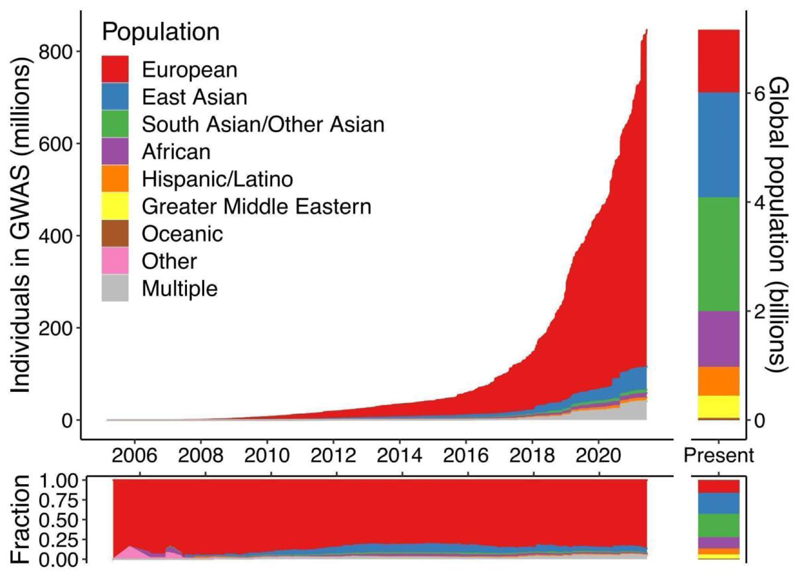
“Notably, 86% of high-throughput genetic association studies that have identified loci for traits and diseases have been carried out in Europeans [54], and there is a call to carry out studies in ancestrally diverse populations to provide insights into disease [55].”
BackgroundWu, C. W., Tomaszewski, A., Stark, L. A., Scaglia, F., Elenberg, E., & Schumaker, F. R. (2024) · Frontiers in Genetics · doi:10.3389/fgene.2024.1402667
“Notably, there is a signi fi cantly greater genetic and linguistic diversity among the African population compared to populations from other continents, which is not accurately represented by the low proportion of participants of African ancestry in the GWAS Catalog (Fatumo et al., 2022).”
BackgroundEthics of obtaining research skin biopsies from healthy African American volunteers
Brown, M., Zhou, A. E., & Grant-Kels, J. M. (2024) · Journal of the American Academy of Dermatology · doi:10.1016/j.jaad.2024.09.024
Tamuhla, T., Coussens, A. K., Abrahams, M., Blumenthal, M. J., Lakay, F. M., Wilkinson, R. J., Riou, C., Raubenheimer, P. J., Dave, J. A., & Tiffin, N. (2024) · Wellcome Open Research · doi:10.12688/wellcomeopenres.23009.1
Implementing genomics research in developing countries: Common challenges, and emerging solutions
Reynolds, A. W., Lea, A. J., & Nieves-Colón, M. A. (2024) · Elsevier eBooks · doi:10.1016/b978-0-443-18546-5.00004-8
Sengupta, D., Basu, A., Ramsay, M., & Choudhury, A. (2024) · Elsevier eBooks · doi:10.1016/b978-0-443-18546-5.00003-6
Self-citationDiversity in Clinical Trials: Challenges and Opportunities for Ibero-American Countries
Vispo, N. S. (2024) · Bionatura journal : · doi:10.70099/bj/2024.01.04.1
Advances in the Use of Genomics as a Biomarker for Diabetic Nephropathy
彭, 如. (2024) · Advances in Clinical Medicine · doi:10.12677/acm.2024.14123112
Using pharmacogenomics to prescribe across ethnicities
Mendes, A. (2025) · Journal of Prescribing Practice · doi:10.12968/jprp.2025.0001
Genetic data from Indigenous Greenlanders could help to narrow health-care gap
Arbour, L. T. (2025) · Nature · doi:10.1038/d41586-025-00091-6
Muriuki, J. M., Mentzer, A. J., Band, G., Chong, A. Y.-Y., Macharia, A., Mogire, R. M., Abuga, K. M., Mitchell, R. E., Gilchrist, J. J., Webb, E. L., et al. (2026) · Nature Communications · doi:10.1038/s41467-026-71567-w
Mehta, S., Antonio‐Aguirre, B., See, W. Y. N., Esposito, E. P., Pan, A. A., Applegate, C. D., Guthrie, K. S., Smith, C. H., Doyle, J. J., & Singh, M. S. (2025) · medRxiv · doi:10.1101/2025.03.03.25322102
Genetic architecture of Multiple Sclerosis patients in the French national OFSEP-HD cohortPreprint
Paris, J., Silva, N. D. S. B., Faddeenkov, I., Morin, M. E., Boussamet, L., Demuth, S., Barzine, M., Serova-Erard, A., Cornélis, F., Bourguiba, S., et al. (2025) · medRxiv · doi:10.1101/2025.04.28.25326562 · Cited by 2
de Freitas, R. M., Felipe, S. M. D. S., Pacheco, C., Faria, E., Martins, J. E. R., Fortes, J. P. A., Silva, D. S. D., Oliveira, P., & Ceccatto, V. M. (2025) · Biomedicines · doi:10.3390/biomedicines13051192
“While equity between continents remains lacking, it is believed that approximately 86% of all studies involving whole-genome-wide association studies (GWAS) are from Europe, while ~7% are from Asia, ~1% from Africa, and ~1% from Hispanic/Latino populations [46].”
Assembling unmapped reads reveals hidden variation in South Asian genomes
Das, A., Biddanda, A., McCoy, R. C., & Schatz, M. C. (2026) · Nature Communications · doi:10.1038/s41467-026-71755-8 · Cited by 1
Genetics and Genomics in Health and Disease: A Focus on African Populations
Chikowore, T., Soremekun, O. S., & Chilunga, F. P. (2025) · Annals of Human Genetics · doi:10.1111/ahg.12603
Self-citationDesigualdades genómicas y medicina de precisión
Herrera-Sánchez, P. J., -Cudco, L. L. L., & Mina-Villalta, G. Y. (2025) · Space Scientific Journal of Multidisciplinary · doi:10.63618/omd/ssjm/v3/n2/46
Underserved and Under Resourced: Towards Representation in Prenatal Diagnosis Research
Adams, A. D., & Peter, M. (2025) · Prenatal Diagnosis · doi:10.1002/pd.6831
DeBortoli, E., Nathan, V., Akbar, H. G., McInerney-Leo, A. M., Gilroy, D., Henders, A. K., Shah, S. H., & Yanes, T. (2025) · medRxiv · doi:10.1101/2025.06.26.25330306
Inclusion of Diverse Populations in Genomics Research: A Survey of InvestigatorsPreprint
Trelles, M. P., Sabin, T., Ramos, M. B., Robinson, M., Levy, T., Madden, E. B., Horowitz, C. R., & Vangeepuram, N. (2025) · Research Square · doi:10.21203/rs.3.rs-5551656/v1
Modern Bio-Technological Applications: Innovations and Insights in Life Sciences
Mohammed, W. M. A., Mohamed, W. A. A., Odeh, A. A. M., Hassan, I. I. A., & Hamid, Z. Z. N. (2025) · Bright Sky Publications eBooks · doi:10.62906/bs.book.410
Genomic Studies in Cardiovascular Research
Ding, H., Zhang, Y., & Liu, C. (2025) · Elsevier eBooks · doi:10.1016/b978-0-443-15734-9.00042-x
Unlocking Clinical Precision Through Polygenic Risk Prediction
Sathian, B., Iqbal, J., Banerjee, I., & Hamad, H. K. A. (2024) · Nepal Journal of Epidemiology · doi:10.3126/nje.v14i3.82370
Expert Perspectives on Clinical Laboratory Accreditation for Polygenic Risk ScoresPreprint
Wallingford, C. K., Clinch, T., Fowles, L., Young, M., Leo, P. J., Shah, S. H., McInerney-Leo, A. M., Bell, K. J., Saya, S., Siggs, O. M., et al. (2025) · medRxiv · doi:10.1101/2025.07.23.25332024
Genome Interpretation of Peruvian Inca Empire Descendants Reveals Actionable InsightsPreprint
Corpas, M., Fatumo, S., Sánchez, C., Cáceres, O., Padilla, C., Valdivia‐Silva, J., & Guio, H. (2025) · Research Square · doi:10.21203/rs.3.rs-6362225/v1
Self-citationMartini, R. N., Tijjani, A., Founta, K., Cha, D., Awai, A., Maurice, S., White, J. A., Mason, C. E., Cortés‐Ciriano, I., Robine, N., et al. (2025) · bioRxiv (Cold Spring Harbor Laboratory) · doi:10.1101/2025.08.15.670543
Une étude génétique retrace les origines des Peuls, la plus grande communauté pastorale d’Afrique
Schlebusch, C. M., Fortes‐Lima, C., & Černý, V. (2025) · The Conversation · doi:10.64628/aaj.c56yjxvsg
A golden era for personalized medicine is approaching, but are we ready?
PhD, N. (2025) · The Conversation · doi:10.64628/aam.n7ayknndt
Seheri, M. L., Mawela, D., Kgosana, L. P., Baker, C., van Hougenhouck-Tulleken, W. G., & Oladimeji, O. (2026) · JMIR Research Protocols · doi:10.2196/85150
“Furthermore, in populations characterized by high genetic diversity, such as those across Global South, integrating targeted NGS into clinical practice could illuminate novel genetic variants and expand the global understanding of rare diseases [12].”
Mighton, C. E., Reble, E., Sam, J., Kodida, R., Shickh, S., Clausen, M., Hirjikaka, D., Grewal, S. K., Panchal, S., Piccinin, C., et al. (2025) · Genetics in Medicine · doi:10.1016/j.gim.2025.101599
Silva, S., Nitsch, D., & Fatumo, S. (2025) · Tropical Medicine & International Health · doi:10.1111/tmi.70051
“Phenotypic heterogeneity, differences in sample characteristics, and environmental variation across cohorts, including population-specific gene–environment interactions, may contribute to the observed effect [51].”
Self-citationRaisa, A., Ackermann, N., Carter, C. R., Linnenbringer, E. L., Souroullas, G. P., Hamilton, J. G., Mozersky, J. T., & Waters, E. A. (2025) · Journal of Health Psychology · doi:10.1177/13591053251376860
“Behavioral and genetic research have been criticized for lacking inclusive samples and for oversampling white, nonHispanic population groups (Carter et al., 2023; Fatumo et al., 2022; He and Martin, 2023; Roberts et al., 2020).”
Juengling, F. D., Riauka, T., & Sundar, L. K. S. (2025) · Journal of Nuclear Medicine · doi:10.2967/jnumed.125.270717
“It is also critical that these efforts address existing biases in data representation, as current NIH datasets tend to overrepresent certain populations, limiting the applicability of AI models in diverse clinical settings ( 9 ).”
Schimmel‐Bristow, A., Embry, L. M., Fritz, A. M., Ramirez, L., Thomas, H. M., Reiter, I. A., & Faith, M. A. (2025) · Journal of Clinical Psychology in Medical Settings · doi:10.1007/s10880-025-10104-1
“For example, over 80% of post-mortem tissue samples used in extant genomic research have represented European-descended donors, limiting cutting-edge genomic medicine’s generalizability (Fatumo et al., 2022).”
Genetically Estimated Ancestry and the Risk of Pre-Eclampsia
Conti-Ramsden, F. I., Nicolaides, K. H., Syngelaki, A., Dixon, P. H., Williamson, C., Tsoukaki, M., Wright, A., Chappell, L. C., Hysi, P. G., & de Marvao, A. (2025) · JACC Advances · doi:10.1016/j.jacadv.2025.102283 · Cited by 1
Equitable inclusion of racialised communities in genomic research: a scoping review
Valiani, A. A., Raihan, M. M. H., Aroua, M., Chowdhury, N. A., Anderson, D. W., Gray, M., Hardcastle, L. E., & Turin, T. C. (2025) · BMJ Open · doi:10.1136/bmjopen-2024-095585
“9 33–37 Nevertheless, the terms of such forms of inclusion remain either ill-fitting for racialised communities in Canada and undefined in regards to the strategies that are adopted to equitably include them.”
Returning research results isn’t rocket science
von Baeyer, S. L. (2025) · Trends in Genetics · doi:10.1016/j.tig.2025.10.006
PERSIAN cohort biobank: creating a large-scale national resource for biomedical research in Iran
Shayanrad, A., Mousavi, S., Eftekhari, S., Roshandel, G., Irilouzadian, R., Poustchi, H., & Malekzadeh, R. (2025) · BMC Public Health · doi:10.1186/s12889-025-25006-y
“With-out a stronger scientific foundation that includes these populations, precision medicine cannot achieve its full potential and may unintentionally widen global health disparities [5–7].”
Kodji, E., Attaoua, R., Haloui, M., Hishmih, C., Seitz, M., Hamet, P., Hussin, J., & Tremblay, J. (2025) · Canadian Journal of Diabetes · doi:10.1016/j.jcjd.2025.10.139
Substance Use Disorders as Genetic Bridges Across Psychiatric Disorders in Diverse Ancestries
Ohi, K. (2025) · Biological Psychiatry · doi:10.1016/j.biopsych.2025.09.017
Challenges and opportunities for understanding the genetic causes of congenital anomalies
Kueper, J., Moskowitz, I. P. G., Stottmann, R. W., Zohn, I. E., & Khokha, M. K. (2025) · Developmental Biology · doi:10.1016/j.ydbio.2025.12.001
Metadata
- Authors
- Fatumo, S., Chikowore, T., Choudhury, A., Ayub, M., Martin, A. R., & Kuchenbaecker, K.
- Affiliations
- London School of Hygiene & Tropical Medicine (GB)
- University of the Witwatersrand (ZA)
- University College London (GB)
- Broad Institute (US)
- Corresponding author
- Fatumo, Segun
- ORCID
- Venue
- Nature Medicine
- Published
- 2022-02
- Volume
- 28
- Issue
- 2
- Pages
- 243-250
- ISSN
- 1078-8956 (ISSN-L)
- 1546-170X
- PMC
- PMC7614889
- OpenAlex
- W4211005061
- Cited by
- 707
- References
- 63
- Citations by year
- 2026: 169 · 2025: 188 · 2024: 152 · 2023: 132 · 2022: 64
- FWCI
- 20.80
- Type
- journal article
- Language
- en
- Open access
- green
- www.ncbi.nlm.nih.gov
- Licence
- cc-by
- www.springer.com/tdm (tdm)
- www.springer.com/tdm (vor)
- Locations
- Nature Medicine (publishedVersion)
- PubMed (publishedVersion)
- PubMed Central (acceptedVersion, cc-by)
- LSHTM Research Online (London School of Hygiene and Tropical Medicine) (acceptedVersion)
- UCL Discovery (University College London) (submittedVersion)
- Funders
- Wellcome Trust (214205, 214205/Z/18/Z)
- Topics
- Social Sciences › Anthropology › Race, Genetics, and Society
- Health Sciences › Medicine › Public Health, Environmental and Occupational Health › Ethics in Clinical Research
- Life Sciences › Biochemistry, Genetics and Molecular Biology › Genetics › Genetic Associations and Epidemiology
- Keywords
- genomic diversity, underrepresented groups, health equity, research inclusion, etiology, drug design
- MeSH terms
- Whole Genome Sequencing, Humans, Genome, Human, Genomics
About these checks
Registry, retraction, Cites and statistics results are computed, not judged, with one exception: a printed reference that no index lists is read once by a model before it counts as a citation error. Claims are extracted by a model and kept only when their quote appears verbatim in the text; each cited source is then checked, with a model’s help, for whether it says what the claim relies on. Those verdicts can be wrong — read the claim’s quote and the cited source before relying on one.
Statistics and arithmetic are recomputed, not judged.
Confidence bands are shown only for fields calibrated on our annotated test set. None is calibrated yet, so no band is shown.
What counts as a claim ›How we measure confidence ›How we check this ›
Are you an author, or do you see a problem with this page? Request a review
Data sources
Bibliographic data: Semantic Scholar, OpenAlex, Crossref.
Contains information from the Semantic Scholar Academic Graph Datasets, made available under the ODC Attribution License (ODC-BY 1.0).
Semantic Scholar’s data is described in: Kinney, R., et al. (2023). The Semantic Scholar Open Data Platform. arXiv:2301.10140.
