

A roadmap to increase diversity in genomic studies
Open accessThe DOI matches its Crossref record; 63 of the 63 references it cites were found in a registry or an index.
Abstract
Two decades ago, the sequence of the first human genome was published. Since then, advances in genome technologies have resulted in whole-genome sequencing and microarray-based genotyping of millions of human genomes. However, genetic and genomic studies are predominantly based on populations of European ancestry. As a result, the potential benefits of genomic research-including better understanding of disease etiology, early detection and diagnosis, rational drug design and improved clinical care-may elude the many underrepresented populations. Here, we describe factors that have contributed to the imbalance in representation of different populations and, leveraging our experiences in setting up genomic studies in diverse global populations, we propose a roadmap to enhancing inclusion and ensuring equal health benefits of genomics advances. Our Perspective highlights the importance of sincere, concerted global efforts toward genomic equity to ensure the benefits of genomic medicine are accessible to all.
Overview
The claims and statistics of this paper haven’t been checked yet.
Free: it reads the open-access text and checks the first 5 claims that cite a source we can check. Create a free account to check every claim.
Integrity signals
Registry
Cites
Statistics
Figures
Verification
Claims the paper makes
The claims and statistics of this paper haven’t been checked yet.
Free: it reads the open-access text and checks the first 5 claims that cite a source we can check. Create a free account to check every claim.
Claims other papers make about this one
Each is checked against this paper’s own text: does it say what the citing paper says it does?
The source backs part of the claim, not all of it — or backs it for a different population, condition or comparison.
In the citing paper
“The lack of diversity in genetic studies on EduYears could lead to social and health disparities due to inadequate comprehension of EduYears and its impact on socioeconomic and health outcomes in understudied populations15.”
From Shared genetic architectures of educational attainment in East Asian and European populations (2024) · cites this paper as [15]
Experimental — accuracy not yet measuredIn the citing paper
“Large open datasets are more likely to come from the Global North, may prioritize research questions from these populations, and can have limited generalizability (e.g., the overrepresentation of European ancestry in genomic studies [115]).”
From Open Science 2.0: Towards a truly collaborative research ecosystem (2023) · cites this paper as [115]
Self-check
Percentages, sums and reported differences re-computed from the paper’s own numbers.
The self-check needs the paper’s full text.
Citations
Cites
The mutational constraint spectrum quantified from variation in 141,456 humans
Karczewski, K. J., Francioli, L. C., Tiao, G., Cummings, B. B., Alföldi, J., Wang, Q., Collins, R. L., Laricchia, K. M., Ganna, A., Birnbaum, D. P., et al. (2020) · Nature · doi:10.1038/s41586-020-2308-7 · Cited by 9,434
Buniello, A., MacArthur, J. A. L., Cerezo, M., Harris, L. W., Hayhurst, J., Malangone, C., McMahon, A., Morales, J., Mountjoy, E., Sollis, E., et al. (2019) · Nucleic Acids Research · doi:10.1093/nar/gky1120 · Cited by 4,000
Clinical use of current polygenic risk scores may exacerbate health disparities
Martin, A. R., Kanai, M., Kamatani, Y., Okada, Y., Neale, B. M., & Daly, M. J. (2019) · Nature Genetics · doi:10.1038/s41588-019-0379-x · Cited by 2,821
Self-citationThe personal and clinical utility of polygenic risk scores
Torkamani, A., Wineinger, N. E., & Topol, E. J. (2018) · Nature Reviews Genetics · doi:10.1038/s41576-018-0018-x · Cited by 1,623
The Missing Diversity in Human Genetic Studies
Sirugo, G., Williams, S. M., & Tishkoff, S. A. (2019) · Cell · doi:10.1016/j.cell.2019.02.048 · Cited by 1,516
Human Demographic History Impacts Genetic Risk Prediction across Diverse Populations
Martin, A. R., Gignoux, C. R., Walters, R. K., Wojcik, G. L., Neale, B. M., Gravel, S., Daly, M. J., Bustamante, C. D., & Kenny, E. E. (2017) · The American Journal of Human Genetics · doi:10.1016/j.ajhg.2017.03.004 · Cited by 1,391
Self-citationCohen, J., Pertsemlidis, A., Kotowski, I. K., Graham, R., Garcia, C. K., & Hobbs, H. H. (2005) · Nature Genetics · doi:10.1038/ng1509 · Cited by 1,381
Genomic Risk Prediction of Coronary Artery Disease in 480,000 Adults
Inouye, M., Abraham, G., Nelson, C. P., Wood, A. M., Sweeting, M. J., Dudbridge, F., Lai, F. Y., Kaptoge, S., Brozynska, M., Wang, T., et al. (2018) · Journal of the American College of Cardiology · doi:10.1016/j.jacc.2018.07.079 · Cited by 793
Genetics of blood lipids among ∼300,000 multi-ethnic participants of the Million Veteran Program
Global Lipids Genetics Consortium, Klarin, D., Myocardial Infarction Genetics (MIGen) Consortium, The Geisinger-Regeneron DiscovEHR Collaboration, Program, T. V. M. V., Damrauer, S. M., Cho, K., Sun, Y. V., Teslovich, T. M., Honerlaw, J., et al. (2018) · Nature Genetics · doi:10.1038/s41588-018-0222-9 · Cited by 625
Diversity in clinical and biomedical research: a promise yet to be fulfilled
Oh, S. S., Galanter, J., Thakur, N., Pino-Yanes, M., Barcelo, N. E., White, M. J., de Bruin, D. M., Greenblatt, R. M., Bibbins-Domingo, K., Wu, A. H. B., et al. (2015) · PLOS Medicine · doi:10.1371/journal.pmed.1001918 · Cited by 585
Cited by
Items 101–200 of 776
Coronel‐Oliveros, C., González-Gómez, R., Ranasinghe, K. G., Sainz‐Ballesteros, A., Legaz, A., Fittipaldi, S., Cruzat, J., Herzog, R. A., Yener, G., Parra, M. A., et al. (2024) · Alzheimer s & Dementia · doi:10.1002/alz.13788 · Cited by 28
Burden of Mendelian disorders in a large Middle Eastern biobank
Aamer, W., Al-Maraghi, A., Syed, N., Gandhi, G. D., ALIYEV, E. E., Al-Kurbi, A. A., Al-Saei, O., Kohailan, M., Krishnamoorthy, N., Palaniswamy, S., et al. (2024) · Genome Medicine · doi:10.1186/s13073-024-01307-6 · Cited by 26
Universal newborn screening using genome sequencing: early experience from the GUARDIAN study
Ziegler, A. C., & Chung, W. K. (2024) · Pediatric Research · doi:10.1038/s41390-024-03647-w · Cited by 34
“Indeed, non-White populations are under-represented in genetic databases, 16 impairing the ability to interpret variants speci fi c to these populations.”
Liu, T., Lu, H.-F., Chen, Y.-C., Liao, C., Lin, Y., Yang, J., Liao, W., Lin, W.-D., Chen, S., Huang, Y.-C., et al. (2025) · Science Advances · doi:10.1126/sciadv.adt0539 · Cited by 30
Beyond race: Recruitment of diverse participants in clinical genomics research for rare disease
Young, J. L., Halley, M. C., Anguiano, B., Fernández, L., Bernstein, J. A., Wheeler, M. T., & Tabor, H. K. (2022) · Frontiers in Genetics · doi:10.3389/fgene.2022.949422 · Cited by 26
“A number of sociodemographic factors are known to shape access to health research, including cultural norms and beliefs related to health and illness, lack of education, financial resources and health insurance (Lee et al., 2019; McGuire et al., 2020; Fatumo et al., 2022) Especially for historically excluded or exploi…”
BackgroundSharing GWAS summary statistics results in more citations
Reales, G., & Wallace, C. (2023) · Communications Biology · doi:10.1038/s42003-023-04497-8 · Cited by 26
Overcoming barriers to single-cell RNA sequencing adoption in low- and middle-income countries
Serebour, T. B., Cribbs, A. P., Baldwin, M. J., Masimirembwa, C. M., Chikwambi, Z., Kerasidou, A., & Snelling, S. J. B. (2024) · European Journal of Human Genetics · doi:10.1038/s41431-024-01564-4 · Cited by 30
Advancing Understanding of Inequities in Rare Disease Genomics
Serrano, J. G., O'Leary, M., VanNoy, G. E., Mangilog, B. E., Holm, I. A., Fraiman, Y. S., Rehm, H. L., O'Donnell-Luria, A., & Wojcik, M. H. (2023) · Clinical Therapeutics · doi:10.1016/j.clinthera.2023.06.010 · Cited by 25
Young, M., Yanes, T., Cust, A. E., Dunlop, K. L. A., Limb, S., Newson, A. J., Purvis, R., Thiyagarajan, L., Scott, R. J., Verma, K. P., et al. (2023) · Twin Research and Human Genetics · doi:10.1017/thg.2023.10 · Cited by 26
“More inclusive genomic research is widely recognised as a priority by the genetics community, and various studies are now underway that aim to develop more diverse databases that are representative of global populations (Fatumo et al., 2022).”
Disparities in Genetic Testing for Neurologic Disorders
Baldwin, A., Copeland, J. N., Azage, M., Dratch, L., Johnson, K., Paul, R., Amado, D. A., Baer, M., Deik, A., Elman, L. B., et al. (2024) · Neurology · doi:10.1212/wnl.0000000000209161 · Cited by 26
Genome-driven Chinese precision medicine: Biobank-scale genomic research as a new paradigm
Wang, M., Duan, S., Li, X., Yang, J., Yuan, H., Liu, C., & He, G. (2025) · The Innovation Life · doi:10.59717/j.xinn-life.2025.100131 · Cited by 25
Pervasive ancestry bias in variant effect predictors
Pathak, A. K., Bora, N., Badonyi, M., Livesey, B. J., SG10K_Health Consortium, Ngeow, J., & Marsh, J. A. (2024) · bioRxiv (Cold Spring Harbor Laboratory) · doi:10.1101/2024.05.20.594987 · Cited by 19
Diagnosing cystic fibrosis in low- and middle-income countries: challenges and strategies
Fuhrer, M., Zampoli, M., & Abriel, H. (2024) · Orphanet Journal of Rare Diseases · doi:10.1186/s13023-024-03506-1 · Cited by 26
“Fatumo et al. found that European populations are overrepresented in genomic studies [28].”
InfluentialDriving Global Health equity and precision medicine through African genomic data
Ojewunmi, O. O., & Fatumo, S. (2025) · Human Molecular Genetics · doi:10.1093/hmg/ddaf025 · Cited by 24
Self-citationPrecision Medicine Needs to Think Outside the Box
Martschenko, D. O., & Young, J. L. (2022) · Frontiers in Genetics · doi:10.3389/fgene.2022.795992 · Cited by 25
“It is ethically problematic to continue inequitable resource allocations that drive underrepresentation in genomic studies, (Fatumo et al., 2022), just as it is ethically problematic to recruit participants for research and then discard their contributions from analyses.”
BackgroundVicente, A. L. S. A., Novoloaca, A., Cahais, V., Awada, Z., Cuenin, C., Spitz, N., Carvalho, A. L., Evangelista, A. F., Crovador, C. S., Reis, R. M., et al. (2022) · Nature Communications · doi:10.1038/s41467-022-31488-w · Cited by 29
Public engagement with genomics
Middleton, A., Adams, A., Aidid, H., Atutornu, J., Boraschi, D., Borra, J., Bircan, T., Burch, C., Costa, A., Dickinson, A., et al. (2023) · Wellcome Open Research · doi:10.12688/wellcomeopenres.19473.2 · Cited by 27
Mbuya-Bienge, C., Pashayan, N., Kazemali, C. D., Lapointe, J., Simard, J., & Nabi, H. (2023) · Cancers · doi:10.3390/cancers15225380 · Cited by 26
“Finally, studies showed the predictive performance of models, but only some of them considered the clinical and practical utility of these models [102].”
BackgroundMulti-omics: a bridge connecting genotype and phenotype for epilepsy?
Wang, N., Cao, F., Zhang, L.-H., Zheng, Y.-F., & Xu, D. (2025) · Biomarker Research · doi:10.1186/s40364-025-00798-8 · Cited by 25
“However, most genomic studies are predominantly based on populations of European population [18].”
Chan, M., Sadeghi‐Alavijeh, O., Lopes, F. M., Hilger, A. C., Stanescu, H. C., Voinescu, C., Beaman, G. M., Newman, W. G., Zaniew, M., Weber, S., et al. (2022) · eLife · doi:10.7554/elife.74777 · Cited by 24
Diversity, Equity, and Inclusion: A Decade of Progress?
Jones, B. L., Carter, M. C., Davis, C. M., & Wang, J. (2022) · The Journal of Allergy and Clinical Immunology In Practice · doi:10.1016/j.jaip.2022.10.007 · Cited by 26
Soremekun, O. S., Dib, M., Rajasundaram, S., Fatumo, S., & Gill, D. (2023) · Cambridge Prisms Precision Medicine · doi:10.1017/pcm.2022.13 · Cited by 24
Self-citationAfrican genomes hold the key to accurate genetic risk prediction
Fatumo, S., & Inouye, M. (2023) · Nature Human Behaviour · doi:10.1038/s41562-023-01549-1 · Cited by 23
Self-citationGenetic predisposition to sarcoidosis
Liao, S., Fingerlin, T. E., & Maier, L. A. (2023) · Journal of Autoimmunity · doi:10.1016/j.jaut.2023.103122 · Cited by 23
The Mutographs biorepository: A unique genomic resource to study cancer around the world
Perdomo, S. P., Abedi‐Ardekani, B., de Carvalho, A. C., Ferreiro-Iglesias, A., Gaborieau, V., Cattiaux, T., Renard, H., Chopard, P., Carreira, C., Spanu, A., et al. (2024) · Cell Genomics · doi:10.1016/j.xgen.2024.100500 · Cited by 27
“Inclusion of more diverse populations of patients from other geographical regions in cancer genomic studies still lags behind, 4 and emerging findings from comparative studies of population diversity in cancer genomics 5,6 have established the necessity to expand diverse genetic and epidemiological…”
BackgroundLeong, I. U. S., Cabrera, C., Cipriani, V., Ross, P. J., Turner, R. M., Stuckey, A., Sanghvi, S., Pasko, D., Moutsianas, L., Odhams, C. A., et al. (2024) · Journal of Clinical Oncology · doi:10.1200/jco.23.02761 · Cited by 29
A comprehensive survey of genome language models in bioinformatics
Shu, L., Tang, J., Guan, X., & Zhang, D. (2026) · Briefings in Bioinformatics · doi:10.1093/bib/bbaf724 · Cited by 25
“Labeled DNA and RNA datasets are disproportionately concentrated in humans and a few model organisms, leading to representational biases that impair model generalization across species [31, 89, 131, 132].”
Hughes, J. H., Woo, K., Keizer, R. J., & Goswami, S. (2022) · Clinical Pharmacology & Therapeutics · doi:10.1002/cpt.2799 · Cited by 26
Optimal strategies for learning multi-ancestry polygenic scores vary across traits
Lehmann, B., Mackintosh, M. E., McVean, G., & Holmes, C. C. (2023) · Nature Communications · doi:10.1038/s41467-023-38930-7 · Cited by 24
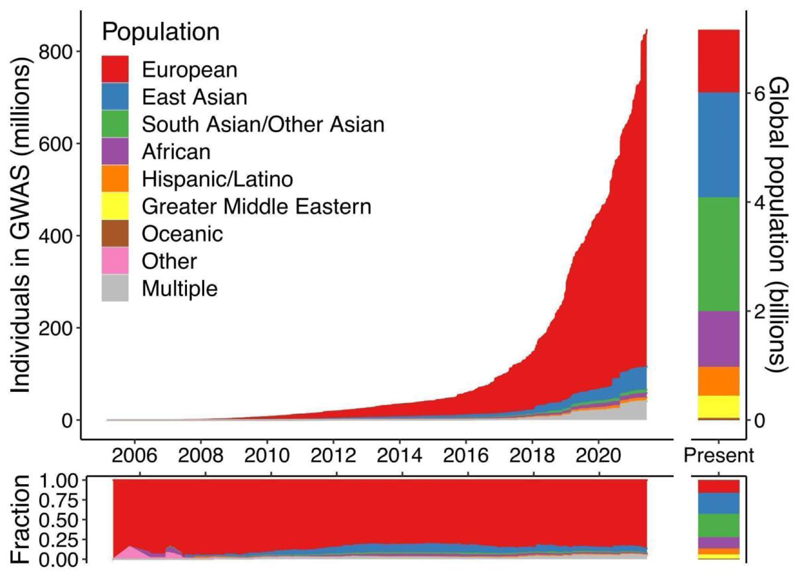
“In fact, 284 despite calls for more diversity in genomic studies, this Eurocentric bias appears to be getting worse: 285 in 2019 the proportion of samples in the GWAS Catalog [40] from European-ancestry individuals was 286 78% [39].”
BackgroundEnsuring equity: Pharmacogenetic implementation in rural and tribal communities
Leitch, T., Killam, S. R., Brown, K. E., Katseanes, K. C., George, K. M., Schwanke, C. M., Loveland, J. G., Elias, A. F., Haney, K., Krebsbach, K., et al. (2022) · Frontiers in Pharmacology · doi:10.3389/fphar.2022.953142 · Cited by 21
“pharmacogenetic variation in diverse populations desperately lagging (Popejoy and Fullerton, 2016; Martin et al., 2019; Fatumo et al., 2022).”
BackgroundBizzari, S., Nair, P., Hana, S., Deepthi, A., Al‐Ali, M. T., Al‐Gazali, L., & El‐Hayek, S. (2023) · Frontiers in Genetics · doi:10.3389/fgene.2023.1177204 · Cited by 23
The Role of Germline Mutations in Thoracic Malignancies: Between Myth and Reality
Farinea, G., Crespi, V., Listì, A., Righi, L., Bironzo, P., Merlini, A., Malapelle, U., Novello, S., Scagliotti, G. V., & Passiglia, F. (2023) · Journal of Thoracic Oncology · doi:10.1016/j.jtho.2023.05.028 · Cited by 21
Prospects for Leveraging the Microbiota as Medicine for Hypertension
Durgan, D. J., Zubcevic, J. A., Vijay–Kumar, M., Yang, T., Manandhar, I., Aryal, S., Muralitharan, R. R., Li, H., Li, Y., Abais‐Battad, J. M., et al. (2024) · Hypertension · doi:10.1161/hypertensionaha.124.21721 · Cited by 21
Elmonem, M. A., Soliman, N. A., Moustafa, A., Gad, Y. Z., Hassan, W. A., Taha, T., El-Feky, G. S., Sakr, M. M., & Amer, K. (2024) · Nature Genetics · doi:10.1038/s41588-024-01739-1 · Cited by 21
Parmar, J., Laing, N. G., Kennerson, M. L., & Ravenscroft, G. (2024) · Journal of Neurology Neurosurgery & Psychiatry · doi:10.1136/jnnp-2024-333436 · Cited by 22
Co-Creating the Experience of Consent for Newborn Genome Sequencing: The Generation Study
Leblond, M., Galati, M., Roberts, J., Etheredge, H. R., Willacy, N., Özkurt, Ö., & Pichini, A. (2024) · Public Health Genomics · doi:10.1159/000541935 · Cited by 22
Social-Science Genomics: Progress, Challenges, and Future Directions
Benjamin, D., Cesarini, D., Turley, P., & Young, A. S. (2024) · doi:10.3386/w32404 · Cited by 20
Austin-Zimmerman, I., Spinazzola, E., Quattrone, D., Wu-Choi, B., Trotta, G., Li, Z., Johnson, E. C., Richards, A. L., Freeman, T. P., Tripoli, G., et al. (2024) · Psychological Medicine · doi:10.1017/s0033291724002058 · Cited by 20
“This is a common problem in genetic studies, and one that must be rapidly addressed to ensure scientific discoveries, especially those with potential clinical implications, are relevant to all populations (Duncan et al., 2019; Fatumo et al., 2022; Peterson et al., 2019).”
Epistemological Pitfalls in the Proxy Theory of Race: The Case of Genomics-Based Medicine
Malinowska, J. K., & Serpico, D. (2023) · The British Journal for the Philosophy of Science · doi:10.1086/727957 · Cited by 22
Shaping immunity: The influence of natural selection on population immune diversity
Randolph, H. E., Aracena, K. A., Lin, Y., Mu, Z., & Barreiro, L. B. (2024) · Immunological Reviews · doi:10.1111/imr.13329 · Cited by 23
Evaluation for genetic disease in kidney transplant candidates: A practice resource
Ames, E. G., Anand, P. M., Bekheirnia, M. R., Doshi, M. D., Ters, M. E., Freese, M. E., Gbadegesin, R., Guay‐Woodford, L. M., Java, A., Ranch, D., et al. (2024) · American Journal of Transplantation · doi:10.1016/j.ajt.2024.10.019 · Cited by 20
Zheng, Z., Qiao, X., Yin, J., Kong, J., Han, W., Qin, J., Meng, F., Tian, G., & Feng, X. (2024) · International Journal of Molecular Medicine · doi:10.3892/ijmm.2024.5479 · Cited by 22
Genetic context modulates aging and degeneration in the murine retina
Marola, O. J., MacLean, M., Cossette, T. L., Diemler, C. A., Hewes, A. A., Reagan, A. M., Kanyinda, J. N., Skelly, D. A., & Howell, G. R. (2025) · Molecular Neurodegeneration · doi:10.1186/s13024-025-00800-9 · Cited by 19
“In addition, genetic contributions to retinal degeneration are likely to be underestimated as, historically, the inclusion of genetically diverse individuals is lacking [30].”
Genetic architecture in Greenland is shaped by demography, structure and selection
Stæger, F. F., Andersen, M. K., Li, Z., Hjerresen, J. P., He, S., Santander, C. G., Jensen, R. T., Rex, K. F., Thuesen, A. C. B., Hanghøj, K., et al. (2025) · Nature · doi:10.1038/s41586-024-08516-4 · Cited by 22
McIntosh, A. M., & Lewis, C. M. (2024) · medRxiv · doi:10.1101/2024.04.29.24306535 · Cited by 25
Cross-ancestry genomic research: time to close the gap
Atkinson, E. G., Bianchi, S. B., Ye, G. Y., Martínez-Magaña, J. J., Tietz, G. E., Montalvo-Ortiz, J. L., Giusti-Rodriguez, P., Palmer, A. A., & Sanchez-Roige, S. (2022) · Neuropsychopharmacology · doi:10.1038/s41386-022-01365-7 · Cited by 19
“Beyond these efforts to generate more diverse data and enhance methods for its analysis, other challenges remain to increase equity in genomics research [5, 9, 10, 24].”
BackgroundShared genetic architectures of educational attainment in East Asian and European populations
Chen, T.-T., Kim, J., Lam, M., Chuang, Y.-F., Chiu, Y.-L., Lin, S.-C., Jung, S.-H., Kim, B., Kim, S., Cho, C., et al. (2024) · Nature Human Behaviour · doi:10.1038/s41562-023-01781-9 · Cited by 18
“The lack of diversity in genetic studies on EduYears could lead to social and health disparities due to inadequate comprehension of EduYears and its impact on socioeconomic and health outcomes in understudied populations 15 .”
Millischer, V., Matheson, G. J., Bergen, S. E., Coombes, B. J., Ponzer, K., Wikström, F., Jagiełło, K., Lundberg, M., Stenvinkel, P., Biernacka, J. M., et al. (2022) · The Lancet Psychiatry · doi:10.1016/s2215-0366(22)00100-6 · Cited by 19
Haddad, A., Radhakrishnan, A., McGee, S. R., Smith, J. D., Karnes, J. H., Venner, E., Wheeler, M. M., Patterson, K., Walker, K., Kalra, D., et al. (2026) · Science Translational Medicine · doi:10.1101/2024.06.12.24304664 · Cited by 19
Streit, F., Awasthi, S., Hall, A. S. M., Braun, A., Niarchou, M., Marouli, E., Babajide, O., Frank, J., Zillich, L., Callies, C., et al. (2026) · Nature Genetics · doi:10.1038/s41588-026-02654-3 · Cited by 20
“Furthermore, expanding the analyses to non-European ancestries is necessary to improve our understanding of the underlying genetic architecture and to facilitate the generalizability of the results 84,85 .”
Su, C.-Y., van der Graaf, A., Zhang, W., Jang, D.-K., Selber-Hnatiw, S., Yang, T.-Y., Butler-Laporte, G., Liang, K. Y. H., Matsuda, F., Costanzo, M. C., et al. (2024) · doi:10.1101/2024.10.17.24315553 · Cited by 17
Reitz, J., Rosoff, D. B., Perlstein, T., Wagner, A., Jung, J., Wagner, J., Reiner, B. C., & Lohoff, F. W. (2025) · Molecular Psychiatry · doi:10.1038/s41380-025-03199-3 · Cited by 18
Complex trait associations in rare diseases and impacts on Mendelian variant interpretation
Smail, C., Ge, B., Keever-Keigher, M. R., Schwendinger-Schreck, C., Cheung, W., Johnston, J. J., Barrett, C. M., Feldman, K., Cohen, A. S. A., Farrow, E., et al. (2024) · Nature Communications · doi:10.1038/s41467-024-52407-1 · Cited by 18
Asiimwe, I. G., Blockman, M., Cohen, K., Cupido, C., Hutchinson, C., Jacobson, B. F., Lamorde, M., Morgan, J., Mouton, J. P., Nakagaayi, D., et al. (2022) · Frontiers in Pharmacology · doi:10.3389/fphar.2022.967082 · Cited by 18
“This is especially true in relation to the inclusion of black African patients, who have not been well-represented in previous studies (Sirugo et al., 2019; Asiimwe and Pirmohamed, 2022; Fatumo et al., 2022).”
BackgroundResultFlory, A. R., Lazzarotto, C. R., Li, Y., Chyr, J., Yang, M., Katta, V., Urbina, E., Lee, G., Wood, R. K., Matsubara, A., et al. (2025) · bioRxiv (Cold Spring Harbor Laboratory) · doi:10.1101/2025.02.10.637517 · Cited by 17
Perspective on the ethics of AI at the intersection of nutrition and behaviour change
Abrahams, M., & Raimundo, M. (2025) · Frontiers in Aging · doi:10.3389/fragi.2025.1423759 · Cited by 17
“This requires the use of diverse data sets to train the AI system, to avoid irrelevant recommendations to be made for speci fi c individuals or groups (Fatumo et al., 2023).”
Rosoff, D. B., Bell, A. S., Wagner, J., Mavromatis, L. A., Hamandi, A. M., Park, L. Y., Jung, J., & Lohoff, F. W. (2023) · Cellular and Molecular Gastroenterology and Hepatology · doi:10.1016/j.jcmgh.2023.09.001 · Cited by 17
Underrepresented populations in genomic research: a qualitative study of researchers’ perspectives
Omeranovic, A., Long, F. N. V., Boubaker, A., Turgeon, A., & Nabi, H. (2025) · BMC Medical Genomics · doi:10.1186/s12920-025-02140-5 · Cited by 18
Peters, R., Best, S., Lynch, F., Vears, D. F., Downie, L., Archibald, A. D., Lunke, S., Stark, Z., & Goranitis, I. (2025) · The American Journal of Human Genetics · doi:10.1016/j.ajhg.2025.05.001 · Cited by 16
Long-read transcriptomics of a diverse human cohort reveals ancestry bias in gene annotation
Clavell-Revelles, P., Reese, F., Sala, S. C., Degalez, F., Arnan, C., Oliveros, W., Palumbo, E., Perteghella, T., Guigó, R., & Melé, M. (2025) · Nature Communications · doi:10.1038/s41467-025-66096-x · Cited by 16
“This will become increasingly relevant as GWAS studies start to capture a wider diversity of ancestries 70,71 and therefore will require ancestry-unbiased genome annotations that properly enable the mechanistic understanding of identi fi ed genetic variants.”
Miller, E. G., Young, J. L., Rao, A., Ward-Lev, E., & Halley, M. C. (2023) · JAMA Network Open · doi:10.1001/jamanetworkopen.2023.10367 · Cited by 17
Low-frequency and rare genetic variants associated with rheumatoid arthritis risk
Kronzer, V. L., Sparks, J. A., Raychaudhuri, S., & Cerhan, J. R. (2024) · Nature Reviews Rheumatology · doi:10.1038/s41584-024-01096-7 · Cited by 15
Reassessing human MHC-I genetic diversity in T cell studies
Slieker, R. C., Warmerdam, D. O., Vermeer, M. H., van Doorn, R., Heemskerk, M. H. M., & Scheeren, F. A. (2024) · Scientific Reports · doi:10.1038/s41598-024-58777-2 · Cited by 17
Morneau‐Vaillancourt, G., Palaiologou, E., Polderman, T. J. C., & Eley, T. C. (2024) · Journal of Child Psychology and Psychiatry · doi:10.1111/jcpp.14099 · Cited by 16
“It is crucial to increase inclusivity and diversity in genetic research so that the benefits of research can be generalised to all (Fatumo et al., 2022).”
Genetic Susceptibility of Type 2 Diabetes and Metabolic Syndrome
Ercegović, V., Džimbeg, M., & Gelemanović, A. (2025) · Diabetology · doi:10.3390/diabetology6020011 · Cited by 17
Optimizing DNA Sequence Classification via a Deep Learning Hybrid of LSTM and CNN Architecture
Tabane, E., Mnkandla, E., & Wang, Z. (2025) · Applied Sciences · doi:10.3390/app15158225 · Cited by 17
Geneviève, L. D., Elger, B. S., & Wangmo, T. (2022) · Cambridge Prisms Precision Medicine · doi:10.1017/pcm.2022.4 · Cited by 16
Genetics of Chronic Kidney Disease in Low-Resource Settings
Ilori, T. O., Watanabe, A., Ng, K. H., Solarin, A. U., Sinha, A. P., & Gbadegesin, R. (2022) · Seminars in Nephrology · doi:10.1016/j.semnephrol.2023.151314 · Cited by 14
Genomic Newborn Screening for Pediatric Cancer Predisposition Syndromes: A Holistic Approach
Linga, B. G., Mohammed, S. G. A. A., Farrell, T. J., Rifai, H. A., Al-Dewik, N. I. E., & Qoronfleh, M. W. (2024) · Cancers · doi:10.3390/cancers16112017 · Cited by 15
“There is a growing concern regarding the potential unequal access to the benefits of genome sequencing, which could further widen health disparities based on income or geographic location [193].”
BackgroundUsing DNA to Predict Education: a Meta-analytic Review
Wilding, K., Wright, M., & von Stumm, S. (2024) · Educational Psychology Review · doi:10.1007/s10648-024-09928-4 · Cited by 16
“…in genomic research, funding bodies like the National Institute of Health (NIH) now mandate the inclusion of non-European ancestry samples in data collection projects, although dedicated funding calls to study and foster ancestral diversity remain scarce (Fatumo et al., 2022; Mills & Rahal, 2020).”
Ben‐Mahmoud, A., Gupta, V. R., Aleem, A. K. A., Thompson, I. R., Aden, A., Mbarek, H., Saad, C., Tolefat, M., Alshaban, F. A. W., Stanton, L. W., et al. (2024) · International Journal of Molecular Sciences · doi:10.3390/ijms252111551 · Cited by 14
Maternal depression and the polygenic p factor: A family perspective on direct and indirect effects
Ayorech, Z., Cheesman, R., Eilertsen, E. M., Bjørndal, L. D., Røysamb, E., McAdams, T. A., Havdahl, A., & Ystrøm, E. (2023) · Journal of Affective Disorders · doi:10.1016/j.jad.2023.03.043 · Cited by 18
“The present study is based on GWAS summary statistics from those of European ancestry and recent evidence suggest accuracy of polygenic score predictions decays with increasing genetic distance from the GWAS study cohort (Fatumo et al., 2022; Martin et al., 2019).”
MethodModafferi, C., Grippaudo, C., Corvaglia, A., Cristi, V., Amato, M., Rigotti, P., Polizzi, A., & Isola, G. (2025) · Genes · doi:10.3390/genes16111308 · Cited by 16
“Addressing ancestry bias requires not only expanded sampling, but also investment in local genomics capacity, phenotype harmonization across settings, and prospective validation studies that quantify predictive performance and clinical utility in each target population [123].”
Nursing strategies to address health disparities in genomics-informed care: a scoping review
Limoges, J., Chiu, P., Dordunoo, D., Puddester, R., Pike, A. D., Wonsiak, T., Zakher, B., Carlsson, L., & Mussell, J. (2024) · JBI Evidence Synthesis · doi:10.11124/jbies-24-00009 · Cited by 16
Evolution, genetic diversity, and health
Palma-Martínez, M. J., Posadas‐García, Y. S., Shaukat, A., López-Ángeles, B. E., & Sohail, M. (2025) · Nature Medicine · doi:10.1038/s41591-025-03558-1 · Cited by 15
“As societies seek to make amends for centuries of coloniza-tion—the harms of which are still evident in wide-ranging inequities, including within health and medicine—this topic has never been more relevant 7–10 .”
Genetic evaluation of early-onset atrial fibrillation: impact on patient management
Laws, J. L., Shabani, M., Williams, H. L., Grauherr, D. D., Kilbourne, W. M., Crawford, D. M., Ogunmola, I., Sun, L., Virk, Z. M., Cathey, B. M., et al. (2025) · European Heart Journal · doi:10.1093/eurheartj/ehaf829 · Cited by 13
Could Africa be the future for genomics research?
Lombard, Z., & Landouré, G. (2023) · Nature · doi:10.1038/d41586-023-00222-x · Cited by 13
Fernández-Carrión, R., Sorlí, J. V., Asensio, E. M., Pascual, E. C., Portolés, O., Álvarez‐Sala, A., Francès, F., Sabio, J. B. R., Fidalgo, J. A. P., Villamil, L. V., et al. (2023) · International Journal of Environmental Research and Public Health · doi:10.3390/ijerph20043635 · Cited by 13
Lona‐Durazo, F., Reynolds, R. H., Scholz, S. W., Ryten, M., & Taliun, S. A. G. (2023) · Communications Biology · doi:10.1038/s42003-023-05113-5 · Cited by 15
“First, our analyses used GWAS and QTL datasets of inferred European genetic ancestry, which is a limitation stemming from the lack of diversity in GWAS cohorts 46 .”
Tian, J., Zhang, M., Zhang, F., Gao, K., Lu, Z., Cai, Y., Chen, C., Ning, C., Li, Y. X., Qian, S., et al. (2024) · Genome Medicine · doi:10.1186/s13073-024-01355-y · Cited by 13
“Broadening the sample diversity is essential to understand genetic architecture and non-genetic factors across global populations, enhancing PRS prediction accuracy [36].”
BackgroundGuare, L. A., Das, J., Caruth, L., Rajagopalan, A. S., Akerele, A. T., Jaworski, J., Kottyan, L. C., Mulford, A. J., Moreno, E., Brumpton, B. M., et al. (2026) · Nature Genetics · doi:10.1101/2024.11.26.24316723 · Cited by 16
Precision health equity for racialized communities
Valiani, A. A., Anderson, D. W., Gonzales, A. A., Gray, M., Hardcastle, L. E., & Turin, T. C. (2023) · International Journal for Equity in Health · doi:10.1186/s12939-023-02049-4 · Cited by 14
Germline Genetic Associations for Hepatobiliary Cancers
Chotiprasidhi, P., Sato-Espinoza, A. K., & Wangensteen, K. J. (2023) · Cellular and Molecular Gastroenterology and Hepatology · doi:10.1016/j.jcmgh.2023.12.010 · Cited by 12
Alamad, B., Elliott, K., & Knight, J. C. (2024) · Cambridge Prisms Precision Medicine · doi:10.1017/pcm.2023.25 · Cited by 14
Islam, M., Valiani, A. A., Datta, R. K., Chowdhury, M., & Turin, T. C. (2024) · Cambridge Quarterly of Healthcare Ethics · doi:10.1017/s096318012400015x · Cited by 15
Minimum levels of interpretability for artificial moral agents
Vijayaraghavan, A., & Badea, C. (2023) · AI and Ethics · doi:10.1007/s43681-024-00536-0 · Cited by 10
“An overt example is historical medical exploitation of underrepresented communities which has led to a lack of diversity in large-scale genomic data, and been a major obstacle to generalisable genomic insights across populations [79].”
Jenkins, S. M., Palmquist, R. N., Shayota, B. J., Solorzano, C. M., Bonkowsky, J. L., Estabrooks, P. A., & Tristani‐Firouzi, M. (2025) · Pediatric Research · doi:10.1038/s41390-025-03859-8 · Cited by 16
Cohort Profile: Kunshan Aging Research with E-health (KARE)
Xie, T., Pan, Y., Ke, L., Wei, Y., Chen, F., Tian, Z., Wu, P., Li, Q., Wu, B., Liu, Y., et al. (2025) · International Journal of Epidemiology · doi:10.1093/ije/dyaf041 · Cited by 12
HLA-focused type 1 diabetes genetic risk prediction in populations of diverse ancestry
Michalek, D. A., Tern, C., Robertson, C. C., Chen, W., Önengüt-Gümüşcü, S., & Rich, S. S. (2025) · Diabetologia · doi:10.1007/s00125-025-06563-8 · Cited by 13
Deleterious coding variation associated with autism is shared across ancestries
Avila, M. N., Jung, S., Satterstrom, F. K., Fu, J. M., Levy, T., Sloofman, L. G., Klei, L., Pichardo, T., Márquez., D. Y. P., Stevens, C. R., et al. (2026) · Nature Medicine · doi:10.1038/s41591-026-04228-6 · Cited by 13
“Gene Ontology and Mammalian Phenotype enrichment analyses (Supplementary Tables 7 and 8) highlighted biological processes and phenotypes related to synaptic function, neuronal development and social and repetitive behaviors.”
Pham, D., Truong, B. M. T., Tran, K., Ni, G., Nguyen, D., Tran, T. T. H., Tran, M. H., Thuy, D. N., Vo, N. S., & Nguyen, Q. H. (2022) · Briefings in Bioinformatics · doi:10.1093/bib/bbac459 · Cited by 15
Persistent thinness and anorexia nervosa differ on a genomic level
Hübel, C., Abdulkadir, M., Herle, M., Palmos, A., Loos, R. J. F., Breen, G. D., Micali, N., & Bulik, C. M. (2023) · European Journal of Human Genetics · doi:10.1038/s41431-023-01431-8 · Cited by 12
The legacy of language: What we say, and what people hear, when we talk about genomics
Middleton, A., Costa, A., Milne, R., Patch, C., Robarts, L., Tomlin, B., Danson, M., Henriques, S., Atutornu, J., Aidid, U., et al. (2023) · Human Genetics and Genomics Advances · doi:10.1016/j.xhgg.2023.100231 · Cited by 13
“…databases 20,21 and with specific policy calls to recruit participants from missing community groups 3 and recognition that attention to cultural and linguistic sensitivity is paramount 22 and yet there is limited evidence of how to operationalize this sensitively at scale, specifically in the UK.”
BackgroundSaurav, J. R., Nasr, M. S., Shang, H. H., Koomey, P., Robben, M., Huber, M., Weidanz, J. A., Ryan, B. M., Ruppin, E., Jiang, P., et al. (2023) · IEEE Conference on Computational Intelligence in Bioinformatics and Computational Biology (CIBCB) · doi:10.1109/cibcb56990.2023.10264899 · Cited by 12
“[41] The generation of high resolution images is important in the field of computer generated data for medical purposes, as often, medical decisions are made from very small features within the image [42].”
BackgroundAncestry, race and ethnicity: the role and relevance of language in clinical genetics practice
Redman, M. G., Horton, R. H., Carley, H., & Lucassen, A. (2023) · Journal of Medical Genetics · doi:10.1136/jmg-2023-109370 · Cited by 12
“39 Most countries recognised as low-income and middle-income are non-European and their populations are poorly represented in genomic datasets.”
BackgroundInfluentialBiogeographic Perspectives on Human Genetic Diversification
Hünemeier, T. (2024) · Molecular Biology and Evolution · doi:10.1093/molbev/msae029 · Cited by 11
Benefit-Sharing by Design: A Call to Action for Human Genomics Research
Cartney, A. M. M., Scholz, A. H., Groussin, M., & Staunton, C. (2024) · Annual Review of Genomics and Human Genetics · doi:10.1146/annurev-genom-021623-104241 · Cited by 13
Weighted support vector machine for extremely imbalanced data
Mun, J., Bang, S., & Kim, J. (2024) · Computational Statistics & Data Analysis · doi:10.1016/j.csda.2024.108078 · Cited by 11
Gupta, V. R., Ben‐Mahmoud, A., Idris, A. B., Hottenga, J., Habbab, W., Alsayegh, A., Kim, H., Al‐Mamari, W., & Stanton, L. W. (2024) · International Journal of Molecular Sciences · doi:10.3390/ijms252413700 · Cited by 11
“However, the advent of next-generation sequencing (NGS) technologies such as exome sequencing (ES) and genome sequencing (GS) have revolutionized gene discovery by generating massive genomic datasets that greatly expand the scope of genetic research [19,30,31,39–52].”
Genetic Architecture of Ischemic Stroke: Insights from Genome-Wide Association Studies and Beyond
Jagodic, A., Zivalj, D., Kršek, A., & Batičić, L. (2025) · Journal of Cardiovascular Development and Disease · doi:10.3390/jcdd12080281 · Cited by 13
“This disproportionate focus shifts the center of gravity away from generalizability and could obscure population-specific genetic variants that are essential for assessing risk and discovering therapies [156].”
Metadata
- Authors
- Fatumo, S., Chikowore, T., Choudhury, A., Ayub, M., Martin, A. R., & Kuchenbaecker, K.
- Affiliations
- London School of Hygiene & Tropical Medicine (GB)
- University of the Witwatersrand (ZA)
- University College London (GB)
- Broad Institute (US)
- Corresponding author
- Fatumo, Segun
- ORCID
- Venue
- Nature Medicine
- Published
- 2022-02
- Volume
- 28
- Issue
- 2
- Pages
- 243-250
- ISSN
- 1078-8956 (ISSN-L)
- 1546-170X
- PMC
- PMC7614889
- OpenAlex
- W4211005061
- Cited by
- 707
- References
- 63
- Citations by year
- 2026: 169 · 2025: 188 · 2024: 152 · 2023: 132 · 2022: 64
- FWCI
- 20.80
- Type
- journal article
- Language
- en
- Open access
- green
- www.ncbi.nlm.nih.gov
- Licence
- cc-by
- www.springer.com/tdm (tdm)
- www.springer.com/tdm (vor)
- Locations
- Nature Medicine (publishedVersion)
- PubMed (publishedVersion)
- PubMed Central (acceptedVersion, cc-by)
- LSHTM Research Online (London School of Hygiene and Tropical Medicine) (acceptedVersion)
- UCL Discovery (University College London) (submittedVersion)
- Funders
- Wellcome Trust (214205, 214205/Z/18/Z)
- Topics
- Social Sciences › Anthropology › Race, Genetics, and Society
- Health Sciences › Medicine › Public Health, Environmental and Occupational Health › Ethics in Clinical Research
- Life Sciences › Biochemistry, Genetics and Molecular Biology › Genetics › Genetic Associations and Epidemiology
- Keywords
- genomic diversity, underrepresented groups, health equity, research inclusion, etiology, drug design
- MeSH terms
- Whole Genome Sequencing, Humans, Genome, Human, Genomics
About these checks
Registry, retraction, Cites and statistics results are computed, not judged, with one exception: a printed reference that no index lists is read once by a model before it counts as a citation error. Claims are extracted by a model and kept only when their quote appears verbatim in the text; each cited source is then checked, with a model’s help, for whether it says what the claim relies on. Those verdicts can be wrong — read the claim’s quote and the cited source before relying on one.
Statistics and arithmetic are recomputed, not judged.
Confidence bands are shown only for fields calibrated on our annotated test set. None is calibrated yet, so no band is shown.
What counts as a claim ›How we measure confidence ›How we check this ›
Are you an author, or do you see a problem with this page? Request a review
Data sources
Bibliographic data: Semantic Scholar, OpenAlex, Crossref.
Contains information from the Semantic Scholar Academic Graph Datasets, made available under the ODC Attribution License (ODC-BY 1.0).
Semantic Scholar’s data is described in: Kinney, R., et al. (2023). The Semantic Scholar Open Data Platform. arXiv:2301.10140.
