

A roadmap to increase diversity in genomic studies
Open accessThe DOI matches its Crossref record; 63 of the 63 references it cites were found in a registry or an index.
Abstract
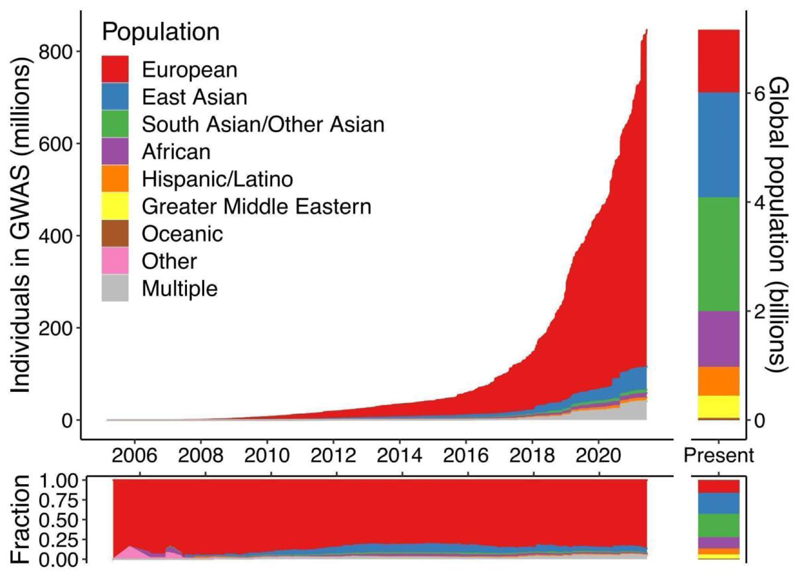
Two decades ago, the sequence of the first human genome was published. Since then, advances in genome technologies have resulted in whole-genome sequencing and microarray-based genotyping of millions of human genomes. However, genetic and genomic studies are predominantly based on populations of European ancestry. As a result, the potential benefits of genomic research-including better understanding of disease etiology, early detection and diagnosis, rational drug design and improved clinical care-may elude the many underrepresented populations. Here, we describe factors that have contributed to the imbalance in representation of different populations and, leveraging our experiences in setting up genomic studies in diverse global populations, we propose a roadmap to enhancing inclusion and ensuring equal health benefits of genomics advances. Our Perspective highlights the importance of sincere, concerted global efforts toward genomic equity to ensure the benefits of genomic medicine are accessible to all.
Overview
The claims and statistics of this paper haven’t been checked yet.
Free: it reads the open-access text and checks the first 5 claims that cite a source we can check. Create a free account to check every claim.
Integrity signals
Registry
Cites
Statistics
Figures
Verification
Claims the paper makes
The claims and statistics of this paper haven’t been checked yet.
Free: it reads the open-access text and checks the first 5 claims that cite a source we can check. Create a free account to check every claim.
Claims other papers make about this one
Each is checked against this paper’s own text: does it say what the citing paper says it does?
The source backs part of the claim, not all of it — or backs it for a different population, condition or comparison.
In the citing paper
“The lack of diversity in genetic studies on EduYears could lead to social and health disparities due to inadequate comprehension of EduYears and its impact on socioeconomic and health outcomes in understudied populations15.”
From Shared genetic architectures of educational attainment in East Asian and European populations (2024) · cites this paper as [15]
Experimental — accuracy not yet measuredIn the citing paper
“Large open datasets are more likely to come from the Global North, may prioritize research questions from these populations, and can have limited generalizability (e.g., the overrepresentation of European ancestry in genomic studies [115]).”
From Open Science 2.0: Towards a truly collaborative research ecosystem (2023) · cites this paper as [115]
Self-check
Percentages, sums and reported differences re-computed from the paper’s own numbers.
The self-check needs the paper’s full text.
Citations
Cites
The mutational constraint spectrum quantified from variation in 141,456 humans
Karczewski, K. J., Francioli, L. C., Tiao, G., Cummings, B. B., Alföldi, J., Wang, Q., Collins, R. L., Laricchia, K. M., Ganna, A., Birnbaum, D. P., et al. (2020) · Nature · doi:10.1038/s41586-020-2308-7 · Cited by 9,434
Buniello, A., MacArthur, J. A. L., Cerezo, M., Harris, L. W., Hayhurst, J., Malangone, C., McMahon, A., Morales, J., Mountjoy, E., Sollis, E., et al. (2019) · Nucleic Acids Research · doi:10.1093/nar/gky1120 · Cited by 4,000
Clinical use of current polygenic risk scores may exacerbate health disparities
Martin, A. R., Kanai, M., Kamatani, Y., Okada, Y., Neale, B. M., & Daly, M. J. (2019) · Nature Genetics · doi:10.1038/s41588-019-0379-x · Cited by 2,821
Self-citationThe personal and clinical utility of polygenic risk scores
Torkamani, A., Wineinger, N. E., & Topol, E. J. (2018) · Nature Reviews Genetics · doi:10.1038/s41576-018-0018-x · Cited by 1,623
The Missing Diversity in Human Genetic Studies
Sirugo, G., Williams, S. M., & Tishkoff, S. A. (2019) · Cell · doi:10.1016/j.cell.2019.02.048 · Cited by 1,516
Human Demographic History Impacts Genetic Risk Prediction across Diverse Populations
Martin, A. R., Gignoux, C. R., Walters, R. K., Wojcik, G. L., Neale, B. M., Gravel, S., Daly, M. J., Bustamante, C. D., & Kenny, E. E. (2017) · The American Journal of Human Genetics · doi:10.1016/j.ajhg.2017.03.004 · Cited by 1,391
Self-citationCohen, J., Pertsemlidis, A., Kotowski, I. K., Graham, R., Garcia, C. K., & Hobbs, H. H. (2005) · Nature Genetics · doi:10.1038/ng1509 · Cited by 1,381
Genomic Risk Prediction of Coronary Artery Disease in 480,000 Adults
Inouye, M., Abraham, G., Nelson, C. P., Wood, A. M., Sweeting, M. J., Dudbridge, F., Lai, F. Y., Kaptoge, S., Brozynska, M., Wang, T., et al. (2018) · Journal of the American College of Cardiology · doi:10.1016/j.jacc.2018.07.079 · Cited by 793
Genetics of blood lipids among ∼300,000 multi-ethnic participants of the Million Veteran Program
Global Lipids Genetics Consortium, Klarin, D., Myocardial Infarction Genetics (MIGen) Consortium, The Geisinger-Regeneron DiscovEHR Collaboration, Program, T. V. M. V., Damrauer, S. M., Cho, K., Sun, Y. V., Teslovich, T. M., Honerlaw, J., et al. (2018) · Nature Genetics · doi:10.1038/s41588-018-0222-9 · Cited by 625
Diversity in clinical and biomedical research: a promise yet to be fulfilled
Oh, S. S., Galanter, J., Thakur, N., Pino-Yanes, M., Barcelo, N. E., White, M. J., de Bruin, D. M., Greenblatt, R. M., Bibbins-Domingo, K., Wu, A. H. B., et al. (2015) · PLOS Medicine · doi:10.1371/journal.pmed.1001918 · Cited by 585
Cited by
Items 701–776 of 776
Expanding access to molecular oncology testing in Africa and lower middle-income countries
Chaudhry, S. A., & Ehtesham, Z. (2026) · African Journal of Laboratory Medicine · doi:10.4102/ajlm.v15i1.3401
“7,8 This lack of representation limits the applicability of global precision oncology advances.”
An interpretable omnigenic neural network architecture for the human genomePreprint
zu Belzen, J. U., Arnoldt, L., Hollmann, N., Herrmann, L., Nguyen, K. M., Eckhoff, L., Kohleick, L., Ghaloun, S. A., Schmidt, H., Hegselmann, S., et al. (2026) · medRxiv · doi:10.64898/2026.07.28.26359187
Menon, R., Mahadevan, L., Kumar, A., Bassi, A., Udwani, L., Verma, A., Gupta, A., Balakrishnan, L., Lakshmi, M., Pathak, A. B., et al. (2026) · medRxiv · doi:10.64898/2026.07.29.26358035
SNP-based population structure and disease-relevant genetic variation in the Indian population
Benny, B. K., Aruna, S. I., Thasleema, S., Melba, D., Shabna, S., & Vijayababu, P. (2026) · Ecological Genetics and Genomics · doi:10.1016/j.egg.2026.100514
Using RE-AIM and ConNECT Frameworks to Promote Genomically Informed Care in Diverse Populations
Kronk, R. A., Zoucha, R., Kalarchian, M. A., & Pillsbury, S. V. D. (2026) · Journal of Transcultural Nursing · doi:10.1177/10436596261468712
“%) focused on individuals of European descent, while only 4.8% included participants from multiple ancestries (Fatumo et al., 2022).”
InfluentialGeospatial Analysis of Disease Transmission and Genetic Diversity
Malinda, R. R. (2026) · Journal of Cambodian Health · doi:10.70243/jch2026.4103
Nanopore Sequencing the Pharmacogene CYP2C19 in a Ngāti Porou Hauora Cohort
Kerekere, T. (2023) · Otago University Research Archive (University of Otago)
Elhaj, K. E. M., & Mudawi, M. M. E. (2026) · JCO Global Oncology · doi:10.1200/go-25-00694
Global disparities in inherited retinal disease: A scoping review
Yu, J. H., Adams, A. R., See, W. Y. N., & Ahmed, I. (2026) · AJO International · doi:10.1016/j.ajoint.2026.100299
PANACEA: a framework to maximise genetic diversity in genome-wide association study meta-analysesPreprint
Yap, C. F., & Morris, A. P. (2026) · medRxiv · doi:10.64898/2026.08.06.26359891
Rigorous Female Breast Cancer Phenotyping Using the All of Us Research ProgramPreprint
Qi, Y., Lundy, K., Gee, D. A., & Chambwe, N. (2026) · medRxiv · doi:10.64898/2026.08.07.26359972
Traoré, M., Coulibaly, A., Dembele, S., & Diallo, B. (2025) · Pharmacophore · doi:10.51847/3i8xro74vf
Zhuang, B. C., Konwar, C., Kohler, I. V., Purcell, H., Kumwenda, B., Katundu, K., Zulu, A., Dever, K., Brewis, H. T., MacIsaac, J. L., et al. (2026) · iScience · doi:10.1016/j.isci.2026.117104
Toward personalized medicine in AD/ADRD through genetic-exposome dementia risk assessments
Tolosa‐Tort, P., Okorie, M., Chatterjee, A., Boeriu, A. I., Sharma, R. U., & Andrews, S. J. (2026) · npj Dementia · doi:10.1038/s44400-026-00087-7
Passmore, S. R., Medina, M. N., Garcia, M., & Green‐Harris, G. (2026) · Journal of Racial and Ethnic Health Disparities · doi:10.1007/s40615-026-03147-z
Kodji, E., Attaoua, R., Haloui, M., Hishmih, C., Seitz, M., Woodward, M., Hussin, J., Hamet, P., & Tremblay, J. (2026) · PLoS Computational Biology · doi:10.1371/journal.pcbi.1014670
“Continued efforts to recruit participants from underrepresented populations remain essential, particularly as genomic datasets continue to be dominated by individuals of European ancestry [36,37].”
Leveraging Omics to Decode Oral and Systemic Health Linkages
Alade, A. A., Gajendrareddy, P. K., Allareddy, V., & Allareddy, V. (2026) · International Dental Journal · doi:10.1016/j.identj.2026.109816
“48 This limitation is particularly relevant in oral-systemic research because oral disease prevalence, microbiome composition and environmental exposures vary substantially across populations.”
Toward inclusive medical education, research, and practice: Removing race from genetics
Fernandez, P. W., Msimang, P. M., Uren, C., & Petersen, D. C. (2026) · Elsevier eBooks · doi:10.1016/b978-0-443-44998-7.00010-7
Andrews, E. A., Scherr, C. L., Ramesh, S., Fakhari, H., Kerstiens, S., Arundel, C., Perera, M. A., & Tuck, M. (2026) · Patient Education and Counseling · doi:10.1016/j.pec.2026.109820
Sherman, C. A., Maldonado, B. L., Rozell, L., Slack, S. D., Eaton, I. E., Martinez, D. E., Johnson, R. K., & Claw, K. G. (2026) · Human Genetics and Genomics Advances · doi:10.1016/j.xhgg.2026.100660
Roberts, D. M., Thompson, S., Anderson, J., & Smith, R. (2026) · International Journal Of Pharmaceutical Research And Allied Sciences · doi:10.51847/08gmscs3fz
Weber, L., Janssen, S., Richter, J., & Fischer, E. (2025) · International Journal Of Pharmaceutical Research And Allied Sciences · doi:10.51847/hbsjhv5cvf
Gutierrez-Arratia, J. D., Awad, P. S., Schuh, A. F. S., & Cornejo‐Olivas, M. (2026) · Journal of Parkinson s Disease · doi:10.1177/1877718x261478730
“78,79 Although the cost of whole-genome sequencing has fallen signi fi cantly, it remains prohibitively expensive for the vast majority of patients in underfunded public healthcare systems, who are often forced to pay for molecular diagnostics entirely out of pocket.”
Abbatangelo, C. L. (2026) · TSpace (University of Toronto)
First CDH3 -related HJMD case in a black patient: novel variants and diagnostic odyssey
Vaidyanathan, A., Paula, M. M., Estrada-Puente, C., & Maldonado, R. S. (2026) · Ophthalmic Genetics · doi:10.1080/13816810.2026.2716313
A Curated Pharmacogenomic Allele Catalog for Sub-Saharan African PopulationsPreprint
Sulaiman, M. A., & Oyeyemi, B. F. (2026) · medRxiv · doi:10.64898/2026.08.25.26361354
Environmentally responsible human genomic data governance: points for consideration
Ghinea, N., Samuel, G., Xin, W., Bonser, E., Cook-Deegan, R. M., Ferrie, M. M., Gyngell, C., Otlowski, M. F. A., Petersen, A. R., Pratt, B., et al. (2026) · npj Genomic Medicine · doi:10.1038/s41525-026-00614-8
Ahmed, Z., Khawaja, A. A., Tariq, A., & Qadri, H. M. (2026) · Cureus · doi:10.7759/cureus.115830
“Additionally, part of this disparity comes from the large volume of research, approximately 86.3% of genome-wide association studies being carried out in people of European ancestry [3].”
InfluentialGenomic landscape of autism spectrum disorder in Brazil
Campos, G. D. S., Costa, C. I. S., Wang, J. Y. T., Ferraz, A. L., Filippo, A. L., de Toledo, V. H. C., Silva, M. C. F., Passos, C. H., Meyer, D., Errera, F. I. V., et al. (2026) · Genetics and Molecular Biology · doi:10.1590/1678-4685-gmb-2025-0247
Against the default analysis and reporting of ethno-racial data in biomedical research
Żuradzki, T. (2026) · Ethics Medicine and Public Health · doi:10.1016/j.jemep.2026.101311
Grech, L., & Pace, N. P. (2026) · Frontiers in Genetics · doi:10.3389/fgene.2026.1932078
“Genomic datasets remain skewed towards populations of European ancestry, but even within Europe there is substantial underrepresentation of smaller, isolated, admixed or founder populations (Dajani et al., 2022; Fatumo et al., 2022).”
Hu, R., Weng, K., Guo, B., Zhuang, S., Zhou, J., Hong, Z., Lin, P., Wu, C., Chen, Z., Wang, Y., et al. (2026) · Frontiers in Pharmacology · doi:10.3389/fphar.2026.1906466 · Cited by 1
“As current PGx data are predominantly derived from Caucasians, implementation efforts must acknowledge and address health equity issues arising from population genetic diversity (Fatumo et al., 2022; Wang et al., 2024).”
Hypertension in Colombia: First pharmacogenomic risk profile stratified by ancestryPreprint
Suarez-Causado, A., Ochoa-Elles, M. L., & Hernández-Páez, D. A. (2026) · Research Square · doi:10.21203/rs.3.rs-10647259/v1
African genomes are not a subset
Seifu, W. D., Edea, Z., & Zeng, C. (2026) · Trends in Genetics · doi:10.1016/j.tig.2026.08.008
Uren, C., Kasser, S. M., Chimusa, E. R., Adeyemo, A., & Möller, M. (2026) · Current Opinion in Genetics & Development · doi:10.1016/j.gde.2026.102535
STROEBEL, B. M., Jimenez, A., Lindquist, K. J., Torgerson, D., Longoria, K. D., Ignacio‐Espinoza, J. C., & Flowers, E. (2026) · Frontiers in Genetics · doi:10.3389/fgene.2026.1934355
“A well-documented limitation of many early GWAS is the lack of study samples that are globally representative (Fatumo et al., 2022).”
A statistical review of polygenic risk scores: from heuristics to model-based inference
Huang, X., & Jiang, W. (2026) · Statistical Applications in Genetics and Molecular Biology · doi:10.1515/sagmb-2026-0007
“At present, GWAS have been disproportionately conducted in populations of European ancestry, with sample sizes far exceeding those available for other groups; although efforts to close these gaps are underway, achieving truly global representation remains challenging (Fatumo et al. 2022).”
Genetic analyses of blood pressure traits in 140,000 admixed adults from Mexico CityPreprint
Turner, M., Berumen-Campos, J., Morris, S., Aguilar-Ramirez, D. J., Fernández‐Chirino, L., Orešković, T., Baca, P., Barrera, E., Rivas, F., Gnatiuc, L., et al. (2026) · medRxiv · doi:10.64898/2026.09.17.26363296
Verma, P., Halder, S., & Sharma, M. (2026) · Research Square · doi:10.21203/rs.3.rs-10983210/v1
77. CHARACTERIZING THE UNCERTAINTY, MISCLASSIFICATION AND INCONSISTENCY OF POLYGENIC PREDICTION
Ge, T., Zhang, Y., & Zhang, R. (2026) · European Neuropsychopharmacology · doi:10.1016/j.euroneuro.2026.113104
Lerner‐Ellis, J. P., Fisher, Y., Zawati, M. H., Agatep, R., Antonishyn, N. A., Bosdet, I., Boycott, K. M., King, I., Lamont, R. E., Marshall, C. R., et al. (2026) · The American Journal of Human Genetics · doi:10.1016/j.ajhg.2026.09.001
Soraya, M., Amalia, A., Ernanda, S. A., & Prusty, P. (2026) · BIO Web of Conferences · doi:10.1051/bioconf/202625503007
“Nearly 86% of the current data comes from people of European descent [6].”
Study of Ancestry, Health, Environment, and Late-Life Neurodegeneration (SAHEL)Preprint
Kwairanga, S. H., Iwar, H. J., Faruk, A. U., Wakawa, I. A., Musami, U. B., Ogualili, P. N., Mahmood, M. Y., Fugu, M. A., Gimba, M. M., Allamin, M. M., et al. (2026) · medRxiv · doi:10.64898/2026.09.23.26363703
Large language model-based bibliometric evaluation of population descriptors in human geneticsPreprint
Gogarten, S. M., Martschenko, D. O., Patel, R., & Sinnott-Armstrong, N. (2026) · bioRxiv (Cold Spring Harbor Laboratory) · doi:10.64898/2026.09.24.754051
Harnessing the human mutational spectrum to advance missense variant effect prediction
Pathak, A. K. (2026) · Edinburgh Research Archive (University of Edinburgh) · doi:10.7488/era/7794
Skvortsova, L., Yergali, К., Zhaxylykova, A., Begmanova, M., & Mansharipova, A. T. (2026) · Frontiers in Genetics · doi:10.3389/fgene.2026.1927147
“It should be noted that few sequencing studies of Kazakhs indicate mixed European and East Asian ancestry and substantial heterogeneity (Seidualy et al., 2020; Karczewski et al., 2020; Fatumo et al., 2022; Akilzhanova et al., 2014; Kairov et al., 2021; Kairov et al., 2022).”
Kotnik, U., Lovrečić, L., & Peterlin, B. (2026) · Frontiers in Genetics · doi:10.3389/fgene.2026.1847596
“Still, such large scale studies have historically disproportionately prioritized larger populations, specifically those of Western and of Northern European ancestry, leaving the small Central European populations underrepresented (Fatumo et al., 2022).”
Mohsen-Pour, N., Esmaeili, S., Feyzi, A., Sharafi, A., Maleki, M., & Kalayinia, S. (2026) · Clinical Cardiology · doi:10.1002/clc.70482
“The first strategy focuses on increasing the statistical power of genome‐wide analyses by expanding cohort sizes, incorporating underrepresented populations and ancestries, and interrogating rare variants through WES and WGS [55–57].”
Marí, I. R. (2025) · Rovira & Virgili repository
Health inequalities in precision medicine: A systematic review
Hassanein, Z. M., Bains, M., Bajwa, R. K., Leonardi‐Bee, J., Jayes, L., Bogdanovica, I., Donoghue, J., Amah, L., Egwumba, P., Aiyelabegan, F., et al. (2026) · European Journal of Human Genetics · doi:10.1038/s41431-026-02225-4
Parra-Vilchis, M. A., Garibaldi-Ríos, A. F., Gallegos‐Arreola, M. P., Alonzo-Rojo, A., Sanchez‐Ante, G., & García‐Ortíz, J. E. (2026) · Archives of Medical Research · doi:10.1016/j.arcmed.2026.103518
Multi-omics advances in sepsis-associated encephalopathy: from pathogenesis to clinical translation
Gao, L., & Liu, X. (2026) · Frontiers in Immunology · doi:10.3389/fimmu.2026.1941590
Ametefe, G. D., Zhou, Y., Wang, S., Ametefe, D. S., John, D., & Owen, M. M. (2026) · Journal of Biological Education · doi:10.1080/00219266.2026.2743580
Ancestry Labels Are Poor Substitutes for Functional Pharmacogenomic Evidence
Kim, D., Park, J., Kang, M.-S., & Jung, H.-W. (2025) · International Journal Of Pharmaceutical Research And Allied Sciences · doi:10.51847/bw31g5lswh
Prostate Cancer Research in Ghana: A Scoping Review of Research Direction and Priorities
Amoah, I., Anie, H. A., Tetteh, D., Sarpong, V. A., Appiah, K. A. A., & Tawiah, P. (2026) · Cancers · doi:10.3390/cancers18203246
Resource-stratified genomic medicine: a policy framework for equitable implementation
Lázaro-Guevara, J. M., & Garrido-Lopez, K. M. (2026) · Health Policy and Technology · doi:10.1016/j.hlpt.2026.101336
From bench to Brussels and back: co-producing personalized medicine in the European Union
Nimmerfeldt, G., & Rikmann, E. (2026) · Critical Policy Studies · doi:10.1080/19460171.2026.2743233
Genetic evidence for the psychosis continuum: polygenic score analysis
Haussler, S. M., Prata, D. P., Kempton, M. J., Bhavsar, V., Arathimos, R., Coleman, J. R. I., Valmaggia, L., Tognin, S., Modinos, G., Fusar‐Poli, P., et al. (2026) · The British Journal of Psychiatry · doi:10.1192/bjp.2026.10795
A genomic foundation model for interpreting human genetic diversityPreprint
Xu, Q., Wu, Z., Dong, M., Bao, T., ng, W., Huang, X., Yang, H., Zhou, Y., 易显富, Zhang, S., et al. (2026) · bioRxiv (Cold Spring Harbor Laboratory) · doi:10.64898/2026.10.19.760276
Choy, C., Vicuña, L., Patino, M., Araújo, D. S., Obispo, D., Guevara, M. L., Fonseca, S., Scariot, D., Araujo, C., Guerreiro, J. R., et al. (2026) · medRxiv · doi:10.64898/2026.10.21.26365630
Ilechukwu, G. E. (2026) · Path of Science · doi:10.22178/pos.134-9
Beyond the Binary: Infusing Culture Into Computing Education
Campbell, D. G., & Campbell‐Whatley, G. D. (2026) · Emerald Group Publishing Limited eBooks · doi:10.1108/978-1-80791-800-220261014
Hajizadah, F., & Walsh, R. (2026) · Mayo Clinic Proceedings Innovations Quality & Outcomes · doi:10.1016/j.mayocpiqo.2026.100776
Adnan, A. (2026) · Journal of Basic & Clinical Medical Sciences · doi:10.58398/0002.000037
Little, D. R., Shirinifard, A., Lupo, M., Wu, C.-H., Chen, H., Clemons, M. R., MacLean, M., Marola, O. J., Howell, G. R., Li, C., et al. (2026) · Zenodo (CERN European Organization for Nuclear Research) · doi:10.5281/zenodo.18623981
BLocPRS: locus-aware ensembles of polygenic scores provide accurate linear predictionPreprint
Song, J., Zabad, S., Gravel, S., & Li, Y. (2026) · bioRxiv (Cold Spring Harbor Laboratory) · doi:10.64898/2026.10.26.759503
Precision nutrition and metabolic health: Integrating multi-omics for individualized prevention
Gu, W., Ning, H., Tian, Z., & Sun, C. (2026) · Metabolism and Diseases · doi:10.1016/j.metdis.2026.100040
African genomes and the precision gap—Inclusion, diversity, and innovation
Marima, R. M., Miya, T. V., Alabi, B., Koatale, P. C., Tymovska, Y., Baila, L., Misner, R., Saini, K. S., Khanyile, R., & Dlamini, Z. (2026) · Elsevier eBooks · doi:10.1016/b978-0-443-45925-2.00012-3
Genotype–Phenotype Spectrum of Overgrowth Syndromes in Polish and Lithuanian Cohorts
Šiaurytė, K., Baronas, K., Matulevičienė, A., Aleksiūnienė, B., Mozere, M., Wawrusiewicz‐Kurylonek, N., Stasiewicz‐Jarocka, B., Panasiuk, B., Tafazoli, A., Marciniak, B., et al. (2026) · Genes · doi:10.3390/genes17111356
Advancing Evidence Generation in Small, Diverse, Understudied Population
Mitra, A., Dosne, A., Steinbach, D., Jones, H. M., Mondick, J. T., & Krishna, R. (2026) · Clinical Pharmacology & Therapeutics · doi:10.1002/cpt.70548
Tatuene, J. K., Li, L., & Rothwell, P. M. (2026) · Journal of the Neurological Sciences · doi:10.1016/j.jns.2026.126238
Muthu-Pandian, C. K. (2026) · Current Genomics · doi:10.1016/j.curgen.2026.11.001
Milko, L. V., Leon-Lozano, G., Powell, S. N., Byfield, G. E., Giric, S., Grewe, M. E., Jackson, J., Jimenez-Cyrus, S., Caro, L., Orphanides, A., et al. (2026) · Genetics in Medicine · doi:10.1016/j.gim.2026.102781
Beyond Disease Susceptibility: Genetics, Prediction, and the Limits of Inferring Human Potential
Qu, H., & Hakonarson, H. H. (2026) · Biomedicines · doi:10.3390/biomedicines14112548
Global Genomic Analysis of Antimicrobial Resistance in Streptococcus pyogenes
Rezaie, N., Beig, M., KALANTAR-NEYESTANAKI, M., Mohammadzadeh, N., Kiani, N., Sholeh, M., & Badmasti, F. (2026) · Journal of Global Antimicrobial Resistance · doi:10.1016/j.jgar.2026.10.007
Gur‐Arie, R., Quijada, R. D. A., Hernandez, V., Gonzalez, C., Williams, A. N., Singh, D. P., Sharp, R. R., & Shaibi, G. Q. (2026) · Journal of Primary Care & Community Health · doi:10.1177/21501319261506834
Metadata
- Authors
- Fatumo, S., Chikowore, T., Choudhury, A., Ayub, M., Martin, A. R., & Kuchenbaecker, K.
- Affiliations
- London School of Hygiene & Tropical Medicine (GB)
- University of the Witwatersrand (ZA)
- University College London (GB)
- Broad Institute (US)
- Corresponding author
- Fatumo, Segun
- ORCID
- Venue
- Nature Medicine
- Published
- 2022-02
- Volume
- 28
- Issue
- 2
- Pages
- 243-250
- ISSN
- 1078-8956 (ISSN-L)
- 1546-170X
- PMC
- PMC7614889
- OpenAlex
- W4211005061
- Cited by
- 707
- References
- 63
- Citations by year
- 2026: 169 · 2025: 188 · 2024: 152 · 2023: 132 · 2022: 64
- FWCI
- 20.80
- Type
- journal article
- Language
- en
- Open access
- green
- www.ncbi.nlm.nih.gov
- Licence
- cc-by
- www.springer.com/tdm (tdm)
- www.springer.com/tdm (vor)
- Locations
- Nature Medicine (publishedVersion)
- PubMed (publishedVersion)
- PubMed Central (acceptedVersion, cc-by)
- LSHTM Research Online (London School of Hygiene and Tropical Medicine) (acceptedVersion)
- UCL Discovery (University College London) (submittedVersion)
- Funders
- Wellcome Trust (214205, 214205/Z/18/Z)
- Topics
- Social Sciences › Anthropology › Race, Genetics, and Society
- Health Sciences › Medicine › Public Health, Environmental and Occupational Health › Ethics in Clinical Research
- Life Sciences › Biochemistry, Genetics and Molecular Biology › Genetics › Genetic Associations and Epidemiology
- Keywords
- genomic diversity, underrepresented groups, health equity, research inclusion, etiology, drug design
- MeSH terms
- Whole Genome Sequencing, Humans, Genome, Human, Genomics
About these checks
Registry, retraction, Cites and statistics results are computed, not judged, with one exception: a printed reference that no index lists is read once by a model before it counts as a citation error. Claims are extracted by a model and kept only when their quote appears verbatim in the text; each cited source is then checked, with a model’s help, for whether it says what the claim relies on. Those verdicts can be wrong — read the claim’s quote and the cited source before relying on one.
Statistics and arithmetic are recomputed, not judged.
Confidence bands are shown only for fields calibrated on our annotated test set. None is calibrated yet, so no band is shown.
What counts as a claim ›How we measure confidence ›How we check this ›
Are you an author, or do you see a problem with this page? Request a review
Data sources
Bibliographic data: Semantic Scholar, OpenAlex, Crossref.
Contains information from the Semantic Scholar Academic Graph Datasets, made available under the ODC Attribution License (ODC-BY 1.0).
Semantic Scholar’s data is described in: Kinney, R., et al. (2023). The Semantic Scholar Open Data Platform. arXiv:2301.10140.
