

A roadmap to increase diversity in genomic studies
Open accessThe DOI matches its Crossref record; 63 of the 63 references it cites were found in a registry or an index.
Abstract
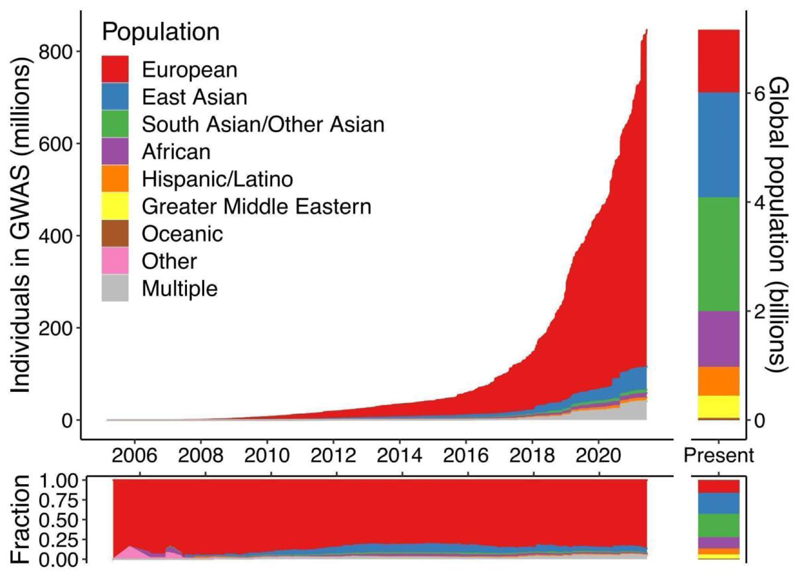
Two decades ago, the sequence of the first human genome was published. Since then, advances in genome technologies have resulted in whole-genome sequencing and microarray-based genotyping of millions of human genomes. However, genetic and genomic studies are predominantly based on populations of European ancestry. As a result, the potential benefits of genomic research-including better understanding of disease etiology, early detection and diagnosis, rational drug design and improved clinical care-may elude the many underrepresented populations. Here, we describe factors that have contributed to the imbalance in representation of different populations and, leveraging our experiences in setting up genomic studies in diverse global populations, we propose a roadmap to enhancing inclusion and ensuring equal health benefits of genomics advances. Our Perspective highlights the importance of sincere, concerted global efforts toward genomic equity to ensure the benefits of genomic medicine are accessible to all.
Overview
The claims and statistics of this paper haven’t been checked yet.
Free: it reads the open-access text and checks the first 5 claims that cite a source we can check. Create a free account to check every claim.
Integrity signals
Registry
Cites
Statistics
Figures
Verification
Claims the paper makes
The claims and statistics of this paper haven’t been checked yet.
Free: it reads the open-access text and checks the first 5 claims that cite a source we can check. Create a free account to check every claim.
Claims other papers make about this one
Each is checked against this paper’s own text: does it say what the citing paper says it does?
The source backs part of the claim, not all of it — or backs it for a different population, condition or comparison.
In the citing paper
“The lack of diversity in genetic studies on EduYears could lead to social and health disparities due to inadequate comprehension of EduYears and its impact on socioeconomic and health outcomes in understudied populations15.”
From Shared genetic architectures of educational attainment in East Asian and European populations (2024) · cites this paper as [15]
Experimental — accuracy not yet measuredIn the citing paper
“Large open datasets are more likely to come from the Global North, may prioritize research questions from these populations, and can have limited generalizability (e.g., the overrepresentation of European ancestry in genomic studies [115]).”
From Open Science 2.0: Towards a truly collaborative research ecosystem (2023) · cites this paper as [115]
Self-check
Percentages, sums and reported differences re-computed from the paper’s own numbers.
The self-check needs the paper’s full text.
Citations
Cites
The mutational constraint spectrum quantified from variation in 141,456 humans
Karczewski, K. J., Francioli, L. C., Tiao, G., Cummings, B. B., Alföldi, J., Wang, Q., Collins, R. L., Laricchia, K. M., Ganna, A., Birnbaum, D. P., et al. (2020) · Nature · doi:10.1038/s41586-020-2308-7 · Cited by 9,434
Buniello, A., MacArthur, J. A. L., Cerezo, M., Harris, L. W., Hayhurst, J., Malangone, C., McMahon, A., Morales, J., Mountjoy, E., Sollis, E., et al. (2019) · Nucleic Acids Research · doi:10.1093/nar/gky1120 · Cited by 4,000
Clinical use of current polygenic risk scores may exacerbate health disparities
Martin, A. R., Kanai, M., Kamatani, Y., Okada, Y., Neale, B. M., & Daly, M. J. (2019) · Nature Genetics · doi:10.1038/s41588-019-0379-x · Cited by 2,821
Self-citationThe personal and clinical utility of polygenic risk scores
Torkamani, A., Wineinger, N. E., & Topol, E. J. (2018) · Nature Reviews Genetics · doi:10.1038/s41576-018-0018-x · Cited by 1,623
The Missing Diversity in Human Genetic Studies
Sirugo, G., Williams, S. M., & Tishkoff, S. A. (2019) · Cell · doi:10.1016/j.cell.2019.02.048 · Cited by 1,516
Human Demographic History Impacts Genetic Risk Prediction across Diverse Populations
Martin, A. R., Gignoux, C. R., Walters, R. K., Wojcik, G. L., Neale, B. M., Gravel, S., Daly, M. J., Bustamante, C. D., & Kenny, E. E. (2017) · The American Journal of Human Genetics · doi:10.1016/j.ajhg.2017.03.004 · Cited by 1,391
Self-citationCohen, J., Pertsemlidis, A., Kotowski, I. K., Graham, R., Garcia, C. K., & Hobbs, H. H. (2005) · Nature Genetics · doi:10.1038/ng1509 · Cited by 1,381
Genomic Risk Prediction of Coronary Artery Disease in 480,000 Adults
Inouye, M., Abraham, G., Nelson, C. P., Wood, A. M., Sweeting, M. J., Dudbridge, F., Lai, F. Y., Kaptoge, S., Brozynska, M., Wang, T., et al. (2018) · Journal of the American College of Cardiology · doi:10.1016/j.jacc.2018.07.079 · Cited by 793
Genetics of blood lipids among ∼300,000 multi-ethnic participants of the Million Veteran Program
Global Lipids Genetics Consortium, Klarin, D., Myocardial Infarction Genetics (MIGen) Consortium, The Geisinger-Regeneron DiscovEHR Collaboration, Program, T. V. M. V., Damrauer, S. M., Cho, K., Sun, Y. V., Teslovich, T. M., Honerlaw, J., et al. (2018) · Nature Genetics · doi:10.1038/s41588-018-0222-9 · Cited by 625
Diversity in clinical and biomedical research: a promise yet to be fulfilled
Oh, S. S., Galanter, J., Thakur, N., Pino-Yanes, M., Barcelo, N. E., White, M. J., de Bruin, D. M., Greenblatt, R. M., Bibbins-Domingo, K., Wu, A. H. B., et al. (2015) · PLOS Medicine · doi:10.1371/journal.pmed.1001918 · Cited by 585
Cited by
Items 601–700 of 776
ADVANCING HEALTH EQUITY IN GENOMIC MEDICINE: REDUCING DISPARITIES IN RARE DISEASE DIAGNOSIS
SIMEON, A. O., OYENIYI, E. O., MUNIRU, E. T., & RHODA, A. J. (2025) · International Journal of Social Health and Medical Research · doi:10.70382/tijbshmr.v10i3.015 · Cited by 1
Genetic Liability for Internalizing–Externalizing Traits in Mexican Youth: Moderation by AdversityPreprint
Ceja, Z., Hung, I., Thomas, N., Thorp, J. G., García‐Marín, L. M., Cruz-Fuentes, C. S., Rentería, M. E., Benjet, C. L., Rabinowitz, J. A., & Martínez-Levy, G. A. (2025) · medRxiv · doi:10.64898/2025.11.30.25341187 · Cited by 1
Tian, J., Zhang, M., Zhang, F., Gao, K., Lu, Z., Cai, Y., Chen, C., Ning, C., Li, Y., Qian, S., et al. (2024) · Figshare · doi:10.6084/m9.figshare.26036399
Additional file 1 of Burden of Mendelian disorders in a large Middle Eastern biobank
Aamer, W., Al-Maraghi, A., Syed, N., Gandhi, G. D., ALIYEV, E. E., Al-Kurbi, A. A., Al-Saei, O., Kohailan, M., Krishnamoorthy, N., Palaniswamy, S., et al. (2024) · Figshare · doi:10.6084/m9.figshare.25560873
Additional file 2 of Burden of Mendelian disorders in a large Middle Eastern biobank
Aamer, W., Al-Maraghi, A., Syed, N., Gandhi, G. D., ALIYEV, E. E., Al-Kurbi, A. A., Al-Saei, O., Kohailan, M., Krishnamoorthy, N., Palaniswamy, S., et al. (2024) · Figshare · doi:10.6084/m9.figshare.25560900
Association between genetic factors and chronic stress responses in daily life
Peter, H. L. (2023) · University of Regensburg Publication Server (University of Regensburg) · doi:10.5283/epub.54567
Fatumo, S., Sathan, D., Samtal, C., Isewon, I., Tamuhla, T., Soremekun, C., Jafali, J., Panji, S., Tiffin, N., & Fakim, Y. J. (2024) · Figshare · doi:10.6084/m9.figshare.26633919
Self-citationArunachalam, V., Lea, R. A., Hoy, W. E., Lee, S., Mott, S. A., Savige, J., Mathews, J. D., McMorran, B. J., & Nagaraj, S. H. (2024) · Figshare · doi:10.6084/m9.figshare.26679890
Tian, J., Zhang, M., Zhang, F., Gao, K., Lu, Z., Cai, Y., Chen, C., Ning, C., Li, Y., Qian, S., et al. (2024) · Figshare · doi:10.6084/m9.figshare.26036511
Arunachalam, V., Lea, R. A., Hoy, W. E., Lee, S., Mott, S. A., Savige, J., Mathews, J. D., McMorran, B. J., & Nagaraj, S. H. (2024) · Figshare · doi:10.6084/m9.figshare.25210483
Arunachalam, V., Lea, R. A., Hoy, W. E., Lee, S., Mott, S. A., Savige, J., Mathews, J. D., McMorran, B. J., & Nagaraj, S. H. (2024) · Figshare · doi:10.6084/m9.figshare.25210830
The molecular genetics of familial cardiomyopathy
Kamuli, S. (2023) · Open University of Cape Town (University of Cape Town)
Lineage, cell state and cell identity in the developing human brain
Mannens, C. C. A. (2024) · Open Archive (Karolinska Institutet)
Integrative omics data analysis to discover novel signatures in complex diseases
Pan, L. (2023) · Open Archive (Karolinska Institutet)
Frach, L. (2024) · UCL Discovery (University College London)
Investigation of Cumulative Genetic Risk and CC16 in Adult Asthma and COPD Populations
Gribben, K. C. (2022) · DigitalCommons@UNMC
Investigating sex-specific genetic associations with PheWeb 2.0
Bellavance, J. (2025) · doi:10.71781/53
Fulani: new study unravels the genetic history of Africa’s largest pastoralist community
Schlebusch, C. M., Fortes-Lima, C., & Černý, V. (2025) · The Conversation · doi:10.64628/aaj.3cfq6qncu
Grobler, A.-L. (2025) · Open University of Cape Town (University of Cape Town)
Genetic Architecture of Alcohol Use Disorder in NepalPreprint
Tubbs, J. D., He, Y., Tsuo, K., Yohannes, M. T., Lee, Y. H., Madsen, E. M., Ghimire, D. J., Hermosilla, S., Ge, T., Martin, A. R., et al. (2025) · medRxiv · doi:10.64898/2025.12.13.25342207
Self-citationPeng, S., & Lu, T. (2025) · medRxiv · doi:10.64898/2025.12.16.25342408
Improving DNA Sequence Classification Accuracy Using a Hybrid LSTM-CNN Deep Learning Model
Tabane, E., Wang, Z., & Mnkandla, E. (2026) · Lecture notes in networks and systems · doi:10.1007/978-981-96-9191-3_14
Tabane, E., Wang, Z., & Mnkandla, E. (2025) · Smart innovation, systems and technologies · doi:10.1007/978-981-95-1365-9_14
Moutinho, S. (2026) · Nature Medicine · doi:10.1038/s41591-025-04161-0
Duncan, C., D’Silva, R., & Gauba, V. (2025) · Medical Research Archives · doi:10.18103/mra.v13i12.7172
Kabibulatova, A., Mussina, K., Almazan, J. U., Sarría‐Santamera, A., Salustri, A., & Atageldiyeva, K. K. (2026) · Medical Sciences · doi:10.3390/medsci14010052 · Cited by 1
Patient, parent and provider perspectives on sickle cell disease genetics research in Jamaica
Jones, K., Stewart, K. A., Asnani, M., & Royal, C. D. (2026) · PLOS Global Public Health · doi:10.1371/journal.pgph.0005789
Hosawi, M., Baadhaim, M., Al-Shehri, M., Herrera‐López, G., Ramirez, G., Fadaili, Y., Zakri, S., Haneef, A., Hakami, F., Alamoudi, D., et al. (2026) · Research Square · doi:10.21203/rs.3.rs-8666694/v1
Chen, J., Shrine, N. R. G., Izquierdo, A. G., Guyatt, A. L., Williams, A., Völzke, H., London, S., Hall, I. H., Dudbridge, F., Wain, L. V., et al. (2026) · International Journal for Population Data Science · doi:10.23889/ijpds.v11i1.2997
Weerarathna, I. N., Kumar, P., Arachchige, M. H. J., Patil, M. S., & Mishra, G. (2025) · DMIHER International Conference on Artificial Intelligence in Healthcare, Education and Industry (IDICAIHEI) · doi:10.1109/idicaihei65991.2025.11377568
Population-Specific Structural Variant Landscape in a Puerto Rican Rare Disease CohortPreprint
LeMaster, C., Farrow, E., McLennan, R., Albino, E., Pastinen, T., & Smail, C. (2026) · Research Square · doi:10.21203/rs.3.rs-8544782/v1
Mighton, C. E. (2024) · TSpace (University of Toronto)
Grewal, S. K. (2025) · TSpace (University of Toronto)
Examination of Mitochondrial Genetic Variation in Reported Autism Spectrum Disorder
Giannoulis, S. (2022) · TSpace (University of Toronto)
Rader, L., Zorina-Lichtenwalter, K., Gustavson, D. E., Wager, T. D., & Friedman, N. P. (2026) · Journal of Pain · doi:10.1016/j.jpain.2026.106260
Selection-guided discovery in South Asians implicates the MAPT locus in insulin resistancePreprint
Pennarun, E., Banfalvi, B., Li, Y., Hodgson, S., Bui, V., Bigossi, M., Samuel, M., Arnab, S. P., Naimah, T., Rison, S., et al. (2026) · medRxiv · doi:10.64898/2026.03.12.26348237
AI-driven innovations in neuroscience: Rewiring precision drug design for neurological disorders
Ali, A. M., Almuqdadi, H. T. A., Hindi, A. A., Murshidy, M. K., Qazi, S., Temur, A. A., Razooqi, N. F., Murshedi, G. H. M. A., & Waheed, M. S. (2026) · Elsevier eBooks · doi:10.1016/b978-0-443-44430-2.00021-9
Ramachandra, K., Nandi, S., Rambabu, M., Vasudevan, K., & Dasegowda, K. R. (2026) · Elsevier eBooks · doi:10.1016/b978-0-443-44430-2.00019-0
Literature Review: Racial and Social Bias in Artificial Intelligence for Healthcare
Balde, A. (2026) · University of Michigan Undergraduate Research Journal · doi:10.3998/umurj.9828
Movassagh, M., Newbury, L., Hehnly, C., Whalen, A. J., Peterson, M. R., Estrada, E. M., Ericson, J. E., Smith, J., Sasanami, M., Natukwatsa, D., et al. (2026) · medRxiv · doi:10.64898/2026.03.16.26348489 · Cited by 1
Ying, Z.-K., Xu, X.-Y., Hu, J., Cui, Y., & Jiang, D.-W. (2026) · World Journal of Stem Cells · doi:10.4252/wjsc.v18.i3.118401
Genes that increase the risk of autism are shared across ancestries
(2026) · Nature Medicine · doi:10.1038/s41591-026-04259-z
Yoshiji, S. (2024) · eScholarship@McGill (McGill) · doi:10.82308/23011
Chotiprasidhi, P., Umpierre, V. P. G., Nartey, Y. A., Miller, H. B., Gefre, A. F., Sato‐Espinoza, K., O'Brien, D., Ma, J., Awuku, Y. A., Agyei-Nkansah, A. A., et al. (2026) · JCO Global Oncology · doi:10.1200/go-25-00446
“21 This underrepresentation in research limits our understanding of disease mechanisms and genetic risk in African populations.”
Genetic insights into the peoples who shaped the American continent
Tavares, G. M., Missaggia, B. O., Lima, T., Marcano-Ruiz, M., Mesquita, M. T. S., Baldo, G., Dorn, M., Hünemeier, T., & Bortolini, M. C. (2026) · Genetics and Molecular Biology · doi:10.1590/1678-4685-gmb-2025-0244
Diagne, P. A., Fatimata, M., Diop, M. S., Ousmane, B. P., Diop, M. S., Khadre, F., Ba, P. S., Gabriel, C. A., & Mbacke, S. (2026) · Science Discovery Medicine · doi:10.11648/j.sdmed.20260102.11
Pascat, V. (2024) · theses.fr (ABES) · doi:10.70675/ee25a652z0aadz46c1z83f4zd89e14223bfb
Progranulin genetic variant rs5848 displays ancestry-specific associations with Alzheimer’s disease
Life, B. E., Navarro‐Delgado, E. I., Fornés, O., Friedman, J. M., Wasserman, W. W., Korthauer, K. D., & Leavitt, B. R. (2026) · Human Genomics · doi:10.1186/s40246-026-00958-3
“More broadly, the present research demonstrates the importance of ancestry-aware analysis and underscores the need for studying populations with greater diversity in medical genetics research [70].”
Rensink, M. J., Schermer, M., & Bolt, I. L. L. E. (2026) · Journal of Genetic Counseling · doi:10.1002/jgc4.70206
The Open Hyperinsulinism Genes Project bridges global disparities in access to genomic medicine
Raskin, J., Houghton, J., Männistö, J. M. E., van Heugten, R., LLEWELLYN, A. S., Hattersley, A. T., Pasquini, T. L. S., & Flanagan, S. E. (2026) · Nature Health · doi:10.1038/s44360-026-00119-9
The epidemiology of artificial intelligence
Parikh, H., McCormick, T. H., Johnson, E. K., Hickey, L., Ranney, M. L., & Mukherjee, B. (2026) · Nature Health · doi:10.1038/s44360-026-00188-w · Cited by 1
“Individuals of non-European ancestry account for a small fraction of genomic studies, and electronic health records under-represent the same populations 64–66 .”
Perspective on Bias in Biomedical AI: Preventing Downstream Healthcare Disparities
Rosen‐Zvi, M., Kan‐Tor, Y., Danziger, M. M., Ferretti, A., Aula-Blasco, J., Falcão, J., Shamir, R., Marcus-Kalish, M., & Muszkat, M. (2026) · IEEE International Conference on Digital Health (ICDH) · doi:10.1109/icdh72779.2026.00018
From bench to byte: A UK perspective on data-driven cancer research
Wooller, S. K., Blake, A., McCabe, M. G., Mclean, C., Price, G. J., Unsworth, H., Hemelrijck, M. V., & Pearl, F. M. G. (2026) · European Journal of Cancer · doi:10.1016/j.ejca.2026.116751
Genomic medicine is failing most of humanity
Ojewunmi, O. O., & Fatumo, S. (2026) · Nature Reviews Nephrology · doi:10.1038/s41581-026-01079-9
“This approach is being modelled by Indigenous communities that are developing their own genomics programmes 2 .”
Self-citationRibeiro, N., & Pearce, B. (2026) · Journal of Community Genetics · doi:10.1007/s12687-026-00889-5
“Additionally, inadequate medical infrastructure – including under-equipped laboratories, limited specialised clinics and unreliable electricity poses a major challenge in conducting complex genomic research or delivering advanced genetic testing and counselling (Fatumo et al. 2022).”
InfluentialGiannopoulou, E. G., & Sboner, A. (2026) · Health informatics · doi:10.1007/978-3-032-16657-9_18
Saitou, M., & Diblasi, C. (2026) · bioRxiv (Cold Spring Harbor Laboratory) · doi:10.64898/2026.05.06.723173
Long-Read Sequencing in CKD Diagnostics: Breaking Genomic Barriers and Expanding Global Inclusion
Barichello, R., Hung, J. Y., Mallett, A. J., & Schmitz, U. (2026) · Kidney International Reports · doi:10.1016/j.ekir.2026.106593
“109,111,112 However, the translation of research genomics into routine clinical management remains an evolving process and is not yet fully optimized, particularly for complex disorders such as CKD.”
The Diverse Landscape of Cancer Genomics in Africa
Karla, C. S. S., Chiara, L. M. F., Wium, M., Maria, S. Z., Cacciatore, S., Lara, D., & Zerbini, L. F. (2026) · Nature anthropology · doi:10.70322/natanthropol.2026.10008
Associations among discrimination, genetic susceptibility to inflammation, and C-reactive protein
Crump, A. A., Bather, J. R., Krueger, R. F., Rodrigues, M., Kranz, E. O., Villalonga-Olives, E., & Cuevas, A. G. (2026) · Brain Behavior & Immunity - Health · doi:10.1016/j.bbih.2026.101258
Walker, A. N. (2026) · Journal of Bioethical Inquiry · doi:10.1007/s11673-026-10559-3
Wallingford, C. K., Clinch, T., Fowles, L., Young, M., Leo, P. J., Shah, S. H., McInerney-Leo, A. M., Bell, K. J., Saya, S., Siggs, O. M., et al. (2026) · Research Square · doi:10.21203/rs.3.rs-9614453/v1
Mapoko, B. S. E., Ndi, K. C., Mouaye, V., Adejumo, P., Awolude, O. A., Moun, N. N., Azemafac, K., Missinga, C. W., Montheu, L., Bala, L., et al. (2026) · Journal of Cancer Therapy · doi:10.4236/jct.2026.175025
Mapoko, B. S. E., Ndi, K. C., Mboua, V. B., Mouaye, V., Adejumo, P., Awolude, O. A., Moun, N. N., Azemafac, K., Missinga, C. W., Montheu, L., et al. (2026) · Journal of Cancer Therapy · doi:10.4236/jct.2026.175024
Mapoko, B. S. E., Ndi, K. C., Mouaye, V., Adejumo, P., Awolude, O. A., Moun, N. N., Azemafac, K., Missinga, C. W., Montheu, L., Bala, L., et al. (2026) · Journal of Cancer Therapy · doi:10.4236/jct.2026.175023
Enhancing DNA Sequence Classification Accuracy Using the Transformer-XL Deep Learning Model
Tabane, E., Mnkandla, E., & Wang, Z. (2026) · Lecture notes on data engineering and communications technologies · doi:10.1007/978-3-032-18188-6_14
Vargas, E., Torres, W., & Riaño-Moreno, J. C. (2026) · Frontiers in Oncology · doi:10.3389/fonc.2026.1839127
“…— a gap particularly consequential given that Colombian and broader Latin American populations exhibit a unique genetic admixture of Native American, European, and African ancestries that may harbor population-speci fi c molecular patterns not captured by existing biomarker frameworks (10 – 12).”
InfluentialDakal, T. C., Beura, A., & Kumar, A. (2026) · Genetics. · doi:10.5772/intechopen.1015851
Exploring Genetic Variations Associated with the Immune Response in Underrepresented Populations
Hernández-Ledesma, A. L., Coss-Navarrete, E. L., Sevilla-Parra, G., Bravo-García, M. F., Schäfer, A., Brunck, M. E. G., & Medina-Rivera, A. (2026) · Annual Review of Biomedical Data Science · doi:10.1146/annurev-biodatasci-092724-034109
Jiang, A., Duan, S., Wu, S., Yu, W., & Liang, X. (2026) · PLoS neglected tropical diseases · doi:10.1371/journal.pntd.0014374
Variants in genes regulating thiamine metabolism in children in the Lao Thiamine study
Nunez, K. C., Hess, S. Y., Smith, T. J., Kounnavong, S., Thacher, T. D., & Fischer, P. R. (2026) · Paediatrics and International Child Health · doi:10.1080/20469047.2026.2657620
“Diversifying reference genome data might improve interpretation of variants of uncertain significance, such as that identified in LONP1 [20].”
The relationship between family background and children’s language development and education
Wilding, K. (2025) · White Rose eTheses Online (University of Leeds, The University of Sheffield, University of York)
Role of AI chatbots in nutrition and dietary guidance
Agarwal, S., & Singh, V. (2026) · Elsevier eBooks · doi:10.1016/b978-0-443-40501-3.00014-5
Osaghale, L., Beshiru, A., & Subhan, U. (2026) · Gene Reports · doi:10.1016/j.genrep.2026.102551
Immune context unmasks regulatory effects of Neanderthal and Denisovan introgressionPreprint
Li, Z., Kerner, G., Mendoza‐Revilla, J., Inoue, F., Fishilevich, S., Patin, É., Gokhman, D., Quintana‐Murci, L., & Rotival, M. (2026) · bioRxiv (Cold Spring Harbor Laboratory) · doi:10.64898/2026.05.29.727880
Cavassana, S. D., Alencar-Coutinho, D., Abreu-Oberhuber, R., Paramo-Neto, M. E., Oiticica, J., Bento, R. F., Batissoco, A. C., & Lezirovitz, K. (2026) · Clinical Genetics · doi:10.1111/cge.70186
Segura, P. D. (2026) · Investigative News in Education (Universidad de Costa Rica)
FIND: a software tool for identifying population-enriched pathogenic variants in gnomADPreprint
Horowitz, A. L., Liebman, A. Z., & Liebman, S. W. (2026) · bioRxiv (Cold Spring Harbor Laboratory) · doi:10.64898/2026.06.05.730273
Li, B., Hsu, P., Khatab, Z., Zai, C. C. H., Zai, G. C., Das, S., & Mah, L. (2026) · Equality Diversity and Inclusion An International Journal · doi:10.1108/edi-10-2025-0737
The All of Us Evenings with Genetics Research Program
Lloyd, S. M., Baker, J. N., Jorgez, C. J., Coleman, J. R., Williams, L. C., Adams, A., Butler, A. M., Atkinson, E. G., Ketkar, S., Scherer, S. E., et al. (2026) · Journal of Clinical and Translational Science · doi:10.1017/cts.2026.10763
Genetic and epigenetic landscape of type 2 diabetes mellitus
Patil, P. C., Surve, S., Kaleem, M., Kayali, A., & Bachhav, R. S. (2026) · Elsevier eBooks · doi:10.1016/b978-0-443-33590-7.00012-5
Genetic and health determinants of cancer risk in Bangladeshi and Pakistani individuals in the UK
Ullah, A. Z. M. D., Joby, A., Thorn, G. J., James, L. G. E., Sanders, I., van Heel, D. A., Chaudhary, S., Gafton, J., Hunt, K. A., Hussain, S., et al. (2026) · Nature Communications · doi:10.1038/s41467-026-74415-z
Rouskas, K., Meyre, D., Lobbens, S., Papazoglou, D., Kouvatsi, A., & Froguel, P. (2026) · Biochemical Genetics · doi:10.1007/s10528-026-11413-2
“…in the role of this haplotype on the risk of obesity and confirming the significance of conducting reproducibility studies (Li and Meyre 2013; Fatumo et al. 2022 ) in populations with different life - styles, ethnic and environmental backgrounds, however functional and larger studies are…”
Ismail, M. A. (2026) · The Pharmacogenomics Journal · doi:10.1038/s41397-026-00422-4
“The FedEnTrust framework has validated the feasibility of privacy-preserving FL, achieving 84.2% accuracy for diabetes prediction across diverse populations [40].”
InfluentialPalma, J., Alijaro, S., Acre, D., Milena Villarroel, C., Antillón, F., Lopes, L., Mercado, N., de Morais, A., Portilla, A., Arana, L., et al. (2026) · ecancermedicalscience · doi:10.3332/ecancer.2026.2157
The landscape of human genomic diversity
Fatumo, S., Kutanan, W., & King, J. I. (2026) · BMC Biology · doi:10.1186/s12915-026-02664-x
Self-citationNudel, R., Appadurai, V., Thompson, W. K., Børglum, A. D., Werge, T. M., & Benros, M. E. (2026) · Psychiatry Research · doi:10.1016/j.psychres.2026.117322
Tao, G., Du, H., Zhao, J., Zeng, Z. K., Cui, J., & Lei, L. (2026) · Frontiers in Immunology · doi:10.3389/fimmu.2026.1853177
“First, the genetic analyses were based on GWAS summary statistics from predominantly European-ancestry cohorts, which may limit generalizability to more diverse populations and reinforces the need for broader ancestry representation in future IBD genetic studies (26).”
Ancestry in the Margins: Justice, Genomics, and the Ethics of Human Classification
Henriques, S. (2026) · Apollo (University of Cambridge) · doi:10.17863/cam.132081
Stow, D., Tsang, R. S. M., Katzourou, I. K., Huang, Q., Samuel, M., The Genes & Health Team, Payne, R., Holmans, P., Timpson, N. J., Barroso, I., et al. (2026) · PLoS Medicine · doi:10.1371/journal.pmed.1004844
“We selected this population due to the greater burden and earlier onset of several of the single conditions in this multimorbidity cluster, and to redress the lack of representation of South Asian populations in genomic research [21].”
Wang, C., Wu, H., Zhu, Z., Kang, H., ding, L., Feng, G., Wu, T., & Cheng, S. (2026) · Research Square · doi:10.21203/rs.3.rs-10235713/v1
Milton, A., & Tétreault, P. (2025) · Dunod eBooks · doi:10.3917/dunod.poisb.2025.01.0381
D’Antona, S., Abakar, M. E. A., Ramazzotti, D., Antoniotti, M., & Graudenzi, A. (2026) · BioData Mining · doi:10.1186/s13040-026-00584-8
“This is evidenced by the fact that to date, only 5.9% of GWAS datasets include East Asian participants [174].”
InfluentialPipettes and Pipelines: The Weapons of Omics Sciences for a New Age of Clinical Studies
Lopes, Í. S., Fukutani, E. R., Mota, T. F., Andrade, B. B., Araújo‐Pereira, M., & Queiroz, A. T. L. (2026) · Current Issues in Molecular Biology · doi:10.3390/cimb48070734
“As a result, it becomes complex to develop common and concise legal guidelines, creating disparities between countries and delaying scientific progress in the field [221].”
The use of artificial intelligence in advancing molecular biology in Africa: a narrative review
Awuah, D., Hounkpe, A., Anane-Asamoah, J., Dakubo, W. K., Adu, I. K., Barnie, P. A., Ansah, E. O., Fosu, K., Aidoo, C. O., Essien, V., et al. (2026) · Molecular Genetics and Genomics · doi:10.1007/s00438-026-02492-2
“As noted, fewer than 2% of GWAS participants have been of African ancestry, and even within Africa, genomic studies are heavily concentrated in Nigeria, Ghana, Kenya, South Africa, and Ethiopia, leaving large portions of the conti-nent’s genomic diversity uncharacterized (Fatumo et al. 2022).”
InfluentialArner, A. M., McCabe, T. C., Seyler, A., Zamri, S. N., Huat, T. B. T. A. P. T. B., Tam, K. L., Kinyua, P., John, E., Njeru, S. N., Lim, Y. A., et al. (2026) · American Journal of Biological Anthropology · doi:10.1002/ajpa.70314
Johnson, M. D., Hite, A., Richmond, J., Lisi, E. C., & Ainsworth, H. C. (2026) · Journal of Community Genetics · doi:10.1007/s12687-026-00921-8
“Accordingly, genetics researchers have taken steps globally to increase equitable participation in research (Fatumo et al. 2022; Lemke et al. 2022), but improving equity in healthcare goes beyond representation in research (Khoury et al. 2022).”
Genetic decoding reveals druggable biology implicitly learned by a medical-history foundation modelPreprint
Zeng, W., Kohleick, L., Beuchel, C. F., Zoodsma, M., Koprulu, M., Carrasco-Zanini, J., Wild, B., Langenberg, C., & Pietzner, M. (2026) · medRxiv · doi:10.64898/2026.07.28.26359117
Metadata
- Authors
- Fatumo, S., Chikowore, T., Choudhury, A., Ayub, M., Martin, A. R., & Kuchenbaecker, K.
- Affiliations
- London School of Hygiene & Tropical Medicine (GB)
- University of the Witwatersrand (ZA)
- University College London (GB)
- Broad Institute (US)
- Corresponding author
- Fatumo, Segun
- ORCID
- Venue
- Nature Medicine
- Published
- 2022-02
- Volume
- 28
- Issue
- 2
- Pages
- 243-250
- ISSN
- 1078-8956 (ISSN-L)
- 1546-170X
- PMC
- PMC7614889
- OpenAlex
- W4211005061
- Cited by
- 707
- References
- 63
- Citations by year
- 2026: 169 · 2025: 188 · 2024: 152 · 2023: 132 · 2022: 64
- FWCI
- 20.80
- Type
- journal article
- Language
- en
- Open access
- green
- www.ncbi.nlm.nih.gov
- Licence
- cc-by
- www.springer.com/tdm (tdm)
- www.springer.com/tdm (vor)
- Locations
- Nature Medicine (publishedVersion)
- PubMed (publishedVersion)
- PubMed Central (acceptedVersion, cc-by)
- LSHTM Research Online (London School of Hygiene and Tropical Medicine) (acceptedVersion)
- UCL Discovery (University College London) (submittedVersion)
- Funders
- Wellcome Trust (214205, 214205/Z/18/Z)
- Topics
- Social Sciences › Anthropology › Race, Genetics, and Society
- Health Sciences › Medicine › Public Health, Environmental and Occupational Health › Ethics in Clinical Research
- Life Sciences › Biochemistry, Genetics and Molecular Biology › Genetics › Genetic Associations and Epidemiology
- Keywords
- genomic diversity, underrepresented groups, health equity, research inclusion, etiology, drug design
- MeSH terms
- Whole Genome Sequencing, Humans, Genome, Human, Genomics
About these checks
Registry, retraction, Cites and statistics results are computed, not judged, with one exception: a printed reference that no index lists is read once by a model before it counts as a citation error. Claims are extracted by a model and kept only when their quote appears verbatim in the text; each cited source is then checked, with a model’s help, for whether it says what the claim relies on. Those verdicts can be wrong — read the claim’s quote and the cited source before relying on one.
Statistics and arithmetic are recomputed, not judged.
Confidence bands are shown only for fields calibrated on our annotated test set. None is calibrated yet, so no band is shown.
What counts as a claim ›How we measure confidence ›How we check this ›
Are you an author, or do you see a problem with this page? Request a review
Data sources
Bibliographic data: Semantic Scholar, OpenAlex, Crossref.
Contains information from the Semantic Scholar Academic Graph Datasets, made available under the ODC Attribution License (ODC-BY 1.0).
Semantic Scholar’s data is described in: Kinney, R., et al. (2023). The Semantic Scholar Open Data Platform. arXiv:2301.10140.
