

Epidemiological data from the COVID-19 outbreak, real-time case information
Open accessThe DOI matches its Crossref record; 15 of the 16 references it cites were found in a registry or an index.
Abstract
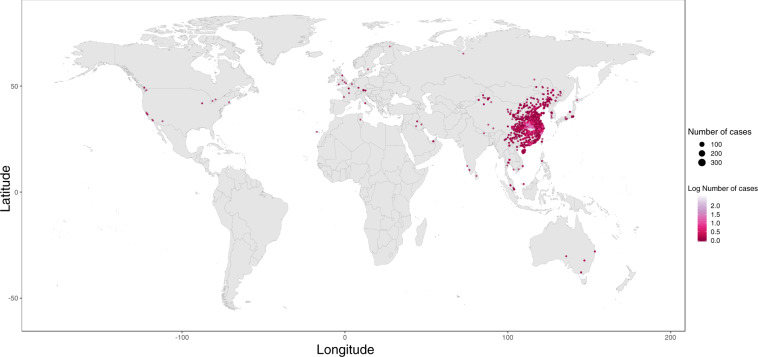
Cases of a novel coronavirus were first reported in Wuhan, Hubei province, China, in December 2019 and have since spread across the world. Epidemiological studies have indicated human-to-human transmission in China and elsewhere. To aid the analysis and tracking of the COVID-19 epidemic we collected and curated individual-level data from national, provincial, and municipal health reports, as well as additional information from online reports. All data are geo-coded and, where available, include symptoms, key dates (date of onset, admission, and confirmation), and travel history. The generation of detailed, real-time, and robust data for emerging disease outbreaks is important and can help to generate robust evidence that will support and inform public health decision making.
Overview
The claims and statistics of this paper haven’t been checked yet.
Free: it reads the open-access text and checks the first 5 claims that cite a source we can check. Create a free account to check every claim.
Integrity signals
Registry
Cites
Statistics
Figures
Verification
Claims the paper makes
The claims and statistics of this paper haven’t been checked yet.
Free: it reads the open-access text and checks the first 5 claims that cite a source we can check. Create a free account to check every claim.
Claims other papers make about this one
Each is checked against this paper’s own text: does it say what the citing paper says it does?
In the citing paper
“We aligned cases and seroprevalence on the basis of individual record data suggesting that exposure to a laboratory-confirmed case was typically 10–13 days36 and exposure to seroconversion was 14–17 days.37, 38, 39”
From Estimating global, regional, and national daily and cumulative infections with SARS-CoV-2 through Nov 14, 2021: a statistical analysis (2022) · cites this paper as [36]
Self-check
Percentages, sums and reported differences re-computed from the paper’s own numbers.
The self-check needs the paper’s full text.
Citations
Cites
Chen, N., Zhou, M., Dong, X., Qu, J., Gong, F., Han, Y., Qiu, Y., Wang, J., Liu, Y., Wei, Y., et al. (2020) · The Lancet · doi:10.1016/s0140-6736(20)30211-7 · Cited by 21,415 · cited 1×
“(1) columns with no variability across all records were removed, (2) the remaining data were hashed using a 32-bit variant of MurmurHash3 implemented in the R package FeatureHashing version 0.9.1.3 8, 9 , (3) a principle component analysis on the centered, scaled hashed feature matrix is performed for dimension reduct…”
MethodInfluentialEarly transmission dynamics in Wuhan, China, of novel coronavirus-infected pneumonia
Li, Q., Guan, X., Wu, P., Wang, X., Zhou, L., Tong, Y., Ren, R., Leung, K. S. M., Lau, E. H. Y., Wong, J. Y., et al. (2020) · New England Journal of Medicine · doi:10.1056/nejmoa2001316 · Cited by 16,575 · cited 2×
“Third, in some instances more detailed data are available, typically through peer-reviewed research articles 1, 7 , which were subsequently used to modify existing records in the database.”
BackgroundAn interactive web-based dashboard to track COVID-19 in real time
Dong, E., Du, H., & Gardner, L. (2020) · The Lancet Infectious Diseases · doi:10.1016/s1473-3099(20)30120-1 · Cited by 10,048 · cited 1×
“Third, in some instances more detailed data are available, typically through peer-reviewed research articles 1, 7 , which were subsequently used to modify existing records in the database.”
BackgroundPandemic Potential of a Strain of Influenza A (H1N1): Early Findings
Fraser, C., Donnelly, C. A., Cauchemez, S., Hanage, W. P., Van Kerkhove, M. D., Hollingsworth, T. D., Griffin, J., Baggaley, R. F., Jenkins, H. E., Lyons, E. J., et al. (2009) · Science · doi:10.1126/science.1176062 · Cited by 1,909 · cited 1×
“However, the dataset presented here includes fine grained geographic details and the most comprehensive list of cases.”
BackgroundSelf-citationZhao, S., Lin, Q., Ran, J., Musa, S. S., Yang, G., Wang, W., Lou, Y., Gao, D., Yang, L., He, D., et al. (2020) · International Journal of Infectious Diseases · doi:10.1016/j.ijid.2020.01.050 · Cited by 1,853
Feature hashing for large scale multitask learning
Weinberger, K., Dasgupta, A., Langford, J., Smola, A., & Attenberg, J. (2009) · Proceedings of the 26th Annual International Conference on Machine Learning · doi:10.1145/1553374.1553516 · Cited by 906 · cited 1×
“(1) columns with no variability across all records were removed, (2) the remaining data were hashed using a 32-bit variant of MurmurHash3 implemented in the R package FeatureHashing version 0.9.1.3 8, 9 , (3) a principle component analysis on the centered, scaled hashed feature matrix is performed for dimension reduct…”
MethodInfluentialBogoch, I. I., Watts, A., Thomas-Bachli, A., Huber, C., Kraemer, M. U. G., & Khan, K. (2020) · Journal of Travel Medicine · doi:10.1093/jtm/taaa008 · Cited by 898
Self-citationDigital disease detection - harnessing the Web for public health surveillance
Brownstein, J. S., Freifeld, C. C., & Madoff, L. C. (2009) · New England Journal of Medicine · doi:10.1056/nejmp0900702 · Cited by 819 · cited 1×
“Geo-positioned records of case data can be important for risk communication and evaluation during outbreaks, especially when they are available in real-time 4, 5 .”
BackgroundSelf-citationSun, K., Chen, J., & Viboud, C. (2020) · The Lancet Digital Health · doi:10.1016/s2589-7500(20)30026-1 · Cited by 517
The global compendium of Aedes aegypti and Ae. albopictus occurrence
Kraemer, M. U. G., Sinka, M. E., Duda, K. A., Mylne, A., Shearer, F. M., Brady, O. J., Messina, J. P., Barker, C. M., Moore, C. G., Carvalho, R. G., et al. (2015) · Scientific Data · doi:10.1038/sdata.2015.35 · Cited by 388 · cited 1×
“Going forward we will likely update records in the period described here which occurs frequently after outbreaks [13] [14] [15] [16] .”
BackgroundSelf-citation
Cited by
Items 301–400 of 407
COVID-19 Mobility Data Collection of Seoul, South KoreaPreprint
Cho, J., Oh, S., Kim, S., Kim, N., Shin, Y., Cho, H., & Yoon, Y. (2020) · arXiv (Cornell University) · doi:10.6084/m9.figshare.c.5015093 · Cited by 2
Lippolis, E. (2024) · Elsevier eBooks · doi:10.1016/b978-0-443-13681-8.00015-1 · Cited by 2
Artificial Intelligence Applications in Emergency Response and Disaster Management
Ruiz-Diaz, J., Marroquín-Gutiérrez, F., Simancas-Acevedo, E., Salgado-Ramírez, J. C., Trejo-Macotela, F. R., Ramos-Fernandez, J. C., Tafoya-Rivera, E. V., Vera, U., & Cuenca, A. D. M. (2025) · Advances in computational intelligence and robotics book series · doi:10.4018/979-8-3693-8161-8.ch020 · Cited by 2
Predicting COVID-19 Vaccination Intentions Among UK Parents Using Protection Motivation Theory
Obohwemu, K. O. (2025) · JORMA International Journal of Health and Social Sciences · doi:10.64074/jorma003 · Cited by 1
Shaito, M., Fegaras, L., & Levine, D. (2025) · International Conference on PErvasive Technologies Related to Assistive Environments (PETRA) · doi:10.1145/3733155.3734893 · Cited by 1
“Similarly, the COVID-19 epidemiology analysis as described by Xu et al [4] provides valuable data for surveillance but does not offer integrated data analysis.”
Sopko, J., Han, A., Powers, J., Sauer, J., Avunoori, M., Zakrzewski, S., Krugman, A., Dasgupta, A., Sewalk, K. C., Gertz, A., et al. (2026) · JMIR Public Health and Surveillance · doi:10.2196/86209 · Cited by 1
“Global.health was formed during the early stages of the SARS-CoV-2 pandemic in 2020 to address the challenge of integrating fragmented data during multiagency, multi-jurisdictional outbreak responses [23,26-28].”
Self-citationData Mining to Predict COVID-19 Patients’ Recovery on a Balanced Dataset
Valdiviezo-Díaz, P. (2021) · Communications in computer and information science · doi:10.1007/978-3-030-71503-8_26 · Cited by 2
Socio-economic Insinuations and Air Quality Status in India Due to COVID-19 Pandemic Lockdown
Gautam, M., Yadav, D. S., Agrawal, S., & Agrawal, M. (2021) · Environmental footprints and eco-design of products and processes · doi:10.1007/978-981-16-3856-5_4 · Cited by 1
Emerging and Established Histological Techniques for the Analysis of Thrombosis in COVID-19 Lungs
Spier, A. B., & Evans, C. E. (2021) · Frontiers in Cardiovascular Medicine · doi:10.3389/fcvm.2021.745906 · Cited by 1
“The COVID-19 pandemic has resulted in massive global suffering (4) including job losses, travel restrictions (5), mental and physical illness (6, 7), and mortality (7).”
BackgroundNieto–Chaupis, H. (2021) · Lecture notes of the Institute for Computer Sciences, Social Informatics and Telecommunications Engineering · doi:10.1007/978-3-030-92163-7_21 · Cited by 1
Black Pepper an Ideal Choice against Corona Virus: A Systemic study against Pandemic Covid-19
Lall, D., Rathore, S., Agrawal, B., & Sharma, N. (2022) · Research Journal of Pharmacognosy and Phytochemistry · doi:10.52711/0975-4385.2022.00012 · Cited by 1
effect of COVID-19 on micro RNA and therefore gene expression
Alquraishi, M. K. S., & Alzeyadi, M. (2022) · International Journal of Health Sciences · doi:10.53730/ijhs.v6ns2.6277 · Cited by 1
Community Survey on Wearing Mask to Prevent COVID-19, Bangladesh, 2021
Chowdhury, N. M., Farrque, M. M. O., Hassin, C. N., & Henderson, A. K. (2022) · International Journal of TROPICAL DISEASE & Health · doi:10.9734/ijtdh/2022/v43i1230628 · Cited by 1
COVID-19 datasets: A brief overview
Sun, K., Li, W., Saikrishna, V., Chadhar, M., & Xia, F. (2022) · Computer Science and Information Systems · doi:10.2298/csis210822014s · Cited by 1
DeCoP: Deep Learning for COVID-19 Prediction of Survival
Deng, Y., Liu, S., Jolfaei, A., Cheng, H., Wang, Z., & Zheng, X. (2022) · IEEE Transactions on Molecular Biological and Multi-Scale Communications · doi:10.1109/tmbmc.2022.3181514 · Cited by 1
“BiLSTM network is employed to learn the high representations based on the Open COVID-19 Data [7], [8].”
MethodKim, K., & Park, J. S. (2022) · Vaccines · doi:10.3390/vaccines10111917 · Cited by 1
“After adjustment for sex and age [13] as covariates, the rate of obesity showed a positive correlation with the death rate of COVID-19 at a statistically significant level.”
BackgroundAI and the Infectious Medicine of COVID-19
Andriasyan, V., Petkidis, A., & Yakimovich, A. (2022) · Springer eBooks · doi:10.1007/978-3-031-08506-2_6 · Cited by 1
Detecting Global Community Structure in a COVID-19 Activity Correlation Network
Sayama, H. (2023) · Studies in computational intelligence · doi:10.1007/978-3-031-21127-0_46 · Cited by 1
The Role of the Rural Librarian on the Provision of Social Justice Education in South Africa
Netshakhuma, N. S. (2023) · Advances in educational marketing, administration, and leadership book series · doi:10.4018/978-1-7998-9678-4.ch016 · Cited by 1
Association of COVID-19 pandemic and depression occurrence in university students worldwide
Gilandoust, A., & Torkaman, F. M. T. (2022) · Journal of Biological Studies · doi:10.62400/jbs.v5i3.7083 · Cited by 1
Mounir, A. M., Marie, M. I., & Abdelhamid, L. (2024) · Journal of Computer Science · doi:10.3844/jcssp.2024.1251.1262 · Cited by 1
Models for SARS-CoV-2 health policies: social distancing amid vaccination and virus variants
Zhang, Y., & Kapoor, S. (2025) · Royal Society Open Science · doi:10.1098/rsos.242277 · Cited by 1
Golan, A., Mumladze, T., Wilson, D., Cohen, E., McGuinness, T., Mooney, W., & Moon, J. (2020) · SSRN Electronic Journal · doi:10.2139/ssrn.3623085 · Cited by 1
Bao, L., Zhang, Y., & Niu, X. M. (2020) · PubMed · doi:10.48550/arxiv.2008.11874 · Cited by 1
“We obtained the traveler case reports within the period specified above from [8] with re-verification of their travel histories using government and media reports.”
MethodDiscrepancies in Epidemiological Modeling of Aggregated Heterogeneous DataPreprint
Trella, A. L., Argaw, P., Li, M. M., & Hay, J. A. (2021) · arXiv (Cornell University) · doi:10.48550/arxiv.2106.10610 · Cited by 1
The timing of natural killer cell response in coronavirus infection: a concise model perspectivePreprint
Xu, X., & Sneppen, K. (2021) · bioRxiv (Cold Spring Harbor Laboratory) · doi:10.1101/2021.08.02.454730 · Cited by 1
Variation in NO 2 , AOD and O 3 concentrations in Italy during COVID-19 outbreakPreprint
Jain, A., Bhadauria, N., Aswin, S., & Suresh, A. (2020) · doi:10.1002/essoar.10503667.1 · Cited by 1
The misleading illusion of COVID-19 confirmed case data: alternative estimates and a monitoring toolPreprint
Macías‐Ordóñez, R., & Villaseñor‐Amador, D. (2020) · medRxiv · doi:10.1101/2020.05.20.20107516 · Cited by 1
“of the population, but rather aimed at suspicious individuals (travelers or recent contacts 344 with other infections) or at symptomatic individuals [6,12,27].”
BackgroundResultSevidzem, S. L., Koumba, A. A., Koumba, C. R. Z., Kêdoté, N. M., Maganga, G. D., Agossou, E. E., Doumbo, S., Kabkia, B. D., Djogbénou, L., Acapovi-Yao, G. L., et al. (2020) · Asian Journal of Medicine and Health · doi:10.9734/ajmah/2020/v18i630213
“The associated risk factors include individuals with age >= 50 years [15], males, smokers as”
BackgroundIMPORTANCIA DE LA ALTITUD EN LA FISIOPATOLOGÍA DEL COVID-19
Montoya, M. (2020) · SITUA · doi:10.51343/si.v23i2.310
Jia, J., Dai, X., Jiang, X., Li, S., Wang, X., Gao, R., Jiang, F., Qi, F., & Kang, D. (2020) · Research Square · doi:10.21203/rs.3.rs-95094/v1
Self-citationFighting Global Viruses Under SGT
Sapaty, P. S. (2021) · Studies in systems, decision and control · doi:10.1007/978-3-030-68341-2_7
Interpretable machine learning approach for predicting COVID-19 risk status of an individual
Onoja, A., Ejiwale, M. O., & Rewane, A. (2021) · Transactions on Networks and Communications · doi:10.14738/tnc.92.9760
Pourhomayoun, M., & Shakibi, M. (2021) · Transactions on computational science and computational intelligence · doi:10.1007/978-3-030-71051-4_49
Rani, S. (2021) · Advances in medical technologies and clinical practice book series · doi:10.4018/978-1-7998-7188-0.ch004
Basu, S., Das, R., Gupta, S., & Ganguli, S. (2021) · Current World Environment · doi:10.12944/cwe.16.2.27
Elsayed, B. M. S., Altarawneh, L. N., Farooqui, H. H., Khan, M. N., Babu, G. R., Doi, S. A. R., & Chivese, T. (2021) · Building Resilience at Universities: Role of Innovation and Entrepreneurship · doi:10.29117/quarfe.2021.0151
Sex difference in hospitalized patients with COVID-19 infection
Abdelwahab, H. W., Shaltout, S. W., Fouda, A. M., Ali, R. E., Shalabi, N. M., Elhoseiny, F., Farrag, N. S., & Ehab, A. (2021) · Chest Disease Reports · doi:10.4081/cdr.2021.9842
Yaragalla, S. (2020) · Journal of Infectious Diseases & Case Reports · doi:10.47363/jidscr/2020(1)104
AI-driven deep learning method for diagnosing COVID-19 symptoms
(2021) · International Journal For Innovative Engineering and Management Research · doi:10.48047/ijiemr/v10/i11/07
Influence of important environmental parameters on the spread and severity of COVID-19: Part 1
Tiwari, V., & Sharma, N. (2020) · American Journal of Environmental Biology · doi:10.47610/ajeb-2020-a1v1
Does Multi-Hop Crowdsourcing Work? A Case Study on Collecting COVID-19 Local Information
Zhong, Y. C., Kobayashi, M., Matsubara, M., & Morishima, A. (2021) · IEEE International Conference on Big Data (BigData) · doi:10.1109/bigdata52589.2021.9671950
“The generation of detailed, real-time, and robust data for emerging disease outbreaks such as COVID-19 is important and can help generate robust evidence that will support and inform public health decision making [8].”
BackgroundMachine Learning-based Approach for Prevention of COVID-19 using Steam VaporizerPreprint
Saket, R. K. (2022) · doi:10.36227/techrxiv.18753377
Machine Learning-based Approach for Prevention of COVID-19 using Steam VaporizerPreprint
Saket, R. K. (2022) · doi:10.36227/techrxiv.18753377.v1
Wu, J. Y., Killeen, B. D., Nikutta, P., Chakraborty, S., Zapaishchykova, A., Thies, M., & Unberath, M. (2020) · Research Square · doi:10.21203/rs.3.rs-71225/v1
Serhani, M. A., Kassabi, H. T. E., Kassabi, H. T. E., Oulahaj, A., & Khalil, K. M. (2021) · doi:10.2196/preprints.28001
Developing natural language processing instruments to study sociotechnical systemsPreprint
Lab, S. (2021) · OSF Preprints (OSF Preprints) · doi:10.31219/osf.io/zrbd4
Impact of corona virus crisis management among Libyan population
khpiza, H. A. (2022) · International Journal of Health Sciences · doi:10.53730/ijhs.v6ns5.9749
Muhammad, F. M., & Pambuk, C. I. A. (2022) · International Journal of Medical Science and Clinical Research Studies · doi:10.47191/ijmscrs/v2-i8-27
COVID-19 Pandemisinde Semptomlar ve Vaka Profilinin Veri Madenciliği Yaklaşımıyla İncelenmesi
Adalı, G. K. (2022) · Haliç Üniversitesi Sosyal Bilimler Dergisi · doi:10.56206/husbd.1150952
COVID-19 in India: Epidemiological reflections from initial 170 million consecutive test results
Lohia, R., Goel, P., Kaur, J., Kumar, S., Bajpai, M., & Singh, H. (2022) · Frontiers in Epidemiology · doi:10.3389/fepid.2022.933820 · Cited by 1
SEQUELAS FISIOLÓGICAS E PSICOLÓGICAS PÓS-COVID: REVISÃO INTEGRATIVA
Alvarenga, M. V. F., Silva, R. D. Q., Gonzalez, J. D. C. T., Torres, B. S., Belo, L. B., Souto, J. L. F. C., Evangelista, F. D. M., Campos, C. S., Moraes, C. G. A., Freire, A. L. P., et al. (2022) · doi:10.22533/at.ed.94522221113
Cunha, N. D. C. P., Pagio, M. G., Oliveira, R. V., de Oliveira, E. C. R., Suhett, L. C., Rodrigues, S. D. J., Bezerra, Í. M. P., & Leitão, F. N. C. (2022) · doi:10.22533/at.ed.9452222113
Moraes, M. D. A., Mussi, F. C., Pires, C. G. D. S., Oliveira, C. C. R. B., Silva, C. T. O., Teixeira, J. R. B., de Oliveira, J. S. B., Silva, F. M. S. E., Sales, R. S., Ribeiro, L. S., et al. (2022) · doi:10.22533/at.ed.9452222117
O ENSINO E A COVID-19: IMPACTOS DA PANDEMIA NO ENSINO FUNDAMENTAL BRASILEIRO
de Sousa, C. B., Brito, N. A. S. M. V. D. S., & Brito, E. D. S. (2022) · doi:10.22533/at.ed.94522221110
IMPACTOS DA PANDEMIA NA SAÚDE MENTAL EM PACIENTES VÍTIMAS DA COVID-19 : READAPÇÃO NA VIDA COTIDIANA
Vicente, D. A. R., Rocha, L. A., Picinalli, M. N. D., & da Silva, A. A. (2022) · doi:10.22533/at.ed.94522221117
Castelló, V. O., Pérez‐Benito, F. J., Catalá, O. D. T., Igual, I. S., Llobet, R., & Pérez-Cortés, J.-C. (2022) · IEEE Access · doi:10.1109/access.2022.3221936
“This EAPP value confirms the analysis of [28], where a high bias in the dataset is reported.”
BackgroundMethodSewariya, M., & Patidar, S. (2023) · Lecture notes in networks and systems · doi:10.1007/978-981-19-7402-1_21
Muruganandham, S., & Venmani, A. (2023) · Lecture notes in networks and systems · doi:10.1007/978-981-19-8825-7_28
Salichos, L., Warrell, J., Cevasco, H., Chung, A., & Gerstein, M. (2023) · Scientific Reports · doi:10.1038/s41598-023-34959-2
“Previous studies have provided an important historical view of the travel and viral transmission of COVID-19 based on genetic variability 6,8,9,11–15 Click or tap here to enter text.”
A Review Study On OVID-19 Forecasting Using Machine Learning
Kamlesh, K. N., & Vishal, D. K. (2023) · Journal of Survey in Fisheries Sciences · doi:10.53555/sfs.v10i1.1352
Journal of Survey in Fisheries Sciences
Kamlesh, K. N., & Vishal, D. K. (2023) · doi:10.53555//sfs.v10i1.1352
Monaco, F., Sarli, L., Ceccato, E., Masuzzo, P., Simone, R. D., Minardi, E., Giorgi, P., Ghezzo, A., & Bonacaro, A. (2023) · The Malaysian Journal of Nursing · doi:10.31674/mjn.2023.v15i01.017
Encefalitis asociada a infección por SARS-CoV-2
Pinto, K., Cuenca, M. E. F., & Aucay, J. E. O. (2023) · Revista Vive · doi:10.33996/revistavive.v6i17.248
Perspectives on the Information Technologies Being Used in the Battle Against COVID-19
Kennedy, J., & Carrick, J. (2023) · Journal of Leadership Accountability and Ethics · doi:10.33423/jlae.v20i5.6603
Exhaustive Goodness of Fit Via Smoothed Inference and Graphics
Algeri, S., & Zhang, X. (2021) · Figshare · doi:10.6084/m9.figshare.16934418
Enrique, U., Antonio, R., Armando, J., Villa, D. F. V., Javier, R., Hernández-Vargas, B., Cristina, J., Luque, K. M. M., Salazar, K. O., Toncel, V. B., et al. (2024) · Editorial Unimagdalena eBooks · doi:10.21676/9789587467321
Potential of Ayurveda Therapeutic in Prophylaxis of COVID 19 Pandemic
Arya, P., Chauhan, J. S., Kumar, D., & Kumar, P. (2024) · Journal of Advances in Microbiology · doi:10.9734/jamb/2024/v24i6828 · Cited by 2
Programação Genética para Classificação de Dados de Pacientes Infectados com COVID-19
Conceição, G. R. S. D., & Magalhães, C. S. D. (2024) · doi:10.5753/ercas.2024.238720
Machine Learning Algorithms for Prediction of COVID-19 in Early Stages Using Explainable AI Approach
Kaur, B. P., Singh, H., Hans, R., & Sharma, S. K. (2024) · Algorithms for intelligent systems · doi:10.1007/978-981-97-4496-1_21
Park, J., & Rho, M. J. (2024) · Health Informatics Journal · doi:10.1177/14604582241294208
Manejo odontológico en tiempos de COVID-19
Universidad Internacional del Ecuador, U. I. D. E., Valencia, M. S. V., Molina, G. A., Universidad San Francisco de Quito, U. S. F. Q., Tafur, V. V. C., Universidad Internacional del Ecuador, U. I. D. E., Hinojosa, M. D. C., Universidad De Las Américas, U. D. L. A., Vega, N. I. L., Externo, et al. (2024) · doi:10.33890/manejo.odontologico.covid
Fitting COVID-19 Incidences in Kenya Using Fractional Polynomials and Linear Splines
Njoroge, D., Mwalili, S. M., & Wanjoya, A. (2024) · International Journal of Statistical Distributions and Applications · doi:10.11648/j.ijsd.20241004.11
ETL Model for Pandemic Data Processing
Tomaščík, L., Ádám, N., Geciová, N., Madoš, B., Poprík, P., & Khorshidiyeh, H. (2025) · IEEE World Symposium on Applied Machine Intelligence and Informatics (SAMI) · doi:10.1109/sami63904.2025.10883187
“ETL M ODEL D ESIGN AND A RCHITECTURE The recent global pandemic has generated massive amounts of data from diverse sources, such as health institutions, testing centers, and governments [8].”
Multiple Imputation Confidence Intervals for a Risk Difference With Missing Observations
Lee, C. (2025) · Statistics in Medicine · doi:10.1002/sim.70136
Pandemics of tomorrow: how AI and nanotech will transform global health
Gupta, V., Hasija, U., & Ebadi, M. J. (2025) · Elsevier eBooks · doi:10.1016/b978-0-443-33871-7.00012-x · Cited by 1
Kajero, O., & Osagie, O. M. (2025) · Asian Journal of Research in Computer Science · doi:10.9734/ajrcos/2025/v18i7731
Elsayed, B. M. S., Altarawneh, L. N., Farooqui, H. H., Khan, M. N., Babu, G. R., Doi, S. A. R., & Chivese, T. (2025) · Pathogens · doi:10.3390/pathogens14090917
“In the GH, data were captured by curators who are skilled in English, Mandarin Chinese, Cantonese, Spanish, and Portuguese, and both machine learning and manual checking were used to reduce duplicate entries and other errors in data capturing [22].”
InfluentialUnified framework for the ingestion of early epidemic data for downstream data analytics
Kamau, E., Kelly, S., Darji, D., Baidjoe, A. Y., Brownstein, J. S., Campbell, F., Dasgupta, A., Degail, M.-A., Demidova, A., Luca Ferretti, A., et al. (2025) · Wellcome Open Research · doi:10.12688/wellcomeopenres.24776.2
Self-citationFang, R., Wang, L., Yang, X. Y., Guo, Y., Peng, B., Zhang, Y., Kamili, D., Li, S., Lyv, Y., Li, S., et al. (2025) · Transboundary and Emerging Diseases · doi:10.1155/tbed/3959370
“Livestock density data were obtained from published articles, while COVID-19 mortality rates and accessibility information were sourced from publicly available databases [32, 34, 35].”
Self-citationSherratt, K. (2024) · LSHTM Research Online (London School of Hygiene and Tropical Medicine) · doi:10.17037/pubs.04674767
Lu, Q., Zhang, H.-Y., Che, T.-L., Zhao, H., Chen, X., Rui, L., Jiang, W.-L., Zeng, H.-L., Zhang, X.-A., Long, H., et al. (2021) · Figshare · doi:10.6084/m9.figshare.14684478
Why does the COVID-19 outbreak in Mexico seem to be slower? Some hypotheses for testingPreprint
Elías-Gutiérrez, M., Mendoza-Carranza, M., Takahashi-Aguilar, U., Valdéz-Moreno, M., Prado-Bernal, J. A., & Mora-Loya, C. (2020) · Research Square · doi:10.21203/rs.3.rs-51450/v1
“Other unpublished studies have tried to resolve weather effects on a pandemic, with no conclusive results (Xu et al. 2020).”
BackgroundΛάμπρου, Γ. Ν., & Λάμπρου, Γ. Ν. (2024) · University of Thessaly Institutional Repository (University of Thessaly)
Abaft, S. A. (2024) · White Rose eTheses Online (University of Leeds, The University of Sheffield, University of York)
PICCHIANTI, M. (2022) · Electronic Theses and Dissertations Repository (University of Pisa)
Mental Health and Well-Being of People Aged 60 and Older Due to COVID-19
Grayson, H. (2024) · ScholarWorks (Walden University)
Wang, D., Wang, Y., Gressani, O., Chen, J., Tao, Y., Wang, H., Li, S., Chen, D., Lau, E. H. Y., Zhao, Y., et al. (2025) · medRxiv · doi:10.64898/2025.12.17.25342513
Self-citationBag, A., Chowdhury, A., Das, C., Ray, S. S., & Ghosh, K. (2026) · International Conference on Image Processing and Capsule Networks (ICIPCN) · doi:10.1109/icipcn67432.2026.11438547
“Hybrid models combining mechanistic epidemiological frameworks with data-driven methods have also been proposed to enhance predictive performance while retaining interpretability [23], [24].”
SSA post-analysis of COVID-19 incidence magnitude in Novosibirsk Region
Petrakova, V. (2026) · Russian Journal of Infection and Immunity · doi:10.15789/2220-7619-spa-17967
“Отметим без детального описания еще несколько работ [7, 8, 31], в которых ключевая роль также отведена анализу эпидемиологичес-ких данных.”
Rakotondramanga, J. M. (2023) · theses.fr (ABES) · doi:10.70675/aae0cc9az3b0fz4ccdzb05az583a89448b7d
Measuring Mobility and Social Mixing to Inform Pandemic Prediction and Response
Luiz, P., Gantenberg, J. R., Rosenblatt, S. F., Wei, G., Khanna, A., Loftness, B. C., & Lurie, M. N. (2026) · Sustainable development goals series · doi:10.1007/978-3-032-06125-6_22
The Impact of Transportation Flows on the SEIR Epidemic Model: A Case Study
Ma, K., Li, Y., & Gubar, E. (2026) · Mathematics · doi:10.3390/math14111820
Metadata
- Authors
- Xu, B., Gutierrez, B., Mekaru, S., Sewalk, K., Goodwin, L., Loskill, A., Cohn, E. L., Hswen, Y., Hill, S. C., Cobo, M. M., Zarebski, A. E., Li, S., Wu, C.-H., Hulland, E., Morgan, J. D., Wang, L., O’Brien, K., Scarpino, S. V., Brownstein, J. S., Pybus, O. G., Pigott, D. M., & Kraemer, M. U. G.
- Affiliations
- University of Oxford (GB)
- Boston Children's Hospital (US)
- Boston University (US)
- University of Southampton (GB)
- University of Washington (US)
- Centre National de la Recherche Scientifique (FR)
- Northeastern University (US)
- Corresponding author
- Zarebski, Alexander E.
- Pigott, David M.
- Kraemer, Moritz U. G.
- ORCID
- Venue
- Scientific Data
- Published
- 2020-03-24
- Volume
- 7
- Issue
- 1
- Pages
- 106-106
- ISSN
- 2052-4463 (ISSN-L)
- PMC
- PMC7093412
- OpenAlex
- W3012798837
- Cited by
- 396
- References
- 16
- Citations by year
- 2026: 8 · 2025: 18 · 2024: 21 · 2023: 35 · 2022: 67 · 2021: 110 · 2020: 137
- Type
- data paper
- Language
- en
- Open access
- gold
- doi.org
- Licence
- cc-by
- creativecommons.org/licenses/by/4.0 (tdm)
- creativecommons.org/licenses/by/4.0 (vor)
- Locations
- Scientific Data (publishedVersion, cc-by)
- PubMed Central (publishedVersion, cc-by)
- PubMed (publishedVersion)
- ePrints Soton (University of Southampton) (acceptedVersion)
- Informationszentrum Lebenswissenschaften (ZB MED) (submittedVersion, cc-by)
- eScholarship (California Digital Library) (submittedVersion)
- eScholarship (California Digital Library) (submittedVersion, cc-by)
- Apollo (University of Cambridge) (submittedVersion, cc-by)
- Apollo (cc-by)
- Apollo
- Funders
- Bill and Melinda Gates Foundation (INV-006113)
- Wellcome Trust (220414/Z/20/Z)
- China Scholarship Council
- Topics
- Physical Sciences › Mathematics › Modeling and Simulation › COVID-19 epidemiological studies
- Health Sciences › Medicine › Epidemiology › Data-Driven Disease Surveillance
- Health Sciences › Medicine › Infectious Diseases › SARS-CoV-2 and COVID-19 Research
- Keywords
- COVID-19 pandemic, SARS-CoV-2, disease surveillance, human-to-human transmission, travel history, symptom data, outbreak surveillance, public health decision-making
- MeSH terms
- Betacoronavirus, COVID-19, SARS-CoV-2, China, Geography, Humans, Pneumonia, Viral, Public Health, Coronavirus Infections, Epidemics, Pandemics, Geographic Mapping
About these checks
Registry, retraction, Cites and statistics results are computed, not judged, with one exception: a printed reference that no index lists is read once by a model before it counts as a citation error. Claims are extracted by a model and kept only when their quote appears verbatim in the text; each cited source is then checked, with a model’s help, for whether it says what the claim relies on. Those verdicts can be wrong — read the claim’s quote and the cited source before relying on one.
Statistics and arithmetic are recomputed, not judged.
Confidence bands are shown only for fields calibrated on our annotated test set. None is calibrated yet, so no band is shown.
What counts as a claim ›How we measure confidence ›How we check this ›
Are you an author, or do you see a problem with this page? Request a review
Data sources
Bibliographic data: Semantic Scholar, OpenAlex, Crossref.
Contains information from the Semantic Scholar Academic Graph Datasets, made available under the ODC Attribution License (ODC-BY 1.0).
Semantic Scholar’s data is described in: Kinney, R., et al. (2023). The Semantic Scholar Open Data Platform. arXiv:2301.10140.
