

Epidemiological data from the COVID-19 outbreak, real-time case information
Open accessThe DOI matches its Crossref record; 15 of the 16 references it cites were found in a registry or an index.
Abstract
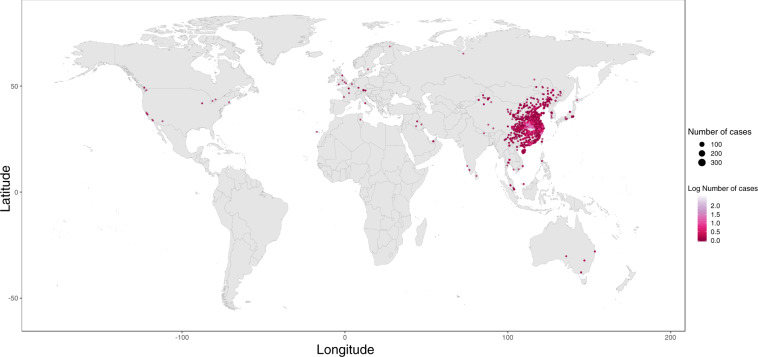
Cases of a novel coronavirus were first reported in Wuhan, Hubei province, China, in December 2019 and have since spread across the world. Epidemiological studies have indicated human-to-human transmission in China and elsewhere. To aid the analysis and tracking of the COVID-19 epidemic we collected and curated individual-level data from national, provincial, and municipal health reports, as well as additional information from online reports. All data are geo-coded and, where available, include symptoms, key dates (date of onset, admission, and confirmation), and travel history. The generation of detailed, real-time, and robust data for emerging disease outbreaks is important and can help to generate robust evidence that will support and inform public health decision making.
Overview
The claims and statistics of this paper haven’t been checked yet.
Free: it reads the open-access text and checks the first 5 claims that cite a source we can check. Create a free account to check every claim.
Integrity signals
Registry
Cites
Statistics
Figures
Verification
Claims the paper makes
The claims and statistics of this paper haven’t been checked yet.
Free: it reads the open-access text and checks the first 5 claims that cite a source we can check. Create a free account to check every claim.
Claims other papers make about this one
Each is checked against this paper’s own text: does it say what the citing paper says it does?
In the citing paper
“We aligned cases and seroprevalence on the basis of individual record data suggesting that exposure to a laboratory-confirmed case was typically 10–13 days36 and exposure to seroconversion was 14–17 days.37, 38, 39”
From Estimating global, regional, and national daily and cumulative infections with SARS-CoV-2 through Nov 14, 2021: a statistical analysis (2022) · cites this paper as [36]
Self-check
Percentages, sums and reported differences re-computed from the paper’s own numbers.
The self-check needs the paper’s full text.
Citations
Cites
Chen, N., Zhou, M., Dong, X., Qu, J., Gong, F., Han, Y., Qiu, Y., Wang, J., Liu, Y., Wei, Y., et al. (2020) · The Lancet · doi:10.1016/s0140-6736(20)30211-7 · Cited by 21,415 · cited 1×
“(1) columns with no variability across all records were removed, (2) the remaining data were hashed using a 32-bit variant of MurmurHash3 implemented in the R package FeatureHashing version 0.9.1.3 8, 9 , (3) a principle component analysis on the centered, scaled hashed feature matrix is performed for dimension reduct…”
MethodInfluentialEarly transmission dynamics in Wuhan, China, of novel coronavirus-infected pneumonia
Li, Q., Guan, X., Wu, P., Wang, X., Zhou, L., Tong, Y., Ren, R., Leung, K. S. M., Lau, E. H. Y., Wong, J. Y., et al. (2020) · New England Journal of Medicine · doi:10.1056/nejmoa2001316 · Cited by 16,575 · cited 2×
“Third, in some instances more detailed data are available, typically through peer-reviewed research articles 1, 7 , which were subsequently used to modify existing records in the database.”
BackgroundAn interactive web-based dashboard to track COVID-19 in real time
Dong, E., Du, H., & Gardner, L. (2020) · The Lancet Infectious Diseases · doi:10.1016/s1473-3099(20)30120-1 · Cited by 10,048 · cited 1×
“Third, in some instances more detailed data are available, typically through peer-reviewed research articles 1, 7 , which were subsequently used to modify existing records in the database.”
BackgroundPandemic Potential of a Strain of Influenza A (H1N1): Early Findings
Fraser, C., Donnelly, C. A., Cauchemez, S., Hanage, W. P., Van Kerkhove, M. D., Hollingsworth, T. D., Griffin, J., Baggaley, R. F., Jenkins, H. E., Lyons, E. J., et al. (2009) · Science · doi:10.1126/science.1176062 · Cited by 1,909 · cited 1×
“However, the dataset presented here includes fine grained geographic details and the most comprehensive list of cases.”
BackgroundSelf-citationZhao, S., Lin, Q., Ran, J., Musa, S. S., Yang, G., Wang, W., Lou, Y., Gao, D., Yang, L., He, D., et al. (2020) · International Journal of Infectious Diseases · doi:10.1016/j.ijid.2020.01.050 · Cited by 1,853
Feature hashing for large scale multitask learning
Weinberger, K., Dasgupta, A., Langford, J., Smola, A., & Attenberg, J. (2009) · Proceedings of the 26th Annual International Conference on Machine Learning · doi:10.1145/1553374.1553516 · Cited by 906 · cited 1×
“(1) columns with no variability across all records were removed, (2) the remaining data were hashed using a 32-bit variant of MurmurHash3 implemented in the R package FeatureHashing version 0.9.1.3 8, 9 , (3) a principle component analysis on the centered, scaled hashed feature matrix is performed for dimension reduct…”
MethodInfluentialBogoch, I. I., Watts, A., Thomas-Bachli, A., Huber, C., Kraemer, M. U. G., & Khan, K. (2020) · Journal of Travel Medicine · doi:10.1093/jtm/taaa008 · Cited by 898
Self-citationDigital disease detection - harnessing the Web for public health surveillance
Brownstein, J. S., Freifeld, C. C., & Madoff, L. C. (2009) · New England Journal of Medicine · doi:10.1056/nejmp0900702 · Cited by 819 · cited 1×
“Geo-positioned records of case data can be important for risk communication and evaluation during outbreaks, especially when they are available in real-time 4, 5 .”
BackgroundSelf-citationSun, K., Chen, J., & Viboud, C. (2020) · The Lancet Digital Health · doi:10.1016/s2589-7500(20)30026-1 · Cited by 517
The global compendium of Aedes aegypti and Ae. albopictus occurrence
Kraemer, M. U. G., Sinka, M. E., Duda, K. A., Mylne, A., Shearer, F. M., Brady, O. J., Messina, J. P., Barker, C. M., Moore, C. G., Carvalho, R. G., et al. (2015) · Scientific Data · doi:10.1038/sdata.2015.35 · Cited by 388 · cited 1×
“Going forward we will likely update records in the period described here which occurs frequently after outbreaks [13] [14] [15] [16] .”
BackgroundSelf-citation
Cited by
Items 401–407 of 407
Wolfrath, N., Wolfrath, J., Chatterjee, V., Yan, C. Y., Hu, H., Banerjee, A., Somai, M. M., Crotty, B., & Kothari, A. N. (2026) · doi:10.2196/preprints.101883
A Semiparametric Probit Mixture Cure Model for Interval Censored Data with a Cure Fraction
Zhang, N., Zhao, S., & Lu, D. (2026) · Symmetry · doi:10.3390/sym18071216
“The real data used in this section were collected and continuously maintained by Xu et al. [31], who compiled a database of individual-level COVID-19 cases globally.”
Artificial Intelligence in Disease Surveillance
Ahmed, S., Choudhari, S. G., & Gaidhane, A. M. (2026) · IEEE International Conference on Intelligent Technologies for a Sustainable and Inclusive Future (ICITSIF) · doi:10.1109/icitsif69060.2026.11609114
“As it has been demonstrated in previous studies, artificial intelligence (AI) models can be applied to monitor the COVID-19 growth through various sources of data, which include travel patterns and social media [7,8].”
Geographic Information Systems for Medical Data Analysis
Kumar, K. G., Keerthana, N. V., Balamurugan, K., Sangamithra, T., Periyasamy, S., & Kaviya, D. (2026) · Advances in geospatial technologies book series · doi:10.4018/979-8-3373-7769-8.ch002
Synthetic Spatiotemporal Covid-19 Data Replicates Generated via the USPopulationSampler R PackagePreprint
Yean, R. T., Zhang, J., & Holbrook, A. J. (2026) · medRxiv · doi:10.64898/2026.08.20.26360919
Davis, S. R. (2026) · medRxiv · doi:10.64898/2026.08.24.26361254
ПОСТАНАЛИЗ ДАННЫХ ПО ЗАБОЛЕВАЕМОСТИ COVID-19 МЕТОДОМ SSA НА ПРИМЕРЕ НОВОСИБИРСКОЙ ОБЛАСТИ
Сергеевна, П. В. (2026) · Russian Journal of Infection and Immunity
Metadata
- Authors
- Xu, B., Gutierrez, B., Mekaru, S., Sewalk, K., Goodwin, L., Loskill, A., Cohn, E. L., Hswen, Y., Hill, S. C., Cobo, M. M., Zarebski, A. E., Li, S., Wu, C.-H., Hulland, E., Morgan, J. D., Wang, L., O’Brien, K., Scarpino, S. V., Brownstein, J. S., Pybus, O. G., Pigott, D. M., & Kraemer, M. U. G.
- Affiliations
- University of Oxford (GB)
- Boston Children's Hospital (US)
- Boston University (US)
- University of Southampton (GB)
- University of Washington (US)
- Centre National de la Recherche Scientifique (FR)
- Northeastern University (US)
- Corresponding author
- Zarebski, Alexander E.
- Pigott, David M.
- Kraemer, Moritz U. G.
- ORCID
- Venue
- Scientific Data
- Published
- 2020-03-24
- Volume
- 7
- Issue
- 1
- Pages
- 106-106
- ISSN
- 2052-4463 (ISSN-L)
- PMC
- PMC7093412
- OpenAlex
- W3012798837
- Cited by
- 396
- References
- 16
- Citations by year
- 2026: 8 · 2025: 18 · 2024: 21 · 2023: 35 · 2022: 67 · 2021: 110 · 2020: 137
- Type
- data paper
- Language
- en
- Open access
- gold
- doi.org
- Licence
- cc-by
- creativecommons.org/licenses/by/4.0 (tdm)
- creativecommons.org/licenses/by/4.0 (vor)
- Locations
- Scientific Data (publishedVersion, cc-by)
- PubMed Central (publishedVersion, cc-by)
- PubMed (publishedVersion)
- ePrints Soton (University of Southampton) (acceptedVersion)
- Informationszentrum Lebenswissenschaften (ZB MED) (submittedVersion, cc-by)
- eScholarship (California Digital Library) (submittedVersion)
- eScholarship (California Digital Library) (submittedVersion, cc-by)
- Apollo (University of Cambridge) (submittedVersion, cc-by)
- Apollo (cc-by)
- Apollo
- Funders
- Bill and Melinda Gates Foundation (INV-006113)
- Wellcome Trust (220414/Z/20/Z)
- China Scholarship Council
- Topics
- Physical Sciences › Mathematics › Modeling and Simulation › COVID-19 epidemiological studies
- Health Sciences › Medicine › Epidemiology › Data-Driven Disease Surveillance
- Health Sciences › Medicine › Infectious Diseases › SARS-CoV-2 and COVID-19 Research
- Keywords
- COVID-19 pandemic, SARS-CoV-2, disease surveillance, human-to-human transmission, travel history, symptom data, outbreak surveillance, public health decision-making
- MeSH terms
- Betacoronavirus, COVID-19, SARS-CoV-2, China, Geography, Humans, Pneumonia, Viral, Public Health, Coronavirus Infections, Epidemics, Pandemics, Geographic Mapping
About these checks
Registry, retraction, Cites and statistics results are computed, not judged, with one exception: a printed reference that no index lists is read once by a model before it counts as a citation error. Claims are extracted by a model and kept only when their quote appears verbatim in the text; each cited source is then checked, with a model’s help, for whether it says what the claim relies on. Those verdicts can be wrong — read the claim’s quote and the cited source before relying on one.
Statistics and arithmetic are recomputed, not judged.
Confidence bands are shown only for fields calibrated on our annotated test set. None is calibrated yet, so no band is shown.
What counts as a claim ›How we measure confidence ›How we check this ›
Are you an author, or do you see a problem with this page? Request a review
Data sources
Bibliographic data: Semantic Scholar, OpenAlex, Crossref.
Contains information from the Semantic Scholar Academic Graph Datasets, made available under the ODC Attribution License (ODC-BY 1.0).
Semantic Scholar’s data is described in: Kinney, R., et al. (2023). The Semantic Scholar Open Data Platform. arXiv:2301.10140.
