

CRISPR/Cas9-mediated PD-1 disruption enhances anti-tumor efficacy of human chimeric antigen receptor T cells
Open accessThe DOI matches its Crossref record; 38 of the 39 references it cites were found in a registry or an index.
Abstract
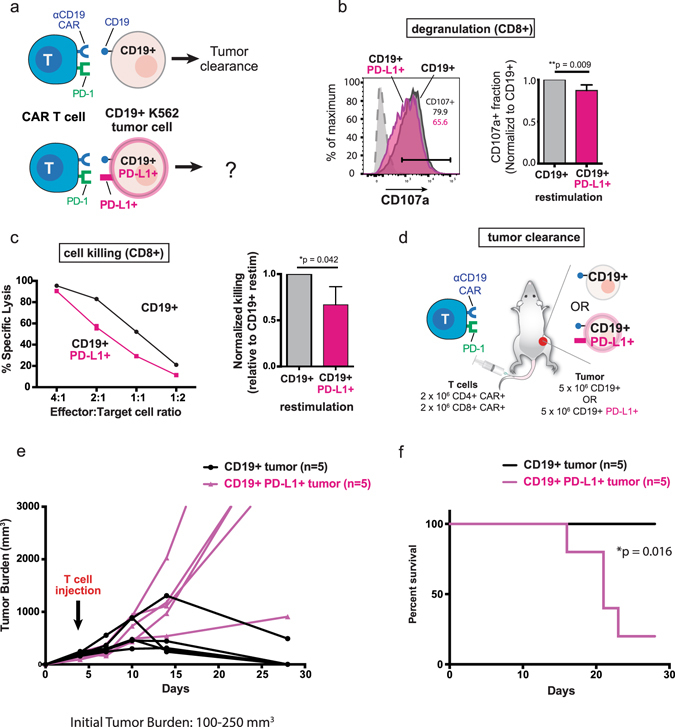
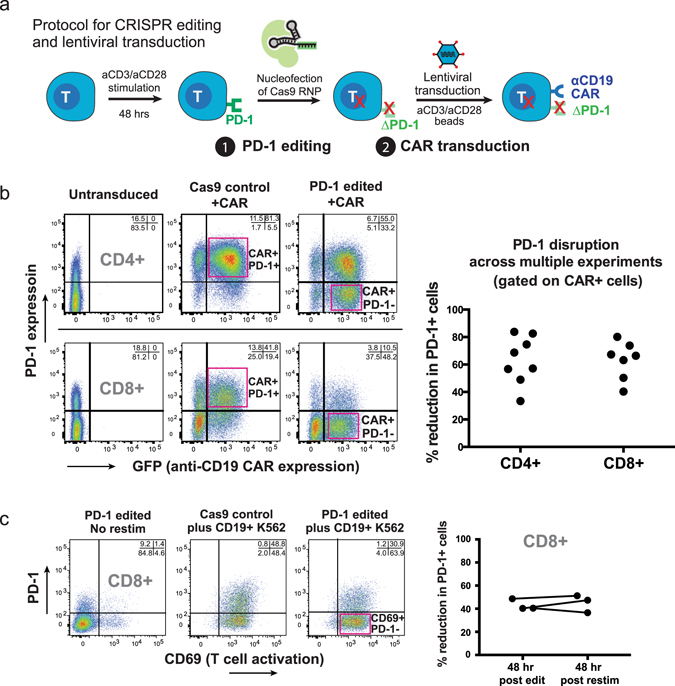
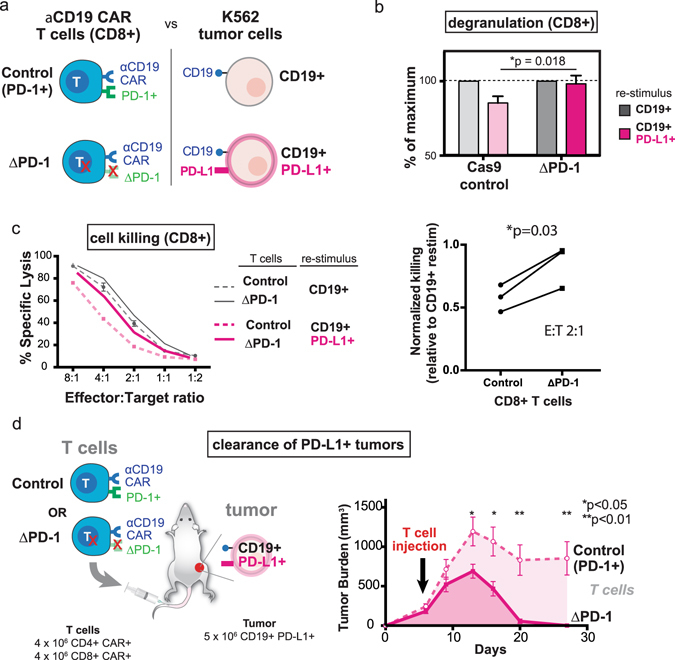
Immunotherapies with chimeric antigen receptor (CAR) T cells and checkpoint inhibitors (including antibodies that antagonize programmed cell death protein 1 [PD-1]) have both opened new avenues for cancer treatment, but the clinical potential of combined disruption of inhibitory checkpoints and CAR T cell therapy remains incompletely explored. Here we show that programmed death ligand 1 (PD-L1) expression on tumor cells can render human CAR T cells (anti-CD19 4-1BBζ) hypo-functional, resulting in impaired tumor clearance in a sub-cutaneous xenograft model. To overcome this suppressed anti-tumor response, we developed a protocol for combined Cas9 ribonucleoprotein (Cas9 RNP)-mediated gene editing and lentiviral transduction to generate PD-1 deficient anti-CD19 CAR T cells. Pdcd1 (PD-1) disruption augmented CAR T cell mediated killing of tumor cells in vitro and enhanced clearance of PD-L1+ tumor xenografts in vivo. This study demonstrates improved therapeutic efficacy of Cas9-edited CAR T cells and highlights the potential of precision genome engineering to enhance next-generation cell therapies.
Overview
The claims and statistics of this paper haven’t been checked yet.
Free: it reads the open-access text and checks the first 5 claims that cite a source we can check. Create a free account to check every claim.
Integrity signals
Registry
Cites
Statistics
Figures
Verification
Claims the paper makes
The claims and statistics of this paper haven’t been checked yet.
Free: it reads the open-access text and checks the first 5 claims that cite a source we can check. Create a free account to check every claim.
Claims other papers make about this one
Each is checked against this paper’s own text: does it say what the citing paper says it does?
The check wasn’t confident either way, so it gives no verdict — never disputed.
In the citing paper
“Mouse cells lacking p53 are unable to effectively arrest cell cycle progression after DNA damage, leading to genomic instability [16].”
From A Review of Research on CRISPR/Cas9 Gene Editing Technology in Disease Treatment (2024) · cites this paper as [16]
Experimental — accuracy not yet measuredThe check wasn’t confident either way, so it gives no verdict — never disputed.
In the citing paper
“Donehower, L.A. and his team found that mice with the P53 gene knocked out exhibit a high frequency of spontaneous tumorigenesis, including lymphomas, osteosarcomas, and other types of tumors.”
From A Review of Research on CRISPR/Cas9 Gene Editing Technology in Disease Treatment (2024) · cites this paper as [16]
Experimental — accuracy not yet measuredThe check wasn’t confident either way, so it gives no verdict — never disputed.
In the citing paper
“This observation suggests that p53 plays a crucial role in tumor suppression.”
From A Review of Research on CRISPR/Cas9 Gene Editing Technology in Disease Treatment (2024) · cites this paper as [16]
Experimental — accuracy not yet measuredIn the citing paper
“CRISPR-Cas9 genetic ablation of checkpoint targets such as PD-1 in adoptive T cell therapies has also shown increased functionality in certain models and is being persued clinically (Ren et al., 2017; Rupp et al., 2017; Stadtmauer et al., 2020; Su et al., 2016).”
From Pooled Knockin Targeting for Genome Engineering of Cellular Immunotherapies (2020) · cites this paper as Rupp et al., 2017
Self-check
Percentages, sums and reported differences re-computed from the paper’s own numbers.
The self-check needs the paper’s full text.
Citations
Cites
PD-1 and PD-L1 Immune Checkpoint Blockade to Treat Breast Cancer
Hartkopf, A. D., Taran, F.-A., Wallwiener, M., Walter, C. B., Krämer, B., Grischke, E.-M., & Brucker, S. Y. (2016) · Breast Care · doi:10.1159/000453569 · Cited by 30,845
Safety, activity, and immune correlates of anti–PD-1 antibody in cancer
Topalian, S. L., Hodi, F. S., Brahmer, J. R., Gettinger, S. N., Smith, D. C., McDermott, D. F., Powderly, J. D., Carvajal, R. D., Sosman, J. A., Atkins, M. B., et al. (2012) · New England Journal of Medicine · doi:10.1056/nejmoa1200690 · Cited by 12,628
Safety and activity of anti-PD-L1 antibody in patients with advanced cancer
Brahmer, J. R., Tykodi, S. S., Chow, L. Q. M., Hwu, W.-J., Topalian, S. L., Hwu, P., Drake, C. G., Camacho, L. H., Kauh, J., Odunsi, K., et al. (2012) · New England Journal of Medicine · doi:10.1056/nejmoa1200694 · Cited by 7,945
Chimeric Antigen Receptor T Cells for Sustained Remissions in Leukemia
Maude, S. L., Frey, N., Shaw, P. A., Aplenc, R., Barrett, D. M., Bunin, N. J., Chew, A., Gonzalez, V. E., Zheng, Z., Lacey, S. F., et al. (2014) · New England Journal of Medicine · doi:10.1056/nejmoa1407222 · Cited by 5,413
PD-1 and Its Ligands in Tolerance and Immunity
Keir, M. E., Butte, M. J., Freeman, G. J., & Sharpe, A. H. (2008) · Annual Review of Immunology · doi:10.1146/annurev.immunol.26.021607.090331 · Cited by 5,378
Restoring function in exhausted CD8 T cells during chronic viral infection
Barber, D. L., Wherry, E. J., Masopust, D., Zhu, B., Allison, J. P., Sharpe, A. H., Freeman, G. J., & Ahmed, R. (2006) · Nature · doi:10.1038/nature04444 · Cited by 3,986
PD-1 Blockade with Nivolumab in Relapsed or Refractory Hodgkin's Lymphoma
Ansell, S. M., Lesokhin, A. M., Borrello, I., Halwani, A., Scott, E. C., Gutierrez, M., Schuster, S. J., Millenson, M. M., Cattry, D., Freeman, G. J., et al. (2015) · New England Journal of Medicine · doi:10.1056/nejmoa1411087 · Cited by 3,560
Wang, H., Yang, H., Shivalila, C. S., Dawlaty, M. M., Cheng, A. W., Zhang, F., & Jaenisch, R. (2013) · Cell · doi:10.1016/j.cell.2013.04.025 · Cited by 3,495
Metabolic Competition in the Tumor Microenvironment Is a Driver of Cancer Progression
Chang, C.-H., Qiu, J., O’Sullivan, D., Buck, M. D., Noguchi, T., Curtis, J. D., Chen, Q., Gindin, M., Gubin, M. M., van der Windt, G. J. W., et al. (2015) · Cell · doi:10.1016/j.cell.2015.08.016 · Cited by 3,331
High-fidelity CRISPR-Cas9 nucleases with no detectable genome-wide off-target effects
Kleinstiver, B. P., Pattanayak, V., Prew, M. S., Tsai, S. Q., Nguyen, N. T., Zheng, Z., & Joung, J. K. (2016) · Nature · doi:10.1038/nature16526 · Cited by 2,673
Cited by
Items 301–400 of 757
Coengineering specificity, safety, and function into T cells for cancer immunotherapy
Attianese, G. M. P. G., Ash, S., & Irving, M. B. (2023) · Immunological Reviews · doi:10.1111/imr.13252 · Cited by 30
Off the shelf T cell therapies for hematologic malignancies
McCreedy, B. J., Senyukov, V., & Nguyen, K. T. (2018) · Best Practice & Research Clinical Haematology · doi:10.1016/j.beha.2018.03.001 · Cited by 32
Integrated epigenetic and genetic programming of primary human T cells
Goudy, L., Ha, A. S., Borah, A. A., Umhoefer, J. M., Chow, L., Tran, C., Winters, A., Talbot, A., Hernandez, R., Li, Z., et al. (2025) · Nature Biotechnology · doi:10.1038/s41587-025-02856-w · Cited by 48
“Our group and many others have identified additional genes that can be disrupted to further enhance CAR-T cell function in challenging tumor microenvironments, which we reasoned would be appropriate targets for epi-editing 38,53–55 .”
Self-citationGarcía-Robledo, J. E., Cabrera-Salcedo, S. C., Brandauer, A. M., Romano, F., Rengifo-Martinez, J., Toro-Pedroza, A., Hincapie, J. S. V., Ríos-Serna, L. J., Loukanov, A. R., Cardona, A. F., et al. (2026) · Frontiers in Oncology · doi:10.3389/fonc.2025.1698442 · Cited by 45
Avwioroko, O. J., Anigboro, A. A., Atanu, F. O., Otuechere, C. A., Alfred, M. O., Abugo, J. N., & Omorogie, M. O. (2020) · Chemical Data Collections · doi:10.1016/j.cdc.2020.100517 · Cited by 28
Shen, L., Xiao, Y., Tian, J., & Lu, Z. (2022) · Cancer Letters · doi:10.1016/j.canlet.2022.01.006 · Cited by 31
PLAP -CAR T nbsp cells mediate high specific cytotoxicity against colon cancer cells
Golubovskaya, V. (2020) · Frontiers in bioscience · doi:10.2741/4877 · Cited by 28
Augmenting anti-CD19 and anti-CD22 CAR T-cell function using PD-1-CD28 checkpoint fusion proteins
Blaeschke, F., Stenger, D., Apfelbeck, A., Cadilha, B. L., Benmebarek, M.-R., Mahdawi, J., Ortner, E., Lepenies, M., Habjan, N., Rataj, F., et al. (2021) · Blood Cancer Journal · doi:10.1038/s41408-021-00499-z · Cited by 27
Yang, P., Wang, Y., Yao, Z., Gao, X., Liu, C., Wang, X., Wu, H., Xu, D., Hu, J., Lin, B., et al. (2020) · Journal of the American Chemical Society · doi:10.1021/jacs.0c08538 · Cited by 28
Abken, H. (2021) · Human Gene Therapy · doi:10.1089/hum.2021.165 · Cited by 31
Gene editing to enhance the efficacy of cancer cell therapies
Murty, T., & Mackall, C. L. (2021) · Molecular Therapy · doi:10.1016/j.ymthe.2021.10.001 · Cited by 26
Krug, A., Martinez-Turtos, A., & Verhoeyen, E. (2021) · Cancers · doi:10.3390/cancers14010183 · Cited by 32
CAR T Cell Immunotherapy Beyond Haematological Malignancy
Hupperetz, C., Lah, S., Kim, H., & Kim, C. H. (2022) · Immune Network · doi:10.4110/in.2022.22.e6 · Cited by 26
“(52) generated CD19-specific CAR T cells with CRISPR/Cas9-mediated knockout of PD-1 which led to enhanced clearance of PD-1+ tumor xenografts.”
BackgroundChimeric Antigen Receptor T Cells in Glioblastoma—Current Concepts and Promising Future
Kringel, R., Lamszus, K., & Mohme, M. (2023) · Cells · doi:10.3390/cells12131770 · Cited by 28
Nasri, M., Mir, P., Dannenmann, B., Amend, D., Skroblyn, T., Xu, Y., Schulze‐Osthoff, K., Klimiankou, M., Welte, K., & Skokowa, J. (2019) · Blood Advances · doi:10.1182/bloodadvances.2017015511 · Cited by 26
“CRISPR/Cas9-mediated gene editing(1,2) has a tremendous potential for clinical applications, such as gene therapy of inherited disorders or boosting of immune cells for cancer immunotherapies.(3-9) Several monogenic disorders, including life-threatening bone marrow failure syndromes, might be treated by CRISPR/Cas9-me…”
BackgroundRelapse and Resistance to CAR-T Cells and Blinatumomab in Hematologic Malignancies
Jacoby, E. (2019) · Clinical Hematology International · doi:10.2991/chi.d.190219.001 · Cited by 27
“Genetic engineering eliminating PD-1 via Crispr/Cas9 targeted pdcd1 disruption in CAR-transduced T cells may further improve their function in vivo and prevent their loss [41].”
BackgroundEmerging Approaches for Solid Tumor Treatment Using CAR-T Cell Therapy
Chung, H., Jung, H., & Noh, J. (2021) · International Journal of Molecular Sciences · doi:10.3390/ijms222212126 · Cited by 28
Application of nanotechnology in CAR-T-cell immunotherapy
Zeng, Q., Liu, Z., Niu, T., He, C., Qu, Y., & Qian, Z. (2022) · Chinese Chemical Letters · doi:10.1016/j.cclet.2022.107747 · Cited by 25
Khan, A. A., & Sarkar, E. (2022) · Cancer Treatment and Research Communications · doi:10.1016/j.ctarc.2022.100641 · Cited by 28
RETRACTED: CRISPR/Cas9: A revolutionary genome editing tool for human cancers treatment
Akram, F., Haq, I. U., Sahreen, S., Nasir, N., Naseem, W., Imitaz, M., & Aqeel, A. (2022) · Technology in Cancer Research & Treatment · doi:10.1177/15330338221132078 · Cited by 27
RetractedLau, E. K., Kwong, G., Fowler, T. W., Sun, B.-C., Donohoue, P. D., Davis, R. T., Bryan, M. B., McCawley, S., Clarke, S., Williams, C., et al. (2023) · Cytotherapy · doi:10.1016/j.jcyt.2023.03.011 · Cited by 26
Charting the Course: Sequencing Immunotherapy for Multiple Myeloma
Mohan, M., Oekelen, O. V., Akhtar, O. S., Cohen, A. D., & Parekh, S. S. (2024) · American Society of Clinical Oncology Educational Book · doi:10.1200/edbk_432204 · Cited by 29
Advances in therapeutic application of CRISPR-Cas9
Sun, J., Wang, J., Zheng, D., & Hu, X. (2019) · Briefings in Functional Genomics · doi:10.1093/bfgp/elz031 · Cited by 26
Arunachalam, A. K., Grégoire, C., de Oliveira, B. C., & Melenhorst, J. J. (2024) · Blood Reviews · doi:10.1016/j.blre.2024.101241 · Cited by 30
Research progress and design optimization of CAR‐T therapy for pancreatic ductal adenocarcinoma
Li, T., Li, H., Li, S., Xu, S., Zhang, W., Gao, H., Xu, H., Wu, C., Wang, W., Yu, X., et al. (2019) · Cancer Medicine · doi:10.1002/cam4.2430 · Cited by 27
Innovative strategies to advance CAR T cell therapy for solid tumors.
Huang, M., Jinniu, D., Gao, L., & Zhou, J. (2020) · PubMed Central · Cited by 39
Adoptive cell therapy for solid tumors: Chimeric antigen receptor T cells and beyond
Moreno, V., Hernández, T., de Miguel, M., Doger, B., & Calvo, E. (2021) · Current Opinion in Pharmacology · doi:10.1016/j.coph.2021.05.004 · Cited by 26
Better living through chemistry: CRISPR/Cas engineered T cells for cancer immunotherapy
Wellhausen, N., Agarwal, S., Rommel, P. C., Gill, S. I., & June, C. H. (2021) · Current Opinion in Immunology · doi:10.1016/j.coi.2021.10.008 · Cited by 28
Wang, Y., Cho, J.-W., Kastrunes, G. M., Buck, A., Razimbaud, C., Culhane, A. C., Sun, J., Braun, D. A., Choueiri, T. K., Wu, C. J., et al. (2024) · iScience · doi:10.1016/j.isci.2024.108879 · Cited by 28
Versatile CAR T-cells for cancer immunotherapy
Chu, F., Cao, J., & Neelalpu, S. S. (2018) · Współczesna Onkologia · doi:10.5114/wo.2018.73892 · Cited by 25
Boosting CAR-T cell therapy with CRISPR technology
Yan, L., Gao, S., Wang, X., Zhou, X., Limsakul, P., & Wu, Y. (2024) · hLife · doi:10.1016/j.hlife.2024.06.002 · Cited by 25
Fix, S. M., Jazaeri, A. A., & Hwu, P. (2021) · Cancer Discovery · doi:10.1158/2159-8290.cd-20-1083 · Cited by 26
“Preclinical data demonstrate the therapeutic potential of this approach, with improved tumor control reported following treatment with PD-1–knockout T cells in models of gastric cancer (53), leukemia (52, 54), hepatocellular carcinoma (55), triple-negative breast cancer (34), and glioma (31).”
BackgroundRapid Progress in Immunotherapies for Multiple Myeloma: An Updated Comprehensive Review
Nishida, H. (2021) · Cancers · doi:10.3390/cancers13112712 · Cited by 25
The nuclear transportation of PD-L1 and the function in tumor immunity and progression
Qu, L., Jin, J., Lou, J., Qian, C., Lin, J., Xu, A., Liu, B., Zhang, M., Tao, H., & Yu, W. (2022) · Cancer Immunology Immunotherapy · doi:10.1007/s00262-022-03176-7 · Cited by 24
“Clinical researches have emerged that PD-1 gene disrupted CAR-T cells therapies have an attractive result by monoclonal antibody or CRISPR/Cas9 strategy [25, 26].”
BackgroundEvolving Strategies to Eliminate the CD4 T Cells HIV Viral Reservoir via CAR T Cell Immunotherapy
York, J., Gowrishankar, K., Micklethwaite, K. P., Palmer, S., Cunningham, A. L., & Nasr, N. (2022) · Frontiers in Immunology · doi:10.3389/fimmu.2022.873701 · Cited by 30
“PD-1 receptor expression has also been disrupted completely via CRISPR/Cas9 resulting in augmentation of CAR T cell mediated killing of tumor cells in vitro and enhanced clearance of PDL-1 expressing tumor xenografts in vivo (129).”
BackgroundCao, Y., Efetov, S. K., He, M., Fu, Y., Beeraka, N. M., Zhang, J., Zhang, X., Bannimath, N., & Chen, K. (2023) · Archivum Immunologiae et Therapiae Experimentalis · doi:10.1007/s00005-023-00684-x · Cited by 25
Genome Editing in Engineered T Cells for Cancer Immunotherapy
Bonini, C., Chapuis, A. G., Hudecek, M., Guedan, S., Magnani, C. F., & Qasim, W. (2023) · Human Gene Therapy · doi:10.1089/hum.2023.128 · Cited by 30
Epigenetic profiles guide improved CRISPR/Cas9-mediated gene knockout in human T cells
Ito, Y., Inoue, S., Nakashima, T., Zhang, H., Li, Y., Kasuya, H., Matsukawa, T., Wu, Z., Yoshikawa, T., Kataoka, M., et al. (2023) · Nucleic Acids Research · doi:10.1093/nar/gkad1076 · Cited by 25
Glioblastoma Vaccines as Promising Immune-Therapeutics: Challenges and Current Status
Houssaini, A. S., Lamrabet, S., Nshizirungu, J. P., Senhaji, N., Sekal, M., Karkouri, M., & Bennis, S. (2024) · Vaccines · doi:10.3390/vaccines12060655 · Cited by 28
The application of CRISPR-Cas9 genome editing tool in cancer immunotherapy
Wu, H., & Cao, C. (2018) · Briefings in Functional Genomics · doi:10.1093/bfgp/ely011 · Cited by 28
Applications of CRISPR-Cas in Bioengineering, Biotechnology, and Translational Research
Lau, C. (2018) · The CRISPR Journal · doi:10.1089/crispr.2018.0026 · Cited by 24
Could the menagerie of the gut microbiome really cure cancer? Hope or hype
Abid, M. B. (2019) · Journal for ImmunoTherapy of Cancer · doi:10.1186/s40425-019-0561-9 · Cited by 25
Steffin, D., Hsieh, E. M., & Rouce, R. H. (2019) · Advances in Pediatrics · doi:10.1016/j.yapd.2019.04.001 · Cited by 32
Engineering T Cells to Treat Cancer: The Convergence of Immuno-Oncology and Synthetic Biology
Choe, J. H., Williams, J. Z., & Lim, W. A. (2020) · Annual Review of Cancer Biology · doi:10.1146/annurev-cancerbio-030419-033657 · Cited by 26
“Virally transduced CAR T cells experience random integration, making them less predictable and reliable.”
BackgroundSelf-citationRecent advancement in targeted therapy and role of emerging technologies to treat cancer
Barot, S., Patel, H. J., Yadav, A., & Ban, I. (2023) · Medical Oncology · doi:10.1007/s12032-023-02184-6 · Cited by 33
Current Treatment Options for Renal Cell Carcinoma: Focus on Cell-Based Immunotherapy
Hwang, A., Mehra, V., Chhetri, J. B., Ali, S., Tran, M. G. B., & Roddie, C. (2024) · Cancers · doi:10.3390/cancers16061209 · Cited by 25
“Additional strategies can include the combinatorial use of antibody-driven PD-1/CTLA-4 immune checkpoint inhibition [131], engineering methods via gene-editing-based knockout of ICIs on T cells such as PD-1 [132] and CAR-T-driven secretion of anti-PD-L1 antibodies in the TME [82,133].”
BackgroundHunter, B. D., Rogalski, M., & Jacobson, C. A. (2019) · Expert Opinion on Biological Therapy · doi:10.1080/14712598.2019.1644316 · Cited by 24
Zhen, S., Qiang, R., Lu, J., Tuo, X., Yang, X., & Li, X. (2020) · Molecular Immunology · doi:10.1016/j.molimm.2020.12.004 · Cited by 23
Interrogating immune cells and cancer with CRISPR-Cas9
Buquicchio, F. A., & Satpathy, A. T. (2021) · Trends in Immunology · doi:10.1016/j.it.2021.03.003 · Cited by 21
Terry, R. L., Meyran, D., Fleuren, E. D. G., Mayoh, C., Zhu, J. J., Omer, N., Ziegler, D. S., Haber, M., Darcy, P. K., Trapani, J. A., et al. (2021) · Cancers · doi:10.3390/cancers13184704 · Cited by 24
“demonstrated, using CD19+ PD-L1+ K562 cells, that PD-1 disrupted CAR T cells significantly enhanced anti-tumor efficacy in vitro and in vivo (tumor clearance rate of 17% for conventional anti-CD19 CAR T cells increased to 100% in animals receiving PD-1 edited CAR T cells at 28 days post tumor implant) [58,59].”
ResultTokunaga, Y., Sasaki, T., Goto, S., Adachi, K., Sakoda, Y., & Tamada, K. (2022) · Molecular Cancer Therapeutics · doi:10.1158/1535-7163.mct-21-0400 · Cited by 24
Heeren, J. J. F. (2022) · BioTech · doi:10.3390/biotech11030025 · Cited by 25
“In the context of T cells, CRISPR/Cas9 has been used as a gene editing tool to study intracellular signaling pathways [61], to enhance T cell effector function [62], e.g., by modulating cytokine production [63], or redirecting T cell antigen-specificity [59], and to alter the expression of (membrane-bound) receptors,…”
BackgroundEnhanced cellular therapy: revolutionizing adoptive cellular therapy
Xu, M., Zeng, N., Liu, C., Sun, J., An, Y., Zhang, S.-H., Xu, J., Zhong, X., Ma, S., He, H., et al. (2024) · Experimental Hematology and Oncology · doi:10.1186/s40164-024-00506-6 · Cited by 25
“It is a cunning strategy for improving the ACT effect that enhances T cell activation signals and changes the interaction between ACT cells and TME by transgene expression of cytokines or engineered cytokine receptors [72].”
BackgroundCAR T-cell therapy for glioblastoma: ready for the next round of clinical testing?
Prinzing, B. L., Gottschalk, S. M., & Krenciute, G. (2018) · Expert Review of Anticancer Therapy · doi:10.1080/14737140.2018.1451749 · Cited by 22
“In addition, the highlighted approaches, like CRISPR/Cas9 gene editing, could be applied to other targets.”
MethodInfluentialThe potential of CAR T therapy for relapsed or refractory pediatric and young adult B-cell ALL
Forsberg, M. H., Das, A., Saha, K., & Capitini, C. M. (2018) · Therapeutics and Clinical Risk Management · doi:10.2147/tcrm.s146309 · Cited by 23
“was demonstrated to enhance CAR T-cell-mediated killing of tumor cells in vitro and increased clearance of PD-L1+ tumor xenografts in vivo.(66) In a recent study, researchers reported on the unique case of a 78-year-old patient who had undergone CTL019 therapy for relapsed/refractory CLL.”
BackgroundRecent Advancements and Applications of Human Immune System Mice in Preclinical Immuno-Oncology
Curran, M., Mairesse, M., Matas‐Céspedes, A., Bareham, B. R., Pellegrini, G., Liaunardy, A., Powell, E., Sargeant, R., Cuomo, E. M., Stebbings, R., et al. (2019) · Toxicologic Pathology · doi:10.1177/0192623319886304 · Cited by 24
Emerging vistas in CAR T-cell therapy: challenges and opportunities in solid tumors
Date, V., & Nair, S. (2020) · Expert Opinion on Biological Therapy · doi:10.1080/14712598.2020.1819978 · Cited by 22
“Targeting immune checkpoints: a) CRISPR/Cas-9 mediated gene knockout [91,92], [93] NCT03399448, NCT03747965, NCT03545815 b)Glycogen synthase kinase-3 (GSK-3) inhibition [97]”
MethodNeoantigen‐reactive T cell: An emerging role in adoptive cellular immunotherapy
Zhu, Y., Qian, Y., Li, Z., Li, Y., & Li, B. (2021) · MedComm · doi:10.1002/mco2.41 · Cited by 24
Falgàs, A., Lázaro‐Gorines, R., Zanetti, S. R., Rubio-Pérez, L., Martínez-Moreno, A., Vinyoles, M., Guerrero-Murillo, M., Fernández‐Fuentes, N., Roca-Ho, H., Tirado, N., et al. (2025) · Blood · doi:10.1182/blood.2024025440 · Cited by 22
Zhang, A., Sun, Y., Wang, S., Du, J., Gao, X., Yuan, Y., Zhao, L., Yang, Y., Xu, L., Lei, Y., et al. (2020) · Cytotherapy · doi:10.1016/j.jcyt.2020.05.007 · Cited by 22
Gene knockout in cellular immunotherapy: Application and limitations
Zhang, X., Jin, X. K., Sun, R., Zhang, M., Lu, W., & Zhao, M. (2022) · Cancer Letters · doi:10.1016/j.canlet.2022.215736 · Cited by 25
Gene Modified CAR-T Cellular Therapy for Hematologic Malignancies
Lin, W., Wang, H., Chen, Y., Lin, C., Fan, H., & Lee, Y. (2020) · International Journal of Molecular Sciences · doi:10.3390/ijms21228655 · Cited by 22
State-of-Art of Cellular Therapy for Acute Leukemia
Lee, J. B., Vasić, D., Kang, H., Fang, K., & Li, Z. (2021) · International Journal of Molecular Sciences · doi:10.3390/ijms22094590 · Cited by 24
“One pre-clinical study demonstrated that the expression of ligands for PD-1 on a B cell tumor model rendered the CAR-T non-functional, and that knockout PD-1 on CAR-Ts improved clearance of PD-ligand expressing tumor cells compared to the standard CAR-T [47].”
BackgroundAgyepong, L., Kuuwill, A., Kimengsi, J. N., Darfor, K. N., Ampomah, S., Evans, K., Gbogbolu, A., Attado, G. N., & Charles, A. K. (2024) · Journal of Poverty · doi:10.1080/10875549.2024.2338164 · Cited by 34
Wang, Y., Chen, P., Wen, H., Gui, Y., Yan, D., Huang, D., Wang, D., Tang, B. Z., & Tan, H. (2024) · ACS Nano · doi:10.1021/acsnano.4c11757 · Cited by 23
Engineering T Cells Using CRISPR/Cas9 for Cancer Therapy
Zhang, X., Cheng, C., Sun, W. C., & Wang, H. (2020) · Methods in molecular biology · doi:10.1007/978-1-0716-0290-4_23 · Cited by 22
Recent Advances in Glioma Cancer Treatment: Conventional and Epigenetic Realms
Fath, M. K., Babakhaniyan, K., Anjomrooz, M., Jalalifar, M.-R., Alizadeh, S. D., Pourghasem, Z., Oshagh, P. A., Azargoonjahromi, A., Almasi, F., Manzoor, H. Z., et al. (2022) · Vaccines · doi:10.3390/vaccines10091448 · Cited by 25
Chimeric antigen receptor T-cell therapy for multiple myeloma
Wang, Z., Chen, C., Wang, L., Jia, Y., & Qin, Y. (2022) · Frontiers in Immunology · doi:10.3389/fimmu.2022.1050522 · Cited by 25
CRISPR in Targeted Therapy and Adoptive T Cell Immunotherapy for Hepatocellular Carcinoma
Palaz, F., Özsöz, M., Zarrinpar, A., & Şahin, İ. (2024) · Journal of Hepatocellular Carcinoma · doi:10.2147/jhc.s456683 · Cited by 24
“90 In another study, researchers harvested CIK cells from the peripheral blood of HCC patients, and electroporated Cas9-gRNA RNPs into CIK cells to knockout PD-1 followed by lentiviral delivery of the human telomerase reverse transcriptase ( hTERT ) gene.”
MethodPractical considerations for chimeric antigen receptor design and delivery
Oldham, R. A. A., & Medin, J. A. (2017) · Expert Opinion on Biological Therapy · doi:10.1080/14712598.2017.1339687 · Cited by 22
“used to knock-out expression of other cell-surface proteins such as checkpoint molecules [271,272] (Figure 3B), and TAAs that are also expressed on the CAR T cells themselves [273] (Figure 3C).”
Industrializing engineered autologous T cells as medicines for solid tumours
Britten, C. M., Shalabi, A. M., & Hoos, A. (2021) · Nature Reviews Drug Discovery · doi:10.1038/s41573-021-00175-8 · Cited by 21
Cancer immunotherapy with lymphocytes genetically engineered with T cell receptors for solid cancers
Chen, L., Qiao, D., Wang, J., Tian, G., & Wang, M. (2019) · Immunology Letters · doi:10.1016/j.imlet.2019.10.002 · Cited by 22
Yu, T., Jhita, N., Shankles, P. G., Fedanov, A., Kramer, N. B., Raikar, S. S., & Sulchek, T. (2023) · Lab on a Chip · doi:10.1039/d3lc00311f · Cited by 19
Editing out HIV: application of gene editing technology to achieve functional cure
Xun, J., Zhang, X., Guo, S., Lu, H., & Chen, J. (2021) · Retrovirology · doi:10.1186/s12977-021-00581-1 · Cited by 24
Yu, S., Zhao, R., Zhang, B., Lai, C., Li, L., Shen, J., Tan, X., & Shao, J. (2023) · Asian Journal of Pharmaceutical Sciences · doi:10.1016/j.ajps.2023.100828 · Cited by 25
“[53] Rupp LJ , Schumann K , Roybal KT , Gate RE , Ye CJ , Lim WA , et al.”
BackgroundUpdates on CAR T cell therapy in multiple myeloma
Nasiri, F., Asaadi, Y., Mirzadeh, F., Abdolahi, S., Molaei, S., Piri‐Gavgani, S., & Rahbarizadeh, F. (2024) · Biomarker Research · doi:10.1186/s40364-024-00634-5 · Cited by 22
Sun, Y., Maggs, L., Panda, A., Wright, S. J., Cicerchia, A. M., Jenney, A., Perricone, M. D., Mills, C. E., Cattaneo, G., Ventin, M., et al. (2025) · Cancer Immunology Research · doi:10.1158/2326-6066.cir-23-1011 · Cited by 21
Blossom of CRISPR technologies and applications in disease treatment
Liu, H., Wang, L., & Luo, Y. (2018) · Synthetic and Systems Biotechnology · doi:10.1016/j.synbio.2018.10.003 · Cited by 21
How Can We Engineer CAR T Cells to Overcome Resistance?
Glover, M., Avraamides, S., & Maher, J. F. (2021) · Biologics · doi:10.2147/btt.s252568 · Cited by 24
The Role of Immune Checkpoints after Cellular Therapy
Schmitz, F., Wolf, D. G. F., & Holderried, T. A. W. (2020) · International Journal of Molecular Sciences · doi:10.3390/ijms21103650 · Cited by 19
“Combined CRISPR/Cas9- based gene editing of anti-CD19 CAR T cells with mediated disruption of PD-1 resulted in augmented killing efficacy of the CRISPR/Cas9-edited CAR T cells in vitro and potently cleared PD-L1+ tumor xenografts in vivo [93].”
BackgroundYaacoub, S., VanNoy, E. L., Maslova, S., Haffey, A., Khorsandi, K., Sheybani, N., & Haydar, D. (2025) · Frontiers in Immunology · doi:10.3389/fimmu.2025.1596499 · Cited by 21
Han, H., Sun, X., Guo, X., Wen, J., Zhao, X., & Zhou, W. (2025) · Frontiers in Pharmacology · doi:10.3389/fphar.2025.1552741 · Cited by 29
Berikkhanova, K., Inuwa, I., Jibo, A. G., Berikkhanov, N., Bikhanov, N., Sultan, Y., & Omarbekov, A. (2025) · International Journal of Molecular Sciences · doi:10.3390/ijms27010248 · Cited by 26
“One notable study demonstrated the effectiveness of CRISPR/Cas9-mediated PD-1 disruption in CAR-T cells [141].”
Kim, S., Park, C. I., Lee, S., Choi, H. R., & Kim, C. H. (2023) · Frontiers in Immunology · doi:10.3389/fimmu.2023.1062365 · Cited by 21
Cornel, A. M., van Til, N. P., Boelens, J. J., & Nierkens, S. (2018) · Frontiers in Immunology · doi:10.3389/fimmu.2018.00982 · Cited by 19
“In that way, effector T lymphocyte function can still be inhibited by PD-L1 binding to the T cell membrane protein PD-1.”
MethodInfluentialFGFR4 does not contribute to progression of chronic kidney disease
Taylor, A., Yanucil, C., Musgrove, J., Shi, M., Ide, S., Souma, T., Faul, C., Wolf, M. S., & Grabner, A. (2019) · Scientific Reports · doi:10.1038/s41598-019-50669-0 · Cited by 18
Xie, S., Hou, X., Yang, W., Shi, W., Yang, X., Duan, S., Mo, F., Liu, A., Wang, W., & Lü, X. (2021) · International Journal of Nanomedicine · doi:10.2147/ijn.s317220 · Cited by 18
Azcona, M. S. R., Monaco, G., Whitehead, M., Kaufmann, M. M., Alzubi, J., Cathomen, T., & Mussolino, C. (2025) · Molecular Therapy — Nucleic Acids · doi:10.1016/j.omtn.2025.102618 · Cited by 20
“12 Similarly, LAG3 knockout has been shown to boost T cell function in vitro and in vivo , 49 and dual disruption of PD-1 and LAG-3 can yield additive or synergistic effects in some preclinical systems.”
Genome editing of immune cells using CRISPR/Cas9
Kim, S., Hupperetz, C., Kim, C. H., & Kim, C. H. (2021) · BMB Reports · doi:10.5483/bmbrep.2021.54.1.245 · Cited by 26
Alayoubi, A. M., Khawaji, Z. Y., Mohammed, M. A., & Mercier, F. (2023) · Annals of Hematology · doi:10.1007/s00277-023-05457-2 · Cited by 27
“To solve this issue, the generation of PD-1 deficient CAR T cells using CRISPR-Cas9 technology mediated a potent onc-olytic capacity within PD-L1-positive tumors in vivo [80].”
Engineered PsCas9 enables therapeutic genome editing in mouse liver with lipid nanoparticles
Degtev, D., Bravo, J. P. K., Emmanouilidi, A., Zdravković, A., Choong, O. K., Touza, J. L., Selfjord, N., Weisheit, I., Francescatto, M., Akçakaya, P., et al. (2024) · Nature Communications · doi:10.1038/s41467-024-53418-8 · Cited by 24
Chimeric Antigen Receptor T Cells: Extending Translation from Liquid to Solid Tumors
Morgan, M. A., & Schambach, A. (2018) · Human Gene Therapy · doi:10.1089/hum.2017.251 · Cited by 18
Targeted multi-epitope switching enables straightforward positive/negative selection of CAR T cells
Mosti, L., Langner, L. M., Chmielewski, K. O., Arbuthnot, P. B., Alzubi, J., & Cathomen, T. (2021) · Gene Therapy · doi:10.1038/s41434-021-00220-6 · Cited by 19
Lesch, S., Nottebrock, A., Rataj, F., Heise, C., Endres, S., & Kobold, S. (2022) · Cellular Oncology · doi:10.1007/s13402-022-00747-9 · Cited by 18
HPV-driven cancers: a looming threat and the potential of CRISPR/Cas9 for targeted therapy
Kermanshahi, A. Z., Ebrahimi, F., Taherpoor, A., Eslami, N., & Baghi, H. B. (2025) · Virology Journal · doi:10.1186/s12985-025-02783-x · Cited by 22
“The depletion of PD-1 through CRISPR/Cas9 has been demonstrated to enhance the capacity of CAR-T cells to eliminate tumor cells in vitro and to eradicate PD-L1 + tumor xenografts in vivo [72].”
Armored human CAR T reg cells with PD1 promoter-driven IL-10 have enhanced suppressive function
Boardman, D. A., Mangat, S., Gillies, J. K., Leon, L., Fung, V. C. W., Haque, M., Mojibian, M., Halvorson, T., Huang, Q. B., Tuomela, K., et al. (2025) · Science Advances · doi:10.1126/sciadv.adx7845 · Cited by 21
“In our study, CRISPR-mediated PD1 ablation increased the activation potential of CAR T reg cells but, unlike cancer-relevant CAR-T cells ( 48 , 49 ), this modification did not significantly improve their function.”
Metabolism of Immune Cells in the Tumor Microenvironment
Jung, J. G., & Le, A. (2021) · Advances in experimental medicine and biology · doi:10.1007/978-3-030-65768-0_13 · Cited by 20
Lee, J. H., Kang, Y. K., Oh, E., Jeong, J., Im, S. H., Kim, D. K., Lee, H., Kim, S., Jung, K., & Chung, H. J. (2021) · Chemistry of Materials · doi:10.1021/acs.chemmater.1c02844 · Cited by 16
Non-synergy of PD-1 blockade with T-cell therapy in solid tumors
Davies, J. S., Karimipour, F., Zhang, L., Nagarsheth, N., Norberg, S. M., Serna, C., Strauss, J., Chiou, S., Gulley, J. L., & Hinrichs, C. S. (2022) · Journal for ImmunoTherapy of Cancer · doi:10.1136/jitc-2022-004906 · Cited by 20
Chimeric Antigen Receptor T-Cell Therapy for Solid Tumors
Wala, J. A., & Hanna, G. J. (2023) · Hematology/Oncology Clinics of North America · doi:10.1016/j.hoc.2023.05.009 · Cited by 18
Metadata
- Authors
- Rupp, L. J., Schumann, K., Roybal, K. T., Gate, R. E., Ye, C. J., Lim, W. A., & Marson, A.
- Affiliations
- Howard Hughes Medical Institute (US)
- University of California, San Francisco (US)
- Corresponding author
- Lim, Wendell A.
- Venue
- Scientific Reports
- Published
- 2017-04-07
- Volume
- 7
- Issue
- 1
- Pages
- 737-737
- ISSN
- 2045-2322 (ISSN-L)
- PMC
- PMC5428439
- OpenAlex
- W2604982880
- Semantic Scholar
- 27ffac41ff676af9dc298997351e23839515638e
- Cited by
- 757
- References
- 39
- Citations by year
- 2026: 58 · 2025: 72 · 2024: 70 · 2023: 72 · 2022: 94 · 2021: 107 · 2020: 122 · 2019: 85 · 2018: 67 · 2017: 10
- FWCI
- 34.37
- Type
- journal article
- Language
- en
- Open access
- gold
- doi.org
- Licence
- cc-by
- creativecommons.org/licenses/by/4.0 (tdm)
- creativecommons.org/licenses/by/4.0 (vor)
- Locations
- Scientific Reports (publishedVersion, cc-by)
- PubMed Central (publishedVersion, cc-by)
- PubMed (publishedVersion)
- eScholarship (California Digital Library) (submittedVersion)
- DOAJ (DOAJ: Directory of Open Access Journals) (submittedVersion, cc-by-sa)
- KOPS (University of Konstanz) (submittedVersion, cc-by)
- Funders
- Howard Hughes Medical Institute (R01 CA196277)
- Burroughs Wellcome Fund
- Deutsche Forschungsgemeinschaft
- National Institutes of Health (EY016546)
- University of California, San Francisco
- National Eye Institute (PN2EY016546)
- National Cancer Institute (R01CA196277)
- National Institute of General Medical Sciences (T32GM067547, R01GM055040)
- National Institute of Allergy and Infectious Diseases (F32AI120352)
- Topics
- Health Sciences › Medicine › Oncology › CAR-T cell therapy research
- Health Sciences › Medicine › Oncology › Cancer Immunotherapy and Biomarkers
- Life Sciences › Biochemistry, Genetics and Molecular Biology › Molecular Biology › CRISPR and Genetic Engineering
- Keywords
- CRISPR/Cas9 genome editing, PD-1, PD-L1, chimeric antigen receptor T cells, CD19 CAR T cells, 4-1BB, lentiviral transduction, Cas9 ribonucleoprotein, cancer immunotherapy, antitumor efficacy, anti-PD-1 therapy
- MeSH terms
- Animals, Antigens, Neoplasm, Female, Humans, Neoplasms, Receptors, Antigen, T-Cell, T-Lymphocytes, Biomarkers, Gene Expression, Immunophenotyping, Mice, Knockout, Gene Targeting, Antigens, CD19, Cell Line, Tumor, Mice, Gene Knockdown Techniques, B7-H1 Antigen, Programmed Cell Death 1 Receptor, CRISPR-Cas Systems
About these checks
Registry, retraction, Cites and statistics results are computed, not judged, with one exception: a printed reference that no index lists is read once by a model before it counts as a citation error. Claims are extracted by a model and kept only when their quote appears verbatim in the text; each cited source is then checked, with a model’s help, for whether it says what the claim relies on. Those verdicts can be wrong — read the claim’s quote and the cited source before relying on one.
Statistics and arithmetic are recomputed, not judged.
Confidence bands are shown only for fields calibrated on our annotated test set. None is calibrated yet, so no band is shown.
What counts as a claim ›How we measure confidence ›How we check this ›
Are you an author, or do you see a problem with this page? Request a review
Data sources
Bibliographic data: Semantic Scholar, OpenAlex, Crossref.
Contains information from the Semantic Scholar Academic Graph Datasets, made available under the ODC Attribution License (ODC-BY 1.0).
Semantic Scholar’s data is described in: Kinney, R., et al. (2023). The Semantic Scholar Open Data Platform. arXiv:2301.10140.
