

CRISPR/Cas9-mediated PD-1 disruption enhances anti-tumor efficacy of human chimeric antigen receptor T cells
Open accessThe DOI matches its Crossref record; 38 of the 39 references it cites were found in a registry or an index.
Abstract
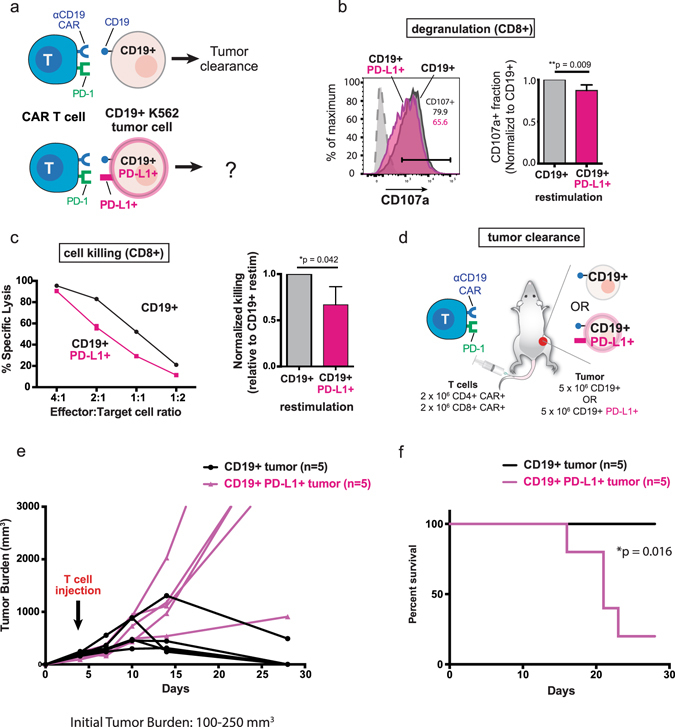
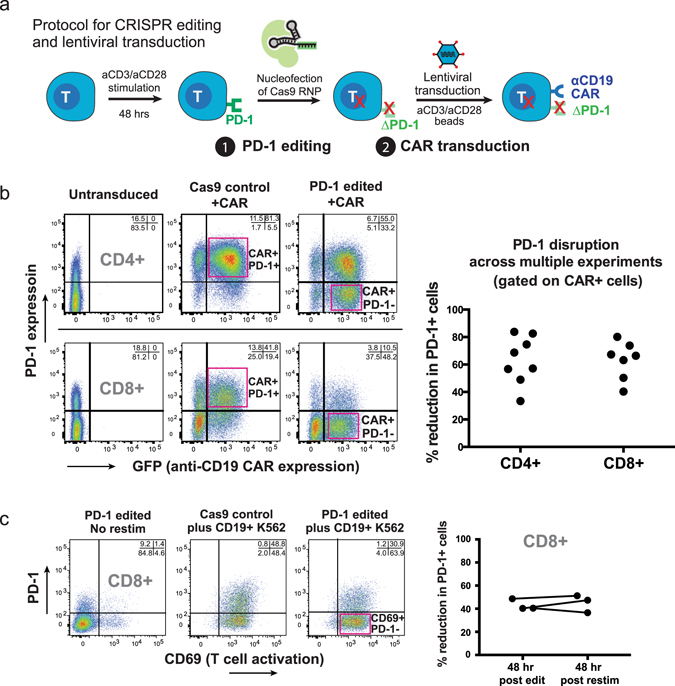
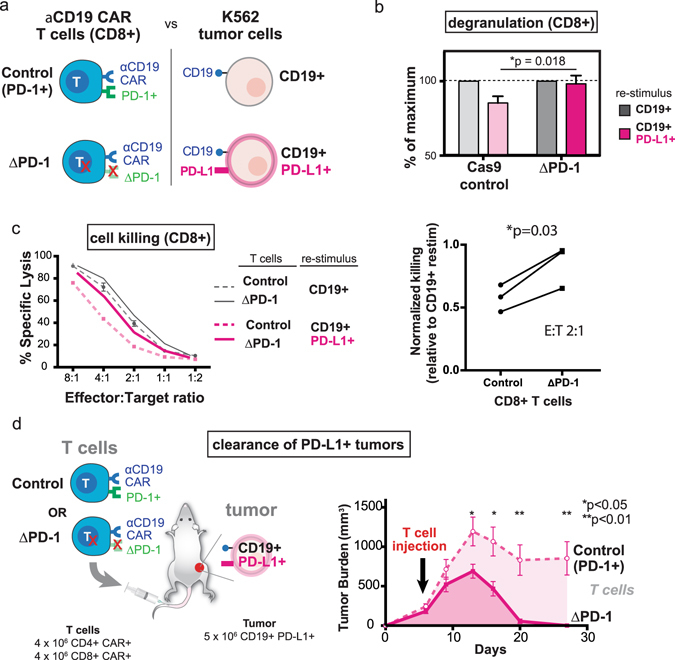
Immunotherapies with chimeric antigen receptor (CAR) T cells and checkpoint inhibitors (including antibodies that antagonize programmed cell death protein 1 [PD-1]) have both opened new avenues for cancer treatment, but the clinical potential of combined disruption of inhibitory checkpoints and CAR T cell therapy remains incompletely explored. Here we show that programmed death ligand 1 (PD-L1) expression on tumor cells can render human CAR T cells (anti-CD19 4-1BBζ) hypo-functional, resulting in impaired tumor clearance in a sub-cutaneous xenograft model. To overcome this suppressed anti-tumor response, we developed a protocol for combined Cas9 ribonucleoprotein (Cas9 RNP)-mediated gene editing and lentiviral transduction to generate PD-1 deficient anti-CD19 CAR T cells. Pdcd1 (PD-1) disruption augmented CAR T cell mediated killing of tumor cells in vitro and enhanced clearance of PD-L1+ tumor xenografts in vivo. This study demonstrates improved therapeutic efficacy of Cas9-edited CAR T cells and highlights the potential of precision genome engineering to enhance next-generation cell therapies.
Overview
The claims and statistics of this paper haven’t been checked yet.
Free: it reads the open-access text and checks the first 5 claims that cite a source we can check. Create a free account to check every claim.
Integrity signals
Registry
Cites
Statistics
Figures
Verification
Claims the paper makes
The claims and statistics of this paper haven’t been checked yet.
Free: it reads the open-access text and checks the first 5 claims that cite a source we can check. Create a free account to check every claim.
Claims other papers make about this one
Each is checked against this paper’s own text: does it say what the citing paper says it does?
The check wasn’t confident either way, so it gives no verdict — never disputed.
In the citing paper
“Mouse cells lacking p53 are unable to effectively arrest cell cycle progression after DNA damage, leading to genomic instability [16].”
From A Review of Research on CRISPR/Cas9 Gene Editing Technology in Disease Treatment (2024) · cites this paper as [16]
Experimental — accuracy not yet measuredThe check wasn’t confident either way, so it gives no verdict — never disputed.
In the citing paper
“Donehower, L.A. and his team found that mice with the P53 gene knocked out exhibit a high frequency of spontaneous tumorigenesis, including lymphomas, osteosarcomas, and other types of tumors.”
From A Review of Research on CRISPR/Cas9 Gene Editing Technology in Disease Treatment (2024) · cites this paper as [16]
Experimental — accuracy not yet measuredThe check wasn’t confident either way, so it gives no verdict — never disputed.
In the citing paper
“This observation suggests that p53 plays a crucial role in tumor suppression.”
From A Review of Research on CRISPR/Cas9 Gene Editing Technology in Disease Treatment (2024) · cites this paper as [16]
Experimental — accuracy not yet measuredIn the citing paper
“CRISPR-Cas9 genetic ablation of checkpoint targets such as PD-1 in adoptive T cell therapies has also shown increased functionality in certain models and is being persued clinically (Ren et al., 2017; Rupp et al., 2017; Stadtmauer et al., 2020; Su et al., 2016).”
From Pooled Knockin Targeting for Genome Engineering of Cellular Immunotherapies (2020) · cites this paper as Rupp et al., 2017
Self-check
Percentages, sums and reported differences re-computed from the paper’s own numbers.
The self-check needs the paper’s full text.
Citations
Cites
PD-1 and PD-L1 Immune Checkpoint Blockade to Treat Breast Cancer
Hartkopf, A. D., Taran, F.-A., Wallwiener, M., Walter, C. B., Krämer, B., Grischke, E.-M., & Brucker, S. Y. (2016) · Breast Care · doi:10.1159/000453569 · Cited by 30,845
Safety, activity, and immune correlates of anti–PD-1 antibody in cancer
Topalian, S. L., Hodi, F. S., Brahmer, J. R., Gettinger, S. N., Smith, D. C., McDermott, D. F., Powderly, J. D., Carvajal, R. D., Sosman, J. A., Atkins, M. B., et al. (2012) · New England Journal of Medicine · doi:10.1056/nejmoa1200690 · Cited by 12,628
Safety and activity of anti-PD-L1 antibody in patients with advanced cancer
Brahmer, J. R., Tykodi, S. S., Chow, L. Q. M., Hwu, W.-J., Topalian, S. L., Hwu, P., Drake, C. G., Camacho, L. H., Kauh, J., Odunsi, K., et al. (2012) · New England Journal of Medicine · doi:10.1056/nejmoa1200694 · Cited by 7,945
Chimeric Antigen Receptor T Cells for Sustained Remissions in Leukemia
Maude, S. L., Frey, N., Shaw, P. A., Aplenc, R., Barrett, D. M., Bunin, N. J., Chew, A., Gonzalez, V. E., Zheng, Z., Lacey, S. F., et al. (2014) · New England Journal of Medicine · doi:10.1056/nejmoa1407222 · Cited by 5,413
PD-1 and Its Ligands in Tolerance and Immunity
Keir, M. E., Butte, M. J., Freeman, G. J., & Sharpe, A. H. (2008) · Annual Review of Immunology · doi:10.1146/annurev.immunol.26.021607.090331 · Cited by 5,378
Restoring function in exhausted CD8 T cells during chronic viral infection
Barber, D. L., Wherry, E. J., Masopust, D., Zhu, B., Allison, J. P., Sharpe, A. H., Freeman, G. J., & Ahmed, R. (2006) · Nature · doi:10.1038/nature04444 · Cited by 3,986
PD-1 Blockade with Nivolumab in Relapsed or Refractory Hodgkin's Lymphoma
Ansell, S. M., Lesokhin, A. M., Borrello, I., Halwani, A., Scott, E. C., Gutierrez, M., Schuster, S. J., Millenson, M. M., Cattry, D., Freeman, G. J., et al. (2015) · New England Journal of Medicine · doi:10.1056/nejmoa1411087 · Cited by 3,560
Wang, H., Yang, H., Shivalila, C. S., Dawlaty, M. M., Cheng, A. W., Zhang, F., & Jaenisch, R. (2013) · Cell · doi:10.1016/j.cell.2013.04.025 · Cited by 3,495
Metabolic Competition in the Tumor Microenvironment Is a Driver of Cancer Progression
Chang, C.-H., Qiu, J., O’Sullivan, D., Buck, M. D., Noguchi, T., Curtis, J. D., Chen, Q., Gindin, M., Gubin, M. M., van der Windt, G. J. W., et al. (2015) · Cell · doi:10.1016/j.cell.2015.08.016 · Cited by 3,331
High-fidelity CRISPR-Cas9 nucleases with no detectable genome-wide off-target effects
Kleinstiver, B. P., Pattanayak, V., Prew, M. S., Tsai, S. Q., Nguyen, N. T., Zheng, Z., & Joung, J. K. (2016) · Nature · doi:10.1038/nature16526 · Cited by 2,673
Cited by
Items 701–757 of 757
Additional file 1 of Strategies to enhance CAR-T persistence
Liu, Y., An, L., Huang, R., Xiong, J., Yang, H., Wang, X., & Zhang, X. (2022) · Figshare · doi:10.6084/m9.figshare.21622536
Engineered Cellular Immunotherapy for Cancer
Trivedi, N. H. (2024) · IntechOpen eBooks · doi:10.5772/intechopen.1004201
Employing CRISPR-Cas9 to Enhance T Cell Effector Function
Heeren, J. J. F. (2024) · Methods in molecular biology · doi:10.1007/978-1-0716-3754-8_16
Murray, R. C. (2024) · Digital Repository Service (Northeastern University) · doi:10.17760/d20653008 · Cited by 2
Application of CRISPR in Cancer Research and Treatment
Singh, A. K., Kapoor, V., & Gupta, R. K. (2024) · Springer eBooks · doi:10.1007/978-981-99-3746-2_7
Fourth generation CAR Tregs with PDCD1 -driven IL-10 have enhanced suppressive functionPreprint
Boardman, D. A., Mangat, S., Gillies, J. K., Fung, V. C. W., Haque, M., Mojibian, M., Tuomela, K., Wardell, C. M., Brown, A., Lam, A. J., et al. (2024) · bioRxiv (Cold Spring Harbor Laboratory) · doi:10.1101/2024.10.01.616177
Les cellules CAR-T anti-CD19 : prototypes du médicament vivant
Sadelain, M., & Rivière, I. (2024) · Bulletin de l Académie Nationale de Médecine · doi:10.1016/j.banm.2024.10.009 · Cited by 2
Advances in the Application of CRISPR-Cas9 in Stem Cell Therapy
Wu, H. (2025) · Theoretical and Natural Science · doi:10.54254/2753-8818/2025.gu20454
AI-Driven CRISPR-Cas9 sgRNA Design for PDCD1, TRAC, and B2M Knockout to Improve CAR T Cell TherapyPreprint
sharma, K. (2025) · Research Square · doi:10.21203/rs.3.rs-6596407/v1
Wobma, H., Calderon, F. A., Dong, J., Omdahl, K. I., Rui, X., Palato, E. R., Bermea, R. S., Albanese, A., Wachter, F., Winschel, M., et al. (2026) · Blood Immunology & Cellular Therapy · doi:10.1016/j.bict.2026.100054 · Cited by 1
Live-cell analyses with unsegmented images to study cancer cell response to modified T cell therapyPreprint
Epstein, L., Weiner, A. C., Verma, A., Saedi, M., Carnevale, J. C., Marson, A., & Engelhardt, B. E. (2025) · bioRxiv (Cold Spring Harbor Laboratory) · doi:10.1101/2025.06.04.657687
Self-citationCombination of Pre-existing and New Strategies to Improve CAR-T Cells’ Efficiency
Tanwar, L. (2025) · International journal of high school research · doi:10.36838/v7i6.31
Cortijo-Gutierréz, M., Maldonado‐Pérez, N., Tristán‐Manzano, M., Pavlovic, K., Justicia-Lirio, P., Fuster‐García, C., Cathomen, T., Bak, R. O., Jurado-Bascón, P. P., Carmona‐Sáez, P., et al. (2025) · Research Square · doi:10.21203/rs.3.rs-7012598/v1
Neuropilin-1 expression by solid tumors impairs CAR T cell functionPreprint
Condon, L., Bouillié, M., Fuentealba, J. R., Saitakis, M., & Hermine, O. (2025) · bioRxiv (Cold Spring Harbor Laboratory) · doi:10.1101/2025.09.16.676545
CRISPR's impact on cancer: From fundamental models to clinical solutions
Hillary, V. E., Rajan, V., & Ceasar, S. A. (2025) · Life Sciences · doi:10.1016/j.lfs.2025.124087
Kumar, C., Verma, R. P., Sharma, A. K., & Veeraraghavan, V. P. (2025) · Exploration of Immunology · doi:10.37349/ei.2025.1003227
Chen, Y.-J., Chen, M. J., Cheng, T.-L., Tsai, Y.-S., Wang, C.-H., Chen, C.-Y., Wu, T.-Y., Tzou, S.-C., Wang, K.-H., Cheng, J.-J., et al. (2024) · Figshare · doi:10.6084/m9.figshare.26593136
Li, F., & Zheng, L. (2026) · Frontiers in Oncology · doi:10.3389/fonc.2025.1691189 · Cited by 1
Engineering a PD-L1–sensing synthetic receptor for programmable macrophage-mediated phagocytosisPreprint
Martino, I. D., Russo, L., Marchetti, M., & Siciliano, V. (2026) · bioRxiv (Cold Spring Harbor Laboratory) · doi:10.64898/2026.01.21.700810
From Immunobiology to Clinical Application: Tumor-Infiltrating Lymphocytes in Melanoma
Mokos, M., & Šitum, M. (2026) · Journal of Personalized Medicine · doi:10.3390/jpm16030147
“Knocking out PD-1 or blocking its signaling with CRISPR-based tools increases effector function and cytokine production in preclinical studies [276–282].”
CRISPR-Cas9: Genome Engineering and Future Vaccine Applications
Madhi, M., & Gholizadeh, P. (2026) · Molecular Biotechnology · doi:10.1007/s12033-026-01563-4 · Cited by 2
“…supported by foundational studies demonstrating efficient CRISPR-mediated PD-1 disruption in primary human T cells [85] and enhanced antitumor efficacy of PD-1-edited CAR-T cells [86], as well as more recent strategies employing CRISPRi for multi-plexed repression of checkpoint regulators [87].”
Targeted cancer therapy: A comprehensive review of strategies in drug development
Wang, Y., & Tang, S.-C. (2026) · Critical Reviews in Oncology/Hematology · doi:10.1016/j.critrevonc.2026.105303 · Cited by 4
Darrigrand, R. (2020) · theses.fr (ABES) · doi:10.70675/4396e503ze07cz4317zb7bbz9e542a7b3d24 · Cited by 1
Impact de la radiothérapie interne vectorisée alpha sur le microenvironnement tumoral
Perrin, J. (2021) · theses.fr (ABES) · doi:10.70675/31c91866z101fz4e07zbde2z6887a8fdba6d
The anti-tumoral effects of a low protein diet and of the IRE1α signaling
Turtos, A. M. (2022) · theses.fr (ABES) · doi:10.70675/fd90a3e8ze35az42fdzbd0ez966f12ddad22
Marcos-Kovandzic, L. (2024) · theses.fr (ABES) · doi:10.70675/3bde4b45z23ecz4b69zb90dzabccd7cd7fca
Cancer immunotherapy: Pros, cons, and beyond
Natarajan, K., Natarajan, K., Rajaram, G., Arulsamy, S., & Babu, D. (2026) · Elsevier eBooks · doi:10.1016/b978-0-443-41551-7.00007-2
Rapidly evolved PD-1 for enhance receptor and checkpoint inhibitor in immunotherapy
Mei, X., Li, X., Wu, Y., Fu, D., Zhang, F., Yan, T., Gu, W., & Gao, B. (2026) · Molecular Therapy Oncology · doi:10.1016/j.omton.2026.201228
“14,15 Another strategy involves directly modifying T cells, such as disrupting PD-1 in T cells using CRISPR-Cas9 technology 16 or expressing dominant-negative PD-1 extracellular molecules on T cells.”
Bioengineering CAR-T cells to function in hostile tumor microenvironments
Mahajna, S., Barhoum, R., Sabbah, A., Igescu, I.-M., & Mahameed, M. (2026) · Trends in biotechnology · doi:10.1016/j.tibtech.2026.04.023 · Cited by 1
Kim, J.-H., Cho, H. J., & Lee, H. (2026) · Biochemical and Biophysical Research Communications · doi:10.1016/j.bbrc.2026.154003 · Cited by 1
Daneshvar, A., Mashayekhi, R., & Sharifnia, M. (2026) · bioRxiv (Cold Spring Harbor Laboratory) · doi:10.64898/2026.05.24.727464
Chen, H., Dang, X., Zhu, J., Wang, Z., Huang, T., Wang, Z., Li, Z., Wei, Z., Yang, C., Wang, C., et al. (2026) · Journal of Controlled Release · doi:10.1016/j.jconrel.2026.115065
Cancer immunotherapy, including CAR-T cell therapy and immune checkpoint inhibitors
Jana, M. K., Swarup, V., Roy, D., Tripathy, S., Joshi, D., Gupta, N. M., Jana, S., Kumar, U., & Das, S. (2026) · Elsevier eBooks · doi:10.1016/b978-0-443-45146-1.00020-5
Engineering a PD-L1–sensing synthetic receptor for programmable macrophage response
Martino, I. D., Russo, L., Marchetti, M., & Siciliano, V. (2026) · Journal of Biological Engineering · doi:10.1186/s13036-026-00708-y · Cited by 2
“Statistical significance was determined using repeated-measures one-way ANOVA followed by Fisher’s LSD test ( p 0.05), n = 3 suppression of T cell cytotoxicity and induction of T cell exhaustion [13, 20, 27].”
InfluentialFrom association to intervention: Rethinking CD24’s causal role in hepatocellular carcinogenesis
Ren, L., Liu, C., Cheng-qiang, J., & Zhang, X.-H. (2026) · World Journal of Gastrointestinal Oncology · doi:10.4251/wjgo.v18.i6.117434
Enhancing the persistence of therapeutic T cells
Chen, G. M., & Fraietta, J. A. (2026) · Advances in pharmacology · doi:10.1016/bs.apha.2026.05.008
Ethics and accessibility in next generation cancer therapies
Kurella, B. R., Siddaraju, H., Ramesha, S. T., Prasad, C. N., & Narayanappa, R. (2026) · Elsevier eBooks · doi:10.1016/b978-0-443-44181-3.00004-7
Epstein, L., Weiner, A. C., Verma, A., Saeidi, M., Carnevale, J. C., Marson, A., & Engelhardt, B. E. (2026) · Scientific Reports · doi:10.1038/s41598-026-50029-9
Self-citationYu, H., Feng, W., Lan, D., Liu, Q., He, X., Zhang, S., Tong, C., & Song, B. (2026) · Cancer Causes & Control · doi:10.1007/s10552-026-02200-w
“Enhancing resistance to suppression : Employ gene-editing technologies (e.g., CRISPR/Cas9) to disrupt PD-1 or CTLA-4 genes in CAR-T cells, or engineer CAR-T cells to express dominant-negative receptors (e.g., DN-TGF-βRII) to counteract inhibitory signals within the TME [62].”
Engineering Strategies for Allogeneic T Cell-Based Platforms in Cancer Immunotherapy
Kang, S., & Lee, H. (2026) · Pharmaceuticals · doi:10.3390/ph19070991
“PD-1 disruption can reduce exhaustion-associated signaling and improve T cell persistence, but permanent loss of PD-1 signaling may also impair control of excessive T cell activation and raise safety concerns [93].”
Kong, Z., & Wang, J. (2026) · Frontiers in Immunology · doi:10.3389/fimmu.2026.1891408 · Cited by 2
CAR-T in solid tumors: Obstacles and potential strategies
Ding, Z., Li, Y., & Huang, M. (2026) · Acta Pharmaceutica Sinica B · doi:10.1016/j.apsb.2026.07.047
A groundbreaking development in cancer treatment: Chimeric antigen receptor (CAR) T-cell therapy
Thoker, Z. A., Marwaha, L., & Prakash, A. (2026) · Elsevier eBooks · doi:10.1016/b978-0-443-27731-3.00001-2
Genetic manipulation and designed breeding
Lian, S., Bao, Z., & Wang, S. (2026) · Elsevier eBooks · doi:10.1016/b978-0-443-33606-5.00013-8
Farahani, M. S., Shamsara, M., Moazzeni, S. M., Khalili, S., Johnson, B., Darzi, L., Shoae, M., Ghavami, M., Razi, A., Hosseini-Beheshti, E., et al. (2026) · Applied Microbiology and Biotechnology · doi:10.1007/s00253-026-13976-x
“In this study, the CRISPR/Cas9 gene-editing system was employed to disrupt PD-1 expression in human primary T cells (Ligtenberg et al. 2018; Rupp et al. 2017).”
Cai, S., Tan, Y., Yang, Q., & Huang, J. (2026) · Frontiers in Genome Editing · doi:10.3389/fgeed.2026.1878460
“Elevated checkpoint signaling may favor PD-1-disrupted or checkpoint-rewired effector cells (Rupp et al., 2017; Cherkassky et al., 2016).”
Control of breast cancer patient-derived xenografts by CD70-targeted HIT-CAR T cells
Lindenbergh, P. L., Rajasekhar, V. K., Linkov, I., Mansilla‐Soto, J., Hanina, S., & Sadelain, M. (2026) · Frontiers in Immunology · doi:10.3389/fimmu.2026.1852493
Personalized medicine utilizing biomarkers
Shen, J., & Xie, Z. (2026) · Elsevier eBooks · doi:10.1016/b978-0-443-36649-9.00012-8
Recent Advances in CRISPR/Cas Technologies for Biological Discovery, Therapeutics, and Diagnostics
Kim, M., Do, H. S., Jang, H. Y., Lee, K. E., & Lee, S. J. (2026) · Biomolecules · doi:10.3390/biom16091268 · Cited by 2
“However, subsequent studies revealed that tumor cell-intrinsic PD-1 may function as a tumor suppressor in certain cancer types, highlighting the context-dependent biological roles of PD-1 [65,66].”
Marei, H. E. S., Pozzoli, G., Caratelli, S., & Cenciarelli, C. (2026) · Stem Cell Research & Therapy · doi:10.1186/s13287-026-05266-0
Why CD4+ T cells matter in adoptive cell therapy for solid cancers
Jegatheeson, S., Scheffler, C. M., Bondt, M. D., Darcy, P., & Neeson, P. J. (2026) · Immuno-Oncology Technology · doi:10.1016/j.iotech.2026.101615
Genetic Engineering of Natural Killer Cells: Unleashing Their Killer Instincts
Kluge, P., Lai, K.-Y., Knapp, L. R., Sapre, A., Tarannum, M., Raskó, T., Romee, R., Bexte, T., & Ullrich, E. (2026) · Springer eBooks · doi:10.1007/978-3-662-68816-8_48-1 · Cited by 1
Why only 3 months? Immunological constraints on CAR-T therapy in gastrointestinal cancers
Zeng, L., Wei, S., Chen, N., & Xie, X. (2026) · Frontiers in Immunology · doi:10.3389/fimmu.2026.1942381
Assessment of cytotoxicity of human CAR-NK cells against various canine tumor cell lines
Kang, Y., Lim, G., Kwon, D., Lee, J., Moon, B., Kang, K., Ryu, M.-O., Seo, K., & Youn, H. (2026) · Research in Veterinary Science · doi:10.1016/j.rvsc.2026.106448
Metadata
- Authors
- Rupp, L. J., Schumann, K., Roybal, K. T., Gate, R. E., Ye, C. J., Lim, W. A., & Marson, A.
- Affiliations
- Howard Hughes Medical Institute (US)
- University of California, San Francisco (US)
- Corresponding author
- Lim, Wendell A.
- Venue
- Scientific Reports
- Published
- 2017-04-07
- Volume
- 7
- Issue
- 1
- Pages
- 737-737
- ISSN
- 2045-2322 (ISSN-L)
- PMC
- PMC5428439
- OpenAlex
- W2604982880
- Semantic Scholar
- 27ffac41ff676af9dc298997351e23839515638e
- Cited by
- 757
- References
- 39
- Citations by year
- 2026: 58 · 2025: 72 · 2024: 70 · 2023: 72 · 2022: 94 · 2021: 107 · 2020: 122 · 2019: 85 · 2018: 67 · 2017: 10
- FWCI
- 34.37
- Type
- journal article
- Language
- en
- Open access
- gold
- doi.org
- Licence
- cc-by
- creativecommons.org/licenses/by/4.0 (tdm)
- creativecommons.org/licenses/by/4.0 (vor)
- Locations
- Scientific Reports (publishedVersion, cc-by)
- PubMed Central (publishedVersion, cc-by)
- PubMed (publishedVersion)
- eScholarship (California Digital Library) (submittedVersion)
- DOAJ (DOAJ: Directory of Open Access Journals) (submittedVersion, cc-by-sa)
- KOPS (University of Konstanz) (submittedVersion, cc-by)
- Funders
- Howard Hughes Medical Institute (R01 CA196277)
- Burroughs Wellcome Fund
- Deutsche Forschungsgemeinschaft
- National Institutes of Health (EY016546)
- University of California, San Francisco
- National Eye Institute (PN2EY016546)
- National Cancer Institute (R01CA196277)
- National Institute of General Medical Sciences (T32GM067547, R01GM055040)
- National Institute of Allergy and Infectious Diseases (F32AI120352)
- Topics
- Health Sciences › Medicine › Oncology › CAR-T cell therapy research
- Health Sciences › Medicine › Oncology › Cancer Immunotherapy and Biomarkers
- Life Sciences › Biochemistry, Genetics and Molecular Biology › Molecular Biology › CRISPR and Genetic Engineering
- Keywords
- CRISPR/Cas9 genome editing, PD-1, PD-L1, chimeric antigen receptor T cells, CD19 CAR T cells, 4-1BB, lentiviral transduction, Cas9 ribonucleoprotein, cancer immunotherapy, antitumor efficacy, anti-PD-1 therapy
- MeSH terms
- Animals, Antigens, Neoplasm, Female, Humans, Neoplasms, Receptors, Antigen, T-Cell, T-Lymphocytes, Biomarkers, Gene Expression, Immunophenotyping, Mice, Knockout, Gene Targeting, Antigens, CD19, Cell Line, Tumor, Mice, Gene Knockdown Techniques, B7-H1 Antigen, Programmed Cell Death 1 Receptor, CRISPR-Cas Systems
About these checks
Registry, retraction, Cites and statistics results are computed, not judged, with one exception: a printed reference that no index lists is read once by a model before it counts as a citation error. Claims are extracted by a model and kept only when their quote appears verbatim in the text; each cited source is then checked, with a model’s help, for whether it says what the claim relies on. Those verdicts can be wrong — read the claim’s quote and the cited source before relying on one.
Statistics and arithmetic are recomputed, not judged.
Confidence bands are shown only for fields calibrated on our annotated test set. None is calibrated yet, so no band is shown.
What counts as a claim ›How we measure confidence ›How we check this ›
Are you an author, or do you see a problem with this page? Request a review
Data sources
Bibliographic data: Semantic Scholar, OpenAlex, Crossref.
Contains information from the Semantic Scholar Academic Graph Datasets, made available under the ODC Attribution License (ODC-BY 1.0).
Semantic Scholar’s data is described in: Kinney, R., et al. (2023). The Semantic Scholar Open Data Platform. arXiv:2301.10140.
