

CRISPR/Cas9-mediated PD-1 disruption enhances anti-tumor efficacy of human chimeric antigen receptor T cells
Open accessThe DOI matches its Crossref record; 38 of the 39 references it cites were found in a registry or an index.
Abstract
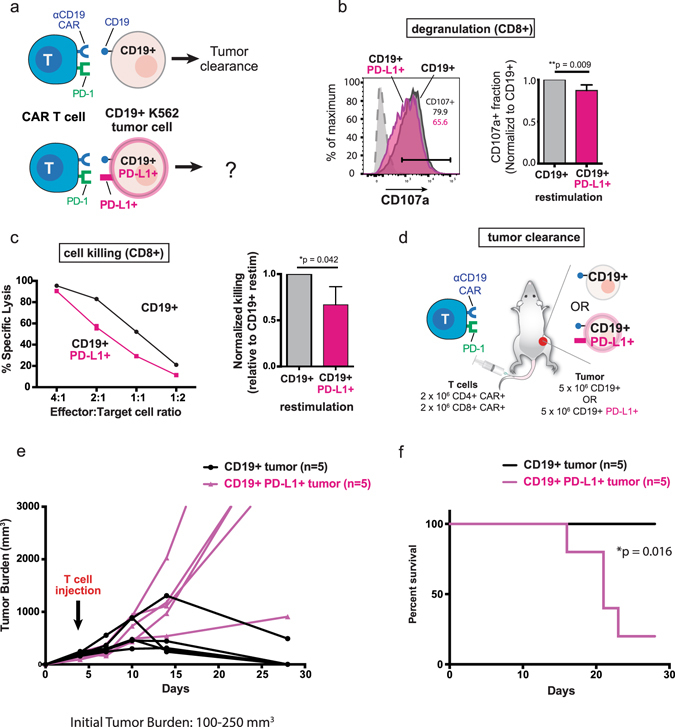
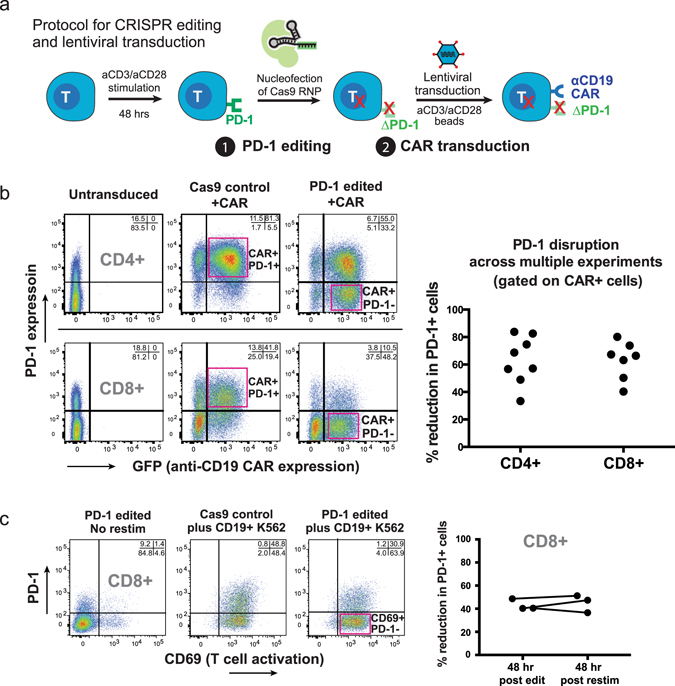
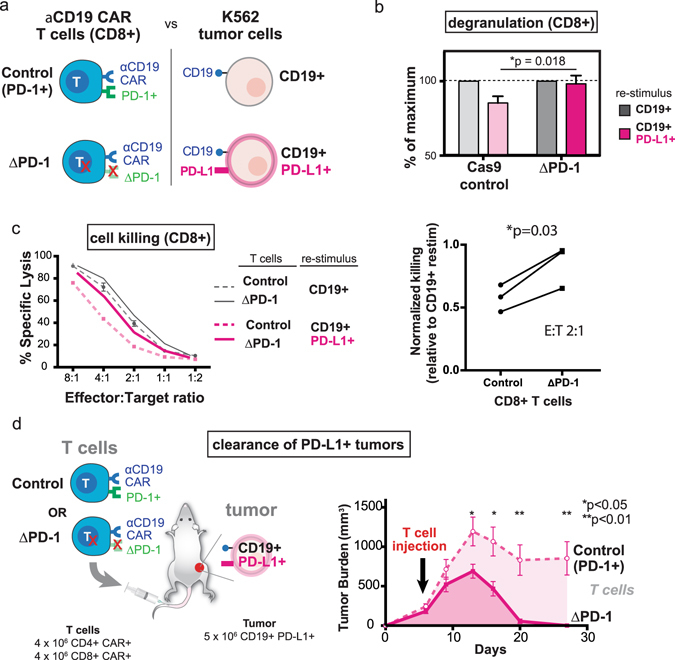
Immunotherapies with chimeric antigen receptor (CAR) T cells and checkpoint inhibitors (including antibodies that antagonize programmed cell death protein 1 [PD-1]) have both opened new avenues for cancer treatment, but the clinical potential of combined disruption of inhibitory checkpoints and CAR T cell therapy remains incompletely explored. Here we show that programmed death ligand 1 (PD-L1) expression on tumor cells can render human CAR T cells (anti-CD19 4-1BBζ) hypo-functional, resulting in impaired tumor clearance in a sub-cutaneous xenograft model. To overcome this suppressed anti-tumor response, we developed a protocol for combined Cas9 ribonucleoprotein (Cas9 RNP)-mediated gene editing and lentiviral transduction to generate PD-1 deficient anti-CD19 CAR T cells. Pdcd1 (PD-1) disruption augmented CAR T cell mediated killing of tumor cells in vitro and enhanced clearance of PD-L1+ tumor xenografts in vivo. This study demonstrates improved therapeutic efficacy of Cas9-edited CAR T cells and highlights the potential of precision genome engineering to enhance next-generation cell therapies.
Overview
The claims and statistics of this paper haven’t been checked yet.
Free: it reads the open-access text and checks the first 5 claims that cite a source we can check. Create a free account to check every claim.
Integrity signals
Registry
Cites
Statistics
Figures
Verification
Claims the paper makes
The claims and statistics of this paper haven’t been checked yet.
Free: it reads the open-access text and checks the first 5 claims that cite a source we can check. Create a free account to check every claim.
Claims other papers make about this one
Each is checked against this paper’s own text: does it say what the citing paper says it does?
The check wasn’t confident either way, so it gives no verdict — never disputed.
In the citing paper
“Mouse cells lacking p53 are unable to effectively arrest cell cycle progression after DNA damage, leading to genomic instability [16].”
From A Review of Research on CRISPR/Cas9 Gene Editing Technology in Disease Treatment (2024) · cites this paper as [16]
Experimental — accuracy not yet measuredThe check wasn’t confident either way, so it gives no verdict — never disputed.
In the citing paper
“Donehower, L.A. and his team found that mice with the P53 gene knocked out exhibit a high frequency of spontaneous tumorigenesis, including lymphomas, osteosarcomas, and other types of tumors.”
From A Review of Research on CRISPR/Cas9 Gene Editing Technology in Disease Treatment (2024) · cites this paper as [16]
Experimental — accuracy not yet measuredThe check wasn’t confident either way, so it gives no verdict — never disputed.
In the citing paper
“This observation suggests that p53 plays a crucial role in tumor suppression.”
From A Review of Research on CRISPR/Cas9 Gene Editing Technology in Disease Treatment (2024) · cites this paper as [16]
Experimental — accuracy not yet measuredIn the citing paper
“CRISPR-Cas9 genetic ablation of checkpoint targets such as PD-1 in adoptive T cell therapies has also shown increased functionality in certain models and is being persued clinically (Ren et al., 2017; Rupp et al., 2017; Stadtmauer et al., 2020; Su et al., 2016).”
From Pooled Knockin Targeting for Genome Engineering of Cellular Immunotherapies (2020) · cites this paper as Rupp et al., 2017
Self-check
Percentages, sums and reported differences re-computed from the paper’s own numbers.
The self-check needs the paper’s full text.
Citations
Cites
PD-1 and PD-L1 Immune Checkpoint Blockade to Treat Breast Cancer
Hartkopf, A. D., Taran, F.-A., Wallwiener, M., Walter, C. B., Krämer, B., Grischke, E.-M., & Brucker, S. Y. (2016) · Breast Care · doi:10.1159/000453569 · Cited by 30,845
Safety, activity, and immune correlates of anti–PD-1 antibody in cancer
Topalian, S. L., Hodi, F. S., Brahmer, J. R., Gettinger, S. N., Smith, D. C., McDermott, D. F., Powderly, J. D., Carvajal, R. D., Sosman, J. A., Atkins, M. B., et al. (2012) · New England Journal of Medicine · doi:10.1056/nejmoa1200690 · Cited by 12,628
Safety and activity of anti-PD-L1 antibody in patients with advanced cancer
Brahmer, J. R., Tykodi, S. S., Chow, L. Q. M., Hwu, W.-J., Topalian, S. L., Hwu, P., Drake, C. G., Camacho, L. H., Kauh, J., Odunsi, K., et al. (2012) · New England Journal of Medicine · doi:10.1056/nejmoa1200694 · Cited by 7,945
Chimeric Antigen Receptor T Cells for Sustained Remissions in Leukemia
Maude, S. L., Frey, N., Shaw, P. A., Aplenc, R., Barrett, D. M., Bunin, N. J., Chew, A., Gonzalez, V. E., Zheng, Z., Lacey, S. F., et al. (2014) · New England Journal of Medicine · doi:10.1056/nejmoa1407222 · Cited by 5,413
PD-1 and Its Ligands in Tolerance and Immunity
Keir, M. E., Butte, M. J., Freeman, G. J., & Sharpe, A. H. (2008) · Annual Review of Immunology · doi:10.1146/annurev.immunol.26.021607.090331 · Cited by 5,378
Restoring function in exhausted CD8 T cells during chronic viral infection
Barber, D. L., Wherry, E. J., Masopust, D., Zhu, B., Allison, J. P., Sharpe, A. H., Freeman, G. J., & Ahmed, R. (2006) · Nature · doi:10.1038/nature04444 · Cited by 3,986
PD-1 Blockade with Nivolumab in Relapsed or Refractory Hodgkin's Lymphoma
Ansell, S. M., Lesokhin, A. M., Borrello, I., Halwani, A., Scott, E. C., Gutierrez, M., Schuster, S. J., Millenson, M. M., Cattry, D., Freeman, G. J., et al. (2015) · New England Journal of Medicine · doi:10.1056/nejmoa1411087 · Cited by 3,560
Wang, H., Yang, H., Shivalila, C. S., Dawlaty, M. M., Cheng, A. W., Zhang, F., & Jaenisch, R. (2013) · Cell · doi:10.1016/j.cell.2013.04.025 · Cited by 3,495
Metabolic Competition in the Tumor Microenvironment Is a Driver of Cancer Progression
Chang, C.-H., Qiu, J., O’Sullivan, D., Buck, M. D., Noguchi, T., Curtis, J. D., Chen, Q., Gindin, M., Gubin, M. M., van der Windt, G. J. W., et al. (2015) · Cell · doi:10.1016/j.cell.2015.08.016 · Cited by 3,331
High-fidelity CRISPR-Cas9 nucleases with no detectable genome-wide off-target effects
Kleinstiver, B. P., Pattanayak, V., Prew, M. S., Tsai, S. Q., Nguyen, N. T., Zheng, Z., & Joung, J. K. (2016) · Nature · doi:10.1038/nature16526 · Cited by 2,673
Cited by
Items 201–300 of 757
Gut microbiome and CAR-T therapy
Abid, M. B., Shah, N. N., Maatman, T. C., & Hari, P. (2019) · Experimental Hematology and Oncology · doi:10.1186/s40164-019-0155-8 · Cited by 59
Modified Hypoxia-Inducible Factor Expression in CD8+ T Cells Increases Antitumor Efficacy
Veliça, P., Cunha, P. P., Vojnovic, N., Foskolou, I. P., Bargiela, D., Gojkovic, M., Rundqvist, H., & Johnson, R. S. (2021) · Cancer Immunology Research · doi:10.1158/2326-6066.cir-20-0561 · Cited by 52
Liu, X., Zhang, Y., Li, K., Liu, Y., Xu, J., Ma, J., An, L., Wang, H., & Chu, X. (2021) · Translational Oncology · doi:10.1016/j.tranon.2021.101085 · Cited by 57
All systems go: converging synthetic biology and combinatorial treatment for CAR-T cell therapy
Lanitis, E., Coukos, G., & Irving, M. B. (2020) · Current Opinion in Biotechnology · doi:10.1016/j.copbio.2020.01.009 · Cited by 54
A CAR enhancer increases the activity and persistence of CAR T cells
Rakhshandehroo, T., Mantri, S. R., Moravej, S. H., Louis, B. B. V., Farid, A. S., Munaretto, L., Regan, K., Khan, R. M. M., Wolff, A. N., Farkash, Z., et al. (2024) · Nature Biotechnology · doi:10.1038/s41587-024-02339-4 · Cited by 67
Delivery systems of CRISPR/Cas9-based cancer gene therapy
Biagioni, A., Laurenzana, A., Margheri, F., Chillà, A., Fibbi, G., & Rosso, M. D. (2018) · Journal of Biological Engineering · doi:10.1186/s13036-018-0127-2 · Cited by 58
Augmenting the Effectiveness of CAR-T Cells by Enhanced Self-Delivery of PD-1-Neutralizing scFv
Yü, P., Li, F., Nan, S., Zhang, D., Shi, X., Shan, J., & Zhang, Y. (2020) · Frontiers in Cell and Developmental Biology · doi:10.3389/fcell.2020.00803 · Cited by 56
Gautron, A.-S., Juillerat, A., Guyot, V., Filhol, J.-M., Dessez, E., Duclert, A., Duchateau, P., & Poirot, L. (2017) · Molecular Therapy - Nucleic Acids · doi:10.1016/j.omtn.2017.10.005 · Cited by 50
IKZF3 deficiency potentiates chimeric antigen receptor T cells targeting solid tumors
Zou, Y., Liu, B., Li, L., Yin, Q., Tang, J., Jing, Z., Huang, X., Zhu, X., & Chi, T. (2021) · Cancer Letters · doi:10.1016/j.canlet.2021.10.016 · Cited by 53
Overcoming Chimeric Antigen Receptor (CAR) Modified T-Cell Therapy Limitations in Multiple Myeloma
García‐Guerrero, E., Sierro-Martínez, B., & Pérez‐Simón, J. A. (2020) · Frontiers in Immunology · doi:10.3389/fimmu.2020.01128 · Cited by 51
Immunometabolism in the Tumor Microenvironment
Roy, D. G., Kaymak, I., Williams, K. S., Ma, E. H., & Jones, R. G. (2020) · Annual Review of Cancer Biology · doi:10.1146/annurev-cancerbio-030518-055817 · Cited by 51
Vo, M.-C., Tran, V.-D.-H., Nguyen, V., Ruzimurodov, N., Trung, D. T., Kim, S. K., Jung, S., & Lee, J. (2025) · Journal of Hematology & Oncology · doi:10.1186/s13045-025-01744-9 · Cited by 64
“…using CRISPR-Cas9 further enhances CAR-T cell function by eliminating inhibitory checkpoints; for instance, deletion of PD-1 or CTLA4 genes enhances resistance to tumor-mediated immunosuppression, whereas ablation of RASA2 increases antigen sensitivity and long-term functionality [162, 163].”
Ribonucleoprotein Transfection for CRISPR/Cas9‐Mediated Gene Knockout in Primary T Cells
Oh, S. A., Seki, A., & Rutz, S. (2018) · Current Protocols in Immunology · doi:10.1002/cpim.69 · Cited by 54
T cell immunotherapy enhanced by designer biomaterials
Dunn, Z. S., Mac, J., & Wang, P. (2019) · Biomaterials · doi:10.1016/j.biomaterials.2019.119265 · Cited by 49
“T cells have progressed through 1st, 2nd, 3rd, and now 4th generations, and a few of the advancements can be seen through the introductory of suicide genes [186], tandem targeting moieties [187], masking peptides [176], secretory abilities [188], and altered receptor/gene expression [189].”
BackgroundGold Nanoparticles for Vectorization of Nucleic Acids for Cancer Therapeutics
Ferreira, D., Fontinha, D., Martins, C., Pires, D., Fernandes, A. R., & Baptista, P. V. (2020) · Molecules · doi:10.3390/molecules25153489 · Cited by 62
Historic Overview of Genetic Engineering Technologies for Human Gene Therapy
Tamura, R., & Toda, M. (2020) · Neurologia medico-chirurgica · doi:10.2176/nmc.ra.2020-0049 · Cited by 62
Engineering strategies for broad application of TCR-T- and CAR-T-cell therapies
Watanabe, K., & Nishikawa, H. (2021) · International Immunology · doi:10.1093/intimm/dxab052 · Cited by 52
CRISPR/Cas9 System: A Bacterial Tailor for Genomic Engineering
Lone, B. A., Karna, S. K. L., Ahmad, F., Shahi, N., & Pokharel, Y. R. (2018) · Genetics Research International · doi:10.1155/2018/3797214 · Cited by 60
RETRACTED ARTICLE: Hurdles to breakthrough in CAR T cell therapy of solid tumors
Marofi, F., Achmad, H., Bokov, D., Abdelbasset, W. K., Alsadoon, Z., Chupradit, S., Suksatan, W., Shariatzadeh, S., Hasanpoor, Z., Yazdanifar, M., et al. (2022) · Stem Cell Research & Therapy · doi:10.1186/s13287-022-02819-x · Cited by 47
“In this regard, Rupp and colleagues utilized Cas9 RNP to ablate PD1 expression and generate PD1 knockout anti-CD19targeted CAR T cells [136].”
RetractedUnleashing the Therapeutic Potential of CAR-T Cell Therapy Using Gene-Editing Technologies.
Jung, I.-Y., & Lee, J. (2018) · PubMed · doi:10.14348/molcells.2018.0242 · Cited by 46
“PD-1 KO improves antitumor efficacy of CAR-T in various blood and solid tumor mouse models, presumably by enhancing effector function and survival of T-cells in TME (Menger et al., 2016; Su et al., 2016; Rupp et al., 2017).”
BackgroundLiu, M., Deng, H., Mu, J., Li, Q., Pu, Y., Jiang, Y., Deng, Q., & Qian, Z. (2021) · Cancer Science · doi:10.1111/cas.14915 · Cited by 46
T cell engineering for adoptive T cell therapy: safety and receptor avidity
D’Ippolito, E., Schober, K., Nauerth, M., & Busch, D. H. (2019) · Cancer Immunology Immunotherapy · doi:10.1007/s00262-019-02395-9 · Cited by 50
Utility and Drawbacks of Chimeric Antigen Receptor T Cell (CAR-T) Therapy in Lung Cancer
Kandra, P., Nandigama, R., Eul, B. G., Huber, M., Kobold, S., Seeger, W., Grimminger, F., & Savai, R. (2022) · Frontiers in Immunology · doi:10.3389/fimmu.2022.903562 · Cited by 56
Chimeric Antigen Receptor T-Cells for the Treatment of B-Cell Acute Lymphoblastic Leukemia
Tomuleasa, C., Fuji, S., Berce, C., Onaciu, A., Chira, S., Petrushev, B., Micu, W.-T., Moisoiu, V., Osan, C., Constantinescu, C. S., et al. (2018) · Frontiers in Immunology · doi:10.3389/fimmu.2018.00239 · Cited by 51
“Up to date, CRISPR/Cas9 already proved its applicability in the field of immunotherapy by enhancing CAR T-cells potency by knockout diverse genes to improve target recognition and cytotoxic activity (104).”
BackgroundMethodPD-1 silencing improves anti-tumor activities of human mesothelin-targeted CAR T cells
Liu, G., Zhang, Q., Li, D., Zhang, L., Gu, Z., Liu, J., Liu, G., Yang, M., Gu, J., Cui, X., et al. (2020) · Human Immunology · doi:10.1016/j.humimm.2020.12.002 · Cited by 47
CRISPR Gene Editing of Human Primary NK and T Cells for Cancer Immunotherapy
Elmas, E., Saljoughian, N., Pereira, M. D. S. F., Tullius, B. P., Sorathia, K., Nakkula, R. J., Lee, D. A., & Kararoudi, M. N. (2022) · Frontiers in Oncology · doi:10.3389/fonc.2022.834002 · Cited by 51
Synthetic manipulation of the cancer-immunity cycle: CAR-T cell therapy
Singh, N., & Maus, M. V. (2023) · Immunity · doi:10.1016/j.immuni.2023.09.010 · Cited by 47
Enhanced Genome Editing with Cas9 Ribonucleoprotein in Diverse Cells and Organisms
Farboud, B., Jarvis, E., Roth, T. L., Shin, J., Corn, J. E., Marson, A., Meyer, B. J., Patel, N. H., & Hochstrasser, M. L. (2018) · Journal of Visualized Experiments · doi:10.3791/57350 · Cited by 44
Self-citationExpanding CAR T cells in human platelet lysate renders T cells with in vivo longevity
Chavez, A. G. T., McKenna, M. K., Canestrari, E., Dann, C. T., Ramos, C. A., Lulla, P., Leen, A. M., Vera, J. F., & Watanabe, N. (2019) · Journal for ImmunoTherapy of Cancer · doi:10.1186/s40425-019-0804-9 · Cited by 47
Zhou, J., Yu, J., Wang, Y., Wang, H., Wang, J., Wang, Y., Yu, L., & Yan, Z. (2021) · Biomedicine & Pharmacotherapy · doi:10.1016/j.biopha.2021.111339 · Cited by 49
CRISPR-Cas System: The Current and Emerging Translational Landscape
Bhokisham, N., Laudermilch, E., Traeger, L. L., Bonilla, T. D., Ruíz-Estévez, M., & Becker, J. R. (2023) · Cells · doi:10.3390/cells12081103 · Cited by 57
“With the advent of facile gene editing technologies, CRISPR-Cas9 has been used for disruption of the PDCD1 gene encoding for PD1, and this has resulted in the enhancement of anti-tumor effects of CAR-T in animal models [41,42].”
MethodAltered cancer metabolism and implications for next-generation CAR T-cell therapies
Ramapriyan, R., Vykunta, V. S., Vandecandelaere, G., Richardson, L. G., Sun, J. M., Curry, W. T., & Choi, B. D. (2024) · Pharmacology & Therapeutics · doi:10.1016/j.pharmthera.2024.108667 · Cited by 49
From synthetic biology to human therapy: engineered mammalian cells
Scheller, L., & Fussenegger, M. (2019) · Current Opinion in Biotechnology · doi:10.1016/j.copbio.2019.02.023 · Cited by 46
T-cell–engaging Therapy for Solid Tumors
de Miguel, M., Umaña, P., de Morais, A. L. G., Moreno, V., & Calvo, E. (2020) · Clinical Cancer Research · doi:10.1158/1078-0432.ccr-20-2448 · Cited by 45
Exploiting Single-Cell Tools in Gene and Cell Therapy
Bode, D., Cull, A. H., Rubio-Lara, J. A., & Kent, D. G. (2021) · Frontiers in Immunology · doi:10.3389/fimmu.2021.702636 · Cited by 46
Prajapati, R., & Somoza, Á. (2021) · Cancers · doi:10.3390/cancers13143454 · Cited by 43
Engineering stem cells for cancer immunotherapy
Li, Y.-R., Zhou, Y., Kramer, A. B., & Yang, L. (2021) · Trends in cancer · doi:10.1016/j.trecan.2021.08.004 · Cited by 44
The promise and perils of immunotherapy
Lesch, S., & Gill, S. I. (2021) · Blood Advances · doi:10.1182/bloodadvances.2021004453c · Cited by 48
Engineered Treg cells: The heir to the throne of immunotherapy
Stucchi, A., Maspes, F., Montee-Rodrigues, E., & Fousteri, G. (2023) · Journal of Autoimmunity · doi:10.1016/j.jaut.2022.102986 · Cited by 46
Dötsch, S., Svec, M., Schober, K., Hammel, M., Wanisch, A., Gökmen, F., Jarosch, S., Warmuth, L., Barton, J., Čičin‐Šain, L., et al. (2023) · Proceedings of the National Academy of Sciences · doi:10.1073/pnas.2200626120 · Cited by 48
Chimeric Antigen Receptor Cell Therapy: Overcoming Obstacles to Battle Cancer
Petty, A. J., Heyman, B. M., & Yang, Y. (2020) · Cancers · doi:10.3390/cancers12040842 · Cited by 44
New directions in chimeric antigen receptor T cell [CAR‐T] therapy and related flow cytometry
Maryamchik, E., Gallagher, K., Preffer, F. I., Kadauke, S., & Maus, M. V. (2020) · Cytometry Part B Clinical Cytometry · doi:10.1002/cyto.b.21880 · Cited by 46
“…disruption of PD1 genes of the CAR T cells augmented the effectiveness of PD-L1 positive tumor clearance in xenograft tumor models (Hu et al., 2019; Rupp et al., 2017; Zhang et al., 2017) and PD-1-knockout CD19 CAR is now in Phase I clinical trial of acute lymphoblastic leukemia (NCT03298828).”
BackgroundProgress and pitfalls of gene editing technology in CAR-T cell therapy: a state-of-the-art review
Moradi, V., Khodabandehloo, E., Alidadi, M., Omidkhoda, A., & Ahmadbeigi, N. (2024) · Frontiers in Oncology · doi:10.3389/fonc.2024.1388475 · Cited by 49
Manipulating the tumor microenvironment by adoptive cell transfer of CAR T-cells
Gowrishankar, K., Birtwistle, L., & Micklethwaite, K. P. (2018) · Mammalian Genome · doi:10.1007/s00335-018-9756-5 · Cited by 49
Exploiting the CRISPR‐Cas9 gene‐editing system for human cancers and immunotherapy
Afolabi, L. O., Afolabi, M. O., Sani, M. M., Okunowo, W. O., Yan, D., Chen, L., Zhang, Y., & Wan, X. (2021) · Clinical & Translational Immunology · doi:10.1002/cti2.1286 · Cited by 39
Development of CAR T Cell Therapy in Children—A Comprehensive Overview
Boettcher, M., Joechner, A., Li, Z., Yang, S. F., & Schlegel, P. (2022) · Journal of Clinical Medicine · doi:10.3390/jcm11082158 · Cited by 46
“These potentiating CAR technologies and strategies have demonstrated the ability to increase the CAR effector functions in preclinical models [275,276].”
BackgroundEngineering Next-Generation CAR-T Cells: Overcoming Tumor Hypoxia and Metabolism
Gao, T. A., & Chen, Y. Y. (2022) · Annual Review of Chemical and Biomolecular Engineering · doi:10.1146/annurev-chembioeng-092120-092914 · Cited by 44
Mahato, R. K., Bhattacharya, S., Khullar, N., Sidhu, I. S., Reddy, P. H., Bhatti, G. K., & Bhatti, J. S. (2023) · Journal of Biotechnology · doi:10.1016/j.jbiotec.2023.12.003 · Cited by 44
A Roadmap of CAR-T-Cell Therapy in Glioblastoma: Challenges and Future Perspectives
Montoya, M., Gallus, M., Phyu, S. M., Haegelin, J., de Groot, J., & Okada, H. (2024) · Cells · doi:10.3390/cells13090726 · Cited by 49
“CRISPR-Cas9-targeting of checkpoint inhibitors (PD-1, CTLA-4, LAG-3) [105,175,176], activation-induced cell death ligands (FasR/FasL) [177], and immunosuppressive mediators (DGK) [178] may result in improved CAR-T-cell persistence and effector function in vivo.”
BackgroundImmunotherapy in Hematologic Malignancies: Emerging Therapies and Novel Approaches
Noh, J., Seo, H., Lee, J., & Jung, H. (2020) · International Journal of Molecular Sciences · doi:10.3390/ijms21218000 · Cited by 45
Lv, J., Qin, L., Zhao, R., Wu, D., Wu, Z., Zheng, D., Li, S., Luo, M., Wu, Q., Long, Y., et al. (2022) · Molecular Therapy — Oncolytics · doi:10.1016/j.omto.2022.12.003 · Cited by 39
CRISPR/Cas9 system: recent applications in immuno-oncology and cancer immunotherapy
Chen, C., Wang, Z., & Qin, Y. (2023) · Experimental Hematology and Oncology · doi:10.1186/s40164-023-00457-4 · Cited by 49
“The most widely explored example is PD-1 knockout via CRISPR to reinvigorate CD8 + T cell effector function, which has been successfully validated in multiple pre-clinical models [92, 95–99] and clinical trials [100, 101].”
BackgroundShum, T., Kruse, R. L., & Rooney, C. M. (2018) · Expert Opinion on Biological Therapy · doi:10.1080/14712598.2018.1473368 · Cited by 39
Heat-Triggered Remote Control of CRISPR-dCas9 for Tunable Transcriptional Modulation
Gamboa, L., Phung, E. V., Li, H., Meyers, J. P., Hart, A. C., Miller, I. C., & Kwong, G. A. (2020) · ACS Chemical Biology · doi:10.1021/acschembio.9b01005 · Cited by 41
Huang, D., Miller, M., Ashok, B., Jain, S., & Peppas, N. A. (2020) · Advanced Drug Delivery Reviews · doi:10.1016/j.addr.2020.07.015 · Cited by 39
Zhao, M., Huang, H., He, F., & Fu, X. (2023) · Frontiers in Immunology · doi:10.3389/fimmu.2023.1188277 · Cited by 47
CAR‐T TREK through the lymphoma universe, to boldly go where no other therapy has gone before
Ghilardi, G., Brændstrup, P., Chong, E. A., Schuster, S. J., Svoboda, J., & Ruella, M. (2020) · British Journal of Haematology · doi:10.1111/bjh.17191 · Cited by 38
Rossetti, R., Brand, H., de Lima, S. C. G., Furtado, I. P., Silveira, R. M., Fantacini, D. M. C., Covas, D. T., & de Souza, L. E. B. (2022) · Immunotherapy Advances · doi:10.1093/immadv/ltac005 · Cited by 45
“Similar results were consistently observed in other studies using anti-mesothelin and anti-CD19 CAR-T cells [100, 101].”
ResultFunction and evolution of the prototypic CD28ζ and 4-1BBζ chimeric antigen receptors
Feucht, J., & Sadelain, M. (2020) · Immuno-Oncology Technology · doi:10.1016/j.iotech.2020.09.001 · Cited by 45
“deletion of the Pdcd1 (PD-1) locus in 19BBz CAR T cells resulted in enhanced in vivo antitumour activity against PDL1þ tumours.(93) Further gene-editing approaches that are currently evaluated involve multiplex genome editing targeting TCR, b2-microglobulin and Fas, PD-1 and CTLA-4 or other molecules to promote effica…”
BackgroundCAR-T cell combination therapies in hematologic malignancies
Zhou, D., Zhu, X., & Xiao, Y. Q. (2024) · Experimental Hematology and Oncology · doi:10.1186/s40164-024-00536-0 · Cited by 45
Qin, H., Zhou, Z., Shi, R., Mai, Y., Xu, Y., Fu, P., Cheng, G., Zhang, Z., Chen, W., Chen, Y., et al. (2025) · Journal of Hematology & Oncology · doi:10.1186/s13045-025-01701-6 · Cited by 51
Jiang, H., Hu, Y., & Mei, H. (2020) · Biomarker Research · doi:10.1186/s40364-020-00247-8 · Cited by 40
CRISPR/Cas-Dependent and Nuclease-Free In Vivo Therapeutic Gene Editing
Dasgupta, I., Flotte, T. R., & Keeler, A. M. (2021) · Human Gene Therapy · doi:10.1089/hum.2021.013 · Cited by 40
Singh, D. D., Han, I., Choi, E. H., & Yadav, D. K. (2021) · Computational and Structural Biotechnology Journal · doi:10.1016/j.csbj.2021.04.036 · Cited by 41
“Gene knock-out of PD-1 in Car T cells using CRISPR technology was also assessed against glioblastoma, hepatocellular, and K562 tumor cell lines and demonstrated enhanced anti-tumor activity, reduced exhaustion, and augmented killing power in Car T cells [163].”
BackgroundMethodCas9 RNP transfection by vapor nanobubble photoporation for ex vivo cell engineering
Raes, L., Pille, M., Harizaj, A., Goetgeluk, G., Hoeck, J. V., Stremersch, S., Fraire, J. C., Brans, T., de Jong, O. G., Maas-Bakker, R. F., et al. (2021) · Molecular Therapy — Nucleic Acids · doi:10.1016/j.omtn.2021.08.014 · Cited by 42
Nada, M. H., Wang, H., Hussein, A. J., Tanaka, Y., & Morita, C. T. (2021) · OncoImmunology · doi:10.1080/2162402x.2021.1989789 · Cited by 44
CRISPR-Cas based targeting of host and viral genes as an antiviral strategy
Koujah, L., Shukla, D., & Naqvi, A. R. (2019) · Seminars in Cell and Developmental Biology · doi:10.1016/j.semcdb.2019.04.004 · Cited by 37
Engineering CAR T cells for enhanced efficacy and safety
Wu, Y., Huang, Z., Harrison, R. E. S., Liu, L., Zhu, L., Situ, Y., & Wang, Y. (2022) · APL Bioengineering · doi:10.1063/5.0073746 · Cited by 36
Potenza, A., Balestrieri, C., Spiga, M., Albarello, L., Pedica, F., Manfredi, F., Cianciotti, B. C., de Lalla, C., Botrugno, O. A., Faccani, C., et al. (2023) · Gut · doi:10.1136/gutjnl-2022-328042 · Cited by 39
Raigani, M., Eftekhari, Z., Adeli, A., & Kazemi‐Lomedasht, F. (2025) · Molecular Therapy — Nucleic Acids · doi:10.1016/j.omtn.2025.102666 · Cited by 46
“115”
Eyles, J. E., Vessillier, S., Jones, A., Stacey, G., Schneider, C. K., & Price, J. (2018) · Journal of Chemical Technology & Biotechnology · doi:10.1002/jctb.5829 · Cited by 36
Increased antitumor efficacy of PD-1-deficient melanoma-specific human lymphocytes
Marotte, L., Simon, S., Vignard, V., Dupre, E., Gantier, M., Cruard, J., Alberge, J.-B., Hussong, M., Deleine, C., Heslan, J., et al. (2020) · Journal for ImmunoTherapy of Cancer · doi:10.1136/jitc-2019-000311 · Cited by 38
Future of CAR T cells in multiple myeloma
Wudhikarn, K., Mailankody, S., & Smith, E. L. (2020) · Hematology · doi:10.1182/hematology.2020000111 · Cited by 36
Current development of chimeric antigen receptor T-cell therapy
Wang, J., Hu, Y., & Huang, H. (2018) · Stem Cell Investigation · doi:10.21037/sci.2018.11.05 · Cited by 33
CAR T Cell Therapy Progress and Challenges for Solid Tumors
Stern, L. A., Jönsson, V. D., & Priceman, S. J. (2020) · Cancer treatment and research · doi:10.1007/978-3-030-38862-1_11 · Cited by 35
Yuan, X., Sun, Z., Yuan, Q., Hou, W., Liang, Q., Wang, Y.-X., Mo, W., Wang, H., & Yu, M. (2020) · Investigational New Drugs · doi:10.1007/s10637-020-00978-3 · Cited by 32
Tang, O. Y., Tian, L., Yoder, T., Xu, R., Kulikovskaya, I. M., Gupta, M., Melenhorst, J. J., Lacey, S. F., O’Rourke, D. M., & Binder, Z. A. (2022) · Frontiers in Immunology · doi:10.3389/fimmu.2022.872756 · Cited by 38
Ge, Y., Zhang, Y., Zhao, K., & Zhu, H. (2022) · Drug Design Development and Therapy · doi:10.2147/dddt.s374672 · Cited by 34
“In addition, the use of CRISPR/Cas9 gene-editing approaches could disrupt PD-1 on CAR-T cells, and stronger antitumor immunity has been observed in vitro and in vivo.(98,99) Tang et al constructed a chimeric activated receptor named PD1-CAR, which consists of the extracellular domain of PD1 and the transmembrane and i…”
BackgroundDrougkas, K., Karampinos, K. I., Karavolias, I., Koumprentziotis, I., Ploumaki, I., Triantafyllou, E., Trontzas, I. P., & Kotteas, E. A. (2022) · Journal of Cancer Research and Clinical Oncology · doi:10.1007/s00432-022-04547-4 · Cited by 33
TIM-3, LAG-3, or 2B4 gene disruptions increase the anti-tumor response of engineered T cells
Cianciotti, B. C., Magnani, Z. I., Ugolini, A., Camisa, B., Merelli, I., Vavassori, V., Potenza, A., Imparato, A., Manfredi, F., Abbati, D., et al. (2024) · Frontiers in Immunology · doi:10.3389/fimmu.2024.1315283 · Cited by 34
Chen, Z., Shu, J., Hu, Y., & Mei, H. (2024) · Molecular Therapy · doi:10.1016/j.ymthe.2024.09.019 · Cited by 33
Vlasova, K. Y., Kerr, A., Pennock, N. D., Jozić, A., Sahel, D. K., Gautam, M., Murthy, N. T. V., Roberts, A., Ali, M. W., MacDonald, K. D., et al. (2025) · Nature Communications · doi:10.1038/s41467-025-59136-z · Cited by 41
Tedder, B., & Bhutani, M. (2025) · Cells · doi:10.3390/cells14141077 · Cited by 40
“Targeted modulation of PD-1 in CAR-T cell products through gene editing offers the advantage of protecting CAR-T cells from PD-1–mediated exhaustion, while sparing bystander T cells [77].”
The Landscape of CAR T Cells Beyond Acute Lymphoblastic Leukemia for Pediatric Solid Tumors
DeRenzo, C. C., Krenciute, G., & Gottschalk, S. M. (2018) · American Society of Clinical Oncology Educational Book · doi:10.1200/edbk_200773 · Cited by 40
Hsi, P. T., Christianson, R. J., Dubay, R., Lissandrello, C. A., Fiering, J. O., Balestrini, J. L., & Tandon, V. (2019) · Lab on a Chip · doi:10.1039/c9lc00458k · Cited by 32
CAR T cell therapy: newer approaches to counter resistance and cost
Yadav, R. K., Ali, A., Kumar, S., Sharma, A., Baghchi, B., Singh, P., Das, S., Singh, C., & Sharma, S. (2020) · Heliyon · doi:10.1016/j.heliyon.2020.e03779 · Cited by 35
Li, L., Gao, Y., Srivastava, R., Wang, W., Xiong, Q., Fang, Z., Pelayo, A., Denson, C. R., Goswami, A., Harari-Steinfeld, R., et al. (2020) · Journal of Translational Medicine · doi:10.1186/s12967-020-02526-2 · Cited by 32
CAR T-cell therapy for pleural mesothelioma: Rationale, preclinical development, and clinical trials
Chintala, N. K., Restle, D. J., Quach, H. T., Saini, J. K., Bellis, R. Y., Offin, M. D., Beattie, J., & Adusumilli, P. S. (2021) · Lung Cancer · doi:10.1016/j.lungcan.2021.05.004 · Cited by 32
PD-1 and LAG-3 Checkpoint Blockade: Potential Avenues for Therapy in B-Cell Lymphoma
Tobin, J. W. D., Bednarska, K., Campbell, A., & Keane, C. (2021) · Cells · doi:10.3390/cells10051152 · Cited by 32
CAR-NK cells for gastrointestinal cancer immunotherapy: from bench to bedside
Zhu, X., Xue, J., Jiang, H., & Xue, D. (2024) · Molecular Cancer · doi:10.1186/s12943-024-02151-3 · Cited by 33
“Additionally, CRISPR/Cas9 technology has been used to remove the PD-1 gene from CD19-targeted CAR-T cells, amplifying their efficacy against CD19-positive cancer cells [166].”
MethodNucleic Acid Immunotherapeutics for Cancer
Shen, T., Zhang, Y., Zhou, S., Lin, S., Zhang, X., & Zhu, G. (2020) · ACS Applied Bio Materials · doi:10.1021/acsabm.0c00101 · Cited by 33
Strengthening the CAR‐T cell therapeutic application using CRISPR/Cas9 technology
Nezhad, M. S., Yazdanifar, M., Abdollahpour‐Alitappeh, M., Sattari, A., Seifalian, A. M., & Bagheri, N. (2021) · Biotechnology and Bioengineering · doi:10.1002/bit.27882 · Cited by 33
“Further, the study revealed the applicability of CRISPR-Cas9 genome editing as a viable tool for the enhancement of CAR T-cell performance (Rupp et al., 2017).”
The Application of CRISPR/Cas9 Technology for Cancer Immunotherapy: Current Status and Problems
Wang, L., Chen, Y., Liu, X., Li, Z., & Dai, X. (2022) · Frontiers in Oncology · doi:10.3389/fonc.2021.704999 · Cited by 38
Naeem, M., Hazafa, A., Bano, N., Ali, R., Farooq, M., Razak, S. I. A., Lee, T. Y., & Devaraj, S. (2023) · Life Sciences · doi:10.1016/j.lfs.2023.121409 · Cited by 34
Evolving CAR-T-Cell Therapy for Cancer Treatment: From Scientific Discovery to Cures
Majumder, A. (2023) · Cancers · doi:10.3390/cancers16010039 · Cited by 42
“Likewise, another study showed that the CRISPR/Cas9-mediated deletion of the PDCD1 gene increased the cytotoxic effect of CD19 targeting CAR-T cells and reduced tumor growth in a xenograft tumor model [158].”
BackgroundSubburaj, S., & Agapito-Tenfen, S. Z. (2023) · Frontiers in Plant Science · doi:10.3389/fpls.2023.1255819 · Cited by 31
In vivo gene editing of T-cells in lymph nodes for enhanced cancer immunotherapy
Qu, J., Wang, Y., Xiong, C., Wang, M., He, X., Jia, W., Li, C. Y., Zhang, T., Wang, Z., Li, W., et al. (2024) · Nature Communications · doi:10.1038/s41467-024-54292-0 · Cited by 34
Li, Y.-R., Zhou, K., Lee, D., Zhu, Y., Halladay, T., Yu, J., Zhou, Y., Lyu, Z., Fang, Y., Chen, Y., et al. (2025) · Nature Protocols · doi:10.1038/s41596-024-01077-w · Cited by 32
Using CRISPR to enhance T cell effector function for therapeutic applications
Heeren, J. J. F. (2020) · Cytokine X · doi:10.1016/j.cytox.2020.100049 · Cited by 34
“a murine myeloid leukemia xenograft model, CRISPR/Cas9-generated PD-1 knock-out CD19 CAR-T cells were also able to clear the tumor, in contrast to wildtype CD19 CAR-T cells [45].”
BackgroundResultBeider, K., Itzhaki, O., Schachter, J., Grushchenko-Polaq, A. H., Voevoda-Dimenshtein, V., Rosenberg, E., Ostrovsky, O., Devillers, O., Frommer, R. S., Zeltzer, L., et al. (2022) · Cells · doi:10.3390/cells11071140 · Cited by 33
“Moreover, strategies for interference of the PD-1 axis that were developed recently emerge as a promising approach for reinvigorating CAR T cells in clinical settings [54,55] but failed to improve TCR-based adoptive cell therapies [56].”
Background
Metadata
- Authors
- Rupp, L. J., Schumann, K., Roybal, K. T., Gate, R. E., Ye, C. J., Lim, W. A., & Marson, A.
- Affiliations
- Howard Hughes Medical Institute (US)
- University of California, San Francisco (US)
- Corresponding author
- Lim, Wendell A.
- Venue
- Scientific Reports
- Published
- 2017-04-07
- Volume
- 7
- Issue
- 1
- Pages
- 737-737
- ISSN
- 2045-2322 (ISSN-L)
- PMC
- PMC5428439
- OpenAlex
- W2604982880
- Semantic Scholar
- 27ffac41ff676af9dc298997351e23839515638e
- Cited by
- 757
- References
- 39
- Citations by year
- 2026: 58 · 2025: 72 · 2024: 70 · 2023: 72 · 2022: 94 · 2021: 107 · 2020: 122 · 2019: 85 · 2018: 67 · 2017: 10
- FWCI
- 34.37
- Type
- journal article
- Language
- en
- Open access
- gold
- doi.org
- Licence
- cc-by
- creativecommons.org/licenses/by/4.0 (tdm)
- creativecommons.org/licenses/by/4.0 (vor)
- Locations
- Scientific Reports (publishedVersion, cc-by)
- PubMed Central (publishedVersion, cc-by)
- PubMed (publishedVersion)
- eScholarship (California Digital Library) (submittedVersion)
- DOAJ (DOAJ: Directory of Open Access Journals) (submittedVersion, cc-by-sa)
- KOPS (University of Konstanz) (submittedVersion, cc-by)
- Funders
- Howard Hughes Medical Institute (R01 CA196277)
- Burroughs Wellcome Fund
- Deutsche Forschungsgemeinschaft
- National Institutes of Health (EY016546)
- University of California, San Francisco
- National Eye Institute (PN2EY016546)
- National Cancer Institute (R01CA196277)
- National Institute of General Medical Sciences (T32GM067547, R01GM055040)
- National Institute of Allergy and Infectious Diseases (F32AI120352)
- Topics
- Health Sciences › Medicine › Oncology › CAR-T cell therapy research
- Health Sciences › Medicine › Oncology › Cancer Immunotherapy and Biomarkers
- Life Sciences › Biochemistry, Genetics and Molecular Biology › Molecular Biology › CRISPR and Genetic Engineering
- Keywords
- CRISPR/Cas9 genome editing, PD-1, PD-L1, chimeric antigen receptor T cells, CD19 CAR T cells, 4-1BB, lentiviral transduction, Cas9 ribonucleoprotein, cancer immunotherapy, antitumor efficacy, anti-PD-1 therapy
- MeSH terms
- Animals, Antigens, Neoplasm, Female, Humans, Neoplasms, Receptors, Antigen, T-Cell, T-Lymphocytes, Biomarkers, Gene Expression, Immunophenotyping, Mice, Knockout, Gene Targeting, Antigens, CD19, Cell Line, Tumor, Mice, Gene Knockdown Techniques, B7-H1 Antigen, Programmed Cell Death 1 Receptor, CRISPR-Cas Systems
About these checks
Registry, retraction, Cites and statistics results are computed, not judged, with one exception: a printed reference that no index lists is read once by a model before it counts as a citation error. Claims are extracted by a model and kept only when their quote appears verbatim in the text; each cited source is then checked, with a model’s help, for whether it says what the claim relies on. Those verdicts can be wrong — read the claim’s quote and the cited source before relying on one.
Statistics and arithmetic are recomputed, not judged.
Confidence bands are shown only for fields calibrated on our annotated test set. None is calibrated yet, so no band is shown.
What counts as a claim ›How we measure confidence ›How we check this ›
Are you an author, or do you see a problem with this page? Request a review
Data sources
Bibliographic data: Semantic Scholar, OpenAlex, Crossref.
Contains information from the Semantic Scholar Academic Graph Datasets, made available under the ODC Attribution License (ODC-BY 1.0).
Semantic Scholar’s data is described in: Kinney, R., et al. (2023). The Semantic Scholar Open Data Platform. arXiv:2301.10140.
