

CRISPR/Cas9-mediated PD-1 disruption enhances anti-tumor efficacy of human chimeric antigen receptor T cells
Open accessThe DOI matches its Crossref record; 38 of the 39 references it cites were found in a registry or an index.
Abstract
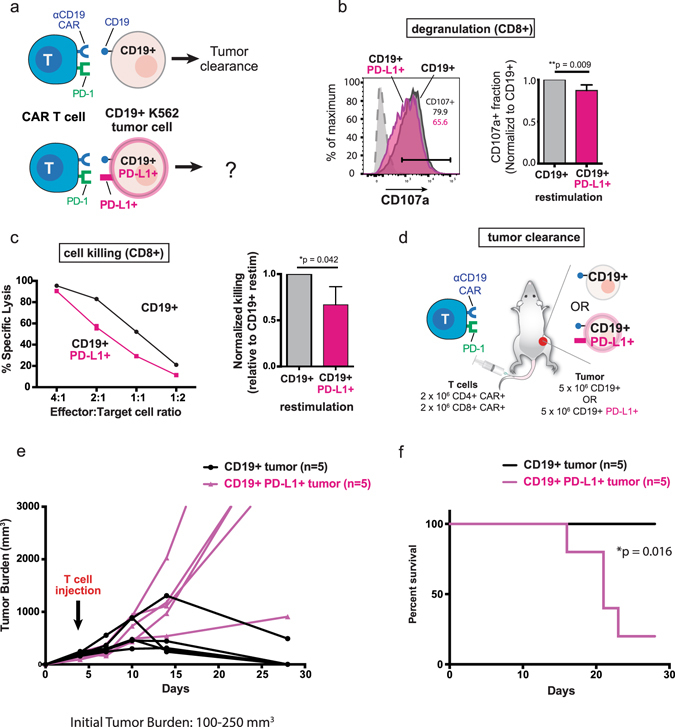
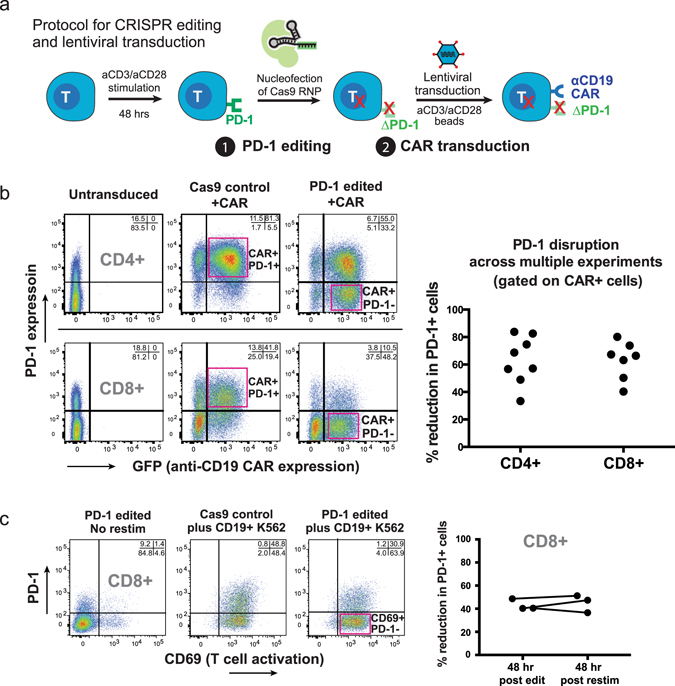
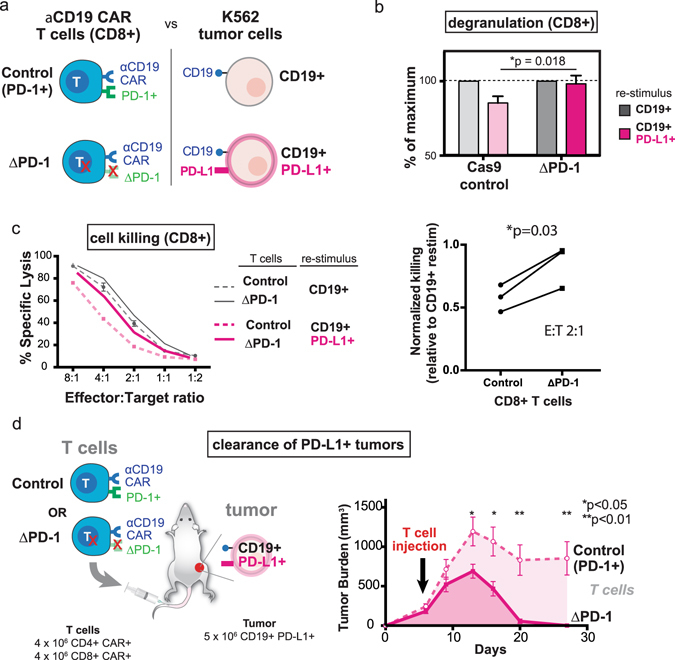
Immunotherapies with chimeric antigen receptor (CAR) T cells and checkpoint inhibitors (including antibodies that antagonize programmed cell death protein 1 [PD-1]) have both opened new avenues for cancer treatment, but the clinical potential of combined disruption of inhibitory checkpoints and CAR T cell therapy remains incompletely explored. Here we show that programmed death ligand 1 (PD-L1) expression on tumor cells can render human CAR T cells (anti-CD19 4-1BBζ) hypo-functional, resulting in impaired tumor clearance in a sub-cutaneous xenograft model. To overcome this suppressed anti-tumor response, we developed a protocol for combined Cas9 ribonucleoprotein (Cas9 RNP)-mediated gene editing and lentiviral transduction to generate PD-1 deficient anti-CD19 CAR T cells. Pdcd1 (PD-1) disruption augmented CAR T cell mediated killing of tumor cells in vitro and enhanced clearance of PD-L1+ tumor xenografts in vivo. This study demonstrates improved therapeutic efficacy of Cas9-edited CAR T cells and highlights the potential of precision genome engineering to enhance next-generation cell therapies.
Overview
The claims and statistics of this paper haven’t been checked yet.
Free: it reads the open-access text and checks the first 5 claims that cite a source we can check. Create a free account to check every claim.
Integrity signals
Registry
Cites
Statistics
Figures
Verification
Claims the paper makes
The claims and statistics of this paper haven’t been checked yet.
Free: it reads the open-access text and checks the first 5 claims that cite a source we can check. Create a free account to check every claim.
Claims other papers make about this one
Each is checked against this paper’s own text: does it say what the citing paper says it does?
The check wasn’t confident either way, so it gives no verdict — never disputed.
In the citing paper
“Mouse cells lacking p53 are unable to effectively arrest cell cycle progression after DNA damage, leading to genomic instability [16].”
From A Review of Research on CRISPR/Cas9 Gene Editing Technology in Disease Treatment (2024) · cites this paper as [16]
Experimental — accuracy not yet measuredThe check wasn’t confident either way, so it gives no verdict — never disputed.
In the citing paper
“Donehower, L.A. and his team found that mice with the P53 gene knocked out exhibit a high frequency of spontaneous tumorigenesis, including lymphomas, osteosarcomas, and other types of tumors.”
From A Review of Research on CRISPR/Cas9 Gene Editing Technology in Disease Treatment (2024) · cites this paper as [16]
Experimental — accuracy not yet measuredThe check wasn’t confident either way, so it gives no verdict — never disputed.
In the citing paper
“This observation suggests that p53 plays a crucial role in tumor suppression.”
From A Review of Research on CRISPR/Cas9 Gene Editing Technology in Disease Treatment (2024) · cites this paper as [16]
Experimental — accuracy not yet measuredIn the citing paper
“CRISPR-Cas9 genetic ablation of checkpoint targets such as PD-1 in adoptive T cell therapies has also shown increased functionality in certain models and is being persued clinically (Ren et al., 2017; Rupp et al., 2017; Stadtmauer et al., 2020; Su et al., 2016).”
From Pooled Knockin Targeting for Genome Engineering of Cellular Immunotherapies (2020) · cites this paper as Rupp et al., 2017
Self-check
Percentages, sums and reported differences re-computed from the paper’s own numbers.
The self-check needs the paper’s full text.
Citations
Cites
PD-1 and PD-L1 Immune Checkpoint Blockade to Treat Breast Cancer
Hartkopf, A. D., Taran, F.-A., Wallwiener, M., Walter, C. B., Krämer, B., Grischke, E.-M., & Brucker, S. Y. (2016) · Breast Care · doi:10.1159/000453569 · Cited by 30,845
Safety, activity, and immune correlates of anti–PD-1 antibody in cancer
Topalian, S. L., Hodi, F. S., Brahmer, J. R., Gettinger, S. N., Smith, D. C., McDermott, D. F., Powderly, J. D., Carvajal, R. D., Sosman, J. A., Atkins, M. B., et al. (2012) · New England Journal of Medicine · doi:10.1056/nejmoa1200690 · Cited by 12,628
Safety and activity of anti-PD-L1 antibody in patients with advanced cancer
Brahmer, J. R., Tykodi, S. S., Chow, L. Q. M., Hwu, W.-J., Topalian, S. L., Hwu, P., Drake, C. G., Camacho, L. H., Kauh, J., Odunsi, K., et al. (2012) · New England Journal of Medicine · doi:10.1056/nejmoa1200694 · Cited by 7,945
Chimeric Antigen Receptor T Cells for Sustained Remissions in Leukemia
Maude, S. L., Frey, N., Shaw, P. A., Aplenc, R., Barrett, D. M., Bunin, N. J., Chew, A., Gonzalez, V. E., Zheng, Z., Lacey, S. F., et al. (2014) · New England Journal of Medicine · doi:10.1056/nejmoa1407222 · Cited by 5,413
PD-1 and Its Ligands in Tolerance and Immunity
Keir, M. E., Butte, M. J., Freeman, G. J., & Sharpe, A. H. (2008) · Annual Review of Immunology · doi:10.1146/annurev.immunol.26.021607.090331 · Cited by 5,378
Restoring function in exhausted CD8 T cells during chronic viral infection
Barber, D. L., Wherry, E. J., Masopust, D., Zhu, B., Allison, J. P., Sharpe, A. H., Freeman, G. J., & Ahmed, R. (2006) · Nature · doi:10.1038/nature04444 · Cited by 3,986
PD-1 Blockade with Nivolumab in Relapsed or Refractory Hodgkin's Lymphoma
Ansell, S. M., Lesokhin, A. M., Borrello, I., Halwani, A., Scott, E. C., Gutierrez, M., Schuster, S. J., Millenson, M. M., Cattry, D., Freeman, G. J., et al. (2015) · New England Journal of Medicine · doi:10.1056/nejmoa1411087 · Cited by 3,560
Wang, H., Yang, H., Shivalila, C. S., Dawlaty, M. M., Cheng, A. W., Zhang, F., & Jaenisch, R. (2013) · Cell · doi:10.1016/j.cell.2013.04.025 · Cited by 3,495
Metabolic Competition in the Tumor Microenvironment Is a Driver of Cancer Progression
Chang, C.-H., Qiu, J., O’Sullivan, D., Buck, M. D., Noguchi, T., Curtis, J. D., Chen, Q., Gindin, M., Gubin, M. M., van der Windt, G. J. W., et al. (2015) · Cell · doi:10.1016/j.cell.2015.08.016 · Cited by 3,331
High-fidelity CRISPR-Cas9 nucleases with no detectable genome-wide off-target effects
Kleinstiver, B. P., Pattanayak, V., Prew, M. S., Tsai, S. Q., Nguyen, N. T., Zheng, Z., & Joung, J. K. (2016) · Nature · doi:10.1038/nature16526 · Cited by 2,673
Cited by
Items 401–500 of 757
The Dawn of In Vivo Gene Editing Era: A Revolution in the Making
Niazi, S. K. (2023) · Biologics · doi:10.3390/biologics3040014 · Cited by 23
Yin, S., Li, C., Shen, X., Yu, G., Cui, L., Wu, Y., He, Y., Yu, S., Chen, J., Lu, S., et al. (2024) · Advanced Science · doi:10.1002/advs.202403438 · Cited by 21
Generating CAR T cells from tumor-infiltrating lymphocytes
Mills, J. K., Henderson, M. A., Giuffrida, L., Petrone, P., Westwood, J. A., Darcy, P. K., Neeson, P. J., Kershaw, M. H., & Gyorki, D. E. (2021) · Therapeutic Advances in Vaccines and Immunotherapy · doi:10.1177/25151355211017119 · Cited by 19
Engineering T cells to survive and thrive in the hostile tumor microenvironment
Kim, G. B., Riley, J. L., & Levine, B. L. (2021) · Current Opinion in Biomedical Engineering · doi:10.1016/j.cobme.2021.100360 · Cited by 18
Pushing Past the Blockade: Advancements in T Cell-Based Cancer Immunotherapies
Polania, J. W., Lerner, E., Wilkinson, D. S., Hoyt-Miggelbrink, A. M., & Fecci, P. E. (2021) · Frontiers in Immunology · doi:10.3389/fimmu.2021.777073 · Cited by 18
GMP-manufactured CRISPR/Cas9 technology as an advantageous tool to support cancer immunotherapy
Caforio, M., Iacovelli, S., Quintarelli, C., Locatelli, F., & Folgiero, V. (2024) · Journal of Experimental & Clinical Cancer Research · doi:10.1186/s13046-024-02993-1 · Cited by 15
“It has been demonstrated that PD-1 deficient CAR T-cells have an improved antitumor activity in vitro [19] while a previous study and clinical trials (NCT02808442 and NCT02746952), performed using TALEN as gene editing system, have showed how disrupting genes encoding T cell receptor (TCR) α and β…”
ResultCRISPR-Cas gene knockouts to optimize engineered T cells for cancer immunotherapy
Castro, V. D., Galaine, J., Loyon, R., & Godet, Y. (2024) · Cancer Gene Therapy · doi:10.1038/s41417-024-00771-x · Cited by 18
Development of Personalized Strategies for Precisely Battling Malignant Melanoma
Isaak, A. J., Clements, G. R., Buenaventura, R. G. M., Merlino, G. T., & Yu, Y. (2024) · International Journal of Molecular Sciences · doi:10.3390/ijms25095023 · Cited by 17
“Successful attempts include stable knockouts of the inhibitory receptors via CRISPR/Cas-9 and the development of CAR-T cells that are capable of constitutively secreting immune checkpoint inhibitors [127–129].”
BackgroundOvercoming the challenges of primary resistance and relapse after CAR-T cell therapy
Dreyzin, A., Rankin, A. W., Luciani, K., Gavrilova, T., & Shah, N. N. (2024) · Expert Review of Clinical Immunology · doi:10.1080/1744666x.2024.2349738 · Cited by 18
Expanding the horizon of CAR T cell therapy: from cancer treatment to autoimmune diseases and beyond
Yang, Z., Ha, B., Wu, Q., Ren, F., Yin, Z., & Zhang, H. (2025) · Frontiers in Immunology · doi:10.3389/fimmu.2025.1544532 · Cited by 24
Use of Customizable Nucleases for Gene Editing and Other Novel Applications
Reddy, P., Vilella, F., Belmonte, J. C. I., & Simón, C. (2020) · Genes · doi:10.3390/genes11090976 · Cited by 18
“Similar to ZFN and TALEN, T-cells have been genetically edited using CRISPR to knockdown immune checkpoint inhibitor programmed cell death-1 (PD-1), which is upregulated during activation of T-cells to reduce the autoimmune reaction and aid cancer cells in evading the immune system [77].”
MethodStrategies to Improve Chimeric Antigen Receptor Therapies for Neuroblastoma
Sawaisorn, P., Atjanasuppat, K., Anurathapan, U., Chutipongtanate, S., & Hongeng, S. (2020) · Vaccines · doi:10.3390/vaccines8040753 · Cited by 16
Baghini, S. S., Gardanova, Z. R., Zekiy, A. O., Shomali, N., Tosan, F., & Jarahian, M. (2021) · Frontiers in Bioengineering and Biotechnology · doi:10.3389/fbioe.2021.775309 · Cited by 19
“Interestingly, the major challenges of the CAR T cell-based therapies, containing accelerated T cell exhaustion, the possible occurrence of graft versus host disease (GVHD) and neurotoxicities, and also insertional oncogenesis, can be greatly circumvented using CRISPR/Cas9 technology, holding potential for manufacturi…”
BackgroundRetractedThe War Is on: The Immune System against Glioblastoma—How Can NK Cells Drive This Battle?
da Silva, L. H. R., Catharino, L. C. C., da Silva, V. J., Evangelista, G. C. M., & Barbuto, J. A. M. (2022) · Biomedicines · doi:10.3390/biomedicines10020400 · Cited by 19
Presti, V. L., Nierkens, S., Boelens, J. J., & van Til, N. P. (2018) · Expert Review of Hematology · doi:10.1080/17474086.2018.1431119 · Cited by 18
“In another study, Clustered Regulatory Interspaced Short Palindromic Repeats (CRISPR)/Cas9 was used to eliminate PD-1 expression in CD19 CAR-T cells, which enhanced CAR T cell function significantly and shows the potential of these applications [62], which could also be applied on CB T cells.”
MethodCRISPR/Cas9 genome engineering in hematopoietic cells
Sürün, D., von Melchner, H., & Schnütgen, F. (2018) · Drug Discovery Today Technologies · doi:10.1016/j.ddtec.2018.08.001 · Cited by 16
Lu, X., Zhu, Y., Wei, C. Y., Cheng, L., Goodier, K. D., Kong, J., Gao, X., Yu, D., Liu, X., Long, Y., et al. (2025) · Science Advances · doi:10.1126/sciadv.ady5579 · Cited by 20
CAR-T cell therapy in hepatocellular carcinoma: from mechanistic insights to clinical translation
Elahi, R., Idrissi, Y. A., & Saeed, A. (2025) · Cancer Treatment Reviews · doi:10.1016/j.ctrv.2025.103046 · Cited by 18
Non-viral vectors for chimeric antigen receptor immunotherapy
Tretbar, S., Rurik, J. G., Rustad, E. H., Sürün, D., Koehl, U., Olweus, J., Buchholz, F., Ivics, Z., Fricke, S., & Blache, U. (2024) · Nature Reviews Methods Primers · doi:10.1038/s43586-024-00348-w · Cited by 16
Significant Advancements and Evolutions in Chimeric Antigen Receptor Design
Gaimari, A., Lucia, A. D., Nicolini, F., Mazzotti, L., Maltoni, R., Rughi, G., Zurlo, M., Marchesini, M., Juan, M., Parras, D., et al. (2024) · International Journal of Molecular Sciences · doi:10.3390/ijms252212201 · Cited by 17
Mardomi, A., & Abediankenari, S. (2018) · Cancer Microenvironment · doi:10.1007/s12307-018-0208-2 · Cited by 15
“Although some hurdles of solid tumor CAR-T cell therapy such as immunosuppressive microenvironment has been overcome by the introduction of anti-PD-1 blocking antibody and PD-1 knockout CAR-Tcells [39, 40], the expected success rates still remain to be achieved.”
BackgroundGene Augmentation and Editing to Improve TCR Engineered T Cell Therapy against Solid Tumors
Lo Presti, V., Buitenwerf, F., van Til, N. P., & Nierkens, S. (2020) · Vaccines · doi:10.3390/vaccines8040733 · Cited by 14
Amini, L., Vollmer, T., Wendering, D. J., Jurisch, A., Landwehr-Kenzel, S., Otto, N., Jürchott, K., Volk, H., Reinke, P., & Schmueck‐Henneresse, M. (2019) · Frontiers in Immunology · doi:10.3389/fimmu.2019.01148 · Cited by 15
“Proposed strategies for genetic engineering include induction of resistance to immunosuppressive medication (96, 97), introduction of suicide genes as safety switch (49, 98) and knock out of antiinflammatory signaling components such as PD-1 and LAG-3 (99, 100).”
BackgroundEngineering Solutions for Mitigation of Chimeric Antigen Receptor T-Cell Dysfunction
Gavriil, A., Barisa, M., Halliwell, E., & Anderson, J. (2020) · Cancers · doi:10.3390/cancers12082326 · Cited by 14
CRISPR Takes the Front Seat in CART-Cell Development
Manriquez-Roman, C., Siegler, E. L., & Kenderian, S. S. (2021) · BioDrugs · doi:10.1007/s40259-021-00473-y · Cited by 17
Dhakal, B., Chhabra, S., Savani, B. N., & Hamadani, M. (2021) · British Journal of Haematology · doi:10.1111/bjh.17904 · Cited by 14
“Further, knocking out T-cell inhibitory receptors such as PD-1, T-cell immunoglobulin domain and mucin domain 3 (TIM-3), lymphocyte-activation gene 3 (LAG-3), and cytotoxic T-lymphocyte antigen 4 (CTLA-4) can enable CAR T cells to avoid exhaustion, improve persistence and evade immunological response.(67,74,75) Alloge…”
BackgroundOvercoming key challenges in cancer immunotherapy with engineered T cells
Arcangeli, S., Mestermann, K., Weber, J., Bonini, C., Casucci, M., & Hudecek, M. (2020) · Current Opinion in Oncology · doi:10.1097/cco.0000000000000664 · Cited by 14
Susek, K. H., Schwietzer, Y. A., Karvouni, M., Gilljam, M., Keszei, M., Hussain, A., Lund, J., Kashif, M., Lundqvist, A., Ljunggren, H., et al. (2022) · Cancer Immunology Immunotherapy · doi:10.1007/s00262-022-03317-y · Cited by 14
Azar, H. K., Imanpour, A., Rezaee, H., Ezzatifar, F., Zarei‐Behjani, Z., Rostami, M., Azami, M., Beheshtizadeh, N., & Rezaei, N. (2023) · European Journal Of Haematology · doi:10.1111/ejh.14014 · Cited by 13
CRISPR/Cas9: an overview of recent developments and applications in cancer research
Devi, S. N., Rana, R., Malik, P., & Ganguly, N. K. (2024) · International Journal of Surgery · doi:10.1097/js9.0000000000001081 · Cited by 17
The next innovations in chimeric antigen receptor T cell immunotherapies for cancer
Anupindi, K., Malachowski, J., Hodson, I., Zhu, D., June, C. H., & Levine, B. L. (2025) · Cytotherapy · doi:10.1016/j.jcyt.2025.05.010 · Cited by 14
Enhancing CAR T cell efficacy: the next step toward a clinical revolution?
Namuduri, M., & Brentjens, R. J. (2020) · Expert Review of Hematology · doi:10.1080/17474086.2020.1753501 · Cited by 14
Vandghanooni, S., Eskandani, M., Sanaat, Z., & Omidi, Y. (2022) · Life Sciences · doi:10.1016/j.lfs.2022.121016 · Cited by 13
Zhang, Y., Geng, H., Zeng, L., Li, J., Yang, Q., Jia, S., Zong, X., Cai, W., Liu, S., Lu, Y., et al. (2023) · Hematological Oncology · doi:10.1002/hon.3227 · Cited by 14
Large-scale manufacturing of base-edited chimeric antigen receptor T cells
Woodruff, R., Parekh, F., Lamb, K., Mekkaoui, L., Allen, C. G., Smetanova, K., Huang, J. L., Williams, A., Toledo, G. S., Lilova, K., et al. (2023) · Molecular Therapy — Methods & Clinical Development · doi:10.1016/j.omtm.2023.101123 · Cited by 16
Programming CAR T cells to enhance anti-tumor efficacy through remodeling of the immune system
Wang, X., Wu, Z., Qiu, W., Chen, P., Xu, X. M., & Han, W. (2020) · Frontiers of Medicine · doi:10.1007/s11684-020-0746-0 · Cited by 16
CRISPR-Cas, a robust gene-editing technology in the era of modern cancer immunotherapy
Miri, S. M., Tafsiri, E., Cho, W. C. S., & Ghaemi, A. (2020) · Cancer Cell International · doi:10.1186/s12935-020-01546-8 · Cited by 17
Elucidation of CRISPR-Cas9 Application in Novel Cellular Immunotherapy.Preprint
Quazi, S. (2021) · Preprints.org · doi:10.20944/preprints202108.0387.v1 · Cited by 12
CRISPR-Cas9 genome editing for cancer immunotherapy: opportunities and challenges
Chen, M., Xu, J., Zhou, Y., Zhang, S., & Zhu, D. (2020) · Briefings in Functional Genomics · doi:10.1093/bfgp/elz027 · Cited by 12
Lamothe, R. C., Storlie, M. D., Espinosa, D. A., Rudlaff, R. M., Browne, P. J., Liu, J., Rivas, A., Devoto, A. E., Oki, J., Khoubyari, A., et al. (2023) · The CRISPR Journal · doi:10.1089/crispr.2022.0089 · Cited by 14
Zhang, A., Wang, S., Sun, Y., Zhang, Y., Zhao, L., Yang, Y., Zhang, Y., Xu, L., Lei, Y., Du, J., et al. (2023) · Experimental Hematology and Oncology · doi:10.1186/s40164-023-00438-7 · Cited by 12
“These strategies include PD1-CD28 switch-receptor [14–17], PD1/PDL1 antibody single-chain variable fragment (scFv) secretion [18, 19], and PD1 knockdown or knockout [20, 21].”
MethodCAR-T Cells in Acute Myeloid Leukemia: Where Do We Stand?
Damiani, D., & Tiribelli, M. (2024) · Biomedicines · doi:10.3390/biomedicines12061194 · Cited by 14
“CAR-T cells have been designed to block PD-1 through secreted single chain variable fragments (scFv), antibodies, shRNA, dominant negative receptors and CRISPR/cas9 mediated knockout [124–126]; anti-PD-1 CAR-T cells are under investigation in B cell malignancies and solid tumors.”
BackgroundNovel strategies to overcome tumor immunotherapy resistance using CAR NK cells
Guo, J., Afzal, A., Ahmad, S., Saeed, G., Rehman, A., Saddozai, U. A. K., Liu, L., Guo, S., Ji, X., & Khawar, M. B. (2025) · Frontiers in Immunology · doi:10.3389/fimmu.2025.1550652 · Cited by 18
Singh, D. D., Hawkins, R. D., Lahesmaa, R., & Tripathi, S. K. (2019) · Seminars in Cell and Developmental Biology · doi:10.1016/j.semcdb.2019.05.007 · Cited by 13
Knocking out barriers to engineered cell activity
Hamilton, J. R., & Doudna, J. A. (2020) · Science · doi:10.1126/science.aba9844 · Cited by 13
CRISPR-Based Editing Techniques for Genetic Manipulation of Primary T Cells
Kotowski, M., & Sharma, S. (2020) · Methods and Protocols · doi:10.3390/mps3040079 · Cited by 16
“Ablation of PD-1 in CAR T cells using either Cas9 RNP or mRNA electroporation has been demonstrated to enhance the clearance of PD-L1 expressing tumours in mice [21,84].”
BackgroundMaking Potent CAR T Cells Using Genetic Engineering and Synergistic Agents
Park, C. H. (2021) · Cancers · doi:10.3390/cancers13133236 · Cited by 11
Zhang, J., Chen, P., & Miao, L. (2022) · Frontiers in Immunology · doi:10.3389/fimmu.2022.969196 · Cited by 14
Huang, K., Sun, B., Luo, N., Guo, H., Hu, J., & Peng, J. (2018) · Medical Science Monitor · doi:10.12659/msm.910903 · Cited by 12
“Some researchers have proved that PD-1 knockout using the gene editing technology such as the CRISPR/Cas9 system could enhance antitumor efficacy of primary T cells and Chimeric Antigen Receptor (CAR) T cell [8,9].”
BackgroundResultIntelligent cell-based therapies for cancer and autoimmune disorders
Chen, R., Ji, J., Siwko, S. K., Huang, Y., & Zhou, Y. (2020) · Current Opinion in Biotechnology · doi:10.1016/j.copbio.2020.08.012 · Cited by 13
Current trends in gene therapy to treat inherited disorders of the brain
Matuszek, Ż., Brown, B. L., Yrigollen, C. M., Keiser, M. S., & Davidson, B. L. (2025) · Molecular Therapy · doi:10.1016/j.ymthe.2025.03.057 · Cited by 14
“–237 The discovery of Cas9 revolutionized genome editing, leading to more than 80 CRISPR-based strategies in clinical trials.”
Combined analysis of T cell activation and T cell-mediated cytotoxicity by imaging cytometry
Chanda, M., Shudde, C. E., Piper, T. L., Zheng, Y., & Courtney, A. H. (2022) · Journal of Immunological Methods · doi:10.1016/j.jim.2022.113290 · Cited by 12
Contemporary Approaches to Immunotherapy of Solid Tumors
Kuznetsova, A. V., Glukhova, K. А., Попова, О. П., Beletsky, I. P., & Aa, I. (2024) · Cancers · doi:10.3390/cancers16122270 · Cited by 14
“Downregulation of PD-1, CTLA-4, and TIGIT using CRISPR/Cas9 or small interfering RNAs resulted in increased cytotoxicity of CAR-T cells, promoted a sustained antitumor response, and improved CAR-T cell persistence in vivo [120,175,176].”
CAR-T cell technologies that interact with the tumour microenvironment in solid tumours
Taylor, C. A., Glover, M., & Maher, J. F. (2024) · Expert Review of Clinical Immunology · doi:10.1080/1744666x.2024.2380894 · Cited by 15
“Although most studies have demonstrated a benefit of this approach [137,193–196], this has not been observed consistently [197,198].”
Natural Killer Cell‐Mediated Antitumor Immunity: Molecular Mechanisms and Clinical Applications
Luo, N., Chen, C., Zhou, W., Hao, J., He, S., Liu, Y., Ku, Y., Huang, L., Zhang, C., Shu, Y., et al. (2025) · MedComm · doi:10.1002/mco2.70387 · Cited by 12
SJI 2020 special issue: A catalogue of Ovarian Cancer targets for CAR therapy
Benard, E., Casey, N. P., Inderberg, E. M., & Wälchli, S. (2020) · Scandinavian Journal of Immunology · doi:10.1111/sji.12917 · Cited by 14
Synthetic Cell-Based Immunotherapies for Neurologic Diseases
von Baumgarten, L., Stauss, H. J., & Lünemann, J. D. (2023) · Neurology Neuroimmunology & Neuroinflammation · doi:10.1212/nxi.0000000000200139 · Cited by 12
Recent progress in chimeric antigen receptor therapy for acute myeloid leukemia
Wang, X., Zhang, Y., & Xue, S. (2024) · Annals of Hematology · doi:10.1007/s00277-023-05601-y · Cited by 13
“Its effectiveness in combating CAR-T cell exhaustion becomes evident when precisely targeting inhibitory receptors like PD-1 and CTLA-4 [51, 64, 65].”
Novickij, V., Zinkevičienė, A., Valiulis, J., Švedienė, J., Paškevičius, A., Lastauskienė, E., Markovskaja, S., Novickij, J., & Girkontaitė, I. (2018) · Bioelectrochemistry · doi:10.1016/j.bioelechem.2018.04.006 · Cited by 11
Engineering Platforms for T Cell Modulation
Hickey, J. W., Kosmides, A. K., & Schneck, J. P. (2018) · International review of cytology · doi:10.1016/bs.ircmb.2018.06.003 · Cited by 17
Chimeric Antigen Receptor Therapy: How Are We Driving in Solid Tumors?
Greenbaum, U., Yalniz, F., Srour, S. A., Rezvani, K., Singh, H., Olson, A. L., Blumenschein, G. R., Hong, D. S., Shpall, E. J., & Kebriaei, P. (2020) · Transplantation and Cellular Therapy · doi:10.1016/j.bbmt.2020.06.020 · Cited by 11
Utilization of CRISPR/Cas9 gene editing in cellular therapies for lymphoid malignancies
Mehravar, M., Roshandel, E., Salimi, M., Chegeni, R., Gholizadeh, M., Mohammadi, M. H., & Hajifathali, A. (2020) · Immunology Letters · doi:10.1016/j.imlet.2020.07.003 · Cited by 13
Hu, K., Yin, E. T. S., Hu, Y., & Huang, H. (2021) · Current Medical Science · doi:10.1007/s11596-021-2391-5 · Cited by 13
Genome editing in animals: an overview
Bharati, J., Punetha, M., Kumar, B. A. A. S., Vidyalakshmi, G. M., Sarkar, M., D’Occhio, M. J., & Singh, R. K. (2019) · Elsevier eBooks · doi:10.1016/b978-0-12-816352-8.00003-5 · Cited by 13
Why Immunotherapy Fails in Multiple Myeloma
Rodríguez‐Lobato, L. G., Oliver‐Caldés, A., Moreno, D. F., de Larrea, C. F., & Bladé, J. (2020) · Hemato · doi:10.3390/hemato2010001 · Cited by 13
Qi, T., Fu, J., Zhang, W., Cui, W., Xu, X., Yue, J., Wang, Q., & Tian, X. (2020) · Translational Cancer Research · doi:10.21037/tcr-20-2118 · Cited by 10
Targeted gene delivery systems for T-cell engineering
Wang, F., Huang, Y., Li, J., Zhou, W., & Wang, W. (2024) · Cellular Oncology · doi:10.1007/s13402-024-00954-6 · Cited by 13
Non-viral expression of chimeric antigen receptors with multiplex gene editing in primary T cells
Cappabianca, D., Li, J., Zheng, Y., Tran, C., Kasparek, K., Mendez, P., Thu, R., Maures, T. J., Capitini, C. M., Deans, R., et al. (2024) · Frontiers in Bioengineering and Biotechnology · doi:10.3389/fbioe.2024.1379900 · Cited by 11
Recent advances and challenges of cellular immunotherapies in lung cancer treatment
Yang, C., Liu, Y., Huang, Z., Liu, S., Zhang, X., Liu, Q., & Dai, J. (2025) · Experimental Hematology and Oncology · doi:10.1186/s40164-025-00679-8 · Cited by 14
“Genetic knock-out of PD-1 during the CAR-T preparation stage has demonstrated promising results for the treatment of different tumors [139, 140].”
Du, X., Goh, P. K., Ma, C., Coughlan, E., Greatorex, S., Porter, L. H., Russ, B. E., Cummins, K. D., Sek, K., Slaney, C. Y., et al. (2025) · Science Translational Medicine · doi:10.1126/scitranslmed.adk0627 · Cited by 11
Tuning the performance of CAR T cell immunotherapies
Richardson, N. H., Luttrell, J. B., Bryant, J. S., Chamberlain, D., Khawaja, S., Neeli, I., & Radic, M. Z. (2019) · BMC Biotechnology · doi:10.1186/s12896-019-0576-9 · Cited by 10
AI applications in prevalent diseases and disorders
Catania, L. J. (2020) · Elsevier eBooks · doi:10.1016/b978-0-12-824477-7.00007-9 · Cited by 12
“Built‐in” PD‐1 blocker to rescue NK‐92 activity from PD‐L1–mediated tumor escape mechanisms
Mensali, N., Dillard, P., Fayzullin, A., Köksal, H., Gaudernack, G., Kvalheim, G., Inderberg, E. M., & Wälchli, S. (2021) · The FASEB Journal · doi:10.1096/fj.202100025r · Cited by 10
Yang, Z., Wu, H., Lin, Q., Wang, X., & Kang, S. (2022) · Immunology Letters · doi:10.1016/j.imlet.2022.09.004 · Cited by 11
Radiotherapy plus CAR-T cell therapy to date: A note for cautions optimism?
Tian, H., Li, H., & Tang, B. (2022) · Frontiers in Immunology · doi:10.3389/fimmu.2022.1033512 · Cited by 10
“Similarly, preclinical and clinical studies have shown that CRISPR/Cas9 gene editing systems are knocking down the PD-1 gene in CAR-T cells or combining immune checkpoint blockade with CAR-T cells can not only improve the ability of CAR-T cells to expand and reduce exhaustion but also increase the proportion of CD8/CD…”
BackgroundWelch, M., Flusberg, D. A., Hsi, P. T., Haroutunian, N. J., Santos, J. A. L., Kim, E. S., Markovic, S., Coppeta, J. R., Lissandrello, C. A., Balestrini, J. L., et al. (2023) · Advanced Materials Technologies · doi:10.1002/admt.202300275 · Cited by 15
Lee, H., Yoon, S. E., Kim, S. J., Kim, W. S., & Cho, J. (2023) · Cancer Medicine · doi:10.1002/cam4.6268 · Cited by 9
Neidemire-Colley, L. M., Khanal, S., Braunreiter, K. M., Gao, Y., Kumar, R., Snyder, K. J., Weber, M. A., Surana, S., Toirov, O., Karunasiri, M. S., et al. (2024) · Blood Advances · doi:10.1182/bloodadvances.2023010570 · Cited by 10
Dey, S., Devender, M., Rani, S., & Pandey, R. K. (2024) · Advances in protein chemistry and structural biology · doi:10.1016/bs.apcsb.2024.02.003 · Cited by 13
Applications of molecular engineering in T‐cell‐based immunotherapies
McBride, D. A., Kerr, M. D., Wai, S. L., & Shah, N. J. (2019) · Wiley Interdisciplinary Reviews Nanomedicine and Nanobiotechnology · doi:10.1002/wnan.1557 · Cited by 12
“CAR T-cells with the disrupted Pdcd1 gene eliminated all tumors in mice whereas about the tumors were cleared on only 17% of mice by the control cells at the same dose(Rupp et al., 2017).”
BackgroundCRISPR/Cas9 genetic screens in hepatocellular carcinoma gene discovery
Chiu, C. H. (2023) · Current Research in Biotechnology · doi:10.1016/j.crbiot.2023.100127 · Cited by 10
“Currently, the CRISPR/Cas9 was mainly applied as direct gene editing in T cell engineering (Rupp, 2017; Choi, 2019; Ren, 2017; Zhang, 2017; Jung, 2018; Tang, 2020).”
CRISPR/Cas9 for achieving postintervention HIV control
Moso, M. A., Roche, M., Cevaal, P. M., & Lewin, S. R. (2025) · Current Opinion in HIV and AIDS · doi:10.1097/coh.0000000000000963 · Cited by 13
Alencar, G. F., Mohamed, A. O., Burnett, M. G., Jean, S. C. S., Nelson, A. R., Su, Y., Voillet, V., Bates, B. M., Suarez, M. L. R., Ruskin, S. L., et al. (2025) · Proceedings of the National Academy of Sciences · doi:10.1073/pnas.2419888122 · Cited by 11
“Genetic ablation of PD-1 (37, 38), Lag-3 (39), or PD-1, Lag-3, and Tim-3 simultaneously (40) in CAR T cells using CRISPR-Cas9 editing has been demonstrated to achieve enhanced antitumor cytotoxicity and improved tumor growth control.”
Abdel‐Azim, H., Dave, H., Jordan, K. R., Rawlings-Rhea, S. D., Luong, A., & Wilson, A. L. (2021) · Cytotherapy · doi:10.1016/j.jcyt.2021.08.007 · Cited by 9
Varadarajan, I., Pierce, E. J., Scheuing, L., Morris, A., Chaer, F. E., & Keng, M. K. (2023) · OncoTargets and Therapy · doi:10.2147/ott.s274551 · Cited by 10
CRISPR/Cas genome editing in triple negative breast cancer: Current situation and future directions
Fu, L., Li, Z., Ren, Y., Yu, H., Liu, B., & Qiu, Y. (2023) · Biochemical Pharmacology · doi:10.1016/j.bcp.2023.115449 · Cited by 10
Liu, Y., An, L., Yang, C., Wang, X., Huang, R., & Zhang, X. (2023) · Blood Science · doi:10.1097/bs9.0000000000000165 · Cited by 18
Prospects and challenges of CRISPR /Cas9 gene‐editing technology in cancer research
Li, N., Xi, J., Yin, Z., Chen, M., Zou, Q., Zhou, X., & Tang, C. (2023) · Clinical Genetics · doi:10.1111/cge.14424 · Cited by 14
Bhutani, B., Sharma, V., Ganguly, N. K., & Rana, R. (2025) · Biomedicine & Pharmacotherapy · doi:10.1016/j.biopha.2025.117987 · Cited by 11
Jiang, P., Gao, Y., Chen, X., Ke, Q., Jin, X., & Huang, C. (2018) · ACS Macro Letters · doi:10.1021/acsmacrolett.8b00545 · Cited by 9
Zhao, J., Wu, M., Li, Z., Su, S., Wen, Y., Zhang, L., & Li, Y. (2020) · Annals of Hematology · doi:10.1007/s00277-020-04020-7 · Cited by 11
Cellular based treatment modalities for unresectable hepatocellular carcinoma
Damiris, K., Abbad, H., & Pyrsopoulos, N. (2021) · World Journal of Clinical Oncology · doi:10.5306/wjco.v12.i5.290 · Cited by 8
Car-T Cell Therapy: Current Advances and Future Research Possibilities
Ahmed, M. M. E. (2021) · Journal of Scientific Research in Medical and Biological Sciences · doi:10.47631/jsrmbs.v2i2.234 · Cited by 18
How CRISPR/Cas9 Gene Editing Is Revolutionizing T Cell Research
Johansen, K. H. (2022) · DNA and Cell Biology · doi:10.1089/dna.2021.0579 · Cited by 9
“…for generating efficacious CAR-T cells for therapy, which have an artificially introduced antigen receptor (Eyquem et al., 2017; Liu et al., 2017; Rupp et al., 2017), as well as for adoptive T cell transfers of cancerspecific T cells as therapy for cancer after KO of immune checkpoint inhibitors…”
BackgroundInfluentialThe tricks for fighting against cancer using CAR NK cells: A review
Vahidian, F., Khosroshahi, L. M., Akbarzadeh, M., Jahanban‐Esfahlan, A., Baghbanzadeh, A., Ali‐Hassanzadeh, M., & Safarzadeh, E. (2022) · Molecular and Cellular Probes · doi:10.1016/j.mcp.2022.101817 · Cited by 10
CAR‐T Therapy in Clinical Practice: Technical Advances and Current Challenges
Ren, P., Zhang, C., Li, W., Wang, X., Liang, A., Yang, G., Xu, H., & Ma, P. (2022) · Advanced Biology · doi:10.1002/adbi.202101262 · Cited by 13
RETRACTED ARTICLE: Molecular and therapeutic effect of CRISPR in treating cancer
Rodrigo, S., Senasinghe, K., & Quazi, S. (2023) · Medical Oncology · doi:10.1007/s12032-022-01930-6 · Cited by 11
“…transduction were combined to generate PD1 disrupted anti-CD19 CAR T cells which dampened PD/PD-L1 axis and displayed enhanced antitumor activity in vitro and tumor cell lysis in PDL1 + tumor xenografts in myelogenous leukemia murine models, in comparison to normal anti-CD19 CAR T cells [80].”
RetractedYang, Y., & Huang, Y. (2019) · Animal Models and Experimental Medicine · doi:10.1002/ame2.12061 · Cited by 8
CAR-T Therapy in Relapsed Refractory Multiple Myeloma
Ding, H. S., & Wu, Y. (2023) · Current Medicinal Chemistry · doi:10.2174/0109298673268932230920063933 · Cited by 12
CRISPR Advancements for Human Health.
Davis, D. J., & Yeddula, S. G. R. (2024) · PubMed Central · Cited by 25
Metadata
- Authors
- Rupp, L. J., Schumann, K., Roybal, K. T., Gate, R. E., Ye, C. J., Lim, W. A., & Marson, A.
- Affiliations
- Howard Hughes Medical Institute (US)
- University of California, San Francisco (US)
- Corresponding author
- Lim, Wendell A.
- Venue
- Scientific Reports
- Published
- 2017-04-07
- Volume
- 7
- Issue
- 1
- Pages
- 737-737
- ISSN
- 2045-2322 (ISSN-L)
- PMC
- PMC5428439
- OpenAlex
- W2604982880
- Semantic Scholar
- 27ffac41ff676af9dc298997351e23839515638e
- Cited by
- 757
- References
- 39
- Citations by year
- 2026: 58 · 2025: 72 · 2024: 70 · 2023: 72 · 2022: 94 · 2021: 107 · 2020: 122 · 2019: 85 · 2018: 67 · 2017: 10
- FWCI
- 34.37
- Type
- journal article
- Language
- en
- Open access
- gold
- doi.org
- Licence
- cc-by
- creativecommons.org/licenses/by/4.0 (tdm)
- creativecommons.org/licenses/by/4.0 (vor)
- Locations
- Scientific Reports (publishedVersion, cc-by)
- PubMed Central (publishedVersion, cc-by)
- PubMed (publishedVersion)
- eScholarship (California Digital Library) (submittedVersion)
- DOAJ (DOAJ: Directory of Open Access Journals) (submittedVersion, cc-by-sa)
- KOPS (University of Konstanz) (submittedVersion, cc-by)
- Funders
- Howard Hughes Medical Institute (R01 CA196277)
- Burroughs Wellcome Fund
- Deutsche Forschungsgemeinschaft
- National Institutes of Health (EY016546)
- University of California, San Francisco
- National Eye Institute (PN2EY016546)
- National Cancer Institute (R01CA196277)
- National Institute of General Medical Sciences (T32GM067547, R01GM055040)
- National Institute of Allergy and Infectious Diseases (F32AI120352)
- Topics
- Health Sciences › Medicine › Oncology › CAR-T cell therapy research
- Health Sciences › Medicine › Oncology › Cancer Immunotherapy and Biomarkers
- Life Sciences › Biochemistry, Genetics and Molecular Biology › Molecular Biology › CRISPR and Genetic Engineering
- Keywords
- CRISPR/Cas9 genome editing, PD-1, PD-L1, chimeric antigen receptor T cells, CD19 CAR T cells, 4-1BB, lentiviral transduction, Cas9 ribonucleoprotein, cancer immunotherapy, antitumor efficacy, anti-PD-1 therapy
- MeSH terms
- Animals, Antigens, Neoplasm, Female, Humans, Neoplasms, Receptors, Antigen, T-Cell, T-Lymphocytes, Biomarkers, Gene Expression, Immunophenotyping, Mice, Knockout, Gene Targeting, Antigens, CD19, Cell Line, Tumor, Mice, Gene Knockdown Techniques, B7-H1 Antigen, Programmed Cell Death 1 Receptor, CRISPR-Cas Systems
About these checks
Registry, retraction, Cites and statistics results are computed, not judged, with one exception: a printed reference that no index lists is read once by a model before it counts as a citation error. Claims are extracted by a model and kept only when their quote appears verbatim in the text; each cited source is then checked, with a model’s help, for whether it says what the claim relies on. Those verdicts can be wrong — read the claim’s quote and the cited source before relying on one.
Statistics and arithmetic are recomputed, not judged.
Confidence bands are shown only for fields calibrated on our annotated test set. None is calibrated yet, so no band is shown.
What counts as a claim ›How we measure confidence ›How we check this ›
Are you an author, or do you see a problem with this page? Request a review
Data sources
Bibliographic data: Semantic Scholar, OpenAlex, Crossref.
Contains information from the Semantic Scholar Academic Graph Datasets, made available under the ODC Attribution License (ODC-BY 1.0).
Semantic Scholar’s data is described in: Kinney, R., et al. (2023). The Semantic Scholar Open Data Platform. arXiv:2301.10140.
