

CRISPR/Cas9-mediated PD-1 disruption enhances anti-tumor efficacy of human chimeric antigen receptor T cells
Open accessThe DOI matches its Crossref record; 38 of the 39 references it cites were found in a registry or an index.
Abstract
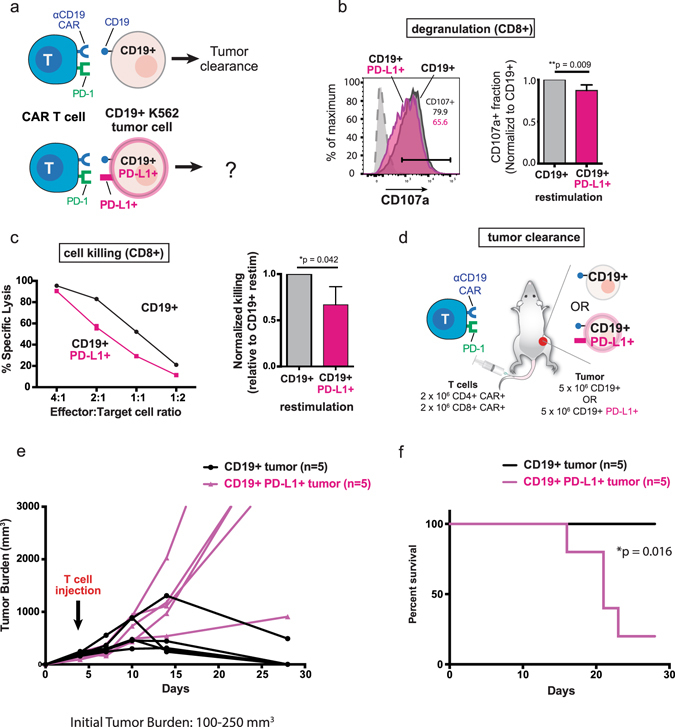
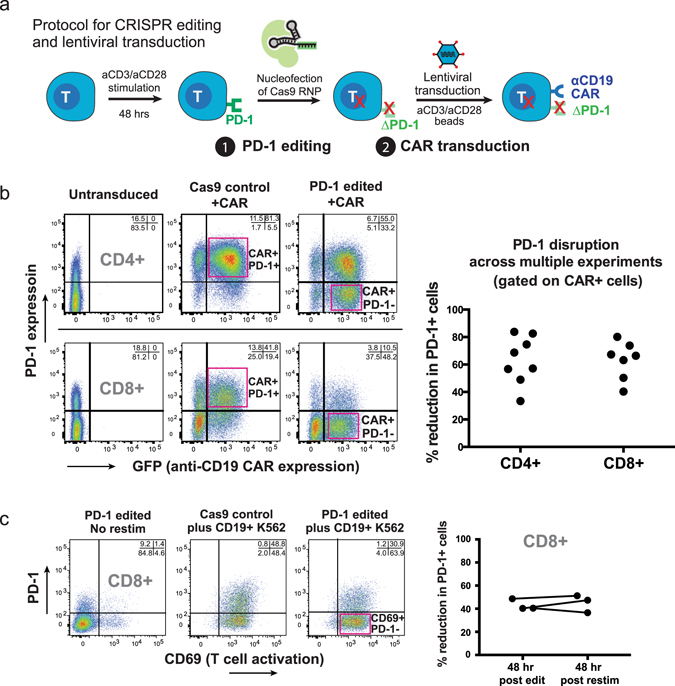
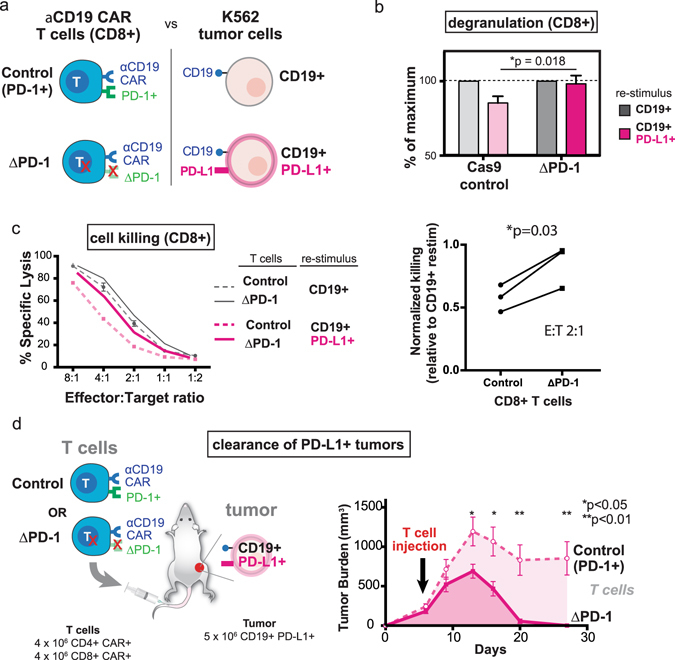
Immunotherapies with chimeric antigen receptor (CAR) T cells and checkpoint inhibitors (including antibodies that antagonize programmed cell death protein 1 [PD-1]) have both opened new avenues for cancer treatment, but the clinical potential of combined disruption of inhibitory checkpoints and CAR T cell therapy remains incompletely explored. Here we show that programmed death ligand 1 (PD-L1) expression on tumor cells can render human CAR T cells (anti-CD19 4-1BBζ) hypo-functional, resulting in impaired tumor clearance in a sub-cutaneous xenograft model. To overcome this suppressed anti-tumor response, we developed a protocol for combined Cas9 ribonucleoprotein (Cas9 RNP)-mediated gene editing and lentiviral transduction to generate PD-1 deficient anti-CD19 CAR T cells. Pdcd1 (PD-1) disruption augmented CAR T cell mediated killing of tumor cells in vitro and enhanced clearance of PD-L1+ tumor xenografts in vivo. This study demonstrates improved therapeutic efficacy of Cas9-edited CAR T cells and highlights the potential of precision genome engineering to enhance next-generation cell therapies.
Overview
The claims and statistics of this paper haven’t been checked yet.
Free: it reads the open-access text and checks the first 5 claims that cite a source we can check. Create a free account to check every claim.
Integrity signals
Registry
Cites
Statistics
Figures
Verification
Claims the paper makes
The claims and statistics of this paper haven’t been checked yet.
Free: it reads the open-access text and checks the first 5 claims that cite a source we can check. Create a free account to check every claim.
Claims other papers make about this one
Each is checked against this paper’s own text: does it say what the citing paper says it does?
The check wasn’t confident either way, so it gives no verdict — never disputed.
In the citing paper
“Mouse cells lacking p53 are unable to effectively arrest cell cycle progression after DNA damage, leading to genomic instability [16].”
From A Review of Research on CRISPR/Cas9 Gene Editing Technology in Disease Treatment (2024) · cites this paper as [16]
Experimental — accuracy not yet measuredThe check wasn’t confident either way, so it gives no verdict — never disputed.
In the citing paper
“Donehower, L.A. and his team found that mice with the P53 gene knocked out exhibit a high frequency of spontaneous tumorigenesis, including lymphomas, osteosarcomas, and other types of tumors.”
From A Review of Research on CRISPR/Cas9 Gene Editing Technology in Disease Treatment (2024) · cites this paper as [16]
Experimental — accuracy not yet measuredThe check wasn’t confident either way, so it gives no verdict — never disputed.
In the citing paper
“This observation suggests that p53 plays a crucial role in tumor suppression.”
From A Review of Research on CRISPR/Cas9 Gene Editing Technology in Disease Treatment (2024) · cites this paper as [16]
Experimental — accuracy not yet measuredIn the citing paper
“CRISPR-Cas9 genetic ablation of checkpoint targets such as PD-1 in adoptive T cell therapies has also shown increased functionality in certain models and is being persued clinically (Ren et al., 2017; Rupp et al., 2017; Stadtmauer et al., 2020; Su et al., 2016).”
From Pooled Knockin Targeting for Genome Engineering of Cellular Immunotherapies (2020) · cites this paper as Rupp et al., 2017
Self-check
Percentages, sums and reported differences re-computed from the paper’s own numbers.
The self-check needs the paper’s full text.
Citations
Cites
PD-1 and PD-L1 Immune Checkpoint Blockade to Treat Breast Cancer
Hartkopf, A. D., Taran, F.-A., Wallwiener, M., Walter, C. B., Krämer, B., Grischke, E.-M., & Brucker, S. Y. (2016) · Breast Care · doi:10.1159/000453569 · Cited by 30,845
Safety, activity, and immune correlates of anti–PD-1 antibody in cancer
Topalian, S. L., Hodi, F. S., Brahmer, J. R., Gettinger, S. N., Smith, D. C., McDermott, D. F., Powderly, J. D., Carvajal, R. D., Sosman, J. A., Atkins, M. B., et al. (2012) · New England Journal of Medicine · doi:10.1056/nejmoa1200690 · Cited by 12,628
Safety and activity of anti-PD-L1 antibody in patients with advanced cancer
Brahmer, J. R., Tykodi, S. S., Chow, L. Q. M., Hwu, W.-J., Topalian, S. L., Hwu, P., Drake, C. G., Camacho, L. H., Kauh, J., Odunsi, K., et al. (2012) · New England Journal of Medicine · doi:10.1056/nejmoa1200694 · Cited by 7,945
Chimeric Antigen Receptor T Cells for Sustained Remissions in Leukemia
Maude, S. L., Frey, N., Shaw, P. A., Aplenc, R., Barrett, D. M., Bunin, N. J., Chew, A., Gonzalez, V. E., Zheng, Z., Lacey, S. F., et al. (2014) · New England Journal of Medicine · doi:10.1056/nejmoa1407222 · Cited by 5,413
PD-1 and Its Ligands in Tolerance and Immunity
Keir, M. E., Butte, M. J., Freeman, G. J., & Sharpe, A. H. (2008) · Annual Review of Immunology · doi:10.1146/annurev.immunol.26.021607.090331 · Cited by 5,378
Restoring function in exhausted CD8 T cells during chronic viral infection
Barber, D. L., Wherry, E. J., Masopust, D., Zhu, B., Allison, J. P., Sharpe, A. H., Freeman, G. J., & Ahmed, R. (2006) · Nature · doi:10.1038/nature04444 · Cited by 3,986
PD-1 Blockade with Nivolumab in Relapsed or Refractory Hodgkin's Lymphoma
Ansell, S. M., Lesokhin, A. M., Borrello, I., Halwani, A., Scott, E. C., Gutierrez, M., Schuster, S. J., Millenson, M. M., Cattry, D., Freeman, G. J., et al. (2015) · New England Journal of Medicine · doi:10.1056/nejmoa1411087 · Cited by 3,560
Wang, H., Yang, H., Shivalila, C. S., Dawlaty, M. M., Cheng, A. W., Zhang, F., & Jaenisch, R. (2013) · Cell · doi:10.1016/j.cell.2013.04.025 · Cited by 3,495
Metabolic Competition in the Tumor Microenvironment Is a Driver of Cancer Progression
Chang, C.-H., Qiu, J., O’Sullivan, D., Buck, M. D., Noguchi, T., Curtis, J. D., Chen, Q., Gindin, M., Gubin, M. M., van der Windt, G. J. W., et al. (2015) · Cell · doi:10.1016/j.cell.2015.08.016 · Cited by 3,331
High-fidelity CRISPR-Cas9 nucleases with no detectable genome-wide off-target effects
Kleinstiver, B. P., Pattanayak, V., Prew, M. S., Tsai, S. Q., Nguyen, N. T., Zheng, Z., & Joung, J. K. (2016) · Nature · doi:10.1038/nature16526 · Cited by 2,673
Cited by
Items 601–700 of 757
Genome Editing and Hematologic Malignancy
Emmer, B. T., & Ginsburg, D. (2019) · Annual Review of Medicine · doi:10.1146/annurev-med-052318-100741 · Cited by 2
Bogdanov, A. A., Vysochinskaya, V. V., Kornev, A. A., Emelyanov, A., Bogdanov, A. A., & Moiseyenko, V. M. (2021) · Practical oncology · doi:10.31917/2203204 · Cited by 2
Genome Editing of Pluripotent Stem Cells for Adoptive and Regenerative Cell Therapies
Blassberg, R. A. (2022) · GEN Biotechnology · doi:10.1089/genbio.2021.0010 · Cited by 3
Diffuse large B-Cell lymphoma: from novel molecular classifications to tailored targeted therapies
Lue, J. K., & Nowakowski, G. S. (2022) · Journal of Cancer Metastasis and Treatment · doi:10.20517/2394-4722.2021.193 · Cited by 2
Optimized Nonviral Gene Disruption in Primary Murine and Human Myeloid Cells
Freund, E. C., Haag, S. M., Haley, B., & Murthy, A. (2023) · Methods in molecular biology · doi:10.1007/978-1-0716-2938-3_15 · Cited by 3
CAR T-Cell Therapy in Solid Tumors: Current Review and Future Perspectives
Zheng, J. (2023) · Highlights in Science Engineering and Technology · doi:10.54097/hset.v54i.9841 · Cited by 4
Acharya, L., Garg, A., Rai, M., Kshetri, R., Grewal, U. S., & Dhakal, P. (2023) · Journal of Investigative Medicine · doi:10.1177/10815589231191811 · Cited by 2
Yousefi-Najafabadi, Z., Mehmandoostli, Z., Asgari, Y., Kaboli, S., Falak, R., & Kardar, G. A. (2023) · PubMed Central · doi:10.22074/cellj.2023.1999548.1269 · Cited by 2
“CRISPR gene knock-out methods used in recent studies caused disruption of the PDCD1 gene and blocked both sPD-1 and mPD-1 expression (10-12, 19).”
BackgroundMethodStem Cell-Derived Cell Therapy for Cancer
Wilson, M., Lyu, Z., Fang, Y., & Li, Y.-R. (2023) · Interdisciplinary cancer research · doi:10.1007/16833_2023_196 · Cited by 2
CRISPR: the Janus god of modern science
Khare, P., Mandal, S., Verma, A. K., Parashar, D., Jadhav, K., & Gupta, S. K. (2024) · Elsevier eBooks · doi:10.1016/b978-0-323-91808-4.00006-7 · Cited by 2
Computational identification of migrating T cells in spatial transcriptomics data
Zhong, L., Li, B., Chi, Z., Zhang, S., Li, Q., & Xiao, G. (2026) · JCI Insight · doi:10.1172/jci.insight.192718 · Cited by 3
“Clinical efforts have been prioritized to lift T cell exhaustion by immune checkpoint blockade (10, 11) or to break down the tumor barrier to turn immune “cold” tumors “hot” (12).”
Mandavkar, A. A., Padakanti, S. S. N., Gupta, S., Akram, S., Jaffar, N., Chauhan, J., Allu, L. R., Saini, P., Nasrallah, J., Omar, M. A., et al. (2025) · Human Antibodies · doi:10.1177/10932607241301699 · Cited by 2
Kong, L., Xu, K., & Chen, W. (2025) · Best Practice & Research Clinical Haematology · doi:10.1016/j.beha.2025.101632 · Cited by 3
Yan, K., & Xiao, Z. (2025) · Cellular Immunology · doi:10.1016/j.cellimm.2025.105001 · Cited by 2
Special Issue “The Promising Future of CAR-Based Therapies: A Matter of Molecular Details”
Nicolini, F., Montini, O., Zurlo, M., Tettamanti, S., & Mazza, M. (2025) · International Journal of Molecular Sciences · doi:10.3390/ijms26199587 · Cited by 2
“Notably, disrupting immune checkpoints like PD-1 and LAG3 with CRISPR/Cas9 has demonstrated the ability to rejuvenate exhausted CAR-T cells and prolong their anti-tumor activity [11,18–23].”
CRISPR-Cas genome editing tool: a narrow lane of cancer therapeutics with potential blockades
Bhatkar, D., Sarode, S. C., Sarode, G. S., Patil, S., & Sharma, N. K. (2020) · Translational Cancer Research · doi:10.21037/tcr.2020.02.33 · Cited by 1
Perspectives d’évolution et d’utilisation des cellules CAR-T
Genebrier, S., & Tarte, K. (2021) · Bulletin du Cancer · doi:10.1016/j.bulcan.2021.04.021 · Cited by 3
Lupatov, A. Y., Karalkin, P. A., Boyko, A. A., & Yarygin, K. N. (2018) · Russian Journal of Transplantology and Artificial Organs · doi:10.15825/1995-1191-2018-3-95-104 · Cited by 2
Emerging CRISPR/Cas9 applications for T-cell gene editing
Preece, R., & Georgiadis, C. (2019) · Emerging Topics in Life Sciences · doi:10.1042/etls20180144 · Cited by 3
“This study however, exposed two important considerations; firstly, expression of endogenous TCR would undoubtedly result in severe auto-reactive or allo-reactive effects, and importantly, enhancing CAR activity through PDCD1 knockout may be undesirable resulting in unmanageable cytokine release syndrome (CRS) [78].”
BackgroundInfluentialSupranoto, Y. T. N., Nugraha, M. Y., & Setyawardani, A. (2020) · OISAA Journal of Indonesia Emas · doi:10.52162/jie.2020.003.02.5 · Cited by 2
“Reduction percentage of PD-1 receptor is measured using flow cytometry based on the staining that has been done at PD-1 on the cell surface[9].”
BackgroundMethodInfluentialCAR-T cells for cancer immunotherapy—the barriers ahead and the paths through
Zhang, Q., Zu, C., Hu, Y., & Huang, H. (2022) · International Reviews of Immunology · doi:10.1080/08830185.2022.2080820 · Cited by 2
Mechanisms of Resistance and Strategies to Combat Resistance in PD-(L)1 Blockade
Moise, J., Murthy, J. J., Dabir, D., Yu, S., Kisto, F., Herron, E., & Aulakh, S. (2022) · Immuno · doi:10.3390/immuno2040041 · Cited by 2
New CRISPR Technology for Creating Cell Models of Lipoprotein Assembly and Secretion
Anaganti, N., Chattopadhyay, A., Filippo, M. D., & Hussain, M. M. (2023) · Current Atherosclerosis Reports · doi:10.1007/s11883-023-01095-1 · Cited by 2
Evaluation of the Elements of Short Hairpin RNAs in Developing shRNA-Containing CAR T Cells
Urak, R. Z., Gittins, B. J., Soemardy, C., Grepo, N., Goldberg, L., Maker, M. S., Shevchenko, G., Davis, A. M., Li, S., Scott, T. A., et al. (2023) · Cancers · doi:10.3390/cancers15102848 · Cited by 4
“Furthermore, CRISPR has been used preclinically to knockout exhaustion makers, such as PD-1, and proteins needed for HIV infection, such as CCR5, which has alleviated these respective conditions [48].”
Chimeric Antigen Receptor T Cell Immunotherapy for Tumor: A Review of Patent Literatures
Fu, M., & Tang, L. (2019) · Recent Patents on Anti-Cancer Drug Discovery · doi:10.2174/1574892814666190111120908 · Cited by 2
Kişiye Özgü Geliştirilen Antijen Reseptörü ile Hücre Tedavisi (CAR-T)
Gök, Ö., & Aslan, A. N. (2019) · Iğdır Üniversitesi Fen Bilimleri Enstitüsü Dergisi · doi:10.21597/jist.591578 · Cited by 2
CRISPR as a tool in tumor therapy: A short review
Tan, J., & Yu, W. C. (2020) · Biotechnology and Applied Biochemistry · doi:10.1002/bab.1913 · Cited by 2
Chimeric Antigen Receptor T Cells: Clinical Applications, Advances and Challenges
O'Connor, M. H., Madugula, K., & Smith, M. M. (2020) · Springer eBooks · doi:10.1007/978-3-030-33946-3_7 · Cited by 2
Synthetic Biology in Immunotherapy and Stem Cell Therapy Engineering
Ho, P., & Chen, Y. Y. (2018) · Wiley eBooks · doi:10.1002/9783527688104.ch17 · Cited by 1
Catania, L. J. (2022) · Elsevier eBooks · doi:10.1016/b978-0-323-95187-6.00004-2 · Cited by 1
Genetic engineering in oncology based on CRISPR-Cas9 technology
Polatova, D., Madaminov, А. Y., Савкин, А. В., & Ибрагимова, Д. А. (2024) · Siberian Journal of Oncology · doi:10.21294/1814-4861-2024-23-4-152-161 · Cited by 1
Mouse and human T cell Cas9-RNP/nucleofection-mediated gene-editing
Sohn, M., Pantsulaia, G., & Brody, J. (2025) · Methods in cell biology · doi:10.1016/bs.mcb.2025.03.020 · Cited by 2
Efficient gene disruption with CRISPR–Cas3 in human T cells
Fujii, T., Sakoda, Y., Yoshimi, K., Takeshita, K., Watanabe, S., Iida, R., Obo, T., Yokoyama, K., Tamada, K., & Mashimo, T. (2026) · NAR Cancer · doi:10.1093/narcan/zcag009 · Cited by 1
Engineering adoptive cell therapy for solid tumors
Sanjary, M., Shokati, A., Rahnama, M. A., Khaseb, S., & Ahmadvand, M. (2025) · Medical Oncology · doi:10.1007/s12032-025-03067-8 · Cited by 1
“To overcome these barriers, researchers have developed strategies to enhance T cell activation and modify interactions with the TME using cytokine engineering[159].”
Karimi, A., Kazemi-Harikandei, S.-Z., Alilou, S., Salabat, D., Pourfaraji, S. M., Shirmard, F. O., Seighali, N., Maleki, S., Akbari, B., Noorbakhsh, F., et al. (2025) · Cancer Cell International · doi:10.1186/s12935-025-04090-5 · Cited by 2
“…cytokine production against the tumors (such as IL-2) [100, 108, 111], better CAR T cell cytotoxicity [49, 53, 99, 100, 108, 111, 118, 119, 127, 139, 144, 176], and increased mice survival [31, 64, 99, 100, 104, 108, 109, 116, 117, 119, 139, 142] with PD-1 KO/KD mice compared to the controls.”
Thakur, A., Sharma, R., Sharma, R., Jeet, K., & Deepak, A. (2025) · Journal of Drug Delivery Science and Technology · doi:10.1016/j.jddst.2025.107705 · Cited by 3
Mapping the clinical landscape of multifunctional CAR T cells: Targets, trends, and synergies
Ogusuku, I. E. Y., Knelangen, N., Engels, B., Subklewe, M. S., & Lock, D. (2026) · Molecular Therapy · doi:10.1016/j.ymthe.2026.02.006 · Cited by 2
“These include secretion of inhibitory receptor antagonists, 160–162 expression of truncated dominant-negative inhibitory receptors, 163 inhibitory receptor knockdown/knockout, 164,165 and rewiring of inhibitory receptor to transmit activating signals.”
Moravej, S. H., Rakhshandehroo, T., Khan, R. M. M., Rivet, V., Marcandalli, E., Mantri, S. R., Taklifi, P., Lee, U., Louis, B. B. V., Munaretto, L., et al. (2026) · Journal for ImmunoTherapy of Cancer · doi:10.1136/jitc-2025-013665 · Cited by 2
Izumi, N., Furukawa, Y., Kinoshita, S., Ishii, M., Goto, A., Yasuda, H., Ando, J., Nakauchi, H., & Ando, M. (2026) · Frontiers in Cell and Developmental Biology · doi:10.3389/fcell.2026.1772146 · Cited by 1
Scherlinger, M. (2026) · Frontiers in Immunology · doi:10.3389/fimmu.2026.1806459 · Cited by 1
Rao, A. K., Darwish, C. C., Campbell, K. S., Khanal, R., Fung, H., & Stack, A. (2026) · Frontiers in Immunology · doi:10.3389/fimmu.2026.1727926 · Cited by 1
Liu, W.-W., Xie, X.-S., & Yang, X.-J. (2026) · Journal of Translational Medicine · doi:10.1186/s12967-026-08278-9 · Cited by 3
“Genetic silencing of these receptors has been shown to enhance CAR-T cell activity, suggesting a cooperative role in T-cell exhaustion [78].”
Logic-Gated CAR T Cells Effective Against Acute Myeloid Leukemia—Current Status and Future Prospects
Neeli, P. K., Karanam, L. S., Chai, D., & Maza, P. A. M. (2026) · Lymphatics · doi:10.3390/lymphatics4020031 · Cited by 2
“This strategy involves deleting checkpoints like PD1, LAG3, CTLA4, or overexpressing transcription factors like c-Jun and FOXO1 to improve effector function [92–94].”
Wu, T., Li, Z., Yao, J., Chen, H., Xu, R., Yang, X., Wei, Y., & Ding, Y. (2026) · npj Clean Air · doi:10.1038/s44407-026-00088-z · Cited by 3
Mukherjee, A. M. (2026) · Journal of Rare Diseases · doi:10.1007/s44162-026-00220-3 · Cited by 2
“Adoptive T cell therapies represent one of the most advanced clinical applications of CRISPR-based genome editing, particularly for the disruption of immune check-point genes such as PD-1 and LAG-3 [44].”
CAR-T Therapy for Solid Tumors: Development of New Strategies
Bernal, S. D. (2019) · Trends in Immunotherapy · doi:10.24294/ti.v2.i3.1064 · Cited by 1
“In some other reports, CAR-T cells can be co-engineered using CRISPR (clustered regularly interspaced short palindromic repeats)-Cas9[121] or RNAi (RNA interference) technology[122] to harbor dominant-negative inhibitory”
Background[PD-1 expression, mRNA level and cytotoxicity changes in CD19CAR-T cells].
Pu, Y. D., Wang, J., Deng, Q., Zhu, H., Jiang, Y., Meng, J., & Li, Y. M. (2019) · PubMed Central · doi:10.3760/cma.j.issn.0253-2727.2019.09.010 · Cited by 1
Delivery strategies for ex vivo and in vivo T-cell reprogramming
Ben‐Akiva, E., Karlsson, J. E., Tzeng, S. Y., Yu, H., & Green, J. J. (2021) · Elsevier eBooks · doi:10.1016/b978-0-323-85781-9.00002-6 · Cited by 1
Hopkins, C. R., & Fraietta, J. A. (2021) · European Medical Journal · doi:10.33590/emj/21-000981 · Cited by 1
Sebastian, M., Dean, B. D., & Flores, C. T. (2022) · IntechOpen eBooks · doi:10.5772/intechopen.101386 · Cited by 1
Presti, V. L., Cutilli, A., Dogariu, Y., Müskens, K. F., Dünnebach, E., van den Beemt, D. A. M. H., Cornel, A. M., Plantinga, M., & Nierkens, S. (2022) · The CRISPR Journal · doi:10.1089/crispr.2021.0133 · Cited by 1
PD-1/PD-L1 Blockade in Cancer Immunotherapy: Clinical Benefits, Limitations and Beyond
Han, T., Li, Y., & Wang, X. (2022) · Highlights in Science Engineering and Technology · doi:10.54097/hset.v8i.1114 · Cited by 1
“Notably, such a technique may achieve enhanced immunotherapeutic efficacy by CRISPR-Cas9-mediated gene-editing, providing a promising future where precise genome editing synergizes with immunotherapies [20].”
BackgroundA novel non-viral PDCD1 site-integrated CAR design: killing 2 birds with 1 stone
Cui, Y., Huang, Y., Qin, L., & Li, P. (2022) · Blood Science · doi:10.1097/bs9.0000000000000135 · Cited by 1
Applications and challenges for CRISPR/Cas9-mediated gene editing
Zhiyang, G. (2022) · AIP conference proceedings · doi:10.1063/5.0115407 · Cited by 1
L’ingénierie cellulaire au service de l’optimisation des CAR-T cells
Galatioto, A., Fredon, M., & Galaine, J. (2024) · Bulletin de l Académie Nationale de Médecine · doi:10.1016/j.banm.2024.07.005 · Cited by 1
Anderson, J. (2024) · Elsevier eBooks · doi:10.1016/b978-0-443-21766-1.00009-6 · Cited by 1
Advances and applications of crispr-cas9 technology in medicine and agriculture
Nandal, K., Rathee, J., Dahiya, P., & Kaur, M. (2025) · International Journal of Molecular Biology and Biochemistry · doi:10.33545/26646501.2025.v7.i1b.86 · Cited by 3
Fard, G. B., Ahmadi, M. H., Gholamin, M., & Bafghi, M. H. (2025) · Current Research in Translational Medicine · doi:10.1016/j.retram.2025.103531 · Cited by 6
Active Immunotherapy in cancer – Current Status
Khamar, B. M. (2018) · Novel Approaches in Cancer Study · doi:10.31031/nacs.2018.01.000513 · Cited by 1
“Efforts are made to use CRISP technology to incorporate checkpoint inhibitor into CAR-T cells [60] or generate CAR-T cells which do not express PD-1 under any circumstances [61].”
Chimeric antigen receptor T-cells for glioblastoma: The journey ahead
Joseph, S. K., Hegde, M. G., & Ahmed, N. (2019) · Glioma · doi:10.4103/glioma.glioma_6_19 · Cited by 1
Treatment and resistance of glioblastoma to CAR T-cell immunotherapies
Bagley, S. J. (2021) · Elsevier eBooks · doi:10.1016/b978-0-12-821567-8.00023-3 · Cited by 1
Chen, T., Zhang, X., & Wu, Q. (2021) · Quantitative Biology · doi:10.15302/j-qb-021-0253 · Cited by 1
Aplicación de tecnología de edición de genes como alternativa de tratamiento en pacientes con VIH
Cabrera-Ávila, P., Solano, F. D. C., & Flores-Montesinos, C. (2023) · 593 Digital Publisher CEIT · doi:10.33386/593dp.2023.5.2001
Vesiculovirus G protein-based stable cell lines for continuous lentiviral vector production
Tijani, M. (2018) · UCL Discovery (University College London) · Cited by 1
Modified Hypoxia Inducible Factor expression in CD8+ T cells increases anti-tumor efficacyPreprint
Veliça, P., Cunha, P. P., Vojnovic, N., Foskolou, I. P., Bargiela, D., Gojković, M., Rundqvist, H., & Johnson, R. S. (2020) · bioRxiv (Cold Spring Harbor Laboratory) · doi:10.1101/2020.06.18.159137 · Cited by 1
Fumagalli, M., An, D., Simula, L., Combe, C., Aziez, L., Simoni, Y., Alves‐Guerra, M., Valentini, A., Marchais, M., Vermare, A., et al. (2025) · bioRxiv (Cold Spring Harbor Laboratory) · doi:10.1101/2025.03.28.645780 · Cited by 1
Enhancing CAR-T Cell Therapy with CRISPR for Blood Cancer TreatmentPreprint
Arutyunyan, H. (2025) · doi:10.58445/rars.2461 · Cited by 1
A Review of Research on CRISPR/Cas9 Gene Editing Technology in Disease Treatment
Jing, X. (2024) · Academic Journal of Science and Technology · doi:10.54097/5crj2x50
“Mouse cells lacking p53 are unable to effectively arrest cell cycle progression after DNA damage, leading to genomic instability [16].”
Enhancing the Efficiency of CRISPR/Cas9 Precise Gene Editing for Cystic Fibrosis Gene Therapy
Seigel, K. E. (2018) · TSpace (University of Toronto)
Fry, T. J., & Jacoby, E. (2019) · Elsevier eBooks · doi:10.1016/b978-0-12-812630-1.00008-6
Future prospects of chimeric antigen receptor T‐cell therapy for multiple myeloma
de Larrea, C. F., Mailankody, S., Landgren, O., & Smith, E. L. (2019) · Advances in Cell and Gene Therapy · doi:10.1002/acg2.72
Engineering Biomaterial Properties for T Cell Immunotherapy
Hickey, J. W. (2019)
CAR 2.0: The Next Generation of Synthetic Receptor–Based Cellular Therapy for Cancer
Jacoby, E., & Fry, T. J. (2019) · Elsevier eBooks · doi:10.1016/b978-0-323-66181-2.00013-5
CAR T-Cell Therapy for CNS Malignancies
Sanber, K. S., Joseph, S. K., & Ahmed, N. M. (2019) · Elsevier eBooks · doi:10.1016/b978-0-323-66181-2.00012-3 · Cited by 1
Regional Gene Therapy for Cancer
Cherkassky, L., Grosser, R. A., & Adusumilli, P. S. (2019) · Springer eBooks · doi:10.1007/978-3-030-28891-4_5
Gene-Editing Technologies in Adoptive T Cell Therapy for Cancer
Refolo, P., Pascali, V. L., & Spagnolo, A. G. (2020) · Elsevier eBooks · doi:10.1016/b978-0-12-812034-7.00021-2 · Cited by 1
Prediction of Effective Cytokines in CAR-T Therapy with Semi- Supervised GCN
Wei, Z., Cheng, Q., Li, Z., Guo, Z., He, B., & Feng, W. (2020) · Chinese Control Conference (CCC) · doi:10.23919/ccc50068.2020.9189367
Lee, Y.-H., Lee, H. J., Kim, H. C., Lee, Y., Nam, S. K., Hupperetz, C., Ma, J. S., Wang, X., Singer, O., Kim, W. S., et al. (2020) · bioRxiv (Cold Spring Harbor Laboratory) · doi:10.1101/2020.11.07.372334
CRISPR enriches for cells with mutations in a p53-related interactome, and this can be inhibitedPreprint
Jiang, L., Ingelshed, K., Shen, Y., Boddul, S. V., Iyer, V. S., Kasza, Z., Sedimbi, S. K., Lane, D. P., & Wermeling, F. (2021) · bioRxiv (Cold Spring Harbor Laboratory) · doi:10.1101/2021.03.10.434760
Generating Isogenic Models of Li-Fraumeni Syndrome and Restoring p53 using CRISPR
Tran, J. (2020) · TSpace (University of Toronto) · Cited by 1
Habibi, A., Risqiyani, S. Z., & Putri, D. A. S. (2021) · JIMKI Jurnal Ilmiah Mahasiswa Kedokteran Indonesia · doi:10.53366/jimki.v9i1.321 · Cited by 4
Chen, C., Gu, Y., Zhang, Z., Zhang, Y., He, Y.-D., Tang, F., Liu, H., & Li, Y. (2020) · SSRN Electronic Journal · doi:10.2139/ssrn.3738093
Combination and integration to redirect NK cells for cancer immunotherapy
Gong, Y. (2021) · Research Publications (Maastricht University) · doi:10.26481/dis.20211130yg
131 Genetic disruption of negative immune regulators to enhance CAR-T efficacy against solid tumors
Mai, D., Johnson, O., & June, C. H. (2021) · Regular and Young Investigator Award Abstracts · doi:10.1136/jitc-2021-sitc2021.131
The Evolution and Recent Progress in the Field of Synthetic Immunology
Rather, A., & Ravindran, P. T. (2021) · Journal of Student Research · doi:10.47611/jsrhs.v10i3.2093
Genome editing in therapy: immunological context
Rieske, P. (2021) · Alergologia Polska - Polish Journal of Allergology · doi:10.5114/pja.2021.111801
“Jedną z przyczyn zaburzenia funkcjonowania układu odpornościowego w chorobach nowotworowych jest immunosupresja komórek układu odpornościowego na skutek interakcji receptora PD1 z ligandem PD-L1 [32].”
BackgroundImmunopathology and Immunotherapy of Non-Hodgkin Lymphoma
Ebadi, M., Sadeghi, M. A., Reddy, N. M., & Rezaei, N. (2020) · Springer eBooks · doi:10.1007/978-3-030-57949-4_7
Application of CRISPR-Based Technology in Medical Research and Disease Treatment
Zhang, Z., Wang, P., & Liu, J. (2022) · Springer eBooks · doi:10.1007/978-981-16-8504-0_4 · Cited by 1
Genome Editing Applications in Cancer T Cell Therapy
Nyberg, W. A., & Eyquem, J. (2022) · Wiley eBooks · doi:10.1002/9781119671404.ch16
ARCOBALENO cell therapy to treat pediatric cancer patients
Presti, V. L. (2022) · Utrecht University Repository (Utrecht University) · doi:10.33540/1187
CAR-T Therapy for Solid Tumors: Development of New Strategies
Santos, M. D. L., & Bernal, S. D. (2020) · Trends in Immunotherapy · doi:10.24294/ti.v4.i2.1064
Amini, L., Vollmer, T., Wendering, D. J., Jurisch, A., Landwehr-Kenzel, S., Otto, N., Jürchott, K., Volk, H., Reinke, P., & Schmueck‐Henneresse, M. (2019) · immuneACCESS · doi:10.21417/la2019fi
Wang, C., Silva, M., & Ma, L. (2019) · Elsevier eBooks · doi:10.1016/b978-0-12-813886-1.00011-5
CRISPR: Genome Editing and Beyond
Aiana, & Singh, K. (2022) · Springer eBooks · doi:10.1007/978-981-16-4345-3_12 · Cited by 2
Immunotherapy using CAR T: What we have learned from trials and where we are heading
Zhu, A., Bellis, R. Y., Saini, J. K., Fong, C., & Adusumilli, P. S. (2023) · Elsevier eBooks · doi:10.1016/b978-0-12-822620-9.00012-4
Luan, R., & Deng, B. (2023) · Hematology and Oncology Discovery · doi:10.15212/hod-2022-0009
Mechanisms and Clinical Features of Relapse and/or Refractory to CAR T-cell Therapy
Goto, H. (2023) · Japanese Journal of Transplantation and Cellular Therapy · doi:10.7889/tct-23-017
Zhou, J., Zong, X. P., Zhang, Y., Geng, H., & Li, C. X. (2023) · PubMed Central · doi:10.3760/cma.j.issn.0253-2727.2023.05.013
Advances in the application of CRISPR/Cas9 system in the study of hematologic diseases and cancer
Yang, D. (2023) · International Conference on Biomedical and Intelligent Systems (IC-BIS) · doi:10.1117/12.2688210 · Cited by 1
“The result of their study shows that by knocking out the endogenous Pdcd1 site, the antitumor function of CAR T cells is restored [57].”
BackgroundUnleashing the Potential of Natural Killer Cells in Immunotherapy for Glioblastoma and Brain Tumors
Farhangnia, P., Khorramdelazad, H., Ghiaee, P., Fard, S. R., & Delbandi, A. (2023) · Interdisciplinary cancer research · doi:10.1007/16833_2023_186
Metadata
- Authors
- Rupp, L. J., Schumann, K., Roybal, K. T., Gate, R. E., Ye, C. J., Lim, W. A., & Marson, A.
- Affiliations
- Howard Hughes Medical Institute (US)
- University of California, San Francisco (US)
- Corresponding author
- Lim, Wendell A.
- Venue
- Scientific Reports
- Published
- 2017-04-07
- Volume
- 7
- Issue
- 1
- Pages
- 737-737
- ISSN
- 2045-2322 (ISSN-L)
- PMC
- PMC5428439
- OpenAlex
- W2604982880
- Cited by
- 757
- References
- 39
- Citations by year
- 2026: 58 · 2025: 72 · 2024: 70 · 2023: 72 · 2022: 94 · 2021: 107 · 2020: 122 · 2019: 85 · 2018: 67 · 2017: 10
- FWCI
- 34.37
- Type
- journal article
- Language
- en
- Open access
- gold
- doi.org
- Licence
- cc-by
- creativecommons.org/licenses/by/4.0 (tdm)
- creativecommons.org/licenses/by/4.0 (vor)
- Locations
- Scientific Reports (publishedVersion, cc-by)
- PubMed Central (publishedVersion, cc-by)
- PubMed (publishedVersion)
- eScholarship (California Digital Library) (submittedVersion)
- DOAJ (DOAJ: Directory of Open Access Journals) (submittedVersion, cc-by-sa)
- KOPS (University of Konstanz) (submittedVersion, cc-by)
- Funders
- Howard Hughes Medical Institute (R01 CA196277)
- Burroughs Wellcome Fund
- Deutsche Forschungsgemeinschaft
- National Institutes of Health (EY016546)
- University of California, San Francisco
- National Eye Institute (PN2EY016546)
- National Cancer Institute (R01CA196277)
- National Institute of General Medical Sciences (T32GM067547, R01GM055040)
- National Institute of Allergy and Infectious Diseases (F32AI120352)
- Topics
- Health Sciences › Medicine › Oncology › CAR-T cell therapy research
- Health Sciences › Medicine › Oncology › Cancer Immunotherapy and Biomarkers
- Life Sciences › Biochemistry, Genetics and Molecular Biology › Molecular Biology › CRISPR and Genetic Engineering
- Keywords
- CRISPR/Cas9 genome editing, PD-1, PD-L1, chimeric antigen receptor T cells, CD19 CAR T cells, 4-1BB, lentiviral transduction, Cas9 ribonucleoprotein, cancer immunotherapy, antitumor efficacy, anti-PD-1 therapy
- MeSH terms
- Animals, Antigens, Neoplasm, Female, Humans, Neoplasms, Receptors, Antigen, T-Cell, T-Lymphocytes, Biomarkers, Gene Expression, Immunophenotyping, Mice, Knockout, Gene Targeting, Antigens, CD19, Cell Line, Tumor, Mice, Gene Knockdown Techniques, B7-H1 Antigen, Programmed Cell Death 1 Receptor, CRISPR-Cas Systems
About these checks
Registry, retraction, Cites and statistics results are computed, not judged, with one exception: a printed reference that no index lists is read once by a model before it counts as a citation error. Claims are extracted by a model and kept only when their quote appears verbatim in the text; each cited source is then checked, with a model’s help, for whether it says what the claim relies on. Those verdicts can be wrong — read the claim’s quote and the cited source before relying on one.
Statistics and arithmetic are recomputed, not judged.
Confidence bands are shown only for fields calibrated on our annotated test set. None is calibrated yet, so no band is shown.
What counts as a claim ›How we measure confidence ›How we check this ›
Are you an author, or do you see a problem with this page? Request a review
Data sources
Bibliographic data: Semantic Scholar, OpenAlex, Crossref.
Contains information from the Semantic Scholar Academic Graph Datasets, made available under the ODC Attribution License (ODC-BY 1.0).
Semantic Scholar’s data is described in: Kinney, R., et al. (2023). The Semantic Scholar Open Data Platform. arXiv:2301.10140.
