

CRISPR/Cas9-mediated PD-1 disruption enhances anti-tumor efficacy of human chimeric antigen receptor T cells
Open accessThe DOI matches its Crossref record; 38 of the 39 references it cites were found in a registry or an index.
Abstract
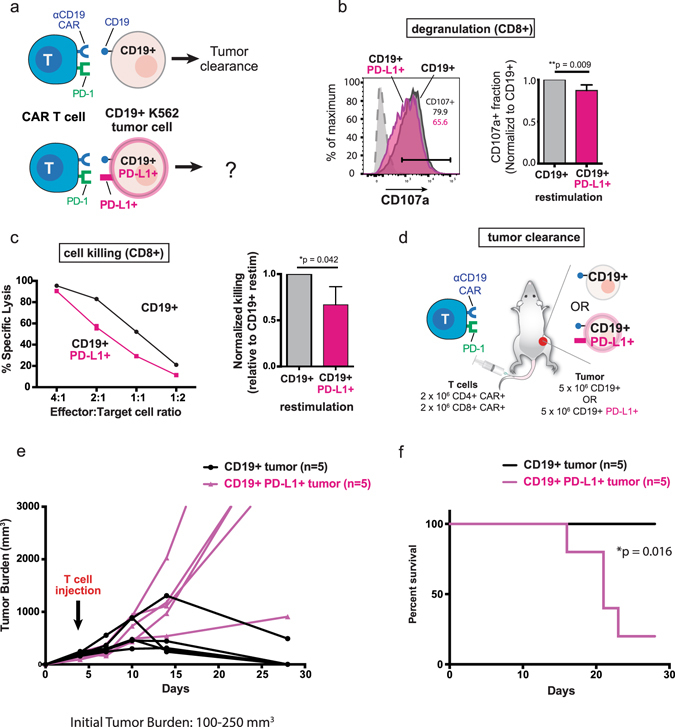
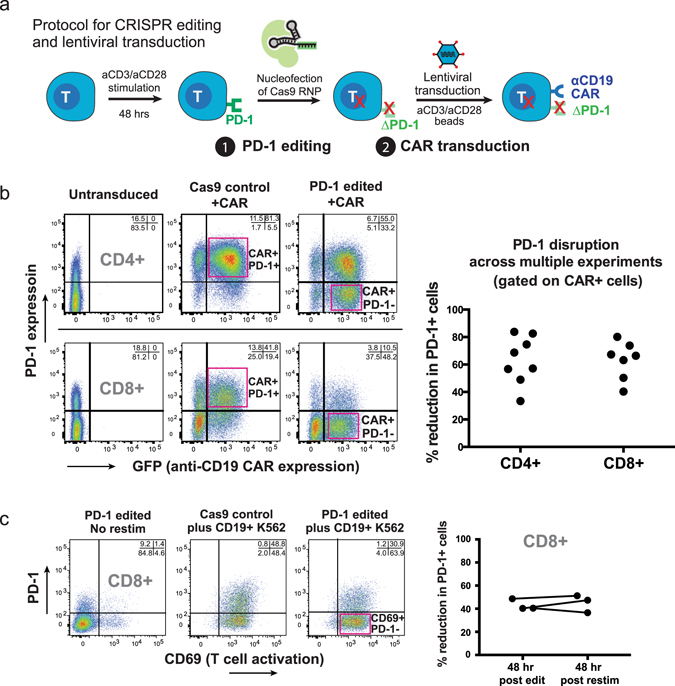
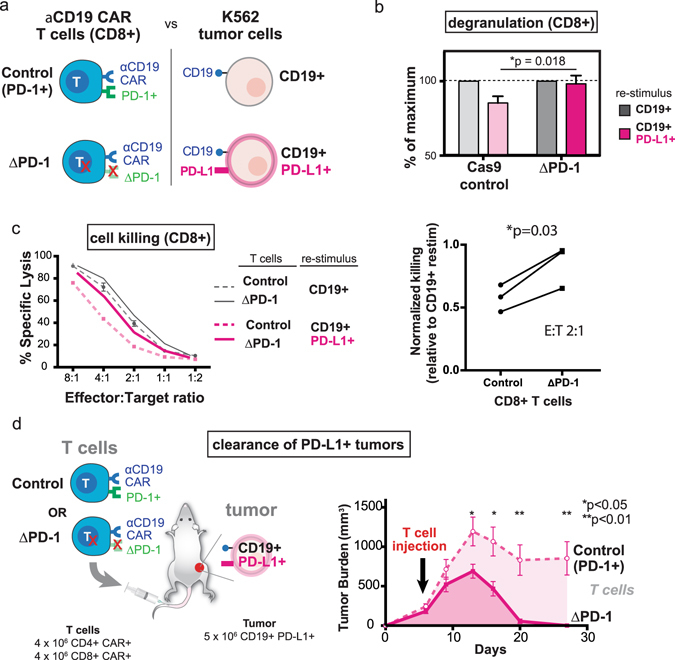
Immunotherapies with chimeric antigen receptor (CAR) T cells and checkpoint inhibitors (including antibodies that antagonize programmed cell death protein 1 [PD-1]) have both opened new avenues for cancer treatment, but the clinical potential of combined disruption of inhibitory checkpoints and CAR T cell therapy remains incompletely explored. Here we show that programmed death ligand 1 (PD-L1) expression on tumor cells can render human CAR T cells (anti-CD19 4-1BBζ) hypo-functional, resulting in impaired tumor clearance in a sub-cutaneous xenograft model. To overcome this suppressed anti-tumor response, we developed a protocol for combined Cas9 ribonucleoprotein (Cas9 RNP)-mediated gene editing and lentiviral transduction to generate PD-1 deficient anti-CD19 CAR T cells. Pdcd1 (PD-1) disruption augmented CAR T cell mediated killing of tumor cells in vitro and enhanced clearance of PD-L1+ tumor xenografts in vivo. This study demonstrates improved therapeutic efficacy of Cas9-edited CAR T cells and highlights the potential of precision genome engineering to enhance next-generation cell therapies.
Overview
The claims and statistics of this paper haven’t been checked yet.
Free: it reads the open-access text and checks the first 5 claims that cite a source we can check. Create a free account to check every claim.
Integrity signals
Registry
Cites
Statistics
Figures
Verification
Claims the paper makes
The claims and statistics of this paper haven’t been checked yet.
Free: it reads the open-access text and checks the first 5 claims that cite a source we can check. Create a free account to check every claim.
Claims other papers make about this one
Each is checked against this paper’s own text: does it say what the citing paper says it does?
The check wasn’t confident either way, so it gives no verdict — never disputed.
In the citing paper
“Mouse cells lacking p53 are unable to effectively arrest cell cycle progression after DNA damage, leading to genomic instability [16].”
From A Review of Research on CRISPR/Cas9 Gene Editing Technology in Disease Treatment (2024) · cites this paper as [16]
Experimental — accuracy not yet measuredThe check wasn’t confident either way, so it gives no verdict — never disputed.
In the citing paper
“Donehower, L.A. and his team found that mice with the P53 gene knocked out exhibit a high frequency of spontaneous tumorigenesis, including lymphomas, osteosarcomas, and other types of tumors.”
From A Review of Research on CRISPR/Cas9 Gene Editing Technology in Disease Treatment (2024) · cites this paper as [16]
Experimental — accuracy not yet measuredThe check wasn’t confident either way, so it gives no verdict — never disputed.
In the citing paper
“This observation suggests that p53 plays a crucial role in tumor suppression.”
From A Review of Research on CRISPR/Cas9 Gene Editing Technology in Disease Treatment (2024) · cites this paper as [16]
Experimental — accuracy not yet measuredIn the citing paper
“CRISPR-Cas9 genetic ablation of checkpoint targets such as PD-1 in adoptive T cell therapies has also shown increased functionality in certain models and is being persued clinically (Ren et al., 2017; Rupp et al., 2017; Stadtmauer et al., 2020; Su et al., 2016).”
From Pooled Knockin Targeting for Genome Engineering of Cellular Immunotherapies (2020) · cites this paper as Rupp et al., 2017
Self-check
Percentages, sums and reported differences re-computed from the paper’s own numbers.
The self-check needs the paper’s full text.
Citations
Cites
PD-1 and PD-L1 Immune Checkpoint Blockade to Treat Breast Cancer
Hartkopf, A. D., Taran, F.-A., Wallwiener, M., Walter, C. B., Krämer, B., Grischke, E.-M., & Brucker, S. Y. (2016) · Breast Care · doi:10.1159/000453569 · Cited by 30,845
Safety, activity, and immune correlates of anti–PD-1 antibody in cancer
Topalian, S. L., Hodi, F. S., Brahmer, J. R., Gettinger, S. N., Smith, D. C., McDermott, D. F., Powderly, J. D., Carvajal, R. D., Sosman, J. A., Atkins, M. B., et al. (2012) · New England Journal of Medicine · doi:10.1056/nejmoa1200690 · Cited by 12,628
Safety and activity of anti-PD-L1 antibody in patients with advanced cancer
Brahmer, J. R., Tykodi, S. S., Chow, L. Q. M., Hwu, W.-J., Topalian, S. L., Hwu, P., Drake, C. G., Camacho, L. H., Kauh, J., Odunsi, K., et al. (2012) · New England Journal of Medicine · doi:10.1056/nejmoa1200694 · Cited by 7,945
Chimeric Antigen Receptor T Cells for Sustained Remissions in Leukemia
Maude, S. L., Frey, N., Shaw, P. A., Aplenc, R., Barrett, D. M., Bunin, N. J., Chew, A., Gonzalez, V. E., Zheng, Z., Lacey, S. F., et al. (2014) · New England Journal of Medicine · doi:10.1056/nejmoa1407222 · Cited by 5,413
PD-1 and Its Ligands in Tolerance and Immunity
Keir, M. E., Butte, M. J., Freeman, G. J., & Sharpe, A. H. (2008) · Annual Review of Immunology · doi:10.1146/annurev.immunol.26.021607.090331 · Cited by 5,378
Restoring function in exhausted CD8 T cells during chronic viral infection
Barber, D. L., Wherry, E. J., Masopust, D., Zhu, B., Allison, J. P., Sharpe, A. H., Freeman, G. J., & Ahmed, R. (2006) · Nature · doi:10.1038/nature04444 · Cited by 3,986
PD-1 Blockade with Nivolumab in Relapsed or Refractory Hodgkin's Lymphoma
Ansell, S. M., Lesokhin, A. M., Borrello, I., Halwani, A., Scott, E. C., Gutierrez, M., Schuster, S. J., Millenson, M. M., Cattry, D., Freeman, G. J., et al. (2015) · New England Journal of Medicine · doi:10.1056/nejmoa1411087 · Cited by 3,560
Wang, H., Yang, H., Shivalila, C. S., Dawlaty, M. M., Cheng, A. W., Zhang, F., & Jaenisch, R. (2013) · Cell · doi:10.1016/j.cell.2013.04.025 · Cited by 3,495
Metabolic Competition in the Tumor Microenvironment Is a Driver of Cancer Progression
Chang, C.-H., Qiu, J., O’Sullivan, D., Buck, M. D., Noguchi, T., Curtis, J. D., Chen, Q., Gindin, M., Gubin, M. M., van der Windt, G. J. W., et al. (2015) · Cell · doi:10.1016/j.cell.2015.08.016 · Cited by 3,331
High-fidelity CRISPR-Cas9 nucleases with no detectable genome-wide off-target effects
Kleinstiver, B. P., Pattanayak, V., Prew, M. S., Tsai, S. Q., Nguyen, N. T., Zheng, Z., & Joung, J. K. (2016) · Nature · doi:10.1038/nature16526 · Cited by 2,673
Cited by
Items 501–600 of 757
Hang, Y., Huang, J., Ding, M., Shen, Y., Zhou, Y., & Cai, W. (2024) · International Immunopharmacology · doi:10.1016/j.intimp.2024.112820 · Cited by 8
Nguyen, D. A. H., & Quang, M. T. (2025) · Molecular Biotechnology · doi:10.1007/s12033-025-01533-2 · Cited by 13
“CRISPR-mediated deletion of PDCD1 (encoding PD-1 ) has emerged as a powerful strategy to maintain CAR-T effector function in hostile TMEs [136, 143].”
Ji, F., Yan, K., Ding, B., Zhu, Y., Rao, M., Gao, K., Lin, H., Shan, Y., Liu, S., Xiao, Z., et al. (2025) · Oncogene · doi:10.1038/s41388-025-03663-y · Cited by 12
Synthetic Biology Technologies And Genetically Engineering Strategies For Enhanced Cell Therapeutics
Li, S., Tang, H., Li, C., Ma, J., Ali, M., Dong, Q. R., Wu, J., Hui, Y., & Sun, C. (2022) · Stem Cell Reviews and Reports · doi:10.1007/s12015-022-10454-5 · Cited by 9
Exploration of T cell immune responses by expression of a dominant-negative SHP1 and SHP2
Taylor, J., Bulek, A. M., Gannon, I., Robson, M. P., Kokalaki, E., Grothier, T., McKenzie, C., El-Kholy, M., Stavrou, M., Traynor-White, C., et al. (2023) · Frontiers in Immunology · doi:10.3389/fimmu.2023.1119350 · Cited by 9
“Current efforts have focused on individual surface receptors such as ablation of PD1 through the expression of siRNA or genomic editing (33, 34), or expression of dominant negative and “switch receptor” variants of PD1 (9, 35).”
BackgroundSelf-citationChimeric Antigen Receptors for the Tumour Microenvironment
Habib, R., Nagrial, A. M., Micklethwaite, K. P., & Gowrishankar, K. (2020) · Advances in experimental medicine and biology · doi:10.1007/978-3-030-44518-8_8 · Cited by 8
Marotte, L., Capitao, M., Deleine, C., Beauvais, T., Cadiou, G., Perrin, J., Chérel, M., Scotet, E., Guilloux, Y., Bruchertseifer, F., et al. (2021) · OncoImmunology · doi:10.1080/2162402x.2021.1940676 · Cited by 8
An overview of multiplexed analyses of CAR T-cell therapies: insights and potential
DePriest, B. P., Vieira, N., Bidgoli, A., & Paczesny, S. (2021) · Expert Review of Proteomics · doi:10.1080/14789450.2021.1992276 · Cited by 9
“regularly interspaced short palindromic repeats (CRISPR) technology [118].”
BackgroundImmunotherapy to get on point with base editing
Harbottle, J. A. (2021) · Drug Discovery Today · doi:10.1016/j.drudis.2021.04.003 · Cited by 8
A Pan-RNase Inhibitor Enabling CRISPR-mRNA Platforms for Engineering of Primary Human Monocytes
Laoharawee, K., Johnson, M. J., Lahr, W. S., Sipe, C. J., Kleinboehl, E., Peterson, J. J., Lonetree, C.-L., Bell, J. B., Slipek, N. J., Crane, A. T., et al. (2022) · International Journal of Molecular Sciences · doi:10.3390/ijms23179749 · Cited by 7
Protein Engineering Paving the Way for Next-Generation Therapies in Cancer
Naderiyan, Z., & Shoari, A. (2025) · International Journal of Translational Medicine · doi:10.3390/ijtm5030028 · Cited by 8
“Moreover, CRISPR can be used to disrupt immune checkpoint genes (e.g., PD-1) or endogenous T-cell receptors to enhance the persistence, potency, and safety of CAR T cells in clinical applications [70].”
Huang, M., Ewadi, A., Servatian, N., Noormohamadi, H., Aminov, Z., Muzammil, K., Esfahani, M. A., Abak, N., & Samarkhazan, H. S. (2025) · Critical Reviews in Oncology/Hematology · doi:10.1016/j.critrevonc.2025.104916 · Cited by 9
Paving the road to make chimeric antigen receptor‐T‐cell therapy effective against solid tumors
Adachi, K., & Tamada, K. (2022) · Cancer Science · doi:10.1111/cas.15552 · Cited by 8
Discovery and engineering of AiEvo2, a novel Cas12a nuclease for human gene editing applications
Sharrar, A. M., de Tacca, L. A., Meacham, Z. A., Staples-Ager, J., Collingwood, T. N., Rabuka, D., & Schelle, M. W. (2024) · Journal of Biological Chemistry · doi:10.1016/j.jbc.2024.105685 · Cited by 8
Current Insights into CAR T-Cell-Based Therapies for Myelodysplastic Syndrome
Gandhi, M., Sharma, B., Nair, S., & Vaidya, A. D. B. (2024) · Pharmaceutical Research · doi:10.1007/s11095-024-03761-8 · Cited by 7
“As such, PD-1 down-regulation can be achieved by various ways such as by inhibiting GSK-3 expression in CAR T-cells [73] and by PD-1 gene knockout achieved by CRISPR/Cas9 gene editing [74].”
Therapeutic advantage of combinatorial chimeric antigen receptor T cell and chemotherapies
Ward, M. B., Jones, A. B., & Krenciute, G. (2024) · Pharmacological Reviews · doi:10.1124/pharmrev.124.001070 · Cited by 8
Yang, Y., Zhou, J., Cao, C., Cai, P., Wang, X., Chang, C., Wang, J., & Zhang, Q. (2020) · Translational Cancer Research · doi:10.21037/tcr-20-72 · Cited by 6
Understanding on CRISPR/Cas9 mediated cutting-edge approaches for cancer therapeutics
Bhattacharjee, R., Roy, L. D., & Choudhury, A. (2022) · Discover Oncology · doi:10.1007/s12672-022-00509-x · Cited by 7
“utilized CRISPR/Cas9 to disrupt the PD1 gene and found marked improvement in CAR-T cell anti-tumour effect, both in-vitro and in-vivo [28].”
MethodApproaches towards biomaterial-mediated gene editing for cancer immunotherapy
Shannon, S. R., Ben‐Akiva, E., & Green, J. J. (2022) · Biomaterials Science · doi:10.1039/d2bm00806h · Cited by 7
Shen, J., Yang, D., & Ding, Y. (2022) · Cancers · doi:10.3390/cancers14205018 · Cited by 9
“There is also research evidence that PD-1-deficient CAR-T cells based on lentiviral transduction and CRISPR (clustered regularly interspersed short palindromic repeats)-associated protein (Cas9) ribonucleoprotein particle (RNP)-mediated gene editing is a feasible solution of improving therapeutic efficacy [17].”
BackgroundBiggi, A. F. B., & Simioni, P. U. (2019) · Revista da Faculdade de Ciências Médicas de Sorocaba · doi:10.23925/1984-4840.2019v21i1a2 · Cited by 9
“These results indicated that the deactivation of PD-1 in CAR T lymphocytes using the CRISPR-Cas9 method increases the antitumor response of these cells.(49) A group of scientists are performing the first test of the CRISPR-Cas9 method for the treatment of NSCLC in humans.”
BackgroundRegulatory T cell dysfunction and immunotherapeutic breakthroughs in type 1 diabetes
Zhou, K.-J., Rong, S.-J., Liu, Y.-C., Sun, F., Wang, T., Yu, Q.-L., & Wang, C.-Y. (2026) · Frontiers in Endocrinology · doi:10.3389/fendo.2025.1740102 · Cited by 10
Song, L., Liao, Y., Shu, Y., Shao, W., Zhu, C., Zhang, H., Guo, Y., & Zhang, W. (2026) · TransMed · doi:10.1016/j.tmed.2026.100021 · Cited by 7
Immunotherapy and CRISPR Cas Systems: Potential Cure of COVID-19?
He, X., & Zeng, X. X. (2022) · Drug Design Development and Therapy · doi:10.2147/dddt.s347297 · Cited by 8
“Another study also reports that CRISPR/Cas 9 technology engineered PD1 deficient anti-CD19 CAR-T cells demonstrated improved anti tumour effects in vivo.(184) CRISPR Cas technology can be utilized to knock out CD7 on CAR-T cells for the survival of CAR-T cells as they might kill among themselves due to the CAR recogni…”
BackgroundEnabling Precision Medicine with CRISPR-Cas Genome Editing Technology: A Translational Perspective
Ilahibaks, N. F., Hulsbos, M. J., Lei, Z., Vader, P., & Sluijter, J. P. G. (2022) · Advances in experimental medicine and biology · doi:10.1007/978-981-19-5642-3_20 · Cited by 11
Genetically enhanced T lymphocytes and the intensive care unit
Tat, T., Li, H., Constantinescu, C.-S., Onaciu, A., Chira, S., Osan, C., Paşca, S., Petrushev, B., Moisoiu, V., Micu, W.-T., et al. (2018) · Oncotarget · doi:10.18632/oncotarget.24637 · Cited by 6
“Up to date, CRISPR/Cas9 already proved its applicability in the field of immunotherapy by enhancing CAR-T cells potency by knock-out diverse genes with importance in target recognition and cytotoxic activity [53].”
BackgroundCancer diagnosis and immunotherapy in the age of CRISPR
Cook, P. J., & Ventura, A. (2018) · Genes Chromosomes and Cancer · doi:10.1002/gcc.22702 · Cited by 6
Nanomedicines as Multifunctional Modulators of Melanoma Immune Microenvironment
Carreira, B., Acúrcio, R. C., Matos, A. I., Peres, C., Pozzi, S., Vaskovich‐Koubi, D., Kleiner, R., Bento, M., Satchi‐Fainaro, R., & Florindo, H. F. (2020) · Advanced Therapeutics · doi:10.1002/adtp.202000147 · Cited by 7
Engineering precision therapies: lessons and motivations from the clinic
Xie, M., Viviani, M., & Fussenegger, M. (2020) · Synthetic Biology · doi:10.1093/synbio/ysaa024 · Cited by 11
Targeting cancer-associated glycans as a therapeutic strategy in leukemia
Saad, A. A. (2022) · All Life · doi:10.1080/26895293.2022.2049901 · Cited by 9
Moral Issues in the Natural Sciences and Technologies
van den Heever, J., & Jones, C. (2019) · doi:10.4102/aosis.2019.bk114 · Cited by 9
Evtimov, V. J., Nguyen, N.-Y. N., Hammett, M. V., Pupovac, A., Hudson, P. J., Zhuang, J., Lee, J., Kim, S., Trounson, A. O., Boyd, R. L., et al. (2025) · Molecular Therapy Oncology · doi:10.1016/j.omton.2025.200962 · Cited by 7
Kumar, A. V., Garg, V. K., & Buttar, H. S. (2025) · Elsevier eBooks · doi:10.1016/b978-0-443-22300-6.00044-9 · Cited by 14
Genome editing of immune checkpoints: CRISPR-mediated PD-1 inhibition in cancer
Mohammad, S. I. S., Kareem, A. K., Vasudevan, A., Rekha, M. M., Jabir, M. S., Nayak, P. P., AlKhafaje, Z., Arora, V., Kadhum, W. R., & Chennakesavulu, K. (2025) · Seminars in Oncology · doi:10.1016/j.seminoncol.2025.152438 · Cited by 7
Makni‐Maalej, K., Alotaibi, S., Fernandes, Q., Ahmed, S. O., Mestiri, S., Bougarn, S., Amir, W., Syed, F., Kharfan‐Dabaja, M. A., Merhi, M., et al. (2026) · Frontiers in Immunology · doi:10.3389/fimmu.2026.1762453 · Cited by 7
Tulsian, K., Thakker, D., & Vyas, V. K. (2025) · International Journal of Biological Macromolecules · doi:10.1016/j.ijbiomac.2025.141364 · Cited by 6
Tian, R., Tian, X., Meiying, Y., Song, Y., Zhao, T., Zhong, C., Zhu, W. Z., Zhou, P., Han, Z., & Hu, Z. (2025) · Science Advances · doi:10.1126/sciadv.adu7334 · Cited by 7
Advances in research on factors affecting chimeric antigen receptor T‐cell efficacy
Zhou, D., Zhu, X., & Xiao, Y. (2024) · Cancer Medicine · doi:10.1002/cam4.7375 · Cited by 6
Insight into the natural regulatory mechanisms and clinical applications of the CRISPR-Cas system
Cheng, H., Deng, H., Ma, D., Gao, M., Zhou, Z., Li, H., Liu, S., & Teng, T. (2024) · Heliyon · doi:10.1016/j.heliyon.2024.e39538 · Cited by 8
“By introducing defective phenotypes of PD-1 [68], [69], TGF-β receptor II (TGFBR2) [70], CD7 and TRAC [71], the circulating number of TCR-T cells is increased.”
BackgroundTherapeutic status and the prospect of CRISPR/Cas9 gene editing in multiple myeloma
Hong, L., Zhang, C., Jiang, Y., Liu, H., Huang, H., & Guo, D. (2020) · Future Oncology · doi:10.2217/fon-2019-0822 · Cited by 5
Precision Medicine in Lung Cancer
Joshi, E., Nanayakkara, B., Barnes, D. J., & Troy, L. K. (2020) · EMJ Oncology · doi:10.33590/emjoncol/19-00145 · Cited by 5
“Off-the-shelf” immunotherapies for multiple myeloma
Mohammed, T. J., & Mailankody, S. (2022) · Seminars in Oncology · doi:10.1053/j.seminoncol.2022.01.001 · Cited by 7
Castiello, L., Santodonato, L., Napolitano, M., Carlei, D., Montefiore, E., Monque, D. M., D’Agostino, G., & Aricò, E. (2022) · Cancers · doi:10.3390/cancers14215351 · Cited by 5
Toward the clinical development of synthetic immunity to cancer
Garcia, J. M., Burnett, C. E., & Roybal, K. T. (2023) · Immunological Reviews · doi:10.1111/imr.13245 · Cited by 11
Self-citationImproving Cancer Immunotherapy with CRISPR‐Based Technology
Li, Z., & Teng, F. (2020) · Advanced Biosystems · doi:10.1002/adbi.201900253 · Cited by 7
Modified Hypoxia-Inducible Factor Expression in CD8+ T Cells Increases Antitumor Efficacy
Johnson, R. S., Veliça, P., Cunha, P. P., Vojnovic, N., Foskolou, I. P., Bargiela, D., Gojković, M., & Rundqvist, H. (2021) · Apollo (University of Cambridge) · doi:10.17863/cam.65798 · Cited by 5
A unified genetic perturbation language for human cellular programmingPreprint
Hartman, A., Takacsi-Nagy, O., Kernick, C., Theberath, N. E., Lu, J., Wu, L., Mantilla, M., Mittra, S., McClellan, A. K., Johnson, N., et al. (2025) · bioRxiv (Cold Spring Harbor Laboratory) · doi:10.1101/2025.11.20.689421 · Cited by 7
Adoptive cell therapy for HBV-associated liver diseases
Zhou, Y., Chen, K., Zhang, Y., Cheng, H., & Zhang, S. (2025) · Biomedical Technology · doi:10.1016/j.bmt.2025.100116 · Cited by 4
Hsieh, H.-J., Urak, R. Z., Clark, M. C., Kwak, L. W., Forman, S. J., & Wang, X. (2025) · Molecular Therapy — Methods & Clinical Development · doi:10.1016/j.omtm.2025.101421 · Cited by 5
Therapeutic T cells with 3-in-1 strategy for the treatment of biliary tract cancer
Wan, X., Zhao, J., Yang, X., Mou, X., Liu, B., Gao, B., Gu, W., & Zhao, H. (2025) · Cell Reports Medicine · doi:10.1016/j.xcrm.2025.102349 · Cited by 6
“Strategies to overcome this include anti-PD-1 antibodies, 13,14 disrupting PD-1 in CAR-T via CRISPR-Cas9, 15 or expressing dominant-negative PD-1 extracellular domains on CAR-T.”
CAR-T cell therapy: A therapeutic strategy for cancer treatment
Sharif, S., Sharma, U., & Yadav, A. K. (2025) · Seminars in Oncology · doi:10.1016/j.seminoncol.2025.152430 · Cited by 6
Huang, M., Wang, S., Huang, H., Li, L., & Wang, T. (2025) · Frontiers in Immunology · doi:10.3389/fimmu.2025.1705354 · Cited by 7
Next generation CAR-T cells to tackle solid tumors
Abreu, T. R., Godinho‐Santos, A., Amaral, A. T., Paiva, A. A., Moreira, J. N., & Gonçalves, J. R. M. (2026) · Journal of Controlled Release · doi:10.1016/j.jconrel.2026.114650 · Cited by 9
Fumagalli, M., An, D., Simula, L., Combe, C., Aziez, L., Simoni, Y., Alves‐Guerra, M., Valentini, A., Marchais, M., Vermare, A., et al. (2026) · Molecular Therapy · doi:10.1016/j.ymthe.2026.04.009 · Cited by 6
T lymphocytes as therapeutic arsenal for patients with hematological malignancies
Montoro, J., Piñana, J. L., Sanz, J., & Guerreiro, M. (2018) · Current Opinion in Oncology · doi:10.1097/cco.0000000000000481 · Cited by 4
Advanced strategies in improving the immunotherapeutic effect of CAR‐T cell therapy
Wang, M., Jia, L., Dai, X., & Zhang, X. (2024) · Molecular Oncology · doi:10.1002/1878-0261.13621 · Cited by 10
A platform to deliver single and bi-specific Cas9/guide RNA to perturb genes in vitro and in vivo
Li, Y., Chien, S., Huang, R., Herrmann, A., Zhao, Q., Li, P.-C., Zhang, C., Martincuks, A., Santiago, N. L., Zong, K., et al. (2024) · Molecular Therapy · doi:10.1016/j.ymthe.2024.07.025 · Cited by 9
The road ahead for chimeric antigen receptor T cells
Stewart, C. M., Siegler, E. L., & Kenderian, S. S. (2025) · The Journal of Immunology · doi:10.1093/jimmun/vkaf047 · Cited by 4
New horizons in early drugs development in solid cancers
Kotecki, N., Kindt, N., Krayem, M., & Awada, A. H. (2021) · Current Opinion in Oncology · doi:10.1097/cco.0000000000000766 · Cited by 4
“Strategies to enhance the therapeutic index of CAR-T cells comprise but are not limited to a better selection of the on-target antigen, approaches to overcome immunosuppressive tumor microenvironnement, whereas combining with checkpoint inhibitors and/or immunomodulators, and the use of better CAR-T cells conferred fo…”
BackgroundNardo, M., Motta, T. C., Colli, L. M., & Avanzi, M. P. (2021) · Hematology Transfusion and Cell Therapy · doi:10.1016/j.htct.2021.09.011 · Cited by 9
Secretory co-factors in next-generation cellular therapies for cancer
Okuma, A., Ishida, Y., Kawara, T., Hisada, S., & Araki, S. (2022) · Frontiers in Immunology · doi:10.3389/fimmu.2022.907022 · Cited by 5
“For instance, programmed cell death protein 1 (PD1) knockout CAR T cells can avoid PD-1–PD-L1 (programmed death-ligand 1) immune checkpoint signals (64), whereas dominant-negative transforming growth factor–b (TGF-b) receptor–expressing CAR T cells can attenuate Treg maintenance by blocking TGF-b (65).”
BackgroundChen, Y.-J., Chen, M. J., Cheng, T., Tsai, Y.-S., Wang, C.-H., Chen, C.-Y., Wu, T.-Y., Tzou, S.-C., Wang, K., Cheng, J., et al. (2023) · Journal of Biomedical Science · doi:10.1186/s12929-023-00929-z · Cited by 6
“These strategies focus on improving the anti-tumor effects of CAR-T cells by preventing PD-1/PD-L1-mediated immunosuppression [29].”
BackgroundThe CRISPR System and Cancer Immunotherapy Biomarkers
Balan, V., & Wang, J. (2019) · Methods in molecular biology · doi:10.1007/978-1-4939-9773-2_14 · Cited by 4
Zhang, J., Hu, Y., Yang, J., Li, W., Tian, Y., Wei, G., Zhang, L., Zhao, K., Qi, Y., Tan, B., et al. (2020) · medRxiv · doi:10.1101/2020.09.22.20199786 · Cited by 5
A comparative review of DNA assembly strategies: From traditional to modern
Ta, H. K. K., Dang, L. M., & Nguyen, L. T. T. (2025) · Gene Reports · doi:10.1016/j.genrep.2025.102376 · Cited by 5
Bonini, C. (2025) · Hematology · doi:10.1182/hematology.2025000681 · Cited by 3
Advancing adoptive T cell therapy in ovarian cancer: barriers, innovations, and emerging platforms
Santos, G. N. D. S., DeJohn, C. R., Hess, S. M., Zsíros, E., & McGray, A. R. (2026) · Journal for ImmunoTherapy of Cancer · doi:10.1136/jitc-2025-013285 · Cited by 3
“138 139 Recent work by Tieu et al introduced the multiplexed effector guide arrays platform, which leverages CRISPR-Cas13d to regulate T cell transcriptomes.”
Yadav, V., Yadav, P., Mallappa, S., & Neeli, P. (2026) · Biomedicines · doi:10.3390/biomedicines14061276 · Cited by 7
“In principle, this approach could be used to disrupt endogenous T cell checkpoints (such as PD1, CTLA4, and LAG3) at the same time as introducing a CAR, thereby generating CAR-T cells with enhanced persistence and reduced exhaustion directly within the patient [140].”
Zuo, S., Cheng, N., Hou, Z., Yang, Y., Tian, Q., & Yisheng, X. (2026) · Frontiers in Immunology · doi:10.3389/fimmu.2026.1865742 · Cited by 3
Berger, T. R., Boardman, A., Brentjens, R. J., & Maus, M. V. (2022) · Cancer drug discovery and develogment/Cancer drug discovery and development · doi:10.1007/978-3-030-87849-8_3 · Cited by 4
Neurosurgical Management of Malignancy: The Role of Biopsy and Resection
Nelson, J., Matheson, D. J., Omoba, O. E., Winterton, C., Rawson, C. D., Kurudza, E., & Lucke-Wold, B. P. (2024) · Interdisciplinary cancer research · doi:10.1007/16833_2024_236 · Cited by 3
A singular base-editing platform for polyfunctional multiplex engineering of immune cells
Skeate, J. G., Slipek, N. J., Lahr, W. S., Roy, S., Wick, B. J., Kar, B., Chang, J.-W., Stelljes, E. M., Gilkey, A. K., Thenge, P. P., et al. (2026) · Molecular Therapy · doi:10.1016/j.ymthe.2026.07.033 · Cited by 3
Kiseleva, Y. Y., Шишкин, А. М., Ivanov, A. V., Михайловна, К. Т., & Bozhenko, K. V. (2019) · Вестник Российского государственного медицинского университета · doi:10.24075/brsmu.2019.066 · Cited by 5
Next Generation of Adoptive T Cell Therapy Using CRISPR/Cas9 Technology: Universal or Boosted?
Wälchli, S., & Sioud, M. (2020) · Methods in molecular biology · doi:10.1007/978-1-0716-0290-4_22 · Cited by 4
Editing of Endogenous Genes in Cellular Immunotherapies
Roth, T. L. (2020) · Current Hematologic Malignancy Reports · doi:10.1007/s11899-020-00587-0 · Cited by 3
High-efficiency of genetic modification using CRISPR/Cpf1 system for engineered CAR-T cell therapy
Ding, R., Chao, C., & Gao, Q. (2022) · Methods in cell biology · doi:10.1016/bs.mcb.2021.08.001 · Cited by 4
Rapid and efficient generation of antigen‐specific isogenic T cells from cryopreserved blood samples
Eerkens, A. L., Vledder, A., van Rooij, N., Foijer, F., Nijman, H. W., & de Bruyn, M. (2022) · Immunology and Cell Biology · doi:10.1111/imcb.12538 · Cited by 3
Ha, J. Y., Chun, K.-J., Ko, S., Lee, H., Hwang, O. K., Lim, C. S., Ha, K., Ko, B. J., & Jung, S. T. (2023) · Molecular Pharmaceutics · doi:10.1021/acs.molpharmaceut.3c00003 · Cited by 3
Novel technologies for applying immune checkpoint blockers
Awad, R. M., & Breckpot, K. (2023) · International review of cytology · doi:10.1016/bs.ircmb.2023.03.003 · Cited by 3
Svec, M., Dötsch, S., Warmuth, L., Trebo, M., Fräßle, S. P., Riddell, S. R., Jaeger, U., D’Ippolito, E., & Busch, D. H. (2024) · Frontiers in Immunology · doi:10.3389/fimmu.2023.1268698 · Cited by 4
Gene Therapy Approaches in HIV Treatment
Kothawade, S. N., Wagh, V. S., Pande, V. V., & Lunkad, A. S. (2024) · Infectious diseases · doi:10.5772/intechopen.112138 · Cited by 4
Al-Janabi, I. I. (2024) · Al-Rafidain Journal of Medical Sciences · doi:10.54133/ajms.v6i2.726 · Cited by 3
Ursch, L. T., Müschen, J. S., Ritter, J. M., Klermund, J., Bernard, B. E., Kolb, S., Warmuth, L., Andrieux, G., Miller, G., Jiménez‐Muñoz, M., et al. (2024) · Cell Reports Medicine · doi:10.1016/j.xcrm.2024.101846 · Cited by 4
Self-citationNanomedicine in Immunotherapy for Non‐Small Cell Lung Cancer: Applications and Perspectives
Liao, S., Li, X., Lü, Y., & Luo, K. (2025) · Small Methods · doi:10.1002/smtd.202401783 · Cited by 4
Shams, F., Sharif, E., Abbasi‐Kenarsari, H., Hashemi, N., Hosseini, M. S., Heidari, N., Noori, E., Amini, A. H., Bazrgar, M., Rouhani, M., et al. (2025) · Current Gene Therapy · doi:10.2174/0115665232357078250331180413 · Cited by 9
Combining immunotherapies to treat non-small cell lung cancer
Spagnuolo, A., & Gridelli, C. (2019) · Expert Review of Respiratory Medicine · doi:10.1080/17476348.2019.1623027 · Cited by 3
“, the destruction of PD-1 by CRISPR/Cas 9-mediated gene editing within CAR-T cells improved the CAR-T cell function, suggesting the high potential of precision genomic engineering for new-generation cell therapies [72].”
Gao, C., Song, Q., Zhang, M., Li, J., Miao, Y., Li, Z., & Dong, J. (2020) · Molecular Immunology · doi:10.1016/j.molimm.2020.05.007 · Cited by 3
A brief review concerning Chimeric Antigen Receptors T cell therapy
Li, L.-L., Yuan, H., Yang, Y., Wang, L., & Zou, R. (2020) · Journal of Cancer · doi:10.7150/jca.46308 · Cited by 3
New indications and platforms for CAR‐T therapy in lymphomas beyond DLBCL
Iqbal, M., Savani, B. N., & Hamadani, M. (2021) · eJHaem · doi:10.1002/jha2.323 · Cited by 2
“4 can enable CAR-T to avoid exhaustion, improve persistence, and evade immunologic response [79, 89, 90].”
BackgroundCRISPR technology for immuno-oncology applications
Wang, J., Balan, V., & Marincola, F. M. (2019) · Methods in enzymology on CD-ROM/Methods in enzymology · doi:10.1016/bs.mie.2019.05.018 · Cited by 3
Advances in engineering and synthetic biology toward improved therapeutic immune cells
Mai, D. H., Sheppard, N. C., & Levine, B. L. (2021) · Current Opinion in Biomedical Engineering · doi:10.1016/j.cobme.2021.100342 · Cited by 3
PARP11 interfer(on)es with CAR T cell efficacy
Munoz, I., & Beavis, P. A. (2022) · Nature Cancer · doi:10.1038/s43018-022-00406-w · Cited by 3
Editorial on “Cell Therapy, Bispecific Antibodies and Other Immunotherapies against Cancer”
Golubovskaya, V. (2023) · Cancers · doi:10.3390/cancers15205053 · Cited by 3
Dhara, C., Sah, H., Gantayat, S., Rajput, M., & Mishra, S. (2026) · Molecular Biology Reports · doi:10.1007/s11033-026-11815-w · Cited by 4
The hotspots and publication trends in glioblastoma and CAR-T immunotherapy: A bibliometric analysis
Song, Z., Yang, C., Gu, J., Qu, R., Xie, Y., Guo, Y., Nong, X., Chen, Z., & Wang, Z. (2025) · Human Vaccines & Immunotherapeutics · doi:10.1080/21645515.2025.2509483 · Cited by 3
Zhang, Y., Lei, Y., Huang, Y., Gao, Y., Liu, R., Guo, K., Zhao, C., & Lei, M. (2025) · Molecular Biology Reports · doi:10.1007/s11033-025-11317-1 · Cited by 2
“…their antitumor activity and effi - cacy in an ex vivo model of MM. PD-1 knockdown signifi - cantly enhances the cytotoxicity and functional durability of CAR-T cells, effectively kills tumor cells, inhibits tumor growth, and significantly promotes tumor regression and recurrence control [95 ].”
My, B., Lia, A., Rizzo, L., Maiorano, G., Galeone, A., Palamà, I. E., & Gigli, G. (2026) · iScience · doi:10.1016/j.isci.2026.115422 · Cited by 2
“54 Schumann et al. achieved efficient knock-in and knock-out editing in primary human T cells without viral vectors, illustrating a broadly applicable Cas9 ribonucleoprotein (RNP) method, 55 and the first-in-human trial of CRISPR-engi-neered T cells, disrupting PD1 and endogenous, demonstrated…”
Application of CAR-T therapy in solid tumors: current opportunities and challenges
Wang, A., Ye, X., Zhao, Y., Huang, D., & Zhang, C. (2026) · Cancer Gene Therapy · doi:10.1038/s41417-026-01033-8 · Cited by 4
Yang, Q., Wang, S., Liu, F., Yu, Y., & Zhao, H. (2026) · Frontiers in Immunology · doi:10.3389/fimmu.2026.1847986 · Cited by 4
Dawn of chimeric antigen receptor T cell therapy in non-Hodgkin Lymphoma
Perica, K., Palomba, M. L., & Brentjens, R. J. (2018) · Advances in Cell and Gene Therapy · doi:10.1002/acg2.23 · Cited by 2
Metadata
- Authors
- Rupp, L. J., Schumann, K., Roybal, K. T., Gate, R. E., Ye, C. J., Lim, W. A., & Marson, A.
- Affiliations
- Howard Hughes Medical Institute (US)
- University of California, San Francisco (US)
- Corresponding author
- Lim, Wendell A.
- Venue
- Scientific Reports
- Published
- 2017-04-07
- Volume
- 7
- Issue
- 1
- Pages
- 737-737
- ISSN
- 2045-2322 (ISSN-L)
- PMC
- PMC5428439
- OpenAlex
- W2604982880
- Cited by
- 757
- References
- 39
- Citations by year
- 2026: 58 · 2025: 72 · 2024: 70 · 2023: 72 · 2022: 94 · 2021: 107 · 2020: 122 · 2019: 85 · 2018: 67 · 2017: 10
- FWCI
- 34.37
- Type
- journal article
- Language
- en
- Open access
- gold
- doi.org
- Licence
- cc-by
- creativecommons.org/licenses/by/4.0 (tdm)
- creativecommons.org/licenses/by/4.0 (vor)
- Locations
- Scientific Reports (publishedVersion, cc-by)
- PubMed Central (publishedVersion, cc-by)
- PubMed (publishedVersion)
- eScholarship (California Digital Library) (submittedVersion)
- DOAJ (DOAJ: Directory of Open Access Journals) (submittedVersion, cc-by-sa)
- KOPS (University of Konstanz) (submittedVersion, cc-by)
- Funders
- Howard Hughes Medical Institute (R01 CA196277)
- Burroughs Wellcome Fund
- Deutsche Forschungsgemeinschaft
- National Institutes of Health (EY016546)
- University of California, San Francisco
- National Eye Institute (PN2EY016546)
- National Cancer Institute (R01CA196277)
- National Institute of General Medical Sciences (T32GM067547, R01GM055040)
- National Institute of Allergy and Infectious Diseases (F32AI120352)
- Topics
- Health Sciences › Medicine › Oncology › CAR-T cell therapy research
- Health Sciences › Medicine › Oncology › Cancer Immunotherapy and Biomarkers
- Life Sciences › Biochemistry, Genetics and Molecular Biology › Molecular Biology › CRISPR and Genetic Engineering
- Keywords
- CRISPR/Cas9 genome editing, PD-1, PD-L1, chimeric antigen receptor T cells, CD19 CAR T cells, 4-1BB, lentiviral transduction, Cas9 ribonucleoprotein, cancer immunotherapy, antitumor efficacy, anti-PD-1 therapy
- MeSH terms
- Animals, Antigens, Neoplasm, Female, Humans, Neoplasms, Receptors, Antigen, T-Cell, T-Lymphocytes, Biomarkers, Gene Expression, Immunophenotyping, Mice, Knockout, Gene Targeting, Antigens, CD19, Cell Line, Tumor, Mice, Gene Knockdown Techniques, B7-H1 Antigen, Programmed Cell Death 1 Receptor, CRISPR-Cas Systems
About these checks
Registry, retraction, Cites and statistics results are computed, not judged, with one exception: a printed reference that no index lists is read once by a model before it counts as a citation error. Claims are extracted by a model and kept only when their quote appears verbatim in the text; each cited source is then checked, with a model’s help, for whether it says what the claim relies on. Those verdicts can be wrong — read the claim’s quote and the cited source before relying on one.
Statistics and arithmetic are recomputed, not judged.
Confidence bands are shown only for fields calibrated on our annotated test set. None is calibrated yet, so no band is shown.
What counts as a claim ›How we measure confidence ›How we check this ›
Are you an author, or do you see a problem with this page? Request a review
Data sources
Bibliographic data: Semantic Scholar, OpenAlex, Crossref.
Contains information from the Semantic Scholar Academic Graph Datasets, made available under the ODC Attribution License (ODC-BY 1.0).
Semantic Scholar’s data is described in: Kinney, R., et al. (2023). The Semantic Scholar Open Data Platform. arXiv:2301.10140.
