

CRISPR/Cas9-mediated PD-1 disruption enhances anti-tumor efficacy of human chimeric antigen receptor T cells
Open accessThe DOI matches its Crossref record; 38 of the 39 references it cites were found in a registry or an index.
Abstract
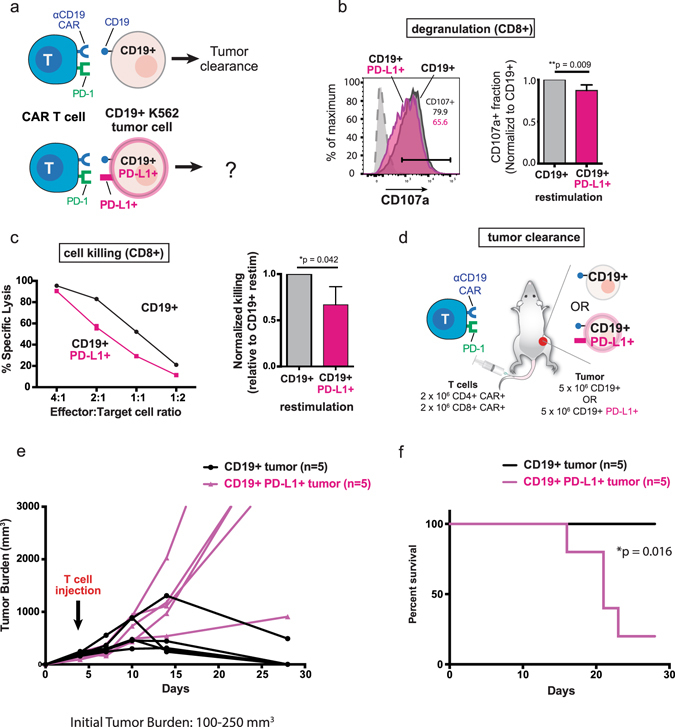
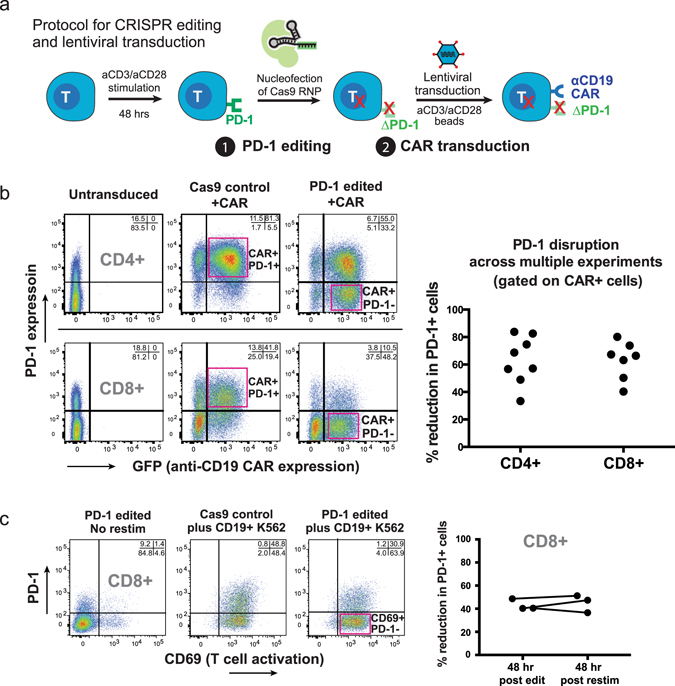
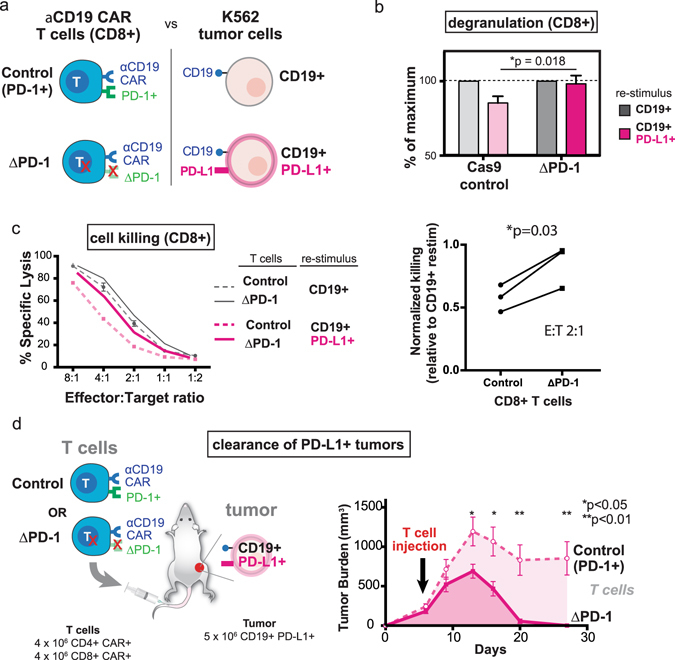
Immunotherapies with chimeric antigen receptor (CAR) T cells and checkpoint inhibitors (including antibodies that antagonize programmed cell death protein 1 [PD-1]) have both opened new avenues for cancer treatment, but the clinical potential of combined disruption of inhibitory checkpoints and CAR T cell therapy remains incompletely explored. Here we show that programmed death ligand 1 (PD-L1) expression on tumor cells can render human CAR T cells (anti-CD19 4-1BBζ) hypo-functional, resulting in impaired tumor clearance in a sub-cutaneous xenograft model. To overcome this suppressed anti-tumor response, we developed a protocol for combined Cas9 ribonucleoprotein (Cas9 RNP)-mediated gene editing and lentiviral transduction to generate PD-1 deficient anti-CD19 CAR T cells. Pdcd1 (PD-1) disruption augmented CAR T cell mediated killing of tumor cells in vitro and enhanced clearance of PD-L1+ tumor xenografts in vivo. This study demonstrates improved therapeutic efficacy of Cas9-edited CAR T cells and highlights the potential of precision genome engineering to enhance next-generation cell therapies.
Overview
The claims and statistics of this paper haven’t been checked yet.
Free: it reads the open-access text and checks the first 5 claims that cite a source we can check. Create a free account to check every claim.
Integrity signals
Registry
Cites
Statistics
Figures
Verification
Claims the paper makes
The claims and statistics of this paper haven’t been checked yet.
Free: it reads the open-access text and checks the first 5 claims that cite a source we can check. Create a free account to check every claim.
Claims other papers make about this one
Each is checked against this paper’s own text: does it say what the citing paper says it does?
The check wasn’t confident either way, so it gives no verdict — never disputed.
In the citing paper
“Mouse cells lacking p53 are unable to effectively arrest cell cycle progression after DNA damage, leading to genomic instability [16].”
From A Review of Research on CRISPR/Cas9 Gene Editing Technology in Disease Treatment (2024) · cites this paper as [16]
Experimental — accuracy not yet measuredThe check wasn’t confident either way, so it gives no verdict — never disputed.
In the citing paper
“Donehower, L.A. and his team found that mice with the P53 gene knocked out exhibit a high frequency of spontaneous tumorigenesis, including lymphomas, osteosarcomas, and other types of tumors.”
From A Review of Research on CRISPR/Cas9 Gene Editing Technology in Disease Treatment (2024) · cites this paper as [16]
Experimental — accuracy not yet measuredThe check wasn’t confident either way, so it gives no verdict — never disputed.
In the citing paper
“This observation suggests that p53 plays a crucial role in tumor suppression.”
From A Review of Research on CRISPR/Cas9 Gene Editing Technology in Disease Treatment (2024) · cites this paper as [16]
Experimental — accuracy not yet measuredIn the citing paper
“CRISPR-Cas9 genetic ablation of checkpoint targets such as PD-1 in adoptive T cell therapies has also shown increased functionality in certain models and is being persued clinically (Ren et al., 2017; Rupp et al., 2017; Stadtmauer et al., 2020; Su et al., 2016).”
From Pooled Knockin Targeting for Genome Engineering of Cellular Immunotherapies (2020) · cites this paper as Rupp et al., 2017
Self-check
Percentages, sums and reported differences re-computed from the paper’s own numbers.
The self-check needs the paper’s full text.
Citations
Cites
PD-1 and PD-L1 Immune Checkpoint Blockade to Treat Breast Cancer
Hartkopf, A. D., Taran, F.-A., Wallwiener, M., Walter, C. B., Krämer, B., Grischke, E.-M., & Brucker, S. Y. (2016) · Breast Care · doi:10.1159/000453569 · Cited by 30,845
Safety, activity, and immune correlates of anti–PD-1 antibody in cancer
Topalian, S. L., Hodi, F. S., Brahmer, J. R., Gettinger, S. N., Smith, D. C., McDermott, D. F., Powderly, J. D., Carvajal, R. D., Sosman, J. A., Atkins, M. B., et al. (2012) · New England Journal of Medicine · doi:10.1056/nejmoa1200690 · Cited by 12,628
Safety and activity of anti-PD-L1 antibody in patients with advanced cancer
Brahmer, J. R., Tykodi, S. S., Chow, L. Q. M., Hwu, W.-J., Topalian, S. L., Hwu, P., Drake, C. G., Camacho, L. H., Kauh, J., Odunsi, K., et al. (2012) · New England Journal of Medicine · doi:10.1056/nejmoa1200694 · Cited by 7,945
Chimeric Antigen Receptor T Cells for Sustained Remissions in Leukemia
Maude, S. L., Frey, N., Shaw, P. A., Aplenc, R., Barrett, D. M., Bunin, N. J., Chew, A., Gonzalez, V. E., Zheng, Z., Lacey, S. F., et al. (2014) · New England Journal of Medicine · doi:10.1056/nejmoa1407222 · Cited by 5,413
PD-1 and Its Ligands in Tolerance and Immunity
Keir, M. E., Butte, M. J., Freeman, G. J., & Sharpe, A. H. (2008) · Annual Review of Immunology · doi:10.1146/annurev.immunol.26.021607.090331 · Cited by 5,378
Restoring function in exhausted CD8 T cells during chronic viral infection
Barber, D. L., Wherry, E. J., Masopust, D., Zhu, B., Allison, J. P., Sharpe, A. H., Freeman, G. J., & Ahmed, R. (2006) · Nature · doi:10.1038/nature04444 · Cited by 3,986
PD-1 Blockade with Nivolumab in Relapsed or Refractory Hodgkin's Lymphoma
Ansell, S. M., Lesokhin, A. M., Borrello, I., Halwani, A., Scott, E. C., Gutierrez, M., Schuster, S. J., Millenson, M. M., Cattry, D., Freeman, G. J., et al. (2015) · New England Journal of Medicine · doi:10.1056/nejmoa1411087 · Cited by 3,560
Wang, H., Yang, H., Shivalila, C. S., Dawlaty, M. M., Cheng, A. W., Zhang, F., & Jaenisch, R. (2013) · Cell · doi:10.1016/j.cell.2013.04.025 · Cited by 3,495
Metabolic Competition in the Tumor Microenvironment Is a Driver of Cancer Progression
Chang, C.-H., Qiu, J., O’Sullivan, D., Buck, M. D., Noguchi, T., Curtis, J. D., Chen, Q., Gindin, M., Gubin, M. M., van der Windt, G. J. W., et al. (2015) · Cell · doi:10.1016/j.cell.2015.08.016 · Cited by 3,331
High-fidelity CRISPR-Cas9 nucleases with no detectable genome-wide off-target effects
Kleinstiver, B. P., Pattanayak, V., Prew, M. S., Tsai, S. Q., Nguyen, N. T., Zheng, Z., & Joung, J. K. (2016) · Nature · doi:10.1038/nature16526 · Cited by 2,673
Cited by
Items 101–200 of 757
Solid Tumors Challenges and New Insights of CAR T Cell Engineering
Tahmasebi, S., Elahi, R., & Esmaeilzadeh, A. (2019) · Stem Cell Reviews and Reports · doi:10.1007/s12015-019-09901-7 · Cited by 144
Sharpening the Molecular Scissors: Advances in Gene-Editing Technology
Broeders, M., Herrero-Hernandez, P., Ernst, M. P. T., van der Ploeg, A. T., & Pijnappel, W. W. M. P. (2019) · iScience · doi:10.1016/j.isci.2019.100789 · Cited by 130
“PD-1 knockout have been deployed to improve redirected T cells (Guo et al., 2018b; Hu et al., 2019a, 2019b; Lu et al., 2019; Ouchi et al., 2018; Rupp et al., 2017; Su et al., 2017), which were genetically altered to express a transgenic T cell receptor (tTCR) or a chimeric antigen receptor (CAR)…”
BackgroundGiuffrida, L., Sek, K., Henderson, M. A., House, I. G., Lai, J., Chen, A. X. Y., Todd, K. L., Petley, E. V., Mardiana, S., Todorovski, I., et al. (2020) · Molecular Therapy · doi:10.1016/j.ymthe.2020.07.018 · Cited by 113
Current state and next-generation CAR-T cells in multiple myeloma
Manier, S., Ingegnere, T., Escure, G., Prodhomme, C., Nudel, M., Mitra, S., & Facon, T. T. F. (2022) · Blood Reviews · doi:10.1016/j.blre.2022.100929 · Cited by 123
Immune Checkpoints and CAR-T Cells: The Pioneers in Future Cancer Therapies?
Hosseinkhani, N., Derakhshani, A., Kooshkaki, O., Abdoli Shadbad, M., Hajiasgharzadeh, K., Baghbanzadeh, A., Safarpour, H., Mokhtarzadeh, A., Brunetti, O., Yue, S., et al. (2020) · International Journal of Molecular Sciences · doi:10.3390/ijms21218305 · Cited by 107
Cancer organoid co-culture model system: Novel approach to guide precision medicine
Yuan, J., Li, X., & Yu, S. (2023) · Frontiers in Immunology · doi:10.3389/fimmu.2022.1061388 · Cited by 106
The Cellular Immunotherapy Revolution: Arming the Immune System for Precision Therapy
Paucek, R. D., Baltimore, D., & Li, G. (2019) · Trends in Immunology · doi:10.1016/j.it.2019.02.002 · Cited by 104
TCR Redirected T Cells for Cancer Treatment: Achievements, Hurdles, and Goals
Manfredi, F., Cianciotti, B. C., Potenza, A., Tassi, E., Noviello, M., Biondi, A., Ciceri, F., Bonini, C., & Ruggiero, E. (2020) · Frontiers in Immunology · doi:10.3389/fimmu.2020.01689 · Cited by 116
Nakazawa, T., Natsume, A., Nishimura, F., Morimoto, T., Matsuda, R., Nakamura, M., Yamada, S., Nakagawa, I., Motoyama, Y., Park, Y.-S., et al. (2020) · Cells · doi:10.3390/cells9040998 · Cited by 103
“also reported disruption of the PD-1 gene by an exon 1-targeting sgRNA (5′-CGACTGGCCAGGGCGCCTGT-3′) in second-generation CD19-redirected CAR-T cells [43].”
BackgroundHamilton, A. G., Swingle, K. L., Joseph, R. A., Mai, D. H., Gong, N., Billingsley, M. M., Alameh, M., Weissman, D., Sheppard, N. C., June, C. H., et al. (2023) · Advanced Healthcare Materials · doi:10.1002/adhm.202301515 · Cited by 114
Mollanoori, H., Shahraki, H., Rahmati, Y., & Teimourian, S. (2018) · Human Immunology · doi:10.1016/j.humimm.2018.09.007 · Cited by 110
Methods to manufacture regulatory T cells for cell therapy
MacDonald, K. N., Piret, J. M., & Levings, M. K. (2019) · Clinical & Experimental Immunology · doi:10.1111/cei.13297 · Cited by 106
Kato-Inui, T., Takahashi, G., Hsu, S., & Miyaoka, Y. (2018) · Nucleic Acids Research · doi:10.1093/nar/gky264 · Cited by 110
Wei, J., Luo, C., Wang, Y., Guo, Y., Dai, H., Tong, C., Ti, D., Wu, Z., & Han, W. (2019) · Journal for ImmunoTherapy of Cancer · doi:10.1186/s40425-019-0685-y · Cited by 118
Ready for Repair? Gene Editing Enters the Clinic for the Treatment of Human Disease
Ernst, M. P. T., Broeders, M., Herrero-Hernandez, P., Oussoren, E., van der Ploeg, A. T., & Pijnappel, W. W. M. P. (2020) · Molecular Therapy — Methods & Clinical Development · doi:10.1016/j.omtm.2020.06.022 · Cited by 108
In Vivo T Cell-Targeting Nanoparticle Drug Delivery Systems: Considerations for Rational Design
Cevaal, P. M., Ali, A., Czuba‐Wojnilowicz, E., Symons, J., Lewin, S. R., Cortez‐Jugo, C., & Caruso, F. (2021) · ACS Nano · doi:10.1021/acsnano.0c09514 · Cited by 106
Functional Genomics via CRISPR–Cas
Ford, K. M., McDonald, D., & Mali, P. (2018) · Journal of Molecular Biology · doi:10.1016/j.jmb.2018.06.034 · Cited by 106
Understanding CAR T cell-tumor interactions: Paving the way for successful clinical outcomes
Korell, F., Berger, T. R., & Maus, M. V. (2022) · Med · doi:10.1016/j.medj.2022.05.001 · Cited by 115
Strategies to enhance CAR-T persistence
Liu, Y., An, L., Huang, R., Xiong, J., Yang, H., Wang, X., & Zhang, X. (2022) · Biomarker Research · doi:10.1186/s40364-022-00434-9 · Cited by 97
Bo, M. D., Mattia, E. D., Baboçi, L., Mezzalira, S., Cecchin, E., Assaraf, Y. G., & Toffoli, G. (2020) · Drug Resistance Updates · doi:10.1016/j.drup.2020.100702 · Cited by 104
CRISPR screens for functional interrogation of immunity
Shi, H., Doench, J. G., & Chi, H. (2022) · Nature reviews. Immunology · doi:10.1038/s41577-022-00802-4 · Cited by 110
Humanized mouse models: Application to human diseases
Ito, R., Takahashi, T., & Ito, M. (2017) · Journal of Cellular Physiology · doi:10.1002/jcp.26045 · Cited by 107
“Anti-CD19 chimeric antigen receptor (CAR) T cells with genomic disruption of PD-1 have been generated by CRISPR/Cas9-based gene editing (Rupp et al., 2017).”
MethodA Bump in the Road: How the Hostile AML Microenvironment Affects CAR T Cell Therapy
Epperly, R., Gottschalk, S. M., & Velasquez, M. P. (2020) · Frontiers in Oncology · doi:10.3389/fonc.2020.00262 · Cited by 101
The Promise and Challenge of In Vivo Delivery for Genome Therapeutics
Wilson, R. C., & Gilbert, L. A. (2017) · ACS Chemical Biology · doi:10.1021/acschembio.7b00680 · Cited by 102
Determinants of response and resistance to CAR T cell therapy
Lesch, S., Benmebarek, M.-R., Cadilha, B. L., Stoiber, S., Subklewe, M. S., Endres, S., & Kobold, S. (2019) · Seminars in Cancer Biology · doi:10.1016/j.semcancer.2019.11.004 · Cited by 107
Engineering better chimeric antigen receptor T cells
Zhang, H., Zhao, P., & Huang, H. (2020) · Experimental Hematology & Oncology · doi:10.1186/s40164-020-00190-2 · Cited by 93
Advancing cell-based cancer immunotherapy through stem cell engineering
Li, Y.-R., Dunn, Z. S., Yu, Y., Li, M., Wang, P., & Yang, L. (2023) · Cell stem cell · doi:10.1016/j.stem.2023.02.009 · Cited by 100
Reprogramming T cell differentiation and exhaustion in CAR-T cell therapy
Bulliard, Y., Andersson, B. S., Baysal, M. A., Damiano, J. S., & Tsimberidou, A. M. (2023) · Journal of Hematology & Oncology · doi:10.1186/s13045-023-01504-7 · Cited by 105
Determinants of Response and Mechanisms of Resistance of CAR T-cell Therapy in Multiple Myeloma
van de Donk, N. W. C. J., Themeli, M., & Usmani, S. Z. (2021) · Blood Cancer Discovery · doi:10.1158/2643-3230.bcd-20-0227 · Cited by 95
“Similarly, knockdown or knockout of PD-1 in CAR T cells improved their antitumor efficacy (86, 91).”
BackgroundInsight into next-generation CAR therapeutics: designing CAR T cells to improve clinical outcomes
Roselli, E., Faramand, R. G., & Davila, M. L. (2021) · Journal of Clinical Investigation · doi:10.1172/jci142030 · Cited by 100
Lee, Y.-H., Lee, H. J., Kim, H. C., Lee, Y., Nam, S. K., Hupperetz, C., Ma, J. S. Y., Wang, X., Singer, O., Kim, W. S., et al. (2021) · Molecular Therapy · doi:10.1016/j.ymthe.2021.10.004 · Cited by 99
Bioengineering Solutions for Manufacturing Challenges in CAR T Cells
Piscopo, N. J., Mueller, K. P., Das, A., Hematti, P., Murphy, W. L., Palecek, S. P., Capitini, C. M., & Saha, K. (2018) · Biotechnology Journal · doi:10.1002/biot.201700095 · Cited by 87
Cellular immunotherapies for cancer
Hayes, C. (2020) · Irish Journal of Medical Science (1971 -) · doi:10.1007/s11845-020-02264-w · Cited by 101
“Inhibitory CARs (iCARs) can be co-expressed with a conventional activating CAR on a T cell; the iCAR has specificity for antigens expressed on normal tissues and generates a dominant negative signal, often via PD-1 or CTLA-4 signalling pathways, which inhibits the response of the cell, counteracting signals received f…”
BackgroundInfluentialMarquardt, S., Solanki, M., Spitschak, A., Vera, J., & Pützer, B. M. (2018) · Seminars in Cancer Biology · doi:10.1016/j.semcancer.2018.06.006 · Cited by 92
CRISPR/Cas9 revitalizes adoptive T-cell therapy for cancer immunotherapy
Ghaffari, S., Khalili, N., & Rezaei, N. (2021) · Journal of Experimental & Clinical Cancer Research · doi:10.1186/s13046-021-02076-5 · Cited by 96
“importance of PD-1 in CAR T-cell response [53].”
BackgroundSimon, B., Harrer, D. C., Schuler‐Thurner, B., Schaft, N., Schuler, G., Dörrie, J., & Uslu, U. (2018) · Experimental Dermatology · doi:10.1111/exd.13678 · Cited by 95
Clinical CAR-T Cell and Oncolytic Virotherapy for Cancer Treatment
Watanabe, N., McKenna, M. K., Shaw, A. R., & Suzuki, M. (2020) · Molecular Therapy · doi:10.1016/j.ymthe.2020.10.023 · Cited by 89
Chen, C., Gu, Y., Zhang, F., Zhang, Z.-C., Zhang, Y., He, Y.-D., Wang, L., Zhou, N., Tang, F., Liu, H., et al. (2021) · OncoImmunology · doi:10.1080/2162402x.2021.1901434 · Cited by 93
CAR-T cell therapy: developments, challenges and expanded applications from cancer to autoimmunity
Kong, Y., Li, J., Zhao, X., Wu, Y., & Chen, L. (2025) · Frontiers in Immunology · doi:10.3389/fimmu.2024.1519671 · Cited by 120
Tumor Microenvironment Immunosuppression: A Roadblock to CAR T-Cell Advancement in Solid Tumors
Cheever, A., Townsend, M. H., & O'Neill, K. L. (2022) · Cells · doi:10.3390/cells11223626 · Cited by 109
Lissandrello, C. A., Santos, J. A., Hsi, P., Welch, M., Mott, V. L., Kim, E. S., Chesin, J., Haroutunian, N. J., Stoddard, A. G., Czarnecki, A., et al. (2020) · Scientific Reports · doi:10.1038/s41598-020-73755-0 · Cited by 82
Therapeutic potential of CRISPR/Cas9 gene editing in engineered T‐cell therapy
Gao, Q., Dong, X., Xu, Q., Zhu, L., Wang, F., Hou, Y., & Chao, C. (2019) · Cancer Medicine · doi:10.1002/cam4.2257 · Cited by 91
Immune evasion in cell-based immunotherapy: unraveling challenges and novel strategies
Li, Y.-R., Halladay, T., & Yang, L. (2024) · Journal of Biomedical Science · doi:10.1186/s12929-024-00998-8 · Cited by 101
“Similar genetic engineering approaches have been applied to mitigate the effects of PD-1 signaling [103].”
BackgroundCAR affinity modulates the sensitivity of CAR-T cells to PD-1/PD-L1-mediated inhibition
Andreu-Saumell, I., Rodríguez-García, A., Mühlgrabner, V., Giménez-Alejandre, M., Marzal, B., Castellsagué, J., Brasó‐Maristany, F., Calderón, H., Angelats, L., Colell, S., et al. (2024) · Nature Communications · doi:10.1038/s41467-024-47799-z · Cited by 94
Next Generation CAR T Cells for the Immunotherapy of High-Grade Glioma
Petersen, C. T., & Krenciute, G. (2019) · Frontiers in Oncology · doi:10.3389/fonc.2019.00069 · Cited by 93
Biomaterials to enhance antigen-specific T cell expansion for cancer immunotherapy
Isser, A., Livingston, N. K., & Schneck, J. P. (2020) · Biomaterials · doi:10.1016/j.biomaterials.2020.120584 · Cited by 79
Elahi, R., Khosh, E., Tahmasebi, S., & Esmaeilzadeh, A. (2018) · Frontiers in Immunology · doi:10.3389/fimmu.2018.01717 · Cited by 93
“This modification inhibits the anti-immune checkpoint inhibitory function of the tumor cells and has shown to increase the demolition of the PD-L1+ xenograft in vivo tumor model (68).”
BackgroundApplication of CRISPR/Cas9 gene editing technique in the study of cancer treatment
Jiang, C., Meng, L., Yang, B., & Luo, X. (2019) · Clinical Genetics · doi:10.1111/cge.13589 · Cited by 91
Li, Y., Xiao, F., Zhang, A., Zhang, D., Nie, W., Xu, T., Han, B., Seth, P. K., Wang, H., Yang, Y., et al. (2020) · Cellular Immunology · doi:10.1016/j.cellimm.2020.104041 · Cited by 82
Viral Delivery of CAR Targets to Solid Tumors Enables Effective Cell Therapy
Aalipour, A., Boeuf, F. L., Tang, M. Y. H., Murty, S., Simonetta, F., Lozano, A. X., Shaffer, T. M., Bell, J. C., & Gambhir, S. S. (2020) · Molecular Therapy — Oncolytics · doi:10.1016/j.omto.2020.03.018 · Cited by 77
CRISPR/Cas: From Tumor Gene Editing to T Cell-Based Immunotherapy of Cancer
Azangou‐Khyavy, M., Ghasemi, M., Khanali, J., Boroomand-Saboor, M., Jamalkhah, M., Soleimani, M., & Kiani, J. (2020) · Frontiers in Immunology · doi:10.3389/fimmu.2020.02062 · Cited by 86
Chamberlain, C. A., Bennett, E., Kverneland, A. H., Svane, I. M., Donia, M., & Met, Ö. (2022) · Molecular Therapy — Oncolytics · doi:10.1016/j.omto.2022.01.004 · Cited by 86
Development and application of CRISPR/Cas9 technologies in genomic editing
Zhang, C., Quan, R., & Wang, J. (2018) · Human Molecular Genetics · doi:10.1093/hmg/ddy120 · Cited by 86
Zhang, W., Shi, L., Zhao, Z., Du, P., Ye, X., Li, D., Cai, Z., Han, J., & Cai, J. (2019) · Cancer Chemotherapy and Pharmacology · doi:10.1007/s00280-019-03800-x · Cited by 84
Humanized Mice Are Precious Tools for Preclinical Evaluation of CAR T and CAR NK Cell Therapies
Mhaidly, R., & Verhoeyen, E. (2020) · Cancers · doi:10.3390/cancers12071915 · Cited by 80
In Vivo Genome Editing as a Therapeutic Approach
Ho, B. X., Loh, S. J. H., Chan, W., & Soh, B.-S. (2018) · International Journal of Molecular Sciences · doi:10.3390/ijms19092721 · Cited by 83
“Abbreviations ZFN Zinc-finger Nucleases TALEN Transcription Activator-like Effector Nucleases CRISPR Clustered Regularly Interspaced Short Palindrome Repeats hiPSCs Human induced Pluripotent Stem Cells hPSCs Human Pluripotent stem cells hESCs Human Embryonic Stem Cells HIV-1 Human Immunodeficiency Virus tracrRNA trans…”
BackgroundInfluentialGenetic reprogramming for NK cell cancer immunotherapy with CRISPR/Cas9
Afolabi, L. O., Adeshakin, A. O., Sani, M. M., Bi, J., & Wan, X. (2019) · Immunology · doi:10.1111/imm.13094 · Cited by 83
Nucleic Acid-Based Approaches for Tumor Therapy
Hager, S., Fittler, F. J., Wagner, E., & Bros, M. (2020) · Cells · doi:10.3390/cells9092061 · Cited by 81
“Concerning the latter, mRNA encoding for an anti-CTLA-4 antibody [445], pDNA encoding for PD-L1 traps [386,446,447], siRNA specific for PD-L1 [448–452], and CRISPR/Cas9-mediated knock-out of the PD-1 gene in CAR-T cells [453,454] have been tested so far (Figure 3).”
BackgroundActors on the Scene: Immune Cells in the Myeloma Niche
Leone, P., Solimando, A. G., Malerba, E., Fasano, R., Buonavoglia, A., Pappagallo, F., Re, V. D., Argentiero, A., Silvestris, N., Vacca, A., et al. (2020) · Frontiers in Oncology · doi:10.3389/fonc.2020.599098 · Cited by 76
“The destruction of PD-1 increased CAR T cell ability to kill tumor cells in vitro (180).”
BackgroundSong, W., & Zhang, M. (2020) · Clinical Immunology · doi:10.1016/j.clim.2020.108382 · Cited by 77
Budi, H. S., Ahmad, F. N., Achmad, H., Ansari, M. J., Mikhailova, M. V., Suksatan, W., Chupradit, S., Shomali, N., & Marofi, F. (2022) · Stem Cell Research & Therapy · doi:10.1186/s13287-022-02719-0 · Cited by 76
CAR ‐T cell therapy in melanoma: A future success story?
Simon, B., & Uslu, U. (2018) · Experimental Dermatology · doi:10.1111/exd.13792 · Cited by 80
Rewriting History: Epigenetic Reprogramming of CD8+ T Cell Differentiation to Enhance Immunotherapy
Zebley, C. C., Gottschalk, S., & Youngblood, B. (2020) · Trends in Immunology · doi:10.1016/j.it.2020.06.008 · Cited by 69
“However, these studies previously used cell surface markers such as PD-1, Tim3, and LAG3 to define T cell exhaustion and thus, overlooked a molecular definition of the cell’s differentiation status, such as its epigenetic program.”
BackgroundA Chimeric GM-CSF/IL18 Receptor to Sustain CAR T-cell Function
Lange, S., Sand, L. G. L., Bell, M., Patil, S. L., Langfitt, D., & Gottschalk, S. (2021) · Cancer Discovery · doi:10.1158/2159-8290.cd-20-0896 · Cited by 68
“In addition, gene editing approaches are actively being pursued to delete negative regulators in CAR T-cells such as PD-1 (13) or Regnase-1 (14).”
BackgroundGene editing and its applications in biomedicine
Li, G., Li, X., Zhuang, S., Wang, L., Zhu, Y., Chen, Y., Sun, W. C., Wu, Z., Zhou, Z. L., Chen, J., et al. (2022) · Science China Life Sciences · doi:10.1007/s11427-021-2057-0 · Cited by 77
“Later, CRISPR/ Cas9-mediated KO of various genes in CAR-T cells or CD8+ T cells to eliminate various immune checkpoint genes (PDCD1, LAG3, CTLA4, DGKα) (Jung et al., 2018; Rupp et al., 2017; Zhang et al., 2019b; Zhang et al., 2017b), to inhibit immune-suppressive signaling (TGFβ, A2AR) (Li et al., 2020b), or to genera…”
BackgroundSpringuel, L., Lonez, C., Alexandre, B., Cutsem, E. V., Machiels, J., den Eynde, M. V., Prenen, H., Hendlisz, A., Shaza, L., Carrasco, J., et al. (2019) · BioDrugs · doi:10.1007/s40259-019-00368-z · Cited by 72
MyD88/CD40 signaling retains CAR T cells in a less differentiated state
Prinzing, B. L., Schreiner, P. A., Bell, M. R., Fan, Y., Krenciute, G., & Gottschalk, S. M. (2020) · JCI Insight · doi:10.1172/jci.insight.136093 · Cited by 69
CRISPR/Cas9 ribonucleoprotein-mediated genome and epigenome editing in mammalian cells
Bloomer, H., Khirallah, J., Li, Y., & Xu, Q. (2021) · Advanced Drug Delivery Reviews · doi:10.1016/j.addr.2021.114087 · Cited by 78
CAR T cell therapy as a promising approach in cancer immunotherapy: challenges and opportunities
Akhoundi, M., Mohammadi, M., Sahraei, S. S., Sheykhhasan, M., & Hosseini, N. F. (2021) · Cellular Oncology · doi:10.1007/s13402-021-00593-1 · Cited by 74
“The CRISPR/Cas9 method has been used in several in vitro and in vivo xenograft studies, exhibiting enhanced anti-tumor efficiencies [145].”
MethodCRISPR/Cas9-based genome editing in the era of CAR T cell immunotherapy
Salas-McKee, J., Kong, W., Gladney, W. L., Jadlowsky, J. K., Plesa, G., Suhoski, M. M., & Fraietta, J. A. (2019) · Human Vaccines & Immunotherapeutics · doi:10.1080/21645515.2019.1571893 · Cited by 73
miR‐134 targets PDCD7 to reduce E‐cadherin expression and enhance oral cancer progression
Peng, S., Tu, H., Yang, C., Wu, C., Liu, C., Chang, K., & Lin, S. (2018) · International Journal of Cancer · doi:10.1002/ijc.31638 · Cited by 73
“As one study noted, Crispr/Cas9-associated PDCD1 editing enhances antitumor efficacy of chimeric antigen receptor T cells.(47) Similarly, our results showed that Crispr/ Cas9-mediated genome editing appears to be an effective approach to address the suppressor activity of PDCD7.”
BackgroundNon-viral transfection technologies for next-generation therapeutic T cell engineering
Raes, L., Smedt, S. C. D., Raemdonck, K., & Braeckmans, K. (2021) · Biotechnology Advances · doi:10.1016/j.biotechadv.2021.107760 · Cited by 70
Pan, Z., Di, S., Shi, B., Jiang, H., Shi, Z., Liu, Y., Wang, Y., Luo, H., Yu, M., Wu, X., et al. (2018) · Cancer Immunology Immunotherapy · doi:10.1007/s00262-018-2221-1 · Cited by 64
Mirzaei, H. R., Pourghadamyari, H., Rahmati, M., Mohammadi, A., Nahand, J. S., Rezaei, A., Mirzaei, H., & Hadjati, J. (2018) · Cancer Letters · doi:10.1016/j.canlet.2018.03.010 · Cited by 66
Sang, W., Wang, X., Geng, H., Li, T., Li, D., Zhang, B., Zhou, Y., Song, X., Sun, C., Yan, D., et al. (2022) · Frontiers in Immunology · doi:10.3389/fimmu.2022.858021 · Cited by 64
Glioma Stem Cells: Novel Data Obtained by Single-Cell Sequencing
Gisina, A. M., Kholodenko, I. V., Kim, Y. S., Abakumov, M. A., Lupatov, A. Y., & Yarygin, K. N. (2022) · International Journal of Molecular Sciences · doi:10.3390/ijms232214224 · Cited by 73
“In addition to the recognition domain of a TAAs-specific antibody and CD3ζ signaling domain, the CAR-T cells of the latest generation usually include genetic modifications that increase the efficiency of their activation and resistance to apoptosis [153].”
BackgroundState of the art CRISPR-based strategies for cancer diagnostics and treatment
Carlo, E. D., & Sorrentino, C. (2024) · Biomarker Research · doi:10.1186/s40364-024-00701-x · Cited by 79
Effect of CRISPR/Cas9-Edited PD-1/PD-L1 on Tumor Immunity and Immunotherapy
Xu, Y., Chen, C., Guo, Y., Hu, S., & Sun, Z. (2022) · Frontiers in Immunology · doi:10.3389/fimmu.2022.848327 · Cited by 78
Melanoma therapeutics: a literature review
Dhanyamraju, P. K., & Patel, T. (2022) · Journal of Biomedical Research · doi:10.7555/jbr.36.20210163 · Cited by 77
Engineering chimeric antigen receptor T cells for solid tumour therapy
Liu, L., Qu, Y., Cheng, L., Yoon, C. W., He, P., Monther, A., Guo, T., Chittle, S. J., & Wang, Y. (2022) · Clinical and Translational Medicine · doi:10.1002/ctm2.1141 · Cited by 62
CRISPR–Cas9 delivery strategies for the modulation of immune and non-immune cells
Alsaiari, S. K., Eshaghi, B., Du, B., Kanelli, M., Li, G., Wu, X., Zhang, L., Chaddah, M., Lau, A., Yang, X., et al. (2024) · Nature Reviews Materials · doi:10.1038/s41578-024-00725-7 · Cited by 70
“3b), such as AAV, adenovirus, lentivirus and retrovirus, have been used in ex vivo and in vivo deliveries of CRISPR–Cas9 components 90 .”
Microenvironmental regulation of solid tumour resistance to CAR T cell therapy
Lamplugh, Z. L., Wellhausen, N., June, C. H., & Fan, Y. (2025) · Nature reviews. Immunology · doi:10.1038/s41577-025-01229-3 · Cited by 87
“202–205).”
A review on CRISPR/Cas: a versatile tool for cancer screening, diagnosis, and clinic treatment
Yang, X., & Zhang, B. (2023) · Functional & Integrative Genomics · doi:10.1007/s10142-023-01117-w · Cited by 63
“CRISPR/Cas knockout of T-cell negative regulator PD-1 and PD-L1 have demonstrated the enhanced anti-tumor activities in CAR T-cells (Hu et al. 2019; Rupp et al. 2017; Su et al. 2016; Xu et al. 2022).”
BackgroundMotta, B. M., Pramstaller, P. P., Hicks, A. A., & Rossini, A. (2017) · Stem Cells International · doi:10.1155/2017/8960236 · Cited by 68
CAR T cells and checkpoint inhibition for the treatment of glioblastoma
Shen, S. H., Woroniecka, K. I., Barbour, A. B., Fecci, P. E., Sanchez-Perez, L. A., & Sampson, J. H. (2020) · Expert Opinion on Biological Therapy · doi:10.1080/14712598.2020.1727436 · Cited by 66
“tively excise the PD-1 [107,108] and LAG-3 [109] checkpoint receptors.”
BackgroundInnate and Innate-Like Cells: The Future of Chimeric Antigen Receptor (CAR) Cell Therapy
Cortés‐Selva, D., Dasgupta, B., Singh, S., & Grewal, I. S. (2020) · Trends in Pharmacological Sciences · doi:10.1016/j.tips.2020.11.004 · Cited by 66
Delivery Techniques for Enhancing CAR T Cell Therapy against Solid Tumors
Fu, R., Li, H., Li, R., McGrath, K. V., Dotti, G., & Gu, Z. (2021) · Advanced Functional Materials · doi:10.1002/adfm.202009489 · Cited by 59
Hirayama, A. V. V., Kimble, E. L., Wright, J. H., Fiorenza, S., Gauthier, J., Voutsinas, J. M., Wu, Q. V., Yeung, C. C. S., Gazeau, N., Pender, B. S., et al. (2024) · Blood Advances · doi:10.1182/bloodadvances.2023011287 · Cited by 62
CRISPR-Based Tools in Immunity
Simeonov, D. R., & Marson, A. (2019) · Annual Review of Immunology · doi:10.1146/annurev-immunol-042718-041522 · Cited by 63
Self-citationNovel therapeutic strategies for spinal osteosarcomas
Anwar, M. A., El‐Baba, C., Elnaggar, M. H., Elkholy, Y. O., Mottawea, M., Johar, D., Shehabi, T. S. A., Kobeissy, F. H., Moussalem, C. K., Massaad, E., et al. (2019) · Seminars in Cancer Biology · doi:10.1016/j.semcancer.2019.05.018 · Cited by 60
Huemer, F., Leisch, M., Geisberger, R., Melchardt, T., Rinnerthaler, G., Zaborsky, N., & Greil, R. (2020) · International Journal of Molecular Sciences · doi:10.3390/ijms21082856 · Cited by 62
“All animals that received the PD-1 deficient CAR-T cells cleared the tumors within 28 days, whereas this was only achieved in 17% of the mice treated with control CAR-T cells [96].”
BackgroundKnowns and Unknowns about CAR-T Cell Dysfunction
Titov, A., Kaminskiy, Y., Ganeeva, I., Zmievskaya, E., Valiullina, A., Rakhmatullina, A., Petukhov, A., Рифкатовна, М. Р., Rizvanov, A. A., & Bulatov, E. (2022) · Cancers · doi:10.3390/cancers14041078 · Cited by 59
Chimeric antigen receptor T cells in solid tumors: a war against the tumor microenvironment
Zhao, Z., Xiao, X., Saw, P. E., Wu, W., Huang, H., Chen, J., & Nie, Y. (2019) · Science China Life Sciences · doi:10.1007/s11427-019-9665-8 · Cited by 60
“using the CRISPR/Cas9 system, where some clinical trials utilizing this technology are currently underway (Menger et al., 2016; Su et al., 2016; Rupp et al., 2017; Hu et al., 2019) (https://clinicaltrials.”
BackgroundMethodEngineering CAR T Cells to Target the HIV Reservoir
Mu, W., Carrillo, M. A., & Kitchen, S. G. (2020) · Frontiers in Cellular and Infection Microbiology · doi:10.3389/fcimb.2020.00410 · Cited by 59
Yang, J. P., Li, Z., Shen, M., Wang, Y., Wang, L., Li, J., Yang, W., Li, J., Li, H., Wang, X., et al. (2021) · Advanced Science · doi:10.1002/advs.202100292 · Cited by 55
Ou, X., Ma, Q., Yin, W., Ma, X., & He, Z. (2021) · Frontiers in Cell and Developmental Biology · doi:10.3389/fcell.2021.674467 · Cited by 64
Acute lymphoblastic leukemia relapse after CD19-targeted chimeric antigen receptor T cell therapy
Wang, J., Hu, Y., & Huang, H. (2017) · Journal of Leukocyte Biology · doi:10.1189/jlb.5ru0817-315r · Cited by 59
Emerging Strategies in TCR-Engineered T Cells
Fang, W., Cheng, X., Xue, J. Z., & Xue, S. (2022) · Frontiers in Immunology · doi:10.3389/fimmu.2022.850358 · Cited by 65
CAR T Cells and Other Cellular Therapies for Multiple Myeloma: 2018 Update
Cohen, A. D. (2018) · American Society of Clinical Oncology Educational Book · doi:10.1200/edbk_200889 · Cited by 57
Nakajima, M., Sakoda, Y., Adachi, K., Nagano, H., & Tamada, K. (2019) · Cancer Science · doi:10.1111/cas.14169 · Cited by 56
Metadata
- Authors
- Rupp, L. J., Schumann, K., Roybal, K. T., Gate, R. E., Ye, C. J., Lim, W. A., & Marson, A.
- Affiliations
- Howard Hughes Medical Institute (US)
- University of California, San Francisco (US)
- Corresponding author
- Lim, Wendell A.
- Venue
- Scientific Reports
- Published
- 2017-04-07
- Volume
- 7
- Issue
- 1
- Pages
- 737-737
- ISSN
- 2045-2322 (ISSN-L)
- PMC
- PMC5428439
- OpenAlex
- W2604982880
- Semantic Scholar
- 27ffac41ff676af9dc298997351e23839515638e
- Cited by
- 757
- References
- 39
- Citations by year
- 2026: 58 · 2025: 72 · 2024: 70 · 2023: 72 · 2022: 94 · 2021: 107 · 2020: 122 · 2019: 85 · 2018: 67 · 2017: 10
- FWCI
- 34.37
- Type
- journal article
- Language
- en
- Open access
- gold
- doi.org
- Licence
- cc-by
- creativecommons.org/licenses/by/4.0 (tdm)
- creativecommons.org/licenses/by/4.0 (vor)
- Locations
- Scientific Reports (publishedVersion, cc-by)
- PubMed Central (publishedVersion, cc-by)
- PubMed (publishedVersion)
- eScholarship (California Digital Library) (submittedVersion)
- DOAJ (DOAJ: Directory of Open Access Journals) (submittedVersion, cc-by-sa)
- KOPS (University of Konstanz) (submittedVersion, cc-by)
- Funders
- Howard Hughes Medical Institute (R01 CA196277)
- Burroughs Wellcome Fund
- Deutsche Forschungsgemeinschaft
- National Institutes of Health (EY016546)
- University of California, San Francisco
- National Eye Institute (PN2EY016546)
- National Cancer Institute (R01CA196277)
- National Institute of General Medical Sciences (T32GM067547, R01GM055040)
- National Institute of Allergy and Infectious Diseases (F32AI120352)
- Topics
- Health Sciences › Medicine › Oncology › CAR-T cell therapy research
- Health Sciences › Medicine › Oncology › Cancer Immunotherapy and Biomarkers
- Life Sciences › Biochemistry, Genetics and Molecular Biology › Molecular Biology › CRISPR and Genetic Engineering
- Keywords
- CRISPR/Cas9 genome editing, PD-1, PD-L1, chimeric antigen receptor T cells, CD19 CAR T cells, 4-1BB, lentiviral transduction, Cas9 ribonucleoprotein, cancer immunotherapy, antitumor efficacy, anti-PD-1 therapy
- MeSH terms
- Animals, Antigens, Neoplasm, Female, Humans, Neoplasms, Receptors, Antigen, T-Cell, T-Lymphocytes, Biomarkers, Gene Expression, Immunophenotyping, Mice, Knockout, Gene Targeting, Antigens, CD19, Cell Line, Tumor, Mice, Gene Knockdown Techniques, B7-H1 Antigen, Programmed Cell Death 1 Receptor, CRISPR-Cas Systems
About these checks
Registry, retraction, Cites and statistics results are computed, not judged, with one exception: a printed reference that no index lists is read once by a model before it counts as a citation error. Claims are extracted by a model and kept only when their quote appears verbatim in the text; each cited source is then checked, with a model’s help, for whether it says what the claim relies on. Those verdicts can be wrong — read the claim’s quote and the cited source before relying on one.
Statistics and arithmetic are recomputed, not judged.
Confidence bands are shown only for fields calibrated on our annotated test set. None is calibrated yet, so no band is shown.
What counts as a claim ›How we measure confidence ›How we check this ›
Are you an author, or do you see a problem with this page? Request a review
Data sources
Bibliographic data: Semantic Scholar, OpenAlex, Crossref.
Contains information from the Semantic Scholar Academic Graph Datasets, made available under the ODC Attribution License (ODC-BY 1.0).
Semantic Scholar’s data is described in: Kinney, R., et al. (2023). The Semantic Scholar Open Data Platform. arXiv:2301.10140.
