

The DOI matches its Crossref record; 54 of the 55 references it cites were found in a registry or an index.
Small-molecule MDM2 antagonists attenuate the senescence-associated secretory phenotype
Open accessAbstract
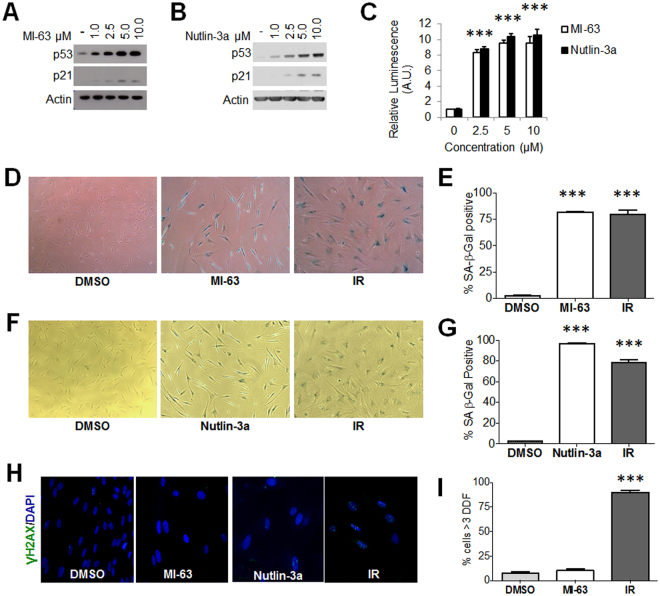
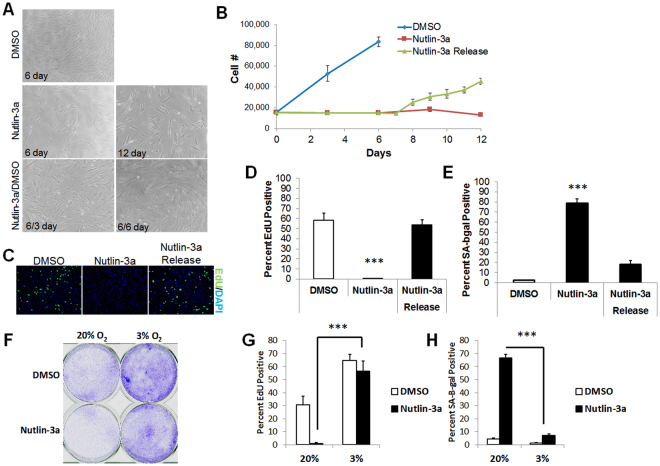
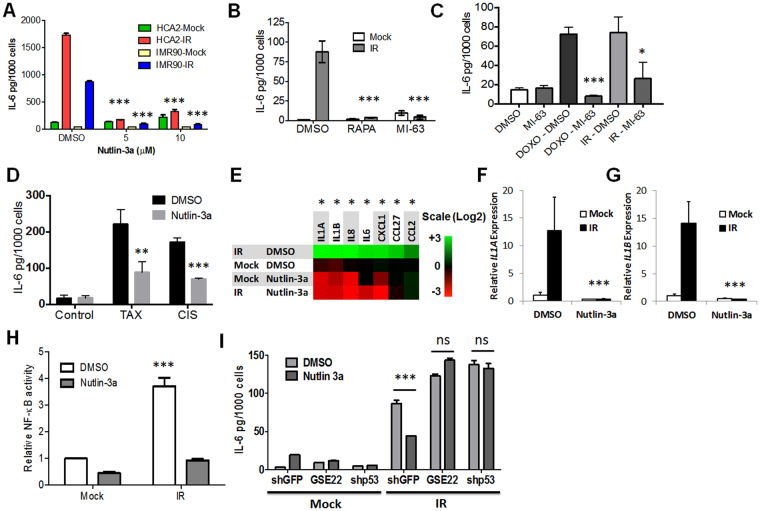
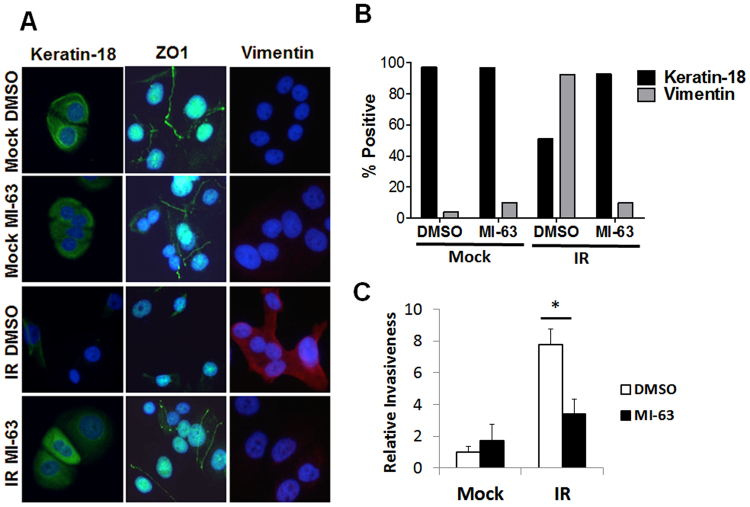
Processes that have been linked to aging and cancer include an inflammatory milieu driven by senescent cells. Senescent cells lose the ability to divide, essentially irreversibly, and secrete numerous proteases, cytokines and growth factors, termed the senescence-associated secretory phenotype (SASP). Senescent cells that lack p53 tumor suppressor function show an exaggerated SASP, suggesting the SASP is negatively controlled by p53. Here, we show that increased p53 activity caused by small molecule inhibitors of MDM2, which promotes p53 degradation, reduces inflammatory cytokine production by senescent cells. Upon treatment with the MDM2 inhibitors nutlin-3a or MI-63, human cells acquired a senescence-like growth arrest, but the arrest was reversible. Importantly, the inhibitors reduced expression of the signature SASP factors IL-6 and IL-1α by cells made senescent by genotoxic stimuli, and suppressed the ability of senescent fibroblasts to stimulate breast cancer cell aggressiveness. Our findings suggest that MDM2 inhibitors could reduce cancer progression in part by reducing the pro-inflammatory environment created by senescent cells.
Overview
The claims and statistics of this paper haven’t been checked yet.
Run the check — free, no account needed. It reads the open-access text and checks the sources it cites.
Integrity signals
Registry
Cites
Statistics
Figures
Verification
Claims the paper makes
The claims and statistics of this paper haven’t been checked yet.
Run the check — free, no account needed. It reads the open-access text and checks the sources it cites.
Claims other papers make about this one
Each is checked against this paper’s own text: does it say what the citing paper says it does?
In the citing paper
“We previously showed that p53 restrains segments of the SASP by antagonizing NF-kB signaling (Freund et al., 2011; Wiley et al., 2018).”
From Oxylipin biosynthesis reinforces cellular senescence and allows detection of senolysis (2021) · cites this paper as Wiley et al., 2018
Self-check
Percentages, sums and reported differences re-computed from the paper’s own numbers.
The self-check needs the paper’s full text.
Citations
Cites
Immunity, Inflammation, and Cancer
Grivennikov, S. I., Greten, F. R., & Karin, M. (2010) · Cell · doi:10.1016/j.cell.2010.01.025 · Cited by 10,755
A biomarker that identifies senescent human cells in culture and in aging skin in vivo.
Dimri, G. P., Lee, X., Basile, G., Acosta, M., Scott, G., Roskelley, C., Medrano, E. E., Linskens, M., Rubelj, I., & Pereira-Smith, O. (1995) · Proceedings of the National Academy of Sciences · doi:10.1073/pnas.92.20.9363 · Cited by 7,477
Self-citationVogelstein, B., Lane, D., & Levine, A. J. (2000) · Nature · doi:10.1038/35042675 · Cited by 6,607
The senescence-associated secretory phenotype: the dark side of tumor suppression
Coppé, J.-P., Desprez, P.-Y., Krtolica, A., & Campisi, J. (2010) · Annual Review of Pathology: Mechanisms of Disease · doi:10.1146/annurev-pathol-121808-102144 · Cited by 5,206
Self-citationIn Vivo Activation of the p53 Pathway by Small-Molecule Antagonists of MDM2
Vassilev, L. T., Vu, B. T., Graves, B., Carvajal, D., Podlaski, F., Filipovic, Z., Kong, N., Kammlott, U., Lukacs, C., Klein, C., et al. (2004) · Science · doi:10.1126/science.1092472 · Cited by 4,661
Cellular senescence: when bad things happen to good cells
Campisi, J., & d'Adda di Fagagna, F. (2007) · Nature Reviews Molecular Cell Biology · doi:10.1038/nrm2233 · Cited by 4,441
Self-citationMechanisms underlying inflammation in neurodegeneration
Glass, C. K., Saijo, K., Winner, B., Marchetto, M. C., & Gage, F. H. (2010) · Cell · doi:10.1016/j.cell.2010.02.016 · Cited by 3,580
Cellular senescence: from physiology to pathology
Muñoz-Espín, D., & Serrano, M. (2014) · Nature Reviews Molecular Cell Biology · doi:10.1038/nrm3823 · Cited by 2,818
Persistent DNA damage signalling triggers senescence-associated inflammatory cytokine secretion
Rodier, F., Coppé, J.-P., Patil, C. K., Hoeijmakers, W. A. M., Muñoz, D. P., Raza, S. R., Freund, A., Campeau, E., Davalos, A. R., & Campisi, J. (2009) · Nature Cell Biology · doi:10.1038/ncb1909 · Cited by 2,232
Self-citationFranceschi, C., Capri, M., Monti, D., Giunta, S., Olivieri, F., Sevini, F., Panourgia, M. P., Invidia, L., Celani, L., Scurti, M., et al. (2007) · Mechanisms of Ageing and Development · doi:10.1016/j.mad.2006.11.016 · Cited by 2,087
Oncogene-Induced Senescence Relayed by an Interleukin-Dependent Inflammatory Network
Kuilman, T., Michaloglou, C., Vredeveld, L. C. W., Douma, S., van Doorn, R., Desmet, C. J., Aarden, L. A., Mooi, W. J., & Peeper, D. S. (2008) · Cell · doi:10.1016/j.cell.2008.03.039 · Cited by 2,086
Clearance of senescent cells by ABT263 rejuvenates aged hematopoietic stem cells in mice
Chang, J., Wang, Y., Shao, L., Laberge, R.-M., Demaria, M., Campisi, J., Janakiraman, K., Sharpless, N. E., Ding, S., Feng, W., et al. (2016) · Nature Medicine · doi:10.1038/nm.4010 · Cited by 1,819
Self-citationChemokine signaling via the CXCR2 receptor reinforces senescence
Acosta, J. C., O'Loghlen, A., Banito, A., Guijarro, M. V., Augert, A., Raguz, S., Fumagalli, M., Da Costa, M., Brown, C., Popov, N., et al. (2008) · Cell · doi:10.1016/j.cell.2008.03.038 · Cited by 1,801
Krtolica, A., Parrinello, S., Lockett, S., Desprez, P.-Y., & Campisi, J. (2001) · Proceedings of the National Academy of Sciences · doi:10.1073/pnas.211053698 · Cited by 1,730
Self-citationSenescence in premalignant tumours
Collado, M., Gil, J., Efeyan, A., Guerra, C., Schuhmacher, A. J., Barradas, M., Benguría, A., Zaballos, A., Flores, J. M., Barbacid, M., et al. (2005) · Nature · doi:10.1038/436642a · Cited by 1,482
Reversal of human cellular senescence: roles of the p53 and p16 pathways
Beauséjour, C. M., Krtolica, A., Galimi, F., Narita, M., Lowe, S. W., Yaswen, P., & Campisi, J. (2003) · The EMBO Journal · doi:10.1093/emboj/cdg417 · Cited by 1,457
Self-citationInflammatory networks during cellular senescence: causes and consequences.
Freund, A., Orjalo, A. V., Desprez, P.-Y., & Campisi, J. (2010) · Trends in Molecular Medicine · doi:10.1016/j.molmed.2010.03.003 · Cited by 1,354
Self-citationCellular senescence promotes adverse effects of chemotherapy and cancer relapse
Demaria, M., O'Leary, M. N., Chang, J., Shao, L., Liu, S., Alimirah, F., Koenig, K., Le, C., Mitin, N., Deal, A. M., et al. (2017) · Cancer Discovery · doi:10.1158/2159-8290.cd-16-0241 · Cited by 1,338
Self-citationLaberge, R.-M., Sun, Y., Orjalo, A. V., Patil, C. K., Freund, A., Zhou, L., Curran, S. C., Davalos, A. R., Wilson-Edell, K. A., Liu, S., et al. (2015) · Nature Cell Biology · doi:10.1038/ncb3195 · Cited by 1,160
Self-citationSenescence in tumours: evidence from mice and humans
Collado, M., & Serrano, M. (2010) · Nature Reviews Cancer · doi:10.1038/nrc2772 · Cited by 1,124
Oxygen sensitivity severely limits the replicative lifespan of murine fibroblasts
Parrinello, S., Samper, E., Krtolica, A., Goldstein, J., Melov, S., & Campisi, J. (2003) · Nature Cell Biology · doi:10.1038/ncb1024 · Cited by 1,116
Self-citationDrugging the p53 pathway: understanding the route to clinical efficacy
Khoo, K. H., Verma, C. S., & Lane, D. P. (2014) · Nature Reviews Drug Discovery · doi:10.1038/nrd4236 · Cited by 742
Small-molecule MDM2 antagonists reveal aberrant p53 signaling in cancer: implications for therapy
Tovar, C., Rosinski, J., Filipovic, Z., Higgins, B., Kolinsky, K., Hilton, H., Zhao, X., Vu, B. T., Qing, W., Packman, K., et al. (2006) · Proceedings of the National Academy of Sciences · doi:10.1073/pnas.0507493103 · Cited by 708
Orjalo, A. V., Bhaumik, D., Gengler, B. K., Scott, G. K., & Campisi, J. (2009) · Proceedings of the National Academy of Sciences · doi:10.1073/pnas.0905299106 · Cited by 654
Self-citationSenescent cells as a source of inflammatory factors for tumor progression
Davalos, A. R., Coppe, J.-P., Campisi, J., & Desprez, P.-Y. (2010) · Cancer and Metastasis Reviews · doi:10.1007/s10555-010-9220-9 · Cited by 636
Self-citationShangary, S., & Wang, S. (2009) · Annual Review of Pharmacology and Toxicology · doi:10.1146/annurev.pharmtox.48.113006.094723 · Cited by 623
Accumulation of senescent cells in Mitotic tissue of aging primates
Jeyapalan, J. C., Ferreira, M., Sedivy, J. M., & Herbig, U. (2007) · Mechanisms of Ageing and Development · doi:10.1016/j.mad.2006.11.008 · Cited by 571
Liu, D., & Hornsby, P. J. (2007) · Cancer Research · doi:10.1158/0008-5472.can-06-3452 · Cited by 499
Cooks, T., Pateras, I. S., Tarcic, O., Solomon, H., Schetter, A. J., Wilder, S., Lozano, G., Pikarsky, E., Forshew, T., Rozenfeld, N., et al. (2013) · Cancer Cell · doi:10.1016/j.ccr.2013.03.022 · Cited by 478
Coppé, J.-P., Patil, C. K., Rodier, F., Krtolica, A., Beauséjour, C. M., Parrinello, S., Hodgson, J. G., Chin, K., Desprez, P.-Y., & Campisi, J. (2010) · PLoS ONE · doi:10.1371/journal.pone.0009188 · Cited by 455
Self-citationBavik, C., Coleman, I., Dean, J. P., Knudsen, B., Plymate, S., & Nelson, P. S. (2006) · Cancer Research · doi:10.1158/0008-5472.can-05-1716 · Cited by 453
From Ancient Pathways to Aging Cells—Connecting Metabolism and Cellular Senescence
Wiley, C. D., & Campisi, J. (2016) · Cell Metabolism · doi:10.1016/j.cmet.2016.05.010 · Cited by 440
Self-citationCellular senescence as a tumor-suppressor mechanism
Campisi, J. (2001) · Trends in Cell Biology · doi:10.1016/s0962-8924(01)82148-6 · Cited by 390
Self-citationSenescence in human intervertebral discs
Roberts, S., Evans, E. H., Kletsas, D., Jaffray, D. C., & Eisenstein, S. M. (2006) · European Spine Journal · doi:10.1007/s00586-006-0126-8 · Cited by 305
Coppé, J.-P., Patil, C. K., Rodier, F., Sun, Y., Muñoz, D. P., Goldstein, J., Nelson, P. S., Desprez, P.-Y., & Campisi, J. (2008) · PLoS Biology · doi:10.1371/journal.pbio.0060301 · Cited by 302
Paradoxical suppression of cellular senescence by p53
Demidenko, Z. N., Korotchkina, L. G., Gudkov, A. V., & Blagosklonny, M. V. (2010) · Proceedings of the National Academy of Sciences · doi:10.1073/pnas.1002298107 · Cited by 273
Suppressing Cancer: The Importance of Being Senescent
Campisi, J. (2005) · Science · doi:10.1126/science.1116801 · Cited by 255
Self-citationCellular senescence in vivo: Its relevance in ageing and cardiovascular disease
Erusalimsky, J. D., & Kurz, D. J. (2005) · Experimental Gerontology · doi:10.1016/j.exger.2005.04.010 · Cited by 252
Cancer and ageing: a nexus at several levels
Balducci, L., & Ershler, W. B. (2005) · Nature Reviews Cancer · doi:10.1038/nrc1675 · Cited by 250
Kumamoto, K., Spillare, E. A., Fujita, K., Horikawa, I., Yamashita, T., Appella, E., Nagashima, M., Takenoshita, S., Yokota, J., & Harris, C. C. (2008) · Cancer Research · doi:10.1158/0008-5472.can-07-2780 · Cited by 231
Mikhed, Y., Görlach, A., Knaus, U. G., & Daiber, A. (2015) · Redox Biology · doi:10.1016/j.redox.2015.05.008 · Cited by 189
Use of genetic suppressor elements to dissect distinct biological effects of separate p53 domains.
Ossovskaya, V., Mazo, I. A., Chernov, M. V., Chernova, O. B., Strezoska, Ž., Kondratov, R. V., Stark, G. R., Chumakov, P. M., & Gudkov, A. V. (1996) · Proceedings of the National Academy of Sciences · doi:10.1073/pnas.93.19.10309 · Cited by 173
The p53 pathway and its inactivation in neuroblastoma
Tweddle, D. A., Pearson, A. D. J., Haber, M., Norris, M. D., Xue, C., Flemming, C. L., & Lunec, J. (2003) · Cancer Letters · doi:10.1016/s0304-3835(03)00088-0 · Cited by 171
Senescent Stromal-Derived Osteopontin Promotes Preneoplastic Cell Growth
Pazolli, E., Luo, X., Brehm, S., Carbery, K., Chung, J.-J., Prior, J. L., Doherty, J. M., Demehri, S., Salavaggione, L., Piwnica-Worms, D. R., et al. (2009) · Cancer Research · doi:10.1158/0008-5472.can-08-2970 · Cited by 152
Efeyan, A., Ortega-Molina, A., Velasco-Miguel, S., Herranz, D., Vassilev, L. T., & Serrano, M. (2007) · Cancer Research · doi:10.1158/0008-5472.can-07-0200 · Cited by 140
Villalonga-Planells, R., Coll-Mulet, L., Martínez‐Soler, F., Castaño, E., Acebes, J.-J., Gimenez‐Bonafé, P., Gil, J., & Tortosa, A. (2011) · PLoS ONE · doi:10.1371/journal.pone.0018588 · Cited by 131
Cellular senescence in pretransplant renal biopsies predicts postoperative organ function
McGlynn, L. M., Stevenson, K. S., Lamb, K. J., Zino, S., Brown, M., Prina, A., Kingsmore, D. B., & Shiels, P. G. (2008) · Aging Cell · doi:10.1111/j.1474-9726.2008.00447.x · Cited by 108
Tumor suppressor protein (p)53, is a regulator of NF-κB repression by the glucocorticoid receptor
Murphy, S. H., Suzuki, K., Downes, M., Welch, G. L., De Jesus, P., Miraglia, L. J., Orth, A. P., Chanda, S. K., Evans, R. M., & Verma, I. M. (2011) · Proceedings of the National Academy of Sciences · doi:10.1073/pnas.1114420108 · Cited by 93
Canner, J. A., Sobo, M., Ball, S. L., Hutzen, B. J., Deangelis, S., Willis, W. L., Studebaker, A. W., Ding, K., Wang, S., Yang, D., et al. (2009) · British Journal of Cancer · doi:10.1038/sj.bjc.6605199 · Cited by 72
Nutlin-3 inhibits the NFκB Pathway in a p53 Dependent Manner: Implications in Lung Cancer Therapy
Dey, A., Wong, E. T., Bist, P., Tergaonkar, V., & Lane, D. (2007) · Cell Cycle · doi:10.4161/cc.6.17.4643 · Cited by 70
Luo, H., Yount, C. L., Lang, H., Yang, A., Riemer, E. C., Lyons, K., Vanek, K. N., Silvestri, G. A., Schulte, B. A., & Wang, G. Y. (2013) · Lung Cancer · doi:10.1016/j.lungcan.2013.04.017 · Cited by 65
Harajly, M., Zalzali, H., Nawaz, Z., Ghayad, S. E., Ghamloush, F., Basma, H., Zainedin, S., Rabeh, W., Jabbour, M. N., Tawil, A. N., et al. (2015) · Molecular and Cellular Biology · doi:10.1128/mcb.00747-15 · Cited by 24
Nair, A. R., Schliekelman, M. J., Thomas, M. B., Wakefield, J., Jurgensen, S. R., & Ramabhadran, R. (2005) · Cell Cycle · doi:10.4161/cc.4.5.1672 · Cited by 14
Herzog, G., Lu-Hesselmann, J., Zimmermann, Y., Haferlach, T., Hiddemann, W., & Dreyling, M. H. (2005) · PubMed · Cited by 12
Cited by
Sorted by citations
The senescence-associated secretory phenotype and its physiological and pathological implications
Wang, B., Han, J., Elisseeff, J. H., & Demaria, M. (2024) · Nature Reviews Molecular Cell Biology · doi:10.1038/s41580-024-00727-x · Cited by 948
The metabolic roots of senescence: mechanisms and opportunities for intervention
Wiley, C. D., & Campisi, J. (2021) · Nature Metabolism · doi:10.1038/s42255-021-00483-8 · Cited by 691
Self-citationThe senescence-associated secretory phenotype and its regulation
Lopes-Paciencia, S., Saint-Germain, E., Rowell, M.-C., Ruiz, A. F., Kalegari, P., & Ferbeyre, G. (2019) · Cytokine · doi:10.1016/j.cyto.2019.01.013 · Cited by 601
Targeting senescent cells in translational medicine
Paez‐Ribes, M., González‐Gualda, E., Doherty, G. J., & Muñoz‐Espín, D. (2019) · EMBO Molecular Medicine · doi:10.15252/emmm.201810234 · Cited by 293
Lagoumtzi, S. M., & Chondrogianni, N. (2021) · Free Radical Biology and Medicine · doi:10.1016/j.freeradbiomed.2021.05.003 · Cited by 279
Metadata
- Authors
- Wiley, C. D., Schaum, N., Alimirah, F., Lopez-Dominguez, J. A., Orjalo, A. V., Scott, G., Desprez, P.-Y., Benz, C., Davalos, A. R., & Campisi, J.
- Affiliations
- Buck Institute for Research on Aging (US)
- Corresponding author
- Davalos, Albert R.
- Campisi, Judith
- ORCID
- Venue
- Scientific Reports
- Published
- 2018-02-05
- Volume
- 8
- Issue
- 1
- Pages
- 2410-2410
- ISSN
- 2045-2322 (ISSN-L)
- PMC
- PMC5799282
- OpenAlex
- W2802384001
- Cited by
- 124
- References
- 55
- Citations by year
- 2026: 10 · 2025: 10 · 2024: 13 · 2023: 8 · 2022: 25 · 2021: 25 · 2020: 20 · 2019: 8 · 2018: 5
- FWCI
- 9.97
- Type
- journal article
- Language
- en
- Open access
- gold
- doi.org
- Locations
- Scientific Reports (publishedVersion, cc-by)
- PubMed Central (publishedVersion, cc-by)
- PubMed (publishedVersion)
- DOAJ (DOAJ: Directory of Open Access Journals) (submittedVersion)
- eScholarship (California Digital Library) (submittedVersion)
- Funders
- National Institutes of Health (AG09909, AG017242)
- National Institute on Aging (R56AG009909, R37AG009909, P01AG017242)
- Topics
- Life Sciences › Biochemistry, Genetics and Molecular Biology › Cell Biology › Telomeres, Telomerase, and Senescence
- Health Sciences › Medicine › Oncology › Cancer-related Molecular Pathways
- Life Sciences › Biochemistry, Genetics and Molecular Biology › Aging › Genetics, Aging, and Longevity in Model Organisms
- Keywords
- MDM2 inhibitors, senescence-associated secretory phenotype, cellular senescence, p53, Nutlin-3a, interleukin-6, IL-1α, inflammation, breast cancer progression, genotoxic stress, aging
- MeSH terms
- Interleukin-6 Inhibitors, Cell Line, Enzyme Inhibitors, Epithelial Cells, Fibroblasts, Gamma Rays, Humans, Imidazoles, Indoles, Lung, Male, Piperazines, Spiro Compounds, Interleukin-6, Tumor Suppressor Protein p53, Cellular Senescence, Proto-Oncogene Proteins c-mdm2, Foreskin, Interleukin-1alpha, Cell Cycle Checkpoints
About these checks
Registry, retraction, Cites and statistics results are computed, not judged, with one exception: a printed reference that no index lists is read once by a model before it counts as a citation error. Claims are extracted by a model and kept only when their quote appears verbatim in the text; each cited source is then checked, with a model’s help, for whether it says what the claim relies on. Those verdicts can be wrong — read the claim’s quote and the cited source before relying on one.
Statistics and arithmetic are recomputed, not judged.
Confidence bands are shown only for fields calibrated on our annotated test set. None is calibrated yet, so no band is shown.
What counts as a claim ›How we measure confidence ›How we check this ›
Are you an author, or do you see a problem with this page? Request a review
