

Acidity and Antioxidant Activity of Cold Brew Coffee
Open accessThe DOI matches its Crossref record; 45 of the 46 references it cites were found in a registry or an index; 6 of the 25 sources its claims cite were checked for support.
Abstract
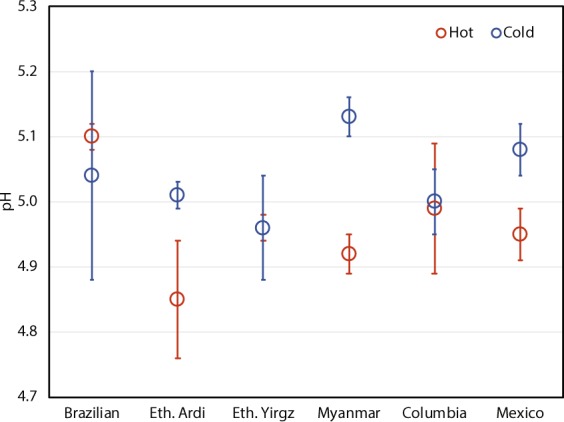
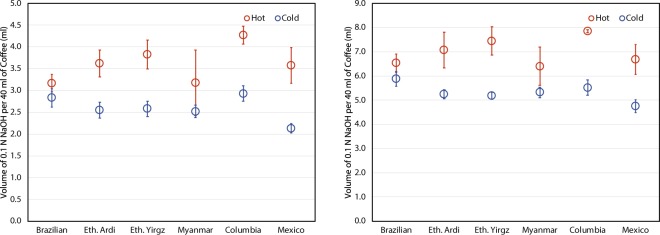
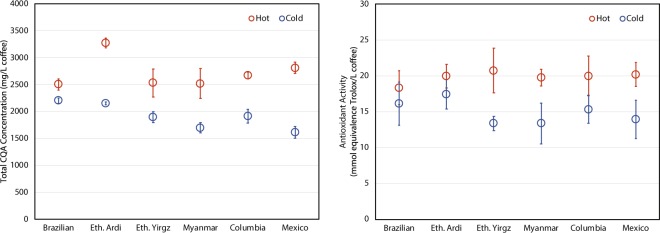
The acidity and antioxidant activity of cold brew coffee were investigated using light roast coffees from Brazil, two regions of Ethiopia, Columbia, Myanmar, and Mexico. The concentrations of three caffeoylquinic acid (CQA) isomers were also determined. Cold brew coffee chemistry was compared to that of hot brew coffee prepared with the same grind-to-coffee ratio. The pH values of the cold and hot brew samples were found to be comparable, ranging from 4.85 to 5.13. The hot brew coffees were found to have higher concentrations of total titratable acids, as well as higher antioxidant activity, than that of their cold brew counterparts. It was also noted that both the concentration of total titratable acids and antioxidant activity correlated poorly with total CQA concentration in hot brew coffee. This work suggests that the hot brew method tends to extract more non-deprotonated acids than the cold brew method. These acids may be responsible for the higher antioxidant activities observed in the hot brew coffee samples.
Overview
CoChat Summary
TL;DR
This study compared cold brew and hot brew coffees made from the same light-roast beans and found similar pH values but consistently lower total titratable acidity and antioxidant activity in cold brew. The authors conclude that hot water extracts more non-deprotonated acidic compounds, which may explain the higher antioxidant capacity of hot brew coffee.
Key findings
- pH was similar across brewing methods: all samples ranged from 4.85 to 5.13; cold brew ranged 4.96 to 5.13 and hot brew ranged 4.85 to 5.10.
- Hot brew coffees had higher total titratable acidity than cold brew coffees, and cold brew samples had lower titratable acid levels than their hot brew counterparts across all samples.
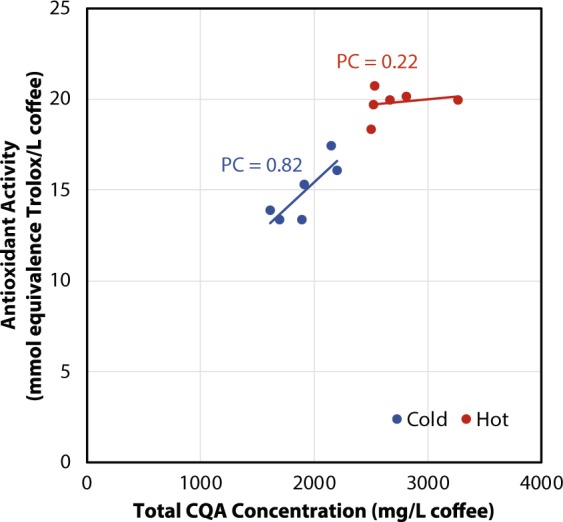
- Hot brew coffees also had higher antioxidant activity than cold brew coffees; the paper reports a Pearson correlation coefficient of 0.82 between total CQA concentration and antioxidant activity in cold brew, but only 0.22 in hot brew.
- CQA patterns differed by origin: in hot brew, Ethiopian-Ardi had the highest 5-CQA and total CQA (1721 ± 99 mg/L and 3270 ± 90 mg/L), while Brazilian had the lowest (1261 ± 111 mg/L and 2503 ± 103 mg/L); in cold brew, Brazilian had the highest CQA isomers and Mexican the lowest.
Methods
- Comparative experimental study of cold brew vs hot brew coffee prepared from light-roast, pre-ground coffees sourced from Brazil, Colombia, Ethiopia (two regions: Ardi and Yirgz), Mexico, and Myanmar.
- Cold brew used 35.0 g coffee in 350 mL water, brewed at room temperature for 7 hours; hot brew used the same coffee-to-water ratio, boiling water, and 6 minutes brewing in a French press. Cold brew experiments were run in duplicate with n = 8 and hot brew with n = 6.
- Measured pH, total titratable acidity (titration with 0.1 N NaOH to pH 6 and 8), CQA isomers by HPLC, and antioxidant activity via an ABTS radical cation decolorization assay; analysis used ANOVA and two-tailed t-tests.
Limitations
- The paper states that there was little published data to contextualize the cold brew results, and that more research is needed to understand chemical differences and health effects.
- The authors note that the study did not perform compound-specific analysis beyond CQA isomers, and say future work is needed to identify and quantify additional compounds, including melanoidins.
- Evident from the text: the brewing comparison was done under one cold-brew time (7 hours) and one hot-brew time (6 minutes), so brewing temperature and time are not disentangled.
Model-written summary. Check it against the paper before relying on it.
Integrity signals
Registry
Cites
Statistics
Figures
Verification
Claims the paper makes
3 Valid · 2 Not valid · 7 Not checked · 50 Own results and interpretations
At least one cited source doesn’t support this claim or points to a different paper, and none confirmed it — see the verdicts below.
In the paper
“Of the three CQA isomers analyzed, 5-CQA was found to have the highest concentration in all samples, in agreement with previous studies33–39.”
§ Acidity and Antioxidant Activity of Cold Brew Coffee > Results > Hot Brew Coffee
What the sources say
- Not checked — no full text of the sourcecites [33] Trugo LC Macrae R Chlorogenic acid composition of instant coffees Analyst 1984 109 263 266 10.1039/an9840900263 6721155 source
- Not checked — no full text of the sourcecites [34] Farah A de Paulis T Trugo LC Martin PR Effect of roasting on the formation of chlorogenic acid lactones in coffee J. Agric. Food Chem. 2005 53 1505 1513 10.1021/jf048701t 15740032 source
- Not checked — no full text of the sourcecites [35] Moon J-K Yoo HS Shibamoto T Role of roasting conditions in the level of chlorogenic acid content in coffee beans: correlation with coffee acidity J. Agric. Food Chem. 2009 57 5365 5369 10.1021/jf900012b 19530715 source
- Disputedcites [36] Gloess AN Comparison of nine common coffee extraction methods: instrumental and sensory analysis Eur. Food Res. Technol. 2013 236 607 627 10.1007/s00217-013-1917-x sourceExperimental — accuracy not yet measured
The Chlorogenic acids section reports that double espresso contained 5.8 ± 0.2 mg/10 ml of 3-CQA but only 2.8 ± 0.2 mg/10 ml of 5-CQA, contrary to the claim that 5-CQA was highest in all samples. The methods section also says the paper quantified only two CQA isomers; 4-CQA was not quantified. Page numbers are unavailable in our copy. (LLM, conf=0.90)
Checked by a reasoning model — may be wrong.
- Not checked — no full text of the sourcecites [37] Fujioka K Shibamoto T Chlorogenic acid and caffeine contents in various commercial brewed coffees Food Chem. 2008 106 217 221 10.1016/j.foodchem.2007.05.091 source
- Not checked — no full text of the sourcecites [38] Monente C Ludwig IA Irigoyen A De Peña M-P Cid C Assessment of total (free and bound) phenolic compounds in spent coffee extracts J. Agric. Food Chem. 2015 63 4327 4334 10.1021/acs.jafc.5b01619 25891228 source
- Not checked — no full text of the sourcecites [39] Ludwig IA Extraction of coffee antioxidants: Impact of brewing time and method Food Res. Int. 2012 48 57 64 10.1016/j.foodres.2012.02.023 source
plain- Asserted: passes — The authors put it forward as true.
- Checkable: passes — It can be checked against evidence.
- Load-bearing: unclear — It is unclear whether the paper’s conclusions depend on it.
- Based: passes — The paper gives a reason why it holds.
The cited sources support only part of this claim — read each source’s verdict below.
In the paper
“An exhaustive literature search returned only four peer-reviewed studies related to cold brew coffee29–32.”
§ Acidity and Antioxidant Activity of Cold Brew Coffee > Introduction
What the sources say
- Not matchedcites [29] Kim AR Kim JS Flavor Contributing Nonvolatile Chemical and Sensory Characterization of Cold Water Extraction-based Coffee by Different ExtractionMethods (Dripping vs Steeping) and Time Journal of The Korea Society for Coffee Industry 2014 3 1 9
Its entry has no title and year that we can search by.
- Partly supportedcites [30] Lane S Palmer J Christie B Ehlting J Le C Can Cold Brew Coffee Be Convenient? A Pilot Study For Caffeine Content in Cold Brew Coffee Concentrate Using High Performance Liquid Chromatography The Arbutus Review 2017 8 15 23 10.18357/tar81201716816 sourceExperimental — accuracy not yet measured
The paper's section C says that, to the authors' knowledge, few peer-reviewed studies had examined caffeine or secondary psychoactive components in cold brew. It does not report an exhaustive literature search or a count of four studies, and its statement is narrower than studies related to cold brew coffee generally. No page number is available in our copy. (LLM, conf=0.88)
- Could not verifycites [31] Shin K-S The Chemical Characteristics and Immune-Modulating Activity of Polysaccharides Isolated from Cold-Brew Coffee Prev Nutr Food Sci 2017 22 100 106 28702426 PMC5503418 doi:10.3746/pnf.2017.22.2.100Experimental — accuracy not yet measured
The Introduction discusses cold-brew coffee and cites earlier studies, but does not report an exhaustive literature search or say that only four peer-reviewed studies existed. Searches for that wording and for a statement about limited prior cold-brew research found no supporting passage in our copy; page numbers were not provided. (LLM, conf=0.76)
- Partly supportedcites [32] Fuller M Rao NZ The Effect of Time, Roasting Temperature, and Grind Size on Caffeine and Chlorogenic Acid Concentrations in Cold Brew Coffee Sci. Rep. 2017 7 17979 10.1038/s41598-017-18247-4 29269877 PMC5740146 sourceExperimental — accuracy not yet measured
The Introduction says an exhaustive literature search found very limited publications on cold brew coffee and names three earlier studies. It does not say the search returned exactly four peer-reviewed studies; this paper could be counted as a fourth study, but not as one returned by its own search. (LLM, conf=0.85)
plain- Asserted: passes — The authors put it forward as true.
- Checkable: passes — It can be checked against evidence.
- Load-bearing: passes — The paper’s conclusions depend on it.
- Based: passes — The paper gives a reason why it holds.
- Not matched
The cited sources support only part of this claim — read each source’s verdict below.
In the paper
“The lack of a correlation in this data agrees with the findings of Gloess et al.36 and suggests that pH is a poor measurement for the complex acid chemistry in both hot and cold brew coffee extracts.”
§ Acidity and Antioxidant Activity of Cold Brew Coffee > Results > Hot and Cold Brew Comparisons
What the sources say
- Partly supportedcites Gloess et al.36 Gloess AN Comparison of nine common coffee extraction methods: instrumental and sensory analysis Eur. Food Res. Technol. 2013 236 607 627 10.1007/s00217-013-1917-x sourceExperimental — accuracy not yet measured
In “pH value, titratable acidity versus acidity in flavor and aftersensation” (page not provided), Gloess et al. report that pH did not correlate with titratable acidity or perceived acidity, and explain that some acids do not contribute to a brew’s pH. This supports the concern that pH alone poorly captures acidity in the brews they studied. The “Coffee extraction” section describes nine espresso and lungo methods, not cold-brew extraction, so extending the finding to both hot and cold brew is unsupported. (LLM, conf=0.88)
hedged- Asserted: passes — The authors put it forward as true.
- Checkable: passes — It can be checked against evidence.
- Load-bearing: passes — The paper’s conclusions depend on it.
- Based: passes — The paper gives a reason why it holds.
- Partly supported
A result the paper reports from its own data — it cites no other source for it, so there is none to check. The quote shows it is in the paper.
In the paper
“The Ethiopian-Ardi samples were also found to have the highest 5-CQA and total CQA concentration (1721 ± 99 mg/L of coffee and 3270 ± 90 mg/L of coffee, respectively).”
§ Acidity and Antioxidant Activity of Cold Brew Coffee > Results > Hot Brew Coffee
plain- Asserted: passes — The authors put it forward as true.
- Checkable: passes — It can be checked against evidence.
- Load-bearing: unclear — It is unclear whether the paper’s conclusions depend on it.
- Based: passes — The paper gives a reason why it holds.
A result the paper reports from its own data — it cites no other source for it, so there is none to check. The quote shows it is in the paper.
In the paper
“The hot brew coffee samples analyzed in this study were found to have pH values ranging from 4.85 to 5.10.”
§ Acidity and Antioxidant Activity of Cold Brew Coffee > Results > Hot Brew Coffee
plain- Asserted: passes — The authors put it forward as true.
- Checkable: passes — It can be checked against evidence.
- Load-bearing: unclear — It is unclear whether the paper’s conclusions depend on it.
- Based: passes — The paper gives a reason why it holds.
31 more claims
Create a free account to see all 62 claims and every source verdict.
- It may state two separate claims as one. 21
- Probably not a substantial claim. 12
Claims other papers make about this one
Each is checked against this paper’s own text: does it say what the citing paper says it does?
The source backs part of the claim, not all of it — or backs it for a different population, condition or comparison.
In the citing paper
“Rao and Fuller found that, for a variety of regions, medium roast hot brew coffees had higher TAC than their cold brew counterparts, as evaluated using the ABTS decolorization assay [10].”
From Physiochemical Characteristics of Hot and Cold Brew Coffee Chemistry: The Effects of Roast Level and Brewing Temperature on Compound Extraction (2020) · cites this paper as [10]
Experimental — accuracy not yet measured
Citations
Cites
Antioxidant activity applying an improved ABTS radical cation decolorization assay
Re, R., Pellegrini, N., Proteggente, A., Pannala, A., Yang, M., & Rice-Evans, C. (1999) · Free Radical Biology and Medicine · doi:10.1016/s0891-5849(98)00315-3 · Cited by 26,165
Free radicals and antioxidants in normal physiological functions and human disease
Valko, M., Leibfritz, D., Moncol, J., Cronin, M. T. D., Mazur, M., & Telser, J. (2007) · The International Journal of Biochemistry & Cell Biology · doi:10.1016/j.biocel.2006.07.001 · Cited by 14,269
Chlorogenic acid (CGA): A pharmacological review and call for further research
Naveed, M., Hejazi, V., Abbas, M., Kamboh, A. A., Khan, G. J., Shumzaid, M., Ahmad, F., Babazadeh, D., FangFang, X., Modarresi-Ghazani, F., et al. (2018) · Biomedicine & Pharmacotherapy · doi:10.1016/j.biopha.2017.10.064 · Cited by 1,586
Coffee consumption and health: umbrella review of meta-analyses of multiple health outcomes
Poole, R., Kennedy, O. J., Roderick, P., Fallowfield, J. A., Hayes, P. C., & Parkes, J. (2017) · BMJ · doi:10.1136/bmj.j5024 · Cited by 835
A meta‐analysis of coffee drinking, cigarette smoking, and the risk of Parkinson's disease
Hernán, M. A., Takkouche, B., Caamaño‐Isorna, F., & Gestal‐Otero, J. J. (2002) · Annals of Neurology · doi:10.1002/ana.10277 · Cited by 818
Ding, M., Bhupathiraju, S. N., Satija, A., van Dam, R. M., & Hu, F. B. (2014) · Circulation · doi:10.1161/circulationaha.113.005925 · Cited by 565
Effect of Roasting on the Formation of Chlorogenic Acid Lactones in Coffee
Farah, A., de Paulis, T., Trugo, L. C., & Martin, P. R. (2005) · Journal of Agricultural and Food Chemistry · doi:10.1021/jf048701t · Cited by 540
Ding, M., Bhupathiraju, S. N., Chen, M., van Dam, R. M., & Hu, F. B. (2014) · Diabetes Care · doi:10.2337/dc13-1203 · Cited by 511
Chemical Characterization and Antioxidant Properties of Coffee Melanoidins
Borrelli, R. C., Visconti, A., Mennella, C., Anese, M., & Fogliano, V. (2002) · Journal of Agricultural and Food Chemistry · doi:10.1021/jf025686o · Cited by 384
Vignoli, J. A., Bassoli, D. G., & Benassi, M. T. (2011) · Food Chemistry · doi:10.1016/j.foodchem.2010.07.008 · Cited by 375
Research works printed but not linked: 3
- Kim AR Kim JS Flavor Contributing Nonvolatile Chemical and Sensory Characterization of Cold Water Extraction-based Coffee by Different ExtractionMethods (Dripping vs Steeping) and Time Journal of The Korea Society for Coffee Industry 2014 3 1 9
- Maier HG Balcke C Thies F-C Die Säuren Des Kaffees. VI. Abhängigkeit des sauren Geschmacks von pH-Vert und Säuregrad Lebensm. Gerichtl. Chem. 1983 37 81 83
- Balzer, H. H. Acids in coffee. In Coffee: Recent Development (eds Clarke, R. J. & Vitzthum, O. G.) 1, 18–32 (Oxford, England: Blackwell Science, 2001).
Cited by
Cordoba, N., Fernandez-Alduenda, M., Moreno, F. L., & Ruiz, Y. (2020) · Trends in Food Science & Technology · doi:10.1016/j.tifs.2019.12.004 · Cited by 271
Consumption of Chlorogenic Acids through Coffee and Health Implications
Farah, A., & de Paula Lima, J. (2019) · Beverages · doi:10.3390/beverages5010011 · Cited by 175
“1 [44] Arabica Mexico 1 L 10 25 ◦C 7 hr 85.”
BackgroundInfluentialAcids in coffee: A review of sensory measurements and meta-analysis of chemical composition
Yeager, S. E., Batali, M. E., Guinard, J.-X., & Ristenpart, W. D. (2023) · Critical Reviews in Food Science and Nutrition · doi:10.1080/10408398.2021.1957767 · Cited by 173
Cordoba, N., Pataquiva, L., Osorio, C., Moreno, F. L. M., & Ruiz, R. Y. (2019) · Scientific Reports · doi:10.1038/s41598-019-44886-w · Cited by 166
Effects of Coffee and Its Components on the Gastrointestinal Tract and the Brain–Gut Axis
Iriondo-DeHond, A., Uranga, J. A., del Castillo, M. D., & Abalo, R. (2020) · Nutrients · doi:10.3390/nu13010088 · Cited by 126
Rao, N. Z., Fuller, M., & Grim, M. D. (2020) · Foods · doi:10.3390/foods9070902 · Cited by 113
“Rao and Fuller found that, for a variety of regions, medium roast hot brew coffees had higher TAC than their cold brew counterparts, as evaluated using the ABTS decolorization assay [10].”
BackgroundMethodResultInfluentialSelf-citationCórdoba, N., Moreno, F. L., Osorio, C., Velásquez, S., & Ruiz, Y. (2021) · Food Research International · doi:10.1016/j.foodres.2021.110141 · Cited by 101
Acids in brewed coffees: Chemical composition and sensory threshold
Rune, C. J. B., Giacalone, D., Steen, I., Duelund, L., Münchow, M., & Clausen, M. P. (2023) · Current Research in Food Science · doi:10.1016/j.crfs.2023.100485 · Cited by 90
Zhong, H., Abdullah, Zhao, M., Tang, J., Deng, L., & Feng, F. (2021) · Journal of the Science of Food and Agriculture · doi:10.1002/jsfa.11083 · Cited by 67
Stanek, N., Zarębska, M., Biłos, Ł., Barabosz, K., Nowakowska‐Bogdan, E., Semeniuk, I., Błaszkiewicz, J., Kulesza, R., Matejuk, R., & Szkutnik, K. (2021) · Scientific Reports · doi:10.1038/s41598-021-01001-2 · Cited by 89
Muzykiewicz-Szymańska, A., Nowak, A., Wira, D., & Klimowicz, A. (2021) · Molecules · doi:10.3390/molecules26123681 · Cited by 86
Culinary fluid mechanics and other currents in food science
Mathijssen, A. J. T. M., Lisicki, M., Prakash, V. N., & Mossige, E. J. L. (2023) · Reviews of Modern Physics · doi:10.1103/revmodphys.95.025004 · Cited by 80
Córdoba, N., Moreno, F. L., Osorio, C., Velásquez, S., Fernandez-Alduenda, M., & Ruiz-Pardo, Y. (2021) · LWT · doi:10.1016/j.lwt.2021.111363 · Cited by 62
Xu, L., Lao, F., Xu, Z., Wang, X., Chen, F., Liao, X., Chen, A., & Yang, S. (2019) · Food Chemistry · doi:10.1016/j.foodchem.2019.01.154 · Cited by 60
El-Moghazy, A. Y., Amaly, N., Istamboulié, G., Nitin, N., & Sun, G. Z. (2020) · Microchimica Acta · doi:10.1007/s00604-020-04509-y · Cited by 55
Titratable Acidity, Perceived Sourness, and Liking of Acidity in Drip Brewed Coffee
Batali, M. E., Cotter, A. R., Frost, S. C., Ristenpart, W. D., & Guinard, J.-X. (2021) · ACS Food Science & Technology · doi:10.1021/acsfoodscitech.0c00078 · Cited by 49
Das, G., Heredia, J. B., Pereira, M. D. L., Coy-Barrera, E. D., Oliveira, S. M. R., Gutiérrez‐Grijalva, E. P., Cabanillas-Bojórquez, L. Á., Shin, H., & Patra, J. K. (2021) · Trends in Food Science & Technology · doi:10.1016/j.tifs.2021.07.037 · Cited by 54
Portela, C. D. S., Almeida, I. F. D., Mori, A. L. B., Yamashita, F., & Benassi, M. D. T. (2021) · LWT · doi:10.1016/j.lwt.2021.111090 · Cited by 47
International society of sports nutrition position stand: coffee and sports performance
Lowery, L. M., Anderson, D. E., Scanlon, K. F., Stack, A., Escalante, G., Campbell, S. C., Kerksick, C. M., Nelson, M. T., Ziegenfuss, T. N., VanDusseldorp, T. A., et al. (2023) · Journal of the International Society of Sports Nutrition · doi:10.1080/15502783.2023.2237952 · Cited by 58
“To recap, researchers to date have demonstrated hydration effects similar to water [83] enhanced glycogen recovery [137], and antioxidant effects in the general healthy population [5,9,209].”
BackgroundBatali, M. E., Ristenpart, W. D., & Guinard, J.-X. (2020) · Scientific Reports · doi:10.1038/s41598-020-73341-4 · Cited by 41
“At one extreme, cold brew coffee prepared at temperatures less than 25 °C is widely reported to be sweeter and less acidic than hot brewed coffee 20–23 , suggesting that less dramatic temperature differences might play a similar role for hot drip brew coffee.”
Bellumori, M., Angeloni, G., Guerrini, L., Masella, P., Calamai, L., Mulinacci, N., Parenti, A., & Innocenti, M. (2021) · LWT · doi:10.1016/j.lwt.2021.111043 · Cited by 47
Santanatoglia, A., Caprioli, G., Cespi, M., Ciarlantini, D., Cognigni, L., Fioretti, L., Maggi, F., Mustafa, A. M., Nzekoue, F. K., & Vittori, S. (2023) · LWT · doi:10.1016/j.lwt.2023.114471 · Cited by 46
Mallik, S. B., Mudgal, J., Hall, S., Kinra, M., Grant, G. D., Nampoothiri, M., Anoopkumar‐Dukie, S., & Arora, D. S. (2021) · Nutritional Neuroscience · doi:10.1080/1028415x.2021.1906393 · Cited by 37
“87, of SAL group respectively, F [2, 15] = 9.”
BackgroundBilge, G. (2020) · Journal of Food Science and Technology · doi:10.1007/s13197-020-04367-9 · Cited by 33
Ogutu, C. O., Cherono, S., Ntini, C., Wang, L., & Han, Y. (2022) · Food Chemistry X · doi:10.1016/j.fochx.2022.100294 · Cited by 38
Wang, X., & Lim, L. (2023) · Applied Food Research · doi:10.1016/j.afres.2023.100334 · Cited by 38
Coffee Roasting and Extraction as a Factor in Cold Brew Coffee Quality
Maksimowski, D., Pachura, N., Oziembłowski, M., Nawirska‐Olszańska, A., & Szumny, A. J. (2022) · Applied Sciences · doi:10.3390/app12052582 · Cited by 38
“Coffee can be an important source of a compound belonging to this group—chlorogenic acid, an ester of caffeic and quinic acid, which, in addition to neutralizing radicals and counteracting oxidation reactions, can additionally activate other biosynthetic pathways of antioxidant compounds [3,4].”
BackgroundSunoqrot, S., Al‐Shalabi, E., Al‐Bakri, A. G., Zalloum, H. M., Abu‐Irmaileh, B., Ibrahim, L. H., & Zeno, H. (2021) · ACS Omega · doi:10.1021/acsomega.0c05061 · Cited by 31
Extraction and physicochemical characteristics of high pressure-assisted cold brew coffee
Zhang, L., Wang, X., Manickavasagan, A., & Lim, L. (2022) · Future Foods · doi:10.1016/j.fufo.2022.100113 · Cited by 30
Wu, H., Viejo, C. G., Fuentes, S., Dunshea, F. R., & Suleria, H. A. R. (2023) · Fermentation · doi:10.3390/fermentation9010068 · Cited by 40
Portela, C. D. S., de Almeida, I. F., dos Reis, T. A. D., BÖGER, B. R., & Benassi, M. D. T. (2021) · Food Research International · doi:10.1016/j.foodres.2021.110860 · Cited by 33
Kwok, R., Lee, K. W. T., Schwarz, S., Claassen, L., & Lachenmeier, D. W. (2020) · Challenges · doi:10.3390/challe11020026 · Cited by 27
Várady, M., Tauchen, J., Klouček, P., & Popelka, P. (2022) · Fermentation · doi:10.3390/fermentation8080375 · Cited by 37
Comparison of Characterization of Cold Brew and Hot Brew Coffee Prepared at Various Roasting Degrees
Pan, L., Xiao, Y., Jiang, F., Jiang, T., Zhu, J. F., Tang, W., Liu, X., Zhou, Y., & Yu, L. M. (2023) · Journal of Food Processing and Preservation · doi:10.1155/2023/3175570 · Cited by 32
A Comprehensive View on the Impact of Chlorogenic Acids on Colorectal Cancer
Neamțu, A.-A., Maghiar, T. A., Turcuș, V., Maghiar, P. B., Căpraru, A.-M., Lazar, B. A., Dehelean, C.-A., Pop, O. L., Neamţu, C., Totolici, B. D., et al. (2024) · Current Issues in Molecular Biology · doi:10.3390/cimb46070405 · Cited by 28
“They are best-known for their high concentration in coffee and other dietary sources and the antioxidant properties that they exhibit [29].”
BackgroundChan, M. Z. A., Toh, M., & Liu, S. (2020) · Food Research International · doi:10.1016/j.foodres.2020.109746 · Cited by 29
Lin, H., Tello, E., Simons, C. T., & Peterson, D. G. (2022) · Molecules · doi:10.3390/molecules27072120 · Cited by 30
Wang, X., & Lim, L. (2021) · Journal of Food Process Engineering · doi:10.1111/jfpe.13748 · Cited by 22
Chansriniyom, C., Nooin, R., Nuengchamnong, N., Wongwanakul, R., Petpiroon, N., Srinuanchai, W., Chantarasuwan, B., Pitchakarn, P., Temviriyanukul, P., & Nuchuchua, O. (2021) · Scientific Reports · doi:10.1038/s41598-021-96261-3 · Cited by 23
Kyroglou, S., Thanasouli, K., & Vareltzis, P. K. (2021) · Journal of the Science of Food and Agriculture · doi:10.1002/jsfa.11125 · Cited by 24
Chongsrimsirisakhol, O., & Pirak, T. (2022) · International Journal of Food Properties · doi:10.1080/10942912.2022.2056197 · Cited by 21
“and Rao and Fuller,([39]) hot water could extract more phenolic compounds during the brewing method compared to cold water.”
BackgroundAzam, F., Chaudhry, B. A., Ijaz, H., & Qadir, M. I. (2019) · Scientific Reports · doi:10.1038/s41598-019-52166-w · Cited by 21
Ryu, J., Choi, Y., Hong, K.-H., Chung, Y. S., & Cho, S. K. (2020) · Foods · doi:10.3390/foods9091331 · Cited by 22
“The effects of cold brewing on the phenolic compounds and antioxidant activities in coffee and tea have been investigated [11,15,16].”
BackgroundCastañeda-Rodríguez, R., Mulík, S., & Ozuna, C. (2022) · Journal of Culinary Science & Technology · doi:10.1080/15428052.2020.1848683 · Cited by 19
“The Trolox equivalent antioxidant capacity (TEAC) assay was carried according to the method described by Rao and Fuller (2018) with slight modifications.”
BackgroundMethodResultInfluentialVárady, M., Hrušková, T., & Popelka, P. (2020) · Czech Journal of Food Sciences · doi:10.17221/122/2020-cjfs · Cited by 20
“These differences in pH were probably due to the presence of isomers of caffeoylquinic acid (CQA), lower concentrations of which are correlated with higher pHs (Rao & Fuller 2018).”
BackgroundQuality Attributes and Sensory Acceptance of Different Botanical Coffee Co-Products
Poláková, K., Bobková, A., Demianová, A., Bobko, M., Lidiková, J., Jurčaga, L., Belej, Ľ., Mesárošová, A., Korčok, M., & Tóth, T. (2023) · Foods · doi:10.3390/foods12142675 · Cited by 24
“A similar fact was observed by Rao and Fuller [70] and Basheer et al. [71].”
ResultMaharani, S., Mustikawati, I., Nailufhar, L., & Istiqomah, S. (2021) · Journal of Physics Conference Series · doi:10.1088/1742-6596/1869/1/012050 · Cited by 20
Kyroglou, S., Laskari, R., & Vareltzis, P. K. (2022) · Molecules · doi:10.3390/molecules27092971 · Cited by 21
“Acidity The total titratable acidity of the coffee extracts was expressed in ml of 0.10 N NaOH required to move the 20 mL coffee extract from its initial pH value to a pH of 8, as it was suggested by Rao and Fuller (2018) [13].”
BackgroundMethodResultInfluentialYust, B. G., Rao, N. Z., Schwarzmann, E. T., & Peoples, M. (2022) · Molecules · doi:10.3390/molecules27165124 · Cited by 21
Self-citationVariables Affecting the Extraction of Antioxidants in Cold and Hot Brew Coffee: A Review
Yust, B. G., Wilkinson, F. H., & Rao, N. Z. (2023) · Antioxidants · doi:10.3390/antiox13010029 · Cited by 24
“As an example, TAC was reported to decrease as the degree of roast increased for cold brew coffee when measured by ABTS radical cation decolorization assay [105] and 2,2-diphenyl-1-picrylhydrazyl (DPPH) decolorization assay [106].”
MethodSelf-citationChiu, S., Naliyadhara, N., Bucknall, M. P., Thomas, D. S., Smyth, H. E., Nadolny, J. M., Kalantar‐Zadeh, K., & Trujillo, F. J. (2024) · Ultrasonics Sonochemistry · doi:10.1016/j.ultsonch.2024.106885 · Cited by 13
“Cold brew coffee, with its reduced acidity, enhanced sweetness, and floral aroma [5,6], has recently surged in popularity.”
BackgroundMethodInfluentialFormation of Cysteine Adducts with Chlorogenic Acid in Coffee Beans
Sagu, S. T., Ulbrich, N., Morche, J. R., Nichani, K., Özpınar, H., Schwarz, S., Henze, A., Rohn, S., & Rawel, H. M. (2024) · Foods · doi:10.3390/foods13111660 · Cited by 14
“They were also able to detect traces of cysteine-CQA adducts in the beverages.”
BackgroundProduction of instant coffee from cold brewed coffee; process characteristics and optimization
Vareltzis, P. K., Ζελεσκίδου, Μ., Kiroglou, S., & Gargali, I. (2020) · Food Science and Applied Biotechnology · doi:10.30721/fsab2020.v3.i1.92 · Cited by 14
“…on the combination of time and temperature, roasting results in unique flavour and aroma development, but also affects the final concentration of various components such as HMF, acrylamide, phenolic acids and other antioxidants (Aguiar et al. 2016; Fuller and Rao 2017; Rao and Fuller 2018).”
BackgroundResultThe Impact of Brewing Methods on the Quality of a Cup of Coffee
Genovese, A., Caporaso, N., & Baiano, A. (2025) · Beverages · doi:10.3390/beverages11050125 · Cited by 28
Ultrafast cold-brewing of coffee by picosecond-pulsed laser extraction
Ziefuß, A. R., Hupfeld, T., Meckelmann, S. W., Meyer, M., Schmitz, O. J., Kaziur-Cegla, W., Tintrop, L. K., Schmidt, T. C., Gökce, B., & Barcikowski, S. (2022) · npj Science of Food · doi:10.1038/s41538-022-00134-6 · Cited by 16
Mardjan, S. S., Purwanto, E., & Pratama, G. Y. (2022) · Jurnal Keteknikan Pertanian · doi:10.19028/jtep.010.2.108-122 · Cited by 11
Zakaria, N. H., Whanmek, K., Thangsiri, S., Chathiran, W., Srichamnong, W., Suttisansanee, U., & Santivarangkna, C. (2023) · Foods · doi:10.3390/foods12122412 · Cited by 10
“Even though similar pH readings were obtained from hot and cold brew coffee, the titratable acidity was higher in the hot brew coffee [16].”
BackgroundMethodInfluentialLipophilic and Hydrophilic Metabolites as Descriptors of Different Coffee Beverages
Ollennu-Chuasam, P., Ahmed, H., Koistinen, V., Hanhineva, K., Linderborg, K. M., & Suomela, J. (2024) · Journal of Agricultural and Food Chemistry · doi:10.1021/acs.jafc.4c03347 · Cited by 12
Barroso, L. A., Macedo, A. S., Lemos, I. L., Neves, N. D. A., Schmiele, M. M., da Silveira, J. V. W., Amaral, T. N., & Fonte, P. (2022) · JSFA reports · doi:10.1002/jsf2.33 · Cited by 11
SISTEM PRODUKSI DAN PENGOLAHAN KOPI BERKELANJUTAN: STATE OF THE ART
Jaya, R., Yusriana, Y., & Ardiansyah, R. (2020) · JURNAL AGROTEKNOLOGI · doi:10.19184/j-agt.v13i02.14651 · Cited by 10
Effect of Antioxidants in the Treatment of COPD Patients: Scoping Review
Orozco‐Levi, M., Mejía, C. C. C., Ruiz, J. C., Valencia-Barón, Y. D., Ramírez-Sarmiento, A., Quintero-Lesmes, D. C., & Serrano, N. C. (2021) · Journal of Nutrition and Metabolism · doi:10.1155/2021/7463391 · Cited by 11
“Our scoping review shows that it has not been possible to define which antioxidant drug or nutraceutical, or a combination thereof, may be the best candidate at the level of in vivo research, despite the fact that in vitro studies of some products have reported potential beneficial findings [52, 54, 55].”
BackgroundPhysicochemical Analysis of Cold Brew and Hot Brew Peaberry Coffee
Schwarzmann, E. T., Washington, M. P., & Rao, N. Z. (2022) · Processes · doi:10.3390/pr10101989 · Cited by 13
Self-citationAkoa, S. P., Kouam, J. C. D., Ondobo, M. L., Ndjaga, J. M., Djocgoue, P. F., & Onomo, P. E. (2021) · Journal of Food Research · doi:10.5539/jfr.v10n2p32 · Cited by 9
“The acidity and antioxidant activity of chlorogenic acid were reported and this phenolic compound was richer in coffee than in cocoa (Rao & Fuller, 2018) With the assistance of the retention time (RT), the ultra-violet (UV) and (+)HRESI-MS, other compounds were recorded.”
BackgroundEvaluation of heavy metals in Roasted Coffee powder in Iran and Turkey
Massoud, R., Mirmohammadmakki, F., Makki, S. F. M., Mirmohammadmakki, N., & Massoud, A. (2022) · Coffee Science · doi:10.25186/.v17i.2013 · Cited by 12
Polanco-Estibález, B., García-Santa-Cruz, R., Queirós, R. P., Serment‐Moreno, V., González-Angulo, M., Tonello-Samson, C., & Rivero-Perez, M. D. (2023) · Foods · doi:10.3390/foods12234231 · Cited by 10
Celli, G. B., & de Camargo, A. C. (2019) · Journal of Food Bioactives · doi:10.31665/jfb.2019.6185 · Cited by 10
Duan, S., Qiao, Z., Chen, Y., Shen, Y. N., Du, Z., Dong, J., Yu, L., Li, Y., Yang, R., & Fang, C. (2025) · Ultrasonics Sonochemistry · doi:10.1016/j.ultsonch.2025.107499 · Cited by 8
“The pH of the coffee extracts was determined using a pH meter, in accordance with the method outlined by Rao et al. [64].”
Cerca, N. F., DePaula, J., Calado, V. M. D. A., Miguel, M. A. L., & Farah, A. (2023) · Food Research International · doi:10.1016/j.foodres.2023.113667 · Cited by 6
Zapata, A. M. O., Arango, F. O. D., & Rojano, B. A. (2020) · Coffee Science · doi:10.25186/.v15i.1758 · Cited by 7
Marin, R., Benayas, A., García‐Carillo, N., et al. (2021) · Advanced Photonics Research · doi:10.1002/adpr.202100260 · Cited by 6
Hidayat, D. D., Ikrawan, Y., Harin, N. Y., Furqon, M., Rahayuningtyas, A., Sudaryanto, A., & Sagita, D. (2023) · Pelita Perkebunan (a Coffee and Cocoa Research Journal) · doi:10.22302/iccri.jur.pelitaperkebunan.v39i1.532 · Cited by 8
Maksimowski, D., Oziembłowski, M., Kolniak‐Ostek, J., Stach, M., Zubaidi, M. A., & Nawirska‐Olszańska, A. (2023) · Foods · doi:10.3390/foods12203840 · Cited by 9
“…of chlorogenic acid and isomers in fresh cold brew coffee was 3279.50 mg/L and decreased to 1804 mg/L after nine months, whereas results obtained by Rao and Fuller [29] indicate that total CQA reached 2503 mg/L, and 5-CQA was found to have the highest concentration 1261 mg/L in Brazilian samples.”
ResultInfluentialBrewed Robusta Coffee Increases Nickel Ion Release from Dental Alloys: An In Vitro Study
Rachmawati, D., Cahyasari, D. A., Febiantama, A. T., Hidayati, L., & Kleverlaan, C. J. (2021) · Materials · doi:10.3390/ma14227069 · Cited by 6
“It can also trigger reduction and oxidation reactions, which lead to increased release of metal ions [12].”
BackgroundBarroso, L. A., Viegas, C., Stančiauskaitė, M., Macedo, A. S., Lemos, I. L., da Costa, J. M. G., Schmiele, M. M., da Silveira, J. V. W., Brandão, P., Amaral, T. N., et al. (2024) · Food and Bioprocess Technology · doi:10.1007/s11947-024-03387-z · Cited by 9
“Rao and Fuller found that cold extraction results in higher pH values compared to those obtained in coffees by hot extraction, resulting in lower total acidity in cold extraction processes (Rao & Fuller, 2018).”
Sagita, D., Rukmana, J., Utami, D., Andriansyah, R. C. E., Ekafitri, R., Kristanti, D., Kumalasari, R., Setiaboma, W., Yulianti, L. E., Putri, D. P., et al. (2025) · Journal of Future Foods · doi:10.1016/j.jfutfo.2024.06.001 · Cited by 9
Putro, A. W., Zulkarnaen, F. M., Sari, A., Anggrahini, S., & Setyaningsih, W. (2022) · Indonesian Food and Nutrition Progress · doi:10.22146/ifnp.65741 · Cited by 5
Phenolic Compounds in Coffee and Tea Beverages
Jeszka‐Skowron, M., Zgoła‐Grześkowiak, A., & Grześkowiak, T. (2021) · Food bioactive ingredients · doi:10.1007/978-3-030-61879-7_3 · Cited by 15
Development of suitable formula for ready-to-drink healthy mixture of chicory and coffee
Charoenphun, N., & Puttha, R. (2021) · Coffee Science · doi:10.25186/.v16i.1785 · Cited by 5
Otsogile, K., Seifu, E., & Bultosa, G. (2022) · Heliyon · doi:10.1016/j.heliyon.2022.e10829 · Cited by 9
Process Optimisation of Low-caffeine Coffee Using Steam TreatmentPreprint
Anggriawan, R., Maksum, A., Wijaya, F., & Purbowati, I. S. M. (2020) · Preprints.org · doi:10.20944/preprints202005.0254.v1 · Cited by 5
“These organic acids are polar and easily dissolve in water (Rao and Fuller, 2018).”
BackgroundChongsrimsirisakhol, O., Jangchud, K., Wilde, P. J., & Pirak, T. (2025) · Food Science & Nutrition · doi:10.1002/fsn3.70131 · Cited by 6
“The total phenolic content (TPC) and antioxidant activity of coffee obtained from the hot brewing process and cold brewing process are reported (Rao and Fuller 2018).”
Protective Role of Coffee in Chronic Liver Disease: A Focus on Processing
Khalifa, R., Al-Naamani, K. M., Elbadry, M., Zhang, Y., Alswat, K., & El‐Kassas, M. (2025) · Journal of Viral Hepatitis · doi:10.1111/jvh.70072 · Cited by 6
“Cold brew coffee, noted for its higher CGA content and lower acidity, may be particularly beneficial for individuals with gastrointestinal sensitivities [36].”
Oblitas-Delgado, R., Meléndez-Mori, J. B., Mori-Vigo, S., Mena-Chacón, L., Sánchez, L. M. Q., Chicana, F., Huamán, E. H., Yoplac, I., Chavez, S. G., & Oliva-Cruz, M. (2026) · Applied Food Research · doi:10.1016/j.afres.2026.101926 · Cited by 4
Effect of ultraviolet irradiation on the shelf life and chemical composition of cold brew coffee
Orjuela, M. A., Moreno, F. L., Córdoba, N., Osorio, C., & Ruiz-Pardo, R. Y. (2024) · Food and Bioproducts Processing · doi:10.1016/j.fbp.2024.11.007 · Cited by 4
Impact of pH and Temperature on Foodborne Pathogens’ Survival in Cold Brew Coffee
Singh, A., Sawale, M., Kaur, H., Benyathiar, P., & Mishra, D. K. (2025) · Journal of Food Safety · doi:10.1111/jfs.70024 · Cited by 4
Wang, Z., Zhou, Y., Zong, Y., Wu, J., & Lao, F. (2025) · Foods · doi:10.3390/foods14162840 · Cited by 4
Morresi, A. M., Truglio, K., Specchio, J., & Kerrihard, A. L. (2020) · International Journal of Food Science & Technology · doi:10.1111/ijfs.14824 · Cited by 7
DePaula, J., Cunha, S. C., Revi, I., Batista, A. M., de Sá, S. V. M., Calado, V. M. D. A., Fernandes, J. O., da Cruz, A. G., & Farah, A. (2020) · Food & Function · doi:10.1039/d0fo01674h · Cited by 6
Kowalski, R. K., Belniak, K., Kowalska, G., Włodarczyk-Stasiak, M., Mazurek, A., & Baj, T. (2025) · Frontiers in Chemistry · doi:10.3389/fchem.2025.1681137 · Cited by 4
Processing and Shelf Life of Cold Brew Organic Coffee
Soares, E. A., Bento, G. P., Nogueira, L., Arismendes, T. L. C., Machado, C. L. D. O., Guerra, E. L., Verruma-Bernardi, M. R., & Petrus, R. R. (2025) · Processes · doi:10.3390/pr13010243 · Cited by 4
Yıldız, E. (2022) · Iğdır Üniversitesi Fen Bilimleri Enstitüsü Dergisi · doi:10.21597/jist.1067994 · Cited by 3
Zwicker, M., & Lim, L. (2023) · Journal of Food Process Engineering · doi:10.1111/jfpe.14509 · Cited by 5
Mahardhika, D. A., Hintono, A., & Dwiloka, B. (2022) · Jurnal Aplikasi Teknologi Pangan · doi:10.17728/jatp.13827 · Cited by 3
Assessment of the physical stability of cold brew coffee in retorted beverages
Kazes, S., Sanchez, J., Quintero, M., Velásquez, S., Restrepo, T., & Casanova, H. (2024) · Journal of Food Composition and Analysis · doi:10.1016/j.jfca.2024.106210 · Cited by 5
Emerging trends in coffee consumption among university students in Béjaïa, Algeria
Hamitri‐Guerfi, F., & Bachir‐bey, M. (2024) · The North African Journal of Food and Nutrition Research · doi:10.51745/najfnr.8.18.176-183 · Cited by 3
Effects of grind size and brewing time on properties of cold brewed Robusta Ijen coffee
JAYUS, J., Darmajana, D. A., Fitria, A. N., & Afriliana, A. (2026) · Journal of Food Science and Technology · doi:10.1007/s13197-026-06628-5 · Cited by 3
Hamdy, T. M., Zaki, Z. M., & Abdelraouf, R. M. (2026) · Scientific Reports · doi:10.1038/s41598-026-39375-w · Cited by 2
“The difference between their chemical composition and structure may affect their response to the coffee and its acidity, which had been reported previously in the literature (pH ≈ 4.8–5.1) 39 .”
InfluentialFatolahi, H., Farahmand, A. H. T., & Rezakhani, S. (2020) · Nutrition and Food Sciences Research · doi:10.29252/nfsr.7.2.1 · Cited by 2
“Rao and Fuller, 2018 [32] Research article/ Brazil, Ethiopia, Columbia, Myanmar, Mexico.”
Determination of Chlorine on Brewed Robusta Coffee (Coffea canephora var. Robusta) with V60 Method
Rahmawati, I., & Tanjung, Y. P. (2020) · JKPK (Jurnal Kimia dan Pendidikan Kimia) · doi:10.20961/jkpk.v5i3.46746 · Cited by 2
“For maximum brewed results, in every movement of one circle, leave it until the water is poured on the bottom of the coffee [13].”
BackgroundDarmajana, D. A., WULANDARI, R., & Sagita, D. (2022) · INMATEH Agricultural Engineering · doi:10.35633/inmateh-68-83 · Cited by 4
Metadata
- Authors
- Rao, N. Z., & Fuller, M.
- Affiliations
- Thomas Jefferson University (US)
- Corresponding author
- Rao, Niny Z.
- Venue
- Scientific Reports
- Published
- 2018-10-30
- Volume
- 8
- Issue
- 1
- Pages
- 16030-16030
- ISSN
- 2045-2322 (ISSN-L)
- PMC
- PMC6207714
- OpenAlex
- W2898509149
- Semantic Scholar
- f0ad073960bf16a965bf08243f1da455ae584298
- Cited by
- 144
- References
- 46
- Citations by year
- 2026: 17 · 2025: 21 · 2024: 14 · 2023: 18 · 2022: 22 · 2021: 27 · 2020: 18 · 2019: 7
- FWCI
- 8.39
- Type
- journal article
- Language
- en
- Open access
- gold
- doi.org
- Licence
- cc-by
- creativecommons.org/licenses/by/4.0 (tdm)
- creativecommons.org/licenses/by/4.0 (vor)
- Locations
- Scientific Reports (publishedVersion, cc-by)
- Europe PMC (PubMed Central) (publishedVersion, other-oa)
- PubMed Central (publishedVersion, cc-by)
- PubMed (publishedVersion)
- The Medicine Forum (submittedVersion, cc-by)
- DOAJ (DOAJ: Directory of Open Access Journals) (submittedVersion)
- Funders
- Thomas Jefferson University
- Topics
- Health Sciences › Medicine › Pharmacology (medical) › Coffee research and impacts
- Health Sciences › Medicine › Biochemistry (medical) › Phytochemicals and Antioxidant Activities
- Life Sciences › Agricultural and Biological Sciences › Food Science › Food Chemistry and Fat Analysis
- Keywords
- cold brew coffee, coffee acidity, antioxidant activity, caffeoylquinic acids, coffee origin
- MeSH terms
- Acids, Antioxidants, Brazil, Myanmar, Chlorogenic Acid, Coffee, Ethiopia, Hot Temperature, Humans, Hydrogen-Ion Concentration, Mexico, Quinic Acid, Seeds
About these checks
Registry, retraction, Cites and statistics results are computed, not judged, with one exception: a printed reference that no index lists is read once by a model before it counts as a citation error. Claims are extracted by a model and kept only when their quote appears verbatim in the text; each cited source is then checked, with a model’s help, for whether it says what the claim relies on. Those verdicts can be wrong — read the claim’s quote and the cited source before relying on one.
The claim verdicts this report counts are experimental: their accuracy is not yet measured.
A language model drew the claims from the paper on 2026-10-10, under version 3 of the claim definition (model deepseek-v4.1-flash, prompt extract-v3).
A second model labelled each claim on 2026-10-10 (model jev-1.13-20260917, definition revision gold-guideline-v0.2).
Cited sources are checked with a language model’s help (gpt-6-sol).
Statistics and arithmetic are recomputed, not judged.
Confidence bands are shown only for fields calibrated on our annotated test set. None is calibrated yet, so no band is shown.
What counts as a claim ›How we measure confidence ›How we check this ›
Are you an author, or do you see a problem with this page? Request a review
Data sources
Bibliographic data: Semantic Scholar, OpenAlex, Crossref.
Contains information from the Semantic Scholar Academic Graph Datasets, made available under the ODC Attribution License (ODC-BY 1.0).
Semantic Scholar’s data is described in: Kinney, R., et al. (2023). The Semantic Scholar Open Data Platform. arXiv:2301.10140.
