

Multi-omics analysis of multiple missions to space reveal a theme of lipid dysregulation in mouse liver
Open accessThe DOI matches its Crossref record; 69 of the 69 references it cites were found in a registry or an index.
Abstract
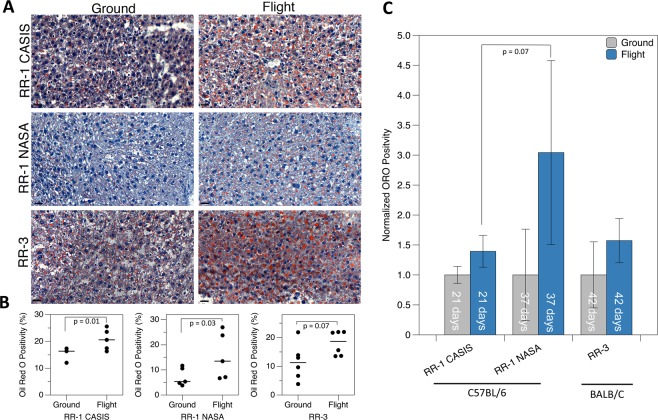
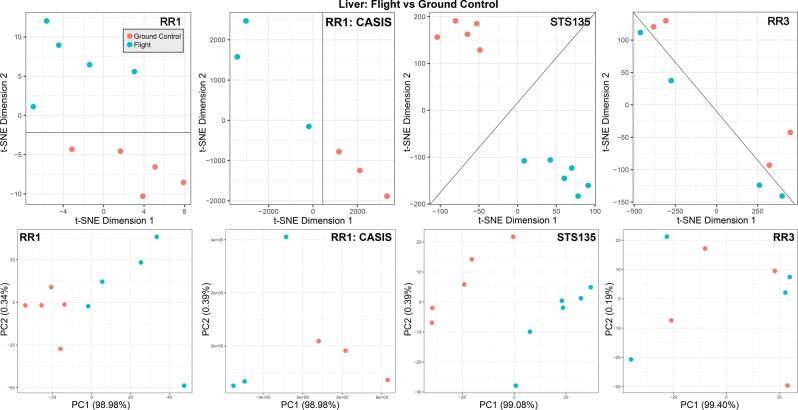
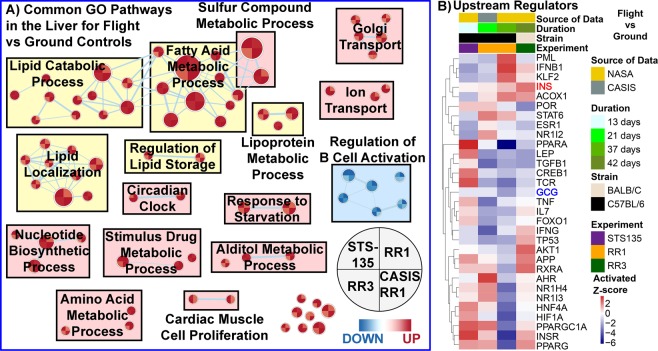
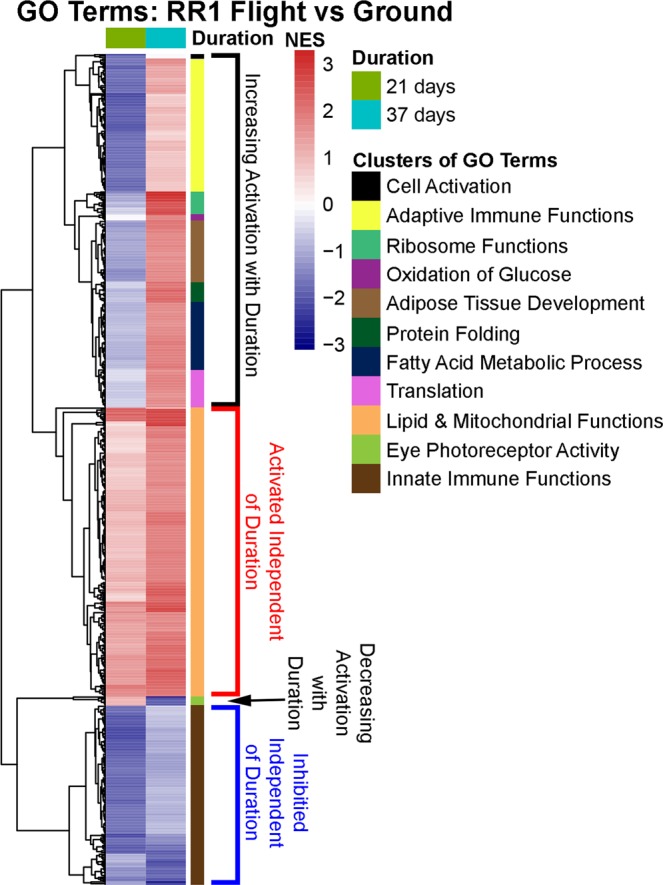
Spaceflight has several detrimental effects on the physiology of astronauts, many of which are recapitulated in rodent models. Mouse studies performed on the Space Shuttle showed disruption of lipid metabolism in liver. However, given that these animals were not sacrificed on-orbit and instead returned live to earth, it is unclear if these disruptions were solely induced by space stressors (e.g. microgravity, space radiation) or in part explained by the stress of return to Earth. In this work we analyzed three liver datasets from two different strains of mice (C57BL/6 (Jackson) & BALB/c (Taconic)) flown aboard the International Space Station (ISS). Notably, these animals were sacrificed on-orbit and exposed to varying spaceflight durations (i.e. 21, 37, and 42 days vs 13 days for the Shuttle mice). Oil Red O (ORO) staining showed abnormal lipid accumulation in all space-flown mice compared to ground controls regardless of strain or exposure duration. Similarly, transcriptomic analysis by RNA-sequencing revealed several pathways that were affected in both strains related to increased lipid metabolism, fatty acid metabolism, lipid and fatty acid processing, lipid catabolic processing, and lipid localization. In addition, key upstream regulators were predicted to be commonly regulated across all conditions including Glucagon (GCG) and Insulin (INS). Moreover, quantitative proteomic analysis showed that a number of lipid related proteins were changed in the livers during spaceflight. Taken together, these data indicate that activation of lipotoxic pathways are the result of space stressors alone and this activation occurs in various genetic backgrounds during spaceflight exposures of weeks to months. If similar responses occur in humans, a prolonged change of these pathways may result in the development of liver disease and should be investigated further.
Overview
The claims and statistics of this paper haven’t been checked yet.
Free: it reads the open-access text and checks the first 5 claims that cite a source we can check. Create a free account to check every claim.
Integrity signals
Registry
Cites
Statistics
Figures
Verification
Claims the paper makes
The claims and statistics of this paper haven’t been checked yet.
Free: it reads the open-access text and checks the first 5 claims that cite a source we can check. Create a free account to check every claim.
Claims other papers make about this one
Each is checked against this paper’s own text: does it say what the citing paper says it does?
The source backs part of the claim, not all of it — or backs it for a different population, condition or comparison.
In the citing paper
“We focused on the liver since we previously demonstrated that the liver regulates immune activity and lipid dysregulation during spaceflight (Beheshti et al., 2019).”
From Comprehensive Multi-omics Analysis Reveals Mitochondrial Stress as a Central Biological Hub for Spaceflight Impact (2020) · cites this paper as Beheshti et al., 2019
Experimental — accuracy not yet measuredThe source backs part of the claim, not all of it — or backs it for a different population, condition or comparison.
In the citing paper
“As stated earlier, lipid dysregulation with spaceflight originates from the liver (Beheshti et al., 2019).”
From Comprehensive Multi-omics Analysis Reveals Mitochondrial Stress as a Central Biological Hub for Spaceflight Impact (2020) · cites this paper as Beheshti et al., 2019
Experimental — accuracy not yet measuredThe source backs part of the claim, not all of it — or backs it for a different population, condition or comparison.
In the citing paper
“Pro-inflammatory responses negatively regulate PPARα in rodent models of atherosclerosis and early NAFLD that could be affecting astronauts as well75,76,79,80.”
From Key points for the development of antioxidant cocktails to prevent cellular stress and damage caused by reactive oxygen species (ROS) during manned space missions (2021) · cites this paper as [76]
Experimental — accuracy not yet measuredThe cited source says what the claim attributes to it.
In the citing paper
“and the results from our analyses are consistent with those from previous studies (Beheshti et al., 2019; Suomalainen and Battersby, 2018) and are supported by multiple other omics studies (Bezdan et al., 2020; Gertz et al., 2020).”
From Comprehensive Multi-omics Analysis Reveals Mitochondrial Stress as a Central Biological Hub for Spaceflight Impact (2020) · cites this paper as Beheshti et al., 2019
The cited source says what the claim attributes to it.
In the citing paper
“Two mouse strains were previously found to have accumulated lipids in the liver due to spaceflight exposure (Beheshti et al., 2019).”
From Comprehensive Multi-omics Analysis Reveals Mitochondrial Stress as a Central Biological Hub for Spaceflight Impact (2020) · cites this paper as Beheshti et al., 2019
Self-check
Percentages, sums and reported differences re-computed from the paper’s own numbers.
The self-check needs the paper’s full text.
Citations
Cites
Subramanian, A., Tamayo, P., Mootha, V. K., Mukherjee, S., Ebert, B. L., Gillette, M. A., Paulovich, A., Pomeroy, S. L., Golub, T. R., Lander, E. S., et al. (2005) · Proceedings of the National Academy of Sciences · doi:10.1073/pnas.0506580102 · Cited by 53,625
Cytoscape: A software Environment for integrated models of biomolecular interaction networks
Shannon, P., Markiel, A., Ozier, O., Baliga, N. S., Wang, J. T., Ramage, D., Amin, N., Schwikowski, B., & Ideker, T. (2003) · Genome Research · doi:10.1101/gr.1239303 · Cited by 51,888
STAR: ultrafast universal RNA-seq aligner
Dobin, A., Davis, C. A., Schlesinger, F., Drenkow, J., Zaleski, C., Jha, S., Batut, P., Chaisson, M., & Gingeras, T. R. (2013) · Bioinformatics · doi:10.1093/bioinformatics/bts635 · Cited by 51,709
Gene Ontology: tool for the unification of biology
Ashburner, M., Ball, C. A., Blake, J. A., Botstein, D., Butler, H., Cherry, J. M., Davis, A. P., Dolinski, K., Dwight, S. S., Eppig, J. T., et al. (2000) · Nature Genetics · doi:10.1038/75556 · Cited by 43,206
(2008) · Journal of Machine Learning Research · Cited by 33,051
Szklarczyk, D., Gable, A. L., Lyon, D., Junge, A., Wyder, S., Huerta-Cepas, J., Simonovic, M., Doncheva, N. T., Morris, J. H., Bork, P., et al. (2019) · Nucleic Acids Research · doi:10.1093/nar/gky1131 · Cited by 17,749
The Perseus computational platform for comprehensive analysis of (prote)omics data
Tyanova, S., Temu, T., Sinitcyn, P., Carlson, A., Hein, M. Y., Geiger, T., Mann, M., & Cox, J. (2016) · Nature Methods · doi:10.1038/nmeth.3901 · Cited by 8,803
Causal analysis approaches in Ingenuity Pathway Analysis
Krämer, A., Green, J., Pollard, J., & Tugendreich, S. (2014) · Bioinformatics · doi:10.1093/bioinformatics/btt703 · Cited by 5,724
The Reactome pathway Knowledgebase
Fabregat, A., Sidiropoulos, K., Garapati, P., Gillespie, M., Hausmann, K., Haw, R., Jassal, B., Jupe, S., Korninger, F., McKay, S., et al. (2016) · Nucleic Acids Research · doi:10.1093/nar/gkv1351 · Cited by 5,605
The Gene Ontology Resource: 20 years and still GOing strong
The Gene Ontology Consortium (2019) · Nucleic Acids Research · doi:10.1093/nar/gky1055 · Cited by 4,747
ToppGene Suite for gene list enrichment analysis and candidate gene prioritization
Chen, J., Bardes, E. E., Aronow, B. J., & Jegga, A. G. (2009) · Nucleic Acids Research · doi:10.1093/nar/gkp427 · Cited by 2,952
The Reactome Pathway Knowledgebase
Fabregat, A., Jupe, S., Matthews, L., Sidiropoulos, K., Gillespie, M., Garapati, P., Haw, R., Jassal, B., Korninger, F., May, B., et al. (2018) · Nucleic Acids Research · doi:10.1093/nar/gkx1132 · Cited by 2,855
Enrichment Map: A Network-Based Method for Gene-Set Enrichment Visualization and Interpretation
Merico, D., Isserlin, R., Stueker, O., Emili, A., & Bader, G. D. (2010) · PLoS ONE · doi:10.1371/journal.pone.0013984 · Cited by 2,235
[9] TM4 Microarray Software Suite
Saeed, A. I., Bhagabati, N. K., Braisted, J. C., Liang, W., Sharov, V., Howe, E. A., Li, J., Thiagarajan, M., White, J. A., & Quackenbush, J. (2006) · Methods in Enzymology · doi:10.1016/s0076-6879(06)11009-5 · Cited by 1,983
Pawlak, M., Lefebvre, P., & Staels, B. (2015) · Journal of Hepatology · doi:10.1016/j.jhep.2014.10.039 · Cited by 1,578
Regulation of hepatic glucose metabolism in health and disease
Petersen, M. C., Vatner, D. F., & Shulman, G. I. (2017) · Nature Reviews Endocrinology · doi:10.1038/nrendo.2017.80 · Cited by 1,133
Nguyen, P., Leray, V., Diez, M., Serisier, S., Bloc’h, J. L., Siliart, B., & Dumon, H. (2008) · Journal of Animal Physiology and Animal Nutrition · doi:10.1111/j.1439-0396.2007.00752.x · Cited by 968
Nonalcoholic Fatty Liver Disease: Pathology and Pathogenesis
Tiniakos, D. G., Vos, M. B., & Brunt, E. M. (2010) · Annual Review of Pathology: Mechanisms of Disease · doi:10.1146/annurev-pathol-121808-102132 · Cited by 870
The unfolded protein response in immunity and inflammation
Grootjans, J., Kaser, A., Kaufman, R. J., & Blumberg, R. S. (2016) · Nature Reviews Immunology · doi:10.1038/nri.2016.62 · Cited by 816
Cobbina, E., & Akhlaghi, F. (2017) · Drug Metabolism Reviews · doi:10.1080/03602532.2017.1293683 · Cited by 653
Sayiner, M., Koenig, A., Henry, L., & Younossi, Z. M. (2016) · Clinics in Liver Disease · doi:10.1016/j.cld.2015.10.001 · Cited by 529
Circadian Homeostasis of Liver Metabolism Suppresses Hepatocarcinogenesis
Kettner, N. M., Voicu, H., Finegold, M. J., Coarfa, C., Sreekumar, A., Putluri, N., Katchy, C. A., Lee, C., Moore, D. D., & Fu, L. (2016) · Cancer Cell · doi:10.1016/j.ccell.2016.10.007 · Cited by 508
Central Role of Pparα–Dependent Hepatic Lipid Turnover in Dietary Steatohepatitis in Mice
Ip, E., Farrell, G. C., Robertson, G., Hall, P., Kirsch, R., & Leclercq, I. (2003) · Hepatology · doi:10.1053/jhep.2003.50307 · Cited by 476
Adipose tissue as an immunological organ
Grant, R. W., & Dixit, V. D. (2015) · Obesity · doi:10.1002/oby.21003 · Cited by 453
Crucian, B. E., Choukèr, A., Simpson, R. J., Mehta, S., Marshall, G., Smith, S. M., Zwart, S. R., Heer, M., Ponomarev, S., Whitmire, A., et al. (2018) · Frontiers in Immunology · doi:10.3389/fimmu.2018.01437 · Cited by 421
The metabolic actions of glucagon revisited
Habegger, K. M., Heppner, K. M., Geary, N., Bartness, T. J., DiMarchi, R., & Tschöp, M. H. (2010) · Nature Reviews Endocrinology · doi:10.1038/nrendo.2010.187 · Cited by 406
Obesity Drives STAT-1-Dependent NASH and STAT-3-Dependent HCC
Grohmann, M., Wiede, F., Dodd, G. T., Gurzov, E. N., Ooi, G. J., Butt, T., Rasmiena, A. A., Kaur, S., Gulati, T., Goh, P. K., et al. (2018) · Cell · doi:10.1016/j.cell.2018.09.053 · Cited by 373
Plubell, D. L., Wilmarth, P. A., Zhao, Y., Fenton, A. M., Minnier, J., Reddy, A. P., Klimek, J., Yang, X., David, L. L., & Pamir, N. (2017) · Molecular & Cellular Proteomics · doi:10.1074/mcp.m116.065524 · Cited by 356
Fold change and p-value cutoffs significantly alter microarray interpretations
Dalman, M. R., Deeter, A., Nimishakavi, G., & Duan, Z.-H. (2012) · BMC Bioinformatics · doi:10.1186/1471-2105-13-s2-s11 · Cited by 332
Physiologic action of glucagon on liver glucose metabolism
Ramnanan, C. J., Edgerton, D. S., Kraft, G., & Cherrington, A. D. (2011) · Diabetes Obesity and Metabolism · doi:10.1111/j.1463-1326.2011.01454.x · Cited by 293
Roles of PPARs in NAFLD: Potential therapeutic targets
Tailleux, A., Wouters, K., & Staels, B. (2012) · Biochimica et Biophysica Acta (BBA) - Molecular and Cell Biology of Lipids · doi:10.1016/j.bbalip.2011.10.016 · Cited by 282
Mouse models of nonalcoholic steatohepatitis in preclinical drug development
Hansen, H. H., Feigh, M., Veidal, S. S., Rigbolt, K. T., Vrang, N., & Fosgerau, K. (2017) · Drug Discovery Today · doi:10.1016/j.drudis.2017.06.007 · Cited by 270
Role of lipids in the metabolism and activation of immune cells
Hubler, M. J., & Kennedy, A. J. (2016) · The Journal of Nutritional Biochemistry · doi:10.1016/j.jnutbio.2015.11.002 · Cited by 255
Alterations in adaptive immunity persist during long-duration spaceflight
Crucian, B., Stowe, R. P., Mehta, S., Quiriarte, H., Pierson, D., & Sams, C. (2015) · npj Microgravity · doi:10.1038/npjmgrav.2015.13 · Cited by 252
Gervois, P., Kleemann, R., Pilon, A., Percevault, F., Koenig, W., Staels, B., & Kooistra, T. (2004) · Journal of Biological Chemistry · doi:10.1074/jbc.m400346200 · Cited by 212
Microanatomy of the human liver—exploring the hidden interfaces
Saxena, R., Theise, N. D., & Crawford, J. M. (1999) · Hepatology · doi:10.1002/hep.510300607 · Cited by 183
Practical pathology of aging mice
Pettan-Brewer, C., & M. Treuting, P. (2011) · Pathobiology of Aging & Age-related Diseases · doi:10.3402/pba.v1i0.7202 · Cited by 151
Antoch, M. P., Gorbacheva, V. Y., Vykhovanets, O., Toshkov, I. A., Kondratov, R. V., Kondratova, A. A., Lee, C., & Nikitin, A. Y. (2008) · Cell Cycle · doi:10.4161/cc.7.9.5886 · Cited by 144
The Metabolic Syndrome and Its Influence on Nonalcoholic Steatohepatitis
Kanwar, P., & Kowdley, K. V. (2015) · Clinics in Liver Disease · doi:10.1016/j.cld.2015.10.002 · Cited by 141
The Role of Lipid and Lipoprotein Metabolism in Non‐Alcoholic Fatty Liver Disease
Perla, F., Prelati, M., Lavorato, M., Visicchio, D., & Anania, C. (2017) · Children · doi:10.3390/children4060046 · Cited by 127
Protein metabolism and liver disease
Charlton, M. R. (1996) · Baillière s Clinical Endocrinology and Metabolism · doi:10.1016/s0950-351x(96)80771-3 · Cited by 123
Jovicic, N. U., Jeftic, I. D., Jovanović, I., Radosavljevic, G. D., Arsenijević, N., Lukić, M. L., & Pejnovic, N. N. (2015) · PLoS ONE · doi:10.1371/journal.pone.0134089 · Cited by 115
Spaceflight Activates Lipotoxic Pathways in Mouse Liver
Jonscher, K. R., Alfonso-Garcia, A., Suhalim, J. L., Orlicky, D. J., Potma, E. O., Ferguson, V. L., Bouxsein, M. L., Bateman, T. A., Stodieck, L. S., Levi, M., et al. (2016) · PLOS ONE · doi:10.1371/journal.pone.0152877 · Cited by 108
GeneLab: Omics database for spaceflight experiments
Ray, S., Gebre, S., Fogle, H. W., Berrios, D. C., Tran, P. B., Galazka, J. M., & Costes, S. V. (2018) · Bioinformatics · doi:10.1093/bioinformatics/bty884 · Cited by 108
Self-citationMagee, N., Zou, A., & Zhang, Y. (2016) · BioMed Research International · doi:10.1155/2016/5170402 · Cited by 107
Quantifying hepatic steatosis – more than meets the eye
Levene, A., Kudo, H., Armstrong, M. J., Thursz, M. R., Gedroyc, W. M. W., Anstee, Q. M., & Goldin, R. D. (2012) · Histopathology · doi:10.1111/j.1365-2559.2012.04193.x · Cited by 98
Insulin secretion and sensitivity in space flight
Tobin, B. W., Uchakin, P., & Leeper-Woodford, S. K. (2002) · Nutrition · doi:10.1016/s0899-9007(02)00940-1 · Cited by 95
Behavior of mice aboard the International Space Station
Ronca, A. E., Moyer, E. L., Talyansky, Y., Lowe, M., Padmanabhan, S., Choi, S., Gong, C., Cadena, S. M., Stodieck, L., & Globus, R. K. (2019) · Scientific Reports · doi:10.1038/s41598-019-40789-y · Cited by 80
Sundberg, J. P., Berndt, A., Sundberg, B. A., Silva, K. A., Kennedy, V., Bronson, R., Yuan, R., Paigen, B., Harrison, D., & N. Schofield, P. (2011) · Pathobiology of Aging & Age-related Diseases · doi:10.3402/pba.v1i0.7179 · Cited by 79
Gene Expression Profiling in Slow-Type Calf Soleus Muscle of 30 Days Space-Flown Mice
Gambara, G., Salanova, M., Ciciliot, S., Furlan, S., Gutsmann, M., Schiffl, G., Ungethuem, U., Volpe, P., Gunga, H.-C., & Blottner, D. (2017) · PLOS ONE · doi:10.1371/journal.pone.0169314 · Cited by 74
Nonalcoholic Fatty Liver Disease and Obesity
Saadeh, S. N. (2007) · Nutrition in Clinical Practice · doi:10.1177/011542650702200101 · Cited by 72
Spaceflight Activates Autophagy Programs and the Proteasome in Mouse Liver
Blaber, E., Pecaut, M., & Jonscher, K. (2017) · International Journal of Molecular Sciences · doi:10.3390/ijms18102062 · Cited by 70
Is spaceflight-induced immune dysfunction linked to systemic changes in metabolism?
Pecaut, M. J., Mao, X. W., Bellinger, D. L., Jonscher, K. R., Stodieck, L. S., Ferguson, V. L., Bateman, T. A., Mohney, R. P., & Gridley, D. S. (2017) · PLOS ONE · doi:10.1371/journal.pone.0174174 · Cited by 57
Wood, G. C., Chu, X., Argyropoulos, G., Benotti, P., Rolston, D., Mirshahi, T., Petrick, A., Gabrielson, J., Carey, D. J., DiStefano, J. K., et al. (2017) · Scientific Reports · doi:10.1038/srep43238 · Cited by 56
Apolipoprotein A5: Extracellular and Intracellular Roles in Triglyceride Metabolism
Forte, T., & Ryan, R. (2015) · Current Drug Targets · doi:10.2174/1389450116666150531161138 · Cited by 52
Spaceflight Effects on Cytochrome P450 Content in Mouse Liver
Moskaleva, N., Moysa, A., Novikova, S., Tikhonova, O., Zgoda, V., & Archakov, A. (2015) · PLOS ONE · doi:10.1371/journal.pone.0142374 · Cited by 44
Radugina, E. A., Almeida, E. A. C., Blaber, E. A., Poplinskaya, V. A., Markitantova, Y. V., & Grigoryan, E. N. (2017) · Life Sciences in Space Research · doi:10.1016/j.lssr.2017.08.005 · Cited by 43
Protein Translation Activity: A New Measure of Host Immune Cell Activation
Seedhom, M. O., Hickman, H. D., Wei, J., David, A., & Yewdell, J. W. (2016) · The Journal of Immunology · doi:10.4049/jimmunol.1600088 · Cited by 39
Urasaki, Y., Zhang, C., Cheng, J., & Le, T. T. (2018) · Scientific Reports · doi:10.1038/s41598-018-22082-6 · Cited by 38
Deficiency of 5-hydroxyisourate hydrolase causes hepatomegaly and hepatocellular carcinoma in mice
Stevenson, W. S., Hyland, C. D., Zhang, J., Morgan, P. O., Willson, T. A., Gill, A. J., Hilton, A. A., Viney, E. M., Bahlo, M., Masters, S. L., et al. (2010) · Proceedings of the National Academy of Sciences · doi:10.1073/pnas.1010390107 · Cited by 35
Targeting bile acids and lipotoxicity for NASH treatment
Chiang, J. Y. L. (2017) · Hepatology Communications · doi:10.1002/hep4.1127 · Cited by 32
NASA GeneLab Project: Bridging Space Radiation Omics with Ground Studies
Beheshti, A., Miller, J., Kidane, Y. H., Berrios, D. C., Gebre, S., & Costes, S. V. (2018) · Radiation Research · doi:10.1667/rr15062.1 · Cited by 32
Self-citationMoyer, E. L., Dumars, P. M., Sun, G.-S., Martin, K. J., Heathcote, D. G., Boyle, R. D., & Skidmore, M. (2016) · npj Microgravity · doi:10.1038/npjmgrav.2016.2 · Cited by 30
Biomarker Identification from RNA-Seq Data using a Robust Statistical Approach
Akond, Z., Alam, M., & Mollah, M. N. H. (2018) · Bioinformation · doi:10.6026/97320630014153 · Cited by 23
Exploring the Effects of Spaceflight on Mouse Physiology using the Open Access NASA GeneLab Platform
Beheshti, A., Shirazi‐Fard, Y., Choi, S. Y., Berrios, D. C., Gebre, S., Galazka, J. M., & Costes, S. V. (2019) · Journal of Visualized Experiments · doi:10.3791/58447 · Cited by 21
Self-citationEvaluation of the nutrient-upgraded rodent food bar for rodent spaceflight experiments
Sun, G.-S., Tou, J. C. L., Liittschwager, K., Herrera, A. M., Hill, E. L., Girten, B. E., Reiss-Bubenheim, D., & Vasques, M. (2010) · Nutrition · doi:10.1016/j.nut.2009.09.018 · Cited by 20
A role of the adaptive immune system in glucose homeostasis
Bronsart, L. L., & Contag, C. H. (2016) · BMJ Open Diabetes Research & Care · doi:10.1136/bmjdrc-2015-000136 · Cited by 18
Lipid biosynthesis: When the cell cycle meets protein synthesis?
Blank, H. M., Maitra, N., & Polymenis, M. (2017) · Cell Cycle · doi:10.1080/15384101.2017.1312851 · Cited by 17
Hausen, J., Otte, J. C., Strähle, U., Hammers‐Wirtz, M., Hollert, H., Keiter, S. H., & Ottermanns, R. (2015) · Environmental Science and Pollution Research · doi:10.1007/s11356-015-5019-0 · Cited by 4
Research works printed but not linked: 1
- Fengler VH Macheiner T Sargsyan K Manifestation of Non-Alcoholic Fatty Liver Disease/Non-Alcoholic Steatohepatitis in Different Dietary Mouse Models. European Medical Journal Hepatology 2016 4 94 102
Cited by
Fundamental Biological Features of Spaceflight: Advancing the Field to Enable Deep-Space Exploration
Afshinnekoo, E., Scott, R. T., MacKay, M. J., Pariset, E., Cekanaviciute, E., Barker, R., Gilroy, S., Hassane, D., Smith, S. M., Zwart, S. R., et al. (2020) · Cell · doi:10.1016/j.cell.2020.10.050 · Cited by 478
“ISS, Shuttle, and microgravity ground-analog animal livers presented with damage contributing to increased lipid and fatty acid processing (Beheshti et al., 2019; Jonscher et al., 2016).”
BackgroundSelf-citationda Silveira, W. A., Fazelinia, H., Rosenthal, S. B., Laiakis, E. C., Kim, M. S., Meydan, C., Kidane, Y., Rathi, K. S., Smith, S. M., Stear, B., et al. (2020) · Cell · doi:10.1016/j.cell.2020.11.002 · Cited by 402
“As stated earlier, lipid dysregulation with spaceflight originates from the liver (Beheshti et al., 2019).”
InfluentialSelf-citationHuman Health during Space Travel: State-of-the-Art Review
Krittanawong, C., Singh, N. K., Scheuring, R. A., Urquieta, E., Bershad, E. M., Macaulay, T. R., Kaplin, S., Dunn, C., Kry, S. F., Russomano, T., et al. (2022) · Cells · doi:10.3390/cells12010040 · Cited by 170
“Another potential consequence of prolonged microgravity exposure is the possibility of increased fatty-acid processing [145], leading to the development of non-alcoholic fatty liver disease (NAFLD) and hepatic fibrosis [146,147].”
BackgroundNASA GeneLab: interfaces for the exploration of space omics data
Berrios, D. C., Galazka, J. M., Grigorev, K. A., Gebre, S., & Costes, S. V. (2020) · Nucleic Acids Research · doi:10.1093/nar/gkaa887 · Cited by 132
Self-citationHemolysis contributes to anemia during long-duration space flight
Trudel, G., Shahin, N., Ramsay, T., Laneuville, O., & Louati, H. (2022) · Nature Medicine · doi:10.1038/s41591-021-01637-7 · Cited by 127
Metadata
- Authors
- Beheshti, A., Chakravarty, K., Fogle, H., Fazelinia, H., Silveira, W. A. D., Boyko, V., Polo, S.-H. L., Saravia-Butler, A. M., Hardiman, G., Taylor, D., Galazka, J. M., & Costes, S. V.
- Affiliations
- Ames Research Center (US)
- Children's Hospital of Philadelphia (US)
- Queen's University Belfast (GB)
- Corresponding author
- Beheshti, Afshin
- Costes, Sylvain V.
- ORCID
- Venue
- Scientific Reports
- Published
- 2019-12-16
- Volume
- 9
- Issue
- 1
- Pages
- 19195-19195
- ISSN
- 2045-2322 (ISSN-L)
- PMC
- PMC6915713
- OpenAlex
- W2996338841
- Cited by
- 90
- References
- 69
- Citations by year
- 2026: 17 · 2025: 13 · 2024: 15 · 2023: 12 · 2022: 14 · 2021: 8 · 2020: 11
- FWCI
- 5.66
- Type
- journal article
- Language
- en
- Update notices
- correction (2020-01-27)
- Open access
- gold
- doi.org
- Licence
- cc-by
- creativecommons.org/licenses/by/4.0 (tdm)
- creativecommons.org/licenses/by/4.0 (vor)
- Locations
- Scientific Reports (publishedVersion, cc-by)
- Europe PMC (PubMed Central) (publishedVersion, cc-by)
- PubMed Central (publishedVersion, cc-by)
- PubMed (publishedVersion)
- DOAJ (DOAJ: Directory of Open Access Journals) (submittedVersion)
- Research Portal (Queen's University Belfast) (submittedVersion, cc-by)
- Funders
- National Aeronautics and Space Administration
- Ames Research Center
- Topics
- Health Sciences › Medicine › Physiology (medical) › Spaceflight effects on biology
- Life Sciences › Biochemistry, Genetics and Molecular Biology › Biochemistry › Lipid metabolism and biosynthesis
- Social Sciences › Political Science and International Relations › Space exploration and regulation
- Keywords
- spaceflight, lipid dysregulation, liver, lipid metabolism, fatty acid metabolism, lipotoxicity, microgravity, space radiation, mouse model, C57BL/6 mice, BALB/c mice, International Space Station, Space Shuttle, transcriptomics, proteomics, glucagon, insulin, lipid accumulation, liver disease
About these checks
Registry, retraction, Cites and statistics results are computed, not judged, with one exception: a printed reference that no index lists is read once by a model before it counts as a citation error. Claims are extracted by a model and kept only when their quote appears verbatim in the text; each cited source is then checked, with a model’s help, for whether it says what the claim relies on. Those verdicts can be wrong — read the claim’s quote and the cited source before relying on one.
Statistics and arithmetic are recomputed, not judged.
Confidence bands are shown only for fields calibrated on our annotated test set. None is calibrated yet, so no band is shown.
What counts as a claim ›How we measure confidence ›How we check this ›
Are you an author, or do you see a problem with this page? Request a review
Data sources
Bibliographic data: Semantic Scholar, OpenAlex, Crossref.
Contains information from the Semantic Scholar Academic Graph Datasets, made available under the ODC Attribution License (ODC-BY 1.0).
Semantic Scholar’s data is described in: Kinney, R., et al. (2023). The Semantic Scholar Open Data Platform. arXiv:2301.10140.
