

Visuo-motor and interoceptive influences on peripersonal space representation following spinal cord injury
Open accessThe DOI matches its Crossref record; 111 of the 111 references it cites were found in a registry or an index.
Abstract
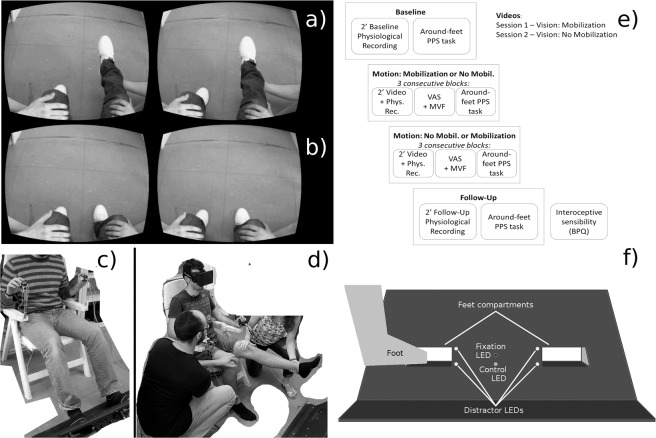
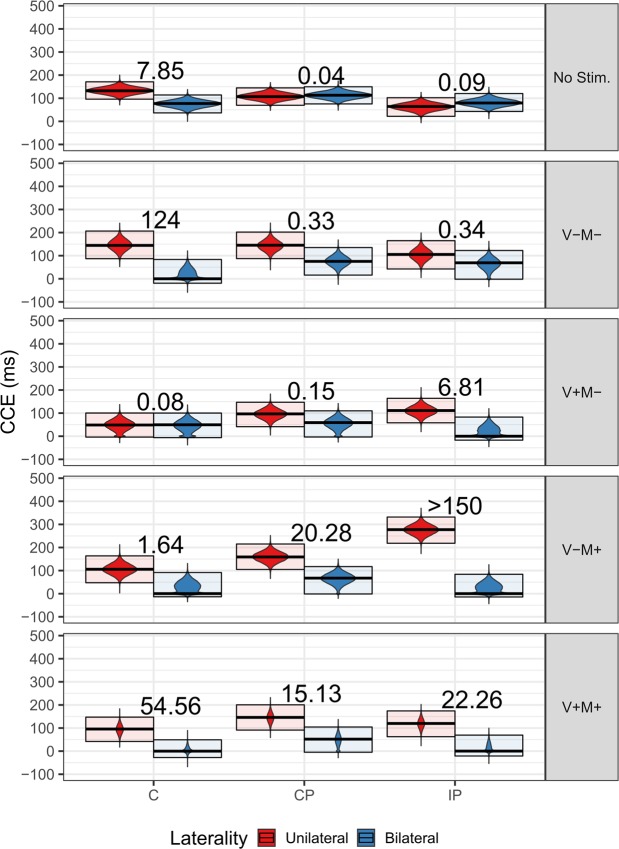
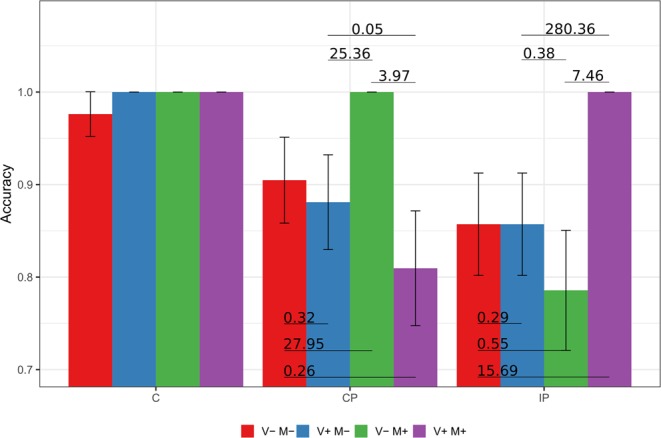
Peripersonal space (PPS) representation is modulated by information coming from the body. In paraplegic individuals, whose lower limb sensory-motor functions are impaired or completely lost, the representation of PPS around the feet is reduced. However, passive motion can have short-term restorative effects. What remains unclear is the mechanisms underlying this recovery, in particular with regard to the contribution of visual and motor feedback and of interoception. Using virtual reality technology, we dissociated the motor and visual feedback during passive motion in paraplegics with complete and incomplete lesions and in healthy controls. The results show that in the case of paraplegics, the presence of motor feedback was necessary for the recovery of PPS representation, both when the motor feedback was congruent and when it was incongruent with the visual feedback. In contrast, visuo-motor incongruence led to an inhibition of PPS representation in the control group. There were no differences in sympathetic responses between the three groups. Nevertheless, in individuals with incomplete lesions, greater interoceptive sensitivity was associated with a better representation of PPS around the feet in the visuo-motor incongruent conditions. These results shed new light on the modulation of PPS representation, and demonstrate the importance of residual motor feedback and its integration with other bodily information in maintaining space representation.
Overview
The claims and statistics of this paper haven’t been checked yet.
Free: it reads the open-access text and checks the first 5 claims that cite a source we can check. Create a free account to check every claim.
Integrity signals
Registry
Cites
Statistics
Figures
Verification
Claims the paper makes
The claims and statistics of this paper haven’t been checked yet.
Free: it reads the open-access text and checks the first 5 claims that cite a source we can check. Create a free account to check every claim.
Claims other papers make about this one
Each is checked against this paper’s own text: does it say what the citing paper says it does?
The source backs part of the claim, not all of it — or backs it for a different population, condition or comparison.
In the citing paper
“a positive relationship between the quality of the PPS representation and the level of interoceptive awareness (Scandola et al. 2020).”
From Neuroanatomical correlates of peripersonal space: bridging the gap between perception, action, emotion and social cognition (2024) · cites this paper as Scandola et al. 2020
Experimental — accuracy not yet measuredThe source backs part of the claim, not all of it — or backs it for a different population, condition or comparison.
In the citing paper
“Scandola and colleagues designed a cross-modal integration paradigm (i.e., tactile and visual) to assess PPS representation around the legs in 18 paraplegic patients (Scandola et al. 2020), showing that SCIs are associated with reduced PPS representation around the body parts below the lesion level.”
From Neuroanatomical correlates of peripersonal space: bridging the gap between perception, action, emotion and social cognition (2024) · cites this paper as Scandola et al. 2020
Experimental — accuracy not yet measuredThe cited source says what the claim attributes to it.
In the citing paper
“In spinal cord injured patients, PPS is selectively reduced around the body parts below the lesion level, while it remained preserved around the body parts above the lesion level (Scandola et al., 2016(Scandola et al., , 2020)).”
From The Peripersonal Space in a social world (2021) · cites this paper as Scandola et al., 2020
Self-check
Percentages, sums and reported differences re-computed from the paper’s own numbers.
The self-check needs the paper’s full text.
Citations
Cites
Data Analysis Using Regression and Multilevel/Hierarchical Models
Gelman, A., & Hill, J. (2006) · doi:10.1017/cbo9780511790942 · Cited by 13,597
Kass, R. E., & Raftery, A. E. (1995) · Journal of the American Statistical Association · doi:10.1080/01621459.1995.10476572 · Cited by 12,558
Mixed-Effects Models in Sand S-PLUS
Pinheiro, J. C., & Bates, D. M. (2000) · Statistics and Computing · doi:10.1007/978-1-4419-0318-1 · Cited by 11,187
Mixed-Effects Models in S and S-PLUS
(2001) · Technometrics · doi:10.1198/tech.2001.s574 · Cited by 9,278
Estimating the reproducibility of psychological science
Open Science Collaboration (2015) · Science · doi:10.1126/science.aac4716 · Cited by 8,515
Bayesian model selection in social research
Raftery, A. E. (1995) · Sociological Methodology · doi:10.2307/271063 · Cited by 6,823
How do you feel? Interoception: The sense of the physiological condition of the body
Craig, A. D. (2002) · Nature Reviews Neuroscience · doi:10.1038/nrn894 · Cited by 6,006
Interoception: the sense of the physiological condition of the body
(Bud) Craig, A. (2003) · Current Opinion in Neurobiology · doi:10.1016/s0959-4388(03)00090-4 · Cited by 2,556
The distinct modes of vision offered by feedforward and recurrent processing
Lamme, V. A. F., & Roelfsema, P. R. (2000) · Trends in Neurosciences · doi:10.1016/s0166-2236(00)01657-x · Cited by 2,338
International standards for neurological classification of spinal cord injury (Revised 2011)
Kirshblum, S. C., Burns, S. P., Biering-Sorensen, F., Donovan, W., Graves, D. E., Jha, A., Johansen, M., Jones, L., Krassioukov, A., Mulcahey, M. J., et al. (2011) · The Journal of Spinal Cord Medicine · doi:10.1179/204577211x13207446293695 · Cited by 2,327
Salience processing and insular cortical function and dysfunction
Uddin, L. Q. (2015) · Nature Reviews Neuroscience · doi:10.1038/nrn3857 · Cited by 2,083
Things I have learned (so far).
Cohen, J. (1990) · American Psychologist · doi:10.1037/0003-066x.45.12.1304 · Cited by 1,781
Knowing your own heart: Distinguishing interoceptive accuracy from interoceptive awareness
Garfinkel, S. N., Seth, A. K., Barrett, A. B., Suzuki, K., & Critchley, H. D. (2015) · Biological Psychology · doi:10.1016/j.biopsycho.2014.11.004 · Cited by 1,624
Maravita, A., & Iriki, A. (2004) · Trends in Cognitive Sciences · doi:10.1016/j.tics.2003.12.008 · Cited by 1,214
Neural plasticity after peripheral nerve injury and regeneration
Navarro, X., Vivó, M., & Valero-Cabré, A. (2007) · Progress in Neurobiology · doi:10.1016/j.pneurobio.2007.06.005 · Cited by 881
Afferent properties of periarcuate neurons in macaque monkeys. II. Visual responses
Rizzolatti, G., Scandolara, C., Matelli, M., & Gentilucci, M. (1981) · Behavioural Brain Research · doi:10.1016/0166-4328(81)90053-x · Cited by 766
How to Make More Published Research True
Ioannidis, J. P. A. (2014) · PLoS Medicine · doi:10.1371/journal.pmed.1001747 · Cited by 760
Visual Capture of Touch: Out-of-the-Body Experiences With Rubber Gloves.
Pavani, F., Spence, C., & Driver, J. (2000) · Psychological Science · doi:10.1111/1467-9280.00270 · Cited by 608
Multisensory integration and the body schema: Close to hand and within reach
Maravita, A., Spence, C., & Driver, J. (2003) · Current Biology · doi:10.1016/s0960-9822(03)00449-4 · Cited by 578
VARIABLE SELECTION IN REGRESSION MODELS
Rao, M. S., & M.Venkataramanaih, M. S. (2013) · International Journal of Research in Commerce, IT and Management · Cited by 473
Attention and the crossmodal construction of space
Driver, J., & Spence, C. (1998) · Trends in Cognitive Sciences · doi:10.1016/s1364-6613(98)01188-7 · Cited by 400
Dynamic size-change of hand peripersonal space following tool use
Farnè, A., & Làdavas, E. (2000) · NeuroReport · doi:10.1097/00001756-200006050-00010 · Cited by 385
Makin, T. R., Holmes, N. P., & Zohary, E. (2007) · The Journal of Neuroscience · doi:10.1523/jneurosci.3653-06.2007 · Cited by 381
Gartia, M. R., Misra, S. K., Ye, M., Schwartz-Duval, A., Plucinski, L., Zhou, X., Kellner, D., Labriola, L. T., & Pan, D. (2016) · Scientific Reports · doi:10.1038/srep20452 · Cited by 379
Tool-use changes multimodal spatial interactions between vision and touch in normal humans
Maravita, A., Spence, C., Kennett, S., & Driver, J. (2002) · Cognition · doi:10.1016/s0010-0277(02)00003-3 · Cited by 323
Assessment of parasympathetic control of heart rate by a noninvasive method
Fouad, F. M., Tarazi, R. C., Ferrario, C. M., Fighaly, S., & Alicandri, C. (1984) · American Journal of Physiology-Heart and Circulatory Physiology · doi:10.1152/ajpheart.1984.246.6.h838 · Cited by 309
Serino, A. (2019) · Neuroscience & Biobehavioral Reviews · doi:10.1016/j.neubiorev.2019.01.016 · Cited by 304
Disability, atrophy and cortical reorganization following spinal cord injury
Freund, P., Weiskopf, N., Ward, N. S., Hutton, C., Gall, A., Ciccarelli, O., Craggs, M., Friston, K., & Thompson, A. J. (2011) · Brain · doi:10.1093/brain/awr093 · Cited by 294
Freund, P., Weiskopf, N., Ashburner, J., Wolf, K., Sutter, R., Altmann, D. R., Friston, K., Thompson, A., & Curt, A. (2013) · The Lancet Neurology · doi:10.1016/s1474-4422(13)70146-7 · Cited by 271
Social modulation of peripersonal space boundaries
Teneggi, C., Canzoneri, E., di Pellegrino, G., & Serino, A. (2013) · Current Biology · doi:10.1016/j.cub.2013.01.043 · Cited by 257
New aspects of motion perception: selective neural encoding of apparent human movements
Stevens, J. A., Fonlupt, P., Shiffrar, M., & Decety, J. (2000) · NeuroReport · doi:10.1097/00001756-200001170-00022 · Cited by 243
de Vignemont, F., & Iannetti, G. D. (2015) · Neuropsychologia · doi:10.1016/j.neuropsychologia.2014.11.018 · Cited by 238
Maravita, A., Husain, M., Clarke, K., & Driver, J. (2001) · Neuropsychologia · doi:10.1016/s0028-3932(00)00150-0 · Cited by 222
An action field theory of peripersonal space
Bufacchi, R. J., & Iannetti, G. D. (2018) · Trends in Cognitive Sciences · doi:10.1016/j.tics.2018.09.004 · Cited by 221
Evidence of subclinical brain influence in clinically complete spinal cord injury: discomplete SCI
Sherwood, A. M., Dimitrijevic, M. R., & Barry McKay, W. (1992) · Journal of the Neurological Sciences · doi:10.1016/0022-510x(92)90014-c · Cited by 215
Body part-centered and full body-centered peripersonal space representations
Serino, A., Noel, J.-P., Galli, G., Canzoneri, E., Marmaroli, P., Lissek, H., & Blanke, O. (2015) · Scientific Reports · doi:10.1038/srep18603 · Cited by 215
How does the human brain deal with a spinal cord injury?
Bruehlmeier, M., Dietz, V., Leenders, K. L., Roelcke, U., Missimer, J., & Curt, A. (1998) · European Journal of Neuroscience · doi:10.1046/j.1460-9568.1998.00454.x · Cited by 214
Why P Values Are Not a Useful Measure of Evidence in Statistical Significance Testing
Hubbard, R., & Lindsay, R. M. (2008) · Theory & Psychology · doi:10.1177/0959354307086923 · Cited by 212
Krassioukov, A. V., Karlsson, A.-K., Wecht, J. M., Wuermser, L.-A., Mathias, C. J., & Marino, R. J. (2007) · The Journal of Rehabilitation Research and Development · doi:10.1682/jrrd.2005.10.0159 · Cited by 210
Grivaz, P., Blanke, O., & Serino, A. (2017) · NeuroImage · doi:10.1016/j.neuroimage.2016.12.052 · Cited by 203
The Neural Basis of Body Form and Body Action Agnosia
Moro, V., Urgesi, C., Pernigo, S., Lanteri, P., Pazzaglia, M., & Aglioti, S. M. (2008) · Neuron · doi:10.1016/j.neuron.2008.09.022 · Cited by 200
Self-citationNeural Systems Underlying Observation of Humanly Impossible Movements: An fMRI Study
Costantini, M., Galati, G., Ferretti, A., Caulo, M., Tartaro, A., Romani, G. L., & Aglioti, S. M. (2005) · Cerebral Cortex · doi:10.1093/cercor/bhi053 · Cited by 189
Self-citationWhat Disconnection Tells about Motor Imagery: Evidence from Paraplegic Patients
Alkadhi, H., Brugger, P., Boendermaker, S. H., Crelier, G., Curt, A., Hepp-Reymond, M.-C., & Kollias, S. S. (2005) · Cerebral Cortex · doi:10.1093/cercor/bhh116 · Cited by 183
Impact of Neurologic Deficits on Motor Imagery: A Systematic Review of Clinical Evaluations
Rienzo, F. D., Collet, C., Hoyek, N., & Guillot, A. (2014) · Neuropsychology Review · doi:10.1007/s11065-014-9257-6 · Cited by 161
Kokotilo, K. J., Eng, J. J., & Curt, A. (2009) · Journal of Neurotrauma · doi:10.1089/neu.2008.0688 · Cited by 156
Virtual reality improves embodiment and neuropathic pain caused by spinal cord injury
Pozeg, P., Palluel, E., Ronchi, R., Solcà, M., Al-Khodairy, A.-W., Jordan, X., Kassouha, A., & Blanke, O. (2017) · Neurology · doi:10.1212/wnl.0000000000004585 · Cited by 149
Sambo, C. F., Liang, M., Cruccu, G., & Iannetti, G. D. (2012) · Journal of Neurophysiology · doi:10.1152/jn.00731.2011 · Cited by 144
Candidi, M., Urgesi, C., Ionta, S., & Aglioti, S. M. (2008) · Social Neuroscience · doi:10.1080/17470910701676269 · Cited by 136
Self-citationCrossmodal congruency measures of lateral distance effects on the rubber hand illusion
Zopf, R., Savage, G. R., & Williams, M. (2009) · Neuropsychologia · doi:10.1016/j.neuropsychologia.2009.10.028 · Cited by 135
Cortical reorganization after spinal cord injury: Always for good?
Moxon, K. A., Oliviero, A., Aguilar, J., & Foffani, G. (2014) · Neuroscience · doi:10.1016/j.neuroscience.2014.06.056 · Cited by 129
A tutorial on Bayes factor estimation with the product space method
Lodewyckx, T., Kim, W., Lee, M. D., Tuerlinckx, F., Kuppens, P., & Wagenmakers, E. (2011) · Journal of Mathematical Psychology · doi:10.1016/j.jmp.2011.06.001 · Cited by 128 · cited 1×
“…lower than 0.0067, within (0.0067÷ 0.05], and within (0.05 ÷ 0.33] are, respectively, indicators of very strong, strong and positive evidence in favour of the null hypothesis (i.e. the absence of a difference between the levels of the factor or the degree of interaction)(Lodewyckx et al., 2011).”
InfluentialCortical sensorimotor reorganization after spinal cord injury: An electroencephalographic study
Green, J. B., Sora, E., Bialy, Y., Ricamato, A., & Thatcher, R. W. (1998) · Neurology · doi:10.1212/wnl.50.4.1115 · Cited by 126
Amputation and prosthesis implantation shape body and peripersonal space representations
Canzoneri, E., Marzolla, M., Amoresano, A., Verni, G., & Serino, A. (2013) · Scientific Reports · doi:10.1038/srep02844 · Cited by 115
Heed, T., & Röder, B. (2010) · Journal of Cognitive Neuroscience · doi:10.1162/jocn.2008.21168 · Cited by 112
Dissociating effect of upper limb non-use and overuse on space and body representations
Bassolino, M., Finisguerra, A., Canzoneri, E., Serino, A., & Pozzo, T. (2015) · Neuropsychologia · doi:10.1016/j.neuropsychologia.2014.11.028 · Cited by 103
Combination and Integration in the Perception of Visual-Haptic Compliance Information
Kuschel, M., Luca, M. D., BUSS, M. J., & Klatzky, R. L. (2010) · IEEE Transactions on Haptics · doi:10.1109/toh.2010.9 · Cited by 103
Brain changes after spinal cord injury, a quantitative meta-analysis and review
Dahlberg, L. S., Becerra, L. R., Borsook, D., & Linnman, C. (2018) · Neuroscience & Biobehavioral Reviews · doi:10.1016/j.neubiorev.2018.04.018 · Cited by 103
Bonner, M. F., & Grossman, M. (2012) · Journal of Neuroscience · doi:10.1523/jneurosci.6241-11.2012 · Cited by 99
The Sense of the Body in Individuals with Spinal Cord Injury
Lenggenhager, B., Pazzaglia, M., Scivoletto, G., Molinari, M., & Aglioti, S. M. (2012) · PLoS ONE · doi:10.1371/journal.pone.0050757 · Cited by 97
Self-citationDifferential Effect of Spinal Cord Injury and Functional Impairment on Human Brain Activation
Curt, A. E. P., Bruehlmeier, M., Leenders, K. L., Roelcke, U., & Dietz, V. (2002) · Journal of Neurotrauma · doi:10.1089/089771502753460222 · Cited by 96
Corticomotor representation to a human forearm muscle changes following cervical spinal cord injury
Freund, P., Rothwell, J. C., Craggs, M. D., Thompson, A. J., & Bestmann, S. (2011) · European Journal of Neuroscience · doi:10.1111/j.1460-9568.2011.07895.x · Cited by 93
Ferri, F., Chiarelli, A. M., Merla, A., Gallese, V., & Costantini, M. (2013) · Proceedings of the Royal Society B: Biological Sciences · doi:10.1098/rspb.2013.1140 · Cited by 93
Cynophobic Fear Adaptively Extends Peri-Personal Space
Taffou, M., & Viaud-Delmon, I. (2014) · Frontiers in Psychiatry · doi:10.3389/fpsyt.2014.00122 · Cited by 92
Discrimination of motor imagery-induced EEG patterns in patients with complete spinal cord injury
Pfurtscheller, G., Linortner, P., Winkler, R., Korisek, G., & Müller-Putz, G. (2009) · Computational Intelligence and Neuroscience · doi:10.1155/2009/104180 · Cited by 88
Unsupervised Learning of Overlapping Image Components Using Divisive Input Modulation
Spratling, M. W., De Meyer, K., & Kompass, R. (2009) · Computational Intelligence and Neuroscience · doi:10.1155/2009/381457 · Cited by 78
Shokur, S., Gallo, S., Moioli, R. C., Donati, A. R. C., Morya, E., Bleuler, H., & Nicolelis, M. A. L. (2016) · Scientific Reports · doi:10.1038/srep32293 · Cited by 74
Patterns of sinus arrhythmia in patients with lesions of the central nervous system
Vallbona, C., Cardus, D., Spencer, W. A., & HOFF, H. E. (1965) · The American Journal of Cardiology · doi:10.1016/0002-9149(65)90729-0 · Cited by 68
Spinal cord injury affects the interplay between visual and sensorimotor representations of the body
Ionta, S., Villiger, M., Jutzeler, C. R., Freund, P., Curt, A., & Gassert, R. (2016) · Scientific Reports · doi:10.1038/srep20144 · Cited by 64
Self-citationEvolution of EEG Motor Rhythms after Spinal Cord Injury: A Longitudinal Study
López‐Larraz, E., Montesano, L., Gil-Agudo, A. M., Mínguez, J., & Oliviero, A. (2015) · PLoS ONE · doi:10.1371/journal.pone.0131759 · Cited by 63
Functional effect of short-term immobilization: Kinematic changes and recovery on reaching-to-grasp
Bassolino, M., Bove, M., Jacono, M., Fadiga, L., & Pozzo, T. (2012) · Neuroscience · doi:10.1016/j.neuroscience.2012.04.019 · Cited by 63
The costly filtering of potential distraction: Evidence for a supramodal mechanism.
Marini, F., Chelazzi, L., & Maravita, A. (2013) · Journal of Experimental Psychology General · doi:10.1037/a0029905 · Cited by 62
What is peripersonal space? An examination of unresolved empirical issues and emerging findings
Hunley, S. B., & Lourenco, S. F. (2018) · WIREs Cognitive Science · doi:10.1002/wcs.1472 · Cited by 59
Restoring Tactile Awareness Through the Rubber Hand Illusion in Cervical Spinal Cord Injury
Lenggenhager, B., Scivoletto, G., Molinari, M., & Pazzaglia, M. (2013) · Neurorehabilitation and neural repair · doi:10.1177/1545968313491009 · Cited by 58
Schicke, T., Bauer, F., & Röder, B. (2009) · Experimental Brain Research · doi:10.1007/s00221-008-1587-2 · Cited by 54
Scandola, M., Tidoni, E., Avesani, R., Brunelli, G., Aglioti, S. M., & Moro, V. (2014) · Frontiers in Human Neuroscience · doi:10.3389/fnhum.2014.00404 · Cited by 53
Self-citationScandola, M., Aglioti, S. M., Pozeg, P., Avesani, R., & Moro, V. (2016) · Journal of Neuropsychology · doi:10.1111/jnp.12098 · Cited by 49
Self-citationSpence, C., Pavani, F., Maravita, A., & Holmes, N. (2008) · A K Peters/CRC Press eBooks · doi:10.1201/b10636-4 · Cited by 48
Scandola, M., Aglioti, S. M., Bonente, C., Avesani, R., & Moro, V. (2016) · Scientific Reports · doi:10.1038/srep24126 · Cited by 45
Self-citationPernigo, S., Moro, V., Avesani, R., Miatello, C., Urgesi, C., & Aglioti, S. M. (2012) · European Journal of Neuroscience · doi:10.1111/j.1460-9568.2012.08266.x · Cited by 43
Self-citationTidoni, E., Grisoni, L., Liuzza, M. T., & Aglioti, S. M. (2014) · Restorative Neurology and Neuroscience · doi:10.3233/rnn-130385 · Cited by 43
Self-citationPeripersonal space boundaries around the lower limbs
Stone, K. D., Kandula, M., Keizer, A., & Dijkerman, H. C. (2018) · Experimental Brain Research · doi:10.1007/s00221-017-5115-0 · Cited by 43
Scandola, M., Togni, R., Tieri, G., Avesani, R., Brambilla, M., Aglioti, S. M., & Moro, V. (2019) · Experimental Brain Research · doi:10.1007/s00221-019-05618-8 · Cited by 43
Self-citationReduced perceptual sensitivity for biological motion in paraplegia patients
Arrighi, R., Cartocci, G., & Burr, D. C. (2011) · Current Biology · doi:10.1016/j.cub.2011.09.048 · Cited by 42
Audio-visual sensory deprivation degrades visuo-tactile peri-personal space
Noel, J.-P., Park, H.-D., Pasqualini, I., Lissek, H., Wallace, M., Blanke, O., & Serino, A. (2018) · Consciousness and Cognition · doi:10.1016/j.concog.2018.04.001 · Cited by 42
van Elk, M., Forget, J., & Blanke, O. (2013) · Consciousness and Cognition · doi:10.1016/j.concog.2013.02.006 · Cited by 40
Ponsi, G., Panasiti, M. S., Scandola, M., & Aglioti, S. M. (2016) · Quarterly Journal of Experimental Psychology · doi:10.1080/17470218.2015.1084339 · Cited by 40
Self-citationCorporeal illusions in chronic spinal cord injuries
Scandola, M., Aglioti, S. M., Avesani, R., Bertagnoni, G., Marangoni, A., & Moro, V. (2017) · Consciousness and Cognition · doi:10.1016/j.concog.2017.01.010 · Cited by 40
Self-citationNeurocognitive Benefits of Physiotherapy for Spinal Cord Injury
Scandola, M., Dodoni, L., Lazzeri, G., Arcangeli, C. A., Avesani, R., Moro, V., & Ionta, S. (2018) · Journal of Neurotrauma · doi:10.1089/neu.2018.6123 · Cited by 38
Self-citationBloch, C. W., Schneider, J. W., & Sinkjær, T. (2016) · PLoS ONE · doi:10.1371/journal.pone.0147726 · Cited by 36
Specific Deficit in Implicit Motor Sequence Learning following Spinal Cord Injury
Bloch, A., Tamir, D., Vakil, E., & Zeilig, G. (2016) · PLoS ONE · doi:10.1371/journal.pone.0158396 · Cited by 36
Perruchoud, D., Pisotta, I., Carda, S., Murray, M. M., & Ionta, S. (2016) · Journal of Neural Engineering · doi:10.1088/1741-2560/13/4/041001 · Cited by 35
Self-citationIndividual Differences in the Flexibility of Peripersonal Space
Hunley, S. B., Marker, A. M., & Lourenco, S. F. (2017) · Experimental Psychology · doi:10.1027/1618-3169/a000350 · Cited by 34
Walking dreams in congenital and acquired paraplegia
Saurat, M.-T., Agbakou, M., Attigui, P., Golmard, J., & Arnulf, I. (2011) · Consciousness and Cognition · doi:10.1016/j.concog.2011.05.015 · Cited by 33
Chen, X., Wan, L., Qin, W., Zheng, W., Qi, Z., Chen, N., & Li, K. (2016) · Frontiers in Human Neuroscience · doi:10.3389/fnhum.2016.00046 · Cited by 30
Carda, S., Biasiucci, A., Maesani, A., Ionta, S., Moncharmont, J., Clarke, S., Murray, M. M., & Millán, J. D. R. (2017) · Archives of Physical Medicine and Rehabilitation · doi:10.1016/j.apmr.2017.02.020 · Cited by 30
Self-citationHand-in-hand advances in biomedical engineering and sensorimotor restoration
Pisotta, I., Perruchoud, D., & Ionta, S. (2015) · Journal of Neuroscience Methods · doi:10.1016/j.jneumeth.2015.03.003 · Cited by 29
Self-citationMovement Observation Activates Lower Limb Motor Networks in Chronic Complete Paraplegia
Boendermaker, S. H., Hepp‐Reymond, M., Curt, A. E. P., & Kollias, S. (2011) · Neurorehabilitation and neural repair · doi:10.1177/1545968310389184 · Cited by 29
Embodying functionally relevant action sounds in patients with spinal cord injury
Pazzaglia, M., Galli, G., Lewis, J. W., Scivoletto, G., Giannini, A. M., & Molinari, M. (2018) · Scientific Reports · doi:10.1038/s41598-018-34133-z · Cited by 28
Illusion of arm movement evoked by tendon vibration in patients with spinal cord injury
Fusco, G., Tidoni, E., Barone, N., Pilati, C., & Aglioti, S. M. (2016) · Restorative Neurology and Neuroscience · doi:10.3233/rnn-160660 · Cited by 26
Self-citationMarini, F., Romano, D., & Maravita, A. (2016) · Experimental Brain Research · doi:10.1007/s00221-016-4849-4 · Cited by 24
Neuroplasticity of imagined wrist actions after spinal cord injury: a pilot study
Rienzo, F. D., Guillot, A., Mateo, S., Daligault, S., Delpuech, C., Rode, G., & Collet, C. (2014) · Experimental Brain Research · doi:10.1007/s00221-014-4114-7 · Cited by 19
Santamaría, A. J., Benavides, F. D., DiFede, D. L., Khan, A., Pujol, M. V., Dietrich, W. D., Marttos, A. C., Jr., Green, B. A., Hare, J. M., & Guest, J. D. (2018) · Journal of Neurotrauma · doi:10.1089/neu.2018.5716 · Cited by 19
OBSERVATION OF ACTION AND AUTONOMIC NERVOUS SYSTEM RESPONSES
Bolliet, O., Collet, C., & Dittmar, A. (2005) · Perceptual and Motor Skills · doi:10.2466/pms.101.1.195-202 · Cited by 18
Passive limb movement intervals results in repeated hyperemic responses in those with paraplegia
Burns, K. J., Pollock, B. S., Stavres, J., Kilbane, M. J., Brochetti, A., & McDaniel, J. (2018) · Spinal Cord · doi:10.1038/s41393-018-0099-6 · Cited by 18
Affordances after spinal cord injury
Sedda, A., Ambrosini, E., Dirupo, G., Tonin, D., Valsecchi, L., Redaelli, T., Spinelli, M., Costantini, M., & Bottini, G. (2018) · Journal of Neuropsychology · doi:10.1111/jnp.12151 · Cited by 16
Cardiovascular response to peak voluntary exercise in males with cervical spinal cord injury
Macháč, S., Radvanský, J., Kolář, P., & Kříž, J. (2015) · Journal of Spinal Cord Medicine · doi:10.1080/10790268.2015.1126939 · Cited by 15
Scandola, M., Aglioti, S. M., Avesani, R., Bertagnoni, G., Marangoni, A., & Moro, V. (2019) · PLoS ONE · doi:10.1371/journal.pone.0213838 · Cited by 13
Self-citationAction Possibility Judgments of People with Varying Motor Abilities Due to Spinal Cord Injury
Manson, G. A., Sayenko, D. G., Masani, K., Goodman, R. S., Wong, L., Popović, M. R., Tremblay, L., & Welsh, T. N. (2014) · PLoS ONE · doi:10.1371/journal.pone.0110250 · Cited by 9
OBSERVATION OF ACTION AND AUTONOMIC NERVOUS SYSTEM RESPONSES
Bolliet, O. (2005) · Perceptual and Motor Skills · doi:10.2466/pms.101.5.195-202 · Cited by 8
Salvato, G., Peviani, V., Scarano, E., Scarpa, P., Leo, A., Redaelli, T., Spinelli, M., Sberna, M., & Bottini, G. (2017) · Neurocase · doi:10.1080/13554794.2017.1332227 · Cited by 6
The role of visual-haptic discrepancy in virtual reality environments
Scandola, M., Gasperotti, L., Vicentini, M., & Fiorini, P. (2012) · IEEE Haptics Symposium · doi:10.1109/haptic.2012.6183804 · Cited by 5
Self-citation
Research works printed but not linked: 3
- McElreath, R. Statistical Rethinking: A Bayesian Course with Examples in R and Stan. (CRC Press, 2016).
- Fusco G Tidoni E Barone N Pilati C Aglioti SM Illusion of arm movement evoked by tendon vibration in patients with spinal cord injury Restor. Neurol. Neurosci. 2016 34 815 826 27567757
- Pozeg P Virtual reality improves embodiment and neuropathic pain caused by spinal cord injury Neurology 2017 89 1894 1903 10.1212/WNL.0000000000004585 28986411 PMC5664293 · DOI · Paper page
Cited by
The Peripersonal Space in a social world
Bogdanova, O. V., Bogdanov, V. B., Dureux, A., Farnè, A., & Hadj-Bouziane, F. (2021) · Cortex · doi:10.1016/j.cortex.2021.05.005 · Cited by 86
“…awareness, based on the perception of inner state of the body may thus be related to PPS representation (Ardizzi & Ferri, 2018; Cartaud et al., 2018; Noel, Park, et al., 2018; Noel, Pfeiffer, et al., 2015; Rabellino, Frewen, McKinnon, & Lanius, 2020; Rossetti et al., 2015; Scandola et al., 2020).”
BackgroundInfluentialThe sensorimotor theory of pathological pain revisited
Vittersø, A. D., Halicka, M., Buckingham, G., Proulx, M. J., & Bultitude, J. H. (2022) · Neuroscience & Biobehavioral Reviews · doi:10.1016/j.neubiorev.2022.104735 · Cited by 52
Interoception, network physiology and the emergence of bodily self-awareness
Candia‐Rivera, D., Engelen, T., Babo-Rebelo, M., & Salamone, P. (2024) · Neuroscience & Biobehavioral Reviews · doi:10.1016/j.neubiorev.2024.105864 · Cited by 67
“Improved cardiac interoception correlates with increased perceived self-body closeness and peripersonal space representation (Nakul et al., 2020; Scandola et al., 2020), and a higher interoceptive accuracy predicts narrower peripersonal space boundaries (Ardizzi and Ferri, 2018).”
BackgroundScandola, M., Togni, R., Tieri, G., Avesani, R., Brambilla, M., Aglioti, S. M., & Moro, V. (2019) · Experimental Brain Research · doi:10.1007/s00221-019-05618-8 · Cited by 43
Self-citationMaggio, M. G., Bonanno, M., Manuli, A., & Calabrò, R. S. (2024) · Brain Sciences · doi:10.3390/brainsci14020140 · Cited by 41
“…and Chiaravalloti et al. [54,55], have helped highlight these cognitive impairments, including decreased attention, impaired visuospatial perception, reduced problem-solving ability, reduced processing speed, and decreased memory and learning abilities as well as the risk of aggressive behavior.”
Background
Metadata
- Authors
- Scandola, M., Aglioti, S. M., Lazzeri, G., Avesani, R., Ionta, S., & Moro, V.
- Affiliations
- University of Verona (IT)
- Italian Institute of Technology (IT)
- Hôpital Ophtalmique Jules-Gonin (CH)
- Corresponding author
- Scandola, Michele
- Venue
- Scientific Reports
- Published
- 2020-03-20
- Volume
- 10
- Issue
- 1
- Pages
- 5162-5162
- ISSN
- 2045-2322 (ISSN-L)
- PMC
- PMC7083926
- OpenAlex
- W3011474320
- Cited by
- 38
- References
- 110
- Citations by year
- 2026: 1 · 2025: 5 · 2024: 10 · 2023: 7 · 2022: 6 · 2021: 8
- FWCI
- 2.82
- Type
- journal article
- Language
- en
- Open access
- gold
- doi.org
- Licence
- cc-by
- creativecommons.org/licenses/by/4.0 (tdm)
- creativecommons.org/licenses/by/4.0 (vor)
- Locations
- Scientific Reports (publishedVersion, cc-by)
- PubMed Central (publishedVersion, cc-by)
- PubMed (publishedVersion)
- IRIS (submittedVersion, cc-by)
- SERVAL (Université de Lausanne) (submittedVersion, cc-by)
- PsyArXiv (OSF Preprints) (submittedVersion)
- PsyArXiv (OSF Preprints) (submittedVersion, cc-by)
- Funders
- International Foundation for Research in Paraplegia (P164)
- Università degli Studi di Verona (Bando di Ateneo per la Ricerca di Base 2015 project MOTOS)
- Ministero dell'Istruzione, dell'Università e della Ricerca (PRIN 2015 - 9CZFJK)
- Schweizerischer Nationalfonds zur Förderung der Wissenschaftlichen Forschung (PP00P1-170506/1)
- Topics
- Life Sciences › Neuroscience › Cognitive Neuroscience › Tactile and Sensory Interactions
- Physical Sciences › Computer Science › Human-Computer Interaction › Virtual Reality Applications and Impacts
- Life Sciences › Neuroscience › Cognitive Neuroscience › Spatial Neglect and Hemispheric Dysfunction
- Keywords
- peripersonal space, spinal cord injury, paraplegia, interoception, motor feedback, visual feedback, passive movement, virtual reality, incomplete spinal cord injury, sympathetic response
- MeSH terms
- Adult, Humans, Male, Middle Aged, Paraplegia, Personal Space, Physical Stimulation, Psychomotor Performance, Space Perception, Spinal Cord Injuries, Touch Perception, Interoception
About these checks
Registry, retraction, Cites and statistics results are computed, not judged, with one exception: a printed reference that no index lists is read once by a model before it counts as a citation error. Claims are extracted by a model and kept only when their quote appears verbatim in the text; each cited source is then checked, with a model’s help, for whether it says what the claim relies on. Those verdicts can be wrong — read the claim’s quote and the cited source before relying on one.
Statistics and arithmetic are recomputed, not judged.
Confidence bands are shown only for fields calibrated on our annotated test set. None is calibrated yet, so no band is shown.
What counts as a claim ›How we measure confidence ›How we check this ›
Are you an author, or do you see a problem with this page? Request a review
Data sources
Bibliographic data: Semantic Scholar, OpenAlex, Crossref.
Contains information from the Semantic Scholar Academic Graph Datasets, made available under the ODC Attribution License (ODC-BY 1.0).
Semantic Scholar’s data is described in: Kinney, R., et al. (2023). The Semantic Scholar Open Data Platform. arXiv:2301.10140.
